Archives

The Ragged Self

Several years ago I read a book called Trees Make the Best Mobiles. Primarily geared towards first time parents of infants, it didn’t cover a lot of new ground for me, but there were a couple of good reminders in it about present, mindful parenting. I originally wrote about this on an old blog and this week the notion of the “ragged self” came back up for me again. In the book regarding time with our children, the authors write: “They offer us a chance, not only to quell past demons, but to leave behind the pressures of the day. With them, we can be our best selves: alert, vibrant, and generous—and fully alive in the present tense.” And then, with regard to children learning your behaviors: “Make sure that what your child is absorbing isn’t your ragged, frustrated, or furious self, but your best self. And when it’s not, let him know that you know, and that you’ll try harder next time.”

Unfortunately, I think I often do show my “ragged” self to my family and am NOT necessarily my best, alert and vibrant self. It isn’t a “furious” self usually, but sort of a worn out and taut self. My husband “gets” to see this side a lot—I start out the day much more vibrantly and as it passes, I become more ragged so when he gets home, all that is left for him is “scraps.” I hate that. I also feel like my mom sees my ragged self more often than I’d like—aren’t these the people that matter most? Why do “other people” get the vibrant parts?! I try to tell them sometimes that that raggedness isn’t how I am or how I feel for a lot of the day, it is just that which is only “allowed” to reveal herself in front of them.

I’ve noticed the ragged self emerges when:

  • I’m hungry
  • I’m tired
  • I have a headache (sometimes related to the above two)
  • I haven’t had my two hours

What’s this about two hours?

Well, picture that newspaper kid from the movie Better Off Dead and you’ll have how I feel about it 😉 Almost every day, my wonderful parents pick up my boys and take them to their house to visit for approximately two hours. If I play my cards right, this is also when Alaina takes her afternoon nap, which gives me two hours on my own to “get things done.” I NEED this time in order to survive—in order to keep up with the other elements of my life besides mothering. I know other mothers swoon with jealousy at the idea of having a regular two hours—they should, my parents are awesome and they are a key factor in how I’m able to “do it all.” They’re my “tribe”—the village that comes to help me grind my corn. I rely on having this time and so when I don’t get it for some reason, I become very ragged and feel like I must quit everything else (surrender). So, sometimes when I start feeling ragged and can’t put my finger on exactly why, it comes to me: “I WANT MY TWO HOURS!”

Yes, that kid’s face is exactly how my own looks when I say it!

Another minute?

From the same book quoted above, the authors write “Each time you say, ‘I need another minute to finish this…,’ you squander a moment with your child, never to be reclaimed.”

I confess, though this is another good reminder, it also annoys me. There is a little too much “romanticizing” of parenting implicit within it. I thought of all the times when I’ve said “I just need another minute to…” Hmmm. Go to the BATHROOM! Finish fixing breakfast, put the baby to sleep, help someone else go to the bathroom, talk to my husband—the love of my life… I guess each could be seen as “squandering” and I have an inner monitor in my head that lets me know that! But, get real, sometimes you really DO need another minute to “finish this” and there is no reason to get all blamey about it! (I also confess that my defensiveness here is also about the times I do say “just a minute” when it really ISN’T that important and I could drop what I’m doing to meet their needs—but is it always actual needs, or sometimes just a nonstop desire for parental entertainment?)

The entertainment committee?

In thinking about entertainment, another quote:

“Keep in mind, too, that life isn’t all entertainment—even when you’re only three…Allowing them to become bored means letting them draw on their own resources. It means trusting them to make their own fun. A child who can reach inside herself for amusement or consolation is a child who is truly plugged in.”

And a final reminder:

“What we all crave is to be seen, really seen, and through that seeing, know ourselves. We spend much of our life—in work, love, friendship, and sometimes even in therapy—trying to achieve this.”

Self-improvement

I’ve been having a ragged couple of days and have been lamenting my tendency to turn myself into one, long, relentless, failure-filled, self-improvement project. I get annoyed with myself for always wanting to be “productive” and conclude that becoming more awesomely zen-like is required aaaand! There’s another self-improvement project… 😉 Or, that I need to focus on just BE-ing (which as soon as it becomes a “pursuit” the very point is lost! That is just the kind of mental conundrum that makes me spin ruts in my brain). Anyway, yesterday morning I saw the tiny edge of a new top tooth in Alaina’s mouth and suddenly it all became clear to me why she hadn’t been napping as expected (thus not getting me my TWO HOURS!). I would have thought I’d be wise to this pattern by now—unexplained non-napping baby precipitates spiral of despair in mama involving large doses of self-criticism and conclusion that giving up all personal goals is required and then tiny tooth is revealed. Since I’ve done this exact thing with two other kids as well as with Alaina herself just last month, you’d think I’d finally get a clue!

I was trying to come up with a picture to share of a ragged self—you know, sticking up hair and crazy eyes—and instead I felt like sharing a picture of Xena instead. And, sharing these two quotes:

Be wild; that is how to clear the river.” (Clarissa Pinkola Estes)

We’re volcanoes. When we women offer our experience as our truth, as human truth, all the maps change. New mountains form” – Ursula Le Guin

But, returning to the notion of “being seen,” I’ve decided that rather than take a complete break from blogging, I’ve instead got to let go of making long, self-analyzing, personal journal type posts. I don’t know that anyone even actually wants to read them AND they take a long time to write (and make me seem neurotic and needy. Inside my head is an intense place!). This blog didn’t start out in that vein, but as I’ve noted, it took on more of a personal journal feel when I was pregnant with Alaina and in the months following her birth. I think it is time to bring it back from that personal ramble place and just share shorter and more simple posts. I have trouble with short—this is why I don’t enjoy Twitter very much—but I also know that long posts are very unlikely to be fully read. So, this is my last navel-gazing post for some time to come (unless something is already in my drafts folder—I do have 78 drafts in there!).

I got a necklace at the ICAN conference with the image of a standing woman holding her arms up to the moon. Inscribed on the back it says, “the call of the wild is not a difficult song.

Clear the river!


Surrender?

Giving kisses

Instructions for the New Mother

by Andrea Potos

Mothering magazine, January/February 1998 issue

Give up your calendar and clock,
start flowing with milk time.

Hunt for the frayed scraps
and threads of your fears.
Wrap your child’s cries around
the skein of your days.

Stop racing to meet your familiar ways–
know change
will always beat you.

Lower that small fist of resistance
still struggling to rise within you–start now–
unclench your life.
———
I feel like I have spent my whole mothering journey trying to unclench my life and to surrender fully to the rhythm of life with small children. I “should” myself a lot about this actually, telling myself about various things at various points during various days, “you need to just give up. You need to surrender. You need to figure out when to quit.” To be clear, this can be about things as simple as fixing myself breakfast or as complicated as wondering if I should give up blogging. As I’ve referenced, I’ve been going through a period of internal debate about my blog and my writing and wondering if I should just stop writing for a while. I feel like I am constantly awash with blog ideas and can spend the better part of a day waiting for the opportunity to finally have a few minutes to write one. While I really love it and find it fulfilling to do, I don’t like the tickling feeling that I’m spending so much time waiting to write about my life, that I’m not actually fully living my life. And, I do not like the frustrated, blocked, squelched, and denied feeling I get when I’m not “allowed” the space in my day I feel like I need to write (see my post about “my music“). So, I’ve spent quite a bit of time moaning and groaning about how I just need to know when to quit. I also somewhat coincidentally stumbled on a blog post by Progressive Pioneer about quitting blogging, in which she makes a lot of interesting points about the “darker side” of blogging.

And, duh, I know some people reading might think, “it’s simple. Just write when you have time and don’t write when life is too hectic. It’s just a blog, dummy.” And, I know that maybe someone will comment and say that I just need to find, “balance” (which is why I already wrote about that here). I know myself well enough to know that isn’t how I work though—I am very black and white about my responsibilities. Either I can make room in my life for something or I can’t. I cannot STAND having things lurking in the back of my brain that I want to do, or should be doing, or thought I was going to be able to do. I either have to do them, or cut off the possibility all together, otherwise they haunt me. I am almost pathologically responsible and it is impossible for me to “just relax” when I have a to-do or ought-to or thought-I-was-going-to-get-to hanging over my head—even if they are completely self-imposed.  Despite parenting for almost 8 years, I continue to have trouble realizing when to hold ’em and when to fold ’em, often struggling to keep working on something or doing something, even when it would make more sense to just quit—or, perhaps more rationally, take a break and come back later.

But, a couple of months ago as I struggled to complete something and simultaneously berated myself about not knowing when to quit, I also had a companion thought—is this what I want to teach my children? That when something feels difficult or is hard work or feels like a struggle, you just quit?! Do I want to raise children who give up when something isn’t going perfectly smoothly? Do I want them to learn to just throw up their hands, throw in the towel, and never raise a small fist of resistance? If I’d “known when to quit” trying to have another baby, I wouldn’t have Alaina right now. She is here expressly because I didn’t give up. I kept going even though it was hard and I felt like quitting and I even felt like maybe I was ignoring signs that told me I should quit. Maybe I’m actually glad I haven’t yet learned when to fold. So, I hold companion thoughts, that there is grace and ease in surrender; it makes sense, is harmonious, is zen. And, it is brave to try again. To not give up. There is beauty and strength in persistence and in refusing to quit. I do want my kids to know when to quit, but I also want them to value getting back up. I don’t want them to capitulate to the “plodding dullness of spirit” that can occur when you lower that small fist.

I was also reminded of an essay that I wrote several years ago, but no one has yet published, in which I considered the notion of “surrender” in relationship to mothering:

Is it more sensible, more true, more rational to surrender? Or is surrender another word for hiding behind? For failing to reach potential, to scale to new heights, to realize dreams. “I can’t because of the kids”—does that represent a truth and a surrendered, graceful acceptance of the season of my life, or does it actually mask fear and a hiding from potential? Isn’t it possible to hide behind my children and their need of me and in so doing deny all of us opportunities for growth and to stretch our personal boundaries?

Isn’t there value in the seeking? Is it better not to ponder and wonder, but instead to coast and flow? Which is more beautiful? Taking the fabric of life as it is and embracing it, or actively trying to sew something rich and new? Is acceptance or struggle more illuminating? Is flowing or paddling? Is it more graceful to surrender to the current or to flap my wings and soar above the trees?

What I know is that I wish to live passionately. With aliveness. Connected to the arteries and pulse of life. To know deepness, not hollowness. Sustenance and hope. Peace, but with the ability to peer into dark places and to ask difficult questions in order to more completely scale the cliffs of life. Vibrancy and truth in word, action, life, and rhythm.

I originally wrote the above in 2008 when my second son was two. After writing it, I paused in my chair and a spontaneous vision came to me—I was walking to the top of a hill. At the top, I opened my hands and beautiful butterflies spread their wings and flew away from me. Then, a matching vision—instead of opening my hands, I folded their wings up and put them into a box.

So, which is it? Open my hands and let my unique butterflies fly into the world. Or, fold their wings and shut them into a box in my heart to get out later when the time is right? Do I have to quit or just know when to stop and when to go? When to pause and when to resume?

What are the ways in which my children can climb the hill with me? To be a part of my growth and development at the same time that I am a part of theirs? How do we blend the rhythms of our lives and days into a seamless whole? How do we live harmoniously and meet the needs of all family members? To all learn and grow and reach and change together? Can we all walk up the hill together, joyfully hold up our open hands with our butterflies and greet the sun as it rises and the rain as it falls? Arm in arm?

I guess rather than balance per se, it comes back to mindfulness, attention, and discernment—knowing when to hold and when to fold. Just as I continue to return to my image of grinding corn, I continue to return to this inner vision of joyfully releasing our butterflies together…

Like many posts, I originally wrote most of this over a month ago, with, as noted, some quotes from a piece I wrote three years ago, but I continue to return to the same issues in my life. The to blog or not to blog question actually surfaced for me  in this post, but I then published several other pieces before it that were also musing on the same topic—so, if this seems like a rehash of some recent posts, consider that this one came first! This morning, as I considered that the time had come to finally publish this post, I sat at my living room sacred space/altar and these words came to my mind: surrendering to the moment is not the same as a permanent surrender.

Regarding Balance

My friends and I often reference the word “balance” in our conversations, with a popular refrain being, “it all comes back to balance!” I have several books about life balance—my favorite being A Mother’s Guide to Self-Renewal and I feel like I continually engage in a dance with balance in my life, coming into various sensations of balance or imbalance throughout my days. I think I make a mistake in thinking that balance is something I will one day “achieve,” rather than dipping in and out of it. I also think that the cry for “balance” can sometimes be a secret code in my brain for, “I will eventually figure everything out and life will be perfect!” So, I appreciate this quote from the book  The Mommy Wars, with regard to balance, that eternal question:

“Let me save you some money: In a life with children, balance does not exist. Once you’re a parent, you can figure you’ll be out of whack for the rest of your life…Children are not born to provide balance. children are made to stir us up, to teach us how angry we can get, how scared we can be, how utterly happy, happier than we’d ever imagined was possible, how deeply we can love. Children turn us upside down and inside out; they send us to the depths and heights of ourselves; but they do not balance us. We can’t balance them either, and that’s a good thing, too. They’re finding out how to live in the world, and the most we can do is make them as safe as possible and have a good time with them.”

I have just started teaching (college) again after having a three week break and I’m teaching more classes than I ever have before, not to mention continuing to homeschool my kids and finding scraps of time to work on my own doctoral program. And, Alaina is on the move now—a seven month old baby is quite a lot more work than a younger baby! (Chiefly that she sleeps less and gets into more!) So, I’m in that time of trying to find my footing, my balance, with this new schedule and making sure I…once again…have my priorities in the right order. I have a blog post about “surrender” that I wrote several weeks ago that I keep waiting to post for some reason, as well as some other musings about keeping my blog posts going or not. I think I will keep writing, but I’m going to just post once per week—on Wednesdays probably (though, I may prep extra posts on that day to go out on different days). I also have plans for keeping them short, less navel-gazing, using material I’ve already written, and that sort of thing. While I really enjoy writing blog posts and there is something important—but hard to identify—that I get out of it (I think it is both about telling about it and playing my music), in the scope of my life right now, it really needs to slip to the bottom and possibly off of my radar entirely for a time.

This conviction that something I’m doing needs to change in order to be “balanced” (or perfect, as the case may be!) makes me think the root issue is really about control—control of life’s energy and flow—and reminds me of something else I read recently in Thomas Moore’s book, Original Self:

As a therapist, I often followed a simple rule…I would listen to a man or woman passionately explain what was going on in their lives and what they needed to do. This strong expression of self-understanding and intention told me a great deal about their suffering. I could see where and how they were defending themselves against life…it always seemed fruitful to explore the direction closed off by insistent plans for improving life.

To free our souls, we may have to be loosened by our suffering and our problems. Rather than look for ways to be further in control, we may have to surrender to the vitality that is trying to get some representation. Rather than understand our dreams, we might be understood by them–reimagine our lives through their challenging images. Rather than get life together, we might allow life to have its way with us and get us together in a form that is a surprise. (emphasis mine)

True personal strength is not to be found in an iron will or in superior intelligence. Real strength of character shows itself in a willingness to let life sweep over us and burrow its way into us. Courage appears as we open ourselves to the natural alchemy of personal transformation, not when we close ourselves by making the changes we think are best. (emphasis mine)

In the following section he also says that, “when people say they want to change, I hear a subtle rejection of the person they are…even then, a conscious plan for change usually comes from the same imagination that got us into trouble in the first place. A new project of self-transformation may land us back in the uncomfortable wallowing hole we just left.”

Hmm. Not sure what my conclusion is after all this now…to blog or not to blog. I don’t think that is really the question.

Getting a C-Minus

Several years ago, I read a collection of essays called Sons & Mothers that I picked up at the book sale. I marked this quote from it to share:

“I also believe that C-minus is the top mark for motherhood. Each generation strives to build faster, cleaner planes, trains, and automobiles and to be better parents than their own. Without this margin for error, there can be no growth, no development” [as a species].

This is hard for me to swallow as a quintessential 4.0 overachiever student type. I like A’s dangit! 😉

On a related note, check out this wonderful post from my homeschooling friend that draws parallels between evolving technology and the not-evolving nature of education. It is just full of awesome.

Homeschooling & Feminism

Though I spent my entire childhood as a homeschooler and my own children are also homeschooled, I find I rarely have the urge to write about it. Homeschooling for my own children felt like a “given” to me—I didn’t feel like doing any reading or soul-searching about making the decision, as it had been made in my mind before ever even becoming pregnant with our first child. Indeed, the decision was made when I was a child myself. When I had been married for about two years, I remember telling a friend that maybe I wanted to wait a little longer than many people do to have children after getting married, because once I had them, I knew I was in it for the “long haul.” There was no, “well, after they’re five, then I’ll have six hours a day to myself.” I knew without a doubt that once I had kids it was going to be a 24/7, 365 gig. She said, “well, you don’t have to homeschool you know. You always have a choice.” I said, “you know. I really don’t have a choice.” And, while I do know that in truth one always has choices, homeschooling was a completely foregone conclusion for me. (Breastfeeding was the same way—I didn’t “choose” between feeding methods, I was born to be a breastfeeding mother. There wasn’t a choice about it for me in my mind—much like if someone had asked me whether I was going to go with “artificial blood” or regular blood in my own body! Hmm, thanks, I’ll take what my body makes of its own accord!) Another Molly at the blog first the egg asked a couple of weeks ago for input about homeschooling and feminism—i.e. where are the homeschooling feminist mothers. I raised my virtual hand, but said I don’t really write about it and she essentially said, “get started.” I’m surprised by how many good “nuggets” exist at my old blog, just languishing and waiting to be mined into new blog posts here and I discovered that I had, in fact, done a little writing about homeschooling there. So, with minor modification, here are some thoughts about homeschooling and feminism…as primarily separate topics though, not intertwined…

Natural Life magazine often has good articles about homeschooling. A couple of years ago, I enjoyed one called “Education is Not Something That’s Done to You” and it addresses the (false) assumption that learning “can and should be produced in people.” It addresses the assumption that children won’t learn on their own, but must be made to learn by being kept in confinement with others their own age day in and day out. She notes that even homeschoolers often fall into the trap of thinking education must be “done to” children. I marked the conclusion to share: “What we should not do is create new schools—be they charter schools, private schools, or home schools—which perpetuate old assumptions of how children learn or who controls children’s learning.” I have to remind myself of this sometimes—if I start to feel like my own children “should” be doing something specific, or think “most 5 year olds can XYZ…” or if someone asks my boys if they’re getting ready to go back to school or remarks on how “is your mommy or your daddy your teacher,” that I reject that system—why would I try to use its values to define our experiences?

The other article I enjoyed in the same issue is  The Hand that Rocks the Cradle Rocks the Boat: Life learning as the ultimate feminist act. In it, the author quotes social commentator Susan Maushart as asserting that “motherhood needs to be at the center of human society, from which all social and economic life should spin. Society needs to ‘acknowledge that bearing and raising children is not some pesky, peripheral activity we engage in, but the whole point,’…Warehousing kids in daycare or school so mothers can get on with what they see as their real lives is not part of that vision, but we need to find ways to ensure economic security for women of all classes, and extend the vision to include fathers as well.”

While thinking about feminism and homeschooling, I had an epiphany while facilitating a series of women’s spirituality classes. The theme of one week’s session was “womanpower.” A point was emphasized several times during this class that in feminism the view of power is different. A patriarchal view of power is that of “power over” or control over—you have power, someone else doesn’t. You can use your power to control others, or to take their power away, etc. A feminist view of power is of cooperation—“power with” as well as inner power. When you have inner power, you do not need power over someone else. A hierarchical version of power falls away and is unnecessary. I reflected on the times I have heard women say, “I’m not a feminist, but…” and how I’ve always *boggled* at that. How can you NOT be a feminist, I’d wonder. Now, I think it is because of a misinterpretation of values—an interpretation that views feminism as wanting to “take over” or to “dominate” men or to prove that “women are better than men.” This is flaw in understanding—using a worldview rooted in “power over” concepts, instead of a totally different worldview or a reinvention of how society operates/what it’s values are. My epiphany is that this is just like homeschooling—you can’t use the “lens” of public school to understand homeschooling and you can’t use the “lens” of patriarchy to understand feminism. These different lenses are why you feel like you are banging your head against something when you speak to someone who is coming from a fundamental misinterpretation of the values at work. Feminism and homeschooling both involve alternate value systems to that of mainstream society and a revisioning of social structures into new kinds of systems (healthier ones).

Another issue of Natural Life had an interesting article about free schools called U of Free. Some points I liked: “most come with the free school philosophy of solely pursuing an interest, rather than for a degree or other recognition of knowledge. They resist the consumer-driven mentality sweeping traditional schools, where students vie for exam hints and quick solutions to get to the next step, with their ultimate goal being an exit out – their graduation. At Anarchist U, the students are all about learning itself. Without the pressure of exams and marks, students can relax and savor their learning moments.”

And on the same topic: “In his classes at U of T, he encounters a chorus of students whose sing-song refrain ‘is this on the exam?’ puts his pedagogical ideals out of tune. The classroom conductor laments that these U of T students are looking for a quick study guide ‘because they need the credit from my class to get the piece of paper.’ Instead of enjoying the educational experience, his students are disengaged, shrewdly seeking the quickest route out of the system.”

I struggle to cope with this in teaching college classes—I want to work with people who are excited to learn, not people who are trying to just get the grade and get out. I see this as the whole point of homeschooling/unschooling—to create a way of life that involves learning for intrinsic reasons, not extrinsic ones. This was very much true for me as a homeschooler and I carried it over into college—I didn’t understand why people were there for other reasons than to learn. It didn’t make any sense to me to hear someone recommend a class because it was an “easy A” (but had a teacher who was so boring and so pointless as to make you wish to be unconscious under a rock rather than listen to him any longer). What is the point of an easy A?! Hello! It also didn’t make sense to me to have to take classes that I wasn’t interested in (and I did have to do this), but I made the best of them by studying the stuff and trying to get it/like it. Someone at our craft camp one year expressed surprise that I was “self-taught” at the classes I was teaching—“so, you just learned this by teaching yourself?” Yes, I did! Why? Because I like to learn stuff—no one has to make me do it or show me how! I study and learn things all of the time, because I like it. I’m a very self-motivated, self-disciplined, self-directed person and credit that to my homeschooled/unschooled background (thanks, Mom!). I long while ago a heard a friend say about herself that if, “no one is making me do it, I won’t do it/learn it.” I thought that was incredibly sad as well as incredibly telling about the drawbacks of our current social methods of education as something that is “done to” people, rather than a self-directed process.

Pulling my two seemingly disparate subjects back together, I return to Wendy Priesnitz’ article in which she says this: “In short, schools – and society in general – treat children the way women don’t want to be treated. They don’t trust children to control their own lives, to keep themselves safe, and to make their own decisions. In this way, feminism and life learning are one and the same because they trust people to take the paths that suit them best. ” (emphasis mine)

Isn’t that just delicious?

—-

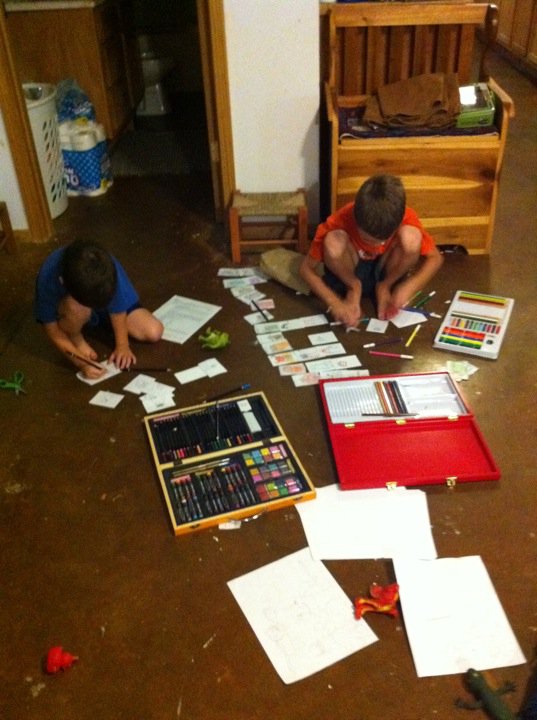
Two pictures from our lives this morning:

Artists at work!

Pensively patting

A Fresh Look at Discipline

“It is easier to build strong children than to repair broken men.”

– Frederick Douglass

I’m cleaning up my “office” area and keep coming across small scraps of things I’ve saved to read later. One was a notecard sized piece headed, “A Fresh Look at Discipline.” I’m not even sure what book it came from. I’m making it into a blog post rather than continue to hang onto the scrap, because then it is stored/saved this way, rather than my needing to keep track of many little papers (this makes sense and seems efficient, right?! I will do this with more scraps as I discover them!)

A Fresh Look at Discipline

(from Playful Parenting…maybe?)

  • Cool off
  • Make a connection
  • Choose a “Meeting on the Couch” over a “Time-out”
  • Play!
  • Instill good judgement
  • Look underneath the surface, at the child’s feelings and needs
  • Prevent instead of punish
  • Know your child
  • Set clear limits

I’m also trying to remember to use Naomi Aldort’s SALVE formula, which connects with the looking under the surface at the child’s feelings and needs. And, today, I started trying something I read about in the book Momfulness which involves a three breath hug—take three deep breaths together while hugging. My second son, Z, gets so upset and mad about things that I tried this with him this morning when he was really mad and having trouble calming down and it helped. I also try to remember (and I did get this from Playful Parenting) that children are seeking connection—sometimes not always in “positive” ways, but the ultimate goal is connection—and you can either promote and encourage that in your interactions, or shut it down. And that, reminds me of a quote Lu Hanessian uses in her talks about parenting: “Ernest Hemingway said it was the world that does break everyone, not life itself, but that most of us get stronger at the broken places.” She reminds us that when you do have a “breakdown” with your children, that what matters most is how you repair the cracks.

Breastfeeding Toward Enlightenment

I have a book called The Tao of Motherhood. It is literally the Tao Te Ching for mothers—a translation of the ancient Tao Te Ching by Lao-Tzu, but reworked slightly so that every “chapter” is about mothering and mothering well. It has 81 one to two page “chapters” just like the classic book. A quote from the end of the chapter on selflessness:

“You can sit and meditate while

your baby cries himself to sleep.

Or you can go to him and share

his tears, and find your Self.”

I’ve been thinking lately about writing an article about breastfeeding as a spiritual practice and have been using the same technique lately when nursing Alaina as described in this Mothering article by the same name: “breathing in, I am nursing my baby. Breathing out, I am at peace,” etc. (It also reminds me of my own How to Meditate with a Baby poem.)

On Monday, I was lying in bed nursing her and thinking about the intensity and totality of the breastfeeding relationship—it requires a more complete physical/body investment with someone than you will ever have with anyone else in your life, including sexual relationships. While I don’t like to lump the breastfeeding relationship in the same category with sex, because it feels like I’m saying breastfeeding is sexual, when it isn’t…though, I since lactation is definitely part of a woman’s reproductive functions, I guess maybe it is…but basically my line of thought was that if you nurse a couple of kids through toddlerhood, odds are high that you will have nursed them many more times than you will end up having sex with your husband in your entire lifetime.  (This question of function reminds me of a quote I saw today: “Breasts are a scandal because they shatter the border between motherhood and sexuality.” ~Iris Marion Young)

I calculated that so far in my life I’ve put a baby to my breast more than 12,000 times. Even if I only experienced a single moment of mindful awareness or contemplation or transcendence or sacredness during each of those occasions, that is one heck of a potent, dedicated, and holy practice 🙂

In the book Tying Rocks to Clouds, the author interviews Stephen Levine who has three children and he says:

“Talk about a fierce teaching. It is easier to sit for three years in a cave than to raise a child from the time he is born to three years old.” This was in response to a question about whether serious spiritual development is possible when having relationships with others (spouse, children, etc.) I do believe that without having children, I would be less “developed” than I am now—I’ve said before that having kids can be hard on the self (ego), but great for the soul.

“Perhaps we owe some of our most moving literature to men who didn’t understand that they wanted to be women nursing babies.”

–Louise Erdrich, The Blue Jay’s Dance

Nursing Johnny Depp

While planning posts for World Breastfeeding Week, I realized that I’ve never posted the essay for which I am most “famous” on my own blog! “Nursing Johnny Depp” originally appeared in Literary Mama in 2009 and an excerpt was used in the 2010 edition of The Womanly Art of Breastfeeding in the section about nursing toddlers.

Nursing Johnny Depp

by Molly Remer

As I put his head to my breast, I feel a distinct thrill of the forbidden.”Na-na, Jack Sparrow, Mama,” my two-year-old son said, and I put the action figure to my chest without much thought.

As I look down at that tangled mop of dark hair and braided beard, and touch the slightly sneering lips to my nipple, I suddenly feel a bit dirty. Illicit. Inappropriate. As if perhaps I shouldn’t tell my husband what I’ve been doing in my spare time. In nursing that plastic Johnny Depp, I’ve crossed a line that maybe a good girl wouldn’t cross. Or, at least, I’ve surely violated some social norm or standard of propriety.

Previously an equal opportunity nurser, from that point on I begin to place more limits on what I am willing to nurse. Yes, to the tree frog. No, to the pink rubber rat. Yes, to the hungry-looking little piglet. No, to the Shrek Pez dispenser. I’m teaching my son about limits, I think: Body boundaries, personal space, self-respect, common decency. These are good concepts to master. Or, as I reject nursing a large red monster with a mouthful of sharp-looking teeth, am I teaching him to discriminate on the basis of personal appearance? To withhold love and to be stingy with affection? Or, perhaps more simply, that grimy, but appealing men are more worthy of attention than large blue stag beetles?

Sitting on the living room floor, my little son rocks back and forth with two small toys singing, “Rock, baby. Rock, baby…” I look closer and see that Obi-Wan Kenobi is tenderly cradling Yoda in his arms.

At dinner, eating grapes, my boy picks out a large grape and a very small grape. He is delighted with the small grape, “baby grape! Baby grape!” He holds up the large one and announces, “Mama grape.” He sets them on the table and carefully pushes the small grape towards the large one until they are touching. “Dat baby grape have na-nas!” he reports with obvious satisfaction. Later, he eats them both.

Skin contact is a requirement of nursing the inanimate. I used to try to get away with putting the toys to my breast on the outside of my shirt, but that was unacceptably less-than-genuine.

“Dat frog crying, Mama!” he implores. Later, he asks, “Where my frog go?” and I realize it is still snuggly tucked inside my bra, its purple rubber face nestled comfortably against my nipple.

I’ve seen a number of snapshots of other people’s little girls and boys “nursing” their own dolls, stuffed animals, or dump trucks, but neither of my own sons have been interested in nursing their own toys.

I have suggested it and was met with utter contempt–“Mom, we’re BOYS! We don’t have na-nas.” I am well aware that I look somewhat less than adorable at the park with a plastic alligator latched on.

Playing on the floor with my dad, my son picks up one of my husband’s childhood He-Man action figures. Evilyn has bright yellow skin and a revealing metallic bikini.

“Hey!” Zander exclaims, “Dat lady got na-nas!”

He fingers them approvingly and my dad comments blandly, “Well, yes, she does.”

Several months prior, at my older son’s insistent request, I lovingly fashioned a cloth baby carrier for Evilyn to wear on her back. Her baby of choice is a tiny crocheted “button buddy” monster with googly eyes.

“Look, Mom! She can hold her baby!” The five year old announces. Evilyn’s yellow hand is tucked completely through the button hole in the middle of her baby’s chest.

I begin to consider that perhaps I am the chief toy nurser because my sons lack enough appropriately endowed female toys. Indeed, my little one is greatly distressed by trying to get one of our Playmobil women to hold her baby. Her stiff plastic arms hold the baby by the wrist at arm’s length and this simply will not do.

He holds the baby to her plastic bump of a chest (she has a “uni-breast”) crying and fretting, “Hold baby! Na-na baby!”

Eventually I solve the problem by taping the baby sideways across her chest like a bandolier, its head now appropriately positioned at breast level. (Lest it appear my son is only concerned about proper nursing access, earlier this same month I also carefully taped a tiny plastic knife into “Baby Froggie’s” beanie baby paw. “Look, Daddy! Baby. Froggie. Got. Sword!”)

So, yes, I am still nursing and not only do I nurse my toddler, I sometimes nurse a big orange robot, assorted earth-moving vehicles, Ewoks, squirrel puppets, the occasional pretzel or grape, and more. I turn down an offer of nursing Luke Skywalker (would I have turned down Han Solo, I wonder?) and also of some guy with a half-metal face. “Sorry, honey,” I say, “I don’t nurse that kind of guy.”

Molly Remer, MSW, ICCE is a certified birth educator, writer, and activist. She is a professor of human services, an LLL Leader, and editor of the Friends of Missouri Midwives newsletter. She has two living sons and an infant daughter and blogs about birth at https://talkbirth.wordpress.com

Postscript: In the Literary Mama version, the editor decided to take out my last line, which was originally this: “Next time we watch Pirates of the Caribbean and that roguish face fills the screen, I can’t help but feel as if Johnny and I share a little secret. And, hey, if my son brings me Orlando Bloom to nurse next time, I definitely won’t say no… ”

I couldn’t decide whether to leave it in this version or not and ended up deciding to take it out here too (but then not, since I’m including it in this little postscript!). As a special bonus, this version includes pictures of the actual toys! (I took these last night and amazingly, three years post-events-described-in essay, Evilyn is still wearing her baby carrier and the Playmobil baby is still taped in place!)

I just want to grind my corn!

If you know me in real life (or if you are my husband), you’ve probably heard me use the phrase, “I just want to grind my corn.” I’ve been meaning to write a blog post about this idea for quite some time and when I posted my essay about “playing my music,” I received a comment from a friend saying, “I worry I’m not accomplishing what I’m capable of doing, but I know that ditching my kids and simply pursuing my ‘own thing’ would not be fulfilling.” When I read that, I knew that the time for my corn grinding post had come. When I use the phrase, I’m envisioning some kind of ancient tribe in which the mothers are working together grinding corn, while their babies are tied to their backs, and the older children play nearby. While I do not literally want to live in primitive times (those corn grinding mothers also probably had a lifespan of 35 years!), I feel as if mothering is “meant” to be a communal activity rather than a solitary one and I feel like babies and children are meant to coexist alongside their mothers as they go about their daily work. Rather than intensive, child-focused, total-reality mothering, I think babies are happy watching their mothers work and participating in the daily rhythms of the home and world with no need for the mother to be “rolling around on the floor in the glitter in her sweatpants” (see the book Perfect Madness) while serving as a one woman entertainment committee. This age of individual mothers caring for individual children in isolation from the larger “tribe,” is a social and cultural anomaly when we look at the wide scope of human history. Likewise, meeting for playdates isn’t what I mean either—I mean more task-oriented, corn grinding work, than that.

In the book Perfect Madness, the author articulates what I mean when I say I want to grind my corn—the need for something in between staying at home and working full time (basically, that working and mothering simultaneously is the most natural and fulfilling approach, but our society does not make that combination often feasible or comfortable):

Which means that ‘natural’ motherhood today should know no conflict between providing for our children (i.e. ‘working’) and nurturing them (i.e. ‘being a mom’). Both are part of our evolutionary heritage; both are equally ‘child-centered’ imperatives. What’s ‘unnatural’ about motherhood today, if you follow Hrdy’s line of thinking, is not that mothers work but rather that their ‘striving for status’ and their ‘maternal emotions’ have been compartmentalized. By putting the two in conflict–by insisting on the incompatibility of work and motherhood–our culture does violence to mothers, splitting them, unnaturally, within themselves…For they show that the so-called ‘choices’ most of us face in America–between more-than-full-time work or 24/7 on-duty motherhood–are, quite simply, unnatural. They amount to a kind of psychological castration: excessive work severs a mother from her need to be physically present in caring for her child, and excessive ‘full-time’ motherhood of the total-reality variety severs a mother not only from her ability to financially provide for her family but also from her adult sense of agency…

This is what I’m talking about. There needs to be a third, realistic option (and not just for women. For men too. For families!). I have often expressed the desire to find a balance between mothering and “personing.” I’m seeking a seamless integration of work and family life for both Mark and myself. An integration that makes true co-parenting possible, while still meeting the potent biological need of a baby for her mother and a mother’s biological compulsion to be present with her baby. Why is the work world designed to ignore the existence of families?

So, returning to my friend’s remark, I truly feel as if there is another option between “not accomplishing” and “ditching my kids.” And, I feel like after a LOT of work and trying, I’ve found somewhat of a balance in my own life between “personing” and “mothering.” It is possible to mother well AND also do some other things that feed your soul. It doesn’t have to be an either/or arrangement. And, we don’t do our kids any favors by not pursuing some of our own passions when they can watch and observe us being vibrant, active, complex, complete human beings (not saying that it isn’t “complete” to be a SAHM, but that if you DO want to pursue some other non-kid projects, kids learn good things from watching that happen!) I used to feel like I was going to die–-metaphorically speaking…like my soul was getting squashed—if I wasn’t able to pursue some of my personal goals. I don’t feel that way anymore (and I still spend roughly 90% of every week with my kids and 99% of my waking and sleeping hours with my baby!).

At one point when my first son was a baby, I was trying to explain my “trapped” or bound feelings to my mother and she said something like, “well what would you rather be doing instead?” And, that was exactly it. I DIDN’T want to be doing something instead, I wanted to be doing something AND. I wanted to grind my corn with my baby. Before he was born I had work that I loved very much and that, to me, felt deeply important to the world. Motherhood required a radically re-defining of my sense of my self, my purpose on earth, and my reason for being. While I had been told I could bring my baby with me while continuing to teach volunteer trainings, I quickly found that it was incompatible for me—I felt like I was doing neither job well while bringing my baby with me and I had to “vote” for my baby and quit my work. While I felt like this was the right choice for my family, it felt like a tremendous personal sacrifice and I felt very restricted and “denied” in having to make it. With my first baby, I had to give up just about everything of my “old life” and it was a difficult and painful transition. When my second baby was born, it was much easier because I was already in “kid mode.” I’d already re-defined my identity to include motherhood and while I still chafed sometimes at the bonds of being bonded, they were now familiar to me.

I become fully certified as a childbirth educator in that year after my second son’s birth (provisionally certified in 2005 and he was born in 2006) and another feeling I struggled with was the sensation that I had all of this change-the-world birth energy that was being stagnated or blocked somehow. I felt like I had become a birth educator in order to change the birth world, to transform the birth culture in the US, and in my own small corner of the world I could not make the kind of impact I envisioned making. That is when I started writing and found satisfaction in reaching out to the wider world in that manner (I explored how that benefited me in the music post already).

Now, with Alaina, while I do feel overloaded or overbooked at times, in general I feel like I have found a better balance than with any of my other children. I continue to teach college classes in person (a total of 10 hours a week) and online and while it is tricky at times, so far it is working pretty well and we’re all happy (thanks in no small part to my mom who has been willing to come to class with me to take care of her in between my breaks, so that we experience only small amounts of separation once a week). As she gets bigger and more energetic (read: sleeps less), I’m definitely finding that I will probably have to let something else in my life go in order to continue to be available to her, to my boys, and to my own need for “down time” in the manner in which I wish to be without hurting myself (by staying up too late, not eating well, having stressed out “freak out” moments, etc.). Sadly, I think it is going to be my birth classes that I put on hold and possibly this blog as well (more about this later) .

Speaking of the difference between parenting and personing—I also do not view being a mother as my job. Mothering is a relationship to me and not a job that I perform. Just as it is unhealthy for me to be defined by work responsibilities, it is also unhealthy for me to be defined by relationships. I would never describe my job as being “Mark’s wife” or “Barbara’s daughter,” that gives them too much responsibility for my identity. We are in relationship to each other, but that is not a duty I perform. And, just being in relation to them is not enough for the full expression of my personhood, I need other aspects and elements to my identity. Why am I surprised that I feel the same way about parenting? I want to be with my children, but I wish to be engaged in my own pursuits at the same time. When our lives feel happiest and most harmonious is when exactly this is occurring—when we are all together, but each working on our own projects and “doing our own thing.” I envision a life of seamless integration, where there need not even be a notion of “life/work” balance, because it is all just life and living. A life in which children are welcome in workplaces and in which work can be accomplished while in childspaces. A life in which I can grind my corn with my children nearby and not feel I need apologize for doing so or explain myself to anyone.

—————————

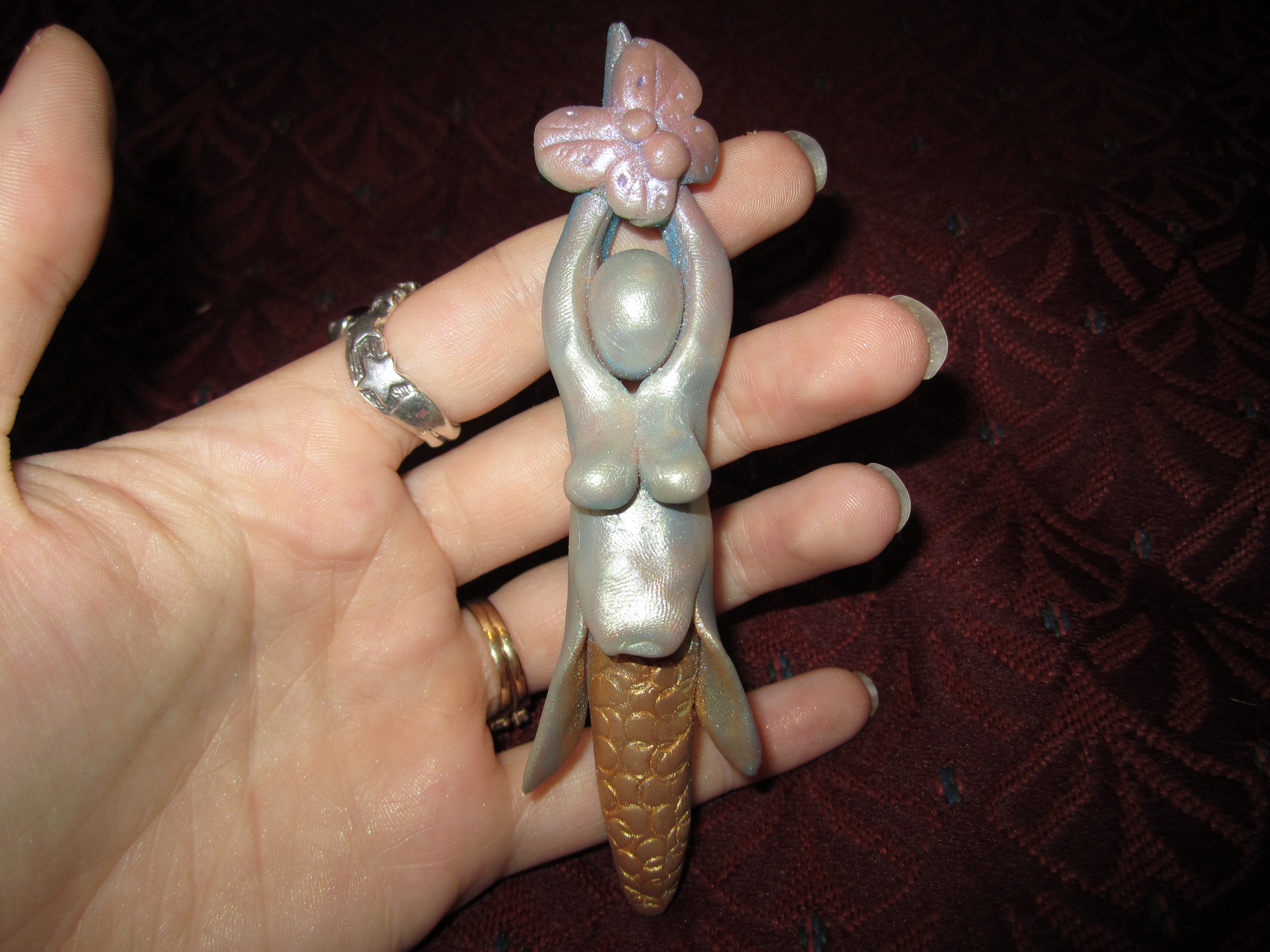
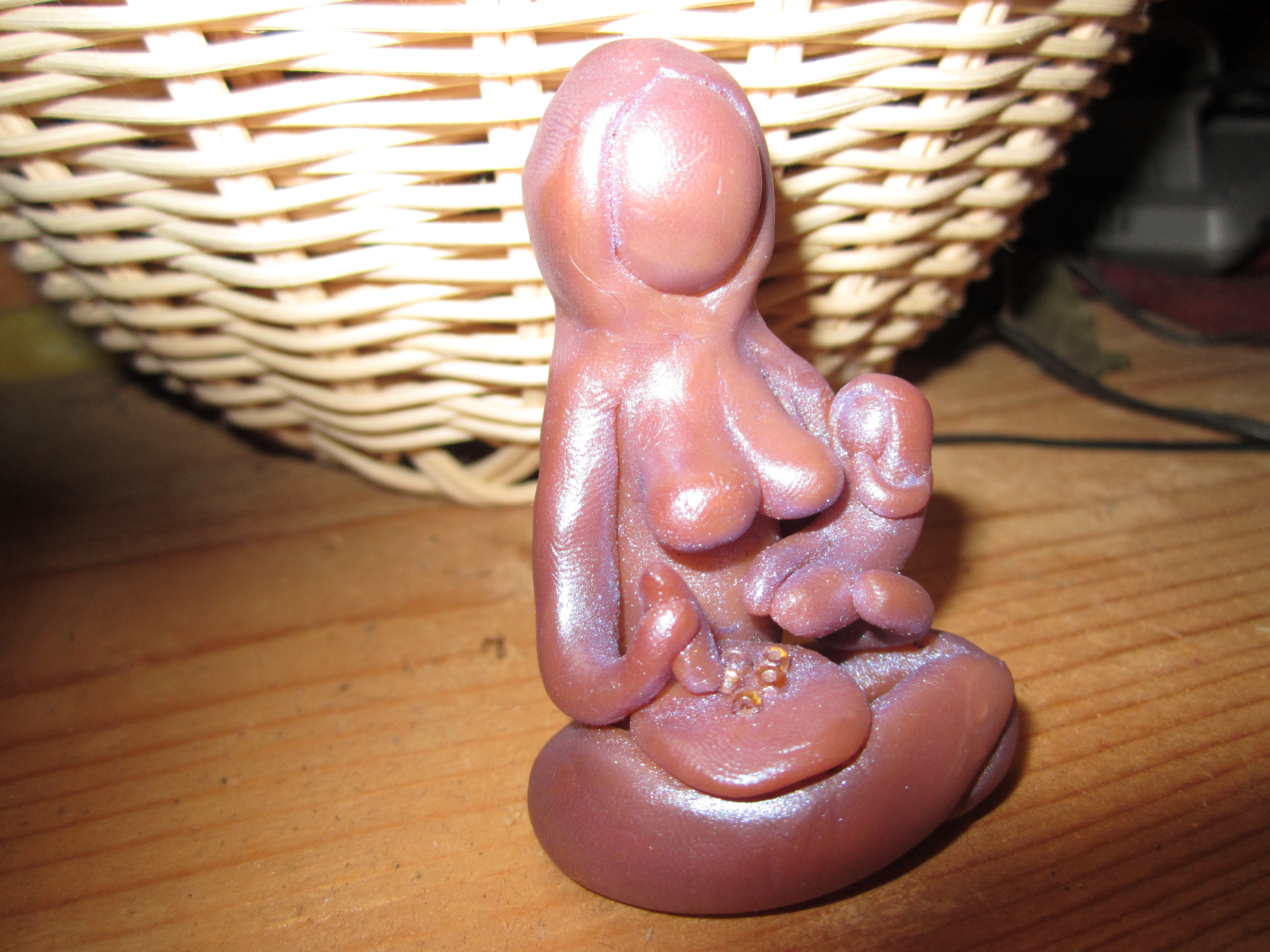
Continuing my birth art and life theme, I made two new sculptures a couple of weeks ago to express my corn grinding spirit. The first one is a corn goddess sculpture:

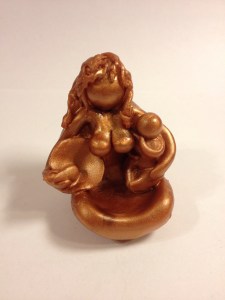
The second is a mama literally grinding her corn and holding her baby 🙂

They both make me happy when I look at them and I added them to my living room side table altar/sacred space.

Footnote: I started this post on June 17 and am now finishing it over a month later. Simultaneous corn-grinding and mothering can be very sloooooow…..;)

Footnote 2015: I’ve added a whole new baby since I first wrote this in 2011! I also created a whole new sculpture about the experience:

IMG_3732

Separation Anxiety?

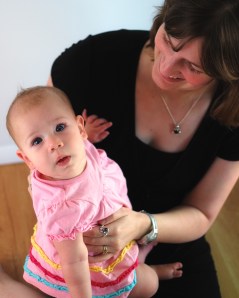
Who is that looking at me?

I’m starting to notice some signs of what is traditionally called “separation anxiety” with Alaina—she starts to call/complain if she can’t see me, turns away from other people if she doesn’t want someone else to hold her, flops around at night until her hand is touching me, that kind of thing. Anyway, it made me think of the following quote that I had saved to post about it. From an article by the same name by Naomi Aldort in the May/June 2011 issue of Natural Life:

“By nature, there is no such thing as ‘separation anxiety.’ Instead, there is a healthy need of a child to be with her mother. Only a deprivation of a need creates anxiety. If we honor the need for as long as their child needs it, no anxiety develops. The concept ‘separation anxiety’ is the invention of a society that denies a baby and child’s need for uninterrupted connection. In this vein, we can deprive a child of food and describe her reaction as ‘hunger anxiety,’ or we can let her be cold and call her cries ‘temperature anxiety.'”

I loved this. What a strange society we have that defines a baby’s normal and wholly biologically appropriate need to be with its mother, as “anxiety.” I always call a baby that wants to be with its mother a smart baby, not a baby that has “separation anxiety.” 🙂