Archives

Book Review: Lady’s Hands, Lion’s Heart ~ A Midwife’s Saga

Lady’s Hands, Lion’s Heart: A Midwife’s Saga
by Carol Leonard, 2008. ISBN: 978-0-615-19550-6.
Bad Beaver Publishing, $15.00, 363 pages, soft cover.
www.badbeaverfarm.com

Reviewed by Molly Remer, Talk Birth

This memoir by experienced New Hampshire midwife, Carol Leonard, is a wonderful read. It is funny, compelling, exciting, and sad. I think it is the best midwife’s memoir I’ve ever read!

Spanning 13 years (1975-1987), the book represents not just her personal experiences and birth stories, but also chronicles the development of independent midwifery in New Hampshire and the birth of MANA and its emergence as an international presence.

Leonard is an engaging writer with a flair for the dramatic. The style of the book is present tense, so you get a sense of actually “being there” and the book reads with the pace of a novel.

The many birth stories in the book are riveting. She has her share of close calls and complications, as well as tons of strong, inspirational births. Her love of the work and of the women she serves shines throughout and I got a strong sense of the author as a deeply passionate and committed woman.

The book opens with her own birth story in a hospital in 1975, her only child, and chronicles her development into a midwife (a fascinating sub-story in the book is of the changes her local hospital goes through to make their maternity unit more mother-friendly). Be prepared for a sad ending.

The birth stories shared each represent an event or lesson learned. Leonard is a busy midwife (you get a sense in the book that she doesn’t have much time to take care of herself!) and she attends many births in her years of service. The births detailed here are carefully chosen for impact and purpose. (Side note: as an LLL Leader, I was saddened that her one experience with LLL [in the book] is a bad one).

More than a collection of birth stories or midwifery musings, Lady’s Hands, Lion’s Heart: A Midwife’s Saga, is a personal journey, as well as a spirited account of a larger journey occurring in the midwifery profession.

Disclosure: I received a complimentary copy of this book for review purposes

Review previously published at Citizens for Midwifery

Amazon affiliate link included in book title/image.

Book Review: The Blue Cotton Gown


Book Review: The Blue Cotton Gown: A Midwife’s Memoir
By Patricia Harman
Beacon Press, 2008
Hardcover, 290 pages
ISBN: 978-0807072899

Reviewed by Molly Remer, Talk Birth

Patsy Harman is a CNM in West Virginia. She runs a busy women’s health practice with her husband Tom, an OB-GYN. Though obstetrics was once a rewarding part of their practice, they’ve stopped attending births due to unaffordable malpractice insurance rates. In addition to tales from the office, this compelling narrative follows Patsy through struggles with the IRS, fears over potential lawsuits, family complications, and uterine cancer. Since I usually come from a consumer advocate’s perspective, it was very interesting to have this intensely personal look at the other side of the coin—the deep fear obstetric professionals have of lawsuit.

The author told me in advance that this is not a book of birth stories, “it is about women giving birth to themselves.” This is true—there are almost no birth stories in the book (and in one of the few there is, I was surprised to read that the mother was induced with misoprostol!). However, this is actually what gives the book its absorbing edge. In it, you get to see another side of midwifery—the “with woman” side that extends before and after pregnancy and childbirth. This is a side of midwifery that I haven’t yet seen explored in memoir format and it was incredibly engaging. Patsy’s clientele are women who have STDs or yeast infections, who need pap smears or well-woman exams, or who need a pregnancy diagnosed, but her care for them goes beyond the physical. The women’s lives are complicated, as is her own. Some of the stories are very sad and others are uplifting. If you are looking for birth stories, look elsewhere, if you are looking for a skillfully written and emotional look at the practice of nurse-midwifery and its dominating role in a woman’s multifaceted life, you will find a treasure in The Blue Cotton Gown. As it came to an end, I found myself wishing for Part Two.

Read my review of Patsy’s other memoir here:

Book Review: Arms Wide Open: A Midwife’s Journey

Disclosures:

I received a complimentary copy of this book for review purposes.

Amazon affiliate link included above (in title and image)

This review was previously published at Citizens for Midwifery.

Sharing Stories

Mother-to-mother birthtelling is easy at blessingways!

In an excellent article by Rachel Reed in the Autumn 2011 issue of Midwifery Today, Sharing Stories, Reclaiming Birth Knowledge, she makes this important point: “Women not only learn practical information about pregnancy, birth, and motherhood through exchanging stories, but also gain emotional and social support…Through sharing stories, women created a sense of connection to other mothers and to the ‘universal nature of birthing’ …”

Despite the everyday miracle of birth and potent role in women’s lives and self-identity, “women’s birth stories are largely ignored in mainstream childbirth education programs. Instead, the approach consists of an ‘expert’ transmitting standardized information sanctioned by the maternity system. This approach does not adequately meet the needs of mothers, nor reinforce mothers’ expertise and knowledge. Building childbirth education around mother-to-mother story sharing would reinforce mothers as the experts in birth.”

What do you know about birth that other people don’t know?

As I read this article, I thought of several experiences in my own childbearing experiences that varied from “standardized information sanctioned by the maternity system” and that includes the alternative care system of which I was a part. Things that, for me, were not available from those systems around me—books, professionals, or media, but that nevertheless came through and are part of my own stories:

  • Being able to feel my babies practice breathing in the last 8-10 weeks of my pregnancies.
  • “Skipping” transition–no “freaking out” required to have a baby after all.
  • Tearing “up” into the labia/clitoral area instead of the more common or expected perineal tearing
  • Experiencing a spontaneous birth reflex
  • No bloody show/mucus/fluid until shortly before pushing
  • Long “strings” of post-birth mucus. So tough and sinuous that they are almost like membrane.
  • Experiencing a second trimester miscarriage clearly and potently as a birth event.

I’m curious to know what other women have experienced like this. What happened to you that you had never heard about before? What is a part of your story that isn’t a part of birth books? What do you know about birth that other people don’t know? How does your story enhance the collective culture of women?

The role of story in midwifery education

Reed goes on to explore the role of story in midwifery care and the education of midwives, explaining, “It is time for midwives, informed by being ‘with woman’ and experiencing birth in all its complexities, to reclaim their own unique birth knowledge. Sharing birth stories represents a rich source of knowledge and develops the ‘collective culture of women.’ Mothers are already doing this well, and childbirth education should reinforce this mother-to-mother expertise. Midwifery education also needs to embrace the power of storytelling as a means of developing woman-centered knowledge and practice.”

One of the most valuable elements of La Leche League for breastfeeding mothers is the mother-to-mother support and information sharing. This is irreplaceable. We need a means of providing this type of mother-to-mother support for birth as well. Not in swapping horror stories or “enlightening” others, but in authentic connection based on our own unique birth wisdom.

Birthtellers

In another article in the same issue of Midwifery Today KaRa Ananda shares the following gem in her article about Birthtellers: “…the stories women tell to each other privately–shape cultures, beliefs, choices and lives. Women used to learn about birth and motherhood through the stories of their mothers, sisters, grandmothers, midwives and friends. Today, that knowledge is transmitted primary through television, movies, peers and the internet. Now is the time for the Birthtellers to arise and once again share our inspirational birth stories–both within our communities and globally through new media technology.”

One of the midwife-authors that makes my heart sing with her lyrical, magical writing, is Sister MorningStar (author of Power of Women). She shared her daughter’s birth story in the autumn 2011 edition of Midwifery Today and it is just beautiful.

My own article on the value of sharing story also appeared in the same issue of Midwifery Today.

I am a Midwife Campaign

MANA has a great educational campaign going on right now called I am a Midwife. The campaign involves a series of short videos released once a week about a variety of topics. More than just a general education campaign, each video includes a variety of different women–midwives, mothers, public health activists, maternity care activists, authors—speaking out on important topics in maternity care. Each woman also identifies, “I am a Midwife.” This week’s video is about health disparities in maternity care, which is a very important and too-often ignored topic. It raises the concern that African American women and their babies are more likely to die than their Caucasian counterparts even when other variables are equalized (i.e. same socioeconomic status, same education, etc.) and moves into wider discussions about racism and the treatment of minority group members. It then focuses on the value and role of midwifery care in addressing these concerns.

As MANA states in relationship to this campaign: “For midwives, sharing is daring. We dare to challenge the status quo. We dare to speak up for women’s innate wisdom in pregnancy and birth. We dare to assert that there is a better way for our babies to be born. And we dare to insist that birth belongs to families.

Absolutely! The I am a Midwife public education campaign is extremely powerful. I have to confess that when it originally launched, I didn’t personally make time to watch the videos right away, somehow assuming that they were “generic” videos with a “rah, midwives!” type of message. Don’t make the same mistake I did. These are quality videos with important messages, powerful voices, and essential education and information. You will definitely learn something from watching them!

The videos aren’t only of use to birth professionals, when I teach community organizing at the college level I show videos like this as examples of activism strategies. In fact, for the final exam in that course I show the Crisis in the Crib video about infant mortality and disparities from the Office of Minority Health’s A Healthy Baby Begins With You campaign. This MANA video could be an interesting follow-up addition to the video I already use. As a related side note, during this class I also show footage from The Doula Story, a project by the Georgia Campaign for Adolescent Teen Pregnancy Prevention (whose program director I heard speak at the CAPPA conference in NC in 2010—she was amazing!). So, people do not leave my class without having heard of doulas and midwives and their relationship to community health. Go me and my mad birth activist skills! ;-D

Is there really even such a thing as second stage?

Is there a second stage in labor? Who says so? Who thought it up and why? How did they decide what it would be and when it would start? How it would be measured? When it would end? Is there really even such a thing as second stage? If there isn’t, might it not be important for midwives to know that? Is the Earth really flat? Well, it is in some places. Mothers that lie, sit, walk, stand, crawl, glide, stride, squat, climb stairs or hills, dance, sway, cry, throw up, chant or create positions and sounds never heard or seen before are moving their baby from the inside of them to the outside of them. That’s labor. It doesn’t have stages. One thing melts and overlaps another. It starts slowly and gets bigger. It changes a mother’s breathing from light to deep. Her sounds change as her body and baby mould and mimic each other on the journey from inside to outside. By the time the baby is low so is the mother, her breathing and her sounds and her body. –Sister MorningStar in “Midwifing Second Stage” in Midwifery Today, 98, Summer 2011

After having written recently about the rest and be thankful stage and the spontaneous birth reflex and then finally about the
birth pause, the above quote caught my eye in an issue of Midwifery Today from last year (I’m trying to catch up with my stack of magazines/journals). I explain to my birth class clients that birth looks different from the outside than it feels on the inside. Perhaps from the outside we can identify stages and phases of labor. From the inside, we are just doing it and the stages and phases meld into one continuous experiencing.

I love the final comment in this quote especially–we don’t really need tips, tricks, and vaginal checks to tell us where baby is positioned. When mother gets “low” baby likely is too! This reminds me of another article I read in MT recently. (I didn’t save the actual quote, just going from memory.) It was about a traditional midwife who was asked, “aren’t you going to check her?” when a mother felt like pushing. The midwife put the tip of a finger in and the other people laughed at her—“that isn’t checking her!” She said that all you needed to do was feel for the baby’s head—it the finger only goes in a tip, that means baby is close, if it goes in up to the knuckle, baby is pretty close, if you can’t reach the head, baby will be a while. Why would you need to try to reach the cervix or know what it is doing?

I love Sister MorningStar’s writing. It is so beautiful and expressive. Some time ago, I reviewed her book The Power of Women and I highly recommend it.

The Midwife’s Role

From midwife Elizabeth Davis’ non-midwifery-oriented book, The 20120404-223722.jpgWomen’s Wheel of Life she explores the archetype of the Midwife and shares this story:

I recently prepared a panel presentation on the topic of “Keeping Birth Normal” for a midwifery convention, and it dawned on me how insidiously the quest for standardization has permeated this sacred blood rite. Gearing midwifery practice to a reductionist, generic view of birth is but a travesty of our time-honored proficiencies, our ancient arts. There is no “normal” birth–each is individual and nonconforming. Childbirth opens an extraordinary spectrum of physical, emotional, and spiritual growth opportunities that is  nothing less than extraordinary, which women should be supported in freely exploring. The Midwife must guard parameters of safety, yes, but she should also encourage women to play their edges, experience deep currents of emotion, discover their own ways of transformation, and chart new creative territory. This is “taming” based not on repression or control but on integration, being in synch and in surrender to one’s true self. Midwives must find ways to make the unseen visible and comprehensible, they must learn to recognize and validate gut instincts, heart feelings, or any other messages coming from the body, and they must translate these perceptions into tangible action and/or words.

I recently reviewed the book More Than a Midwife and the author, Mary Sommers, has a beautiful way of describing the role of a midwife:

Midwifery is about guiding women through the internal and external journeys of their everyday lives. The birth of our children may be without regard to a fixed date and time; the experience of birth is the expression of eternity. Women in labor have the ability to transcend time and space, to regain a deep appreciation of the nature of their internal selves…She…is immersed in a journey of recognizing a part of her that had remained a mystery until this moment…

We long to have our internal and external dimensions integrated. In birth, this naturally unfolds. You do not need to be a spiritual scholar or have a daily practice to gain spiritual growth. A woman only needs to go into the experience and the spiritual journey unfolds. Nevertheless, I have also found that women who live in harmony with nature in their daily existence can access the journey more readily.

Midwifery asks us to truly become at home with ourselves, with nature, and with women. Birth takes us out of our external experiences, our linear timing of progress, and our everyday rituals. In contrast, birth time is measured in a circular movement like the seasons. There are rhythms and patterns. If we let birth unfold with spontaneity and attuned to nature, we will end up appreciating the nature of our souls as well. For women in birth, there exists a duality of time and space. They are present in both the physical and the internal dimensions. Midwives are called to not only be medical providers, but emotional guides, allowing women to get in touch with their innermost selves, the place where the soul dwells.

Both of these passages are beautiful explorations of the multifaceted and relational role of a midwife. I keep thinking I’ll have more time to explore these quotes in a more fully developed post, but I just don’t have room to do it today after all. The piece I particularly like from Davis was about there being no normal birth. I feel the same about the birth profession’s obsession with, “evidence-based care.” I’ve often asked myself, is evidence-based care enough? Do we really need to quantify everything? I think it should be a given that women receive evidence-based care. It is a travesty that it is often, apparently, too much to expect or hope for. I think women deserve loving care, respectful care, humane care, personalized care, beautiful, life-celebrating care. I think evidence-based care sets the standard too low…at obvious rather than profound.

In the second passage, my eye was caught by the phrase, “I have also found that women who live in harmony with nature in their daily existence can access the journey more readily.” Is this true in your experience? I have conflicted feelings about it. Do I live in harmony with my daily existence? My birth experiences certainly reflected a “harmony” with body, instinct, mind, and surrender. But, in daily life, while I certainly live close to nature and view it as sacred and while I choose many practices of “natural parenting” my head is often in conflict with what really is. I often find myself arguing with reality and in a mental state that feels more scattered than harmonious–and, angry with myself for not being more skilled at “surrender.” Luckily, that part neatly shuts off during labor, freeing my body to do the work of birthing with relatively little interference or struggle.

Book Review: Into These Hands

Into These Hands: Wisdom from Midwives
Geradine Simkins
Paperback, 300 pages
Published by Spirituality & Health Publisher, 2011
ISBN: 9780981870854
Wisdom from Midwives

Reviewed by Molly Remer, Talk Birth

Into These Hands is an amazing anthology of midwives’ retrospectives about their careers and midwifery journey. You won’t find birth stories here–this is book about women’s lives and journeys to midwifery. A book of midwife stories–how women are birthed as midwives, rather than about births they attended–Into These Hands is great reading for aspiring midwives or for currently practicing midwives who wish to feel a sense of solidarity with their sisters. There are many paths, many lessons, many voices and each midwife clearly loves women and has a passion for birth.

From the press release:

We are eager for you to meet some modern-day wise women, healers, revolutionaries, and reformers. Into These Hands, Wisdom from Midwives© is a comprehensive anthology of the life stories of 25 remarkable women who have dedicated their lives and careers to the path of social change through midwifery. These exemplary midwives are all over 50 years of age with 25-40 years in the field. Collectively, they have over 800 years of experience and have assisted in over 35,000 births.

The midwives whose voices are included in the anthology come from diverse backgrounds, training, experiences, and range of practice settings. Quite a few of the stories are from “bridge club” members–women who began as direct entry midwives and later became CNMs. These midwives have a foot in both worlds and insight into the politics of the profession. In general, Into These Hands is a good look at the politics of midwifery both past and present. Almost all of the midwives in the book have homebirth roots or orientation.

Since there are lots of voices represented, the tone or style of some stories is more compelling than others. Some within-story chronology jumps were a little confusing and there were a couple of stories in which I had to do some re-reading for clarity.

Into These Hands is likely to be of particular interest to midwifery activists, aspiring midwives, or current/retired midwives and may hold less appeal for general birth enthusiasts, doulas, or childbirth educators. The stories are rich, insightful, thought-provoking, and diverse and they brought tears to my eyes several times. This book is a treasury of women’s wisdom and a powerful legacy for the generations of women to follow.

20120402-120957.jpg

An indicator of how much I like a book is how many page corners I turn down in order to come back to re-read those sections and write blog posts based on them/share quotes/etc. This is Into These Hands last night as I was finishing it...;-D

Disclosure: I was provided with a complimentary copy of the book for review purposes.

Book Review: More Than a Midwife

More Than a Midwife: Stories of Grace, Glory, and Motherhood [Paperback]
by Mary Sommers
MavenMark Books (HenschelHAUS Publishing) (October 1, 2011), 148 pages
ISBN-13:978-1595981066

Reviewed by Molly Remer, Talk Birth

More Than a Midwife is a thoroughly delightful little volume by experienced and resourceful midwife, Mary Sommers. One of the things that makes the book particularly distinctive is the impressive diversity of Mary’s work experience. The book includes stories from her work as a midwife in urban Chicago as well as in Africa and Mexico. As always, glimpsing the dire situations facing birthing women cross-culturally is a sobering reminder of the immense challenges international midwives face with few physical resources—they accomplish an amazing level of care with only their heads, hands, and hearts.

Each story shared in the book is selected with care and has an important message to share. The stories are about unique women and their unique births and what Mary (and the reader) can learn from them. From empowering and exhilarating, to difficult and heartbreaking, particularly notable are the stories that remind us all to treat every woman with dignity and respect, regardless of her life’s circumstances or choices. Mary is clearly a midwife who loves women and birth and practices with sensitivity, respect, and positive regard.

More Than a Midwife is a slim paperback. It is nice size to hold easily and the stories are short and easy to read in small chunks of free time. It is occasionally erratic in the organization/flow of a story and in a few of them I had to re-read segments to understand chronology. However, this  was a negligible issue in the context of this thoroughly enjoyable small book.

Mary Sommers has written a true gem of a book. I feel honored to have read More Than a Midwife and I highly recommend it to anyone interested in birth, homebirth, midwifery, or women’s health. Most excellent!

Disclosure: I was provided with a complimentary copy of the book for review purposes.

A Tale of Two Births

As Penny Simkin has frequently noted: “We can’t control labor, whether it’s hard; that’s a leap of faith. But we can always control how we care for [the mother]” [1]

In 2001 and in 2004, I attended the births of two of my dear friend’s children in the same hospital in a mid-sized Midwestern city.  I was not a childbirth educator or doula at this time, but was there in the capacity of friend and “witness.” Both births were intervention-heavy and not what I would call ideal, natural births; but the feelings were vastly different, which made all the difference.
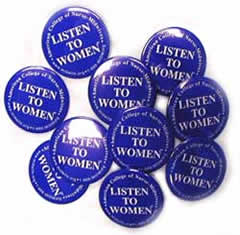
At the 2007 LLL International conference in Chicago, I picked up several of these great "Listen to Women" buttons from the ACNM booth in the exhibit area. I love them. Isn't this what it is all about? So simple and yet so profound. Imagine how the world would change if we just listened to women.

One had an atmosphere of respect, caring and trust; the other had a “climate of doubt” throughout. The difference was a certified nurse-midwife (CNM). My commitment to homebirth midwifery often leads me to forget what a profound and true difference a caring CNM can make in a hospital birth. All the other hospital procedures can be present, but the care factor a CNM provides can transform a woman’s experience from powerless to powerful. Sometimes I forget how CNMs are poised to bridge the gap between home and hospital effectively. The US needs lots of them (not as subordinate “junior obstetricians”—but as expert guardians of normal birth in a hospital setting).

The details were similar in each birth. The babies were both almost 9 lb; a doula was present (same doula in both births); and the mother labored with an IV, spent a large portion of the labor in bed and had internal fetal monitoring. In the first birth (with the CNM), the mother even had several hours of Pitocin augmentation; in the second, with the obstetrician, she had no Pitocin until third stage. With each birth, the mother also had an extensive tear and long repair (a third-degree with the CNM, a second-degree with the obstetrician).

However, some things were very different.

When the mother said, “Can I have a birth ball?” the CNM said, “Yes,” and the obstetrician said, “Not until the baby has been monitored.” And then, “The baby doesn’t like that; you need to get back into bed.”

When the mother’s confidence waned, the CNM said, “You can do it. You are.” The obstetrician said, “I don’t think this baby is moving down.

When the mother said, “This is taking such a long time,” the CNM said, “I know. It is taking for-freaking-ever!” and everyone laughed (including the laboring mother). The obstetrician said, “I think we should consider a c-section based on your history. The baby is not moving down.”

The CNM said, “You have such strong muscles in your legs and bottom, do you exercise a lot? I think because you are so strong, you’re holding a lot of tension here. Try to let it go.” The obstetrician ironed the perineum until the mother screamed with pain.

The CNM waited. The obstetrician did another internal check.

In both, a baby was eventually born (the first after four hours of pushing, the second after a little over an hour). A strong, healthy baby. Vaginally and without pain medications. After the first birth—though she would have done some things differently—my friend felt triumphant, empowered, powerful, strong, capable, happy and proud.

After the second birth she felt abused, disappointed, ashamed, guilty, angry, assaulted, diminished, wounded and scarred.

I believe the CNM’s personality, attitude and basic belief that vaginal birth would work was the critical difference between these two experiences. These births dramatically, viscerally illustrated for me that no matter what else is happening around the birthing woman, we can control how we care for her.

Endnote: My friend went on to have her third baby at home in 2008. She pushed this baby out in fifteen minutes, with no tear, and she shone with her power.

Molly Remer, MSW, ICCE, CCCE is a certified birth educator, writer, and activist who lives with her husband and children in central Missouri. She is the editor of the Friends of Missouri Midwives newsletter, a breastfeeding counselor, a professor of human services, and a doctoral student in women’s spirituality. She blogs about birth, motherhood, and women’s issues at https://talkbirth.me/posts.


[1] Looking to nature, doula Penny Simkin practices the art of delivery, in The Seattle Times, Pacific Northwest Cover Story. Originally published March 23, 2008. Accessed April 27, 2009. http://seattletimes.nwsource.com/html/pacificnw/2004299467_pacificpenny23.html.

This is a preprint of A Tale of Two Births, an article by Molly Remer, MSW, ICCE, published in Midwifery Today, Issue 91, Autumn 2009. Copyright © 2009 Midwifery Today. Midwifery Today’s website is located at: http://www.midwiferytoday.com/

Midwifery & Feminism

“Midwifery work is feminist work. That is to say, midwives recognize that women’s health care has been subordinated to men’s care by a historically male, physician-dominated medical industry. Midwifery values woman-centered care and puts mothers’ needs first. Though not all midwives embrace the word feminism (the term admittedly carries some baggage), I maintain that providing midwifery care is an expression of feminism’s core values (that women are people who have intrinsic rights).
–Jon Lasser, in Diversity & Social Justice in Maternity Care as an Ethical Concern, Midwifery Today, issue 100, Winter 2011/2012

I tend to define feminism as believing in the inherent worth and value of women and acting on that belief. I see birth care as a crucial, basic feminist issue and midwifery and most types of birth activism as feminist work. While, as Lasser notes above, not all midwives embrace the term, in my personal experience some of the most beautiful, loving words and actions about the value and worth of women are exhibited by midwives.