Archives

Postpartum Reading List

20130903-200533.jpgSuggested Reading—Postpartum

After the Baby’s Birth, by Robin Lim. This book is very holistic in approach and is one of my very favorite postpartum reads. It offers such gems as, “you’re postpartum for the rest of your life” (which some people have said they feel like is depressing, but I find a tremendously empowering statement!) and “when the tears flow, so does the milk” (with regard to the third day postpartum). It does have a large section on Ayurvedic cooking, which, personally, I don’t connect with, so be aware that that section is in there and depending on your belief system, might make perfect sense to you, or might seem inapplicable like it feels to me.

Mother Nurture: A Mother’s Guide to Health in Body, Mind, & Intimate Relationships, by Rick & Jan Hanson. This book is phenomenal. Very comprehensive. It addresses mothers of children from birth to age 5, so even if you are several years past the early postpartum weeks, this book has much to offer to you! One of the focus areas is on “Depleted Mother Syndrome” and addresses coping with it via all areas (body, mind, social/relational).

The Womanly Art of Breastfeeding, by Diane Weissinger and Diana West for La Leche League International. This classic book from the original mother-to-mother support organization has been published for more than fifty years. This nurturing, conversational book will help you with all of your breastfeeding questions from birth and onward, whether your breastfeeding goal is three days, three weeks, three months, or three years. Reading this book is like having access to an experienced, friendly network of breastfeeding mothers who know all the practical, as well as emotional, ins and outs of mothering through breastfeeding. (And, to get this kind of support in person, check out an LLL group near you!)

The Year After Childbirth, by Sheila Kitzinger. Another book covering the physical, social, and emotional changes after birth. This book is more “basic” and less in-depth than the two above.

The Post-Pregnancy Handbook, by Sylvia Brown. This book is the most “mainstream” of my suggested titles.

Mothering the New Mother, by Sally Placksin. This book is excellent for people supporting new mothers, as well as for mothers themselves. It is very validating and affirming of women’s feelings and needs after birth. This is the book in which I learned the term “matrescence”= becoming a mother.

What Mothers Do: Especially When it Looks Like its Nothing, by Naomi Stadlen. I love this book! It takes a close look at how women mother and how skillfully they do so (so that on the outside it looks like they are doing “nothing”). This is not a “how to” book, but a book that tries to look below the surface and explore concepts that are very difficult to verbalize/articulate. She strives to put into words/give us language to describe what is it that mothers do all day–their often invisible contributions to life. Contributions that are often invisible even to ourselves. This is a very affirming and unique book.

Postpartum Memoirs:

Misconceptions: Truth, Lies, and the Unexpected on the Journey to Motherhood, by Naomi Wolf. This was the first book that I ever read about a woman’s postpartum experience. It was suggested to me by the doctor at the birth center when I expressed some teary frustrations about adjusting to my new life and wondering if I would ever get “back to normal.” This book is on the “angry” side–it is not a nurturing and tender read in the way my earlier suggestions are. I did not identify with the author’s birth experiences or feelings about birth (I felt tremendous during birth and powerful, empowered, triumphant, and confident), but her postpartum feelings closely match my own (weak, wounded, invisible, etc.)

Operating Instructions, by Anne Lamott. This is a classic. A memoir of the author’s first year with her son. She is a single parent and so the book addresses some of the challenges involved with parenting solo. This book is incredibly funny at times.

Let the Baby Drive: Navigating the Road of New Motherhood, by Lu Hanessian. Another wonderful read! I first read this when my own children were out of babyhood and still found it tremendously relevant and enjoyable.

Callie’s Tally: An Accounting of Baby’s First Year, [or, What My Daughter Owes Me], by Betsy Howie. Very funny, though not particularly “AP” (so if you’re looking for that, read Let the Baby Drive instead). This book chronicles how much money the author has spent on her daughter during her first year of life.

You might also like to check out my list of Non-Advice Books for Mothers | Talk Birth.
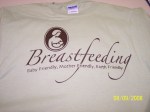
World Breastfeeding Week T-Shirts

We have a number of t-shirts left from our World Breastfeeding Week event in Rolla on August 9. The shirts are a light sage green with dark brown printing. The printing says Breastfeeding: Baby Friendly, Mother Friendly, Earth Friendly. The back of the shirt has the logos of our three generous t-shirt sponsors: Town & Country Bank, Il Bacio Day Spa, and St. James Veterinary Clinic. The shirts are $10 each with a range in sizes of small all the way to 2XL. If you would like to buy one, please email me. ($3 shipping if you live outside of the area.) 

Do Epidurals Impact Breastfeeding?

There was a question recently on a list I belong to about the impact of epidurals on breastfeeding. The person asking the question had been told by several hospital based childbirth educators that epidurals do not “cross the placenta’ and thus do not have an impact on the baby. Since this is an issue of concern, I thought I’d share some of my response/thoughts regarding this question here. I was happy to hear Linda J. Smith speak at the LLLI conference luncheon session about this very issue–the impact of birth practices on breastfeeding–and she covered a ton of material about the impact of epidurals on breastfeeding (she also wrote a book on the same topic with the late Mary Kroeger). There is some good information, though much less complete, on her site. The biggest problems with epidurals are the impact on the mother rather than the baby, though the medications used in epidurals DO cross the placenta and get to the baby, they are much less seriously impactful than IV or IM narcotics. An epidural refers to the means of medication delivery not what is actually being delivered into the body, so it is hard to say definitively that one has no effect, because different anesthesiologists use different “cocktails” of drugs in their epidurals. They usually use bupivacaine as the anesthetic, but there are opoids included as well, such as *morphine* or other related opoids like that.

All the books I have as a CBE say that medications used in epidurals do make it to the baby, but effects vary. Most effects are connected to what is happening to mom—i.e. mother gets a fever as a side effect of the meds and that stresses baby. Fluid overloading leads to more fluid in baby’s lungs, etc. The main breastfeeding impact on the mother’s side is excess fluid retention in the breasts due to the fluid “bolus” administered prior to an epidural. Baby is a little sleepy following birth and then can’t latch to severely swollen breasts (which are not “normally” engorged, but excessively so due to excess fluid), and so it goes. You often hear from mothers that their nipples are “too flat” for the baby to latch on to and as you probe further you find that the flatness has NOTHING to do with the mother’s true anatomy, but has to do with that excess fluid. Women are so programmed to look inward and blame themselves for problems that it is really unfortunate (like mothers who “aren’t making enough milk” when it is really a pump with bad suction).

Basically most breastfeeding problems that have to do with birth practices are not correctly attributed to the source—the birth practices—and are instead blamed on the mother (“flat nipples”), the baby (“lazy suck”), or breastfeeding (“sometimes it just doesn’t work out”).


“Balanced” Information?

Occasionally I read that someone is planning to take a hospital sponsored birth class because they feel they will get more “balanced” information. This usually seems to be said with regard to medications “versus” natural birth. There is an excellent discussion about this issue in the book Mother’s Intention: How Belief Shapes Birth.

“Let us look at [the word] ‘balanced’ first…’to make two parts exactly equal.’ What if the two parts are not equal? What if a parent will be making decisions that will affect her and her baby with both short and long term consequences? Is it fair to distort reality so that the information she has to choose from seems ‘equal,’ even though it really isn’t? Why would a parent want information that appears balanced, but isn’t factual?”

From my perspective, independent classes are better able to provide you with truly helpful, accurate, and factual information (even though they might not feel “balanced” towards all interventions/options), because the educator is working for you and not for an institution.

Birth Experience or Healthy Baby?

As you may have read in many blogs in the birth world, ACOG issued a press release this month opposing the choice of homebirth for women. One of the quotes towards the end of the release, “Choosing to deliver a baby at home, however, is to place the process of giving birth over the goal of having a healthy baby,” is a sentiment that I see expressed fairly frequently and I’d like to explore it a little. I do not think these two things are mutually exclusive by any means. I say, why not BOTH? A “good experience”/process of giving birth AND healthy baby–these two things can, should, and do go together. Many of the elements that make up a good experience are also things that are best for the baby–as I said, the two concepts are not mutually exclusive, instead they reinforce and contribute to each other! Most of the time, taking good care of a mother in birth (i.e. contributing to her “good birth experience”) is the very best thing you can do to take care of her baby. Babies do not need to be “rescued” from their mother’s bodies–healthy mothers help lead to healthy babies! Women and babies BOTH deserve a good birth experience.


I also question whether ANY mother actually considers this a choice, or makes this choice. Erica Lyon, quoted in the book Pushed, speaks eloquently on this topic:

“…The goal is to have a healthy baby. ‘This phrase is used over and over and over to shut down women’s requests,’ she [Erica Lyon] says. ‘The context needs to be that the goal is a healthy mom. Because mothers never make decisions without thinking about that healthy baby. And to suggest otherwise is insulting and degrading and disrespectful’…What’s best for women is best for babies. and what’s best for women and babies is minimally invasive births that are physically, emotionally, and socially supported. This is not the kind of experience that most women have. In the age of evidence based medicine, women need to know that standard American maternity care is not primarily driven by their health and well-being or by the health and well-being of their babies. Care is constrained and determined by liability and financial considerations, by a provider’s licensing regulations and malpractice insurer. The evidence often has nothing to do with it.” (emphasis mine)