Archives

Milk, Money, & Madness

In early August, I received a press email from Evenflo about their “in-law feeding frenzy” video. While I recognized they were attempting to be playful and funny, I chose not to share the video with my readers because I found several elements of it problematic. Rather than recognize the opportunity to create an internet stir over the video, I just wrote back to the company and told them, “I try not to encourage the notion of other people having a chance to feed the baby, so I do not plan to use the video myself—I would have been more pleased with it if somehow mom stood her ground and helped in-laws see that there are other ways to be involved with the baby other than by feeding it expressed milk. I don’t promote the idea that mothers need to pump, ‘just because.’” Considering what a controversy has now boiled up this week over Evenflo’s “funny” breastfeeding video, I confess I sort of feel like I missed my opportunity for a major wave of blog traffic by exposing the ad and expositing on the problems therein when I received it in August! 😉  However, when considering the controversy, I thought of some wonderful quotes I’d saved to share from the book Milk, Money, & Madness and so I’m sharing them instead.

Dia Michels is one of the co-authors of Milk, Money, and Madness and I’ve actually heard her speak twice—once in 2003 when I was pregnant with L and then in 2007 at the LLL of MO conference. I’m surprised at how thoroughly riveting a book about the “culture and politics of breastfeeding” can be and I highly recommend it to breastfeeding and women’s health activists.

In perfect response to the Evenflo video, we have this quote:

“Babies need holding, stroking, dressing, bathing, comforting, burping, and, within a short time, feeding solids. Dad can do every one of these. The desire to participate should not be confused with the need to give the baby the best of what each partner has to offer.”

I hear from people SO often that they want Daddy to be able to participate in baby care by giving the baby a bottle. There are LOTS of things that fathers can do for their babies, other than feeding—bathing, snuggling skin-to-skin, diaper changes, playing, babywearing, and just plain walking around holding the baby while mom takes care of her own needs.

And, here is an excellent quote with regard to public breastfeeding/breasts as sexual objects:

“When the attitude is taken that a woman’s breasts belong to her and no job is more important than caring for one’s young, the confusion between breastfeeding and obscenity goes away.”

And, then considering the argument that bottle feeding “liberates” women from the tyranny/restrictiveness of breastfeeding:

The liberation women need is to breastfeed free of social, medical, and employer constraints. Instead, they have been presented with the notion that liberation comes with being able to abandon breastfeeding without guilt. This ‘liberation,’ though, is an illusion representing a distorted view of what breastfeeding is, what breastfeeding does, and what both mothers and babies need after birth. [emphasis mine]

I’ve noted before that I am a systems thinker and I think this way about breastfeeding as well as many other experiences—breastfeeding occurs in a context, a context that involves a variety of “circles of support” or lack thereof. Women don’t “fail” at breastfeeding because of personal flaws, society fails breastfeeding women and their babies every day through things like minimal maternity leave, no pumping rooms in workplaces, formula advertising and “gifts” in hospitals, formula company sponsorship of research and materials for doctors, the sexualization of breasts and objectification of women’s bodies, and so on and so forth. According to the book, “…infant formula sales comprise up to 50% of the total profits of Abbott Labs, an enormous pharmaceutical concern.” And the U.S. government is the largest buyer of formula, providing it for something like 37% of babies. (I should have written that quote down too!)

I have a special interest in how women are treated postpartum and Milk, Money, and Madness has some gems to share about postpartum care as well:

An entirely different situation exists in societies where technology is emphasized. The birth process is seen from a clinical viewpoint, with obstetricians emphasizing technology. A battery of defensive practices are employed, some of which are totally irrelevant to the health of either mother or infant. Skilled technicians spend their time and the family’s money on identifying the baby’s gender and performing various stress tests. All the focus is geared toward the actual birth. After the birth, mother and baby become medically separated. The infant is relegated to the care of the pediatrician, the uterus to the obstetrician, the breast abscess to the surgeon. While the various anatomical parts are given the required care, the person who is the new mother is often left to fend for herself…All the tender loving care goes flows to the infant; the mother becomes an unpaid nursemaid. [emphasis mine]

When I do breastfeeding help with mothers, I always make sure I address the whole woman and do not  focus only on the mechanics of breastfeeding. Recently a mother told me, “I don’t know if it was your breastfeeding advice or just the encouragement that helped most, probably both.” Women need both—“technical assistance” and emotional support. Sometimes, all they need is the emotional support and they can figure out the rest with some undisturbed time with their babies. The pendulum in breastfeeding support is shifting from active, “education” based strategies, to the recognition that often the best we can do for mothers is give them time to get to know their babies. Rather than offering positioning “advice” and “breastfeeding management suggestions,” we need to give her space, stand aside, and offer encouragement as she discovers her baby and the biological dance they are hardwired to engage in. The Milk quote continues with:

This may appear to be a harsh evaluation, but it is realistic. In western society, the baby gets attention while the mother is given lectures. Pregnancy is considered an illness; once the ‘illness’ is over, interest in her wanes. Mothers in ‘civilized’ countries often have no or very little help with a new baby. Women tend to be home alone to fend for themselves and the children. They are typically isolated socially and expected to complete their usual chores, including keeping the house clean and doing the cooking and shopping, while being the sole person to care for the infant… (emphasis mine)

According to the U.S. rules and regulations governing the federal worker, the pregnancy and postdelivery period is referred to as ‘the period of incapacitation.’ This reflects the reality of the a situation that should be called ‘the period of joy.’ Historically, mothering was a group process shared by the available adults. This provided not only needed relief but also readily available advice and experience. Of the ‘traditional’ and ‘modern’ child-rearing situations, it is the modern isolated western mom who is much more likely to find herself experiencing lactation failure.

I think these quotes are important because I think there is a tendency for women to look inward and blame themselves for “failing” at breastfeeding. There is also an unfortunate tendency for other mothers to also blame the mother for “failing”—she was “too lazy” or “just made an excuse,” etc. We live in a bottle feeding culture; the cards are stacked against breastfeeding from many angles–economically, socially, medically. When I hear women discussing why they couldn’t breastfeed, I don’t hear “excuses,” I hear “broken systems of support” (whether it be the epidural in the hospital that caused fluid retention and the accompanying flat nipples, the employer who won’t provide a pumping location, the husband who doesn’t want to share “his breasts,” the mother-in-law who thinks breastfeeding is perverted, or the video that promotes expressing milk so other people can feed the baby). Of course, there can actually be true “excuses” and “bad reasons” and women theoretically always have the power to choose for themselves rather than be swayed by those around them, but there is a whole lot that goes into not-breastfeeding, besides the quickest answer or what is initially apparent on the surface. As I said above, breastfeeding occurs in a context and that context is often one that DOES NOT reinforce a breastfeeding relationship. In my six years in breastfeeding support, with well over 600 helping contacts, I’ve more often thought it is a miracle that a mother manages to breastfeed, than I have wondered why she doesn’t.

For more about the relationship between birth and breastfeeding, check out my previous post: The Birth-Breastfeeding Continuum.

Check out those exclusively breastfed thighs!

Guest Post: 5 Easy Ways to Stay Happy and Relaxed

Chicago Healers Practitioner Dr. Helen Lee provides five easy ways to stay calm, relaxed and connected to the self throughout even the busiest days.

  • Breathe – It may feel silly to remind oneself to breathe, but it is so important.  There are two types of breathing: shallow and deep.  Taking shallow chest breaths causes the body to operate in “fight or flight” mode, which is highly stressful.  Less oxygen goes to the brain and the body continues to operate on high alert.  It is important to take deep abdominal breaths, which stimulate the parasympathetic nervous system.  This optimizes digestion, relaxation and detoxification while keeping hormones balanced.
  • Gratitude – Remembering things to be grateful for throughout the day really does wonders for personal state of mind and for the body.  Positive thinking releases chemicals that help with digestion, euphoria, relaxation and overall well-being.
  • Laughter – Laughter is the best medicine as the saying goes, and this is often the case.  Laughing for 10 minutes a day will do amazing things.  It changes the physiology of the entire body—increases circulation, releases different “happy” chemicals in the body, reduces stress, keeps everyone in a lighter frame of mind, helps the heart and can even burn calories!  It’s contagious, too!
  • Sit in Silence – Taking 10-30 minutes to quiet the mind and clear thoughts can be so beneficial.  If meditating is not preferable, spend the time visualizing goals for the day.  This will put focus on personal needs, which will be relaxing later when the day starts to get stressful.
  • Take a 15-20 Minute Walk Outside – Sometimes all that’s needed is fresh air and sunlight.  Taking a step away from the computer, the phone, the office, etc. can really help clear thoughts and be very calming.

Stress is almost unavoidable these days but there are many ways to keep it at bay.  Practicing these five methods is a great start.

Chicago Healers (www.ChicagoHealers.com) is the nation’s pioneer prescreened integrative health care network, offering a comprehensive understanding of each practitioner’s services, approach, and philosophy.  Our holistic health experts teach and advocate natural and empowered health and life choices through their practices, the media, educational events, and our website.  With close to 200 practitioners and over 300 treatment services, Chicago Healers has provided nearly 400 free educational events for Chicagoans and has been featured in 300+ TV news programs and print publications.  For more information, visit www.ChicagoHealers.com.

Omega 3 Fatty Acid Supplementation During Pregnancy

This week, I was contacted about some new research being presented at the The Era of Hope conference in Orlando, FL about omega 3 supplementation during pregnancy reducing the risk of breast cancer for the baby girl in the future. Era of Hope is a scientific meeting funded by the Department of Defense Breast Cancer Research Program (BCRP). I was offered the opportunity to do a short interview with the researcher, Dr. Georgel:

Q. What are some easy tips for pregnant mothers to increase their consumption of omega 3 fatty acids?

A. Select the right type of oil when you go shopping:

  • Avoid corn oil and chose canola oil instead. Price is similar and canola proper ratio of omega 3 to omega 6 fatty acids (i.e., 1-2).
  • Wild caught salmon is a viable option; avoid farm-raised
  • Walnuts and broccoli are also good foods to incorporate into your diet.

Q. Are supplements (i.e. fish oil or flaxseed oil  in capsule form) as effective as other foods?

A. Yes, if you select them properly. Read the label; for fish oil, you have to make sure that the amount of omega 3 fatty acid (combined EPA plus DHA) is around 1600 mg/day. If the label says, “essential fatty acids,” it usually contains and high level of omega 6 and low omega 3 (which is not optimal) so you want to avoid those.

Q. Is the effect dose dependent? (i.e. how much do women need?

A. Yes, 1600mg of combined (EPA plus DHA) omega 3 fatty acids per day.

Q. Since it is World Breastfeeding Week this week, I’d love to tie this research in to research we already know about the role of breastfeeding in reducing a woman chance of breast cancer. Any thoughts on that?

A. Our research indicates that the maternal diet (in utero and during breast feeding) containing omega 3 fatty acids has the potential to reduce the female off-spring’s incidence of breast cancer.

I also asked about the following: finally, there is some evidence that supplementation with EFAs postpartum has an effect on reducing the incidence of postpartum mood disorders. Any thoughts on how prenatal supplementation might have a similar impact? But, since Dr. Georgel’s research does not explore mood disorders, he was unable to comment on this question. Here are two great handouts from Kathleen Kendall-Tackett about EFA supplementation postpartum:

Can fats make you happy? Omega-3s and your mental health pregnancy, postpartum and beyond

Why Breastfeeding and Omega-3s Help Prevent Depression in Pregnant and Postpartum Women

Listening to my baby…even when we disagreed!

I have a lot of breastfeeding-related posts I’d like to share soon. Here’s hoping I have time to make that come true! The following is an essay I wrote about my experiences nursing my first baby. It was originally published in LLL‘s New Beginnings in 2006.

Listening to my baby…

Taking a break from nursing to peek at the camera!

By Molly Remer

Before my son Lann was born, I felt prepared for frequent nursing, comfort nursing, and for experiences nursing in public. I started attending LLL meetings when I was 26 weeks pregnant and was also involved with the local Breastfeeding Coalition. I fondly imagined cuddling my baby as he nursed away. I also imagined proudly nursing in public wherever necessary—doing my part to increasing public perception of nursing being a normal part of everyday life, not secret or shameful.

After newborn Lann’s first growth spurt had passed, I was surprised to learn that he had other ideas about what our breastfeeding relationship would be like. Lann did not like to comfort nurse—he nursed when hungry and stopped when full. He would become upset and cry loudly if the breast was offered and after the first few sucks he would get milk that he wasn’t looking for. He also vastly preferred nursing lying down in our own bed. In public, he would refuse to nurse at all or would nurse a bit, choke on a mouthful, and become upset and not continue. He would often choke while nursing in any setting (though less frequently while lying down at home) and become very distraught and turn away from the breast—sometimes even pushing at me with his hands. These experiences were very difficult for me. I felt embarrassed to go to LLL meetings with a baby who cried and fought the breast, despite clearly appearing hungry, but then would nurse happily in the car! I did not have the cozy, peaceful nursling I imagined (though I was comforted by the fact that at home, lying down, when he was hungry, he certainly loved to nurse!).

These challenges continued for three and a half months, before I finally accepted that listening to my baby’s needs applied to these situations as well! Even though Lann didn’t breastfeed the way I had imagined or in the way I thought he needed to breastfeed, I still needed to listen to what he was telling me. Things became much less stressful when I finally realized this. If we were in a public place, I went to the car to nurse him and generally averted the crying, gagging/choking on milk episodes. At friends’ houses, I would ask to go lie down in another room. I made sure to “tank him up” before we left our house and planned to be home again within approximately three hours so we could nurse in our comfortable surroundings. I stopped being embarrassed that my baby wouldn’t nurse the “right” way and accepted that his style was different than what I had anticipated. After Lann went through a very challenging nursing strike at 5 months old due to a cold, I also learned that it often worked to nurse him standing up and moving around and I successfully employed this strategy in other settings after the nursing strike had passed. I also learned that if I let him unlatch to look around frequently while nursing in public (something I had never expected to “allow” before he was born), we could usually manage to complete a nursing session without struggling.

Interestingly, Lann’s disinterest in comfort nursing and his preference for private nursing both faded away when he was about 10 months old. He began to enjoy nursing “just because” or for comfort when distressed. He started to nurse around other people and in public places with ease and continued to nurse happily and frequently until he was two and half and weaned during my pregnancy with his brother, Zander.

I loved the feeling of being able to meet multiple needs in one interaction with Lann. Even during our early “conflict” over where and how to nurse, I loved the experience of feeling both of our bodies suffused with peace as we lay down together to nurse. I also deeply cherished the times we eventually spent comfort nursing. I felt so sad to be missing out on those times when he was younger, that every time toddler Lann asked to comfort nurse, I felt like it was a true gift.

—-

(Hindsight lets me know that I was struggling with oversupply/overactive letdown with Lann, an issue that has re-arisen with each baby, but one that I’ve managed much better each time!)

Inseparable

Notice how she is holding my finger?

The cutting of the umbilical cord tends to herald the arrival of a new and unique life. Though this tiny being began its existence many months before, growing nestled and protected within the womb, the just-born infant is seen as an individual apart from his or her mother. There is, however, a significant error in this thinking, for baby and mother are one, so to speak, and severing this unit denies an empirical truth. Birth should not be a celebration of separation, but rather a reuniting of mother and baby, who joins her for an external connection. –Barbara Latterner, in the book New Lives [emphasis mine]

I felt like this was a completely relevant quote for our Independence Day weekend. A baby has no concept of the notion of independence. Even though we live in a culture that pushes for independence at young ages, all babies are born hard-wired for connection. For dependence. It is completely biologically appropriate and is the baby’s first and most potent instinct. I remind mothers that after birth your chest literally becomes your new baby’s habitat. Mother’s body is baby’s home—the maternal nest. If the baby cries when you put her down, that means you have a smart baby! Not a “dependent” or “manipulative” one. People are fond of making comments about babies being “spoiled” if they are held often. It is impossible to spoil a baby by responding to her needs (why do people have such an issue with other people holding babies anyway?). I am 100% certain that it is impossible to “spoil” any baby under the age of one by answering her when she cries and giving her what she needs (which at this point is food, warmth, safety, love, and physical closeness). One of LLL’s  pearls of wisdom is, “a baby’s wants are a baby’s needs”—-there is no difference between them at this age. A baby is not “manipulating” you by crying for you to come to her and then stopping when you pick her up—-that is a perfect example of skillful mother-baby communication (if someone says, “she is only crying to get you to pick her up” the answer is “yes! She is! Isn’t she smart!”) .

New Lives is a compilation of essays by NICU nurses and it is no surprise to me that the essay from which the above quote comes was written by a former LLL Leader 🙂

Speaking of LLL, at the last international conference in 2007 I was fortunate enough to hear Dr. Nils Bergman speak about skin-to-skin contact, breastfeeding, and perinatal neuroscience. In super short summary: babies NEED to be with their mothers following birth in order to develop proper neural connections and ensure healthy brain development and proper brain “organization”; Mother’s chest is baby’s natural post-birth “habitat” and is of vital developmental and survival significance; Breastfeeding = Brain wiring.

And, as long as I’m reminiscing about the conference and Dr. Bergman, in fact I actually ended up “performing” on stage with him in a mimed play put on immediately prior to his presentation! He is a dynamic and engaging speaker (with a great accent!) and has so much of value to share. I will never forget hearing his duet with an LLL Leader of the song, “Anything Tech Can Do, Mum Can Do Better.”

Yes she can, yes she can, yes she CAAAANNNNNN!!

Today, let’s celebrate being in dependence with our babies 🙂

Postpartum Feelings, Part 3

When I published my article about my postpartum feelings with my first son, I envisioned it as the first part of a series of three posts comparing/contrasting my postpartum feelings and experiences following each child. Here’s what happened—I wrote part two in which I shared some of the recurrent thoughts I had in the year following my second son’s birth and decided that I just don’t feel like publishing it. Reading it back over makes me feel like I probably could have been considered mentally ill and I don’t really feel like sharing that right now. I started to analyze why I feel like sharing any kinds of feelings via blog anyway—really, what is this about? Why “expose” myself? In part, because that is what helped, and still helps, me the most; knowing that I’m not alone in my feelings and that other women have “been there.” So, I feel I have a responsibility of sorts to share my own “been theres.” When I began this website/blog, it was primarily about gathering and sharing information with others, not about telling my own story or sharing my personal experiences. I didn’t start it intending to have any element of a, “personal journal published online” feeling. After the birth-miscarriage of my third son and then my pregnancy-after-loss journey, it took on more of the personal journal flavor. And, I’ve liked that. I’ve enjoyed sharing my feelings and experiences and learning from the comments other people leave that I’ve “spoken” to something in them, and/or helped someone to understand their own experiences (or me) better. That said, I don’t have to share everything I write just because I’ve bothered typing it and I just don’t feel like sharing my second post about weirdo, “crazy” postpartum thoughts right now. So there! Maybe someday I’ll hit “publish” on it.

Of course I know (and firmly believe!), that you’re “postpartum for the rest of your life” (Robin Lim), but I feel like this current postpartum experience is different than my others in some qualitatively different ways. I first credited it to having taken placenta pills this time around. My doula encapsulated my placenta for me and I took all 95 capsules during the first 6 weeks postpartum. It was amazing! I have become a total “convert” to the benefits of placenta encapsulation. I felt GREAT and I had tons and tons of energy, instead of being wiped out and weak and exhausted feeling. I’ve only taken about two naps in Alaina’s life (this may come back to bite me with regard to lactational amenorrhea , we’ll see…) and that ISN’T because I’m crazy and was pushing myself too hard, it is because I haven’t felt like I needed to take any naps. I highly recommend placenta encapsulation. Amazingly powerful!

Another thing that is different about this experience is that I don’t feel “restricted” after having her—I don’t feel like I’ve had to sacrifice or let anything go, I feel like she has integrated smoothly into our lives. I had a phone counseling session with an intuitive healer the afternoon before Alaina was born and one of the new “neural pathways” I set was, “the new baby seamlessly integrates into our lives.” I think it worked! 🙂 What is interesting, is that I have put quite a lot on hold lately, but it doesn’t feel like she MADE me, it feels like what I want to do (or not do, as the case may be). When my first son was born, I had to let go of most of my old life and work and it was very painful. With my second son. I felt like I had a lot of energy to give to the “world” that was being blocked/couldn’t find expression. This time, there is more balance. I’m continuing to teach college classes in-seat and online and that feels really good to me. I’m homeschooling the boys and doing well with that (we actually “do school” almost every day!). I read all of the time (55 books so far this year!). I’ve started a doctoral program. And, I make time for a variety of other smallish projects like facilitating quarterly women’s retreats, editing the FoMM newsletter, and answering breastfeeding help calls/emails.  Oh, and making birth art sculptures (new pictures to follow soon!) And, here’s what I’m not doing: writing new articles, working on my books (I have three in progress), doing much birth work, staying caught up on articles/news/research, teaching prenatal yoga or prenatal fitness classes or leading birth art sessions (all of which I trained to do last year), creating (or teaching) any new craft classes for our annual craft camp, writing the dozens of blog posts that come to mind (or even pulling old material into this blog the way I’d like to do), staying caught up with book reviews, keeping up with the garden, etc., etc. More about balancing mothering and personing will follow someday. I promise!

With previous babies, I’ve felt very haunted by the “list” of all I’m not doing. While I still feel this way sometimes, I more often have a less familiar feeling—that of amazement at my own capacity for adaptation and change. I regularly feel kind of proud of myself—like, look how I can expand and enfold and how I can create a life that works and is satisfying as it continually evolves and changes.

This time with my baby has been the sweetest and most delicious time in my life. Yes, I’m still busy and overextended and hard on myself about a lot of things, but there is a different clarity to the experience. I feel like every moment with her is so vivid, clear, and memorable and like each one is being etched into me. It is just so real this life we have together now and it is weird for me to realize how quickly things change and how pretty soon, this life that I’m living in this moment, will just be our past. I do feel like I savored my boys’ infancies as well, but I don’t remember this sharpness of feeling and observation.  I feel like I will never forget what it is like to be this mother of my baby girl. However, I also know that the reality is that the growing baby and then toddler, and then child replaces the one who came before (even though it is the same person—those other versions of them are replaced by the vivid reality of the now). So, while I retain distinct mental snapshots of my life with the boys as babies, their current, vibrant, and ever-growing selves are much more intense and real (obviously), and I know it will be the same with her. And, it makes my eyes well up to know that this sharp sweetness will float away on the rivers of time and that before I know it, I will be the mother of two men and a woman. It is hard to explain what I mean in writing—what I want to say is, “but this is SO REAL now.” Well, duh. It IS real now. And, later will be real as well. That is just the flow of life, Molly dear ;-P However, one of the main reasons I wanted to get her pictures taken yesterday is to try to capture what it is like to be her mother NOW:

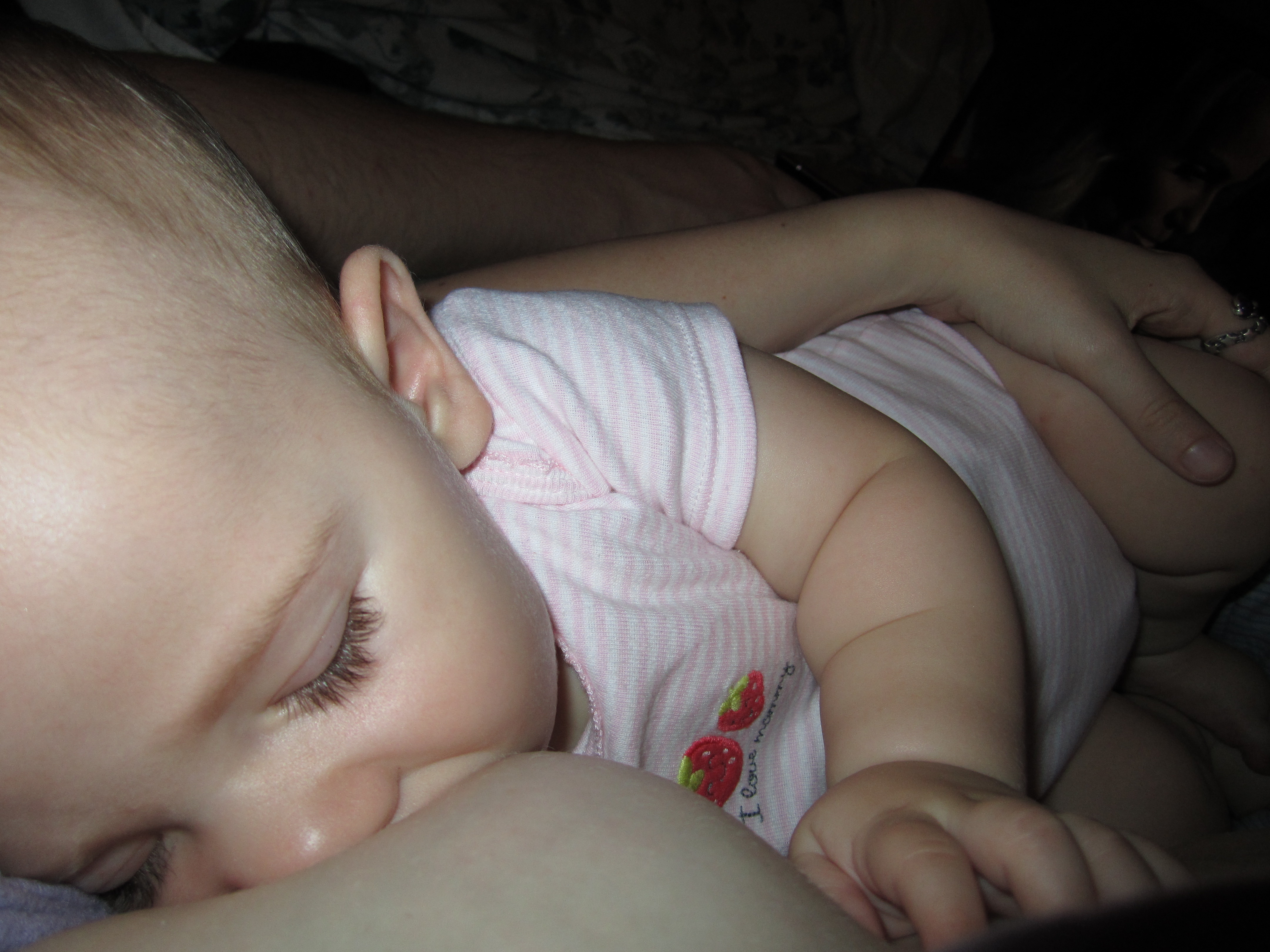
Then, last night while I was nursing her to sleep in my arms as I have done every night for five months, I took this picture myself to capture how well we fit together. I wanted to get how her little feet are nestled into my legs so perfectly and how her hands rests on me and how her head cradles in my arm:

I know this one isn’t a pro picture, but this is what it is like to be her mama 🙂

The Rhythm of Our Lives

This article was originally published in New Beginnings magazine (publication of La Leche League International) in 2007. As I’ve noted, I’m making an effort to “centralize” my written pieces into one location—bringing things here that I’ve written for other blogs or for other publications.

The Rhythm of Our Lives

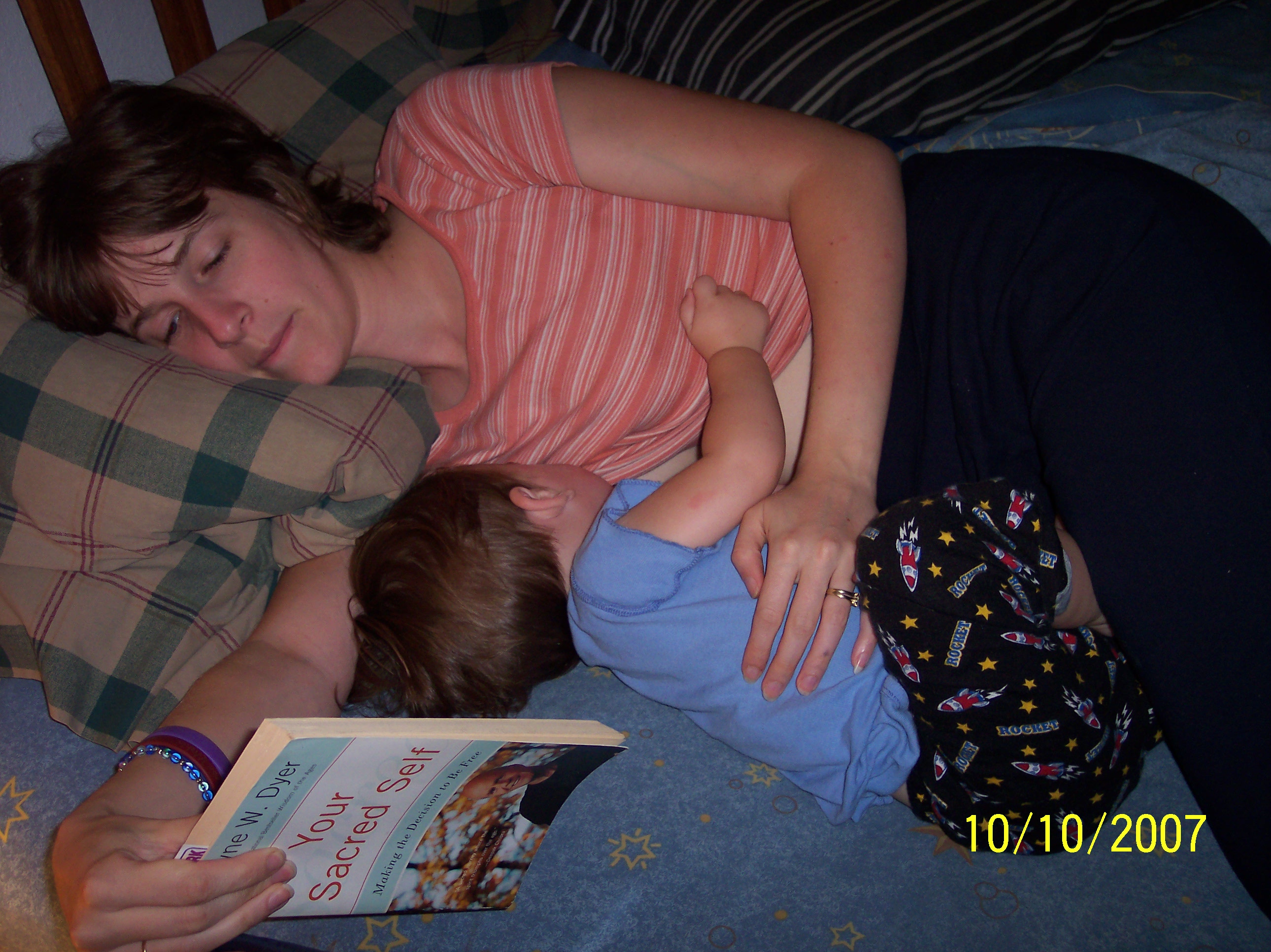
Nursing & Reading, 2007

by Molly Remer

2007

When I became a mother, many things in my life changed. I was startled and dismayed by the magnitude in which my free time diminished and one by one many of my leisure pursuits and hobbies were discarded. The time for one of my favorite hobbies increased exponentially, however, and this was a very pleasant surprise. That hobby is reading. As a child I was a voracious reader—my mother had to set a limit for me of “only two books a day.” In college and graduate school, reading for fun fell away and I spent six years reading primarily textbooks and journal articles. In the years following, I began to read for pleasure again and when my first baby was born in 2003, I once again became a truly avid reader. Why? Because of breastfeeding. As I nursed my little son, I read and read and read. I devoured mostly nonfiction with occasional fiction as “dessert.”

At first I scoured The Womanly Art of Breastfeeding and the Sears’ The Baby Book to try to make sense of my new life and then began to gobble up books about motherhood and women’s experiences of mothering. Reading did actually help me adjust to motherhood. Subtitled “Breastfeeding as a Spiritual Practice,” an article published in the fall 2003 issue of Mothering magazine was immensely meaningful to me. My baby was about two weeks old when the magazine arrived—the first issue I had received after his birth. This article was in it and it was exactly what I needed to read. Breastfeeding can be a meditative and spiritual act–it is actually a “practice” a “discipline” of sorts. The author, Leslie Davis, explains it better:

I realized I’d never before devoted myself to something so entirely. Of course I’ve devoted myself to my husband, to my family, to friends, to my writing, to mothering, and even to God and other spiritual endeavors at various points in my life…I’d completely given myself to this act of nursing in a way that I never had before. Nothing was more important than nursing my son. Nothing was put before it. There was no procrastination as with exercise, no excuses as with trying to stop eating sugar, no laziness as with housecleaning and other chores. Nursing had to be done, and I did it, over and over again, multiple times a day, for more than 800 days in a row. It was the closest thing to a spiritual practice that I’d ever experienced.

Viewing the act of breastfeeding through a spiritual lens like this was a lifeline to me as a vulnerable, sensitive, and bruised postpartum woman trying desperately to adjust my pace as an overachieving “successful” independent person to one spending hours in my nursing chair attached to a tiny mouth. I marvel at the uncountable number of times I spent nursing Lann and that I now spend nursing my second son, Zander. I calculate that I’ve probably nursed Zander about 3,000 times just lying down to go to sleep (nap or bedtime, plus waking up times too). That is just the lying down times, not the sitting in the chair or standing in the Ergo baby carrier times. This is the key to my reading success–I’ve had over 3,000 opportunities during the last year to pick up a book or other reading materials!

In 2007, I read approximately 150 books. I lie in my “nest” with my baby nursing and my older son resting near my back. The baby is nourished by me and in this pause in the busyness of life I am in turn nourished by the access he allows me to the printed word. As he grows bigger with my milk, I also “grow” intellectually and in the opportunity for spiritual and emotional renewal. As the baby drifts off I read to myself and when he is asleep I read stories to my four year old. This is the rhythm of our lives—suck, swallow, read, and consider.

——-

With my current baby, my reading “landscape” has changed again, since I now have a Kindle! 🙂

Birthing the Mother-Writer (or: Playing My Music, or: Postpartum Feelings, Part 1)

A friend and colleague of mine recently wrote some very touching and honest posts about her recent postpartum experiences. It is amazing how powerful the written word can be at clarifying and explaining one’s feelings.

I wrote the following article about my own postpartum feelings several years ago and have submitted to various publications, but it has always been rejected. So, I decided to finally “publish” it here. I plan to then do a follow-up post about my postpartum experiences with my other children.

Birthing the Mother-Writer* (or: Playing My Music)

By Molly Remer

After my first son was born in 2003 I felt silenced. Stifled. Shut down. Squelched. Denied. Invisible. Dissolved. Muted. I felt suffocated, chewed up and my bones spit out, erased, deconstructed, worthless, and useless. (In hindsight, I see the PPD-ish glint behind these feelings, though some of these feelings also featured in my pre-motherhood neuroses.) Postpartum was the most vivid and painful transition point of my life.

I felt slapped in the face by postpartum. I was triumphant and empowered in birth, but diminished, insecure, and wounded postpartum. I had a difficult physical recovery due to unusual labial tearing that was not repaired. I hypothesize that perhaps this contributed to my difficult adjustment to early motherhood. I’ve long tried to analyze the difficulty, concluding that it is not uncommon in the least, but wondering why/how others survive without mentioning this pain. How is anyone doing this? I would wonder, concluding that I must not be “cut out for this” and that I was the only one feeling alone, stifled, shut down, and unheard. As a consistently overachieving type, it was humbling as well as psychologically painful to not “get an A” on this new “assignment,” my baby. Each time he cried, I felt it was evidence of failure, failure, failure. I would see women and couples without children and think, “it isn’t too late for you” and, “if only you knew.” When I would see women who were pregnant I would feel a sense of grief for them, “Just wait. You have NO idea what is coming.”

I felt a duality in motherhood for which I was completely unprepared. How is it possible to feel simultaneously so captivated and yet also so captive, I would wonder. Bonded and also bound.

Maybe these feelings mean I’m egocentric, selfish, or immature (I certainly lectured and berated myself about that!), but they were my reality at the time. The experience was so scarring to me that for about 18 months after my first baby was born I considered not having any more children;  not because I couldn’t handle pregnancy, birth, or even the mothering of a baby and toddler, but because I could not stand the idea of experiencing postpartum again. I came to realize that my only regret about these days of early motherhood was not in how I related to my baby, or in how I took care of him, or loved him, or appreciated him, or marveled at him. My regret is that I was so very mean to myself the whole time I did those things—in reality, I was actually fairly skillfully learning how to mother. I was responsive, nurturing, kind, and loving and I took delight in my baby, but I was cruel to myself almost the entire time and failed to appreciate or notice any worth I had as a person or to accept and have patience for my birth as a mother.

When my first son was almost one, I wrote in my journal:

I feel like I have no one to talk to. I feel like no one understands me. I feel like I cannot express what I really feel inside. I feel like no one believes me. I do not feel accepted. I feel like my needs are not being met. I feel burned out. I feel drained. I feel angry. I feel sad. I feel desperately unhappy. I feel guilty. I feel wrong. I feel alone. I feel unworthy. I feel like I am not good. I feel invisible. I feel ignored. I feel small. I feel bad. I feel like I cannot say what I mean and actually be heard. I feel like I can’t explain my “bad” feelings. I feel trapped. I feel suffocated. I feel stressed. I feel overloaded. I feel like snapping. I feel mean. I feel unfair. I feel selfish. I feel disconnected.

I miss Mark. I miss our relationship. I miss feeling right in our marriage. I miss being alone together.

I feel like I am not enjoying motherhood the way I am “supposed” to. I feel confused. I feel conflicted. I feel torn. I feel low. I feel resentful. I feel worried about the future. I feel anxious about being good enough. I feel stretched. I feel taut. I feel like changing.

What helped me a great deal during this time were the voices of other women. Not women face-to-face, though I had begun building a network of wonderful female friends, it seemed too painful or dark to broach the question with them—-“Do you hate this sometimes too?” And I couldn’t really bear to voice my feelings to my own mother, also a tremendous source of support for me, because to risk hearing her say, “Yes, sometimes I did feel tortured by YOU” was not really what I needed. She also has a well-meaning, but frustrating tendency to meet genuine expressions of despair with comments that imply I should put on a happy face. Instead, it was the voices of women reaching off the printed page that met my hunger for contact. For truth. For rawness and a look at the “ugly.” I gobbled up books about motherhood and women’s experiences of mothering and have a permanent place in my heart for the “momoir.”

A quote from Wayne Dyer that serves a recurrent guidepost (or almost obsession) in my life is, “Don’t die with your music still in you.” During my abovementioned painful transition to motherhood I couldn’t shake the feeling that I wasn’t letting my “music” out. Then, following the birth of my second son in 2006, sort of accidentally, I began writing again and in earnest this time (articles, essays, blog posts, journals) and later realized that I no longer have any fear about dying with my music still in me. And, I also don’t feel depressed, invisible, worthless, or muted anymore. During my original fretting over this phrase, I felt like it was another type of “music” that I needed to let out (mainly that of the social service work that I had been groomed for in graduate school), not words necessarily. However, I’ve finally realized that maybe it was literally my words dying in me that gave me that feeling and that fretfulness. They needed to get out. I’ve spent a lifetime writing various essays in my head, nearly every day, but those words always “died” in me before they ever got out onto paper. After spending a full three years letting other women’s voices reach me through books and essays, and then six more years birthing the mother-writer within, I continue to feel an almost physical sense of relief and release whenever I sit down to write and to let my own voice be heard.

—–

Molly Remer, MSW, CCCE is a certified birth educator, activist, and writer who lives in a straw bale house in central Missouri with her husband, two young sons, and infant daughter. She blogs about birth at https://talkbirth.wordpress.com.

*title inspired by Literary Mama.

Alaina’s Complete Birth Story

It has taken me a long time to finish typing up Alaina’s birth story. I wrote it in my journal at 3 days postpartum and the following is almost verbatim. I’ve gone back and forth about what to include and decided to just include everything, as originally written. I feel critical of the story somehow, like it is “choppy.” I used interestingly short, jumpy sentences and while part of me want to smooth it out, another part of me feels like it is more authentic in this format. I also feel like I “should” be posting it on a more significant date—i.e. her six month birthday, or something. But, it is finished now, so I feel like sharing now! Additionally, I thought about taking the self-analysis section about the use of a hypnosis for birth program out of the story, but, indeed, this was the FIRST thing I wrote in my journal, so it seems like it “deserves” to be included as well. It obviously was one of the most important details for me to write about. However, for the purposes of clarity, I moved it to the end of the story in this version. Likewise, I thought about making the section about my newborn- love into a separate post, but because those feelings are so intimately entwined with her birth and because, in my journal, that is exactly the chronology I used—first hypnosis criticism, second birth chronology, third baby love–it feels like it all belongs together in one story. It is funny how that first story has such value to me and that it feels almost wrong to edit, change, or add anything to it. It feels most honest this way.

The Birth of Alaina Diana Remer
January 19, 2011
11:15 a.m.
7lbs, 8oz; 20 inches.
Short version of her story is here and labor pictures are here.

I had a restless, up and down night, getting up at 3:00 a.m. and even checked in with my online class. Mark got up with me and we talked and speculated. Waves were four minutes apart and then kind of dissipated unenthusiastically away. He went back to bed at 4:00 and I listened to Hypnobabies. At 6:00, I was feeling trapped lying down and got up. Mark got up then too and worked in the kitchen on the dishes and things like that, while I walked around and leaned on the half wall during contractions (a lot. It was the perfect height). Sitting down in a chair caused horribleness, leaning forward on the ½ wall was good. Called Mom and told her to be on standby and to notify my blessingway crew. Also, called Summer (doula/friend) to be on alert. Felt serious, but not totally. Also was having back involvement which each wave. I felt like I would have a real contraction and then a closely following, but milder, back-only contraction (no tightness in uterus really during these, but definitely a wave-like progression and then ease of sensation).

I was very quiet during most waves until the end. I think because I was doing the Hypnobabies and was concentrating on that. Then, I would talk and analyze and be very normal in between. This pattern seemed to lead to a decreased perception of seriousness from others of my need for attention—Mark washed dishes, went outside to take care of chickens, work on fire, feed cats and so forth. The boys woke up at 7:00 a.m. and as soon as they came out and started talking to me (Mark was outside), I knew they needed to go elsewhere. We called my mom at 7:30ish and she came to get them. I did not want to feel watched or observed at all, so asked her to wait to come back.

I kept waiting for the “action” to increase and feeling distressed that it was taking such a “long” time. I suggested to the baby that she come out by 10:00. I continued to stand in the kitchen and lean on the ½ wall, sometimes the table or the bathroom counter. Dismayed to see no blood/mucous, nothing indicating any “progress.” Significant feelings of pressure and pain in lower back continued and at the time felt normal to me, but looking back seems like an extra dose of back involvement. In another intensity-increasing experience, the baby moved during contractions for the entire labor until the contraction before I pushed her out. She moved, wiggled and pushed out with her bottom and body during each contraction, which really added a new layer of intensity that was difficult. I was, however, glad she was moving because then I knew she was okay, without doing any heart checks.

I went into the living room, very tired from bad sleep during the night. We set up the birth ball in the living room so I could sit on it and drape over pillows piled onto the couch. I spent a long time like this. Mark sat close and would lightly and perfectly stroke my back. Continued to use Hypnobabies—finger-drop, peace and release, with most waves.

Mark fixed me chlorophyll to drink and I barfed it up immediately and horribly. Called Mom to come back and 9:00 or so, at which point I finally had a little blood in my underwear. Kept up my ball by the couch routine and moved into humming with each wave. Also did some contractions on the floor leaning over the ball. Also good.

On the ball, I began to feel some rectal pressure with each wave. However, I felt like the waves were erratic still, with some very long and intense and then smaller ones. Hums began to become oooohs and aaaaahs and I began to feel like there was a bit of an umph at the end of the oooooh. Went back to the bathroom and there was quite a bit more blood (plus mucous string) and I started to fret about placental abruptions and so forth. Left the bathroom analyzing how much blood is too much blood and began to critique myself for being too “in my head” and analytical and not letting my “monkey do it.” Said I still didn’t feel like I was in “birth brain” and wondered if that meant I still had a long time to go. Started to feel concerned that I was still early on. This is a common feature of all of my births and is how the self-doubt signpost manifests for me. Rather than thinking I can’t do it, I start thinking I’m two centimeters dilated.

I almost immediately returned to the bathroom feeling like I needed to poop. Serious contractions on toilet produced more pressure with associated umphs at the end. At some point in the bathroom, I said, “I think this is pushing.” I was feeling desperate for my water to break. It felt like it was in the way and holding things up. I reached my hand down and thought I felt squooshy sac-ish feeling, but Mom and Mark looked and could not see anything. And, it still didn’t break. Mom mentioned that I should probably go to my birth nest in order to avoid having the baby on the toilet. My birth nest was a futon stack near the bathroom door. I got down on hands and knees after feeling like I might not make it all the way to the futons. Felt like I wanted to kneel on hard floor before reaching the nest.

Suddenly became obsessed with checking her heartbeat. I knew you’re supposed to do so during pushing and I had stopped feeling her moving painfully with each contraction. I couldn’t find her heartbeat and started to feel a little panicky about that as well as really uncomfortable and then threw the Doppler to the side saying, “forget it!” because big pushing was coming. I was down on hands and knees and then moved partially up on one hand in order to put my other hand down to feel what was happening. Could feel squishiness and water finally broke (not much, just a small trickle before her head). I could feel her head with my fingers and began to feel familiar sensation of front-burning. I said, “stretchy, stretchy, stretchy, stretchy,” the phone rang, her head pushed and pushed itself down as I continued to support myself with my hand and I moved up onto my knees, with them spread apart so I was almost sitting on my heels and her whole body and a whole bunch of fluid blooshed out into my hands. She was pink and warm and slippery and crying instantly—quite a lot of crying, actually. I said, “you’re alive, you’re alive! I did it! There’s nothing wrong with me!” and I kissed her and cried and laughed and was amazed. I felt an intense feeling of relief. Of survival. I didn’t realize until some moments later than both Mark and Mom missed the actual moment of her birth. Mark because he was coming around from behind me to the front of me when I moved up to kneeling. My mom because she went to stop the phone from ringing. I had felt like the pushing went on for a “long” time, but Mark said that from hands and knees to kneeling with baby in my hands was about 12 seconds. I don’t know. Inner experience is different than outer observation. What I do know is that the moment of catching my own daughter in my hands and bringing her warm, fresh body up into my arms was the most powerful and potent moment of my life.

I was covered in blood again. Caked in my fingernails and toenails and on the bottoms of my feet again. And, I did tear again, same places.

I feel the moment of her birth was an authentic “fetal ejection reflex” including the forward movement of my hips. The immediate postpartum went exactly as I had planned. Summer arrived approximately 20 minutes after Alaina was born. She brought me snacks, wiped blood off of me, and served me a tiny bit of placenta (which I swallowed with no problem!). My midwife arrived approximately 40 minutes post-birth and assessed blood loss and helped with placenta. She said I lost about 3 cups of blood, but I think all of the fluid that came out with the baby, plus the blood from the tears, may have bumped the estimate up too high. I did not feel weak or tired like I’d lost too much blood, I felt energetic and really good, actually. I didn’t get faint in the bathroom either and my color stayed good throughout. “Don’t look down” (while using the bathroom) is an excellent plan for me!

My post-birth feelings were different this time. I feel more baby-centered in my feelings about it rather than self-empowerment centered. I also feel more critical in my own self assessment this time—like I didn’t “perform” well or handle myself well. I hypothesize that this may be related to using a hypnosis for birth program, because I didn’t feel “calm and comfortable” on the inside. On the outside I think I looked it, but my internal experience involved more “should” than I like. The hypnosis philosophy wasn’t really a match with my own lived experience of birth. Birth isn’t calm, quiet, and comfortable and I don’t actually think it should be or that I want it to be. However, I was trying to make it so and thus not using some of my own internal resources. I felt more mind/body disconnect than I have before also, perhaps because I was trying to use a mind (“control”) based method on such an embodied process. Anyway, it was good for relaxing during pregnancy, personally not so good for behaving instinctually in labor. I did use it though and technically I guess it “worked” because Mom and Mark couldn’t read where I was in birthing and though I was very calm. It didn’t feel calm inside though, it felt HARD. I also was very stuck—almost in a competitive-feeling way—on thinking it was going to be fast and feeling stressed/concerned that it wasn’t.

I also want to include this segment from my journal, written when she was three days old:

She is so wonderful and amazing and beautiful and perfect and I just want to etch these days into my mind forever and never forget a single, precious, beautiful, irreplaceable moment. I want to write everything down to try to preserve each second of these first few days with baby Alaina—my treasure, my BABY! The one I hoped for and feared for and worked SO HARD to bring to this world (in pregnancy more so than in birth). I can’t really though—I am here, now. Living this, feeling this, knowing this. The newborn haze is my reality in these moments, but it will pass away and the best thing to do is to fully live it. To feel it and to be here—without struggling to preserve it all. It is here in my heart and soul and preserved in the eddies and ripples of time. The unfolding, continuous ribbon of life and experiences. I have a weird, petrified feeling of forgetting—i.e. when I’m 89 will I still remember how this FELT?!

What do I want to remember?

Newborn photo (c) Sincerely Yours Photography

Alaina newborn photo (c) Sincerely Yours Photography

    • The scrunchy feel of a newborn’s body.
    • The little mewing squeaks and sighs
    • How she is comforted by my voice and turns to me with a smacky, nursie face…
    • The soft, soft skin
    • The soft, soft hair
    • The fuzzy ears and arms
    • The little legs that pull up into reflexive, fetal position.
    • The utter, utter, MARVEL that I grew her and that she’s here. That she came from me. That sense of magic and wonder and disbelief when I look over and see her lying next to me—how did YOU get here?!
    • The miraculous transition from belly to baby. From pregnant woman to motherbaby unit? How does it happen? It is indescribably awesome.
  • The sleeping profile
  • The scrunchy face
  • The “wheeling” half coordinated movements of arms and legs—sort of “swimming” in air.
  • The peace of snuggling her against my chest and neck.
  • The tiny, skinny feet.
  • Putting my hand on her back and feeling her breathe, just like in utero

I was still scared she was going to die until the moment I held her.

Molly & Alaina newborn photo (c) Sincerely Yours Photography

Three Month a-Baby!

Saw lots of baby girls with handbands at the ICAN conference and decided to cobble together a test one 🙂

I can hardly believe my baby girl is three months old now! It is amazing. Though, on the other hand, I also can hardly remember life without her. We also just crossed into her “life spark-aversary” as the anniversary of my LMP was April 17th (TMI!). This time last year, I was still full of confusion and anxiety about whether we would be able to have another baby and gathering up my courage to try again, “one more time.” She continues to be the most delightful, wonderful baby in the history of the world 🙂 Seriously though, she is just a really great baby. She is tons of fun, she smiles all the time, she laughs sometimes (mostly only at her Baba [my mom]), she chews on her hands in a contemplative manner, she drools a little. She goos and coos and gives little squeals of communication. She is shockingly accommodating, patient, good natured, pleasant, and adaptable (Z threw-dropped a pile of clothes on her head out of nowhere last night and when we snatched them back off, she was just blinking and then she smiled and kicked her legs—the boys would have SCREAMED from being surprised unpleasantly like that). I’ve never had such a calm and cooperative baby. She also sleeps like magic. Of course, she does also sleep in my actual arms all night long, so maybe that is why! I think she is actually one of those babies that I could probably put down in another bed, but I haven’t tried it. I sleep better with her close by and I don’t want to miss out on any opportunities to snuggle and enjoy her. I guess it is because we’ve said she is the last baby, but every day I think that I’ve got to have another one. She is so adorable that this can’t be the last time I get to have a baby! (I still think it is going to be last time though, for a variety of reasons.)

Despite being so used to her and feeling like she’s been with us for ages, I continue to have that sense of marvel over her—every day I feel it. I tell her things like, “guess what? You’re my BABY!” This is an unfamiliar feeling for me and it may be related to the same “last baby” thing, or, just because of my fear that I wouldn’t have another baby, or because of my relief to be on this side of the PAL journey. Whatever it is, I just feel amazed and grateful and delighted by her presence in our lives.

Having tummy time and showing off her cute little ears!

We’re doing elimination communication (EC) with her just like we did with Z. It is working out great. EC is amazing and I will write a separate post about that experience. But, I think it is just so COOL that a 3 month old baby will sleep all night and have a dry diaper in the morning (and then pee in her little potty).

The boys totally love her, which can have its challenges. They both like to get really close to her face and also kind of lean on her head to snuggle her. Her eyes start to blink rapidly when she sees them getting close to her! 😦 But, she also gives them some of the biggest grins and loves to watch them play. They are her favorite show and she will sit on my lap and just watch them for the longest time. She also likes to ride facing outward on my hip and kick and pump her legs and wave her arms. Lann is big enough at 7.5 that he can carry her around and you can tell she trusts him to take care of her. She has even fallen asleep on him before! (He was holding her and kind of dancing around while we cooked dinner one night and then laid down on the couch with her laying on top of him and she conked out.) She weighs about 15 pounds now and is getting heavy enough that he can’t hold her for very long without complaining about the weight though, LOL. She has fabulously chubby legs and dimpled hands.


Daddy and his kids!

We’ve just had a family-wide cold and she got it too (she escaped the one that caused laryngitis for me two weeks ago, but this one she got before me, which meant my antibodies weren’t able to save her from this one). My grandma is coming to visit from CA this week and I hope she will be suitably enraptured with her first little great-granddaughter!

This blog has taken on a more personal tone during my pregnancy experience and continues to do so. Eventually, I will get back to writing more educational or advocacy-oriented posts. Right now, I just feel more like writing about my own personal experiences.

There has been a “baby boom” of April babies amongst my friends recently and as I read their birth stories, I realize that I’ve yet to share the full version of Alaina’s birth story. I have it hand written in my journal and think I will transcribe it “sometime soon.” Attending Pam England’s presentation about the gates of birth story sharing also heightened my desire to write it up in full. Of course, every day I have at least 10 things I’d like to do that I don’t make it to that day. I was just talking about this to my husband, saying that really, I actually like this about myself. While I feel some kind of pressure somewhere to be “more Zen” and to “chill out”/relax, I like my own intensity. I run fast and high and bright. It’s okay. That’s how I am. As I’ve noted before, if chilling out means cooling my enthusiasm or putting out my fire, then, no thanks! I don’t want it after all. I’d rather have the slightly manic edge 🙂

I like waking up in the morning with my head boiling with possibilities and being full of exciting ideas. Of course, perhaps I could be calm and relaxed and full of ideas, but if it is a trade, I’ll take the ideas! To be totally honest, sometimes I feel like people who suggest relaxing are secretly trying to “dim my shine.” So there! ;-P

Cutie pie!