Thursday Tidbits: Happy Birth-Day!

September 2015 008This week, our oldest son turned 12! I can hardly believe that it has been twelve years since Mark and I were snuggled up in bed marveling over our new baby boy! Lann is an amazing big brother, a helpful, responsible son, and a creative, imaginative, sensitive kid. He loves Minecraft, computer games in general, and making gaming videos for YouTube.

We had his birthday party earlier this month, so his actual birthday was pretty low-key (minus me scrambling to catch up with backlogged work from being away and poor Tanner being a crying, stumbling around, stressed out little mess from the same). We put up his nice new birthday trampoline and went out to dinner and had cake with my parents.September 2015 137Twelve years ago this is what I was doing…

…I felt very internally focused and yet still aware of the people around me, though I wasn’t talking to them much and spent a lot of time with my eyes closed. They kept commenting to me and to each other about how calm and focused I was being and how “in control” I appeared. I don’t think I was really showing how intense and back-to-back these contractions were for me. I also started to have lots of internal pressure feelings during contractions when I was on my hands and knees.

My First Birth | Talk Birth

On Sunday night, Alaina, Tanner, and I got back home from Kansas after five days away. Gaea Goddess Gathering was an experience, as always. Vending was a rewarding experience with lots of lovely connections woven, but many other elements felt like something we survived! It is quite physically taxing to be there–not enough food, water, or sleep, too much climbing up seventy steps up a steep hillside while breastfeeding + babywearing! And, weather extremes this year—90+ degrees, then rain and wind, then cool. I couldn’t have done it without my mom, who helped me way more than I should have expected her to. It was also fun to spend so much time with my sister-in-law and my little nephew (she also helped me a lot!)

September 2015 077The other day I told my husband that it is interesting to me how I was “maxed out” when I only had one little baby. And, now I have four and I’m still maxed out (but that first little baby is now a twelve-year-old who helps take care of the other babies, so in some sense it is easier to have more kids than less kids!). I also told my mom what the midwife for my second baby told me: one kid takes all of your time, so a second one can’t possibly take any more.

There are a lot of things that are easier about having an older kid and some things that are harder:

And, I no longer smell like piss. So, there’s that.

Sure things have gotten easier in ways. I can leave the house now without small humans attached to me. I sleep for stretches longer than three hours. And I haven’t been vomited on in at least a few months. But in some ways, it’s so very much harder. (Plus they aren’t as cute and easy to forgive anymore.)

Source: It’s a Lie; Mothering Doesn’t Get Any Easier Scary Mommy

What this article doesn’t address is the complexities of having both big kids and little kids at the same time. That is what feels hardest right now and I think it may get harder before it gets easier. Time always feels shorter than I dream of it feeling.

When I was nursing infant Lann, a moment with my then-teenage brother still stands out to me: he walked in while I was nursing Lann to sleep at my parents’ house and said, “oh, he’s having nursies.” The normality of “nursies” to a teenage boy is important (and now that teenage boy is in his twenties and has a breastfed baby boy of his own). I’m surprised to realize that Lann will remember more about me nursing Tanner than Tanner ever will.

What did they learn from those experiences? Well, hopefully, they learned that human bodies are just that, bodies. We respect them and we revere them and we don’t shame them. Because they don’t deserve any of that.

This is where the change starts. With my kids and your kids and the kids who see us feeding our babies without embarrassment. Things become normalized one act a time.

I’ve given my kids the opportunity to see something I hope will serve them in their lives. My son’s partners will never have to be concerned that they won’t be supported. My daughters will know the normalcy that is child birthing and feeding and rearing.

Source: Breastfeeding and Teenage Boys | The Leaky B@@b

Thinking about the swift passage of time from that tender, new mother and soft, fresh baby of twelve years ago to the boy whose head is now past my shoulder and who records tutorial videos, reads about the solar system, totes his little brother on his hip, and fixes breakfast for everyone, I feel oddly comforted by the information that some cells from each of my kids, might be with me forever:

The new study suggests that women almost always acquire fetal cells each time they are pregnant. They have been detected as early as seven weeks into a pregnancy. In later years, the cells may disappear, but sometimes, the cells settle in for a lifetime. In a 2012 study, Dr. Nelson and her colleagues examined the brains of 59 deceased older women and found Y chromosomes in 63 percent of them. (Many studies on fetal microchimerism focus on the cells left behind by sons, because they are easier to distinguish from the cells of their mother.) Experts now believe that microchimerism is far from rare. “Most of us think that it’s very common, if not universal,” Dr. Nelson said. But it remains quite mysterious.

Fetal cells are frequently found in breast tissue, even in milk, for instance. The researchers argue that children might thrive more if their fetal cells drove up milk production.

Mothers also nurture their babies with body heat. The thyroid gland, located in the neck, acts like a thermostat, and fetal cells in the thyroid gland in theory could cause mothers to generate more heat than they would otherwise.

Source: A Pregnancy Souvenir: Cells That Are Not Your Own – The New York Times


September 2015 065

Be Your Own Publisher Author Interview Series

BYOPInterviewSeriesFall2015I’m excited to be a part of the author interview series leading up to the next session of Lucy Pearce’s Be Your Own Publisher e-course. We signed up for this course last year and it is a treasure trove of information (so much that I haven’t finished it yet!). My interview will air on October 1.

Everyone who signs up for the free author interview series will have access to it as well as Module 1 of the Course FREE as a thank you.

I love the opportunity to connect with people around the world thanks to the internet. Lucy and I chatted away via Skype like old friends even though she is in Ireland and I am here in Missouri!

Disclosure: affiliate link included.

Guest Post: How childhood stress can affect female fertility

cropAugust 2015 048

Related to my Tuesday Tidbits post from earlier this week, this guest post touches on the relationship between childhood stress and later female fertility.

How childhood stress can affect female fertility

“Early life events may impact later reproductive strategies.”

Can events you endured as a child really impact your ability to have children yourself? New research in the Journal of Psychosomatic Obstetrics & Gynecology examines the mechanism by which adverse experiences in childhood impact female fertility.

In their paper ‘Adverse childhood event experiences, fertility difficulties and menstrual cycle characteristics’, Marni B. Jacobs et al. explore the hypothesis that negative experiences in childhood can result in menstrual cycle irregularities, which consequently impact fertility. They relate their hypothesis to life-history theory, which talks of balancing the preservation of one’s health and the production of offspring that will survive to reproduce themselves, and theorise that “early life stressors may predispose an individual to adaptively suppress fertility when situations are less than optimal, leading to periods of fertility difficulties even following previous births.”

The study examined data from 774 women of reproductive age, 195 of whom were pregnant. It analysed fertility difficulties, menstrual cycle irregularities and adverse childhood experiences, through a mixture of in-person interviews and take-home questionnaires.

Following their research, the team came to the conclusion that those women who had experienced negative events at a young age – such as “abuse, neglect, household dysfunction or parental substance abuse” – were more likely to have faced fertility difficulties and abnormal absences of menstruation lasting three months or more, and also took a longer time to get pregnant. Their research also suggests that certain harmful events in childhood can potentially have a greater impact on fertility than others.

Adverse childhood event experiences, fertility difficulties and menstrual cycle characteristics by Marni B. Jacobs, Renee D. Boynton-Jarrett & Emily W. Harville published by Taylor & Francis.

* Read the full article online

Tuesday Tidbits: Women’s Circles and Cycles

11890947_1658752111003671_3875428907499186114_nOne of the things I notice in Red Tent work is how little information women had about their own fertility cycles as girls and young women. I feel like my own mother was more attentive than many in preparing me for my body’s changes with puberty, but I only really learned about my own fertility (vs. just periods and how to cope with them) after having my first baby. I am convinced that how girls learn to relate to their bodies during menstruation has a big impact on how they relate to their bodies during birth and breastfeeding. I don’t find it coincidental that our culture expresses an overall avoidance of menstruation and fertility (other than “don’t get pregnant” and “here’s all the ways to pretend that you’re not a cyclical being, but instead are always the same and no one should ever know that you’re menstruating”) AND also medicates women during childbirth and considers breastfeeding a “private matter” and “personal choice.” These events, the reproductive transitions of the female body, are largely supposed to remain culturally invisible.

Here is an interesting article about what we need to teach young women about their bodies:

At the clinic I rarely met women, young or old, who understand their fertility and what happens during the menstrual cycle. They all know about the blood, although not always why they bleed. But few know anything about what happens between periods. No one has told them. Why have we kept this information from young women? Why do we tell them they can get pregnant any time of the month? If it’s to encourage young people to use protection when they have sex, it doesn’t seem to work.

Source: What We Need to Teach Young Women About Their Bodies | Ruth Miller

It also turns out that the age of first menstruation can have a lifelong impact on many areas of a woman’s life:

From academic success to cancer risk, research increasingly shows that the age at which a girl gets her period—called “menarche”—can have a significant impact on her life. These findings are especially notable given that, around the world, the average age of menarche has dropped steadily since the 1950s. With new studies coming out regularly about girls going through puberty earlier, we were curious: What’s causing this global decline—and what are the potential long-term consequences?

Source: Why the age you get your period can matter forever | Fusion

In my own local Red Tent Circle, we’ve been talking about having a “Pink Tent” event for girls this fall or early next year. My little girl desperately wants to go to a red tent with me! She asks every month if she can come with me. So, I’m hoping to plan and priestess a mother-daughter based event soon in addition to my women-only events. I enjoyed this article recently about planning a mother-daughter body-gratitude ritual:

​Break the generational cycle of body shame and body dissatisfaction, and enjoy special intimate time with your daughter. This is a beautiful way to start the day or to seed your dreams before bed. Ideally, meet in the same spot at about the same time each day…

Source: Mother-Daughter Body Gratitude Ritual – Journey Of Young Women

Speaking of Women’s Circle work, here is a good resource on The Twelve Tenets of Circle Work.

And, speaking of circles + teenage girls + women’s friendships, here is an article on The Art of Loving and Losing Female Friends.

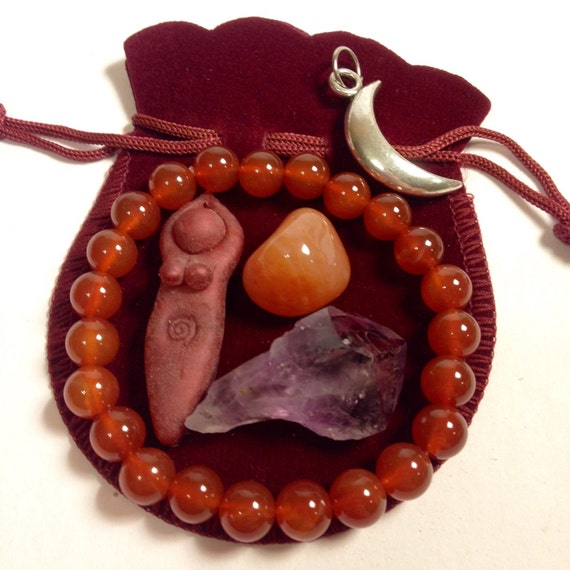
First Moon Blessing Pocket Altar (mini altar, medicine bundle, blessing bundle, menarche, moontime, red tent)

First Moon blessing bundles in our Etsy shop

Sign up for the Brigid’s Grove Newsletter for resources, monthly freebies, + art and workshop announcements.


Guest Post: Postnatal Mental Health

11998990_1661958487349700_7935437715757927025_nI received notice of a new article published in the Journal of Psychosomatic Obstetrics & Gynecology looking at the types of distress experienced by postpartum women and the type of support available. It indicates that current classification of “postpartum depression” and other postpartum mood disorders are inadequate to convey the range of women’s experiences, nor do they properly account for the role of support in their lives.

Before I share the article, I wanted to note something I’ve done recently to support postpartum health. I donated to the fundraising effort to buy a permanent location for WomanSpace, the local community center devoted to supporting women. It is spearheaded by Summer Birth Services, an organization offering birth, postpartum, and breastfeeding support to Rolla area mothers. We can’t undervalue the importance of organizations like this! WomanSpace offers meeting space for groups, classes, and workshops for a wide range of purposes for all ages, stages, and phases of a woman’s life.

For women in any community, you might want to check out a free virtual retreat for women (unaffiliated with any of the above): Nurturing You.

Postnatal mental health: Are women getting the support they need?

“I really did not feel like I fitted the box.” New research indicates the need for postnatal support that encompasses all mental health issues, not only postnatal depression.

The study, published in Journal of Psychosomatic Obstetrics & Gynecology, examines the postnatal symptoms of distress experienced by women, and the support options they were offered. Rose Coates et al. argue that “Current classification and assessment of postnatal mental health problems may not adequately address the range or combination of emotional distress experienced by mothers.” To understand women’s own experiences, the team interviewed 17 women, all of whom had a child under one and had experienced a postnatal mental health problem.

Through the interviews, the women reported a number of different postnatal mental health symptoms, with tearfulness and anxiousness the most frequently mentioned. In addition a number of women each reported feeling: stressed, isolated, lonely, angry, low, panicky, frustrated, worried, scared and overthinking. Despite these symptoms of postnatal distress, the women found that they didn’t identify with postnatal depression, and many of them were left “bereft of information, advice and support” about other types of distress. The paper notes that “there was a perception that health professionals were focussed on postnatal depression and once it had been ruled out there was no further investigation.”

At the time of their distress some of the women had been assessed for postnatal depression by health care professionals through answering a questionnaire. This paper questions whether this alone is really sufficient to identify distress, and suggests that alternative methods of assessment would be conducive to identifying and supporting women with a number of different postnatal mental health issues. The authors conclude that “Identification and recognition of symptoms and disorders beyond postnatal depression needs to be improved, through evaluating different approaches to assessment and their acceptability to women.”

Post provided by Taylor and Francis Group.

Tuesday Tidbits: Parental Leave

centeredmamaI’m teaching Introduction to Human Services right now. In this class, I emphasize systems theory and the complex, dynamic interplay between people and the environment. I cannot stop being a birth activist, nor can I stop being a social worker, so of course, one of the examples I use in class is adequate parental leave. Yes, parental leave. We talk about maternity leave more often in the U.S., but I consider it practically criminal that so many workplaces expect fathers to return to work within a few days after a baby’s birth. This isn’t fair to babies, mothers, fathers, or to workplaces or communities. As I explain to my students, we place people into abnormal situations and expect them to cope normally. When they don’t cope “normally,” we decide they have a disorder and need some medication or possibly parenting classes (or even removal of children). I also make sure to share this quote: It is no measure of health to be well adjusted to a profoundly sick society (Krishnamurti).

For Natasha Long, who was back three weeks after her third child, Jayden, was born in 2012, the worst part was missing out on bonding time with her son.

Long, who was 29 at the time, was determined to make sure Jayden got breast milk. But the factory where she worked, ACCO Office Supplies in Booneville, Mississippi, didn’t have a lactation room. So when she was on breaks, she had to run out to her truck. She sat in the cab, worried that someone might see her, and pumped, while tears rolled down her face and over the plastic suction cups attached to her breasts.

Long cried because she wanted to be holding her baby rather than sitting in the parking lot of a factory in her old Yukon Denali. But exhaustion clearly also played a role in her emotional state. Her job was simple—to place stickers with the company logo on the bottom right-hand corner of plastic binders and then box up the binders. But the shifts were long—from 6 a.m. to 6 p.m.—and she put in four or five a week. Because the factory was an hour’s drive from her home in Okalona, Mississippi, Long had only 10 hours left in the day to do everything else, including tend to her three children, spend time with Jayden’s father, and sleep. By the time she got back in the evening, her children, who were being looked after by her father during the day, were on their way to bed. To pump breast milk before leaving for work, she had to get up at 4 a.m.

After just a few days of this crazed schedule, Long began to develop strange symptoms, including a headache that never seemed to go away and a choking sensation that left her feeling breathless. She started biting her fingernails to the quick—something she’d never done before—and crying a lot. “I felt like I was alone,” says Long. “I wanted to fall off the face of the earth.” Long had never been depressed. But when she went to the doctor, he surmised that her physical symptoms were rooted in her mental state, which was itself rooted in her schedule. When her doctor said he thought she was depressed, Long worried that if child welfare authorities found out, they might take her children away. She had seen other people’s children put in foster care. But when her doctor prescribed her antidepressants, she took them.

Source: The Real War on Families: Why the U.S. Needs Paid Leave Now – In These Times

The issue here is not women’s inability to cope, it is that society’s expectations are disordered.

Here is another good article about the perils of no paid leave in the U.S.:

“I was in the car with my candidate with my brand new baby, a first-time mom, and I was driving to a fundraising meeting to shake somebody down for some cash,” Spradlin said. “I mean, I’m still bleeding. So I’m like, well, what pants do I fit into that are black, just in case I bleed through them. And these are not reasonable ways to behave. I mean, postpartum hemorrhage is a true and real cause of death of women.”

Spradlin is now a lactation consultant, a health-care professional who helps women having trouble breastfeeding. Too often, she said, “trouble breastfeeding” is really just a symptom of a deeper problem—a system that denies too many women the chance to heal and bond with their babies because they can’t afford to take more unpaid time off of work…

Source: Bleeding Wounds and Breastfeeding Hell: The Costs of No Paid Maternity Leave in America

I’ve mentioned several times before that in my ten years in breastfeeding support, I’ve more often marveled that a woman continues to breastfeed, than I’ve wondered why she doesn’t.

I feel like almost every woman I meet or every one I speak to online is seeking community. We’re looking for the “tribe,” we’re looking for the village. We don’t want to do this alone.

The truth is, creating a village sometimes just isn’t possible and there have been many times as a mom a “break” isn’t realistic. Balance, thriving, creating time for you — sometimes, those helpful tidbits tossed out to drowning moms just make me feel like yet another thing I’m failing at…

Source: To the Mom Without a Village – Babble

The problem I note with self-care advice to “ask for help,” is that most people are in similar situations–it is hard to ask for help when the people you ask, also need help!

As we muddle our way through our own home-based life, often “too busy” and “too chaotic” and “not enough time,” I absolutely loved this article about messy importance of the every-day, the real, and the complicated:

…Joy will be there waiting when we’ve adequately tidied our lives, is simply another disempowering cultural story. A story that has an entire generation of humans (and particularly mothers) feeling bad about ourselves, scrambling to “keep up,” and futilely spending billions in attempts to find solace…

Source: Revolution from Home » Blog Archive Life Is Meant to Be Messy (You’re Not Doing It Wrong)11998990_1661958487349700_7935437715757927025_n


Talk Books: Q & A with Jenny Kitzinger

cropAugust 2015 048“These hands are big enough to save the world, and small enough to rock a child to sleep.”

–Zelda Brown

Childbirth education pioneer and feminist icon, Sheila Kitzinger has five daughters. After reading and reviewing Sheila’s passionate, beautiful, inspiring memoir: A Passion for Birth, published shortly before her death this spring, I did a short interview with her daughter, Jenny Kitzinger…

  1. How has your own work been influenced by your mother?

I grew up knowing that the ‘personal was political’ – including issues such as birth, marriage and death – and believing that nothing was taboo or closed off for discussion.

My early work on AIDS, and then on child sexual abuse, as well as my most recent work on the treatment of patients in long-term coma, has all been fundamentally influenced by my mother’s approach to life and work.

  1. What was it like to grow up with a birth activism “celebrity”?

To me my mother was just normal – so I took for granted her passion, determination and impact on the world, and the privilege we had as children of meeting lots of interesting people from the world of women’s rights, politics, and the arts.

  1. I was struck by the focus on humanitarian work in Kitzinger’s memoir. Do you have any childhood memories of these experiences and their influence? Are you still involved in cause-oriented work as an adult?

We often had people staying who needed support – it was lovely to meet the different people who came into our home – and to see the practical support and nurture my mother offered them. Sheila was also clear that the personal was political and that alongside supporting individuals it was necessary to learn from them and work alongside them to tackle root causes of problems.

My sister Tess was centrally involved in support for refugees – a cause also close to my father’s heart (he came over to England as a refugee in 1939). I was involved in setting up one of the first incest survivors refuges. Polly was also active in disability rights, advocating for people with mental illness. Our oldest sister, Celia, is a leading campaigner for sexual equality and equal marriage.

Since my sister, Polly’s car crash in 2009, Celia and I have worked together to examine the treatment of people with catastrophic brain injuries, including rights at the end-of-life. Although we are both full professor, and publish academically, we are committed to making work accessible to families, health care practitioners and policy makers. That is why we designed an online support and information resource about the vegetative and minimally conscious state.

  1. How many times did you hear birth stories around the dinner table?

We are a loud and talkative family. We would often discuss childbirth issues around the dinner table – alongside topics such as sex. This was fine at home, but I think when we went out to eat in restaurants I am not sure next door tables always enjoyed either the content of our lively debates, or the volume of the conversation as we became engrossed in family debate and everyone spoke at once!

  1. What do you feel like is your mother’s most enduring legacy?

The transformation of assumptions about childbirth – alongside a broader contribution to respecting women’s experience and supporting their rights to have choice and control over their own healthcare decisions.

Sheila

A Passion for Birth, My Life: anthropology, family and feminism by Sheila Kitzinger

(Pinter & Martin)

Sign up for the Brigid’s Grove Newsletter for resources, monthly freebies, + art and workshop announcements.

Talk Books: Maternity Leave Excerpt, 19 Days Old…

This is an excerpt from the new novel, Maternity Leave, by Julie Halpern, released today and previously reviewed here.

19 Days Old

Two days and counting before Zach goes back to work as an IT specialist at a local bank. “What are you so worried about?” My mom holds Sam as I drag a pen along the seams of an envelope. Two half-finished thank you notes jeer at me. “I raised you kids without your dad around, and you turned out decent.”

“I’m not worried about Sam being decent. He barely has a sporting chance, what with being your grandson.” I smirk. “I’m worried about generally sucking as a mom,” I explain.

“Let me let you in on a little secret: all moms suck much of the time. The beauty about being a stay-at-home mom is that there is no one to watch you fail. It’s not like Sam is going to tell anyone. You’ll be back at work before he learns to talk anyway.”

“Mom, you’re wigging me out a little. And yet, you are very wise. You sure you don’t want to move in for a few months?”

“Oh, you’d love that. We couldn’t spend two days in Lake Geneva without the battle of the air conditioner. No, I’ll just be around for support when you need me. At least until I go to San Francisco next month.”

“I can’t believe you’re still going. You have a grandchild now!” I’m worried more about me not having her to help than my mom not seeing Sam, but it sounds better when the baby is the one being the baby.

“He won’t remember. And you’ll make it without me. What if I were dead? You’d have to do it without me anyway. In fact, pretend I’m dead. It’ll be easier.”

“Ma! Why do you always have to go to the dark side?” I ask.

“It’s part of my charm, I guess.”

Doogan looks at me, and I swear I detect a shrug. “She’s your mother,” he says.

I have managed to take care of Doogan for seventeen years. I’ll take that as a good sign. Then Doogan bites me, and I shove him off the couch.

I’m screwed.

20 Days Old

Zach goes back to work tomorrow. I am terrified, scared shitless, and entrenched with fear. I have to be alone with this baby all day, every day, and I don’t know if I can do it.

“You’re going to be fine. You’ve been doing it already for three weeks,” Zach tries to comfort me as we watch “Supernatural” on the couch. Sam sleeps peacefully on Zach’s chest. I give him the stinkeye, just in case he can sense I’m not happy with him.

“I haven’t been doing it for three weeks by myself. At first I was in the hospital, and you’ve been here the whole time, playing a supporting role, as has my mom in her morbid kind of way. Plus– fine? I don’t want to be fine. I want to be the best, most kick-ass mother on the planet. And beyond. I want to nurse him lovingly whilst I bake cakes and keep the house so clean you can hear little chimes of sparkle ringing from the countertops. I want Sam to learn sign language and ten other languages and to fit all the right shapes into that ball with the shapes cut out that five different people bought for him. Fine wasn’t good enough for me before I had this baby, so it certainly should not be good enough when we’re talking about the health and happiness of our first born son!” This would be the start of many a sleep-deprived diatribe on the subject of mama failure. But Zach will soon be lucky enough to get away from it all for ten hours a day, five days a week. Son of a bitch.

Middle of the Night

Full-on panic that Zach goes back to work tomorrow. Thank god for QVC. I don’t know what I’d do without the hypnotic beauty of twenty-four hours of gemstones.

21 Days Old

First Day Without Zach Goals

  • Feed, clothe, change, etc. Sam
  • cut fingernails
  • paint toenails
  • bake chocolate chip cookies
  • take nap
  • master Moby Wrap

Zach is gone, and so far so good. Nothing out of the ordinary, and I did manage to write three more thank you notes. Perhaps I will send them before Sam’s first birthday.

I spent much of the day practicing intricate wrappings of the Moby Wrap so I can wear Sam around when I go places. Working with at least twenty feet of fabric to somehow transform it into a safe nest in which Sam will lay seems semi-impossible, but I’ve made it my quest for the day. Or maybe the week. Why rush these things.

First Day without Zach Accomplishments

  • Blah blah blah Sam
  • Managed to knot my Moby Wrap and watched it fall on the floor
  • Fell asleep while on toilet (nap?)
  • Ate half a roll of refrigerated cookie dough (baked in my stomach?)

When Zach arrives home, the house is the same mess it was before he left. My face is still the same mess it was before he left. Zach looks like he just returned from a three week trip to a spa. I pray for a gigantic, dribbly poo to slither into Sam’s diaper so I can hand it off to Zach, but for once Sam’s baby buns have clammed up. Not that Zach would care. “I missed you so much!” he proclaims to Sam as he swings him around the room. I should take my act on the road. How much does an Invisible Woman make?

Copyright © 2015 by St. Martin’s Press LLC.

Maternity Leave by Julie HalpernMATERNITY LEAVE by Julie Halpern
Published by Thomas Dunne Books
On-sale September 1, 2015
ISBN-13: 9781250065025 | $24.99 | Hardcover

Tenmonthababy!

August 2015 060Tanner is ten months old and stepping out all over the place. When I started keeping notes for my ten month update post, I’d put that he was crawling around with rocks in each hand clicking on the concrete floor—crawling fast, and clicking along so you can hear him coming. As August progressed, that crawling-fast baby disappeared and turned into an all-out walking baby! I knew the day was rapidly approaching and I actually was surprised when he wasn’t walking at the start of nine months, given how skillful his furniture navigation skills were at that point. In our family, we don’t count the baby as truly walking until they go ten steps in a row unsupported. He did 27 steps in a row on August 19 and hasn’t stopped since. He skipped over the sweet, heart-breakingly darling “walk to Mama!” stage and has never once walked holding onto our hands the way babies do (breaking your back at same time). We tried, “walk to Mama! Walk to Daddy!” and he would get so excited he would jump and jump and fall down. He started walking by walking away from us, back to us, heading out across the living room or kitchen from my legs. From the 27 steps, he moved quickly on to walking while holding items, pivoting, changing direction, turning completely around, squatting down to pick stuff up and walking away with it, etc. He also climbs onto the couch and apparently stepped down the steps at my parents’ house alone too (touching wall for support). His steps have been adorably tiny—less than a half foot-length between each and with a slightly hunched forward posture (prepared to catch self in fall) and we joked that he isn’t really walking, he’s just rocking his feet from side to side and propelling himself forward upright that way! (kind of penguin-style) But, even the last few days have seen bigger steps, more confident about not falling down. In the same week he shifted from fast crawling and careful walking, to choosing walking most of the time, no matter what else is happening or where is trying to travel. I sense that the last vestiges of a crawling baby in the house will be over by the next week or so.

August 2015 006

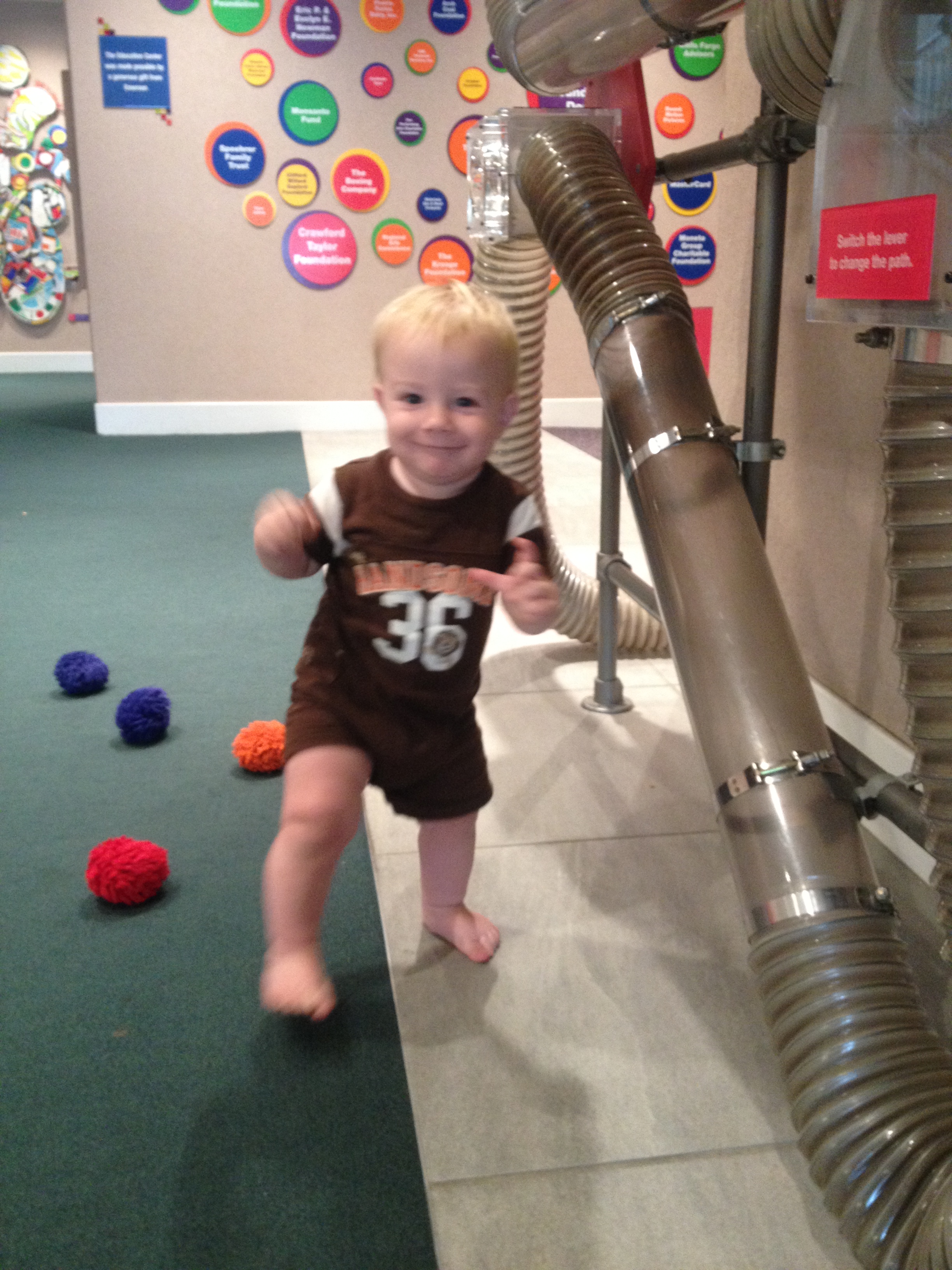
Like mother, like son. “Grinding corn” at the Newburg Children’s Museum two weeks ago.

Can I take a few minutes to :::::sob:::::? While I delight in baby milestones, I can’t help but feel like I’ve been “cheated” out of the last three months of having a baby! He is remarkably toddler-like and not just the walking, but the talking too. He actually asks for things saying, “me, me, me?” or, “meeeeeeeeeee!” with lunge + grab, when not getting his fair share. We’ve heard him say high five, bad, cat, ow, bye, ball, yum yum, rock, dad, doll, block, and “away” (while putting blocks away in tub: “bock. way.” Is that a sentence before ten months? 😉 )

He also kisses baby dolls on the head and snuggles his face into theirs. And, he makes music with everything—rattles bracelets, drums on surfaces, strums the wires. He is remarkably good at figuring stuff out—i.e. dropping something between slats and then staring at it, trying to reach through to get it and that doesn’t work, so bends down and reaches around and under to retrieve it instead. He loves to eat whole peppers from the green house and merrily rides out to pick them with Mark every day.

He crushes All. The. Things. It is nonstop chore keeping him from ruining the rest of the house and the people in it.

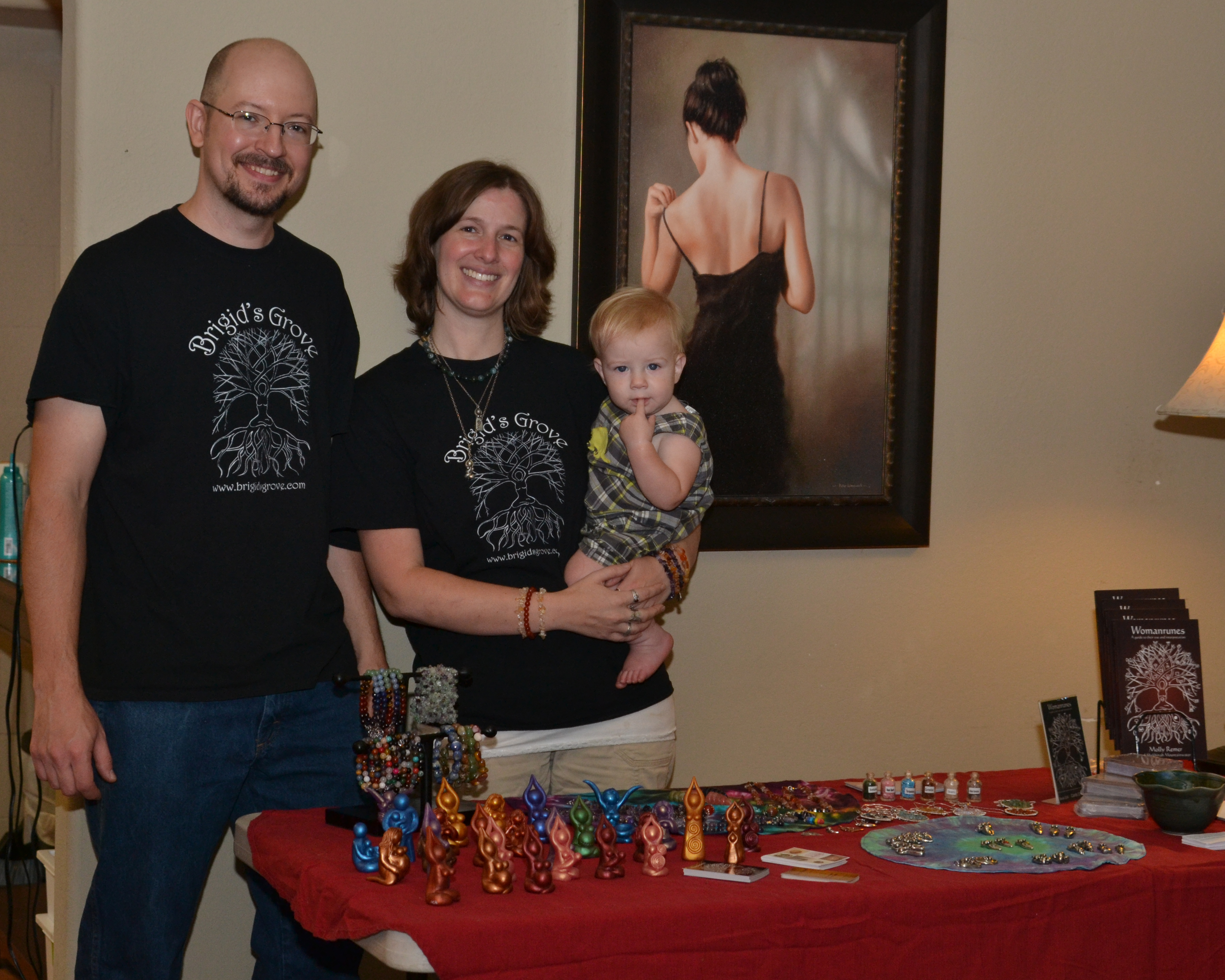
Working at our table at Mamafest last weekend.

Working at our table at Mamafest last weekend.

He is also a very rough nurser—preferring to nurse upside down with legs standing up over my shoulder, while I’m lying on my back (usually attempting to practice yoga). He makes the same “bratty” face that all my kids have made and that I remember my youngest siblings making too: nose wrinkled up, smirky smile, and a snuffing, hissing sort of sound with tongue against teeth while doing something intentionally naughty or destructive. (He also says, “bad” while getting some things, which makes me really annoyed with my other children, who have been known to holler “BAD!!!!” at him when he is getting into their things.) He also has a knack for raising one eyebrow in surprise. I can’t do that myself, but all of my kids can and got it genetically from Mark. Tanner seems really young for it though!

Tanner is a morning baby compared to all of our other kids. He is ready for bed at about 8:30 and wakes up at about 8:00 each morning with big smiles, hugging me, snuggling, and ready to go. When I pick him up, he adds an extra oomph/leap to it so that he flies into the air and into my arms. He will lean from my arms  to hug and snuggle everyone else in greeting–face leaned against chest or head, saying good morning.

At the end of last week, we went to Magic House with friends in St. Louis. The kids had free tickets from the summer reading program at the library. We had an amazingly good time. I figured I might as well put the photos from it into this post as well!

August 2015 053Last year, when we went to Magic House, I was pregnant with Tanner. What a difference a year makes! That is what I mean about being “cheated” out of three months of baby. This time last year, I was pregnant and there was no Tanner in the house. Now, there is a toddler boy! What happened?!

Recreating pregnant picture from previous year as well as modeling new silk skirt from my mom!

Recreating pregnant picture from previous year as well as modeling new silk skirt from my mom!

August 2015 063

The tiny judge in this picture cracks me up every time I see it!


Tuesday Tidbits: Parenting Big and Little Kids at the Same Time

July 2015 146

The biggest (almost 12) and the littlest (9 months) at Alley Spring at the end of July.

I’ve been trying to post this post since last week. But, then Zander stood on my closed laptop and broke the screen. (Luckily, Mark is a genius and Amazon has overnight shipping so it had the screen replaced within 24 hours and was ready for me to take to the first night of class at the Fort). Then, while we were at Mamafest on Saturday, there was a big storm that took out our internet and apparently our dryer too. The ISP can’t fix said internet until possibly Friday, which creates a near crisis survival state in a home with two work at home parents. It is hard to teach online and to ship orders with only one little iPhone’s connection to the outside world!

I’ve been really crying out for rest lately and interestingly, this forced hiatus has felt like a welcome change. We spent the morning sitting on the back deck, drinking tea, reading magazines (that with working internet perhaps would have remained unread for 6 months), while the kids played (alternating with wigging out about spiders and screeching about Tanner getting too close to the edge of the deck). 

This was going to begin as a much different post, but a lot happens in a week as well as a little refreshment and perspective offered by some time off “verandahing” (as Leonie Dawson would say). I woke up yesterday morning telling Mark, “today I will be full of enthusiasm…and making lists.” And, indeed, I did make lists. I made lists of what matters to me/us to include in every day, every week, every month, every other month, and every year. I’m ready for our home to be our haven, our own “retreat” space, and to have it feel as nice and nurturing on a regular basis as it feels to be on vacation. I’m ready to stop pushing and forcing and trying so hard to take care of everything…and then one more thing after that. This is going to mean some significant changes to my blogging here, but I will save that for a separate post. 

It is hard sometimes to feel so full to bursting with inspiration and ideas constantly, while coupled with the realities of the needs of a household of six people. I’ve been feeling down and discouraged about changes in friendships, homeschooling, projects, and more. Tanner has been teething (maybe), sleeping poorly and napping worse, and has morphed suddenly into a full-scale walking baby. Adequately parenting a multi-age range of kids feels virtually impossible. Meeting the needs of one usually means another’s needs are left unmet. I usually feel like I am not “enough” for my kids, while in the rest of my life I feel like “too much,” like I’m overwhelming and too intense for the people around me.

Tanner is a baby-on-wheels walking baby (leaving totally impressive destruction in his wake) and suddenly saying lots of new words intentionally: “ball” and “cat” and “ow,” “Dad,” “rock” and “yum.” Alaina is perpetually in need of attention and help. The older boys blessedly give each other attention and are helpful with Tanner, but increasingly pick on Alaina and taunt her in a way that really needs to stop. When they have things to tell me, I usually have to say, “not now,” or “hold the baby.” Instead of having those fabled bonding-with-pre-teen-boys conversations in the car I always read about, instead we are all loudly singing, “bay-bee, bay-bee, baby, baby, baby,” in an effort to keep Tanner from crying so hard in the car he throws up. “We HAVE to listen to them talk about Minecraft now,” I lament to Mark, “or when someone offers them cocaine, they won’t feel like they can tell us!!!!”

My mom, also a parent of four, split by age much the same as my own, tells me it actually gets harder from here!

So, my posts I highlight today are a potpourri of offerings about big kids and parenting in general…

First, a spot of humor:

The research found that despite using the same disciplinary methods, 100% of the children were more responsive to instructions spoken at a normal voice level if they came from someone other than their mother. To receive similar behavioral results, the women in the group had to raise their voices to that of someone being attacked by several large animals.

via Study: Children Are 800% Worse When Their Mothers Are In The Room | Mom News Daily.

And, then the bad news. Research on the happiness of German parents drew some grim conclusions…

Life has its ups and downs, but parenthood is supposed to be among the most joyous. At least that’s what the movies and Target ads tell us. In reality, it turns out that having a child can have a pretty strong negative impact on a person’s happiness, according to a new study published in the journal Demography. In fact, on average, the effect of a new baby on a person’s life in the first year is devastatingly bad — worse than divorce, worse than unemployment and worse even than the death of a partner.

via It turns out parenthood is worse than divorce, unemployment — even the death of a partner – The Washington Post.

It was interesting to note that the effect was even stronger in parents who are over 30 and have a higher level of education.

Luckily, it turns out that the whole four kids thing is a winner though in the parental life satisfaction arena!

Families with four or more children enjoy the greatest life satisfaction, a five-year study by Perth’s Edith Cowan University has found. Bronwyn Harman, a lecturer in the School of Psychology and Social Science, asked parents from different family types about resilience, social support and self-esteem. She found that parents with four or more children had the best ratings in each of these areas. The second-highest life-satisfaction scores, separated by just 0.25 per cent, were parents who identified as lesbian, gay, bisexual, transgender or queer (LGBTQ). “With large families, we think they have social support within the family,” Dr Harman said. “The kids are never bored, they have someone to play with and they get independence quite early on.”

via Bigger is better: Parents with four or more children happiest despite chaos, research finds – ABC News (Australian Broadcasting Corporation).

A couple of years ago, I spent some time musing about why parenting feels so hard and why do new mothers often say, “why didn’t anyone tell me?!” The individual pieces of parenting aren’t that hard and it is hard to point specifically to anything as “the reason” (which is why remarks about said hardness are so frustrating and mystifying to first-time parents while still pregnant), but I settled on the fact that it is relentless. That’s what’s hard. It never stops. And, once you start it, it basically keeps going to the end of your life!

I sink down onto the kitchen floor and cry.

I cry because the work of motherhood is relentless.

I cry because I’m tired.

And I need a shower.

I cry because it’s taking me half an hour to cut up these damn plums.

And I cry because I love these kids so much. They’re beautiful and curious and funny and complicated and completely exasperating. They deserve my patience, and I want to give it to them, but today it’s buried under a heaping pile of demands and I yelled at them instead.

via I’m Not Taking A Break. I’m Breaking. – Scary Mommy Scary Mommy

Moving on to the big kids though and those car conversations we don’t get to have…

I am sorry that when you are starting to explore girls, finding your own independence, and wanting some adult conversation, the toddler is saying the same thing a hundred times in a row at the top of her lungs and we cannot hear you.

I am sorry that every time you want our attention, the baby starts crying or needs something. I am sorry that when you first wanted to drive, we did not trust you with the kids in the car and so it took awhile before you could get your hours up on your learner’s permit.

I am sorry we do not pick you up at the train station when you finish work more often, because we are either settling your baby brother, feeding him, or fell asleep waiting for your text.

I am sorry I cannot remember what time your game is on Sunday – or anything you have told me, for that matter – because I have not slept a full night in over a year.

via Dear Teenager, Sorry About The Toddler And The Baby Scary Mommy.

And this ode to big kids that rings so true for me right now:

You didn’t sign up for this position. You didn’t choose to be the ones born first, a few years earlier, and if you asked to be in this situation, you probably didn’t know what being the older one actually entailed. Real babies and real toddlers, well, they’re a whole lot different than the stuffed animals you used to push in the toy stroller and put to bed in shoe boxes, aren’t they? Yet, you handle the younger ones with an unexpected patience and gentleness (OK, usually), and a lot of the time, you “Big Kids” do a better job of not totally losing it in the face of an unruly 2-year old’s demands than most adults. It’s inspiring. Big Kids are a parent’s unsung heroes. Thank you for holding the fussy baby while we fumble through our trashcan of a purse looking for our credit card so we can just pay for these diapers and get the hell out of the store and home before nap time.

via A Thank You To The Big Kids Scary Mommy

In the midst of all these ups and downs and multitudinous chaos’ of daily life, I am stunned by the bookended realities of my biggest boy and my littlest boy. In looking at the two of them together, it is all right there, in a heart-rending way that means, in fact, I am paying good enough attention and I am, myself, enough after all.

I knew that it would all go very fast, but I still, somehow, forgot just a little bit that once those years were gone, they were gone forever and irretrievable. I forgot, for a moment or many, that it’s a special grief that parents must continually and consistently endure: being at once nothing but grateful our children are growing and healthy, and yet at the same time, painfully aware of the loss of something with each year they put behind them…

via Just Like That Scary Mommy.

At the same time I’ve been feeling this tension and strain and perpetual “push,” I felt moved to create a new sculpture. She was created to remind me to be tender with my heart and to hold my own center with as much love as I’ve cradled my babies, all ages of them, for the last twelve years.

IMG_7256

Sign up for the Brigid’s Grove Newsletter for resources, monthly freebies, + art and workshop announcements.

Most recent Brigid’s Grove newsletter is here.