More Readings for Women’s Programs

I absolutely love collecting these kinds of things (almost as much as I love collecting quotes) and I figure that as long as I’ve bothered retyping or saving them, I might as well share them via my blog—that way more people can possibly benefit from or enjoy them!

Invocation:

Mother of the Medicine Wheel (from Sage Woman issue 81)

By Sharon Blessum

In the womb of the East Lodge

She gives birth in the morning.

She mothers us with smiles and songs.

In the strong sun of the South

She offers food from Her garden,

Enchantment for the mid-day of life.

In the benediction of the West

She colors evening with sunset

Wraps us in reflections of day.

In the old age of the North Lodge,

She will hold us in sweetness

Cross with us into the Land of the Ancestors.

—-

Opening Words/Chalice Lightings

May we be reminded here of our highest aspirations,

 and inspired to bring our gifts of love and service to the altar of humanity.

 May we know once again that we are not isolated beings

 but connected, in mystery and miracle, to the universe,

 to this community and to each other.

-Anonymous (Reading #434 in Singing The Living Tradition)

—-

Or (not sure of the source for this one, I had it jotted on a little piece of paper):

With the kindling of this flame,

We honor the mysteries and riddles that prompt us to ask questions;

We give thanks for community, in which we can seek their answers;

And we open our hearts and minds to our great and many freedoms.

Introductory Reading/Welcome

The Gaze of Love: A Body-Loving Invitation to all Women, by Patricia Lynn Reilly

Today, and everyday, let’s turn toward other women’s bodies, and our own, with mercy and unconditional acceptance, letting go of the competition and scrutiny-based sizing up of each other, letting go of the subtle put-downs and diminishments when we’re threatened by each other, allowing healing attention to flow one to another until the gaze of love heals us.

A gaze of love, calling wise women with their beautiful silver hair and life-lines out of hiding; inviting our smart, gifted daughters to reject the tyranny of thinness and to cease from harming themselves; welcoming the full, rounded bodies of our friends, bodies that refuse to be battered into shape by diets and admonishments.

A gaze of love so powerful, so encompassing, embracing the whole community of women, all sizes, shapes, colors, ages, and languages, with the widest welcome, the deepest affirmation, the highest calling, the loudest YES.

A gaze of love, inspiring us to bite into LIFE and the fullness of its possibility, to express LIFE through us in color and shape, sound and movement, to honor LIFE by turning our body-loving energy toward projects of justice, relationships of comfort, strategies of  wellness, and words of affirmation.

Knowing we’re all in this together.
One breath. One body. One life. And so it is.

Moon Salutation Yoga Series for Blessingway or Women’s Gathering

At my blessingway with my second son, my mom led us through a moon salutation together outside and then we all entered the blessingway space via a “birth arch” made with the women’s arms (think London Bridge only all in a row making a channel of arms to pass through). This weekend, we had a women’s retreat with the theme of the sacred body and I found this moon salutation from the book She Who Changes for us to do together—seemed fitting that with a theme of the body, we should actually use our bodies! (In addition to the moon salutation below, I also have a handout with a birthing room yoga series available.)

Moon Salutation
I stand tall, heart open to the world, body full and present in all of its beauty.

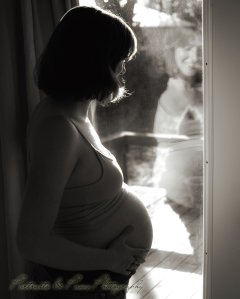
(c) Karen Orozco, Portraits & Paws (Molly at 37 weeks)

(standing with arms in prayer position)

I open my arms wide to bring all of life into my being.

(opening arms and tracing the circle of the moon)

My arms form a temple above me, sheltering and protecting me.

I know that I am on holy ground.

(arms completing the circle extended with palms touching above the head)

Yielding now, softening, my body takes the shape of the crescent moon.

I see visions of women, young and old, helping and loving each other.

(bending to the side with arms still above the head and palms touching)

Rising up and bending to the other side, I know that my softness is my strength. I am tested, but not broken.

(bending to the other side)

Up again, I feel the sweet stillness, always present within me.

(arms above head, palms still touching)

I step wide now into a squat. Mother Earth’s ferocious powers rise up through my strong legs, hips and back. As woman, I give birth to all that is, caring for and protecting life.

(arms bent in priestess pose, legs bent and open in birth pose)

Straightening arms and legs, I am a star. I am the universe. Planets and galaxies whirl within me. I radiate in all directions.

(legs straight and spread widely apart, arms straight out to the sides)

Supple and yielding, I stretch to the side. I open my arms and look up, opening to love and compassion.

I reach, yearning and striving, and yet rest, accepting fully.

(triangle pose)

Turning to pyramid pose, I become quiet. Head to knee, I sense the inner workings of my own being.

(typical runners’ stretch)

Lunging, I stretch long and feel the glorious length of my body.

As I look up, the moon shines on my path.

(lunge pose)

Turning now, I touch the earth, hands on the blessed Mother, strong and steady.

Gratefully and tenderly, I bow my head.

(turning and bending to touch the earth)

Coming into a squat, I am connected with all animal and plant life. My body open and close to the earth, I know my body’s ability to give birth, to love, to work, to pray. I resolve to hold all of these activities as sacred.

(full squat)


The Moon Salutation continues with the poses repeated in reverse order to form a complete circle and cycle of the moon with the whole body. The combination of words and yoga movement creates connections between the body and the mind, enabling the meaning of the words to come into the body. The full meaning of the Moon Salutation can be appreciated only in the doing. It celebrates the female body and the earth body, affirming that the female body is sacred, an image of the body of Goddess. It names the connection between women and the moon, positively affirming cycles of change, in contrast to classical theological traditions. In the Moon Salutation, women’s changing bodies and the process of giving birth become images of the divine creativity of the Goddess. The Moon Salutation celebrates strength as supple and yielding, yet ferocious in the protection of life. These are images of strength as power with, not power over. In the Moon Salutation, the female body is not perceived negatively as it is in traditions associating femininity with the “weaker” light of the moon. Still, it might be asked: Does the Moon Salutation limit women to the body or the traditional roles associated with it? I do not find this to be so. In the Moon Salutation the female body is an image of all the creative powers in the universe. It can expand to include planets and galaxies. The female body is celebrated not only for its capacity to give birth, but also for its ability to love, to work, and to pray.

From: Carol P. Christ. She Who Changes: Re-imagining the Divine in the World, Kindle Edition.

Placenta Encapsulation—Three Days Postpartum Comparison…

I’ve been wanting to write a quick post about placenta encapsulation for ages. I had it done after Alaina was born and I’m a total convert. A month or so ago, the topic came up on a breastfeeding email list I belong to, with concern raised by several IBCLCs about the possibility of hormonal disruption of milk supply with placenta ingestion. Several women stated that they would not be comfortable doing it until there is some real evidence to support it. All I had to offer to the conversation was my own personal experience (and, I’m well aware that the plural of anecdote is NOT “data”) and also the observation that it is common practice for mammals to ingest the placenta. Of course, mammals eat it all at once and don’t powder it up into little capsules first, but then again, mammals also don’t wear socks or read stories to their kids or drive cars or sleep in beds in warm comfy houses either. I only found minimal evidence online via these two articles (which I think cite the same sources): Research Studies supporting Placenta Encapsulation and Scientific Research (from Placenta Benefits which certifies placenta encapsulators). Edited to add: there is a literature review now available at this site.

Anyway, this is what I shared with the list about my own experience:

I had it done with my last baby (born in January) and I’m a total convert. I have never felt better during postpartum. I joked that I was “placenta powered.” I felt and looked great—good color in my face, etc. Tons of energy. Total opposite of my other postpartum experiences in which I felt completely depleted and run over by a truck. I didn’t even ever feel like taking naps during the early weeks—you know how new mothers are often all strung out and exhausted. I was vibrant, cheerful, and alert. (I also swallowed a small piece of it raw, immediately pp.) I do not think there is any real research on milk supply and I had/have the same questions as you—if it is putting those “discarded” hormones back into the body, couldn’t it have a milk supply reducing effect? My guess is that the amount you take is so small (one placenta makes around 100 capsules), that it does not have a significant impact on supply one way or the other. I only have anecdotal evidence to offer in favor of it. In addition to various long-distance friends, three in-person friends have also done it during the last six months. Three of the four of us have had oversupply—one of which had not had oversupply with her other three children (my other friend and I had oversupply with previous children who we did not do placenta encapsulation with), though she is tandem nursing, so I suspect that as the cause more than placenta (she also has had mastitis with the current nursling).

I had less trouble with oversupply this time around than with previous children—my first baby and I struggled with it for 10 months, my second baby and I did 12 hour block feedings to get it under control. With my new baby, I started block feeding her from birth (I know this isn’t an officially recommended strategy, but I truly think it made a very positive difference for us). While we still had some issues with it, including several days of 12 hour blocks and one day with 24 hours on one side only (her choice, not mine!), it was much less stressful than my previous experiences. (And, BTW, I did have a couple of plugged duct incidents that quickly resolved with ginger tea compresses.)

Anyway, IMHO, placenta encapsulation= awesome. I really support it!

Oh, and one side effect I did experience was bad headaches when I started “weaning” off the placenta pills. I’ve always been sensitive to hormone changes provoking headaches (get one with ovulation and then again with menstruation, etc.).

As I was typing and thinking about my experiences, some pictures came to mind and so in this post I want to do a photographic comparison of how I looked at 3 days postpartum with each baby. (I left out Noah’s post birth pictures, because how I look in those is complicated by grief as well as blood loss.)

First baby–pretty happy and pretty tired. Note the eyes, pale skin, and the semi-exhausted tilt of head.

Second baby. Could NOT find another 3 days pp that was any better than this. Again, note pale skin and kind of distant, tired eyes.

Second baby again, but now one week postpartum. I’ve perked up! Still see tired eyes and pale-ish skin.

Last baby–note pink cheeks and happy, sparkling, semi-manic, placenta-powered eyes!

Of course, when this picture was taken I had actually hardly ingested any of the placenta, but for me, it visually sums up the vastly different physical recovery experience of this most recent postpartum time. I also think part of the difference is also in my emotional relief at her live birth!

Integrated Mama

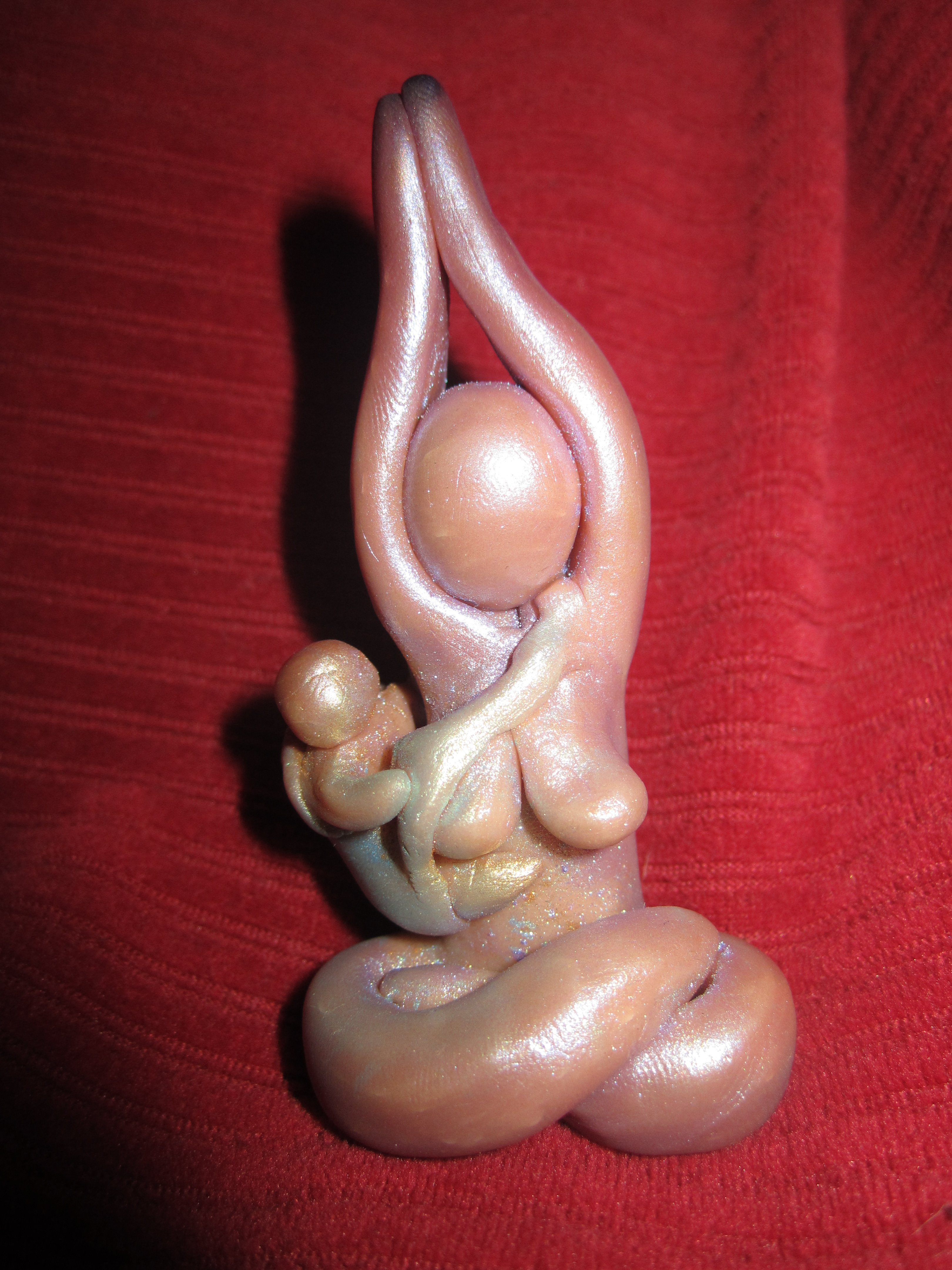
Alaina turned nine months old this week and I again found myself wishing to make a new polymer clay goddess sculpture to capture this new phase in our life cycle. I’m interested by how I began this series during my pregnancy with her and how I continue to feel “moved” to add to it as she grows and changes. While she is on the move a lot, she also spends a great deal of time riding on my hip in a pouch carrier. So, it felt àpropos to make another slingin’ mama figure, this time with the baby on her hip. While, as always, it isn’t perfect, I do like how my new sculpture turned out:

Slingin' mama goddess!

Healthy Baby Fair Booth--just popped out of baby carrier for photo op

I’ve written several times before about my desire to live an integrated life and I honestly think that babywearing makes it (semi) possible. She most wants to be with me, but often she doesn’t want direct play, she wants to ride along and see what interesting things I’m going to do. I think this is part of baby’s biology and part of how the motherbaby relationship is socially and biologically meant to be at this point—mother goes about her business (grinding corn, perhaps), with baby very close and watching. Unfortunately, this doesn’t include typing things on the computer, which is what much of my work actually entails. So, I save household work to do while she’s awake and riding along and I do computer-based work while she sleeps. That way, we (usually) both get our biologically appropriate needs met within our cultural context. Recently, I had a LLL table at the local Healthy Baby fair and several people came up to my friend and me to comment on how we were wearing our babies and how they were just riding along so content to look at what was going on. I tried to explain to one booth visitor who was expressing concern about the changes babies bring to life how I believe that babies can go along with mothers as they go about their tasks/days—it is possible to integrate the baby into the rest of your responsibilities.

Looking at the wavy lake from safe harbor of mama's body (in Ergo)

I was thinking about this again over the last couple of days that I spent with my family on a mini-vacation to Silver Dollar City (theme park in Branson, Missouri). As long as Alaina was riding with me in the pouch or Ergo she was totally happy. We spent hours outside on Wednesday in pretty bitter cold and she rode and looked and nursed and snoozed. On Thursday we took a lunch “cruise” on a Showboat (didn’t actually cruise due to wind) and again, she rode and checked out the world. Then, on Friday, we were back in the park where she got to go on her first rides ever like a big girl—the carousel (out of pouch) and on the Flooded Mine ride (where the whole family rode in a boat—she rode in the Ergo in the boat with me).

Big girl going for a ride!

Several years ago at an LLL conference, a sleep “expert” spoke during the lunch session. She was of the opinion (which is not shared by LLL as a whole), that nursing a baby to sleep is a “habit” that you don’t want to get into and advocates detaching them when they get sleepy so that they learn how to fall asleep without relying on nursing to get them there. She gave examples of babies and sleep associations and then said, “but if a baby is used to being nursed to sleep, they could fall asleep in the middle of Times Square while the ball was dropping on New Year’s Eve as long as mama was there too and nursing them.” And, I thought, EXACTLY! The problem with that is….?! That is one of the very best things about breastfeeding to me—home is where the mama is. So, this week as Alaina snoozed peacefully when she was sleepy while roller coasters sped around and bluegrass played and fiddlers fiddled and cold winds blew and people swarmed all over, I was thankful that I’ve never tried to get my baby to develop a different sleep association! Breastfeeding is magic like this to me, not an inconvenience or a habit to be restructured.

She is nursing in this picture

Of course, integration of parenting with work can also be a pretty significant challenge, as I touch on in my recent interview in the working/parenting series at Molly Westerman’s blog First the Egg. (I typed my responses to her interview questions on my phone while lying on my side in bed nursing Alaina to sleep.)

My whole series of sculptures

The Value of Sharing Story

“..no matter what her experience in birth was, every mother knows something other people don’t know.”—Pam England


“Stories are medicine…They have such power; they do not require that we do, be, act anything—we need only listen. The remedies for repair or reclamation of any lost psychic drive are contained in stories.” –Clarissa Pinkola Estes


Every woman who has given birth knows something about birth that other people don’t know. She has something unique and powerful to offer.

As birth professionals, we are often cautioned against sharing our personal stories. We must remember that it is her birth and her story, not ours. In doula and childbirth educator trainings, trainees are taught to keep their own stories to themselves and to present evidence-based information so that women can make their own informed choices. As a breastfeeding counselor too, I must remind myself to keep my own personal experiences out of the helping relationship. My formal education is in clinical social work and in that field as well we are indoctrinated to guard against inappropriate self-disclosure in a client-helper setting. In each environment, we are taught how to be good listeners without clouding the exchange with our own “baggage.” The messages are powerful—keep your own stories out of it. Recently, I have been wondering how this caution might impact our real-life connections with women?

Nine months after I experienced a powerful miscarriage at home at 15 weeks, a good friend found out at 13 weeks that her baby died. As I had, she decided to let nature take its course and to let her body let go of the pregnancy on its own timetable, rather than a medical timetable. When she emailed me for support, it was extremely difficult to separate our experiences. I kept sharing bits and pieces of my own loss experiences and then apologizing and feeling guilty for having violated the “no stories” rule. I kept telling her, “I know this isn’t about me, but I felt this way…” I told her about choosing to take pictures of the baby and to have a ceremony for him at home. That I wished I had gotten his footprints and handprints. The kinds of personal sharing that may have been frowned upon in my varied collection of professional trainings. After several apologies of this sort, I began to reflect and remembered that what I hungered for most in the aftermath of my own miscarriage was other women’s voices and stories. Real stories. The nitty gritty, how-much-blood-is-normal and did-you-feel-like-you-were-going-to-die, type of stories. Just as many women enjoy and benefit from reading other women’s birth stories, I craved real, deep, miscarriage-birth stories. These stories told me the most about what I needed to know and more than organization websites or “coping with loss” books ever could.

I had a similar realization the following month when considering the effectiveness of childbirth classes and trying to pin down what truly had reached me as a first time mother. The question I was trying to answer as I considered my own childbirth education practice was how do women really learn about birth? What did I, personally, retain and carry with me into my own birth journey? The answer, for me, was again, story.

On this blog, I have a narrative about my experiences during my first pregnancy with being able to feel my baby practicing breathing while in-utero. More than any other post on the site, this post receives more comments on an ongoing basis from women saying, “thank you for sharing”–that the story has validated their own current experience. In this example, rather than getting what they need from books, experts, or classes, women have found what they needed from story and, indeed, most of them reference that it was the only place they were able to find the information they were seeking.

And finally, as breastfeeding counselor, during monthly support meetings, I cannot count the number of times I’ve seen mothers’ faces fill with relief when another mother validates her story with a similar one.

So, what is special about story as a medium and what can it offer to women that traditional forms of education cannot? Stories are validating. They can communicate that you are not alone, not crazy, and not weird. Stories are instructive without being directive or prescriptive. It is very easy to take what works from stories and leave the rest because stories communicate personal experiences and lessons learned, rather than expert direction, recommendations, or advice. Stories can also provide a point of identification and clarification as a way of sharing information that is open to possibility, rather than advice-giving.

Cautions in sharing stories while also listening to another’s experience include:

  • Are you so busy in your own story that you can’t see the person in front of you?
  • Does the story contain bad, inaccurate, or misleading information?
  • Is the story so long and involved that it is distracting from the other person’s point?
  • Does the story communicate that you are the only right person and that everyone else should do things exactly like you?
  • Is the story really advice or a “to do” disguised as a story?
  • Does the story redirect attention to you and away from the person in need of help/listening?
  • Does the story keep the focus in the past and not in the here and now present moment?
  • Is there a subtext of, “you should…”?

Several of these self-awareness questions are much bigger concerns during a person-to-person direct dialogue rather than in written form such as blog. In reading stories, the reader has the power to engage or disengage with the story, while in person there is a possibility of becoming stuck in an unwelcome story. Some things to keep in mind while sharing stories in person are:

  • Sensitivity to whether your story is welcome, helpful, or contributing to the other person’s process.
  • Being mindful of personal motives—are you telling a story to bolster your own self-image, as a means of pointing out others’ flaws and failings, or to secretly give advice?
  • Asking yourself whether the story is one that will move us forward (returning to the here and now question above).

While my training and professional background might suggest otherwise, my personal lived experience is that stories have had more power in my own childbearing life than most other single influences. The sharing of story in an appropriate way is, indeed, intimately intertwined with good listening and warm connection. As the authors of the book, Sacred Circles, remind us “…in listening you become an opening for that other person…Indeed, nothing comes close to an evening spent spellbound by the stories of women’s inner lives.”

Molly Remer, MSW, ICCE, CCCE is a certified birth educator, writer, and activist who lives in central Missouri with her husband and children. She is an LLL Leader, a professor of Human Services, and the editor of the Friends of Missouri Midwives newsletter. She blogs about birth, women, and motherhood at https://talkbirth.wordpress.com.

This is a preprint of The Value of Sharing Story, an article by Molly Remer, MSW, ICCE, published in Midwifery Today, Issue 99, Autumn 2011. Copyright © 2011 Midwifery Today. Midwifery Today’s website is located at: http://www.midwiferytoday.com/

Glass Half Full

Written by Katy Read, the article “Glass Half Full” in the fall issue of Brain, Child magazine, explores the questions: “Have mothers complained too much, already … or not enough?” In it, she references a book I hadn’t yet heard of by Bryan Caplan, Selfish Reasons to Have More Kids: Why Being a Great Parent Is Less Work and More Fun Than You’d Think

…Caplan argues that parents make their own job unnecessarily difficult. If they’d cut themselves some slack, he insists, raising kids would be more enjoyable—so much so that couples should consider having more children than they’d planned.

At the same time, however, other observers contend that it’s still rare and socially risky for mothers to admit any discontent…

So which are we: A culture in which mothers hesitate to voice misgivings for fear of social reprisal? Or one so inundated with maternal kvetching that onlookers are understandably tired of it?…

Glass Half Full in Brain, Child magazine.

She later returns to Caplan’s ideas about nature vs. nurture (i.e. that nurture carries less weight than we often assume):

Why do moms “self-flagellate”? Because they’ve been taught that kids pay a long-term price for their parents’ ordinary mistakes. They don’t. Because they think they’re to blame for their children’s flaws. They aren’t.

But guess what. Admitting you can’t control phenomena that nevertheless significantly color your emotional well-being and day-to-day life is not necessarily a ticket to relaxation. Even armed with twins studies and mortality stats, I have not experienced parenting as the carefree romp that Caplan promises.

Sure, much of it has been wonderful. However, not to get all whiny mother on you, raising children remains an often complicated, frustrating, and stress-inducing enterprise, involving many kinds of challenges.

The best part of this article in my opinion, however, was the author’s postscript:

If I were the conspiracy-theory type, I might imagine a sinister plot behind efforts to keep mothers from complaining. After all, mothers perform the lion’s share of unpaid housework and child care—and pay a steep economic price for doing so, on average making less money than fathers or childless people and suffering from a higher rate of poverty. What better way to keep mothers from rebelling against those circumstances than to discourage them from voicing any objections? It’s ingenious: convince women through cultural conditioning that mothers are blissfully content—or ought to be, anyway—and penalize those who contradict that image by lashing back with criticism dripping with contempt.

Luckily, I’m not a conspiracy nut. So of course I don’t seriously think that the writers and publications I quoted in this piece, whom I respect, are in cahoots with opponents of reforms that would make mothers’ lives more manageable (universal health insurance that would make part-time work more feasible, for example). Still, it’s worth asking why the reaction is so swift and harsh—why the outrage? where’s the threat? what deep, dark fears are being tapped?—when a mother dares to mention the empty half of the glass. Glass Half Full in Brain, Child magazine.

As a side note, the same issue contains another interesting article called Inappropriate. This article includes a nude photo of a woman with a double mastectomy and notes that no print publication has ever published the photos, taken by photographer/artist David Jay in a project called SCAR (“Surviving Cancer. Absolute Reality.”). So, it was cool to extrapolate from that that Brain, Child was the first publication to have the guts to publish his work in a print magazine!

American Girl & Nursing

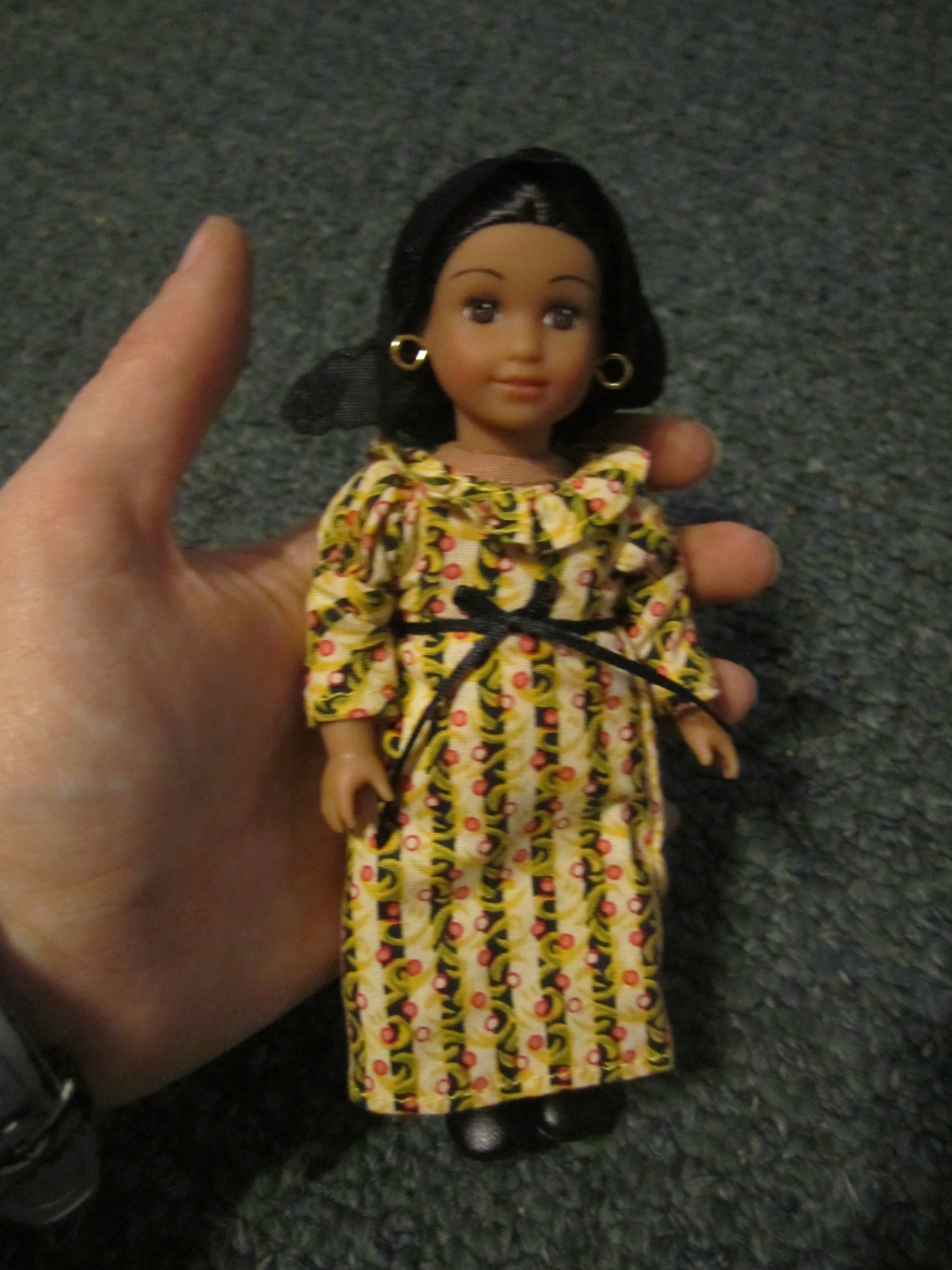
I’ve long loved American Girl dolls. While I’ve decided to finally decree “enough” on the full-size dolls, I continue to want to add to my collection of the mini dolls. This year in honor of the 25th anniversary, the company has special edition mini dolls in their holiday dresses. I went back and forth about whether or not I should buy them and finally decided to order a couple as my “reward” for juggling so much this session and making it through to the end! I opened up mini Josefina when my Monday night class ended and when my online class ends tonight, mini Kit will join her 🙂

To relate this post to my overall themes of this blog, I thought I’d mention an experience in the past when reading an American Girl book. In their “history mystery,” Riddle of the Prairie Bride, widowed father of 12 year old Ida Kate sends for a mail order bride. She arrives with her one year old baby and it soon becomes clear that something is amiss. She does not meet her description from her letters, gives inconsistent answers and so forth. Ida Kate investigates, mystery is solved, and true love reigns on the prairie. What’s the connection you may ask? Because, I always keep an eye out for “breastfeeding as normal” content in kids books and I loved that in this mystery the first clue that the prairie bride is not who she says she is is that she didn’t nurse her baby! (And, a one-year-old baby at that! Wow!) The book states, “She feeds him milk from a cup rather than nursing him as mothers do…” (Ida Kate notices the baby patting on the front of the mystery woman’s dress and instead of nursing him, she gets a cup of milk for him). I also liked the use of the word “nurse” instead of “breastfeed.” Cozy, familiar, desirable, and NORMAL. (With the emphasis on the process and not the product as Diane Wiessinger would say.) Of the top of my head, I also remember that in one of the AG short stories–Josefina’s Reward I think—her older sister has to hurry back from what she is doing to “nurse the baby” (who is also over one year old and walks and talks in the book).

(These breastfeeding bits don’t really make up for the bottles sold for Bitty Baby, but anyway.)

Mini Josefina in holiday finery

Holiday mini Kit is still in her box waiting to reward--luckily I have two regular mini Kits (plus one big Kit) to keep me company 😉

Have you met Pachamama?

I have a friend who was taking a mythology class in college this session. She sent me an email titled, “have you met Pachamama?” and included this great little picture:

I just love her! Love her serene little face and the yin-yang type of background.

“Pachamama is a goddess revered by the indigenous people of the Andes. Pachamama is usually translated as Mother Earth, but a more literal translation would be “Mother world” (in Aymara and Quechua mama = mother / pacha = world or land; and later widened in a modern meaning as the cosmos or the universe).[1] Pachamama and Inti are the most benevolent deities; they are worshiped in parts of the Andean mountain ranges, also known as Tawantinsuyu (the former Inca Empire) (stretching from present day Ecuador to Chile and northern Argentina being present day Peru the center of the empire with its capital city in Cuzco).”

http://en.wikipedia.org/wiki/Pachamama

Natural Learners

As long as I have homeschooling on the brain lately, I want to quickly share some things I had saved in my drafts folder. This will most likely be my last homeschooling post for a while and I’ll return to my usual topics!

Quite some time ago (pre-children), I wrote the following in response to a 2001 Time magazine article about homeschooling that bemoaned both that homeschooled children were “not allowed to have a childhood”  (forced to be miniature adults and grow up too soon) and that they somehow also “miss out on learning ‘real world’ skills” (in school) such as conflict resolution that will benefit them in adulthood. In the article, a strong statement was made that I’ve never forgotten that riding the school bus is a valuable and important part of growing up and imparts irreplaceable life lessons summarily denied to poor, deprived homeschoolers. (Luckily for my social and personal development as a complete human being, I did get to ride a school bus to our local Vacation Bible School each year for a number of years.)

Truly, is there anything inherently valuable about things like riding the school bus? I lived my childhood and it was rich and full in a way that is impossible to create when you spend 8-9 hours per day institutionalized. Why is sitting at a desk, artificially grouped with children all your own age, being spoonfed information, and restricted from developing your own personality and preferences (i.e. everyone must learn algebra), what childhood “should” be? Why do so many adults go through crises as adults that involve having to “find themselves” and develop their “true selves”? I would hypothesize that is because they never got to explore themselves and their identities in childhood, which is actually the ideal time for such growth and development. Government schooling is somehow seen as the better way for children to spend childhood instead of letting children develop, grow, and learn in the actual world in which they will live as adults.

I also had saved a quote about natural learners from the book, Providence, by Daniel Quinn. Quinn is the author best known for his philosophical novel Ishmael, which I read as a young teenager. I remember considering it to be a life changing and fascinating read, but it has been a LONG time since I read it—my primary memory of it is how he challenges the very human conception that we are the “end” result of evolution. That’s it, evolution has finished, we’re here now. Anyway, Providence was less illuminating/interesting. It was primarily an autobiography with an emphasis on how the author developed Ishmael (which went through more than 6 versions over a period of like 13 years) as well as an exploration of his religious development (which includes some time spent in a monastery and ends with animism).

While he was writing his book, he worked in educational publishing and I appreciated his remarks about education:

One of the great, persistent myths of education in our culture is that children become reluctant learners as they grow older. In fact, what they become reluctant about it going to school, where they’re bullied, regimented, bored silly, and very effectively prevented from learning…We know what works for children up to the age where we ship them off to school: Let them be around you, pay attention to them, talk to them, give them access to as much as you can, let them try things, and that’s it. They take care of the rest. You don’t have to strap small children down and teach them to speak, all you have to do is talk to them. You don’t have to give them crawling lessons or walking lessons or running lessons. You don’t have to spend an hour a day showing them how to bang two pots together; they’ll figure that out all by themselves–if you give them access to the pots. Nothing magical happens at the age of five to render this process obsolete or invalid.

Rebirth: What We Don’t Say

A new self did emerge. This is what women do not tell each other. I want to say it here: You will die when you become a mother and it will hurt and it will be confusing and you will be someone you never imagined and then, you will be reborn. Truthfully, I have never wanted to be the woman I was before I had children. I loved that woman and I loved that life but I don’t want it again. My daughters have made me more daring, more human, more compassionate. Their births have brought me closer to the earth and they have helped me pare my life down to its essentials. Writing, quick prayers, good food, a few close friends, many deep breaths, love, plants, dancing, music, teaching-these are the ingredients of my/this new self. I waited for this new self in the dark, in the bittersweet water of letting go, in the heavy heartbeat of learning to be a mother, against the isolation, I grew and emerged laughing and crying and here I am, sisters and brothers. Rebirth: What We Don’t Say | The Sage Mama.

One of my favorite songs to listen to after my miscarriage experiences had a refrain of, “it is dark, dark, dark inside.” While previously not connecting to “darkness” as a place of growth or healing, during these experiences I learned that it is in the darkness that new things take root and grow.

As I’ve shared before, one of my favorite quotes about postpartum comes from Naomi Wolf, A mother is not born when a baby is born; a mother is forged, made. The quote I shared above from this “Rebirth” article touches that place in me—that motherhood results in a total life overhaul and a new, enriched identity. (This article also made me think of first postpartum journey which I wrote about here.)

In a previous post, I wrote the following about the idea that giving birth and mothering leaves permanent marks:

I’ve also come to realize that despite the many amazing and wonderful, profound and magical things about birth, the experience of giving birth is very likely to take some kind of toll on a woman—whether her body, mind, or emotions. There is usually some type of “price” to be paid for each and every birth and sometimes the price is very high. This is, I guess, what qualifies, birth as such an intense, initiatory rite for women. It is most definitely a transformative event and transformation does not usually come without some degree of challenge. Sometimes to be triumphed over or overcome, but something that also leaves permanent marks. Sometimes those marks are literal and sometimes they are emotional and sometimes they are truly beautiful, but we all earn some of them, somewhere along the line. And, I also think that by glossing over the marks, the figurative or literal scars birth can leave on us, and talking about only the “sunny side” we can deny or hide the full impact of our journeys.

During Pam England’s presentation about birth stories at the ICAN conference, she said that the place “where you were the most wounded—the place where the meat was chewed off your bones, becomes the seat of your most powerful medicine and the place where you can reach someone where no one else can.

(I’m experimenting with PressThis for this short post)