I just finished reading another book about the history of childbirth. This one was called Get Me Out: A History of Childbirth. I half expected it to be a repeat of Birth Day, which I finished reading earlier this month, or at least similar to Birth: A Surprising History of How We are Born (the covers are even similar). I was pleased to discover that this book stood on its own as an interesting and absorbing tale—the emphasis was really on the recent history of childbirth, up to and including sperm banking and cryo-preserving eggs. I will share a full review soon, but I first wanted to share one of the new things I learned from the book. In the chapter on Freebirthing, the author shares the story of Pat Carter, a woman in the 1950’s who had seven unassisted births and wrote a “manifesto” about unassisted birth called Come Gently, Sweet Lucina (the book I had heard of, the rest of the historical information, I had not). She called her theory of birth euthagenesis (“good origin”). It didn’t really catch on and the author of Get Me Out states that euthagenesis is one of the “few un-Google-able terms.” So, I instantly wanted to write a post and make it googleable 😉 Of course, I did google it prior to posting and lo and behold I did get a single result, Rixa Freeze’s dissertation Born Free: Unassisted Childbirth in North America. So, darn, I didn’t get to put it on the map first after all! Rixa is so awesome that I can forgive her for that though 😉
Archive | January 2010
Pathways Article
I was happy to have an article and an accompanying sidebar in the winter issue of Pathways to Family Wellness (the magazine of ICPA). This was one of my most exciting publications to date as Pathways is a lovely, full color magazine and they laid my article out so nicely and professionally. I’m posting about it here, because the articles were based on two posts originally written here:
What to Expect When You Go to the Hospital for a Natural Birth (re-named in Pathways as “The Hospital ‘Birth Plan'” and available in an online version here)
and
Can I Really Expect to Have a Great Birth? (included as the sidebar in Pathways)
As long as I’m writing about writing, I wanted to share links to some of my recent books/film reviews also:
Multimedia Review: Baby’s First Gift
Book Review: Labor of Love
DVD Review: It’s My Body, My Baby, My Birth: A film About Natural Childbirth
Book Review: The Power of Women
Book Review: Fathers-To-Be Handbook
Book Review: Permission to Mother
Book Review: Dance of the Womb
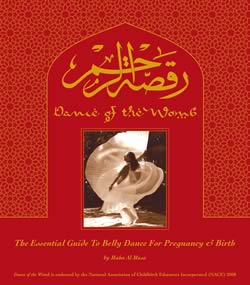
Dance of the Womb book cover
Book Review: Dance of the Womb: The Essential Guide to Belly Dance for Pregnancy and Birth
By Maha Al Musa, 2008
ISBN 978-0-646-48705-2
260 page hardcover book, $49.95 (AUS)
http://www.bellydanceforbirth.com
Reviewed by Molly Remer, MSW, ICCE
Some books simply feel good to hold in your hands. Dance of the Womb is one such book: it is beautiful, both in content and appearance. While priced a little higher than some birth books, I cannot emphasize enough what a high quality book it is—-it is not a traditional trade paperback, it is of textbook quality and size. Hardbound with a lovely cover and endpapers, Dance of the Womb is packed with full color, detailed, step-by-step instructional photographs leading the reader through a “belly dance for birth” journey.
Dance of the Womb is divided into several segments. The first section summarizes the benefits of belly dance and explores the physiology of birth. The next section walks the reader through a series of gentle warm-up exercises while the following sections progress through a variety of different specific belly dance movements. Nearing the conclusion of the text is a segment about labor movements with positions. Each section of the book is lavishly illustrated with very clear, easy to follow, step-by-step photographs.
The author’s own journey through pregnancy, birth, and mothering is skillfully interwoven throughout the text as well as her own feminine passage into understanding herself as a complete woman. Interspersed with the photographs and belly dance instructions, is the exploration of the author’s pregnancy and birth experiences, her relationship with her own mother and her parents’ culture. The book contains her personal birth stories as well as perspectives on belly dance for birth from three midwives.
The author, Maha Al Musa lives in Australia. Her interest in Middle Eastern Dance was sparked by her Palestinian/Lebanese roots and birthplace as well as her pilgrimage to explore her heritage and reconnect with her long-separated mother. Maha has also developed a Dance of the Womb step-by-step instructional belly dancing DVD (sold separately, review to follow) that includes a video of her own homebirth journey with her third child. She is also developing a one day foundation course in “bellydancebirth” for birth professionals with a plan to go international in 2011.
Dance of the Womb is a great introduction to not just the basic physical elements of prenatal belly dance, but also to the spiritual aspects of giving birth and life as a woman. It is written with an intimate tone that makes the reader feel as if the author has reached out across the miles to form a direct, personal connection. This book feels like a rich treasure to hold and is a gentle, nurturing, encouraging, and enriching voyage for pregnant women or the people who serve them.
—-
Disclosure: I received a complimentary copy of this book for review purposes.
Tips for Emotional Well-Being During Pregnancy
I got a lot of wonderful responses to my question about emotional well-being during pregnancy (associated with my giveaway of the book Birth Space, Safe Place). So, courtesy of a lot of wise women, here are some top tips for supporting your emotional well-being during pregnancy and birth:
- Peaceful Beginnings doula services shared “I think my best tip for emotional well-being during pregnancy (and life in general) is to let go of guilt. We can only do the best we can with the information we have at the time, no more, no less.”
- Yasmel shared that her most helpful tip, “would be to find whatever gives you positive thoughts and use it, a lot. I loved the book Ina May’s Guide to Childbirth and whenever I started second guessing my homebirth decision, I would open it up and just read the birth stories in it.”
- Heather appreciated a helpful tip from her sister: “I was having alot of people question my birthing choices and telling me that my baby and I were going to die. None of which happened. She told me that ‘you can’t expect people to agree with your choices or behave respectfully about them. All you can do is know that you are doing what’s right for you and your child and that is all the matters. Don’t let them change your mind with fear. It has no place in childbirth.’”
- And I especially enjoyed Ahmie’s advice: “remember that cats purr while giving birth. Figure out what makes you ‘purr’ while you’re pregnant and find ways to do more of that as well as to bring those tools to the birth-space with you.”
- One of the most simple and yet important tips was shared by bubbledumpster, “Trust yourself,” and echoed in several other comments, such as earthmothergypsy who said, “I think one of the best helps emotionally is to encourage mamas to trust in themselves, their bodies and their babies. By giving them support in a way that they don’t feel undermined they can build the above trust in themselves.” And inoakpark who said, ” learning to trust your body (and trusting the people who will be with you at your birth to hold that space), is vital for an emotionally secure pregnancy and birth.”
- bee in the balm offered another elegantly simple tip “to breathe, just take the time to come back to center and be and breathe.”
- Nicole d shared that her best tip is “meditation on good/safe birth… the normalcy and miraculous nature of it. So much of pregnancy stress is uncertainty and fear of the birth process. The more you can trust in the process of pregnancy and birth, the more joyful and peaceful pregnancy can be.”
- For Lee-Ann, “emotional wellbeing came with knowledge, the more I read and the more I normalized the birth process in my mind, the more research I did, the more confident and at peace I became.”
- Rebekah made an excellent point about honest during pregnancy: “I think being open and honest with yourself and talking to your baby openly helps. It benefits no one to ‘pretend’ like everything is perfect and is okay to have trials, doubts, and fears.”
- Jessica benefited from midwifery care: “One of the things that helped me a lot was having a midwife that I knew and trusted implicitly. I knew that my body and my baby would know what to do, and that I had a wonderful woman who would let it all unfold!”
- And whoz_your_doula pointed out the benefit of taking time for yourself: “For me that took the form of meditation and prayer. The early morning is my time for deep reflection before the house begins to stir.”
- A similar tip was shared by Gentle Beginnings: “I feel it is very important for a woman’s emotional well being to take a few minutes each day to spend time alone. To sit quietly and think about the precious child growing inside them, to disconnect from the world, to envision how peaceful they want their birth to be, to take a stroll in nature and to connect with their inner self. I think we can all benefit from these simple suggestions, but feel it is especially important during pregnancy and childbirth.”
- Helpful for birth educators as well as couples, Janet shared that her favorite tip is “teaching the mom and her partner to work together towards open and honest communication before hand. I find a lot of the mothers I teach think, ‘Oh, well we talked about it once and I think we are on the same page,’ only to be completely blind-sided afterwards. Keeping these lines of communication open before, during and after pregnancy makes for a much better emotional state for all.”
- Jamie moved us back to the trust theme: “Trust yourself. Trust that your body knows how to be pregnant and how to give birth. Be positive in the changes your body is going through and how you are being prepared for motherhood in all facets of your being. Know that you can do this—you are doing it!”
- And another excellent and simple tip was shared by Heather Richins: “My tip is to make sure you stay well fed and hydrated. It is hard to feel good emotionally if you don’t feel good physically.”
- Deborah had more than one to share: “1) Eat well: increase protein and raw fruits & veggies, and drink lots of water. Decrease refined foods, white flour products and sugars. 2) Exercise: walk, swim, yoga, etc. 3) Talk: find someone you trust and be honest about how you are feeling.”
- And finally, Kathy offered a comprehensive collection of tips: “to be conscious of their needs each day. This includes physical,emotional, and spiritual. For the physical; Eat well. Whole foods, including whole grains, fruits, vegetables. Protein intakes needs to be adequate for a pregnant woman on a daily basis. Eating often to keep your blood sugars level is especially important for warding off mood swings. For the emotional; Trust yourself and others who care about you. Surround yourself with positive people who support you in what your doing. Communicate your needs and wants. Be willing to be honest and vulnerable. Pregnancy can often ‘stir the pot.’ Being willing to work out your feeling and talk to someone you trust and bring about personal growth and sometimes, bring about healing the past. For the spiritual; It is just as important for the spirit to be fed, as it for the body. Fellowshipping with others of the same faith is uplifting to the spirit. Take time for reflections and meditations each day. Keep a journal.”
I appreciated all the responses and think that emotional well-being is such an important subject. I feel like, especially with a first baby, it is an often overlooked element of birth preparation—a lot of time and energy is spent on the physical health of the pregnant woman, but the emotions are assumed to kind of take care of themselves, to perhaps be no one’s business, or to be dismissed summarily as “crazy pregnancy hormones” and “mood swings of pregnancy!”
Cesarean Trivia
Anyone who is even slightly familiar with the history of childbirth in the modern world has probably heard the legendary story of the pig-gelder Jacob Nufer and the first successful cesarean section (performed on his wife in 1500). Successful because both mother and child lived, which had never before been documented to happen with a cesarean—and took quite some time to happen again. For example, there was a 100% mortality rate for cesareans performed in Paris for 89 YEARS (1787–1876). I’ve read several excellent books about the history of birth and feel fairly well-versed in the associated facts. However, this month I finished reading a new book by pediatrician Mark Sloan and was surprised to learn something completely new about the history of the cesarean section. This was that, the well-known legacy of Jacob Nufer notwithstanding, the first well-documented successful cesarean section performed in the English-speaking world was performed by Dr. James Barry in Cape Town South Africa in 1826. James Barry was quite the character, small of stature and very big of opinion and personality. He was a British Army officer who clashed frequently with everyone over everything (including even fighting duels!). He even had public arguments with none other than Florence Nightingale! And…then…the conclusion to this already interesting tale is that after Dr. James Barry died—after his forty year medical and military career—it was discovered that he was actually a woman!
I found this extremely fascinating. (I also imagined Jill at Unnecesarean using her Photoshop talents to make some kind of image about this…) So, despite the dominance of males in the medical profession, the first successful cesarean in the English-speaking world was actually performed by a woman! A point the author brings out in this discussion is that, “Here in the early years of the twenty-first century we have reached a point of high medical irony that would not be lost on James Barry: it now can take more courage—or foolhardiness—not to do a cesarean than it takes to do one.” How true.
Some other non-related quotes from Birth Day that I shared via the CfM Facebook page are as follows:
“Birth is about radical, creative, life-affirming change. It is about adaptation on a nearly unbelievable scale.” –Mark Sloan, MD
The quote above is in regard to the physical adaptations required by the baby immediately after birth—I see it as about both mother and baby though and I enjoy that it comes from a man and a doctor no less!
“Rigid plans work best if you’re building a skyscraper; with something as mysteriously human as giving birth, it’s best, both literally and figuratively, to keep your knees bent.” –Mark Sloan, MD
The above quote is from the segment about what he would want to tell his daughter about giving birth. Though the book wasn’t as “alternative” as many of the birth books I enjoy, I found Birth Day to be a very engaging and entertaining read!
Birth Space, Safe Place Book Giveaway!
This giveaway is now closed! The winner was drawn and was Jessica (of Jess Loves Being a Mommy)—please email me with your mailing address! 🙂
I am fortunate to have an extra copy of the new book Birth Space, Safe Place: Emotional Well-Being through Pregnancy and Birth. to give away to one lucky reader! 🙂 You can read my review of the book in the post below. There are three ways to enter to win the book and you will receive an entry for each method you employ (please make a separate comment for each of your entries):
1. Leave a comment on this post sharing your most helpful tip for emotional well-being during pregnancy and birth. I would like to compile these tips into a new blog post in the future (so if you don’t want me to include yours in that, please let me know!)
2. Become a fan of Talk Birth on Facebook (and post a comment here letting me know you are a fan).
3. Post about the giveaway on your blog and post a link back to it as well as a comment letting me know you did so.
Have fun! This is an interesting and useful little book and I know many people would enjoy having a copy. I will draw for the winner on Friday, January 22 at noon, so make sure to enter before that date!
Book Review: Birth Space, Safe Place
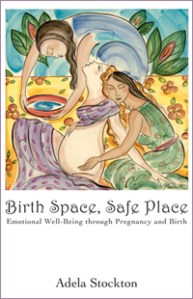 Birth Space, Safe Place: Emotional Well-Being through Pregnancy & Birth
By Adela Stockton
Findhorn Press, 2009
ISBN 978-1-84409-165-2
102 pages, paperback, $14.95
http://www.findhornpress.com
Reviewed by Molly Remer, MSW, ICCE
Appropriate for first time mothers as well as women having subsequent children, Birth Space, Safe Place is a slim and succinct little volume with a sole center: emotional well-being throughout pregnancy and birth. This very specific purpose is what makes the book special. It focuses on creating the emotional space for a gentle birth as well as a physical environment conducive to gentle, physiological birth. However, there is a broad range of topics covered within this specific focus including pain, fear, support, the “cocktail” of labor hormones, avoiding physiological disturbances of the birth process, optimal fetal positioning, and blessingways.
The chronology of the book flows from “conscious conception” through making decisions about birth location, preparing for labor, support during birth, “the spirit of birth,” and “early parenting joys and griefs” which addresses birth processing and postpartum recovery. The chapter on “cleansing the past” briefly addresses prior loss and bereavement, difficult previous birth experiences, and issues of abuse. Each section contains brief personal anecdotes, some from the author and some from mothers she has worked with. The exploration of each topic is brief, but is an adequate overview.
The author is a “childbirth homeopath” and so there are several sections about homeopathic remedies for specific symptoms or concerns. Aside from the homeopathic content, I did not feel as if I learned anything particularly new from the book, however it was very nice to have information about a specific element of pregnancy and birth preparation all pulled together into one nurturing place.
Birth Space, Safe Place is very supportive of doulas—for both labor and postpartum—and also of midwifery care and homebirth.
The book contains three appendices, endnotes, references, a glossary, and resource listing. The book is written in the UK (author is in Scotland), so National Health Service care is assumed and that system of maternity care, midwifery, and homebirth. The first appendix briefly addresses differences in US and Australian midwives compared to the UK.
—
And, make sure to check out my giveaway of Birth Space, Safe Place here!
Disclosure: I received a copy of this book for review purposes.
Heroin and Labor…
I recently finished reading the new book Birth Space, Safe Place by Adela Stockton (watch for my full review and a giveaway on the CfM blog next week!). The author lives in Scotland and something in the book’s glossary jumped out and caught my eye. The word was “diamorphine” and the definition was: “a semi-synthetic opoid for labour—only adnimistered in Scotland; another name for heroin.”
The irony that giving heroin to women in labor is considered a medically acceptable practice, but that “letting” a woman labor without an IV or in water—as some of many examples—is considered unsafe or risky is so boggling my mind that I can’t even comment any further!
Does Water Slow Down Labor?
 A concern commonly expressed about using water during labor is that immersion in a tub of warm, soothing water has the potential to slow down or even stop labor, particularly in the early stage. For many women, this is not a desirable effect!
The Waterbirth International website (www.waterbirth.org) shares this information about choosing when to get into the water:
A woman should be encouraged to use the labor pool whenever she wants. However, if a mother chooses to get into the water in early labor, before her contractions are strong and close together, the water may relax her enough to slow or stop labor altogether. That is why some practitioners limit the use of the pool until labor patterns are established and the cervix is dilated to at least 5 centimeters.
There is some physiological data that supports this rule, but each and every situation must be evaluated on its own.
Some mothers find a bath in early labor useful for its calming effect and to determine if labor has actually started. If contractions are strong and regular, no matter how dilated the cervix is, a bath might be in order to help the mother to relax enough to facilitate dilation.
Therefore, it has been suggested that the bath be used in a ‘trial of water’ for at least one hour and allow the mother to judge its effectiveness. Midwives report that some women can go from 1 cm to complete dilation within the first hour or two of immersion. The first hour of relaxation in the pool is usually the best and can often help a woman achieve complete dilation quickly.
In the book, Birth Day: A Pediatrician Explores the Science, Mystery, and Wonder of Childbirth, Dr. Mark Sloan explores the biochemical reason why water immersion can slow down labor. I found the explanation interesting as well as logical:
When a laboring woman climbs into a bath, the refreshing buoyancy she feels sets off a chain of physical and hormonal events. As her muscles relax, her catecholamine levels—the ‘fight or flight’ hormones that rise in labor—decrease. This can actually help her labor progress, as excessive levels of catecholamines are known to slow down uterine contractions.
But countering that lowered-catecholamine labor boost is the effect that water pressure has on other maternal hormones. When a mother sinks deep into a tub, the weight of the water on her body forces fluid contained in her tissues into her bloodstream, thus increasing her blood volume. Sounds like a good idea—increased blood volume means increased cardiac output and oxygen-carrying capacity, and oxygen is a good thing to have coursing through your arteries when you’re trying to have a baby.
But the weight of the water on a woman’s body also causes a ‘pooling’ effect in the blood vessels inside her chest, because the rib cage protects the lungs from the water-pressure squeeze exerted on the softer tissues of the limbs and abdomen. Over time this leads to a complicated hormonal chain reaction that results in decreased secretion of oxytocin, the uterine-contraction hormone, from the pituitary gland within the brain. With less oxytocin circulating than before she climbed in the tub, a woman’s labor can slow down significantly.
The labor-slowing effect of taking a bath seems to be a problem only if the bath is taken early in labor, though. Once a woman is in active labor, the oxytocin surges are strong enough that no bath in the world can derail them.
The author goes on to explain that current research isn’t clear on when exactly oxytocin levels are high enough to prevent labor from slowing down, but suggests that it is “prudent to hold off on baths until the cervix has dilated to about five centimeters.” He also notes that water immersion during labor does not increase the infection risk for either mother or baby, and that as long as water is kept at body temperature, there is no risk to either of overheating.
I also decided to ask the real experts—birthing women—what their experiences were with water in labor. I posted the question to my Facebook Talk Birth “fan” page and received a few responses:
“I feel like it definitely helped me. I couldn’t find a comfortable position, but when I got out of the water it was definitely worse. It didn’t seem to slow anything down; C was born a few hours after I got in. I plan to blow the ol’ gal up again for the next baby.”–SE
“I have such fast, easy labor that I only get in the water for transition and delivery. I will not do it any other way and kick myself for not doing it with all my births!!! It definitely takes the edge off for me (and no ring of fire either). I think it actually does slow me down a bit, but my births are crazy fast, so that is a good thing.”–NA
“I feel like for first time moms it’s hard to know how to push when you don’t have all of the pressure. I labored in the water with Ashton but delivered him out of the water when things just weren’t finishing. With Brice I knew what I was doing so had no problems pushing Brice out in the water. I really liked the water but haven’t labored without it for transition. My [midwife] also has found that first time moms many times need to get out of the water to deliver and that it can slow down labor.”–RK
“I had a waterbirth with my 2nd, and due to her malpositioning it was by far my most painful birth. Most people say the water really relaxes them and eases pain, but that was not the case with me. Also, one thing I did not realize about water birth babies is that often they are not full of color when they are born. Some people say this is because they have an easier transition into the air. I’m not sure of the reason, but this was very startling for my husband. I just talked to her and rubbed her vigorously, and she pinked up soon after.”–GC
Personally, think the laboring woman should be the guide. If she feels like getting into the water, then it seems like the right time to me! With my second baby, I had a birth pool on hand thinking I may like to try it, but my labor progressed so rapidly that there was no time to blow up the pool, let alone fill it up or deliberate about when to get into it. As midwife Judy Edmunds says, “Waterbirth is one of many lovely ways to enter the world.”
—
Originally written for the FoMM newsletter.
Sign up for my Brigid’s Grove Newsletter for resources, monthly freebies, and art announcements.
 Talk Birth