Archive | 2011

The Illusion of Choice

A choice is not a choice if it is made in the context of fear.

Informed choice is a popular phrase with birth professionals and healthy birth activists. I’ve read impassioned blog posts from doulas and birth activists claiming that if we support women’s right to homebirth, we must also support her “choice” to have an elective cesarean. But, I believe we have constructed a collaborative mythos within the birth activist community that an informed choice is possible for most women. The statistics tell us a different story. I do not believe that women with full ability to exercise their choices would choose many of the things that are typically on the “menu” for birth in mainstream culture.

What’s on the menu?

Women give their blanket “informed consent” to all manner of hospital procedures without the corollary of informed refusal–is a choice a choice when you don’t have the option of saying no?

In many hospitals, women are STILL not allowed to eat during labor despite ample evidence that this practice is harmful–is a choice a real choice if made in the context of hospital “policies” that are not evidence-based?

Women are told that their babies are “too big” and then “choose” a cesarean. Is a choice a choice when it is made in the context of coercion and deception?

Women choose hospitals and obstetricians that are covered by their insurance companies. Is a choice a real choice when it is made by your HMO?

Women choose hospital birth because they cannot find a local midwife. Is a choice a real choice when it is made in the context of restrictive laws and hostile political climates?

Women often state they are seeking “balanced” birth classes that aren’t “biased” towards natural birth (or towards hospital birth), but is a choice a choice when it is made in the context of misrepresented information? Because, as Kim Wildner notes, balance means “to make two parts equal”–what if the two parts aren’t equal? What is the value of information that appears balanced, but is not factually accurate? Pointing out inequalities and giving evidence-based information does not make an educator “biased” or judgmental–it makes her honest! (though honesty can be “heard” as judgment when it does not reflect one’s own opinions or experiences).

On a somewhat related note, recently, the subject of “quiverfull” families came up amongst my friends and comments were made about feminists needing to support those women’s “choice” to have so many children. However, I worry about women who are making reproductive “choices” in the context of what can be a very repressive religious tradition. Women’s choices about their lives are not always made with free agency. And, that is where some feminist critiques of other women’s choices come from–a critique of the larger context (patriarchy) rather than the woman herself. Is a choice a choice when it is made in the context of oppression?

Where do women get information to make their choices?

In his 2010 presentation, Birthing Ethics: What You Should Know About the Ethics of Childbirth, Raymond DeVries uses data from the Listening to Mother’s studies to help us understand where women are getting their information about birth—this is the context in which their “informed choices” are being made and this is the context we need to consider.

Our choices in birth and life are profoundly influenced by the systems in which we participate…

Some choices shaped by the system
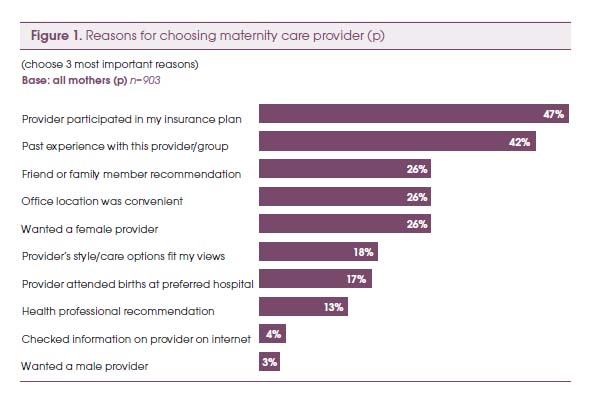

Women learn from books and experiences of others (and self):
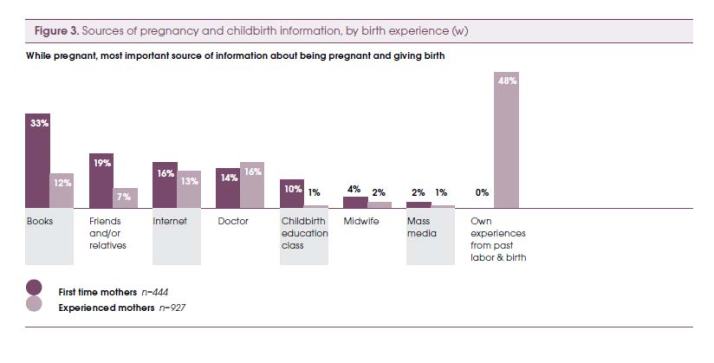
The number one book women learn from is What to Expect When You’re Expecting, which has been number four on NY Times Bestsellers list for over 500 weeks and counting.

According to De Vries, via the Listening to Mothers data, this is what women tell us about how they learn, what they learn, and upon what their choices are based:

Television explains birth
Pain is not your friend
But technology is
Mothers are listening to doctors (and nurses)
Medicalized birth allows mothers to feel capable and confident
Interfering with birth is mostly okay
Our health system works (mostly)
We like choice
We want to be “informed”

He also explains polarization: “We seek information to confirm our opinion. Contrary information does not convince, it polarizes.” How do we share information so that women can make truly informed choices without polarizing?

As advocates, I think we sometimes fall back on the phrase “informed choice” as an excuse not to be outraged, not to despair, and not to give up, because it promises that change is possible if only women change and most of us have access to change at that level.

Birthing room ethics

In another presentation, U.S. Maternity Care: Understanding the Exception That Proves the Rule, DeVries explores the ethical issues surrounding choices in birth, noting that “choice is central at all levels – but can choice do all the moral work?” We wish to respect parental choice, but information does not equal knowledge and we often err on the side of treating them as one and the same. In maternity care, often there is no choice. Tests become routine or practices become policy, and “information [is] given with no effort to understand parental values (the ritual of informed consent).”

Is choice possible while in active labor?
De Vries also raises a really critical question with no clear answers—is choice really possible during active labor? He also asks, “should a healthy pregnant woman be allowed to choose a surgical birth? But is it safe? The problem with data…Interestingly, those who think it should be allowed find it safe, and those who oppose it, find it to be unsafe.” When considering where this “choice” of surgical birth comes from, he identifies the following factors:

The desires of women
• Preserve sexual function
• Preserve ideal body
• The need to fit birth into employment
• Options offered by health care system

The desires of physicians
• Manage an unpredictable process
• The limits of obstetric education

Why should we care, anyway?

Another popular phrase is, “it’s not my birth.” I agree with the opinion of Desirre Andrews on this one:

“I do not believe in the saying ‘Not my birth.’ Women are connected together through the fabric of daily life including birth. What occurs in birth influences local culture, reshapes beliefs, weaves into how we see ourselves as wives, mothers, sisters, & women in our community. Your birth is my birth. My birth is your birth. This is why no matter my age or the age of my children it matters to me.”

Victims of circumstance?

While it may sound as if I am saying women are powerlessly buffeted about by circumstance and environment, I’m not. Theoretically, we always have the power to choose for ourselves, but by ignoring, denying, or minimizing the multiplicity of contexts in which women make “informed choices” about their births and their lives, we oversimplify the issue and turn it into a hollow catchphrase rather than a meaningful concept.

Women’s lives and their choices are deeply embedded in a complex, multifaceted, practically infinite web of social, political, cultural, socioeconomic, religious, historical, and environmental relationships.

And, I maintain that a choice is not a choice if it is made in a context of fear.

But, what do we know?

I read an interesting article by anthropologist and birth activist, Robbie Davis-Floyd, in the summer issue of Pathways Magazine. It was an excerpt from a longer article that appeared in Anthropology News, titled “Anthropology and Birth Activism: What Do We Know?” In the conclusion, Davis-Floyd states the following:

“Doctors ‘know’ they are giving women ‘the best care,’ and ‘what they really want.’ Birth activists…know that this ‘best care’ is too often a travesty of what birth can be. And yet on that existential brink, I tremble at the birth activist’s coding of women as ‘not knowing.’ So, here’s to women educating themselves on healthy, safe birth practices–to women knowing what is best for themselves and their babies, and to women rising above everything else.”

I believe that every woman who has given birth knows something about birth that other people don’t know. I also believe that women know what is right for their bodies and that mothers know what is right for their babies. I’m also pretty certain that these “knowings” are often crowded out or obliterated or rendered useless by the large sociocultural context in which women live their lives, birth their babies, and mother their young. So, how do we celebrate and honor the knowings and help women tease out and identify what they know compared to what they may believe or accept to be true while still respecting their autonomy and not denigrating them by characterizing them as “not knowing” or as needing to “be educated”? As I’ve written previously, with regard to education as a strategy for change: People often suggest “education” as a change strategy with the assumption that education is all that is needed. But, truly, do we want people to know more or do we want them to act differently? There is a LOT of information available to women about birth choices and healthy birth options. What we really want is not actually more education, we want them to act, or to choose, differently. Education in and of itself is not sufficient, it must be complemented by other methods that motivate people to act. As the textbook I use in class states, “a simple lack of information is rarely the major stumbling block.” You have to show them why it matters and the steps they can take to get there…

And, as the wise Pam England points out: “A knowledgeable childbirth teacher can inform mothers about birth, physiology, hospital policies and technology. But that kind of information doesn’t touch what a mother actually experiences IN labor, or what she needs to know as a mother (not a patient) in this rite of passage.”

The systemic context…

We MUST look at the larger system when we ask our questions and when we consider women’s choices. The fact that we even have to teach birth classes and to help women learn how to navigate the hospital system and to assert their rights to evidence-based care, indicates serious issues that go way beyond the individual. When we talk about women making informed choices or make statements like, “well, it’s her birth” or “it’s not my birth, it’s not my birth,” or wonder why she went to “that doctor” or “that hospital,” we are becoming blind to the sociocultural context in which those birth “choices” are embedded. When we teach women to ask their doctors about maintaining freedom of movement in labor or when we tell them to stay home as long as possible, we are, in a very real sense, endorsing, or at least acquiescing to these conditions in the first place. This isn’t changing the world for women, it is only softening the impact of a broken and oftentimes abusive system.

And, then I read an amazing story like this grandmother’s story of supporting her non-breastfeeding daughter-in-law and I don’t know WHAT to do in the end. Can we just trust that women will find their own right ways, define their own experiences, and access their own knowings in the context of all the impediments to free choice that I’ve already explored? What if she says, “why didn’t you TELL me?” But, if we share our information we risk polarization. If we keep silent and just offer neutral “support,” regardless of the choice made, then doesn’t it eventually become that the only voice available for her as she strives to make her own best choices is the voice of What to Expect and of hospital policy?

“Our lives are lived in story. When the stories offered us are limited, our lives are limited as well. Few have the courage, drive and imagination to invent life-narratives drastically different from those they’ve been told are possible. And unfortunately, some self-invented narratives are really just reversals of the limiting stereotype…” –Patricia Monaghan (New Book of Goddesses and Heroines, p. xii)

—-
Related posts:

What to Expect When You Go to the Hospital for a Natural Childbirth
Birth & Culture & Pregnant Feelings
Asking the right questions…
Active Birth in the Hospital
Why do I care?

References:

De Vries, Raymond. May 20, 2010. Birthing Ethics: What You Should Know About the Ethics of Childbirth, Webinar presented by Lamaze International.

De Vries, Raymond. Feb. 26-27. U.S. Maternity Care: Understanding the Exception That Proves the Rule. Coalition for Improving Maternity Services (CIMS). 2010 Mother-Friendly Childbirth Forum


Imaginary Future Children

My brother graduated from college earlier this year and recently got his ultimate dream job in a nearby state. This is the realization of a plan and vision he’s held for himself since he was a very small child. It is pretty exciting for the whole family! Anyway, a couple of weeks ago I was talking to my husband about it and we were reminiscing about when we were young and launching our lives. Thinking about my brother, I was feeling a little wistful and a little tied down, thinking about how we’re never planning to move anywhere else and so forth and musing about whether we’ve made a mistake by settling so permanently in one home and location, are we missing out on “adventure,” etc. I also said, “remember what it was like to make decisions without having to think about our kids?” After a pause, we realized that we did not remember and that was because, while our children at one point didn’t physically exist, making decisions about our lives as adults has still always included them. And, then I was struck with a wave of memories of how the choices we made as a very young couple were based on the then-hypothetical nature of our future children and what we wanted for them. When I was finishing my BA in psychology, one of the top issues on my mind was where to go to graduate school. I felt a pull towards PhD programs in psychology and I felt like that is what many people were expecting of me, but I also knew in my heart that there was no way I could manage a practice as a psychologist while also having children. I didn’t want to spend that much time in school and then feel torn being pursuing my career and taking care of my children. So, I decided to work on my MSW, theorizing that the more flexible nature of the work and the less expensive nature of the degree would be more compatible with family life. (I was 18 while making this decision.)

Then, when I was getting ready to graduate from graduate school and Mark was finishing his bachelor’s degree we had a conversation about how it was “now or never” in terms of what we were going to do—I told him that now was the time when we had the MOST freedom and flexibility with our choices and if we felt like we wanted to live in a different part of the country, etc., NOW was the time to do it, before we had a family to uproot. We talked at length and looked for jobs and apartments in a variety of different states. Finally, we concluded that we wanted our children to be raised near their grandparents and not in a different state where they would see them once or twice a year. (I was now 21 and would not actually have any children for three more years.)

No way could I keep these people apart!

We realized that many towns and places are much the same as any other and why not settle where we were certain the grandparents would remain. I also knew that I wanted to be close to my own mom so she could help me with my babies! So, we bought land one mile from where my parents live before I even got pregnant with our first baby. Post-graduate school I was offered a full-time job at an organization that I adored the year before I planned to get pregnant and I turned it down, knowing that I wouldn’t want to be working full-time while having a baby.
Any more future babies out there?

Yesterday, I was sitting in the living room playing with Alaina and waxing eloquent about her fundamental awesomeness. The boys were playing in the living room too and I said, “I think I HAVE to have one more baby so Alaina has someone to play with! She’s going to really want me to have a friend for her.” Lann said, “But mom, what if you have a…” and I said, “it won’t matter if the baby is a boy. Boys and girls can play together just fine! It is great to have two boys and it would be fun to have two girls, but the other baby doesn’t have to be a girl. Alaina will be happy to have a boy to play with too.” He started to say something again and I went on and on about why do people think children have to be segregated by gender, blah, blah and then he said, “MOM! I’m not talking about what if the baby is a BOY, I was trying to say, what if it is a MISCARRIAGE!” And, I was quiet for a moment before saying, “I know. I worry about that too.” It was a sobering moment. I’ve talked and thought at length about how I’d like to end my childbearing years on this high, happy note, rather than possibly begin a new loss journey. (I do recognize that it is bizarre to make decisions about our family’s future based on fear, rather than love.) Just as when I was a teenager and twenty-something, today I continue to make decisions based on my present-day children and my hypothetical future children, including the possibility of experiencing further pregnancy losses.

Today as I was snuggling Alaina in the morning—she was popping up and staring at me and then flopping on top of me and snuggling her head into my shoulder over and over—and I was smelling her and feeling her strong, wiggly, vibrant little form and I thought, “you healed me.” If I hadn’t had her, I know I would have carried a permanent wound and a permanent place of sadness in my soul surrounding my childbearing years. She fixed it.

Thankful for place

Returning to my notion of being “permanent, this is an excerpt from one of my essays for my Ecology and the Sacred course.

I was interested by the explanation [in our class text] about how we typically, “tell the story of our cultural lives and our interactions with other people…” While I definitely share this tendency, I do also feel deeply rooted to my natural place—the land on which I live and on which I grew up. My parents homesteaded their property in the 1970’s and I was born at home and spent my entire childhood on the same piece of land on which I was born, playing in the woods. They are very connected to their land and literally their blood, sweat, and tears have gone into their “place” in the natural world.

Eight years ago, my husband and I bought a parcel of my parents’ property and built our own home there. We live on a different road than my parents, but are still only one mile from where I was born, and our property is bordered by theirs on two sides. My husband and I have now invested a lot of time and energy into this piece of land, now our blood, and sweat, and tears are part of this piece of land and we feel permanent in this location. We do not—indeed, cannot—envision ever moving and living anywhere else. Sometimes my husband and I talk about whether this sense of permanence is binding or restrictive—i.e. what about the sense of possibility, about being able to “start over” anywhere—but we’ve concluded that rootedness has a great deal of personal value to us and we wouldn’t want to trade our roots for “wings.” While this isn’t quite the same as a natural history of place, I do feel that my own identity and social story includes an interwoven, personally important element of natural place. This part of the country is where I belong and I am invested in it…

While some people lament the “foolishness” of their youth, looking back at my own young adult years, I’m surprised at my own youthful perceptiveness and foresight about what choices would best suit the needs of my then-imaginary children and family. I’m curious to know what life choices did you make as an inexperienced young adult that have continued to serve you well?

The boys playing in our place last year–not hypothetical children anymore!

Front of house

Back deck. See why I love it here?

Magic of Mothering

Nursing baby A at two weeks old


(The first part of this post is an excerpt from an assignment in one of the classes I’m taking)

“Remember, when Keplet postulated that the moon effected the tides on earth, Galileo dismissed the hypothesis as ‘occult fancy.’ It involved action at a distance, and, therefore, violated the ‘solid laws of nature’ of that time. Now these laws of nature (as they were understood by classical physics only a century ago) have already been transcended; this progression should gently hint to us that many of the solid laws of our day are beliefs that obscure the otherwise obvious” (Passmore, 168).

I have long been wary of the phrase, “we used to think, but now we know…” usually stated with great conviction and little room for debate.

Body Wisdom

As Passmore goes on to note, “It is important to make a distinction between ‘progress in science’ and its explanatory power. This power for explanation depends upon the kind of question being asked. History shows that the questions change with changing beliefs/values in both time and space, periods and cultures.” It is exciting to me to consider how much we just don’t know and yet, the world keeps on spinning along, with or without our “knowing” all the facts. I think about this with regard to birth and breastfeeding. How many generations of women have pushed out their babies and fed them at the breast without knowing the exact mechanics of reproduction even, let alone milk production. There are all kinds of historical myths and “rules” about breastmilk and breastfeeding and even ten years ago we used to think the inner structure of the breast was completely different than what we think it is like now. Guess what? Our breasts still made milk and we still fed our babies, whether or not we knew exactly how the milk was being produced and delivered. Body knowledge, in this case, definitely still trumped scientific knowledge. I love that feeling when I snuggle down to nurse my own baby—my body is producing milk for her regardless of my conscious knowledge of the patterns or processes. And, guess what, humans cannot improve upon it. The body continues to do what the human mind and hand cannot replicate in a lab. And, has done so for millennia. I couldn’t make this milk myself using my brain and hands and yet day in and day out I do make it for her, using the literal blood and breath of my body, approximately 32 ounces of milk every single day for the last eleven months. That is beautiful.

The protective impact of a mama

And, on a somewhat related note, several years ago when I read Birth Book, I marked a section about “imprinting” in it (I think it has been fairly well established that there isn’t really human “imprinting” after birth, but when this book was written it was still one of the ideas). Anyway, there was a section about research done with baby goats done to look at the ability of a mother to protect her offspring from environmental stress. They separated twin goats and put some in rooms alone and the others in rooms with their mothers. The only difference in the room was the presence of the mother. An artificial stress environment was created involving turning off the lights every two minutes and shocking the baby goats on the legs. After the babies were conditioned like this, they were tested again two years later. This time all the babies (now adult goats) were in rooms alone and were again “treated” to the lights off and shock routine. The goats who had been with their mothers during the early experience showed no evidence of abnormal behavior in the stressful environment. The ones who had not been with their mothers did show “definite neurotic behavior.” Somehow, the presence of the mother alone served to protect the baby goats from the traumatic influences and keep them from being “psychologically” disturbed in adulthood.

Except for feeling sorry for the baby goats, I thought this information was SO COOL. How magic are mothers that just by being there we can help our babies–even if there is still something stressful going on, our simple presence helps our babies not be stressed by it and continue to feel safe. Magic!

Birth stress?

The goat research was included in the book because of the idea that birth may be a stressful environment for a baby and if the continuity of motherbaby is maintained after birth (immediate skin-to-skin contact and opportunity for breastfeeding), the baby does not become stressed or “neurotic.” But…if the continuity for mother and baby is broken by separation (baby whisked away for weighing or whatever), both mother and baby are stressed by this and it may have an impact on their future relationship and behavior. The book also talks about how the sound of the baby’s first cry has a sort of “imprinting” effect on the mother in that her uterus immediately begins to contract and involute after hearing her baby’s first cry, whereas mothers who are immediately separated from their babies and do not make contact with them have a higher likelihood of postpartum hemorrhage (I have no idea if this has been debunked or not since the book was written in 1972, but it was an interesting idea to read about).

Mothering is magic. Seriously.

Guest Post: Alcohol and Breastmilk

Just in time for the holiday season, a note to clarify the issue of nursing moms drinking alcohol. (c) Karen Orozco

Your milk alcohol level will be exactly the same as your blood alcohol level. So if you’ve had a couple of drinks and hit the legal limit, your milk has about the same alcohol content as fresh fruit juice or a non-alcoholic beer–.08%ish. Alcohol does not concentrate in the milk, and as your liver clears it from your blood, the milk alcohol level will also drop. There is no need to pump and dump for a healthy baby! If you are concerned about even very minimal amounts of alcohol in the baby’s system, nurse before you go out, and time your drinking so that you give your liver time to metabolize it before the baby would want to nurse again.

The takeaway message: Long before you have enough alcohol in your milk for your baby to even notice, you would be so hammered that you would hardly remember you even had a baby. The concern for occasional drinkers is not really alcohol being passed to the baby, but mom and dad remaining sober enough to care for the baby–and that’s a really big deal where co-sleeping is concerned! Safely sleeping with a baby means being stone cold sober. Period.

Merry Christmas, Happy Holidays, and a great New Year to everyone!

Please note that I’m really only talking about moms who have a drink now and then, not habitual heavy drinkers. We just don’t know what effect continuous long-term exposure to alcohol might have on a baby.

Lynn Carter is an IBCLC in Kirksville, Missouri.

Guest Post: 8 Toddler Pitfalls to Avoid on Christmas Morning

Regardless of your nostalgic, Christmas-morning-frenzy memories, you’ll quickly learn that a no-holds-barred approach doesn’t go (C) Karen Orozcoover well with your toddler — especially on the most anticipated morning of the year. Don’t wing it Christmas morning. Get a game plan together now so that your entire family can enjoy the holidays without going into meltdown mode.

1. Decide on a number of sweet treats allowed.
With the font of sucrose flowing throughout the holidays, be a sugar-monitor fiend and make sure other house visitors know your rules. If you have a struggle with, ahem, I-want-to-be-the-favorite grandmothers, get it out in the open first rather than commencing a power struggle on Christmas. According to the American Heart Association, children should limit their intake to about 4 teaspoons of added sugar each day.

2. Get to bed early the night before.
While establishing family traditions for Christmas takes precedence over toddler routine, make your plans reasonable for the younger crowd. Try to wrap up Christmas Eve activities early and give plenty of down time before going to sleep. Junior needs good rest to enjoy the following morning. He won’t get it if he stays up until 10:00 with out-of-town visitors.

3. Limit gift opening to a small number.
Three is good. This will be the hardest part of your holiday experience. Regardless of your convictions, the gift-giving fever kicks in at Toys ‘R Us and you go crazy buying, wrapping–and still more buying–several days ahead of Christmas. Even this late in the season you can nab holiday coupons from sites like CouponSherpa.com for one or two special gifts — open them earlier in the week rather than all at once on Christmas morning.

4. Wrap up the morning with quiet time and a nap.
After opening a few presents and enjoying time with visiting family, give your toddler plenty of time to decompress alone in a quiet space. Review the fun times of the morning with her and read a special book to help calm her down. Be on the lookout for overstimulation — nasty meltdowns, hyperactivity, and avoiding eye contact should be a red flag to flee the scene and recover.

5. Plan a Christmas morning activity.
In the throngs of gift-wrap thrashing, laughing and emotion, kids with a typically predictable routine can become stressed out by the absence of normal. If your toddler is particularly sensitive to big events, make sure you have a small, soothing activity planned — like watercolor Christmas trees or lacing boards of holiday characters — to keep your little one anchored.

6. Space out opening gifts throughout the morning.
You’ll probably feel enormous pressure for your kid to open every gift, respond with enthusiasm and then give a huge, grateful “thank you” to the recipient. It just won’t happen if you rush through the gift opening. Some moms, like Mae at What To Expect, prefer to open one gift every other day for the week leading up to Christmas–a godsend when winter storms hit and the family is stuck indoors. Bare in mind that your preschooler will enjoy his offerings much more if he has time in between opening to play with the goodies.

7. Construct all disassembled toys the night before.
Most parents learn this the hard way after their first Christmas with kids. Kids don’t want to open up a box, especially the preschool crowd. They will either get frustrated while you sweat over a screwdriver and instructions written in Mandarin or lose complete interest. Skip the $5.99 for wrapping paper and tie a simple bow on your ready-to-play toys. Start putting them together now so you aren’t up past midnight, bleary eyed with a wrench, on Christmas Eve.

8. Don’t barrage your kids with posed pictures.
Get candid with these fantastic tips from Photography Blog! A surefire way to send your toddler into defiance is demanding he smile in a picture with his hand-knitted sweater. Even though Aunt Jean may get a little ticked off that she can’t see Junior with her woven creation Christmas morning, it’s not worth the struggle. Opt instead for unposed, spontaneous smiles.

Photo by Karen Orozco

###

Ashley Grimaldo comes from a long line of penny pinchers and enjoys blogging on money-saving tips and advice for frugal-minded parents. She lives with her husband and three children in Bryan, Texas. Ashley has been featured among such media outlets as Redbook, The Chicago Tribune, Time.com, and CBS News-Houston.

For all media inquiries, please contact Ashley Grimaldo at ashley@kinoliinc.com.

Polymer Clay Birth Power Pendants

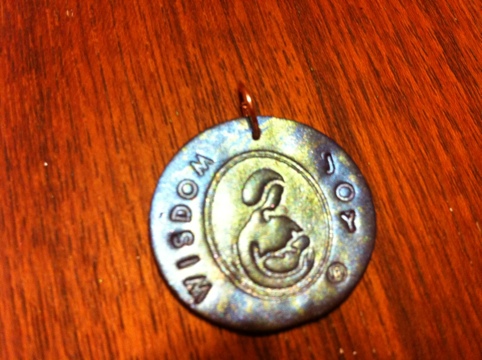
20111219-192036.jpgInspired by a tutorial pinned by a friend on Pinterest, I made a bunch of polymer clay birth power pendants this weekend. Short version instructions are to roll out polymer clay in a pasta maker. Stamp something cool on them using a rubber stamp and cut it out using a clay/cookie cutter and then either carve or write a meaningful word on it. I used individual pieces of type from my dad’s antique printing press to make the letters on mine. I was psyched to make these because I already have my birth logo as a rubber stamp (I drew it and it is fun to be able to get so much mileage out of just one drawing once upon a time!) I also have a rubber stamp of the LLL logo. More awesomeness.20111219-192106.jpg

I used metallic powdered pigments (Pearlex brand) to color them–I did some by brushing the pigment onto the unbaked clay after already having stamped it and others by brushed pigment over a whole section of rolled out clay and then stamping and cutting it.

My husband drilled small holes in the tops and made copper rings for them, so they can be strung as a pendant or used as an ornament.

I had a delightful time having the lifespace to be crafty and then my husband accidentally cooked my art at 350 degrees and burned the living daylights out of all of them.

20111219-192154.jpg

So, after a few tears from me about my wasted effort, we started over from the beginning and made a new batch. We put ribbons on the least burned ones and used them as birth power ornaments for the Christmas tree!

They do have a certain similarity to Necco wafers or poker chips, but I’m pretty pleased with them.

20111219-192120.jpg

Busy is Boring!

Another tidbit for my personal “remember this” files…

Stop Describing Yourself as Busy
When you’re swamped, it’s easy to tell anyone who will listen that you are very, very busy. As I describe in Hidden Feelings of Motherhood, your thoughts are powerful. Viewing a situation as negative releases the stress hormone cortisol. This is not good for you! Mentally rehearsing your busyness accomplishes nothing positive and is most likely harmful. So stop describing yourself that way.

This is something you can do for yourself now. Besides, everyone is busy these days. It’s actually kind of boring to hear about the busyness of others. And telling others about our busyness fuels the peer pressure you might feel when talking with other mothers—a rather bizarre competition to see who is the busiest of all.
–Kathleen Kendall-Tackett: Practical Steps Toward Achieving More Balance in Your Life

I read this several years ago and it comes to mind whenever I’m tempted to describe myself as “busy.” She’s right. It is boring to hear about how busy other people are and to essentially compare lists of busyness. I’d rather talk about the things we’re doing that fuel us and excite us, rather than review a litany of to-dos.

Elevenmonthababy!

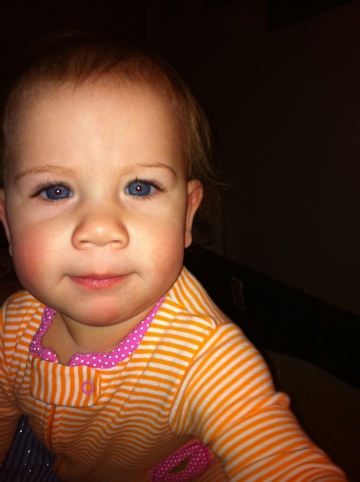
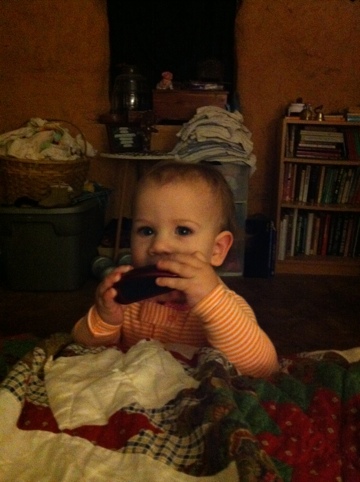
I can hardly believe I’ve spent 11 months now with this baby girl in my arms! She’s got nine teeth now and seems to say (to the very carefully observing and possibly imaginative ear): kitty, dolly, cookie, book, egg, up, na na, mama, daddy, brother, Baba, baby, boo, and something that indicates “I see people I know in that picture” as well as a “go that way” directive sound and maybe says, “get” or “got.” Does baby signs for nurse, eat, and all done. Is into EVERYTHING, stays up til midnight, only goes down for nap in the Ergo, eats toilet paper, loves dolls, and is unbelievably adorable!

My little heart is all aflutter because of her obsession with dollies. If she’s going to be a fan, she’s definitely in the right house!

She practices standing up often, but no steps yet.

Here is a standing video (she’d been practicing over and over when we took this at 11:30 one evening–she had been clapping and cheering for herself every time, but that cuteness disappeared when the video was on!)

And, here is an adorable one of “walking” using a push toy:

I mentioned the staying up til midnight–this is what I see…

20111219-095218.jpg

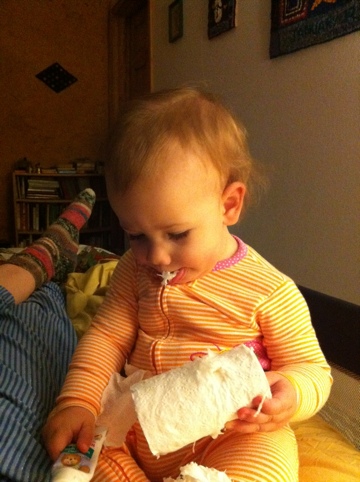
I mentioned the toilet paper eating (also at midnight):

20111219-095331.jpg

And, there’s mouse-eating that happens too. She hopped out of bed of her own accord and stood on my laptop looking like this:
20111219-095347.jpg

That is another skill this month–can climb out of bed by backing off edge semi-carefully.

She’s fabulous, truly!

The potty strike seems to be waning—has been sleeping dry all night and pottying in morning. Also pottying successfully for all recent poops. She is on the move all of the time and is quite a bit harder to take care of than she used to be! Has destroyed the Christmas tree twice this month—luckily, she wasn’t hurt either time, but there was a shower of broken glass and the second time the tree itself was broken beyond repair. So, my husband cut the top of it off and made a stand for it and now we have a pretty-sad looking tiny, tabletop tree.

I’m on break from teaching and looking forward to three weeks of time off and holiday fun! I’m scheduled for three classes next session (luckily, all the same class, which should make prep time significantly easier). So far, one is very low on registrations though so I may not end up teaching that one and that’s more than okay. I’m nervous about driving in January-February weather and I also really only feel comfortable trying to leave her home for one night per week (that’s right, the time with my mom coming with me is drawing to a close—I don’t feel like I can have a walking [presumably] baby hanging out in the building and my mom, while still gamely trekking out with us, is pretty tired of having to come with me. It isn’t really about proximity for nursing, it is about not being separated from my baby for long, and I’ve very grateful that she’s been willing to keep coming with me for so many months so that we could be together.)

Last Minute Gift Idea: Rescue Gifts

I received a press release recently with a neat last-minute gift idea that has relevance to birth activism—a symbolic gift of a safe birth kit for a mother in the developing world (I investigated a little and the organization is a legitimate humanitarian organization.) Here is the information:

Rescue Gifts help refugees and others who have been impacted by war and natural disaster. Holiday shoppers can choose a gift that inspires them and dedicate it in honor of a special person in their lives. The International Rescue Committee will send gift recipients a beautiful acknowledgement card with the gift giver’s personalized message.

There’s a perfect gift for everyone:

  • For a mom: A Safe Delivery ($24) can ensure critical supplies for the safe birth of a child in a crisis zone.
  • For a spouse: Emergency Food ($68) can deliver a month’s supply of vitamin-rich therapeutic food for at least 50 malnourished children in places wracked by food shortages or famine.
  • For the foodie or friend with a green thumb: A Community Garden ($60) can provide tools and seeds to refugees who have been resettled in the United States, so that they can grow their own fresh, healthy food in an IRC community garden.
  • For a teacher:  A Year of School ($52) can supply the tuition, books and other materials for one year of a child’s schooling in a country recovering from war.

Shoppers who spend $75 or more will receive a fashionable organic cotton “Rescue” T-shirt designed and donated by Threads for Thought, or they can opt to have it sent as a gift.

Rashida Jones, IRC Voice and star of NBC’s “Parks and Recreation,” is promoting the Clean Water Rescue Gift and giving it to her friends this year. She says, “At an IRC refugee camp in Thailand, I saw that the ready availability of water transforms lives. I am buying this gift for my friends this holiday season.”

Parks & Recreation is one of my favorites TV shows, so it is fun to have that connection too. Of course, I inquired as to what exactly a “safe delivery kit” entails, because I do not want to inadvertently be promoting non-evidence based Western medical care practices in countries relying heavily on traditional midwives. I was told that, “as such, the Safe Delivery Rescue Gift represents the typical amount of money needed for the IRC to provide supplies and assistance necessary for a safe delivery. However, Safe Delivery Rescue Gift donations will be used where and when most needed in our wide-ranging humanitarian work in more than 40 countries and 22 U.S. cities. The IRC does provide and support pre and post natal care for new and expectant mothers and their babies. This includes training and equipping midwives like the ones in Tham Hin refugee camp in Thailand, although midwifery is not the only childbirth model that the IRC supports.”

If you’re looking for a last-minute stocking stuffer for a humanitarian minded friend or family member, or for a birth activist buddy, you might find the right gift at Rescue Gifts!

Polymer Clay Goddess Pendants

So many blog topics and ideas and yet so many papers to grade! (Expect a flurry of extremely awesome posts from me during my break that starts Sunday.)

Just a picture post then to show my two most recent experiments in polymer clay birth goddess pendant making.

This little one is my tiniest effort. She doesn’t have a belly stone, just the jewel in her hands:
20111128-144746.jpg

The larger one is my favorite so far. She has a moonstone belly and is holding a heart shaped crystal.

20111205-143346.jpg

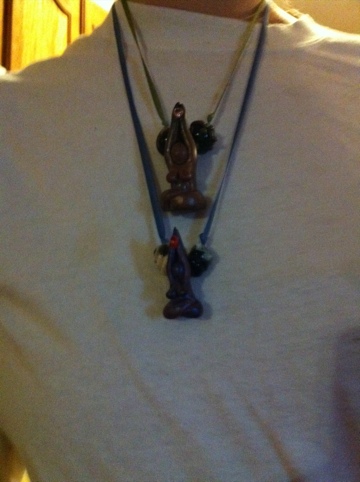
Tried to get a picture of me wearing them, but it didn’t really turn out (and, my, what an attractive shirt I wearing in which to model them. Love the flattering neckline with the pendants).
20111205-143408.jpg

I really love making these sculptures and have plans for more on that aforementioned break as well!