Archive | July 2012

Another Pinterest Day!

Yesterday we had another Pinterest Day. It was so exhausting that I’m going to not do another one for a couple of weeks! Alaina has been incredibly whiny and demanding and getting into everything all the time, often destroying things—so, it is really difficult to do fun stuff with the other kids, when someone else is complaining on my hip and sticking her hand down my shirt to twist my nipples half the time. So, our Pinterest projects of awesomeness were shaded by an overlay of intense crabbiness on my part. Boo! 😦 We expanded the definition to include “stuff we want to make” too. So, for lunch we had the best ever grilled cheese sandwiches that we just created, not from Pinterest. Mine had sautéed organic spinach and mushrooms added to the top of organic mozzarella and provolone all on (totally non-organic) french bread. Yummy, yum, yum!20120714-091343.jpg

Also, from our own heads we decided to make caramel apples using super delightful little Kraft caramel bits and organic apples from the food co-op:

20120714-091349.jpg

Can you tell which one we made last?

After lunch the boys were excited to try these microwave chocolate chip cookies that looked super simple and easy. However, results were poor and I didn’t even both trying to make the pictures look better using Instagram. We made Zander’s first and since it still look squishy after the allotted time, we roasted the heck out of it and it was crunchy and burned on the bottom. The choco chips turned into powdery relics (that were kind of tasty). Lann deemed his a, “mega sugar bomb” and left it abandoned on the table. We didn’t put enough butter in his, I guess, because it was just loose crumbles.

20120714-091404.jpg

We tried again with mine and it was no better.

20120714-091412.jpg

My assessment is that this was about as tasty and texturally appealing as leaving a small bowl of egg, flour, and sugar on your dashboard on a hot day. Epic fail all around!

Pinterest Day dinner was vastly more successful: a cheesy, wild rice and spinach casserole and “crispy roast potatoes.” The potatoes called for “duck fat,” which is not one of my personal kitchen staples, so I used olive oil. I also sliced them in the food processor rather than into chunks.

20120714-091427.jpg

Verdict: totally delicious.

The casserole was a modified version of this recipe. I added spinach and didn’t use chicken (or any of the veggies called for, other than dried, minced onion and garlic). Mark and I enjoyed it, the kids didn’t really.

20120714-091434.jpg

20120714-091441.jpg

Nice glass of strawberry wine to help me recover from Pinterest Day adventures with Alaina!

We’ve actually had other Pinterest Days in between the first one and this one. On the fourth of July I made several things, including homemade Payday bars that I was absurdly pleased with:

20120714-154247.jpg

Definite win with these! Next time I’ll just stir the peanuts in though rather than layering them on the bottom on the top, where they had a tendency to pop out and roll away.

Women’s Retreat Recipe

Quarterly, I get together with some of my friends and we have a women’s retreat. We had our summer retreat this past Sunday and I thought I’d share the outline and our activities as a “retreat recipe” that others may use if they wish to do so. Since my friends do not necessarily share specific religious beliefs, the retreats are spiritual in a somewhat generic “womanspirit” sort of way and you can obviously customize your own retreat to best suit the spiritual beliefs/backgrounds of your own friendship group.

Circle up—we stand in a circle, place our hands on eachother’s backs and hum together three times to raise the energy of the circle.

Invocation to directions. This time we used an invocation by Judith Laura:

We honor the East
Home of air
March wind
Morning’s song
Eagle’s flight
Aurora’s breath
Welcome East

We honor the South
Home of fire
Noon sun
Flame of change
Heat of passion
Pele’s power
Welcome South

We honor the West
Home of water
River’s flow
Font of feelings
World’s womb
Kwan Yin’s love
Welcome West

We honor the North
Home of Earth
Root of life
Shaded mystery
Ground of being
Gaia’s growth
Welcome North.

Light candle/opening quote

“I see the wise woman. And she sees me. She smiles

from shrines in thousands of places. She is buried

in the ground of every country. She flows in every

river and pulses in the oceans. The wise woman’s

robe flows down your back, centering you in the

ever-changing, ever-spiraling mystery.

Everywhere I look, the wise woman looks back.

And she smiles.”

–Susun Weed quoted in Birthing Ourselves Into Being

Check-in–we take turns “passing the rattle” and each woman has about two minutes to share what’s been on her mind.

Since we are close to summer solstice, I then chose to do this solstice prayer of healing from the United Nations as a responsive reading as a group:

A Prayer of Healing
From the United Nations Environmental Sabbath

We join with the earth and with each other.
To celebrate the seas.
To rejoice the sunlight.
To sing the song of the stars.

We join with the earth and with each other.
To recall our destiny.
To renew our spirits.
To reinvigorate our bodies.

We join with the earth and with each other.
To create the human community.
To promote justice and peace.
To remember our children.

We join together as many and diverse expressions of one loving mystery: for the healing of the earth and the renewal of all life. We join with the earth and with each other.
To bring new life to the land.
To restore the waters.
To refresh the air.

We join with the earth and with each other.
To renew the forests.
To care for the plants.
To protect the creatures.

Guided visualization/meditation/relaxation (for this particular retreat, I used a nice full body relaxation from the book Birthing Ourselves into Being. This one isn’t available online that I can find, but you can find others online, like this one for example.)

We followed the relaxation with a muse questions and journaling using one of the questions from Shiloh Sophia’s Museletter:

Your Muse would like to show you something you haven’t been able to see.

She wants to invite you to have a thought you haven’t had yet…isn’t that an enticing thought in and of itself?

A thought that has lingered on the edge of your consciousness for maybe even a few years, or months….tell her…

I want to know what it is I am not seeing.

Then automatic write whatever comes up until you have to put the pen down.

Immediately following this question, it began to rain. Blissful, blessed, healing, glorious rain for which we were in so much need.

Discuss responses/experiences to relaxation/journaling.

Listen to songs/perhaps drum (this time, went outside together and stood in the rain)

Closing circle: Sing Woman Am I (recording of my friends singing it together is here).

Closing quote and extinguish candle

“A circle! No sharp edges, no hierarchy, just a circle of women…We are mothers. We are the portals. The next generation comes through our bodies.” –Annie Lennox

and one of my all-time favorites:

“I believe that these circles of women around us weave invisible nets of love that carry us when we’re weak and sing with us when we’re strong.” –SARK, Succulent Wild Woman

When reading a 1988 back issue of SageWoman magazine, I fell in love with Womanrunes by Shekhinah Mountainwater (originally in her book Ariadne’s Thread, which I then purchased) and so I made copies of the images to share with my friends. We are going to make some sets of runes at our next retreat. (And, after much scouring of the interwebz, I found a pronunciation guide for the runes here).

I also made a handout packet for them of various moon wheels/circular calendars for tracking your cycles, or simply for planning and thinking in circles rather than in lines. In the packets were:

And, then it was time for a craft, so as we snacked and chatted, I showed everyone how to make a small, hardbound pocket journal. You can find instructions for a simple book here, or, to make it even more simple, use this kit from Blick Art Supplies.

It was a delightful afternoon of connection and celebration—my original vision for holding these retreats was to bring some blessingway spirit into our regular lives, rather than only centered on being pregnant and I think that purpose was achieved.

This post is crossposted at Woodspriestess.

I See You: talking to mothers about their breastfeeding concerns…

I’m helping to train two women right now to become breastfeeding counselors. As well as discussing how to help other women with the numerous issues that may be a part of the normal course of breastfeeding, we talk a lot about listening skills. As I’ve been working with them, I found a reminder list that I made 7 years ago when I took on this role myself. The list simply consists of ideas for how to talk to mothers about their breastfeeding questions in a way that promotes continued dialogue, demonstrates respect, and employs good active listening.

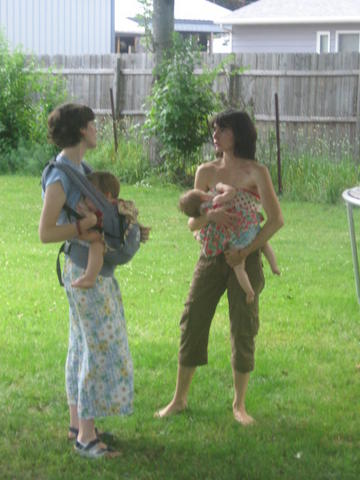
Photo from several years ago of a good friend and I nursing our babies while “seeing” each other.

Talking to mothers about their breastfeeding concerns…

“I hear you saying that….”

“You seem to be telling me that….”

“You seem to be feeling….”

“You sound…”

“How do you…”

“What are you observing that makes you think…”

“Tell me more about…”

“How would you like to see this resolved…”

“Many mothers have found…” **This is my all-time favorite and hands-down most useful. I use it all the time. It is so handy.**

“How would you feel about…”

“For some families it works well to…”

“There are some suggestions I can give you for… that have been helpful for other mothers…”

“It depends….”

“It sounds to me like you are doing a wonderful job as a mother”

“It sounds to me like your baby really responds to you”

“Your baby is so lucky that you want to/did give him the benefit of your milk”

With doctors/others’ opinions:

“How do you feel about those suggestions?”

Some doctors take that approach, but research has shown….” (or, “we’ve noticed…” or, “reliable references indicate…” May also follow-up with, “Would you like me to send you a reference?”). **This is another one of my favorites, it doesn’t smack down the doctor and yet it gently and firmly provides you with a means of sharing alternate—correct—information.

Other good things to remember when listening to mothers:

Breastfeeding is not a by the book procedure—it is an intimate relationship with different dynamics from one nursing couple to the next. Individual mothers and babies respond differently to the same things. There are no hard and fast rules.

Our main message to each mother is how important she is to her baby and how breastfeeding can be a wonderful part of this. We want to help mothers feel good about being a mother, about meeting their babies’ needs in the way that feels best for them, and to trust their own instincts. We wish to leave mothers with a feeling of self-confidence and acceptance.

I See You

I often remind students in my human services classes that all people have a basic need to be both seen and heard. This doesn’t mean agreeing with everything someone else says and does, it means being present and witnessing them as they follow their own paths.

In a newsletter recently, I read an article called “I See You” by Sue Scott, a communication skills instructor. She explains that in South Africa, native peoples greet each other with an expression that literally means, “I see you.” The response is then, “I am here.” She observes, “what a powerful and beautiful gift it is to recognize another individuals in this way: ‘I see you.’ Acknowledgement, recognition, and respect all require focus on the other person…the word respect comes from the Latin word ‘respecere’ meaning ‘to look at again and again…’I see you’…seems to me to be the ultimate in respect.” Sue goes on to explain that when we truly SEE another mother—“when we truly hear her concerns—then we affirm her ability to mother her baby in her own best way.”

A little more than two years ago, I received the precious gift of being seen when a mother that I had previously helped with many breastfeeding questions called to ask me another question. We had become friends over the course of time since she’d had her first baby and I was in the process of my second miscarriage when she called with a question about her own pregnancy. I told her about the miscarriage, but said I felt like I could still talk with her about her question. We ended up then talking for a time about miscarriage and about cesarean birth, because we discover numerous surprising connections between the feelings and experiences of an unexpected outcome to our dreams for our pregnancies. She then said, “You know in that movie Avatar how they say, ‘I see you’?” I said yes, and she said, “I just wanted to let you know that I see you, Molly.” These words were such a gift to me. It was beautiful to hear them and I cried. I felt so seen. It was just what I needed and I hadn’t even known it. I will never forget that simple and yet extremely potent gift of acknowledgement from another woman.

A previous post about Listening Well Enough.

Women’s Power & Self-Authority

“I know myself linked by chains of fires,
to every woman who has kept a hearth.
In the resinous smoke
I smell hut, castle, cave,
mansion and hovel,
See in the shifting flame
my mother and grandmothers
out over the world.”
–Elsa Gidlo

I used the quote above as my winter solstice Facebook posting last year. It reminds me of a quote from Margaret Atwood used in the book Sacred Circles, “Sons branch out, but one woman leads to another.” One of the powerful gifts of feminist spirituality is the sense of intergenerational connectedness to all women of all time. We begin to sense the buried matrilineal links across time and culture. Links that have often been culturally, socially, and religiously broken on purpose as a way to separate and disempower women and to bury women’s wisdom. I believe a potent source of female power lies in the female body and that body wisdom has been suppressed and denied over the course of many years as a means of oppression and control. One of the root issues of patriarchy is who “owns” women’s bodies—is it men, is it the government, is the medical system, or is it the woman herself? (you know my pick).

Body wisdom and sources of power

Considering power, sources of power, and body wisdom, I appreciated reading Barbara Starrett’s essay The Metaphors of Power in the book The Politics of Women’s Spirituality. While she used abortion as her example, I have modified and paraphrased her thoughts to make the idea about birth instead. Starrett originally states, “We can create power centers both within and outside ourselves…Power is where power is perceived. Power resides in the mind. We can give or withhold power through our beliefs, our felt thoughts.” Medical professionals can make decisions about a woman’s body and birth choices effectively only as long as women believe that the professionals have the right to do this. When women reclaim the power to decide for themselves about birth, the doctors proclaim in a vacuum. Their power depends on the transference of our power, through our belief that this is right…Power is where power is perceived. This also means that in any given in-the-world situation, we can intentionally set up our own power centers. If we believe that power resides in those centers, it will. We will act successfully on this belief. Women’s organizations, unions, birth coalitions, etc., will never work unless we regard them, “as the legitimate centers of power…We must grant our own power to ourselves” (p. 191).
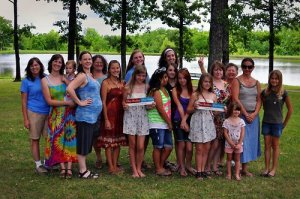
Lucky to have such a great group of friends to gather in the park to take part in the Our Bodies, Our Votes campaign.

While this comes a little too close for comfort to me with the idea that “we create our own reality” (which I cannot fully embrace due to the logical extension into blaming the victim that it creates), I connect deeply with the idea that we must treat women’s organizations and work as legitimate power sources. I think of books/movements like Our Bodies, Ourselves, for example. To me, this is a definitive women’s health resource—by women, for women and separated from the medical establishment that often dehumanizes women. If we continue to believe our “alternative” structures are just that, “alternative,” then the dominant model is still the norm and still accepted, even by us, as “normal.”

Starrett continues her essay by sharing that “It is necessary for some women to risk total reclamation, to risk the direct and intentional use of power, in bold, even outrageous ways. It takes only a minority of women to alter present reality, to create new reality, because our efforts are more completely focused, more total.” (p. 193) This is the risk that the creators of Our Bodies, Ourselves took. It is the risk birth activists and women’s health activists continue to take.

Peggy O’Mara tackles a similar topic in her essay, “Holy Mother,” in her collection of essays The Way Back Home, observing:

We live in a society…that romanticizes and trivializes the feminine…we live in an economy that regards women as cheap labor. In the marketplace, women work for less than men. At home, we do the large majority of the work. I believe that we enslave ourselves.

Is it any wonder, then, that we have not successfully resolved the childcare debate? Child care and national family policy are process issues, and thus sexist issues. Women themselves engage in sexism when they debate the either/or dichotomy of work or home. Too often, we do not realize the devaluation involved in playing by the crumbling rules of a male-dominated society rather than making up our own. The matriarchal process-based model comes from a religious belief system in which the Divine is immanent, within life, within us, ascribing sacredness to the ordinary processes of daily life. Rather than choosing between opposites, let us evolve a culture that values both the product and the process, a culture that synthesizes both the patriarchy and the matriarchy.

…we must put all of our loves–work and family, mothering and career, self and others—on the bargaining table at once, and not assume that because we are women, we must acquiesce to the cultural ideal. To run our personal lives in enslavement to an economic reality that does not serve our needs makes society crazy.

In a brief except from author Libba Bray, she states that for years she “…heard feminist Gloria Steinem described as ‘shrill’ and ‘hostile’ and many other dismissive, denigrating terms. But after reading about her struggles as a human being and as a leader of feminism’s second wave…I got a truer picture…I learned that it’s far too easy for women to be shamed into staying quiet about their lives–their dreams, needs, desires, anger, aspirations—and that the old adage, ‘Well-behaved women seldom make history’ is all too true.”

Consult your health care provider?

In my own life, I am frustrated by the ubiquitous phrase, “Consult your health care provider.” No thanks. I prefer consulting myself, my books, google, my own research, and my friends. Last time I checked, my doctor did not own my body nor did she have divine revelation as to what I need in my life. I am a breastfeeding counselor providing phone and email support to women who have breastfeeding questions. Women frequently receive very poor breastfeeding “advice” from their doctors—to the extent that I honestly think they’d receive better information by polling random strangers at Wal-Mart with their questions (and, yes, I will actually tell women this). One caller once used the phrase, “but, I don’t want to disobey my doctor” and I found this extraordinarily telling as well as depressing. I recognize that doctors have special training and can be life-saving, however, what does that say about mothering in our culture that a woman would not act on behalf of her own baby and herself because of fear of being disobedient to a professional that she has hired? She is a consumer of a service, not the subject of a ruler!

This brings me to a thought by Dr. Michelle Harrison, author of the book A Woman in Residence: “I used to have fantasies…about women in a state of revolution. I saw them getting up out of their beds and refusing the knife, refusing to be tied down, refusing to submit…Women’s health care will not improve until women reject the present system and begin instead to develop less destructive means of creating and maintaining a state of wellness.” Indeed! And, in an essay by Sally Gearhart’s about womanpower, she notes: “…there’s no forcing any other woman into a full trot or a gallop; she will move at her own pace, but at her own pace we can be sure she will move. At this point I always remind myself that the patriarchal use of crash programs is antithetical to organic movement; in a crash program the theory goes that if you can get nine women pregnant you can have a baby in one month; it takes women, I suppose, to understand that it doesn’t work that way.” (p. 202-203)

Reclaiming power

So, how do women reclaim power? I think story holds a key to power reclamation in this context. As I’ve referenced before, Carol Christ describes it thusly, “When one woman puts her experiences into words, another woman who has kept silent, afraid of what others will think, can find validation. And when the second woman says aloud, ‘yes, that was my experience too,’ the first woman loses some of her fear.” As I touch on above, for me it is to see myself and my body as a source of wisdom and to refuse to participate in structures that do not honor my power and personal agency. It involves more often turning to my peers, to other women, for advice and comfort and support, rather than to experts.

Returning to Gearhart, she states: “If I can move out of the patriarchy for my re-sourcement, then I do indeed march to a different drummer; but I have to march with the consciousness in my very bones of the cost in blood and pain and death that is somewhere being paid for my personal growth.” (p. 203)

I’ve written before that I am a systems thinker. Women’s choices about their bodies and about birth are not made in personal isolation, but in a complexly interwoven network of social, political, medical, religious, and cultural systems. As Gearhart notes, “There may be no ‘enemy’ except a system. How do we deal with ‘the enemy’? As seldom as possible but when necessary by opening the way for [their] transformation into not-the-enemy. What weapons do we use? Our healing, our self-protection, our health, our fantasies, our collective care…” (p. 203).

And, in closing I like this reminder:

“Study after study has taught us that there is no tool for development more effective than the empowerment of women. No other policy is as likely to raise economic productivity, or to reduce infant and maternal mortality. No other policy is as sure to improve nutrition and promote health—including the prevention of HIV/AIDS. No other policy is as powerful in increasing the chances of education for the next generation. But whatever the very real benefits of investing in women, the most important fact remains: Women themselves have the right to live in dignity, in freedom from want and from fear.” —Former UN Secretary-General Kofi Annan

This is the whole point—women’s rights aren’t about “taking” rights from anyone else OR about demanding “special treatment,” they are important for a HUMANE WORLD for all people. I think it is hilariously awful that “women’s rights” are considered a political issue and that there is a section about “women’s rights” in the “opposing viewpoints” database for my social policy class. As long as women’s rights are considered a political issue or as something about which an opposing viewpoint can be held, rather than as self-evident, we are in continued, desperate need of revolution.

—-

(note: portions of this post are excerpted from one of my essays for a class I took about Goddess Traditions)