Archives

New Quotes About Birth, Motherhood, Activism, and Women

I have a LOT of new quotes to add to my collection! I’ve got to start updating more frequently. As I’ve mentioned before that while these quotes are obviously not my own words, I do appreciate a linkback to my site if you re-post them because I have a significant amount of legwork invested in finding and typing the quotes. Most are not recycled from other pages (I give credit if they are), but are typed up when they catch my eye in the books/magazines/journals I’m reading.

‎”Women experience pain differently; some feel strong overwhelming pain, some may feel a deep discomfort during birth, and still others may feel no pain at all. The experience of pain during childbirth facilitates an unfolding of inner power and resources we never imagined we possessed, similar to enduring the pain of completing a marathon at the finish line.” –Barbara Nicholson and Lysa Parker, API founders

(I do wish the analogy was flipped culturally–ie running a marathon is like giving birth, rather than vice versa. We’ll get there!)

“For months I just looked at you. I wondered about all the mothers before me–if they looked at their babies the way I looked at you. In an instant I knew what moved humankind from continent to continent, Against all odds.” –Michelle Singer (in We’Moon 2011 datebook)

“I use the word midwife to refer to all birth practitioners. Whether you are a mother, doula, educator, or understanding doctor or nurse you are doing midwifery when you care for motherbaby.” –Midwifery Today editorial by Jan Tritten

“Change, when it comes, cracks everything open.” ~Dorothy Allison

“I invite people to examine their lives, knowing that it’s scary, but that not doing it is even scarier.” – Barbara De Angelis

‎”There isn’t a lot you actually *need* to do to birth, but there is a lot you can do to get in the *way* of birth…” –Elizabeth McKeown

‎”Mother love is the fuel that enables a normal human being to do the impossible.” –Marion C. Garretty

‎”In western society, the baby gets attention while the mother is given lectures. Pregnancy is considered an illness; once the ‘illness’ is over, interest in her wanes. Mothers in ‘civilized’ countries often have no or very little help with a new baby. Women tend to be home alone to fend for themselves and the children. They are typically isolated socially & expected to complete their usual chores…while being the sole person to care for the infant…” –Milk, Money, & Madness

 “I have discovered nothing more stunning, nothing more emotionally stirring, nothing more intriguing than a woman as she creates life.” –Patrick Stull

‎”My first delivery was a traumatic experience, physically and psychologically almost destroying me. My second, with a midwife, allowed me to regain my womanhood and experience my biological imperative. And yet, I would do them both over again to have what I created.” –mother quoted in the book Evolve, by Patrick Stull

‎”Too often in modern busy obstetric practice, we doctors forget this meaningfulness of childbirth. In our anxiety and impatience, or in our sincere, but misguided efforts to relieve suffering (and childbirth is not without it), we relieve a woman not only of this suffering, but also of her ‘birth right.'” ~John Miller, MD, Childbirth via Citizens for Midwifery

‎”Too often in modern busy obstetric practice, we doctors forget this meaningfulness of childbirth. In our anxiety and impatience, or in our sincere, but misguided efforts to relieve suffering (and childbirth is not without it), we relieve a woman not only of this suffering, but also of her ‘birth right.'” ~John Miller, MD, Childbirth

 “A woman’s confidence and ability to give birth and to care for her baby are enhanced or diminished by every person who gives her care, and by the environment in which she gives birth…Every women should have the opportunity to give birth as she wishes in an environment in which she feels nurtured and secure, and her emotional well-being, privacy, and personal preferences are respected.” –Coalition for Improving Maternity Services (CIMS)

‎”Aside from new babies, new mothers must be the most beautiful creatures on earth.” ~Terri Guillemets

‎”It’s a good day not to judge anything – not myself, not others, not the world. Let us just be.” ~ Sonia Choquette

‎”We’re volcanoes. When we women offer our experience as our truth, as human truth, all the maps change. New mountains form” – Ursula Le Guin

‎”Be wild; that is how to clear the river.” –Clarissa Pinkola Estes

‎”I believe global transformation hangs on the empowerment of women.” –Vajra Ma

‎”Grace reveals to you a great mothering love that you can step into, that’s been here before you and will be here after you. Grace will be with you as you open your arms, as you release your children and send them out into the world. If you listen carefully, you can hear grace whispering its thanks to you for being a mother to these souls.” –Denise Roy (Momfulness)

‎”No one has yet realized the wealth of sympathy, the kindness and generosity hidden in the soul of a child. The effort of every true education should be to unlock that treasure.” – Emma Goldman

‎”A person who believes too earnestly in [her] own convictions can be dangerous to others, for absence of humor signals a failure in basic humanity.” –Thomas Moore (Original Self)

 “There is a sacredness in tears. They are messengers of overwhelming grief…and unspeakable love.” –Washington Irving

‎”It is easier to build strong children than to repair broken men.” – Frederick Douglass

‎”No mammal on this planet separates the newborn from its mother at birth except the human animal. No mammal on this planet denies the breast of the newborn except the human.” –James Prescott (neuropsychologist quoted in The Art of Conscious Parenting)

‎”Every society practices the birthing ceremonies that best mirror its values, norms, and philosophy.” –Gregory Bateson (quoted in The Art of Conscious Parenting)

‎”The world can only value mothering to the extent that women everywhere stand and declare that it must be so.” –Oprah

‎”Motherhood focused my early political consciousness. It helped me understand how the choices I make in my personal life are linked to those I make on a larger scale.” –Wendy Priesnitz

‎”There is a wild tiger in every woman’s heart. Its hot and holy breath quietly, relentlessly feeding her.” – Chameli Ardagh

 “The state of the world today demands that women become less modest and dream/plan/act/risk on a larger scale.” – Charlotte Bunch

‎”Prenatal care of the future will be guided by a [this rule]: “Eat sardines, be happy…and sing!” –Michel Odent

‎”If you are going to generalize about women, you’ll find yourself up to here in exceptions.” – Dolores Hitchens

‎”If we can mobilize the mothering instinct in all of us, we could save the planet. It is inappropriate to be dispassionate right now.” –Helen Caldicott (1981) in Momfulness

‎”There’s something contagious about demanding freedom.” – Robin Morgan

‎”Remember our heritage is our power; we can know ourselves and our capacities by seeing that other women have been strong.” – Judy Chicago

“For months I just looked at you. I wondered about all the mothers before me–if they looked at their babies the way I looked at you. In an instant I knew what moved humankind from continent to continent, Against all odds.” –Michelle Singer (in We’Moon 2011 datebook)

‎”I use the word midwife to refer to all birth practitioners. Whether you are a mother, doula, educator, or understanding doctor or nurse you are doing midwifery when you care for motherbaby.” –Midwifery Today editorial by Jan Tritten

“Change, when it comes, cracks everything open.” – Dorothy Allison

“I invite people to examine their lives, knowing that it’s scary, but that not doing it is even scarier.” – Barbara De Angelis”There isn’t a lot you actually *need* to do to birth, but there is a lot you can do to get in the *way* of birth…” –Elizabeth McKeown

‎”Mother love is the fuel that enables a normal human being to do the impossible.” –Marion C. Garretty

‎”As a woman, you are powerful. Birth is of course only one of many amazing pieces of being female, but it is unique in some very key ways…it is a time in a woman’s life that requires physical, spiritual, and emotional strength. It tests the foundation of who we believe we are as women, and challenges our beliefs about our own power.” –Marcie Macari (She Births)

‎”And I say the sacred hoop of my people was one of the many hoops that made one circle, wide as daylight and as starlight, and in the center grew one mighty flowering tree to shelter all the children of one mother and one father.” – Black Elk (via Literary Mama)

‎”We must act to keep the knowledge and the powers of women alive.” – Lynn Andrews

‎”Doctors ‘know’ they are giving women ‘the best care’…Birth activists…know that this ‘best care’ is too often a travesty of what birth can be. And yet on that existential brink, I tremble at the birth activist’s coding of women as ‘not knowing.’ So, here’s to women…to women knowing what is best for themselves and their babies, and to women rising above everything else.” -Robbie Davis-Floyd

 “The natural process of birth sets the stage for parenting. Birth and parenting mirror each other. While it takes courage and strength to cope with labor and birth, it also takes courage and strength to parent a child.” –Marcy White

“For each of us as women, there is a deep place within, where hidden and growing our true spirit rises…Within these deep places, each one holds an incredible reserve of creativity and power, of unexamined and unrecorded emotion and feeling. The woman’s place of power within each of us…it is dark, it is ancient, and it is deep.” –Audre Lorde

‎”Time stands still best in moments that look suspiciously like ordinary life.” –Brian Andreas (quoted in Momfulness)

‎”Your children love you. Be the trampoline for their rocketing and the cupped palms for their returning.” –Shae Savoy (in We’Moon 2011 datebook)

‎”Birth should not be a celebration of separation, but rather a reuniting of mother and baby, who joins her for an external connection.” –Barbara Latterner, in New Lives

‎”When you bring consciousness to anything, things begin to shift.”–Eve Ensler

‎”Birth is a time we need to believe in – and need those around us to trust and encourage – our bodies, our power.” –Choices in Childbirth blog

‎”Scientific medicine has never been shy to dismiss if not denigrate any perceived threat to its values or power.” –from the book Breakthrough: How the 10 Greatest Discoveries in Medicine Saved Millions and Saved the World

‎”Fatherhood challenges us, but it also enlarges us and reshapes our perception of what is important in the world around us. As we take stock of this new world, we find that doing our job as a dad is inherently honorable and respectful, and brings to us the dignity that goes with the territory. Far from being emasculating, being a dad makes us men in the finest sense of the term.” –Dads Adventure

‎”Where you give birth is not nearly as important as who is there. The *human environment*–the people who surround you and your relationships with them–is what sets the tone for the birth, directly affecting its safety and success, as well as your own satisfaction.” –Jan Mallak/Teresa Bailey, Doula’s Guide to Birthing Your Way

‎”Drugs, machinery, and medical personnel are not match for a woman’s own intellect and intuition. Birth is sexual and spiritual, magical and miraculous–but not when it is managed, controlled, and manipulated by the medical establishment, or hindered by the mother’s own mind.” –Laura Shanley quoted in book Home/Birth: A Poemic

I am compelled by some deep hunger of the soul, driven by a desire that will not leave me alone, to live life to the fullest. And I know this does not mean working endlessly, accomplishing the most, or consuming the greatest amount & variety of things and experiences. It means tasting each mouthful, feeling each breath, listening to each song, being awake & aware of each moment as it unfolds. ~ Oriah Mountain Dreamer

‎”The expectant mother is an image of strength, power, and creativity. She is able to carry twenty to thirty or more extra pounds and still continue her daily activities. And more wonderful, she is able to bring forth a new life.” – Carl Jones

‎”Make the most of yourself by fanning the tiny, inner sparks of possibility into flames of achievement.” -Golda Meir

‎”Every birth is holy. I think a midwife must be religious because the energy she’s dealing with is holy. She needs to know that other people’s energy is sacred…By religious, I mean that compassion must be a way of life for her. Her religion has to come forth in her practice…it cannot be just theory. Truly caring for people cannot be a part-time job.” Ina May Gaskin, from The Spiritual Midwife, Mothering #8, 1978

‎”We have barely tapped the power that is ours. We are more than we know.” –Charlene Spretnak

‎”Birth always alters you. It’s a learning experience…no matter how many classes you go to, how much you practice relaxation, how many books you read, or how many prayers you put out into the universe, childbirth is beyond your control, a force of nature, like a tornado, a blizzard, or an earthquake.” –Patrician Harman (Arms Wide Open: A Midwife’s Memoir)

“Becoming a mother makes you the mother of all children. From now on each wounded, abandoned, frightened child is yours. You live in the suffering mothers of every race and creed and weep with them. You long to comfort all who are desolate.” — Charlotte Gray (via Giving Birth with Confidence)

‎”It is not female biology that has betrayed the female…it is the stories and myths we have come to believe about ourselves.” –Glenys Livingstone

‎”In western society, the baby gets attention while the mother is given lectures. Pregnancy is considered an illness; once the ‘illness’ is over, interest in her wanes. Mothers in ‘civilized’ countries often have no or very little help with a new baby. Women tend to be home alone to fend for themselves and the children. They are typically isolated socially & expected to complete their usual chores…while being the sole person to care for the infant…” –Milk, Money, & Madness

“Women experience pain differently; some feel strong overwhelming pain, some may feel a deep discomfort during birth, and still others may feel no pain at all. The experience of pain during childbirth facilitates an unfolding of inner power and resources we never imagined we possessed, similar to enduring the pain of completing a marathon at the finish line.” –Barbara Nicholson and Lysa Parker, API founders

“Nourish beginnings, let us nourish beginnings. Not all things are blest, but the seeds of all things are blest.The blessing is in the seed.” –Muriel Rukeyser

 “One of the most important things I have learned about birthing babies is that the process is more of an unfolding marvel than a routine progression of events.” –Tori Kropp

“There is no telling how many miles you will have to run while chasing a dream.” ~Author Unknown

“Aside from new babies, new mothers must be the most beautiful creatures on earth.” ~Terri Guillemets (via Brio Birth)

‎”There’s nothing that can help you understand your beliefs more than trying to explain them to an inquisitive child.” – Frank A. Clark

“Grace reveals to you a great mothering love that you can step into, that’s been here before you and will be here after you. Grace will be with you as you open your arms, as you release your children and send them out into the world. If you listen carefully, you can hear grace whispering its thanks to you for being a mother to these souls.” –Denise Roy (Momfulness)

“I believe global transformation hangs on the empowerment of women.” –Vajra Ma

“Learning too soon our limitations, we never learn our powers. We will learn them now.” – Mignon McLaughlin

‎”No one has yet realized the wealth of sympathy, the kindness and generosity hidden in the soul of a child. The effort of every true education should be to unlock that treasure.” – Emma Goldman

“A person who believes too earnestly in [her] own convictions can be dangerous to others, for absence of humor signals a failure in basic humanity.” –Thomas Moore (Original Self)

“No mammal on this planet separates the newborn from its mother at birth except the human animal. No mammal on this planet denies the breast of the newborn except the human.” –James Prescott (neuropsychologist quoted in The Art of Conscious Parenting)

(While I like this quote, the snarky part of me wants to say, no other mammal wears clothes, sleeps in a bed, drives a car, etc., etc.)

“If we can mobilize the mothering instinct in all of us, we could save the planet. It is inappropriate to be dispassionate right now.” –Helen Caldicott (1981) in Momfulness

“Parenting is a mirror in which we get to see the best of ourselves, and the worst; the richest moments of living, and the most frightening.” –Myla & Jon Kabat-Zinn quoted in Momfulness

“Remember our heritage is our power; we can know ourselves and our capacities by seeing that other women have been strong.” – Judy Chicago

‎”I hear the singing of the lives of women. The clear mystery, the offering, and the pride.” – Muriel Rukeyser

“She’s turning her life into something sacred: Each breath a new birth. Each moment, a new chance. She bows her head, gathers her dreams from a pure, deep stream and stretches her arms toward the sky.” –from the journal offered for giveaway on Mamahhh

“Birthing is the most profound initiation to Spirituality a woman can have.” –Robin Lim (in She Births)

“As a woman, you are powerful. Birth is of course only one of many amazing pieces of being female, but it is unique in some very key ways…it is a time in a woman’s life that requires physical, spiritual, and emotional strength. It tests the foundation of who we believe we are as women, and challenges our beliefs about our own power.” –Marcie Macari (She Births)

“There is something wonderfully bold and liberating about saying yes to our entire imperfect and messy life.” –Tara Brach (in Momfulness)

“We cannot withhold facts for fear of offending because the importance of the information outweighs people’s right to not be challenged in their beliefs.” ~Maddy Reid

“Courage is what it takes to stand up and speak; Courage is also what it takes to sit down and listen.” –Winston Churchill

“A ‘no’ uttered from the deepest conviction is better and greater than a ‘yes’ merely uttered to please, or what is worse, to avoid trouble.” ~ Mahatma Gandhi

“Let’s declare a permanent truce with our bodies for the sake of our daughters. Imagine with me being at home, at ease, and at peace with our bodies.” –Patricia Lynn Reilly

 “I believe that natural childbirth is a right and a privilege…Our country needs to step up to the plate in educating women about the benefits of natural birth, and we need to help women actually do it – not just hear about it.” –Mayim Bialik

“I dream of giving birth to a child who will ask, ‘Mother, what was war?'” – Eve Merriam

“…undisturbed (not neglected or abandoned) birth is a powerful initiation into motherhood, not only in a physical and physiological sense, but also in an emotional and spiritual sense.” –Christina Hurst-Prager (in (ICEA) International Childbirth Education Association’s journal)

Maternal-Fetal Conflict?

You will have ideas, options and paths to ponder, but you will also have a sense of possible directions to take as you consider midwifery, childbirth education, or being a doula or an activist. Your path may be circular or straight, but meanwhile you can serve motherbaby while on the path, with a destination clearly in mind.” She also says, “I use the word midwife to refer to all birth practitioners. Whether you are a mother, doula, educator, or understanding doctor or nurse you are doing midwifery when you care for motherbaby.” —Midwifery Today editorial by Jan Tritten

Mamatoto is a Swahili word meaning “motherbaby”–reflecting the concept that mother and infant are not two separate people, but an interrelated dyad. What impacts one impacts the other and what is good for one is good for the other. The midwifery and birth communities have used this concept for quite some time and more recently some maternal health researchers have also referenced the idea of the “maternal nest”–that even following birth, the mother is the baby’s “habitat.”

Critiques of homebirth sometimes rest on a (flawed) assumption of maternal-fetal conflict (which is also invoked to describe situations with substance abuse or other risky behavior). In the Fall 2007 issue of CfM News, Willa Powell wrote about maternal-fetal conflict in response to an ABC segment on unassisted birth. She wrote:

[quoting the expert physician interviewed for the segment] “The few hours of labor are the most dangerous time during the entire lifetime of that soon to be born child. Because of this, I would argue, all soon to be born children have a right to access to immediate cesarean delivery, and women who insist on denying this right are irresponsible.”

This was the only professional opinion in the program on unassisted birth, and he set up a typical expression of an obstetric community belief: the “maternal-fetal conflict.” The notion is that there are two “patients”, where the mother’s desires are sometimes in conflict with the well-being of the baby, and that the obstetrician has a moral/professional obligation to abandon the mother in favor of the baby.

I have to remind myself that Dr. Chervenak is setting up a false choice. In fact, this scenario is a “doctor-patient conflict”. The mother wants what’s best for herself and her child, but she disagrees with her doctor about what is, in fact, best. Women are making choices they believe are best for themselves and best for their babies, but those choices are often at odds with what doctors consider best for both, and certainly at odds with what is best for the obstetrician!

In the book Birth Tides, the author discusses maternal-fetal conflict:

According to obstetricians, the infant’s need to be born in what they have defined as a safe environment, i.e. an obstetric unit, takes precedence over the mother’s desire to give birth in what doctors have described as the comfort of her own home. It is a perspective that pits the baby’s needs against those of the mother, setting ‘overriding’ physical needs against ‘mere’ psychological ones. It is rooted in the perception that the baby is a passenger in the carriage of its mother’s body–the ‘hard and soft passages,’ as they are called. It is also rooted in the notion of the mind-body split, in the idea that the two are separate and function, somehow, independently of each other, just like the passenger and the passages. While women may speak about ‘carrying’ babies, they do not see themselves as ‘carriers,’ any more than they regard their babies as ‘parasites’ in the ‘maternal environment.’ If you see your baby as a part of you, there can be no conflicts on interests between you.

I previously linked to a book review that explores this concept of the more aptly described “obstetric conflict” in even more depth.

I think it is fitting to remember that mother and baby dyads are NOT independent of each other. With a mamatoto—or, motherbaby—mother and baby are a single psychobiological organism whose needs are in harmony (what’s good for one is good for the other).

As Willa concluded in her CfM News article, “...we must reject the language that portrays a mother as hostile to her baby, just because she disagrees with her doctor.

An example of a mamatoto 🙂

Women and Knowing

I read an interesting article by anthropologist and birth activist, Robbie Davis-Floyd, in the summer issue of Pathways Magazine. It was an excerpt from a longer article that appeared in Anthropology News, titled “Anthropology and Birth Activism: What Do We Know?” In the conclusion, Davis-Floyd states the following:

“Doctors ‘know’ they are giving women ‘the best care,’ and ‘what they really want.’ Birth activists…know that this ‘best care’ is too often a travesty of what birth can be. And yet on that existential brink, I tremble at the birth activist’s coding of women as ‘not knowing.’ So, here’s to women educating themselves on healthy, safe birth practices–to women knowing what is best for themselves and their babies, and to women rising above everything else.” –Robbie Davis-Floyd

I believe that every woman who has given birth knows something about birth that other people don’t know. I also believe that women know what is right for their bodies and that mothers know what is right for their babies. I’m also pretty certain that these “knowings” are often crowded out or obliterated or rendered useless by the large sociocultural context in which women live their lives, birth their babies, and mother their young. So, how do we celebrate and honor the knowings and help women tease out and identify what they know compared to what they may believe or accept to be true while still respecting their autonomy and not denigrating them by characterizing them as “not knowing” or as needing to “be educated”?

Additionally, with regard to education as a strategy for change, I’m brought back to a point I raise in my community organizing class: People often suggest “education” as a change strategy with the assumption that education is all that is needed. But, truly, do we want people to know more or do we want them to act differently? There is a LOT of education available to women about birth choices and healthy birth options. What we really want is not actually more education, we want them to act, or to choose, differently. Education in and of itself is not sufficient, it must be complemented by other methods that motivate people to act. As the textbook I use in class states, “a simple lack of information is rarely the major stumbling block.” You have to show them why it matters and the steps they can take to get there…

She knows

Guest Post: Overcoming Stigma: A Film Story of Stillbirth, Miscarriage

This post is republished from the blog of the Bill & Melinda Gates Foundation:

Overcoming Stigma: A Film Story of Stillbirth, Miscarriage

by Jhene Erwin

In 2007, with one two and half-year-old child, my husband and I decided it was time to have another baby. My first miscarriage occurred at six weeks. My second was at almost eleven weeks. The grief was alarming but I did what many women do – my best to quietly “carry on.”

Simple tasks became challenging. I’d stand in the cereal aisle frozen by the choice between honey-nut and plain. The question, “Paper or plastic?” should not make a person cry. Maintaining this external “everything-is-ok” façade was agonizing.

It was the tension – between façade and grief – which inspired my short film about miscarriage, stillbirth and early infant loss. “The House I Keep” is a story of transformation during one woman’s struggle to come to terms with the loss of her child.

My hope is that this film frees people to talk more openly about what remains stubbornly taboo. When people hear about my film total strangers let loose regardless of location: be it the gym or in a grocery store. Their stories are always deeply moving and I am honored by their candor.

What do they say?

They tell me there is no appropriate place to mourn this loss. While family and community are powerful sources of comfort, the silence on this subject prevents women from accessing that healing power. Consequently, the mental health of not only mothers but also their children suffers.

Consider this stigma magnified around the globe. In some developing countries, superstitious beliefs lead women to be blamed for a stillbirth or miscarriage. Some communities feel more people will die if the bereaved mother is in contact with other women and children. Subsequently, access to the healing power of family and community becomes greatly restricted. As we move forward with the important work of improving global maternal and newborn health, the long term effects of stigma on the mental health of women and their surviving children cannot be over looked or marginalized.

Talking heals. Women want to feel reassured that their child’s too-short life had a place in the world and that the world is different because of that child’s absence. You can help mark that life by just being willing to talk and listen. The landmark Lancet Stillbirth Series released in April is already impacting the worldwide perception of stillbirth.

In my own community of Seattle, Washington, in the United States, nonprofits that counsel women postpartum will be using my film as a starting place for open discussions. The ripple effect of community efforts, combined with the work of organizations including PATH, UNICEF, Save the Children, and the Bill & Melinda Gates Foundation, will undoubtedly lessen the stigma of a tragedy for which no woman should ever be held accountable.

By letting women talk openly, and by listening, our communities around the world can help women – including me – begin to heal.

More to Explore

Jhene Erwin is an actor and filmmaker. She lives in Seattle, Washington with her husband and six year old daughter.
—-
The Bill & Melinda Gates Foundation works to help all people lead healthy, productive lives. Safeguarding the health of mothers and young children is one of the world’s most urgent priorities and a core focus of the foundation’s work; especially in the developing world.

Asking the right questions…

A couple of weeks ago a list of sexual assault prevention tips made the rounds on Facebook. Containing reminders such as, “When you see someone walking by themselves, leave them alone” and “Carry a whistle! If you are worried you might assault someone ‘on accident’ you can hand it to the person you are with, so they can blow it if you do,” these tips are absolutely perfect and so very appropriate. I spent several years working in domestic violence shelters answering the hotline. The number one question/comment I used to get from people about this work was, “why doesn’t she just leave?” And, we always used to reply that that is the wrong question, “the question isn’t, ‘why does she stay?’ but ‘Why does HE do it?!'” And, why, as a society, do we accept it? The same website that created the SA Prevention Tips poster, also noted this:

When we talk about rape as something that happens to 1 in 6 women, it is something that happens to women. Oh no, women! You have a problem! A women’s problem! That has to do with women! What are women going to do to solve this problem? Perhaps if we rephrased that as ‘one in…however many…men will commit rape in his lifetime,’ the problem might start to look a little different to certain people.

The wrong questions

Quite a while before this, an article made the rounds about women in another country ironing their pubescent daughters’ breasts flat to try to make them less appealing as rape targets. Many comments on the article were to the effect of, “ugh! What horrible mothers.” Again, entirely the wrong lens with which to be looking. Why is it okay to rape little girls?! Ditto for the news reports of a reporter being sexually harassed by the football team when she went to  interview them—people responded with things like, “she should try dressing professionally.” Um, excuse me? How about the football players—adult, capable men—try acting like professionals? Wrong questions, wrong lens, wrong direction to point the fingers. And, it is because I respect men as people that I give them more credit than this—I believe men are rational and fully capable people who are responsible for their own behavior, not out of control pigs who women are responsible for “taming” and/or not “provoking” (sexually or otherwise). Men are smart, let’s treat them like it by remembering to ask the right questions and to give the right sets of tips.

Of cannibalism & implied social acceptance

These topics remind me of an example I use in the college classes I teach and the questions I encourage my students to ask about all kinds of social services: If we respond to the presence of disturbing social conditions by working primarily to soften the pain they cause, does this imply tolerance for their existence? Our actions do help, but we need to be sensitive to the fact that our limited actions indicate endorsement of, or at least acquiescence to, these conditions that call for all our hurry and scramble. Under the guise of caring we may have reached a point of acceptance of conditions that produce the pain we try to ease…Why are we accepting that children go hungry, that people are homeless, and that women are beaten and raped? Are these conditions that you find acceptable? Are these things just part of the “normal” course of life? I then ask my students to consider cannibalism—what would it be like if rape was as unheard of in our culture as cannibalism? We don’t have “cannibalism survivors support groups” and cannibal hotlines and shelters, because as a whole, our culture does NOT accept cannibalism as a remotely acceptable activity. All of our “services” for sexual assault and domestic violence tell a different story—while these things are “too bad” and “shouldn’t happen,” we’ve accepted that they do and in a way tolerate their existence. I believe we can and should create a world where DV and SA are as unheard of as cannibalism! Usually this example gives students pause. We need to ask bigger social questions that go beyond the individual cases right in front of us.

But what about pregnancy and birth, anyway?

Okay, what does any of this have to do with pregnancy or birth?! Well, in the most recent issue of Brain, Child magazine, I was reading an essay called “Play Parallels” by Dorothy Fortenberry, exploring parallels between her play, Good Egg, and reading What to Expect during her own pregnancy. In it, she makes this fabulous observation:

“I also left my obstetrician. The more I saw him, the less I wanted to talk to him—and if you don’t like chatting with someone, I’ve usually found you also don’t want to have his face in your crotch.”

And how! She then comments on reading an article about how the environment in the womb sets the stage for the baby’s entire life and that mothers are responsible for making this environment as pure as possible–it is in your hands! She also is thinking about the dangers of eating coldcuts during pregnancy, frequently warned about in popular pregnancy books and media: “Hold on, I thought, deep breath. Stop hating yourself and start asking questions. Like: Where was an article about why cities have air pollution in the first place? What about an article about what to do if you want to leave your ob/gyn? Or the headline I would have written: ‘Pregnant Women Routinely Denied Health Insurance, Perhaps a Bigger Deal for Babies Than Tuna‘?…I’d be damned if I paid someone else to make me feel bad about myself. The next time I started to panic, I vowed to put my time and money to helping women with real challenges in pregnancy, and more worrisome things on their plate than sliced turkey.” [emphases mine]

Finally, she describes the book as, “a long, depressing catalogue of all the ways I had already failed my baby” and then concludes, “I saw it as one more way our society puts all of the blame and credit on individual mothers, casually omitting any larger forces like politics, or fate.”

Motherblame

I truly think this is a chronic social issue—motherblame. We MUST look at the larger system when we ask our questions. The fact that we even have to teach birth classes and to help women learn how to navigate the hospital system and to assert their rights to evidence-based care, indicates serious issues that go way beyond the individual. When we say things about women making informed choices or make statements like, “well, it’s her birth” or “it’s not my birth, it’s not my birth,” or wonder why she went to “that doctor” or “that hospital,” we are becoming blind to the sociocultural context in which those birth “choices” are embedded. When we teach women to ask their doctors about maintaining freedom of movement in labor or when we tell them to stay home as long as possible, we are, in a very real sense, endorsing, or at least acquiescing to these conditions in the first place. This isn’t changing the world for women, it is only softening the impact of a broken and oftentimes abusive system.

Help Choices in Childbirth Win a Grant!

I’ve posted several times before about one of my top favorite handouts for birth classes and birth education booths—Choices in Childbirth’s booklet, Guide to a Healthy BirthNow, Choices in Childbirth is trying to win a $5000 grant through FAM (the Foundation for the Advancement of Midwifery) and would really appreciate your vote. Here is the information:

Help Choices in Childbirth win $5k! Vote Today! Tell your friends!

 Vote for CIC to win the $5,000 Floradix Fan Favorite Award from FAM, and you can help to expand our educational programs that have a direct, and positive impact on women’s pregnancy and birth experiences.

In her words…

Thank you from the bottom of my heart for your work and the ongoing work of Choices in Childbirth. Your Guide has singularly been the best and most comprehensive resource I have been given to date. Two months ago I decided to switch my care over to “Mother-Friendly” facilities and practitioners. Finding alternatives to traditional practices proved to be one of the most difficult and stressful projects in my pregnancy. I was give your Guide last week and within 2 days I had set up meetings with a pre-natal chiropractor, birth center, pediatrician, and midwife!

– Joey Anna Young

. . . . . . . . . . . . . . . . . . . . . . . . . . . . . . . . . . . . . . . . . . . . . . . . . . . . . . . . . 

The Details:

As one of the finalists for a grant proposal we submitted to FAM (the Foundation for the Advancement of Midwifery), CIC is eligible to compete for an additional $5,000 Fan Favorite Award furnished by Floradix. Your vote will help us to win crucial dollars that support our educational resources for women: the online Mother-Friendly Provider Network and the printed Guide to a Healthy Birth!

Here’s how you can help:

1. VOTE for us! Use this link (www.choicesinchildbirth.org/vote) to complete the survey and choose CHOICES IN CHILDBIRTH when you get to the selection page! (you have to click through a few pages first with a few words from the generous sponsors of this award, but hang in there – we appreciate your vote!)

2. SHARE your status! Copy this text, and set it as your status on Facebook, G-chat and Instant Messenger:

Please vote for an organization I support, Choices in Childbirth, to help them win a $5k award to fund their work to educate and support women in their maternity care options:  www.choicesinchildbirth.org/vote 

3. FORWARD this email!

4. TELL US YOUR STORY! We would love to hear your story of what CIC means to you.

Please tell us more! We’d love to be able to show what our work means to our supporters.

Email info@choicesinchildbirth.org with your story!

. . . . . . . . . . . . . . . . . . . . . . . . . . . . . . . . . . . . . . . . . . . . . . . . . . . . . . . . .

Our Proposal

CIC is eligible for this fan favorite award because the project we submitted to the Foundation for the Advancement of Midwifery has made it to the final round of the 2011 grant cycle! Below is a synopsis of our proposal:

Choices in Childbirth’s education and outreach programs are creating a national movement to change the way women and families think about birth. We are not satisfied with speaking to the choir – we want everyone to know their rights and options in birth! CIC has created two educational programs, the Guide to a Healthy Birth and the online Mother-Friendly Provider Network, that will significantly impact maternity care in this country by bringing the conversation about birth into mainstream dialogue in an accessible, evidence based way. The Sponsor a Midwife campaign is a creative marketing and outreach plan that will showcase midwifery within these programs by providing 100 free memberships to Mother-Friendly midwives in the Provider Network and distributing at least 5,000 copies of the Guide in each of 5 pilot cities. Together, these educational programs and the outreach campaign will provide more families with information about their options in maternity care, promote access to midwifery care, provide valuable advertising opportunities for midwives, and help us to create a sustainable model for providing these resources in additional communities across the country.

Celebrating 100,000 Hits! Mother Rising Book Giveaway

Giveaway is now closed. Shawna was the winner!

Talk Birth has reached 100,000 hits and I’m having a giveaway to celebrate this milestone! When I initially began this website in 2007, it was exclusively for the purpose of providing information about my birth classes to the local community. I never intended for anyone other than local, potential clients to read the information here, I was just using WordPress as a platform to host what I assumed would be a fairly static site—possibly just being updated with new class information and dates. Then, I decided I’d like to add a couple of posts/articles for my prospective clients to read. Before I knew it, the few posts I had made were receiving hits from locations other than my local area and so I started writing posts with a wider/more general audience in mind. Eventually, the class information portion of my site became very secondary to the birth-blog portion of my site. And, I find it somewhat amusing, that now I primarily reach women through my writing rather than through my classes. I have a new class beginning in June, but otherwise, I have been on leave from teaching any classes since my new baby was born and due to my other commitments, I have only had limited availability for classes for the past year or so.

When I first began my journey as a childbirth educator, some part of me envisioned reaching hundreds of couples through my classes. I quickly realized that I wasn’t going to be able to fill group classes in my small hometown and felt like I had an excess of birth-change energy that was being blocked/frustrated by only working with one couple every so often. I used to complain to my husband, “I just want to transform the birth culture in the U.S. Is that too much to ask?” I felt like my drive to change the birth world was just hitting up against a wall and I felt frustrated by living in an area that could not support that packed-to-the-brim, life-transforming classes I’d envisioned offering. Writing blog posts became my way of “discharging” this energy as well as being a birth educator to a wider audience—i.e., whomever stumbled across my blog! This has been a fulfilling way for me to use some of that activist energy and to feel like I have the ability to make some type of change within a large circle. As my classes became more well known, I did build enough of a practice to be working with new clients each and every month of the year and I felt personally satisfied with that—I need direct contact as well as virtual contact to feel like I am making a difference. I love that this website/blog helps me with each of those avenues for change.

In honor of 100,000 hits, I am giving away a copy of the book Mother Rising: The Blessingway Journey into Motherhood. Since my tagline is, “Celebrating Women, Transforming Birth,” I wanted to give away a book that exemplifies the idea. Mother Rising is perfect, because it is literally about celebrating women through blessingways. My friends and I have a long-standing tradition of hosting mother blessing ceremonies for each other during our pregnancies and Mother Rising is a helpful resource for planning them. It even includes recipes for snacks!

To enter the giveaway, just leave a comment letting me know your favorite way to celebrate women.

You can earn bonus entries by doing any of the following and letting me know via another comment that you’ve done so:

  • Tell me what post/idea you’ve read here on Talk Birth is your favorite!
  • Become a fan of Talk Birth on Facebook
  • Subscribe to this blog via email (link this way —>)
  • Share the giveaway link on your own Facebook page or blog

Giveaway ends next Thursday at noon!

Updating My Birth Quotes!

(c) K Orozco

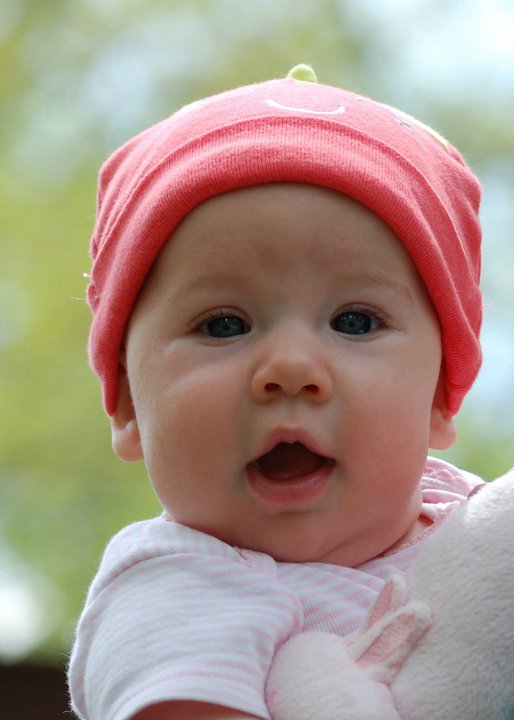
Baby Alaina, 3.5 months, taken at the park by my friend Karen 🙂

“Blessed be all the mothers of mothers.
Blessed be all the daughters of daughters.
Blessed be all the daughters of mothers.
Blessed be all the mothers of daughters.
Now and forever, wherever we are.” –Diann L. Neu

“I have almost given up on the government and the country but I have not given up on birth. I believe rabidly. It is not enough to hold the space for one woman at a time. Peace on earth begins with birth.” –Arielle Greenberg/Rachel Zucker (in Home/Birth: A Poemic)

“In giving birth my attention was pulled inside forcibly by something naturally wild, hot, raw and primitive—something so powerful that my only choice was to surrender.” –Kristin Luce

“Now I see the secret of making the best person: it is to grow in the open air and to eat and sleep with the earth.” ~ Walt Whitman

“A new baby is like the beginning of all things–wonder, hope, a dream of possibilities.” ~ Eda J. Le Shan

“Birth isn’t something we suffer, but something we actively do and exult in.” –Sheila Kitzinger (from promo for new One World Birth film)

“Many women have described their experiences of childbirth as being associated with a spiritual uplifting, the power of which they have never previously been aware … To such a woman childbirth is a monument of joy within her memory. She turns to it in thought to seek again an ecstasy which passed too soon.” ~ Grantly Dick-Read (Childbirth Without Fear)

“Childbirth isn’t something that is done to you, or for you; it is something you do yourself. Women give birth. Doctors, hospitals and nurses don’t.” ~ Lester Dessez Hazell

“Whether she chooses to birth at home, a hospital or a birth center, it is the right–in fact, the responsibility–of every woman to plan her own baby’s birth with the information, honor and freedom to which she is entitled.” –Cynthia Overgard (in Pathways to Family Wellness Magazine)

Life, love, and laughter – what priceless gifts to give our children. — Phylis Campbell Dryden

“A mother’s joy begins when new life is stirring inside… when a tiny heartbeat is heard for the very first time, and a playful kick reminds her that she is never alone.” ~Author Unknown

“Growing, bearing, mothering, or fathering, supporting, and at last letting go…are powerful and mundane creative acts that rapturously suck up whole chunks of life.” –Louise Erdrich

“Perhaps we owe some of our most moving literature to men who didn’t understand that they wanted to be women nursing babies.” –Louise Erdrich

“Labor is about finding your threshold and learning you can go beyond it.” –Rose St. John

“…the labor with which we give birth is simply a rehearsal for something we mothers must do over and over: turn ourselves inside out, and then let go.” –Susan Piver (Joyful Birth)

“The minute my child was born, I was reborn as a feminist. It’s so incredible what women can do…Birthing naturally, as most women do around the globe, is a superhuman act. You leave behind the comforts of being human and plunge back into being an animal…” –Ani DiFranco

“The health of mothers, infants, and children is of critical importance, both as a reflection of the current health status of a large segment of the U.S. population and as a predictor of the health of the next generation.” –Healthy People, 2010

“The miraculous nature inherent in the unfolding of a flower is the very same that moves through a woman as she gives life to the world. We can neither control nor improve upon it, only trust it.” -Robin Sale

“Loving, knowing, and respecting our bodies is a powerful and invincible act of rebellion in this society.” –Inga Muscio

“A new baby’s fresh milk smell causes the mother’s heart to spill over.” -Melanie Lofland Gendron

“…childbirth is much like a marathon…marathon runners know how to breathe, to run, and to complete their race according to their own body signals. Similarly, women know how to breathe, to birth, and to complete the [birth] according to their own body signals. Marathon runners who are true champions are free to stop the fast pace, and even quit the race without loss of integrity.” –Claudia Panuthos

“Birth, like love, is an energy and a process, happening within a relationship. Both unfold with their own timing, with a uniqueness that can never be anticipated, with a power that can never be controlled, but with an exquisite mystery to be appreciated.” –Elizabeth Noble

“…all those tasks and interactions of motherhood, a day full of which might make you feel you’ve ‘gotten nothing done’ because you’ve been in the cycle of care, are the heart and soul of the best brain building possible.” –Lauren Lindsey Porter (Attachment Theory in Everyday Life, in Mothering magazine, 2009)

“The lure of the distant and the difficult is deceptive. The great opportunity is where you are. Do not despise your own place and hour. Every place is under the stars, every place is the center of the world.” –John Burroughs

“Motherhood has a very humanizing effect. Everything gets reduced to essentials.” ~ Meryl Streep (via Midwifery Today)

“It is not ‘ladylike’ to give birth. The strength and power of labor is not demure.” –Rhonda (midwife quoted in Gayle Peterson’s An Easier Childbirth Book)

What we have once enjoyed we can never lose. All that we love deeply becomes a part of us.” —Helen Keller

“The greatest teachers we have are the women we serve.” –Jan Tritten

“…undisturbed (not neglected or abandoned) birth is a powerful initiation into motherhood, not only in a physical and physiological sense, but also in an emotional and spiritual sense.” –Christina Hurst-Prager (in (ICEA) International Childbirth Education Association‘s journal)

“Never hire a midwife who is afraid your birth will go wrong.” –Arielle Greenberg/Rachel Zucker, Home/Birth: A Poemic

“It is dangerous to be right on a subject on which the established authorities are wrong.” –Bumper sticker quoted in the book Home/Birth: A Poemic

“Women today not only possess genetic memory of birth from a thousand generations of women, but they are also assailed from every direction by information and misinformation about birth.” ~ Valerie El Halta

“I see generations of women bearing a flame. It has been hidden, buried deep within, yet they hand it down from generation to generation still burning. It is a gift of fire, transported from a remote and distant world, yet never extinguished.” –Kim Chernin

“Birth is as vast and voluminous, as unfathomable and inevitable as the rising and setting of the sun. And true to the inexorable power and rhythm of their life-giving bodies, women will continue to birth with dignity, grace and courage.” –Mandala Mom

“I pity the folks at ACOG who think they can make protocols, rules and guidelines that will cover all births in all situations. A better goal would be to have clinicians who can think for themselves, distinguish complications from normal birth, relax when things are taking a while, and marvel over the consistently fascinating process of human birth” -Gloria Lemay in Pathways to Family Wellness Magazine

“A pair of substantial mammary glands have the advantage over the two hemispheres of the most learned professor’s brain in the art of compounding a nutritive fluid for infants.” ~Chief Justice Oliver Wendell Holmes (1809-1894)

“The energy that can rise in real connection is the stuff of revolution.” –Carol Lee Flinders

“A woman meets herself in childbirth” –Cynthia Caillagh

“I believe that these circles of women around us weave invisible nets of love that carry us when we’re weak and sing with us when we’re strong.” –SARK, Succulent Wild Woman

“Don’t ask what the world needs. Ask what makes you come alive, and go do it. Because what the world needs is people who have come alive.” –Howard Thurman

“If ever the world sees a time when women shall come together purely and simply for the benefit of humanity it will be a power such as the world has never known.” –Matthew Arnold

“Authority without wisdom is like a heavy ax without an edge: fitter to bruise than polish.” ~ Anne Bradstreet (Feeling frustrated with anti-midwifery legislators in Missouri and then this quote came along from Midwifery Today’s e-news and I thought it was quite fitting)

The midwife teacher’s first concern is to preserve the students fragile unborn thoughts, to see that they are born with their truths intact, that these truths do not turn into acceptable lies” — from the book Women’s Ways of Knowing (shared by a participant in the Birth Workers and Beyond group)

“…we do not have humanized birth in many places today…Why? Because fish can’t see the water they swim in. Birth attendants, be they doctors, midwives or nurses, who have experienced only hospital based…medicalised birth cannot see the profound effect their interventions are having on the birth. [They] have no idea what a birth looks like without all the interventions, a birth which is not dehumanized.” –Marsden Wagner

Childbirth is a rite of passage so intense physically, psychologically, emotionally, spiritually, that most other events in a woman’s life pale next to it. In our modern lives, there are few remaining rituals of initiation, few events that challenge a person’s mettle down to the very core. Childbirth remains a primary initiatory rite for a woman.” –from the book MotherMysteries

“The holistic model holds that birth is a normal, woman-centered process in which mind and body are one and that, in the vast majority of cases, nature is sufficient to create a healthy pregnancy and birth. The midwife is seen as a nurturer.” –Penfield Chester (midwife)

“Birth, like love, is an energy and a process, happening within a relationship. Both unfold with their own timing, with a uniqueness that can never be anticipated, with a power that can never be controlled, but with an exquisite mystery to be appreciated.” –Elizabeth Noble

“If there is ever a part of human anatomy that resembles the image of God it is the uterus.” –Reverend Darren Cushman-Wood

(I hesitated to share this quote because I thought it could be viewed as disrespectful [or even sacrilegious!] by some. But, it caught my eye in an article called Pharaohs and Kentuckians in a 1997 issue of Mothering magazine. Written by a pastor of a Methodist church about homebirth and spirituality 🙂

Modern culture often teaches us to be ‘tight’…trim, taut, & terrific…We understand the need to stay ‘fit’…but we would also like to encourage you to soften yourself, in preparation for mothering & nurturing your baby. Soften your viewpoint, soften your body, surrender to this awe-inspiring event…in this way, you will be preparing yourself not only for labour, but for the days & years afterward…” -The Pink Kit Method For Birthing Better®

“Love is such a powerful force. It’s there for everyone to embrace—that kind of unconditional love for all of humankind. That is the kind of love that impels people to go into the community and try to change conditions for others, to take risks for what they believe in.” —Coretta Scott King

Nurturing is not a genetically feminine attribute. Tears and laughter are not the province of women only. The last time I looked, men had tear ducts. They had arms for holding babies. They cared about their children. And they cried at births…let the shared experience of childbirth reclaim the human soul.” –Ariska Razak (midwife and healer)

“When my kids become wild and unruly, I use a nice, safe playpen. When they’re finished, I climb out.” ~Erma Bombeck (via Moby® Wrap)

Honoring Mothers

Science and Sensibility is having a Mother’s Day event inviting birth professionals to submit stories of how they especially honor mothers in their practices, leading up to Mother’s Day.  The invitation is part of a contest:  a randomly-selected reader who submits a story will be chosen to receive a beautifully hand-made “Beads of Strength” bracelet from Amnesty International.

While I’m not sure will actually work with the vision of the contest, when I think about honoring mothers in my own work, I think about honoring their right to define their own experience and therefore, I submitted this previously written post: Musings on Story, Experience, and Choice.

Mother-honoring birthday gift from my mother this year.