Archives

Tuesday Tidbits: Precious and Fragile

Via Birthing Beautiful Ideas, wisdom from BBI sponsor, The Mindful Way through Pregnancy from Shambhala Publications:

A better photo of our matching mother-daughter necklaces made by Mark :)

A better photo of our matching mother-daughter necklaces made by Mark 🙂

“Ultimately, what makes pregnancy a spiritual practice is not what kind of pregnancy we have. It’s who we open to it, moment by moment, breath by breath. Pregnancy is not about escaping or transcending physical existence. It’s about embracing it, in all its grit and mess and blood and uncertainty and pain. Pregnancy pulls us straight to the heart of what it means to be alive. It reminds us we are part of a universe that is infinitely creative and breathtakingly beautiful but where, ultimately, most of what really matters is out of our personal control. It teaches us that life is both precious and fragile–and that our hearts are both bigger and more vulnerable than we could have imagined.” –Anne Cushman

And, in considering life’s precious fragility, we need also consider the preciousness of midwifery:

“Bickering with each other will lead to our demise. We need to move away from a culture of blame and shift our focus to working collaboratively in order to identify a range of care options. This is a vastly different model than one group of midwives exclaiming, ‘VBACs are safe, all midwives should do them!’ or ‘VBACs are unsafe, no midwives should do them!’ (This is the same rigidity that accounts for high c-section rates in hospital settings.) Could it be possible that midwives who feel safe doing VBACs should be doing them and those who do not, should not? What if we each excelled at particular things and referred women to other midwives when we felt unable to provide care for them? We all need to take responsibility for the overall heath of our industry by honoring the journey that others have made to get where they are and the roles they play in service to mothers and babies.” –Jodilyn Owen (in Midwifery Today, Spring 2012, p. 28)

Shared via ScoopIt:

Some articles about birth:

Writer looks for healthiest, happiest approach to childbirth – California Watch

Study finds widespread ‘criminalisation of pregnancy’ in US institutions

Ky. Voices: Doctors often push for risky births | Op-Ed | Kentucky.com

And, some articles about parenting:

In not very enjoyable parenting articles, I found myself annoyed by this piece…

The Attached Family » What To Do When You Crave a “Mommy Time-Out”

The basic message is, you don’t need a timeout! Just hunker down, spend MORE time and love ’em harder! You are bad for ever wanting a break! Breaks need not ever occur to you. Bad, bad! Attach MORE, more, MORE! The sanctimonious and holistic-er-than-thou tone is exactly why I eventually discontinued my API membership. I am a very crunchy, AP-type parent, but I find that there are certain voices of the “movement” that make me want to run away screaming and saying, no wonder some people HATE US!

In enjoyable parenting articles I very much liked these companion pieces from Dreaming Aloud:

Dreaming aloud: The Sacred Role of a Parent

Dreaming aloud: Finding Our Centres – Tried and Tested Techniques for Family Sanity

And, I also found some things to identify with in this article:

Please Don’t Help My Kids

I’m more likely to be irritated by what I call Maternal Failure Alert alarm-raisers, in which someone “helpfully” points out something your child did or is doing or is asking or is needing or is located, when you already know it very well and in some cases are choosing to ignore/not respond/let them do it/or wait a minute.

Over the weekend I updated my Handouts page also.

Two!

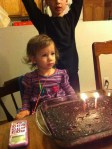
Bear with me as I continue with my string of personal posts. I have some super good birth-philosophy and postpartum-oriented posts planned for the coming weeks, but first I need to spend just a little more time swooning over my baby (I mean big girl!). I know I already posted about her birthday, but I since I wrote the post prior to the actual day, it didn’t include any pictures from her actual birthday:

One thing I noticed on her birthday was very gendered gift choices. I see this, have feminist philosophies about it, and yet still totally participate in it! This is why I will never claim that kids just “naturally” choose certain toys and are “naturally” different from the beginning, because I think it is impossible to separate out what is actually a “natural choice” and what is very actively constructed or promoted from the environment and people around you. One thing I do admit about Alaina that is very stereotypically “girl” is the obsession with changing clothes—she picks out new underwear to wear several times a day and chooses new clothes multiple times a day as well, sometimes specifically asking for something that is “pretty” or “sparkly.” This is not something that I feel like I am actively cultivating in her (because, it is frustrating, really!). I AM actively contributing to her interest in dolls, babies, and baby care stuff, because I like those things too! And, it is fun! And, I also bought dolls and baby care stuff for my boys when they were this age too (and, they too, baby wore. I didn’t buy them an expensive doll carrier though—but, I did make them a homemade mei tai and let them wear my slings with dolls in them).

Here is a very short (22 second) video of Alaina on her birthday answering the question, “how old are you?” 🙂

She’s such a joy. I can honestly say that there has not yet been a single day of her life that I haven’t marveled at and cherished her. She is annoying sometimes too and frustrating and overwhelming and I want to “get away” sometimes, but she has spent every single day of her existence being treasured, loved, and having me spend conscious moments in total appreciation of her.

And, back on topic, today is Martin Luther King, Jr. Day! I read a friend’s blog post this morning and she included this favorite quote:

“Everybody can be great, because anybody can serve. You don’t have to have a college degree to serve. You don’t have to make your subject and verb agree to serve. You only need a heart full of grace. A soul generated by love.” –Martin Luther King, Jr.

I don’t actually use this quote in my own article, but it made me think of our “small stones” of birth activism and so in honor of the day I am re-sharing my Small Stone Birth Activism post:

While reading the book The Mother Trip by Ariel Gore, I came across this quote from civil rights activist Alice Walker: “It has become a common feeling, I believe, as we have watched our heroes failing over the years, that our own small stone of activism, which might not seem to measure up to the rugged boulders of heroism we have so admired, is a paltry offering toward the building of an edifice of hope. Many who believe this choose to withhold their offerings out of shame. This is the tragedy of our world.” Ariel adds her own thoughts to this: “Remember: as women, as mothers, we cannot not work. Put aside your ideas that your work should be something different or grander than it is. In each area of your life—in work, art, child-rearing, gardening, friendships, politics, love, and spirituality—do what you can do. That’s enough. Your small stone is enough.”

These quotes caused me to reflect on the myriad methods of “small stone” birth activism that can be engaged in as a passionate birth activist mother embroiled in a season of her life in which the needs of her own young family take precedence over “changing the world”…

via Small Stone Birth Activism | Talk Birth.

Happy Birthday, Big (little) Girl!

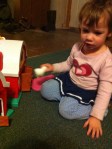
MollyNov 067Happy Second Birthday!

How can it be that TWO YEARS ago I was giving birth in my living room to my precious baby girl? Has it really been that long ago that I felt that intense, sweet relief at her living presence and the knowing that I DID IT and we were both okay?

Here’s what our world is like right now with this little treasure in it:

  • Can talk now. I worried a little about her speech and whether she was “ever” going to talk. She does now, though not in sentences and not with fluency. But, man, she can say all kinds of words. Like…
  • Says yes adorably (“jes” or “dash”/d-yes kind of)
  • Says things like: thank you, dude, spicy, sparkly, birthday (also poop, butt, and boob)
  • Says “um…” I didn’t know that started this early! And, because of our jobs, Mark and I have worked pretty hard to cull this from our own speaking, so I’m surprised she’s picking it up anyway.
  • Still has sour milk/yogurt baby breath. I love it!
  • Skip-hop-gallops to do or get things.
  • Seemed to call me bratty yesterday when I was whining about her not going to bed! 😦
  • In another “bad mom” confession, a couple of days ago she was being aggravating about going to sleep and was nursing really roughly, etc. and I was crabby at her and said, “what is wrong with you?” and she said, “Done, mama.” And, I said, “you’re done with mama?!” and she said, “JES!”
  • Nurses around ten times a day–is pretty rough and I’m getting pretty fed up with being manhandled and abused!
  • Loves having rituals and setting up candles. (Says, “ommmm” while doing so)
  • Remains a night owl and is routinely up til midnight.
  • Clearly self-identifies as one of the kids–runs to join in with everything. Will do yoga and gymnastics, carefully studying and imitating.
  • Tuesday hit big girl milestone in that I left her (and the boys) with a friend for 1.5 hours in between me leaving for class and Mark picking them up. First time in nongrandparental care. She did a really good job and was happy and played like one of the kids!
  • Rides scooter under own power, but also cackling with glee if someone else zooms her around!
  • Knows some colors and can count to three (or, at least two). Blue is favorite.
  • Has thing for “pretty” clothes and wants to change clothes, choose own outfits in dramatically different way than I’ve been used to with prior children.
  • Loves dolls and real babies. Loves, loves them. I may actually have to have another baby just so I can give it to her.

Here’s what I wrote when she was born. And, about her birth. And, here’s what I wrote on her first birthday.

Video of first “dude” saying (plus, bonus “boob” thrown in for good measure):

I think it is officially time to stop saying I have a baby. I have a two-year little girl now!

Happy birthday, sweetness!

Blog Circle: New Beginnings and Most Significant Events

The January Blog Circle at The Amethyst Network has the theme of New Beginnings. This is perfect for me, since my pregnancy-after-loss “rainbow baby” was born in January. The Amethyst Network was named for the infant sister of one of the founders. Her name was Amethyst. We use “Amethyst babies” as a way to identify and label loss stories on the TAN blog and we are using “Garnet babies” to refer to babies born following loss. Garnet is the January birthstone and several of the founders have January rainbow babies. Several of us also have February miscarriages (amethyst is the birthstone for February). While this obviously isn’t a universal experience, this is how we personally make the connection between our choice to use gemstone names and our own experiences. Here’s the info about this month’s blog circle:

The loss of a baby is the end of something but it is also the beginning of something new. It takes time to find that new, to navigate and find your way in this new world you have been thrust into and to navigate and find your way into this new normal.

The New Year is also an opportunity for New beginnings. Many people set Goals and New Years resolutions to focus on for the year. It may be a time of letting go of the old and focusing on the new.

We have chosen the theme “New Beginnings” for our January Blog circle. The decision was based both on the New Year as well as the new beginning for the Amethyst Network. We have been redoing our website, redefining our mission and creating a space of hope and healing and a place of information for those who in the miscarriage/babyloss community.

We would love to have you participate in our January Blog Circle. The theme is New Beginnings. Was your loss a new beginning for you? Your next baby? How do you feel about the New Year? Are you in a place of letting go? Or embracing?

676

A lot of hopes and dreams rested on this little body!

My first loss was, in fact, a new beginning for me in many ways. That miscarriage-birth changed my life forever. It changed my worldview, it changed how I work with women, it changed my understanding of the world, it prompted a spiritual awakening, it changed the trajectory of my work and my focus, and it broadened and deepened the scope of what I’d like to offer in service to others. It was BIG. It was important. It was hard, it was scary, it was emotionally and physically painful, and it lasted a long, long time. It took the birth of my pregnancy-after-loss baby in January of 2011 to really feel “healed” from the scars of loss and so in this way, she was definitely a new beginning as well. I remember thinking during my pregnancy that there was so much riding on her—a lot for a little baby to shoulder—all of our hope, our fears, our very future of a family felt like it rested in her. And, I remember telling her, shortly before her first birthday—you, you healed me. In our conversations among The Amethyst Network board members, I’ve also shared that I didn’t feel completely healed until she reached her first birthday—until we taken one whole turn of the wheel together with her in my arms. And, in that way, I’m also not sure that we ever completely heal from loss—I know that one of the factors behind our decision not to have more children is a still, small, lurking fear of what if it started all over again? That would suggest that a scar on our lives remains (that isn’t necessarily a bad thing. Our scars are part of the landscape of being–of loving, living, risking, losing, learning, and changing).

Considering this topic also brought me an old question, previously posed in response to a midwife’s blog post, in which I ask the following:  What is the most significant event that shaped your life as a woman? As a mother? Are your answers to the two questions different?

My own answers have in fact been different. And, they have changed. Pre-loss, I described my postpartum journey following my first birth as the most significant event shaping my life as a mother. After the miscarriage-birth of my tiny son, the texture of my response and my definition of my life experiences shifted:

When originally writing this post, I was pregnant with my third son. That pregnancy ended very unexpectedly in November, rather than May, when my baby was born after almost 15 weeks of pregnancy. Interestingly, my experience of miscarriage has supplanted the birth of my other two sons as essentially the most powerful/significant and transformative event of my life. (My sense that his birth has “replaced” the birth of my other children as most significant makes sense to me, because though it is classed as miscarriage, it is still my most recent birth experience—all of their births stand out as special, important, and meaningful days and I will remember each with clarity for the rest of my life, but his birth is the freshest and most recent and came with the additional transformative journey of grief. And thus, when I think of giving birth or when I think back to birth memories or birth feelings, his birth is the first one that comes to mind.) Though I still “vote” for postpartum as the most significant event in my life as a mother, I now “vote” for my birth-miscarriage experience as the most significant event in my life as a woman.

Interestingly, my answer has evolved again since writing the post above and I would now include the entire pregnancy-after-loss journey as the most significant event in my life as a mother. It was hard, people. It was day in and day out and never-ending and so, so delicate. So tinged with hope and fear and so laden with meaning. As a woman, though, I’m not sure that my answer has changed. I need to think about it more deeply, but I think that miscarriage-birth is still it. Just as life divides cleaning between before kids and after kids, there is a dramatic, pivotal before miscarriage and after miscarriage that has shaped my female identity and understanding of myself.

567b

Preventing Culturally Induced Lactation Failure

281How often does it happen that women truly are physically unable to breastfeed?

No one actually has a solid answer to this question. The common estimate is a very hazy, “less than 1%.” I’ve said it, very hazily, plenty of times myself. But, what does that really mean? I’ve certainly talked with a lot of struggling mothers over the years—many of whom go on to continue to breastfeed successfully, but who might very well not have done so without encouragement, reinforcement, and practical suggestions. If they never reached out for help, might they have ended up as part of that semi-mythical 1%? How about those mothers that absolutely stagger me with their ability to keep going and keep trying when I would understand completely if they decided to quit and in fact question that I, personally, would have been able to continue if faced with the same obstacles—where do they fit in? Maybe just in the category box labeled amazing.

Yesterday, I read an article on the Breastfeeding Medicine blog that really shook my personal framework up a bit:

…I would argue that there’s a very fine line between “sensationalizing” and “truth in advertising.” Reproductive biology is imperfect — some couples can’t conceive, and some pregnancies end in miscarriage or stillbirth. The silence around these losses and the isolation that women have historically experienced has probably worsened the suffering for many women. On the other hand, emphasizing these risks and creating a culture of fear harms the majority of mothers who will have successful pregnancies and births.

Lactation is probably a few decades behind infertility and pregnancy loss in coming “out into the open” as a generally robust, but not invincible, part of reproductive biology.

via Establishing the Fourth Trimester « Breastfeeding Medicine.

Wow! Brain boggled in reading this. Heart clenched at thinking that I may have treated someone as casually in breastfeeding loss as other mothers have been treated over and over again in pregnancy loss. The author goes on to explain that women used to be blamed for having miscarriages and we just might be doing the same thing to women who physically can’t breastfeed. I have never in my wildest dreams considered adding “lactation failure” to my understandings of the things that can truly go wrong during the childbearing year. I usually consider, “some mothers are physically unable to breastfeed” to essentially be in the same territory as dragons and unicorns. I’ve remained firmly convinced for, like, ever, that it is culture that fails mothers and babies and not women’s bodies that fail. And, I truly wonder if it is ever possible (except for in cases of insufficient glandular tissue, metabolic disorders, breast surgery/removal, and clear physical malformations) to really tease apart whether a mother is actually experiencing lactation failure or sociocultural failure. I remain fairly convinced that in many cases it is impossible to know—but, that a mother (or physician) may certainly experience it as “lactation failure” and thus add that data point to the 1%. I have long maintained that a lot of people forget that breastfeeding occurs in a context and that context doesn’t necessarily support breastfeeding. However, I do also know from years of experience that motherbaby physiology can lead to problems too and we often overlook that in assertions about breastfeeding.

How do we get breastfeeding off to a good start?

At our 2011 Big Latch On event.

At our 2011 Big Latch On event.

How do we make sure that mothers do not experience sociocultural breastfeeding failure? It begins with the birth. Birth and breastfeeding are not discreet events—they exist on a biological continuum. When I attended the La Leche League International conference in 2007, there was an exciting emphasis on “the motherbaby” as a single psychobiological organism. The womb is the baby’s first habitat and following birth the baby’s “habitat” becomes the mother’s chest—otherwise referred to as “the maternal nest.” In short, a normal, healthy, undisturbed birth leads naturally into a normal, healthy, undisturbed breastfeeding relationship. Disturbed birth contributes to disrupted breastfeeding. In a previous article on this topic I wrote:

New mothers, and those who help them, are often left wondering, “Where did breastfeeding go wrong?” All too often the answer is, “during labor and birth.” Interventions during the birthing process are an often overlooked answer to the mystery of how breastfeeding becomes derailed. An example is a mother who has an epidural, which leads to excess fluid retention in her breasts (a common side effect of the IV “bolus” of fluid administered in preparation for an epidural). After birth, the baby can’t latch well to the flattened nipple of the overfull breast, leading to frustration for both mother and baby. This frustration can quickly cascade into formula supplementation and before she knows it, the mother is left saying, “something was wrong with my nipples and the baby just couldn’t breastfeed. I tried really hard, but it just didn’t work out.” Nothing is truly wrong with her nipples or with her baby,

I know that my birth experiences significantly impacted my breastfeeding experiences in that my babies were never separated from me after my peaceful, undisturbed births (one birth center, two homebirth). They went directly from being born to my breast, keeping the physicality and continuity of our relationship unbroken and undisturbed. That is not to say that we never experienced any challenges, I struggled with oversupply with all of them—which reminds me of attending another LLL conference presentation by Diana West in which she stated that she is seeing much fewer “normal course of breastfeeding” issues in her practice and instead of noticing an “epidemic of both low milk supply and oversupply.” She asked the room if we were noticing the same thing and many of us raised our hands. One possible theory is the amount of endocrine disruptors in our food supply. Again, is that actual lactation failure or is that ecological failure?!

Some time ago I wrote an article for the Friends of Missouri Midwives newsletter in which I asked for submissions regarding the topic of how birth experiences impact breastfeeding. A doula wrote to share her experiences:

My births definitely affected my breastfeeding experiences. I prepared extensively for my first child’s birth. I felt fully educated about birth and also breastfeeding. I planned and had a natural birth. Being empowered by that helped me know I could handle and be successful at breastfeeding too. My two unassisted births were “all me”. There was no one telling me what to do. I was confident in that and that also helped build my confidence one again in breastfeeding. I will also go on to say that not only did my natural hospital birth and subsequent home births help in breastfeeding, but also generally as a mother. They empowered me to know that I was capable of a lot more than I could ever imagine! (Which is great on a day with three little ones screaming around the house!)

 And, a local physician also had input about the question:

Gosh, my own experience–how can I know how my birthing influenced my breastfeeding?  Since the nursing part was so easy, and I birthed at home (thank heavens), well, how would I know if it would have been different if we had done it differently?  But I know this:  it is SO much easier being a breastfeeding supportive physician to home born babies than it was trying to support breastfeeding when the birth was distorted.  In my experience, the only other thing that makes that much difference is La Leche League attendance.  I think mothers and babies are designed to experience labor and birth and then breastfeed.  When things go differently–like when labor is started early for some reason, or when mothers don’t get to experience their labors and births because of epidurals or other drugs or cesarean  sections, then the breastfeeding is more likely to be challenged.

Babies are programmed to learn to nurse in that first hour after birth.  They need to be in contact with their mothers for that time to do that.  It doesn’t take much intervention to undermine that.  Our babies are working so hard, learning to live on the outside of the womb–changing everything, including their breathing, their circulation, their digestion, elimination, integrating new and overwhelming sensations–and also learning the complex skill of finding the nipple, grasping the nipple, holding the nipple, milking the nipple (and don’t forget to swallow and breathe!).  We should leave them alone and not ask them to do one more thing–like meet Grandma, or deal with the nurse, or warm back up from a bath.

So here’s my advice:  If you want to breastfeed and do it effortlessly:

1.  Get great prenatal care from the best midwife you can find

2.   Plan and achieve a home birth

3. Go to La Leche League regularly during pregnancy and nursing.

This doctor then wrote back to me again with some additional comments about breastfeeding and La Leche League:

La Leche League makes a BIG difference.  In my experience, mothers who are members have far fewer reasons to call me for advice (of any kind, really).  And when they do, they tend to be focused, easy-to-answer questions or requests.  So, instead of “my nipples hurt,” it is, “I’ve been reading/talking to/consulting with various sources and I think that I have nipple thrush.  The things I have tried haven’t worked and I am not ready to try Nystatin.  Can you prescribe this for me?”  LLL ladies ROCK!

I am convinced that a thousand little adjustments get made in the wise nursing circles–a comment made, a slight modification of a nursing  position, an encouraging word, a question asked, a behavior modeled.  With these gentle, under-the-radar moves, nursing just gets easier or stays easy.  The woman and her circle never consider that a “nursing problem” existed.  No big intervention needs to happen.

Without these “interventions” nursing problems DO develop, and then the rescue team gets called in–people have big feelings, do big or little interventions, they help or they don’t and people feel like heroes or failures and “breastfeeding problems” get into the story-telling.  But what gets lost is how easily these things are “prevented”.

Midwifery is like this.  Parenting is like this.  Life is like this.

I really appreciate her closing observations here about wise nursing circles. I believe it can be in these circles that we find the women who know and we can certainly give each woman who we come into contact with the best chance at preventing or overcoming culturally induced lactation failure.

Talk to Your Baby

I already know that you can learn a lot from chickens about giving birth. This summer, I had another profound birth-mothering experience with one of our chickens after she hatched her first baby. During the last several days of incubation, mothers hens “talk” to their babies a lot through the eggshells and the babies respond. It is part of how they get to know each other and imprint before hatching. Then, after baby hatches, the mother hen continues to talk and cluck to the baby in a reassuring manner—she calls to the babies when separated and she calls a special call when there is something good to eat and she clucks softly and reassuringly at bedtime as she snuggles them all beneath her. There is a specific type of “soothing” noise they make to stressed or lost babies and a specific sort of excited sound they make to let the babies know something good is happening. There are also distressed sound that means, “run to me now, there might be danger!”

537

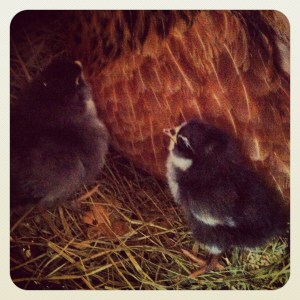
The baby chick who tried desperately to get to a mama who would talk to it (this mama, interestingly, is the same one I wrote about in the Birth Lessons from a Chicken essay several years prior).

We had three broody chickens at the time, each in their own little separate nest box in the broody coop. One of the hens had hatched a baby already and was in the neighboring box. The inexperienced mama hen hatched her baby and she would not talk to it. The baby freaked out. It flailed, it freaked, it stumbled all around. It dragged its tiny little wet, not-even-able-to-walk body to the very corner of the nest box as far away from the mother as possible. It flung itself into the wall where it could hear the neighboring mother clucking to her baby. The baby peeped more frantically and loudly than I’ve ever heard a chick cry out before, it sounded like it was in grave distress and danger. We moved it back to its mother and she fluffed out her wings around it just like she was supposed to do and I thought all would be all right, but…silence. The mother did not talk. Her baby desperately struggled out from under her, still not able to walk, still wet, and flung itself back into the corner, sinking down under the straw, crying piteously. Silence from the mother.

Talk to your baby, we pleaded. Your baby needs to hear you. Please talk to your baby. Silence. The baby squished down on the wire slats, pressed into the corner of the box, screaming at the top of its chick-lungs. The mother in the next box became distressed as well, calling back to the baby more and more loudly. The chick became more frenzied and flopping. The baby in the next box picked up on the fear and began peeping loudly as well. Still, the new mother sat silently and unresponsive. Talk to your baby. We left her alone, thinking her instincts would kick in, but as time passed and we could hear the chick screaming from all the way across the yard, we went back to interfere. We tried twice more to put it back under her and again the same routine repeated. We became concerned the baby would die if its level of distress continued, particularly with forcing itself down and under the straw and into the wire, so we made the decision to remove it and put it in “foster care” with the other, responsive mother. We thought she might attack it, since it wasn’t her own hatchling and because it was several days behind her own baby, but she snuggled it right up, clucking in reassurance, and it went to sleep, the next morning it was fluffy and quiet and perfectly happy with its new mother. The red hen continued to sit, silent, and unresponsive, and of course I felt horrible for stealing her baby and giving it to someone else after she’d worked so hard to hatch it. Luckily for the mental health of all involved, she successfully hatched one more baby and did take care of it, albeit still quite silently compared to all other mama hens we’ve experienced.

What does this have to do with birth?

Babies are primed to hear their mothers’ voices after birth. They expect to be snuggled into the maternal nest. Mammal babies expect to receive a warm breast and to hear comforting words in their own language. I feel fortunate that my own birth pause was respected after all my children’s births and that each baby felt only my hands and heard my voice for their first minutes of life. I talked to all my babies, soothingly and lovingly, and then brought them to my breast. My midwife and the other people around me did not interfere with these sacred, timeless moments of introduction.

It has been several years now, but I’ve worked with a couple of mothers for breastfeeding help postpartum who were unwilling or unable to talk to their babies, even with direct encouragement to do so. Baby was expecting mother’s voice and mother was unable to give it. Not surprisingly to me, these mothers experienced significant difficulty in getting baby to breast. I believe baby is expecting mother’s voice as a guide to the breast as much as it is expecting the smell of her and the sound of her heartbeat. Baby is not expecting multiple, strange voices from nurses (or even helpful breastfeeding helpers like me!). Baby is not expecting gloved hands. Baby is not expecting bright lights or loud noises. Baby is most definitely not expecting to be “helped” to the breast and “shoved” on as many mothers describe experiencing after their births. In Breastfeeding Answers Made Simplethe author emphasizes that what motherbaby pairs need most to successfully breastfeed is time alone to get to know each other. Mother and baby need to explore each other’s bodies and to listen to each other. She points out that with many people in the room, even well-meaning people, mothers have trouble getting to know their babies and getting babies to breastfeed. She says the most helpful strategy to supporting early breastfeeding is to get out of the way and let mother talk to her baby, smell her baby, touch her baby, meet her baby, and learn about her baby.

536

The non-communicative mother and her second baby, who was okay without much talking.

What are we really imprinting upon many newborns at birth in our culture?

As Sister MorningStar writes in her article The Newborn Imprint in Midwifery Today issue 104, Winter 2012…

If you have had the misfortune, as nearly all of us who can read and write have had, to see a baby born, perhaps pulled out, under bright lights with glaring eyes and loud noises of all sorts, in a setting that smells like nothing human, with a mother shocked and teary and scared; if you have witnessed or performed touch that can only be described as brutal and cruel in any other setting…

Every baby born deserves uninterrupted, undisturbed contact with her mother in the environment the mother has nested by her own instinctual nature to create. Any movement we make to enter that inner and external womb must be acknowledged as disturbing and violating to what nature is protecting. We do not know the long-term effects of such disturbance. We cannot consider too seriously a decision to disturb a newborn by touch, sound, light, smell and taste that is different and beyond what the mother is naturally and instinctually providing. Even facilitating is often unnecessary if the motherbaby are given space and time to explore and relate to one another and the life-altering experience they just survived. They both have been turned inside out, one from the other, and the moment to face that seemingly impossible feat cannot be rushed without compromise. We have no right to compromise either a mother or a baby.

I am deliberately leaving out the issue of life-saving because it has become the license for full-scale abuse to every baby born… [emphasis mine]

If mother has been taken to an operating room to give birth, or if mother is for any reason overwhelmed, exhausted, scared, vulnerable, hurt, and traumatized, she may have great difficulty in talking to her baby. If the room is full of people, baby may have difficult hearing her mother’s voice and feeling her welcoming touch. If baby is greeted by a bright light and masked face instead of her mother’s voice, baby may cry loudly in distress and eventually “shut down” into sleep rather than immediately to breastfeeding.

What can we do?

Beyond the obvious answers in carefully choosing place of birth and birth attendant, we can talk to the babies. If birth has been long, scary, or otherwise difficult, talk to the baby. If baby needs immediate care after birth, try as hard as humanly possible to have that care take place on mother’s chest and in reach of mother’s voice. If baby has to be separated from mother, talk to the baby. Call out to him. If mother can’t call out to the baby, father can talk to the baby. If father is unable, doula or midwife or nurse can talk to the baby. Welcome her to the world, reassure her that she is safe and all will be well. Speak gently and soothingly and kindly, never forgetting that this is a new person’s introduction to the world and to life. Our first and deepest impulse is connection. Before Descartes could articulate his thoughts on philosophy, he reached out his hand for his mother. I have learned a lot about the fundamental truth of relatedness through my own experiences as a mother. Relationship is our first and deepest urge and is vital to survival. The infant’s first instinct is to connect with others. Before an infant can verbalize or mobilize, she reaches out to her mother. Mothering is a profoundly physical experience. The mother’s body is the baby’s “habitat” in pregnancy and for many months following birth. Through the mother’s body, the baby learns to interpret and to relate to the rest of the world and it is to the mother’s body that she returns for safety, nurturance, and peace. Birth and breastfeeding exist on a continuum, with mother’s chest becoming baby’s new “home” after having lived in her body for nine months. These thoroughly embodied experiences of the act of giving life and in creating someone else’s life and relationship to the world are profoundly meaningful experiences and the transition from internal connection to external connection, must be vigorously protected and deeply respected.

“Birth should not be a celebration of separation, but rather a reuniting of mother and baby, who joins her for an external connection.” –Barbara Latterner, in New Lives

“No mammal on this planet separates the newborn from its mother at birth except the human animal. No mammal on this planet denies the breast of the newborn except the human.” –James Prescott (neuropsychologist quoted in The Art of Conscious Parenting)

 “A woman’s confidence and ability to give birth and to care for her baby are enhanced or diminished by every person who gives her care, and by the environment in which she gives birth…Every women should have the opportunity to give birth as she wishes in an environment in which she feels nurtured and secure, and her emotional well-being, privacy, and personal preferences are respected.” –Coalition for Improving Maternity Services (CIMS)”


361

Book Review: Fathers-To-Be Handbook: A Road Map for the Transition to Fatherhood


Fathers-To-Be Handbook: A Road Map for the Transition to Fatherhood
By Patrick Houser
Creative Life Systems, 2007
Softcover, 160 pages, $16.95.
ISBN: 978-0-615-23338-3
www.fatherstobe.org

Reviewed by Molly Remer
http://talkbirth.me

I am delighted to see another contribution to a growing body of birth and fatherhood literature written for men. Unlike many fathering books I’ve reviewed, the Fathers-To-Be Handbook was actually written by a man! This man-to-man, father-to-father perspective is a valuable strength of the book.

Patrick Houser is the father of two boys, both born at home with a midwife. His second son, born in 1980 in Missouri, was the first documented water birth in the U.S. The author has been based in the U.K. for a number of years now and is the co-founder of a wonderful organization called Fathers-To-Be, offering resources and education for expectant fathers as well as to the childbirth professionals who work with them.

Fathers-To-Be Handbook is a quick read and is a small-size paperback; like a “pocket guide.” It is definitely meant to accompany other reading and classes. It does not have an index, but does have a helpful resources section.

The first several chapters of the book are about the experience of fathering—about becoming a father, your personal history with your own father (“fathering school”—what was your teacher like?), the importance of fathers, and the journey through pregnancy. The final four chapters address preparing for birth, giving good support, empowered birth, and fathering the newborn. The handbook is very supportive of midwifery, homebirth, and doulas. It also encourages fathers to have a male support person nearby the birthing room (or perhaps available for support by phone).

As the author states in an article included at the end of the handbook, “Humanity cannot invent a drug that can work better than a mother’s body can manufacture or a knife that is sharper than her instinctual nature.” I deeply enjoyed an addition to birth literature that both honors the father’s experience and is rooted in a positive, healthy, celebratory approach towards birth and the inherent capabilities of a woman’s body.

Disclosures: I received a complimentary copy of the book for review purposes.

Amazon affiliate link included in image and book title.

Review first published at Citizens for Midwifery.

Taking it to the body… Part 2: Embodied mindfulness, introversion, and two hours!

Trust yourself. Take it to the body. She always knows.”

For my meditation practice for my compassion class, I’ve been working with several things, starting with the above quote. As I explained in part 1, how often do we deny the urgings of our bodies? It seems as if mindfulness begins there.

So, I’ve decided to practice an embodied mindfulness and meditation…taking it to the body and checking in with what she knows. Consciously noticing and being aware of my body’s signals to sleep, eat, and eliminate. It is much harder than you would think for something so basic and essential for well-being and I “fail” many, many times a day, but, and this is the point: I notice as I am failing, as I am not listening. That is better than remaining unconscious, right?!

The second part of my practice is that I’m trying to make sure I feed my spirit first—going to the woods, praying, setting intentions for the day, lighting a candle and setting up some of my goddess art sculptures near me as I work, rather than letting those things languish for “when I have enough time” and “later.”

The third part of my practice is to notice my thoughts and how I think about things, bringing mindfulness to the repetitive, wheel-spinning , brain-groove making patterns of thought that I habitually engage in. I frequently feel like, “something has got to change!” or, “I need to change what I’m doing and THEN, XYZ.” In mindfulness practice, I notice that more often it isn’t what is actually happening in my life that is upsetting or stimulating the “change” urge, it is expressly how I think about things that needs to change. I have become aware of the following unhelpful brain-groove thoughts that continue to dictate my behavior, choices, feelings, and responses:

I might die

I need to be perfect

I can’t rest

I’m out of time/running out of time/there isn’t enough time

(I haven’t fixed these yet, but awareness of them is a big part of the puzzle.)

As appears to be my custom at this time of year, I had a big meltdown this weekend feeling resentful, overbooked, stressed, ragged, frustrated, blocked, irritable, etc., etc. Then, I piled on a hearty dose of self-admonishment for all those feelings and stirred in some big helpings of guilt. I blamed various things, I blamed myself, I ranted and raved about how something needs to change and I need to do something different because this just isn’t working. (most of this was actually in my own head because Mark was sleeping in the living room as he recovered from the stomach flu that swept our house this week, more on this later.) I was crabby at loved ones. I felt guilty for wanting to be alone and for feeling done with snuggling my nursling and smelling her sweet head, knowing, knowing, knowing that the time is passing and that I will miss it and yet, dang it, stop climbing all over me and ramming your hands down my shirt! I felt like I “should” be doing all kinds of things differently. Like I should be a better, nicer person and like maybe I’m choosing wrongly in my life. I wanted to just stop, to get off, to quit everything. I decided I don’t want to help anyone else anymore and I just want to take care of myself. I cried because I need my parents and Mark to help me so that I can help other people and if I just stopped trying to help anyone else, I could take care of myself/family and not need anyone to help me either. I made plans to make a big life map and ruthlessly chop things off it. I decided to embark on a massive self-care, self-improvement project for the new year. I dragged out piles of books to look through. I remembered that busy is boring , I craved time for a retreat. I exclaimed that I just want to grind my corn! I lamented my ongoing crisis of abundance. I looked up my old post about balanced living and saying ‘no’ and thought about how I’m going to say a big fat NO to everything all the time! Must be clear on priorities. Must choose well and wisely. Then, I got annoyed with myself for already having figured this stuff out before, for writing about it already, for boringly lamenting it all before, for never learning (or integrating) my life lessons, and for knowing better and yet doing it anyway.

And, then…everyone went to bed. I sat up by myself and worked on a drawing for a “make a plate.” The kids all did this at my mom’s house over the weekend as a Christmas project—you draw a design on a special piece of paper, send it in to the company, and they send it back to you as a plate. I wanted to make one too! So, I did:
20121203-093946.jpg

I really like it. After drawing, I felt tons better. I sat alone in the living room with my computer and got my online class all caught up for the week. And, suddenly it hit me. This ugly ragged self of mine I was seeing and experiencing and hating. She was popping out because I hadn’t had my two hours all damn week! And, after I realized that, I understood that things weren’t really that bad after all. Last week was insane. I knew it in advance, but it doesn’t mean it was easier to cope with it. And, if I tuned in to myself and my body, which is really, really hard to do when you’re an introvert without your requisite two hours, I just heard the familiar cry for what I need, to just be by myself at home for some time each week. Not to quit everything, all the time, but just to have some regular, consistent still points of solitude.

This is what last week looked like for us:

Monday: Twenty papers submitted by my online students, they all need to be graded in addition to my usual weekly grades for the week. While I did my usual grades and online class prep work, no papers got graded with the time I had available. Manage to quickly write an assignment for my own class, part of which is excerpted at the beginning of this post. Scramble to town to take the kids to meet Mark. Teach class on Monday night from 5-10. Come home freaking out about the rest of the week and HOW CAN I POSSIBLY GRADE THIS MANY PAPERS WHEN I HAVE NO TIME! Maybe I’m not meant to do this, maybe three classes is too many, maybe there is just something wrong with me.

Tuesday: After doing school with the boys, laboriously make pumpkin pasties to take to the Harry Potter potluck for the last day of homeschool co-op Wednesday. Insist on all three children helping with the “fun” and get super stressed out at not being a more zen mother of awesomeness. Call my dad desperately in the afternoon requesting “tribal reinforcement” (my tribe is a good one!).

20121203-144224.jpg

Pumpkin pasties. Awesome, or unnecessary torture?

After he takes the kids over to play at his house, manage to grade four of the papers among many other tasks. Then, take the kids and head to town for their taekwondo class and my own reiki class (why take a reiki class now when I already have so much going on? Who knows?! Crazy, remember?) Reiki class is great—totally works and I feel like such a healer! Go home and practice fab skills on Mark and boys and they are impressed. Feel buzzing with energy and hands are tingling. Stay up until 2:00 a.m, on purpose and finish grading ALL papers. Feel awesome and smug and have killer, killer headache.

Wednesday: killer headache continues. Take kids to homeschool co-op and potluck. Pumpkin pasties meet with approval. Pick up two of boys’ friends for an overnight. Fingers crossed for Alaina to nap when we get home, since I’m desperate to be alone and need to get “caught up.” She doesn’t.

Make homemade mac and cheese for dinner and it rocks. Boys and friends stay up until past midnight. I stay up and finish prepping for Friday’s class.

20121203-144140.jpg

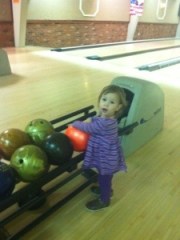
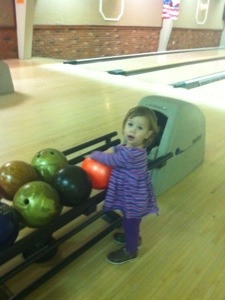
She actually wore bowling shoes this time! Insisted on carrying ball every time for a whole game!

Thursday: Killer headache remains (not enough sleep, I think at the time). Make quesadillas for all kids in house and barely stagger out door with them all to go to playgroup at bowling alley. Bowl a terrible 85, but have lots of fun (Alaina is adorable bowler and gets a 17 [non-bumper lane]). Belabor different post-playgroup scenarios to manage rest of day.
20121203-144200.jpg

Mine, mine?

20121203-144214.jpg

Brothers are not into bowling and complain nonstop and sit staring like this. I finish their games.

20121203-144234.jpg

She’s a natural!

Send boys with friend to get pizza and go to park, while Alaina and I go to Wal-Mart to buy dinner supplies for a postpartum mama. Take dinner to new mama and listen to fab birth story and do breastfeeding help for next two hours. Kids come back from park and are sent with other friend in my van to gymnastics class. Help jump friend’s car and then go to pick up all gymnastics kids (my own boys + two). Am slightly late and they’re getting worried. Zoom to taekwondo to drop all off. Go to Panera to eat dinner and meet couple for wedding ceremony planning. Alaina finally falls asleep and nurse-sleeps throughout Panera visit. Back to get boys at 8:00 and meet other friend to deliver books she’s borrowing, plus pick up evaluation from her from recent birth workshop. Head home, dropping off boys’ friend at her house on the way. Remember LLL monthly stats are due and do them (27 helping contacts for November!), plus send overdue emails and answer help message. Catch up in online class. Collapse in recliner, hoping Alaina’s Panera snooze wasn’t an uber-late nap. She nurses more and falls asleep. Score! Mark and I start a Teen Wolf ep while she keeps nursing. Suddenly, A wakes and projectile vomits all over my body. Yikes! What’s up?! As I wash the chunks off in the shower I start to feel bad too (headache continues, FYI). At 1:30, I throw up too. Alaina throws up seven more times during night with various degrees of mess. Grateful for Mark and his clean-up skills.

Friday: Mark stays home to help, but still needs to get own work done from home. I throw up one more time and debate going to class tonight—do I go or stay?! Zander starts throwing up. My head is actually going to explode with pain. Have fever and chills. Decide not to go to class, even though it means incredible hassle with double make-up classes now (because of no class on Thanksgiving). Nap and wake at 3:00 deciding it is class or bust after all. Both options feel like dumb options. Decide to be Typhoid Molly. Take Advil, get dressed, and head for the Fort where I teach. Class is fine. I have a guest speaker and show a video about child abuse. Hope to leave early, but feel better as class goes on and get busy with student questions/discussions. Dismiss early enough to get out the back gate and take short route home.
20121203-144258.jpg

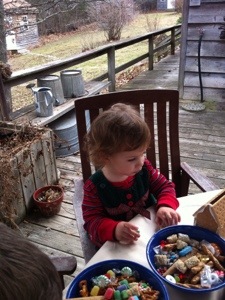
Selecting candies.

Saturday: Work party at my mom’s house. She has good projects planned. While the men cut firewood, the women make seasoning blends using herbs and spices I ordered last week from the bulk food buying club. Alaina is fretful and clingy and nurses nonstop, even though she has to stand on a chair to do it while I mix my seasoning blends. Kids draw pictures for their plates and also make fun cracker houses. Alaina finally naps and I grade two late papers, respond to a help message, and try to catch up with my online class again. Feel bad and guilty about not helping with dinner prep and also misunderstood by others about legitimately needing to get my work done. Feel annoyed that I have to make excuses or justifications for it, feel others are annoyed with me. Eat communal turkey dinner and yummy cake. Home feeling generally distressed, unhappy, and overbooked. Am reminded that I’ve forgotten/misunderstood something again. This keeps happening. My brain is leaking. I can’t hold everything and I keep dropping balls, communicating poorly/not enough, missing things or misunderstanding things, and forgetting stuff. Wish I hadn’t had to go anywhere on the weekend. Need regroup time. Suddenly remember with a shock that today is the FoMM newsletter deadline (for contributions, not for me). Send requisite emails and consider fact that I have exactly zero contributions thus far. Lann wakes before we make it to bed and barfs turkey dinner ALL OVER bedroom floor. As Mark cleans it up, he starts to feel sick too. Is up and down during night with stomach pain and finally also vomits.

20121203-144343.jpg

Finished houses with architects.

20121203-144352.jpg

Lann’s house.


Sunday: I feel pretty good at start of day, but start to freak out as day progresses. Mark is down sick in recliner all day. Alaina is whiny and clingy and doesn’t stay asleep at naptime. By 2:30, I’m still in PJ’s and feeling emotionally fragile. Begin the internal monologue of self-doubt, criticism, and desire for change described above. Kids go visit my parents and I work frantically on various bits and pieces, like preparing for my class on Monday night. Feel I’m choosing wrongly and still not taking care of myself. What’s wrong with priorities?! Argh. Gnash. Suffer.

Sunday night: stay up after others are in bed. Make my drawing for my plate. Have epiphany that this is all about the two hours. I usually get two hours to myself multiple times a week. Review week and see NO two hours. No wonder I feel like crap. I need it. I really do. It’s this introversion thing. I have to be able to count on sometimes being alone. Hmm. Maybe that is all it is. Maybe I don’t really need to quit everything after all, but maybe I need to plan carefully and assertively and strongly avoid weeks like this last one. Maybe I just need to firmly, guilt-free-edly, hold some space for myself, no matter what. Mentally review week and see, DUH. That was a busy, hard week. I got barfed on. I threw up. I taught class with the flu. No wonder I feel overwhelmed, stressed, and upset. It would be weird if I didn’t feel that way. Isn’t it normal to be a little crazy when life is crazy? Remember that one crazy week doesn’t mean entire life is unraveling after all. Wonder if maybe, just maybe, I should actually feel impressed at my own capacities. Stay up “too late” and enter all my grades so that on Monday, I can do some other things that I want to do—like write blog posts—rather than work on my classes and then go teach as well.

Remember I wasn’t going to write long, boring, navel-gazing blog posts like this one anymore and consider not posting it after all…

Think of lots more things to add and remember lots of other to-dos I got done…

Notice current students have become “fans” on Facebook and really, really consider not posting after all…

Spend way too long trying to format pictures for this post and finally give up and set it to post later in the week with crappy-alignment pictures.

Copy this picture from Facebook and try really, really hard to remember it…

20121203-144400.jpg

Deep breath. Hug self. Hug kids. Try again.

1000 Words

20121115-105325.jpg

We got new family pictures taken yesterday in the woods behind our house. While I love words very much–very, very much–sometimes there’s nothing like a picture to say what you really feel… 🙂

“For months I just looked at you
I wondered about all the mothers before me
if they looked at their babies the way I looked at you.
In an instant I knew what moved humankind
from continent to continent
Against all odds.”

–Michelle Singer (in We’Moon 2011 datebook)

Guest Post: The Women’s Lounge

This guest post is part of my blog break festival. The festival continues through December, so please check it out and consider submitting a post! Also, don’t forget to enter my birth jewelry giveaway. This post falls into the Motherful category and was written by my own mother (I’m the 11 year daughter mentioned in the story)!

The Women’s Lounge
by Barbara Johnson

“Excuse me, there’s veal in your baby’s ear,” whispered the stolid-looking, well-groomed businessman seated next to me on the crowded airplane (who had spent the entire trip trying to project himself into another realm where traveling women with multiple children were prohibited from invading his space). I glanced down. Sure enough, there was a pool of tomato sauce, with veal, in my sleeping 6 month old infant’s ear. I grabbed an inadequate airline napkin and swabbed ineffectually away, while Mr. Businessman began searching around in his brief case – presumably to avoid further contact or conversation with me. I seized the moment of his inattention to duck my head discreetly and quickly lick up the remainder of the mess. Slightly gross, but highly efficient…..This episode apparently unleashed some hidden reservoir of chattiness and my seat partner proceeded to produce volumes of photographs of his family, accompanied by amusing anecdotes. No further mention was made of veal.
I managed to extricate myself (holding sleeping baby girl and an insanely oversized diaper bag), my two –year-old high-needs son (understatement), and my two older daughters (ages 9 and 11) from the plane. I was met by an airline representative to be transported to our connecting flight gate. This had been carefully pre-planned, as I knew I had only a 25 minute layover and many small bodies to transport. I was smugly proud of my maternal organizing skills, never reckoning on the embarrassment of hurtling through the Salt Lake City air terminal, honking warning sounds at innocent travelers. We were crammed onto the hindmost seat, facing backwards with our feet braced to avoid being thrown out on our faces every time the vehicle accelerated. The cart reeled past all manner of passengers, including many people certainly more in need of transport that we were. A young man pushing 2 occupied wheel chairs, an elderly woman with a walker, and a blind man with a cane. My humiliation mounted as we beeped them out of our path.

The diaper bag was a massive affair, having been carefully selected for maximum capacity. Its depths contained not only diapers, but boxes of juice, a variety of snacks, my purse and personal items, as well as activity selections for 4 age groups. Oh, and my book that I had been carrying with me for 10 years, hoping for random opportunities for quick reading (hah!). Toys, crayons, tiny cars, stuffed animals, granola bars……It weighed a ton. The relevance of this information will be revealed later.

I could have saved myself this ride had I bothered to check any of the departing flight monitors. They would have told me what I found out upon my jubilantly prompt arrival at the gate. My connecting flight was delayed. Well, that’s not so bad! We can surely occupy ourselves for a while in the airport! No problem! Since there was no departure time listed, I parked the kids in a waiting area and lined up to ask a few questions.

Traveling companions circa 1990

My organized-traveling-mom-with-four-children veneer cracked a bit when I heard that the plane was delayed for 6 hours. This was not good. Must make the best of it! Not to worry! I’m a 24 hour a day parent! A woman of the 90’s! I can do this! No problem!

I returned to my gang, suggesting that we tour the airport and see all the fun sights, like airplanes taking off and landing over and over, and expensively fragile gift shops. Everyone was tired of this after an hour, so I broke out the snacks. Not good enough – the restaurants and vending machine items looked vastly superior to the eyes of my children, but not to my traveling budget.

My 2-year-old son began to melt down. My daughters needed to use the restroom, but I had an irrational and paranoid fear regarding restroom perverts, so we all had to shuffle in together (including the burdensome diaper bag). Exiting the facility, my toddler spotted a candy machine and hurtled headlong towards it, shrieking and maniacally pulling knobs. The baby in the backpack was pulling my hair while bouncing. The big girls were totally loaded down by the diaper bag (it took both of them to lug it around). We were a public spectacle! Oh, the shame! There were still 5 loathsome hours to wait in that sensory-overloaded airport. It was too noisy, to bright, too loud, too hot and too stinky for any sane person to endure for that long! Argh!

There was a gentle tap on my shoulder and I turned to look way up into the face of a burly security officer. Was I to be arrested for disturbing the peace, or possibly vandalizing the candy machine? I cringed.

“Excuse me, ma’am”, he said. “Did you know there’s a women’s lounge over there?”, and indicated a door near the restroom that had a small plaque reading “lounge” on it. I, in my ignorance, had supposed such doors thus marked to be solely for the secret use of airport personnel, and certainly NOT for traveling mothers. But no, apparently I was allowed to enter! The large and kind officer hoisted the diaper-bag-from-hell and led the way, tipping his hat politely at the door as I staggered through it.

An amazing oasis in that desert of chaos greeted me. It was a small, cool sitting room with a couch, table, several chairs and a sink (with paper towels! Oh joy!). As I removed the baby pack, using the handy counter, and collapsed into a chair, a woman of greenish-white complexion emerged blearily from beneath a blanket on the couch, offering weakly to make room for us. “No, no!” I gushed. “We’re fine! There are plenty of chairs. Just settle back down!” She gratefully did. We exchanged stories while I nursed the baby and passed out snacks. She had been compelled to actually miss her connection due to motion sickness, and was actually too ill to continue. Well, that was certainly not fun and possibly worse than my situation. At least we weren’t throwing up. I like to use the reverse psychology of “it could always be worse” to comfort myself under adverse conditions… “Have a cracker?” I offered. She took it and actually seemed improved. Maybe the diaper bag was worth it after all.

The door opened, admitting a cacophony of airport noise, along with a desperate-looking young woman loaded with a rotund infant and a crying 3-ish girl, clutching her stomach. She thrust the infant into my arms, saying “Would you mind holding him? She’s going to throw up!”, and ran out. The baby and I stared at each other. I offered a cracker, which he solemnly accepted, and I hoped was acceptable to his mother. Actually, she looked harried enough to not even notice or care. He was content to merely hold it and watch my kids as they played.

The door opened again, and all eyes turned towards it, expecting the return of the baby’s mother. But no, it was an Asian woman accompanied by a miniature, elderly woman using a walker. They looked around hesitantly, smiling shyly and bowing. Hmmmm……Ms. Airsick, revived by the cracker, shifted around to make room. The elderly woman inched through the children, avoiding fingers and toys, and eased down with an audible sigh. “Many babies!” said the first woman. “Well, they’re not all mine”, I said. She looked puzzled. “I don’t know this one” indicating the solemn fellow on my lap. “Ah”, she replied. “His mother left him with me because her daughter was throwing up, but I never saw any of them before in my life” I babbled. “Ah!” she repeated, clearly baffled. The tiny raisin of a mother (I guess) barked a question in what I supposed was rapid-fire Chinese. “Ah!” said the woman. They both beamed at me and I beamed back. I asked them if they had a long wait, but apparently our conversation about babies had exhausted their English vocabulary. They did say “Hong Kong, many hours, much trouble”. I could read the rest in their eyes. Without a working grasp of the language and a special-needs traveler on top of that, they were trying to travel home and it was not going smoothly. After a while, an Asian-American airline representative came to fetch them. They bowed away, repeating “Thank you very much! Bye-bye!” I wished I could have understood more of that story.

Meanwhile, Little Vomiter and her mother returned. We discussed various stomach complaint home-remedies. Ginger Ale? May try that next time, but of course there’s none available in the airport – perhaps on the plane? Our babies had birthdays only 2 days apart and before you knew it we were exchanging labor stories. Ms. Airsick looked better. Perhaps tales of other people’s discomfort helped take her mind off her own stomach.

The door opened again, admitting a woman with twin four-year olds who looked miserable. We squeezed together to make room. She was having a nightmare trip in which her flight had been totally cancelled and there was a luggage mix-up causing her bags to be sent to Atlanta (they thought). My paltry delay was beginning to seem like a pleasant gift.

This pattern continued throughout my sojourn in the women’s lounge. Women of all ages and backgrounds took solace there. We helped, comforted and commiserated with each other, waving a cheerful farewell as each departed, knowing only the basic fact of TRAVEL INTERRUPTED. In the minutes of our contact, we each forged a bond. It felt as if we were all connected, and fulfilling some cosmic destiny by being thrown together in that haven to support each other. I never asked anyone’s name or more than their travel destination, but we learned so much about each other anyway. The bond of femaleness and motherhood bound us together, allowing us to trust and help each other. I sent my daughters to the restroom with a total stranger, no longer fearful of lurking criminals. We shared an unpleasant, but not unbearable, travel experience and emerged from it enriched. We were like ships that pass in the night, recognizing our bond in a vast ocean. We were all suspended and isolated in a sea of people sailing towards their destinations.

I passed through the Salt Lake City airport many times in the subsequent years, but never faced another delay and never again sought out the women’s lounge. I picture it still exactly the same, with an ongoing stream of stressed women finding peace, comfort and support. I’ve felt this support before, from family and friends in troubled times, but never before I had I been stranded in such a way. The women’s lounge was a haven for us all. The interesting part of it was how quickly we bonded and trusted each other. We were completely united in our efforts to protect our families from the rigors of the airport, and recognized that it was time to band together – no whining allowed. We took care of each other, but it wouldn’t have been possible outside of that room. That space provide a place for us to focus on the needs of ourselves and our children without the mad, jumbled stimulus of the terminal. Bolstered by the peaceful interlude, we were all able to withstand our delays, gathering strength from each other as we prepared to travel onward.

Barbara Johnson was a homesteading, homebirthing, homeschooling, traveling mother of 4 when this trip happened in 1990. Her children are now grown and married, and she enjoys spending time with her 3 grandchildren. She is the director of Shannondale Craft Camp in southern Missouri.