Archives

Book Review: Memoirs of a Singing Birth

Book Review: Memoirs of a Singing Birth
By Elena Skoko
Smashwords, 2010
94 pages, ebook, $9.99
http://www.sugarbabe.org

Reviewed by Molly Remer, MSW, ICCE, CCCE
https://talkbirth.wordpress.com

Spanning the author’s experiences in several countries, Memoirs of a Singing Birth is an international tale of one woman’s journey through gentle pregnancy and birth. Elena Skoko was born in Croatia and lived in Italy before settling down in Bali (Indonesia) to give birth to her first daughter. There, Elena connects with Ibu Robin Lim, the well-known midwife who wrote After the Baby’s Birth and who manages the Bumi Sehat birth center in Bali. Elena and her partner are blues singers and they sing a special song to their baby prior to and during her birth.

Primarily a personal account with occasional observations about the larger maternity care system and its drawbacks, Memoirs of a Singing Birth is a gentle read that anyone interested in holistic pregnancy and birth care will find enjoyable.

English is not the author’s first language and this contributes to some odd or awkwardly phrased segments. In general, the book’s format, style, presentation, and writing is a little rough around the edges, but the author’s graceful story carries a melodious strain of beauty, empowerment, and wonder throughout.

Disclosure: I received a complimentary copy of this book for review purposes.

Another Batch of Birth Quotes

If I do say so myself, I may be amassing the best collection of birth quotes on the internet 🙂 I like to share quotes via the Citizens for Midwifery and Talk Birth Facebook pages and then every couple of months I update this blog with the most recent collection. I think I’m going to start doing this on a weekly basis instead, to make it more manageable! I’ve mentioned before that while these quotes are obviously not my own words, I do appreciate a linkback to my site if you re-post them because I have a significant amount of legwork invested in finding and typing the quotes. Most are not recycled from other pages (I give credit if they are), but are typed up when they catch my eye in the books/magazines/journals I’m reading.

“A child is not a vase to be filled, but a fire to be lit.” –François Rabelais (via Confident Beginnings UK)

“It is not only that we want to bring about an easy labor, without risking injury to the mother or the child; we must go further. We must understand that childbirth is fundamentally a spiritual, as well as a physical, achievement. The birth of a child is the ultimate perfection of human love.” ~Dr. Grantly Dick-Read, 1…953
(via Birth Without Fear)

“I did not want my children to love me because I had been an adequate mother, because I would never be one, this I already knew. I wanted my children to love me for the same reason I want my children themselves to be loved: because we are all irreducible, irreplaceable.” -Gina Bria

“I believe the act of giving birth to be the single most miraculous thing a human being can do and it is surely the moment when a lot of women finally understand the depth of their power. You think it can’t possibly be done, you think you can’t possibly take the pain, and then you do-—and afterward you look at yourself… in a whole new way. If you can do that, you can do anything.” – Ani DiFranco

“Women who are giving birth, trust yourselves. Trust your inner power. Trust your ability to give life. This is something absolutely sacred that is inside all women in the world. A doctor, nurse, and all midwives in the world are people who are not in the position to teach a woman how to give birth, but to make it easi…er for her to do what she already knows how to do.” ~Ricardo Jones, Orgasmic Birth (Unfolding Lotus Birth Support)

“Whenever and with whomever they give birth, women are vulnerable unless information is shared with honesty and they can actively participate in decisions about everything that happens. Any setting in which the providers of care have total control over the management of childbirth can become one in which power is used to abuse women… –Sheila Kitzinger

“One of the most important things I have learned about birthing babies is that the process is more of an unfolding marvel than a routine progression of events.” –Tori Kropp

“I am proposing that the first way to change birth in our culture is to change how we tell children their first story, or stories, about birth. Not only the stories we tell children directly, but also to become aware of the birth stories we are telling adults within earshot of young children.” –Pam England (♥ her and also Birthing From Within!)

“Just as a woman’s heart knows how and when to pump, her lungs to inhale, and her hand to pull back from fire, so she knows when and how to give birth.” – Virginia Di Orio (a classic quote for today courtesy of Lamaze International‘s pregnancy e-newsletter)

“Take a moment to place your hands on your belly or gaze upon you baby or child and take a big breath. Drink in the beauty of connecting to them. And exhale gratitude.” —Pregnancy Awareness Month

“As women, we are inherently both power-filled and power-full. Each one of us knows on some level that we do have awesome strength at our core.” –from the book Mother Rising

“Keep away from people who try to belittle your ambitions. Small people always do that, but the really great ones make you feel that you too, can become great.” – Mark Twain (via Lamaze International pregnancy e-newsletter)

‎”Childbirth takes place at the intersection of time; in all cultures it links past, present and future. In traditional cultures birth unites the world of ‘now’ with the world of the ancestors, and is part of the great tree of life extending in time and eternity.” –Sheila Kitzinger

“Yes, hospitals offer free childbirth classes, but that is because it is a way for them–for the most part–to get people to become passive, compliant consumers of whatever it is that they are offering, which may be the induced labor, the scheduled cesarean, whatever. So, the independent childbirth educator is crucial.” –Suzanne Arms

“In terms of mortality and injury, we know that driving a car is hundreds of times more dangerous for women and children than giving birth…Though it’s proven to be extremely dangerous and can often be fatal, no one accuses a pregnant woman who drives a car every day of being ‘selfish.’ And, when she arrives at her destination without having a crash, no one tells her how ‘lucky’ she was.” –Jennifer Margulis

“It is true that naturally occurring labor can feel larger and greater than the woman birthing. This is not so as she creates from within the very hormones that increase the strength, power, and frequency of her work of labor. That is the good news, it is from her, for her, by her.” — Preparing For Birth

“…birth, if she has her way, happens below the head. In the end, fantasies and images from the stories a woman holds in her heart are what emerge with power…” –Sister MorningStar (The Power of Women)

“In giving birth to our babies, we may find that we give birth to new possibilities within ourselves.” –Everyday Blessings

“I told my dads that they were their partner’s lover and that their most important role at the birth was one they did everyday without classes, books or practice: Loving the mom. You could literally see the dads relax as this thought sunk in and took root.” ~ Lois Wilson, CPM (via Midwifery Today)

“Parents can only give good advice or put them on the right paths, but the final forming of a person’s character lies in their own hands.” ~ Anne Frank

“The happiness, bliss, and love that a new mother feels for her baby come from deep inside her and do not need to be taught. In the same way, the knowledge about how to give birth is already inside every woman. We can have trust and faith in our bodies to do the job of birthing.” —Birth Works International

“Birth is not a cerebral event; it is a visceral-holistic process which requires all of your self–-body, heart, emotion, mind, spirit.” –Baraka Bethany Elihu (Birthing Ourselves into Being)

“Trust your body. Trust yourself. Listen to the voice inside you that says you know how to grow this baby, how to bring forth this child, how to nourish your baby. You know how to be a mother.” — Lamaze International e-news

“Things which matter most should never be at the mercy of things which matter least.” ~ Johann Von Goethe

“Learn to respect this sacred moment of birth, as fragile, as fleeting, as elusive as dawn.” ~ Frederick Leboyer

“A doula gives from the heart to help another woman discover what birth and life are really all about.” –Connie Livingston

‎”The gift of creating new life needs to be, once again, welcomed and honored as one of the most mysterious of human powers. And women need to be confirmed in their decisions to use this power however and whenever they see fit.” –Patricia Monaghan

‎”Giving birth naturally is not just a nice option or the opportunity to have a transforming experience; giving birth naturally is the safest way to give birth for mothers and babies.” –Judith Lothian (in an article in Lamaze International‘s Journal of Perinatal Education, Fall 2009)

‎”…pregnancy is not something to be endured…it is a time of self-celebration, enriched inner life, and a chance to grasp that each woman not only richly deserves self-care but must have it if she is to survive and thrive as a mother. Pregnancy offers us the excuse to be gentle with ourselves. That excuse can become a habit. That habit can slowly become a lovingly held belief: ‘I AM worthy of self-care, not just when I am carrying a child but every day.'” –Jennifer Louden (The Pregnant Woman’s Comfort Book)

‎”Lessons in preparing for childbirth are really lessons in living.” –Lynn Moen (Around the Circle Gently)

“Birth is what women do. Women are privileged to stand in such power! Birth stretches a woman’s limits in every sense. To allow such stretching of one’s limits is the challenge of pregnancy, birth, and parenting. The challenge is to be fully present and to allow the process because of inner trust. How can women find their power, claim it, and stand firm in it throughout?” –Elizabeth Noble

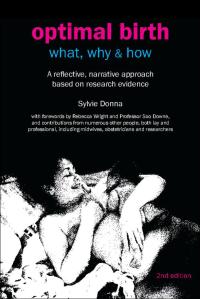
Book Review: Optimal Birth: What, Why & How

Book Review: Optimal Birth: What, Why & How
By Sylvie Donna
Fresh Heart, 2010
ISBN 9781906619138
670 pages, paperback, £24.99
http://www.freshheartpublishing.com

Reviewed by Molly Remer, MSW, ICCE, CCCE
https://talkbirth.wordpress.com

Written in an energetic and confident tone, Optimal Birth is written for midwives and other birth care providers and emphasizes undisturbed, natural birth. Throughout the text, a unique “birthframe” format is used to share birth wisdom in women’s own words. Donna is heavily influenced by the work of Michel Odent (he attended several of her births) and references him frequently. The author writes in a very straightforward manner and has extremely strong opinions as to what constitutes “undisturbed birth,” but these opinions are backed up with ample evidence-based information. The exquisite sensitivity of a birthing woman to her environment is of primary importance in the book and caregivers are strongly urged to take an extremely hands-off approach to care.

A lengthy volume, Optimal Birth is difficult to describe adequately in summary form—it contains extensive sections about physiological birth, birth interventions, the emotional impact of women’s experiences, prenatal care, and postpartum care. It also includes a week-by-week guide to pregnancy. There are a large number of black and white pictures and each section of the book contains a series of insightful questions designed to provoke self-discovery about physiological birth and the appropriate care of birthing women.

Readers unaccustomed to the midwives model of care or to the principles of undisturbed, physiological birth may find the book’s emphasis on non-intervention heavy-handed or one-sided. Considering that many manuals for care providers focus extensively on labor and birth “management,” personally I find the non-disturbance approach advised by Optimal Birth to be inspirational and encouraging as well as appropriate. As the author notes, “the processes of birth are so delicate that many things can disturb a laboring woman and consequently make her labor slower and more dangerous.”

An encouraging and informative companion book containing much of the same information but from a consumer perspective titled Preparing for a Healthy Birth is also available.

Disclosure: I received a complimentary copy of this book for review purposes.

Why, indeed?

On the ICEA Facebook page today, the question was posed, “why did you become a childbirth educator?” I responded with the following: because I care deeply about women’s issues, social justice and social change and I feel like women’s choices in childbirth are intimately entwined with this. Because I believe peace on earth begins with birth. Because the births of my own sons were the most powerful and transformative events of my life. And, because I believe every woman should have the opportunity to feel and know her own power and to blossom into motherhood with strength, confidence, and joy. ♥

Some time ago, I wrote a short essay on why I became a childbirth educator that was one of the winners in a contest held by Passion for Birth. I realized as I was thinking about the ICEA question that I’ve never shared that post on this blog! (where it quite naturally belongs!) Here it is:

On a discussion board once, someone asked the question “what’s at the root of your love of birth?” I was still for a moment and let my intuitive, heart-felt, gut level response come to me and it was this:

Women.
Women’s health, women’s issues, women’s empowerment, women’s rights.

Social justice.

And, that feeling. The “birth power” feeling–-that laughing/crying, euphoric, climbed-the-mountain, glowing, rapture…feeling. The transformative, empowering, triumphant, powerful, I DID IT, feeling.

I want each woman to have the chance to experience that transforming power, that sense of personal accomplishment, the increased self-esteem, and the euphoria of knowing “I did it!” I climbed my mountain, I ran my marathon…I gave birth to MY BABY! I want all women to have the chance to experience that and this is why I became a childbirth educator.

I have a long time interest in women’s health and women’s issues. In 2001, two years before the birth of my first baby, I started reading avidly about pregnancy and birth and became instantly captivated by natural childbirth as powerful experience for women and also fascinated by the erosion of women’s rights in the birthplace. I first sent for information

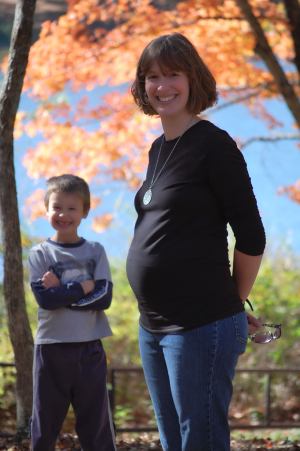
My oldest son at 2.5 and my 37-weeks-pregnant-with-second-baby belly 🙂

about becoming a childbirth educator that year, but decided that I should wait to become one until I had a baby of my own (seemed like the most important first “credential” to me). My son’s birth is 2003 was a triumphant and empowering experience for me and lit my fire to become certified—I wanted to share the transformative potential of birth with other women. I became provisionally certified in 2005 and fully certified in 2006. The birth of my second son at home in 2006 further solidified my commitment to healthy birth education. I continue to teach because of the root reasons cited above as well as for the tremendous satisfaction I feel when a mother tells me that her confidence in giving birth has dramatically improved and that “I’m actually looking forward to it now—like an adventure!” I believe that a confident, normal birth sets the stage for confident, empowered parenting. The sense of accomplishment and satisfaction women experience in birth starts them out on the “right foot” on the lifelong journey of motherhood.

I view my birthwork almost like a tree, with women as the roots, pregnancy as the trunk, (the journey) and then blossoming beautifully in that birth-power feeling.

Prior why I care post and a why I do what I do post.

Fathers, Fear, and Birth

“I told my dads that they were their partner’s lover and that their most important role at the birth was one they did everyday without classes, books or practice: Loving the mom. You could literally see the dads relax as this thought sunk in and took root.”

~ Lois Wilson, CPM

My husband supports me during my birthing time with our second baby

I don’t use these exact words, but I share something similar with the dads in my classes—your most important job is just to love her the way you love her, not to try to be anything different or more “special” than you already are…

I recently shared my review of The Father’s Home Birth Handbook by Leah Hazard and also wanted to share this excerpt from an article in Midwifery Today:

~~~~~~~~~~~~~~~~~~~~~~~~~~~~~~~~~~

Helping Men Enjoy the Birth Experience, by Leah Hazard

~~~~~~~~~~~~~~~~~~~~~~~~~~~~~~~~~~

Nearly 70 years ago, Grantly Dick-Read wrote in Childbirth without Fear that laboring women often experience a cycle of: Fear > Tension > Pain. This is a cycle with which many of us are familiar, and we’ve developed a myriad of ways to break the cycle since Dick-Read first published his seminal work in 1942. However, less attention has been focused on the emotional roller-coaster fathers experience throughout pregnancy and birth, and it’s this area that I’d like to explore in greater depth.

Although a man cannot feel the same pain as a laboring woman, I believe that many men experience a similar cycle of emotions in the birthing space to that which Dick-Read described, with a slightly different end product, namely: Fear > Tension > Panic. A man who is not confident in his partner’s birthing abilities, who is poorly informed, and/or who is poorly supported, becomes increasingly tense; and if this tension is not eased, then he spirals into an irreversible state of panic. This panic manifests differently in different men: some men become paralyzed by their fear (the familiar specter of the terrified dad sitting stock-still at the foot of the bed), while others spring into hyperactivity, bringing endless cups of water or becoming obsessively concerned with the temperature of the birth pool.

The root of this panic is fear, and it’s a fear which often begins to grow long before the first contraction is felt. As such, we need to think about ways that we can address and minimize this fear in the days and months preceding birth…

[Please read the rest of this article excerpt in the full online version of E-News: http://www.midwiferytoday.com/enews/enews1221.asp ]

Excerpted from “Beyond Fear, Tension and Panic: Helping Men Enjoy the Birth Experience,” Midwifery Today, Issue 95 Author Leah Hazard is the author of The Father’s Home Birth Handbook. For more information, visit www.homebirthbook.com .

——

I really think the fear-tension-panic cycle makes a great deal of sense and it brought me to this quote:

“Fear is completely intertwined with what we experience as labor pain…And it is the fear in our physicians and nurses as much as the fear within ourselves.” –Suzanne Arms (Immaculate Deception II)

I think sometimes women underestimate the power the attitudes of other people in the birthplace hold over outcome (the nocebo effect, possibly)—while being prepared, confident, fearless, etc. as a birthing woman is excellent and she can sometimes manage to triumph over the fear of the others around her, I more often see the fear of others overriding the preparation and confidence a mother has tried to develop in herself. I think it is important that we actively cultivate coping skills and resources within fathers-to-be as well, so that they are less likely to get into the fear-tension-panic cycle and are better able to be present for the birthing woman (fear-tension-panic within doctors and nurses is a subject for another post!). Here are some other posts I’ve written specifically for fathers:

Ideas for supporting your partner in labor

No Right Way

Resources for Fathers to Be

Birth Affirmations for Fathers

For Labor Support Remember TLC or BLT

Comfort Measures & Labor Support Strategies

Helping yourself while helping your wife or partner in labor

(P.S. Yesterday this was a much more developed post and WordPress erased it accidentally and to my great dismay 😦 )

Book Review: The Father’s Home Birth Handbook

I came to my attention today that I have never posted this book review! (also, as I prepared to “tag” this post, I realized that I don’t have a tag set up for “homebirth.” Can this really be true??!!)

The Father’s Home Birth Handbook

By Leah Hazard
Victoria Park Press, 2008
Softcover, 208 pages
ISBN: 978-0-9560711-0-1
www.homebirthbook.com

Reviewed by Molly Remer, MSW, ICCE

The Father’s Home Birth Handbook is a succinct and easy to read little guide for fathers and adds to the growing library of birth resources specifically geared towards fathers-to-be. The book is written by a woman, but contains ample quotes from fathers which lend a male perspective. It also includes a number of good birth stories interspersed throughout, which were all written by men.

The target audience for the handbook is easily summed up in the prologue: “…I’ve met far more men who have responded to their partners’ home birth wishes with a mixture of shock, cynicism, and fear…Far from being domineering ogres who just want to see wifey tucked ‘safely’ away a hospital, these loving fathers have simply had very little access to accurate, impartial information about the safety and logistics of home births versus hospital births.”

The first chapter addresses “Risk & Responsibility,” because that is one of the very first issues of concern for most people new to the idea of homebirth. It moves on to a chapter called “Think Positive,” followed by “Choosing the Guest List” and then one titled “Pleasure and Pain” This chapter covers comfort measures and what to do while the woman you love is giving birth: “…away from the intravenous drip and ticking clocks, you can support your partner in experiencing labour in all of its awesome, challenging power.”

Chapter five—“Birth: Normal and Extraordinary” covers Labor 101 topics, including what to do with the placenta. This is followed by “Challenges & Complications” which covers some common issues of concern such as premature labor, being overdue, prolonged labor, distressed baby, cord around the neck, tearing, and blood loss. Each of these is followed by a “what can I do to help?” section.

The final chapter—“Now What?”—concludes with a nice segment called “how can I carry the lessons I’ve learned from my homebirth with me into the rest of my life as a father?”

Published in Scotland, the handbook has a UK perspective—it assumes participation in the NHS and a “booked” midwife and homebirth. There is no “how to choose a midwife” type of section (because there is no choice of midwives). For US readers, this leaves a set of issues unaddressed—such as varying legal statuses, etc. UK specific issues also arise based on the possibility of caregivers who are not thrilled about homebirth, but who have to come to the birth since it is a government supported option. It comes across that in Scotland homebirth may seem readily okay on paper, but in reality is more difficult to pull off.

The book does briefly discuss the birth climate in the US and soundly critiques ACOG’s position on homebirth.

The book has an index and a resources section.

The Father’s Home Birth Handbook is a friendly, practical, matter-of-fact, helpful little guide that neatly addresses common questions and concerns many fathers-to-be have about planning a homebirth.

——————

Disclosure: I received a complimentary copy of this book for review purposes.

Associated amusing anecdote: my then three year old noticed me reading this book, looked at the cover and said, “The dad is trying to grab him, but that little baby is floating away!

Celebrate the Woman Pregnant

Celebrate the Woman Pregnant

By Ani Tuzman

A woman pregnant,

I long to be seen

belly protruding,

life invisibly visible

churning inside

I want to be seen

honored, revered,

Exalted

not as my person,

but as the Miracle itself

of life begetting life

of human birth

Celebrate the woman

pregnant

don’t set her aside

nor cast her off as disabled,

or ever less woman;

Revel with her

feeling her firmness

knowing her softness

Carve her rare beauty

in smooth white marble

Look upon her.

Celebrate the woman pregnant

Hers is to know

the creative moment

of Life incarnating

——–

This poem came in the pregnancy newsletter I get from Mothering.com and it reminded me of the “magic” of being pregnant. I love that feeling (I’ve written about it before in the “the pregnant glow“). After this new baby is born, we do not plan to have any more children (though I have said to my husband, “what if she’s just so awesome we want to have one more?”) and I’m trying to take special time to savor and enjoy that magic feeling of being pregnant, since I will likely not experience it again personally. I told a friend recently that I feel like maybe I’m not savoring as much as I “should” be and realized that I think when I think of savoring, I think I’m picturing sitting around for hours rubbing my belly—possibly making multiple belly casts and drawing some fabulous art as well. Oh, and making some sculptures. And, then sitting and rubbing some more—preferably in the sunshine 😉 I have been making a very conscious effort to downscale my commitments to allow for more of this. I’m also taking a leave from teaching birth classes—I feel like I want to focus on my own pregnancy, rather than on other people’s. I feel a real inward-draw and not so much like being “of service” to others (I’ve been feeling this inner call since Noah was born last year, actually, but it has taken a while to actually get to the downscaling part). I also find that teaching college classes “uses up” most of my available teaching energy and I don’t have as much to give to birth classes—I am not expecting this to be a permanent leave, birthwork is too important to me for that, but I want to heed my inward call. I’ll have to stick with “virtual” birth education via this blog for a while!

I’ve had a post pending for a while that I guess will never get posted, about life balance and feeling like I’ve not been living up to a good guiding quote—“the things that matter most should never be at the mercy of the things that matter least.” Instead, the things that had been getting cut from my schedule were things like hanging out with my friends, sitting in the sunshine, writing in my journal, rubbing my belly, snuggling with my husband, reading books to my kids, chatting with my mom—HELLO! Not a good idea. So, I’ve done some cutting, some saying no, and also just some mental readjusting about how I think about things (like my to-do list). I’ve also been doing a “conditions of enoughness” thing that I learned from Jen Louden, wherein you set some conditions of enoughness for the day—not, just keep burning until the day is used up, not, “I can probably do this one more thing” and likewise not a “bare minimum” approach, but what is enough on a given day. Usually, this does not mean accomplishing everything on one’s to-do list, and it leaves some time leftover in the day for self-care—which is the piece I’ve been missing too. While everything is not perfect, obviously, I feel better about my life balance in recent weeks. My main reason for this downshifting is actually in preparation to enjoy my new baby when she gets here—I want to be all “cleared out” to enjoy a nice babymoon as well as to be free to take good care of myself as well as my baby.

The picture above was taken by my friend Karen at the park last week. She has launched a new photography business recently and if you click the picture, it will take you to her Facebook fan page. She is going to do both pregnancy photography and birth photography and I hope to have some more pictures in another month or so 🙂

And, I actually have been doing a lot of drawing during this pregnancy. Here is one I did when I was starting to re-incorporate the pregnant identity into my life again, as well as to feel some of the joy of pregnancy rather than just anxiety:

I’ve done others as well and then after finding out she is a girl, I drew this one:


Pain with a Purpose?

“The desire to help is so great, even from well-meaning, beautiful midwives, that they use intervention. We want to help. But what’s missing in our culture is that there is pain with a purpose, and that helping is sometimes interfering.” –Augustine Colebrook, CPM (quoted in “Do-it-Yourself Birth” article in Mothering mag)

When I shared this quote on the CfM Facebook page, a reader added: “Dr. Bradley wrote about ‘pain with a purpose’…Problem is, in our society, we don’t value the process of childbirth. Therefore, whatever it is you have to do to get thru it… Hence epidurals & nubain, and on and on. Please know I’m not dismissing your experiences if you went that route. But that phrase alone resonated with me when I was giving birth and helped me. I wish it would do so with more women.”

I’ve written a lot about birth having inherent value in its own right. Process AND “product” (i.e. healthy mom, healthy baby) are both important. A de-emphasis on the birth process and its significance in a woman’s life only serves to disempower, silence, invalidate, and violate women.

That said, I do also value the work of organizations like Hypnobabies that questions the very notion of pain as being an inherent part of birth.

So, what about pain?

I find that couples who come to my classes often have pain and managing pain (or witnessing pain) as their top issue of concern. For this reason, I spend time addressing the subject straight out and yes, I have been known to use the dreaded “pain with a purpose” phrase. Some would say that the word “pain” has no place in birth classes—that it sets women up for just that experience—however, as I noted, my clients come with “pain” on their minds and I find I need to use the p-word and sort of clear the air/get past that hurdle, before we do the rest of our work together. Also, as one of my clients once noted, “it wasn’t you who planted that seed [of pain being possible]. It was planted deeply a long time ago!”

And, what would be the purpose of pain in labor?

It is actually part of a beautiful hormonal symphony of labor—the sensations of labor signal our brains to release more endorphins, more endorphins leads to more oxytocin, and more oxytocin leads to increased intensity, which leads to more endorphins, etc., etc. When the pain to brain feedback loop is interrupted with medications, so too, are the oxytocin and endorphin messages that we need to get our babies born—and more interventions to “augment” labor are then likely to follow. As Preparing For Birth notes: “It is true that naturally occurring labor can feel larger and greater than the woman birthing. This is not so as she creates from within the very hormones that increase the strength, power, and frequency of her work of labor. That is the good news, it is from her, for her, by her.”

But, all these things said, I simply think the word “pain” is woefully inadequate to describe the feelings of labor. I like this description from Stephanie Soderblom better:

“VITA MUTARI – the literal translation from Latin to English is ‘Life Transformation.’ That is the closest thing I could think of the feeling of labor/birth…what you are feeling isn’t pain, it’s life transformation. Is it dramatic? You bet! I think it should be!”

I also love the description from Painless Childbirth:

“When I say painless, please understand, I don’t mean you will not feel anything. What you will feel is a lot of pressure; you will feel the might of creation move through you. Pain, however, is associated with something gone wrong. Childbirth is a lot of hard work, and the sensations that accompany it are very strong, but there is nothing wrong with labor.”

Now that’s what I’m talking about, might of creation moving through you. The word “pain” is way too puny to hold that!

I always explain to my clients that the sensations of labor are more similar to the exertion of intense physical effort more than the pain associated with accident, illness, or injury—both the effort AND the exhilaration are similar to doing good, hard, challenging, limit-testing, but doable work (though even bigger and more important). We need a bigger and broader vocabulary for completely describing the breadth, range, intensity, and beauty of birth experiences! What if we had more choices other than “painful” and “painless” to describe the experiences of birthing our babies? Though I wouldn’t say my births were “painless,” when I describe my own birth experiences, “pain” is simply not the word that rises to the top as the most appropriate descriptor.

“So the question remains. Is childbirth painful? Yes. It can be, along with a thousand amazing sensations for which we have yet to find adequate language. Every Birth is different, and every woman’s experience and telling of her story will be unique.” –Marcie Macari

We end up limited when we use only “pain” based language that fails to embrace the broadness and complexity and enormity of the experience.

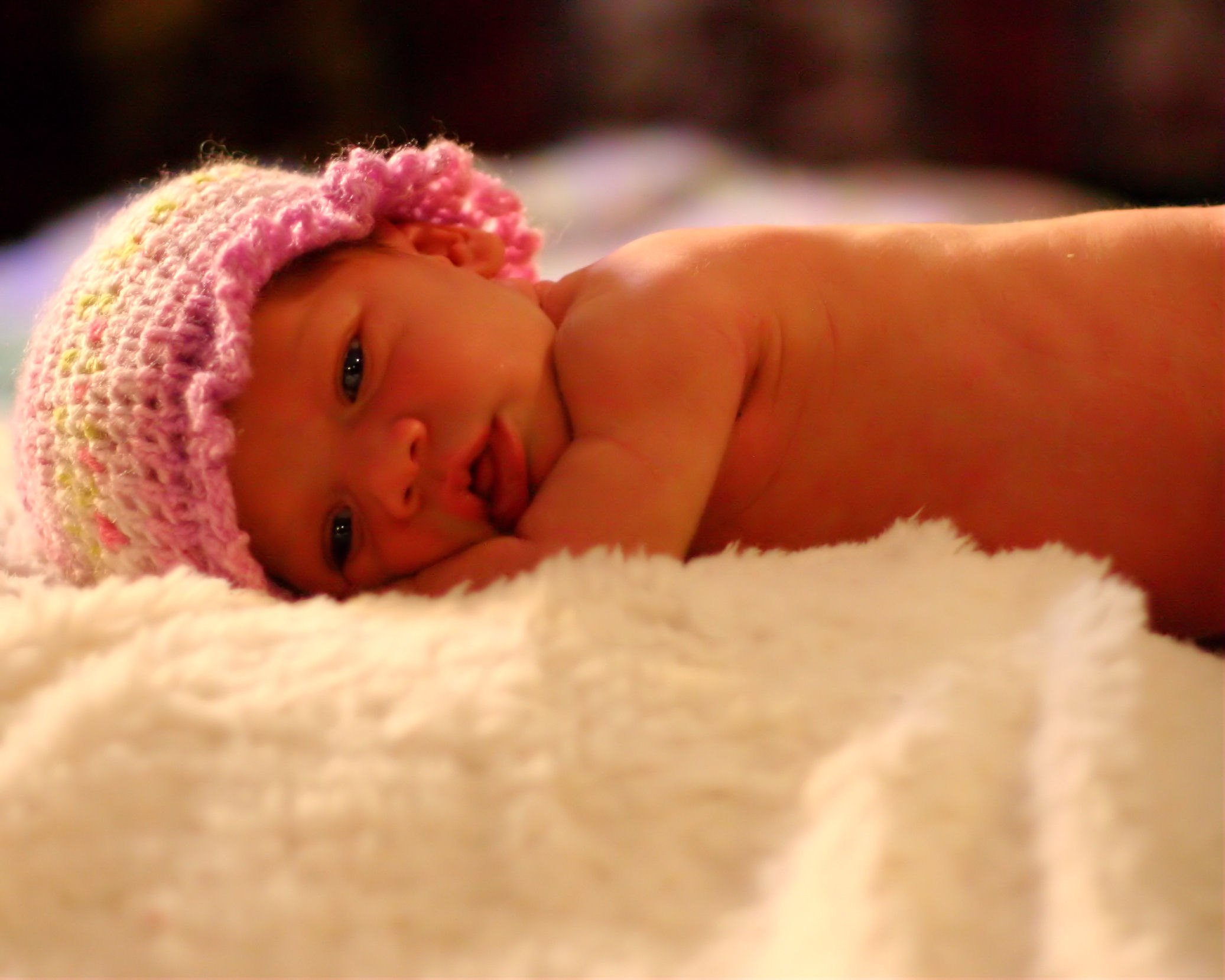
Newborn Alaina, January 2011

Call for contributions: personal birth stories for new booklet on birthing positions

I received an email this weekend from a woman who is writing a booklet about birthing positions (non-profit and free for distributing when finished!). She is seeking contributions of birth stories to use in the book. Below is her message:

———————-

My name is Megan Layton. I have a strong interest in Women’s Health, current issues in obstetrics, as well as the cultural perceptions towards childbirth in general.

As well as being a Missouri native, a supporter of midwives and a woman’s right to an active role in childbirth, I am also a graduate student at the School of the Art Institute of Chicago. Currently I am working on a small, illustrated publication that focuses on birthing positions. The small book will be informative, fun, attractive, and free for distribution and copying. It is my intent to emphasize a woman’s choice during labor and childbirth, and not advocate for any particular position, provider, or setting, but merely convey the options available as well as the potential for birth to be a profound, empowering experience.

Part of the booklet will be first hand accounts of birth—oral histories from women who have had many different birthing experiences.

This is the reason I write to you: to ask that you share this with women who would be willing to share their personal stories, as well as any advice they could give to a woman who is about to experience childbirth for the first time.

Long or short, joyous or rational, funny or sad–any and all stories are welcome, and will be greatly appreciated. At the end of reviewing the narratives, I will ask those women whose stories best suit the publication for permission to use them. As well, I will send copies to all those who graciously allow me to reproduce their words.

All stories, narratives, and questions can be emailed via this link.

—————————

It sounds like a wonderful project to me!

It also reminded me of my previous postings about how to use a hospital bed without lying down. I tell all my clients if they remember only ONE thing from my classes, it is see the hospital bed as a “platform” and a tool in their toolbox—NOT as a place to lie down!

And, here are links to my own birth stories (each which involved freedom of movement during labor as an integral piece!)

First son’s birth (at freestanding birth center): https://talkbirth.wordpress.com/2009/02/25/my-first-birth/

Second son’s birth (at home): https://talkbirth.wordpress.com/2009/02/25/my-second-birth/

Third son’s birth (miscarriage at home at 15 weeks): https://talkbirth.wordpress.com/2010/05/03/noahs-birth-story-warning-miscarriagebaby-loss/


Book Review: Survivor Moms


Book Review: Survivor Moms: Women’s Stories of Birthing, Mothering and Healing after Sexual Abuse

By Mickey Sperlich & Julia Seng
Motherbaby Press, 2008
ISBN 978-1-89-044641-3
245 pages, softcover
http://www.midwiferytoday.com

Reviewed by Molly Remer, MSW, CCCE

Past sexual abuse is an unfortunately common experience for women. Anyone who works with women of childbearing age should be mindful and informed of the effects of an abuse history on the woman’s experience of pregnancy, birthing, and mothering. Indeed, I consider this awareness to be a fundamental professional responsibility. Enter Survivor Moms, published by Motherbaby Press. This book is an incredibly in-depth look at the experiences and need of survivors of sexual abuse during the childbearing year.

One of the best and most unique features of the book is the “tab” format used for much of the clinical, research-based, or fact-based content in the book. Rather than lengthy chapters reviewing research and analyzing the phenomenon, textboxes containing quick facts and reference material are printed in the margins of many of the pages. The bulk of the narrative information in the main body of the text is then in the voices of mothers themselves, interspersed with commentary by the authors linking concepts, explaining ideas, and clarifying essentials. This is a powerful format that makes information readily and quickly available for reference as well as making the overall book very readable and approachable.

As someone with no personal abuse history who is currently pregnant, I did find the book to be a very emotionally difficult, intense, and almost overwhelming read at times. This is not a criticism in any way—sexual abuse is not a light or cheerful topic and it can be one that many people prefer to avoid. This is all the more reason for birth professionals to make a specific effort to be educated and informed.

Written both for mothers themselves and for the professionals who work with them, Survivor Moms is an essential part of any birth professional’s library. As noted in the book’s introduction, “We need to understand the impact of childhood abuse on birthing and mothering deeply, from hearing women’s stories. We also need to understand it broadly—from looking at the impact on samples and populations, on the body and on the culture.” Survivor Moms offers an accessible way of hearing those critically important stories and developing the necessary understanding to care compassionately for birthing women.


Disclosure: I received a complimentary copy of this book for review purposes.