Archives

Call for your experiences – the impact of birth trauma and beyond | Rebecca A. Wright

An online friend and sister birth professional, Rebecca Wright, emailed me recently to share some information about an important new project that she is launching:

I’m planning to write a book on birth trauma that will centre on women’s voices and experiences. It’s not going to be so much dwelling on birth trauma (though there will be an element of that as I want people to understand that whether an experience was ‘objectively’ traumatic or not, it can have an enormous impact – and I think a lot of women say to themselves, ‘my experience wasn’t as bad as some others I hear about’ and so don’t feel able to validate their own feelings and experience). What I really want to focus on is a) the impact of birth trauma (or of ‘difficult’ birth experiences) on mothers, babies, partners, families; b) the many individual paths to healing from birth trauma that people have walked; c) rediscovering your power in birth and motherhood following a difficult or traumatic experience.

She’d like to reach out to mothers, but also their partners, and doulas (midwives, nurses, doctors, etc.) and she’s also interested in hearing from practitioners of whatever sort who work with women and families around these issues.

Full details are available on her blog:

I want this book to be made of women’s voices (and men’s as well). I want it to be a place where the unspoken is spoken clearly and openly. I want it to be a book that honours the sacredness of each birth journey, and each path to healing. I want it to be a book that opens doorways for those who are feeling lost or alone so that they can find hope and a way forward that is suitable for them personally. Most of all, I want it to be a book that shows that it is possible to reclaim your personal power in birth and mothering following a difficult or traumatic experience in birth.

via Call for your experiences – the impact of birth trauma and beyond | Rebecca A. Wright.

Make sure to check out her project and see if you can lend your voice to what sounds like a beautifully healing book!

And, speaking of birth trauma, a while ago, I also received a question via Facebook asking for recommended resources for healing from traumatic birth. Check out the series on Giving Birth with Confidence about traumatic birth prevention and recovery. Or, look into Solace for Mothers.

Miscarriage and Birth

Last month a fellow birth professional asked a question about whether it was possible to have postpartum depression after miscarriage. My response was as follows:

I think it is crucial to remember that miscarriage is a birth event—sometimes a very, very, very early birth event, but reproductively speaking that is what it is! Since we don’t have a better vocabulary for pregnancy loss in our culture, socioculturally speaking we tend to class it as “something else,” but in most ways it isn’t. A soul (or fertilized egg) touches down in a woman’s womb. Her hormones and all other physiological systems are impacted and feel its presence. The embryo/fetus/baby stays for a time and when it leaves her body, the uterus must contract and the cervix must open and the woman’s body must open to allow its passage. Her body, mind, emotions, and spirit are all affected (to varying degrees). In this way, miscarriage and full-term birth simply exist on a continuum of possible birth outcomes and are all birth events whether the pregnancy lasts five weeks or forty-two weeks.

Miscarriage as a birth event is one of my “pet” subtopics within the wide range of reading about miscarriage and quotes that respect the birth-miscarriage relationship always catch my attention. After the birth-miscarriage of my own third baby three years ago today, I found the following quote in a back issue of Midwifery Today:

“Miscarriages are labor, miscarriages are birth. To consider them less dishonors the woman whose womb has held life, however briefly.” –Kathryn Miller Ridiman

It meant so much to me and I returned to it again and again. I believe I was also responsible for introducing the quote to the internet, because since I first typed it up, I’ve now seen it floating around on many other websites and blog posts. And, in a full circle moment, my own miscarriage-birth story was published in Midwifery Today in 2011. I also latched on to a quote from the book Wild Feminine saying, “though it is not always recognized as such, miscarriage is a birth event.”

20121107-013453.jpgChristine Moulder in the book Miscarriage: Women’s Experiences and Needs quoted another mother: “Although I had a miscarriage technically, I don’t feel this. I went through labour. It was incredibly painful but my husband was with me and it was almost a happy occasion.” I agree, with my own birth experience feeling just as “legitimate” as either of my prior labors or my subsequent birth. I And, actually even more so in that Noah’s birth became possibly the most defining moment of my womanhood. I would also describe it as a spiritual experience or “awakening” of sorts in a way that has profoundly influenced me, shaping my future work with women and my life goals. I return to this experience again and again and continue to draw both strength and insight from it.

Returning to Moulder’s book, later in that section, the author says:

With the exception of women who have a late missed [miscarriage] there will be a baby that has to be born. The baby may or may not have died prior to the miscarriage. As with full-term birth, the waters must break, there will be pains and contractions and the cervix must dilate for the baby to leave the womb. Of course the baby will be smaller, in some cases much smaller, but it is essentially the same process and this comes as a great shock to many women.”

And this is absolutely true, but also not something that is mentioned in very many miscarriage books. This shock of experiencing miscarriage so clearly as a labor and birth rather than as “something else” is what led me to describe my wish for miscarriage doulas on my now-complete miscarriage blog:

On a pregnancy loss message board that I read, a mother posted asking if she was the only one who experience her miscarriage as painful (because no one mentioned it being painful in the stories she had read and she was very shocked by the pain involved). I had a couple of thoughts in response to this question. I also shared my “favorite” miscarriage-birth quote: “Miscarriages are labor, miscarriages are birth. To consider them less dishonors the woman whose womb has held life, however briefly.” (Kathryn Miller Ridiman).

I do think the amount of physical pain probably depends in part on where you are in the pregnancy. Since a lot of women experience very early miscarriages (less than 6 weeks), I think that is perhaps why you don’t hear them talk as much about pain because the baby is still so small. OR, because a lot of women end up having D & C’s and thus do not go through the “natural miscarriage” experience, perhaps that is why pain doesn’t figure heavily into narrative. Or, maybe because there is so much emotional pain involved as well, the physical pain gets overshadowed? That said, my 6-week miscarriage was not physically painful at all (not that it couldn’t be for some women, of course). However, my miscarriage at nearly 15 weeks was indistinguishable from a full-term labor. It was just the same, except with the addition of MASSIVE blood clots following the baby. I value his birth as another birth experience in my life, but at the same time I am SHOCKED that miscarriage is so often overlooked as a birth event that requires tenderness and support (where are the miscarriage doulas and midwives?! While in a way, I feel proud of myself for have an “unassisted” birth-miscarriage, I could have used the care of a knowledgeable, caring woman rather than to just be left on my own trying to gauge how much blood loss is normal, etc.)

So, what about “miscarriage doulas” as an idea? I have seriously thought about becoming one. I am trained as a birth doula, but have no interest in actually working as one, but being a m/c doula does interest me a lot. I feel like adding a section to my business website (I’m a childbirth educator) that says, “having a miscarriage? Call me and I’ll come over and rub your back and bring you things to drink…”

I decided two things shortly after my first miscarriage: one, that I was going to write a book specifically about how to deal (i.e. “what to expect when you’re having a miscarriage”), because I felt very betrayed by having this huge wealth of pregnancy, birth, and midwifery books all around me and NONE of them had the information I was looking; And, two, that if anyone was ever to tell me she was in the process of miscarrying I would go to her right away (unfortunately, it seems like people feel like they have to tough it out alone or don’t want to “bother” anyone and so only tell after the fact). Well, if she wanted me to go, obviously, not against her will. And, that would include going to the hospital with her if she needed a m/c doula there, not just for “home miscarriage.” –Originally posted as Miscarriage Doulas…on June 29, 2010

This interest and post led to the co-founding of the organization The Amethyst Network, originally intended to train the miscarriage doulas I’d longed for during my own experiences. TAN took some time getting off the ground and in the meantime the thoroughly amazing organization Stillbirthday independently arose in vibrant support of women and is now skillfully fulfilling the mission of training loss doulas.

Thankfully, I had already read a long message board thread about, “what exactly do you see with a miscarriage” long before I ever had a miscarriage experience of my own, so I did know to expect mine to be somewhat “like labor” and not to be a “heavy period” (OMG, I wanted to scream when I saw miscarriages described like that in books over, and over, and over again! Though, then when I had my second miscarriage and it WAS, in fact, like the mythical “heavy period,” and so then I understood a little better why that was a prevalent descriptor.)

On Pregnancy and Infant Loss Remembrance Day this October I was out-of-town, but I shared past blog musings on jagged peace, acknowledging that the legacy of miscarriage is profound. I also linked to a friend’s story: Mormon Monkey Mama: A Few Thoughts on Miscarriage and to my own birth-miscarriage story: Noah’s Birth Story (Warning: Miscarriage/Baby Loss).

And, I updated my Facebook status with the following:

Today is Pregnancy and Infant Loss Remembrance Day. Babyloss is part of the spectrum of the childbearing year, and miscarriage is one type of birth experience that a large number of women experience. I appreciate the opportunity to recognize this, rather than to keep a lid on our “negative” stories of grief, loss, and a multitude of complicated emotions. Today I think of my own lost baby N and also my lost babystart. I also think of all the women who do not conceive and birth the rainbow babies they so long for. I also think of a friend whose baby died last month. And, I think about and appreciate my friend/doula from Peaceful Beginnings Doula Services who helped me so much to heal from loss and who has her own babystart to remember today as well.

There are many helpful babyloss organizations and one that was particularly helpful to me was Angel Whispers in Canada. They mailed me a birth certificate for my baby (with an official looking gold seal). It meant a lot to me because it acknowledged that he had lived and was born. It hangs in our hallway and it is amazing to me how meaningful a simple, small act of kindness from strangers can be.

Today we recognize the third anniversary of the birth-miscarriage of our little son Noah. I post not for “sympathy” or condolences, but because memories are important, and because even though he only stayed with us for a couple of months, he shaped our lives and in a very real sense is responsible for the life of Alaina. 20121107-013748.jpgI share because his birth and the long, slow journey of grief was a pivotal, transformative point in my life as a mother/woman and because he helped change my destiny. And, I share because there are SO many loss mamas out there with stories of their own to tell and I hold them all in my heart and wish them all the love, caring, and wisdom that I was lucky enough to receive, both three years ago and ongoing today! ♥

There is a sacredness in tears. They are messengers of overwhelming grief…and unspeakable love.” –Washington Irving

“Remember our heritage is our power; we can know ourselves and our capacities by seeing that other women have been strong.” – Judy Chicago

“Change, when it comes, cracks everything open.” ~Dorothy Allison

“She’s turning her life into something sacred: Each breath a new birth. Each moment, a new chance. She bows her head, gathers her dreams from a pure, deep stream and stretches her arms toward the sky.” –from a journal cover

—-
Related posts:

My memories of this time in 2011: Sand Tray Therapy
From 2010: Pregnancy Update
And memories of the anniversary of the second worst day of my life
And, some past thoughts about Honoring Miscarriage

Eleven Years Ago…

In 2000, while working on my block field placement (internship) in graduate school, I met a woman who would become my best friend and a profoundly influential part of my life. We shared a lot of formative life experiences of early adulthood together and I accompanied her to the hospital for the births of two of her children and she came to the birth center with me when my oldest son was born. While my own mother had all four of her children at home and so homebirth and natural birth were parts of my life history, I didn’t really begin to focus on birth as an issue until I was married and in my early 20’s. At this point, I was most influenced by the newsgroup misc.kids.pregnancy. So, I became both deeply interested in natural birth and also very invested in my friend’s birth plans and her ideas about birth. As her pregnancy progressed, she hired a doula that I came across at a street fair and took birth classes from her at the birth center in which I would later have my first baby.

After Maggie was born, I was more involved in her life than I have ever been involved with a baby that was not related to me and in a way that I’ve never been able to be involved again. Without any children of my own at the time, I was able to be present for my friend in a way in which I now see, few friends are able to be for each other, since most women who connect during their childbearing years are intensely embroiled in the needs of their own children and families. Looking back, I see I was like the best postpartum doula ever, without knowing that is what I was being at the time (and, I was free, and did it for a year! :)) After bringing over dinner every night for the first week, for the following year I then I went over to my friend’s house every morning and took care of the baby while my friend ate her breakfast, took care of herself, and went for a run. Then, we would walk in the neighborhood together for about an hour, talking about our lives, dreams, and plans.

Last year, that magical baby that had such a profound influence on my life and on my birthwork in the world turned TEN! I could hardly believe it. At that time, I asked my friend for permission to post the birth story I had written in my journal the morning after her baby’s birth. My friend granted me permission, but then several days passed and since it wasn’t the baby’s birthday any more, the story sat in my drafts folder for…another year. And, now, that magical, wonderful baby is ELEVEN! Here is her birth story, through my naïve, pre-maternal eyes…

Maggie’s Birth

With my little friend, 2002

Journal Entry, 11/3/01. 12:22 p.m.

Returned home this morning at 7:15 after being at the birth of Kate & Dave’s baby girl, Maggie. I’m very tired, but I wanted to write a little bit anyway. We went to the hospital at 1:30 p.m. on Friday (11/2) after Kate’s water broke. She was still 2 centimeters at 9:00 p.m., so they started pitocin. At 12:00 a.m. the doulas arrived and Kate was 3-4 centimeters dilated. The doulas were absolutely wonderful at soothing and guiding her. At 1:15 a.m. she was 7 centimeters (!) and at a tiny bit after 2:00 a.m. she began pushing. Then, she pushed for almost four hours before Maggie was born at 5:51 a.m. (8lbs 10z).

It was really hard to watch and not be able to do anything for her. I can’t imagine what it would have felt like as her husband—someone that close in. She did a wonderful, wonderful job. No pain medication at all, even with the pitocin. She only asked about pain meds once (before the doulas got there). I felt completely in awe of her strength and power. She was so brave and so strong and so tough. Powerful woman stuff. I couldn’t believe that she pushed for four hours. I do not think I could have done it. The baby was worth it though—boy is she cute and pink and making me want to have one too!

I can’t really describe what this experience meant to me or how powerful it was. It was beautiful and strong. Kate is an amazing woman and I am awed by her bravery. She and Dave are so happy with their precious little bundle. I got to hold her too, when she was less than 30 minutes old and Kate was being stitched up (bad tear). I didn’t feel like much help to Kate, but being present mean a lot to me and I hope the fact that I was there meant something to her too. I’m so encouraged to see that a hospital birth can be pulled off so well.

Life is wonderful. Welcome, baby girl!

Happy Birth-Day to you both today, Maggie and Kate! You hold a deep and special place in my heart. You both changed my life forever.

Invisible Nets

I have several friends and acquaintances preparing for the births of their babies at the end of this month and into November. This weekend, when I found out one of them was in labor, I peeked in at her Facebook page and saw her profile picture, so strong and beautiful and solitary and I remembered with such poignancy that liminal point between pregnant woman and mother of a newborn. The tenderness and triumph of standing up with your new baby for the first time. The marveling at the fact that, I did it. The sweet, fresh, beautiful irreplaceable sensations of your fresh new baby lying upon your chest. The worry of how to do this mothering thing “right.” All of those vibrant and deep first moments and trying to sink into them. The stark sensation of having crossed into completely new territory and having left your old self behind forever. The moments of marveling at your own strength and courage and reveling in your own power. The moments of feeling bitterly lost and confused.

I wrote this on my Facebook page as I thought of her and of the other Oct/Nov mothers about to step across the birth threshold:

Holding in my heart all the special mothers taking their birth journeys tonight–stepping across that pivotal threshold and into the unknown. May they discover they are stronger than they knew, may they marvel at their own courage, may they dig deep, and may they know joy beyond measure.

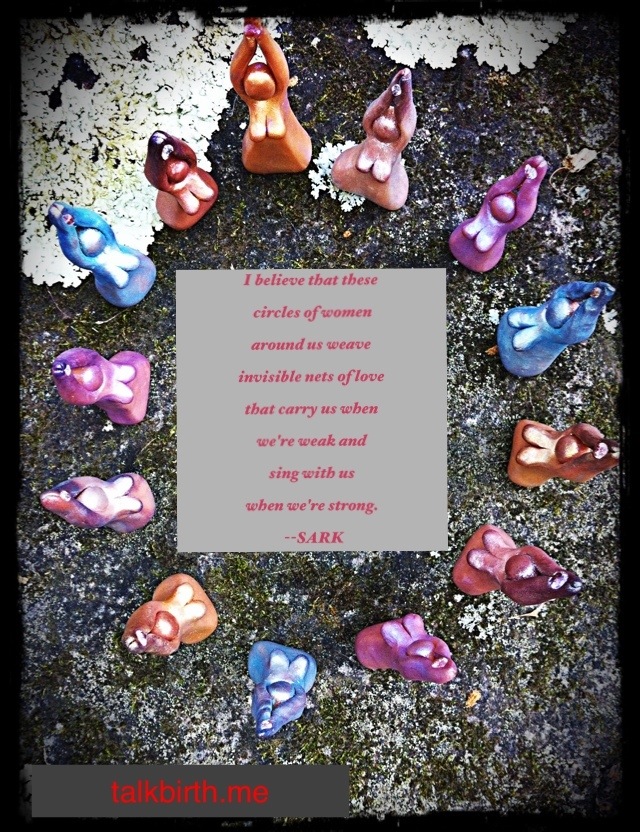
I also finally used one of my favorite quotes for women’s circles and a picture of a set of new sculptures that I made this weekend and turned it into a little shareable image. I’ve wanted to do this for a long time, but had trouble finding anything that would let me edit a picture on my phone to include words. It isn’t perfect, but it is my first attempt!
20121023-152429.jpg
And, I thought of my own past posts…

Thoughts about a birth blessing and more

“…May we see and hear women. May we witness them in the act of living, of birthing, of struggling, of triumphing. In surrender and in self-doubt. In exultation and joy. May we hold that space for her story. May we listen well and wisely.” (Molly Remer)

Thoughts about being a “birth warrior“…

“I was surprised to find myself connect with the birth warrior metaphor in labor. Shortly after my first baby was born, I turned to my dear friend who had been present and said, “I feel like I’ve been in a war…”

Thoughts about those sweet, delicate, precious moments of waiting to inhale

Thoughts of the sweet, sticky, beautiful, and simultaneously soul-crushing and soul-expanding experiences of early postpartum

I hope all of the women I know who are giving birth in the upcoming season discover that, as Sheila Kitzinger said, “Birth isn’t something we suffer, but something we actively do and exult in.” (from promo for One World Birth)

And, that while, “Women are as nervous and unsure of themselves as ever, and they need to learn to trust their bodies. Birthing is much more that eliminating pain. It is one of life’s peak experiences.” (Elisabeth Bing)

Happy Birthing Days, Mamas!

(P.S. This is an experiment with writing a short post! How’d I do?!)

What If…She’s Stronger than She Knows…

“When I dare to be powerful–to use my strength in the service of my vision–then it becomes less and less important whether I am afraid.”

Audre Lorde

As I was writing about shifting the “what if” dialogue of birth to “positive” anticipation rather than fear, another spin on the relationship between pregnancy, birth, womanhood, and what ifs began to emerge for me. I thought about the what ifs that crawl out of our dark places and lodge in our hearts. The what ifs that snake around the edges of our consciousness in the early hours of the morning. The what ifs we try to push down, down, down and away. The what ifs that stalk us. The what ifs so very awful that we fear in giving voice to them, we might give life to them as well.

We may feel guilty, ashamed, negative, and apologetic about our deepest “what ifs.” We worry that if we speak of them, they might come true. We worry that in voicing them, we might make homebirth or midwifery or whatever look bad. We don’t want to add any fuel to the fire of terror that already dominates the “mainstream” birth climate. And, we don’t want to lose “crunchy points.” We want to be blissfully empowered, confident, and courageous. And, guess what? We are. Sometimes that courage comes from looking the “what ifs” right in the eye. Sometimes it comes from living through them. My most powerful gift from my pregnancy with my daughter, my pregnancy-after-loss baby, was to watch myself feel the fear and do it anyway. I was brave. And, it changed me to learn that.

What if we can learn more from our shadows than we ever thought possible? There is power in thinking what if I can’t do this and then discovering that you CAN.

“It is so easy to close down to risk, to protect ourselves against change and growth. But no baby bird emerges without first destroying the perfect egg sheltering it. We must risk being raw and fresh and awkward. For without such openness, life will not penetrate us anew. Unless we are open, we will not be filled.”
–Patricia Monaghan

I also thought about an experience I had recently at a gathering of midwifery supporters. It was an interesting and insightful presentation about language and the impact on birth. The woman speaking urged us to talk in “positive” ways about birth, to use “positive” words and to avoid “negative” stories. As I listened to her, I thought of my own loss story and knew that my experience in giving birth to my little dead baby would likely have ranked way up there as a “negative” story. And, that bothered me. Giving birth via miscarriage to my third son was the most transformative, formative, and powerful experience of my life. He gave me many gifts, he taught me many lessons, and I am a better person than I was without that experience. So, what does it mean for women when we hide away the “negative” stories? What might we be missing by making sure we never hear about a bad outcome? I wondered what if by avoiding “negative stories,” we also miss out on powerful stories of courage, growth, and transformation…

What if she suffered and survived?
What if she danced with death and she’s still here?
What if she faced fear and held on?
What if she was scarred and broken, but she healed?
What if she hasn’t healed, but she’s working on it?
What if she grieved deeply and came out the other side?
What if she felt fear and did it anyway?
What if she was so scared and felt so weak and so helpless and yet she persevered?
What if she sacrificed her body for her baby?
What if she couldn’t keep going…and then she did?
What if she is stronger in her broken places?

In another woman’s strength, may we see our own. In another woman’s fear, our own becomes acceptable.

I have two personal experiences to share with the healing power of other women’s scars and fears. When I was in the middle of my first miscarriage and I was thinking, “how will I do this?!” the faces of other women I knew who had experienced babyloss came floating through my mind. I saw them all and I knew that if they could do it, so could I. After my own baby’s miscarriage-birth, I then made a list of these women. There were 27 names on the list. As I shared my experience and came to know other women’s stories and as multiple friends then experienced losses during that same year, the list grew to at least 40 names (personal connections, not “online only” friends).

The second story is an amalgamation of multiple encounters with in-person acquaintances. After I shared Alaina’s birth story online, in which, as part of the narrative, I mentioned various fears that went through my mind as I was in labor and then concluded with, I was still worried she was going to die until the moment I held her, I spoke with multiple women who thanked me deeply for having shared those “bad” thoughts.

When I read your story and I saw that Molly, Molly, who lives, breathes, and sleeps birth every day, still worried about those things, it healed something in me. I have been carrying around guilt about my own birth experiences. Feeling like I didn’t ‘trust birth’ enough, like I didn’t ‘believe’ strongly enough in homebirth. Reading your story helped me know that my thoughts and worries were okay after all and that I wasn’t a ‘bad mom’ for having fear…

What if I’d been careful to keep anything “negative” out of my story?

“When one woman puts her experiences into words, another woman who has kept silent, afraid of what others will think, can find validation. And when the second woman says aloud, ‘yes, that was my experience too,’ the first woman loses some of her fear.”

–Carol Christ

I first came across the phrase “worry is the work of pregnancy” in my most favorite of birthing books, Birthing from Within by Pam England. I’ve noticed that women often feel like they shouldn’t have worries during pregnancy and that talking about their fears is somehow “dangerous” (like it will make the fear come true). Bringing fear out into the open and “looking at it” instead of keeping it tucked away and bothering you is actually one of the best ways to work with it. Another common concern is that your worries are “silly” or unfounded. It is okay to have worries, even “silly” ones. The strategy Pam suggest for exploring your worries is as follows:

Explore each worry with questions:

° What would you do if this worry /fear actually came true?

° What do you imagine your partner and/or birth attendant would do/say?

° What would it mean about you as a mother if this happened?

° How have you faced crises in the past?

° What, if anything, can you do to prepare for, or even prevent, what you are worrying about? What is keeping you from doing it?

° If there is nothing you can do to prevent it, how would you like to handle the situation?

(For more see: Tracking your Tigers: Effects of Fear on Labor)

During my pregnancy with Alaina, I actually took some time one night to let myself mentally walk through the worst-possible-outcome scenario. I let myself see/feel it all. I’d become tired of stuffing it down and blocking it out and decided to get it out and look it right in the eye. It was amazing how letting the fear wash through me completely, lessened its power and influence.

As I’ve previously written, I’ve also come to realize that despite the many amazing and wonderful, profound and magical things about birth, the experience of giving birth is very likely to take some kind of toll on a woman—whether her body, mind, or emotions. There is usually some type of “price” to be paid for each and every birth and sometimes the price is very high. This is, I guess, what qualifies, birth as such an intense, initiatory rite for women. It is most definitely a transformative event and transformation does not usually come without some degree of challenge. Something to be triumphed over or overcome, but something that also leaves permanent marks. Sometimes those marks are literal and sometimes they are emotional and sometimes they are truly beautiful, but we all earn some of them, somewhere along the line. And, I also think that by glossing over the marks, the figurative or literal scars birth can leave on us, and talking about only the positive side we can deny or hide the full impact of our journeys. What if it was okay to share our scars with each other? Not in a fear-mongering or “horror story” manner, but in honesty, depth, and truth—what if we let other women see the full range of our courage?

And, also as previously shared, during Pam England’s presentation about birth stories at the ICAN conference, she said that the place “where you were the most wounded—the place where the meat was chewed off your bones, becomes the seat of your most powerful medicine and the place where you can reach someone where no one else can.”

What if we withhold our most powerful medicine?

“The purpose of life is not to maintain personal comfort; it’s to grow the soul.”

–Christina Baldwin

“The emerging woman..will be strong-minded, strong-hearted, strong-souled, and strong-bodied…strength and beauty must go together.”

~Louisa May Alcott

What if…she’s stronger than she knows?

What If? Shifting the Dialogue of Birth

Sometimes at mother blessing ceremonies I share a modified version of a piece of writing by Leilah McCracken called, “Shifting the Paradigm of ‘What if?'” (I forget where I originally read it, perhaps in Hypnobabies?).

This is my re-working of McCracken’s words, with the addition of my own thoughts at the end:

Many of us think “What if?!” in fearful ways before giving birth: What if I need to transfer? What if the pain is awful? What if my uterus ruptures? What if the baby won’t come out? What if I lose control? and so on.

Let’s shift the internal dialogue and think “what if?!” in powerful ways: “What if I have the most beautiful experience of my life? What if I could actually feel a wet, moving baby on my belly—just after birth—and fall in love with that feeling forever? What if I give birth and feel pure exhilaration? What will happen if I give birth as a powerful, free woman—what will happen if I claim my right to give birth as my biology impels me to? What if I emerge victorious, free, and powerful? What if—what if my baby never feels anything in her first moments other than my body and my love? What if I push my baby out into my own hands, and pull her up, and kiss her wet head, and cry and moan and weep my joy in private, darkness and love—what if… what if this birth is the most loving, sweet and gentle moment of my life? What if I give birth with wild joy and courageous abandon? What if…

If I read this out loud to a woman, I substitute “you” for “I”—the “you” message puts her directly into that new framework of what if!

What if we become as powerful and wise as we are meant to be? What if we share our wisdom and our strength with other women? What if we act with courage and in solidarity with other women? What if we believe unshakably in the power of women to triumph and to act with courage? What if we expect birth to be beautiful? What if we trust that we can learn so much from each other? What if we trust women’s bodies and the wisdom of babies? What if we listen, really listen? What if we remember that she always has the right to define her own experience? What if we know in our hearts that all mothers love their babies? What if we act as though other women don’t need to be enlightened or “educated”? What if we believe she has the keys within herself to unlock her own steady power? We will change the way the world spins…

What if… the very future rests on our ability to engage with these what if’s?


Note: I then wrote a companion post about the flip side—the going ahead and thinking the “bad” what if’s—because I want to also acknowledge that there is power and value in experiencing and working through the so-called “negative” what if’s as well.

What if…she knows exactly what to do…

Guest Post: Abuse of pregnant women in the medical setting

This post is a companion piece to my article, Domestic Violence During Pregnancy, and was previously published as a sidebar in Citizens for Midwifery News and later in International Doula.

Abuse of pregnant women in the medical setting

 By Susan Hodges, founder and past President of Citizens for Midwifery

Have you or someone you know experienced rude, abusive or violent treatment at the hands of obstetricians or other hospital staff? Abusive behavior, in or out of the hospital, can include threats, coercion, yelling, belittling, lying, omission of information, lack of informed consent, misrepresentation (of medical situation, of interventions, of reasons they “need” you to do something or not do something), and so on. For example, nurses yelling at a woman to push is abusive, even if the nurses don’t intend to be abusive. An OB lying to a woman that her baby is “too big” (something that neither he/she nor anyone else can predict), telling her she “needs” intervention, and then not providing complete information about the risks and benefits of the intervention, is abusive behavior. Unwanted and unnecessary surgery (such as episiotomy or an avoidable cesarean section) is no less violence against a woman than hitting or strangling – most of us have just not thought about it in that way. The fact that most women are persuaded that they “needed” the intervention, that it was because their body was somehow defective, is another aspect of the abuse (blaming the victim).

While the situation is different from domestic violence in some ways, it is also similar. Abuse in the medical setting is also about power and control, the pregnant or laboring woman is often blamed for her situation, and verbal and emotional abuse can be similar. Because we are taught to “trust your doctor”, and in fact there is an explicit assumption of trust in the “fiduciary relationship” between the woman and her doctor who is an “expert”, most of us do not think about the possibility of abuse, and many of us stay with the OB or feel we have no choice about our health care providers or settings, especially when we are in labor. Also, the doctors and staff generally are not even aware that their behavior or actions are abusive.

Forty years ago, domestic violence happened, but was hidden and accepted. A lot of women had to do a great deal of work to come up with the language and the legal strategies, and to educate women, law enforcement, judges, mental health workers, and many others to get us to the point where we are today, where at least the problem has a name and at least some of the time women can fight back with the law on their side.

It is extremely difficult to deal with an abusive OB (and it might be hidden abuse, manipulation, etc.) in the middle of labor, just as is very difficult to effectively deal with an abusive spouse in the middle of the abuse. The childbirth community is only just now beginning to recognize that women are being abused in many ways in the present system of maternity care.  We don’t really have special words for it yet. We do have some legal underpinnings to fight at least some of it, but we are in the very early stages. It will take recognition of the problem on a larger scale and by women who are not being abused by OBs to bring this issue to public attention, create language for it, and use legal tools to end it. We have a lot of work to do.

Have you experienced abuse? At the least you can file a complaint. See “Unhappy With Your Maternity Care? File a Complaint!” at http://cfmidwifery.org/Resources/item.aspx?ID=1

Related post: Birth Violence

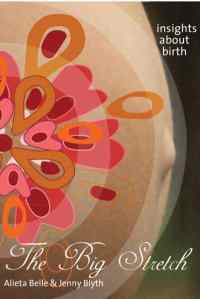
DVD Review: The Big Stretch

DVD Review: The Big Stretch

By Alieta Belle & Jenny Blyth

60 Minutes, includes 20 page booklet

www.birthwork.com

Reviewed by Molly Remer, Talk Birth

Jenny Blyth the author of the book Birthwork, is also a filmmaker who co-created the film The Big Stretch with another mother. The particularly special thing about this film is that it is all about women sharing their own experiences and feelings–unlike many current birth movies there are no “experts” present in the film (other than the true experts–women themselves!), the focus is on the families preparing for birth or reflecting on their past birth experiences. The many topics addressed are insightful.

The film’s emphasis is on, “Women in different stages of pregnancy and preparing for a natural birth reflect on how they and ‘stretched’ in everyway – emotionally, physically and spiritually” and I enjoyed this “stretch” theme that ran throughout.

Introducing new scenes/topic is neat artwork and the images in this film in general are particularly gorgeous. In one exception, I was taken aback by footage at the close of the film of a totally naked man riding a bicycle and feel I should warn other viewers to be prepared for that!

The DVD is accompanied by a 20 page booklet full of questions that carries the themes from the film into personal questions to increase self-awareness during pregnancy.

The Big Stretch is a unique and beautiful film in which women’s voices are clearly represented. There are no titles, no degrees, no qualifications listed. This film is a perceptive “motherful” look at the many stretches of birthing: physical, emotional, mental, and cultural.

Disclosure: I received a complimentary copy of the DVD for review purposes.

Review previously published at Citizens for Midwifery.

Where are the women who know?

Ames, Iowa 1960

Pregnant and
no female friend to confide in
Scared and
no woman to tell it to
A male doctor who patronizingly
calls me by my first name
while I’m supposed to
respectfully
call him Dr. So-an-so

A husband so afraid of
his own fear that
He’s unwilling to know it’s there
not the person
to listen to mine

Where are the witches, midwives
and friends
to belly dance and chant
while I deliver
to hold me and breathe with me
as I push
to touch me and comfort me
as I cry?

Where are the womyn who know
what it’s like
to give birth?

–Antiga in The Goddess Celebrates, p. 152

This poignant poem spoke to me from the pages of an anthology of women’s rituals recently. It made me think about my plans and visions for the birthwork I’d like to offer to my community. Some friends/colleagues and I launched a local Birth Network this year and one of my primary hopes for it is that it will provide easy access to the women who know. And, that in simultaneously creating access for pregnant women to each other, the opportunity arises to uncover their own deep knowing, rather than needing expert advice or opinions. To that end, we’re planning a series of birth workshops (more details soon!) and hopefully a birth circle.

In the novel The Heart of the Fire recently I marked these two quotes:

“A woman who has borne children…loses many of her terrors.” The character speaking goes on to explain, “…for a Priestess it is, a path. A path of opening.”

Later the main character is attending the birth of one of her siblings and observes, “[the midwife] says the most important thing is to never bring fear into the room of a laboring woman. ‘A woman must be completely open to birth a child,’ she says, ‘and so she is unable to defend herself from the thoughts of those around her.'”

I’ve written about birth fear several times before. I think many women underestimate the potent impact the emotional condition of birth witnesses of all kinds (including doctors, nurses, grandmothers, doulas, and friends!) can have on their own birthing times. Women in labor enter a timeless, liminal space, and use their right brain–the primitive brain, the “birth brain” as I call it or “their monkey” as Ina May calls it–to dig deep and access the inner resources they need to birth their babies. When other people in the room are fearful or agitated or even just too talkative, the laboring woman has a heightened vulnerability to and awareness of those emotional states. This is what the fictional midwife quoted above means about being “unable to defend herself from the thoughts of those around her.” This is an important understanding. While to the birth attendant, this is just one more birth in a lifetime career, for the mother giving birth this is potentially a peak experience and definitely something she will remember for the rest of her life. This is a sacred moment and one deserving great care, tenderness, and respect.

In my ideal vision of the world, pregnant women would have ample access to other women who know what it is like to give birth under their own power and self-authority. And, these women who know would likely be women who have lost many of their “terrors” in the process. Access to women who know would render most traditional forms of childbirth education unnecessary, offering instead what Michel Odent would deem “new style childbirth education”:

“…for the most part, these are mothers who have no special qualification but, having given birth to their own children, feel the need to help other women who could benefit from their personal experience. They organize meetings, often at their own homes. They do not usually encumber themselves with any particular theoretical basis for their teaching, but may find it useful to give this or that school of thought as a reference. Their aim could most accurately be described as being to provide information and education, rather than specific preparation.” (previously quoted in thoughts on epidurals, risk, and decision making)

So, this is really what I’m hoping to be a part of creating for the women of my own community. I want to help open the door so that the women who know and the women who are preparing themselves to know can meet in safe space and in so doing lose many of their terrors and joyfully uncover their own unique strengths. I believe I’ve already seen it working.

Related posts:

The Value of Sharing Story

Information ≠ Knowledge

How Do Women Really Learn About Birth?

Becoming an Informed Birth Consumer (updated edition)

20120903-135413.jpg

“Birth is life’s central mystery. No one can predict how a birth may manifest…Our dominant culture is anything but ‘natural’ so it is no surprise that childbirth, even with the most natural lifestyle lived by an individual family, sometimes needs intervention and medical assistance. This is not to say that any one mother’s efforts to have a natural childbirth are futile. Just that birth is bigger than one’s personal desires.” –Jeannine Parvati Baker (in The Goddess Celebrates: An Anthology of Women’s Rituals, p. 215)

It’s Labor Day and it is also the start of Empowered Birth Awareness Week! A blog carnival is in full swing at The Guggie Daily and I’ve been having some thoughts about birth as a consumer issue. Very often, it appears to me that responsibility for birth outcomes is placed on the mother—if only she’d “gotten educated” she would have made “better choices.” Many people have a tendency or overlook or minimize the impact of the context in which she makes her choices. In that way, I appreciate Baker’s observation about that birth is bigger than one’s personal desires. That doesn’t mean that we can’t take vital steps to alter the larger culture of birth in which we make our choices, however, and one of those ways is to remember to think about birth as a consumer issue.

Though it may not often seem so, birth is a consumer issue. When speaking about their experiences with labor and birth, it is very common to hear women say, “they won’t let you do that here” (such as regarding active birth–moving during labor). They seem to have forgotten that they are customers receiving a service, hiring a service provider not a “boss.” If you went to a grocery store and were told at the entrance that you couldn’t bring your list in with you, that the expert shopping professional would choose your items for you, would you continue to shop in that store? No! If you hired a plumber to fix your toilet and he refused and said he was just going to work on your shower instead, would you pay him, or hire him to work for you again? No! In birth as in the rest of life, YOU are the expert on your own life. In this case, the expert on your body, your labor, your birth, and your baby. The rest are “paid consultants,” not experts whose opinions, ideas, and preferences override your own.

There are several helpful ways to become an informed birth consumer:

  • Read great books such as Henci Goer and Amy Romano’s new book Optimal Care in Childbirth or Pushed by Jennifer Block.
  • Hire an Independent Childbirth Educator (someone who works independently and is hired by you, not by a hospital). Some organizations that certify childbirth educators are Childbirth and Postpartum Professionals Association (CAPPA), BirthWorks, Birthing From Within, Lamaze, and Childbirth International. Regardless of the certifying organization, it is important to take classes from an independent educator who does not teach in a hospital. (I’m sure there are lots of great educators who work in hospitals, but in order to make sure you are not getting a “co-opted” class that is based on “hospital obedience training” rather than informed choice, an independent educator is a good bet.)
  • Consider hiring a doula—a doula is an experienced non-medical labor support provider who offers her continuous emotional and physical presence during your labor and birth. Organizations that train doulas include CAPPA, DONA, and Birth Arts.
  • Join birth organizations specifically for consumers such as Citizens for Midwifery or Birth Network National or International Cesarean Awareness Network.
  • Check to see if you have a local birth network in your own community or even start your own (I recently co-founded one in my town!)
  • Talk to other women in your community. Ask them what they liked about their births and about their care providers. Ask them what they wish had been different. Pay attention to their experiences and how they feel about their births. If they are dissatisfied, scarred, unhappy, and disappointed, don’t do what they did.
  • Ask your provider questions. Ask lots of questions. Make sure your philosophies align. If it isn’t a match, switch care providers. This is not the time for misplaced loyalty. Your baby will only be born once, don’t dismiss concerns your may have over the care you receive or decide that you can make different choices “next time.”
  • Find a care provider that supports Lamaze’s Six Healthy Birth Practices and is willing to speak with you seriously about them:
  1. Let labor begin on its own
  2. Walk, move around and change positions throughout labor
  3. Bring a loved one, friend or doula for continuous support
  4. Avoid interventions that are not medically necessary
  5. Avoid giving birth on your back and follow your body’s urges to push
  6. Keep mother and baby together – It’s best for mother, baby and breastfeeding

These care practices are evidence-based and form an excellent backbone for a solid, mother and baby friendly birth plan.

Why “evidence-based care” though?

Because maternity care that is based on research and evidence for best practice is not just a nice idea or a bonus. It isn’t just about having a “good birth.” Evidence-based care is what mothers and babies deserve and what all birthing mothers should be able to expect! Here is a great summary of pregnancy and birthing practices that the evidence backs up:

20120903-142510.jpgRemember that birth is YOURS—it is not the exclusive territory of the doctor, the hospital, the nurse, the midwife, the doula, or the childbirth educator. These people are all paid consultants—hired by you to help you (and what helps you, helps your baby!).

“As long as birth- metaphorically or literally-remains an experience of passively handing over our minds and our bodies to male authority and technology, other kinds of social change can only minimally change our relationship to ourselves, to power, and to the world outside our bodies” – Adrienne Rich (Of Woman Born p185)
20120903-135505.jpg

Related posts:

Birth class handouts

Can I really expect to have a great birth? (updated edition)

What to Expect When You Go to the Hospital for a Natural Birth

Active Birth in the Hospital

The Illusion of Choice

Musings on Story, Experience, & Choice

This post is updated from a previous edition.