Archives

Birthday!

Today is my birthday and my mom sent me a guest post about my own birth!

Molly’s Birth Story (33 years later)
May 3, 2012

At the time of Molly’s birth in 1979, we lived in a 10 x 30, un-insulated building – a shack, really – and were completely off the grid. We used wood for cooking/heat, and kerosene and candles for light. We hauled in drinking water, and bathed in rain water. We had no phone, electricity, or plumbing and shared a vehicle. Many people were appalled at our decision to homebirth (fortunately, they couldn’t call us to yell about it!). Midwives were completely hidden and underground. I had two dear friends, both nurses, who agreed to attend the birth.

I was very close to term, and we were concerned that I would begin labor at home (with no phone or car) while Tom was away at work, so I spent those final days of pregnancy hanging around at the homes of neighbors and friends. Labor began while with neighbors, and continued to progress throughout the evening. It was a wild night – raging thunderstorms, torrential rain, and incessant lightning. It became apparent that this was true labor, so Tom had to leave me alone in our tiny home to go find a phone to call our support people. They arrived by midnight, and I continued to labor throughout the night, culminating in 2 hours of pushing and the arrival of a beautiful, sweet baby girl! I’ll never forget the surreal feeling of contractions punctuated by lightning and thunder. Towards the end, I was actually falling asleep between contractions and still remember the dreams I had…..

Unfortunately, I sustained a large tear, and was unable to push to release the placenta. We had to pack up, borrow a 4-wheel drive truck, and slip and slide through the mud to a doctor who had agreed to provide postpartum care if needed. I was curled up on the seat with baby Molly – this was before car seats were in use! I lamented having to go out in such horrible conditions. The tear was major, and took 42 stitches, making my days of postpartum recovery very difficult. Nothing daunted, I went on to have 3 more children at home – still off the grid, still with no indoor plumbing, but some of the time with a car and a phone for the last two.

This experience – having my first baby – was a transcendent transformation. I became a mother at that moment, and being a mother is still a defining element of my personality and identity. Molly grew to adulthood altogether too fast, and even though she stands before me now as a mother herself, I will never forget the infant, child, and teenager that she was. We’re inextricably linked, and while I marvel at our sameness, I also celebrate our differentness.

I had 2 favorite books that I read to prepare for a very rustic homebirth – Spiritual Midwifery, by Ina May Gaskin, and Special Delivery, by Rahima Baldwin. These books are still being recommended to birthing women, and while the climate of homebirth is certainly in transition, each woman must find her own path through the labyrinth of birth.

Who knew, when I was planning a homebirth all those years ago, that Molly would grow to be the birth advocate and authority that she has become? Perhaps my decision to homebirth had some sort of deep-seated and profound influence on her!

Happy birthday to an amazingly intelligent, witty, loquacious, creative, generous, intuitive, compassionate and productive daughter. I am incredibly proud of the woman you have become, and I love you beyond all reason.

Love,
Mom

She also uploaded a photo of me at 11 months–we think Alaina looks like me 🙂

20120503-220345.jpg

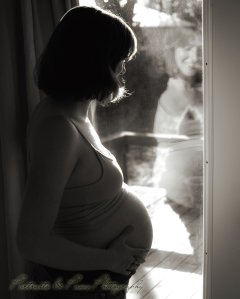
I also had this nursing picture already saved on my computer:

Happy Birth Day to both of us!

Present day…

Today we had to take Alaina to the pediatric dentist in St. Louis to have her front teeth looked at. I thought the four upper front teeth all had decay, but it turned out to be a pretty best case scenario—she only had one actual cavity (some pitting and staining on three others, but not decay) AND the dentist said, “would you like me to just fix it now instead of you having to drive all the way here again from Rolla?” So, not only was the problem more minor than we feared, it is already ALL FIXED! Yay! So, I was able to go on and enjoy the rest of my birthday rather than fretting about her teeth or planning the follow-up visit for the “big work.” We did have a horrible 15 minutes while I held her on my lap and she screamed and cried and they did the work, but that is a tiny blip as far as things go and it was SO much better than the anesthesia route we did with Z (ambulatory surgery clinic admission, etc. Boo on that, especially because most of the work then chipped off—that’s what $5000 or so gets you!). After we got home she was extra clingy and very needy and mama’s girl-ish though, which makes me feel bad because I know she must still be feeling traumatized by the betrayal of being taken somewhere to, essentially, be hurt, trapped, and helpless 😦

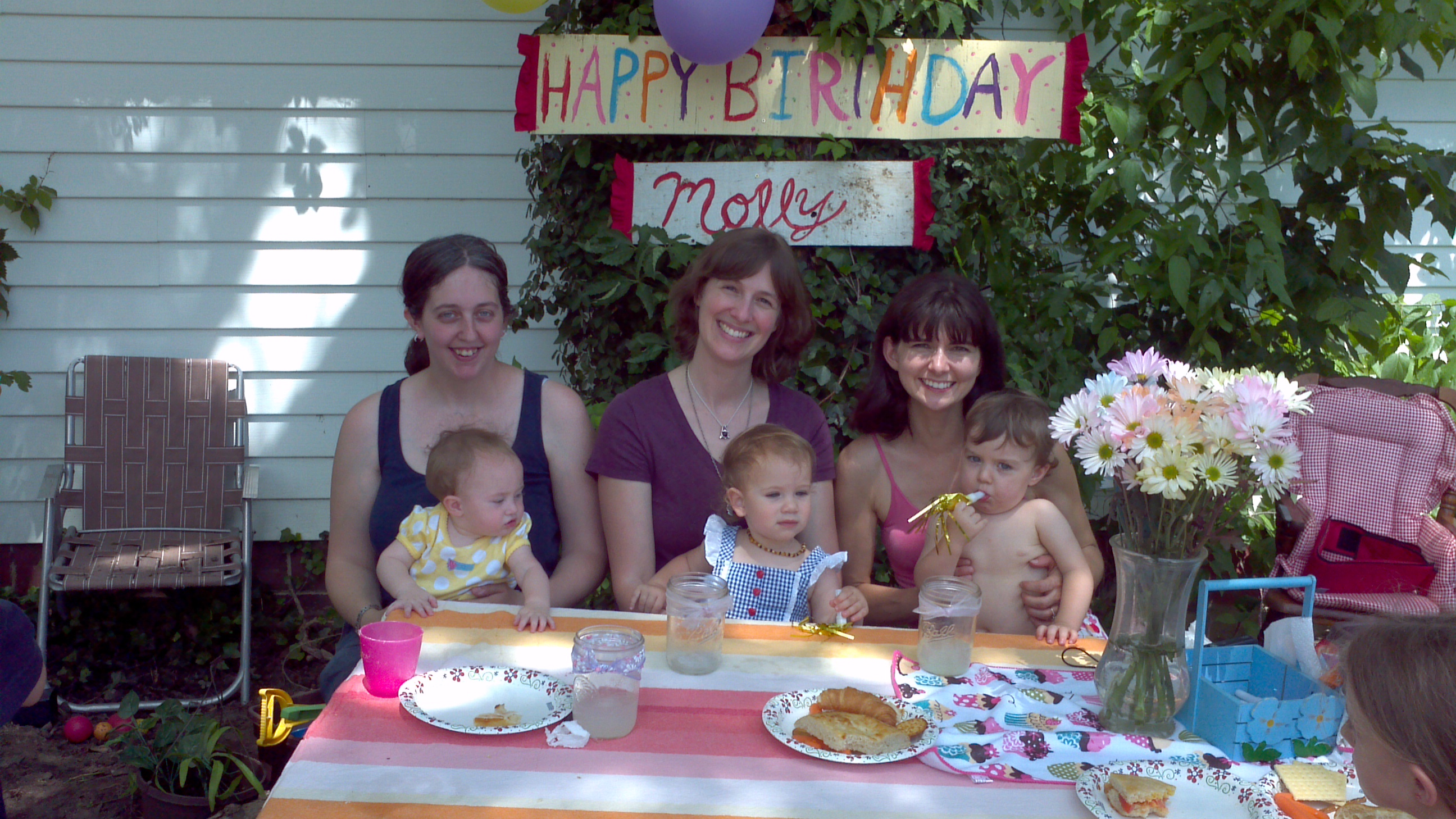
After the dentist, we went to my friend’s house who lives in the vicinity. Another friend joined us and we had a little party with a nice lunch and cupcakes. My friend’s kids had blown up balloons and hung them up all over and there was also a great sign hanging in the tree:

I cried when I saw the cute sign! I really miss seeing both these friends on a regular basis, but I also feel thankful that they still live close enough to be within reach!

20120503-220419.jpg

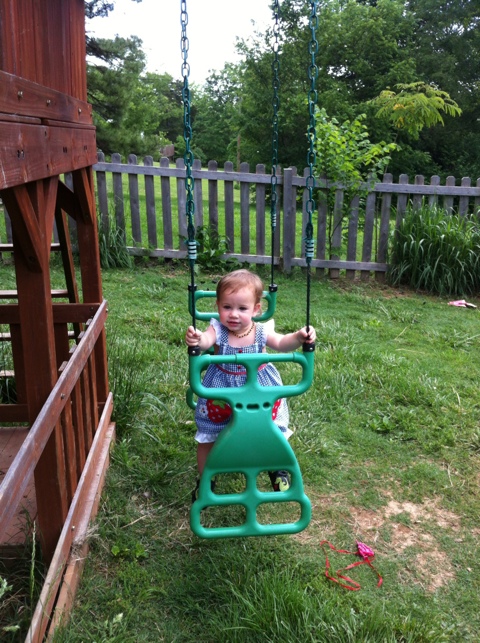
Recovered enough from tooth trauma to swing like a big girl!

On the way home we stopped at the pie shop for the Boston cream pie Mark ordered for us to enjoy with my parents:

20120503-220425.jpg

20120503-220517.jpg

Couldn’t resist taking a picture of the sweaty, wild hair of a traveling baby!

My parents came over bearing gifts and my favorite dinner of beef stroganoff and we also ate the pie. I’m tired, but relieved. I was also feeling weird to be 33 now and said something along the lines of, what happened and is Alaina going to be 33 soon too?! My dad said, “this can never be a long time ago…” and then reminded me that it was a Laura Ingalls Wilder quote:  “…They could not be forgotten, she thought, because now is now. It can never be a long time ago...”

Later, I laid in bed nursing Alaina to sleep and thinking about how my parents remember me as a baby—their baby—but I don’t remember being their baby. And, how this intimacy with Alaina will someday soon be only my memory, not hers (at least not consciously). How strange, because it is so total and so real and so right now…it can never be a long time ago.

Book Review: More Than a Midwife

More Than a Midwife: Stories of Grace, Glory, and Motherhood [Paperback]
by Mary Sommers
MavenMark Books (HenschelHAUS Publishing) (October 1, 2011), 148 pages
ISBN-13:978-1595981066

Reviewed by Molly Remer, Talk Birth

More Than a Midwife is a thoroughly delightful little volume by experienced and resourceful midwife, Mary Sommers. One of the things that makes the book particularly distinctive is the impressive diversity of Mary’s work experience. The book includes stories from her work as a midwife in urban Chicago as well as in Africa and Mexico. As always, glimpsing the dire situations facing birthing women cross-culturally is a sobering reminder of the immense challenges international midwives face with few physical resources—they accomplish an amazing level of care with only their heads, hands, and hearts.

Each story shared in the book is selected with care and has an important message to share. The stories are about unique women and their unique births and what Mary (and the reader) can learn from them. From empowering and exhilarating, to difficult and heartbreaking, particularly notable are the stories that remind us all to treat every woman with dignity and respect, regardless of her life’s circumstances or choices. Mary is clearly a midwife who loves women and birth and practices with sensitivity, respect, and positive regard.

More Than a Midwife is a slim paperback. It is nice size to hold easily and the stories are short and easy to read in small chunks of free time. It is occasionally erratic in the organization/flow of a story and in a few of them I had to re-read segments to understand chronology. However, this  was a negligible issue in the context of this thoroughly enjoyable small book.

Mary Sommers has written a true gem of a book. I feel honored to have read More Than a Midwife and I highly recommend it to anyone interested in birth, homebirth, midwifery, or women’s health. Most excellent!

Disclosure: I was provided with a complimentary copy of the book for review purposes.

A Tale of Two Births

As Penny Simkin has frequently noted: “We can’t control labor, whether it’s hard; that’s a leap of faith. But we can always control how we care for [the mother]” [1]

In 2001 and in 2004, I attended the births of two of my dear friend’s children in the same hospital in a mid-sized Midwestern city.  I was not a childbirth educator or doula at this time, but was there in the capacity of friend and “witness.” Both births were intervention-heavy and not what I would call ideal, natural births; but the feelings were vastly different, which made all the difference.

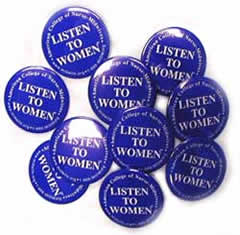
At the 2007 LLL International conference in Chicago, I picked up several of these great "Listen to Women" buttons from the ACNM booth in the exhibit area. I love them. Isn't this what it is all about? So simple and yet so profound. Imagine how the world would change if we just listened to women.

One had an atmosphere of respect, caring and trust; the other had a “climate of doubt” throughout. The difference was a certified nurse-midwife (CNM). My commitment to homebirth midwifery often leads me to forget what a profound and true difference a caring CNM can make in a hospital birth. All the other hospital procedures can be present, but the care factor a CNM provides can transform a woman’s experience from powerless to powerful. Sometimes I forget how CNMs are poised to bridge the gap between home and hospital effectively. The US needs lots of them (not as subordinate “junior obstetricians”—but as expert guardians of normal birth in a hospital setting).

The details were similar in each birth. The babies were both almost 9 lb; a doula was present (same doula in both births); and the mother labored with an IV, spent a large portion of the labor in bed and had internal fetal monitoring. In the first birth (with the CNM), the mother even had several hours of Pitocin augmentation; in the second, with the obstetrician, she had no Pitocin until third stage. With each birth, the mother also had an extensive tear and long repair (a third-degree with the CNM, a second-degree with the obstetrician).

However, some things were very different.

When the mother said, “Can I have a birth ball?” the CNM said, “Yes,” and the obstetrician said, “Not until the baby has been monitored.” And then, “The baby doesn’t like that; you need to get back into bed.”

When the mother’s confidence waned, the CNM said, “You can do it. You are.” The obstetrician said, “I don’t think this baby is moving down.

When the mother said, “This is taking such a long time,” the CNM said, “I know. It is taking for-freaking-ever!” and everyone laughed (including the laboring mother). The obstetrician said, “I think we should consider a c-section based on your history. The baby is not moving down.”

The CNM said, “You have such strong muscles in your legs and bottom, do you exercise a lot? I think because you are so strong, you’re holding a lot of tension here. Try to let it go.” The obstetrician ironed the perineum until the mother screamed with pain.

The CNM waited. The obstetrician did another internal check.

In both, a baby was eventually born (the first after four hours of pushing, the second after a little over an hour). A strong, healthy baby. Vaginally and without pain medications. After the first birth—though she would have done some things differently—my friend felt triumphant, empowered, powerful, strong, capable, happy and proud.

After the second birth she felt abused, disappointed, ashamed, guilty, angry, assaulted, diminished, wounded and scarred.

I believe the CNM’s personality, attitude and basic belief that vaginal birth would work was the critical difference between these two experiences. These births dramatically, viscerally illustrated for me that no matter what else is happening around the birthing woman, we can control how we care for her.

Endnote: My friend went on to have her third baby at home in 2008. She pushed this baby out in fifteen minutes, with no tear, and she shone with her power.

Molly Remer, MSW, ICCE, CCCE is a certified birth educator, writer, and activist who lives with her husband and children in central Missouri. She is the editor of the Friends of Missouri Midwives newsletter, a breastfeeding counselor, a professor of human services, and a doctoral student in women’s spirituality. She blogs about birth, motherhood, and women’s issues at https://talkbirth.me/posts.


[1] Looking to nature, doula Penny Simkin practices the art of delivery, in The Seattle Times, Pacific Northwest Cover Story. Originally published March 23, 2008. Accessed April 27, 2009. http://seattletimes.nwsource.com/html/pacificnw/2004299467_pacificpenny23.html.

This is a preprint of A Tale of Two Births, an article by Molly Remer, MSW, ICCE, published in Midwifery Today, Issue 91, Autumn 2009. Copyright © 2009 Midwifery Today. Midwifery Today’s website is located at: http://www.midwiferytoday.com/

Alaina’s Birth Story–Baba Style!

On Alaina’s birthday I received a special treat—her birth story written by my mom (called Baba in our family). I asked her if I could post it here and here it is!

Alaina’s Birth Story

Baba’s version

Waiting for a baby to be born can be exciting and stressful at the same time – but waiting for baby Alaina was especially poignant because of Molly’s previous loss of little Noah. I was worried. I knew she had a specific vision of how this – her last – birth would be, and I was concerned that my presence would somehow ruin things for her, or not live up to her expectations. I was also actually afraid. I was afraid something would go wrong, either with the birth process or with the baby herself.  I was afraid I’d have to be the one who was called upon to act in some heroic manner and would fail. I was afraid I wouldn’t measure up to Molly’s birth expectations. I wanted to do it all right, perfectly, and was afraid I couldn’t. I felt that voicing these fears would somehow manifest them, and I didn’t want to carry the fear into the sacred birth space. I felt prepared – I had been trained in neonatal resuscitation, knew where all the tinctures, supplements, and supplies were located, had a little bag packed for myself – but I was still emotionally and mentally concerned.

However, a few days before the birth, Molly and I had a talk, and it really cleared the air! When the “stand by” call came from Mark, I knew I was ready to be of service to my daughter and arriving granddaughter. The first request was for us to collect the big brothers, who had awakened early and were impacting Molly’s birth environment. I picked them up and brought them to home with me. At that time, Molly was very clear and focused, doing her work on the birth ball. When Mark called me to come back to the house at about 9:00, I scrambled into the car and tore over there, as if there might not be enough time! Molly has a history of precipitous births…….

There was definitely some birthy energy going on! Molly was on the ball with Mark rubbing her back. I knew she wanted to be left alone and have a peaceful environment, so I spoke as little as possible. At some point, I slipped over to her futon nest and tucked my little cheat sheet list underneath. I didn’t want to forget any of the resuscitation steps or what supplements to give her.  I tried to remind her to eat, drink and use the bathroom, without being obtrusive about it. She was obviously making progress, and I could hear in her voice that the contractions were growing in intensity. She worried about being too much “in her head” and analyzing things. I tried to reassure her that this is always how she approaches the world, and that it was fine to be that way. She was up and moving around, talking and considering, and also worried that she might not be progressing. This made me think transition might be near, but I didn’t say that to her. She felt some rectal pressure and decided to sit on the toilet for a while. It seemed to me that things were progressing apace, when she reached down and felt something squishy. She said she thought she was pushing, and I decided it was time to abandon my “silence” (really hard for me, by the way!) and comment that she should probably get to her nest if she wanted to avoid having the baby on the toilet.  She agreed, but didn’t really seem to want to move. No wonder. She barely made it! Meanwhile, I had called Summer, the doula, and midwife E.

Baba meets Alaina!

Molly dropped to her knees on her futon nest, and had an obviously intense contraction. We helped her get her clothes off. She was upright on her knees, intent upon finding heart tones, when the phone started ringing incessantly. It was SO annoying that I ran over to, picked it up and slammed it down to make it stop. That’s when I heard some garbled crying and Molly had baby Alaina in her arms! In my mad dash to the phone, I had missed the actual moment of birth :(. We all burst into tears and Molly was repeating, “You’re alive! You’re alive! I did it! There’s nothing wrong with me!” The baby was crying lustily, so we got Molly into a prone position (she was still kneeling) with the baby on her chest and covered up. My job was to pop things into Molly’s mouth – supplements, vitamins, chlorophyll, etc., so I got ready to do that. Summer arrived, midwife E arrived, and all was right with the world. Baby Alaina was safe and in her mother’s arms! And in mine, as soon as I could get my hands on her…..

—-

Molly’s version of Alaina’s full birth story.

Sand Tray Therapy

I hoped to finish Noah’s book before his birthday today, but I didn’t quite make it. I’m still editing the last half, adding resources to the appendix, and waiting for my husband to design the cover for me. Hopefully I will publish it by the end of the year! Instead, I wanted to share some pictures and thoughts from a sand tray therapy exercise that I did during a session at the ICAN conference in St. Louis in April. I’ve been meaning to post about it since then and haven’t found the opportunity, so in honor of his birthday seems very fitting and appropriate. The session was intentionally kept small for personal sharing and when we walked in the therapist, Maria Carella, asked if we were there to celebrate a birth or to grieve one. I said I was there for both (I had Alaina with me and she slept in the Ergo during the session). Each of us had a tray of sand and there were long tables at the front of the room full of objects and materials (like shells, feathers, and so forth). We were paired up and after arranging our items on our sand, we were asked to share our tray with the person next to us as well as the message, lesson, reflection, or insight we received from the process of making the tray. While some people used the sand in various creative ways—mounding it up, etc.—I just smoothed mine out and put stuff on top of it. The experience of sharing with my tablemate was very moving and profound. We had a lot of surprising similarities in our feelings about our births, though our stories were very different. And, our closing thoughts or insights about our trays were almost identical.

While it might be hard to see everything, I chose the bridge to symbolize my feeling of having crossed the bridge to the “other side”—meaning first the fact that after Noah and my second miscarriage, I felt separated from women who had not experienced loss by a bridge and as if I’d crossed over into new territory and left my old, happy, naive pregnant self behind (along with the other non-loss mamas. A little more about this bridge here). AND, that I also felt like with Alaina’s birth that I crossed a bridge into the  unknown and to the end of the pregnancy-after-loss journey. Her birth represented the “other side” of PAL. So, at the end of the bridge I drew a question mark in the sand, representing all the questions I had to get past and over in order to get to my new baby. The little baby on the side of the bridge represents how I still had Noah with me. He didn’t get “left behind” on the other side of the bridge, but was next to me on my journey. The spiral on the other side represents the continuous, unfolding spiral of life. Sitting by the question mark is a sort of Kachina-type figure holding many babies. To me she represents all of the babyloss mamas and also reminds me of the jizos who protect lost babies. There is also a coffin on the other side of the question mark, summing up how the fear of the death was everpresent for me and I had to pass over that fear as well to get to my new baby—my light, the candle on the other side of death. The little sparkling gems also represent my joy at her birth and what a treasure she is to me. The bone on the side of the candle represents the places where the “meat was chewed off my bones” by all my births, including Noah’s (I had just attended Pam England’s birth story sharing session prior to this sand tray session). I placed the Goddess of Willendorf figure, that I had immediately snatched off the table as soon as I spotted her, at the top to represent how my sense of spirituality had surrounded and enfolded both my experiences—She is “holding” it all. And, I explained to my tablemate how the roundness of the tray to me also represented the full circle—how Alaina’s story and Noah’s are entwined and how her birth was the “end” (of sorts) of his story, but that they are part of one whole.

View from the top

Happy birthday, tiny third son. We remember you. Thank you for opening my heart and my life for your sister to enter.

The Value of Sharing Story

“..no matter what her experience in birth was, every mother knows something other people don’t know.”—Pam England


“Stories are medicine…They have such power; they do not require that we do, be, act anything—we need only listen. The remedies for repair or reclamation of any lost psychic drive are contained in stories.” –Clarissa Pinkola Estes


Every woman who has given birth knows something about birth that other people don’t know. She has something unique and powerful to offer.

As birth professionals, we are often cautioned against sharing our personal stories. We must remember that it is her birth and her story, not ours. In doula and childbirth educator trainings, trainees are taught to keep their own stories to themselves and to present evidence-based information so that women can make their own informed choices. As a breastfeeding counselor too, I must remind myself to keep my own personal experiences out of the helping relationship. My formal education is in clinical social work and in that field as well we are indoctrinated to guard against inappropriate self-disclosure in a client-helper setting. In each environment, we are taught how to be good listeners without clouding the exchange with our own “baggage.” The messages are powerful—keep your own stories out of it. Recently, I have been wondering how this caution might impact our real-life connections with women?

Nine months after I experienced a powerful miscarriage at home at 15 weeks, a good friend found out at 13 weeks that her baby died. As I had, she decided to let nature take its course and to let her body let go of the pregnancy on its own timetable, rather than a medical timetable. When she emailed me for support, it was extremely difficult to separate our experiences. I kept sharing bits and pieces of my own loss experiences and then apologizing and feeling guilty for having violated the “no stories” rule. I kept telling her, “I know this isn’t about me, but I felt this way…” I told her about choosing to take pictures of the baby and to have a ceremony for him at home. That I wished I had gotten his footprints and handprints. The kinds of personal sharing that may have been frowned upon in my varied collection of professional trainings. After several apologies of this sort, I began to reflect and remembered that what I hungered for most in the aftermath of my own miscarriage was other women’s voices and stories. Real stories. The nitty gritty, how-much-blood-is-normal and did-you-feel-like-you-were-going-to-die, type of stories. Just as many women enjoy and benefit from reading other women’s birth stories, I craved real, deep, miscarriage-birth stories. These stories told me the most about what I needed to know and more than organization websites or “coping with loss” books ever could.

I had a similar realization the following month when considering the effectiveness of childbirth classes and trying to pin down what truly had reached me as a first time mother. The question I was trying to answer as I considered my own childbirth education practice was how do women really learn about birth? What did I, personally, retain and carry with me into my own birth journey? The answer, for me, was again, story.

On this blog, I have a narrative about my experiences during my first pregnancy with being able to feel my baby practicing breathing while in-utero. More than any other post on the site, this post receives more comments on an ongoing basis from women saying, “thank you for sharing”–that the story has validated their own current experience. In this example, rather than getting what they need from books, experts, or classes, women have found what they needed from story and, indeed, most of them reference that it was the only place they were able to find the information they were seeking.

And finally, as breastfeeding counselor, during monthly support meetings, I cannot count the number of times I’ve seen mothers’ faces fill with relief when another mother validates her story with a similar one.

So, what is special about story as a medium and what can it offer to women that traditional forms of education cannot? Stories are validating. They can communicate that you are not alone, not crazy, and not weird. Stories are instructive without being directive or prescriptive. It is very easy to take what works from stories and leave the rest because stories communicate personal experiences and lessons learned, rather than expert direction, recommendations, or advice. Stories can also provide a point of identification and clarification as a way of sharing information that is open to possibility, rather than advice-giving.

Cautions in sharing stories while also listening to another’s experience include:

  • Are you so busy in your own story that you can’t see the person in front of you?
  • Does the story contain bad, inaccurate, or misleading information?
  • Is the story so long and involved that it is distracting from the other person’s point?
  • Does the story communicate that you are the only right person and that everyone else should do things exactly like you?
  • Is the story really advice or a “to do” disguised as a story?
  • Does the story redirect attention to you and away from the person in need of help/listening?
  • Does the story keep the focus in the past and not in the here and now present moment?
  • Is there a subtext of, “you should…”?

Several of these self-awareness questions are much bigger concerns during a person-to-person direct dialogue rather than in written form such as blog. In reading stories, the reader has the power to engage or disengage with the story, while in person there is a possibility of becoming stuck in an unwelcome story. Some things to keep in mind while sharing stories in person are:

  • Sensitivity to whether your story is welcome, helpful, or contributing to the other person’s process.
  • Being mindful of personal motives—are you telling a story to bolster your own self-image, as a means of pointing out others’ flaws and failings, or to secretly give advice?
  • Asking yourself whether the story is one that will move us forward (returning to the here and now question above).

While my training and professional background might suggest otherwise, my personal lived experience is that stories have had more power in my own childbearing life than most other single influences. The sharing of story in an appropriate way is, indeed, intimately intertwined with good listening and warm connection. As the authors of the book, Sacred Circles, remind us “…in listening you become an opening for that other person…Indeed, nothing comes close to an evening spent spellbound by the stories of women’s inner lives.”

Molly Remer, MSW, ICCE, CCCE is a certified birth educator, writer, and activist who lives in central Missouri with her husband and children. She is an LLL Leader, a professor of Human Services, and the editor of the Friends of Missouri Midwives newsletter. She blogs about birth, women, and motherhood at https://talkbirth.wordpress.com.

This is a preprint of The Value of Sharing Story, an article by Molly Remer, MSW, ICCE, published in Midwifery Today, Issue 99, Autumn 2011. Copyright © 2011 Midwifery Today. Midwifery Today’s website is located at: http://www.midwiferytoday.com/

Book Review: Homebirth in the Hospital

Homebirth in the Hospital
by Stacey Marie Kerr, MD
Sentient Publications, 2008
Softcover, 212 pages
ISBN: 978-1-59181-077-3
www.homebirthinthehospital.com

Reviewed by Molly Remer, MSW, ICCE, https://talkbirth.wordpress.com

I would venture to say that most midwifery activists and birth professionals have said at some point, “what she wants is a homebirth in the hospital…” This comment is accompanied with a knowing look, a bit of head shaking, and an unspoken continuation of the thought, “…and we all know that’s not going to happen.”

Well, what if it is possible? A new book by Dr. Stacey Kerr, Homebirth in the Hospital, asserts that it is. She was originally trained at The Farm in TN (home of legendary midwife Ina May Gaskin) and after going to medical school realized that she, “…needed to balance my new knowledge with my old priorities. I missed the feeling of normal birth, the trust that the birthing process would occur without technology, and the time-tested techniques that help women birth naturally. And so it was that I went back to midwives to find the balance.”
If you are a dedicated homebirth advocate, I recommend reading Homebirth in the Hospital with an open mind—clear out any cobwebs and assumptions about doctors, hospitals, and birth and read the book for what it is: an attempt to create a new model of hospital birth. What Dr. Kerr proposes in her book is a model of “integrative childbirth”—the emotional care and support of home, while nestled into the technology of a hospital.

The opening chapter explores the concept of integrative childbirth and “the 5 C’s” of a successful integrative birth: choices, communication, continuity of care, confidence, and control of protocols (“protocols are the most disempowering aspect of modern maternity care…”).

This section is followed by fifteen different birth stories, beginning with the author’s own (at a Missouri birthing center—my own first baby was born in a birth center in Missouri, so I felt a kinship there).

The births are not all happy and “perfect,” not all intervention-free, and most are quite a bit more “managed” and interfered with than a lot of homebirthers prefer (one is a cesarean, several involve epidurals or medications). I, personally, would never freely choose a “homebirth in a hospital” (I also confess to retaining a deep-seated opinion that this phrase is an oxymoron!). However, that is not the point. Over 90% of women do give birth in a hospital attended by a physician and I appreciate the exploration of a new model within the constraints and philosophy of the hospital.

The book closes with a chapter called “how to be an integrative childbirth provider.” The book has no resources section and no index.

I certainly hope that doctors read this book. I am also glad it is available for women who feel like homebirth is not an option or not available and would like to explore an integrative approach. Even though my opinion is that none of the births are really “homebirths in the hospital” as most bear little resemblance to the homebirths I know and love, unlike the content of the standard hospital birth story, they are deeply respectful births in the hospital and that’s the issue truly at the heart of this book.

—-

Disclosure: I received a complimentary copy of this book for review purposes.

Book Review: In Search of the Perfect Birth

Book Review: In Search of the Perfect Birth
By Elizabeth McKeown, 2011
186 pages,  paperback.
ISBN-13: 978-0615481708
http://www.theperfectbirth.com/

Reviewed by Molly Remer

Written by a mother of three, In Search of the Perfect Birth is an unassisted childbirth manifesto. It chronicles the author’s journey through the births of her children—the first born in the hospital, the second a planned homebirth ending in hospital transport, and the third an unassisted birth. Elizabeth is strongly convicted that unassisted birth is the right choice for most women, though I feel she is also fairly respectful that other women’s experiences may or may not lead them to the same conclusion. This book is not a do-it-yourself guide to UC, but is an exploration of one woman’s experiences in healing from birth trauma and taking full responsibility for the birth of her next child. I was fascinated by her conclusions that her own birth trauma wasn’t healed through unassisted birth itself, but through the decision to take charge of her own birth care.

The book is pretty rough around the edges and could use some more editing and polishing. There is a stream-of-consciousness feel to the writing style that can be a little confusing and disjointed.

The author makes some excellent points with regard to the restrictions that can be placed on women’s birth freedoms by midwives also, noting wryly that if you choose the “middle ground” you may well end up with all the downsides of being told what to do with your own body, but “without the opiates that make it bearable!” Elizabeth’s homebirth turned hospital transport experience was pretty horrific and it was difficult to read about. She also writes with candor about the degree and intensity of pain she experienced during all of her births (including the UC).

In Search of the Perfect Birth will be of particular interest to women who already support unassisted birth and to women who have experienced birth trauma and are seeking resolution in future natural childbirths. It is an honest and heartfelt story.

Disclosure: I received a complimentary copy of this book for review purposes.

Alaina’s Complete Birth Story

It has taken me a long time to finish typing up Alaina’s birth story. I wrote it in my journal at 3 days postpartum and the following is almost verbatim. I’ve gone back and forth about what to include and decided to just include everything, as originally written. I feel critical of the story somehow, like it is “choppy.” I used interestingly short, jumpy sentences and while part of me want to smooth it out, another part of me feels like it is more authentic in this format. I also feel like I “should” be posting it on a more significant date—i.e. her six month birthday, or something. But, it is finished now, so I feel like sharing now! Additionally, I thought about taking the self-analysis section about the use of a hypnosis for birth program out of the story, but, indeed, this was the FIRST thing I wrote in my journal, so it seems like it “deserves” to be included as well. It obviously was one of the most important details for me to write about. However, for the purposes of clarity, I moved it to the end of the story in this version. Likewise, I thought about making the section about my newborn- love into a separate post, but because those feelings are so intimately entwined with her birth and because, in my journal, that is exactly the chronology I used—first hypnosis criticism, second birth chronology, third baby love–it feels like it all belongs together in one story. It is funny how that first story has such value to me and that it feels almost wrong to edit, change, or add anything to it. It feels most honest this way.

The Birth of Alaina Diana Remer
January 19, 2011
11:15 a.m.
7lbs, 8oz; 20 inches.
Short version of her story is here and labor pictures are here.

I had a restless, up and down night, getting up at 3:00 a.m. and even checked in with my online class. Mark got up with me and we talked and speculated. Waves were four minutes apart and then kind of dissipated unenthusiastically away. He went back to bed at 4:00 and I listened to Hypnobabies. At 6:00, I was feeling trapped lying down and got up. Mark got up then too and worked in the kitchen on the dishes and things like that, while I walked around and leaned on the half wall during contractions (a lot. It was the perfect height). Sitting down in a chair caused horribleness, leaning forward on the ½ wall was good. Called Mom and told her to be on standby and to notify my blessingway crew. Also, called Summer (doula/friend) to be on alert. Felt serious, but not totally. Also was having back involvement which each wave. I felt like I would have a real contraction and then a closely following, but milder, back-only contraction (no tightness in uterus really during these, but definitely a wave-like progression and then ease of sensation).

I was very quiet during most waves until the end. I think because I was doing the Hypnobabies and was concentrating on that. Then, I would talk and analyze and be very normal in between. This pattern seemed to lead to a decreased perception of seriousness from others of my need for attention—Mark washed dishes, went outside to take care of chickens, work on fire, feed cats and so forth. The boys woke up at 7:00 a.m. and as soon as they came out and started talking to me (Mark was outside), I knew they needed to go elsewhere. We called my mom at 7:30ish and she came to get them. I did not want to feel watched or observed at all, so asked her to wait to come back.

I kept waiting for the “action” to increase and feeling distressed that it was taking such a “long” time. I suggested to the baby that she come out by 10:00. I continued to stand in the kitchen and lean on the ½ wall, sometimes the table or the bathroom counter. Dismayed to see no blood/mucous, nothing indicating any “progress.” Significant feelings of pressure and pain in lower back continued and at the time felt normal to me, but looking back seems like an extra dose of back involvement. In another intensity-increasing experience, the baby moved during contractions for the entire labor until the contraction before I pushed her out. She moved, wiggled and pushed out with her bottom and body during each contraction, which really added a new layer of intensity that was difficult. I was, however, glad she was moving because then I knew she was okay, without doing any heart checks.

I went into the living room, very tired from bad sleep during the night. We set up the birth ball in the living room so I could sit on it and drape over pillows piled onto the couch. I spent a long time like this. Mark sat close and would lightly and perfectly stroke my back. Continued to use Hypnobabies—finger-drop, peace and release, with most waves.

Mark fixed me chlorophyll to drink and I barfed it up immediately and horribly. Called Mom to come back and 9:00 or so, at which point I finally had a little blood in my underwear. Kept up my ball by the couch routine and moved into humming with each wave. Also did some contractions on the floor leaning over the ball. Also good.

On the ball, I began to feel some rectal pressure with each wave. However, I felt like the waves were erratic still, with some very long and intense and then smaller ones. Hums began to become oooohs and aaaaahs and I began to feel like there was a bit of an umph at the end of the oooooh. Went back to the bathroom and there was quite a bit more blood (plus mucous string) and I started to fret about placental abruptions and so forth. Left the bathroom analyzing how much blood is too much blood and began to critique myself for being too “in my head” and analytical and not letting my “monkey do it.” Said I still didn’t feel like I was in “birth brain” and wondered if that meant I still had a long time to go. Started to feel concerned that I was still early on. This is a common feature of all of my births and is how the self-doubt signpost manifests for me. Rather than thinking I can’t do it, I start thinking I’m two centimeters dilated.

I almost immediately returned to the bathroom feeling like I needed to poop. Serious contractions on toilet produced more pressure with associated umphs at the end. At some point in the bathroom, I said, “I think this is pushing.” I was feeling desperate for my water to break. It felt like it was in the way and holding things up. I reached my hand down and thought I felt squooshy sac-ish feeling, but Mom and Mark looked and could not see anything. And, it still didn’t break. Mom mentioned that I should probably go to my birth nest in order to avoid having the baby on the toilet. My birth nest was a futon stack near the bathroom door. I got down on hands and knees after feeling like I might not make it all the way to the futons. Felt like I wanted to kneel on hard floor before reaching the nest.

Suddenly became obsessed with checking her heartbeat. I knew you’re supposed to do so during pushing and I had stopped feeling her moving painfully with each contraction. I couldn’t find her heartbeat and started to feel a little panicky about that as well as really uncomfortable and then threw the Doppler to the side saying, “forget it!” because big pushing was coming. I was down on hands and knees and then moved partially up on one hand in order to put my other hand down to feel what was happening. Could feel squishiness and water finally broke (not much, just a small trickle before her head). I could feel her head with my fingers and began to feel familiar sensation of front-burning. I said, “stretchy, stretchy, stretchy, stretchy,” the phone rang, her head pushed and pushed itself down as I continued to support myself with my hand and I moved up onto my knees, with them spread apart so I was almost sitting on my heels and her whole body and a whole bunch of fluid blooshed out into my hands. She was pink and warm and slippery and crying instantly—quite a lot of crying, actually. I said, “you’re alive, you’re alive! I did it! There’s nothing wrong with me!” and I kissed her and cried and laughed and was amazed. I felt an intense feeling of relief. Of survival. I didn’t realize until some moments later than both Mark and Mom missed the actual moment of her birth. Mark because he was coming around from behind me to the front of me when I moved up to kneeling. My mom because she went to stop the phone from ringing. I had felt like the pushing went on for a “long” time, but Mark said that from hands and knees to kneeling with baby in my hands was about 12 seconds. I don’t know. Inner experience is different than outer observation. What I do know is that the moment of catching my own daughter in my hands and bringing her warm, fresh body up into my arms was the most powerful and potent moment of my life.

I was covered in blood again. Caked in my fingernails and toenails and on the bottoms of my feet again. And, I did tear again, same places.

I feel the moment of her birth was an authentic “fetal ejection reflex” including the forward movement of my hips. The immediate postpartum went exactly as I had planned. Summer arrived approximately 20 minutes after Alaina was born. She brought me snacks, wiped blood off of me, and served me a tiny bit of placenta (which I swallowed with no problem!). My midwife arrived approximately 40 minutes post-birth and assessed blood loss and helped with placenta. She said I lost about 3 cups of blood, but I think all of the fluid that came out with the baby, plus the blood from the tears, may have bumped the estimate up too high. I did not feel weak or tired like I’d lost too much blood, I felt energetic and really good, actually. I didn’t get faint in the bathroom either and my color stayed good throughout. “Don’t look down” (while using the bathroom) is an excellent plan for me!

My post-birth feelings were different this time. I feel more baby-centered in my feelings about it rather than self-empowerment centered. I also feel more critical in my own self assessment this time—like I didn’t “perform” well or handle myself well. I hypothesize that this may be related to using a hypnosis for birth program, because I didn’t feel “calm and comfortable” on the inside. On the outside I think I looked it, but my internal experience involved more “should” than I like. The hypnosis philosophy wasn’t really a match with my own lived experience of birth. Birth isn’t calm, quiet, and comfortable and I don’t actually think it should be or that I want it to be. However, I was trying to make it so and thus not using some of my own internal resources. I felt more mind/body disconnect than I have before also, perhaps because I was trying to use a mind (“control”) based method on such an embodied process. Anyway, it was good for relaxing during pregnancy, personally not so good for behaving instinctually in labor. I did use it though and technically I guess it “worked” because Mom and Mark couldn’t read where I was in birthing and though I was very calm. It didn’t feel calm inside though, it felt HARD. I also was very stuck—almost in a competitive-feeling way—on thinking it was going to be fast and feeling stressed/concerned that it wasn’t.

I also want to include this segment from my journal, written when she was three days old:

She is so wonderful and amazing and beautiful and perfect and I just want to etch these days into my mind forever and never forget a single, precious, beautiful, irreplaceable moment. I want to write everything down to try to preserve each second of these first few days with baby Alaina—my treasure, my BABY! The one I hoped for and feared for and worked SO HARD to bring to this world (in pregnancy more so than in birth). I can’t really though—I am here, now. Living this, feeling this, knowing this. The newborn haze is my reality in these moments, but it will pass away and the best thing to do is to fully live it. To feel it and to be here—without struggling to preserve it all. It is here in my heart and soul and preserved in the eddies and ripples of time. The unfolding, continuous ribbon of life and experiences. I have a weird, petrified feeling of forgetting—i.e. when I’m 89 will I still remember how this FELT?!

What do I want to remember?
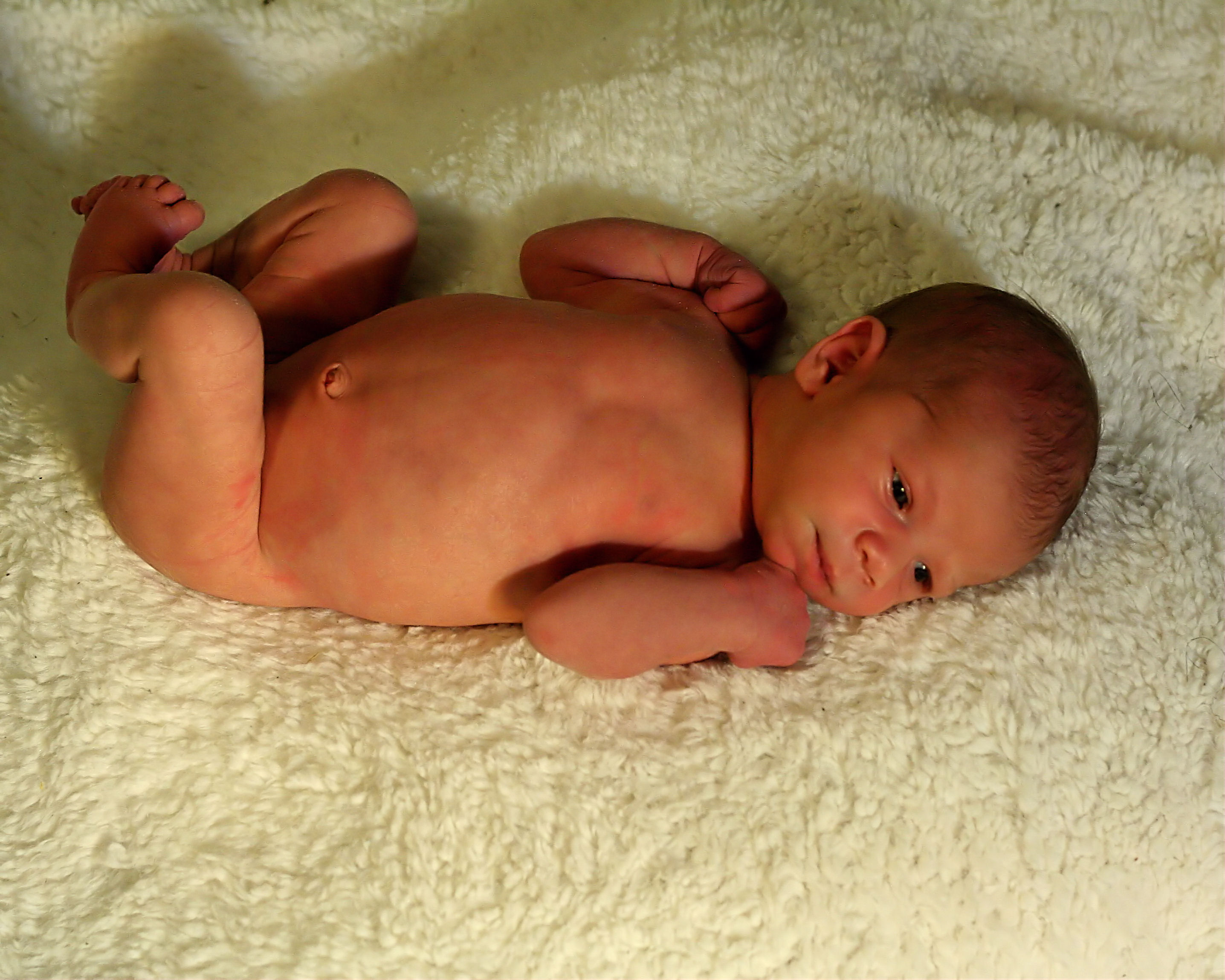
Newborn photo (c) Sincerely Yours Photography

Alaina newborn photo (c) Sincerely Yours Photography

    • The scrunchy feel of a newborn’s body.
    • The little mewing squeaks and sighs
    • How she is comforted by my voice and turns to me with a smacky, nursie face…
    • The soft, soft skin
    • The soft, soft hair
    • The fuzzy ears and arms
    • The little legs that pull up into reflexive, fetal position.
    • The utter, utter, MARVEL that I grew her and that she’s here. That she came from me. That sense of magic and wonder and disbelief when I look over and see her lying next to me—how did YOU get here?!
    • The miraculous transition from belly to baby. From pregnant woman to motherbaby unit? How does it happen? It is indescribably awesome.
  • The sleeping profile
  • The scrunchy face
  • The “wheeling” half coordinated movements of arms and legs—sort of “swimming” in air.
  • The peace of snuggling her against my chest and neck.
  • The tiny, skinny feet.
  • Putting my hand on her back and feeling her breathe, just like in utero

I was still scared she was going to die until the moment I held her.
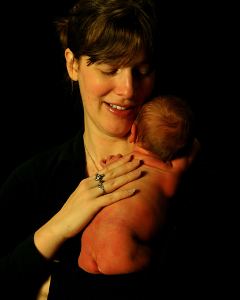
Molly & Alaina newborn photo (c) Sincerely Yours Photography

Book Review: Home/Birth: a poemic

Book Review: Home/Birth: a poemic
By Arielle Greenberg and Rachel Zucker
1913 Press, 2011
ISBN 978-0-9779351-7-8
208 pages, softcover, $11

http://www.1913press.org

http://www.facebook.com/pages/HomeBirth-A-Poemic/

Reviewed by Molly Remer, MSW, ICCE, CCCE
https://talkbirth.wordpress.com

Co-authored by a pair of long-time friends, the “poemic” book Home/Birth reads as if you are eavesdropping on a lengthy, juicy, engaging, thought-provoking conversation about homebirth, birth in America, maternity care, and feminism. The book has a lyric, narrative, stream of consciousness format linked together with segments of poetry.

The text does not differentiate between the two speakers/writers, though through the “call and response,” back-and-forth exchange between the two authors, you quickly begin to recognize two distinct voices (as well as other fragments from birth books, bumper stickers, midwives, etc.).

The book was written during Arielle’s second pregnancy, which ends in the stillbirth of her baby boy. Arielle had one prior homebirth and one subsequent homebirth. Rachel had two hospital births and a homebirth prior to the writing of the book.

While the style in which it is written takes some time to get used to, once you tune in to its rhythm, Home/Birth is a unique and fascinating journey. Because it is so distinctive, I find it difficult to describe in writing—you need to make sure to read it for yourself!

Disclosure: I received a complimentary copy of this book for review purposes.