Archives

Birth Culture

Birth is cultural, the way eating is cultural. We don’t just eat what our bodies need to sustain us. If we only did that, there would be no reason for birthday cake. Birthday cake is part of our food culture. The place you are giving birth in has a local culture as well. It also partakes of our national birth culture. Not everything doctors do regarding birth makes the birth faster or physically easier for you or the baby. Some things are just cultural. For example, most hospitals do not offer enemas to birthing women anymore, yet a few years ago, most women who labored in hospitals were required to have an enema whether they wanted one or not. Enemas are sometimes helpful at birth, but not always…But they used to be part of the birthing culture… –Jan Mallack & Teresa Bailey in (p. 32)

I don’t feel like I have time to construct a big blog post about this subject, but I’ve been having big thoughts lately about birth culture and also how we think about and treat women’s bodies in pregnancy, labor, birth, and postpartum. So, this collection of quotes will have to do for now!

In the short book Birth on the Labyrinth Path by Sarah Whedon, I also marked this passage to share: “In the context of modern medicine, the childbearing year is often treated as a healthcare problem and we are alienated from the natural and holy processes of our reproductive bodies. Let us seek more and more ways to reframe pregnancy as a natural part of the human experience and to honor the holiness of this work that brings a pure and tiny spark of the divine into the messy, beautiful drama of life on Earth. Let us guard mothers, fathers, and babies as they grow families. Let us celebrate our sexy, dangerous, bloody, beautiful ability as people to make and love more people…” (emphasis mine)

Later on, Whedon makes these lovely observations about postpartum bodies:

A body that is curvier than it was before, maybe bearing stretch marks or scars from surgical procedures or tearing, maybe producing milk, is a body that bears the signs of delivering a human being into this world. We may mourn our smooth, skinny, unmarked maiden bodies, but at the same time we can celebrate the beauty of our storied, productive, and strong mama bodies….
—-
You may have seen images of new mothers as mama goddesses, resplendent in their fertility, effortlessly suckling a new babe while woodland creatures graze nearby. This is a lovely scene to aspire to, but my personal experience is that new mama goddesses are more likely to be found pinned to a couch by a ravenous infant, wearing pajamas and a messy ponytail, and surrounded by the remains of hastily grabbed snacks and partially read motherhood memoirs. Those mamas are no less goddesses. In fact, a careful Pagan theology of embodiment will recognize that the true mama goddess must include the range of experience of new motherhood, with all the sleepless nights, messy lochia, and milky-sweet sleeping babes.”

I also came across this quote from Sister MorningStar in the Spring 2011 issue of Midwifery Today: “Every mother has a culture. Every mother is a culture. She is born into an ocean of language, traditions and rituals around how she eats, sleeps, poops, makes love or births a baby.”

And, then from Ani DiFranco’s great introduction to Birth Matters: How What We Don’t Know About Nature, Bodies, and Surgery Can Hurt Us by Ina May Gaskin:
“The pains associated with menstruation and childbirth (even the emotional pain) are the price of having agency with the bloody, pulsing, volcanic divinity of creation, and they lie at the core of feminine wisdom. The literal experience of my body is your body your blood is my blood holds great insight into the way of things. A self-possessed woman in childbirth can be a powerful teacher for all (including herself) on the temporality, humility, and connectedness of life.”
I honestly believe that if modern birth culture rested in perspectives like this, our whole world would change!

Strong Women

“The vulva is at its most beautiful when transformed by a crowning baby who slides out into her mother’s hands. Women are strong. Women are powerful. Women were made to birth their babies—in their own time, in their own way and with their own innate wisdom. The natural birth community is full of the strongest, most fearless women on the planet—women supporting women.”
–Care Messer (in Midwifery Today, Spring 2012)

20120526-193012.jpg

My 6-year-old son took this picture of part of one of my textbook’s covers as I was typing this post and I thought it seems oddly suited to it!

Sharing Stories

Mother-to-mother birthtelling is easy at blessingways!

In an excellent article by Rachel Reed in the Autumn 2011 issue of Midwifery Today, Sharing Stories, Reclaiming Birth Knowledge, she makes this important point: “Women not only learn practical information about pregnancy, birth, and motherhood through exchanging stories, but also gain emotional and social support…Through sharing stories, women created a sense of connection to other mothers and to the ‘universal nature of birthing’ …”

Despite the everyday miracle of birth and potent role in women’s lives and self-identity, “women’s birth stories are largely ignored in mainstream childbirth education programs. Instead, the approach consists of an ‘expert’ transmitting standardized information sanctioned by the maternity system. This approach does not adequately meet the needs of mothers, nor reinforce mothers’ expertise and knowledge. Building childbirth education around mother-to-mother story sharing would reinforce mothers as the experts in birth.”

What do you know about birth that other people don’t know?

As I read this article, I thought of several experiences in my own childbearing experiences that varied from “standardized information sanctioned by the maternity system” and that includes the alternative care system of which I was a part. Things that, for me, were not available from those systems around me—books, professionals, or media, but that nevertheless came through and are part of my own stories:

  • Being able to feel my babies practice breathing in the last 8-10 weeks of my pregnancies.
  • “Skipping” transition–no “freaking out” required to have a baby after all.
  • Tearing “up” into the labia/clitoral area instead of the more common or expected perineal tearing
  • Experiencing a spontaneous birth reflex
  • No bloody show/mucus/fluid until shortly before pushing
  • Long “strings” of post-birth mucus. So tough and sinuous that they are almost like membrane.
  • Experiencing a second trimester miscarriage clearly and potently as a birth event.

I’m curious to know what other women have experienced like this. What happened to you that you had never heard about before? What is a part of your story that isn’t a part of birth books? What do you know about birth that other people don’t know? How does your story enhance the collective culture of women?

The role of story in midwifery education

Reed goes on to explore the role of story in midwifery care and the education of midwives, explaining, “It is time for midwives, informed by being ‘with woman’ and experiencing birth in all its complexities, to reclaim their own unique birth knowledge. Sharing birth stories represents a rich source of knowledge and develops the ‘collective culture of women.’ Mothers are already doing this well, and childbirth education should reinforce this mother-to-mother expertise. Midwifery education also needs to embrace the power of storytelling as a means of developing woman-centered knowledge and practice.”

One of the most valuable elements of La Leche League for breastfeeding mothers is the mother-to-mother support and information sharing. This is irreplaceable. We need a means of providing this type of mother-to-mother support for birth as well. Not in swapping horror stories or “enlightening” others, but in authentic connection based on our own unique birth wisdom.

Birthtellers

In another article in the same issue of Midwifery Today KaRa Ananda shares the following gem in her article about Birthtellers: “…the stories women tell to each other privately–shape cultures, beliefs, choices and lives. Women used to learn about birth and motherhood through the stories of their mothers, sisters, grandmothers, midwives and friends. Today, that knowledge is transmitted primary through television, movies, peers and the internet. Now is the time for the Birthtellers to arise and once again share our inspirational birth stories–both within our communities and globally through new media technology.”

One of the midwife-authors that makes my heart sing with her lyrical, magical writing, is Sister MorningStar (author of Power of Women). She shared her daughter’s birth story in the autumn 2011 edition of Midwifery Today and it is just beautiful.

My own article on the value of sharing story also appeared in the same issue of Midwifery Today.

Book Review: Moon Time

Book Review:  Moon Time: a guide to celebrating your menstrual cycle
by Lucy H. Pearce
Paperback, 145 pages, 2012
ISBN13 9781468056716
http://thehappywomb.com/

Reviewed by Molly Remer, Talk Birth

When I wrote my blog post about moontime’s return in April, I was delighted to get a comment from writer and womancraft wisewoman, Lucy Pearce the author of the book Moon Time. Lucy offered to send me a copy of her book and I received it last week and instantly devoured it. Subtitled “a guide to celebrating your menstrual cycle,” Moon Time is written in a friendly, conversational tone and is a quick read with a lot of insight into the texture and tone of our relationships with menstruation.

The book contains information about charting cycles and about the relationship to the phases of the  moon. I especially enjoyed the excellent section on  “Instant PMT [PMS] Busters” and planning time to nurture and nourish yourself during your monthly moon time. The book also includes planning information for Red Tents/Moon Lodges and for menarche rituals and it ends with an absolutely phenomenal list of resources—suggested reading and websites.

Towards the beginning of the book Lucy observes, “We live in a culture which demands that we are ‘turned on’ all the time. Always bright and happy. Always available for intercourse–both sexual and otherwise with people. Psychologist Peter Suedfeld observes that  we are all ‘chronically stimulated, socially and physically and we are probably operating at a stimulation level higher than that for which our species evolved.’ It is up to us to value rest and fallow time. We must demand it for ourselves to ensure our health “(p. 53). She also comments on something I’ve observed in my own life and have previously discussed with my friends:  “I strongly believe that a large amount of the anger and tearfulness we experience pre-menstrually, is our body’s way of expressing the deep truths which we try to stifle” (p. 56)

Since early spring, as I anticipated moontime’s return in my own life, I’ve been reflecting on how I have been such a devoted proponent of taking good care of yourself physically and emotionally during pregnancy, birth, and especially postpartum, so why have I not applied the same care during moontime? Why haven’t I included this monthly experience of being female as an experience worth respecting and as a sacred opportunity to treat my body and my emotions with loving care and self-renewal? Moon Time includes this great reminder with regard to creating retreat space, taking time out for self-care, and creating ritual each month: “Do what you can with what you have, where you are.” You don’t have create something extensive or elaborate or wait for the “perfect time,” but you can still do something with what you have and where you are. (This is a good reminder for many things in life, actually.)

I highly recommend Moon Time as an empowering resource for cycling women! It would also be a great resource for girls who are approaching menarche or for mothers seeking ways to honor their daughters’ entrance into the cycles of a woman’s life.

If you’d like to pick up a copy of Moon Time yourself, Lucy made this offer to my readers: “Would be delighted to offer your readers a discount on the paperback version of MoonTime: a guide to celebrating your menstrual cycle – they just need to enter MBLP20 at the checkout.”

Disclosure: I received a complimentary copy of this book.

Is there really even such a thing as second stage?

Is there a second stage in labor? Who says so? Who thought it up and why? How did they decide what it would be and when it would start? How it would be measured? When it would end? Is there really even such a thing as second stage? If there isn’t, might it not be important for midwives to know that? Is the Earth really flat? Well, it is in some places. Mothers that lie, sit, walk, stand, crawl, glide, stride, squat, climb stairs or hills, dance, sway, cry, throw up, chant or create positions and sounds never heard or seen before are moving their baby from the inside of them to the outside of them. That’s labor. It doesn’t have stages. One thing melts and overlaps another. It starts slowly and gets bigger. It changes a mother’s breathing from light to deep. Her sounds change as her body and baby mould and mimic each other on the journey from inside to outside. By the time the baby is low so is the mother, her breathing and her sounds and her body. –Sister MorningStar in “Midwifing Second Stage” in Midwifery Today, 98, Summer 2011

After having written recently about the rest and be thankful stage and the spontaneous birth reflex and then finally about the
birth pause, the above quote caught my eye in an issue of Midwifery Today from last year (I’m trying to catch up with my stack of magazines/journals). I explain to my birth class clients that birth looks different from the outside than it feels on the inside. Perhaps from the outside we can identify stages and phases of labor. From the inside, we are just doing it and the stages and phases meld into one continuous experiencing.

I love the final comment in this quote especially–we don’t really need tips, tricks, and vaginal checks to tell us where baby is positioned. When mother gets “low” baby likely is too! This reminds me of another article I read in MT recently. (I didn’t save the actual quote, just going from memory.) It was about a traditional midwife who was asked, “aren’t you going to check her?” when a mother felt like pushing. The midwife put the tip of a finger in and the other people laughed at her—“that isn’t checking her!” She said that all you needed to do was feel for the baby’s head—it the finger only goes in a tip, that means baby is close, if it goes in up to the knuckle, baby is pretty close, if you can’t reach the head, baby will be a while. Why would you need to try to reach the cervix or know what it is doing?

I love Sister MorningStar’s writing. It is so beautiful and expressive. Some time ago, I reviewed her book The Power of Women and I highly recommend it.

A Virtual Mother Blessing for Molly Westerman!

20120410-102111.jpg

I spy...a pregnant woman ready for some honor and celebration!

In 2007, I started blogging for Citizens for Midwifery and one of my favorite blogs was a little gem then called Feminist Childbirth Studies. The blog’s author, Molly Westerman, later became more public with her blogging identity and began writing her current blog, First the Egg, a feminist resource on pregnancy, birth, and parenting. I enjoy her thought-provoking writing, her insight into birth culture and politics, and the glimpses of her family’s life in a nonsexist home. She’s smart, funny, interesting, and she’s also pregnant with her second baby and due any time now! I think every mother deserves a blessingway or mother blessing ceremony and I’m pleased to hostess a virtual blessingway for Molly. There is a tight turnaround since her anticipated birth time is so close, so if you read this and think, “I’d like to do something…” immediately stop thinking and just DO IT!

During my last pregnancy, Molly offered multiple supportive comments in response to my various musings, anxieties and fears as a pregnancy-after-loss mama (even though she didn’t have personal experience with PAL, she did know the right things to say!) Her comments, particularly one about the fact that I was doing this, meant a lot to me. I’ve now followed her current very physically challenging pregnancy with interest and long-distance support/rooting her on as she prepares for the homebirth of her new baby this month. I’m happy to have the chance to offer her a little more encouragement and love through this virtual mother blessing.

Here’s how you can participate:

Email me with your…

  • Words of support, affirmation, encouragement for Molly–either written or recorded (think about what you’d say face-to-face at a ceremony and then, if you have a smartphone, use the handy dandy microphone tool and talk into as if you were speaking directly to Molly in a mother blessing circle. After your voice memo is recorded, choose “share” and send it to me!)
  • Favorite birthy readings/poems/etc. (again could be written or recorded)
  • Birth art (i.e. a picture of something you drew, or you can mail Molly an actual drawing–see below).
  • Beads or charms for a birth bracelet/necklace–if you’d like to do this, email me for Molly’s address and then mail it now, so there is a chance she will receive it before the birth. I figure that all postpartum mamas can use ongoing doses of birth power energy anyway, so even if it gets to her post-birth, that’s cool too!

As I mentioned, there is tight turnaround on this, so on Tuesday of next week, I will gather everything that has been emailed to me and send it to Molly as a “blessingway in your inbox.” 🙂

20120410-102118.jpg

Getting closer and closer to birthing day...

If you are curious to learn more about mother blessings, click here to read other posts I’ve written about them.

Doulas at Homebirths?

What is a doula?

A doula provides non-medical labor support—all the good stuff like back rubs and encouraging words and suggestions for different positions to help with labor. She does not replace the father’s role, but “holds the space” for both mother and father as they take their own journeys/come into their new roles as parents. In my birth classes, I explain that I think one of the benefits of a doula is that it frees the dad up to JUST be the dad and to live his own experience/journey and not have the pressure of trying to remember all the birth “tricks” and book information.

But, why have a doula at a homebirth?

A lot of women planning homebirths do not feel as much of a need for a doula as do women in the hospital. The midwife is capable of providing many of the same functions as a doula, but she also has the monitoring tasks and baby tasks to take care of, while a doula is just there for YOU. Other things to consider when thinking about a doula for a homebirth are whether or not the midwife will be bringing an assistant and what her role will be if there is one–sometimes the assistant is available to fulfill some aspects of the doula role, other times she is observing or otherwise in training for other tasks. And, also consider how many people who want present at the birth–if you’re already having a midwife, an assistant, and say a mother or sister or friend there, adding a doula too may mean too much crowding.

A couple of months ago, I solicited feedback about doulas and homebirth for an article I was compiling for the Friends of Missouri Midwives newsletter. The full article is available here: Doulas and Homebirth. I had anticipated receiving a number of responses suggesting that doulas at homebirth are unnecessary, or redundant. After all, an emotional connection and secure trust is often the hallmark of what differentiates the midwifery model from the medical model. However, the responses I received were overwhelmingly in favor of hiring a doula for a homebirth. Personally, I very much valued the specific and customized postpartum care my doula provided to me after my last homebirth and I’ve concluded that a doula has the potential to offer something unique and precious to families, in whatever setting the birth takes place. I also think that the doula is the most likely member of the birth team to remain in contact with the family in the future. Perhaps it is because, even given the friendliness of the midwifery model, there is less of a “power differential” between mother and doula.

Personal experiences

The decision to hire a doula is a personal one, regardless of in which setting you give birth. My first baby was born at a birth center with the presence of a midwife, a doctor, my doula, a friend, my mother, and my husband. In hindsight, I felt like it had been too many people and that the doula hadn’t really been needed. For my second birth, at home, it was extremely important to me to have as few people present as possible. My husband, my mom, and my son greeted the arrival of my second son. My midwife arrived five minutes before his birth—just in time to catch! My midwife for his birth was so amazing, that I didn’t feel the need for any other professional care. I still miss her! My third baby was a second trimester miscarriage and he was born at home unassisted and just my husband present. Later, a friend who is a doula was very, very helpful to me with postpartum care/doula stuff. I really wished I had a doula there during his birth for emotional support and supportive physical care tasks (not medical support, but tea bringing and towel washing).

It is the little things that matter--here my doula puts warm socks on me following my baby's January birth (baby and I had special matching birth socks knitted by my mom)

And, finally, with my last baby, while I liked and respected my midwife I didn’t have the same warm bond with her and really wanted to hire a doula again, precisely because I was missing some of the emotional component I value so highly in midwifery care. It is really the little things that make doula care so special (see included photo!). When planning my last birth, I chose to hire the same doula as with my third birth, with the primary purpose being immediate postpartum help (“washing the bloody towels and bringing me tea” is how I define it).

Talk Birth in Labor…

And, speaking of my doula, I’ve been meaning to share this photo for a long time. When my doula had her own baby last April, amongst the wonderful photos that our mutual friend took at the birth, I was tickled to see this picture of my doula looking at my website while in labor:
I think this could be an advertisement for my blog 😉

You can read Summer’s intense birth story here and also be moved to tears by the stunning birth awesomeness of her video slideshow here:

The Midwife’s Role

From midwife Elizabeth Davis’ non-midwifery-oriented book, The 20120404-223722.jpgWomen’s Wheel of Life she explores the archetype of the Midwife and shares this story:

I recently prepared a panel presentation on the topic of “Keeping Birth Normal” for a midwifery convention, and it dawned on me how insidiously the quest for standardization has permeated this sacred blood rite. Gearing midwifery practice to a reductionist, generic view of birth is but a travesty of our time-honored proficiencies, our ancient arts. There is no “normal” birth–each is individual and nonconforming. Childbirth opens an extraordinary spectrum of physical, emotional, and spiritual growth opportunities that is  nothing less than extraordinary, which women should be supported in freely exploring. The Midwife must guard parameters of safety, yes, but she should also encourage women to play their edges, experience deep currents of emotion, discover their own ways of transformation, and chart new creative territory. This is “taming” based not on repression or control but on integration, being in synch and in surrender to one’s true self. Midwives must find ways to make the unseen visible and comprehensible, they must learn to recognize and validate gut instincts, heart feelings, or any other messages coming from the body, and they must translate these perceptions into tangible action and/or words.

I recently reviewed the book More Than a Midwife and the author, Mary Sommers, has a beautiful way of describing the role of a midwife:

Midwifery is about guiding women through the internal and external journeys of their everyday lives. The birth of our children may be without regard to a fixed date and time; the experience of birth is the expression of eternity. Women in labor have the ability to transcend time and space, to regain a deep appreciation of the nature of their internal selves…She…is immersed in a journey of recognizing a part of her that had remained a mystery until this moment…

We long to have our internal and external dimensions integrated. In birth, this naturally unfolds. You do not need to be a spiritual scholar or have a daily practice to gain spiritual growth. A woman only needs to go into the experience and the spiritual journey unfolds. Nevertheless, I have also found that women who live in harmony with nature in their daily existence can access the journey more readily.

Midwifery asks us to truly become at home with ourselves, with nature, and with women. Birth takes us out of our external experiences, our linear timing of progress, and our everyday rituals. In contrast, birth time is measured in a circular movement like the seasons. There are rhythms and patterns. If we let birth unfold with spontaneity and attuned to nature, we will end up appreciating the nature of our souls as well. For women in birth, there exists a duality of time and space. They are present in both the physical and the internal dimensions. Midwives are called to not only be medical providers, but emotional guides, allowing women to get in touch with their innermost selves, the place where the soul dwells.

Both of these passages are beautiful explorations of the multifaceted and relational role of a midwife. I keep thinking I’ll have more time to explore these quotes in a more fully developed post, but I just don’t have room to do it today after all. The piece I particularly like from Davis was about there being no normal birth. I feel the same about the birth profession’s obsession with, “evidence-based care.” I’ve often asked myself, is evidence-based care enough? Do we really need to quantify everything? I think it should be a given that women receive evidence-based care. It is a travesty that it is often, apparently, too much to expect or hope for. I think women deserve loving care, respectful care, humane care, personalized care, beautiful, life-celebrating care. I think evidence-based care sets the standard too low…at obvious rather than profound.

In the second passage, my eye was caught by the phrase, “I have also found that women who live in harmony with nature in their daily existence can access the journey more readily.” Is this true in your experience? I have conflicted feelings about it. Do I live in harmony with my daily existence? My birth experiences certainly reflected a “harmony” with body, instinct, mind, and surrender. But, in daily life, while I certainly live close to nature and view it as sacred and while I choose many practices of “natural parenting” my head is often in conflict with what really is. I often find myself arguing with reality and in a mental state that feels more scattered than harmonious–and, angry with myself for not being more skilled at “surrender.” Luckily, that part neatly shuts off during labor, freeing my body to do the work of birthing with relatively little interference or struggle.

A Blessing…and more…

20120330-222120.jpg

Rue anemone
(next to the house)

A Blessing…

May Women all be treated

as rare and holy flowers

Petals strong and fragile

rise up sacred powers

Giving

Giving

Life its very breath.

–Sarah Blogg

I read this poem in an anthology of women’s prayers, blessings, and readings and it spoke to my heart and to the heart of birthwork, of women’s work, of why I do what I do, and care about what I care about. This is what I wish for women, not just in birth, but in life. I wish for baby girls around the world to be greeted with love and joy, “oh, good! It’s a girl! Another girl! We’re so blessed!” rather than viewed as second class citizens or as property or as burdens or as objects. I wish for the lives and bodies of women to be honored and respected and for their wisdom to be cultivated.

I’m happy to be reviewing a really great book right now called Into These Hands, Wisdom from Midwives. In the introduction is a great quote that makes me think of the above sentiments as well: “Every new member of the human family arrives on Earth through the body of a woman. Each day on our planet, the majority of babies emerge into the hands of a midwife. Since the dawn of time, midwives have been receiving the generations into their hands.” –Geraldine Simkins

Birth culture

For a dozen years now, birth and breastfeeding advocacy have been areas of intense and sustained interest to me. I feel like these are core, basic women’s issues and that women in our present day U.S. birth culture, as well as women around the world, experience significant amounts of devaluation, disempowerment, and even abuse in the medical birthplace. I agree with anthropologist Sheila Kitzinger who said that, “In any society, the way a woman gives birth and the kind of care given to her and the baby points as sharply as an arrowhead to the key values of the culture.” Our current birth culture does not value women and children. Though my focus is usually on the women, it also doesn’t much value men or fathers either. I also agree with Kitzinger’s assessment that, “Woman-to-woman help through the rites of passage that are important in every birth has significance not only for the individuals directly involved, but for the whole community. The task in which the women are engaged is political. It forms the warp and weft of society.”

A popular saying in the birth activist community is “peace on earth begins with birth.” Perhaps it really means, “respecting the birth-givers, eradicates patriarchy.”

Women’s voices & social discourse

In an article by Grassley and Eschiti in summer 2011 Journal of Perinatal Education, they state, “Women’s health research is grounded in women’s voices and experience…’What matters to people keeps getting told in their stories of their life.'” I’ve written before about the value of stories and story power. I would love for us to reach a cultural point in which the most common element found in most women’s birth stories is about their own power, rather than about times in which they experienced distress and victimization. How we talk about birth and about women matters. It matters a lot. Some time ago I read an interesting article by Debra Bingham about Taking Birth Back. It it she asks you to consider–when talking about birth–how your basic assumptions affect your discourse (the way you talk about birth):

1. Does your discourse include stories about the power of women?
2. Or do the stories shift the locus of control away from women and their bodies to other authority figures such as nurses, physicians, or machines?
3. Does your discourse assume that women are physiologically capable of giving birth and nourishing their own children?
4. Or does your discourse assume that women’s bodies are fundamentally flawed and in need of medical attention and intervention?

I frequently attempt to shift the locus of control from “authority” figures back to women–it is shocking to me how ingrained the terminology is about medical care providers (even midwives!), “letting” someone do something, etc.

As I’ve previously written, the prevailing social discourse about birth assumes a locus of control external to the woman and you rarely hear stories about the “power of women” amongst the general public or mainstream media. Ditto for the assumption of women’s bodies as fundamentally flawed, except replace “rarely” with “frequently.” These messages are so dominating that I think it is hard for women to really “hear” positive birth talk–it seems like a “joyful birth” must be a myth or impossible. Likewise, when a woman is striving to keep the birth talk around her positive, it can be very difficult to override the predominately negative messages coming at her from every side. I see this in my classes, “I believe birth is a natural event, etc., etc. BUT….” (followed by a “I trust my doctor’s judgment and if he wants me to have this GTT test or this extra ultrasound to check my fluid level, etc. I guess I will do it…” comment that contributes to the “climate of doubt” in her life). There are also the woman’s own “inner voices” to contend with—I hypothesize that the loudly-shouted cultural voices about birth contribute a good deal to the “negative voice” in her inner dialog.

Women’s stories have not been told. And without stories there is no articulation of experience. Without stories a woman is lost when she comes to make the important decisions of her life. She does not learn to value her struggles, to celebrate her strengths, to comprehend her pain. Without stories she cannot understand herself. Without stories she is alienated from those deeper experiences of self and world that have been called spiritual or religious. She is closed in silence. The expression of women’s spiritual quest is integrally related to the telling of women’s stories. If women’s stories are not told, the depth of women’s souls will not be known. (Carol Christ, p. 341, emphasis mine)

Yes. May we see and hear women. May we witness them in the act of living, of birthing, of struggling, of triumphing. In surrender and in self-doubt. In exultation and joy. May we hold that space for her story. May we listen well and wisely.

Birth Pause…

What was the moment like immediately following the birth of your baby?

Was the baby placed directly onto your chest by a caregiver? Was she pushed into your own waiting hands and gathered to your body? Was he put first into a warmer and then onto your chest? Did a midwife pass him to you after gently receiving him? Did you glimpse her body as she was held over a blue cloth in the operating room? Did you see her whole body, or just the top of her head as she rested upon you? Did she emerge onto a soft landing where you could gaze at her for a moment, integrating the transition from giving birth to mothering, and then scoop her up into your waiting arms? No matter how it unfolded, I’m sure it was unforgettable.

Waiting to inhale…

I greatly enjoyed reading a beautiful guest editorial in The Journal of Perinatal Education by Mary Esther Malloy, called “Waiting to Inhale: How to Unhurry the Moment of Birth,” in which she explores this precious post-birth moment. This moment when mother meets baby, earthside. Malloy notes that for many women, the moment of meeting is “hurried” by the immediate placement of the baby on mother’s chest. Many women are in a brief, transitional state almost like “birthshock” at this moment—it is the moment before the classic euphoria and “I did it!” hits. Mother often has her eyes closed and needs a second to breathe and re-focus on the world outside her deeply inner focus. Malloy began to observe at births that if baby was allowed to emerge gently onto the softness beneath the mother, the mother is able to take a brief pause to integrate the shift from birthing to mothering and then begins to gently explore baby’s body on her own time, her own terms, before gathering it into her arms and to her breast. This occurs in the space of only moments, but they are unhurried, timeless, liminal moments. She notes: “…just as we are now appreciating what occurs when we respect a baby’s ability to find its mother at birth, what I am seeing [with mothers] is heightening my respect for an understanding of our own abilities as women to find our babies at birth.” She suggests that this natural pause marks a center point of a sequence that transforms woman to mother; that finding our babies ourselves brings us forward into a new state of being physically, emotionally, psychologically, and mentally. Malloy refers to this transition point as a moment to inhale—to “exhale” the experience of giving birth and to “inhale” the sight of the new baby and the beginning of a new phase of life.

Malloy does make sure to mention that the moment of birth is “just fine” and “unforgettable” without this “birth pause” and that mother’s chest is most definitely baby’s intended destination, but that she is starting to acknowledge that having her own babies delivered straight to her chest, “feels a lot like an intervention to me. If intervention feels like too strong a word, at least, it now seems like an interruption to what I might have done if no one told me what to do.” She concludes with some thoughts regarding her own upcoming birth:

Exhale and then inhale. Exhale the magnitude of the experience of birth and then inhale the unfolding moments in which I am receiving this child. Life is not one big inhale, one big gulping in of experience. It is the symmetry of exhale and inhale. Just as we breathe this rhythm through our labors, present to one contraction at a time, we can also breathe through our transition to motherhood, finding that moment between states and passing through as slowly as we need…

Personal experiences with the birth pause

Since I recently wrote about two other  “stages” of the birth process that are not widely acknowledged, the rest and be thankful stage and the spontaneous birth reflex, I knew immediately upon reading this editorial that I wanted to explore the birth pause as well. I am curious to know of others’ experiences with it or reflections upon it. I think back to my own immediate post-birth moments with my babies. My first baby was born and immediately placed onto my chest. I remember feeling disoriented, unreal, and dazed almost. It was sort of surreal. He was crying, I touched his back, and then asked him if he wanted “nursies.” It was very spontaneous and gentle and natural feeling, though taking a step back I see that there was not much time for that inhale moment.

When my second son was born, I was on my hands and knees and the midwife passed him through my legs to me as I turned over. When my daughter was born, I pushed her out into my own hands in a kneeling position. What struck me upon reading the editorial was how after my second son’s birth and after the birth of my daughter, though I was holding them, I did not immediately put them up to my chest. I held them low, against my body, near the tops of my thighs. I think my eyes were closed both times, head tilted back and then tipped forward. Then, I looked down at them, explored them briefly, and then gathered them up in my arms and to my breast. Neither was born onto the surface in front of or behind me, but neither was placed immediately on my chest either. My daughter’s birth was the most undisturbed and instinctual, and I distinctly remember looking down at her as I held her low against my body, and then making the decision to lift her higher and into my arms against my breast. With my son, I felt like his umbilical cord was short and that I actually couldn’t lift him higher without tugging it uncomfortably (it wasn’t actually short though and I’m still unclear what this sensation was exactly).

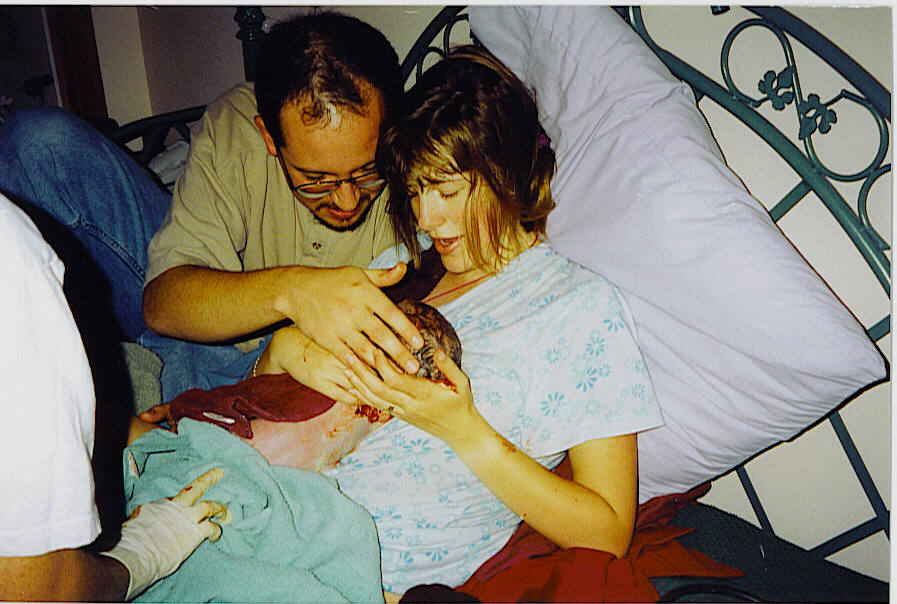
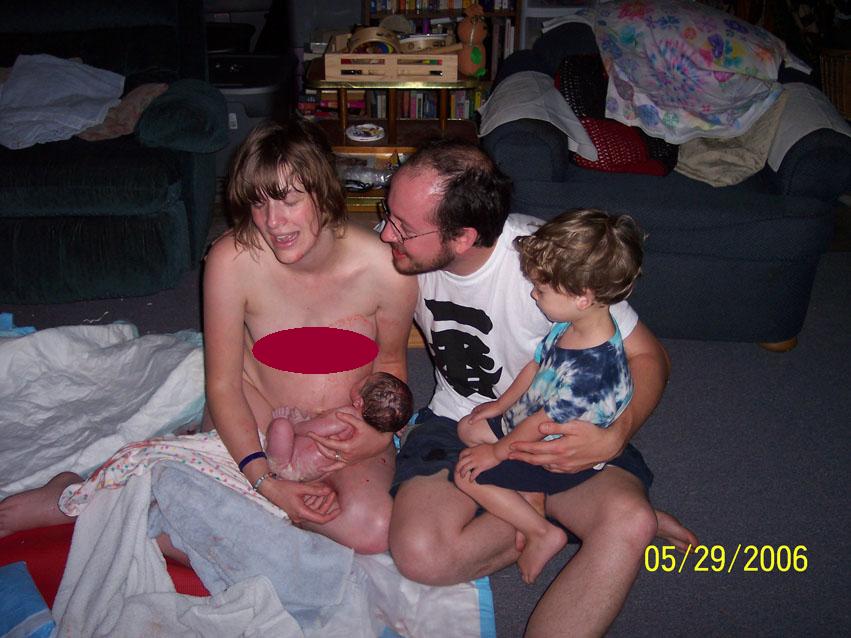
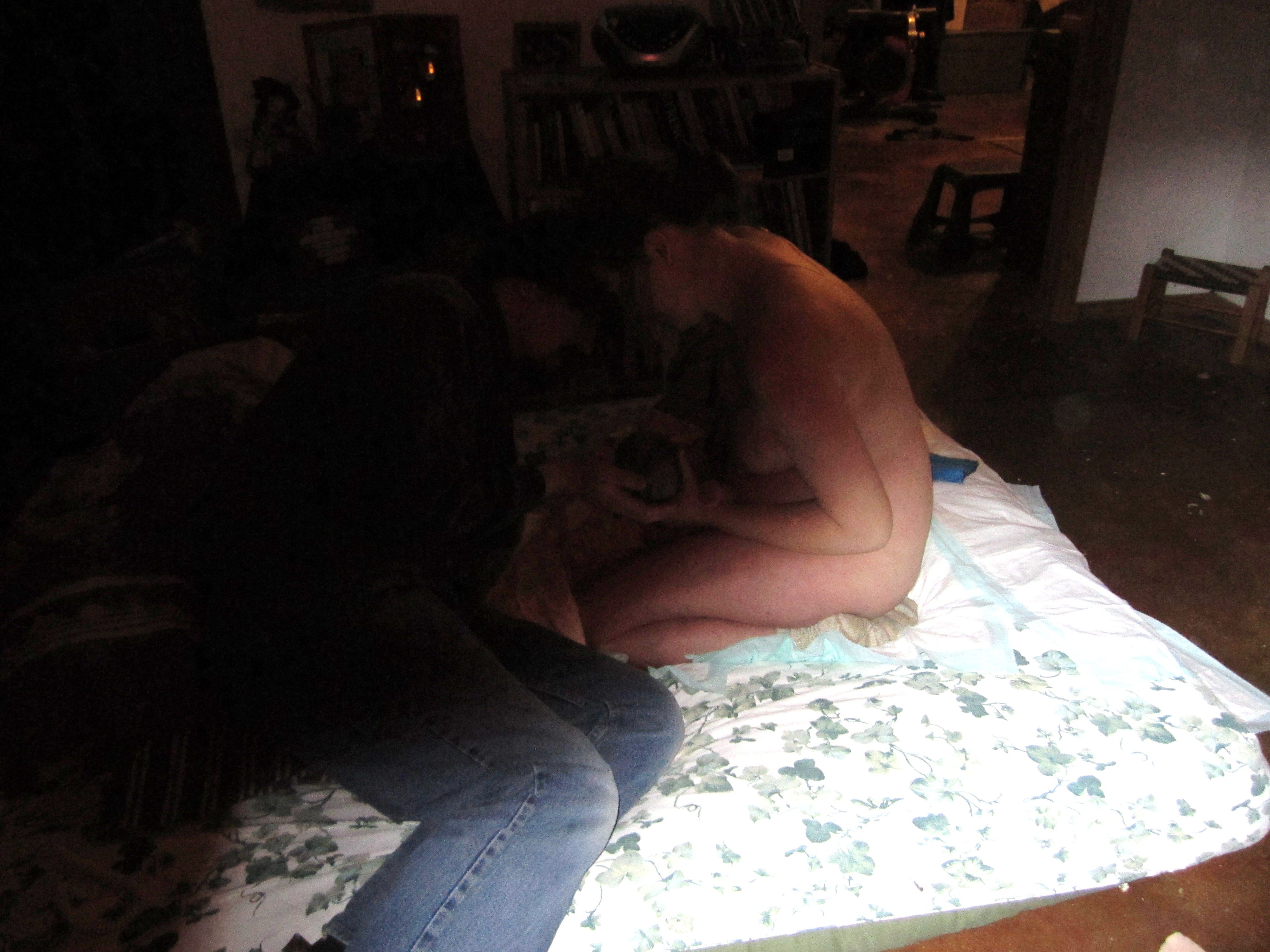
I immediately thought of post-birth pictures of each baby, in this birth pause time:

Immediately after first baby's birth--straight to chest. Main view is of top of his head. Hands tentatively touch/explore.

Immediately after second son's birth. Notice how he's held low down and kind of only with one hand. My eyes are closed and I'm not looking at him yet. In pictures shortly after, I'm looking at him and smiling and I've moved him up to my breast.
(Didn't feel totally comfortable with full breasts shot on my blog, though feel bad to conform to social expectations of appropriateness!)

Immediately after last baby's birth. I know it is dark/hard to see, but note how I'm holding her kind of low down and actually kind of out/away from me (to look at) rather than against my chest.

I actually feel like I see in all of these pictures that birth pause to exhale the birth and then inhale the baby and the mothering of it.

What about you? What was the moment like following the birth of your baby? Did you take a brief pause, a moment to exhale and then inhale? I’d love to hear about it!