Archives

Haumea: The Divine Midwife


“Haumea, a Polynesian Goddess, was credited with teaching women how to give birth by pushing their babies out from between their legs. Before this, folklore claims that children were cut from their wombs, extracted by knife like a pit from ripe fruit. Thanks to Haumea, women were able to forgo this dangerous passage.” –Kris Waldherr, Goddess Inspiration Cards

Reading this, I felt like women need to “meet” Haumea again. Perhaps modern midwives, doulas, and birth educators are Haumeas on earth, reminding women that they have the inherent power and capacity to push their own babies out from between their legs, rather than having major surgery.

After reading about Haumea and thinking about my own births, I felt inspired to make yet another figure in my birth art series. I’m experimenting with new types of figures lately and made this catching-your-own image:


You will safely give birth to something powerful.

Inseparable

Notice how she is holding my finger?

The cutting of the umbilical cord tends to herald the arrival of a new and unique life. Though this tiny being began its existence many months before, growing nestled and protected within the womb, the just-born infant is seen as an individual apart from his or her mother. There is, however, a significant error in this thinking, for baby and mother are one, so to speak, and severing this unit denies an empirical truth. Birth should not be a celebration of separation, but rather a reuniting of mother and baby, who joins her for an external connection. –Barbara Latterner, in the book New Lives [emphasis mine]

I felt like this was a completely relevant quote for our Independence Day weekend. A baby has no concept of the notion of independence. Even though we live in a culture that pushes for independence at young ages, all babies are born hard-wired for connection. For dependence. It is completely biologically appropriate and is the baby’s first and most potent instinct. I remind mothers that after birth your chest literally becomes your new baby’s habitat. Mother’s body is baby’s home—the maternal nest. If the baby cries when you put her down, that means you have a smart baby! Not a “dependent” or “manipulative” one. People are fond of making comments about babies being “spoiled” if they are held often. It is impossible to spoil a baby by responding to her needs (why do people have such an issue with other people holding babies anyway?). I am 100% certain that it is impossible to “spoil” any baby under the age of one by answering her when she cries and giving her what she needs (which at this point is food, warmth, safety, love, and physical closeness). One of LLL’s  pearls of wisdom is, “a baby’s wants are a baby’s needs”—-there is no difference between them at this age. A baby is not “manipulating” you by crying for you to come to her and then stopping when you pick her up—-that is a perfect example of skillful mother-baby communication (if someone says, “she is only crying to get you to pick her up” the answer is “yes! She is! Isn’t she smart!”) .

New Lives is a compilation of essays by NICU nurses and it is no surprise to me that the essay from which the above quote comes was written by a former LLL Leader 🙂

Speaking of LLL, at the last international conference in 2007 I was fortunate enough to hear Dr. Nils Bergman speak about skin-to-skin contact, breastfeeding, and perinatal neuroscience. In super short summary: babies NEED to be with their mothers following birth in order to develop proper neural connections and ensure healthy brain development and proper brain “organization”; Mother’s chest is baby’s natural post-birth “habitat” and is of vital developmental and survival significance; Breastfeeding = Brain wiring.

And, as long as I’m reminiscing about the conference and Dr. Bergman, in fact I actually ended up “performing” on stage with him in a mimed play put on immediately prior to his presentation! He is a dynamic and engaging speaker (with a great accent!) and has so much of value to share. I will never forget hearing his duet with an LLL Leader of the song, “Anything Tech Can Do, Mum Can Do Better.”

Yes she can, yes she can, yes she CAAAANNNNNN!!

Today, let’s celebrate being in dependence with our babies 🙂

Asking the right questions…

A couple of weeks ago a list of sexual assault prevention tips made the rounds on Facebook. Containing reminders such as, “When you see someone walking by themselves, leave them alone” and “Carry a whistle! If you are worried you might assault someone ‘on accident’ you can hand it to the person you are with, so they can blow it if you do,” these tips are absolutely perfect and so very appropriate. I spent several years working in domestic violence shelters answering the hotline. The number one question/comment I used to get from people about this work was, “why doesn’t she just leave?” And, we always used to reply that that is the wrong question, “the question isn’t, ‘why does she stay?’ but ‘Why does HE do it?!'” And, why, as a society, do we accept it? The same website that created the SA Prevention Tips poster, also noted this:

When we talk about rape as something that happens to 1 in 6 women, it is something that happens to women. Oh no, women! You have a problem! A women’s problem! That has to do with women! What are women going to do to solve this problem? Perhaps if we rephrased that as ‘one in…however many…men will commit rape in his lifetime,’ the problem might start to look a little different to certain people.

The wrong questions

Quite a while before this, an article made the rounds about women in another country ironing their pubescent daughters’ breasts flat to try to make them less appealing as rape targets. Many comments on the article were to the effect of, “ugh! What horrible mothers.” Again, entirely the wrong lens with which to be looking. Why is it okay to rape little girls?! Ditto for the news reports of a reporter being sexually harassed by the football team when she went to  interview them—people responded with things like, “she should try dressing professionally.” Um, excuse me? How about the football players—adult, capable men—try acting like professionals? Wrong questions, wrong lens, wrong direction to point the fingers. And, it is because I respect men as people that I give them more credit than this—I believe men are rational and fully capable people who are responsible for their own behavior, not out of control pigs who women are responsible for “taming” and/or not “provoking” (sexually or otherwise). Men are smart, let’s treat them like it by remembering to ask the right questions and to give the right sets of tips.

Of cannibalism & implied social acceptance

These topics remind me of an example I use in the college classes I teach and the questions I encourage my students to ask about all kinds of social services: If we respond to the presence of disturbing social conditions by working primarily to soften the pain they cause, does this imply tolerance for their existence? Our actions do help, but we need to be sensitive to the fact that our limited actions indicate endorsement of, or at least acquiescence to, these conditions that call for all our hurry and scramble. Under the guise of caring we may have reached a point of acceptance of conditions that produce the pain we try to ease…Why are we accepting that children go hungry, that people are homeless, and that women are beaten and raped? Are these conditions that you find acceptable? Are these things just part of the “normal” course of life? I then ask my students to consider cannibalism—what would it be like if rape was as unheard of in our culture as cannibalism? We don’t have “cannibalism survivors support groups” and cannibal hotlines and shelters, because as a whole, our culture does NOT accept cannibalism as a remotely acceptable activity. All of our “services” for sexual assault and domestic violence tell a different story—while these things are “too bad” and “shouldn’t happen,” we’ve accepted that they do and in a way tolerate their existence. I believe we can and should create a world where DV and SA are as unheard of as cannibalism! Usually this example gives students pause. We need to ask bigger social questions that go beyond the individual cases right in front of us.

But what about pregnancy and birth, anyway?

Okay, what does any of this have to do with pregnancy or birth?! Well, in the most recent issue of Brain, Child magazine, I was reading an essay called “Play Parallels” by Dorothy Fortenberry, exploring parallels between her play, Good Egg, and reading What to Expect during her own pregnancy. In it, she makes this fabulous observation:

“I also left my obstetrician. The more I saw him, the less I wanted to talk to him—and if you don’t like chatting with someone, I’ve usually found you also don’t want to have his face in your crotch.”

And how! She then comments on reading an article about how the environment in the womb sets the stage for the baby’s entire life and that mothers are responsible for making this environment as pure as possible–it is in your hands! She also is thinking about the dangers of eating coldcuts during pregnancy, frequently warned about in popular pregnancy books and media: “Hold on, I thought, deep breath. Stop hating yourself and start asking questions. Like: Where was an article about why cities have air pollution in the first place? What about an article about what to do if you want to leave your ob/gyn? Or the headline I would have written: ‘Pregnant Women Routinely Denied Health Insurance, Perhaps a Bigger Deal for Babies Than Tuna‘?…I’d be damned if I paid someone else to make me feel bad about myself. The next time I started to panic, I vowed to put my time and money to helping women with real challenges in pregnancy, and more worrisome things on their plate than sliced turkey.” [emphases mine]

Finally, she describes the book as, “a long, depressing catalogue of all the ways I had already failed my baby” and then concludes, “I saw it as one more way our society puts all of the blame and credit on individual mothers, casually omitting any larger forces like politics, or fate.”

Motherblame

I truly think this is a chronic social issue—motherblame. We MUST look at the larger system when we ask our questions. The fact that we even have to teach birth classes and to help women learn how to navigate the hospital system and to assert their rights to evidence-based care, indicates serious issues that go way beyond the individual. When we say things about women making informed choices or make statements like, “well, it’s her birth” or “it’s not my birth, it’s not my birth,” or wonder why she went to “that doctor” or “that hospital,” we are becoming blind to the sociocultural context in which those birth “choices” are embedded. When we teach women to ask their doctors about maintaining freedom of movement in labor or when we tell them to stay home as long as possible, we are, in a very real sense, endorsing, or at least acquiescing to these conditions in the first place. This isn’t changing the world for women, it is only softening the impact of a broken and oftentimes abusive system.

Alaina’s Complete Birth Story

It has taken me a long time to finish typing up Alaina’s birth story. I wrote it in my journal at 3 days postpartum and the following is almost verbatim. I’ve gone back and forth about what to include and decided to just include everything, as originally written. I feel critical of the story somehow, like it is “choppy.” I used interestingly short, jumpy sentences and while part of me want to smooth it out, another part of me feels like it is more authentic in this format. I also feel like I “should” be posting it on a more significant date—i.e. her six month birthday, or something. But, it is finished now, so I feel like sharing now! Additionally, I thought about taking the self-analysis section about the use of a hypnosis for birth program out of the story, but, indeed, this was the FIRST thing I wrote in my journal, so it seems like it “deserves” to be included as well. It obviously was one of the most important details for me to write about. However, for the purposes of clarity, I moved it to the end of the story in this version. Likewise, I thought about making the section about my newborn- love into a separate post, but because those feelings are so intimately entwined with her birth and because, in my journal, that is exactly the chronology I used—first hypnosis criticism, second birth chronology, third baby love–it feels like it all belongs together in one story. It is funny how that first story has such value to me and that it feels almost wrong to edit, change, or add anything to it. It feels most honest this way.

The Birth of Alaina Diana Remer
January 19, 2011
11:15 a.m.
7lbs, 8oz; 20 inches.
Short version of her story is here and labor pictures are here.

I had a restless, up and down night, getting up at 3:00 a.m. and even checked in with my online class. Mark got up with me and we talked and speculated. Waves were four minutes apart and then kind of dissipated unenthusiastically away. He went back to bed at 4:00 and I listened to Hypnobabies. At 6:00, I was feeling trapped lying down and got up. Mark got up then too and worked in the kitchen on the dishes and things like that, while I walked around and leaned on the half wall during contractions (a lot. It was the perfect height). Sitting down in a chair caused horribleness, leaning forward on the ½ wall was good. Called Mom and told her to be on standby and to notify my blessingway crew. Also, called Summer (doula/friend) to be on alert. Felt serious, but not totally. Also was having back involvement which each wave. I felt like I would have a real contraction and then a closely following, but milder, back-only contraction (no tightness in uterus really during these, but definitely a wave-like progression and then ease of sensation).

I was very quiet during most waves until the end. I think because I was doing the Hypnobabies and was concentrating on that. Then, I would talk and analyze and be very normal in between. This pattern seemed to lead to a decreased perception of seriousness from others of my need for attention—Mark washed dishes, went outside to take care of chickens, work on fire, feed cats and so forth. The boys woke up at 7:00 a.m. and as soon as they came out and started talking to me (Mark was outside), I knew they needed to go elsewhere. We called my mom at 7:30ish and she came to get them. I did not want to feel watched or observed at all, so asked her to wait to come back.

I kept waiting for the “action” to increase and feeling distressed that it was taking such a “long” time. I suggested to the baby that she come out by 10:00. I continued to stand in the kitchen and lean on the ½ wall, sometimes the table or the bathroom counter. Dismayed to see no blood/mucous, nothing indicating any “progress.” Significant feelings of pressure and pain in lower back continued and at the time felt normal to me, but looking back seems like an extra dose of back involvement. In another intensity-increasing experience, the baby moved during contractions for the entire labor until the contraction before I pushed her out. She moved, wiggled and pushed out with her bottom and body during each contraction, which really added a new layer of intensity that was difficult. I was, however, glad she was moving because then I knew she was okay, without doing any heart checks.

I went into the living room, very tired from bad sleep during the night. We set up the birth ball in the living room so I could sit on it and drape over pillows piled onto the couch. I spent a long time like this. Mark sat close and would lightly and perfectly stroke my back. Continued to use Hypnobabies—finger-drop, peace and release, with most waves.

Mark fixed me chlorophyll to drink and I barfed it up immediately and horribly. Called Mom to come back and 9:00 or so, at which point I finally had a little blood in my underwear. Kept up my ball by the couch routine and moved into humming with each wave. Also did some contractions on the floor leaning over the ball. Also good.

On the ball, I began to feel some rectal pressure with each wave. However, I felt like the waves were erratic still, with some very long and intense and then smaller ones. Hums began to become oooohs and aaaaahs and I began to feel like there was a bit of an umph at the end of the oooooh. Went back to the bathroom and there was quite a bit more blood (plus mucous string) and I started to fret about placental abruptions and so forth. Left the bathroom analyzing how much blood is too much blood and began to critique myself for being too “in my head” and analytical and not letting my “monkey do it.” Said I still didn’t feel like I was in “birth brain” and wondered if that meant I still had a long time to go. Started to feel concerned that I was still early on. This is a common feature of all of my births and is how the self-doubt signpost manifests for me. Rather than thinking I can’t do it, I start thinking I’m two centimeters dilated.

I almost immediately returned to the bathroom feeling like I needed to poop. Serious contractions on toilet produced more pressure with associated umphs at the end. At some point in the bathroom, I said, “I think this is pushing.” I was feeling desperate for my water to break. It felt like it was in the way and holding things up. I reached my hand down and thought I felt squooshy sac-ish feeling, but Mom and Mark looked and could not see anything. And, it still didn’t break. Mom mentioned that I should probably go to my birth nest in order to avoid having the baby on the toilet. My birth nest was a futon stack near the bathroom door. I got down on hands and knees after feeling like I might not make it all the way to the futons. Felt like I wanted to kneel on hard floor before reaching the nest.

Suddenly became obsessed with checking her heartbeat. I knew you’re supposed to do so during pushing and I had stopped feeling her moving painfully with each contraction. I couldn’t find her heartbeat and started to feel a little panicky about that as well as really uncomfortable and then threw the Doppler to the side saying, “forget it!” because big pushing was coming. I was down on hands and knees and then moved partially up on one hand in order to put my other hand down to feel what was happening. Could feel squishiness and water finally broke (not much, just a small trickle before her head). I could feel her head with my fingers and began to feel familiar sensation of front-burning. I said, “stretchy, stretchy, stretchy, stretchy,” the phone rang, her head pushed and pushed itself down as I continued to support myself with my hand and I moved up onto my knees, with them spread apart so I was almost sitting on my heels and her whole body and a whole bunch of fluid blooshed out into my hands. She was pink and warm and slippery and crying instantly—quite a lot of crying, actually. I said, “you’re alive, you’re alive! I did it! There’s nothing wrong with me!” and I kissed her and cried and laughed and was amazed. I felt an intense feeling of relief. Of survival. I didn’t realize until some moments later than both Mark and Mom missed the actual moment of her birth. Mark because he was coming around from behind me to the front of me when I moved up to kneeling. My mom because she went to stop the phone from ringing. I had felt like the pushing went on for a “long” time, but Mark said that from hands and knees to kneeling with baby in my hands was about 12 seconds. I don’t know. Inner experience is different than outer observation. What I do know is that the moment of catching my own daughter in my hands and bringing her warm, fresh body up into my arms was the most powerful and potent moment of my life.

I was covered in blood again. Caked in my fingernails and toenails and on the bottoms of my feet again. And, I did tear again, same places.

I feel the moment of her birth was an authentic “fetal ejection reflex” including the forward movement of my hips. The immediate postpartum went exactly as I had planned. Summer arrived approximately 20 minutes after Alaina was born. She brought me snacks, wiped blood off of me, and served me a tiny bit of placenta (which I swallowed with no problem!). My midwife arrived approximately 40 minutes post-birth and assessed blood loss and helped with placenta. She said I lost about 3 cups of blood, but I think all of the fluid that came out with the baby, plus the blood from the tears, may have bumped the estimate up too high. I did not feel weak or tired like I’d lost too much blood, I felt energetic and really good, actually. I didn’t get faint in the bathroom either and my color stayed good throughout. “Don’t look down” (while using the bathroom) is an excellent plan for me!

My post-birth feelings were different this time. I feel more baby-centered in my feelings about it rather than self-empowerment centered. I also feel more critical in my own self assessment this time—like I didn’t “perform” well or handle myself well. I hypothesize that this may be related to using a hypnosis for birth program, because I didn’t feel “calm and comfortable” on the inside. On the outside I think I looked it, but my internal experience involved more “should” than I like. The hypnosis philosophy wasn’t really a match with my own lived experience of birth. Birth isn’t calm, quiet, and comfortable and I don’t actually think it should be or that I want it to be. However, I was trying to make it so and thus not using some of my own internal resources. I felt more mind/body disconnect than I have before also, perhaps because I was trying to use a mind (“control”) based method on such an embodied process. Anyway, it was good for relaxing during pregnancy, personally not so good for behaving instinctually in labor. I did use it though and technically I guess it “worked” because Mom and Mark couldn’t read where I was in birthing and though I was very calm. It didn’t feel calm inside though, it felt HARD. I also was very stuck—almost in a competitive-feeling way—on thinking it was going to be fast and feeling stressed/concerned that it wasn’t.

I also want to include this segment from my journal, written when she was three days old:

She is so wonderful and amazing and beautiful and perfect and I just want to etch these days into my mind forever and never forget a single, precious, beautiful, irreplaceable moment. I want to write everything down to try to preserve each second of these first few days with baby Alaina—my treasure, my BABY! The one I hoped for and feared for and worked SO HARD to bring to this world (in pregnancy more so than in birth). I can’t really though—I am here, now. Living this, feeling this, knowing this. The newborn haze is my reality in these moments, but it will pass away and the best thing to do is to fully live it. To feel it and to be here—without struggling to preserve it all. It is here in my heart and soul and preserved in the eddies and ripples of time. The unfolding, continuous ribbon of life and experiences. I have a weird, petrified feeling of forgetting—i.e. when I’m 89 will I still remember how this FELT?!

What do I want to remember?

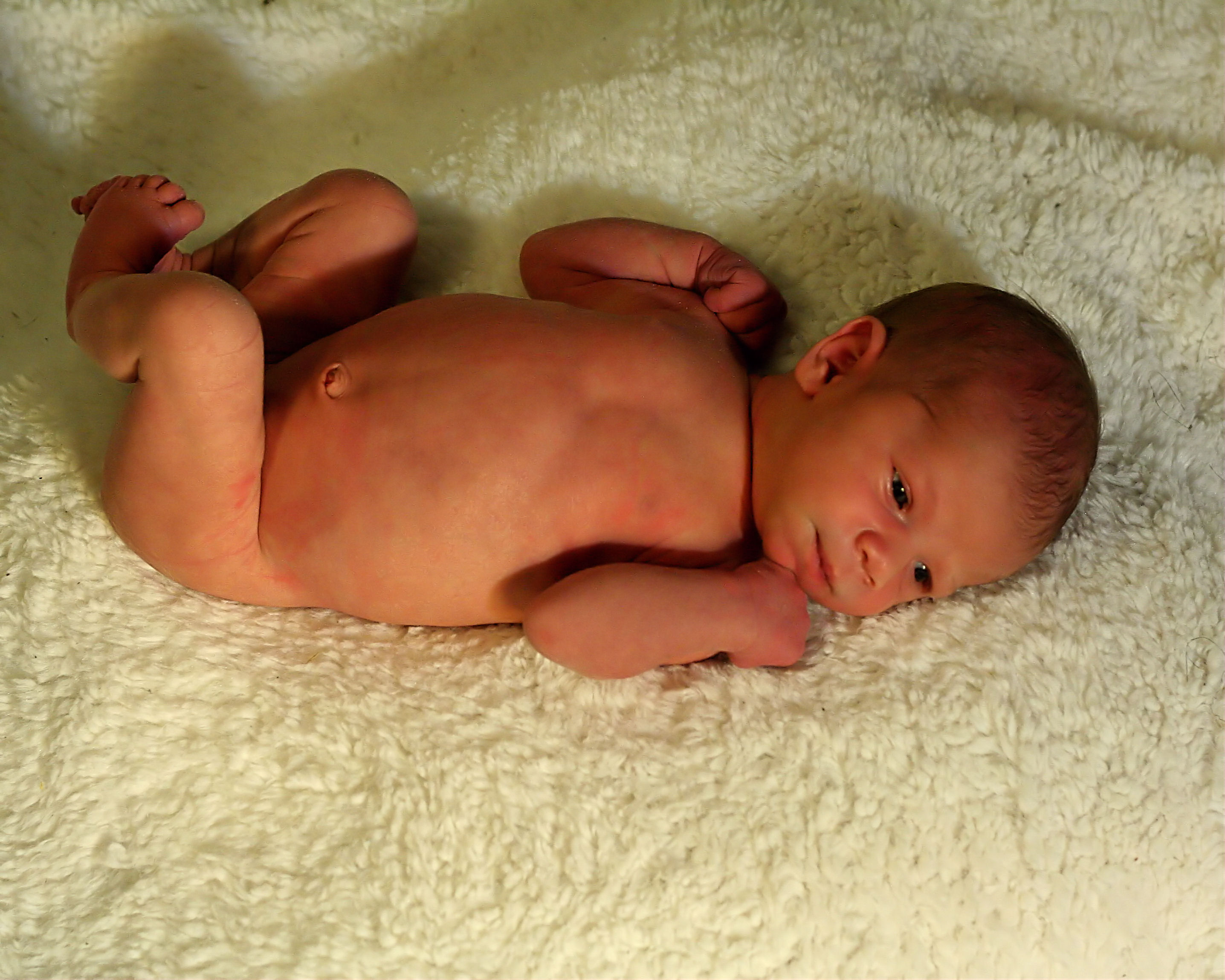
Newborn photo (c) Sincerely Yours Photography

Alaina newborn photo (c) Sincerely Yours Photography

    • The scrunchy feel of a newborn’s body.
    • The little mewing squeaks and sighs
    • How she is comforted by my voice and turns to me with a smacky, nursie face…
    • The soft, soft skin
    • The soft, soft hair
    • The fuzzy ears and arms
    • The little legs that pull up into reflexive, fetal position.
    • The utter, utter, MARVEL that I grew her and that she’s here. That she came from me. That sense of magic and wonder and disbelief when I look over and see her lying next to me—how did YOU get here?!
    • The miraculous transition from belly to baby. From pregnant woman to motherbaby unit? How does it happen? It is indescribably awesome.
  • The sleeping profile
  • The scrunchy face
  • The “wheeling” half coordinated movements of arms and legs—sort of “swimming” in air.
  • The peace of snuggling her against my chest and neck.
  • The tiny, skinny feet.
  • Putting my hand on her back and feeling her breathe, just like in utero

I was still scared she was going to die until the moment I held her.

Molly & Alaina newborn photo (c) Sincerely Yours Photography

Birth Altar Wisdom

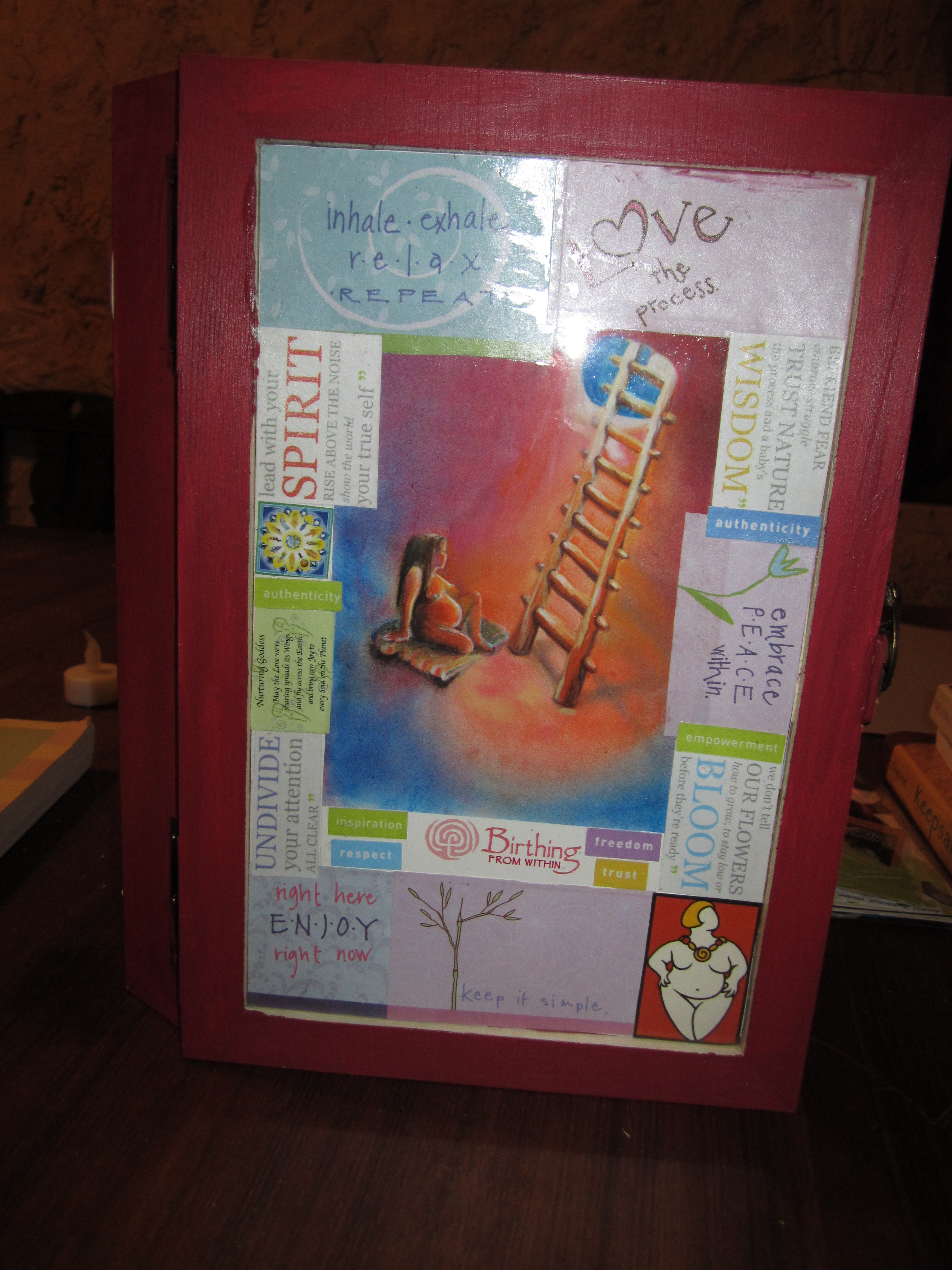
I am preparing to paint a birth altar cabinet for a friend’s upcoming blessingway ceremony. I have felt the urge for some time to share a post about the words that I included on the birth altar that I created for myself before my last birth. Some elements included were from pages of a cheapy page-a-day calendar from the $1 Shop and some were parts of a t-shirt tag from the tag on a shirt I purchased from WYSH at an LLL conference in 2009 (why keep a t-shirt tag from 2009, you might ask? Because it had lots of cool things written on it! And, behold, it became a source of birth altar wisdom for me. Wisdom lurks in unexpected places!)

I am struck by how these words from unconventional locations apply so perfectly to giving birth. Here’s what the little cards and snippets I included say:

From the calendar:

Inhale * Exhale * Relax * Repeat

LOVE the process.

Embrace peace within.

Keep it simple.

Right here

ENJOY

Right now

From the t-shirt tag:

Befriend fear, embrace struggle, trust nature, the process, and a baby’s wisdom (I swear, this shirt had NOTHING to do with giving birth!)

We don’t tell our flowers how to grow, to stay low or bloom before they’re ready.

Undivide your attention. All clear.

Lead with your spirit, rise above the noise, show the world your true self.

Also from the tag were individual words that I included: freedom. trust. inspiration. respect. authenticity. empowerment.

And, then I cut the following from a tag on a pendant from my husband:

May the Love we’re

sharing spread its Wings

and fly across the Earth

and bring new Joy to

every Soul on the Planet.


Updating My Birth Quotes!

(c) K Orozco

Baby Alaina, 3.5 months, taken at the park by my friend Karen 🙂

“Blessed be all the mothers of mothers.
Blessed be all the daughters of daughters.
Blessed be all the daughters of mothers.
Blessed be all the mothers of daughters.
Now and forever, wherever we are.” –Diann L. Neu

“I have almost given up on the government and the country but I have not given up on birth. I believe rabidly. It is not enough to hold the space for one woman at a time. Peace on earth begins with birth.” –Arielle Greenberg/Rachel Zucker (in Home/Birth: A Poemic)

“In giving birth my attention was pulled inside forcibly by something naturally wild, hot, raw and primitive—something so powerful that my only choice was to surrender.” –Kristin Luce

“Now I see the secret of making the best person: it is to grow in the open air and to eat and sleep with the earth.” ~ Walt Whitman

“A new baby is like the beginning of all things–wonder, hope, a dream of possibilities.” ~ Eda J. Le Shan

“Birth isn’t something we suffer, but something we actively do and exult in.” –Sheila Kitzinger (from promo for new One World Birth film)

“Many women have described their experiences of childbirth as being associated with a spiritual uplifting, the power of which they have never previously been aware … To such a woman childbirth is a monument of joy within her memory. She turns to it in thought to seek again an ecstasy which passed too soon.” ~ Grantly Dick-Read (Childbirth Without Fear)

“Childbirth isn’t something that is done to you, or for you; it is something you do yourself. Women give birth. Doctors, hospitals and nurses don’t.” ~ Lester Dessez Hazell

“Whether she chooses to birth at home, a hospital or a birth center, it is the right–in fact, the responsibility–of every woman to plan her own baby’s birth with the information, honor and freedom to which she is entitled.” –Cynthia Overgard (in Pathways to Family Wellness Magazine)

Life, love, and laughter – what priceless gifts to give our children. — Phylis Campbell Dryden

“A mother’s joy begins when new life is stirring inside… when a tiny heartbeat is heard for the very first time, and a playful kick reminds her that she is never alone.” ~Author Unknown

“Growing, bearing, mothering, or fathering, supporting, and at last letting go…are powerful and mundane creative acts that rapturously suck up whole chunks of life.” –Louise Erdrich

“Perhaps we owe some of our most moving literature to men who didn’t understand that they wanted to be women nursing babies.” –Louise Erdrich

“Labor is about finding your threshold and learning you can go beyond it.” –Rose St. John

“…the labor with which we give birth is simply a rehearsal for something we mothers must do over and over: turn ourselves inside out, and then let go.” –Susan Piver (Joyful Birth)

“The minute my child was born, I was reborn as a feminist. It’s so incredible what women can do…Birthing naturally, as most women do around the globe, is a superhuman act. You leave behind the comforts of being human and plunge back into being an animal…” –Ani DiFranco

“The health of mothers, infants, and children is of critical importance, both as a reflection of the current health status of a large segment of the U.S. population and as a predictor of the health of the next generation.” –Healthy People, 2010

“The miraculous nature inherent in the unfolding of a flower is the very same that moves through a woman as she gives life to the world. We can neither control nor improve upon it, only trust it.” -Robin Sale

“Loving, knowing, and respecting our bodies is a powerful and invincible act of rebellion in this society.” –Inga Muscio

“A new baby’s fresh milk smell causes the mother’s heart to spill over.” -Melanie Lofland Gendron

“…childbirth is much like a marathon…marathon runners know how to breathe, to run, and to complete their race according to their own body signals. Similarly, women know how to breathe, to birth, and to complete the [birth] according to their own body signals. Marathon runners who are true champions are free to stop the fast pace, and even quit the race without loss of integrity.” –Claudia Panuthos

“Birth, like love, is an energy and a process, happening within a relationship. Both unfold with their own timing, with a uniqueness that can never be anticipated, with a power that can never be controlled, but with an exquisite mystery to be appreciated.” –Elizabeth Noble

“…all those tasks and interactions of motherhood, a day full of which might make you feel you’ve ‘gotten nothing done’ because you’ve been in the cycle of care, are the heart and soul of the best brain building possible.” –Lauren Lindsey Porter (Attachment Theory in Everyday Life, in Mothering magazine, 2009)

“The lure of the distant and the difficult is deceptive. The great opportunity is where you are. Do not despise your own place and hour. Every place is under the stars, every place is the center of the world.” –John Burroughs

“Motherhood has a very humanizing effect. Everything gets reduced to essentials.” ~ Meryl Streep (via Midwifery Today)

“It is not ‘ladylike’ to give birth. The strength and power of labor is not demure.” –Rhonda (midwife quoted in Gayle Peterson’s An Easier Childbirth Book)

What we have once enjoyed we can never lose. All that we love deeply becomes a part of us.” —Helen Keller

“The greatest teachers we have are the women we serve.” –Jan Tritten

“…undisturbed (not neglected or abandoned) birth is a powerful initiation into motherhood, not only in a physical and physiological sense, but also in an emotional and spiritual sense.” –Christina Hurst-Prager (in (ICEA) International Childbirth Education Association‘s journal)

“Never hire a midwife who is afraid your birth will go wrong.” –Arielle Greenberg/Rachel Zucker, Home/Birth: A Poemic

“It is dangerous to be right on a subject on which the established authorities are wrong.” –Bumper sticker quoted in the book Home/Birth: A Poemic

“Women today not only possess genetic memory of birth from a thousand generations of women, but they are also assailed from every direction by information and misinformation about birth.” ~ Valerie El Halta

“I see generations of women bearing a flame. It has been hidden, buried deep within, yet they hand it down from generation to generation still burning. It is a gift of fire, transported from a remote and distant world, yet never extinguished.” –Kim Chernin

“Birth is as vast and voluminous, as unfathomable and inevitable as the rising and setting of the sun. And true to the inexorable power and rhythm of their life-giving bodies, women will continue to birth with dignity, grace and courage.” –Mandala Mom

“I pity the folks at ACOG who think they can make protocols, rules and guidelines that will cover all births in all situations. A better goal would be to have clinicians who can think for themselves, distinguish complications from normal birth, relax when things are taking a while, and marvel over the consistently fascinating process of human birth” -Gloria Lemay in Pathways to Family Wellness Magazine

“A pair of substantial mammary glands have the advantage over the two hemispheres of the most learned professor’s brain in the art of compounding a nutritive fluid for infants.” ~Chief Justice Oliver Wendell Holmes (1809-1894)

“The energy that can rise in real connection is the stuff of revolution.” –Carol Lee Flinders

“A woman meets herself in childbirth” –Cynthia Caillagh

“I believe that these circles of women around us weave invisible nets of love that carry us when we’re weak and sing with us when we’re strong.” –SARK, Succulent Wild Woman

“Don’t ask what the world needs. Ask what makes you come alive, and go do it. Because what the world needs is people who have come alive.” –Howard Thurman

“If ever the world sees a time when women shall come together purely and simply for the benefit of humanity it will be a power such as the world has never known.” –Matthew Arnold

“Authority without wisdom is like a heavy ax without an edge: fitter to bruise than polish.” ~ Anne Bradstreet (Feeling frustrated with anti-midwifery legislators in Missouri and then this quote came along from Midwifery Today’s e-news and I thought it was quite fitting)

The midwife teacher’s first concern is to preserve the students fragile unborn thoughts, to see that they are born with their truths intact, that these truths do not turn into acceptable lies” — from the book Women’s Ways of Knowing (shared by a participant in the Birth Workers and Beyond group)

“…we do not have humanized birth in many places today…Why? Because fish can’t see the water they swim in. Birth attendants, be they doctors, midwives or nurses, who have experienced only hospital based…medicalised birth cannot see the profound effect their interventions are having on the birth. [They] have no idea what a birth looks like without all the interventions, a birth which is not dehumanized.” –Marsden Wagner

Childbirth is a rite of passage so intense physically, psychologically, emotionally, spiritually, that most other events in a woman’s life pale next to it. In our modern lives, there are few remaining rituals of initiation, few events that challenge a person’s mettle down to the very core. Childbirth remains a primary initiatory rite for a woman.” –from the book MotherMysteries

“The holistic model holds that birth is a normal, woman-centered process in which mind and body are one and that, in the vast majority of cases, nature is sufficient to create a healthy pregnancy and birth. The midwife is seen as a nurturer.” –Penfield Chester (midwife)

“Birth, like love, is an energy and a process, happening within a relationship. Both unfold with their own timing, with a uniqueness that can never be anticipated, with a power that can never be controlled, but with an exquisite mystery to be appreciated.” –Elizabeth Noble

“If there is ever a part of human anatomy that resembles the image of God it is the uterus.” –Reverend Darren Cushman-Wood

(I hesitated to share this quote because I thought it could be viewed as disrespectful [or even sacrilegious!] by some. But, it caught my eye in an article called Pharaohs and Kentuckians in a 1997 issue of Mothering magazine. Written by a pastor of a Methodist church about homebirth and spirituality 🙂

Modern culture often teaches us to be ‘tight’…trim, taut, & terrific…We understand the need to stay ‘fit’…but we would also like to encourage you to soften yourself, in preparation for mothering & nurturing your baby. Soften your viewpoint, soften your body, surrender to this awe-inspiring event…in this way, you will be preparing yourself not only for labour, but for the days & years afterward…” -The Pink Kit Method For Birthing Better®

“Love is such a powerful force. It’s there for everyone to embrace—that kind of unconditional love for all of humankind. That is the kind of love that impels people to go into the community and try to change conditions for others, to take risks for what they believe in.” —Coretta Scott King

Nurturing is not a genetically feminine attribute. Tears and laughter are not the province of women only. The last time I looked, men had tear ducts. They had arms for holding babies. They cared about their children. And they cried at births…let the shared experience of childbirth reclaim the human soul.” –Ariska Razak (midwife and healer)

“When my kids become wild and unruly, I use a nice, safe playpen. When they’re finished, I climb out.” ~Erma Bombeck (via Moby® Wrap)

The Spot

“Can I ask you a personal question?” asks the woman on the phone. She is calling to inquire about my birth classes and the subject of homebirth has come up.

“Sure!”

“What about the mess?”

At first I give the standard answer. That birth isn’t so terribly messy, that you can put down towels and chux pads, that the midwife often does the cleanup. I pause a moment. This prospective client and I have an instant connection and excellent rapport. I add, “Actually, I left a huge blood spot on our living room carpet.” I add that the spot came out almost completely with peroxide, but can’t stop myself from also remarking, “I actually feel kind of proud of it—it felt like a symbol to me.” I find myself laughing a little and there is an unmistakable note of triumph in my voice.

“Of what?”

“That I did it. Gave birth in my own home, in my own living room, on my own terms, under my own power, in my own way. In the way that felt best and right and safest to me. On my own. Me. I did it.”

What I did not add—what would have been pushing it just a little too far—is that when we moved the peroxide-cleaned carpet square into our new home a large, round, rusty-red stain was revealed on the concrete floor beneath. And, that I take secret delight in its presence. I am proud that I left my mark on the floor that bore witness to my labor. I delight and actually revel in the reminder of my power that the stain represents. Is this total weirdness? Or freakishness? A type of maternal masochism or even a perversion? No, I decide. It is really not so different from keeping a football trophy from high school or an award for volunteerism in human services from college. Maybe there is a medal for natural childbirth after all—arriving in different surprising guises, one kind a blotchy reddish stain on a concrete floor.

Despite our easy camaraderie, I never hear from that prospective client again.

Those who critique the zealousness of birth activists sometimes accuse us of supporting an insidious “Cult of Natural Childbirth” and assert that we undermine women and their unique and often traumatic experiences by “insisting” that birth be an empowering and triumphant event for women.

Maybe there actually is a Cult of Natural Childbirth and I am an acolyte of Birth cackling with wild glee as I caper around my bloodstained floor….

Nursing my brand new baby boy! (2006)

———

In the original article, I included a post-birth picture from my second son’s birth that showed one completely exposed breast. I must have still been hopped up on the post-birth euphoria when I sent it, because after it was actually published I felt slightly horrified to have my boob in print and didn’t feel like I could show the article to my dad (or, really, to many other people!) If you look closely at the picture I substituted in this blog post, you can see there is blood streaked all over my chest, arms, and hands. It was a very bloody birth!

—————————————————————————————————————–

This is a preprint of The Spot, an essay by Molly Remer, MSW, ICCE, published in Midwifery Today, Issue 86, Summer 2008. Copyright © 2008 Midwifery Today. Midwifery Today’s website is located at: http://www.midwiferytoday.com/

The “Almost Died…” Remark

?

Anyone who has planned a homebirth has probably heard the, “If I’d had my baby at home, I would have died” remark more times than they can count. It seems to be almost a default response to mentions of homebirth. I used to have a pet peeve about this, because I was almost certain that most of time the people saying it had been nowhere close to death! It seemed like an overly dramatic, overreaction to a normal life process, etc., etc. And, also that we’ve been so brainwashed by the media into thinking birth is this life or death emergency that that filter then artificially colors our perceptions of events and dramatically affects our social lexicon of birth. (However, I also have the companion thought that in many countries, birth does remain a life or death experience for women and babies. Maternal and infant mortality are significant issues and are not subjects to be taken lightly. And, mothers and babies in the U.S. do, in fact, die sometimes. It isn’t just a third-world country thing!) Another statement that used to confuse me was when birth writers say things about giving birth bringing you to the, “edge between life and death.” This didn’t match my own to-that-date birth experiences, which had not ever involved feeling like dying.

So, these things said, it has been very, very difficult for me to write about my own feelings of being close to death following the miscarriage-birth of my third son in November 2009. I really, truly felt like I might be going to die after he was born. I have never felt that close before, but I reached that “edge” after him, and I had the visceral experience of the veil between life and death being very, very thin. And, the feeling did not occur in a scary way, but in a resigned, “oh, so this is how it is going to end, too bad I still had so much I want to do with my life!” kind of way. I felt okay with it actually. A type of acceptance that my time was over. Since everything turned out okay in the end, I haven’t had much reason to process that feeling, but it was very, very intense. And, actually it was also life-changing in several areas of my life, including in terms of my spirituality (I semi-joke that my miscarriage-birth was a “religious experience” for me, but truly, in a way it was). However, I can hardly manage to write about it. And, looking back, I remain amazed that it was humanly possible to bleed as much as I did, especially because at that point early in a second trimester pregnancy I didn’t have the whole 50% increase in blood volume that you have by full-term!

I think I don’t talk much about my own “almost died” experience because obviously, in hindsight, I wasn’t almost dying (since I didn’t), I just felt like I was going to. But, this is the key…the fact that I wasn’t truly dying doesn’t mean that I didn’t truly feel as if I was—and, genuinely so, not in just an irrational fear-planted-by-the-media way. This has given me new insight into the “almost died” remark that seems dished out so casually. I used to think it was primarily a risk-based/skewed/brainwashed attitude, rather than an emotional thing, but I have an understanding now that it more often probably represents how she felt (or perceived the situation) and that her feeling really matters. It was real. And, I now hear and honor that feeling (rather than secretly thinking “yeah, right!”), because the feeling was real. And, that means, to her, she really did “almost die.”

I’ve also come to realize that despite the many amazing and wonderful, profound and magical things about birth, the experience of giving birth is very likely to take some kind of toll on a woman—whether her body, mind, or emotions. There is usually some type of “price” to be paid for each and every birth and sometimes the price is very high. This is, I guess, what qualifies, birth as such an intense, initiatory rite for women. It is most definitely a transformative event and transformation does not usually come without some degree of challenge. Sometimes to be triumphed over or overcome, but something that also leaves permanent marks. Sometimes those marks are literal and sometimes they are emotional and sometimes they are truly beautiful, but we all earn some of them, somewhere along the line. And, I also think that by glossing over the marks, the figurative or literal scars birth can leave on us, and talking about only the “sunny side” we can deny or hide the full impact of our journeys.

During Pam England’s presentation about birth stories at the ICAN conference, she said that the place “where you were the most wounded—the place where the meat was chewed off your bones, becomes the seat of your most powerful medicine and the place where you can reach someone where no one else can.

ICAN Conference Thoughts

This past weekend, I attended the ICAN conference in St. Louis. I was really excited that the conference was in my own back yard (well, two hours from my back yard). I enjoyed seeing lots of people that I know from Friends of Missouri Midwives as well as other friends and contacts from other organizations. And, I got to meet some people in real life (like Jill from the Unnecesarean), who I previously only “knew” online. I also bought myself a pretty awesome new ring from the MANA booth (and a t-shirt and a bumper sticker!).

In addition to these things, highlights of the conference for me were:

  • Hearing Pam England speak and getting to meet her after so many years of being a fan of Birthing from Within. I will write another post soon about her “9 Birth Story Gates” presentation. It was very good.
  • Taking Amy Swagman’s birth art workshop (Amy is the Mandala Journey artist and was someone else that I enjoyed meeting in person after only “knowing” online). I will write about this soon as well.
  • Seeing the amazing breech birth videos shared by Gail Tully of Spinning Babies in her presentation about breech birth.
  • Connecting with another mother during the sand tray art therapy workshop presented by Maria Carella. Though our birth experiences were different, our “processing” of them during the workshop was amazingly similar. More about this later too.

The main reason I wanted to post tonight though was to share my experience in visiting the “Our Voices” room at the conference. This room is a safe, quiet place—a place of silence—in which women can go to to contribute their feelings about their cesareans to the wall displays. They can take their contributions home with them when they leave, or leave them up to be re-installed in the next Our Voices room at the next conference. Every wall in the room, plus the doors and several tables, was covered with women’s words and feelings about their cesarean experiences, subsequent births, VBAC, etc. It is difficult to put into words how potent of an experience visiting this room was. I was not expecting to be moved to tears by it, but I was. It was extraordinary. And, painful. There were other women in the room crying and crying as they composed their additions to the wall, as well as other women walking quietly through and looking and reading. I originally intended to add to the wall—I was told that it was not necessary to have had a cesarean myself in order to add something—but after seeing the room and the women in it, I did not feel “worthy” (so to speak!) of adding to it. It wasn’t my space. It was something I was privileged to witness, but I did not feel it was appropriate to add my own words to these women’s pain and expressive space. I felt like anything I could say would be trite somehow, almost insulting, to the depth of feeling expressed on the walls. Sometimes you really do have to have “been there” in order to fully recognize the experience of another. And, while I can certainly empathize and feel deep compassion, cesarean birth has not been my own personal journey and it just felt like it would be rude almost, to claim enough understanding of it to write on this wall.

This experience also taught me that I am not meant to start an ICAN chapter. I really think our area could use one and I love the work that ICAN does and I had signed up to start a chapter (before coming to my senses and realizing that I am overcommitted to too many projects/organizations right now as it is), but after visiting the Our Voices room, I realized that I am not the appropriate person to lead one. I just can’t really get it even though I can “see” other women and honor their experiences.

I’ve noted before that I feel like my experiences with pregnancy loss opened my heart more fully to the full range of birth loss (which  includes many women’s feelings about their cesareans) and birth/pregnancy trauma. Before loss, I only saw the “pretty” side of birth. Well, not pretty, exactly, but the empowering and triumphant and exciting side. After my birth-miscarriage, my world was opened to the wider world of birth experiences and feelings. I feel like there are—somewhat surprising—parallels between pregnancy loss and  the loss of a vaginal birth women experience with cesarean, but it is also different and the Our Voices room at the conference was a sacred space for those with cesarean experiences. It was both humbling and moving to hear their voices in this way.

There are pictures of the room and the contributions at the ICAN Conference Facebook page.

Happy Birth Dance

“Birth is a creative process, not a surgical procedure. I picture dancers on a stage. Once, doing a pirouette, a woman sustained a cervical fracture as result of a fall; she is not paralyzed. We try to make the stage safer, to have the dancers better prepared. But can a dancer wear a collar around her neck, just in case she falls? The presence of the collar will inhibit her free motion. We cannot say to her, ‘this will be entirely natural except for the brace on your neck, just in case.’ It cannot be ‘as if’ it is not there because we know that creative movement and creative expression cannot exist with those constraints. The dancer cannot dance with the brace on. In the same way the birthing woman cannot ‘dance’ with a brace on. The straps around her abdomen, the wires coming from her vagina, change her birth.” –Dr. Michelle Harrison

Present from my husband after my daughter's birth

I woke up this morning thinking about this quote. I’ve shared it on my blog before, but that was in 2008 and so it has been lost in the shuffle of other posts (and many, many quotes!) since then. My ongoing thought process actually didn’t have much to do with the quote, though my recent labor pictures post illustrates the idea of freedom of movement throughout labor according to my own body’s messages, rather than assisted with anything else.  However, thinking of dancing and birth made me think of the pendant my husband gave me following the birth of our daughter. He actually gave it to me for Christmas first, but since he gave me four other pendants for presents, I gave this one back to him and told him to save it for a post-baby present! Given how I then felt after birthing her, it felt like a perfect present. I love how this exuberant goddess is dancing for joy. And, how her upswept arms form a heart-like shape. I was so happy to have MY BABY. When I wear this pendant, I remember that feeling of relief and happiness after giving birth to her. Every night when I look down and see her there in my arms I feel lucky and also this continued sense of surprise, almost, to have her here with me. It all seems so magic.

I was talking to my husband about this last night (well, quietly croaking, since I’ve had laryngitis for several days) while on our nightly walk. We’d noticed that Noah’s tulip tree actually bloomed! I told him I hadn’t been sure it would actually survive (clear parallels here), but look, now here we are and look at this baby who is here with us while the flowers bloom. We looked quietly for a minute and then I said, “remember how we almost decided not to try again?” I feel like it was brave to try again. I was brave.


Noah's tree bloomed!