Archives

Lamaze: Pregnancy, Birth, & Beyond

In addition to the Healthy Birth guides I posted about in my last post, I also received my first shipment of Lamaze’s new publication, Lamaze: Pregnancy, Birth & Beyond. This magazine is excellent! I was very favorably impressed. It is brief, but provides an excellent, positive, overall overview of pregnancy, birth, and early parenting. I found myself thinking that if I could give only ONE handout in class, this would probably be the one to choose, since it neatly touches all the important bases and in the tone of confidence, trust, and respect that Lamaze does so well. There is a particularly good article called “Position Statement” that reviews the pros and cons of 11 different positions for labor. It has great photo illustrations as well as clear, accurate information.

I was really pleased with this magazine. The articles are clearly written and easy to understand and takes a clear position on the normal, healthy nature of birth. I also appreciated the articles for new parents about taking care of yourself after the baby’s birth, safe sleeping, and breastfeeding. It is important to remember the continuum extends from pregnancy, through birth, and on to breastfeeding and newborn care! Childbirth educators can sign up to receive their own free shipments of these magazines here. It is published once a year, but shipped quarterly.

There is advertising for disposable diapers as Huggies is a sponsor of the magazine, but absolutely NO formula or bottle advertising, which, of course, is no less than I’d expect from Lamaze and their philosophy.

Speaking of Lamaze, I also really enjoy their basic guide, Giving Birth with Confidence.

Birth as a creative process

I recently finished reading the book Rediscovering Birth and there was a section in it that I absolutely LOVED about birth as a creative process. The author quotes another writer, Dr. Michelle Harrison. She forms an analogy about women giving birth as like dancers on a stage and how just as routine interventions for the purpose of “just in case” would hinder the dancers in their creative process, so too, do routine obstetrical interventions hinder the woman’s capacity to give birth in her full strength and creative power:

“Birth is a creative process, not a surgical procedure. I picture dancers on a stage. Once, doing a pirouette, a woman sustained a cervical fracture as result of a fall; she is not paralyzed. We try to make the stage safer, to have the dancers better prepared. But can a dancer wear a collar around her neck, just in case she falls? The presence of the collar will inhibit her free motion. We cannot say to her, ‘this will be entirely natural except for the brace on your neck, just in case.’ It cannot be ‘as if’ it is not there because we know that creative movement and creative expression cannot exist with those constraints. The dancer cannot dance with the brace on. In the same way the birthing woman cannot ‘dance’ with a brace on. The straps around her abdomen, the wires coming from her vagina, change her birth.”

New logo!

I’m delighted to unveil my new logo. I have used the ALACE logo for some time, since I am certified by ALACE, but I really wanted to create my own logo. So, here she is!

She has a yoga connection (“seated mountain pose”), because I have practiced yoga for some time. I also incorporate yoga poses into my birth classes because I feel it is wonderful tool for preparing for birth. To me, this new logo conveys the sense of strength, confidence, and joy that I hope to promote and inspire in my classes.

More Words for Pain

A while ago I posted about needing more words for pain. I got a book for my birthday called Labor Pain (I wanted it in hopes it would have more good coping ideas for me to share with couples in birth classes). In it, she discusses the results of a study about how women feel labor pain. The most frequently used description was “sharp” (62%) followed by camping, aching, stabbing hot, shooting, and heavy. Tiring was another word used (49%), exhausting (36%, intesne (52%), and tight (44%). Other words and descriptions used were burning, grinding, stony, overwhelming, terrific, bruising, knifelike, invaded, baby in charge, powerful, relentless, crampy, like period pain, like thunderbolts, excruciating, frightening, and purposeful. Only 25% of first time mothers and 11% of mothers with other children described pain associated with labor as “horrible” or “excruciating” (the top of the pain-scale range).

Do Epidurals Impact Breastfeeding?

There was a question recently on a list I belong to about the impact of epidurals on breastfeeding. The person asking the question had been told by several hospital based childbirth educators that epidurals do not “cross the placenta’ and thus do not have an impact on the baby. Since this is an issue of concern, I thought I’d share some of my response/thoughts regarding this question here. I was happy to hear Linda J. Smith speak at the LLLI conference luncheon session about this very issue–the impact of birth practices on breastfeeding–and she covered a ton of material about the impact of epidurals on breastfeeding (she also wrote a book on the same topic with the late Mary Kroeger). There is some good information, though much less complete, on her site. The biggest problems with epidurals are the impact on the mother rather than the baby, though the medications used in epidurals DO cross the placenta and get to the baby, they are much less seriously impactful than IV or IM narcotics. An epidural refers to the means of medication delivery not what is actually being delivered into the body, so it is hard to say definitively that one has no effect, because different anesthesiologists use different “cocktails” of drugs in their epidurals. They usually use bupivacaine as the anesthetic, but there are opoids included as well, such as *morphine* or other related opoids like that.

All the books I have as a CBE say that medications used in epidurals do make it to the baby, but effects vary. Most effects are connected to what is happening to mom—i.e. mother gets a fever as a side effect of the meds and that stresses baby. Fluid overloading leads to more fluid in baby’s lungs, etc. The main breastfeeding impact on the mother’s side is excess fluid retention in the breasts due to the fluid “bolus” administered prior to an epidural. Baby is a little sleepy following birth and then can’t latch to severely swollen breasts (which are not “normally” engorged, but excessively so due to excess fluid), and so it goes. You often hear from mothers that their nipples are “too flat” for the baby to latch on to and as you probe further you find that the flatness has NOTHING to do with the mother’s true anatomy, but has to do with that excess fluid. Women are so programmed to look inward and blame themselves for problems that it is really unfortunate (like mothers who “aren’t making enough milk” when it is really a pump with bad suction).

Basically most breastfeeding problems that have to do with birth practices are not correctly attributed to the source—the birth practices—and are instead blamed on the mother (“flat nipples”), the baby (“lazy suck”), or breastfeeding (“sometimes it just doesn’t work out”).


How to Use a Hospital Bed Without Lying Down

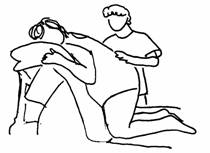
In classes, I often suggest that when couples enter their hospital room in labor they pile all of their belongings onto the bed rather than the laboring woman hopping into it. I encourage people to start seeing the bed as a tool they can actively use during labor, rather than a place for labor and birth to passively happen to you. To that end, I’ve made a little handout called “helpful ways to use a hospital bed without lying down.” I’m uploading it here in hopes that others may find it useful as well.

Kneeling & leaning on back of hospital bedFor more about the importance of freedom of movement during labor, make sure to check out Lamaze’s Healthy Birth Practice paper: Walk, Move Around, and Change Positions Throughout Labor or this video clip from Mother’s Advocate.

Top Five Birth Plan…

Birth plans are a topic often discussed in birth classes. There are SO many things that could be put onto a birth plan that sometimes it is difficult to sort out the most important. I encourage couples in my classes to complete two different “values clarification” exercises to help them include those things on their plan that are MOST important to them, rather than trying to cover everything on a one page birth plan. They often ask what I think is important to include. So, recently I started thinking that if I needed to create a birth plan for a birth in hospital that was as normal and natural as possible and could only include five elements, what would be most important to me, my baby, and a normal birth?

These are my top five after first going into the hospital as late in labor as possible (this isn’t included on my birth plan and doesn’t need to be on anyone’s birth plan–“I plan to labor at home as long as possible”–because it isn’t relevant by the time you get there and people are reading your plan. It belongs on your own personal plan, but not in your “official” plan):

  1. No pitocin.
  2. Minimal fetal monitoring and preferably with a Doppler only.
  3. Freedom of movement throughout labor (stay out of bed, use it as an active tool rather than as a place to lie down. Stay upright during any necessary monitoring.)
  4. Push with the urge in whatever position works best for me (NO coached, directed, or “cheerleader” style pushing).
  5. Baby immediately to me. NO separation.

Helping yourself while helping your wife or partner in labor

Giving birth is an intensely physical process for the woman giving birth and sometimes we forget what an intensely physical process it is to assist a woman giving birth! Here are a few ideas of ways to take care of yourself while you are helping your wife or partner labor and give birth:

  • Bring healthy snacks for yourself (avoid anything that is strong smelling, like garlic, and don’t drink coffee)–granola bars, sandwiches, trail mix, crackers.
  • Wear comfortable clothes and shoes.
  • Dress in layers–the birth room may be cold or it may be hot.
  • Wear clothes that you don’t mind getting stained.
  • Use good “body mechanics” when providing physical support to your wife. Bend your knees slightly and keep your back straight when helping support your wife in a standing squat. If providing counterpressure on her back with your hands, keep your arms straight and lean your body weight down onto her back to provide the counterpressure, rather than using the muscles in your hands or arms to provide it.
  • Take breaks if you need to–it is okay to take a bathroom break or to get something to drink! If your wife or partner does not want to be left alone, have your doula or a helpful nurse serve as a quick stand-in for you. Use your judgment as to whether to announce to your wife that you are taking a quick bathroom break. Some women may be upset at being “abandoned” without warning, while other are so into the rhythm of labor that they will not notice you taking a quick break and it is better not to disturb their rhythm by making a big announcement that you are leaving.
  • If you feel yourself getting tense or anxious, take slow, deep breaths from your abdomen or do a few quick tension relieving stretches such as rolling your neck from side to side or rotating your shoulders.
  • I encourage women to use affirmations during pregnancy and then during labor to help them greet their labors with confidence and acceptance. Though it might seem silly or feel awkward, you may wish to develop some affirmations to use yourself as well as you assist your wife in labor–try things like, “I am calm and confident” or, “each contraction is bringing our baby closer,” or, “my mind is relaxed, my body is relaxed,” or, “her body knows how to birth our baby.”
  • Trust birth and the process–your wife’s body is well designed to give birth to your baby. She can do it! Believe in her and believe in yourself!

Climate of Confidence, Climate of Doubt

Recently I finished reading (and reviewing) the new book Our Bodies, Ourselves: Pregnancy & Birth. In the opening chapter, they identify a concept that I have *felt* for some time, but hadn’t really put a finger on. The authors refer to it as a “climate of confidence” and a “climate of doubt.” I love this way of articulating the messages swirling around pregnant women in our society.

A Climate of Doubt comes from “The media’s preference for portraying emergency situations, and doctors saving babies, sends a message that birth is fraught with danger. Other factors, including the way doctors are trained, financial incentives in the health care system, and a rushed, risk-averse society, also contribute to the popular perception that childbirth is an unbearably painful, risky process to be ‘managed’ in a hospital with the use of many tests, drugs, and procedures. In such an environment, the high-tech medical care that is essential for a small proportion of mothers and babies has become the norm for almost everyone…[a] ‘climate of doubt’ that increases women’s anxiety and fear.”

A Climate of Confidence “reinforces women’s strengths and abilities and minimizes fear. Some of the factors that nourish a climate of confidence include high-quality prenatal care; healthy food and time to rest and exercise; a safe work and home environment; childbearing leave; clear, accurate information about pregnancy and birth; encouragement, love and support from those close to you; and skilled and compassionate health care providers.”

——-
I encourage my birth class clients to consider ways in which they can create a climate of confidence in their lives as they prepare for their births and their babies.

Pain Acronym

Continuing with my musings about pain and birth, I came across a following acronym in the fall 2007 issue of the International Journal of Childbirth Education (the publication of ICEA):

P (purposeful)

A (anticipated)

I (intermittent)

N (normal)

——-

I was previously unfamiliar with the acronym, but I kind of like it. There are so many fears surrounding pain in birth–often of the unknown–and then stories abound about “excruciating pain,” and “you’re gonna need that epidural!” as well as media portrayals of birth as a scary, emergency event with lots of screaming and stress. This little acronym acknowledges that many women experience birth as painful, but also offers the perspective that it is manageable and doable.