
10:30 on Saturday in honor of the worldwide Big Latch On in conjunction with World Breastfeeding Week

10:30 on Saturday in honor of the worldwide Big Latch On in conjunction with World Breastfeeding Week
Today I came across an old note about a dream I had a couple of years ago:
I was in a sort of waiting room area with quite a few people in it including a friend and also a Diplomat (distinguished older gentleman with gray hair). Z wanted to nurse and so I picked him up and then turned slightly away from the diplomat in order to start nursing him. My friend said something like, “I see you’re trying to hide from everyone. I can’t believe you’re STILL breastfeeding him.” The diplomat then said, “at the Embassy we have an old saying: we work together as smoothly and comfortably as a good latch.”
I wonder how world politics would look if breastfeeding mothers were the role models 🙂
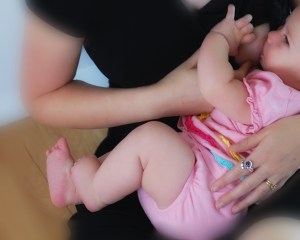
This week, I was contacted about some new research being presented at the The Era of Hope conference in Orlando, FL about omega 3  supplementation during pregnancy reducing the risk of breast cancer for the baby girl in the future. Era of Hope is a scientific meeting funded by the Department of Defense Breast Cancer Research Program (BCRP). I was offered the opportunity to do a short interview with the researcher, Dr. Georgel:
Q. What are some easy tips for pregnant mothers to increase their consumption of omega 3 fatty acids?
A. Select the right type of oil when you go shopping:
Q. Are supplements (i.e. fish oil or flaxseed oil in capsule form) as effective as other foods?
A. Yes, if you select them properly. Read the label; for fish oil, you have to make sure that the amount of omega 3 fatty acid (combined EPA plus DHA) is around 1600 mg/day. If the label says, “essential fatty acids,” it usually contains and high level of omega 6 and low omega 3 (which is not optimal) so you want to avoid those.
Q. Is the effect dose dependent? (i.e. how much do women need?
A. Yes, 1600mg of combined (EPA plus DHA) omega 3 fatty acids per day.
Q. Since it is World Breastfeeding Week this week, I’d love to tie this research in to research we already know about the role of breastfeeding in reducing a woman chance of breast cancer. Any thoughts on that?
A. Our research indicates that the maternal diet (in utero and during breast feeding) containing omega 3 fatty acids has the potential to reduce the female off-spring’s incidence of breast cancer.
I also asked about the following: finally, there is some evidence that supplementation with EFAs postpartum has an effect on reducing the incidence of postpartum mood disorders. Any thoughts on how prenatal supplementation might have a similar impact? But, since Dr. Georgel’s research does not explore mood disorders, he was unable to comment on this question. Here are two great handouts from Kathleen Kendall-Tackett about EFA supplementation postpartum:
Can fats make you happy? Omega-3s and your mental health pregnancy, postpartum and beyond
Why Breastfeeding and Omega-3s Help Prevent Depression in Pregnant and Postpartum Women
For quite some time, breastfeeding advocates have been working to change the language of infant feeding to reflect that breastfeeding is the biological norm (and formula feeding is the replacement/substitute). This includes sharing about the “risks of formula feeding” rather than the “benefits of breastfeeding” as well as encouraging research that no longer uses formula-fed babies as the control group or considers formula to be a benign variable (i.e. the babies in the breastfed group of many research projects also received some formula, but since our culture views formula as the “norm,” this was not seen as a conflict). I love Diane Wiessinger‘s example—would we ever see a research project titled “Clear air and the incidence of lung cancer.” No! Problem behavior is linked to problem outcomes in other areas of research, so it would be “Smoking and the incidence of lung cancer.” However, we routinely see research titles like “Breastfeeding and the rate of diabetes” rather than linking problem to outcome–“Infant formula and the rate of diabetes.”
Similarly, “intactivists” (people who oppose circumcision) have pointed out that there should be no need to refer to some boys as “uncircumcised”—being uncircumcised is the biological norm, it is “circumcised” boys that should received the special word/label. (On a related side note, I have written about “pleonasms”–words that contain unnecessary repetition–and birth and breastfeeding in a previous post.)
So, this brings me to another need for a change in the common language–correctly identifying whether we are really talking about “Health Care” or “Medical Care.” This was originally brought to my attention by Jody McLaughlin the publisher of Compleat Mother magazine. We have a tendency to refer to “health care” and to “health care reform” and “health insurance” and and “health care providers” and “health care centers,” when it reality what we are truly referring to is “medical care”—medical care reform, medical insurance, medical care providers, and medical care centers. As Jody says (paraphrasing), “we do not have a HEALTH care system in this country, we have a MEDICAL care system.” She also makes an interesting point about a trend to re-name medical care systems with names that use the word “health” instead:
This is what I have observed: Our local facility was called Trinity HOSPITAL, later re-named Trinity MEDICAL CENTER, and now it is Trinity HEALTH.
In the late 70’s and early 80’s the discussions centered around the MEDICAL crisis, MEDICAL reform, MEDICAL insurance and MEDICAL care cost containment.
MEDICAL insurance morphed into HEALTH CARE insurance. MEDICAL reform morphed into HEALTHCARE reform.
This is a difference with a distinction.
Health care includes clean air and safe water, enough good food to eat, exercise, rest, shelter and a safe environment as well as healing arts and the availability of and appropriate utilization of medical care services.
Medical care is surgery, pharmaceuticals, invasive tests and procedures. Malpractice tort reform is on the agenda too but no one is talking about reducing the incidence of malpractice, or alleviating the malpractice crisis by improving outcomes.
Why does this discussion belong here? First, I wanted to address it because I have a special interest in our use of language surrounding birth and how that language can impact our birth experiences. Secondly, if we emphasize that birth is a normal bodily process, a normal life function, and not an illness, we need to make sure that we are focused on health care services for birth, rather than medical care services. Personally, I think the midwives model of care can truly be described as health care, whereas standard maternity care in the U.S. can much more aptly be described as medical care.
I have a book called The Tao of Motherhood. It is literally the Tao Te Ching for mothers—a translation of the ancient Tao Te Ching by Lao-Tzu, but reworked slightly so that every “chapter” is about mothering and mothering well. It has 81 one to two page “chapters” just like the classic book. A quote from the end of the chapter on selflessness:
“You can sit and meditate while
your baby cries himself to sleep.
Or you can go to him and share
his tears, and find your Self.”
I’ve been thinking lately about writing an article about breastfeeding as a spiritual practice and have been using the same technique lately when nursing Alaina as described in this Mothering article by the same name: “breathing in, I am nursing my baby. Breathing out, I am at peace,” etc. (It also reminds me of my own How to Meditate with a Baby poem.)
On Monday, I was lying in bed nursing her and thinking about the intensity and totality of the breastfeeding relationship—it requires a more complete physical/body investment with someone than you will ever have with anyone else in your life, including sexual relationships. While I don’t like to lump the breastfeeding relationship in the same category with sex, because it feels like I’m saying breastfeeding is sexual, when it isn’t…though, I since lactation is definitely part of a woman’s reproductive functions, I guess maybe it is…but basically my line of thought was that if you nurse a couple of kids through toddlerhood, odds are high that you will have nursed them many more times than you will end up having sex with your husband in your entire lifetime. (This question of function reminds me of a quote I saw today: “Breasts are a scandal because they shatter the border between motherhood and sexuality.” ~Iris Marion Young)
I calculated that so far in my life I’ve put a baby to my breast more than 12,000 times. Even if I only experienced a single moment of mindful awareness or contemplation or transcendence or sacredness during each of those occasions, that is one heck of a potent, dedicated, and holy practice 🙂
In the book Tying Rocks to Clouds, the author interviews Stephen Levine who has three children and he says:
“Talk about a fierce teaching. It is easier to sit for three years in a cave than to raise a child from the time he is born to three years old.” This was in response to a question about whether serious spiritual development is possible when having relationships with others (spouse, children, etc.) I do believe that without having children, I would be less “developed” than I am now—I’ve said before that having kids can be hard on the self (ego), but great for the soul.
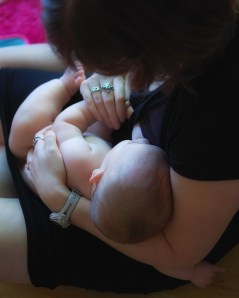
“Perhaps we owe some of our most moving literature to men who didn’t understand that they wanted to be women nursing babies.”
–Louise Erdrich, The Blue Jay’s Dance
While planning posts for World Breastfeeding Week, I realized that I’ve never posted the essay for which I am most “famous” on my own blog! “Nursing Johnny Depp” originally appeared in Literary Mama in 2009 and an excerpt was used in the 2010 edition of The Womanly Art of Breastfeeding in the section about nursing toddlers.
Nursing Johnny Depp
by Molly Remer
As I put his head to my breast, I feel a distinct thrill of the forbidden.”Na-na, Jack Sparrow, Mama,” my two-year-old son said, and I put the action figure to my chest without much thought.
As I look down at that tangled mop of dark hair and braided beard, and touch the slightly sneering lips to my nipple, I suddenly feel a bit dirty. Illicit. Inappropriate. As if perhaps I shouldn’t tell my husband what I’ve been doing in my spare time. In nursing that plastic Johnny Depp, I’ve crossed a line that maybe a good girl wouldn’t cross. Or, at least, I’ve surely violated some social norm or standard of propriety.
Previously an equal opportunity nurser, from that point on I begin to place more limits on what I am willing to nurse. Yes, to the tree frog. No, to the pink rubber rat. Yes, to the hungry-looking little piglet. No, to the Shrek Pez dispenser. I’m teaching my son about limits, I think: Body boundaries, personal space, self-respect, common decency. These are good concepts to master. Or, as I reject nursing a large red monster with a mouthful of sharp-looking teeth, am I teaching him to discriminate on the basis of personal appearance? To withhold love and to be stingy with affection? Or, perhaps more simply, that grimy, but appealing men are more worthy of attention than large blue stag beetles?
Sitting on the living room floor, my little son rocks back and forth with two small toys singing, “Rock, baby. Rock, baby…” I look closer and see that Obi-Wan Kenobi is tenderly cradling Yoda in his arms.
At dinner, eating grapes, my boy picks out a large grape and a very small grape. He is delighted with the small grape, “baby grape! Baby grape!” He holds up the large one and announces, “Mama grape.” He sets them on the table and carefully pushes the small grape towards the large one until they are touching. “Dat baby grape have na-nas!” he reports with obvious satisfaction. Later, he eats them both.
Skin contact is a requirement of nursing the inanimate. I used to try to get away with putting the toys to my breast on the outside of my shirt, but that was unacceptably less-than-genuine.
“Dat frog crying, Mama!” he implores. Later, he asks, “Where my frog go?” and I realize it is still snuggly tucked inside my bra, its purple rubber face nestled comfortably against my nipple.
I’ve seen a number of snapshots of other people’s little girls and boys “nursing” their own dolls, stuffed animals, or dump trucks, but neither of my own sons have been interested in nursing their own toys.
I have suggested it and was met with utter contempt–“Mom, we’re BOYS! We don’t have na-nas.” I am well aware that I look somewhat less than adorable at the park with a plastic alligator latched on.
Playing on the floor with my dad, my son picks up one of my husband’s childhood He-Man action figures. Evilyn has bright yellow skin and a revealing metallic bikini.
“Hey!” Zander exclaims, “Dat lady got na-nas!”
He fingers them approvingly and my dad comments blandly, “Well, yes, she does.”
Several months prior, at my older son’s insistent request, I lovingly fashioned a cloth baby carrier for Evilyn to wear on her back. Her baby of choice is a tiny crocheted “button buddy” monster with googly eyes.
“Look, Mom! She can hold her baby!” The five year old announces. Evilyn’s yellow hand is tucked completely through the button hole in the middle of her baby’s chest.
I begin to consider that perhaps I am the chief toy nurser because my sons lack enough appropriately endowed female toys. Indeed, my little one is greatly distressed by trying to get one of our Playmobil women to hold her baby. Her stiff plastic arms hold the baby by the wrist at arm’s length and this simply will not do.
He holds the baby to her plastic bump of a chest (she has a “uni-breast”) crying and fretting, “Hold baby! Na-na baby!”
Eventually I solve the problem by taping the baby sideways across her chest like a bandolier, its head now appropriately positioned at breast level. (Lest it appear my son is only concerned about proper nursing access, earlier this same month I also carefully taped a tiny plastic knife into “Baby Froggie’s” beanie baby paw. “Look, Daddy! Baby. Froggie. Got. Sword!”)
So, yes, I am still nursing and not only do I nurse my toddler, I sometimes nurse a big orange robot, assorted earth-moving vehicles, Ewoks, squirrel puppets, the occasional pretzel or grape, and more. I turn down an offer of nursing Luke Skywalker (would I have turned down Han Solo, I wonder?) and also of some guy with a half-metal face. “Sorry, honey,” I say, “I don’t nurse that kind of guy.”
Molly Remer, MSW, ICCE is a certified birth educator, writer, and activist. She is a professor of human services, an LLL Leader, and editor of the Friends of Missouri Midwives newsletter. She has two living sons and an infant daughter and blogs about birth at https://talkbirth.wordpress.com
—
Postscript: In the Literary Mama version, the editor decided to take out my last line, which was originally this: “Next time we watch Pirates of the Caribbean and that roguish face fills the screen, I can’t help but feel as if Johnny and I share a little secret. And, hey, if my son brings me Orlando Bloom to nurse next time, I definitely won’t say no… ”
I couldn’t decide whether to leave it in this version or not and ended up deciding to take it out here too (but then not, since I’m including it in this little postscript!). As a special bonus, this version includes pictures of the actual toys! (I took these last night and amazingly, three years post-events-described-in essay, Evilyn is still wearing her baby carrier and the Playmobil baby is still taped in place!)


In honor of World Breastfeeding Week this week, I am planning a series of breastfeeding posts. The following is a modified version of an article that previously appeared in a journal for support group leaders:
Listening Well Enough
by Molly Remer
When I was training to become a breastfeeding counselor, I practiced four helping situations as telephone role-plays. I was very anxious about receiving  the first practice call. In fact, I confess to being so anxious that when one of the women I was working with called for the first time to practice and I missed her call, I actually cried.
After that missed call, I had a dream. In the dream, the woman called to practice. I said “hello,” and received no response. I said hello again. No response. “I’m not able to hear you,” I explained, “you have reached a breastfeeding counselor. Do you have a breastfeeding question?” Silence. I tried again, “Let me tell you a little bit about our services…our services are free, do you want to ask me a question?” Still there was silence, though I was positive that the woman was still on the other end of the line. Finally, I said, “I am not able to hear you, so I’m going to hang up now. Please feel free to call me back if you need to talk.” Finally, the woman spoke. She told me that I had not handled the call well. I asked her how I was supposed to know what to say if the mother wasn’t saying anything. The woman responded, “that mother told you everything you needed to know, you just weren’t listening well enough.”
Obviously, this dream reflected the anxiety I was feeling about being able to “perform” during helping calls. It also showed the fears I had about being judged by the other women as not being warm enough or informative enough (though I was assured by my trainers that the practice calls were to help me feel comfortable, not to judge and test me!). Aside from this analysis of the practical reasons behind my dream, I feel it reminded me of several relevant points:
Before becoming a mother, I worked in domestic violence shelters answering the crisis line and providing short-term crisis intervention services to women who had experienced domestic violence. Interestingly enough, I find that those types of helping calls were in some ways “easier” to work through than breastfeeding help calls, since there were fewer variations in women’s stories and experiences. With breastfeeding questions, there are an infinite number of variables and an infinite array of mothers, babies, families, and mother-baby dyads. Just as there is no one way to be a good mother, there is no perfect way to help mothers. Breastfeeding is not a by the book procedure—it is an intimate relationship with different dynamics from one nursing couple to the next. Individual mothers and babies respond differently to the same things.
Our main message to each mother is how important she is to her baby and how breastfeeding can be a wonderful part of this. We want to help mothers feel good about being a mother, about meeting their babies’ needs in the way that feels best for them, and to trust their own instincts. We wish to leave mothers with a feeling of self-confidence, acceptance, and encouragement.
I have a lot of breastfeeding-related posts I’d like to share soon. Here’s hoping I have time to make that come true! The following is an essay I wrote about my experiences nursing my first baby. It was originally published in LLL‘s New Beginnings in 2006.
Listening to my baby…
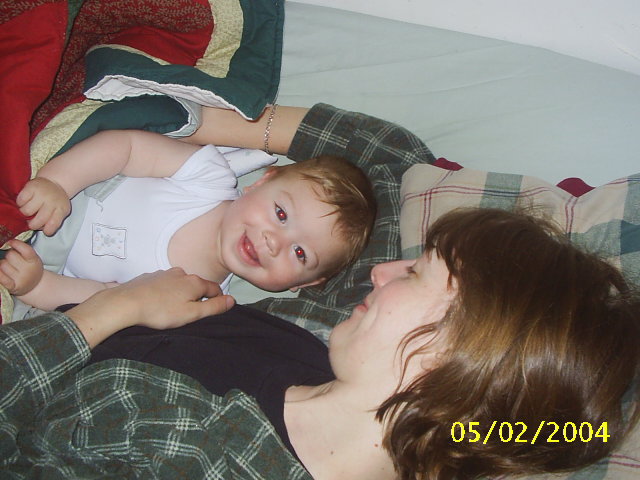
Taking a break from nursing to peek at the camera!
By Molly Remer
Before my son Lann was born, I felt prepared for frequent nursing, comfort nursing, and for experiences nursing in public. I started attending LLL meetings when I was 26 weeks pregnant and was also involved with the local Breastfeeding Coalition. I fondly imagined cuddling my baby as he nursed away. I also imagined proudly nursing in public wherever necessary—doing my part to increasing public perception of nursing being a normal part of everyday life, not secret or shameful.
After newborn Lann’s first growth spurt had passed, I was surprised to learn that he had other ideas about what our breastfeeding relationship would be like. Lann did not like to comfort nurse—he nursed when hungry and stopped when full. He would become upset and cry loudly if the breast was offered and after the first few sucks he would get milk that he wasn’t looking for. He also vastly preferred nursing lying down in our own bed. In public, he would refuse to nurse at all or would nurse a bit, choke on a mouthful, and become upset and not continue. He would often choke while nursing in any setting (though less frequently while lying down at home) and become very distraught and turn away from the breast—sometimes even pushing at me with his hands. These experiences were very difficult for me. I felt embarrassed to go to LLL meetings with a baby who cried and fought the breast, despite clearly appearing hungry, but then would nurse happily in the car! I did not have the cozy, peaceful nursling I imagined (though I was comforted by the fact that at home, lying down, when he was hungry, he certainly loved to nurse!).
These challenges continued for three and a half months, before I finally accepted that listening to my baby’s needs applied to these situations as well! Even though Lann didn’t breastfeed the way I had imagined or in the way I thought he needed to breastfeed, I still needed to listen to what he was telling me. Things became much less stressful when I finally realized this. If we were in a public place, I went to the car to nurse him and generally averted the crying, gagging/choking on milk episodes. At friends’ houses, I would ask to go lie down in another room. I made sure to “tank him up” before we left our house and planned to be home again within approximately three hours so we could nurse in our comfortable surroundings. I stopped being embarrassed that my baby wouldn’t nurse the “right” way and accepted that his style was different than what I had anticipated. After Lann went through a very challenging nursing strike at 5 months old due to a cold, I also learned that it often worked to nurse him standing up and moving around and I successfully employed this strategy in other settings after the nursing strike had passed. I also learned that if I let him unlatch to look around frequently while nursing in public (something I had never expected to “allow” before he was born), we could usually manage to complete a nursing session without struggling.
Interestingly, Lann’s disinterest in comfort nursing and his preference for private nursing both faded away when he was about 10 months old. He began to enjoy nursing “just because” or for comfort when distressed. He started to nurse around other people and in public places with ease and continued to nurse happily and frequently until he was two and half and weaned during my pregnancy with his brother, Zander.
I loved the feeling of being able to meet multiple needs in one interaction with Lann. Even during our early “conflict” over where and how to nurse, I loved the experience of feeling both of our bodies suffused with peace as we lay down together to nurse. I also deeply cherished the times we eventually spent comfort nursing. I felt so sad to be missing out on those times when he was younger, that every time toddler Lann asked to comfort nurse, I felt like it was a true gift.
—-
(Hindsight lets me know that I was struggling with oversupply/overactive letdown with Lann, an issue that has re-arisen with each baby, but one that I’ve managed much better each time!)

Notice how she is holding my finger?
The cutting of the umbilical cord tends to herald the arrival of a new and unique life. Though this tiny being began its existence many months before, growing nestled and protected within the womb, the just-born infant is seen as an individual apart from his or her mother. There is, however, a significant error in this thinking, for baby and mother are one, so to speak, and severing this unit denies an empirical truth. Birth should not be a celebration of separation, but rather a reuniting of mother and baby, who joins her for an external connection. –Barbara Latterner, in the book New Lives [emphasis mine]
I felt like this was a completely relevant quote for our Independence Day weekend. A baby has no concept of the notion of independence. Even though we live in a culture that pushes for independence at young ages, all babies are born hard-wired for connection. For dependence. It is completely biologically appropriate and is the baby’s first and most potent instinct. I remind mothers that after birth your chest literally becomes your new baby’s habitat. Mother’s body is baby’s home—the maternal nest. If the baby cries when you put her down, that means you have a smart baby! Not a “dependent” or “manipulative” one. People are fond of making comments about babies being “spoiled” if they are held often. It is impossible to spoil a baby by responding to her needs (why do people have such an issue with other people holding babies anyway?). I am 100% certain that it is impossible to “spoil” any baby under the age of one by answering her when she cries and giving her what she needs (which at this point is food, warmth, safety, love, and physical closeness). One of LLL’s pearls of wisdom is, “a baby’s wants are a baby’s needs”—-there is no difference between them at this age. A baby is not “manipulating” you by crying for you to come to her and then stopping when you pick her up—-that is a perfect example of skillful mother-baby communication (if someone says, “she is only crying to get you to pick her up” the answer is “yes! She is! Isn’t she smart!”) .
New Lives is a compilation of essays by NICU nurses and it is no surprise to me that the essay from which the above quote comes was written by a former LLL Leader 🙂
Speaking of LLL, at the last international conference in 2007 I was fortunate enough to hear Dr. Nils Bergman speak about skin-to-skin contact, breastfeeding, and perinatal neuroscience. In super short summary: babies NEED to be with their mothers following birth in order to develop proper neural connections and ensure healthy brain development and proper brain “organization”; Mother’s chest is baby’s natural post-birth “habitat” and is of vital developmental and survival significance; Breastfeeding = Brain wiring.
And, as long as I’m reminiscing about the conference and Dr. Bergman, in fact I actually ended up “performing” on stage with him in a mimed play put on immediately prior to his presentation! He is a dynamic and engaging speaker (with a great accent!) and has so much of value to share. I will never forget hearing his duet with an LLL Leader of the song, “Anything Tech Can Do, Mum Can Do Better.”
Yes she can, yes she can, yes she CAAAANNNNNN!!
Today, let’s celebrate being in dependence with our babies 🙂
When I published my article about my postpartum feelings with my first son, I envisioned it as the first part of a series of three posts comparing/contrasting my postpartum feelings and experiences following each child. Here’s what happened—I wrote part two in which I shared some of the recurrent thoughts I had in the year following my second son’s birth and decided that I just don’t feel like publishing it. Reading it back over makes me feel like I probably could have been considered mentally ill and I don’t really feel like sharing that right now. I started to analyze why I feel like sharing any kinds of feelings via blog anyway—really, what is this about? Why “expose” myself? In part, because that is what helped, and still helps, me the most; knowing that I’m not alone in my feelings and that other women have “been there.” So, I feel I have a responsibility of sorts to share my own “been theres.” When I began this website/blog, it was primarily about gathering and sharing information with others, not about telling my own story or sharing my personal experiences. I didn’t start it intending to have any element of a, “personal journal published online” feeling. After the birth-miscarriage of my third son and then my pregnancy-after-loss journey, it took on more of the personal journal flavor. And, I’ve liked that. I’ve enjoyed sharing my feelings and experiences and learning from the comments other people leave that I’ve “spoken” to something in them, and/or helped someone to understand their own experiences (or me) better. That said, I don’t have to share everything I write just because I’ve bothered typing it and I just don’t feel like sharing my second post about weirdo, “crazy” postpartum thoughts right now. So there! Maybe someday I’ll hit “publish” on it.
Of course I know (and firmly believe!), that you’re “postpartum for the rest of your life” (Robin Lim), but I feel like this current postpartum experience is different than my others in some qualitatively different ways. I first credited it to having taken placenta pills this time around. My doula encapsulated my placenta for me and I took all 95 capsules during the first 6 weeks postpartum. It was amazing! I have become a total “convert” to the benefits of placenta encapsulation. I felt GREAT and I had tons and tons of energy, instead of being wiped out and weak and exhausted feeling. I’ve only taken about two naps in Alaina’s life (this may come back to bite me with regard to lactational amenorrhea , we’ll see…) and that ISN’T because I’m crazy and was pushing myself too hard, it is because I haven’t felt like I needed to take any naps. I highly recommend placenta encapsulation. Amazingly powerful!
Another thing that is different about this experience is that I don’t feel “restricted” after having her—I don’t feel like I’ve had to sacrifice or let anything go, I feel like she has integrated smoothly into our lives. I had a phone counseling session with an intuitive healer the afternoon before Alaina was born and one of the new “neural pathways” I set was, “the new baby seamlessly integrates into our lives.” I think it worked! 🙂 What is interesting, is that I have put quite a lot on hold lately, but it doesn’t feel like she MADE me, it feels like what I want to do (or not do, as the case may be). When my first son was born, I had to let go of most of my old life and work and it was very painful. With my second son. I felt like I had a lot of energy to give to the “world” that was being blocked/couldn’t find expression. This time, there is more balance. I’m continuing to teach college classes in-seat and online and that feels really good to me. I’m homeschooling the boys and doing well with that (we actually “do school” almost every day!). I read all of the time (55 books so far this year!). I’ve started a doctoral program. And, I make time for a variety of other smallish projects like facilitating quarterly women’s retreats, editing the FoMM newsletter, and answering breastfeeding help calls/emails. Oh, and making birth art sculptures (new pictures to follow soon!) And, here’s what I’m not doing: writing new articles, working on my books (I have three in progress), doing much birth work, staying caught up on articles/news/research, teaching prenatal yoga or prenatal fitness classes or leading birth art sessions (all of which I trained to do last year), creating (or teaching) any new craft classes for our annual craft camp, writing the dozens of blog posts that come to mind (or even pulling old material into this blog the way I’d like to do), staying caught up with book reviews, keeping up with the garden, etc., etc. More about balancing mothering and personing will follow someday. I promise!
With previous babies, I’ve felt very haunted by the “list” of all I’m not doing. While I still feel this way sometimes, I more often have a less familiar feeling—that of amazement at my own capacity for adaptation and change. I regularly feel kind of proud of myself—like, look how I can expand and enfold and how I can create a life that works and is satisfying as it continually evolves and changes.
This time with my baby has been the sweetest and most delicious time in my life. Yes, I’m still busy and overextended and hard on myself about a lot of things, but there is a different clarity to the experience. I feel like every moment with her is so vivid, clear, and memorable and like each one is being etched into me. It is just so real this life we have together now and it is weird for me to realize how quickly things change and how pretty soon, this life that I’m living in this moment, will just be our past. I do feel like I savored my boys’ infancies as well, but I don’t remember this sharpness of feeling and observation. I feel like I will never forget what it is like to be this mother of my baby girl. However, I also know that the reality is that the growing baby and then toddler, and then child replaces the one who came before (even though it is the same person—those other versions of them are replaced by the vivid reality of the now). So, while I retain distinct mental snapshots of my life with the boys as babies, their current, vibrant, and ever-growing selves are much more intense and real (obviously), and I know it will be the same with her. And, it makes my eyes well up to know that this sharp sweetness will float away on the rivers of time and that before I know it, I will be the mother of two men and a woman. It is hard to explain what I mean in writing—what I want to say is, “but this is SO REAL now.” Well, duh. It IS real now. And, later will be real as well. That is just the flow of life, Molly dear ;-P However, one of the main reasons I wanted to get her pictures taken yesterday is to try to capture what it is like to be her mother NOW:

Then, last night while I was nursing her to sleep in my arms as I have done every night for five months, I took this picture myself to capture how well we fit together. I wanted to get how her little feet are nestled into my legs so perfectly and how her hands rests on me and how her head cradles in my arm:
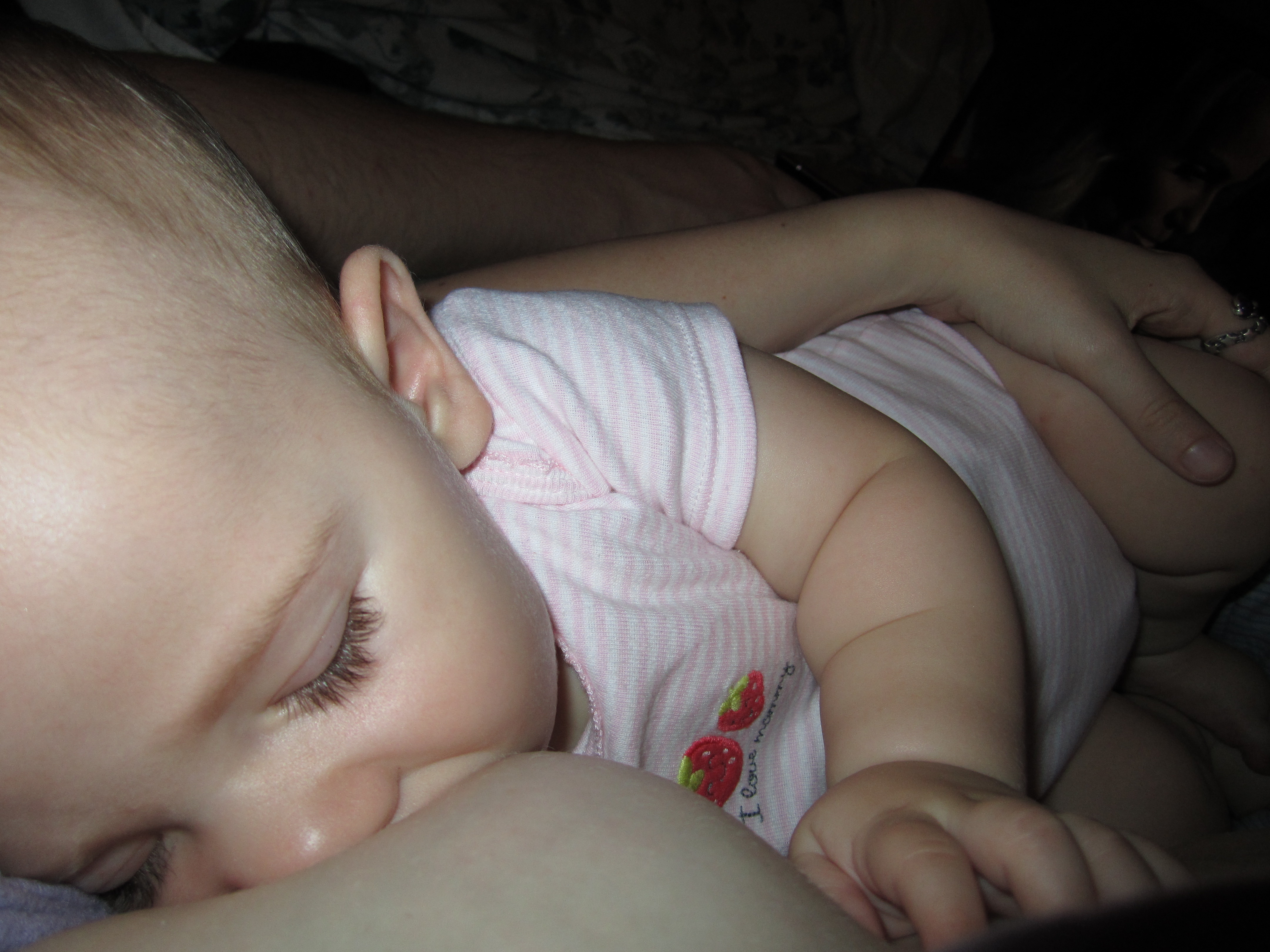
I know this one isn’t a pro picture, but this is what it is like to be her mama 🙂
 Talk Birth