Archives
Balanced Living and Saying ‘No’
I fairly regularly experience what I term a “crisis of abundance.” There are SO many great things to do in the world: SO many great causes, so many wonderful organizations, so many beautiful books, and just so many good things to do with my time. I prefer this state to having a crisis of scarcity or lack, but abundance brings its own challenges and saying “no” or “enough” to the requests for my time is one of those. I feel fortunate that I am humming with life purpose (most of the time), but I also have to be mindful that this hum of energy does not lead me to overcommit and to stretch myself too thin.
This past week, I said “no” to two birthwork-related opportunities that were very appealing, but that I know in my heart that I don’t have the time, space, or energy for right now. It was very empowering and actually semi-thrilling to say,”no” and to mean it. I felt smart and that in these situations saying no was taking care of myself (saying no to someone else = saying “yes” to myself” sometimes!). Perhaps not coincidentally, after my “No” experiences, I received an article to share from life-balance expert Renée Trudeau. I really like her “Nine Creative Ways to Say No.” Enjoy!
Four Key Strategies for Balanced Living by Renée Peterson Trudeau, life balance expert/speaker
~Know your top priorities & effectively manage your energy: What in life is most important to you? How good are you at managing your energy? What is draining you? What is fueling you? Are you comfortable saying “no” and not over committing? “Things which matter most should never be at the mercy of things which matter least.” Goethe
~Make your self-renewal a priority: By filling your cup first, you’ll have more to give to clients/family/friends, you’re able to function at your optimum and you’ll be setting an example for healthy, balanced living for those around you. Self-care (on all levels physical/mental/emotional/spiritual) should be part of your every day life. “Self-care is not about self-indulgence, it is about self-preservation.” A. Lorde
~Build a personal support system: What type of and how much professional & personal support do you need to feel emotionally healthy and stress-free? Learn to ask for and receive help. Re-evaluate your support needs every three months; these change based on your current life stage.
~Be more present in all that you do: Stress and overwhelm are often brought on by dwelling on the past or living in the future. By spending more time living in the present and focusing on what is most important in the here and now, the calmer, more effective we become.
Nine Creative Ways to Say “No”
Below you’ll find specific language to support you in saying “no.” Most people find that the more they say “no,” the easier it becomes say “yes” to those things that really matter.
(1) Just No: “Thanks, I’ll have to pass on that.” (Say it, then shut up.)
(2) The Gracious No: “I really appreciate you asking me, but my time is already committed.”
(3) The “I’m Sorry” No: “I wish I could, but it’s just not going to work right now.”
(4) The “It’s Someone Else’s Decision” No: “I promised my coach (therapist, husband, etc.) I wouldn’t take on any more projects right now. I’m working on creating more balance in my life.”
(5) The “My Family is the Reason” No: “Thanks so much for the invite, that’s the day of my son’s soccer game, and I never miss those.”
(6) The “I Know Someone Else” No: “I just don’t have time right now. Let me recommend someone who may be able to help you.”
(7) The “I’m Already Booked” No: “I appreciate you thinking of me, but I’m afraid I’m already booked that day.”
(8) The “Setting Boundaries” No: “Let me tell you what I can do …” Then limit the commitment to what will be comfortable for you.
(9) The “Not No, But Not Yes” No: “Let me think about it, and I’ll get back to you.”
(This list is adapted in part from Work Less, Make More—Stop Working So Hard and Create the Life You Really Want, by Jennifer White.)
Trudeau is a nationally-recognized career/life balance coach, president of Austin-based Career Strategists and the author of The Mother’s Guide to Self-Renewal: How to Reclaim, Rejuvenate and Re-Balance Your Life. Sign up to receive monthly life balance tips, order the book, find out about upcoming retreats/events and learn more about Trudeau’s coaching groups at www.ReneeTrudeau.com or www.CareerStrategists.net.
DVD Review: Hab It: Pelvic Floor
DVD Review: Hab It: Pelvic Floor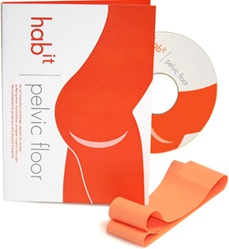
PT Partners, 2008
DVD, 1 hour 42 minutes, $29.95
Reviewed by Molly Remer, MSW, CCCE
Most women, and certainly all birth professionals, are aware of the importance of the pelvic floor. Less well-known are methods and exercises beyond the basic “Kegel” to strengthen and rehabilitate weakened pelvic floor muscles. Hab It: Pelvic Floor is a physical therapy DVD specifically targeting the pelvic floor. It is designed for women who are experiencing incontinence, prolapse, or pelvic floor pain. It is also a preventative tool for women to avert the development of these distressing issues.
Hab It: Pelvic Floor begins with an anatomy overview and Kegel explanation/instruction and moves into correct postural positioning. The DVD contains four progressive workouts each more than 20 minutes long and also “time efficient” versions of each workout. Each workout is coached by physical therapist Tasha Mulligan while being demonstrated by another woman. All of the information is clearly presented and easy to follow and the instructor is pleasant and earnest. The DVD comes with an exercise band for use during some of the exercises and no other equipment or props are required.
A very thorough and complete resource for any woman of any age, Hab It: Pelvic Floor is a relevant, interesting, and worthwhile addition to the libraries of doulas, childbirth educators, and anyone who cares about women’s health.
—
Note: The DVD is not designed specifically for use by pregnant women and there are several exercises that are not compatible with pregnancy—it is ideal for pre or post-pregnancy however!
—
Disclosure: I received a complimentary copy of the DVD for review purposes.
Wordless Wednesday: Wallowing in Books
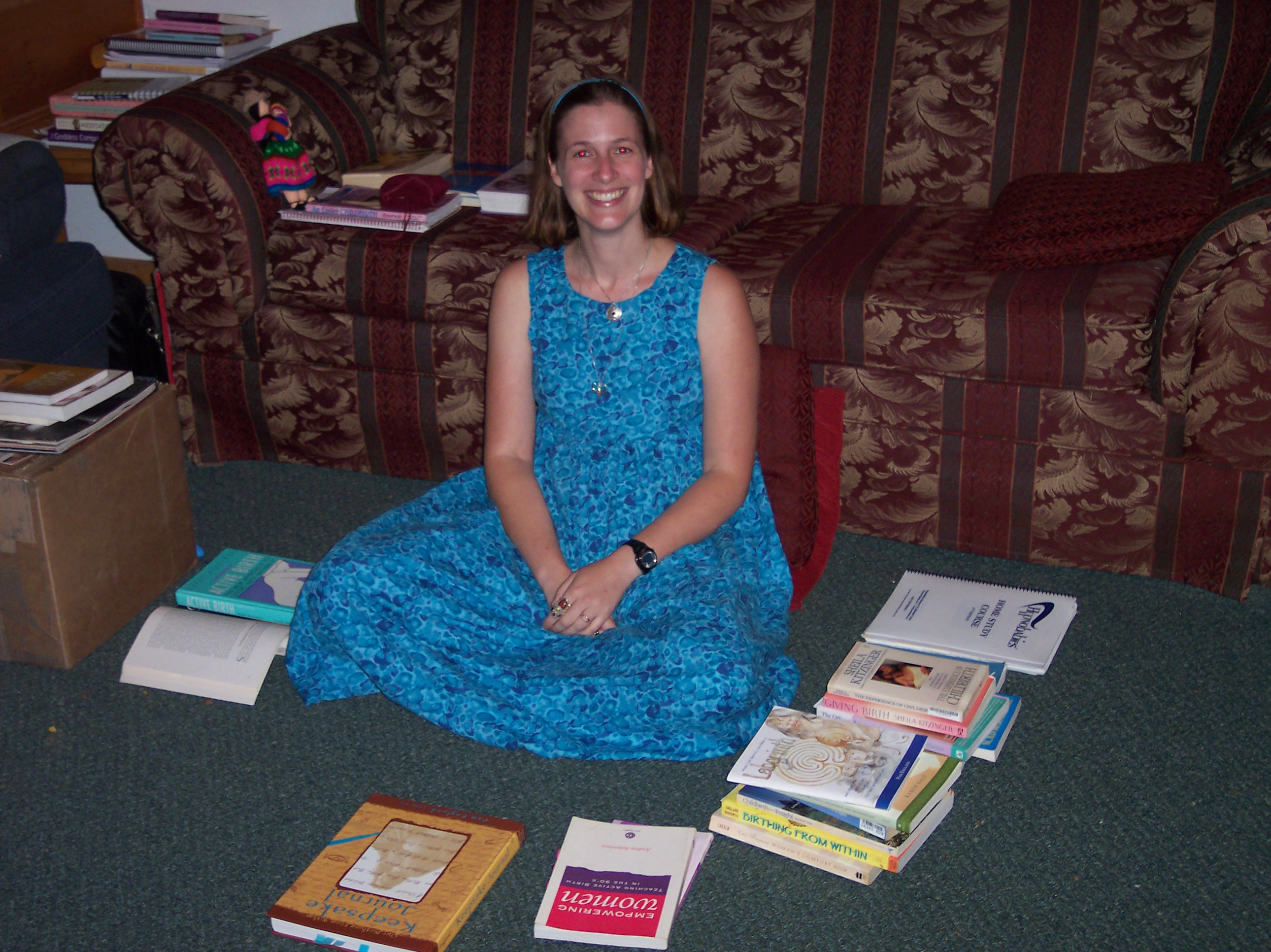
Anyone who knows me in person knows how much I love books! I joke with my husband about feeling like I need some time just to “wallow” in all my books. This past weekend, I finally did exactly that—got out all the birth and childbirth education books that are my favorites or that I’ve been wanting to look through again, spread them all around me and just enjoyed 🙂 (while I love being a book reviewer, one drawback is that I spend so much time reading NEW good books that I don’t have a chance to re-read old favorites!) Notice there are also books on the couch behind me AND in a big stack on the end table next to the couch—these are not books I got out for wallowing purposes, but are currently in-process/being used books! And, yes, that large box next to me is full of books and also has books on top (these are kids’ books mailed to us recently though, not birth books). I also feel like pointing out that this is not a very figure-flattering dress I’m wearing and though, yes, I am pregnant, I am not really as big as I look in the picture.
So much for Wordless!
Book Review: Giving Birth with Confidence
Since I recently wrote a post inspired by a quote from The Official Lamaze Guide: Giving Birth with Confidence, I figured it was high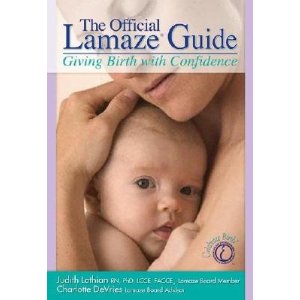 time that I share the review I wrote of the book! The review was originally written in 2007 for CfM News.
The Official Lamaze Guide: Giving Birth with Confidence. By Judith Lothian & Charlotte DeVries. Published in 2005 by Meadowbrook Press (307p), $12.00. ISBN: 088166474X
Reviewed by Molly Remer, MSW, CCCE
Very few pregnancy books deliver the message that we think pregnant women need to hear most: Birth is a normal and natural part of life….We believe deeply that birth is a process you can trust just as millions of women before you have. This belief isn’t sentimental; it’s based on our thorough understanding of the physiologic birth process and research that confirms interfering in that process is harmful unless there is clear evidence that interference provides benefits.
So begins an opening section of the book The Official Lamaze Guide: Giving Birth with Confidence. The degree to which the book accomplishes its simple message can be summarized with a simple review: Excellent! The Lamaze Guide is digestible and reasonable for busy people to manage at less than 300 pages of text and it contains a simple, profound, and elegant message that women in the U.S. desperately need to hear.
The book begins with defining normal birth as “…a normal birth is one that unfolds naturally, free of unnecessary interventions.” It then briefly explains the history of birth and how and why normal birth is not actually the norm in our culture. The authors then clearly address the following areas in one chapter each: early pregnancy; choosing a caregiver and birth site; middle & late pregnancy; preparing for labor and birth; the simple story of birth; keeping birth normal; finding comfort in labor; creating a birth plan and a baby plan; communication and negotiation; greeting your newborn; and early parenting. The authors are clearly very supportive of midwifery and the Midwives Model of Care (though it is not referenced by name) as well as of the benefits of a doula in the birthing room.
The book is framed in the context of Lamaze International’s powerful foundation, the Six Healthy Birth Practices:
- Let labor begin on its own
- Walk, move around and change positions throughout labor
- Bring a loved one, friend or doula for continuous support
- Avoid interventions that are not medically necessary
- Avoid giving birth on your back and follow your body’s urges to push
- Keep mother and baby together – It’s best for mother, baby and breastfeeding
The book is also guided by Lamaze’s comprehensive and lovely philosophy of birth:
- Birth is normal, natural and healthy.
- The experience of birth profoundly affects women and their families.
- Women’s inner wisdom guides them through birth.
- Women’s confidence and ability to give birth is either enhanced or diminished by the care provider and place of birth.
- Women have the right to give birth free from routine medical interventions.
- Birth can safely take place in homes, birth centers and hospitals.
- Childbirth education empowers women to make informed choices in health care, to assume responsibility for their health and to trust their inner wisdom.
After effectively bolstering the confidence of women in birth, The Lamaze Guide concludes with several useful appendices. The first is the excellent tool “Effective Care in Pregnancy & Childbirth: A Synopsis.” Though this information is easily available on the internet (see www.childbirthconnection.org), I find that many parents do not come across it on their own. How powerful to have it included for easy reference of indisputable evidence based practices. The Mother-Friendly Childbirth Initiative is included in another appendix as well as the always excellent text of The Rights of Childbearing Women. I was delighted to see all of these powerful documents in one place—and, in the hands of consumers who need to be aware of them.
This book is a refreshing presence on the shelves of my local bookstore (yes, there is only one retail book shop in my community and The Lamaze Guide is the only “alternative” birth book stocked in the store!). As I read the book, I kept nodding along and wishing it was in the hands of each pregnant woman in my community. Lamaze has a “name recognition” that gives this book the potential to have a wider and broader impact than other alternative birthing books which, though brilliant contributions, may only end up in the hands of “the choir.” The Lamaze Guide is written in such a matter-of-fact and comforting tone that I cannot see it being off putting to the average consumer as having “hippie” language or “extreme” ideas. The blueprint for normal birth that the book lays out is extreme compared to the standard practices at most hospitals, but the way in which the information is presented opens doors of communication, understanding, and exploration as well as providing the evidence basis to back normal birth. I would not hesitate to lend this book out as it will not scare anyone away with “weird” ideas. With the other books in my personal library, I have to carefully consider my audience before choosing which book has the right style and blend of information—not this one! It is good for everyone with its open, simple message. It is a good addition to lending libraries, personal libraries, to give as a gift, or to recommend to others. The Lamaze Guide is straightforward and clearly written with an unabashedly honest and truthful message of what normal birth is and how it can either be supported or undermined.
My only critique of the book is that in contains no real acknowledgment of the several other well known and effective organizations that train and certify birth educators (other than Lamaze International itself). Conspicuously absent from the resources pages are any of these other organizations.
In conclusion, The Lamaze Guide is a source of information that women need to have and a message that women need to hear. I think Giving Birth with Confidence accomplishes its purpose skillfully and has the potential to be a transformative influence. I hope women read it, absorb it, and begin to Celebrate Birth!
Birth Feelings
Those who push themselves to climb the last hill, cross the finish line, or conquer a challenging dance routine often report feelings of euphoria and increased self-esteem…women who experience natural birth often describe similar feelings of exaltation and increased self-esteem. These feelings of accomplishment, confidence, and strength have the potential to transform women’s lives. In many cultures, the runner who completes the long race is admired, but it is not acknowledged that the laboring woman may experience the same life-altering feelings… —Giving Birth with Confidence (by Lamaze International)
This is so true and so often overlooked or diminished in our modern birth culture. Comments such as, “you don’t need to be a martyr” or, “would you get a tooth pulled without medication?” or, “there are no medals for natural childbirth,” or, “in the end, all that matters is a healthy baby!” fail to acknowledge the transformative power birth holds in women’s lives. I think these comments (and the many others like them) often come from one of two places: the first being a place where birth did NOT hold transformative power in that speaker’s life (and, this is something I have to acknowlege as real—birth can be transformative, but it isn’t always, AND it can be a powerful influence in a negative sense as well [i.e. a woman who really did suffer during birth and/or was abused and/or experienced any variety of traumatic things, whether or not we, the listener, “know” that some of those things could have been avoided with different choices, etc., etc.]).
The second place, I believe is one that many medical care providers come from in that they do not want to look at the reality of the importance of birth because then they would have to confront the reality of how they may have interfered with or “ruined” birth for so many women. Perhaps that isn’t true or is a “bad attitude” or judgment on my part coming through, but that is how it looks to me from the outside. It is easier to dismiss natural birth advocates as “zealots” and mothers who wish to birth unmedicated as “martyrs” than to critically examine the institution’s birth practices and policies.
Related to the initial quote, here is a previous post about Birth and marathons…
As a side note, I really like the book I quoted—Giving Birth with Confidence—as a good “basic” birth book for pregnant women. I’m glad it is usually available in “conventional” bookstores as many other birth book treasures are not!
Wordless Wednesday: Playmobil Babies

Playmobil Mamas & Babies
(I know this is supposed to be Wordless, but yes, this is my personal collection of Playmobil mothers and babies. And, yes, I do actually have several others that are not pictured, such as a baby Jesus from the Playmobil nativity scene. And, no, I do not usually let my kids play with them—these are MY toy babies!)
Manual Clot Extraction Following Birth (Sequestered Clots)
There is a new blogger at Science and Sensibility—a science writer (and pediatrician) named Tricia who is going to be writing about patient safety and other interesting topics. She wrote an article for the online medical journal Pulse about her traumatic post-birth experience that involved (among other things) a large number of clots and a painful manual extraction.
What an intense story it was. I had a manual clot extraction following my first son’s birth and my uterus literally HURT while reading her story and remembering that experience. However, unlike Tricia, I was at a birth center and had a very gentle, caring doctor who was wincing as she did the extraction saying, “I’m sorry, I’m sorry. I know this is hurting you.” Even so, it was an excruciatingly painful experience—the most painful physical experience I’ve ever had. Uteruses are simply not MEANT to have hands in them. And, birth is about things coming out, not going in! I was left with lingering questions about why the doctor did a manual extraction instead of having me squat to see if the clots would come out on their own. Perhaps it was a more serious situation that I realized at the time and she was just playing it cool. I can find almost no information online about this type of an experience, just a small mention in one of my midwifery texts about “sequestered clots,” which is I guess what I experienced.
Reading about this other blogger’s experiences really brought back this painful experience for me. I have noticed a tendency amongst childbirth educators and doulas to sometimes only focus on the good and empowering parts of births and to overlook or not mention the “traumatic” parts. Personally, I felt so good OVERALL about my birth experiences, that it seemed like a “betrayal” of sorts to talk too much about the parts that were not as good. While I experience giving birth as the most powerful, transcendent, empowering, and just super awesome cool, experience of my life, when I take a couple of steps back into memory I also realize that each of my births involved a certain element that was significantly traumatic as well. With my first it was the manual extraction and then my postpartum recovery from what I feel like was a very mis-diagnosed/poorly treated labial tear. With my second, it was recovery from a very similar tear right next to the old one (but with the visually traumatic addition of bruises). I really felt like I had “failed” in some way to have not protected myself from tearing again in such an unusual and very awful way. Someday I would like to write a blog post or article about this—I find that labial/clitoral tears are a significantly overlooked subject in the birth and midwifery literature. Indeed, I hadn’t even it was possible to have a non-perineal tear. If they are mentioned, it is in some dismissive way about “skid marks” or “labial split” or “a little burning when you urinate,” not in terms of the fairly significant genital mutilation I experienced.
I also had an intense amount of clots following my third birth (second trimester miscarriage at home)–-“only” the size of grapefruits though, not “frying pans” as in Tricia’s story-–and when I finally went into the ER about it they acted like I was making a big deal out of nothing (“people have miscarriages all the time. They’re very common.”) They were not “sequestered” though, they were coming out (and coming out, and coming out). Despite these experiences, I was never classified as “hemorrhaging”—the ER doctor even said (with a shake of her head like I was an idiot), “you’re not hemorrhaging.” And, indeed, I did not have any postpartum symptoms of hemorrhage—no anemia or anything like that (though yes, loud heart-pounding-in-my-ears after this third birth). In addition to the more obvious trauma of having my baby die, the experience of very truly feeling close to death—of no longer being able to distinguish whether I was fainting or dying—is the thing I can barely talk about from this birth experience.
Sheila Kitzinger on a Woman’s Right to Her Own Experience
I have written before that every woman has the right to define her own experience—a phrase I first remember hearing when used by an ICAN volunteer. I was cleaning out a pile of stuff by my computer this weekend and found I’d marked a related quote in Education and Counseling for Childbirth by Sheila Kitzinger, so it obviously caught my eye before hearing it from ICAN, but hearing it is what fixed it into my own personal philosophy of birthwork. With regard to what good childbirth educators need to know/how they should approach teaching:
…nothing can replace the experience of having joyfully born one’s own babies in full awareness and of having had to face and cope with some of the psychological and social problems which confront most women in childbearing and child rearing. But simply having given birth happily oneself is inadequate as a basis for good teaching. Too often then a woman has a very one-sided picture of labour, and merely superimposes on other women ideals of how labour ought to be.
Labour is a highly personal experience, and every woman has a right to her own experience and to be honest about the emotions she feels. Joy tends to be catching, and when a teacher has enjoyed her own births this is valuable because she infuses her own sense of wonder and keen pleasure into her relations with those she teachers. But she must go on from there, learn how difficult labour can be for some women, and develop an understanding of all the stresses that may be involved.
I’ve noticed that women come into birthwork for a variety of different reasons (okay, that is a very obvious statement!) and two of the big ones seem to be either that she had a wonderful birth herself and wants to “share the light” or, she had a disappointing birth herself and wants to help prevent other women from having the same experience. I came from the first camp—my first birth experience was tremendously empowering and I couldn’t wait to share the joy with others. My second was even more triumphant and powerful and really lit my fire to finish my certification process and to start teaching in earnest. I feel like I have always been compassionate to that fact that not all women DO feel a sense of triumph and joy in birth, even if they do everything “right,” and I read plenty of books and articles on “unexpected outcomes” and about birth trauma. Additionally, as I’ve noted before, I also feel like my birth-miscarriage experience with my third baby more fully opened the complete range of experiences of the childbearing year to me and gave me a deeper sense of compassion and heart for all women.
Book Review: I Can’t Wait to Meet You
Book Review: I Can’t Wait to Meet You: Understanding In Vitro Fertilization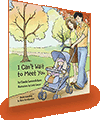
By Claudia Santorelli-Bates
So No Wonder Publishing, 2010
ISBN 978-061531935-3
30 pages, hardcover, $15.99
Reviewed by Molly Remer, MSW, CCCE
Written by a mother of three, I Can’t Wait to Meet You is a story book for children designed to explain in vitro fertilization (IVF) in simple terms. The American Society of Reproductive Medicine has an official position that children conceived via IVF have the right to “full disclosure” of their origins. I confess to wondering if by this logic all children have a right to “full disclosure” about their conception story (!), but, regardless, for children conceived via IVF, I Can’t Wait to Meet You makes the origin story easily accessible. (The author of the book has an article available explaining why disclosure is important available here.)
Colorful cartoon illustrations and basic language tell the story of a couple who longs to have a baby and eventually goes to a doctor for help. Eggs are taken from the mother and sperm from the father in hopes that they “like one another and become an embryo.” The illustrations are friendly, appealing, and fanciful (for example, the embryos are shown resting in little beds before being put back into the mother’s tummy).
The book ends with the couple pushing their toddler in a swing at the park and with the lovely affirmation, “you were so wanted and loved long before we met you.”
I Can’t Wait to Meet You would be a nice addition to the personal libraries of families who have struggled with infertility and who would like to share a piece of their journey with their own “little miracles.”
—
Disclosure: I received a complimentary copy of this book for review purposes.
 Talk Birth