Archives

Affordable Fetal Model

Two things to know about me:

1. I love dolls.

2. I love bargains.

For quite a while, I’ve wanted a realistic baby model to use in my birth classes. My ideal model could be used both for demonstrations of fetal positioning in the pelvis and also for demo’ing newborn care and possibly breastfeeding. Most fetal models sold by CBE supply companies range from $60-150. I usually use a Bitty Baby doll to demo newborn care and breastfeeding (a third thing to know about me is that my love of bargains makes an exception when it comes to American Girl dolls. I have an embarrassing number of AG dolls and vast quantities of accessories. I’ve had this Bitty Baby for over 10 years, I didn’t buy her to use in class). In my knitted uterus, resides a cute little baby doll I bought at Target for $5. Neither of these dolls works at all for fetal positioning or with my demonstration pelvis.

Look at this cute baby!

So, imagine my delight when I found a nearly perfect model newborn at Kmart yesterday while my son was picking out his birthday presents. I named her Sasha AND, get this, she was $20. In a bonus twist, unlike 99.9% of the dolls in the store, she did not come with a bottle! (There is a bottle pictured with a different doll on the back of the box.) She did come with a little cloth diaper, a onesie, a band to cover her cord stump (yes, she seems to have one, but it could just be a dramatic “outie”!), a little outfit, a hat, and socks. Called La Newborn (nursery doll), she is made by Berenguer.
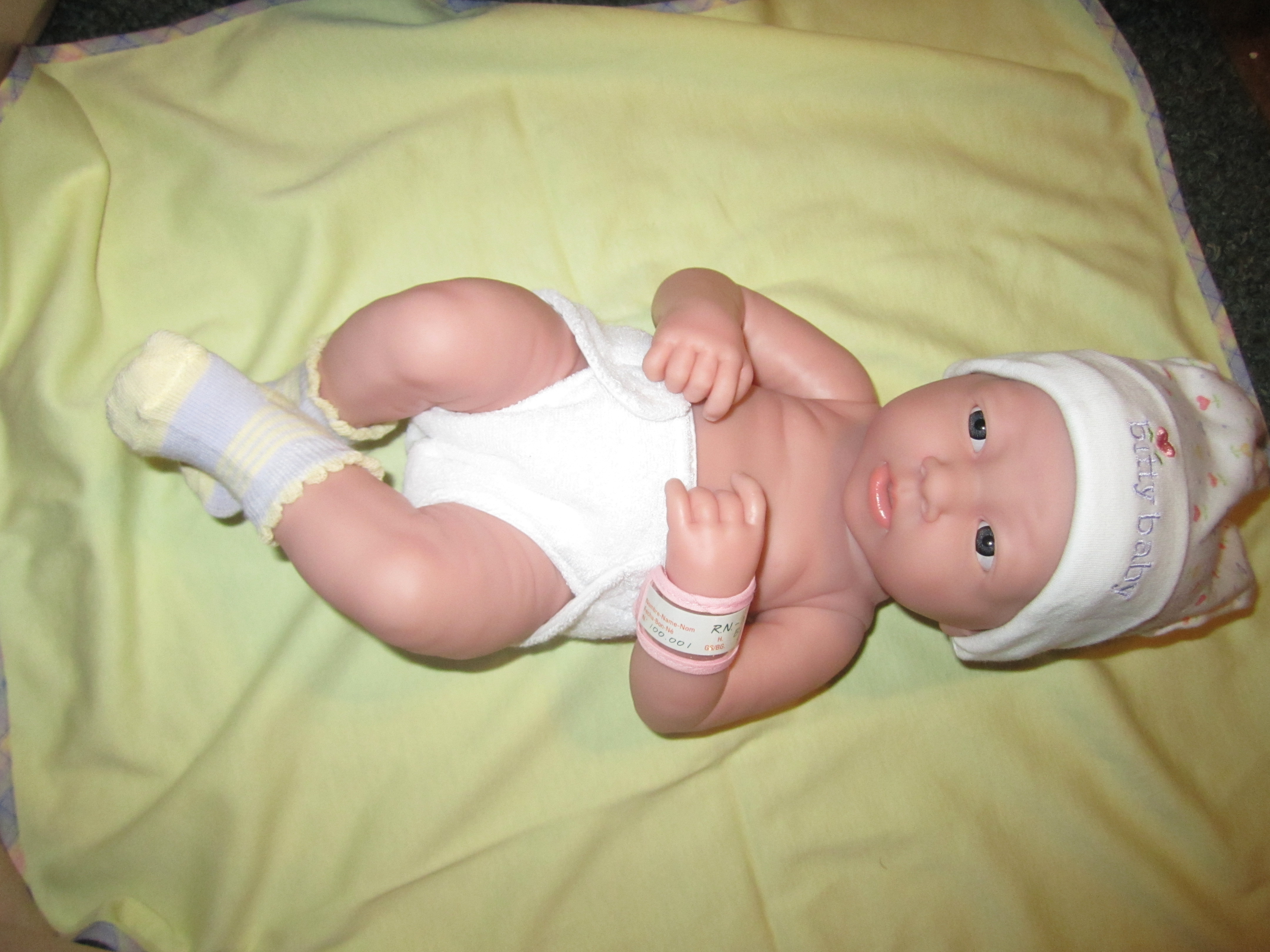
Legs and arms straightened out a little

The only drawback is she is not very flexible and so would be hard to use comfortably for things like practicing putting on diapers. Her fairly flexed permanent body position does make her absolutely ideal for use for fetal positioning and even for swaddling or babywearing practice. I originally planned to take her arms and legs off to fill with plastic pellets to add weight, but I’d don’t think I’m going to bother. While nothing near the weight of a real baby, she is made from good quality vinyl.

After looking these dolls up various places online, I’m now thinking I should have bought the remaining one or two that they had at K-Mart. They don’t seem to be widely available for the $20 price.

This morning, my older son helped me take all kinds of pictures of my new toy—I mean, teaching aid!—today (yet another of the many benefits of having an 8 year old in the house!). So, this is a photo-heavy post!

See what I mean about well flexed for fetal positioning information?!
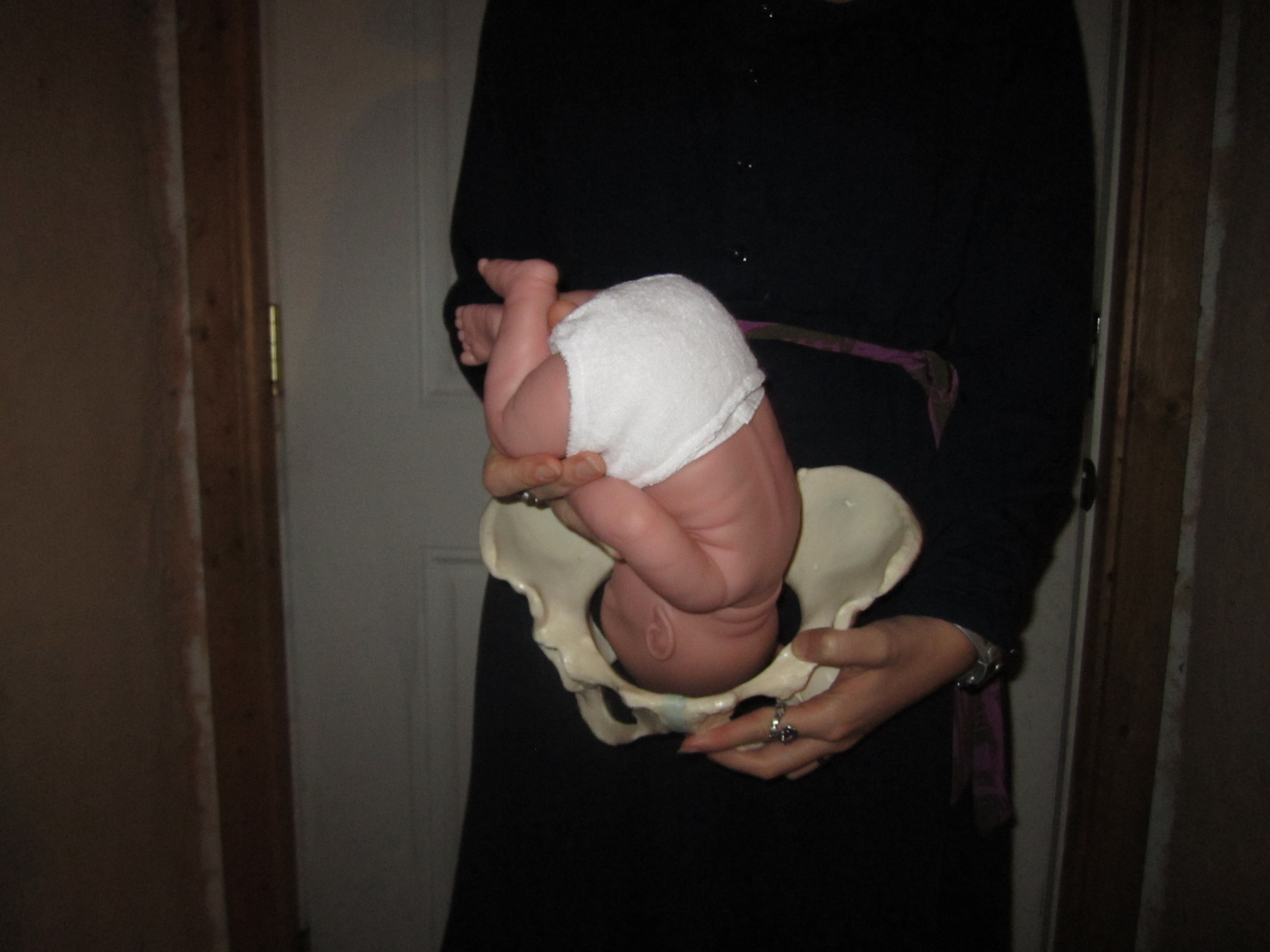
And now my Christmas pelvis gets in on the demo…
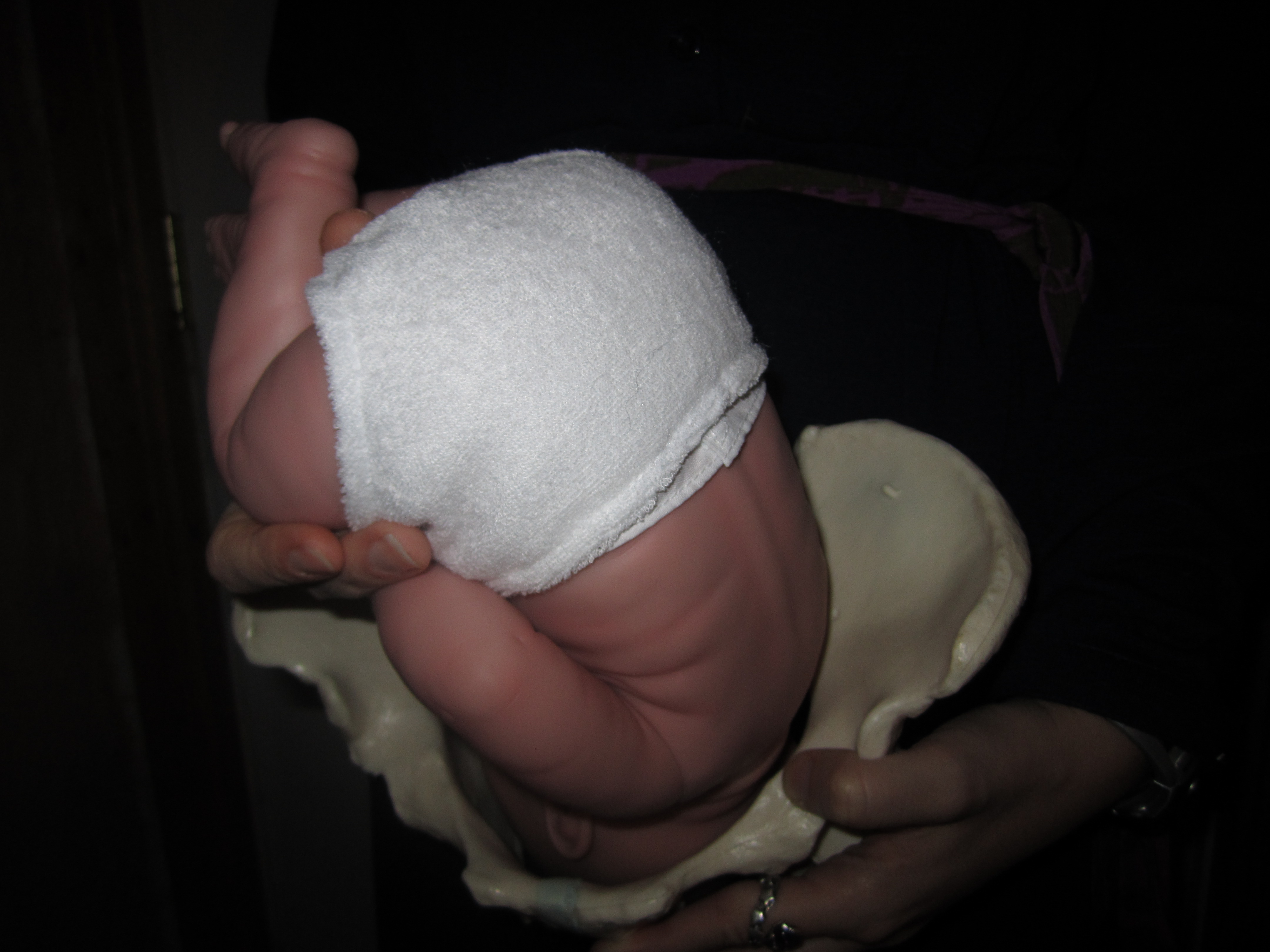
If the demo pelvis had a coccyx joint, the baby would fit perfect through. As it is, her head does get stuck on it (good teaching moment about the importance of active positions for birthing!)

Bitty Baby Noelle and Target Baby are less than impressed with this interloper…

Alaina helps take care of baby Sasha…
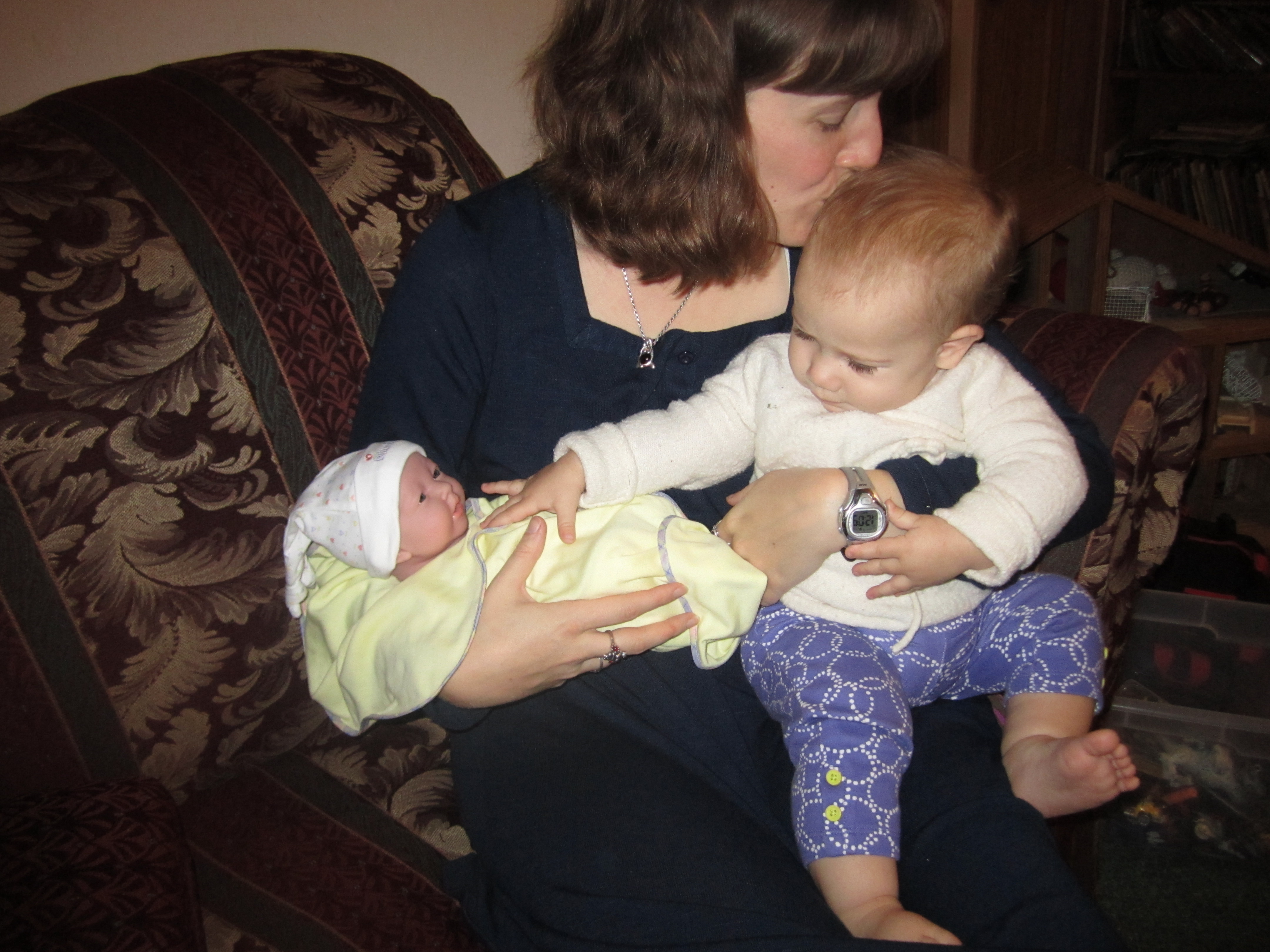
For sizing purposes—while I think she appears to be the perfect, realistic size when held up to my belly as a fetal model for positioning, when held in arms, she is more the size of a preemie baby (maybe a 31 weeker or so). She is about 15 inches.
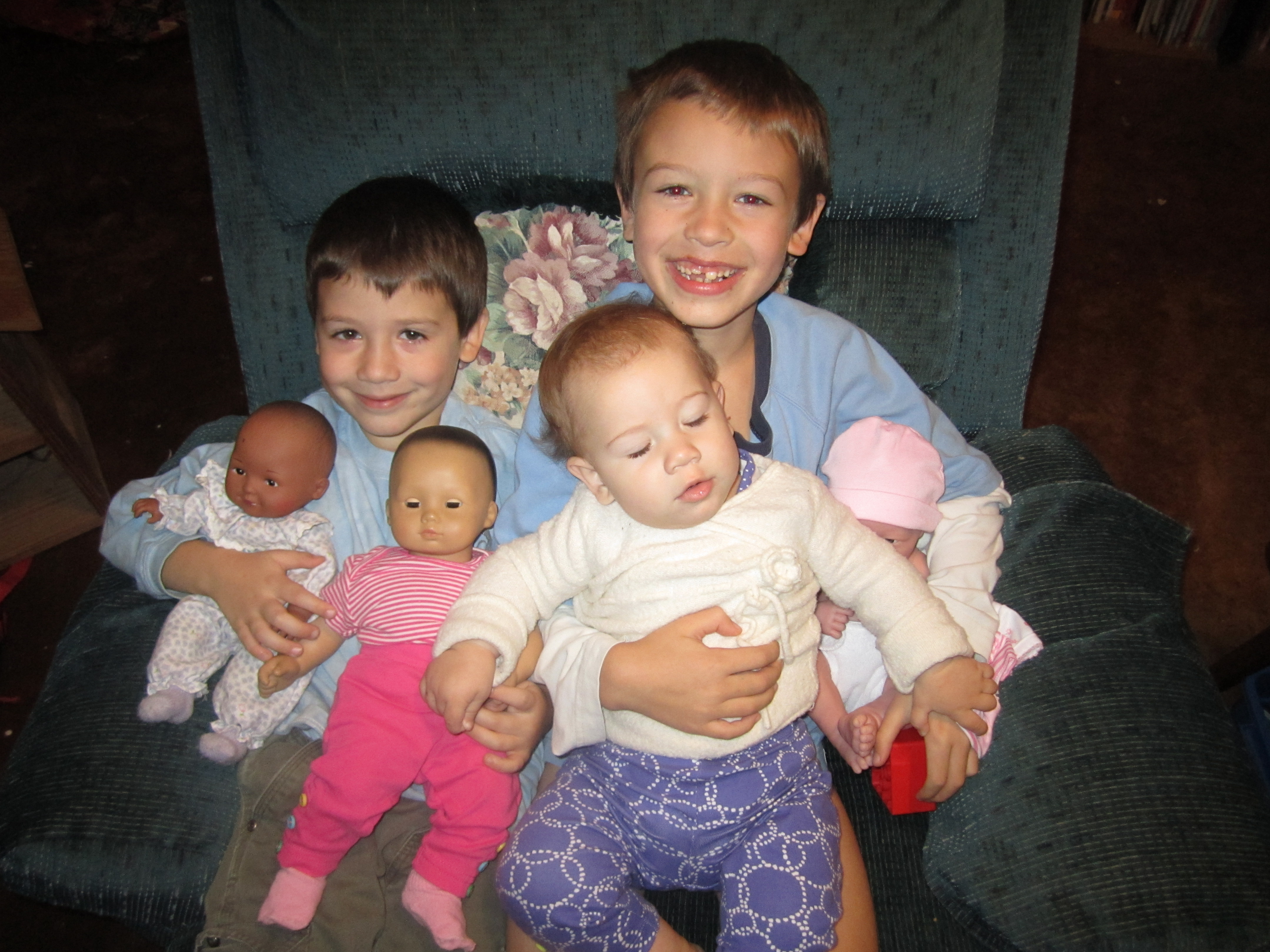
Lann wanted me to take this one—“make them guess who’s the real baby!!!”—conveniently, Alaina closed her eyes for this picture, making identification of the real baby even trickier…


Edited to add, Baby Sasha later experienced an unfortunate accident and had to be replaced. See Fetal Model Update post for pictures.

Book Review: Doulas’ Guide to Birthing Your Way

Book Review: Doulas’ Guide to Birthing Your Way
Authors: Jan Mallak & Teresa Bailey, 2010.
ISBN: 978-0-9823379-7-4
$15.37 – $21.95, 188 pages, softcover
Hale Publishing: http://www.ibreastfeeding.com/

Reviewed by Molly Remer

Geared towards pregnant women, Doulas’ Guide to Birthing Your Way is written in a simplistic manner using short, direct sentences. While in some ways this approach makes the information readily accessible, it can also feel unsophisticated in places. However, while the writing style is basic, the content is not. The Doulas’ Guide is a book that really “goes beyond” the information traditionally offered in birth preparation books, covering topics many parents typically may not have considered prenatally such as natural birth vs. birthing naturally, physical comfort preference styles, visualization, being a savvy consumer, blessingways, and taking pictures of the placenta. The information is refreshingly practical and hands-on. Chapters cover the critical importance of the human environment, “five arms of doula support,” birth preparation, one chapter for each stage of labor including separate chapter for immediate postpartum, a section about cesarean birth and VBAC, and a breastfeeding chapter.  There is an excellent section on postpartum care including a PPD symptoms chart. I was a little taken aback by a blithe comment, “Just think of it as an alternate birth route!” regarding cesareans.

Doulas’ Guide contains good, helpful snapshots throughout the text. Dads will like the plethora of labor support skills and ideas and the accompanying photographs. The book advocates preparation of a “birth vision” and includes examples at the end of the book (including cesarean birth options).

The variety of checklists, key questions, tables with reference information, bullet points, and pictures keep the pace of Doulas’ Guide to Birthing Your Way snappy and digestible. This book covers lots of ground and packs a lot of information into under 200 pages!

—–

Disclosure: I received a complimentary copy of this book for review purposes.

Haumea: The Divine Midwife


“Haumea, a Polynesian Goddess, was credited with teaching women how to give birth by pushing their babies out from between their legs. Before this, folklore claims that children were cut from their wombs, extracted by knife like a pit from ripe fruit. Thanks to Haumea, women were able to forgo this dangerous passage.” –Kris Waldherr, Goddess Inspiration Cards

Reading this, I felt like women need to “meet” Haumea again. Perhaps modern midwives, doulas, and birth educators are Haumeas on earth, reminding women that they have the inherent power and capacity to push their own babies out from between their legs, rather than having major surgery.

After reading about Haumea and thinking about my own births, I felt inspired to make yet another figure in my birth art series. I’m experimenting with new types of figures lately and made this catching-your-own image:


You will safely give birth to something powerful.

Birth Quotes of the Week!

Fabulous crocheted goddess from my mom as a blessingway gift 🙂

“One thing you can depend upon is that your birthing with be powerful! Powerful pressure, powerful stretching, powerful pushing sensations and intense joy. Expect these powerful sensations and emotions, appreciate them for what they are; they bring your baby to you.” —Hypnobabies (Official)

‎”Birth is one of the most profound teaching experiences life offers. It touches us in the depths of our souls, the most private recesses of who we are. It requires that we respond with more creative energy, more conviction, more trust, than almost anything else we do. Birth requires an intensity that is rarely demanded by other experiences…And through it, we can learn more about ourselves, our strengths, our weaknesses, our relationship patterns, and our needs than through almost any other experience we will face in our life.” ~Nancy Wainer Cohen (Via: Peaceful Birth Project)

“We need to take care with every message we deliver to women about birth, and ensure that each message honors the fact that every woman at every moment is making the best decisions she can for herself and her child, with the information she has. And the truth is…that can take a mountain of strength.” – Melissa Bruijn and Debby Gould (in Pathways to Family Wellness Magazine via Birth True Childbirth Education)

“…if every midwife was able to work in the way that midwifery was originally intended, the modern doula’s role might be very different–with an increased focus on practical and physical measures perhaps, and much less requirement for advocacy and counseling.” –Adela Stockton (New – Gentle Birth Companions: doulas serving humanity )

“…I have noticed that the subgroup of women who tend to choose [homebirth] often exhibit certain characteristics, such as comfort within their own bodies, a desire to have a birth experience that is more poetic than clinical, as well as a desire to return what we all feel is some seriously missing humanity to the experience of having a baby…” –Cara Muhlhahn

‎”It seems as if the birth is a story waiting to be played out, and the midwife is but one character in the play…There are many lessons that we all learn from birth…Not only do the woman and her family learn from the experience, but the midwife learns and understands, with more depth and clarity, the mysteries of life from each birth.” –Janice Marsh-Prelesnik (The Roots of Natural Mothering)

“Birth is a mystery, and you never know what’s really going to happen – but if you don’t reach for the stars and plan to have the very best, you’re unlikely to get it. It’s important to have a vision for your birth and to work toward that vision.” ~ Suzanne Arms (via ICAN of Nashville)

Book Review: Gentle Birth Companions

Book Review: Gentle Birth Companions: doulas serving humanity
By Adela Stockton
McCubbington Press, 2010
ISBN 978-1-907931-00-0
104 pages, paperback, £13.00 (worldwide)
http://www.adelastockton.co.uk

Reviewed by Molly Remer, MSW, ICCE, CCCE
https://talkbirth.wordpress.com

Gentle Birth Companions is the first book “written about the doula movement beyond the US” and as such it was a fascinating read. I hadn’t realized how ethnocentric my own perceptions were about the role and history of doulas and I previously assumed that the “doula movement” was essentially synonymous with the “doula profession in the US.” Not so! Indeed, Stockton discusses the way in which in the US, doula professional organizations strive mainly to be acceptable to the medical community, whereas in the UK the doula operates outside of (or parallel to) the medical system. And, she provides an interesting analysis as to whether doulas should be referred to as “professionals” in the first place (this is also due to a difference in what the word means in the UK compared to the US). She expresses several criticisms of certification or even of specialized training programs, feeling that professionalization builds additional, unnecessary layers of bureaucracy into the maternity care system and that the role of a doula should be the role of a lay woman. She also posits that the role of doula actually represents a return to the role of traditional midwifery—what midwifery was supposed to be and has now become removed from politically, socially, and culturally.

Gentle Birth Companions is divided into three sections. In the first, Grassroots, it explores the origins of the doula, the 21st century doula (including doula preparation and training), the UK “brand” of doula, and the wider doula community (thoughts about a global movement and also about doulas in the developing world as well as the industrialized world). The second section, Guardians of Gentle Birth?, explores the doula’s role both antenatally and postpartum and the return to “traditional midwifery” represented by the role. In the third section, Doula Tales, some UK doulas share birth stories , experiences, and thoughts in their own words.

Gentle Birth Companions is an excellent look at the “politics” of the doula movement and the professionalization and motivations of such, as well as at the role and purpose of the doula in women’s lives.

Disclosure: I received a complimentary copy of this book for review purposes.


Birth Quotes of the Week

“…a tenderness for the past, courage for the present, hope for the future….a fervent wish that every cup may overflow with blessings rich and eternal, and that every path may lead to peace.” (adapted from a quote by Agnes M. Pharo)

Happy New Year!

“Understand that the tremendous energy going through you during birth is the same sort of power as the force of ocean waves moving towards shore. Know that just as a bird knows how to build its nest, and when to lay its eggs, you too will build your birthing nest…” –Janice Marsh-Prelesnik (The Roots of Natural Mothering)

“Open hearts, strong hands. Be present, listen, feel her, trust your instincts. And remember–I have birthed my children…she will birth this child her way, with her power, be with her and let her feel your faith in her.” –Jennifer Walker (quoted in Adela Stockton’s new book, Gentle Birth Companions)

“We are living in a time where many birth peeps start out in passionate service to birth work, inspired by a Calling. But without elders to harness that passion and slowly cultivate it to grow a strong inner container so the new birth peep can learn to hold the psychic power of birth, the hard work and… unrealized dream of making a difference gradually morphs that passion into keeping a job or career…” (from Pam England’s blog post about Where are the Birth Grandmothers…)

‎”Doulas are just women who really, truly care about other women, on a major level.” –Linda Quinn (quoted in Adela Stockton’s new book, Gentle Birth Companions)

“Childbearing integrates a woman’s mind and body in the most intense way and brings on an existential crisis. However, this crisis is instructive rather than destructive. It forces a woman to rethink the meaning of her life, and to deal with the imminent, inevitable changes of lifestyle and family roles.” –Elizabeth Noble (Childbirth with Insight)

“Do not force nature, do not insult it, for it is as if you were to open the ears of corn to make the stalks grow.” –Chinese Medical Review (1852) (via Lamaze International e-newsletter)

‎”Every pregnancy and birth has something to teach us. Every one is important. Every mother and baby deserve whatever is truly best for them with respect and dignity.” —Preparing For Birth

“The more pregnancy is lived like an illness, the more it becomes in itself a cause of illness.” -Michel Odent, MD, Birth Reborn (via Mothering Magazine e-news)

“I used to have fantasies…about women in a state of revolution. I saw them getting up out of their beds and refusing the knife, refusing to be tied down, refusing to submit…Women’s health care will not improve until women reject the present system and begin instead to develop less destructive means of creating and maintaining a state of wellness.” ~A Woman in Residence, Dr. Michelle Harrison (Delightful Pregnancy & Birth)

“It is necessary for some women to risk total reclamation, to risk the direct and intentional use of power, in bold, even outrageous ways. It takes only a minority of women to alter present reality, to create new reality, because our efforts are more completely focused, more total.” –Barbara Starrett

‎”Please, choose your birth attendant and place of birth carefully. Search hard for the attendant that you connect well with. You and your baby deserve to be treated with utmost respect and dignity. There are attendants who believe in the sacredness and sanctity of birth. You may, however, need to act as a detective to find them.” –Janice Marsh-Prelesnik (The Roots of Natural Mothering)

“I know myself linked by chains of fires,
to every woman who has kept a hearth.
In the resinous smoke
I smell hut, castle, cave,
mansion and hovel,
See in the shifting flame
my mother and grandmothers
out over the world.”
–Elsa Gidlow (quoted in The Politics of Women’s Spirituality)

Posted in honor of the Winter Solstice.

Product Review: Intelligender Gender Prediction Kit

Product Review: Intelligender

Available at large retailers including Walgreens, Target, CVS/Pharmacy, and Rite-Aid, and online at www.intelligender.com
$34.95

Reviewed by Summer Thorp-Lancaster

I was excited to get home and test out the Intelligender Gender Prediction Test.  My husband and I are not having an ultrasound to find out the sex of our baby, so when asked if I wanted to test/review, I said “Sure!”

I very carefully opened the package and was shocked to see what appeared, at first glance, to be a huge list of very detailed instructions.  Upon further inspection, though, I realized the instructions were actually very simple and well laid out.  Of important note are the several warnings that women who are dealing with Polycystic Ovarian Syndrome or those who have used Progesterone in the last ten days should NOT use this test, as they will most certainly receive a BOY result.  Also of note is the recommendation to avoid intercourse for 48 hours prior to taking the test or else a BOY result will most likely occur (thanks to husband for being such a good sport).

All in all, I found the directions laid out clearly and easily followed them to an easy to read result.  According to the company, laboratory trials averaged a 90% accuracy rate.  The website includes a Sample Results page, where you can compare your results with others to verify.  I do suggest that mothers with toddlers lock the bathroom door, as my two year old found the canister fascinating and had to be held back from touching.

Unfortunately, we’ll all have to wait until March or April to find out the accuracy of my BOY result.  🙂

Pictures & Doulas

I am buzzing with topics to write about, but this week is finals week and I have been really busy with grading papers, tests, and dealing with last minute student issues and requests and blogging keeps slipping down in my possible options for the day. I also have two more giveaways to set up! So, I thought I would share some more pictures from my recent photo session. You may also notice that I have a fabulous new header for my website 🙂

And, here is the one I chose to use on my Talk Birth Facebook page:

I’m pleased as can be with them 🙂

Today I had a visit with my doula for this birth. I am completely confident in my birthgiving abilities and prefer to be nearly alone while birthing my babies (husband only), but I do also feel a deep need for immediate postpartum support. I am very capable at birthing my babies, but afterwards I am wiped out. Indescribably so, really. I’ve toyed with thinking that maybe this is an issue I can “get over” and I could take a mind over matter approach to dealing with, or, is planning for the wipe out I’ve experienced three times before just good, practical, realistic sense? So, my plan with her is for just that—for her to arrive shortly after I’ve had the baby and to quietly walk around in the background washing the bloody towels. This sounds like a good plan to me 🙂 I also have “blood” issues that I’ve touched on before and so I made a “don’t look down” plan for post-birth trips to the bathroom. With each baby, when I go to use the bathroom, I look down to wipe/clean up and then become woozy/light-headed/ringing in my ears/can’t see any more and start to “go under” (though I’ve never actually fainted in my life). But, then when I get back to my “nest,” I feel okay again. (Same thing happens if I get my blood drawn or get an IV, so it doesn’t seem to literally be related to blood loss, but to a mental issue with seeing blood.) So, this time I’m going to make a plan not to look down! It felt really, really nice to have someone paying exclusive attention to me, my baby, and my birth plans—the focused, concentrated time that is hard to find space for in the midst of other kids and responsibilities.

Tomorrow I am going to a mother blessing ceremony for a friend. I’m looking forward to it—they are always special!

Book Review: Understanding the Dangers of Cesarean Birth

Book Review: Understanding the Dangers of Cesarean Birth: Making Informed Decisions
By Nicette Jukelevics
Praeger Publishers, 2008
ISBN 978-0-275-99906-3
264 pages, hardback, $49.95 (or $40.96 via http://www.icea.org)
http://www.dangersofcesareanbirth.com

Reviewed by Molly Remer, MSW, ICCE, CCCE
https://talkbirth.wordpress.com

Intended to be a comprehensive resource for both consumers and birth professionals, Understanding the Dangers of Cesarean Birth is an in-depth look at the incidence and impact of cesarean birth on mothers, babies, families, and society as well as an overview of prevention strategies. The final section of the book is about “why normal birth matters” and addresses changing the status quo. The Midwives Model of Care is reflected and promoted during the book and doulas also receive strong support.

I have two primary opinions of the book: The first is that I truly believe that Understanding the Dangers of Cesarean Birth should become the “go to” book for current, evidence-based, thorough information about cesarean birth in the U.S. It is a treasure trove of information and any birth professional would be well advised to have a copy on their bookshelf. The second opinion is that the “heavy” subject, extremely in-depth information, academic writing style, and relatively high price, will likely keep this book out of the hands out of its primary intended audience—the consumer. The person who most needs to read this book is the first-time pregnant woman. However, the entire time I was reading it, I kept thinking that there was only a slim likelihood of the average first-time mother being attracted to, or actually picking up this book, to read.

Mothers planning VBACs or seeking to understand their own cesarean birth experiences will probably find Understanding the Dangers of Cesarean Birth to be a valuable resource. Birth activists will find clearly articulated and important information that they will wish to shout to the rooftops and I think that this is how the content in Understanding the Dangers of Cesarean Birth has the best chance of truly reaching the women who need to hear its message.

Disclosure: I received a complimentary copy of this book for review purposes.

Guest Book Review: The First 8 Days of Being a Mom

The First 8 Days of Being a Mom

By Gea Meijering

iCare Press, 2008/2009

Softcover, 77 pages, $14.95

ISBN: 978-0-692-00009-0

http://www.thefirst8days.com/

Reviewed by Summer Thorp-Lancaster, http://peacefulbeginnings.wordpress.com

The First 8 Days of Being a Mom is an English language translation of a manual given to new moms in the Netherlands, the Kraamwijzer.

For many moms, the initial magic of new baby is quickly overshadowed by the realization that this tiny person is entirely dependent upon them for everything.  This is can be especially true for women who give birth in the hospital, where the sense of being totally alone and responsible hits hard upon returning home.

This book is intended to help moms know what to expect in those first chaotic days after baby’s arrival.  It includes space for journaling/record keeping each day.  At only 77 pages, it is an easy carry along for those birthing in the hospital.

I liked the inclusion of midwives (they are the main care provider for pregnant women in the Netherlands) doulas and home births, which are still scarce in “mainstream” publications here. The author has carefully mentioned both vaginal and cesarean births, which makes this book appropriate for anyone.  It concisely and clearly covers such basics as bathing and feeding, including both breast and bottle, with pictures to help further understanding.  There is also a strong emphasis on asking for help when needed, which is essential in the first few weeks and months.

Some of the downfalls of the book include the choppiness that comes from translated texts, no bed sharing information and somewhat inaccurate sleeping information, as well as a strong reliance on “call the professional” instead of self-knowledge.  I found this last bit extremely difficult to swallow as I feel it is important for new mothers to trust their knowledge as primary with a “professional” as the secondary opinion.  In my opinion, no one knows baby better than mama (except maybe daddy!).

Overall, this book would make a nice quick-reference guide for first time moms or refresher for veteran moms.  The inclusion of the journaling pages moves it into keepsake material, which balances out the somewhat hefty $20 price tag. [editor’s note: special price currently on website is $14.95]

Disclosure: a complimentary copy of this book was received for review purposes.