Archives

Strong Mothers (& Birth Network Resources)

“Birth is not only about making babies. Birth is about making mothers – strong, competent, capable mothers who trust themselves and know their inner strength.” –Barbara Katz Rothman

This classic quote from Barbara Katz Rothman sums up the potent impact of the birth experience on women’s lives and it seemed like  perfect quote to kick off the website of the Rolla Birth Network that I founded with my birth advocate friends and colleagues. We believe that strong, healthy babies, vibrant families and resourceful communities begin with strong mothers. We chose Strong Mothers, Strong Babies, and Strong Community as our tagline because we believe that when women dig deep into their inner strength, everything else follows. We also chose this as our tagline because it reflects the conviction that women have already got it. They have the inner wisdom and the strength they need. While outside professionals and resources can be tremendously helpful, she’s already got what it takes within her, we may just be a part of helping her to access the strength she already possesses.

We agree with doula and birth educator Heather McCue who said: “The whole point of woman-centered birth is the knowledge that a woman is the birth power source. She may need, and deserve, help, but in essence, she always had, currently has, and will have the power.”

On a related note, Holly Kennedy raises this question in her guest editorial in the spring 2011 issue of The Journal of Perinatal Education:

What “matters” in birth is complex, extremely hard to quantify, and will vary from one person to the next…I found myself contemplating what matted most in my ability to support women in birth so they could emerge from the process as strong, healthy mothers. I believe we have collectively lost our way over time about this outcome—the strong mother. The mother’s experience of childbearing, which will affect her forever, can directly influence her future as a mother. How do we address this as a discipline?

Yes, the strong mother. This is what is about. The strong mother who feels capable and competent in the mothering of her newborn and of her infant as it grows.

Another favorite quote about the strength of women:

“Women are strong, strong, terribly strong. We don’t know how strong until we are pushing out our babies. We are too often treated like babies having babies when we should be in training, like acolytes, novices to high priestesshood, like serious applicants for the space program.”

Louise Erdrich, The Blue Jay’s Dance

It is also important to note that we believe that strength is found in all kinds of birth experiences from the triumphantly empowered to the extraordinarily taxing and even traumatic. (Previous post about Birth Strength and the quote above.)

So, speaking of birth networks. One of the things that I’ve been excited about working on now that I am not actively teaching birth classes is on projects for our local Birth Network. I’ve wanted to do something like this for ages, feeling excited about the potential and momentum created by bringing multiple people together to collaborate on projects that make a difference in our community. We have some great ideas planned and I feel rejuvenated and enthusiastic after every meeting.

Here are some resources on forming a birth network in your own community:

Tools, Tips and Resources for Birth Networks

Birth Network National Resources

Programs from Athens Birth Circle

Some time ago a follower of this page, Nora from Happy Within, posted to let me know that she hosts a virtual birth circle for mothers. She describes it thusly: “the birthcircle is a virtual community which is a sacred women´s circle about conscious pregnancy and birth and its free. You can get details here: http://happywithin.wordpress.com/your-birthcircle/.” You can also keep up with her work on Facebook.

A Virtual Mother Blessing for Molly Westerman!

20120410-102111.jpg

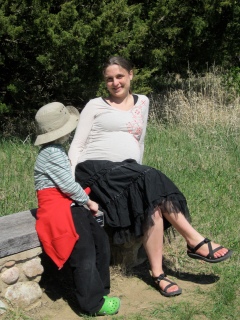
I spy...a pregnant woman ready for some honor and celebration!

In 2007, I started blogging for Citizens for Midwifery and one of my favorite blogs was a little gem then called Feminist Childbirth Studies. The blog’s author, Molly Westerman, later became more public with her blogging identity and began writing her current blog, First the Egg, a feminist resource on pregnancy, birth, and parenting. I enjoy her thought-provoking writing, her insight into birth culture and politics, and the glimpses of her family’s life in a nonsexist home. She’s smart, funny, interesting, and she’s also pregnant with her second baby and due any time now! I think every mother deserves a blessingway or mother blessing ceremony and I’m pleased to hostess a virtual blessingway for Molly. There is a tight turnaround since her anticipated birth time is so close, so if you read this and think, “I’d like to do something…” immediately stop thinking and just DO IT!

During my last pregnancy, Molly offered multiple supportive comments in response to my various musings, anxieties and fears as a pregnancy-after-loss mama (even though she didn’t have personal experience with PAL, she did know the right things to say!) Her comments, particularly one about the fact that I was doing this, meant a lot to me. I’ve now followed her current very physically challenging pregnancy with interest and long-distance support/rooting her on as she prepares for the homebirth of her new baby this month. I’m happy to have the chance to offer her a little more encouragement and love through this virtual mother blessing.

Here’s how you can participate:

Email me with your…

  • Words of support, affirmation, encouragement for Molly–either written or recorded (think about what you’d say face-to-face at a ceremony and then, if you have a smartphone, use the handy dandy microphone tool and talk into as if you were speaking directly to Molly in a mother blessing circle. After your voice memo is recorded, choose “share” and send it to me!)
  • Favorite birthy readings/poems/etc. (again could be written or recorded)
  • Birth art (i.e. a picture of something you drew, or you can mail Molly an actual drawing–see below).
  • Beads or charms for a birth bracelet/necklace–if you’d like to do this, email me for Molly’s address and then mail it now, so there is a chance she will receive it before the birth. I figure that all postpartum mamas can use ongoing doses of birth power energy anyway, so even if it gets to her post-birth, that’s cool too!

As I mentioned, there is tight turnaround on this, so on Tuesday of next week, I will gather everything that has been emailed to me and send it to Molly as a “blessingway in your inbox.” 🙂

20120410-102118.jpg

Getting closer and closer to birthing day...

If you are curious to learn more about mother blessings, click here to read other posts I’ve written about them.

If birth were a temple

20120408-133552.jpg

If birth were a temple


If birth were a temple
my body is religion, and this small form
twisting out of me,
is
prayer
my cries
reach birth’s vaulted
ceilings,
arching like my back over holy
waters,
crystal clear salt of amniotic
my womb–a blessing bowl
releases
her treasure.

–Nane Ariadne Jordan

I came across this beautiful poem in an anthology of prayers and readings called Talking to Goddess, edited by D’vorah Grenn.

Doulas at Homebirths?

What is a doula?

A doula provides non-medical labor support—all the good stuff like back rubs and encouraging words and suggestions for different positions to help with labor. She does not replace the father’s role, but “holds the space” for both mother and father as they take their own journeys/come into their new roles as parents. In my birth classes, I explain that I think one of the benefits of a doula is that it frees the dad up to JUST be the dad and to live his own experience/journey and not have the pressure of trying to remember all the birth “tricks” and book information.

But, why have a doula at a homebirth?

A lot of women planning homebirths do not feel as much of a need for a doula as do women in the hospital. The midwife is capable of providing many of the same functions as a doula, but she also has the monitoring tasks and baby tasks to take care of, while a doula is just there for YOU. Other things to consider when thinking about a doula for a homebirth are whether or not the midwife will be bringing an assistant and what her role will be if there is one–sometimes the assistant is available to fulfill some aspects of the doula role, other times she is observing or otherwise in training for other tasks. And, also consider how many people who want present at the birth–if you’re already having a midwife, an assistant, and say a mother or sister or friend there, adding a doula too may mean too much crowding.

A couple of months ago, I solicited feedback about doulas and homebirth for an article I was compiling for the Friends of Missouri Midwives newsletter. The full article is available here: Doulas and Homebirth. I had anticipated receiving a number of responses suggesting that doulas at homebirth are unnecessary, or redundant. After all, an emotional connection and secure trust is often the hallmark of what differentiates the midwifery model from the medical model. However, the responses I received were overwhelmingly in favor of hiring a doula for a homebirth. Personally, I very much valued the specific and customized postpartum care my doula provided to me after my last homebirth and I’ve concluded that a doula has the potential to offer something unique and precious to families, in whatever setting the birth takes place. I also think that the doula is the most likely member of the birth team to remain in contact with the family in the future. Perhaps it is because, even given the friendliness of the midwifery model, there is less of a “power differential” between mother and doula.

Personal experiences

The decision to hire a doula is a personal one, regardless of in which setting you give birth. My first baby was born at a birth center with the presence of a midwife, a doctor, my doula, a friend, my mother, and my husband. In hindsight, I felt like it had been too many people and that the doula hadn’t really been needed. For my second birth, at home, it was extremely important to me to have as few people present as possible. My husband, my mom, and my son greeted the arrival of my second son. My midwife arrived five minutes before his birth—just in time to catch! My midwife for his birth was so amazing, that I didn’t feel the need for any other professional care. I still miss her! My third baby was a second trimester miscarriage and he was born at home unassisted and just my husband present. Later, a friend who is a doula was very, very helpful to me with postpartum care/doula stuff. I really wished I had a doula there during his birth for emotional support and supportive physical care tasks (not medical support, but tea bringing and towel washing).

It is the little things that matter--here my doula puts warm socks on me following my baby's January birth (baby and I had special matching birth socks knitted by my mom)

And, finally, with my last baby, while I liked and respected my midwife I didn’t have the same warm bond with her and really wanted to hire a doula again, precisely because I was missing some of the emotional component I value so highly in midwifery care. It is really the little things that make doula care so special (see included photo!). When planning my last birth, I chose to hire the same doula as with my third birth, with the primary purpose being immediate postpartum help (“washing the bloody towels and bringing me tea” is how I define it).

Talk Birth in Labor…

And, speaking of my doula, I’ve been meaning to share this photo for a long time. When my doula had her own baby last April, amongst the wonderful photos that our mutual friend took at the birth, I was tickled to see this picture of my doula looking at my website while in labor:
I think this could be an advertisement for my blog 😉

You can read Summer’s intense birth story here and also be moved to tears by the stunning birth awesomeness of her video slideshow here:

The Midwife’s Role

From midwife Elizabeth Davis’ non-midwifery-oriented book, The 20120404-223722.jpgWomen’s Wheel of Life she explores the archetype of the Midwife and shares this story:

I recently prepared a panel presentation on the topic of “Keeping Birth Normal” for a midwifery convention, and it dawned on me how insidiously the quest for standardization has permeated this sacred blood rite. Gearing midwifery practice to a reductionist, generic view of birth is but a travesty of our time-honored proficiencies, our ancient arts. There is no “normal” birth–each is individual and nonconforming. Childbirth opens an extraordinary spectrum of physical, emotional, and spiritual growth opportunities that is  nothing less than extraordinary, which women should be supported in freely exploring. The Midwife must guard parameters of safety, yes, but she should also encourage women to play their edges, experience deep currents of emotion, discover their own ways of transformation, and chart new creative territory. This is “taming” based not on repression or control but on integration, being in synch and in surrender to one’s true self. Midwives must find ways to make the unseen visible and comprehensible, they must learn to recognize and validate gut instincts, heart feelings, or any other messages coming from the body, and they must translate these perceptions into tangible action and/or words.

I recently reviewed the book More Than a Midwife and the author, Mary Sommers, has a beautiful way of describing the role of a midwife:

Midwifery is about guiding women through the internal and external journeys of their everyday lives. The birth of our children may be without regard to a fixed date and time; the experience of birth is the expression of eternity. Women in labor have the ability to transcend time and space, to regain a deep appreciation of the nature of their internal selves…She…is immersed in a journey of recognizing a part of her that had remained a mystery until this moment…

We long to have our internal and external dimensions integrated. In birth, this naturally unfolds. You do not need to be a spiritual scholar or have a daily practice to gain spiritual growth. A woman only needs to go into the experience and the spiritual journey unfolds. Nevertheless, I have also found that women who live in harmony with nature in their daily existence can access the journey more readily.

Midwifery asks us to truly become at home with ourselves, with nature, and with women. Birth takes us out of our external experiences, our linear timing of progress, and our everyday rituals. In contrast, birth time is measured in a circular movement like the seasons. There are rhythms and patterns. If we let birth unfold with spontaneity and attuned to nature, we will end up appreciating the nature of our souls as well. For women in birth, there exists a duality of time and space. They are present in both the physical and the internal dimensions. Midwives are called to not only be medical providers, but emotional guides, allowing women to get in touch with their innermost selves, the place where the soul dwells.

Both of these passages are beautiful explorations of the multifaceted and relational role of a midwife. I keep thinking I’ll have more time to explore these quotes in a more fully developed post, but I just don’t have room to do it today after all. The piece I particularly like from Davis was about there being no normal birth. I feel the same about the birth profession’s obsession with, “evidence-based care.” I’ve often asked myself, is evidence-based care enough? Do we really need to quantify everything? I think it should be a given that women receive evidence-based care. It is a travesty that it is often, apparently, too much to expect or hope for. I think women deserve loving care, respectful care, humane care, personalized care, beautiful, life-celebrating care. I think evidence-based care sets the standard too low…at obvious rather than profound.

In the second passage, my eye was caught by the phrase, “I have also found that women who live in harmony with nature in their daily existence can access the journey more readily.” Is this true in your experience? I have conflicted feelings about it. Do I live in harmony with my daily existence? My birth experiences certainly reflected a “harmony” with body, instinct, mind, and surrender. But, in daily life, while I certainly live close to nature and view it as sacred and while I choose many practices of “natural parenting” my head is often in conflict with what really is. I often find myself arguing with reality and in a mental state that feels more scattered than harmonious–and, angry with myself for not being more skilled at “surrender.” Luckily, that part neatly shuts off during labor, freeing my body to do the work of birthing with relatively little interference or struggle.

A Blessing…and more…

20120330-222120.jpg

Rue anemone
(next to the house)

A Blessing…

May Women all be treated

as rare and holy flowers

Petals strong and fragile

rise up sacred powers

Giving

Giving

Life its very breath.

–Sarah Blogg

I read this poem in an anthology of women’s prayers, blessings, and readings and it spoke to my heart and to the heart of birthwork, of women’s work, of why I do what I do, and care about what I care about. This is what I wish for women, not just in birth, but in life. I wish for baby girls around the world to be greeted with love and joy, “oh, good! It’s a girl! Another girl! We’re so blessed!” rather than viewed as second class citizens or as property or as burdens or as objects. I wish for the lives and bodies of women to be honored and respected and for their wisdom to be cultivated.

I’m happy to be reviewing a really great book right now called Into These Hands, Wisdom from Midwives. In the introduction is a great quote that makes me think of the above sentiments as well: “Every new member of the human family arrives on Earth through the body of a woman. Each day on our planet, the majority of babies emerge into the hands of a midwife. Since the dawn of time, midwives have been receiving the generations into their hands.” –Geraldine Simkins

Birth culture

For a dozen years now, birth and breastfeeding advocacy have been areas of intense and sustained interest to me. I feel like these are core, basic women’s issues and that women in our present day U.S. birth culture, as well as women around the world, experience significant amounts of devaluation, disempowerment, and even abuse in the medical birthplace. I agree with anthropologist Sheila Kitzinger who said that, “In any society, the way a woman gives birth and the kind of care given to her and the baby points as sharply as an arrowhead to the key values of the culture.” Our current birth culture does not value women and children. Though my focus is usually on the women, it also doesn’t much value men or fathers either. I also agree with Kitzinger’s assessment that, “Woman-to-woman help through the rites of passage that are important in every birth has significance not only for the individuals directly involved, but for the whole community. The task in which the women are engaged is political. It forms the warp and weft of society.”

A popular saying in the birth activist community is “peace on earth begins with birth.” Perhaps it really means, “respecting the birth-givers, eradicates patriarchy.”

Women’s voices & social discourse

In an article by Grassley and Eschiti in summer 2011 Journal of Perinatal Education, they state, “Women’s health research is grounded in women’s voices and experience…’What matters to people keeps getting told in their stories of their life.'” I’ve written before about the value of stories and story power. I would love for us to reach a cultural point in which the most common element found in most women’s birth stories is about their own power, rather than about times in which they experienced distress and victimization. How we talk about birth and about women matters. It matters a lot. Some time ago I read an interesting article by Debra Bingham about Taking Birth Back. It it she asks you to consider–when talking about birth–how your basic assumptions affect your discourse (the way you talk about birth):

1. Does your discourse include stories about the power of women?
2. Or do the stories shift the locus of control away from women and their bodies to other authority figures such as nurses, physicians, or machines?
3. Does your discourse assume that women are physiologically capable of giving birth and nourishing their own children?
4. Or does your discourse assume that women’s bodies are fundamentally flawed and in need of medical attention and intervention?

I frequently attempt to shift the locus of control from “authority” figures back to women–it is shocking to me how ingrained the terminology is about medical care providers (even midwives!), “letting” someone do something, etc.

As I’ve previously written, the prevailing social discourse about birth assumes a locus of control external to the woman and you rarely hear stories about the “power of women” amongst the general public or mainstream media. Ditto for the assumption of women’s bodies as fundamentally flawed, except replace “rarely” with “frequently.” These messages are so dominating that I think it is hard for women to really “hear” positive birth talk–it seems like a “joyful birth” must be a myth or impossible. Likewise, when a woman is striving to keep the birth talk around her positive, it can be very difficult to override the predominately negative messages coming at her from every side. I see this in my classes, “I believe birth is a natural event, etc., etc. BUT….” (followed by a “I trust my doctor’s judgment and if he wants me to have this GTT test or this extra ultrasound to check my fluid level, etc. I guess I will do it…” comment that contributes to the “climate of doubt” in her life). There are also the woman’s own “inner voices” to contend with—I hypothesize that the loudly-shouted cultural voices about birth contribute a good deal to the “negative voice” in her inner dialog.

Women’s stories have not been told. And without stories there is no articulation of experience. Without stories a woman is lost when she comes to make the important decisions of her life. She does not learn to value her struggles, to celebrate her strengths, to comprehend her pain. Without stories she cannot understand herself. Without stories she is alienated from those deeper experiences of self and world that have been called spiritual or religious. She is closed in silence. The expression of women’s spiritual quest is integrally related to the telling of women’s stories. If women’s stories are not told, the depth of women’s souls will not be known. (Carol Christ, p. 341, emphasis mine)

Yes. May we see and hear women. May we witness them in the act of living, of birthing, of struggling, of triumphing. In surrender and in self-doubt. In exultation and joy. May we hold that space for her story. May we listen well and wisely.

Birth Pause…

What was the moment like immediately following the birth of your baby?

Was the baby placed directly onto your chest by a caregiver? Was she pushed into your own waiting hands and gathered to your body? Was he put first into a warmer and then onto your chest? Did a midwife pass him to you after gently receiving him? Did you glimpse her body as she was held over a blue cloth in the operating room? Did you see her whole body, or just the top of her head as she rested upon you? Did she emerge onto a soft landing where you could gaze at her for a moment, integrating the transition from giving birth to mothering, and then scoop her up into your waiting arms? No matter how it unfolded, I’m sure it was unforgettable.

Waiting to inhale…

I greatly enjoyed reading a beautiful guest editorial in The Journal of Perinatal Education by Mary Esther Malloy, called “Waiting to Inhale: How to Unhurry the Moment of Birth,” in which she explores this precious post-birth moment. This moment when mother meets baby, earthside. Malloy notes that for many women, the moment of meeting is “hurried” by the immediate placement of the baby on mother’s chest. Many women are in a brief, transitional state almost like “birthshock” at this moment—it is the moment before the classic euphoria and “I did it!” hits. Mother often has her eyes closed and needs a second to breathe and re-focus on the world outside her deeply inner focus. Malloy began to observe at births that if baby was allowed to emerge gently onto the softness beneath the mother, the mother is able to take a brief pause to integrate the shift from birthing to mothering and then begins to gently explore baby’s body on her own time, her own terms, before gathering it into her arms and to her breast. This occurs in the space of only moments, but they are unhurried, timeless, liminal moments. She notes: “…just as we are now appreciating what occurs when we respect a baby’s ability to find its mother at birth, what I am seeing [with mothers] is heightening my respect for an understanding of our own abilities as women to find our babies at birth.” She suggests that this natural pause marks a center point of a sequence that transforms woman to mother; that finding our babies ourselves brings us forward into a new state of being physically, emotionally, psychologically, and mentally. Malloy refers to this transition point as a moment to inhale—to “exhale” the experience of giving birth and to “inhale” the sight of the new baby and the beginning of a new phase of life.

Malloy does make sure to mention that the moment of birth is “just fine” and “unforgettable” without this “birth pause” and that mother’s chest is most definitely baby’s intended destination, but that she is starting to acknowledge that having her own babies delivered straight to her chest, “feels a lot like an intervention to me. If intervention feels like too strong a word, at least, it now seems like an interruption to what I might have done if no one told me what to do.” She concludes with some thoughts regarding her own upcoming birth:

Exhale and then inhale. Exhale the magnitude of the experience of birth and then inhale the unfolding moments in which I am receiving this child. Life is not one big inhale, one big gulping in of experience. It is the symmetry of exhale and inhale. Just as we breathe this rhythm through our labors, present to one contraction at a time, we can also breathe through our transition to motherhood, finding that moment between states and passing through as slowly as we need…

Personal experiences with the birth pause

Since I recently wrote about two other  “stages” of the birth process that are not widely acknowledged, the rest and be thankful stage and the spontaneous birth reflex, I knew immediately upon reading this editorial that I wanted to explore the birth pause as well. I am curious to know of others’ experiences with it or reflections upon it. I think back to my own immediate post-birth moments with my babies. My first baby was born and immediately placed onto my chest. I remember feeling disoriented, unreal, and dazed almost. It was sort of surreal. He was crying, I touched his back, and then asked him if he wanted “nursies.” It was very spontaneous and gentle and natural feeling, though taking a step back I see that there was not much time for that inhale moment.

When my second son was born, I was on my hands and knees and the midwife passed him through my legs to me as I turned over. When my daughter was born, I pushed her out into my own hands in a kneeling position. What struck me upon reading the editorial was how after my second son’s birth and after the birth of my daughter, though I was holding them, I did not immediately put them up to my chest. I held them low, against my body, near the tops of my thighs. I think my eyes were closed both times, head tilted back and then tipped forward. Then, I looked down at them, explored them briefly, and then gathered them up in my arms and to my breast. Neither was born onto the surface in front of or behind me, but neither was placed immediately on my chest either. My daughter’s birth was the most undisturbed and instinctual, and I distinctly remember looking down at her as I held her low against my body, and then making the decision to lift her higher and into my arms against my breast. With my son, I felt like his umbilical cord was short and that I actually couldn’t lift him higher without tugging it uncomfortably (it wasn’t actually short though and I’m still unclear what this sensation was exactly).

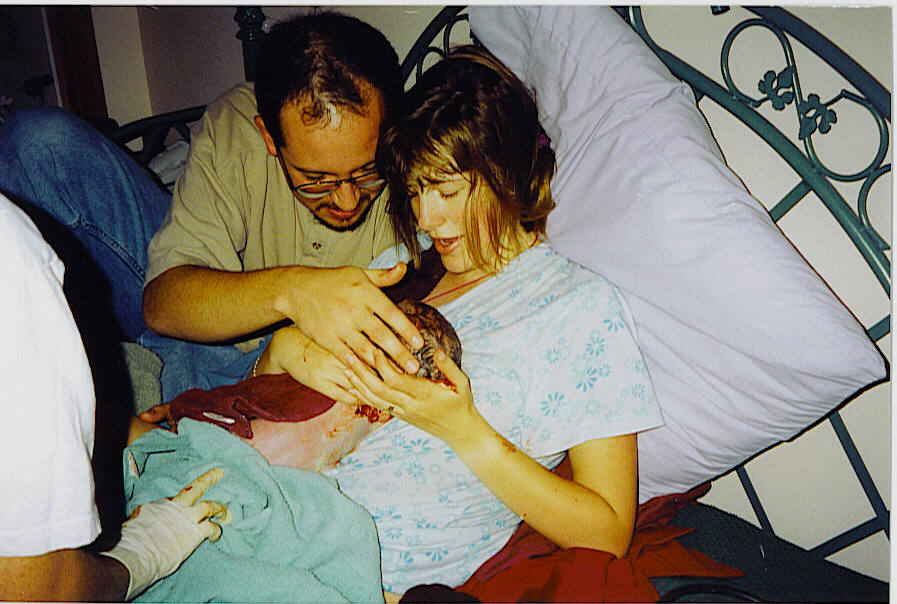
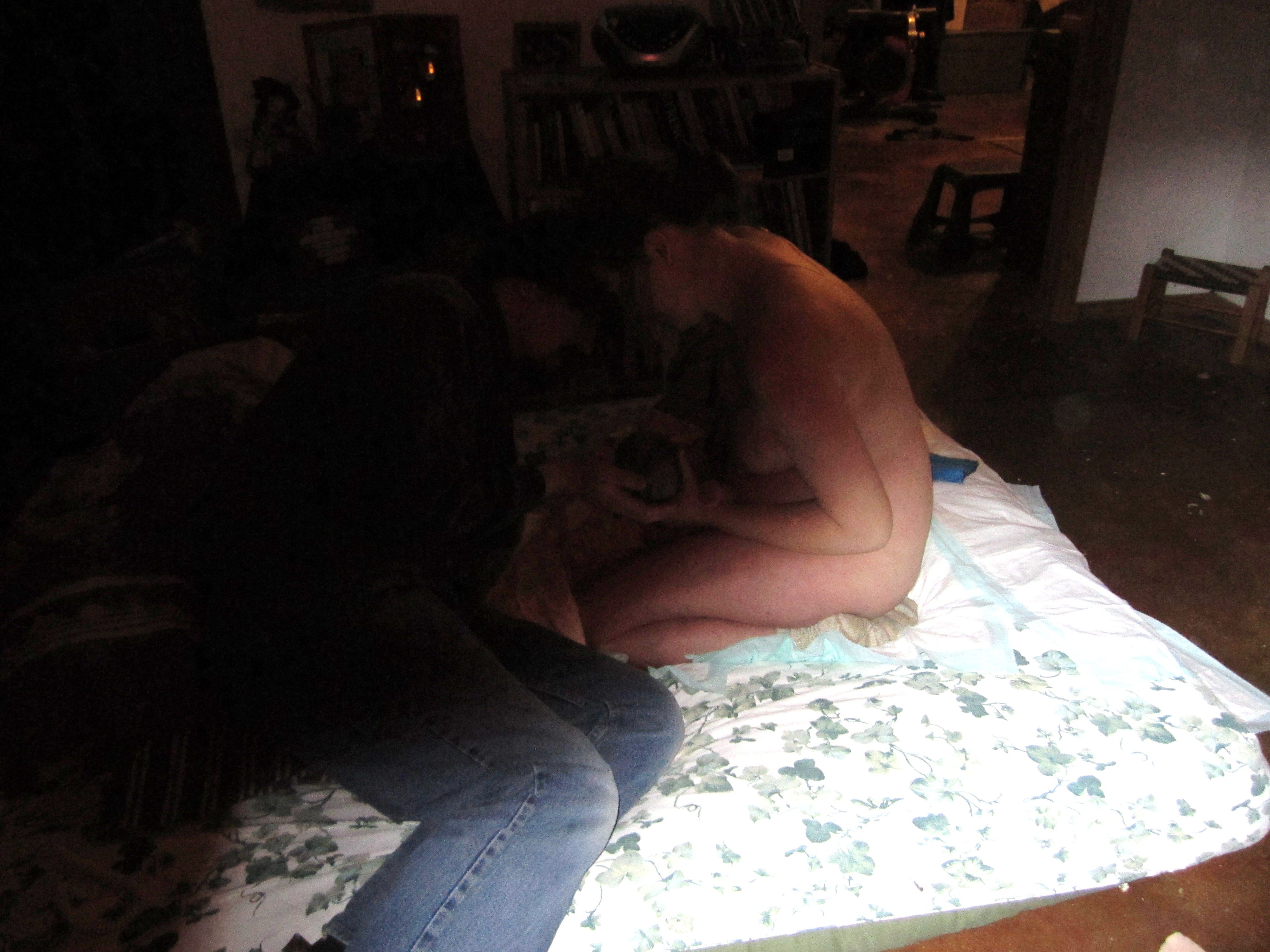
I immediately thought of post-birth pictures of each baby, in this birth pause time:

Immediately after first baby's birth--straight to chest. Main view is of top of his head. Hands tentatively touch/explore.

Immediately after second son's birth. Notice how he's held low down and kind of only with one hand. My eyes are closed and I'm not looking at him yet. In pictures shortly after, I'm looking at him and smiling and I've moved him up to my breast.
(Didn't feel totally comfortable with full breasts shot on my blog, though feel bad to conform to social expectations of appropriateness!)

Immediately after last baby's birth. I know it is dark/hard to see, but note how I'm holding her kind of low down and actually kind of out/away from me (to look at) rather than against my chest.

I actually feel like I see in all of these pictures that birth pause to exhale the birth and then inhale the baby and the mothering of it.

What about you? What was the moment like following the birth of your baby? Did you take a brief pause, a moment to exhale and then inhale? I’d love to hear about it!

A Tale of Two Births

As Penny Simkin has frequently noted: “We can’t control labor, whether it’s hard; that’s a leap of faith. But we can always control how we care for [the mother]” [1]

In 2001 and in 2004, I attended the births of two of my dear friend’s children in the same hospital in a mid-sized Midwestern city.  I was not a childbirth educator or doula at this time, but was there in the capacity of friend and “witness.” Both births were intervention-heavy and not what I would call ideal, natural births; but the feelings were vastly different, which made all the difference.

At the 2007 LLL International conference in Chicago, I picked up several of these great "Listen to Women" buttons from the ACNM booth in the exhibit area. I love them. Isn't this what it is all about? So simple and yet so profound. Imagine how the world would change if we just listened to women.

One had an atmosphere of respect, caring and trust; the other had a “climate of doubt” throughout. The difference was a certified nurse-midwife (CNM). My commitment to homebirth midwifery often leads me to forget what a profound and true difference a caring CNM can make in a hospital birth. All the other hospital procedures can be present, but the care factor a CNM provides can transform a woman’s experience from powerless to powerful. Sometimes I forget how CNMs are poised to bridge the gap between home and hospital effectively. The US needs lots of them (not as subordinate “junior obstetricians”—but as expert guardians of normal birth in a hospital setting).

The details were similar in each birth. The babies were both almost 9 lb; a doula was present (same doula in both births); and the mother labored with an IV, spent a large portion of the labor in bed and had internal fetal monitoring. In the first birth (with the CNM), the mother even had several hours of Pitocin augmentation; in the second, with the obstetrician, she had no Pitocin until third stage. With each birth, the mother also had an extensive tear and long repair (a third-degree with the CNM, a second-degree with the obstetrician).

However, some things were very different.

When the mother said, “Can I have a birth ball?” the CNM said, “Yes,” and the obstetrician said, “Not until the baby has been monitored.” And then, “The baby doesn’t like that; you need to get back into bed.”

When the mother’s confidence waned, the CNM said, “You can do it. You are.” The obstetrician said, “I don’t think this baby is moving down.

When the mother said, “This is taking such a long time,” the CNM said, “I know. It is taking for-freaking-ever!” and everyone laughed (including the laboring mother). The obstetrician said, “I think we should consider a c-section based on your history. The baby is not moving down.”

The CNM said, “You have such strong muscles in your legs and bottom, do you exercise a lot? I think because you are so strong, you’re holding a lot of tension here. Try to let it go.” The obstetrician ironed the perineum until the mother screamed with pain.

The CNM waited. The obstetrician did another internal check.

In both, a baby was eventually born (the first after four hours of pushing, the second after a little over an hour). A strong, healthy baby. Vaginally and without pain medications. After the first birth—though she would have done some things differently—my friend felt triumphant, empowered, powerful, strong, capable, happy and proud.

After the second birth she felt abused, disappointed, ashamed, guilty, angry, assaulted, diminished, wounded and scarred.

I believe the CNM’s personality, attitude and basic belief that vaginal birth would work was the critical difference between these two experiences. These births dramatically, viscerally illustrated for me that no matter what else is happening around the birthing woman, we can control how we care for her.

Endnote: My friend went on to have her third baby at home in 2008. She pushed this baby out in fifteen minutes, with no tear, and she shone with her power.

Molly Remer, MSW, ICCE, CCCE is a certified birth educator, writer, and activist who lives with her husband and children in central Missouri. She is the editor of the Friends of Missouri Midwives newsletter, a breastfeeding counselor, a professor of human services, and a doctoral student in women’s spirituality. She blogs about birth, motherhood, and women’s issues at https://talkbirth.me/posts.


[1] Looking to nature, doula Penny Simkin practices the art of delivery, in The Seattle Times, Pacific Northwest Cover Story. Originally published March 23, 2008. Accessed April 27, 2009. http://seattletimes.nwsource.com/html/pacificnw/2004299467_pacificpenny23.html.

This is a preprint of A Tale of Two Births, an article by Molly Remer, MSW, ICCE, published in Midwifery Today, Issue 91, Autumn 2009. Copyright © 2009 Midwifery Today. Midwifery Today’s website is located at: http://www.midwiferytoday.com/

Woman Rising

No time for a long post today (or, probably, this week), so I share this quote I had saved from the book A Dozen Invisible Pieces by Kimmelin Hull (p. 229):

When faced with behavior battles, health concerns, family finances, and the struggle to stretch time to the fullest, I could choose to sink into the quicksand of life with young children–becoming engulfed in the daily grind, unaware of my own loss of self–or I could rise to the occasion. And I am rising.

Hull goes on to share the following:

Whether it be the thick memory of enduring a non-medicated labor and finally pushing our third child into the world, despite feeling as though I hadn’t an ounce of energy left, or the meager sprint I managed as I neared the finish line of the marathon…, I hold tight to these images as proof that I can and will be able to rise to the occasion–again and again, if and when I need to-because the ability to do so is in my very bones. Because I am a woman.” [emphasis mine]

The birth face, immediately following birth of second son. This feeling--this crying, laughing, euphoric, I DID IT, feeling is the one I draw upon in the rest of life.

This is one of things I find so powerful about women’s birth memories—they can hold onto them as a touchstone, as an affirmation of strength and personal capacity, during other challenging (or mundane) moments of their lives. I also don’t think births have to be “empowering,” natural, or unmedicated births in order to hold this affirmation for women. There is a lot of courage to be found in most birth journeys and the ability to find moments of powerfully conscious strength to draw nourishment from in the rest of life exists in many types of birth experiences. Personally, my birth experiences created a lasting sense of personal worth, that I have drawn from ever since. This includes the birth of Noah, which was not a “happy ending” to my pregnancy. In the months after his birth, I found myself at many times thinking, “I gave birth to my little, nonliving baby alone in my bathroom, I can do this too.” I did the same with the births of my other two boys—only thankfully without the “nonliving” part. Alaina’s birth is more “integrated” somehow, and I don’t find myself thinking about it or referring to it in quite the same way, though I’ve definitely had moments of remembering, “I caught my own baby, I can do this too!

The Rest and Be Thankful Stage

During my first labor, I experienced what Sheila Kitzinger calls the “rest and be thankful stage” after reaching full dilation and before I pushed out my baby. The “rest and be thankful stage” is the lull in labor that some women experience after full dilation and before feeling the physiological urge to push. While commonly described in Kitzinger’s writings and in some other sources, mention of this stage is absent from many birth resources and many women have not heard of it. After writing recently about the spontaneous birth reflex, I received a comment stating the following: “I was particularly interested in the idea of resting after full dilation before pushing. This makes sense if you are only following your body’s urges to push, but never something I had seen (or remember seeing?) spelled out before.

I always make sure to tell my birth class clients about the possibility of experiencing a lull like this, because it is during this resting phase that labor is sometimes described as having “stalled” or as requiring Pitocin to “kick it off again” or as requiring directed or coached pushing. Also, think of the frequency of remarks from mothers such as, “I just never felt the urge to push.” When exploring further, it is often revealed that what the mother actually experienced was no immediate pushing urge instantly following assessment of full dilation. Depending on the baby’s position, this can be extremely normal. The way I explain it to my clients is that the lull represents the conclusion of the physiological shift happening in the uterus—the transition between contractions that open the cervix and the contractions that push the baby down and out.

As I wrote in a previous post from several years ago:

Your uterus is a powerful muscle and will actually push your baby out without conscious or forced effort from you–-at some point following complete dilation your body will begin involuntarily pushing the baby out. Many women experience the unmistakable urge to push as an “uncontrollable urge”–-but, in order to feel that uncontrollable urge, you often have to wait a little while! Though some care providers and nurses encourage you to begin pushing as soon as you are fully dilated there is often a natural lull in labor before your body’s own pushing urge begins. Some people refer to this lull as the “rest and be thankful” stage. It gives your body a chance to relax and prepare to do a different type of work (in labor the muscles of your uterus are working to draw your cervix up and open. During pushing, the muscles of your uterus change functions and begin to push down instead of pull up). If you wait to push until you really need to, you will often find that your pushing stage is shorter and progresses more smoothly that pushing before you feel the urge.

In the book, Our Bodies, Ourselves: Pregnancy and Birth they share the following important point:

“Research suggests that the length of time before the baby is born is the same if you allow one hour of ‘passive descent’ of the baby (when you relax and don’t consciously try to push) or you start pushing immediately after you are fully dilated.”

via Waiting before pushing… « Talk Birth.

That’s right, the length of time between full dilation and baby’s birth is the same, whether the mother waited one hour before pushing, or started pushing without the urge immediately following full dilation. I know which one sounds easier and more peaceful to me!

In my own experience with my first baby, I found that I felt like I should be pushing after full dilation and thus began to do so before feeling the full urge. I ended up pushing for about an hour and fifteen minutes. I suspect if I’d just continued hanging out for 45 minutes to an hour, he may have flown out in 15 minutes. Prior to pushing though, I did experience a rest and be thankful stage of about 30 minutes in which I sat in a rocking chair, joked about feeling “trippy,” and talked about being an A++ birthing woman. I describe it in my son’s birth story:

After finding out that I was fully dilated, I started to feel very odd and I really think I had to go through a sort of emotional/psychological transition to adjust myself to the fact that I had “missed” the physical transition point…I sat in the rocking chair for a while and kept saying things like, “am I dreaming? Is this real?” I also made a joke about feeling “trippy” like in Spiritual Midwifery. We also joked about what an A+ + + laboring woman I was (a family joke–I was a 4.0 student throughout college and grad school and so we always say that I like to get an A+ + + on everything I do). Those pressure feelings I had been having for a while, got a little more intense and I started pushing kind of experimentally. I was on my knees with my head on the bed on my pillow again and during one of the little pushes my water broke with a giant, startling POP and sprayed across the room including all over my friend. At this point, the midwife left saying, “I think I should call the doctor.” via My First Birth « Talk Birth.

The blog Birth and Baby Wise has some great thoughts to share on resting and being thankful (note the blog is from an educator in London, thus the use of the term Syntocinon, rather than the U.S. based brand Pitocin):

… it seems that there is little appreciation for this well documented pause amongst health professionals working in the consultant-led units of hospitals. Any stop in action once the magic ’10 cm dilatation’ is reached is met with almost instant medical intervention to get the contractions back up and running, ie a syntocinon drip. Women experiencing this are already on a consultant-led unit, where a higher level of medical intervention can be anticipated, but it is strange that there seems to be such a rush to use a syntocinon drip to get the contractions going again, providing mother and baby are both coping well.

One reason the contractions may ease temporarily is in order to allow the baby’s head to get into a better position. If this is the case, then artificially speeding contractions up is hardly likely to have the benefit of a faster birth for the woman – if anything, a slower and more complicated birth as she tries to push out a baby that is not quite in the right position. In addition, she has to cope with stronger contractions that she might find difficult to deal with, necessitating further medical help in the shape of an epidural – which in turn makes pushing the baby out even harder…

…At this stage, the woman and her partner are incredibly vulnerable to this well meant ‘help’ from midwives and obstetricians and are unlikely to question the requirement for additional medical help. It is also unlikely that the calm and relaxed environment so important for a peaceful birth can survive the worries of the health professionals, which will affect most women and their partners. via Rest and be thankful – or panic and have a drip shoved in? | Birth and Baby Wise.

I agree. In my own personal experience with my first birth, I was very vulnerable to just the perceived expectation of it being “time to push.” With later babies, it was intensely important to me that I have very few people present at the birth, knowing how sensitive I am to the expectations of those around me. It is truly only my husband and my mother than I trust to not disrupt my “birth brain” and the freedom of my birth space.

I’d love to hear more from readers about their experiences with the rest and be thankful stage.

Did you experience this lull between full dilation and pushing out your baby?

Was the lull recognized and respected by your birth attendants?

If you pushed without feeling the urge, was the pushing stage fairly long?

With subsequent babies, I had no internal checks during labor, so I never really knew if I experienced the rest and be thankful stage with them. I just pushed when my body started pushing—I have no idea how long after full dilation that was. So, I also am curious to know if women find they experience this stage with all babies, with only the first one, or with only some of their babies?

I suspect I did experience it with Alaina, because I remembering feeling concerned that contractions were suddenly “far apart.” I started talking more and analyzing myself and the labor and this was probably part of a lull in the intensity of the contraction action while my body prepared for a powerful spontaneous birth reflex.