Archives

Pictures & Doulas

I am buzzing with topics to write about, but this week is finals week and I have been really busy with grading papers, tests, and dealing with last minute student issues and requests and blogging keeps slipping down in my possible options for the day. I also have two more giveaways to set up! So, I thought I would share some more pictures from my recent photo session. You may also notice that I have a fabulous new header for my website 🙂

And, here is the one I chose to use on my Talk Birth Facebook page:

I’m pleased as can be with them 🙂

Today I had a visit with my doula for this birth. I am completely confident in my birthgiving abilities and prefer to be nearly alone while birthing my babies (husband only), but I do also feel a deep need for immediate postpartum support. I am very capable at birthing my babies, but afterwards I am wiped out. Indescribably so, really. I’ve toyed with thinking that maybe this is an issue I can “get over” and I could take a mind over matter approach to dealing with, or, is planning for the wipe out I’ve experienced three times before just good, practical, realistic sense? So, my plan with her is for just that—for her to arrive shortly after I’ve had the baby and to quietly walk around in the background washing the bloody towels. This sounds like a good plan to me 🙂 I also have “blood” issues that I’ve touched on before and so I made a “don’t look down” plan for post-birth trips to the bathroom. With each baby, when I go to use the bathroom, I look down to wipe/clean up and then become woozy/light-headed/ringing in my ears/can’t see any more and start to “go under” (though I’ve never actually fainted in my life). But, then when I get back to my “nest,” I feel okay again. (Same thing happens if I get my blood drawn or get an IV, so it doesn’t seem to literally be related to blood loss, but to a mental issue with seeing blood.) So, this time I’m going to make a plan not to look down! It felt really, really nice to have someone paying exclusive attention to me, my baby, and my birth plans—the focused, concentrated time that is hard to find space for in the midst of other kids and responsibilities.

Tomorrow I am going to a mother blessing ceremony for a friend. I’m looking forward to it—they are always special!

Birth Quotes Update

“Letting a woman discover her own power is a delicate art…You’ve helped her go to a place where she feels safe…and she will grow there when she is ready. We cannot take away her strength by controlling. We need to shelter and encourage her strength.” –Midwife Carol Gautschi on First Stage (in Midwifery Today interview by Kelly Moyer)

(I have a pet peeve about any use of the word “let” in relationship to birthing women, but I still like the ideas in this quote.)

“When you change the way you view birth, the way you birth will change.” ~Marie Mongan, Hypnobirthing (via Birth Without Fear)

“Every single human being was drummed into this world by a woman, having listened to the heart rhythms of their mother.” -Connie Sauer

“We must not, in trying to think about how we can make a big difference, ignore the small daily differences we can make which, over time, add up to big differences that we often cannot foresee.” –Marian Wright Edelman

‎”I believe the act of giving birth to be the single most miraculous thing a human being can do and it is surely the moment when a lot of women finally understand the depth of their power. You think it can’t possibly be done, you think you can’t possibly take the pain, and then you do —and afterward you look at yourself… in a whole new way. If you can do that, you can do anything.” – Ani DiFranco (via Spirited Doula Services)

“I see the beautiful curve of a pregnant belly shaped by the soul within.” –Hafiz (quoted in The Art of Pregnancy)

“In acknowledging woman-to-woman help it is important to recognize that power, within the family and elsewhere, can be used vindictively, and that it is not only powerful men who abuse women; women with power may also abuse other women.” –Sheila Kitzinger

‎”Anyone who has felt the pain of bearing a child, or pushed past physical limits in some athletic event, or struggled to learn difficult but powerful truths understands that suffering can be an integral part of the most profound joy. In fact, once suffering has ended, having experienced it seems to magnify the capacity… to feel pleasure and delight.” –Martha Beck

My note: As I’ve noted several times previously, I always emphasize in my own birth classes that pain does not equal suffering–there is a profound difference between pain and suffering (and much suffering that women experience in birth is NOT actually physical) and that no one wants birthing women to *suffer* (i.e. “natural birth advocates think women should just suffer” is not true!). However, I still liked the essence of this quote, which did not come from a book that has anything to do with birth, but from Beck’s book Finding Your Own North Star.

“Of course, if 40% of women need oxytocin to progress normally, then something is wrong with the definition of normal.” ~ Henci Goer (via An Everyday Miracle)

(“Synthetic oxytocin” would be better in the quote, because all women DO need oxytocin to progress, but what they need is their OWN oxytocin, not Pitocin, which is what the quote above is actually referring to.)

“When we talk about changing birth in our culture, everybody’s small & grand efforts matter. Birth touches everybody. So everybody must speak up: mothers, fathers, grandmothers, doctors, midwives, doulas, nurses, writers, & artists. We cannot wait for the powers that be to change birth for us. When millions of us change our attitude & expectations, & we speak up, we become the change we are waiting for.” -Pam England

from this blog post: http://birthpeeps.blogspot.com/2010/09/4-change-birth-change-cesarean-customs.html

This quote makes me think of my own “small stone” birth activism article: Small Stone Birth Activism « Talk Birth

“Woman-to-woman help through the rites of passage that are important in every birth has significance not only for the individuals directly involved, but for the whole community. The task in which the women are engaged is *political*. It forms the warp and weft of society.” –Sheila Kitzinger (Rediscovering Birth)

“Women die in childbirth as a result of systemic failures including: barriers to accessing care, inadequate, neglectful or discriminatory care, and overuse of risky interventions like inducing labor and delivering via cesarean section.” — Amnesty International (via Huffington Post article)

Obstetric Violence = “[T]he appropriation of the body & reproductive processes of women by health personnel, which is expressed as dehumanized treatment, an abuse of medication, & to convert the natural processes into pathological ones, bringing with it loss of autonomy & the ability to decide freely about their bodies & sexuality, negatively impacting the quality of life of women.” –International Journal of Gynecology & Obstetrics

This quote is re: the term as used in Venezuela, which carries a fine for violation.

“The protocols in the world of animal husbandry to protect an offspring at the time of birth—no strangers, dimmed lights, freedom of movement, familiar environment, unlimited nourishment, respectful quiet, no disruptions—are done without hesitation because to do otherwise invites ‘unexplained distress’ or sudden demise of the offspring.” ~ Beth Barbeau (via Midwifery Today, from article “Safer Birth in a Barn?”)

“In most societies birth has been an experience in which…women draw together to help each other and reinforce bonds in the community. Now that eradication of pain with effective anesthesia is often the only issue in any discussion of birth…the sacramental and social elements which used to be central to women’s experience of birth…seem, for an increasing proportion of women, to be completely irrelevant.” –Sheila Kitzinger

“Having a good birth is great. It helps you feel empowered. It’s the most powerful time in your life; it’s creation…But the self-empowerment that comes with knowledge and being able to make choices that are good for you, and good for your baby, and good for your family, helps put women on that path of being able to use that for the rest of their lives…” –Jennifer Welch (Turtle Women’s Project Founder)

“When I dare to be powerful–to use my strength in the service of my vision–then it becomes less and less important whether I am afraid.” –Audre Lorde

‎”No one can sufficiently capture in words the euphoria, the gratitude, and the total delight which can follow a natural birth. The high of these moments is spiritual to the utmost, while remaining utterly physical.” -Qahira Qalbi

“If mothers experience birth as a spiritual event that brings them closer to their communities instead of as a violent incident that takes place among strangers, then they can pass that attitude along to their children.” –Elizabeth O’Sullivan (in “The Turtle Women,” Mothering Magazine, 2004)

‎”But, to me, the battle will not be won until midwives can be positioned not as some new fringe ‘hippie-mother’ movement but as a longstanding and natural part of the human experience, as part of rather than threat to the modern health care industry.” –Sam Ford (in article about the Midwife “Brand”)

“A baby, a baby, she will come to remind us of the sweetness in this world, what ripe, fragile, sturdy beauty exists when you allow yourself the air, the sunshine, the reverence for what nature provides, even its uncertainty and sadness.” – Sarah Werthan Buttenwieser (Literary Mama)

“Fear is completely intertwined with what we experience as labor pain
And it is the fear in our physicians and nurses as much as the fear within ourselves.” –Suzanne Arms (Immaculate Deception II)

My note:

I think sometimes women underestimate the power the attitudes of other people in the birthplace hold over outcome (the nocebo effect, possibly)–while being prepared, confident, fearless, etc. a birthing woman is excellent and she *can* som…etimes manage to triumph over the fear of the others around her, I more often see the fear of others overriding the preparation and confidence a mother has tried to develop in herself 😩

“We have disrespected the motherbaby bond and their birthrights so badly that we have changed the course of history. It is time to take birth back. It belongs to motherbaby (with dad and midwife there to love, support and protect the motherbaby). This does not mean any particular birth will always go easy and you must have skill, knowledge, techniques and intuition with a lot of love.” –Jan Tritten (Midwifery Today)

‎”When intervening becomes routine, meaning there is no reason for it, only risks remain.” ~Henci Goer (via Fans of birth activist Henci Goer)

‎”…we can’t define our birth story ahead of time. We can’t go into it assuming it will be healing or empowering or a message or a political statement. When we do that, we risk that we will not see our birth for what it is – a beautiful, amazing process that helps define us as women and mothers in ways we may not expect. It may not be pretty. It may not live up to our standards of perfection. Sometimes birth just
is.” –Angela Quinn in the article Baggage Check via The Unnecesarean: http://www.theunnecesarean.com/blog/2010/10/20/baggage-check.html

My note:

Each of my births has had a “down side” or something that was “bad” about it (“bad” in that it didn’t in some way meet my expectations, OR, it threw me a curve ball). Interestingly, it is those difficult patches that were the most growth/strength producing. I also perceive (perhaps imaginary) pressure from the homebirth/natural birth community to not share or to gloss over the parts of our stories that are not beautiful, wonderful, perfect–the parts that may have been scary, bad, or disappointing. This lack of sharing of the bad parts also comes from within (for me), in order not to “scare” other pregnant women. (Here is a blog post I wrote about the “negative” elements of my births: https://talkbirth.wordpress.com/2010/06/29/manual-clot-extraction-following-birth-sequestered-clots/)

‎”The desire to help is so great, even from well-meaning, beautiful midwives, that they use intervention. We want to help. But what’s missing in our culture is that there is pain with a purpose, and that helping is sometimes interfering.” –Augustine Colebrook, CPM (quoted in “Do-it-Yourself Birth” article in Mothering mag)

I’ve written a lot about birth having inherent value in its own right. Process AND “product” (i.e. healthy mom, healthy baby) are both important. An de-emphasis on the process only serves to disempower, silence, invalidate, and violate women.

That said, I do also value the work of organizations like Hypnobabies that questions the very notion of pain as being an inherent part of birth.

I always explain to my students that the sensations of labor are more similar to the exertion of intense physical work/effort more than the pain associated with accident, illness, or injury. We need a bigger and broader vocabulary for completely describing the breadth, range, intensity, and beauty of birth experiences!

“Today, shake things up. Look at everything differently: Love a tantrum. Don’t dry tears. Embrace your flaws. Trash your guilt. Get stronger at the broken places. Parent where you are. Forget the crystal ball. Trust the process. Develop an insatiable curiosity. Tell another parent they rock. Give your child the benefit of *no* doubt. Go!” —Parent2ParentU

‎”How is one woman to claim her own experience of an ‘easy’ birth when she knows other women labor for days in pain… Or if you had a ‘bad’ experience giving birth, how are you to name that when women around you are happily anticipating a successful culmination to their [birth] classes? Women’s naming of much in their own birthing experiences is silenced by their sensitivity to other women’s feelings.” –Elizabeth Dodson Gray

My note: I think sometimes those of us who do have it “easier,” forget that even sometimes when someone has done all the “right” things, birth is ultimately an unpredictable and surprising journey with its own power, path, and purpose. My third son died unexpectedly early in my second trimester and that labor and birth had a huge impact on me–though not in the “joyful,” share-with-the-world way that I previously associated with homebirth.

“Childbirth can be changed, one woman at a time. Each woman can share with another what she has learned, and as women stand up to their providers with information and intelligence, I believe we will gradually see a desperately needed change in the state of modern obstetric care in America.” ~The Midwife Next Door (via Delightful Pregnancy & Birth)

“Nothing in medical literature today communicates the idea that women’s bodies are well-designed for birth. Ignorance of the capacities of women’s bodies can flourish and quickly spread into the popular culture when the medical profession is unable to distinguish between ancient wisdom and superstitious belief.” –Ina May Gaskin (in an article in Pathways to Family Wellness Magazine)

“The knowledge of how to give birth without outside interventions lies deep within each woman. Successful childbirth depends on the acceptance of the process.” – Suzanne Arms

(I would add, “and birthing in an environment that shares that acceptance…”)

“When there is no home birth in a society, or when home birth is driven completely underground, essential knowledge of women’s capacities in birth is lost to the people of that society–to professional caregivers, as well as to women of childbearing age themselves.” –Ina May Gaskin (in an article in Pathways to Family Wellness Magazine)

“Woman is as common as a loaf of bread, and like a loaf of bread, will rise.” –Judy Grahn

(After my third birth (at 14w5d), I wrote a list of “things I learned from miscarriage” in my journal and one of the final ones was, “when tested, I rise.”)

“…Like other involuntary processes, we cannot consciously control pregnancy and birth unless we physically intervene. Did you need to learn how to make your heart beat? How to breathe? How to digest your food? How to produce hormones?…You don’t have to do anything to make these processes work. You can support them, or you can intervene, but they will happen all on their own. You can trust them.” –Lamaze International

‎”Worry gives a small thing a big shadow.” – Old Swedish proverb (via Lamaze e-news)

“Who invented First Stage? Did it come about when we started putting our hands inside women? This act…killed many women because doctors were doing it before they learned to wash their hands…mother-leading is best. We are in partnership with women, but she is going by her thoughts, knowledge and culture. You have time to change and educate during the prenatal period, but at birth follow her lead!” –Jan Tritten

“Labor is for bringing the baby down and out. If we are going in and up, we are reversing the natural order. Let us try to find the most optimal ways of working with the natural process of birth. It cannot be improved upon in 90–95% of cases. Discerning the 5–10% is the hard part. With good prenatal care and careful attention to our reactions, we can probably come close.” –Jan Tritten (Midwifery Today e-news. Continued from above)

“Pregnant and birthing mothers are elemental forces, in the same sense that gravity, thunderstorms, earthquakes, and hurricanes are elemental forces. In order to understand the laws of their energy flow, you have to love and respect them for their magnificence at the same time that you study them with the accuracy of a true scientist.” – Ina May Gaskin (via Birth True Childbirth Education)

“Don’t forget to bring your sense of humor to your labor.” ~ Ina May Gaskin (via Midwifery Today e-news)

“When you have a baby, your own creative training begins. Because of your child, you are now finding new powers and performing amazing feats.” –Elaine Martin

“Uterine contractions are felt by many women to sweep towards them, rise in crescendo and then fade away like waves of the sea, so that wave imagery is very useful when describing the sensations they produce. This wave imagery is closely associated with the idea of rhythm, which is all important in harmonious psychosomatic adapation to labor.” –Sheila Kitzinger (Education and Counseling for Childbirth)

I’ve noted before that even though I’m not much of a “water” person, wave/water imagery and analogies always strike me as very right/true for my own birth experiences.

“The childbearing year–the time of pregnancy and early parenting–is the temporal and physical passage from being one woman to being a motherbaby dyad. The symbiotic relationship the two share during this time is critical to the long-term wellness of both.” –Julia Seng (intro to Survivor Moms)

‎”Nature in all her wisdom has designed the experience of birth so that it teaches a woman about her inner resources and how to access them.” ~ Christiane Northrup, MD (via An Everyday Miracle)

“The contemporary woman is the victim of her culture. It has beautifully conditioned her to a view of childbirth that cannot serve her well when she enters labor. Western culture generally, and American culture specifically, considers childbirth synonymous with suffering.” –Dr. Irwin Chabon (Awake and Aware, 1969. Quoted in Lamaze International‘s Summer 2010 journal)

I always talk in my classes about the difference between pain and suffering and often see a “lightbulb” go on…

‎”Through the act of controlling birth, we disassociate ourselves with its raw power. Disassociation makes it easier to identify with our ‘civilized’ nature, deny our ‘savage’ roots and connection with indigenous cultures. Birth simultaneously encompasses the three events that civilized societies fear–birth, death, and sexuality.” –Holly Richards  (In Cultural Messages of Childbirth: The Perpetration of Fear,” ICEA Journal, 1993. Via this blog: http://humanizebirth.blogspot.com/)

“Childbirth education has changed because what we know about birth has changed…Childbirth education must evolve from the technological curriculum to a physiologic study of how well women’s bodies are created, not for being delivered, but for giving birth.” –Barbara Hotelling (in Lamaze International’s Journal of Perinatal Education, Fall 2009)

“Mothers who have fears also hand down fearful attitudes about birth to daughters–and to every other woman who will listen. But each woman who gains the confidence to birth as unhindered or freely as her biological circumstances will allow–she will go on to encourage her sisters and daughters with birth words and images which resound with all the potential strength and beauty of birth.” –Jan Tritten

‎”Choices–no matter how *educated* or *informed* the consent–are not real choices when they are made within the context of fear…” –Jan Tritten (in Life of a Midwife)

I get frustrated with comments about how women need to “be educated” or “as long as they make an informed decision…” It is a LOT more complicated and “bigger” than that. I heard a presentation where informed consent was referred to as “the ritual of informed consent.” (i.e. not informed at all!)  Informed refusal is the logical companion of informed consent and yet it is almost never a real “choice” at all–so, how “informed” can the decision be? ARGH! This is so frustrating for me! (and it is frustrating because I hear doulas and childbirth educators say these kinds of things–but,  if the only choice that is allowed is to say “yes” then the whole thing is a sham!) Having no options to choose differently makes a choice not represent a real choice, regardless. Personally, I do not have the energy to fight my way through labor. I also know that even with all my information and resources, I don’t have the strength to overpower the hospital “birth machine” while also birthing a baby!

‎”Remember this, for it is as true and true gets: Your body is not a lemon. You are not a machine. The Creator is not a careless mechanic. Human female bodies have the same potential to give birth well as aardvarks, lions, rhinoceri, elephants, moose, and water buffalo. Even if it has not been your habit throughout your life so far, I recommend that you learn to think positively about your body.” ~ Ina May Gaskin

“One of the central spiritual lessons of birth is accepting that life is unpredicatable and we are not in control. Another is it cannot be done perfectly. Accepting that can be a deeply enriching act of self-love.” –Jennifer Louden (The Pregnant Woman’s Comfort Book)

“You can’t mass produce good birth experiences. Midwifery is a place where you can use all the love you have.” –Jan Tritten (founder of Midwifery Today in their book Life of a Midwife)

“Giving birth naturally is not just a nice option or the opportunity to have a transforming experience; giving birth naturally is the safest way to give birth for mothers and babies.” –Judith Lothian (in an article in Lamaze International‘s Journal of Perinatal Education, Fall 2009)

“…drugging or cutting a pregnant woman with no medical indication is an act of violence, even when performed by a medical professional in a hospital…In what other area of life in the United States is it apparently acceptable or legal for a professional to perform major abdominal surgery to reduce vulnerability to a lawsuit? Is this not even more violent than a black eye? And more insidious?” –Susan Hodges ‎(CfM’s founder, in an article in Lamaze International’s Journal of Perinatal Education)

‎”Truth has a power all its own. Truth is stronger than lies. We need to tell the truth about birth. Trust will follow.” – Carla Hartley (via Lamaze International pregnancy e-newsletter)

“A mother is a school. Empower her and you empower a great nation.” – Hafez Ibrahim (Egyptian poet 1872-1932, via Literary Mama)

“The gift of creating new life needs to be, once again, welcomed and honored as one of the most mysterious of human powers. And women need to be confirmed in their decisions to use this power however and whenever they see fit.” –Patricia Monaghan

“Birth has not only reached the absurdity of having to be relearned, it also has the absurdity of becoming a criminal offense if we are to go ahead with our ideals & do things the way we desire…midwifery as practiced in [Birth Book] is against the law. It has become political. We didn’t make it that way. For us it is… a beautiful, personal, spiritual, sexual experience…for us to have that, we become criminals.” –Raven Lang, Birth Book, 1972

“Be sure to share your story. There is no shortage of fear-mongering and simply unhelpful advice when it comes to birth. As fathers, we need to make birth a part of the masculine dialogue.” –A father quoted in The Father’s Home Birth Handbook by Leah Hazard

“Pregnancy offers us the excuse to be gentle with ourselves. That excuse can become a habit. That habit can slowly become a lovingly held belief: ‘I AM worthy of self-care, not just when I am carrying a child but every day.'” –Jennifer Louden (Pregnant Woman’s Comfort Book)

“Pregnancy can make you fat, or it can allow you to appreciate the wonder of your body. Pregnancy can make you a raving lunatic, or it can give you clues from your raw emotions where you need to ‘cut to the chase’…Pregnancy can make you extraordinarily exhausted, or it can give you clues to slow down and listen to your body, feed it what the baby and you need to thrive…” –Jennifer Louden

“Birth goes best if it is not intruded upon by strange people and strange events. It goes best when a woman feels safe enough and free enough to abandon herself to the process.” –Penny Armstrong & Sheryl Feldman (A Midwife’s Story, quoted in Having a Baby, Naturally)

[re: “surrender” during labor] “…She may refer to this as the feeling of surrender; but this kind of surrender is a gift, not something she herself did with her mind. At this point the body truly takes over and the thinking mind recedes into the background. This may be how women historically and presently, are able to labor without mental suffering and without pain medication.” –Pam England (Labyrinth of Birth)

“…in not disturbing the laboring woman you’re not handing over all control to her…it’s not a question of handing control to the laboring woman, it’s a question of *not controlling* her…while she’s in labor and giving birth physiologically, she’s going to seem well and truly out of control–totally wild!–so the issue of control seems a pretty irrelevant one really.” –Sylvie Donna (Optimal Birth)

“…if you know that you are pregnant and if you know when you conceived your baby and you think that everything’s okay, doctors can probably do nothing for you. Women need to realize that the role of medicine in pregnancy is very limited… –Michel Odent (in Optimal Birth)

Re: “advice” for somone who is pregnant. Quote continues with: “What’s important is for a mom-to-be to be happy, to eat well, to adapt her lifestyle to her pregnancy, to do whatever she likes to do…I think that’s what we have to explain t…o women. They have to realize that doctors have very limited power.”


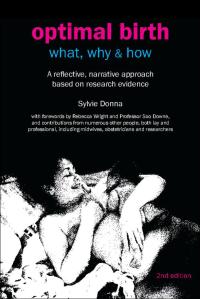
Book Review: Optimal Birth: What, Why & How

Book Review: Optimal Birth: What, Why & How
By Sylvie Donna
Fresh Heart, 2010
ISBN 9781906619138
670 pages, paperback, ÂŁ24.99
http://www.freshheartpublishing.com

Reviewed by Molly Remer, MSW, ICCE, CCCE
https://talkbirth.wordpress.com

Written in an energetic and confident tone, Optimal Birth is written for midwives and other birth care providers and emphasizes undisturbed, natural birth. Throughout the text, a unique “birthframe” format is used to share birth wisdom in women’s own words. Donna is heavily influenced by the work of Michel Odent (he attended several of her births) and references him frequently. The author writes in a very straightforward manner and has extremely strong opinions as to what constitutes “undisturbed birth,” but these opinions are backed up with ample evidence-based information. The exquisite sensitivity of a birthing woman to her environment is of primary importance in the book and caregivers are strongly urged to take an extremely hands-off approach to care.

A lengthy volume, Optimal Birth is difficult to describe adequately in summary form—it contains extensive sections about physiological birth, birth interventions, the emotional impact of women’s experiences, prenatal care, and postpartum care. It also includes a week-by-week guide to pregnancy. There are a large number of black and white pictures and each section of the book contains a series of insightful questions designed to provoke self-discovery about physiological birth and the appropriate care of birthing women.

Readers unaccustomed to the midwives model of care or to the principles of undisturbed, physiological birth may find the book’s emphasis on non-intervention heavy-handed or one-sided. Considering that many manuals for care providers focus extensively on labor and birth “management,” personally I find the non-disturbance approach advised by Optimal Birth to be inspirational and encouraging as well as appropriate. As the author notes, “the processes of birth are so delicate that many things can disturb a laboring woman and consequently make her labor slower and more dangerous.”

An encouraging and informative companion book containing much of the same information but from a consumer perspective titled Preparing for a Healthy Birth is also available.

Disclosure: I received a complimentary copy of this book for review purposes.

Why, indeed?

On the ICEA Facebook page today, the question was posed, “why did you become a childbirth educator?” I responded with the following: because I care deeply about women’s issues, social justice and social change and I feel like women’s choices in childbirth are intimately entwined with this. Because I believe peace on earth begins with birth. Because the births of my own sons were the most powerful and transformative events of my life. And, because I believe every woman should have the opportunity to feel and know her own power and to blossom into motherhood with strength, confidence, and joy. ♄

Some time ago, I wrote a short essay on why I became a childbirth educator that was one of the winners in a contest held by Passion for Birth. I realized as I was thinking about the ICEA question that I’ve never shared that post on this blog! (where it quite naturally belongs!) Here it is:

On a discussion board once, someone asked the question “what’s at the root of your love of birth?” I was still for a moment and let my intuitive, heart-felt, gut level response come to me and it was this:

Women.
Women’s health, women’s issues, women’s empowerment, women’s rights.

Social justice.

And, that feeling. The “birth power” feeling–-that laughing/crying, euphoric, climbed-the-mountain, glowing, rapture
feeling. The transformative, empowering, triumphant, powerful, I DID IT, feeling.

I want each woman to have the chance to experience that transforming power, that sense of personal accomplishment, the increased self-esteem, and the euphoria of knowing “I did it!” I climbed my mountain, I ran my marathon
I gave birth to MY BABY! I want all women to have the chance to experience that and this is why I became a childbirth educator.

I have a long time interest in women’s health and women’s issues. In 2001, two years before the birth of my first baby, I started reading avidly about pregnancy and birth and became instantly captivated by natural childbirth as powerful experience for women and also fascinated by the erosion of women’s rights in the birthplace. I first sent for information

My oldest son at 2.5 and my 37-weeks-pregnant-with-second-baby belly 🙂

about becoming a childbirth educator that year, but decided that I should wait to become one until I had a baby of my own (seemed like the most important first “credential” to me). My son’s birth is 2003 was a triumphant and empowering experience for me and lit my fire to become certified—I wanted to share the transformative potential of birth with other women. I became provisionally certified in 2005 and fully certified in 2006. The birth of my second son at home in 2006 further solidified my commitment to healthy birth education. I continue to teach because of the root reasons cited above as well as for the tremendous satisfaction I feel when a mother tells me that her confidence in giving birth has dramatically improved and that “I’m actually looking forward to it now—like an adventure!” I believe that a confident, normal birth sets the stage for confident, empowered parenting. The sense of accomplishment and satisfaction women experience in birth starts them out on the “right foot” on the lifelong journey of motherhood.

I view my birthwork almost like a tree, with women as the roots, pregnancy as the trunk, (the journey) and then blossoming beautifully in that birth-power feeling.

Prior why I care post and a why I do what I do post.

Pregnancy Update

Labyrinth of pregnancy (the path can be followed all the way into the spiral belly!)

I had my 28 week prenatal appointment earlier this week. I value my midwife and enjoy our visits, but I had a nighttime epiphany recently that I had more options to choose from, because I miss the kind of relationship I had with my midwife during my second pregnancy.

At this appointment, I had my blood sugar checked (2 hour post-prandial) and it was 91 (same as it was with my first baby at this point). I also had my hemoglobin checked and it was 11.5 (same as with my first baby—with second baby, it was 12.9 at 26 weeks). I now weigh almost as much as I did full term with number two! (still five pounds to go). Baby wiggles a LOT—sometimes it almost hurts, which I don’t remember from before. She also has hiccups regularly, which are always cute. She also seems to be head-down. When I heard that, I felt really strange—like, “there is a head in there?! And, I’m going to give birth to it?!” I have been much more reluctant to read about birth during this pregnancy—I think because I’ve been concentrating so much on successfully growing this baby to term, I don’t want to plant any subconscious ideas too early about giving birth and send myself into labor early, or something. I used to read a lot of birth stories and I have some great books of birth stories, but I don’t feel like reading them until I’m like 36 weeks—just in case. After this appointment, I started to think birthy thoughts some more—thinking about ideas and plans for when she is born. I also had a birth dream—the placenta came out first and after a while I was like, “wait, but I didn’t have the baby yet!” and then she was born—enormously fat with small eyes and she gave me a big hug.

The same night I realized I wish I had some more midwife choices, I had another realization (not exactly a new one, but a new version of it)  that I still have a big root fear that something wrong with ME is what caused my miscarriages (like a clotting disorder) and that I still do not trust that I can really give birth to a living baby at the end of this pregnancy. I’m worried that my body was responsible for the loss of my other babies. I don’t know how to get rid of this or work with it really—I’m at an impasse and since I truly do not know the cause and I can’t talk myself out of logically/rationally or just “think positive.” It is buried down there—most of the time I feel happy fine, but when I catch sight of the fear again (that night it was because she wasn’t moving as much as she usually does at that time of night), I realize that it is this bone deep fear-based thing that I don’t know how to shake. I do not want to have a fear-based pregnancy or to live a fear-based life, but there it is…

When it isn’t the middle of the night and I have my logic brain back, I feel more certain that my m/c experiences were chance based—Noah perhaps some kind of abnormality and the second perhaps a progesterone deficiency or something else related to getting pregnant again fairly quickly after a significant loss—and thus have no bearing on my current pregnancy, but still.

However, speaking of fears and returning to my plans for this birth, someone recently expressed surprise to my mom that I’m planning to have this baby at home after what happened with Noah. Hmm. This is completely irrational to me, because what happened to Noah had nothing to do with being at home—he died, we found out, I gave birth to him at home. How would that mean that my new baby should be born in the hospital instead? Not to mention that fact that when I did go to the hospital postpartum because of blood loss, rather than being helped by the assumed-fabulous skills and resources at the hospital, I was dismissed in life-threatening condition! (and was instead helped by a midwife at her home.) Having Noah only reinforced for me that the hospital is not somewhere I want to be when I’m giving birth, postpartum, or in need of compassionate attention. Giving birth to him at home reinforced for me that home is where I can most capably, peacefully, respectfully, powerfully, and safely give birth to my babies.

I keep feeling this “call” to retreat—to quit most of my nonessential responsibilities and just hang around at home. I had this fantasy recently of a year-long postpartum retreat where I just take care of my baby and read and write and play with the kids and look at the clouds (or something). Ever since I had Noah last year, I’ve been feeling like turning inward/away and just spending time by myself. I also felt like I needed to take a break from being of service/helping other people and needed to tend my own hearth and take care of myself instead. I rarely actually follow-up on this urge, even when I have a chance to do so. There is always too much “work” to be done or things to “catch up” with or just “one more thing” and before I know it, my window of alone time has passed. This might just be a fantasy notion—if I really wanted to take the time out, wouldn’t I do it?—but I think it is a true call to self-care that I’m not heeding (even now, here I am writing a blog post while my kids are visiting their grandpa—couldn’t I be having a mini-retreat right now?). This is one reason I’m taking a leave from birth classes and LLL right now—I want to be able to focus on my own pregnancy, birth planning, babymoon, and new baby, rather than focusing on those things for other people. I also feel like writing about my own pregnancy and my own birthing thoughts, rather than writing posts or articles designed to help other people—sometimes I get bogged down in feeling like I should be writing helpful and informative posts and the time for personal reflection passes. Maybe this sounds selfish, but I don’t think so. I’ve always had a fear that if I am not “of service” in some capacity I will cease to exist/have any worth/be a real person—I’d like to get over that!

I often tell my college students that we cannot expect more from our clients than we are willing to do ourselves. I also tell them that sometimes we want to do for others what we are unwilling to do for ourselves. This is where I am right now—I have lots of great ideas for things I’d like to do for other women on pregnancy retreats or in birth classes for women who are having their second or third baby rather than their first and want to deepen their understanding of the meaning of pregnancy and birth in their lives. Why don’t I experiement and do all those things for myself? And, then, see about offering those things to other women…I can see it now—“My Year of Self-Care.” (Inside joke to those who know how I disklike “year of” experiment books.) I feel like I rarely do what I actually want to do with my days, instead of doing what I should do, or what makes the most sense. Sometimes it is what is most pressing, but more often it is should-based or internally driven, rather than an actual issue of priorities.

This actually isn’t the post I set out to write today, which was originally intended to be some self-care tips from Renee Trudeau with a short intro from me about my own “call” to rest and renewal. Perhaps it was the post I needed to write though! Perhaps not, because now I feel like I’ve “wasted” my chance to do some of those other things I’d like to do with my time!

Book Review: The Father’s Home Birth Handbook

I came to my attention today that I have never posted this book review! (also, as I prepared to “tag” this post, I realized that I don’t have a tag set up for “homebirth.” Can this really be true??!!)

The Father’s Home Birth Handbook

By Leah Hazard
Victoria Park Press, 2008
Softcover, 208 pages
ISBN: 978-0-9560711-0-1
www.homebirthbook.com

Reviewed by Molly Remer, MSW, ICCE

The Father’s Home Birth Handbook is a succinct and easy to read little guide for fathers and adds to the growing library of birth resources specifically geared towards fathers-to-be. The book is written by a woman, but contains ample quotes from fathers which lend a male perspective. It also includes a number of good birth stories interspersed throughout, which were all written by men.

The target audience for the handbook is easily summed up in the prologue: “
I’ve met far more men who have responded to their partners’ home birth wishes with a mixture of shock, cynicism, and fear
Far from being domineering ogres who just want to see wifey tucked ‘safely’ away a hospital, these loving fathers have simply had very little access to accurate, impartial information about the safety and logistics of home births versus hospital births.”

The first chapter addresses “Risk & Responsibility,” because that is one of the very first issues of concern for most people new to the idea of homebirth. It moves on to a chapter called “Think Positive,” followed by “Choosing the Guest List” and then one titled “Pleasure and Pain” This chapter covers comfort measures and what to do while the woman you love is giving birth: “
away from the intravenous drip and ticking clocks, you can support your partner in experiencing labour in all of its awesome, challenging power.”

Chapter five—“Birth: Normal and Extraordinary” covers Labor 101 topics, including what to do with the placenta. This is followed by “Challenges & Complications” which covers some common issues of concern such as premature labor, being overdue, prolonged labor, distressed baby, cord around the neck, tearing, and blood loss. Each of these is followed by a “what can I do to help?” section.

The final chapter—“Now What?”—concludes with a nice segment called “how can I carry the lessons I’ve learned from my homebirth with me into the rest of my life as a father?”

Published in Scotland, the handbook has a UK perspective—it assumes participation in the NHS and a “booked” midwife and homebirth. There is no “how to choose a midwife” type of section (because there is no choice of midwives). For US readers, this leaves a set of issues unaddressed—such as varying legal statuses, etc. UK specific issues also arise based on the possibility of caregivers who are not thrilled about homebirth, but who have to come to the birth since it is a government supported option. It comes across that in Scotland homebirth may seem readily okay on paper, but in reality is more difficult to pull off.

The book does briefly discuss the birth climate in the US and soundly critiques ACOG’s position on homebirth.

The book has an index and a resources section.

The Father’s Home Birth Handbook is a friendly, practical, matter-of-fact, helpful little guide that neatly addresses common questions and concerns many fathers-to-be have about planning a homebirth.

——————

Disclosure: I received a complimentary copy of this book for review purposes.

Associated amusing anecdote: my then three year old noticed me reading this book, looked at the cover and said, “The dad is trying to grab him, but that little baby is floating away!