Archives

OBs and Normal

I’ve been looking through posts on my old book blog, because I shared lots of birth-related thoughts/quotes there that are now lost in the shuffle and would be more relevant transferred over to this blog. From the book The Mother Knot by Jane Lazarre, written in the 70’s she shares an anecdote about her OB that I think carries a huge ring of truth still today:

My obstetrician had whispered a secret to me on a sunny afternoon. I had come to the office prepared with my written list of questions. Why was I feeling nauseated, I asked, and what was all this pain in my thighs? And he had answered wearily, ‘If you want answers to questions, have a miscarriage, or toxemia, or let something else go wrong with your pregnancy. We don’t know anything about normal births.’ So much for technological know-how. [emphasis mine]

This is a perfect example of the differences in approach to caring for women present in the midwives model of care and the modern obstetrics model of care. Another good example of some differences is in the Snow Baby story I put on the CfM blog on Friday.

Birth Quotes Update

“Remember that most of the people who really need your work are not hanging out in the oversaturated twitterverse, but in places where what you do isn’t common. Get out of the crowded room and go where there’s a dearth of and a thirst for what you do. Don’t try to shout over lots of shouting.” –Tara Sophia Mohr

(Not specifically birth-related, but an excellent reminder from this post. I’ve often felt with blogging and writing for birth publications that maybe I’m just clamoring to …be heard in a cacophony of other voices (that also have good things to say–am I contributing anything unique?!)

“When my kids become wild and unruly, I use a nice, safe playpen. When they’re finished, I climb out.” ~Erma Bombeck (via Moby® Wrap)

“The miraculous nature inherent in the unfolding of a flower is the very same that moves through a woman as she gives life to the world. We can neither control nor improve upon it, only trust it.” -Robin Sale

…the stories I see of birth in the media don’t reflect the intense emotions, the physical power, or the immense impact of the experience itself. Women screaming, fathers fumbling about, doctors doing most of the heroic work–these images don’t do justice to my experience. I felt empowered, strong, heroic in my efforts to bring my daughter into the world yet, I am painfully aware how little others see the heroism in my birth experience.”  –Amy Hudock (essay in Literary Mama)

“It’s not only children who grow. Parents do too. As much as we watch to see what our children do with their lives, they are watching us to see what we do with ours. I can’t tell my children to reach for the sun. All I can do is reach for it, myself.” – Joyce Maynard (via Literary Mama)

Giving birth, certainly, should rank among the pivotal heroic adventures celebrated in our culture. Certainly it is more heroic than catching a football or acting in front of a camera, and perhaps even more heroic than going off to war. Men return from the battlefield with victory, but women return from the birthing room with life…” –Amy Hudock (in Literary Mama)

“...if you want to know where a woman’s true power lies, look to those primal experiences we’ve been taught to fear…the very same experiences the culture has taught us to distance ourselves from as much as possible, often by medicalizing them so that we are barely conscious of them anymore. Labor and birth rank right up there as experiences that put women in touch with their feminine power…” –Christiane Northrup

The intrinsic intelligence of women’s bodies can be sabotaged when they’re put into clinical settings, surrounded by strangers, and attached to machines that limit their freedom to move. They then risk falling victim to the powerful forces of fear, loneliness, doubt , and distrust, all of which increase pain. Their hopes for a normal birth disappear as quickly as the fluid in an IV bottle.” ~Peggy Vincent

So many words commonly used to describe childbirth–support, patient, management, delivered by, coached, helped, guided–suggest that a woman does not have the power to give birth without being dependent on somebody else. This isn’t the case at all.” –Michel Odent

(This reminds me of that Odent quote about not actively supporting a woman in birth that stirred me up a couple of months ago. That one I had some objections to, the one above, I can definitely get behind, even though I think he is actually …saying the same thing in both quotes!)

I believe that natural childbirth is a right and a privilege…Our country needs to step up to the plate in educating women about the benefits of natural birth, and we need to help women actually do it – not just hear about it.” –Mayim Bialik (via ToLabor Doulas Dallas)

In the moments of labor and birth, all the forces of the universe are flowing through a woman’s body.” – Sister MorningStar (The Power of Women)

Birth Quotes of the Week

“I believe that natural childbirth is a right and a privilege…Our country needs to step up to the plate in educating women about the benefits of natural birth, and we need to help women actually do it – not just hear about it.” –Mayim Bialik (via ToLabor Doulas Dallas)

“In the moments of labor and birth, all the forces of the universe are flowing through a woman’s body.” – Sister MorningStar (The Power of Women)

“These hands are big enough to save the world, and small enough to rock a child to sleep.” –Zelda Brown

“Birth is as vast and voluminous, as unfathomable and inevitable as the rising and setting of the sun. And true to the inexorable power and rhythm of their life-giving bodies, women will continue to birth with dignity, grace and courage.” —Mandala Mom

“In the sheltered simplicity of the first days after a baby is born, one sees again the magical closed circle, the miraculous sense of two people existing only for each other.” –Anne Morrow Lindbergh

‎”I feel the most important thing the birthing woman does is to listen to her own body and find out what her body is telling her she needs to do. And that neither the partner, nor the midwife, nor the doula, or whomever, should be giving orders, ‘Now do this’ or ‘Now do that’ because that interferes with what she is really trying to get from her body…” ~Marsden Wagner, M.D. (via Birth Without Fear)

‎”All labor that uplifts humanity has dignity and importance and should be undertaken with painstaking excellence.” – Martin Luther King, Jr. (via Literary Mama)

“A baby, a baby, she will come to remind us of the sweetness in this world, what ripe, fragile, sturdy beauty exists when you allow yourself the air, the sunshine, the reverence for what nature provides…” – Sarah Werthan Buttenwieser (in Literary Mama)


Birth Lessons from a Chicken

Birth Lessons from a Chicken

by Molly Remer, MSW, ICCE, CCCE

Originally published in Midwifery Today, 2009 Spring;(89):49

“Should we just let her sit on them?” my husband asked. He had been struggling to keep a broody hen off her nest for almost two weeks.

“I always vote in favor of the mother,” I told him. So, we stopped trying to oust her. My husband gathered up six random eggs from the coop and put them under her and we let her sit.

We consulted our book on raising chickens. The chicken book had very little encouraging advice about “natural incubation.” After reading it, we learned that she was likely to let the eggs get too cold causing them to die, or perhaps just chill a part of them causing the chicks to have deformed feet. If she did manage to hatch them, they will probably get bacteria in them from the “unsanitary” nest site and get “mushy chick disease.” This is, of course, if the eggs happen to be viable at all, which is improbable. It is recommended not to let her sit and if she persists to either cull her (kill her), or to just let her sit there until she dies of starvation trying to hatch infertile eggs (and therefore culls herself). The book also informed us that if she has feathery feet (she does), she will probably knock the eggs out of the nest by accident and break them. Also, she should definitely be sitting in the spring and not the dead of winter. After studying the book, we are left with a clear sense that incubating eggs artificially is the preferred way to go and that “natural incubation” is fraught with difficulty and dangers.

However, there our chicken sat in the unheated, but well built and insulated chicken coop as the January temperatures outdoors reached -2F. We concluded that she probably had a 5% chance of actually hatching anything and I felt sad for her.

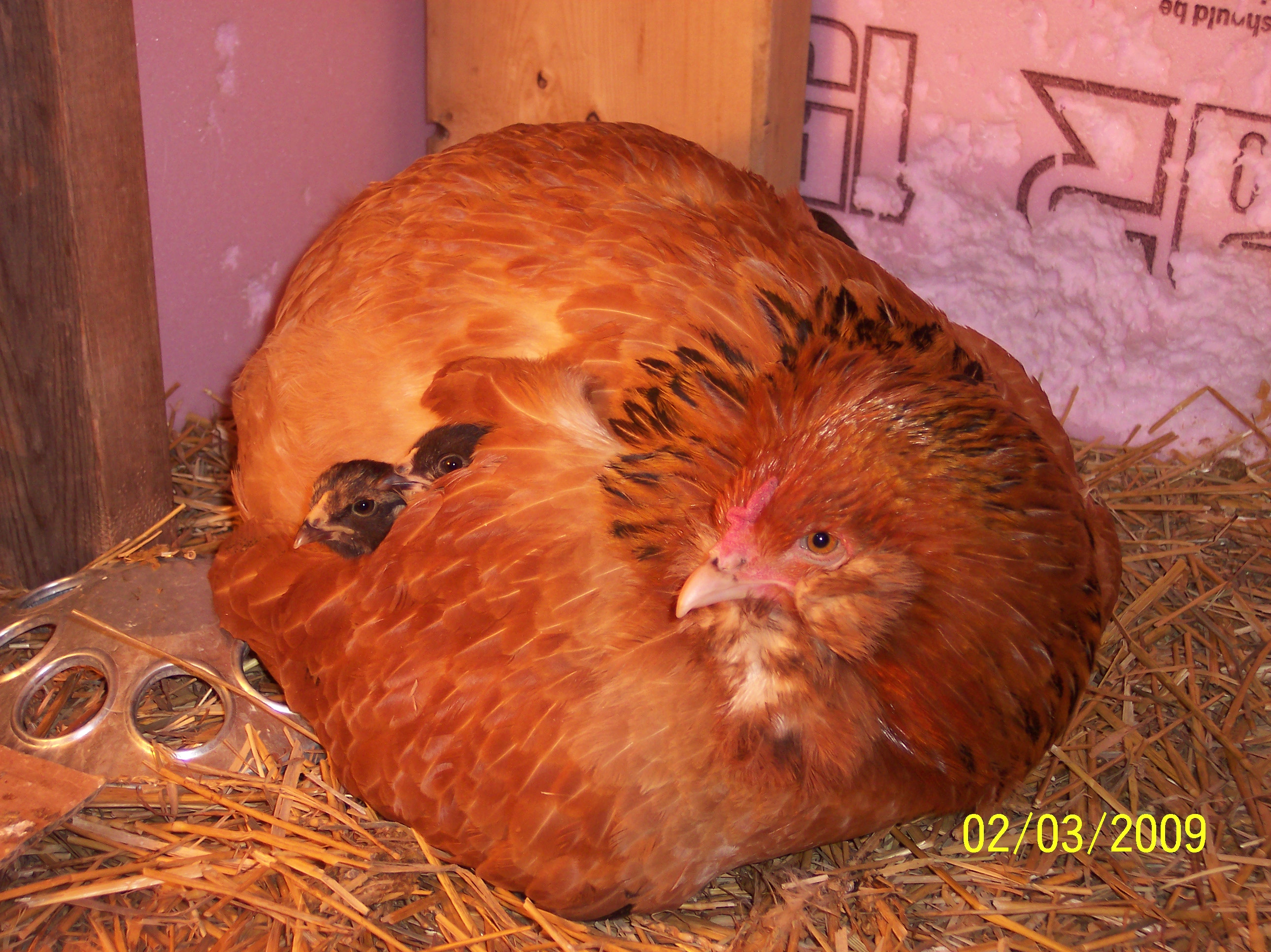
Then, one morning when my husband went to feed the chickens, he heard a funny noise. He looked at the broody hen and from beneath her, a fuzzy head appeared. Then two. Eventually, four. In this cold, cold weather at the wrong time of year with the wrong

The mama hen and two of her chicks

kind of feet and the wrong kind of eggs, she did it! We didn’t trust her, or believe in her. Our book and the experts didn’t either. However, her inherent mothering wisdom won out—it trumped us. At the risk of excessive personification, it truly seemed that she had believed in herself and trusted her instincts (or perhaps, that Nature believed in itself).

Perhaps we could have had the same result with an artificial incubator—a tray that rotates the eggs, instead of “clumsy” feathered feet; a properly temperature controlled unit instead of the heat of her own breast; a sterilized box instead of a wooden coop with an unscientific amount of possibly “germy” feathers plucked from her own body.

My husband ran to get the rest of the family and as we watched that first small fuzzy baby with its eyes bright with life, I was awash with the parallels—the book tells her that her pelvis will be too small, labor will be too painful, her skin won’t stretch, she might have GD, there might be any manner of complications, maybe she should elect to have the baby surgically. Why all the fuss about doing it “naturally” anyway?

Then, as we continued to stare in amazement, the mama hen clucked to her baby softly and fluffed her wings around it until it disappeared beneath her with the others. Isn’t this the birthright of every new baby of any species? To be snuggled immediately after birth into the warm embrace and near the breast of the female body that has given it life? The body that has cared for and nurtured it so lovingly so that its head may finally peek out into the world?

If our chicken were to write a book about hatching babies—or about giving birth—perhaps her section about natural incubation would read:

Maybe she knows what she’s doing.

Maybe you should trust her.

Maybe she can do a better job with her own body and her own babies than you can.

Maybe she can do this all by herself.

Molly Remer, MSW, ICCE, CCCE is a certified birth educator and activist. She is editor of the Friends of Missouri Midwives newsletter, a breastfeeding counselor, and the mother of two young sons and a baby girl on the way. She loves to write and blogs about birth at https://talkbirth.wordpress.com, midwifery at http://cfmidwifery.blogspot.com, and miscarriage at http://tinyfootprintsonmyheart.wordpress.com.

This is a preprint of Birth Lessons from a Chicken, an article published in Midwifery Today, 2009 Spring;(89):49. Copyright © 2009 Midwifery Today. Midwifery Today’s website is located at: http://www.midwiferytoday.com

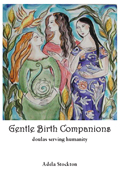
Book Review: Gentle Birth Companions

Book Review: Gentle Birth Companions: doulas serving humanity
By Adela Stockton
McCubbington Press, 2010
ISBN 978-1-907931-00-0
104 pages, paperback, £13.00 (worldwide)
http://www.adelastockton.co.uk

Reviewed by Molly Remer, MSW, ICCE, CCCE
https://talkbirth.wordpress.com

Gentle Birth Companions is the first book “written about the doula movement beyond the US” and as such it was a fascinating read. I hadn’t realized how ethnocentric my own perceptions were about the role and history of doulas and I previously assumed that the “doula movement” was essentially synonymous with the “doula profession in the US.” Not so! Indeed, Stockton discusses the way in which in the US, doula professional organizations strive mainly to be acceptable to the medical community, whereas in the UK the doula operates outside of (or parallel to) the medical system. And, she provides an interesting analysis as to whether doulas should be referred to as “professionals” in the first place (this is also due to a difference in what the word means in the UK compared to the US). She expresses several criticisms of certification or even of specialized training programs, feeling that professionalization builds additional, unnecessary layers of bureaucracy into the maternity care system and that the role of a doula should be the role of a lay woman. She also posits that the role of doula actually represents a return to the role of traditional midwifery—what midwifery was supposed to be and has now become removed from politically, socially, and culturally.

Gentle Birth Companions is divided into three sections. In the first, Grassroots, it explores the origins of the doula, the 21st century doula (including doula preparation and training), the UK “brand” of doula, and the wider doula community (thoughts about a global movement and also about doulas in the developing world as well as the industrialized world). The second section, Guardians of Gentle Birth?, explores the doula’s role both antenatally and postpartum and the return to “traditional midwifery” represented by the role. In the third section, Doula Tales, some UK doulas share birth stories , experiences, and thoughts in their own words.

Gentle Birth Companions is an excellent look at the “politics” of the doula movement and the professionalization and motivations of such, as well as at the role and purpose of the doula in women’s lives.

Disclosure: I received a complimentary copy of this book for review purposes.


Birth Quotes of the Week

“In the midst of a world
…marked by tragedy and beauty
there must be those
who bear witness
against unnecessary destruction
and who, with faith,
stand and lead
in freedom,
with grace and power.

There must be those who
speak honestly
and do not avoid seeing
what must be seen
of sorrow and outrage,
or tenderness,
and wonder.”

–via Unitarian Universalist Association

“One of the most important things I have learned about birthing babies is that the process is more of an unfolding marvel than a routine progression of events.” –Tori Kropp

‎”We are part of generations of women, one to the next. Teaching, mentoring, supporting, assisting, befriending, and so much more. Let us not lose those connections in our lives, in our births…” —Preparing For Birth

‎”There is no other organ quite like the uterus. If men had such an organ they would brag about it. So should we” ~Ina May Gaskin

(this quote got the most “likes” of almost all the quotes I’ve ever posted on the CfM FB page!)

“A woman’s confidence and ability to give birth and to care for her baby are enhanced or diminished by every person who gives her care, and by the environment in which she gives birth…Every women should have the opportunity to give birth as she wishes in an environment in which she feels nurtured and secure, and her emotional well-being, privacy, and personal preferences are respected.” —Coalition for Improving Maternity Services (CIMS)

“Birth wisdom…comes most completely not from the outside but from deep within the woman’s physiology.” –Robbie Davis-Floyd (in intro to Gentle Birth Choices)

“Hospital-based childbirth classes usually do not teach women about the wonder and mystery and sweaty, intense power of birth, but rather prepare them for each and every hospital procedure by educating their intellects instead of honoring their bodies.” –Robbie Davis-Floyd (in intro to Gentle Birth Choices book)

(Let it be known before anyone gets their feelings hurt that I do understand that there are very good, complete, helpful, awesome hospital birth classes and hospital birth educators out there! This quote is a generality, but one that seems quite true in a number of cases [but not all, of course]).

“…I have noticed that the subgroup of women who tend to choose [homebirth] often exhibit certain characteristics, such as comfort within their own bodies, a desire to have a birth experience that is more poetic than clinical, as well as a desire to return what we all feel is some seriously missing humanity to the experience of having a baby…” –Cara Muhlhahn

“We can no longer sit back and debate whether maternity care is evidence-based. We have seen that over and over again, in most cases, it is not…” –Connie Livingstone


Birth Witnesses

Birth Witnesses

Guest post by Bonnie Padgett

In this so-called Age of Information, we have iPads and smart phones, mega computers and micro chips, and a world of knowledge at our fingertips.  We are not limited by the resources in our community when we can reach out to virtual communities that span the globe with the touch of a button – forums full of ideas, innumerable news sources, websites for all schools of thought and up-to-the-minute research from leading experts in every field.

So why, then, are new and prospective mothers still so naive when it comes to the act of childbirth?  Why, despite our best efforts to educate ourselves, are we still in the dark about the whole process until those contractions hit and we begin the journey through labor ourselves?  I, myself, was included in this group, although I did everything I could think of to educate myself prior to my daughter’s birth.  I read books on what to expect, took classes hosted by my hospital, toured the birthing facility, joined an online forum of moms, and Googled everything I could think of related to pregnancy and birth.  I spent months practicing Hypnobabies for a natural birth, discussed my wishes in detail with my doctor, and, after studying ample examples and recommendations, formed a ‘birth preferences’ list for the doctor and hospital.  I knew what I wanted and what I didn’t want when it came to birth.  At the same time, I knew my “plans” would likely not go as expected, but was prepared to make informed choices along the way.  I had ideals and contingencies, preferences and plan Bs.

However, when all was said and done, I found myself totally unprepared for the experience of labor itself.  I had read about contractions, witnessed videos of women in labor, seen and practiced techniques for comfort and relaxation.  None of that prepared me for the anxiety and unknowns that flooded my mind as my body began its natural next steps.  I realized just how little I knew about the hours ahead.  How uncomfortable I would feel with nurses and midwives going about the “day to day” routines of their jobs, and by doing so how secondary I would feel to the process.  How defenseless I would feel to contradict or decline an expected treatment, especially under the medical staff’s disapproving glares, and with no one to support clueless me and my equally unknowing husband.    While a doula certainly would have helped in easing my fears and strengthening my resolve, I think my inability to grasp what I was a part of, indeed, the central part of, would have still left me bewildered and terrified in those hours.

After my daughter’s birth, I found myself struggling to comprehend what had just happened to me.  Although everyone assured me this was a fairly ‘normal’ labor, I had no point of reference on which to base that comment.  I realized the short video clips online and in class captured only key moments in a much longer, more complex and nuanced process.  Those huge gaps left in my knowledge of labor are what left me so unprepared to defend myself and my baby against treatments I didn’t want, didn’t need, and had previously decided against but found myself, in the moment, succumbing to.    I tried discussing it with my mom, who explained that she’d felt the same way when she had me (her first child).  She concluded the only way to truly understand birth was to experience it yourself.

The only way to understand birth is to experience it yourself.  The ONLY way?  That comment stayed with me, haunted me.  I became a doula after my daughter’s birth because I wanted to be able to provide women with support and knowledge that could give them a different experience, a better memory than what I had.  I just couldn’t believe that there wasn’t a way to understand birth at all except to experience it firsthand.  Certainly there wasn’t always this fear and unknown around birth that we each face today.  Not always.  I began studying that idea.  What about other cultures?  What about our culture, historically?  What about The Farm?  There wasn’t always this myth and mystery about birth!  I realized there was a time (and in places, there still is) when women banded together for births.  Mothers, sisters, cousins, daughters, aunts, friends.  They came together and comforted, guided, soothed, coached, and held the space for one another during birth.  These women didn’t go in it alone – they were surrounded by women who had birthed before them.  Women who knew what looked and felt right, and what didn’t.  Women who could empathize with them and empower them.   In addition to that, girls and women were raised in a culture of attending births.  Daughters watched mothers, sisters and aunts labor their babies into this world.  They saw, heard, and supported these women for the long hours of labor, so when they became mothers themselves, the experience was a new, but very familiar one for them.  Birth wasn’t a secretive ritual practiced behind the cold, business-like doors of a hospital.  It was a time for bonding, learning, sharing and sisterhood.  Girls learned how women become mothers, and mothers helped their sisters bring forth life.  It was a sacred and special part of the birthing process that has become lost in our institutionalized, over-medicalized, isolating and impersonalized system today.

While I certainly don’t expect us to throw our entire system out the window in favor of simpler times, I think the rush to technology and medical advances certainly left some essential elements of birth in its wake.  Elements such as women supporting women.  Listening to one’s body.   Intervening only when necessary instead of as a matter of protocol.  And perhaps, most importantly for us all, the community aspect of birth.   This has lead me to believe that in order to truly educate ourselves about birth, to improve the way we birth, and the way we prepare for birth and prepare our sisters and daughters for birth is that we need to provide the women we love (especially those of childbearing years) the opportunity to witness and participate in our births, because only when you are present for a labor and birth can you begin to fathom the process, the emotions, the physiological changes that one goes through. If we can allow women the chance to witness and share in our births – the way it was done historically – and how it is done now at sacred places such as The Farm – we can give them a chance to prepare for birth in a way we were never able to. They can see firsthand the role of a midwife or doctor (and the roles those care providers don’t play). They can observe the benefits of a doula, they can have the opportunity to doula themselves – caring for and soothing a woman in labor.  They can observe the power of changing positions, the instinctual side of birth that leads each woman to listen to her inner voice to bring forth her child.  They can witness the time, energy and atmosphere it takes to birth a baby. I truly wish that more women were invited into the birthing setting by close family or friends so they could witness normal birth and understand it as best they could before they do it themselves. This is one of the keys, to me, to normalizing birth for every woman.

As a ‘birth survivor’ myself, I understand the trepidation some women feel at including more people in this personal and – unfortunately for some – traumatizing event, and I respect that, but I would like to offer a few thoughts about opening your birth to ‘birth witnesses’.  First of all, my initial reaction to the way my daughter was birthed was “that was not how it was supposed to be!” followed shortly by “I don’t want anyone I know to have to suffer through that humiliation, degradation and pain!”  Those sentiments led me down the path of trying to discover a way to share with the women I love what childbirth could be, and what it should not be.  My best answer is to let them witness a birth experience and let them form their own opinions about what works for them and what won’t, so that they can be better equipped going into the experience themselves – empowerment!

My second thought for you is to think of those women you would want to share this experience with – do you have a younger sister? A daughter, niece, or friend who may one day become a mother?  Don’t you want to offer them the best opportunity for a great birthing experience?  Think of the presence they will bring to your birth, in turn.  These are women whom you love the most in the world.  They are going to be calming, happy, supportive presences in your birthing place (and if they’re not, I recommend they not attend).  These women want to see you succeed. They want what is best for you and your baby.  They are going to know you better than any doctor or midwife or doula, making them naturally better able to comfort you and support you.  Their love and warmth will be a welcome and helpful addition to your birth, as well as an educational experience for them.  And, if you, like me, were scarred or traumatized by your first birth, that type of love and unconditional support might be just what the doctor ordered, so to speak.

Like all things in this life, I don’t believe there is a universal approach to anything.  I don’t think that inviting birth witnesses into one’s labor is right or necessary for everyone, nor do I think that every woman must witness a birth to be adequately prepared.  For most women in our country today, though, I think there are many benefits – to the laboring mom and to her support team.    If you do want to invite birth witnesses into your experience, I recommend you consider the following as you prepare for your birth:

  • Think about where you are birthing and how many people are able to attend.  Many hospitals have limits on the number of people who can join a woman in a delivery room, but you may be able to rotate some of them in and out, giving a few women a chance to participate. Some birthing centers are more flexible, especially if you explain your intents, and your home of course is the an ideal option for including birth witnesses.
  • Think about who will best help you as well as who most will benefit from the experience.  This is YOUR birth after all.  Your needs must still come first.  If there is someone whose presence may cause friction or tension, you may not want to include them.   Birthing mothers need calm and relaxation.
  • Consider inviting witnesses no matter if you’re planning on a natural birth, an epidural, induction, or other intervention.  There is something to be learned from every birth experience, so don’t discount your ability to help because of the way you choose to birth. It is the physical presence at a birth that offers more to women than the type of birth.  They will form their own opinions about what they are comfortable with while watching and learning from you.
  • Talk to your witnesses beforehand.  Let them know you’d like them at your birth and why.  The idea of being present with birthing women has become a strange one for many people since it has fallen out of vogue, and explaining that they can help you by being present, and that you’d love for them to be there to witness your birth may warm them up to the idea.
  • Consider hiring a doula.  The doula can become a support for you, your partner and your other attendants, offering explanations and information, ideas for support, and helping to control the atmosphere and activity in the room so that it is ideal for your birth.

In the end, do what is best for you and your family.  Remember, the point of including birthing witnesses in the experience is to help you and to help someone else.  Even if you invite just one friend, a sister, or a niece to join you, you are helping to transform that woman’s view of childbirth and offer her an experience and education that she will carry with her for the rest of her life.  If we all became birth mentors for just one woman, think of the tremendous change we could affect for the next generation of birthing women.

Bonnie Padgett is a proud mother and wife, and an active member of the birthing community in Atlanta.  Bonnie is the owner of La Bonne Mama, which offers labor doula services, childbirth and newborn care education, birth art and placenta encapsulation services.  For her next birth she is planning a homebirth and her sister, sister-in-law, and niece will be invited to share in the experience. You can visit her online at www.labonnemama.com, or www.facebook.com/labonnemama.
Birth Quotes of the Week

“…a tenderness for the past, courage for the present, hope for the future….a fervent wish that every cup may overflow with blessings rich and eternal, and that every path may lead to peace.” (adapted from a quote by Agnes M. Pharo)

Happy New Year!

“Understand that the tremendous energy going through you during birth is the same sort of power as the force of ocean waves moving towards shore. Know that just as a bird knows how to build its nest, and when to lay its eggs, you too will build your birthing nest…” –Janice Marsh-Prelesnik (The Roots of Natural Mothering)

“Open hearts, strong hands. Be present, listen, feel her, trust your instincts. And remember–I have birthed my children…she will birth this child her way, with her power, be with her and let her feel your faith in her.” –Jennifer Walker (quoted in Adela Stockton’s new book, Gentle Birth Companions)

“We are living in a time where many birth peeps start out in passionate service to birth work, inspired by a Calling. But without elders to harness that passion and slowly cultivate it to grow a strong inner container so the new birth peep can learn to hold the psychic power of birth, the hard work and… unrealized dream of making a difference gradually morphs that passion into keeping a job or career…” (from Pam England’s blog post about Where are the Birth Grandmothers…)

‎”Doulas are just women who really, truly care about other women, on a major level.” –Linda Quinn (quoted in Adela Stockton’s new book, Gentle Birth Companions)

“Childbearing integrates a woman’s mind and body in the most intense way and brings on an existential crisis. However, this crisis is instructive rather than destructive. It forces a woman to rethink the meaning of her life, and to deal with the imminent, inevitable changes of lifestyle and family roles.” –Elizabeth Noble (Childbirth with Insight)

“Do not force nature, do not insult it, for it is as if you were to open the ears of corn to make the stalks grow.” –Chinese Medical Review (1852) (via Lamaze International e-newsletter)

‎”Every pregnancy and birth has something to teach us. Every one is important. Every mother and baby deserve whatever is truly best for them with respect and dignity.” —Preparing For Birth

“The more pregnancy is lived like an illness, the more it becomes in itself a cause of illness.” -Michel Odent, MD, Birth Reborn (via Mothering Magazine e-news)

“I used to have fantasies…about women in a state of revolution. I saw them getting up out of their beds and refusing the knife, refusing to be tied down, refusing to submit…Women’s health care will not improve until women reject the present system and begin instead to develop less destructive means of creating and maintaining a state of wellness.” ~A Woman in Residence, Dr. Michelle Harrison (Delightful Pregnancy & Birth)

“It is necessary for some women to risk total reclamation, to risk the direct and intentional use of power, in bold, even outrageous ways. It takes only a minority of women to alter present reality, to create new reality, because our efforts are more completely focused, more total.” –Barbara Starrett

‎”Please, choose your birth attendant and place of birth carefully. Search hard for the attendant that you connect well with. You and your baby deserve to be treated with utmost respect and dignity. There are attendants who believe in the sacredness and sanctity of birth. You may, however, need to act as a detective to find them.” –Janice Marsh-Prelesnik (The Roots of Natural Mothering)

“I know myself linked by chains of fires,
to every woman who has kept a hearth.
In the resinous smoke
I smell hut, castle, cave,
mansion and hovel,
See in the shifting flame
my mother and grandmothers
out over the world.”
–Elsa Gidlow (quoted in The Politics of Women’s Spirituality)

Posted in honor of the Winter Solstice.

Midwife means “loves women”…

Blessingway gift from my first midwife

I know the traditional root of the word midwife is “with woman” (some sources say “wise woman”), but I’d like to offer another. When I was pregnant with my second son, I had a wonderful midwife and we spent many hours together talking about birth and midwifery. During one conversation she said to me, “you can’t be a midwife unless you love women.” This struck me profoundly—a midwife must love women. This phrase has come back up for me several times in the last couple of months as I reflect on my relationship with my current midwife and give thought to midwifery care and birth care in general. I actually believe that not all midwives do, in fact, love women and indeed, my observation is that midwives from specific religious traditions, may actually hold a perspective of women that is almost the opposite of loving them 😦

In any subset of birth work—including breastfeeding consultation—I’ve noticed there are two primary motivators for the women doing this work. For some, it is about the babies and for others, it is about the women. I have noticed this as a volunteer breastfeeding counselor also—women who do this work will say, “I just love babies…” or, they will say, “I love helping mothers.” Please note that I’m not actually saying that one motivation is “better” than another (though, I personally prefer one), just that I’ve noticed this trend. And, obviously, the two are also inextricably intertwined. But, some women do come into birth work primarily to improve the world for babies and some come into it to change the world for mothers (which, I believe, changes the world for babies!). Obviously, you’ve guessed that I’m in the latter category. I believe that we cannot help babies without helping mothers first and that by helping mothers, we cannot help but also be helping babies—but, for me, the mother comes first. And, from the perspective of both a pregnant woman and a birth activist, I think we need midwives whose definition of midwifery is loves women.

In  the Autumn 2010 issue of Midwifery Today, I read an interview with a midwife named Gigliola from Paupa New Guinea and in the article I marked this quote:

“Gigliola has a strong reverence for the power of mothers, for women who are willing to give up their lives for their children, willing to work hard through long labors, feeding their babies from their bodies, staying up nights with them, loving and loving for long years. Then as graciously as they can, watch their ‘successes’ walk off to lead their own lives. The path of motherhood is as rigorous a spiritual path as any on our planet. Gigliola holds motherhood as a sacred calling, deserving of great respect…’Tell them it is about the mothers,’ she said. ‘The mothers are amazing.’” [emphasis mine]

I agree.

Twelve Days of Birth Activist Christmas

12 Days of Birth Activist Christmas

by Molly Remer

On the first day of Christmas, a birth activist gave to me
one woman wanting to birth free…

On the second day of Christmas, a birth activist gave to me
two comfy birth balls
and a woman wanting to birth free…

On the third day of Christmas, a birth activist gave to me
three empowering birth books…

On the fourth day of Christmas, a birth activist gave to me
four independent birth classes...

On the fifth day of Christmas, a birth activist gave to me
five midwife cell phone riiiiiiings…

On the sixth day of Christmas, a birth activist gave to me
six healthy birth practices

On the seventh day of Christmas, a birth activist gave to me
seven supportive partners

On the eighth day of Christmas, a birth activist gave to me
eight helpful doulas…

On the ninth day of Christmas, a birth activist gave to me
nine spontaneous labors…

On the tenth day of Christmas, a birth activist gave to me
ten pregnant women dancing…

On the eleventh day of Christmas, a birth activist gave to me
eleven upright second stages…

On the twelfth day of Christmas, a birth activist gave to me
twelve happy motherbabies!