Archives

Top Ten Things I Love About Having a Baby

The winter holiday season remains linked with pregnancy loss for me. This time last year, I was entering the final stretch of my pregnancy-after-loss journey and feeling so hopeful that I would have a happy ending to my loss story. This time two years ago, I was reeling from Noah’s birth and it was so very difficult to experience the holidays without being pregnant after all. I feel like this whole first year with Alaina has represented another “circuit” in the labyrinth of pregnancy loss, pregnancy-after-loss, and then new baby. I feel like I have to make another complete “round” of the year, passing through all of those significant dates and milestones that I experienced first as a post-loss mama and as a PAL mama, but getting to take another lap, this time holding my new baby. Each time I pass another date, I feel almost like waving—here we gotogether!

So, in this time of thanksgiving, I want to share the

Top Ten Things I Love About Having a Baby

20111122-164224.jpg

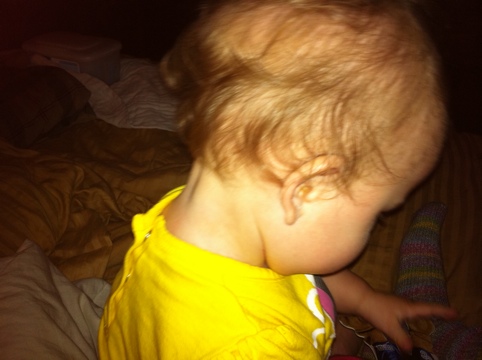
Should have had Karen take a picture of the back of A's neck for me--as it is, this is the best I could do!

  1. Morning lounge-nursing
  2. The bent back of her neck as she seriously examines something.
  3. The way she rides on my hip and snuggles her head in on my shoulder.
  4. Being a little person’s one and only–the most loved and most desired companion. (To be fair, this is one of the hard parts too. It can be exhausting to be needed most of the day and night.)
  5. How curious she is and how quickly she notices something new–and how closely and seriously she studies and examines and explores it.
  6. Babywearing.
  7. Her fuzzy hair. Smelling her head.
  8. How she meets my eyes across the room, or while nursing, or in any instance when she is surprised or startled, or even just noticing something—she checks it out with her home base. It is an honor to be so trusted.
  9. Experiencing the thrill of discovery through her eyes.
  10. Having a baby! Being one of the babymamas. Being a mamatoto. It just feels really right to have a baby on my hip and at my breast.

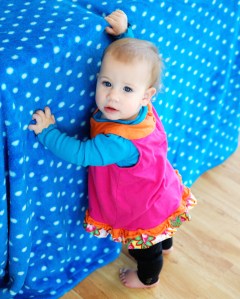
Trusting gaze

Big girl! (but checking in to see if all is well--she's looking at me in this picture).

Happy Thanksgiving!

Sand Tray Therapy

I hoped to finish Noah’s book before his birthday today, but I didn’t quite make it. I’m still editing the last half, adding resources to the appendix, and waiting for my husband to design the cover for me. Hopefully I will publish it by the end of the year! Instead, I wanted to share some pictures and thoughts from a sand tray therapy exercise that I did during a session at the ICAN conference in St. Louis in April. I’ve been meaning to post about it since then and haven’t found the opportunity, so in honor of his birthday seems very fitting and appropriate. The session was intentionally kept small for personal sharing and when we walked in the therapist, Maria Carella, asked if we were there to celebrate a birth or to grieve one. I said I was there for both (I had Alaina with me and she slept in the Ergo during the session). Each of us had a tray of sand and there were long tables at the front of the room full of objects and materials (like shells, feathers, and so forth). We were paired up and after arranging our items on our sand, we were asked to share our tray with the person next to us as well as the message, lesson, reflection, or insight we received from the process of making the tray. While some people used the sand in various creative ways—mounding it up, etc.—I just smoothed mine out and put stuff on top of it. The experience of sharing with my tablemate was very moving and profound. We had a lot of surprising similarities in our feelings about our births, though our stories were very different. And, our closing thoughts or insights about our trays were almost identical.

While it might be hard to see everything, I chose the bridge to symbolize my feeling of having crossed the bridge to the “other side”—meaning first the fact that after Noah and my second miscarriage, I felt separated from women who had not experienced loss by a bridge and as if I’d crossed over into new territory and left my old, happy, naive pregnant self behind (along with the other non-loss mamas. A little more about this bridge here). AND, that I also felt like with Alaina’s birth that I crossed a bridge into the  unknown and to the end of the pregnancy-after-loss journey. Her birth represented the “other side” of PAL. So, at the end of the bridge I drew a question mark in the sand, representing all the questions I had to get past and over in order to get to my new baby. The little baby on the side of the bridge represents how I still had Noah with me. He didn’t get “left behind” on the other side of the bridge, but was next to me on my journey. The spiral on the other side represents the continuous, unfolding spiral of life. Sitting by the question mark is a sort of Kachina-type figure holding many babies. To me she represents all of the babyloss mamas and also reminds me of the jizos who protect lost babies. There is also a coffin on the other side of the question mark, summing up how the fear of the death was everpresent for me and I had to pass over that fear as well to get to my new baby—my light, the candle on the other side of death. The little sparkling gems also represent my joy at her birth and what a treasure she is to me. The bone on the side of the candle represents the places where the “meat was chewed off my bones” by all my births, including Noah’s (I had just attended Pam England’s birth story sharing session prior to this sand tray session). I placed the Goddess of Willendorf figure, that I had immediately snatched off the table as soon as I spotted her, at the top to represent how my sense of spirituality had surrounded and enfolded both my experiences—She is “holding” it all. And, I explained to my tablemate how the roundness of the tray to me also represented the full circle—how Alaina’s story and Noah’s are entwined and how her birth was the “end” (of sorts) of his story, but that they are part of one whole.

View from the top

Happy birthday, tiny third son. We remember you. Thank you for opening my heart and my life for your sister to enter.

Guest Post: Overcoming Stigma: A Film Story of Stillbirth, Miscarriage

This post is republished from the blog of the Bill & Melinda Gates Foundation:

Overcoming Stigma: A Film Story of Stillbirth, Miscarriage

by Jhene Erwin

In 2007, with one two and half-year-old child, my husband and I decided it was time to have another baby. My first miscarriage occurred at six weeks. My second was at almost eleven weeks. The grief was alarming but I did what many women do – my best to quietly “carry on.”

Simple tasks became challenging. I’d stand in the cereal aisle frozen by the choice between honey-nut and plain. The question, “Paper or plastic?” should not make a person cry. Maintaining this external “everything-is-ok” façade was agonizing.

It was the tension – between façade and grief – which inspired my short film about miscarriage, stillbirth and early infant loss. “The House I Keep” is a story of transformation during one woman’s struggle to come to terms with the loss of her child.

My hope is that this film frees people to talk more openly about what remains stubbornly taboo. When people hear about my film total strangers let loose regardless of location: be it the gym or in a grocery store. Their stories are always deeply moving and I am honored by their candor.

What do they say?

They tell me there is no appropriate place to mourn this loss. While family and community are powerful sources of comfort, the silence on this subject prevents women from accessing that healing power. Consequently, the mental health of not only mothers but also their children suffers.

Consider this stigma magnified around the globe. In some developing countries, superstitious beliefs lead women to be blamed for a stillbirth or miscarriage. Some communities feel more people will die if the bereaved mother is in contact with other women and children. Subsequently, access to the healing power of family and community becomes greatly restricted. As we move forward with the important work of improving global maternal and newborn health, the long term effects of stigma on the mental health of women and their surviving children cannot be over looked or marginalized.

Talking heals. Women want to feel reassured that their child’s too-short life had a place in the world and that the world is different because of that child’s absence. You can help mark that life by just being willing to talk and listen. The landmark Lancet Stillbirth Series released in April is already impacting the worldwide perception of stillbirth.

In my own community of Seattle, Washington, in the United States, nonprofits that counsel women postpartum will be using my film as a starting place for open discussions. The ripple effect of community efforts, combined with the work of organizations including PATH, UNICEF, Save the Children, and the Bill & Melinda Gates Foundation, will undoubtedly lessen the stigma of a tragedy for which no woman should ever be held accountable.

By letting women talk openly, and by listening, our communities around the world can help women – including me – begin to heal.

More to Explore

Jhene Erwin is an actor and filmmaker. She lives in Seattle, Washington with her husband and six year old daughter.
—-
The Bill & Melinda Gates Foundation works to help all people lead healthy, productive lives. Safeguarding the health of mothers and young children is one of the world’s most urgent priorities and a core focus of the foundation’s work; especially in the developing world.

Happy Mother’s Day!

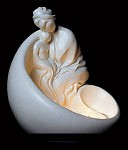
Birthday present from my mom (mother candle-lamp)

In thinking about Mother’s Day this year, I keep thinking of Dr. Bradley’s use of the word “motherlike” in his classic book, Husband-Coached Childbirth. While I’m not a huge fan of the book, I am a fan of this word. To use it in a sentence…giving birth may not be “ladylike,” but it IS motherlike.

This time last year, I was on pins and needles waiting to find out if I was pregnant again (I was!). I attended a friend’s blessingway ceremony on that Mother’s Day and while I was there another friend announced her new pregnancy. And, I’d found out that same week about another friend’s pregnancy as well. These were bittersweet announcements for me as I was happy for my friends, but also felt a pang that it wasn’t me and that I “should” have been full-term myself at that point. Another friend made a very casual, offhand joke about miscarriage shortly after these announcements and I almost lost it completely, feeling at the edge of tears throughout the rest of the event. I was pretty sure that I, too, was also pregnant, but I felt almost paralyzed with fear of being “left behind” again. I imagined all of my friends going on into January and having their babies without me. As it was, the dear friend who had announced her pregnancy that day ended up losing her own sweet baby at a gestation very similar to my own loss of Noah (side note: the 18 month anniversary of his birth is today). My heart ached deeply for her, knowing that now she would have to be the one watching me go on without her and I felt acutely aware of that each time I shared a new pregnancy picture throughout my pregnancy with Alaina—my own sense of “arrested pregnancy” was one of the many difficult post-miscarriage feelings for me (it simply felt wrong to not be pregnant—like pregnancy was my “rightful state” and had been prematurely interrupted).

Anyway, that isn’t really what I planned to write about today, it just came to mind as I began to type. I really planned to just share a couple of new photos! So, here’s one…

All the reasons I'm a mother!

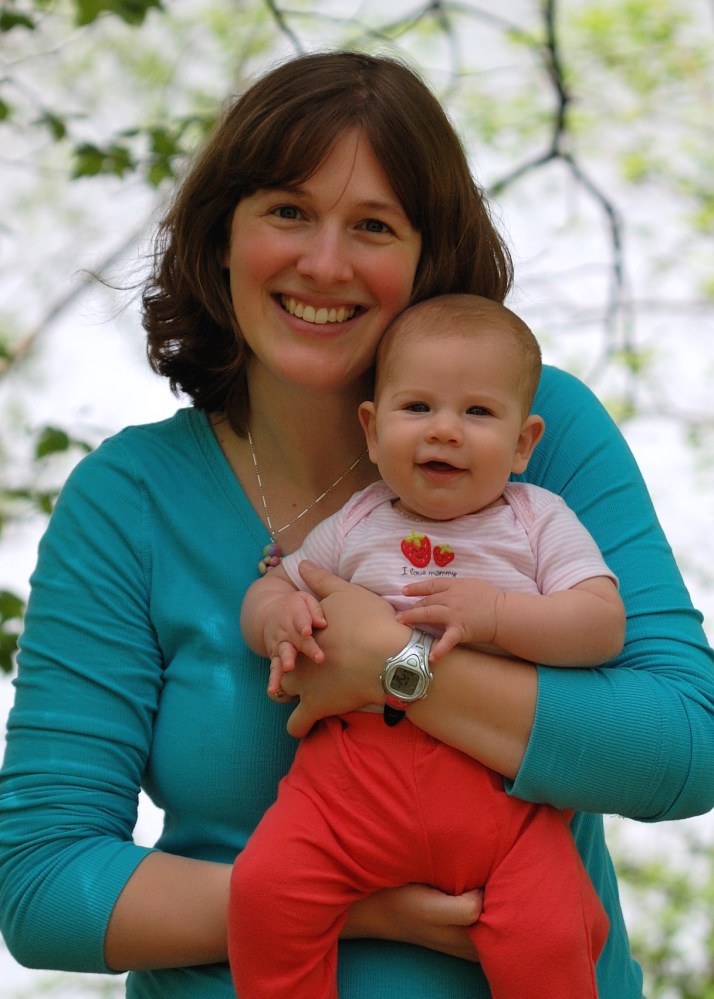
At playgroup this week, I asked my friend to take a new profile picture for me and so she took this one:

(c) K Orozco, Portraits and Paws Photography

I love it! She is the same friend who took all of the wonderful pregnancy photos of me 🙂

Alaina keeps getting bigger and bigger! She weighs about 15 1/2 pounds now. She rolled over for the first time a couple of nights ago, but has yet to repeat the feat. However, she has started to act kind of like she wants to sit up. So, we have been experimenting with that and she has surprisingly good sitting up skills for a 3.5 month old!

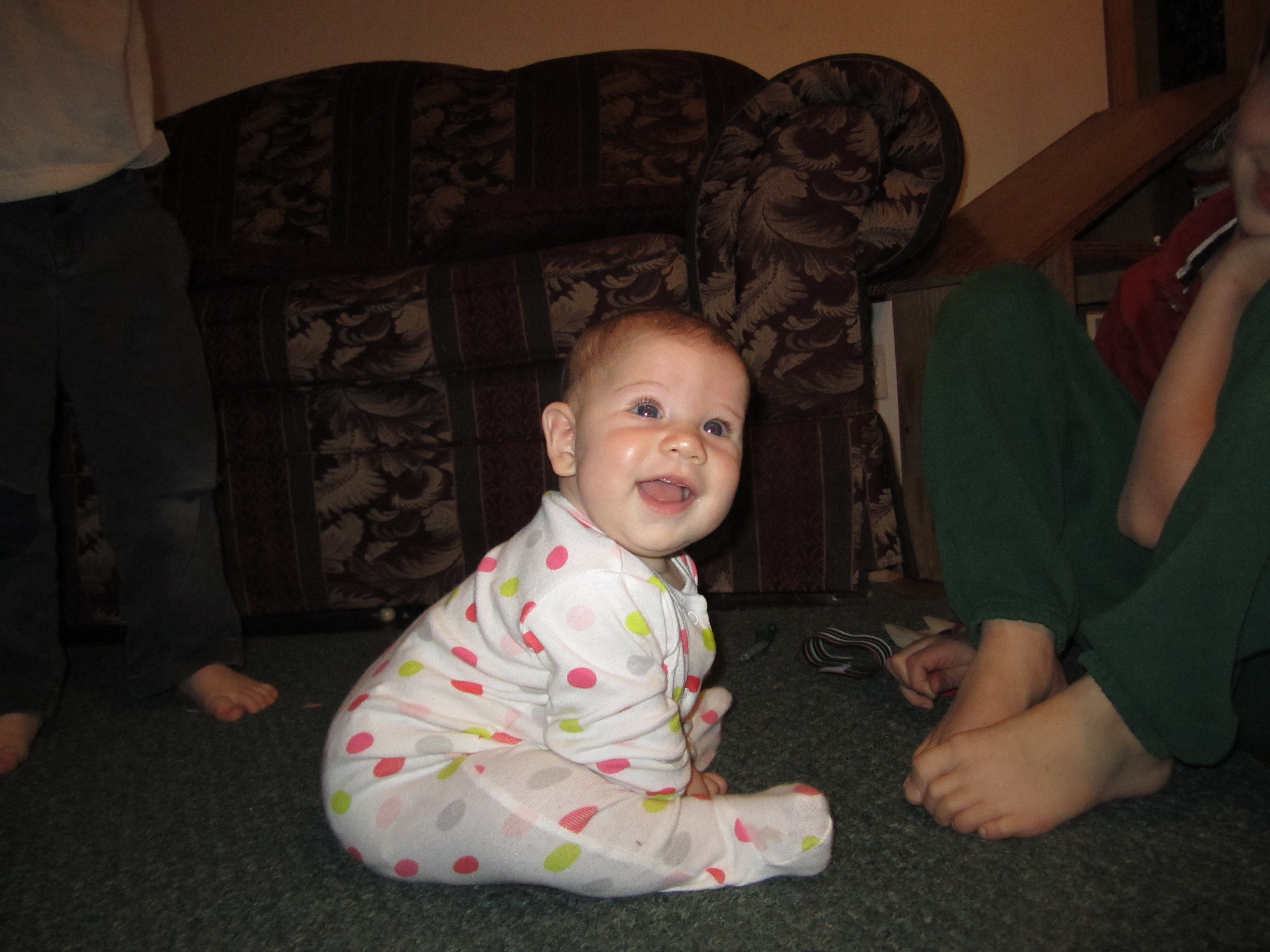
What's this?!

I think her big cloth diapers serve as a stabilizing influence and I would imagine that if we tried to sit her up without one on, she would fall right over!

Last year, my husband gave me a beautiful ring for Mother’s Day. I received it with some trepidation also, knowing that if my tiny, tentative new pregnancy was to also end, I would associate the ring with that forever (it also has two garnets in it—January’s birth stone). The goddess of Willendorf image has held special meaning for me for some time and I love this ring. I am grateful that rather than being a loss trigger, it instead serves as a reminder of the potency and power of the Feminine. Of being motherlike.

Mother's Day present from last year

The Five Ways We Grieve

“…most people are unaware that our losses affect us forever, since they cause us to see the world and ourselves differently. The task of discovering ‘Who am I now?’ and finding our own path to healing represents one of the greatest challenges of the grieving process.” –Susan Berger

I recently received a request to review a new book, The Five Ways we Grieve, by Susan Berger. I was instantly intrigued by the book and felt like while it is not specifically about pregnancy loss, it might still have helpful information to contribute to mothers who are coping with pregnancy loss. And, it does not disappoint! The book describes the five “identities” survivors of loss assume and the ways in which these identities transform or paralyze. While the experience of pregnancy loss is often minimized or marginalized culturally as less significant than other types of loss, the reality is that many women experience profound and genuine grief that is just as “real” as any other sort of grief and loss. When I found out that my tiny son had died after 14 weeks of pregnancy, I experienced a depth of sadness never before experienced in my life. I felt a sorrow so profound and full of anguish that I feel certain it was the same type of grief I would experience at the death of any of my dearly loved children. While some might find this surprising (or even impossible), because the baby wasn’t born yet, I believe that the pit of despair one enters after losing a child is the same regardless of the age of the child and whether born or not—perhaps the duration of grief might be shorter for some, but the initial shock, impact, and sense of intense loss and sadness is the same. And, while my own first loss may be defined by some as, “just a miscarriage,” the reality is that I gave birth to a third tiny son in the privacy of my own home—a real, little baby with fingers and toes and whose little fluttery kicks I had just been beginning to feel.

So, regardless of the size of person who died, I very readily recognized myself in the descriptions of the five identities explored in The Five Ways We Grieve.  Most people are familiar with the classic “5 Stages of Grief” model developed by Elisabeth Kubler-Ross (Denial, Anger, Bargaining, Depression, Acceptance), however, these stages most readily apply to people who are dying, not to the survivors. While survivors still speak of moving through these stages, they are not really adequate to describe the experience of grieving a loved one. The five identities explored in Susan Berger’s book are:

  • Nomads:  Those who have not yet resolved their grief in a way that allows them to move on with their life and form a satisfying new identity.
  • Memorialists:  Their main goal is to honor their loved one by creating physical objects or rituals that honor the deceased.
  • Normalizers:  They work to recreate the kind of life they lost or wished they’d had.
  • Activists:  They focus on helping other people who are dealing with the same disease or issues that caused their loved one’s death.
  • Seekers:  They experience loss as a catalyst for philosophical exploration into the meaning of life.

In my own experience, I believe the Activist and Memorialist roles are intimately intwined—nearly immediately post-loss, I wanted to reach out to others and to try to help them as they experienced their own loss journeys. Creating my website/blog/journal, Footprints on My Heart, was a means of helping myself through exploration of my feelings and thoughts, but also a means of helping others. And, it is also a means of being a memorialist. I wanted to assure that Noah’s brief life would be remembered and would have value. On significant dates, I felt/feel an urge to acknowledge the date with some type of memorialization. In keeping with this, I’m posting this on his due date (which is also my birthday). Earlier in the year, following the birth of my sweet new baby girl, I felt like perhaps these date milestones would have lost their significance. In March, I considered that I had hardly given my former due date any thought at all and was really only thinking of it as my birthday and not really as anything else. However, as we got closer, old feelings were stirred and I remember how very painful this time of year was to me last year. And, no matter how distant the lived experience becomes, my birthday will actually never be the same, because I will never forget. And, I don’t want to. His death/birth and my experiences with those things are part of me in a permanent way. However, the experiences now come through the lens of memory and commemoration/memorialization, rather than as a “fresh” or current, in-process experience. I write about it to ensure that he is not forgotten, nor is what he meant to me. And, I am presently in the process of turning my Footprints blog into a book, again with a dual intention of activism and memorialization.

Finally, I also see myself in the Seeker role. While I have spent a lot of years already exploring the meaning and purpose of life, giving birth to Noah was a catalyst for spiritual exploration for me. His birth prompted me to take a deep and long-lasting inner journey and to much more fully explore and elaborate on my spiritual perspective and my experiences with the Sacred Feminine, rather than to just continue to “dabble” with various ideas.

—-

The Five Ways We Grieve: Finding Your Personal Path to Healing After the Loss of a Loved One
By Susan A. Berger, LICSW, EdD
Psychology/Grief | US $17.95 CAN $20.50 | Paperback | ISBN: 978-1-59030-899-8 | Trumpeter, an imprint of Shambhala Publications, Inc.
http://www.amazon.com/Five-Ways-We-Grieve-Personal/dp/159030697X
http://www.shambhala.com/html/catalog/items/isbn/978-1-59030-697-0.cfm

Happy Birth Dance

“Birth is a creative process, not a surgical procedure. I picture dancers on a stage. Once, doing a pirouette, a woman sustained a cervical fracture as result of a fall; she is not paralyzed. We try to make the stage safer, to have the dancers better prepared. But can a dancer wear a collar around her neck, just in case she falls? The presence of the collar will inhibit her free motion. We cannot say to her, ‘this will be entirely natural except for the brace on your neck, just in case.’ It cannot be ‘as if’ it is not there because we know that creative movement and creative expression cannot exist with those constraints. The dancer cannot dance with the brace on. In the same way the birthing woman cannot ‘dance’ with a brace on. The straps around her abdomen, the wires coming from her vagina, change her birth.” –Dr. Michelle Harrison

Present from my husband after my daughter's birth

I woke up this morning thinking about this quote. I’ve shared it on my blog before, but that was in 2008 and so it has been lost in the shuffle of other posts (and many, many quotes!) since then. My ongoing thought process actually didn’t have much to do with the quote, though my recent labor pictures post illustrates the idea of freedom of movement throughout labor according to my own body’s messages, rather than assisted with anything else.  However, thinking of dancing and birth made me think of the pendant my husband gave me following the birth of our daughter. He actually gave it to me for Christmas first, but since he gave me four other pendants for presents, I gave this one back to him and told him to save it for a post-baby present! Given how I then felt after birthing her, it felt like a perfect present. I love how this exuberant goddess is dancing for joy. And, how her upswept arms form a heart-like shape. I was so happy to have MY BABY. When I wear this pendant, I remember that feeling of relief and happiness after giving birth to her. Every night when I look down and see her there in my arms I feel lucky and also this continued sense of surprise, almost, to have her here with me. It all seems so magic.

I was talking to my husband about this last night (well, quietly croaking, since I’ve had laryngitis for several days) while on our nightly walk. We’d noticed that Noah’s tulip tree actually bloomed! I told him I hadn’t been sure it would actually survive (clear parallels here), but look, now here we are and look at this baby who is here with us while the flowers bloom. We looked quietly for a minute and then I said, “remember how we almost decided not to try again?” I feel like it was brave to try again. I was brave.


Noah's tree bloomed!


Birth Strength

“Women are strong, strong, terribly strong. We don’t know how strong until we are pushing out our babies. We are too often treated like babies having babies when we should be in training, like acolytes, novices to high priestesshood, like serious applicants for the space program.” –Louise Erdrich, The Blue Jay’s Dance

This is one of my favorite quotes to share at blessingways. The Blue Jay’s Dance is a memoir of the writer’s first year with her third baby (sixth child). She isn’t particularly a birth advocate, the book is a general mothering memoir, but at one point she says the above and I love it. Though, I should note that I think there are all kinds of strengths to be found in birth—not just in pushing out a baby. One can experience “terrible strength” in coping with an unexpected cesarean also. And, of course, womanpower can also be found in other non-birth experiences. When I shared the quote on Facebook, some people commented that they hated it or that it was offensive. I have been surprised by how very personally some of the  birth quotes I post on Facebook are taken. There have been several occasions where I’ve felt so upset about it that I thought maybe I should never post quotes ever again! (now who’s taking something too personally? ;)). Then, I realized a strong personal reaction is normal, because birth is such a strong and personal issue, so now I try to be extra mindful of the subtexts that might be perceived in a quote (regardless of original intent) and clarify that below the quote. I truly think the intent in this one is of the potential to discover our own hidden strength via birth, not to say that birth is the only powerful experience available to women. I know that I draw on my “birth strength” in other important moments in my life. I also realized after the miscarriage-birth of my third son that the strength found in birth is present in women, period. It is woman strength and it rises up during birth, but it is always there.

During a recent women’s retreat we reflected on sources of personal power and how we feel when we are standing in our personal power (this question comes from a fabulous book, A Mother’s Guide to Self-Renewal). When I first considered this question, I was somewhat sad to discover that the only instances of personal power I could come up with from giving birth—it would be nice to have piles of personal power experiences! More reflection revealed that I also feel like I’m standing in my personal power when I teach. Not a sense of “power over,” but in power with. More freshly, I’ve realized that I find personal power in Goddess spirituality/images and ideas of the Divine Feminine. And, I also experience personal power when I am alone. I feel most whole and authentic when I am just by myself. I like quiet space in my own head in which to think and I also enjoy my own company 🙂

“A woman meets herself in childbirth” –Cynthia Caillagh

Each time I gave birth I realized I was a pretty amazing person with inherent worth and value. The woman that I met in birth was very strong and very capable and very focused. And, she is me.

I hope my baby girl grows up standing in her own personal power and having a profound sense of her own worth.

Baby's First Bindi--taken at a recent blessingway for my good friend

Pregnancy Update

Labyrinth of pregnancy (the path can be followed all the way into the spiral belly!)

I had my 28 week prenatal appointment earlier this week. I value my midwife and enjoy our visits, but I had a nighttime epiphany recently that I had more options to choose from, because I miss the kind of relationship I had with my midwife during my second pregnancy.

At this appointment, I had my blood sugar checked (2 hour post-prandial) and it was 91 (same as it was with my first baby at this point). I also had my hemoglobin checked and it was 11.5 (same as with my first baby—with second baby, it was 12.9 at 26 weeks). I now weigh almost as much as I did full term with number two! (still five pounds to go). Baby wiggles a LOT—sometimes it almost hurts, which I don’t remember from before. She also has hiccups regularly, which are always cute. She also seems to be head-down. When I heard that, I felt really strange—like, “there is a head in there?! And, I’m going to give birth to it?!” I have been much more reluctant to read about birth during this pregnancy—I think because I’ve been concentrating so much on successfully growing this baby to term, I don’t want to plant any subconscious ideas too early about giving birth and send myself into labor early, or something. I used to read a lot of birth stories and I have some great books of birth stories, but I don’t feel like reading them until I’m like 36 weeks—just in case. After this appointment, I started to think birthy thoughts some more—thinking about ideas and plans for when she is born. I also had a birth dream—the placenta came out first and after a while I was like, “wait, but I didn’t have the baby yet!” and then she was born—enormously fat with small eyes and she gave me a big hug.

The same night I realized I wish I had some more midwife choices, I had another realization (not exactly a new one, but a new version of it)  that I still have a big root fear that something wrong with ME is what caused my miscarriages (like a clotting disorder) and that I still do not trust that I can really give birth to a living baby at the end of this pregnancy. I’m worried that my body was responsible for the loss of my other babies. I don’t know how to get rid of this or work with it really—I’m at an impasse and since I truly do not know the cause and I can’t talk myself out of logically/rationally or just “think positive.” It is buried down there—most of the time I feel happy fine, but when I catch sight of the fear again (that night it was because she wasn’t moving as much as she usually does at that time of night), I realize that it is this bone deep fear-based thing that I don’t know how to shake. I do not want to have a fear-based pregnancy or to live a fear-based life, but there it is…

When it isn’t the middle of the night and I have my logic brain back, I feel more certain that my m/c experiences were chance based—Noah perhaps some kind of abnormality and the second perhaps a progesterone deficiency or something else related to getting pregnant again fairly quickly after a significant loss—and thus have no bearing on my current pregnancy, but still.

However, speaking of fears and returning to my plans for this birth, someone recently expressed surprise to my mom that I’m planning to have this baby at home after what happened with Noah. Hmm. This is completely irrational to me, because what happened to Noah had nothing to do with being at home—he died, we found out, I gave birth to him at home. How would that mean that my new baby should be born in the hospital instead? Not to mention that fact that when I did go to the hospital postpartum because of blood loss, rather than being helped by the assumed-fabulous skills and resources at the hospital, I was dismissed in life-threatening condition! (and was instead helped by a midwife at her home.) Having Noah only reinforced for me that the hospital is not somewhere I want to be when I’m giving birth, postpartum, or in need of compassionate attention. Giving birth to him at home reinforced for me that home is where I can most capably, peacefully, respectfully, powerfully, and safely give birth to my babies.

I keep feeling this “call” to retreat—to quit most of my nonessential responsibilities and just hang around at home. I had this fantasy recently of a year-long postpartum retreat where I just take care of my baby and read and write and play with the kids and look at the clouds (or something). Ever since I had Noah last year, I’ve been feeling like turning inward/away and just spending time by myself. I also felt like I needed to take a break from being of service/helping other people and needed to tend my own hearth and take care of myself instead. I rarely actually follow-up on this urge, even when I have a chance to do so. There is always too much “work” to be done or things to “catch up” with or just “one more thing” and before I know it, my window of alone time has passed. This might just be a fantasy notion—if I really wanted to take the time out, wouldn’t I do it?—but I think it is a true call to self-care that I’m not heeding (even now, here I am writing a blog post while my kids are visiting their grandpa—couldn’t I be having a mini-retreat right now?). This is one reason I’m taking a leave from birth classes and LLL right now—I want to be able to focus on my own pregnancy, birth planning, babymoon, and new baby, rather than focusing on those things for other people. I also feel like writing about my own pregnancy and my own birthing thoughts, rather than writing posts or articles designed to help other people—sometimes I get bogged down in feeling like I should be writing helpful and informative posts and the time for personal reflection passes. Maybe this sounds selfish, but I don’t think so. I’ve always had a fear that if I am not “of service” in some capacity I will cease to exist/have any worth/be a real person—I’d like to get over that!

I often tell my college students that we cannot expect more from our clients than we are willing to do ourselves. I also tell them that sometimes we want to do for others what we are unwilling to do for ourselves. This is where I am right now—I have lots of great ideas for things I’d like to do for other women on pregnancy retreats or in birth classes for women who are having their second or third baby rather than their first and want to deepen their understanding of the meaning of pregnancy and birth in their lives. Why don’t I experiement and do all those things for myself? And, then, see about offering those things to other women…I can see it now—“My Year of Self-Care.” (Inside joke to those who know how I disklike “year of” experiment books.) I feel like I rarely do what I actually want to do with my days, instead of doing what I should do, or what makes the most sense. Sometimes it is what is most pressing, but more often it is should-based or internally driven, rather than an actual issue of priorities.

This actually isn’t the post I set out to write today, which was originally intended to be some self-care tips from Renee Trudeau with a short intro from me about my own “call” to rest and renewal. Perhaps it was the post I needed to write though! Perhaps not, because now I feel like I’ve “wasted” my chance to do some of those other things I’d like to do with my time!
“The Empowered Miscarriage” Book: Call for Contributions

I already posted about this on my miscarriage blog, but I have more readers here and wanted to reach out to those followers as well.

I am currently compiling contributions for a book about miscarriage. I am especially interested in stories about natural miscarriages (i.e. miscarriages that begin and complete on their own timeline rather than a medical timeline) and on miscarriage at home, but I am happy to receive any miscarriage story contribution. I am seeking full stories about miscarriage—the nitty gritty physical reality as well as the emotional components. I have a big vision for this book—I want it to be a “what to expect when you’re having a miscarriage” guidebook that doesn’t only address the feelings involved with miscarriage, but answers practical questions like, “what should I eat?” and “how do I take care of myself?” and “how much blood is too much blood?” and “how to decide whether to have a D & C or whether to wait it out at home?” I feel like the best way to answer many of these questions is through the heartfelt stories of other women who have “been there.”

I welcome contributions from women who chose to go to the hospital at some point during the process even if they originally started out to have a natural miscarriage (I am particularly interested in the decision-making process about going). My primary interest is in the nitty gritty, physical coping stories rather than specific location of miscarriage-birth, though I do still have the special interest in home experiences—-at the root, I want real, complete stories from any setting.

I have a full survey of questions that I am developing to post online, but for now I am pleased to accept any contribution related to my primary theme of natural miscarriage (and/or the physical miscarriage experience regardless of setting). Stories can be emailed to me and I will respectfully and gratefully accept each one with my heart wide open.

——–

I was previously seeking suggestions for the title of this book, originally thinking of calling it simply, “Miscarriage at Home,” when a reader emailed me to suggest the title “The Empowered Miscarriage” (see comments on my other blog for her full explanation). I really like the connotations of the title—-particularly, that it suggests something about miscarriage that is very different than the normal coverage of miscarriage in books. So, I edited my original post to reflect this new title and focus.

Also, I still find myself signficantly displeased with the woefully inadequate word, “miscarriage.” I don’t like it. I don’t like, “miscarrying.” It isn’t enough. I also don’t like the euphemism “loss.” “Pregnancy loss” as a phrase is all right—side note: I feel like there is a range of experiences contained within the miscarriage experience and I think the three are almost separate experiences (emotionally, mentally, and physically)—the babyloss experience, the actual birth-miscarriage experience, and the experience of the loss of being pregnant. I have coped with my own strong, strong feelings about miscarriage as a birth event by referring to my own first miscarriage experience in writing as a miscarriage-birth or a birth-miscarriage. For me, this modifier makes an important point. However, it is cumbersome, not in popular use, and I want something else! Any ideas?

Polymer Clay Birth Goddess Sculptures

In my recent post about “the tentative pregnancy,” I mentioned feeling the urge to make some birth art. Coincidentally, I have several blessingways/mother blessings coming up and also needed to make some gifts…so I put the two needs together and made some lovely (if I do say so myself) polymer clay birth goddess sculptures. I’ve made quite a few in the past, but this was the first time I’d tried using pigments to color them. I also boiled them instead of baking them, which works really well (and they are just as hard and plasticky as when baked—not rubbery or anything as you might expect—but there isn’t any weird fumes from the oven or a need to have an oven heating up the house on a hot day). I think the pigments turned out nice, though I was hoping for more color.

I hope that none of the pregnant mamas for whom these are intended will read this post and have the surprise ruined! (the blue one is actually for me, I thought as long as I was creating for others, I would like to create something for myself as well)

In my earlier post, I’d also mused about my feelings that my pregnancy loss experiences have impacted my ability to connect with the “pregnant identity” during my current pregnancy while at the same time still being constantly aware of being pregnant. Interestingly, I was skimming through my old pregnancy journal from my first pregnancy in 2003 and found the almost exact same sentiment expressed (6 years PRE-loss experiences). I wrote (reflecting on earlier in the pregnancy), “I felt almost constantly aware of being pregnant, but not fully connected to being PREGNANT. This feeling changed after I started feeling the baby move on a regular basis.” Ah ha. So, perhaps my current feelings have more to do with the normal developmental tasks of pregnancy than with having been wounded by loss? (it is probably a combination of both, really, but it was reassuring to me to see that this is not a completely “fresh” feeling!)