Archives

Celebrating Pregnancy & Birth Through Art

This article is adapted from my notes for past birth art workshop presentations. It is part of a story for the Winter 2013 edition of the Friends of Missouri Midwives newsletter.

Celebrating Pregnancy & Birth Through Art

by Molly Remer, MSW, ICCE, CCCE

http://talkbirth.me

See other posts and pictures about birth art here.

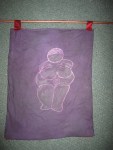
Birth art is one of my favorite birthy subtopics and I used art during my pregnancies, postpartum, and continuing in life today. I love exploring birth art with women and I’ve presented on the subject at multiple conferences, as well as hosted a “birth art booth” at our local MamaFest event this past fall. Art can play an important role in self-discovery and preparation for birth and parenting. Art used during pregnancy and following birth can be powerful tool of validation, celebration, exploration, and insight.

Why is art during pregnancy is useful?

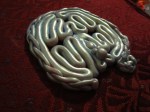
Art during pregnancy is primarily as a tool to tap into “right brain” consciousness and express unexplored gifts, primal wisdom, or release hidden fears. Creating birth art can help both women and men explore your feelings, memories, beliefs, and perceptions surrounding birth outside of the confines of the spoken or written word. The purpose of birth art is to explore what you find within as you create your art and not the final product—as Pam England describes, birth art is as raw, honest, spontaneous, and personal as birth itself.

Art during pregnancy can be used for:

    • Birth preparation.
    • Exploration of fears.
    • Celebration of feelings & experiences.
    • Fun!
    • Visualization.
    • Focal point.
    • Exploration of the unknown.
    • Self-discovery & insight.
    • Healing.
    • Revealing unconscious patterns/ideas.
    • Celebration of the power of the female form.
    • Celebration of new life.
    • Representing hopes/dreams.
    • Communicating hard to verbalize ideas/feelings.
    • Exploring “right brain” methods of understanding the birth journey.
    • Explaining concepts in new ways.
    • Symbolic/spiritual insights.
    • Revealing hidden birth wisdom.
    • Expressing creative gifts.
    • Mementos

Types of art exploration in pregnancy:

    • Sculpture—variety of mediums (fiber, clay, pottery…)
    • Painting
    • Drawing
    • Photos
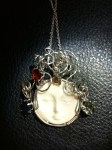
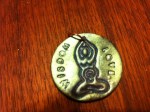
    • Jewelry
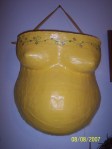
    • Belly casting
    • Body art (such as henna)
    • Collage
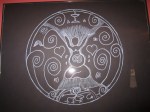
    • Mandalas
    • Decorating objects—prayer box, wreath
    • Quilting

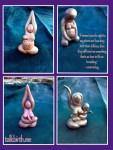
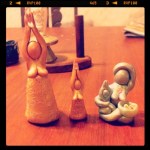
Birth Art Examples:


Two Suggested Exercises for Birth Professionals or Parents:

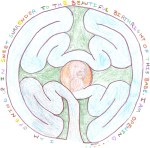
Based on Pam England’s LabOrinth article, I enjoy showing parents how to draw a birth labyrinth (several examples can be seen in the gallery above). Drawing a labyrinth with an explanation of how this type of image can be used to explain/explore the progress of labor as opposed to medical models such as cervical dilation charts or labor progress “bell curves,” can be a very eye-opening exercise for parents. The resulting image is a powerful visual of “normal birth,” instead of “clock watching” birth. I’ve made two posters than I use when I teach birth classes. The first shows a rough Friedman’s curve and a cervical dilation chart—these images are part of a deeply ingrained cultural view of birth and it is hard to shake these associations. This linear birth structure may be how we view labor from the outside, but it is not how we experience it from the inside, the labyrinth is a more appropriate birthing image as it feels from within and this is why…

      • No shortcuts—have to keep going til the end.
      • Speed varies.
      • Can’t get off the path (no falling off the curve).
      • Can get through blindfolded.
      • One step at a time will get you through—one foot in front of the other (one contraction at a time).
      • Can’t get lost. If you get out of the lines, you get lost—try to take shortcuts, get lost. Have to continue on your path.
      • Can crawl if you need to (or run!).
      • Circular (nonlinear)
      • No right way to finish.
      • Contemplative
      • Meditative
      • Journey
      • Everyone gets to the same place eventually—can go own speed, some fast, some slow
      • Do not need instruction to complete (no birth plan)
      • No timeline
      • No need to study.
      • Can rest if you need to.


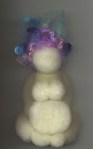
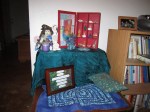
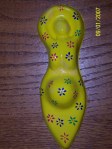
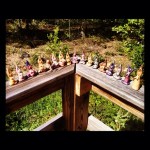
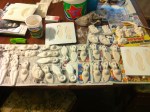
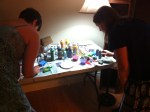
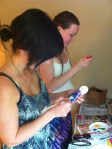
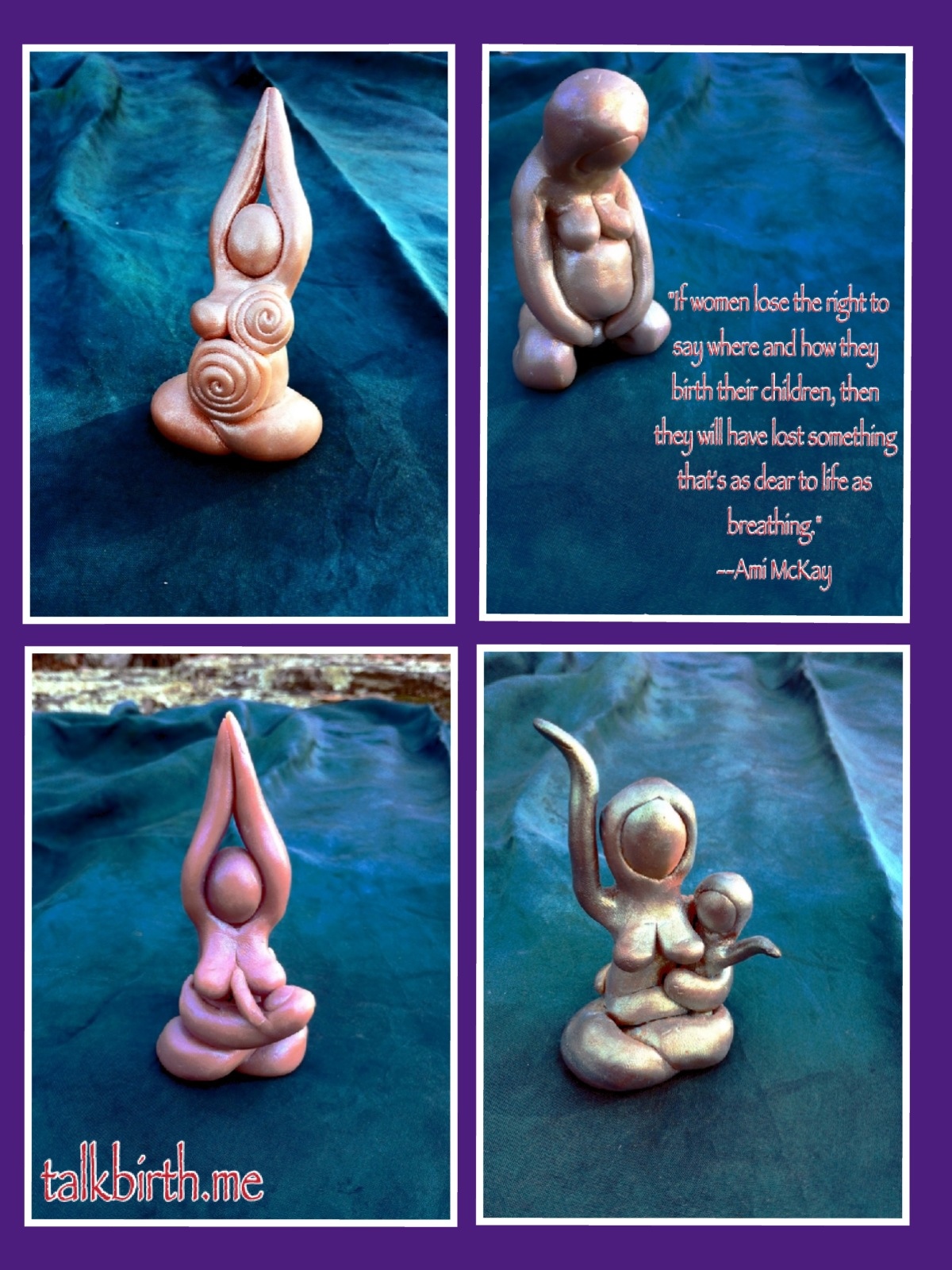
My other favorite group birth art project is to painting small pregnant goddess figurines (I make big batches of these in a mold using plaster). My most recent experience in doing so was at Rolla Birth Network’s MamaFest event:

This experience reaffirmed for me that birth art is about process not product. And, also that I don’t have to personally do anything to have the process be a meaningful one to participants. As an example of what I mean: at MamaFest, a very young mother came into the birth art sanctuary. I gave her my one minute spiel about the purpose of birth art and she painted her figures alone in the room for about 20 minutes. When she emerged, she showed her figures to me and explained what all the symbols and colors meant. Then, with tears in her eyes, she hugged me and said thank you and left. This was a mother I’d never met before and I’ve never seen again. And yet, we shared a special moment through birth art.

Molly Remer is the Friends of Missouri Midwives newsletter editor. She enjoys blogging about birth, motherhood, and women’s issues at http://talkbirth.me.

Talk to Your Baby

I already know that you can learn a lot from chickens about giving birth. This summer, I had another profound birth-mothering experience with one of our chickens after she hatched her first baby. During the last several days of incubation, mothers hens “talk” to their babies a lot through the eggshells and the babies respond. It is part of how they get to know each other and imprint before hatching. Then, after baby hatches, the mother hen continues to talk and cluck to the baby in a reassuring manner—she calls to the babies when separated and she calls a special call when there is something good to eat and she clucks softly and reassuringly at bedtime as she snuggles them all beneath her. There is a specific type of “soothing” noise they make to stressed or lost babies and a specific sort of excited sound they make to let the babies know something good is happening. There are also distressed sound that means, “run to me now, there might be danger!”

537

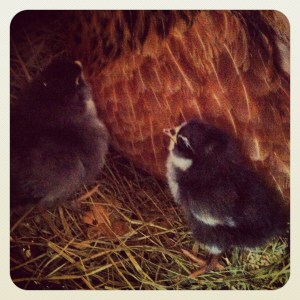
The baby chick who tried desperately to get to a mama who would talk to it (this mama, interestingly, is the same one I wrote about in the Birth Lessons from a Chicken essay several years prior).

We had three broody chickens at the time, each in their own little separate nest box in the broody coop. One of the hens had hatched a baby already and was in the neighboring box. The inexperienced mama hen hatched her baby and she would not talk to it. The baby freaked out. It flailed, it freaked, it stumbled all around. It dragged its tiny little wet, not-even-able-to-walk body to the very corner of the nest box as far away from the mother as possible. It flung itself into the wall where it could hear the neighboring mother clucking to her baby. The baby peeped more frantically and loudly than I’ve ever heard a chick cry out before, it sounded like it was in grave distress and danger. We moved it back to its mother and she fluffed out her wings around it just like she was supposed to do and I thought all would be all right, but…silence. The mother did not talk. Her baby desperately struggled out from under her, still not able to walk, still wet, and flung itself back into the corner, sinking down under the straw, crying piteously. Silence from the mother.

Talk to your baby, we pleaded. Your baby needs to hear you. Please talk to your baby. Silence. The baby squished down on the wire slats, pressed into the corner of the box, screaming at the top of its chick-lungs. The mother in the next box became distressed as well, calling back to the baby more and more loudly. The chick became more frenzied and flopping. The baby in the next box picked up on the fear and began peeping loudly as well. Still, the new mother sat silently and unresponsive. Talk to your baby. We left her alone, thinking her instincts would kick in, but as time passed and we could hear the chick screaming from all the way across the yard, we went back to interfere. We tried twice more to put it back under her and again the same routine repeated. We became concerned the baby would die if its level of distress continued, particularly with forcing itself down and under the straw and into the wire, so we made the decision to remove it and put it in “foster care” with the other, responsive mother. We thought she might attack it, since it wasn’t her own hatchling and because it was several days behind her own baby, but she snuggled it right up, clucking in reassurance, and it went to sleep, the next morning it was fluffy and quiet and perfectly happy with its new mother. The red hen continued to sit, silent, and unresponsive, and of course I felt horrible for stealing her baby and giving it to someone else after she’d worked so hard to hatch it. Luckily for the mental health of all involved, she successfully hatched one more baby and did take care of it, albeit still quite silently compared to all other mama hens we’ve experienced.

What does this have to do with birth?

Babies are primed to hear their mothers’ voices after birth. They expect to be snuggled into the maternal nest. Mammal babies expect to receive a warm breast and to hear comforting words in their own language. I feel fortunate that my own birth pause was respected after all my children’s births and that each baby felt only my hands and heard my voice for their first minutes of life. I talked to all my babies, soothingly and lovingly, and then brought them to my breast. My midwife and the other people around me did not interfere with these sacred, timeless moments of introduction.

It has been several years now, but I’ve worked with a couple of mothers for breastfeeding help postpartum who were unwilling or unable to talk to their babies, even with direct encouragement to do so. Baby was expecting mother’s voice and mother was unable to give it. Not surprisingly to me, these mothers experienced significant difficulty in getting baby to breast. I believe baby is expecting mother’s voice as a guide to the breast as much as it is expecting the smell of her and the sound of her heartbeat. Baby is not expecting multiple, strange voices from nurses (or even helpful breastfeeding helpers like me!). Baby is not expecting gloved hands. Baby is not expecting bright lights or loud noises. Baby is most definitely not expecting to be “helped” to the breast and “shoved” on as many mothers describe experiencing after their births. In Breastfeeding Answers Made Simplethe author emphasizes that what motherbaby pairs need most to successfully breastfeed is time alone to get to know each other. Mother and baby need to explore each other’s bodies and to listen to each other. She points out that with many people in the room, even well-meaning people, mothers have trouble getting to know their babies and getting babies to breastfeed. She says the most helpful strategy to supporting early breastfeeding is to get out of the way and let mother talk to her baby, smell her baby, touch her baby, meet her baby, and learn about her baby.

536

The non-communicative mother and her second baby, who was okay without much talking.

What are we really imprinting upon many newborns at birth in our culture?

As Sister MorningStar writes in her article The Newborn Imprint in Midwifery Today issue 104, Winter 2012…

If you have had the misfortune, as nearly all of us who can read and write have had, to see a baby born, perhaps pulled out, under bright lights with glaring eyes and loud noises of all sorts, in a setting that smells like nothing human, with a mother shocked and teary and scared; if you have witnessed or performed touch that can only be described as brutal and cruel in any other setting…

Every baby born deserves uninterrupted, undisturbed contact with her mother in the environment the mother has nested by her own instinctual nature to create. Any movement we make to enter that inner and external womb must be acknowledged as disturbing and violating to what nature is protecting. We do not know the long-term effects of such disturbance. We cannot consider too seriously a decision to disturb a newborn by touch, sound, light, smell and taste that is different and beyond what the mother is naturally and instinctually providing. Even facilitating is often unnecessary if the motherbaby are given space and time to explore and relate to one another and the life-altering experience they just survived. They both have been turned inside out, one from the other, and the moment to face that seemingly impossible feat cannot be rushed without compromise. We have no right to compromise either a mother or a baby.

I am deliberately leaving out the issue of life-saving because it has become the license for full-scale abuse to every baby born… [emphasis mine]

If mother has been taken to an operating room to give birth, or if mother is for any reason overwhelmed, exhausted, scared, vulnerable, hurt, and traumatized, she may have great difficulty in talking to her baby. If the room is full of people, baby may have difficult hearing her mother’s voice and feeling her welcoming touch. If baby is greeted by a bright light and masked face instead of her mother’s voice, baby may cry loudly in distress and eventually “shut down” into sleep rather than immediately to breastfeeding.

What can we do?

Beyond the obvious answers in carefully choosing place of birth and birth attendant, we can talk to the babies. If birth has been long, scary, or otherwise difficult, talk to the baby. If baby needs immediate care after birth, try as hard as humanly possible to have that care take place on mother’s chest and in reach of mother’s voice. If baby has to be separated from mother, talk to the baby. Call out to him. If mother can’t call out to the baby, father can talk to the baby. If father is unable, doula or midwife or nurse can talk to the baby. Welcome her to the world, reassure her that she is safe and all will be well. Speak gently and soothingly and kindly, never forgetting that this is a new person’s introduction to the world and to life. Our first and deepest impulse is connection. Before Descartes could articulate his thoughts on philosophy, he reached out his hand for his mother. I have learned a lot about the fundamental truth of relatedness through my own experiences as a mother. Relationship is our first and deepest urge and is vital to survival. The infant’s first instinct is to connect with others. Before an infant can verbalize or mobilize, she reaches out to her mother. Mothering is a profoundly physical experience. The mother’s body is the baby’s “habitat” in pregnancy and for many months following birth. Through the mother’s body, the baby learns to interpret and to relate to the rest of the world and it is to the mother’s body that she returns for safety, nurturance, and peace. Birth and breastfeeding exist on a continuum, with mother’s chest becoming baby’s new “home” after having lived in her body for nine months. These thoroughly embodied experiences of the act of giving life and in creating someone else’s life and relationship to the world are profoundly meaningful experiences and the transition from internal connection to external connection, must be vigorously protected and deeply respected.

“Birth should not be a celebration of separation, but rather a reuniting of mother and baby, who joins her for an external connection.” –Barbara Latterner, in New Lives

“No mammal on this planet separates the newborn from its mother at birth except the human animal. No mammal on this planet denies the breast of the newborn except the human.” –James Prescott (neuropsychologist quoted in The Art of Conscious Parenting)

 “A woman’s confidence and ability to give birth and to care for her baby are enhanced or diminished by every person who gives her care, and by the environment in which she gives birth…Every women should have the opportunity to give birth as she wishes in an environment in which she feels nurtured and secure, and her emotional well-being, privacy, and personal preferences are respected.” –Coalition for Improving Maternity Services (CIMS)”


361

Guest Post: Mothers Matter–Creating a Postpartum Plan

I connected with today’s guest post author, Rachel Van Buren, via Facebook. Rachel has a passion for postpartum support and so do I. When she mentioned that she was teaching a postpartum planning workshop, I asked if she’d consider writing up her notes into a post to share and she did!

IMG_5598“Mothers matter” – Creating a postpartum birth plan
by Rachel Van Buren

The Neighborhood Doula

I feel compelled to state the obvious: Society fails to meet the needs of the laboring, birthing, postpartum woman. Because these women lack the support that seems obvious for those around them to give, they assume their feelings are not normal. I am here after having birthed 4 children over the last 13 years to reassure you that your needs are normal. So normal, that I can read ten thousand threads in one afternoon of women who are crying out for support during the postpartum months. Why is it that we dismiss our feelings, and label ourselves as “ungrateful, needy, or weak” because we read one perfect looking blog, or Facebook post? Don’t misunderstand…the 4th trimester is beautiful. It really truly is. But it’s also life changing. Have you ever experienced a life change without experiencing anxiety? Of course not.

My message here is this: Women need to plan for the postpartum time period. It is essential. We get so wrapped up with birth, we forget about what happens when we bring baby home.

There are 3 areas of importance to explore before you bring baby home: Dealing with friends and relatives, how to delegate without guilt, and the importance of self-care.

Let’s explore these topics together.

How to deal with relatives and visitors during those first few weeks:

  • Have a clear vision of what your postpartum time will look like. If you aren’t sure, have that discussion with your partner now. Do not wait.
  • Set clear boundaries: Everyone does better when they know what to expect.
  • Set phones to go directly to voicemail.
  • Change your outgoing voicemail greeting. For example: “You have reached the _______ family, we are sorry we can’t take your call right now, as we are busy enjoying some quiet time together as a family. We are all doing well, and really appreciate your thoughtfulness in calling. We will return your call when we have the opportunity to talk, or are ready to expect company. So good to hear from you, and have a great day!”
  • Stay in bed.
  • Stay in pajamas.
  • Do not offer beverages. Visitors will be less likely to overstay if you are not in the entertaining mode.
  • Have partner or Postpartum doula mediate and advocate to well-intentioned but pushy friends or family. A BFF, parent, or close relative shouldn’t serve in this capacity. Prepare with them an “elevator speech” regarding visitors “Their Doctor/Midwife has encouraged the family to take a postpartum “Baby Moon” and they are really taking that advice to heart.”
  • If mom is breastfeeding: A gentle reminders to others, that she is nursing the baby about every hour(maybe even more) and are spending lots of time skin to skin, so visitors are just not practical right now.
  • Use social media to the fullest…
092b3a174b95cf52f6cbca69837daa08

Update your Facebook status as a way of giving a “heads up“.

Delegating without the guilt: I find it interesting to meet a lot of women that perceive themselves as feminists; they have no problem advocating for a natural/intervention free birth, defending their right to an elective Ceserean, or advocating for their future right to nurse in public. However many of these women come home after birth, and suddenly find themselves struggling to find their inner voice. Suddenly things become sticky because we’re now dealing with people that we have relationships with on a personal level. Boundaries can be tough to establish and maintain because our desire is really to our loved ones. Here’s when guilt creeps in. Perhaps guilt over losing exclusive relationships (first child, partner, or even self). Guilt of not living up to our mother’s example, our friend’s example, or the “perfect” mother on Pinterest who is sewing her own postpartum maxi pads and cloth diapers.

I’m a believer in learning to delegate. It decreases levels of guilt from not being able to be Mrs Cleaver. It lightens our load. Whether it’s with our partner, or our children, we need to do it. The days are gone where we can “do it all”.

Here are some simple steps to practice in order to delegate without feeling guilty:

  • Set your ego aside: There is more than one right way of doing things. Yours is not the only way. Invite the possibility that they might even do the task better or faster than you.
  • Stop waiting for people to volunteer: It is your job to communicate your needs. Partners are not mind readers. Just because they don’t offer, does not mean your needs aren’t normal.
  • Ask and you shall receive: Get to the root as to why you struggle with asking for help (shame? guilt?). Learn a different way. Learn to ask for help.
  • Delegate the objective – NOT the procedure: Dignify the person helping you by allowing them to do it as they choose, but make clear what your desired end result is. This will stop you from being the ever annoying micro-manager. After all, you are not training a robot, but a human being who can adapt and improve.
  • Be patient: The person you delegate will make mistakes, it is part of the learning process. Work consciously to keep a positive and realistic attitude.
  • Recognize your helper: Make sure they hear you brag about them to your friends or family. Everyone loves praise, and when they are appreciated they will be more apt to tune into your needs and want to help. Say THANK YOU! Let partner know that it makes you feel so special that they are working so hard to meet your needs.
  • Avoid controlling partner’s feelings. It doesn’t build up the relationship, and only adds resentment. (“I won’t ask partner to load the dishwasher because I don’t want to hear complaints. I’ll just do it myself to avoid the argument”) Partner has feelings, and is entitled to them, whether you perceive them as “good or bad”. Feelings are not facts. They are interpretations of the facts.
  • It’s OK to feel guilty. NO ONE has ever died from guilt!! (excellent mantra during particular moments of delegating)
  • Avoid saying “yes” when you really mean “no”.
  • Change your “normal”. Embrace the fact that the next 3 months are truly a time to expect the unexpected.

Self care:

Postpartum self-care is an absolute necessity. Get in the habit now of taking care of yourself. I firmly believe that how we take care of ourselves is learned behavior. Surround yourself with women who value their physical and mental health. Watch them, and copy them.

Here is a list of self-care ideas for your physical postpartum recovery: Alaina064

  • Ice packs for perineum
  • Postpartum massage
  • Belly binding
  • C-scar massage
  • Herbal bath (with baby too!)
  • Lots of sleep
  • Ask for help
  • Eat nutritious living food
  • Stay hydrated
  • Listen to your favorite music.
  • Avoid any negative television.
  • If you are already caring for a child with special needs, make sure that support is already in place to continue caring for them during those first few months until you are back into somewhat of a routine.
  • Create a network. Women want intimacy. Do not isolate. Isolation breeds anxiety.
  • Stick to your spiritual routine (whatever that looks like) Feed your soul daily.
  • Avoid stress triggers (if overbearing mother in law is coming by, let partner and baby spend time with her. Go take a shower, or get some rest)
  • Hug your partner. A lot
  • Avoid alcohol and caffeine. These both will be very tempting, and can be OK depending on your circumstances. If you are feeling blue, or have a history of depression, I recommend avoiding during the 4th trimester.

And most of all, listen to your instincts. Don’t compare yourself to others. Believe in yourself. Postpartum is a special time in which we evolve, allow yourself to be transformed.

Be empowered: create a postpartum plan today!

Rachel Van Buren is a birth and postpartum doula living in Charlotte, NC with her husband and four children. Visit her online at The Neighborhood Doula.

Originally posted at The Neighborhood Doula,
Dec 6, 2012

You can read past Talk Birth posts about postpartum here:

Planning for Postpartum

Young Moms: Making Childbirth Education Relevant to Them

This guest post is part of my blog break festival. The festival continues throughout December, so please check it out and consider submitting a post! Also, don’t forget to enter my birth jewelry giveaway. This guest post is about making childbirth education relevant to young mothers. I have a previous post about the classes I taught for a local Young Parents program (some handouts are included): Young Parents Program Prenatal Classes. Another related post, though not specific to childbirth education, is this one about Rites of Passage Resources for Daughters & Sons. If you’re interested in providing birth education specifically for young parents, you might also enjoy checking out CAPPA’s Teen Educator certification program.

Young Moms: Making Childbirth Education Relevant to ThemLoriblessingway 117a

by Keri Samuelson

In this day and age, encountering young mothers is common. With so many of our daughters fitting into this category, updating the ways we educate these expectant mothers should be a top priority. Young people may think they can handle everything on their own, but the truth is that they may still need to learn the basics when it comes to childbirth. They need to know what to expect and how to react. Here’s my take on how to tackle the experience:

Update The Imagery
We have many tools at our fingertips, but some of them require a bit of updating. For instance, it’s imperative to revamp the video and online databases that we frequently employ in hospitals, high school classrooms and the like. Young people today simply do not relate to the characters depicted in movies from the 80s or 90s. They want to see people they can relate to experiencing what they themselves are about to. Do yourself a favor – avoid these outdated resources, and make suggestions to libraries or clinics that still use them.

The Whole Truth
Tell girls the truth – this will need to encompass more than just some action shots of women giving birth. If you are for instance sponsoring a program for expectant mothers, invite women who have recently given birth, and have them detail everything from the beginning to the end of the laboring process. This way, mothers-to-be will have fewer surprises in tow. Also, make sure there is time for questions, and be sure to allow questions to be asked confidentially (on slips of paper, for instance, that you collect and read without announcing the asker), so that the session is truly as relevant as possible.

Technology
Show them that birth is unlikely to be like the shows they watch on television or the movies that they have seen. It sometimes can take many, many hours. It can be exhausting and might be very painful, but it is also very normal and usually safe.

Celebrity Guest Spots
Information is a wonderful tool, but the presenter of this information is what can make or break its effectiveness. In this day and age, celebrities are given the floor more than medical professionals, and so it can be a wise decision to have celebrity mothers give their own testimonies of and their experience. Obviously, not everyone has access to a celebrity, so perform simple Google searches for celebrities you know of that your clients might identify with, and see what they have to say about motherhood on their website, or in interviews. If this still doesn’t work, look for local superstars whom you know have given birth – athletes, state officials, teachers, etc. that you know your young clients will look up to and listen to.

These are, of course, just a few ideas for making childbirth education a little more relatable to youth that are expecting a child. It begins with accurate information, presented by someone who they feel they can trust, and delivered in a manner that doesn’t sugar coat the process either.

Keri Samuelson writes about health promotion, motherhood and helping young people find the best accelerated nursing programs.

Taking it to the body, part 3: Moontime

“…imagine what our lives would be like, what the world would be like if every womoon could bleed and birth inside a sacred circle…”

67676_10152320586165511_1996745276_n

(Art by Mariela Dela Paz)

Blessing to our menstrual blood!

Blessing for our birthing blood!

Blessing to our female body

Blessing to our spirit

Blessing for our connection with other women

Blessing for our self-love and love of each other

Blessing to the world that holds us sacred.

–Antiga in The Goddess Celebrates, p. 168

Continuing my taking it to the body theme, I have some more observations to make about Moontime in a woman’s life. Ever since moontime’s return for me earlier this year, I’ve tried to remind mindful of the ebb and flow of my cycle and associated emotions, feelings, and inclinations. Just as I wouldn’t expect myself to “do it all” during postpartum, I find it logical that I shouldn’t expect myself to “do it all” during menstruation either. But, that is easier said than done! Kids still need to do to playgroup and taekwondo and, and, and…

It is also very, very easy for me to forget that many of the common mental patterns I experience with needing to retreat and wanting to quit and wanting to rest are very cyclical in nature as well. But, I also hate that, because I never want, “must be hormones!” to be an excuse. I honestly think it isn’t an excuse, but is instead is often a wake-up call. So, taking it to the body…it surprises me how, even though I track my cycle using a handy phone app, I still overlook that the “I’m so fat and ugly!” thoughts and the “how come I suddenly have zits on my chin?” and “I want to QUIT THE WORLD” and, “people are so annoying and SO LOUD and never STOP TALKING!!!!!” and, “WHY do people WANT things from me ALL THE TIME!!!!” feelings, also recur on a cyclical basis. And, then moontime comes, and suddenly life takes a turn for the better and things look up. I start feeling energetic and productive and excited about things. Instead of wanting to quit, I have tons of new ideas and feel enthusiastic and optimistic about completing them. I feel creative and inspired. You’d think I’d remember and say, “oh yeah, this. This sensation of wanting to hide…I remember this.” BUT…and this is the ticket…I need to then DO IT. Go ahead and hide for a minute. Things will go on without me. It is when I override my own inclinations and body messages and needs that “Dragon Lady” wishes to come out and roar for her rights.

“Each time we deny our female functions, each time we deviate from our bodies’ natural path, we move father away from out feminine roots. Our female bodies need us now more than ever, and we too need the wisdom, the wildness, the passion, the joy, the vitality and the authenticity that we can gain through this most intimate of reconciliations.” –Sarah J Buckley, M.D.

I recently enjoyed listening to a recording from Indigo Bacal called Womb Magic ~ 3 Things EVERY Cycling Woman Needs to Know.

The three things are:

1. track your cycle

2. create a moon tent and spend time in it alone.

3. moontime is a powerful opportunity for renewal

One of the things she also said is that if your family and the people around you can allow you the space to retreat into your “moon tent,” you will return with powerful medicine for them every month, because of this powerful time for renewal. It is the blocked call for quiet time to rest and renew that causes a variety of premenstrual tension, strain, and stress…

I also enjoyed reading an interesting article about being a Highly Sensitive Person (I have already read the book by the same name):

I learned that life is easier than I think it is. Thinking about life is hard. But, life already is. It’s already happening. That’s easy.

I discovered that highly sensitive people seem to develop backwards compared to traditional theories. Maslow’s Hierarchy of Needs states that in order to develop as people, we must meet certain needs in a certain order, starting with physiological needs.

Well, I find that HSPs actually start at the top with transcendence needs and work down to the physiological needs last.

You really can trust yourself; your body knows more than you think. Your nervous system is getting a lot. Trust it. Trust is a practice. It’s a work out. Start where you are and take a step in the direction of trusting your body and what it is telling you.

That is how you strengthen the connection with your body. The present is here for you to unwrap in each surprising moment…

20121208-104116.jpg

New sculptures! This time from pottery clay and my mom glazed and fired them. They’re cool! 🙂

Book Review: Moon Time

The Amethyst Network December Blog Circle: Holidays After Loss

I’m a founding member of the miscarriage support organization, The Amethyst Network. We’ve been hard at work over the past month restructuring our website, clarifying our vision, and expanding our offerings:

As part of our efforts at sharing stories and creating healing circles, we are launching blog circles here at TAN. Each month we will post a brief message introducing the theme for the month, and inviting you to participate in the circle. All you need to do is put your name and link into the Mr Linky widget at the end of this post, and your blog post can be included in the circle. Posts are welcomed throughout the month (and beyond if you write something later and want to share). We hope you will participate!

The theme of the December Blog Circle is Holidays After Loss.

To participate in the blog circle, I immediately looked up an old blog post from the Christmas season in 2009. I experienced my first miscarriage in early November and so when I hit the holidays that year, my loss was very fresh and raw and I remember countless moments of sitting with family members having “happy” celebrations and feeling at the desperate edge of tears the entire time, but trying to be good spirited for my other kids and also not “ruin” the holidays for everyone else.

This is what I wrote…

Missed

Posted on December 21, 2009

…I no longer have the feeling that I “should” be pregnant. It feels “normal” to not be pregnant now, whereas a couple of weeks ago I felt the loss of the physical experience keenly—that embodied connection—and I still “felt pregnant” for about three weeks or so following my miscarriage. I would have to keep reminding myself, “I’m NOT pregnant.” Now, I feel “normally” not-pregnant and I actually feel really good in my body and pretty good in my life. There has been a shift from “I SHOULD be x number of weeks pregnant” to “I WOULD have been x number of weeks pregnant.”

Today, I would have been 21 weeks pregnant and it has been a hard day for me. Our family has a tradition of having a winter solstice party each year. We host at our house (my mom then hosts Christmas) and it is a nice time. We use the occasion to reflect on the past year and the things we’ve accomplished and then set goals for the year to come—things we’d like to “bring into the light” as it were. We also give our immediate family gifts to each other on this day.

Anyway, I just really missed the baby today and also missed the pregnant-self. I felt really strongly how I would have been really looking pregnant by now and the baby would have been making himself well-known to others around me with kicks and rolls and so forth. I can’t describe it in words, I just really FELT it today. The non. The closed door. The two boys instead of three. It started when I opened up my set of Growing Uterus charts and The Birth Atlas from Childbirth Connection. I’ve always wanted them and I ordered them a couple of months ago when they had a wonderful deal. When they arrived, I had Mark put them away for Christmas. I didn’t think it would bother me to open them. I am still interested in birth, birthwork, and childbirth education. I’ve been reading other birth books and not having any “issues” with them, but opening the charts and seeing the point at which my own pregnancy and baby and hopes and dreams and plans arrested, was really difficult. The “cut off”/stopped/ended road point was right there in black and white and I had a strong and unexpected reaction to that. Later in the afternoon we went outside to go for a walk and also to place Noah’s memorial plaque. Standing there looking at it, I just MISSED him. And, I missed the experience of “would’ve” been 21 weeks pregnant–with my hand on my full belly, feeling my baby from within and outside, and having that communion and connection with him. I felt at the edge of tears for most of the rest of the day and just “down” and distressed feeling. I thought it would help me to write about it, but I’m not finding the words easily. I can’t explain or describe what it was I felt today.

As I mentioned, we use today as a time to reflect on our plans for the coming year. In past years, we’ve also each shared a wish for the coming year while lighting candles (the whole “even in the darkness, new light comes again” type of metaphor). In the past, I feel like people have tired of having to take turns saying too many things (we do the goal sharing and reflecting on whether we accomplished last year’s goal and some other things), so this year I just shared a little prayer—feeling like it summed up nicely what we each would wish for in the coming year:

Make me strong in spirit,
Courageous in action,
Gentle of heart,

Let me act in wisdom,
Conquer my fear and doubt,
Discover my own hidden gifts,

Meet others with compassion,
Be a source of healing energies,
And face each day with hope and joy.

(Abby Willowroot)

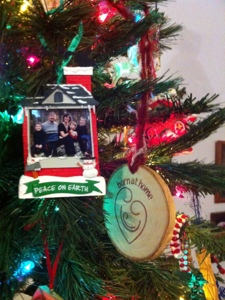
That year, I bought a special ornament for our tree with Noah’s name and birthdate and also the words, Born at Home. As I’ve shared several times, it is very important to me to have miscarriages acknowledged as birth events and it really, really mattered to me to have a homebirth specific ornament to recognize my baby. This year, it hangs on the tree next to our new family ornament for 2012.

20121207-154643.jpg

20121207-154652.jpg

20121207-154659.jpg

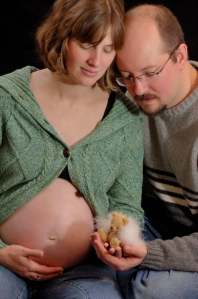
In 2010, when I got maternity photos taken, I made sure to include Noah’s angel bear in several of the photos to acknowledge his presence and place as a member of the family. And again, in 2011, I also included the bear in a photo session with me and the kiddos.

MR_046

MR_051

Alaina9mo 111

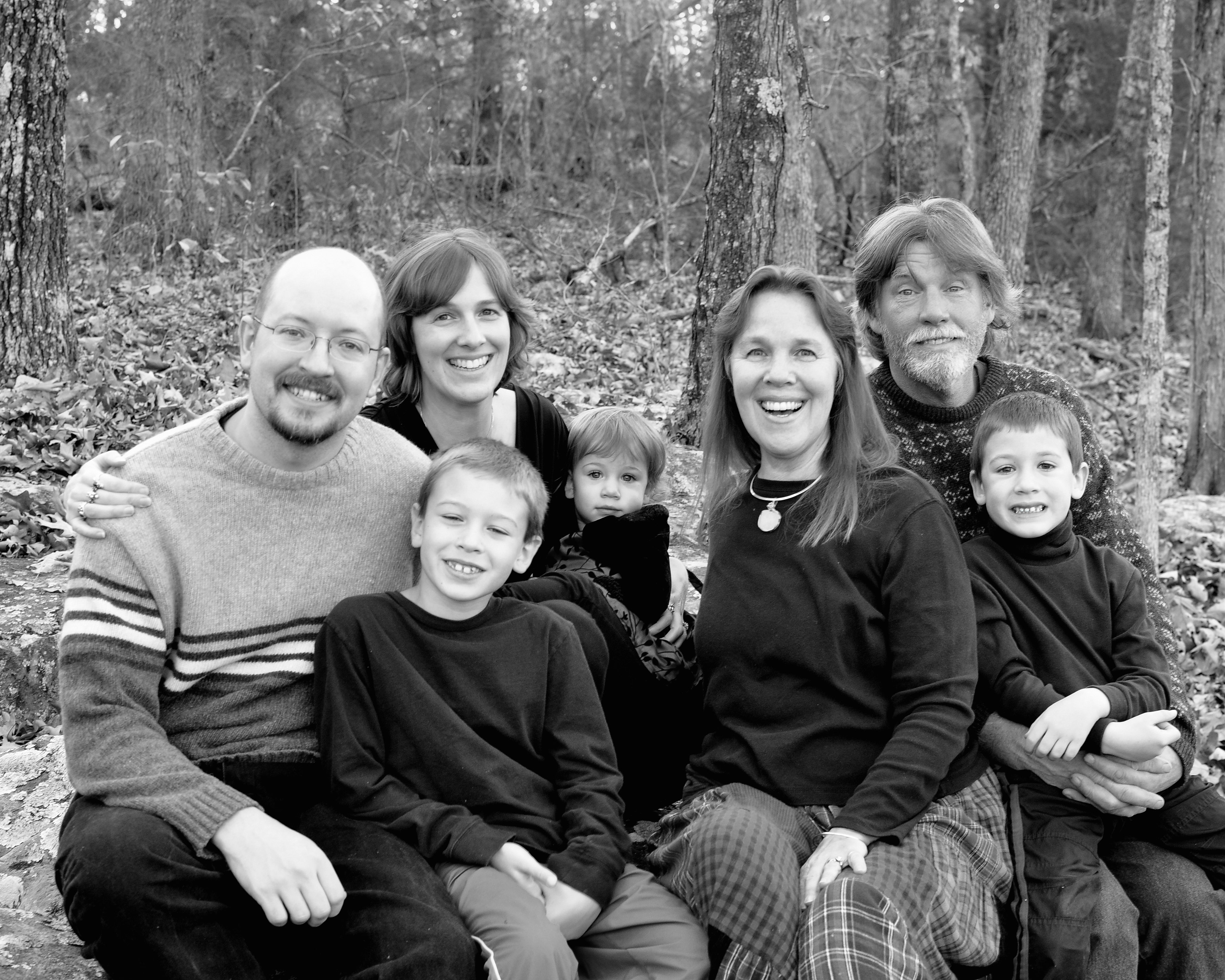
This year when we got our family pictures taken, I made sure to wear my baby-in-my-heart pendant, so that Noah, still, was there with us in the pictures as part of our family.

MollyNov 025

In September, my friend’s baby Tossie died at 36 weeks. To honor Tossie’s memory, she’s started a blog to help other loss mamas: Tossie’s Tree & Painted Rocks. One of the first rocks she painted was for my own little Noah. She took a picture of it at sunrise by her own baby’s special tree and it is lovely!

189787_367110260050351_624535046_n

184976_367110413383669_1287450243_n

546989_367498366678207_2129560304_n

The other posts in this month’s blog circle so far are:

Hope and the Holidays ~ Bainne Mama

Thankgiving After A Loss ~ Bainne Mamai

Special Ornaments ~ Mindful Serenity

Michele–Holidays After Loss (this post was especially good, very poignant, and from it I went to a variety of other interesting posts on her blog. Michele also runs Mending Hearts Bellies which focuses on childbirth education and doula support for post-loss families).
Holidays After Loss: Spirit Babies Ceremony

Taking it to the body… Part 2: Embodied mindfulness, introversion, and two hours!

Trust yourself. Take it to the body. She always knows.”

For my meditation practice for my compassion class, I’ve been working with several things, starting with the above quote. As I explained in part 1, how often do we deny the urgings of our bodies? It seems as if mindfulness begins there.

So, I’ve decided to practice an embodied mindfulness and meditation…taking it to the body and checking in with what she knows. Consciously noticing and being aware of my body’s signals to sleep, eat, and eliminate. It is much harder than you would think for something so basic and essential for well-being and I “fail” many, many times a day, but, and this is the point: I notice as I am failing, as I am not listening. That is better than remaining unconscious, right?!

The second part of my practice is that I’m trying to make sure I feed my spirit first—going to the woods, praying, setting intentions for the day, lighting a candle and setting up some of my goddess art sculptures near me as I work, rather than letting those things languish for “when I have enough time” and “later.”

The third part of my practice is to notice my thoughts and how I think about things, bringing mindfulness to the repetitive, wheel-spinning , brain-groove making patterns of thought that I habitually engage in. I frequently feel like, “something has got to change!” or, “I need to change what I’m doing and THEN, XYZ.” In mindfulness practice, I notice that more often it isn’t what is actually happening in my life that is upsetting or stimulating the “change” urge, it is expressly how I think about things that needs to change. I have become aware of the following unhelpful brain-groove thoughts that continue to dictate my behavior, choices, feelings, and responses:

I might die

I need to be perfect

I can’t rest

I’m out of time/running out of time/there isn’t enough time

(I haven’t fixed these yet, but awareness of them is a big part of the puzzle.)

As appears to be my custom at this time of year, I had a big meltdown this weekend feeling resentful, overbooked, stressed, ragged, frustrated, blocked, irritable, etc., etc. Then, I piled on a hearty dose of self-admonishment for all those feelings and stirred in some big helpings of guilt. I blamed various things, I blamed myself, I ranted and raved about how something needs to change and I need to do something different because this just isn’t working. (most of this was actually in my own head because Mark was sleeping in the living room as he recovered from the stomach flu that swept our house this week, more on this later.) I was crabby at loved ones. I felt guilty for wanting to be alone and for feeling done with snuggling my nursling and smelling her sweet head, knowing, knowing, knowing that the time is passing and that I will miss it and yet, dang it, stop climbing all over me and ramming your hands down my shirt! I felt like I “should” be doing all kinds of things differently. Like I should be a better, nicer person and like maybe I’m choosing wrongly in my life. I wanted to just stop, to get off, to quit everything. I decided I don’t want to help anyone else anymore and I just want to take care of myself. I cried because I need my parents and Mark to help me so that I can help other people and if I just stopped trying to help anyone else, I could take care of myself/family and not need anyone to help me either. I made plans to make a big life map and ruthlessly chop things off it. I decided to embark on a massive self-care, self-improvement project for the new year. I dragged out piles of books to look through. I remembered that busy is boring , I craved time for a retreat. I exclaimed that I just want to grind my corn! I lamented my ongoing crisis of abundance. I looked up my old post about balanced living and saying ‘no’ and thought about how I’m going to say a big fat NO to everything all the time! Must be clear on priorities. Must choose well and wisely. Then, I got annoyed with myself for already having figured this stuff out before, for writing about it already, for boringly lamenting it all before, for never learning (or integrating) my life lessons, and for knowing better and yet doing it anyway.

And, then…everyone went to bed. I sat up by myself and worked on a drawing for a “make a plate.” The kids all did this at my mom’s house over the weekend as a Christmas project—you draw a design on a special piece of paper, send it in to the company, and they send it back to you as a plate. I wanted to make one too! So, I did:
20121203-093946.jpg

I really like it. After drawing, I felt tons better. I sat alone in the living room with my computer and got my online class all caught up for the week. And, suddenly it hit me. This ugly ragged self of mine I was seeing and experiencing and hating. She was popping out because I hadn’t had my two hours all damn week! And, after I realized that, I understood that things weren’t really that bad after all. Last week was insane. I knew it in advance, but it doesn’t mean it was easier to cope with it. And, if I tuned in to myself and my body, which is really, really hard to do when you’re an introvert without your requisite two hours, I just heard the familiar cry for what I need, to just be by myself at home for some time each week. Not to quit everything, all the time, but just to have some regular, consistent still points of solitude.

This is what last week looked like for us:

Monday: Twenty papers submitted by my online students, they all need to be graded in addition to my usual weekly grades for the week. While I did my usual grades and online class prep work, no papers got graded with the time I had available. Manage to quickly write an assignment for my own class, part of which is excerpted at the beginning of this post. Scramble to town to take the kids to meet Mark. Teach class on Monday night from 5-10. Come home freaking out about the rest of the week and HOW CAN I POSSIBLY GRADE THIS MANY PAPERS WHEN I HAVE NO TIME! Maybe I’m not meant to do this, maybe three classes is too many, maybe there is just something wrong with me.

Tuesday: After doing school with the boys, laboriously make pumpkin pasties to take to the Harry Potter potluck for the last day of homeschool co-op Wednesday. Insist on all three children helping with the “fun” and get super stressed out at not being a more zen mother of awesomeness. Call my dad desperately in the afternoon requesting “tribal reinforcement” (my tribe is a good one!).

20121203-144224.jpg

Pumpkin pasties. Awesome, or unnecessary torture?

After he takes the kids over to play at his house, manage to grade four of the papers among many other tasks. Then, take the kids and head to town for their taekwondo class and my own reiki class (why take a reiki class now when I already have so much going on? Who knows?! Crazy, remember?) Reiki class is great—totally works and I feel like such a healer! Go home and practice fab skills on Mark and boys and they are impressed. Feel buzzing with energy and hands are tingling. Stay up until 2:00 a.m, on purpose and finish grading ALL papers. Feel awesome and smug and have killer, killer headache.

Wednesday: killer headache continues. Take kids to homeschool co-op and potluck. Pumpkin pasties meet with approval. Pick up two of boys’ friends for an overnight. Fingers crossed for Alaina to nap when we get home, since I’m desperate to be alone and need to get “caught up.” She doesn’t.

Make homemade mac and cheese for dinner and it rocks. Boys and friends stay up until past midnight. I stay up and finish prepping for Friday’s class.

20121203-144140.jpg

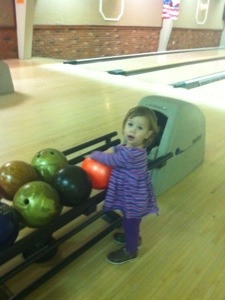
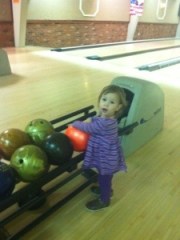
She actually wore bowling shoes this time! Insisted on carrying ball every time for a whole game!

Thursday: Killer headache remains (not enough sleep, I think at the time). Make quesadillas for all kids in house and barely stagger out door with them all to go to playgroup at bowling alley. Bowl a terrible 85, but have lots of fun (Alaina is adorable bowler and gets a 17 [non-bumper lane]). Belabor different post-playgroup scenarios to manage rest of day.
20121203-144200.jpg

Mine, mine?

20121203-144214.jpg

Brothers are not into bowling and complain nonstop and sit staring like this. I finish their games.

20121203-144234.jpg

She’s a natural!

Send boys with friend to get pizza and go to park, while Alaina and I go to Wal-Mart to buy dinner supplies for a postpartum mama. Take dinner to new mama and listen to fab birth story and do breastfeeding help for next two hours. Kids come back from park and are sent with other friend in my van to gymnastics class. Help jump friend’s car and then go to pick up all gymnastics kids (my own boys + two). Am slightly late and they’re getting worried. Zoom to taekwondo to drop all off. Go to Panera to eat dinner and meet couple for wedding ceremony planning. Alaina finally falls asleep and nurse-sleeps throughout Panera visit. Back to get boys at 8:00 and meet other friend to deliver books she’s borrowing, plus pick up evaluation from her from recent birth workshop. Head home, dropping off boys’ friend at her house on the way. Remember LLL monthly stats are due and do them (27 helping contacts for November!), plus send overdue emails and answer help message. Catch up in online class. Collapse in recliner, hoping Alaina’s Panera snooze wasn’t an uber-late nap. She nurses more and falls asleep. Score! Mark and I start a Teen Wolf ep while she keeps nursing. Suddenly, A wakes and projectile vomits all over my body. Yikes! What’s up?! As I wash the chunks off in the shower I start to feel bad too (headache continues, FYI). At 1:30, I throw up too. Alaina throws up seven more times during night with various degrees of mess. Grateful for Mark and his clean-up skills.

Friday: Mark stays home to help, but still needs to get own work done from home. I throw up one more time and debate going to class tonight—do I go or stay?! Zander starts throwing up. My head is actually going to explode with pain. Have fever and chills. Decide not to go to class, even though it means incredible hassle with double make-up classes now (because of no class on Thanksgiving). Nap and wake at 3:00 deciding it is class or bust after all. Both options feel like dumb options. Decide to be Typhoid Molly. Take Advil, get dressed, and head for the Fort where I teach. Class is fine. I have a guest speaker and show a video about child abuse. Hope to leave early, but feel better as class goes on and get busy with student questions/discussions. Dismiss early enough to get out the back gate and take short route home.
20121203-144258.jpg

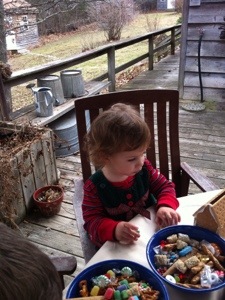
Selecting candies.

Saturday: Work party at my mom’s house. She has good projects planned. While the men cut firewood, the women make seasoning blends using herbs and spices I ordered last week from the bulk food buying club. Alaina is fretful and clingy and nurses nonstop, even though she has to stand on a chair to do it while I mix my seasoning blends. Kids draw pictures for their plates and also make fun cracker houses. Alaina finally naps and I grade two late papers, respond to a help message, and try to catch up with my online class again. Feel bad and guilty about not helping with dinner prep and also misunderstood by others about legitimately needing to get my work done. Feel annoyed that I have to make excuses or justifications for it, feel others are annoyed with me. Eat communal turkey dinner and yummy cake. Home feeling generally distressed, unhappy, and overbooked. Am reminded that I’ve forgotten/misunderstood something again. This keeps happening. My brain is leaking. I can’t hold everything and I keep dropping balls, communicating poorly/not enough, missing things or misunderstanding things, and forgetting stuff. Wish I hadn’t had to go anywhere on the weekend. Need regroup time. Suddenly remember with a shock that today is the FoMM newsletter deadline (for contributions, not for me). Send requisite emails and consider fact that I have exactly zero contributions thus far. Lann wakes before we make it to bed and barfs turkey dinner ALL OVER bedroom floor. As Mark cleans it up, he starts to feel sick too. Is up and down during night with stomach pain and finally also vomits.

20121203-144343.jpg

Finished houses with architects.

20121203-144352.jpg

Lann’s house.


Sunday: I feel pretty good at start of day, but start to freak out as day progresses. Mark is down sick in recliner all day. Alaina is whiny and clingy and doesn’t stay asleep at naptime. By 2:30, I’m still in PJ’s and feeling emotionally fragile. Begin the internal monologue of self-doubt, criticism, and desire for change described above. Kids go visit my parents and I work frantically on various bits and pieces, like preparing for my class on Monday night. Feel I’m choosing wrongly and still not taking care of myself. What’s wrong with priorities?! Argh. Gnash. Suffer.

Sunday night: stay up after others are in bed. Make my drawing for my plate. Have epiphany that this is all about the two hours. I usually get two hours to myself multiple times a week. Review week and see NO two hours. No wonder I feel like crap. I need it. I really do. It’s this introversion thing. I have to be able to count on sometimes being alone. Hmm. Maybe that is all it is. Maybe I don’t really need to quit everything after all, but maybe I need to plan carefully and assertively and strongly avoid weeks like this last one. Maybe I just need to firmly, guilt-free-edly, hold some space for myself, no matter what. Mentally review week and see, DUH. That was a busy, hard week. I got barfed on. I threw up. I taught class with the flu. No wonder I feel overwhelmed, stressed, and upset. It would be weird if I didn’t feel that way. Isn’t it normal to be a little crazy when life is crazy? Remember that one crazy week doesn’t mean entire life is unraveling after all. Wonder if maybe, just maybe, I should actually feel impressed at my own capacities. Stay up “too late” and enter all my grades so that on Monday, I can do some other things that I want to do—like write blog posts—rather than work on my classes and then go teach as well.

Remember I wasn’t going to write long, boring, navel-gazing blog posts like this one anymore and consider not posting it after all…

Think of lots more things to add and remember lots of other to-dos I got done…

Notice current students have become “fans” on Facebook and really, really consider not posting after all…

Spend way too long trying to format pictures for this post and finally give up and set it to post later in the week with crappy-alignment pictures.

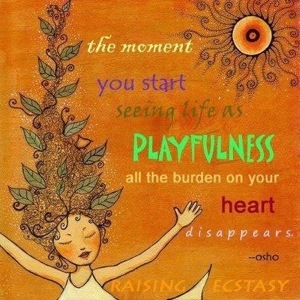
Copy this picture from Facebook and try really, really hard to remember it…
20121203-144400.jpg

Deep breath. Hug self. Hug kids. Try again.

As dear as breathing…

20121126-151448.jpg

“If women lose the right to say where and how they birth their children, then they will have lost something that is as dear to life as breathing.” –Ami McKay

“Mothers need to know that their care and their choices won’t be compromised by birth politics.” – Jennifer Rosenberg

Birth politics have been on my mind this week as I’ve come across various debates from within the birth profession about the regulation of midwives and the question of licensure, and then also the seemingly ever-present critiques of homebirth from outside the homebirth community. I don’t feel as if I have time lately to fully follow all the issues, but Citizens for Midwifery’s recent response to ACOG’s newest homebirth and maternal rights smackdown contains some important thoughts:

AJOG editorial rejects the ethic that autonomy is a fundamental human right

This article represents a serious attack on home birth and on patient centered care in the United States. The attack is based on poor research and runs roughshod over established rights to bodily integrity…

…not only does the article attack home birth, it also represents an attempt to “export” to the rest of the world a position that the obstetric profession, not mothers, should have the final decision on birth, at a time when that isn’t even legally defensible here in the United States…

…One contradiction stands out as the authors call for “safe, respectful, and compassionate” hospital delivery. No hospital birth can be truly respectful if the birth is happening in the hospital because the physician disrespects the woman’s right to an alternative and has rigged the system to eliminate access to all legal alternatives…

via Citizens for Midwifery

Related thoughts:

Maternal-Fetal Conflict?

The Illusion of Choice

“Woman-to-woman help through the rites of passage that are important in every birth has significance not only for the individuals directly involved, but for the whole community. The task in which the women are engaged is political. It forms the warp and weft of society.” –Sheila Kitzinger

Anthropology & Miscarriage

I recently finished reading a book called Mothers of Thyme: Customs and Rituals of Infertility and Miscarriage and my attention was caught by the explanation of how miscarried babies were viewed by some non-Western cultures:

Anthropologists’ writings reveal that non-Western cultures cultivated a more tender attitude toward miscarriage than Western culture has known. Native American cultures considered unborn children to be human beings…these cultures treated the remains of miscarried babies in the same manner as for adults, by burning or burying them…

Manus women of the Admiralities of New Guinea had similar feelings toward children lost during pregnancy. These women named each baby lost to miscarriage and treated its memory as if it had been a full individual.  Years afterward, when reminiscing about their children, these mothers would not distinguish between a miscarriage at three months, a stillborn infant, and a child who died several days after birth. The Ndranirol people of New Guinea also treated miscarried babies as though they had been born full term, naming each child and holding a ceremony to recognize its existence… (p. 72-73)

Noah’s angel bear and necklace

I identified with this section because of how I always want to mention Noah when people ask how many children I have. I usually leave him out and I never fail to feel a pang of regret for ignoring or erasing him in that way. Prior to Alaina’s birth, I used to include him, but now…somehow…it feels easier or simpler to just refer to the children I actually have with me. His birth counted to me. His life counted. And, while he may not have been a fully grown baby, he counted to me. He was/is one of my babies. His heart beat in my body. I felt his tiny kicks. He had fingers and toes and a little jaw that opened. He had closed eyelids with blue eyes beneath them and I saw his little ribcage through his translucently delicate skin. It is this experience that makes me struggle to reconcile my deep belief in women’s reproductive rights, with my deep knowing that this was my baby and he was real. He counted.

Earlier in the book, the author explains that in other cultures women were blamed or viewed with suspicion for having miscarried or for being infertile:

…blamed the problem on poor social graces. Women with this problem were assured that if they tried harder to get along with their female relatives, their chances of conceiving would improve. But sometimes the problem was more serious, such as when the medium determined that an infertile woman was a witch… (p. 31).

This doesn’t seem altogether dissimilar from being told she needs to “just relax” and then she’ll get pregnant, or from legislative attempts to make women prove they had a miscarriage (or, likewise, to withhold abortion from women who are in grave medical condition).

In general this book wasn’t what I expected or hoped for at all. It was basically a compendium of obscure historical and cultural “rituals” of the eat-three-raw-eggs-mixed-with-bat-dung-while-standing-under-the-banana-tree-on-the-new-moon, variety. It contained some things that were really interesting to read about from a historical perspective, particularly with regard to the way out there and funky misinformed beliefs of the health-care-professionals of the day (will we see continuous electronic fetal monitoring in the anthropology books of the future?!), but there was nothing of relevance to creating ceremony/acknowledgement for mothers today. It is definitely a history/anthropology book more than a miscarriage resource.

Strong, Strong…

20121121-212301.jpg

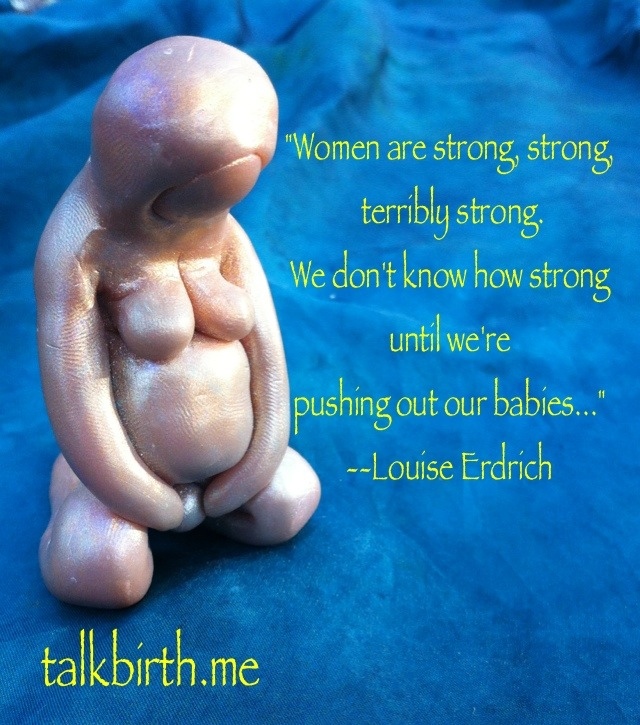
I woke up this morning with this quote running through my head and thinking of a pregnant friend of mine. Since her story is not mine to tell, suffice to say, she had a long and winding road to reach this point and this evening she gave birth at home after having had a cesarean with her first baby! Yay! I’m so excited for her and for their whole family. One part of me just knew she could do it and the other part of me still worried that I was being falsely optimistic. It has happened to me before—that I supported and encouraged and hoped with the mother and despite all those hopes and dreams and wonderful, careful, thoughtful plans, the birth still didn’t go as planned. I also believe that all births are acts of courage and that mothers, whether they push out their babies or not, have the capacity to dig deep and discover strength beyond anything they previously knew. However, just, yay. I’m so happy and excited and relieved for this friend of mine 🙂 The sculpture in the picture is the birth art piece I made after I actually gave birth to my last baby. She captures the pose in which I caught my daughter. My previous photo with this quote was of the pre-birth sculpture I’d made to address my pushing-the-baby-out fears:

Still figuring out the pictures with words app that I got. I love my nature spots in the woods as backgrounds, but they’re too busy and make choosing a text color that actually works almost impossible!

Childbirth is power in its purest and most natural form–it is wild and uncontrollable and takes us on a journey of surrender. Birth is about so much more than babies being born. It is about a mother finding her inner strength at her most vulnerable and powerful moment, which begins her unique and lifelong journey of mothering that child.”

–Brianna Kauer (in Midwifery Today, issue 103)

And, speaking of thankful birthy goodness, Thanksgiving is tomorrow and that reminded me of an earlier post about the rest and be thankful stage!

I also would like to mention that I have a Talk Birth topic on ScoopIt now. I primarily started it so that it could handily feed into my Talk Birth Facebook, while still leaving a more useable record for me to go back to/repost (things just kind of disappear off the page on Facebook and it can be hard to remember what the heck I’ve shared there if I then want to do a blog post about it). I was introduced to ScoopIt via LinkedIn when I started following a really well-curated topic about E-Learning and Online Teaching. There are very, very few birth-related topics on ScoopIt, so start curating one! It is fun and easy and, as I said, really handy for feeding content into your Facebook page or other media (I experimented yesterday with sending a post directly to WordPress and that worked too!)

I’m also thankful for several days at home to spend with my family and without a long to-do list. I have one final paper to grade tonight and then my calendar is pretty deliciously blank for the next four days! We can really use this. I need a stillpoint, a rest, and some time to spend on the fun things I want to do like wallow in piles of books and make fabulous new sculptures and go sit out in the woods and…and…and…

Thankful for all these people too! And, also thankful for fab new pictures from recent photo session with my friend 🙂