Archives

Book Review: Painless Childbirth: An Empowering Journey Through Pregnancy and Birth

Book Review: Painless Childbirth: An Empowering Journey Through Pregnancy and Birth

By Giuditta Tornetta
Cumberland House, 2008
ISBN 978-1-58182-640-1
320 pages, softcover, $16.95

http://joyinbirthing.com/

Reviewed by Molly Remer, MSW, CCCE

Written by a mother of two who is also a doula, childbirth educator, hypnotherapist, Painless Childbirth takes the pregnant mother on a physical, mental, and spiritual journey from conception through postpartum. The text is interspersed with personal stories from the author’s own pregnancies and births as well as those of her doula clients.

A lot of people are initially skeptical of the phrase “painless childbirth” and I really loved the author’s description of what painless childbirth means: “When I say painless, please understand, I don’t mean you will not feel anything. What you will feel is a lot of pressure; you will feel the might of creation move through you. Pain, however, is associated with something gone wrong. Childbirth is a lot of hard work, and the sensations that accompany it are very strong, but there is nothing wrong with labor.” The book has no rigid concept of what “painless” means and no suggestion that mothers who do not experience birth as painless have “failed.” Painless Childbirth is written in a gently nurturing tone throughout (you can “hear” the author’s doula skills coming through), but is also very assertive that painless childbirth is very reasonable, doable, and is, indeed, the birthing mother’s right.

The book contains a lot of ideas and concepts that are of use to doulas and childbirth educators. I particularly liked Tornetta’s characterization of the three phases of first stage labor according to the primary means of coping with each phase—distraction, concentration, and surrender.

After my own experiences with pregnancy loss, I have become more aware of the treatment of the subject in birth books. Painless Childbirth directly addresses childbearing losses in a short, but compassionately written segment about healing past grief. The book also has content about exploring and overcoming fears.

The book is holistic in its approach, addressing body, mind, and spirit. It contains a lot of spiritual content of a “new age” flavor (for example, lots of references to the law of attraction and the book is organized by month according to fetal development as well as associated body chakra). While I definitely agree that birth is a spiritual event, my practical, down-to-earth side stumbled a bit over some of the concepts and phrasing, and the esoteric content may not appeal to all audiences. That said, Painless Childbirth presents a positive, loving, welcoming approach to giving birth that is both refreshing and interesting.

Disclosure: I received a complimentary copy of this book for review purposes.

WomanSpace

Yesterday, a friend/colleague and I toured a possible studio space to rent in Rolla. We do not have a particularly clear idea of what we’d like to do exactly, but we have both long felt the desire to create a “women’s resource center” as well as to have a dedicated “birth studio” for our birthwork (she is a doula and I’m a birth educator and soon to be prenatal yoga teacher). The space felt perfect and was in our exact price range. I left feeling tremendously excited and inspired about the possibilities. Later that evening, the doubts, realities, and fears started to crowd in—I do not want to live a fear-based life, but I also want to be “practical” (which can be a handicap as well as an asset). I have too much to do already, etc., etc. In February, after my miscarriages, I took a personal renewal retreat in which I kept my computer off for 5 days and spent the time nurturing myself and doing those many things I always say I “really want to do.” During that time, I spontaneously wrote a description in my notebook of the women’s center I envision. So, this morning I opened up my notebook and re-read my “vision” there. I want to share it now and continue to explore the possibilities angle of the studio opportunity, rather than get bogged down in fears and self-doubts:

I visualize a center. A place where women can come together to learn, to talk, to develop, to grow. A safe place. A nurturing place. A supportive place. Hostess to LLL meetings, book clubs, birth circle, birth info nights, prenatal yoga classes, birth classes, birth art workshops, pregnancy retreats, journaling workshops, craft classes, crafty mamas meetings, a miscarriage support group, postpartum mamas support group, birth counseling/consultation sessions, dancing for birth, prenatal bellydance, drop-in support chats, blessingways, red tent events, meet the doulas night, Mother’s Guide to Self-Renewal groups, women’s spirituality circles, playgroups, baby massage classes, baby/tot yoga, girls’ coming of age classes, an ICAN chapter, Friends of Missouri Midwives meetings. A gathering place. A woman’s place.

It will have a large, open meeting room, access to a bathroom and another, smaller room that could be an office, consult room, or playroom. We will have counter space to plug in some minimal cooking implements (like a microwave). There will be comfy couches, chairs, toys, a lending library of books and films as well as perhaps toys/games/puzzles. There will be big pillows on the floor and beautiful art all over the walls. Other women wishing to have groups/classes for women, could also use the space for their groups/events.

Think we can do it? (And, if so, what can I not do to make space in my life for it? 😉 )

In a way, my vision is that this will be that classic “room of one’s one” that every woman needs access to. WomanSpace.

Book Review: The Littlest Sister

Book Review: The Littlest Sister
By Leigh Schilling Edwards
Strategic Book Publishing, 2008
ISBN 978-1-60693-041-0
14 pages, softcover, $12.00
http://www.facebook.com/pages/The-Littlest-Sister/317995643791

Reviewed by Molly Remer, MSW, CCCE

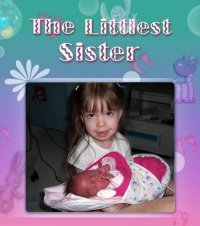
Written from the perspective of a family’s middle child—the big sister of a hospitalized baby—The Littlest Sister is designed for siblings of a baby in the Neonatal Intensive Care Unit (NICU). It would also be a good book for a child who was formerly a preemie themselves. There is an older brother in the story as well, which enables readers of either gender can easily identify with the children.

Color snapshots of a real family grace each page and make the book very genuine and true-to-life. The baby in the book was born at 30 weeks and has Down Syndrome and a mild heart defect. The pictures and text contain a lot of details children will identify with—there is a picture of the big brother touching the baby in her isolette, pictures of the baby sister with a tube in her nose and monitors attached, and so forth. Bottle feeding is mentioned briefly and I wish breastfeeding had been mentioned as well

I have a special interest in the subject area because I worked for the Ronald McDonald House for four years. Written in a warm, personal tone, using easy to understand language and simple descriptions, The Littlest Sister would be a great addition to the lending library resources of Ronald McDonald Houses or NICU facilities.


Disclosure: I received a complimentary copy of this book for review purposes.

Book Review: Brought to Earth by Birth

Book Review: Brought to Earth by Birth

By Harriette Hartigan
Motherbaby Press, 2008
ISBN 978-1-890-44642-0
93 pages, softcover, $25.95

www.motherbabypress.com

Reviewed by Molly Remer, MSW, CCCE

Written by well-known birth photographer Harriette Hartigan, Brought to Earth by Birth is a lyrical ode to the power of birth and babies. The book feels like an extended “poem” expressed in both word and image. The emphasis of the book is the black and white photos of pregnant women, families, and newborns that grace the pages. There are several photos of women in labor and a couple of breastfeeding images. Surrounding the photos are carefully chosen quotes and gentle words.

Brought to Earth by Birth is separated into six “chapters” and contains several birth photos, but no crowning photos or any other photos that some may consider “graphic.” The book is short—under 100 pages—and some photos were familiar to me (cover images in birth publications). The concluding emphasis is on the newborn, the one who is, after all, “brought to earth by birth.”

The book would make a nice gift for a midwife, doula, or childbirth educator and is a nice “waiting room” book to browse through. It would also make an inspirational mother blessing gift. As the author states, “The experience of birth is vast. It is a diverse tapestry woven by cultural customs, shaped in personal choices, affected by biological factors, marked by political circumstances. Yet the nature of birth itself prevails in elegant design of simple complexity.” Brought to Earth by Birth is a lovely glimpse of some strands of that elegant tapestry.

Disclosure: I received a complimentary copy of this book for review purposes.

In-Utero Practice Breathing

During my pregnancy with my first baby I had a somewhat unique experience in that I was able to feel him practice breathing in the womb.  Babies practice breathing movements with increasing frequency towards the end of pregnancy, but usually this is only seen via ultrasound and the mother can’t feel OR see it happening.

A mysterious sensation

38 weeks pregnant with baby #1

I was about 32 weeks pregnant when we had a prenatal visit (and I was up to a whopping 140 pounds—looking back, that seems very thin, but at the time I felt like I had gained  a lot of weight!) . Since 30 weeks I’d been feeling what I thought was the baby practicing breathing. My husband was able to feel it too, as well as occasionally physically see it—a rhythmic sort of pulsing sensation located where the baby’s back was and feeling like a rising/falling breath type sensation (like a cat under a blanket). I noticed it once or twice daily. Very different than the hiccups, which I also felt often. I wanted to mention it to the doctor to see if that was really what I was feeling, because lots of books and things say you won’t be able to feel those movements, but I didn’t want to be wrong and be embarrassed for having a kooky idea about feeling him breathe. (When we mentioned the feeling to my mom, she looked at us like we were quite nutty to think we could feel it!)

A prenatal appointment and a doctor’s surprise

At the prenatal appointment, I laid down to have my fundal height measured (32) and the baby’s heartbeat checked and he was conveniently doing the breathing thing at that exact moment! My husband asked the doctor about it and told her we thought it was breathing. She quickly disregarded the breathing hypothesis, saying it was unlikely we’d be able to feel that, but she was fascinated by the movements and listened with the Doppler trying to figure it out etc. She thought for a minute that it had something to do with my pulse and checked that, but it didn’t match, plus was just on one side of my belly where his back is. She also felt with her hands, etc. It was particularly strong that day—usually I felt a sort of pulsing and could also feel it with my hand. On this occasion, it was like the left side of my belly was rising and falling rhythmically in a very noticeable way. She said she’d never felt or seen anything like it before.

Then (this was the weird part), she said that maybe I should have an ultrasound to see what the baby was doing in there. This doctor was a crunchy-mild-mannered-has-you-call-her-by-her-first-name-homebirth-attending -birth-center-low-intervention-doesn’t-break-your-water-unless-the-baby-is-born-in-the-sac sort of doctor, so I was really shocked by that. I said I really didn’t think that was necessary, because I wasn’t worried about it we just thought it was breathing (again, we get a look that vaguely implies that we are nutty). She kept saying she’d never seen it before and said she was going to call one of her consulting doctor friends, “just because I’m curious,” to see what he thought about maybe needing an ultrasound.

After she left to call him, I started to feel nervous that something might actually be wrong. I knew how this doctor was and she did not seem like the type at all who would be calling other doctors unless she was a little worried about something. My husband kept saying that, “no, she is just curious about what it is,” but the “curious” wording felt to me like a don’t-want-alarm-the-mother-but-I-think-something-is-up type of doctor speak. Also, I knew her well enough to know that running off to call other people in the middle of an appointment wasn’t in character for her, especially since the mom (me) was saying it didn’t seem necessary. So, I briefly became petrified that the baby was having seizures or something.

Trust the mother!

She came back in a bit and had consulted with her ultrasound doctor friend who had said, “let me guess. This mom is thin and very healthy” and then confirmed that it was just the baby’s breathing movements we were seeing. He told her that you usually don’t see them on the outside, just via ultrasound, but it is still normal and just means that the baby is healthy and he is getting good practice. When she came back, the doctor also brought the practice’s midwife in to see, since the midwife had never seen anything like it either, but it had mostly stopped by then. This doctor has been in practice since 1992 and has had four kids of her own and the midwife has six kids and a 20-year practice. The doctor explained that she’d seen the breathing movements on ultrasound before, but they were always more like occasional gasp-type things, not steady and pulsing like that and not visible externally. She thanked me for teaching her something new 🙂

I liked being right about what was going on (trust the mother! She usually knows what’s up!) and I liked that my pregnancy had something “new” or special to it to show to someone for whom pregnancy is quite routine. Being able to feel my baby breathe in the womb was one of the special things about this first pregnancy.

(Side note: the doctor then said, “I’ll bet he comes out screaming” and as a matter of fact this baby did begin to cry when only his head was sticking out of my body!)

Note (added 3/2/2013):

A lot of mothers come to this post because of concerns similar to my own…what if my baby is having seizures in the uterus? Of course I am not able to tell you with 100% certainty that your baby is not having seizures, but here are two things to pay attention to that may set your mind at ease and allow you to enjoy this special connection with your baby:

  • One way to help you feel confident that it is practice breathing is to pay attention to whether it happens at the same time(s) each day. There’s usually a pattern to it.
  • Another way to tell with almost total accuracy is to notice if the baby gets hiccups shortly after and “episode.” A lot of babies will practice breathe and then get hiccups from their practice.

This post is modified from a message board posting that I made shortly after the events described above.

Sign up for my Brigid’s Grove Newsletter for resources, monthly freebies, and art announcements.

Film Review: Natural Born Babies

Film Review: Natural Born Babies

South Coast Midwifery, 2009
DVD, 24 minutes, $24.95

www.naturalbornbabies.com

Reviewed by Molly Remer, MSW, CCCE

This lovely short film produced by a midwifery service in California, is a great “ad” for the benefits of homebirth and of midwifery care. Natural Born Babies has a very clean, fresh, and contemporary feel and features a multicultural collection of homebirth families talking about their experiences in front of a white screen. Something that is particularly striking is that some of the people speaking with love and enthusiasm about their midwives and their birth experiences include a cardiologist, an anesthesiologist, and an ER physician!

The first part of the film is titled Interventions and features both men and women speaking about birth, referencing how pregnancy and birth are treated like medical conditions and including a lot of discussion about the prevalence of cesareans. The point is made that, “no epidural can replace human touch.” The second part is titled The Birth Specialists and points out that OB/GYNS are pathology specialists, whereas midwives are trained in normalcy—“we take low-risk women, and keep them low-risk.” Midwives are specialists in normal pregnancy and birth. Because of the film’s emphasis is wholly on out-of-hospital birth and hospitals are critiqued very soundly, hospital-bound couples viewing the film may find that it causes their defenses to rise.

Several of the parents are holding their babies as they speak and a CNM speaks briefly as well (citing both ACNM and MANA). The CNM manages Orange County’s only accredited birth center. I enjoyed the presence of a bio-physicist dad originally from Holland saying, “everyone I know was born at home” and noting that “you give birth the same way you live.” Several of the couples speaking do refer to the father as “delivering” the baby, which is a long-term pet peeve of mine.

Special features include a 10 minute version of the film, an outtakes section, and a look inside the South Coast Birth Center. At the end of the film we see that one of the couples is the director/producer of the film.

Natural Born Babies is a fast-paced film and though it is filmed in a “talking heads” format, it cuts quickly from person to person, thus keeping the viewer engaged. If you are looking for an informative video that is homebirth and midwifery friendly, but that does not include any birth footage, this would be a good addition to your library.

Disclosure: I received a complimentary copy of the film for review purposes.

Book Review: 25 Ways to Joy & Inner Peace for Mothers

Book Review: 25 Ways to Joy & Inner Peace for Mothers

By Danette Watson & Stephanie Corkhill Hyles
Watson & Corkhill Hyles, 2006
ISBN 0646-46588-0

84 page hardcover book & 60 minute CD set, $24.95
http://www.awakenyourbirthpower.com

Reviewed by Molly Remer, MSW, ICCE

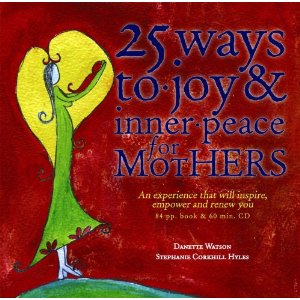
Consisting of a book and CD, 25 Ways to Joy & Inner Peace for Mothers contains 25 short breathing meditations with accompanying whimsical, colorful drawings. The meditations are on topics such as “surround yourself with mother energy,” “embrace change,” “feel reverence,” and “trust the rhythm of your baby.”

The final third of the book contains breathing tips, tips for using the meditations in life, and then “10 Healing Practices for Mothers” that are a very nice addition. This segment is followed by “Questions for Inner Exploration” that include journaling questions and prompts based on each of the meditations.

It is not clear at first glance, but 25 Ways is designed for mothers of newborns and infants, not mothers of older children (though, of course, most of the meditations could be adapted to apply to older children). The addition of “new” to the title would have been a useful clarifier.

Inspiring, empowering, and renewing, 25 Ways to Joy & Inner Peace for Mothers is a lovely and nurturing little manual that would make a nice blessingway gift for a pregnant or a congratulations gift for a special new mother.

Disclosure: I received a complimentary copy of this book for review purposes.

Review originally published in the CAPPA Quarterly, April 2010.

Film Review: Sunshine

Film Review: Sunshine

By Karen Skloss
PBS, Independent Lens, 2010
60 minutes

www.pbs.org/independentlens/sunshine

Reviewed by Molly Remer, MSW, CCCE

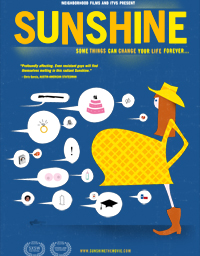
I was very excited to receive a review copy of the independent film, Sunshine, airing on the PBS series Independent Lens on Tuesday, May 4. Through personal narrative, Sunshine chronicles the changing social definition of family and cultural attitudes towards “unwed mothers” and “single moms.” Filmmaker Karen Skloss explores her answer to her question, “does history repeat itself?” as she considers her own history as a baby given up for adoption in 1975 by her nineteen year old “unwed” biological mother (Mary) and her personal experiences of giving birth to her daughter Jasmine as a “single mother” in 1999. Since I teach Human Services classes at the college level as well as teaching private childbirth education classes, I was intrigued in the film’s subject from both perspectives—that of someone in the field of social work at the academic level and that of someone deeply invested in work with pregnant women and new mothers.

The images chosen for the film are pieced together from home movies, family snapshots, interviews, and current footage of Karen and her family—both biological and adoptive. Karen and her biomom also make a pilgrimage of sorts to visit the Texas home for unwed mothers in which Mary lived before she gave birth. Karen co-parents her daughter with Jasmine’s father in a fairly unusual arrangement in that they share care 50-50—Jasmine lives with her father half-time and with Karen half-time. Jeremy, the father, also receives some screen time in the film and has some interesting comments to make about how he is perceived as a single father and how that compares to perceptions of single mothers (i.e. as a single father he is viewed as “hero” and not as someone who is just doing what anyone should do). The footage is mostly of the mundane—everyday life: bike riding, walking, people at kitchen tables—and the content is mild. No biting commentary or sweeping sociological conclusions. The story is an engaging one and an emotional connection is quickly formed. Though the content is nondramatic on the surface, the narrative is a multilayered representation of the complexity of the everyday lives of “normal” people and I was moved to tears on at least three occasions.

My medium is the written word—I read and write prolifically—so Sunshine was a change of pace for me. And yet, it unfolded like a personal essay “written” in visual form. I was fascinated in a way I have not been before by the use of film to tell a personal, human-sized story.

The Human Services professor in me would have liked to see a little more sociopolitical commentary—the viewer is left to draw their own conclusions about larger social issues that could give context to the personal story. The childbirth educator in me was delighted to see some footage of what appeared be a gentle, positive homebirth with Karen laboring in a birth pool and then giving birth in a supported squat on the floor. This footage is without commentary, but appears to be a midwife-attended homebirth with both Karen’s biomom and adoptive mother present as well as the father of her child.

As the film concludes, Karen states that, “it is hard to understand the times you’re living in, because you’re living in them.” Sunshine is a compelling portrait of one woman’s efforts to explore those times.

Disclosure: I received a complimentary copy of this film for review purposes.

Book Review: My Name is Mary Sutter

Book Review: My Name is Mary Sutter

By Robin Oliveira
Viking, 2010
ISBN 978-0670021673
384 pages, hardcover, $26.95

Reviewed by Molly Remer, MSW, CCCE

My Name is Mary Sutter is a new novel about a young Civil War era midwife who longs to be a surgeon, but is denied entry to medical school because she is female. Historical fiction has always been a favorite genre of mine, but historical fiction about a midwife? The best! After some initial chapters involving midwifery and family life, the main character,  Mary Sutter, seeks work first as a nurse in desperately undersupplied and overworked Civil War hospitals and then directly on the battlefield following the soldiers with a cart of medical supplies. Mary is a strong female protagonist and there are some complicated male (doctor) characters as well. A couple of mild love stories serve as sub plots.

Midwifery quickly takes a back seat in the saga as Mary becomes a nurse on the bloody battlefields of the Civil War. However, her work continues to be informed by her midwifery experiences–for example she uses memories of turning malpositioned babies as inspiration for finding the right spot to amputate wounded legs.

Some famous historical figures like President Lincoln, Clara Barton, and Dorothea Dix make appearances in the tale. The slaughter on the (famous) battlefields is tightly wrought and makes you feel as if you’ve “been there.” The reader feels exhausted and battle weary right along with Mary. The novel is a third person narrative throughout, but it almost felt like a first person account—as if the author was writing from personal experience. Be prepared for a variety of personal losses for the main character.

Riveting, well constructed, and tightly paced, My Name is Mary Sutter is a gripping story of one woman’s tenacious will and her drive both to learn and to serve.

Disclosure: I received a complimentary copy of this book for review purposes.

New Training!

This year, I completed several new trainings that I am very excited about.

Prenatal Yoga Training

This weekend I fulfilled a 7 year old dream and attended a prenatal yoga teacher training in St. Louis. I have wanted to teach prenatal yoga since I was pregnant with my first baby, but a training opportunity just never opened up for me until now. I felt like this was perfect timing. The training was through YogaFit and was pretty basic, but it was just what I needed to feel like I can move forward with this dream. YogaFit is a very “fitness” oriented type of program vs. any kind of holistic-mind/body connection stuff, but I can add those elements in myself. I think I will be able to offer something fairly unique—not just yoga and not just childbirth education but yoga-childbirth-education. There are several other programs like that, of course, but none in the local area! At the training, I also learned some really cool partner yoga stuff that I didn’t know how to do before.

Birth Art Training

In February, I completed something else that I’ve been dreaming about for some time—I took Birthing from Within‘s online course, “How to Lead the Birth Art Process.” Aside from a few minor complaints about the sometimes-frustrating “Zen” underlay and occasional contradictions within the course, I really LOVED this class. I found the online course format to be an ideal format for me—real-person interaction through message board, chat, phone call, and email; written information; writing journals/essay responses; hands-on personal practice with the assignments; and real-life application with other people/clients in birth art sessions. I felt like I got more out of actual use out of this workshop than most of the other classes and workshops I’ve attended—I think this was because the course was spread out over 5 weeks, not just a weekend, which allowed plenty of time to really assimilate and USE the information. It was very affordable too and I was able to attend right from the comfort of my own chair! The class is marketed as suitable for beginners, but personally I found my past background in childbirth education to be very important and I cannot imagine having taken the class with no prior birth class teaching experience—I think the people who had little experience were kind of disadvantaged in this course. Birthing from Within is my all-time favorite birth preparation book/resource and it was so exciting for me to have a little taste of direct training with them. Hopefully at some point in the not-too-distant future, I will take further training with BfW.

Childbirth Educator Certification

In March of this year, I was pleased to earn my childbirth educator certification with CAPPA. Since I am already certified with other organizations, I enrolled in the dual certification program option. I am very excited to be “throwing my hat in” with CAPPA. The organization is very friendly and stable and I really connect with the CAPPA Vision. The program information itself was pretty basic and I didn’t really learn anything new from it, but that makes sense because it isn’t specifically designed for people who already have CBE teaching experience—I think it is a great program for someone starting out in this field.

Comparing CBE Programs:

I get a lot of inquiries from people seeking information about different childbirth education programs and thought I would provide a super-quick mention of the things I enjoyed most about each of my certification programs/organizations. Keep in mind that I certified with ALACE first, hence, I had the most direct experience with their full training program, vs. the other organization’s “accelerated” options (which I SO deeply value and I am SO grateful that ICEA and CAPPA make that option available to people—I’m very, very grateful!). In sequential order:

ALACE (now IBWP)—phenomenally in-depth training program with a wonderful woman-oriented, holistic, midwifery-model. Very homebirth friendly. When I finished this program, I felt like I’d earned another master’s degree—this time in birth. At the present time, however, I do not get a “stable” or professional feeling from the organization and that is very disappointing 😦

ICEA—very professional. Lots of really good information on how to teach and on the principles of adult education in general. I learned the most about the “how” from ICEA (and the “how” is very, very important). They also have several great teaching manuals that are super-affordable. I enjoy the International Journal of Childbirth Education as well. Very professional. The training information assumes educators will be teaching a “mainstream” population, probably in a hospital, but their position papers are very sound and I can really get behind their mission as well. Their certification exam was the most difficult of the three programs and I feel like I really earned my certificate!

CAPPA—I am really pleased with my association with CAPPA. As I noted, they are very friendly and I feel like they will be around for a long time to come. I just get a lovely, warm feeling of “sisterhood” from CAPPA and that is very important to me. I feel connected to the organization and the people and it is a very supportive atmosphere. I recommend them for training, especially for people who are just starting out. I’m excited about the free conferences CAPPA offers as well and I’m going to my first one this July! I also enjoy the CAPPA Quarterly and and I am proud to write the book/film reviews column.