Archives

Tuesday Tidbits: Miscarriage Care

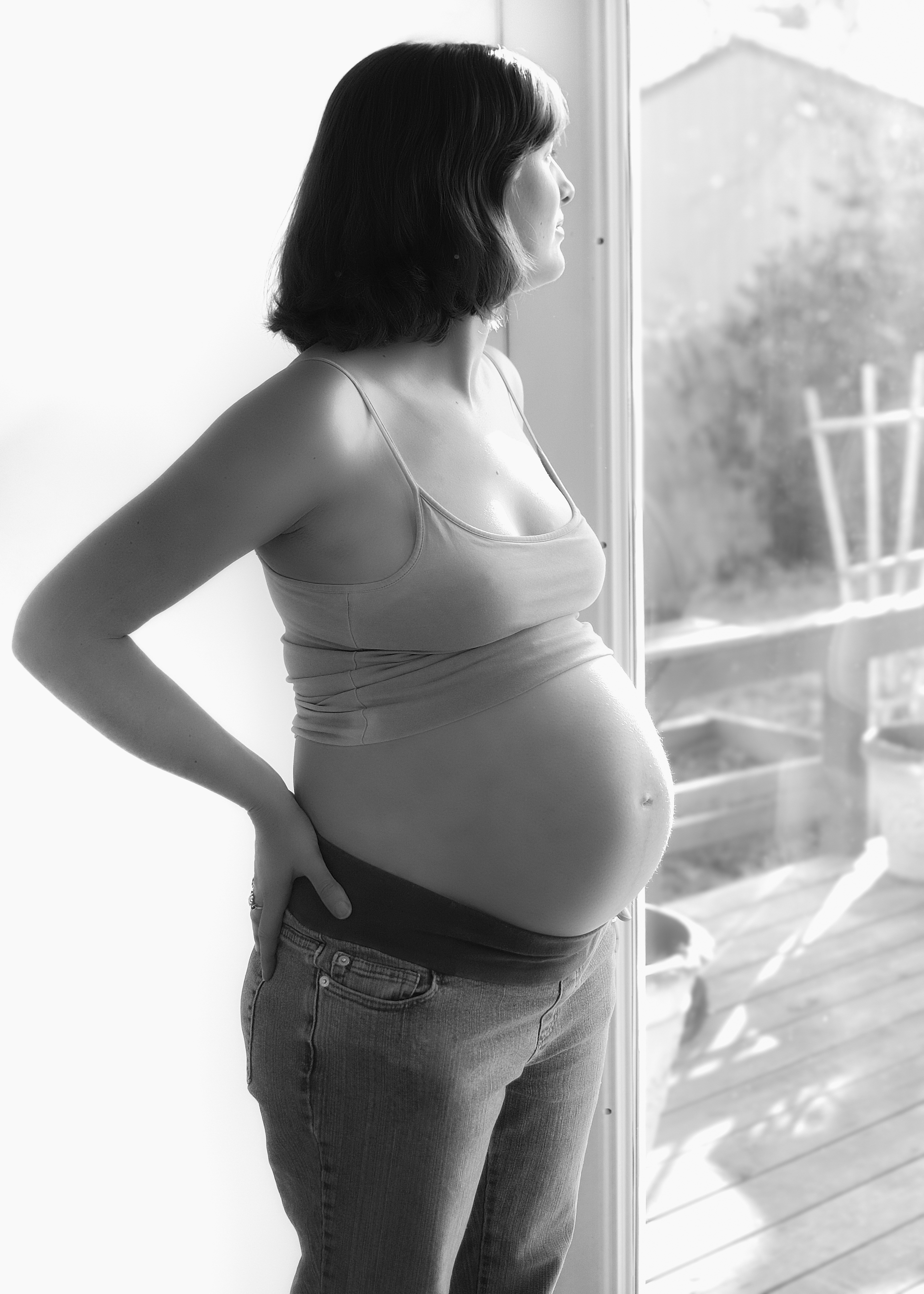
66112_618725968151055_156983473_nFor ages, I’ve had the following quote about miscarriage and doctors saved in my drafts folder:

“The only person who can really tell you what is happening to you is your own doctor, who peers into you with a light and a speculum, who samples your blood or urine, or who presses a sonogram paddle into your belly. If you are in trouble, bleeding, scared, or more depressed than you think you can handle on your own, you must find help. Read and research all you can, but remember that the one-on-one assistance of a real doctor is the only thing that will give you answers that count. If you don’t like or trust your doctor, then find one you can…”

I Will Carry You

I saved it because it bothered me so much to read. One-on-one assistance of a real doctor is the ONLY thing that will give you answers that count?! I disagree so much with this and it saddens me to know that women turn to doctors for support that they are unlikely to be able to provide, particularly if women are looking for compassion. My own ER doctor experience was horrendous and involved quotes like: “this is very common, it is just natural selection” and, “this wouldn’t hurt so much if you would just stay still,” as well as leaving bloody handprints streaked across the bed and blood on the floor (specifically after being told how very disturbed I was by all the blood). In contrast, I was treated with beautiful compassion (and actual, genuine, useful help) by every midwife I talked to. In defense of doctors though, I also went to my own family practice doctor for a follow-up visit and she said one of the best things I heard from anyone, doctor or not: “some women find comfort in knowing that love was all their babies ever knew.” And, before I left, she asked if she could give me a hug. That mattered more and lasted longer than any “advice” that she gave me about possible causes, trying, again, etc.

So, this week, related miscarriage articles and stories started catching my eye, such as this one that touches on the various dehumanizing ways many women are treated in medical care environments:

Rush of blood to my brain. Pounding in my ears. Breathing comes in short bursts. And I’m ushered out into the waiting area where I’m told to go home to wait for it to ‘come away’. And there I find myself, blinking in the sun, shaking like a leaf. So I waited. And waited. One week later the tiny form within still clung on. I saw it in my minds eye, not wanting to let go of me, its mother. Perish the thought. Instead I spent the week overly busy whilst somehow trying to recalibrate a defeated dream and birth date that would never occur. Finally, I just booked in for the D&C, and signed for an “excavation of contents.”

I am a psychotherapist and counsellor. I focus mainly on fertility in all its guises. From pre pregnancy to birth and beyond I am struck as women and their partners endure dehumanising experience after dehumanising experience, just like this one…

via The heartbreak of miscarriage

And, that reminds me of what Ina May said in her Birth Story documentary that the number one rule of maternity care should be Be Nice and she asks us to consider how just those two words could change maternity wards. While not miscarriage-specific, of course The Neighborhood Doula’s status on Facebook tonight jumped out at me:

“We need to treat women tenderly in labor. This may be the first time she has ever been treated that way. She will pass that on to her baby. If mom has a traumatic birth, filled with interventions she may be afraid of her baby. Fear of baby = disempowerment. A new mother should never feel that way. We need to treat dad with tenderness during labor too. If we treat him well, he will treat mom and baby well.”

Wise words from Ina May Gaskin at the 2012 Joyful Birth and Breastfeeding expo, Asheville, NC

Over the weekend, I was touched to see a photo from Stillbirthday on Facebook with a caption that almost made me cry because I think this perspective is SO important:

Supporting Birth Diversity means…

…Honoring that birth can occur, at any point in pregnancy.

The word “birth” is not reserved for full term, neither is it exclusively for live babies.

(Share your photo and what Supporting Birth Diversity means to you.)

And, of course I’ve already shared my thoughts on miscarriage as a birth event: 421806_605009189522733_1988490402_n

“Miscarriages are labor, miscarriages are birth. To consider them less dishonors the woman whose womb has held life, however briefly.” –Kathryn Miller Ridiman

via Miscarriage and Birth | Talk Birth.

I also read several articles about other women’s experiences with miscarriage as a birth event such as this moving exploration of “missing” when your expectation was of carrying:

Instead I was overwhelmed by pain that felt like the worst wrenching of labor, contractions that came so fast I could barely breathe, shaking and numbness in my limbs that finally made me crawl to the phone and call the nurse who told me to get to the ER as fast as we could. I’d never heard stories of the real, raw truth of what it means to miscarry, so I had no idea what to expect.

But just because a death comes early does not mean it is lighter to bear or let go…

on carrying and missing | mothering spirit.

And this article that touches on the birth event concept, as well as issues of guilt and blame, as well as the idea of miscarriage as a rite of passage:

That is why there is no doubt in my mind that any woman – and indeed any family – who goes through a miscarriage should see it as a rite of passage. The more that miscarriage is seen as horrific, as something which somehow could have been preventable, and is therefore blamed on the woman’s health, fitness or diet, the more we are denying ourselves as fallible animals. We are making women responsible somehow for these acts of nature. We are instilling guilt and fear, layer upon layer. The result is a woman, and by extension her family, who no longer trusts her body to do what is right. It must be faulty – it miscarried. Her body was not healthy enough, not experienced enough or somehow not adequately formed to be able to carry the pregnancy to full term.

This is not a healthy attitude to have, and can only result in more negative birth outcomes. One of the reasons I do not have a black tinge around my memories of my son’s birth is that, through it all, I trusted in my body. I did what I could, and although I couldn’t understand WHY it had happened, I came to accept that this time was just not meant to be. I am an animal, and I am fallible. This time I fell into the statistics of 1 in 7 pregnancies failing. There’s really no more to it – no guilt, no shame, no fear for future pregnancies; it’s just not appropriate.

Having gone through this whole process I now feel more of a woman. Yes, really. Not only have I experienced the horror myself, but I have had countless other women suddenly willing to share their own story with me. In a sad way I feel as if I have entered a secret club, something taboo and a bit shameful. I’m not really sure why nobody wants to discuss miscarriage, when it affects so many of us. If it were accepted as a rite of passage for any woman, as much as childbirth itself, I feel we’d all have a more positive outlook on all births, whatever the outcome.

via Guest Post: Miscarriage as a Rite of Passage | The Happy Womb.

I also finished reading a quick book that was offered free on Kindle last week (now back to a regular, reasonable price) and saved these two quotes:

In the days that followed, the bleeding continued. Every time I would see the blood, I couldn’t help but think I was losing my child slowly bit by bit. It wasn’t just ordinary bleeding; it was the end of my baby’s life. It was the end of my dream to become a mom. I was devastated. I felt so lost and alone. Unfortunately, my husband didn’t seem to understand or be able to comfort me. To him, the baby was not even real yet. And since he was actually afraid of becoming a dad, I think in some ways he was relieved that it didn’t work out. In my mind, I had lost a child. Someone important to me had died, and I was grieving. The hard part is that I was grieving alone with no one to share my sorrow. This is often a problem for women who miscarry. You feel so sad and devastated, but many times your friends and family don’t get it. They don’t realize how much love you can feel for a baby you never saw, met or held. You try to turn to those you love for comfort and support, but they have little to offer you during the time when you need someone to lean on the most. It’s not that they don’t want to help or that they don’t care. No one wants to see you sad or hurting. They just don’t understand what you are feeling and the intensity of your emotions. Even the words they say to you can come across as insensitive or hurtful. They often dismiss your grief and trivialize your pain, all the while thinking they are being encouraging and supportive.

(Amazon.com: From Pain to Parenthood: A Journey Through Miscarriage to Adoption eBook: Deanna Kahler: Kindle Store)

The author also touches on the depth of the grief following miscarriage and how very, very real it is (I’ve written before that one of the things I kept saying to my parents when they came to my house following Noah’s miscarriage-birth was, “this was real. I want you to know it was real.” (I honestly think I didn’t think miscarriages were “real” before, in the sense that I categorized them as something other than birth or death.)

According to The Women’s Encyclopedia of Health and Emotional Healing, “the length of the pregnancy is not as significant as how emotionally linked a woman feels to her baby.” The book goes on to say that if you felt your child was real very early in the pregnancy, then you may experience as much grief as someone who has lost a newborn. If the love for your unborn child was already there, you will be heart-broken and devastated. Your loss can affect you in many different ways, some emotional and some physical. You may notice muscle tension, have trouble sleeping, have difficulty concentrating, suffer from frequent headaches, cry a lot or even notice unusual sensations in your body.

(Amazon.com: From Pain to Parenthood: A Journey Through Miscarriage to Adoption eBook: Deanna Kahler: Kindle Store)

And, these quotes made me remember a brief post from The Amethyst Network regarding early losses and the validity of feelings:

I felt very conflicted over this. I HAD grieved before, but if I was grieving over not-an-actual-miscarriage then did it count? If my loss wasn’t actually a loss, then was my grief valid?

I was talking with a friend (who happens to also be involved with TAN) and explained to her how I was feeling confused and upset over this. She taught me something important.
“You grieved” she said. “It doesn’t matter whether the physical experience was a miscarriage or not, because the grief was real, you experienced the emotional process, and that is valid.”

And so I would say to all mothers who have had an early loss, or a loss that they felt in their gut even though there was no proof. Your feelings–no matter what they are–are valid feelings. We each have different experiences, and we each have different feelings. But what you feel is legitimate, regardless of the circumstances.

Did It Count?

995401_615271668496485_1504558296_n

(and, really, there is no “shame” in not acknowledging how it changes us either, the shame rests in the lack of acknowledgment from so many around us)

This last photo (for some reason it refuses to let me caption it?!) is of some “hope” baubles created by members of the Rainbow Group (local loss support group) at our recent MamaFest event (more about this soon, I hope!).

August 2013 028

Wild Feminine: Miscarriage Wisdom

When I spoke about miscarriage at the LLL of Missouri conference last weekend, I emphasized the recognition of miscarriage as a birth event:

I think it is crucial to remember that miscarriage is a birth event—sometimes a very, very, very early birth event, but reproductively speaking that is what it is! Since we don’t have a better vocabulary for pregnancy loss in our culture, socioculturally speaking we tend to class it as “something else,” but in most ways it isn’t. A soul (or fertilized egg) touches down in a woman’s womb. Her hormones and all other physiological systems are impacted and feel its presence. The embryo/fetus/baby stays for a time and when it leaves her body, the uterus must contract and the cervix must open and the woman’s body must open to allow its passage. Her body, mind, emotions, and spirit are all affected (to varying degrees). In this way, miscarriage and full-term birth simply exist on a continuum of possible birth outcomes and are all birth events whether the pregnancy lasts five weeks or forty-two weeks.

via Miscarriage and Birth | Talk Birth.

Following my own miscarriage experiences, I read like crazy, wanting to discover answers, hear experiences, and process pain. One of the Wild Femininebooks that helped me the most was the unexpected treasure, Wild Feminine, by Tami Lynn Kent. This book is really about pelvic health in general and what I appreciated most was that acknowledgment of miscarriage and the author’s own miscarriage experience was woven throughout the book, not relegated for some “bad outcomes” section. Also, miscarriage was acknowledged as a transformative and powerful experience, rather than solely in relationship to grief.

I re-read several passages from the book several times and I would like to share them here:

Some of a woman’s most profound transformations involve the changes in her womb: menarche, pregnancy, miscarriage, childbirth, and menopause. Every womb desires to give birth by receiving and gestating a particular energy; yet the way a woman specifically utilizes her creative energy is a matter of personal intention. One woman may use the energetic capacity for creation in her work as an artist or other creative endeavor. Another woman relies on her creative energy to nurture her children or reinvent her mothering. A spiritual teacher may receive a divine energy, gestating rituals for celebrating the sacred. A healer uses her intuitive capacity to aid others in physical, energetic, and emotional transformation.

See how miscarriage is just included? “Normal,” almost, rather than defective or secret or needing to be fixed or hidden or forgotten.

And, acknowledging miscarriage as a birth event:

Miscarriage is not, as I had always imagined, like an unexpected menstrual period. On the day of my miscarriage, I awoke from a dream that I was bleeding, but my sense of dread did not dissipate upon awakening. The red of my blood confirmed what my body already knew; miscarriage is birth and death simultaneously. Miscarriage is ecstatic connection and unquenchable loss. The uterus dilates and contracts, as in the process of birth. In its wake follows something ancient, something from the hearts and lives of the  grandmothers and women who have walked before, pouring forth from the uterus…

The event of a soul passing on within her body touches each woman in a different way. Yet it also links her to a broader community of women who share in the transformative effects of such experiences. When a spirit touches down in a woman’s womb and leaves from this place as well, a woman experiences the entry and exit of a soul within her body. When a whole life is contained within the womb without coming to term, a powerful invitation is given to the mother—to connect with the spiritual realm in the core of her body, to sit with her feelings and come to know the spirit of her child. But no matter how long a woman carries a baby, this life asks to be acknowledged and remembered, witnessed and loved. The energy that comes in with each life still must be moved. Without the natural movement of energy that occurs with a typical birth, a woman may have to be more conscious about working with the energy in her core. But if she receives the energy of this soul into her womb and then gives it an expression in her outer life, then she also receives a powerful blessing.

And, regarding miscarriage as a transformative life event: MR_048

My own pregnancy loss by miscarriage was a profound event in my body and my life. The spirit who came to be with me brought tremendous healing and creative energy to my womb that continues to inspire me today. If you have experienced a womb loss, you can still celebrate this soul’s life. For example, you can plant a tree to acknowledge what you experienced or learned as a witness. Ask your body how else you might remember the essence of this spirit.

Enhanced receptivity is also normal after a miscarriage, and in my own life felt like a sacred time—when I received many blessings and lessons into my life.

On my original miscarriage blog, I described this feeling an openness to change and I’ve written several times before about my miscarriage as a pivotal life event and a “religious experience” of a sort:

My first loss was, in fact, a new beginning for me in many ways. That miscarriage-birth changed my life forever. It changed my worldview, it changed how I work with women, it changed my understanding of the world, it prompted a spiritual awakening, it changed the trajectory of my work and my focus, and it broadened and deepened the scope of what I’d like to offer in service to others. It was BIG. It was important. It was hard, it was scary, it was emotionally and physically painful, and it lasted a long, long time…

via Blog Circle: New Beginnings and Most Significant Events | Talk Birth.

Related past post:

Honoring Miscarriage

Motherhood and Embodiment

“Loving, knowing, and respecting our bodies is a powerful and invincible act of rebellion in this society.” –Inga Muscio

As I’ve written before, pregnancy, birth, and breastfeeding are incredibly embodied experiences—motherhood in general feels very much a molly37weeks 016physical commitment. Our relationship with our children begins in the body, it is through the maternal body that a baby learns to interpret and engage with the world, and to the maternal body a breastfeeding toddler returns for connection, sustenance, and renewal.

Why might birth be considered an ecofeminist issue though? Because mother’s body is our first habitat. We all entered the world through the body of a woman and that initial habitat has profound and long-lasting effects on us, whether we recognize them or not. Midwife Arisika Razak explains, “the maternal womb is their first environment. The cultural paradigm of birthing is the first institution that receives our children…Each of these elements—womb, birth culture, and family—has a profound effect upon the new human bring. Each deserves our best thinking and analysis. What would it be like if we envisioned a society in which positive, lifelong nurturing support—from old to young, and young to old—were the dominant theme of human interaction?” (p. 167).

What would it be like if we treated birthing women and their babies like they mattered?

Our first and deepest impulse is connection. Before Descartes could articulate his thoughts on philosophy, he reached out his hand for his mother. I have learned a lot about the fundamental truth of relatedness through my own experiences as a mother. Relationship is our first and deepest urge and is vital to survival. The infant’s first instinct is to connect with others. Before an infant can verbalize or mobilize, she reaches out to her mother. Mothering is a profoundly physical experience. The mother’s body is the baby’s “habitat” in pregnancy and for many months following birth. Through the mother’s body, the baby learns to interpret and to relate to the rest of the world and it is to the mother’s body that she returns for safety, nurturance, and peace. Birth and breastfeeding exist on a continuum, with mother’s chest becoming baby’s new “home” after having lived in her body for nine months. These thoroughly embodied experiences of the act of giving life and in creating someone else’s life and relationship to the world are profoundly meaningful experiences and the transition from internal connection to external connection, must be vigorously protected and deeply respected.

via Talk to Your Baby | Talk Birth and Breastfeeding as a Spiritual Practice

I have a particular interest in embodiment and my dissertation topic is related to a thealogy of embodiment (basically the Goddess and the body) and so my attention was caught by some great sections about birth, bodies, and family in the book The Art of Family:

AS WE MOVE THROUGH BODILY stages together, there are some special stages that are worth thinking of in advance. Pregnancy is one, of course, and babies. Nothing is more inescapably BODY than birth. For the mother, both through her pregnancy and the labor and delivery of the baby. In birth, the body gets to drive the soul for a change and one’s soul is on for the wild ride, whatever happens. What does she deliver, after all, but a body, this little lamblike creature packaged in a now wholly-other body? What does she deliver but a body—and what do she and Daddy count but a body’s toes, a body’s fingers? In these small ways we acknowledge our wholeness, our physical sacredness.

Gina Bria (2011-11-28). The Art of Family : Rituals, Imagination, and Everyday Spirituality (Kindle Locations 1693-1700). iUniverse. Kindle Edition.

(Amazon affiliate link included)

And, I appreciate that Bria then moves into a consideration of how men experience pregnancy and birth…

YES, BIRTH IS THE BODY, and for women it is manifestly given. But one should note that the world over, there is a complementary effort by men to try to counterbalance the impressive power of women who have even the potential of birth, whether it is actualized or not. Men, too, have moments of making special use of their bodies. Men make quests, and perform feats of extraordinary effort, to put their bodies on the line in some attempt to match birth.

…For modern men, pregnancy means two things, not one integral, unfolding experience, as for women. First, they must cope with a partner undergoing tremendous physical change. In essence, they are no longer dealing with the same body. It’s a stressful experience, and many men fear they will never see their old partner again, quite literally. They listen to their wives agonize about weight gain and swollen ankles, and secretly grieve the loss, all the while maintaining a show of faith, for their wives, for themselves, that it will come to a happy ending. And on top of that, they must then forge a new relationship with the party responsible for this, someone they can neither see, nor touch, indeed, can hardly believe exists! Women at least get touched by their in-utero babies, even if it’s a swift kick from the inside. “Hey, it’s Daddy,’’ my husband said rather sheepishly into my belly one night. This seemed to me quite amusing, as if the baby needed an introduction to one half of his own genetic material. Then suddenly it struck me that I had never considered introducing myself to the baby, announcer like over an intercom—“This is your mother speaking’’—because I felt the bodily connection so inexorably. I knew I was well known to the baby, but my husband had no such advantage. He had to make connections in other physical ways, in this case using his voice. Making a family where men touch, speak, and care for children is a vital way to connect them to their own progeny; one way that many cultures, including our own, can often deny men. Perhaps you have been stopped in your tracks, as I have, over the recent spate of advertisements of bare-chested men holding tiny babies. Do advertisers, more than Freud, know what women want? Yes! We want to see our handsome men holding babies, snoozing with them, schmoozing with them in chest-to-chest communion. As Jane Austen asks, “What attaches us to life?’’ Anyone who lays on hands gets attached to life.

These thoughts really struck me in a profound way. During each of my own pregnancies, I remember marveling and feeling impressed, as well as a little sad, that my husband had to somehow forge this bond with a newcomer without the same benefit of the embodied, constant experience of pregnancy—pregnancy from the inside is different than pregnancy from the outside. I shared the author’s amusement in picturing how it would have been to “announce” my own presence to my babies. I’ve tried, but cannot fully imagine the process and psychological task involved with the paternal experience, of in a sense, “suddenly” having a baby to hold and care for and “instantly” love, though I’m sure I have the capacity within me somewhere (and, yes, I know that not all mothers feel an instant love either and may have the same sense of suddenness in their own lives—it was certainly true for me that the inner experience of a womb-dwelling baby was pretty different from the external experience of having a physically visible baby to tote around). As a pregnant woman though, the baby is basically inescapably present and part of me in an interconnected, interwoven, symbiosis of being. There is the transition at birth to an “outer” relationship, but that intense embodied interconnection continues immediately with the breastfeeding relationship. It is somewhat impressive or staggering to me almost, that men have to form their own connection born out of different “stuff” that the biology of gestation and lactation that weaves the motherbaby together.

Bria also addresses the loving of a baby’s body that isn’t going to survive:

WE ARE NEVER MORE CRUSHED than when there is trouble at birth. No sadness holds for us the power of an incomplete body, a broken body. We grieve and turn heart stricken at this time like no other. In moments like these we can only comfort ourselves, with love, that love would allow us to care for this child when many would not be able to do so. We hope to find ourselves the kind of people who could, in such circumstances, make a life for a whole person, with an incomplete body. When our son was born with a leaking heart, an old-fashioned “blue baby,’’ and destined to die without surgical repair, we learned quickly that all we could give him, all he could receive as a newborn, was the small, inconsequential daily care of the body, gentle changing, warm nursings, our breath upon his face. Perhaps, we thought, it would be all he would ever get. In that season of attention, we really learned the significance of loving a body. A body, however small, records every trace of touch; it is never unconscious; unlike the mind, a body is never without sensing, even in sleep. A body will always remember.

I liked the description of a body always remembering. We do carry deep, physical memories of our pregnancies, births, and babies. I find the physicality actually comes back most clearly in dreams for me, when I can again feel with a sharp potency the sensation of a baby’s body slipping swiftly from my own body. I also like reading research that indicates that mother’s body carries fetal cells within her forever. I like thinking that physical evidence of the embodied, relational experience of pregnancy remains written into my very cellular structure (well, and on my bones and skin too, I suppose!). I found this a comfort after my little Noah’s birth, thinking that in a very real way, I would truly always remain a “little bit pregnant” with him and that perhaps some of his unique genetic material lives on in my body.

After birth, we continue to relate to our babies on a very physical, body-oriented level. There is nothing like a baby to bring things back to the body, to use your body and their own in a complete, intensive, totalness.

BABIES’ BODIES AND CHILDREN’S BODIES   LIKE PLAY, LOOKING AT THE body of an infant returns us to childhood. Babies’ bodies are a special form of being human, and they elicit in us essential, elemental emotions. They infect us with longing for the integration, the wholeness, they have. As new parents, we experience again all the helpless and exuberant feelings of children, the unfeigned marveling over everything manifested by a baby, a physical miracle. We cannot contain our awe, expressing it to everyone within earshot. New parents on the street can always be identified by their aura of vulnerability; they’ve shed the social cloth that keeps us all appropriately attired to go about our work. Instead, just like the baby, they are naked to everything good. They blink and look around, bemused, tired, and delighted. You will notice they always smile at you at the crosswalk—it is a secret, initiated smile. They assume you either know what they are smiling about or wish that you did. What is it they know? Their babies made them once again aware of the pleasures of physical delight. To care for an infant is a test of our humanness, a trial by fire and love.

What is good about caring for infants is that they never let us forget how essential the body is. They snuffle, bawl, and demand attendance. “Feed me, change me, hold me,’’ for an eternity of right-nows. And when they sleep, it’s as if they have cast themselves on a thin but safe shelf of floating wholeness, complete integration. They show us what we once were, without guile, delightedly in love with our own body. When infants turn into toddlers, the body is still in front, still demanding, but in a bigger world. Now protection from bodily harm becomes a concern of everyday physical life together. We aren’t as impressed by the bodily transmogrification that takes place in front of us, because we’ve learned to live with it happening every day, day to day. It’s impossible for the same miracle to impress us the same way over and over again. Thus begins the very fading away of the lesson we most need from our children—that there is intense pleasure in the active human body. Right under our noses they play. They play and play and we watch and nod as if this itself isn’t a further miracle. What do infants do when they get control of themselves, but move, explore, experience exhilarated delight in their bodies and what they can do. Their essence is to enjoy themselves as bodies, all over…Through physical life with our children, through care of them and play with them, the hands-on of it, we again acquire our innocent selves, a delight in each other and the world around us. We discover all over the potentialities of the senses. This is the heart of being with young children.

Gina Bria (2011-11-28). The Art of Family : Rituals, Imagination, and Everyday Spirituality (Kindle Locations 1729-1760). iUniverse. Kindle Edition.

As they age, this physical, body-based relationality and experiences may wane, and yet still holds important value:

As our children age we must struggle to keep this alive for ourselves, for them, in one form or another, as the world begins its intrusion into our family lives. This may be as simple as pointing out that a flower is beautiful, that rain smells divine, that a hand held feels warm and comfortingly sweet, that nothing satisfies like cool water. Once children hit the walking stage and beyond, we spend more time explaining compared with the time we spent holding. Yet there are still many miniature ways of communicating with one’s body. Its active use—a nod, a wink, a hug—are all fleeting acts of committing one’s body, however momentarily, to another. Looks, touches, squeezes, physical smiles, a physical vocabulary—aren’t they what children long for? Indeed, isn’t that exactly what we thrill to in a romance—those little signals that you belong to each other—and isn’t that what we end up complaining of missing when our marriages seem stale? It isn’t just for romance that these things work, though it is there that we most seem to notice them. All of family life can capitalize on a richer life with each other’s bodies.

And, bringing it back to birth and the care of birthing bodies, I really liked this image via Facebook:

treatment

Blog Circle: Tender Mercies, Unexpected Gifts

The Amethyst Network blog circle for April is on the subject of Tender Mercies:

Blessings, Magic, Tender Mercies, Grace, whatever you call it, there are these moments, times and experience of light in the darkness. Sometimes they are very small. Just a moment where you see a little bit of magic, or a blessing wrapped in the grief. Sometimes it is significant, like close friendships made with people you may never have had the chance to meet otherwise.

For our Blog Circle this month (April) please share your own experiences of grace, tender mercies, magic, blessings, or gifts that your miscarriage has given you. If you have not experienced a miscarriage, please feel free to participate. We all know someone who has miscarried and therefore have been touched by miscarriage in some way.

via April Blog Circle ~ Blessings, Magic, Tender Mercies, Grace… » The Amethyst Network.

As soon as this theme was picked, I knew what I wanted to write about. It was the experience of an unexpected gift from my little baby Noah. It was one of the only moments of “communication” I ever felt from him after his death-birth. I sort of expected or hoped to have some dreams or some other sorts of “metaphysical” sorts of experiences with him, but I didn’t have that, he was simply gone. I did, however, have this one little gift (originally posted about on August 11, 2010)…

This past weekend [August, 2010]…We went to visit my friend M whose baby recently died and was born at a similar gestation point to Noah. While we were there, she showed us the memory box she’d put together for her baby and then she brought out the folder she’d received from Angel Whispers (source of the birth certificate that I got for Noah and that I like so much). She held it out to me silently, and printed on the front was, “this folder was made possible by a donation in memory of sweet baby Noah Remer, November 7, 2009.” Oh. My. Goodness. How could it be that I made a donation to Angel Whispers back in May ([2010] for my due date), the check traveling all the way to Canada, and yet, this folder somehow finding its way back into my life and into the hands of my dear, grieving friend? It was an amazing feeling.

I sent a donation to cover three folders. I wonder who has received the other two? We came up with all kinds of possible reasons for this “coincidence,” but none of them were very logical (she lives in IL, I live in MO-–it isn’t like they saw our addresses and though, “ah ha! We’ll send this one!”) and we were left with the only option to be just to marvel at this simple little gift. :)

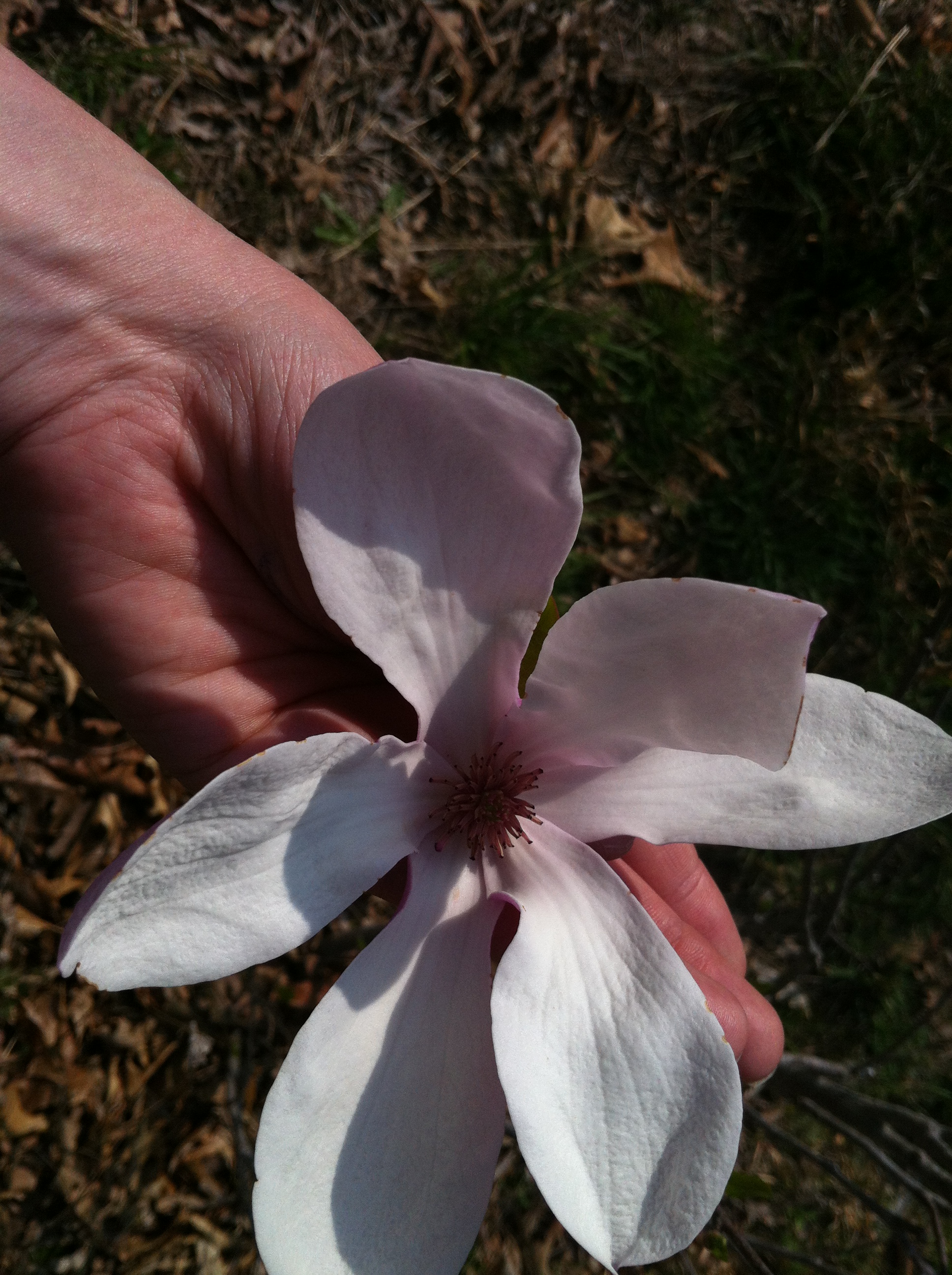
In more current tender mercies, Noah’s memorial tulip tree is about to bloom!

20130412-141712.jpgIt is in a shaded area behind the house and thus is a little off-schedule from the rest of the trees like this in the area. My parents have a matching tree and theirs is fully blooming now:

20130410-155034.jpgSeeing these flowers each year is really meaningful to me and that’s why I used a photo of the flowers as the cover image on my miscarriage memoir. new_coverThinking about this post made me dig around in my archived photos where I found some not-often-before-shared photos of the ritual my mom and friends had for me near my birthday (Noah’s due date), during which we planted said tulip tree. Under the tree I buried the embryo from my second miscarriage and also the hospital bracelet from my ER trip following Noah’s birth. At the time of these photos I was tentatively hoping I might possibly be pregnant again and, in fact, I was justatinybitpregnant with the future Alaina!

mizuko4

Placing the tree in a barely scratched out dip in the rocky soil!

mizuko5

My mom adds a scoop of dirt.

mizuko6

My doula!

mizuko12

I feel lucky to have a supportive mom who does things like this for me! 🙂

And, after I prepped and scheduled this post, I took this photo of the almost opening bloom…

20130415-191007.jpg

And then, the day before it was scheduled to post…YAY! A full flower!

April 2013 031

Not picked, just stabilized for photo op.

April 2013 034 April 2013 016

Tuesday Tidbits: Hemorrhage & Postpartum Care

March 2013 068“A bright red ribbon of blood weaves women together. We are blood sisters. We bleed and bleed, and we do not die. Usually.” –Susun Weed

These Tuesday Tidbits all come from the current issue of Midwifery Today. It is an excellent issue with tons of great information. As I referenced before, however, it is literally making my uterus ache and contract to read it since the theme is Hemorrhage. I’ve had to read it in small doses—5-10 pages at a time—and then come back to it later because the contractions/crampiness in my uterus and lower back get too intense for me to continue. I’ve always known that I have an intense response to blood, but this is the first time that I’ve really tuned in to the body memory my pelvic bowl still holds with regard to excessive postpartum blood loss. That blood loss is one of the things I don’t blog about, but today I’m writing about hemorrhage anyway (even though my back/uterus is starting up again as I type this). I guess you could call it “psychosomatic,” but I call it uterine memory.

Robin Lim’s article about postpartum hemorrhage in Bali includes a nice list of preventing and managing hemorrhage, one of the most significant being to minimize prenatal “scare” as much as possible. She writes about good prenatal nutrition and nurturing prenatal care and she also recommends this essential:

Build layers of support and trust for the mother in pregnancy and labor to help her cope with any social, psychological or spiritual challenges that she might be carrying…

Lim also says that laboring women use “qi” while laboring and birthing, which is our life force, our energy. She says that if women run out of “qi,” they have to dip into their “jin,” which is, “one’s God-given lifespan”:

“If a mother uses all of her qi to bring her baby out, then she has none left to bring her baby out and to close her uterus properly…As birth-keepers it is our job to maintain the qi of pregnant, laboring, birthing and breastfeeding mothers. The mother who maintains her qi and does not use up her jin can still be glowing and full of energy after having five children…the mother who has dipped too deeply into her jin, due to having depleted her qi, can be dangerously run down after having just one baby…”

While one might interpret this as being a little too esoteric for the practical mind and perhaps a tad too close to the victim-blaming “you create your own reality” thought processes that grate on my nerves, I really appreciated the idea of the responsibility of birth-keepers to guard mothers’ life-force energy and to act to preserve mother’s natural resources and reserves of strength.

On a midwifery education note, I love the writing of Sister MorningStar and I loved reading her thoughts on midwifery education, especially her observation that

…I’m dreaming of a way and time when women are as healthy as deer and mothers birth in the night before professionals arrive. Don’t misunderstand, I want and am willing to talk at any roundtable about midwifery education. We need everyone who cares about birth at such a table, including mothers. We need a global table with a global voice, passion and wisdom. I am not saying that birth and midwives are not made better with midwifery education, but I am saying that I have many questions about modern midwifery education and its effect on the experience of birth.

And, moving on to postpartum care, loved this quote from Darla Burns in an article by Allie Chee:

As Americans, we are under the impression that new moms are ‘Superwomen’ & can return to life as it was before baby. We must remember to celebrate this new mother and emulate the other cultures that honor new mothers by caring for them, supporting them, & placing value on the magnificent transformation she is going through. This is the greatest gift we can give to new mothers & newborns…

I appreciated that Chee included information about postpartum recovery from miscarriage and stillbirth as well, rather than assuming that postpartum care is a need only following a live birth. Consistent with my own experiences and observations she notes that, “in the case of miscarriage and stillbirth, a woman is usually sent home with no postpartum care instructions other than perhaps a list of negative signs to watch for that may indicate further complications with her health. In these instances, many friends and family members, often not knowing how to respond, leave the mother to grieve alone and to recover physically by herself.” Other interesting notes with regard to postpartum recovery after miscarriage or stillbirth include these two:

  • The depression and anxiety experienced by many women after a miscarriage can continue for years, even after the birth of a healthy child….
  • [with regard to postpartum recovery/”lying in” time in other cultures]…Amy Wong, an internationally acclaimed author and expert on postpartum writes, “Natural delivery requires at least 30 days of rest, while cesarean delivery, miscarriage and abortion require at least 40 days…”

Of course, this made me reflect on my own experiences. I feel fortunate that I was cared for with a lot of love and tenderness in my own miscarriage postpartum, with my mom bringing us food and providing child care and support, and my doula organizing and delivering meals from friends as well as offering a loving and supportive listening ear. That said, I was back in front of the classroom two weeks postpartum and felt like perhaps I was taking “too long” to get back to “normal.”

Definitely make sure to check out the complete issue! Midwifery Today is my favorite birth publication and is a treasure trove of information as well as personal experiences and reflection.

March 2013 040

Tuesday Tidbits: Story Power

“The great motherhood friendships are the ones in which two women can admit [how difficult mothering is] quietly to each other, over cups of tea at a table sticky with spilled apple juice and littered with markers without tops.” ― Anna Quindlen February 2013 138

This week, almost ten years after I actually had my first experience with my first baby practice breathing in the womb, I received yet another comment from a mother worried that the practice breathing movements she was feeling were really her baby having seizures. This reminds me of both the power of personal stories and of the power of the internet. I didn’t know ten years ago that my voice would still be able to reach off the page and touch another mother’s life today. That feels good! I also like that this long-lasting post is just my little story. It isn’t a scientific article, it isn’t written in a professional tone, or  written with detached objectivity, it is just me telling my story about something that happened and what I learned from it. And, that speaks to other mothers in an irreplaceable way. Since the post now has 130 comments on it, it has become a story-house, so to speak of woman after woman’s stories of this experience and so each woman who comes for the initial story can then benefit from the voices of many other mothers, all in the same place.

And, in a beautiful full-circle experience, the original author of that “miscarriages are labor, miscarriages are birth” quote I’ve used so many times since 2009 and that meant so much to me, found my website this week and left a comment with an update about her own life:

“I am so pleased that my words brought you comfort during a painful time of your life. My miscarriages shaped my life profoundly, as did my experiences as a miscarriage/stillbirth doula. Happily, after many years of infertility, I did give birth to living children, and am now a happy grandmother. The older I get, the more I realize that those little souls who spent their entire lives within me brought me incredible gifts. I am a much better person because they existed…”

Her story and her “old” words reached off the page to me and touched me deeply at a time when I desperately needed them and they’ve gone on and on from there to help many other women.

A lot of other things about stories have been popping off the page at me…

I got a e-newsletter from one of my favorite writers, Jen Loudon, and she was doing an interview with Justine Musk. About said interview with Justine, Jen says:

She writes powerfully about the intersections of so many things I care about: being a creative woman and a feminist, the power of shaping our own stories, the sacred obligation to “connect with your gifts and search for that sweet spot where they cross with the call of the times,” truth, and even thigh-high boots…

And, speaking of feminism and all that good stuff, I followed an internet rabbit trail that started with First the egg’s link to a post at blue milk about slacker moms and white privilege (really good observations, by the way, that behavior reflecting questionable judgement exhibited by a white, middle class mother is way more likely to be blown off or viewed as a funny story than the same story about a poor and/or not-white mother) and eventually landed me at this post about “mothers you hate.” Nestled midway through the article was this interesting observation:

“…The militant mother feels strongly about what happens to her body during birth – and to her baby’s – and she wants women to know about their options. She’s also readily marginalised by powerful institutions. In pro-choice circles we otherwise call the women fighting for rights like these ‘activists’. As a feminist, it concerns me that we’re so intolerant towards birth activism when abortion activism is core to our understanding of bodily autonomy. The activist mother’s beliefs are dismissed as inflexibility, but I’ve had just as many mothers recommend an epidural to me as I’ve had women recommend drug-free births, and they all did so with equal enthusiasm…”

Thinking about mothers and how they interact and how they experience themselves and their lives, my eyes then snapped to this quote in a longer book review:

“…In a sharp observation early in the book, Smyth comments that ‘the role of mother is not immediately intelligible to those who find themselves inhabiting it’ (p. 4). This is certainly borne out in the confessional writing and memoirs of young (feminist) women, who try to make sense of their experiences as a new mother. They write of a crisis of selfhood, feeling undifferentiated in ‘a primordial soup of femaleness’ (Wolf 2001) and of experiencing a gendered, embodied and relational self for the first time (Stephens 2012)…”

Returning to the power of personal stories (but also reminding us not layer our own unresolved personal stories on top of another mother’s grief), I read this very strong, powerful article about miscarriage:

“…I am grieving my enormous loss while simultaneously feeling more at home in my body than ever before. No one seems to want to hear this. No one seems to believe me. Ironically, it wasn’t until I began sharing my story of my daughter emerging from me at 15 weeks that I began to feel sprinkles of shame. Why would I be ashamed of chromosomes gone wrong? How would I have any control over this? Magical thinking and long stored up dark reserves seep out as women experience reproductive hardships. They think they must have done something to “deserve” this, had to have been “unlucky”, and chase every possible line of thinking imaginable to connect the dots. There are no dots here. Miscarriage isn’t about pregnancy ambivalence or anxiety, prior abortions or outbursts of venomous anger, feelings of sadness or anything else that you can seemingly control.

Miscarriage is simpler than all of that. It is loss of life that wasn’t sustainable.

I have fantasies of shouting this from rooftops and tweeting random cryptic notes containing the facts about pregnancy loss in the hopes of galvanizing women’s perceptions of themselves. I daydream about pleading with women not to blame their beautiful bodies for their reproductive devastations. I wish I could dare every woman who has at some point or another wondered if they were somehow the root cause of a reproductive disappointment to turn that question on its head. “What if you are not the reason that this happened to you? What if it just is?” I can’t help but wonder if this would [elicit] more anger, more grief, more relief, and/or more hope. Or maybe something else completely. I am confident that it would engender less competitiveness, less perfectionistic strivings, and more self-love…”

One of my own unresolved bits about my own losses that gets layered on top of (or in the way of listening to) other women’s stories is the WHY of my own losses. I don’t know for certain that Noah’s birth at almost 15 weeks was actually because his life wasn’t sustainable. I continue to have the lingering fear that it was really the UTI I had at the time (the first of my life) that killed him. My gut says that his lifespan only extended that far and was genetically programmed to end at that point, but there is a little part of me that still wonders, what if my body killed him. Ditto with my early miscarriage, my fear is that my hormone levels were low and because I got pregnant again “too soon,” my body couldn’t sustain what might have under different body-circumstances been a perfectly viable baby.

What stories have touched your own life this week? How have your stories helped another mother?

“We live by story. Yours enlarges the circle.” — Richard Rhodes

I am a Story Woman

Be Wild

I’m in the process of finally setting up my etsy store to sell some of my one-of-kind polymer clay birth sculptures. As I do so, I’ve been “hearting” away on all the other stores I like there and I re-came across Mamacita Beadworks, home of two of what used to be my favorite necklaces.

Meet Mamacita and Rosalita…

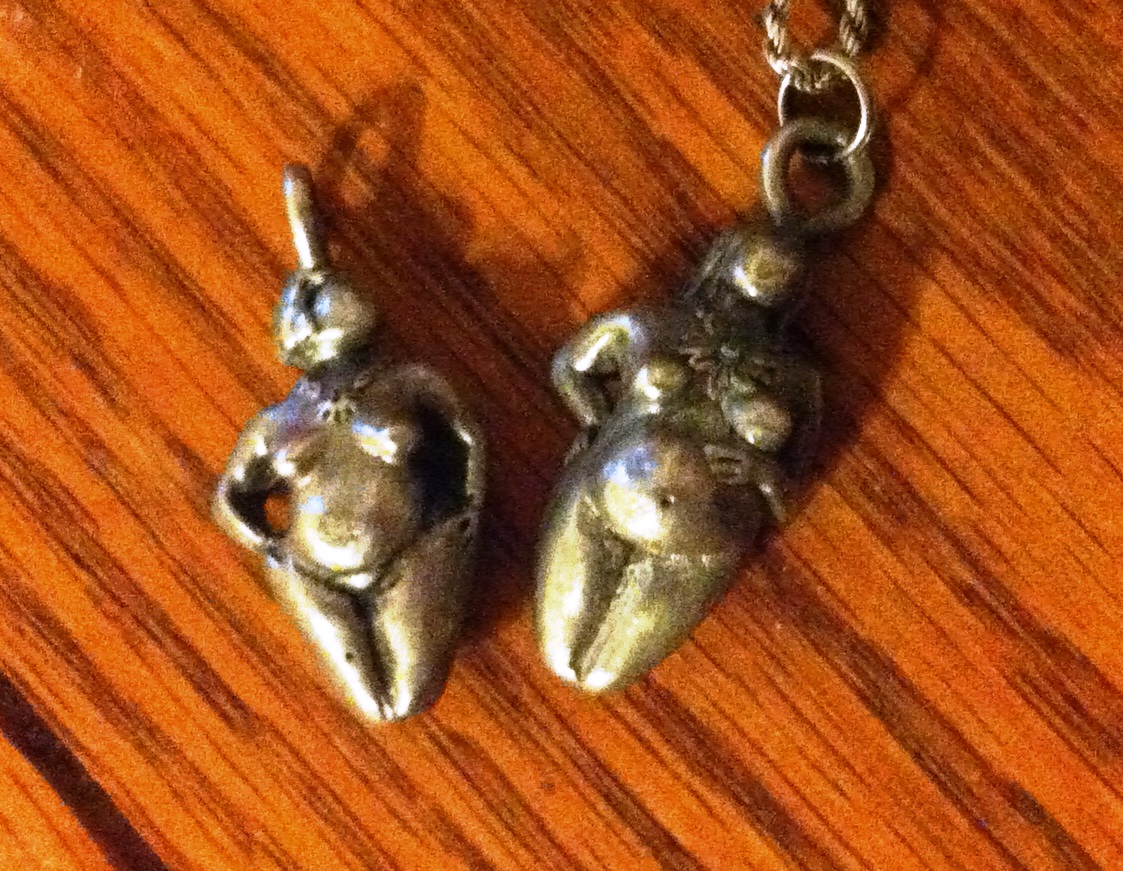
mamacitaAren’t they grand? From these lovelies, my sons learned the word, “sassy.” I told them, I love these because they are such sassy mamas and when I wear them I feel strong and sassy too! However, as I’ve written about before, I have a very deep “jewelry memory,” in that I often use jewelry to mark significant moments in my life, to communicate certain messages, and to remind myself of things or serve as touchstones. Because of this, sad occasions may also become inextricably linked to jewelry as well. These two were my favorite necklaces before miscarriage. After miscarriage, they made me feel like a naïve, pathetic fool. I could hardly stand looking at them. And so, gorgeous, sassy Mamacita and Rosalita and all of my beautiful glass belly necklaces that I used to love so much got put away in the bottom of my jewelry box and I’ve not worn them for about three years. But then…thanks to Etsy, something changed yesterday because in the Mamacita Beadworks I saw THIS…

wildness This pendant is one that I think of as my “be wild” pendant, because on the back is engraved, “the call of the wild is not a difficult song” and that makes me think of a Women Who Run with the Wolves quote: “Be wild, that is how to clear the river” (see prior post). I had no idea that this pendant was made by the same artist as Mamacita and Rosalita, because I didn’t buy this one from Etsy, I bought this pendant from the MANA booth at the ICAN conference in St. Louis when I was pregnant with Alaina. (Obviously, I’m attracted to certain artists without having any clue that they’re one and the same.) So, suddenly I felt this before miscarriage and after miscarriage jewelry memory link that felt significant.

Today, I put on Rosalita and Be Wild. And, I feel a little sassy…

Hope and Healing

Day of Hope and Healing…20130224-162312.jpg

What does that mean to me?

I pause a moment to honor my own courage and heart in trying again. In feeling fear and doing it anyway. Of daring to hope. It takes courage to open oneself up to loss again. To risk pain. To knowingly step forward into what may result in suffering. I celebrate my own daring to try again. For me it paid off, others continue to experience only additional pain and loss. It was a gamble. A roll of the dice. Losing babies shows you how chancy the childbearing year is. How full of promise and how full of pain and disappointment. I’m shocked by how often I continue to think about pregnancy loss, miscarriage, my own little Noah.

Just this weekend, I talked to Mark about the unresolved feelings, questions, and confusion and what ifs I still have and I guess will always have about my own miscarriage experiences. And, I told him, I still think about it every day. Every, single day, three years later. Is that just because I’m a “highly sensitive person” or is it because I was changed to the core by the death of my little baby? Every day I remember him, every day I remember what I learned, and every day I remember how it felt. So, this Day of Hope and Healing to me, is a chance to acknowledge and remember, to celebrate my own strength, and to love the gifts that loss brought me. I still feel a sensation of having a “hurt place” instead. A distinct spot in my uterus that remembers the baby that did not make it. A place that bled with such vigor that I was afraid I would not live. A place that tried so hard not to let go and then yielded. I laid in the bathtub and thought, “I will always be a little bit pregnant with him,” and maybe I am.

Today is The Amethyst Network’s Day of Hope and Healing event. I spent some time yesterday in the woods thinking about this and what it means to me and the above is what I spoke into my little voice memo recorder. I’m excited about our vision for The Amethyst Network in training for miscarriage doulas and offering support for loss families, so today on our Day of Hope and Healing I also donated to our Indiegogo fundraising campaign. We’d surely appreciate your donations as well 🙂 Also, make sure to check out the Day of Hope Pinterest board for inspiration.

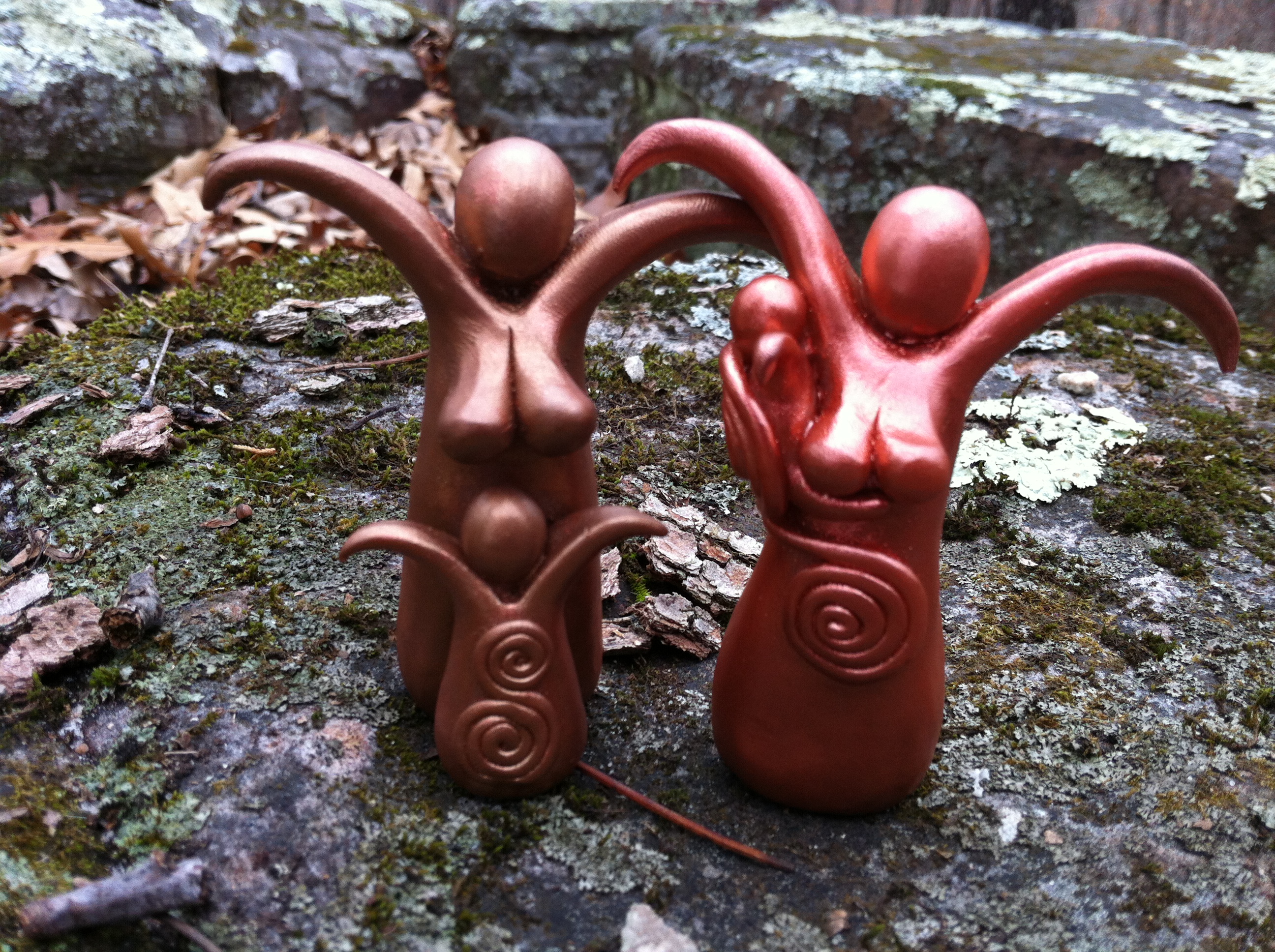
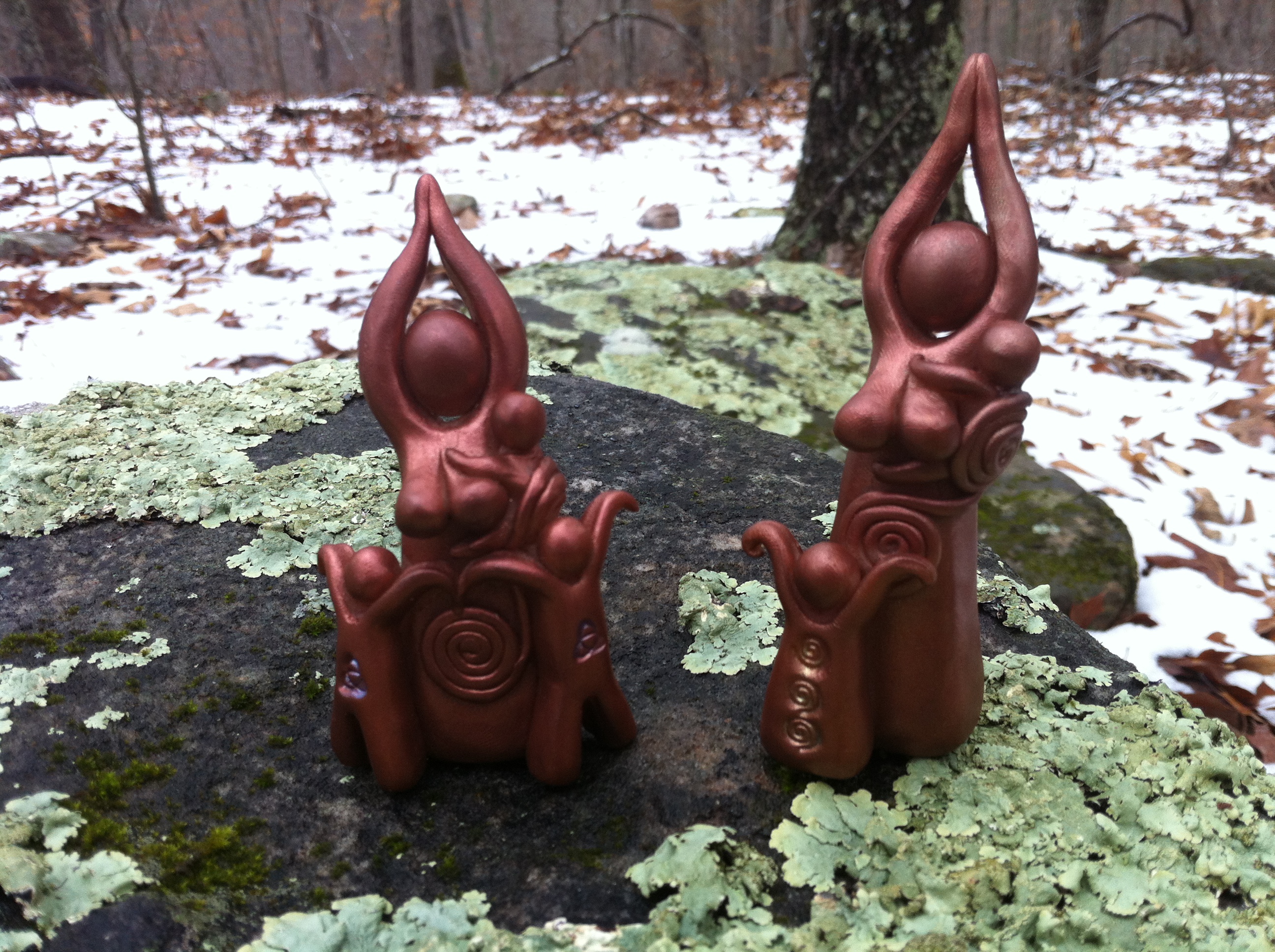
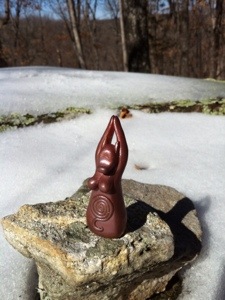
A couple of weeks ago, Zander made some sculptures while I was working on my own and he surprised me by making this little “guardian of the dead.” He says she is holding and nursing baby Noah:

20130224-162344.jpg

Based on my own past “guardian of the womb” experience, I also made a new little sculpture for myself:

20130224-162215.jpg

20130224-162301.jpgOn the way back to the house after taking these pictures, I noticed that some tulip bulbs I planted in a terribly haphazard manner last year are actually starting to come up! That felt like…hope.

20130225-174948.jpg
20130225-174956.jpg

Today I also made some revisions to my miscarriage memoir and decided to reduce the price to only 99 cents on Kindle!

The Amethyst Network February Blog Circle ~ Sharing Our Stories: A Confusing Early Miscarriage Story

We have chosen the theme for the month of February to be Sharing our Stories as we all have a story to share. By sharing our stories we have the opportunity to heal ourselves, heal each other, and break the taboo surrounding miscarriage and pregnancy loss. Story telling is a powerful tool of healing.

Every year I try to come up with a word to focus on. One year it was JOY. One year it was HOPE. This year I was contemplating what word I needed to focus on. Simplify? Prioritize? Gratitude? Service? But the recurring word that has come up for me over and over is STORY TELLING. I admit, I have a hard time keeping my mouth shut. I always have a story to share about whatever is being talked about. Clearly I need to work on keeping my mouth closed! Maybe my word needs to be listening? Listening is an art as well and a valuable tool of healing. Maybe I need to work on listening to others stories? I digress here. The theme of story telling has come up over and over. And we would love to hear your stories.

Please share your stories on miscarriage, pregnancy loss, hope, healing, the journey to your baby, the journey to a rainbow (garnet) baby, the journey to decide to be done. Whatever story is in your heart needing to be shared, that is the one we want to hear.

February Blog Circle ~ Sharing Our Stories » The Amethyst Network.

As soon as I learned the theme for this month’s Blog Circle with The Amethyst Network, especially since it coincides with the month of my second miscarriage experience, I knew it was time for me to finally try to share my story of my second miscarriage.

In January 2010, I experienced a sort of “mysterious surprise” conception. We’d been planning to try again after having lost Noah, I kept waiting and waiting to ovulate and “never” did. I had a dream that I was pregnant and decided to take a pregnancy test just in case. It was positive. I still have confusion about how it happened and how long I was pregnant. I did eventually find the embryo from the pregnancy, which seemed consistent with a 5-6 week embryo, so that I how I define the loss. On February 1 of 2010, I began to bleed red and I knew that my slender hope of a viable pregnancy-after-loss was bleeding away. This miscarriage was a crushing blow, one of the lowest and darkest experiences of my life. While I’d found courage, strength, and even joy and purpose in Noah’s miscarriage-birth, the second miscarriage brought me to floor in despair and confusion. Because there wasn’t a clear-cut “birth event” and there was no baby to hold, name, and cry over, it seemed ambiguous, amorphous, and just so confusing. This miscarriage actually dragged on for almost the entire month of February, with positive pregnancy tests up until a week before I started another period. For some time I even held out hope that I was somehow still pregnant, despite the bleeding and the tiny embryo. In my journal I wrote the story of my feelings:

…I feel dissolved. I am disconnected from this experience and feel unreal and unmoored….I feel so foolish—WHY did I think I could do this again. Why did I open myself up to this again so soon? Why did I let Noah’s birth get run over by this new loss that I fear will eclipse the lessons, gifts, strength, and wisdom he brought to me….I do not want people to have to feel sorry for me again so soon. I don’t want sympathy. I don’t want people to forget Noah and what he meant. I don’t want him to be lost in a string of recurrent losses…I told Mark I am done after this, at least for a good long while. We now have been trying to have another baby for over a year. AND, I have been pregnant during at least part of every month since July 2009…

As it turns out, I did decide I was willing to open myself up to pain one more time and after the February loss, conceived Alaina in early May, meaning I had technically only one “non-pregnant” month between July 2009 and January 2011. Whoa. No wonder I felt so confused and unmoored.

I continue in my journal…

I started to bash myself today about how I have felt so trapped by motherhood on so many different occasions and have yearned for “freedom.” Well, now I’ve got it. My kids steadily need me less and less and I am more mobile and free than I’ve been in six years and so now what?! I can’t believe Zander was the last—last to nurse, to sleep in our bed, to be carried in the Ergo, to watch crawl and learn to walk, to hold in scrunchy newbornness. I’m NOT DONE YET. Or am I? My body is saying yes [I’m done] and my fear is that my subconscious somehow made it so—perhaps the unconscious message I’ve been sending about having another baby is a NO instead of yes.

I do not want to end our family’s childbearing experience on this note of heartache. I do not want my boys to associate pregnancy with dead babies and a crying mama.

I feel like my career ends here too. And, my joy for other women.

I’m also embarrassed to have tried again “too soon” and “failed” again. I really wanted to be pregnant again to fix myself. To right the “wrongness” of being non-pregnant. To show myself (and my kids and the world) that I could still do it. But, I couldn’t after all. What a hideous realization. I think I feel more shame than sadness…I am back to not knowing who I am and not feeling like a good enough or worthy person. I felt a fundamental sense of worth after Noah and I lost it—it has evaporated.

In the night as I laid awake for two hours thinking, I had a lot of memories of how deconstructed I felt after L & Z were born. How NON and how captive and bound. It was HARD for me to transition to motherhood and to give up so many pieces of my identity and sense of myself. And now, I’m on the other side (??) of my childbearing years and suddenly it seems like a FLASH. Like those captive, denied, blocked, not allowed moments have evaporated into nothingness, leaving me both with new clarity and yet nothing tangible.

I just want to say two things again:

  1. I do NOT want people to feel sorry again for me so soon.
  2. I feel DUMB
Burying the embryo and planting a memorial tulip tree during a mizuko-kuyo ceremony planned by my mom and friends.

Burying the embryo and planting a memorial tulip tree during a mizuko-kuyo ceremony planned by my mom and friends.

I do not feel like I am handling this well or with strength. I just feel numb and dumb and done and done for. I am bottoming out right now. Bottom. Pit. Despair.

It is hard for me to read this again, to type it out, and to remember these feelings. It still feels strange or confusing to me about how Noah’s birth was “easier” for me to cope with emotionally—even as it was the most fundamental and profound grief I’ve ever experienced, it was clean. It felt meaningful. It also had a distinct physical, embodied connection via having given birth to him. The second miscarriage felt like being kicked while I was down and being erased.

On my old miscarriage blog I explained my feelings about this miscarriage like this:

…this miscarriage experience was very different from my experience with Noah. It was extremely confusing and not clear-cut and was very personally undermining. My sense of body failure and almost “shame” was much, much higher. It was confusing as to when I got pregnant, how pregnant I was, and when I stopped being pregnant—I kept having positive tests for almost a month after I started bleeding, etc., etc. Very confusing and hard to come to terms with—because there is so much I don’t understand. It was a terribly painful blow right on the heels of Noah’s loss and I just couldn’t DEAL with it. I had thought I was ready to handle a new pregnancy, but I definitely was not ready (emotionally or psychologically) to handle another loss. The physical experience was, in its way, “no big deal”—it was the semi-mythological “heavy period” type of m/c, though even less crampy than a normal period—though I was stunned when about six days after the first bleeding, I found the tiny embryo (smaller than a grain of rice—maybe 5 weeks?). I really expected to see nothing and it was terribly shocking to suddenly see it. Since Noah’s birth was so much a birth, in a way this experience was harder to deal with, because it was very prolonged and had no clear-cut beginning or end. Very strange experience overall. I hesitate to even talk about it. I was surprised by how very DUMB I felt about having tried again. For having opened myself up to loss again so soon. For “cheapening” his memory by dumping another loss right on top of it. For thinking I could just pick back up where I left off and be “fixed” by a new pregnancy, etc., etc., etc. It was a very isolating experience and I also felt like it “undid” some of the good and positive things that came from Noah’s birth.

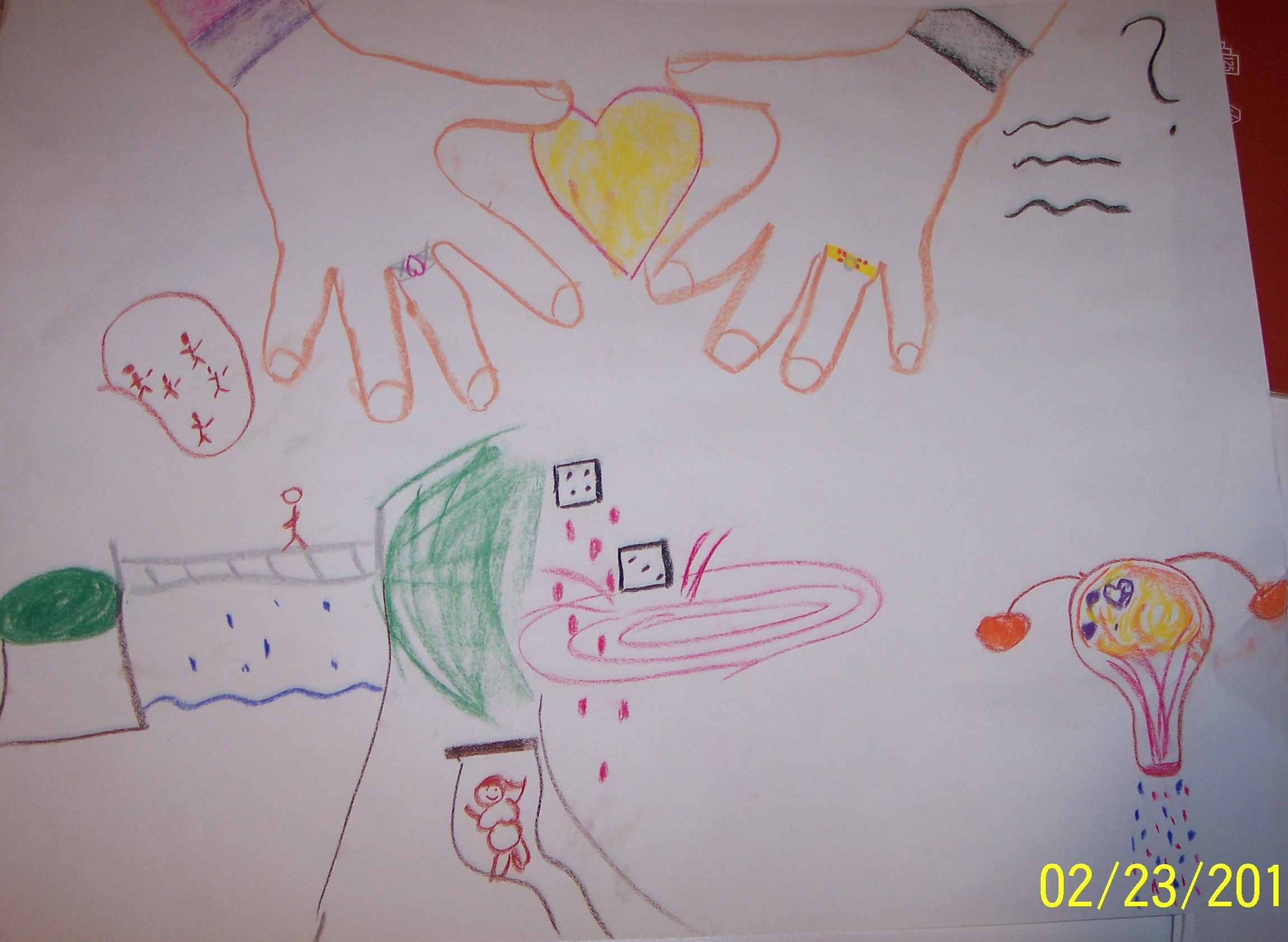
I was taking an online class in how to lead Birth Art sessions when I experienced my second miscarriage and I decided to create some birth art about miscarriage. This was my drawing:

miscarriagedrawing

Birth Art is about “process,” not product, so it is not supposed to be beautiful or even interpretable. The dice refer to our feeling of “tossing the dice” one more time—the numbers 3 and 4 show on the dice—and having those tosses end in blood. The question mark is self-explanatory with the squiggles representing all my reading and efforts to understand. The night I realized that I definitely going to have another m/c, I lay in bed and kept picturing a bridge that I was going to have to cross alone—-leaving behind the safe and familiar. A song kept running through my head, “keep walking in the light….keep following the path…” So, the little figure walking across the bridge is that. Tears are running down below her. The little bubble with other stick figures in it is the women who have gone before me—who are close to me, but I still have to cross alone. The happy pregnant woman behind me represents the “other side”—the one I can’t go back to. The naïvety. The certainty that a positive pregnancy test will result in a baby nine months later. She is all the other women who haven’t “been there” and I am forever separated from her by a wall (the thick line above her head). Or, she is the former me—falling down, down, down and away. The the right is my uterus, weeping both tears and blood. The ovaries and inside the uterus glow with energy. There are some purple dots inside to represent each of my babies—the largest one is actually a little “baby in my heart” image, like my pendant. It is larger because of my feeling post-Noah that I would always be a “little bit pregnant with him.”

So, there it is. My second miscarriage story in all its confusion, sadness, and nearly crippling despair. Thanks for listening.

The Amethyst Network: Fundraising Campaign & Day of Hope

We have big plans for The Amethyst Network to serve families impacted by miscarriage across the country. To help achieve our goals, we’ve launched a Indiegogo fundraising campaign (featuring some great perks for donors, such as a print from The Mandala Journey!). Check it out and make a contribution! The Amethyst Network logo

As one of the members of the TAN board explains:

We got off to a slow start. For our own reasons, it didn’t take off as we had envisioned. We kept in touch but we were all quite overwhelmed with other things. Then this fall we had a renewed energy. I know for my part, the time felt right again. There was a drive coming from somewhere else to revive and renew the Amethyst Network. We refocused our energy. We refined our goals. And with new energy, the Amethyst Network is moving forward in amazing ways.

We hope that this will become a place of support, of hope, and of healing for women experiencing miscarriage and pregnancy loss. We hope that this will become a place for people to share their stories of miscarriage and pregnancy loss. We hope you will find solace and support here.

And that is the story of the Amethyst Network.

Another new project is our upcoming Day of Hope and Healing on February 25. Amethyst is the February birthstone—several members of the board, including me, have miscarriage anniversaries in February and the inspiration for TAN’s name also came from Amethyst, the still-missed baby sister of one of the founding members–so February feels like the perfect time to host a special event. Here is an explanation of the day:

Although we do participate in and support the wave of light on October 15, and the other infant loss awareness and remembrance days in October, we wanted to have a day of our own to focus on living in the present and looking forward, in addition to the days for looking back.

February 25 is Amethyst’s birthday, and so we felt like this was the perfect day to choose for our Day of Hope and Healing.

Many of us are familiar with the stages of grief, but we feel that grieving is one of the stages of healing. In other words, whether you are in the depth of fresh grief, or whether it has been years since your loss, we invite you to join us on this day to acknowledge the journey that we all are on.

Since everyone is in a different part of their journey, we are not asking everyone to do the same thing. Instead we invite you to participate in whatever way meets your needs at this time. Here are a few suggestions that we thought of, and please visit our pinterest page for some visual inspiration. We welcome additional ideas.

Plant flowers or a tree
Light a candle
Make a luminary
Make prayer flags
Buy a piece of jewelry or art that reminds you of your little one
Make a cake to celebrate or remember your little ones birth, loss, or memory
Read stories of other Amethyst Babies, or of Garnet Babies
Submit your story of loss or hope to TAN to be shared with the stories there
Submit your little one’s name to the Forget Me Not Garden at TAN
Write a letter to your little one, and then burn it and let the smoke carry it to him or her
Make a donation to TAN in memory of your little one
Blog about your little one, TAN, or the Day of Hope and Healing
Call a radio show and dedicate a song to your little one
Begin the process of becoming a TAN loss doula so that you can help others