Archives

Strong Women

“The vulva is at its most beautiful when transformed by a crowning baby who slides out into her mother’s hands. Women are strong. Women are powerful. Women were made to birth their babies—in their own time, in their own way and with their own innate wisdom. The natural birth community is full of the strongest, most fearless women on the planet—women supporting women.”
–Care Messer (in Midwifery Today, Spring 2012)

20120526-193012.jpg

My 6-year-old son took this picture of part of one of my textbook’s covers as I was typing this post and I thought it seems oddly suited to it!

Is there really even such a thing as second stage?

Is there a second stage in labor? Who says so? Who thought it up and why? How did they decide what it would be and when it would start? How it would be measured? When it would end? Is there really even such a thing as second stage? If there isn’t, might it not be important for midwives to know that? Is the Earth really flat? Well, it is in some places. Mothers that lie, sit, walk, stand, crawl, glide, stride, squat, climb stairs or hills, dance, sway, cry, throw up, chant or create positions and sounds never heard or seen before are moving their baby from the inside of them to the outside of them. That’s labor. It doesn’t have stages. One thing melts and overlaps another. It starts slowly and gets bigger. It changes a mother’s breathing from light to deep. Her sounds change as her body and baby mould and mimic each other on the journey from inside to outside. By the time the baby is low so is the mother, her breathing and her sounds and her body. –Sister MorningStar in “Midwifing Second Stage” in Midwifery Today, 98, Summer 2011

After having written recently about the rest and be thankful stage and the spontaneous birth reflex and then finally about the
birth pause, the above quote caught my eye in an issue of Midwifery Today from last year (I’m trying to catch up with my stack of magazines/journals). I explain to my birth class clients that birth looks different from the outside than it feels on the inside. Perhaps from the outside we can identify stages and phases of labor. From the inside, we are just doing it and the stages and phases meld into one continuous experiencing.

I love the final comment in this quote especially–we don’t really need tips, tricks, and vaginal checks to tell us where baby is positioned. When mother gets “low” baby likely is too! This reminds me of another article I read in MT recently. (I didn’t save the actual quote, just going from memory.) It was about a traditional midwife who was asked, “aren’t you going to check her?” when a mother felt like pushing. The midwife put the tip of a finger in and the other people laughed at her—“that isn’t checking her!” She said that all you needed to do was feel for the baby’s head—it the finger only goes in a tip, that means baby is close, if it goes in up to the knuckle, baby is pretty close, if you can’t reach the head, baby will be a while. Why would you need to try to reach the cervix or know what it is doing?

I love Sister MorningStar’s writing. It is so beautiful and expressive. Some time ago, I reviewed her book The Power of Women and I highly recommend it.

If birth were a temple

20120408-133552.jpg

If birth were a temple


If birth were a temple
my body is religion, and this small form
twisting out of me,
is
prayer
my cries
reach birth’s vaulted
ceilings,
arching like my back over holy
waters,
crystal clear salt of amniotic
my womb–a blessing bowl
releases
her treasure.

–Nane Ariadne Jordan

I came across this beautiful poem in an anthology of prayers and readings called Talking to Goddess, edited by D’vorah Grenn.

Woman Rising

No time for a long post today (or, probably, this week), so I share this quote I had saved from the book A Dozen Invisible Pieces by Kimmelin Hull (p. 229):

When faced with behavior battles, health concerns, family finances, and the struggle to stretch time to the fullest, I could choose to sink into the quicksand of life with young children–becoming engulfed in the daily grind, unaware of my own loss of self–or I could rise to the occasion. And I am rising.

Hull goes on to share the following:

Whether it be the thick memory of enduring a non-medicated labor and finally pushing our third child into the world, despite feeling as though I hadn’t an ounce of energy left, or the meager sprint I managed as I neared the finish line of the marathon…, I hold tight to these images as proof that I can and will be able to rise to the occasion–again and again, if and when I need to-because the ability to do so is in my very bones. Because I am a woman.” [emphasis mine]

The birth face, immediately following birth of second son. This feeling--this crying, laughing, euphoric, I DID IT, feeling is the one I draw upon in the rest of life.

This is one of things I find so powerful about women’s birth memories—they can hold onto them as a touchstone, as an affirmation of strength and personal capacity, during other challenging (or mundane) moments of their lives. I also don’t think births have to be “empowering,” natural, or unmedicated births in order to hold this affirmation for women. There is a lot of courage to be found in most birth journeys and the ability to find moments of powerfully conscious strength to draw nourishment from in the rest of life exists in many types of birth experiences. Personally, my birth experiences created a lasting sense of personal worth, that I have drawn from ever since. This includes the birth of Noah, which was not a “happy ending” to my pregnancy. In the months after his birth, I found myself at many times thinking, “I gave birth to my little, nonliving baby alone in my bathroom, I can do this too.” I did the same with the births of my other two boys—only thankfully without the “nonliving” part. Alaina’s birth is more “integrated” somehow, and I don’t find myself thinking about it or referring to it in quite the same way, though I’ve definitely had moments of remembering, “I caught my own baby, I can do this too!

An Act of Motherhood

Some time ago I read a clever essay by Jeannie Babb Taylor called “May, 2052.” It is about birth in the future and is told from the perspective of a grandmother who gave birth in 2007, sharing with her granddaughter how birth was “back in the day” and the granddaughter being shocked by how horrible the birth climate was in the “old days” of 2007). Side note: in some ways this story reminds me of a piece that I reprinted with permission of LLL called A Fantasy, which is a satire about birth and breastfeeding that I’m still not convinced won’t actually come to pass.

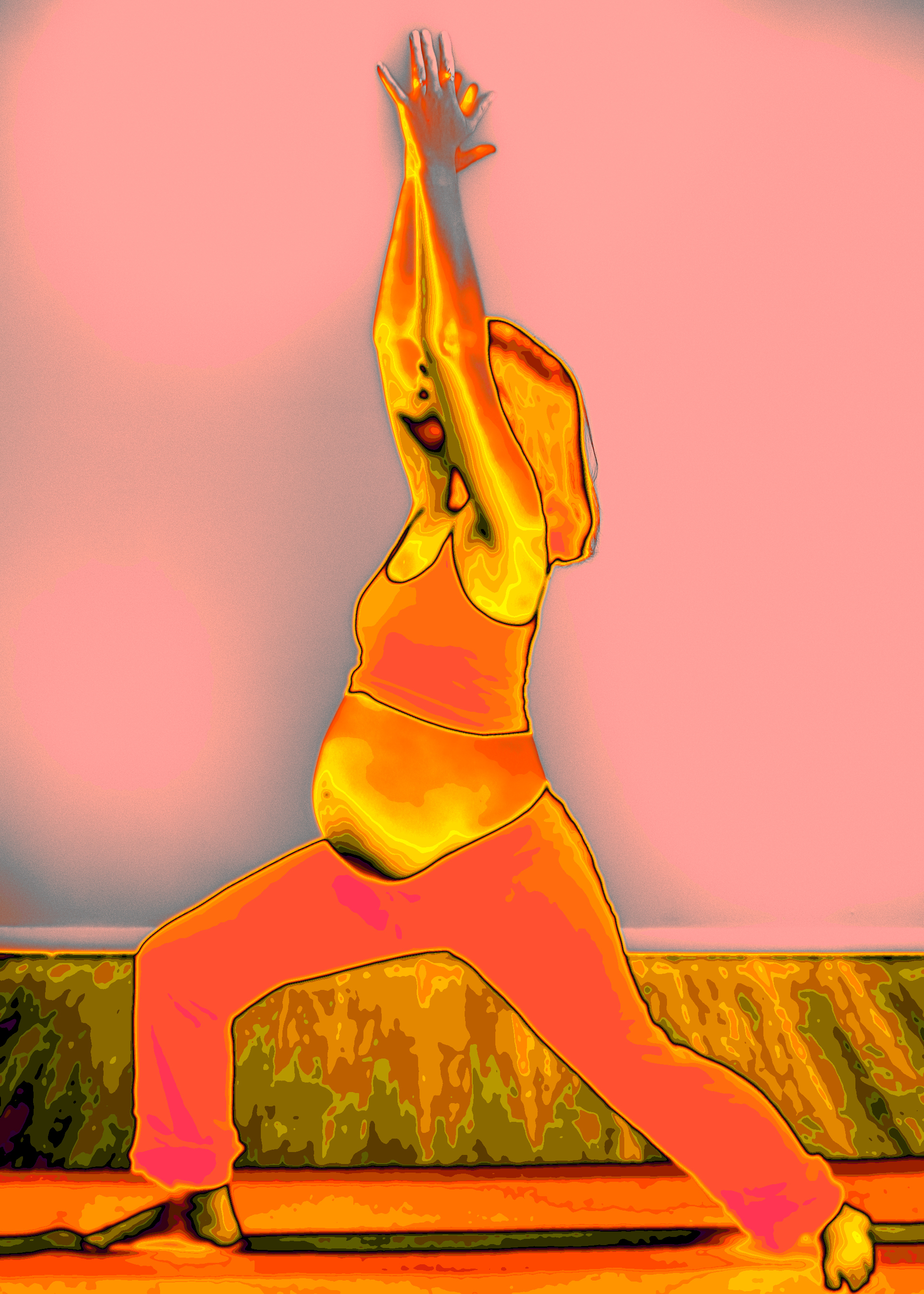
Feeling fierce at 37 weeks last year.

However, I was struck afresh by the power of the closing lines in May, 2052 (when discussing how/why things finally changed):

We insisted on dignity. We did not let doctors push us into inductions or surgeries just to accommodate their schedules. Women who still used hospitals refused the wheelchair and the gown that were presented at check-in. Women refused to be starved, or to have their veins punctured with unnecessary IVs. Mothers refused to let doctors break their waters or insert electronic monitors in the baby’s scalp. When we pushed our babies into the world with our own fierce power, then we refused to let them out of our sight.

…Eventually even the medical community came to recognize that birth is an act of motherhood, not an act of medical science. Today a laboring woman is not regarded as a body on a table, as if she and the baby needed some doctor to ‘deliver’ them from each other. Today women are honored as life-bringers.

Don’t you just love that? Recognizing that birth is an an act of motherhood, not an act of medical science… So true.

I can’t write about it in-depth, but I began thinking about this today after speaking with a mother who had received very, very questionable (to the point of thoroughly bizarre) breastfeeding advice from her doctor. When I could not help but express my dismay at the suggestions she had received, I had the distinct feeling that she was not able to even consider that possibility that her doctor might have been wrong. I wish I could write about the actual circumstance because it just boggled my mind and made my heart cringe. Breastfeeding too is an act of motherhood, not an act of medical science, and not one that “belongs” to anyone except for the motherbaby unit.

However, returning to the act of motherhood, vs. medical act, I also have this quote saved from the older book, Who Made the Lamb:

“Tom [her husband] laughed at this idealism. ‘You don’t understand,’ he said, ‘Pregnancy is not regarded as a process of creation. It’s a disease of the uterus.'” [emphasis mine]

What a (culturally) still true and unfortunate sentiment: A disease of the uterus. This is absolutely how many within the medical system and the general population continue to view pregnancy (and birth is the excavation of the disease). This reminds me of our “friendly” neighborhood doctor testifying at the Capitol against the midwifery bill several years ago stating that pregnancy can be viewed as a foreign object in the body and therefore “babies are like tumors that need to be removed.”

I look forward to the day when our acts of motherhood are celebrated and valued, the motherbaby bond is accepted as inviolable, and pregnancy is a state of health and well-being.*

—-

Note: I am aware that pregnancy and birth take a physical toll on most women and that for some pregnant women, “disease of the uterus” might feel like an apt descriptor—I’m speaking in more general terms of the emotional and cultural climate surrounding pregnancy and birth.

Birth Quotes of the Week

Quotes that recently caught my eye…

Your own wisdom is more powerful than anything you see around you. The price for living your dream is facing your deepest fear; ask yourself ‘What am I afraid of most?’ Facing your answer is the price of greatness.“–@Roots of She

“In acknowledging woman-to-woman help it is important to recognize that power, within the family and elsewhere, can be used vindictively, and that it is not only powerful men who abuse women; women with power may also abuse other women.” –Sheila Kitzinger

A woman who is enjoying her labor swings into the rhythm of contractions as if birth-giving were a powerful dance, her uterus creating the beat. She watches for it, concentrates on it, like an orchestra following its conductor.” –Shelia Kitzinger

“If you have never been called a defiant, incorrigible, impossible woman… have faith. There is yet time.” –Clarissa Pinkola Estes (via @Roots of She)

Pregnancy is a uniquely intimate relationship between two people. All of us luxuriate in this relationship once, and half of us are lucky enough to be able to do it all over again a second time, from the other side as it were. Never again outside of pregnancy can we be so truly intwined with someone else, no matter how hard we try.” -David Bainbridge

“We must not, in trying to think about how we can make a big difference, ignore the small daily differences we can make which, over time, add up to big differences that we often cannot foresee.” –Marian Wright Edelman

Reading this last quote made me remember my Small Stone Birth Activism article and so I posted it yesterday!

Motherhood, Feminism, and More

When a woman tells the truth she is creating the possibility for more truth around her.

– Adrienne Rich (May 16, 1929 – March 27, 2012)

Some time ago Molly at First the Egg did a series of posts about the book Of Woman Born. This book is an excellent feminist classic that at the time during which I read it helped to clarify for me that it is the “institutional” elements of motherhood that I sometimes find so oppressive and binding—it isn’t the children themselves, in the climate of motherhood in which I find myself.

Several years ago I also read Fruitful, by Anne Roiphe. The subtitle is Living the Contradictions : A Memoir of Modern Motherhood. Like Of Woman Born, it was written before the more recent wave of “momoirs” (that is a kind of dismissive term, but it does help me classify the genre) and focuses heavily on feminism and its relationship to mothers/motherhood (so, different from momoirs in that the focus is less on personal experience of motherhood and more on motherhood and its social/cultural/political connections, I suppose). Fruitful is less “heavy” and depressing than Of Woman Born. The focus of the book is on the tension between feminism and motherhood (i.e. can you be a “good” feminist and also be a “good” mother) and she explores that issue throughout. Roiphe is a feminist and yet critiques some elements of the movement’s impact on mothers and motherhood. She is also very pro-father and I appreciated her exploration of men/fathers as people vs. “evil patriarchy—down with them!”

This is a quote about the crux of the mother/feminist issue: “Motherhood by definition requires tending of the other, a sacrifice of self-wishes for the needs of a helpless, hapless human being, and feminism by definition insists on attention being paid to the self. The basic contradiction is not simply the nasty work of a sexist society. It is the lay of the land, the mother of all paradoxes, the irony we cannot bend with mere wishing or might of will.

This reminds me of my journal entry from my early months as a new mother—“is it possible to balance motherhood with person-hood?” I’m still figuring it out! (some days it seems to work, some days it really doesn’t!)

During the time in which I read Fruitful, I also read The Mommy Wars. I almost didn’t read it because I was worried that it would be excessively harsh or inflammatory and I don’t need to bring things like that into my life. However, it seemed truly supportive of women/mothers. It was a collection of essays by various authors (alternating between those who have chosen to be mostly at home and those who have chosen to be mostly pursuing careers) and it quickly became clear that the most real “mommy war” that most of us experience is the one inside of our own heads. There seems to be no ideal/perfect solution. I also noticed that many of the women (including the editor of the collection) had cobbled together some sort of “balance” between working-outside-of-the-home and working inside it–there were lots of part-timers, lots of WAHMs, lots of writer-in-the-spare-minutes, etc. Since I’ve done the same, I particularly identified with those tales of struggle to discover the right balance for your family.

The first quote I wanted to share from this book is with regard to being asked “what do you do?” at a cocktail party: “I find it odd that I’d generate far more interest if I said I raised dogs or horse or chinchillas, but saying, in effect, ‘I raise human beings’ is a huge yawn...It might, in fact, be boring if child care were simply a series of pink-collar tasks–bathe, dress, feed, repeat. But observing and participating in a little Homo Sapien’s development is fascinating to me. Furthermore, being a mother isn’t just a ‘job’ any more than being a wife or a daughter; it’s a relationship.” [emphasis mine and in total agreement with this]

Then in another writer’s essay (the above was from one of the SAHM, the below is from one of the WOHM) came this interesting observation:

I remember reading once that all manner of selfishness is excused under the banner of focusing on one’s family, and it strikes me now as penetratingly true. How many of us don’t do for others because we’re supposedly saving it for our families? and how valuable is staying at home if you’re not teaching your children how much other people (and their feelings) matter?

In another book I have, The Paradox of Natural Mothering, she refers to the “family first” mentality as a type of narcissism and I do see the point.

I also wanted to share some quotes from an essay by a woman who does not yet have children, but is planning to, with regard to talking to mothers who shut down her opinions/thoughts with the, “what could you know? You don’t have children” brush-off. (Which, I personally, have definitely been guilty of thinking on more than one occasion! And, actually did so while reading this essay!):

I want to be able to say that all the judgment and aggression and competitiveness I witness among working and stay-at-home mothers surprises me and absolutely must change. But that wouldn’t be honest. I’ve been party to this one-upping and henpecking and know-it-all-ness my entire life. It’s as if becoming a mother puts us back into a sorority or junior high school, into some petri dish of experience where what other females think and say and feel and do counts more than anything.

The one thing my stay-at-home and working-mom friends share in the country of motherhood is a superiority gene, some may call it a gift of vision, that convinces them that women who don’t have children are, despite their educations and accomplishments, dumb as doorknobs. I’ve sat through many a heated conversation…during which I’ve been silly enough to offer an opinion only to be shut down more condescendingly and viciously by wise Goddess Mothers than I ever have been shut down by any man.

FWIW, I would not call this a “superiority gene” or “gift of vision,” but a “voice of experience”…I think most of us have been in the position of ourselves being the “just doesn’t get it” woman without kids! And, after you have kids of your own, you suddenly realize why “those mothers” were condescending to you.

On a somewhat related subject, I also enjoyed this post by Dreaming Aloud about the silencing of mama anger.

Motherful

“…browsing through a dictionary one evening, I came across a medieval word that has fallen out of usage. It is ‘motherful.’ It would be good to have this word back. We could use it as we use ‘wonderful’ or ‘beautiful,’ to describe something that startles us with its wonder or beauty. A mother might look impressively efficient as she turns up for her work. But when she is together with her child again, we may marvel at the change in her as she relaxes into being motherful.

It may be a challenge to struggle through transitional discomforts as we ripen into mothers. But the better we can understand ourselves, the more we shall be able to support one another–in being motherful to our children.” –Naomi Stadlen (“Learning to be Motherful,” in New Beginnings magazine, issue 2, 2009)

Stadlen’s book, What Mothers Do, is one of my top recommendations for new mothers. One of my favorite things about it is how she explores how culturally we lack an appropriate vocabulary of motherhood and ascribe more value to the other tasks of “getting things done” while simultaneously taking care of children than the multitude of subtle behaviors and actions that make up the nearly invisible act of mothering. She uses an example of a mother trying to brush her teeth and being interrupted by the baby–we see the toothbrush left behind and think that the mother is getting “nothing done,” while in reality, she is mothering at that moment.

Look at that motherful sight! 🙂

I’ve found it helpful to re-read this book with each baby, because I am so likely to fall into the “getting nothing done” mental trap. Stadlen does an amazing job making the point that when we have to stop “getting things done” to look after our babies we ARE still doing something, we are MOTHERING and that truly still is getting “something done.” While I still thing things like that, the reframing really, really helped me. We do lack a vocabulary in our culture to describe what mothering is–we see someone shopping with two kids in the store and we only count the shopping as “getting something done,” the mothering acts the mother performs as she navigates the store while caring for her children are invisible (both to the observer and often to the mother herself).

The word motherful reminds me of Dr. Bradley’s great word, “motherlike”–as in, giving birth may not be ladylike, but it sure is motherlike. I’d like to see both words in common usage.

I think I’ve found my topic for my next LLL meeting!

Midwifery & Feminism

“Midwifery work is feminist work. That is to say, midwives recognize that women’s health care has been subordinated to men’s care by a historically male, physician-dominated medical industry. Midwifery values woman-centered care and puts mothers’ needs first. Though not all midwives embrace the word feminism (the term admittedly carries some baggage), I maintain that providing midwifery care is an expression of feminism’s core values (that women are people who have intrinsic rights).
–Jon Lasser, in Diversity & Social Justice in Maternity Care as an Ethical Concern, Midwifery Today, issue 100, Winter 2011/2012

I tend to define feminism as believing in the inherent worth and value of women and acting on that belief. I see birth care as a crucial, basic feminist issue and midwifery and most types of birth activism as feminist work. While, as Lasser notes above, not all midwives embrace the term, in my personal experience some of the most beautiful, loving words and actions about the value and worth of women are exhibited by midwives.

Birth Quotes of the Month

As always, while these quotes are obviously not my own words, I do appreciate a link back to my site if you re-post them because I have a significant amount of legwork invested in finding and typing the quotes. Most are not recycled from other pages (I give credit if they are), but are typed up when they catch my eye in the books/magazines/journals I’m reading.

“The first few months after a baby comes can be a lot like floating in a jar of honey—very sweet and golden, but very sticky too.” –American College of Nurse-Midwives

“Your children love you. Be the trampoline for their rocketing and the cupped palms for their returning.” –Shae Savoy (in We’Moon 2011 datebook)

“There is nobody, out the other side of that sort of strong birth, who is not better prepared to meet the absolutely remarkable challenges of parenthood. When the power and trust is transferred to the mother, when she delivers her child, rather than ‘is delivered’ when she chooses, rather than ‘is allowed’, no matter what sort of technical birth she has, she is stronger, fiercer, and better. After a trip like that, you would kill for that child, and you know you can.” —The Yarn Harlot

Why do birth work? “I do it, because nothing else… nothing else, compares to watching a woman move mountains with her own self, to watching her rise to a challenge and meet the moment with all she has, and that experience is only enhanced when she is supported by those who care for her, respect her, and want her to be empowered by the journey.” –The Yarn Harlot

“We must act to keep the knowledge and the powers of women alive.” – Lynn Andrews
“Birth Freedom is inevitable. The natural progression is for people to move from tyranny to liberty. The agents of the status quo, however, rarely yield power without a fight.” –Senator John Loudon (ret.) in Midwifery Today e-news

“If I didn’t define myself for myself, I would be crunched into other people’s fantasies for me and eaten alive.” – Audre Lorde

“We have barely tapped the power that is ours. We are more than we know.” –Charlene Spretnak

“Woman is a glorious possibility; the future of the world is hers.” – Matilda Gage

“In everyone’s life, at some time, our inner fire goes out. It is then burst into flame by an encounter with another human being. We should all be thankful for those people who rekindle the inner spirit.” ~Albert Schweitzer

“There is a sacredness in tears. They are messengers of overwhelming grief…and unspeakable love.” –Washington Irving

“Don’t you dare, for one more second, surround yourself with people who are not aware of the greatness that you are.” (Roots of She by Amanda Oaks, via @ROAR! Empowering Women to Give Voice to Their Truth)

“We all start out knowing magic. We are born with whirlwinds, forest fires, and comets inside us. We are born able to sing to birds and read the clouds and see our destiny in grains of sand. But then we get the magic educated right out of our souls.” -Robert R. McGammon

“It’s hard to describe if you’ve never been there, but to watch a woman access her full power as a woman to give birth is awe-inspiring, and I never get tired of being witness to it. It’s an honor to watch that transformation take place.” ~ Julie Bates, CNM

“The emerging woman..will be strong-minded, strong-hearted, strong-souled, and strong-bodied…strength and beauty must go together.” ~Louisa May Alcott

“We must relearn to trust the feminine, to trust women and their bodies as authoritative regarding the children they carry and the way they must birth them.” –Elizabeth Davis, CPM

“The women in labor must have NO STRESS placed upon her. She must be free to move about, walk, rock, go to the bathroom by herself, lie on her side or back, squat or kneel, or anything she finds comfortable, without fear of being scolded or embarrassed. Nor is there any need for her to be either ‘quiet’ or ‘good.’ What is a ‘good’ patient? One who does whatever she is told—who masks all the stresses she is feeling? Why can she not cry, or laugh, or complain?” –Grantly Dick Read, Childbirth without Fear

“The purpose of life is not to maintain personal comfort; it’s to grow the soul.” –Christina Baldwin

“Everyone who interacts with a pregnant woman is, in some way, her ‘teacher.’ Telling birth stories, sharing resources, imparting obstetrical information, giving advice or warnings—these are all direct or indirect ways of teaching about birth and parenting. Whether you currently identify yourself as a ‘childbirth teacher,’ or you are a midwife, doctor, doula, yoga teacher, nurse, therapist, breastfeeding counselor, or you are simply a woman or man who cares about the power of the childbearing year, you already hold the power of mentoring within you.” –Pam England

“The purpose of our lives is to give birth to the best which is within us.” –Marianne Williamson

“There is no single formula for motherhood and writing that suits us all. Instead, there are many paths on this literary journey, all leading to the same destination, each equally valuable.” – Elif Shafak

“Remember our heritage is our power; we can know ourselves and our capacities by seeing that other women have been strong.” – Judy Chicago

“Scientific medicine has never been shy to dismiss if not denigrate any perceived threat to its values or power.” –from the book Breakthrough: How the 10 Greatest Discoveries in Medicine Saved Millions and Saved the World

“Midwives often forget that our beliefs in [mom’s] abilities can alter her accomplishments. It is important to check our hearts and push through any lack of belief that may inhibit her strengths. This may sound silly or ethereal, but I guarantee it can make a difference for a laboring mom and family.” ~ Carol Gautschi (Midwifery Today)

“Hormones have a kind of crazy rhythm that you can trust. Behind them is internal intelligence; try listening instead of controlling. When hormones are ‘raging,’ they exaggerate what’s already going on internally as a signal for us to pay attention and learn from it.” –Camille Maurine (Meditation Secrets for Women)

“Since the release of adrenaline is highly contagious, the main preoccupation of an authentic midwife, after the paradigm shift, will be to maintain her own level of adrenaline as low as possible when she is close to a labouring woman. Midwives of the future will also need to train themselves to remain silent, since language is the most powerful stimulant of the neocortex. The silent knitting session will be a necessary step towards an understanding of what authentic midwifery is. We present it as the symbol of a vital new phase in the history of childbirth and midwifery.” –Michel Odent (in Midwifery Today)

“Sons branch out, but one woman leads to another.” –Margaret Atwood (quoted in Sacred Circles)

“We can no longer sit back and debate whether maternity care is evidence-based. We have seen that over and over again, in most cases, it is not…” –Connie Livingston

“If the first woman God ever made was strong enough to turn the world upside down all alone, together women ought to be able to turn it rightside up again.” –Sojourner Truth

“The intrinsic intelligence of women’s bodies can be sabotaged when they’re put into clinical settings, surrounded by strangers, and attached to machines that limit their freedom to move. They then risk falling victim to the powerful forces of fear, loneliness, doubt , and distrust, all of which increase pain. Their hopes for a normal birth disappear as quickly as the fluid in an IV bottle.” ~Peggy Vincent

“The problem is not that obstetricians are surgeons. They are. The problem is that society has invested surgeons with control over normal childbirth.” –Michael Klein, MD (in The Journal of Perinatal Education)

“Perhaps the greatest gift that women can give their daughters is to take precious care of their own lives—to develop their natural talents and to honor the opportunities that come their way. By so doing, they become vital models for their children as well as full women in their own right.” ~ Evelyn Bassoff

“When one woman puts her experiences into words, another woman who has kept silent, afraid of what others will think, can find validation. And when the second woman says aloud, ‘yes, that was my experience too,’ the first woman loses some of her fear.” –Carol Christ

“Befriend fear, embrace struggle, trust nature, the process, and a baby’s wisdom.” –WYSH (Wear Your Spirit for Humanity see also https://talkbirth.wordpress.com/2011/05/25/birth-altar-wisdom/)

“Thousands of women today have had their babies born under modern humanitarian conditions–they are the first to disclaim any knowledge of the beauties of childbirth…” –Grantly Dick Read, Childbirth without Fear

“I am not free while any woman is unfree, even when her shackles are very different from my own.” –Audre Lorde

“Not only do I trust my body, I am in awe of all it can do. I don’t know if I will ever be able to accomplish anything as marvelous as birthing and nursing two babies. That is more amazing to me than running a marathon or climbing a mountain. I have created and nurtured life; nothing tops that. ” ~ Corbin Lewars (via Midwifery Today)

“Humanizing birth means understanding that the woman giving birth is a human being, not a machine and not just a container for making babies. Showing women—half of all people—that they are inferior and inadequate by taking away their power to give birth is a tragedy for all society.” –Marsden Wagner

“I am sure that if the mothers of various nations could meet, there would be no more wars.” – E. M. Forster

“The strength that is displayed in labor and birth is something that no one can EVER take from you in your life. Elixir of courage.” –Desirre Andrews