Archives

DVD Review: Dance of the Womb

DVD Review: Dance of the Womb: Belly Dance for Pregnancy and Birth
By Maha Al Musa, 2009
Red Polar Pictures
164 minute DVD, $49.95 (AUS)
http://www.bellydanceforbirth.com

Maha Al Musa has created a remarkable treasure for the birth world—an easy-to-follow, beautifully presented, step-by-step instructional bellydancing DVD called Dance of the Womb. Maha’s interest in Middle Eastern Dance was sparked by her Palestinian/Lebanese roots and she brings a lot of love and authenticity to her presentation of the dance techniques. Maha has also published a gorgeous companion book, Dance of the Womb (see previous review).

Dance of the Womb contains a 45-minute dance stretch warm-up. The exercises are comprehensive, gentle, and easy to follow. There are also six instructional dance technique chapters that cover specific beginning bellydance movements.

One of the special treats of this DVD is the included 50 minute video about Maha’s own homebirth journey with her third child (at age 46!). It also contains interviews with several homebirth midwives. The still photographs and birth footage are beautiful and brought a tear to my eye several times! Another bonus feature is a seven minute guided relaxation exercise.

Dance of the Womb is a great introduction to the basic physical elements of prenatal belly dance and also to some the spiritual and rhythmic aspects of giving birth. The DVD is a gentle and nurturing experience for both pregnant women and the women who serve them.


Disclosure: I received a complimentary copy of this DVD for review purposes.
Review: Moby Wrap

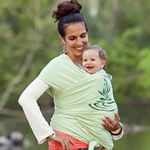
Several months ago, I was sent a sample Moby Wrap. I was absolutely delighted to receive the Moby, because amongst my friends and LLL Group members, a Moby Wrap is hands-down the number one pick for babywearing with an infant. I have a variety of slings and other baby carriers available in my demonstration bag to show parents during the final week of classes, but I did not have a wrap-style carrier (though I was always sure to mention that parents rave about wrap carriers!). I’m so pleased to actually have one available for parents to practice with.

The Moby Wrap is very versatile and can be used in a variety of positions from birth until over two years old. The fabric is soft and nice and hugs the baby closely and securely into your body. The knit of the fabric is also lightweight enough that you do not get roasting hot while wearing the carrier. A Moby Wrap is a long piece of breathable cotton fabric that is “wrapped around the wearer to create a safe, custom-fitted and versatile baby carrier.” Another benefit is that it can be used for “kangaroo care” with premature babies or any baby needing special care.

Babies that are “worn” cry much less frequently and parents can be hands-free to go about daily tasks while still being in close contact with their babies. When my first son was a baby, I was only half-joking when I would say that I would not be able to live without my baby carrier. With my second baby, I greatly appreciated being able to grocery shop while comfortably nursing him and still having both hands available to push the cart!

Recent negative press about slings has made me all the more determined to share the benefits and joys of babywearing with parents in my birth classes. (Reports about sling dangers are referring to a specific type of “bag” type sling [see more here], not to carriers like the Moby Wrap.)  I am currently working with very young parents for a series of prenatal classes and I am eager to introduce them to babywearing and to show them how a Moby Wrap can help them bond with their baby!

New Post…

I spent quite some time writing a new post yesterday and then it disappeared without a trace! I like to make a post here at least once a week, so I’m going to have to just link to the other post I wrote yesterday as part of the Women’s History Month blog carnival from Birth Activist. Birth Activist was the very first birth blog I ever started reading and the blog that sparked my own interest in blogging (a couple of years later).

In addition to teaching the Young Parents classes, which is a new venture for me, I also start teaching my second college class next week. This one is at a college branch about an hour from me, so I’m going to be doing a lot of driving in addition to all the preparation work. I think blogging is going to have to slip down my list of priorities for a while and so I may not be making new posts for a little while—I hope my readers don’t abandon me! Have no fear, I’ve managed to work birth activism into my class in a very appropriate way—I’m going to show them the Reducing Infant Mortality film and possibily The Doula Story as well, during my section of the class on teen pregnancy.

Resource Rack

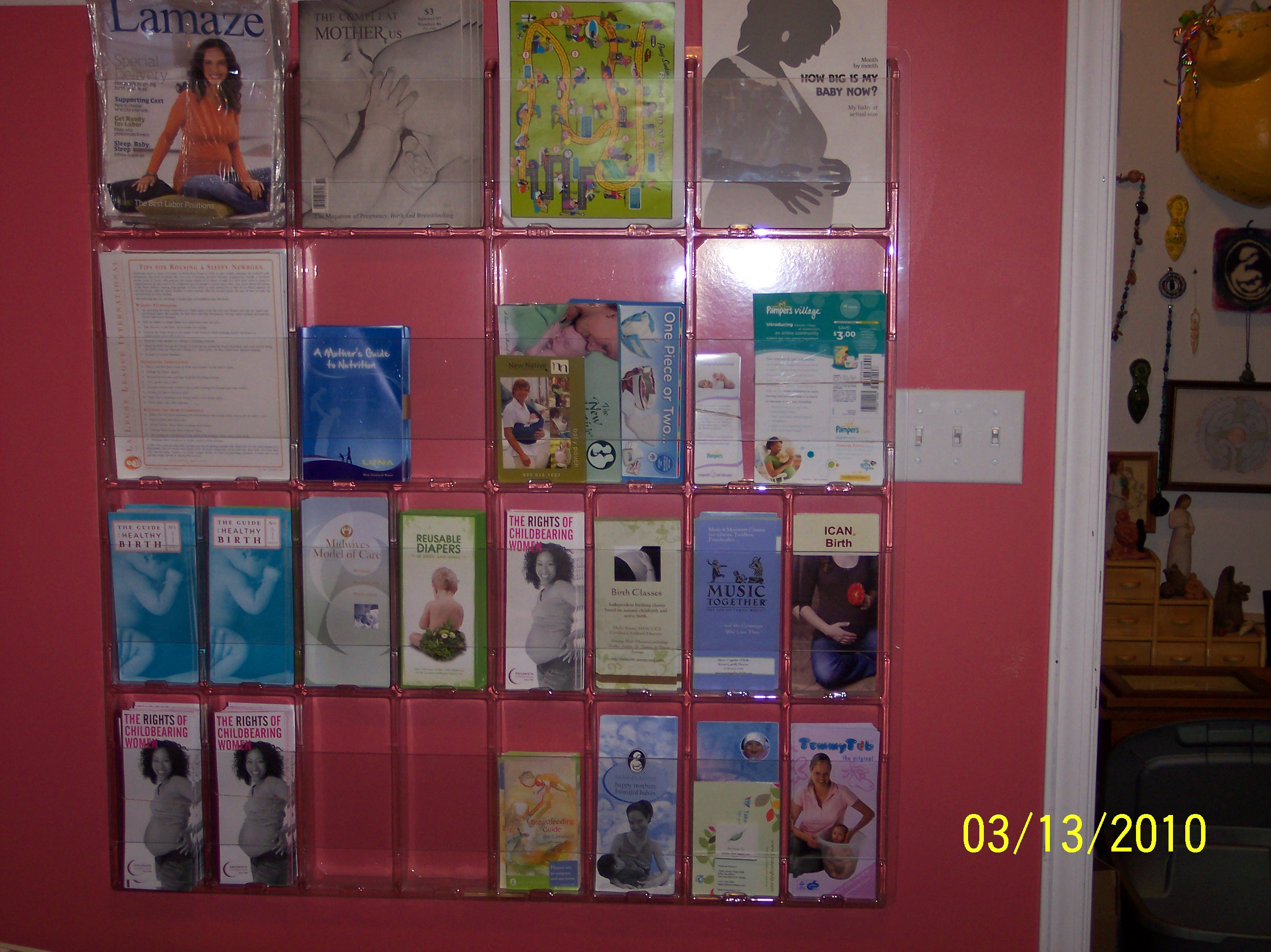
I was pleased as can be when my husband brought home a plastic brochure rack that was getting thrown away at work. As a semi-compulsive gatherer and sharer of information, I have boxes of pamphlets, magazines, brochures, etc. that I put together in packets for my birth class clients. How much more efficient and attractive to organize them this way! I took a picture of it because I’m so happy.

Young Parents Program Prenatal Classes

I am getting ready to teach a series of classes for a local Young Parents program. I have had to rework my class outlines a bit to meet some of the program’s requirements/needs. I decided to upload some of the activities here in case they may help someone else avoid reinventing the wheel by typing up their own similar activities.

Birth BINGO–this is a Bingo card with birth terminology. You can enter the terms into one of a variety of bingo card makers online in order to randomize the cards so that they are not all in the same order (which would then make everyone always win together).

Bingo Definitions–this is the list of definitions that goes with the card above. You can cut them apart and draw terms at random to read aloud. Participants yell out the answer and get to put a candy (Smarties, M & M’s, that sort of thing) onto the appropriate square on their card.

Labor Rehearsal–this is a labor walk-through. It is a little more conventional/conservative than I really like. In most of my classes I like to use the Labor Stations from the Transition to Parenthood site. I print them out as cards, not full pages, and hand them over to the parents to practice. The cards walk them through a whole labor early labor through pushing and it is a god opportunity to review and integrate everything they’ve learned and experimented with in class. I do not include the patterned breathing suggestions because I do not teach patterned breathing techniques. There are LOTS of good games and handouts for classes on this site. I really appreciate it!

Communicating with Baby Prenatally–I was specifically asked to include a component of this in this series of classes. This exercise is modified from one in the Nurturing Parents prenatal curriculum. It isn’t my favorite exercise, but I’m going to try it out. I also have another one from ICEA that I am going to use called Sensory Imaging: The Baby Inside You.

Book Review: Get Me Out

Book Review: Get Me Out: A History of Childbirth From the Garden of Eden to the Sperm Bank
By Randi Hutter Epstein, MD
W.W. Norton & Company, 2010
ISBN 978-0-393-06458-2
302 pages, hardback, $24.95
http://www.randihutterepstein.com/

Reviewed by Molly Remer, MSW, ICCE

Since it shares a subtitle about the history of childbirth, I expected the new book Get Me Out to be very similar in content to the recent book Birth Day by Mark Sloan or to the book Birth by Tina Cassidy. I wondered how much more could possibly be reported about the history of childbirth. It turns out there is plenty more and I was delighted to discover that Get Me Out stands alone as a unique and interesting contribution to books of this genre.

Written by a physician and mother of four, Get Me Out focuses on some very recent elements of birth history including assisted reproductive technologies (ART), ultrasound, and freebirth, subjects not addressed in the books referenced above. Aside from familiar content about things like the Chamberlen brothers and the Twilight Sleep movement, the remainder of the text was fresh and engaging. Part one included an interesting and disturbing chapter about Marion Sims and his research and experiments with fistula repair on enslaved women. A later chapter explores Sims’ research with artificial insemination (this time with middle class white women). In fact, the latter half of the book contains an extensive historical look at artificial insemination, moving into present day history including an exploration of sperm banking and cryo-preservation of eggs.

Unique among birth history books is Epstein’s chapter on freebirth (more commonly known as “unassisted childbirth”) followed with a chapter about ultrasound including content about 4D and “novelty” ultrasounds. There is also a chapter exploring DES and its effects on reproduction.

Also different than Birth Day and Birth, is the total absence of memoir or personal reflective content. Epstein is a medical journalist and Get Me Out is written in that voice. There is a light, personal tone to the text, but nothing personal aside from occasional descriptions, observations, or quotes from interviews with sperm bank mangers (for example). I found myself feeling a little curious about her personal history of childbirth, an element freely interspersed throughout the texts of other recent birth history books.

As the author says, “…the way we give birth is a story about our deepest desires and our fundamental concerns about life, death, and sex.” Get Me Out is a fascinating tale focusing on our collective, cultural story about birth in the late nineteenth and twentieth centuries, as well as dip into the story that continues being written today.


Disclosure: I received a complimentary copy of this book for review purposes.

Birthing Room Yoga Handout

In my classes, I teach a short little series of prenatal yoga poses called “Birthing Room Yoga.” I learned the series from the excellent video, Yoga for Your Pregnancy by Yoga Journal and Lamaze. My rationale for including the poses in all my classes is that while academic/intellectual information is useful (and is my personal learning style), birth happens in your body and not your head—-lots of us are uncomfortable with our bodies, so I try to get people to use their bodies a lot during classes. This helps women become comfortable with using their bodies, plus gets them out of their heads-space and into body-space, plus each exercise chosen has pregnancy or birth related benefits. Physical work is important for partners too—-birth is a physical event (both for the person helping and for the partner watching the pregnant woman work during labor).

I didn’t learn this series of poses until after my first two children were born. I was interested to see that I used all of the poses (or variations thereof—I also show a variety of variations during class) during my labor with my first son—even though I didn’t call it “yoga” or consciously “practice” during labor. I think that is a powerful reminder of the wisdom we carry in our bodies—as long as there is space and freedom in which to do so, this “birth yoga” arises spontaneously out of our own inherent wisdom, no training required!

Here is the Birthing Room Yoga handout I give with the pose reminders! The pelvic circles are particularly good and can be done seated on the edge of a hospital bed while having fetal monitoring.

Book Review: L’Mazeltov

L’Mazeltov: Your Personal Guide to Jewish Childbirth Education
By Pamela Nadav
L’Mazeltov, Inc. 2008
Softcover, 248 pages, $18.00
ISBN: 978-097786610-6
www.lmazeltov.org

Reviewed by Molly Remer, MSW, ICCE

The title of the new Jewish childbirth education book L’Mazeltov combines “two important Jewish symbolic expressions—L’Chaim (To Life) and Mazel Tov (Good Fortune).” The first half of the book consists of basic childbirth education and preparation. The second half is about “Jewish Life Cycle Education.” The strength of this book is the fusion of the two.

The childbirth education section was very conventional and conservative. I was surprised by some of the advice offered such as, “Always follow your doctor’s advice in all matters related to your pregnancy, labor and delivery” and in the section about anesthesia, “All of these modern technologies are designed to assist you in having the best possible birthing experience, and are considered to be relatively safe.” Personally, I feel like an important piece of childbirth education is encouraging pregnant couples to be informed birth consumers. There was no element of this perspective within L’Mazeltov.

The book includes some population-specific pregnancy information such as a short section on Jewish genetic diseases and testing.

There is a nice recipe section at the end of L’Mazeltov. I was inspired to make some delicious Challah bread for my family! There is no index, resource list, or glossary of terms (as a non-Jewish reader, many words were unfamiliar to me—-the author does a good job defining many within the body of the text, however).

Despite my wish for a more creative and evidence-based approach to the birth education portion, this book is a one-of-a-kind contribution to birth literature, covering both the “oys and joys” of preparing for parenthood. What a resource for Jewish couples expecting their first baby! “There is such a special sweetness in being able to participate in creation.”

Disclosure: I was provided with a complimentary copy of this book for review purposes.

Review first published in The CAPPA Quarterly, January 2010.

Rolla Area Doula Recommendation

Summer Eyberg has been a colleague and friend of mine for many years. Late last year, I was privileged to received Summer’s skills as a doula during my third pregnancy and also postpartum when that pregnancy ended unexpectedly during the fourth month. Summer has an amazing gift of presence—she is open and receptive and listens without judgment. She is also skilled at always returning decision-making power to the hands of the mother (where it belongs!). I have always been impressed with Summer’s ability to notice when something needs to be done and how she quickly and graciously moves to do it without fanfare. Summer is also friendly, passionate, and easy to trust and she has a natural gift in celebrating and honoring pregnant women.

Summer’s compassionate attention and sensitive listening have blessed me beyond measure and I am lucky to call her my doula and my friend!

Summer can be contacted via Peaceful Beginnings Doula Services or via Facebook

Book Review: Birth Day

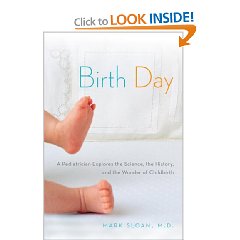
Book Review: Birth Day: A Pediatrician Explores the Science, the History, and the Wonder of Childbirth
By Mark Sloan, M.D.
Ballantine Books, 2009
ISBN 978-0-345-50286-5
370 pages, hardcover, $25

Written in a fast-paced journalistic rather than academic style, Birth Day is a biological, historical, and sociocultural look at birth in our species, highlighting the experiences and skills of the fetus and newborn infant. The focus of Birth Day is on childbirth, but as a pediatrician, the emphasis of the journey in this book is on the baby and its development, skills, and remarkable adaptations to the womb and to life on earth. The book contains frequent references to evolution, which is not a concern to me, but may be to other readers.

The author’s personal experiences and observations are interwoven skillfully throughout the book lending an engaging “human” component—I loved his wry and occasionally self-deprecating honesty and realistic sharing. We read about the births of both of his children (one a very long labor eventually with an epidural and the second a scheduled cesarean due to placenta previa), his experiences as a medical student, and his observations as a hospital and clinic pediatrician. Dr. Sloan has been present at over 3000 births as a hospital pediatrician and 20 births as the baby “catcher” (medical school OB rotation). There is no real mention of homebirth, but occasional, supportive references to CNMs and to doulas.

The author has a healthy respect for the process of birth, noting in his conclusion that “…the most striking thing to me after all these years is how often such a complicated process goes right.” As a breastfeeding counselor, an element that I loved in this book was the author’s complete acceptance and integration of the importance and normalcy of the birth-breastfeeding continuum as well as the assumption of breastfeeding present throughout (bottles and formula do not make a single appearance throughout the 370 pages). This presentation was both very refreshing and completely appropriate.

The content of Birth Day was reminiscent of Birth by Tina Cassidy, with the primary difference being the emphasis on the infant’s experiences. There were occasional instances of questionable data such as, “An unattended breech birth, for example, is nearly always fatal to mother and child.” (?!)

Fast paced and often very funny, the author of Birth Day has a knack for explaining complicated concepts in simple terms and using effective analogies. I learned some new facts about the history of birth and was pretty captivated by the whole ride.

Disclosure: I received a complimentary copy of this book for review purposes.