“We are succulent with our shredded fantasies, our unread books, our misguided perfectionism, our hiding in bed eating rows of cookies, or neurotically running to and away from things. We are succulent just like this. Just the way we are NOW!….”
I like the way this book emphasizes that you are succulent right NOW—you don’t have to do anything special to be it (of course, I still get the “do something and you’ll finally be wonderful” message anyway!).
I had a rough weekend in which I felt overwhelmed by to-dos and “shoulds” and was crabby and snappy at my family and then extremely hard on myself about being crabby and snappy and so on and so forth in an endless spiral of ick. I have known for a long time that I honestly think that if I just read the right book and did the RIGHT thing, I would finally be PERFECT!!!! And, it just sucks when I remember…again!…that I’m not and that it isn’t possible and that the pursuit of doing it all “right,” really ends up making me less than in many respects in the end. I also feel like all the reading I do can mute my own intuition—how can I know what I truly feel and believe, if the words of 5 dozen self-help authors are chasing around inside my brain and each making the “most sense”? (I feel similarly about parenting books—I try so hard to parent the “right” way and wonder if I’ve lost touch with my own sense of what the right way is, by always reading and trying to incorporate other people’s right ways…?) Seriously, there was so much messy should in my brain this weekend I honestly could not distinguish what I really wanted to do from the shoulds—right down to, “I should be having more fun and being a more delightful person.”
P.S. The spellcheck attempted to change, “neurotically” in the quote above to “erotically.” ;-D
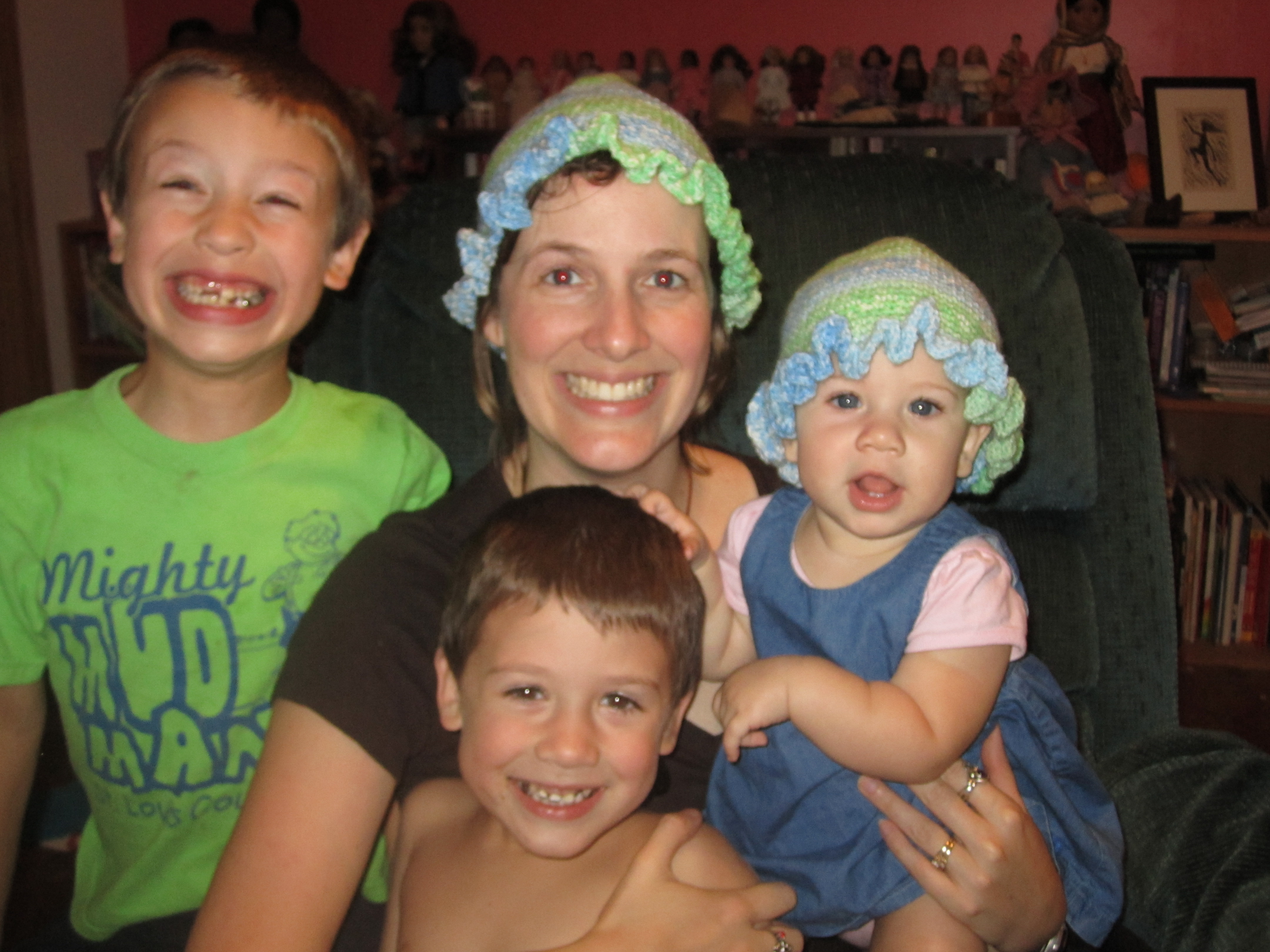
Tried to get a family picture of all our succulence—and, fittingly, it turned out kind of blurry ;-D
“When we lack proper time for the simple pleasures of life, for the enjoyment of eating, drinking, playing, creating, visiting friends, and watching children at play, then we have missed the purpose of life. Not on bread alone do we live, but on all these human and heart-hungry luxuries.” –Ed Hayes
I need to stick this to my forehead!
And, a favorite quote that I used to have on my FB page:
“A simplified home feels friendlier. A simplified life seems easier. And remarkable joy comes from simple things–like having work to do that matters, and having people to love who matter a lot.” –Victoria Moran (Shelter for the Spirit)
Chicago Healers Practitioner Dr. Helen Lee provides five easy ways to stay calm, relaxed and connected to the self throughout even the busiest days.
Breathe – It may feel silly to remind oneself to breathe, but it is so important. There are two types of breathing: shallow and deep. Taking shallow chest breaths causes the body to operate in “fight or flight” mode, which is highly stressful. Less oxygen goes to the brain and the body continues to operate on high alert. It is important to take deep abdominal breaths, which stimulate the parasympathetic nervous system. This optimizes digestion, relaxation and detoxification while keeping hormones balanced.
Gratitude – Remembering things to be grateful for throughout the day really does wonders for personal state of mind and for the body. Positive thinking releases chemicals that help with digestion, euphoria, relaxation and overall well-being.
Laughter – Laughter is the best medicine as the saying goes, and this is often the case. Laughing for 10 minutes a day will do amazing things. It changes the physiology of the entire body—increases circulation, releases different “happy” chemicals in the body, reduces stress, keeps everyone in a lighter frame of mind, helps the heart and can even burn calories! It’s contagious, too!
Sit in Silence – Taking 10-30 minutes to quiet the mind and clear thoughts can be so beneficial. If meditating is not preferable, spend the time visualizing goals for the day. This will put focus on personal needs, which will be relaxing later when the day starts to get stressful.
Take a 15-20 Minute Walk Outside – Sometimes all that’s needed is fresh air and sunlight. Taking a step away from the computer, the phone, the office, etc. can really help clear thoughts and be very calming.
Stress is almost unavoidable these days but there are many ways to keep it at bay. Practicing these five methods is a great start.
—
Chicago Healers (www.ChicagoHealers.com) is the nation’s pioneer prescreened integrative health care network, offering a comprehensive understanding of each practitioner’s services, approach, and philosophy. Our holistic health experts teach and advocate natural and empowered health and life choices through their practices, the media, educational events, and our website. With close to 200 practitioners and over 300 treatment services, Chicago Healers has provided nearly 400 free educational events for Chicagoans and has been featured in 300+ TV news programs and print publications. For more information, visit www.ChicagoHealers.com.
In the U.S. there are more the six million pregnancies each year, and a growing number of women are opting to use massage to deal with the aches, pains and stress that come along with pregnancy. Studies have shown that prenatal massage can reduce anxiety, joint pain and swelling caused by poor circulation, according to the American Pregnancy Association. Massage therapists who are trained in prenatal massage must take extra precautions when giving an expectant mother a massage, including avoiding specific pressure points and ensuring the client is in a position that will not cause added stress to their body.
Q: How can the benefits of massage transfer into the delivery/birthing room? A. Regular massage can assist the labor process by enabling each woman to begin labor with less tension in the back, pelvis and legs. It also provides flexibility, prepares muscles and reduces stress levels which can improve the outcome of labor. It has been noted that labor is shorter with fewer complications for women who receive regular massage.
Q: Are there any special tricks and tips that can be used through massage to help a birthing woman? A: It takes a lot of hard physical work to get a baby into the world but steps can be taken to make that process easier. Regular massage throughout the second and third trimester will allow the muscles to be more relaxed and flexible through the delivery process. Not only does massage help throughout pregnancy and delivery but once baby and Mom are home that’s when disrupted sleep patterns need rejuvenation. A one hour massage is equivalent to three hours of deep sleep….often needed not only for Moms but Dads as well.
Q: When are the best times to receive a massage for pregnant women?
A: Pregnancy is a wonderful experience, but it often comes with physical challenges from a changing body. The second trimester is the safest time to start receiving regular massage, once or twice a month. Weight gain in the front of the body can change the center of gravity placing more stress on joints, the spine and muscles. Massage can offer relief from muscle pain and joint stiffness on into the third trimester as the baby grows and changes the body even more. At this time it would be beneficial to receive a massage every week.
Receiving massage during pregnancy is an excellent way to care for both Mom & baby. It should be part of every pregnant woman’s self-care plan.
Q: What are some of the cautions about receiving massage during pregnancy? A: Prenatal massage is effective and safe for women with uncomplicated, low risk pregnancies. High risk pregnancies with certain medical conditions should get consent from their doctor before receiving massage. Massage should be avoided during the first trimester and there are regions of the body and specific therapeutic techniques that are contraindicated for prenatal massage. A professional massage therapist trained in prenatal massage will know what precautions need to be taken.
Several years ago I read a book called Trees Make the Best Mobiles. Primarily geared towards first time parents of infants, it didn’t cover a lot of new ground for me, but there were a couple of good reminders in it about present, mindful parenting. I originally wrote about this on an old blog and this week the notion of the “ragged self” came back up for me again. In the book regarding time with our children, the authors write: “They offer us a chance, not only to quell past demons, but to leave behind the pressures of the day. With them, we can be our best selves: alert, vibrant, and generous—and fully alive in the present tense.” And then, with regard to children learning your behaviors: “Make sure that what your child is absorbing isn’t your ragged, frustrated, or furious self, but your best self. And when it’s not, let him know that you know, and that you’ll try harder next time.”
Unfortunately, I think I often do show my “ragged” self to my family and am NOT necessarily my best, alert and vibrant self. It isn’t a “furious” self usually, but sort of a worn out and taut self. My husband “gets” to see this side a lot—I start out the day much more vibrantly and as it passes, I become more ragged so when he gets home, all that is left for him is “scraps.” I hate that. I also feel like my mom sees my ragged self more often than I’d like—aren’t these the people that matter most? Why do “other people” get the vibrant parts?! I try to tell them sometimes that that raggedness isn’t how I am or how I feel for a lot of the day, it is just that which is only “allowed” to reveal herself in front of them.
I’ve noticed the ragged self emerges when:
I’m hungry
I’m tired
I have a headache (sometimes related to the above two)
I haven’t had my two hours
What’s this about two hours?
Well, picture that newspaper kid from the movie Better Off Dead and you’ll have how I feel about it 😉 Almost every day, my wonderful parents pick up my boys and take them to their house to visit for approximately two hours. If I play my cards right, this is also when Alaina takes her afternoon nap, which gives me two hours on my own to “get things done.” I NEED this time in order to survive—in order to keep up with the other elements of my life besides mothering. I know other mothers swoon with jealousy at the idea of having a regular two hours—they should, my parents are awesome and they are a key factor in how I’m able to “do it all.” They’re my “tribe”—the village that comes to help me grind my corn. I rely on having this time and so when I don’t get it for some reason, I become very ragged and feel like I must quit everything else (surrender). So, sometimes when I start feeling ragged and can’t put my finger on exactly why, it comes to me: “I WANT MY TWO HOURS!”
Yes, that kid’s face is exactly how my own looks when I say it!
Another minute?
From the same book quoted above, the authors write “Each time you say, ‘I need another minute to finish this…,’ you squander a moment with your child, never to be reclaimed.”
I confess, though this is another good reminder, it also annoys me. There is a little too much “romanticizing” of parenting implicit within it. I thought of all the times when I’ve said “I just need another minute to…” Hmmm. Go to the BATHROOM! Finish fixing breakfast, put the baby to sleep, help someone else go to the bathroom, talk to my husband—the love of my life… I guess each could be seen as “squandering” and I have an inner monitor in my head that lets me know that! But, get real, sometimes you really DO need another minute to “finish this” and there is no reason to get all blamey about it! (I also confess that my defensiveness here is also about the times I do say “just a minute” when it really ISN’T that important and I could drop what I’m doing to meet their needs—but is it always actual needs, or sometimes just a nonstop desire for parental entertainment?)
The entertainment committee?
In thinking about entertainment, another quote:
“Keep in mind, too, that life isn’t all entertainment—even when you’re only three…Allowing them to become bored means letting them draw on their own resources. It means trusting them to make their own fun. A child who can reach inside herself for amusement or consolation is a child who is truly plugged in.”
And a final reminder:
“What we all crave is to be seen, really seen, and through that seeing, know ourselves. We spend much of our life—in work, love, friendship, and sometimes even in therapy—trying to achieve this.”
Self-improvement
I’ve been having a ragged couple of days and have been lamenting my tendency to turn myself into one, long, relentless, failure-filled, self-improvement project. I get annoyed with myself for always wanting to be “productive” and conclude that becoming more awesomely zen-like is required aaaand! There’s another self-improvement project… 😉 Or, that I need to focus on just BE-ing (which as soon as it becomes a “pursuit” the very point is lost! That is just the kind of mental conundrum that makes me spin ruts in my brain). Anyway, yesterday morning I saw the tiny edge of a new top tooth in Alaina’s mouth and suddenly it all became clear to me why she hadn’t been napping as expected (thus not getting me my TWO HOURS!). I would have thought I’d be wise to this pattern by now—unexplained non-napping baby precipitates spiral of despair in mama involving large doses of self-criticism and conclusion that giving up all personal goals is required and then tiny tooth is revealed. Since I’ve done this exact thing with two other kids as well as with Alaina herself just last month, you’d think I’d finally get a clue!
I was trying to come up with a picture to share of a ragged self—you know, sticking up hair and crazy eyes—and instead I felt like sharing a picture of Xena instead. And, sharing these two quotes:
“Be wild; that is how to clear the river.” (Clarissa Pinkola Estes)
“We’re volcanoes. When we women offer our experience as our truth, as human truth, all the maps change. New mountains form” – Ursula Le Guin
But, returning to the notion of “being seen,” I’ve decided that rather than take a complete break from blogging, I’ve instead got to let go of making long, self-analyzing, personal journal type posts. I don’t know that anyone even actually wants to read them AND they take a long time to write (and make me seem neurotic and needy. Inside my head is an intense place!). This blog didn’t start out in that vein, but as I’ve noted, it took on more of a personal journal feel when I was pregnant with Alaina and in the months following her birth. I think it is time to bring it back from that personal ramble place and just share shorter and more simple posts. I have trouble with short—this is why I don’t enjoy Twitter very much—but I also know that long posts are very unlikely to be fully read. So, this is my last navel-gazing post for some time to come (unless something is already in my drafts folder—I do have 78 drafts in there!).
I got a necklace at the ICAN conference with the image of a standing woman holding her arms up to the moon. Inscribed on the back it says, “the call of the wild is not a difficult song.”
My friends and I often reference the word “balance” in our conversations, with a popular refrain being, “it all comes back to balance!” I have several books about life balance—my favorite being A Mother’s Guide to Self-Renewal and I feel like I continually engage in a dance with balance in my life, coming into various sensations of balance or imbalance throughout my days. I think I make a mistake in thinking that balance is something I will one day “achieve,” rather than dipping in and out of it. I also think that the cry for “balance” can sometimes be a secret code in my brain for, “I will eventually figure everything out and life will be perfect!” So, I appreciate this quote from the book The Mommy Wars, with regard to balance, that eternal question:
“Let me save you some money: In a life with children, balance does not exist. Once you’re a parent, you can figure you’ll be out of whack for the rest of your life…Children are not born to provide balance. children are made to stir us up, to teach us how angry we can get, how scared we can be, how utterly happy, happier than we’d ever imagined was possible, how deeply we can love. Children turn us upside down and inside out; they send us to the depths and heights of ourselves; but they do not balance us. We can’t balance them either, and that’s a good thing, too. They’re finding out how to live in the world, and the most we can do is make them as safe as possible and have a good time with them.”
I have just started teaching (college) again after having a three week break and I’m teaching more classes than I ever have before, not to mention continuing to homeschool my kids and finding scraps of time to work on my own doctoral program. And, Alaina is on the move now—a seven month old baby is quite a lot more work than a younger baby! (Chiefly that she sleeps less and gets into more!) So, I’m in that time of trying to find my footing, my balance, with this new schedule and making sure I…once again…have my priorities in the right order. I have a blog post about “surrender” that I wrote several weeks ago that I keep waiting to post for some reason, as well as some other musings about keeping my blog posts going or not. I think I will keep writing, but I’m going to just post once per week—on Wednesdays probably (though, I may prep extra posts on that day to go out on different days). I also have plans for keeping them short, less navel-gazing, using material I’ve already written, and that sort of thing. While I really enjoy writing blog posts and there is something important—but hard to identify—that I get out of it (I think it is both about telling about it and playing my music), in the scope of my life right now, it really needs to slip to the bottom and possibly off of my radar entirely for a time.
This conviction that something I’m doing needs to change in order to be “balanced” (or perfect, as the case may be!) makes me think the root issue is really about control—control of life’s energy and flow—and reminds me of something else I read recently in Thomas Moore’s book, Original Self:
As a therapist, I often followed a simple rule…I would listen to a man or woman passionately explain what was going on in their lives and what they needed to do. This strong expression of self-understanding and intention told me a great deal about their suffering. I could see where and how they were defending themselves against life…it always seemed fruitful to explore the direction closed off by insistent plans for improving life.
To free our souls, we may have to be loosened by our suffering and our problems. Rather than look for ways to be further in control, we may have to surrender to the vitality that is trying to get some representation. Rather than understand our dreams, we might be understood by them–reimagine our lives through their challenging images. Rather than get life together, we might allow life to have its way with us and get us together in a form that is a surprise. (emphasis mine)
True personal strength is not to be found in an iron will or in superior intelligence. Real strength of character shows itself in a willingness to let life sweep over us and burrow its way into us. Courage appears as we open ourselves to the natural alchemy of personal transformation, not when we close ourselves by making the changes we think are best. (emphasis mine)
In the following section he also says that, “when people say they want to change, I hear a subtle rejection of the person they are…even then, a conscious plan for change usually comes from the same imagination that got us into trouble in the first place. A new project of self-transformation may land us back in the uncomfortable wallowing hole we just left.”
Hmm. Not sure what my conclusion is after all this now…to blog or not to blog. I don’t think that is really the question.
If you know me in real life (or if you are my husband), you’ve probably heard me use the phrase, “I just want to grind my corn.” I’ve been meaning to write a blog post about this idea for quite some time and when I posted my essay about “playing my music,” I received a comment from a friend saying, “I worry I’m not accomplishing what I’m capable of doing, but I know that ditching my kids and simply pursuing my ‘own thing’ would not be fulfilling.” When I read that, I knew that the time for my corn grinding post had come. When I use the phrase, I’m envisioning some kind of ancient tribe in which the mothers are working together grinding corn, while their babies are tied to their backs, and the older children play nearby. While I do not literally want to live in primitive times (those corn grinding mothers also probably had a lifespan of 35 years!), I feel as if mothering is “meant” to be a communal activity rather than a solitary one and I feel like babies and children are meant to coexist alongside their mothers as they go about their daily work. Rather than intensive, child-focused, total-reality mothering, I think babies are happy watching their mothers work and participating in the daily rhythms of the home and world with no need for the mother to be “rolling around on the floor in the glitter in her sweatpants” (see the book Perfect Madness) while serving as a one woman entertainment committee. This age of individual mothers caring for individual children in isolation from the larger “tribe,” is a social and cultural anomaly when we look at the wide scope of human history. Likewise, meeting for playdates isn’t what I mean either—I mean more task-oriented, corn grinding work, than that.
In the book Perfect Madness, the author articulates what I mean when I say I want to grind my corn—the need for something in between staying at home and working full time (basically, that working and mothering simultaneously is the most natural and fulfilling approach, but our society does not make that combination often feasible or comfortable):
Which means that ‘natural’ motherhood today should know no conflict between providing for our children (i.e. ‘working’) and nurturing them (i.e. ‘being a mom’). Both are part of our evolutionary heritage; both are equally ‘child-centered’ imperatives. What’s ‘unnatural’ about motherhood today, if you follow Hrdy’s line of thinking, is not that mothers work but rather that their ‘striving for status’ and their ‘maternal emotions’ have been compartmentalized. By putting the two in conflict–by insisting on the incompatibility of work and motherhood–our culture does violence to mothers, splitting them, unnaturally, within themselves…For they show that the so-called ‘choices’ most of us face in America–between more-than-full-time work or 24/7 on-duty motherhood–are, quite simply, unnatural. They amount to a kind of psychological castration: excessive work severs a mother from her need to be physically present in caring for her child, and excessive ‘full-time’ motherhood of the total-reality variety severs a mother not only from her ability to financially provide for her family but also from her adult sense of agency…
This is what I’m talking about. There needs to be a third, realistic option (and not just for women. For men too. For families!). I have often expressed the desire to find a balance between mothering and “personing.” I’m seeking a seamless integration of work and family life for both Mark and myself. An integration that makes true co-parenting possible, while still meeting the potent biological need of a baby for her mother and a mother’s biological compulsion to be present with her baby. Why is the work world designed to ignore the existence of families?
So, returning to my friend’s remark, I truly feel as if there is another option between “not accomplishing” and “ditching my kids.” And, I feel like after a LOT of work and trying, I’ve found somewhat of a balance in my own life between “personing” and “mothering.” It is possible to mother well AND also do some other things that feed your soul. It doesn’t have to be an either/or arrangement. And, we don’t do our kids any favors by not pursuing some of our own passions when they can watch and observe us being vibrant, active, complex, complete human beings (not saying that it isn’t “complete” to be a SAHM, but that if you DO want to pursue some other non-kid projects, kids learn good things from watching that happen!) I used to feel like I was going to die–-metaphorically speaking…like my soul was getting squashed—if I wasn’t able to pursue some of my personal goals. I don’t feel that way anymore (and I still spend roughly 90% of every week with my kids and 99% of my waking and sleeping hours with my baby!).
At one point when my first son was a baby, I was trying to explain my “trapped” or bound feelings to my mother and she said something like, “well what would you rather be doing instead?” And, that was exactly it. I DIDN’T want to be doing something instead, I wanted to be doing something AND. I wanted to grind my corn with my baby. Before he was born I had work that I loved very much and that, to me, felt deeply important to the world. Motherhood required a radically re-defining of my sense of my self, my purpose on earth, and my reason for being. While I had been told I could bring my baby with me while continuing to teach volunteer trainings, I quickly found that it was incompatible for me—I felt like I was doing neither job well while bringing my baby with me and I had to “vote” for my baby and quit my work. While I felt like this was the right choice for my family, it felt like a tremendous personal sacrifice and I felt very restricted and “denied” in having to make it. With my first baby, I had to give up just about everything of my “old life” and it was a difficult and painful transition. When my second baby was born, it was much easier because I was already in “kid mode.” I’d already re-defined my identity to include motherhood and while I still chafed sometimes at the bonds of being bonded, they were now familiar to me.
I become fully certified as a childbirth educator in that year after my second son’s birth (provisionally certified in 2005 and he was born in 2006) and another feeling I struggled with was the sensation that I had all of this change-the-world birth energy that was being stagnated or blocked somehow. I felt like I had become a birth educator in order to change the birth world, to transform the birth culture in the US, and in my own small corner of the world I could not make the kind of impact I envisioned making. That is when I started writing and found satisfaction in reaching out to the wider world in that manner (I explored how that benefited me in the music post already).
Now, with Alaina, while I do feel overloaded or overbooked at times, in general I feel like I have found a better balance than with any of my other children. I continue to teach college classes in person (a total of 10 hours a week) and online and while it is tricky at times, so far it is working pretty well and we’re all happy (thanks in no small part to my mom who has been willing to come to class with me to take care of her in between my breaks, so that we experience only small amounts of separation once a week). As she gets bigger and more energetic (read: sleeps less), I’m definitely finding that I will probably have to let something else in my life go in order to continue to be available to her, to my boys, and to my own need for “down time” in the manner in which I wish to be without hurting myself (by staying up too late, not eating well, having stressed out “freak out” moments, etc.). Sadly, I think it is going to be my birth classes that I put on hold and possibly this blog as well (more about this later) .
Speaking of the difference between parenting and personing—I also do not view being a mother as my job. Mothering is a relationship to me and not a job that I perform. Just as it is unhealthy for me to be defined by work responsibilities, it is also unhealthy for me to be defined by relationships. I would never describe my job as being “Mark’s wife” or “Barbara’s daughter,” that gives them too much responsibility for my identity. We are in relationship to each other, but that is not a duty I perform. And, just being in relation to them is not enough for the full expression of my personhood, I need other aspects and elements to my identity. Why am I surprised that I feel the same way about parenting? I want to be with my children, but I wish to be engaged in my own pursuits at the same time. When our lives feel happiest and most harmonious is when exactly this is occurring—when we are all together, but each working on our own projects and “doing our own thing.” I envision a life of seamless integration, where there need not even be a notion of “life/work” balance, because it is all just life and living. A life in which children are welcome in workplaces and in which work can be accomplished while in childspaces. A life in which I can grind my corn with my children nearby and not feel I need apologize for doing so or explain myself to anyone.
—————————
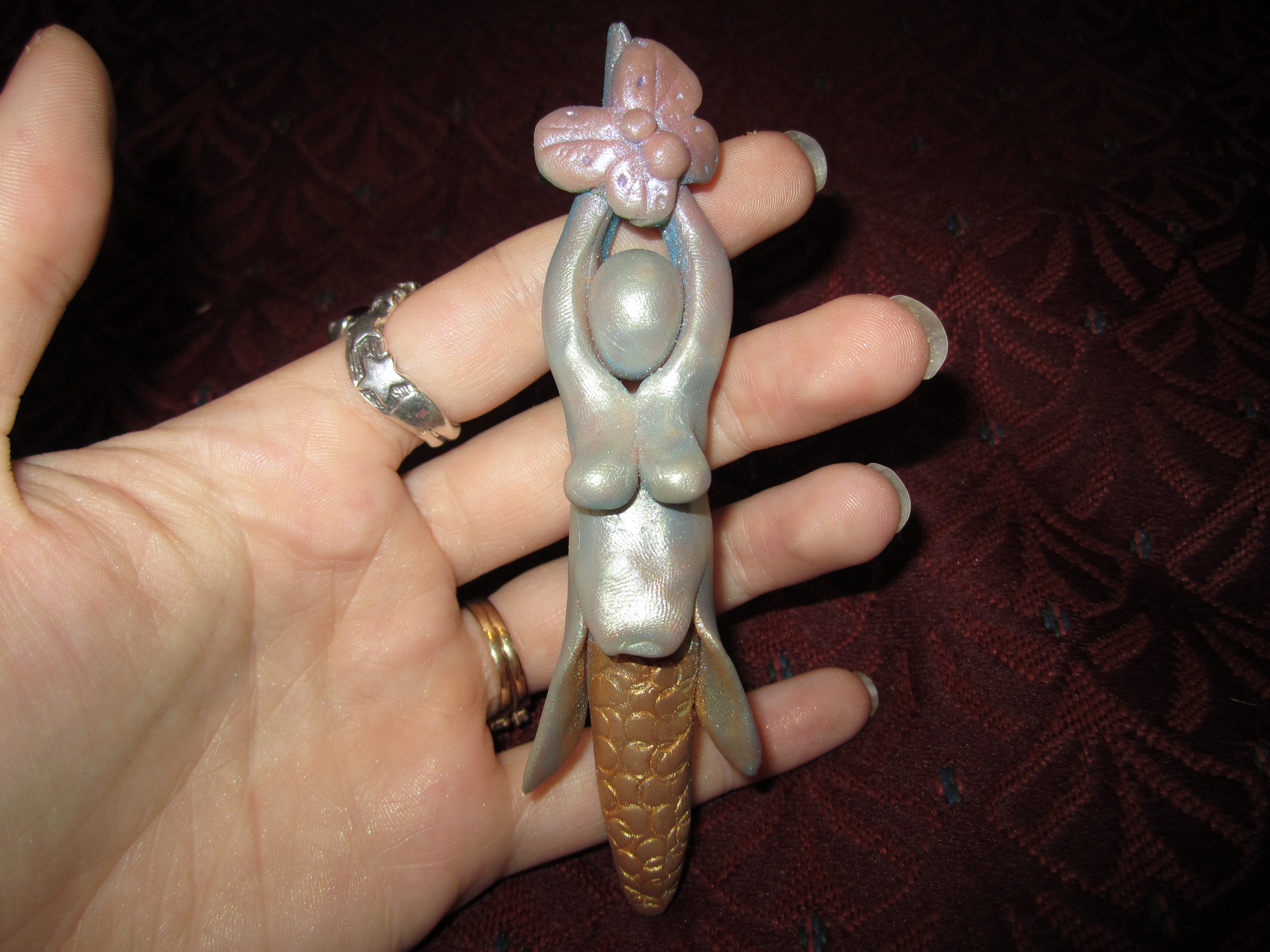
Continuing my birth art and life theme, I made two new sculptures a couple of weeks ago to express my corn grinding spirit. The first one is a corn goddess sculpture:
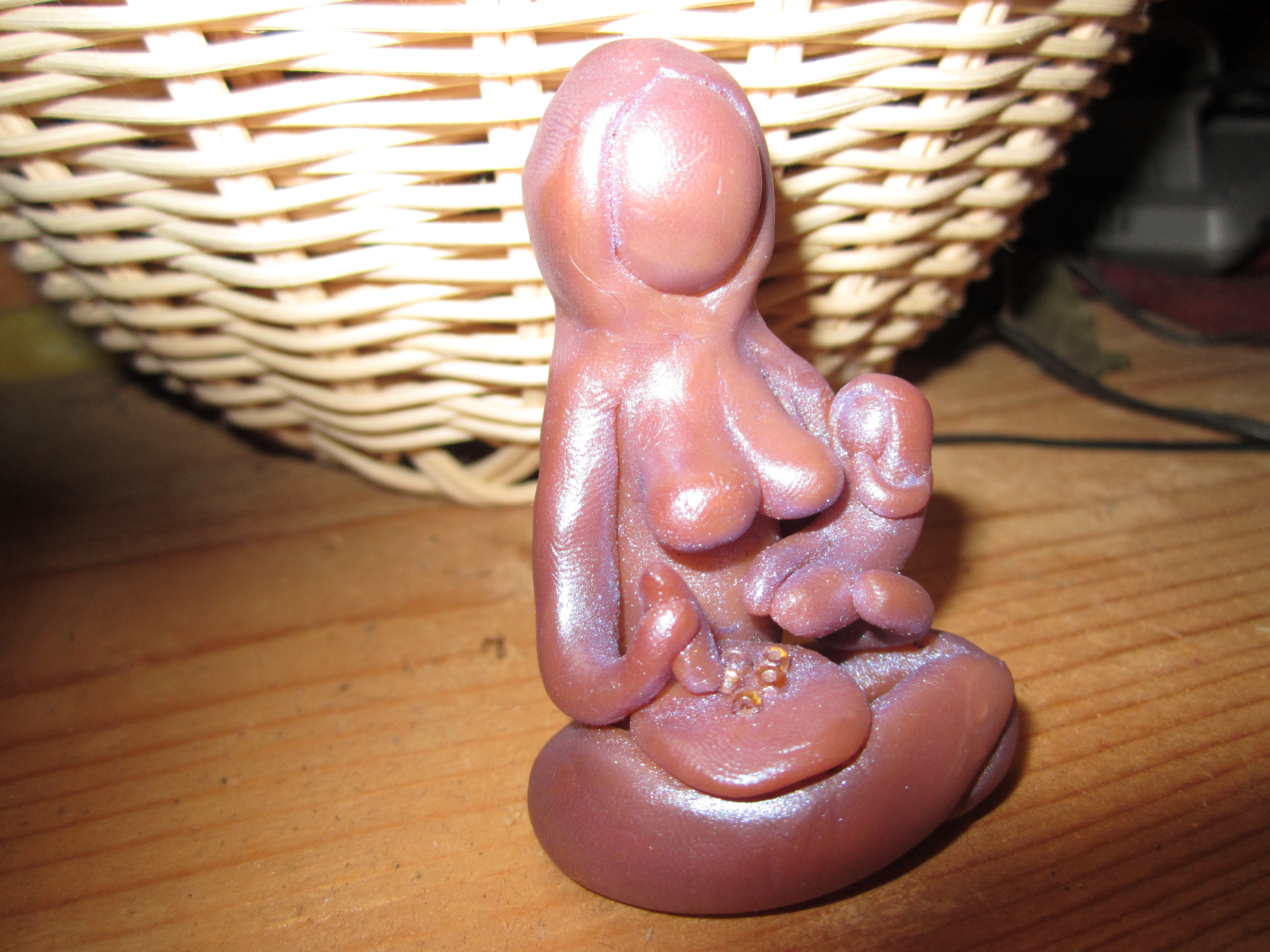
The second is a mama literally grinding her corn and holding her baby 🙂
They both make me happy when I look at them and I added them to my living room side table altar/sacred space.
Footnote: I started this post on June 17 and am now finishing it over a month later. Simultaneous corn-grinding and mothering can be very sloooooow…..;)
—
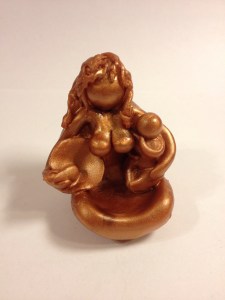
Footnote 2015: I’ve added a whole new baby since I first wrote this in 2011! I also created a whole new sculpture about the experience:
When I published my article about my postpartum feelings with my first son, I envisioned it as the first part of a series of three posts comparing/contrasting my postpartum feelings and experiences following each child. Here’s what happened—I wrote part two in which I shared some of the recurrent thoughts I had in the year following my second son’s birth and decided that I just don’t feel like publishing it. Reading it back over makes me feel like I probably could have been considered mentally ill and I don’t really feel like sharing that right now. I started to analyze why I feel like sharing any kinds of feelings via blog anyway—really, what isthis about? Why “expose” myself? In part, because that is what helped, and still helps, me the most; knowing that I’m not alone in my feelings and that other women have “been there.” So, I feel I have a responsibility of sorts to share my own “been theres.” When I began this website/blog, it was primarily about gathering and sharing information with others, not about telling my own story or sharing my personal experiences. I didn’t start it intending to have any element of a, “personal journal published online” feeling. After the birth-miscarriage of my third son and then my pregnancy-after-loss journey, it took on more of the personal journal flavor. And, I’ve liked that. I’ve enjoyed sharing my feelings and experiences and learning from the comments other people leave that I’ve “spoken” to something in them, and/or helped someone to understand their own experiences (or me) better. That said, I don’t have to share everything I write just because I’ve bothered typing it and I just don’t feel like sharing my second post about weirdo, “crazy” postpartum thoughts right now. So there! Maybe someday I’ll hit “publish” on it.
Of course I know (and firmly believe!), that you’re “postpartum for the rest of your life” (Robin Lim), but I feel like this current postpartum experience is different than my others in some qualitatively different ways. I first credited it to having taken placenta pills this time around. My doula encapsulated my placenta for me and I took all 95 capsules during the first 6 weeks postpartum. It was amazing! I have become a total “convert” to the benefits of placenta encapsulation. I felt GREAT and I had tons and tons of energy, instead of being wiped out and weak and exhausted feeling. I’ve only taken about two naps in Alaina’s life (this may come back to bite me with regard to lactational amenorrhea , we’ll see…) and that ISN’T because I’m crazy and was pushing myself too hard, it is because I haven’t felt like I needed to take any naps. I highly recommend placenta encapsulation. Amazingly powerful!
Another thing that is different about this experience is that I don’t feel “restricted” after having her—I don’t feel like I’ve had to sacrifice or let anything go, I feel like she has integrated smoothly into our lives. I had a phone counseling session with an intuitive healer the afternoon before Alaina was born and one of the new “neural pathways” I set was, “the new baby seamlessly integrates into our lives.” I think it worked! 🙂 What is interesting, is that I have put quite a lot on hold lately, but it doesn’t feel like she MADE me, it feels like what I want to do (or not do, as the case may be). When my first son was born, I had to let go of most of my old life and work and it was very painful. With my second son. I felt like I had a lot of energy to give to the “world” that was being blocked/couldn’t find expression. This time, there is more balance. I’m continuing to teach college classes in-seat and online and that feels really good to me. I’m homeschooling the boys and doing well with that (we actually “do school” almost every day!). I read all of the time (55 books so far this year!). I’ve started a doctoral program. And, I make time for a variety of other smallish projects like facilitating quarterly women’s retreats, editing the FoMM newsletter, and answering breastfeeding help calls/emails. Oh, and making birth art sculptures (new pictures to follow soon!) And, here’s what I’m not doing: writing new articles, working on my books (I have three in progress), doing much birth work, staying caught up on articles/news/research, teaching prenatal yoga or prenatal fitness classes or leading birth art sessions (all of which I trained to do last year), creating (or teaching) any new craft classes for our annual craft camp, writing the dozens of blog posts that come to mind (or even pulling old material into this blog the way I’d like to do), staying caught up with book reviews, keeping up with the garden, etc., etc. More about balancing mothering and personing will follow someday. I promise!
With previous babies, I’ve felt very haunted by the “list” of all I’m not doing. While I still feel this way sometimes, I more often have a less familiar feeling—that of amazement at my own capacity for adaptation and change. I regularly feel kind of proud of myself—like, look how I can expand and enfold and how I can create a life that works and is satisfying as it continually evolves and changes.
This time with my baby has been the sweetest and most delicious time in my life. Yes, I’m still busy and overextended and hard on myself about a lot of things, but there is a different clarity to the experience. I feel like every moment with her is so vivid, clear, and memorable and like each one is being etched into me. It is just so real this life we have together now and it is weird for me to realize how quickly things change and how pretty soon, this life that I’m living in this moment, will just be our past. I do feel like I savored my boys’ infancies as well, but I don’t remember this sharpness of feeling and observation. I feel like I will never forget what it is like to be this mother of my baby girl. However, I also know that the reality is that the growing baby and then toddler, and then child replaces the one who came before (even though it is the same person—those other versions of them are replaced by the vivid reality of the now). So, while I retain distinct mental snapshots of my life with the boys as babies, their current, vibrant, and ever-growing selves are much more intense and real (obviously), and I know it will be the same with her. And, it makes my eyes well up to know that this sharp sweetness will float away on the rivers of time and that before I know it, I will be the mother of two men and a woman. It is hard to explain what I mean in writing—what I want to say is, “but this is SO REAL now.” Well, duh. It IS real now. And, later will be real as well. That is just the flow of life, Molly dear ;-P However, one of the main reasons I wanted to get her pictures taken yesterday is to try to capture what it is like to be her mother NOW:
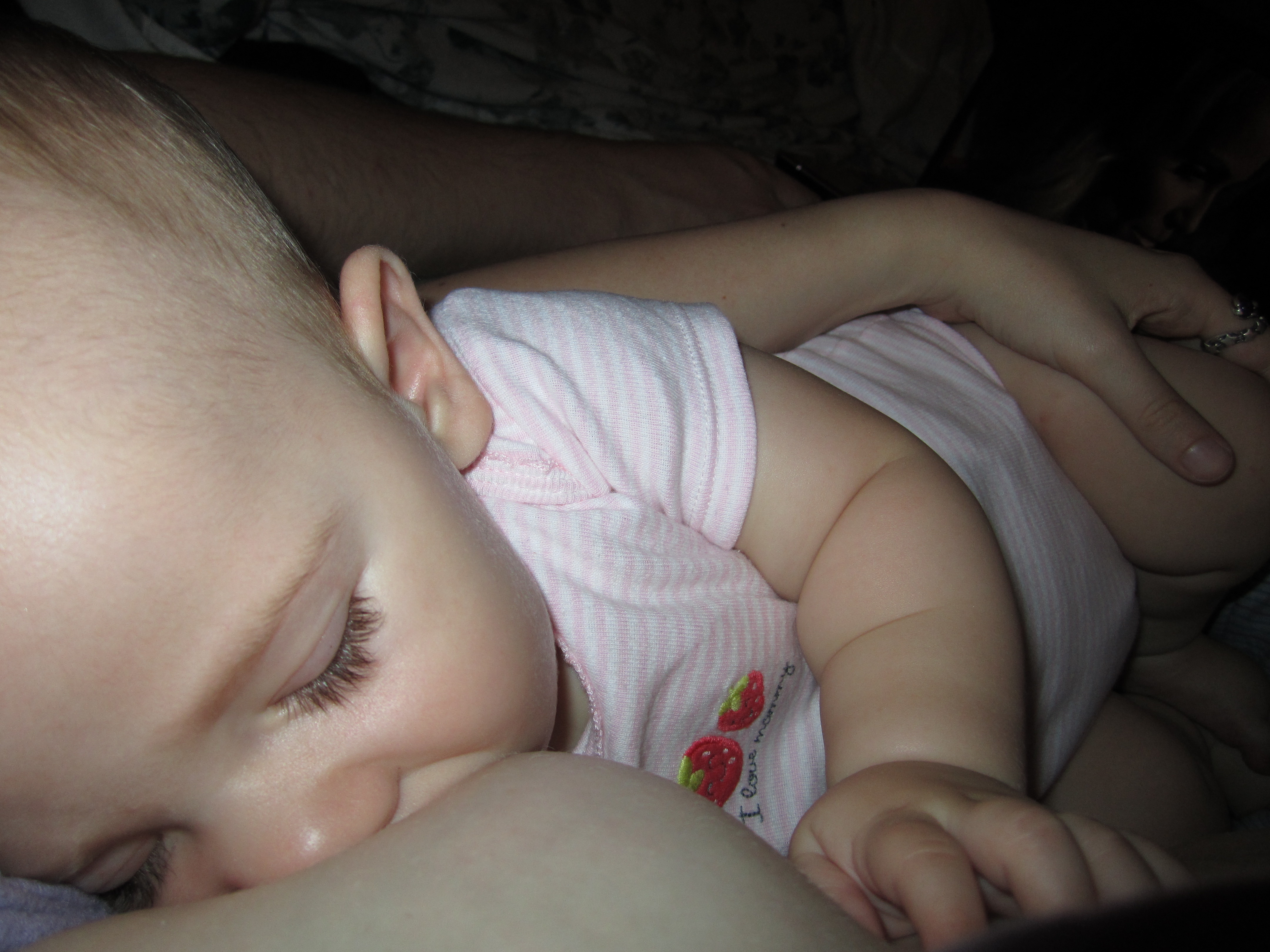
Then, last night while I was nursing her to sleep in my arms as I have done every night for five months, I took this picture myself to capture how well we fit together. I wanted to get how her little feet are nestled into my legs so perfectly and how her hands rests on me and how her head cradles in my arm:
I know this one isn’t a pro picture, but this is what it is like to be her mama 🙂
I copied this poem onto the first page of my journal when my second son was a newborn. I’m not totally sure what the meaning is intended to be, but I take it as a reminder to slow down and remember to look 🙂 My new baby is already one month old (tomorrow). How is that possible? I still look at her with surprise and amazement almost daily—sort of a, “where did you come from?!” feeling. There is something magic about her.
I have surprised myself by not having much urge to write in the last couple of weeks—usually I am consumed with blog post and article ideas. Something switched this week and the topics are flooding in again, as well as the sense of frustration of not having “enough time” to write them all. It may be because of Mark going back to work and now I feel like I am no longer “off” either and have to get caught back up with real life again. So, I remembered that poem and got it back out again. I also want to remember that my conditions of enoughness for the foreseeable future are:
1. take care of my baby.
2. take care of the boys–including doing some school every day.
3. eat enough food.
3. teach my online class.
That’s it. Write scintillating blog posts is not on the list. Nor is write books, which has suddenly popped back into my consciousness as a “want to do RIGHT NOW!” Nor is laundry really, though it has been haunting me this week. Even birth activism efforts are not really on my list, though there is a lot going on right now that I could/should contribute to. I’ve had a familiar sort of pressure this week to get back to “normal” and to prove to myself that I can handle everything I need to handle (without help).
I have been meaning to share this article on my blog for a long time. Now that I’m rapidly approaching another “babymoon,” it feels like a most excellent time to review my own reminders about planning for postpartum!
—-
Planning for Postpartum
By Molly Remer, MSW, ICCE, CCCE
Originally published in The Journal of Attachment Parenting, 2008.
When my first baby was born in 2003, I had a made a classic new mother error—I spent a lot of time preparing for the birth, but not much time truly preparing for life with a new baby.
I had regularly attended La Leche League (LLL) meetings since halfway through my pregnancy and thought I was prepared for “nursing all the time” and having my life focus around my baby’s needs. However, the actual experience of postpartum slapped me in the face and brought me to my knees.
My son’s birth was a joyous, empowering, triumphant experience, but postpartum was one of the most challenging and painful times in my life. I had not given myself permission to rest, heal, and discover. Instead, I felt intense internal pressure to “perform.” I wondered where my old life had gone and I no longer felt like a “real person.” A painful postpartum infection and a difficult healing process with a tear in an unusual location, left me feeling like an invalid—I had imagined caring for my new baby with my normal (high) energy level, not feeling wounded, weak, and depleted. And yet, at five days postpartum I was at the grocery store, at seven days at the post office resuming shipments for my small online business, at two weeks attending meetings and fulfilling responsibilities with an organization (though I still had difficulty walking normally due to pain), at six weeks hostessing at a fundraising ball, and at eight weeks teaching a volunteer training workshop. In retrospect, I have no regrets about how I cared for my baby. He was always with me and I was sensitive to and responsive to his needs. What I regret is how I cared for myself, what I expected from myself, the demands I placed upon myself, and how I treated myself.
I actually slightly delayed having a second child, not for fear of mothering two, but for fear of experiencing the overwhelm of postpartum again.
In 2006, I gave birth to my second son at home. This time I had planned realistically and specifically for a “babymoon.” My husband took four weeks off of work and I stayed at home for the majority of the first month of life with my new baby. Though I again experienced an unfortunate tear and a painful recovery from it (which was still much quicker and less traumatic than the first time) and also some rapidly shifting mood changes along with some tears and anxiety, I look back on this time with my second son with fondness instead of regret. Instead of rushing to rejoin the world, I allowed myself the time, space, and permission to rest and cocoon, knowing that I would be “real” again soon enough.
Reflecting on my two postpartum experiences leads me to offer the following suggestions for postpartum planning:
Try to minimize your out of home commitments in advance. Put a hold on projects and “retire” from committees and responsibilities. I joke that with my first baby I thought I needed to get my responsibilities squared away for six weeks and with my second I realized I needed to try to get them squared away for two years.
Have a good book on hand about postpartum. When my first baby was born, I was well stocked with baby care and breastfeeding books, but none about the transition into motherhood. My favorite postpartum book is After the Baby’s Birth by Robin Lim. It offers such gems as, “you’re postpartum for the rest of your life” and “when the tears flow, the milk will flow” (with regard to the third day postpartum). Other good postpartum readings are The Post Pregnancy Handbook by Sylvia Brown and The Year After Childbirth by Sheila Kitzinger. A classic for support people is Mothering the New Mother by Sally Placksin.
Prepare and freeze a lot of food in advance. Batches of nutritious muffins are a favorite of mine—freeze them and the reheat one as needed for a quick breakfast or snack. These are great for nursing mothers!
Plans to spend three to seven days just in bed with your baby. Skin-to-skin is even better.
Everyone is familiar with the “sleep when the baby sleeps” advice, but even if you don’t feel the need to sleep, stay in bed and use the quiet time for reflection or to read or write in your journal. Rest is definitely essential every day, but it doesn’t have to be actual sleep to be restorative.
If you have other children, arrange for plenty of help caring for them. Do not feel like you “should” be able to handle them all right away. Of course, you could do it if you had to, but you and your new baby will benefit from an extended period of cocooning together. Plan quiet projects that you can do in bed with your older child while the new baby sleeps (a favorite with my older son was making puppets and masks out of felt. I cut them out while still lying down. He actually started calling our bed the “party deck” because we did lots of fun projects there while I was resting with the new baby. I have no idea where he got the phrase!).
Give yourself permission to rest and be off duty.
When people ask what they can do to help, give them a specific task (go grocery shopping, pick up pictures, bring me dinner, etc.).
Ease back into “real life.” Resist the temptation to catch up with email and so forth. Respond to email or phone requests for time or help with a firm, “I just had a baby and I’m not available right now.”
Become comfortable asking for help (I vastly prefer being the helper to being the helped and this is particularly hard for me).
Similar to a birth plan, make a written postpartum plan that includes a list of the people in your support network, arrangements for help with household duties (or a plan for what can be left undone), people to call for meals, and so forth. List what each person is willing to do—laundry, grocery shopping, cleaning, childcare, meal preparation (notice that “holding the baby so you can work” isn’t on the list!). An example postpartum plan is available on DONA International’s website.
If you have relatives coming to help after the baby is born, make sure they know that their job is to take care of you and the house while you take care of the baby. It is not acceptable for you to be fixing meals and sweeping floors while grandma “helpfully” rocks the baby—it needs to be vice versa!
Prepare your partner and anyone else in your support network that you will be Queen for a Month and let them know what you will need from them (also, get it fixed in your mind that being Queen is okay!).
Expect to be “nursing all day long.” It is okay and good for you both (10-14 nursings in 24 hours is perfectly normal and acceptable!).
Encourage your partner to take as much time off as possible—either saved up vacation time or unpaid FMLA time. He can benefit from an extended period of cocooning with his newborn too!
Explore the idea that postpartum can be a time of postpartum expression rather than postpartum depression—letting all of your emotions flow, expressing your needs clearly and assertively, and being aware of and accepting of your continuum of feelings are ways to be expressive. (This concept comes from the excellent, but little known book Transformation Through Birth by Claudia Panuthos.)
Plan a few special things for yourself—have a little present for yourself to enjoy during postpartum (a new book, good magazine, postnatal massage, whatever is self-nurturing and brings you pleasure. Personally, I do not encourage TV or movie watching because it can become a passive time filler that distracts you from enjoying your babymoon. Some people may include favorite films as their enjoyable postpartum activities though).
As postpartum stretches on, if you experience decreased libido, it is okay to honor and accept that.
Planning for a restful, nurturing, “time out” with your new baby is way to honor this new stage in your family’s life cycle and a way to honor yourself as a woman and mother. I hope you will create space in your life for a time in which vulnerability is accepted. Postpartum is a time of openness—heart, body, and mind. I hope your experience is one of tenderness and joy.
Molly Remer, MSW, ICCE, CCCE is a certified birth educator and activist. She is editor of the Friends of Missouri Midwives newsletter, a breastfeeding counselor, and the mother of two young sons and a baby girl on the way. She loves to write and blogs about birth at http://talkbirth.me, midwifery at http://cfmidwifery.blogspot.com, and miscarriage at http://tinyfootprintsonmyheart.wordpress.com.




 Talk Birth