Archives

Moontime’s Return…

With all of my babies, I’ve followed Sheila Kippley’s Seven Standards for Ecological Breastfeeding. Kippley reports that mothers who follow ecological breastfeeding will experience an average of 14 months of amenorrhea (and associated infertility). Sure enough, with my first baby, right at 14 months postpartum my fertility returned. With my second baby, I said I was going for 18 months and I ended up with 16 months of amenorrhea before my “moon” returned. Now, Alaina is nearly 15 months old, and in what I find to be a fascinating biological twist, I’m experiencing my first postpartum mamaflow in exactly two years—it was my April cycle in 2010 during which I got pregnant with her. I just find that so cool—what body wisdom we have. (I then found my old journal from Zander and my cycle returned with him in September of 2007…again exactly two years from the month in which I got pregnant with him.)

Moon mandala I drew last year.

I sensed this was coming and have found myself interested in several related websites and blog resources recently. As part of the Wilde Tribe teleseries, I listened to Deanna L’am, author of two books with a focus on menstrual empowerment (specifically for girls who are coming of age) and founder of Red Tents in Every Neighborhood speak about Red Tents and about honoring this time in our lives with specific quiet time for rest and renewal. I also listened to a presentation about “Honoring Your Crazy Woman” (and her companion, the Creative Rainbow Mama) from The Happy Womb, who has a new book out called Moon Time as well as some super-cool mandalas for charting your cycle. There, I also enjoyed a great guest post about going with the flow and spending time in your own red room.

In one of the classes I’m taking, before exploring any of the above resources, I wrote about planning to take a monthly time of retreat each month during my moontime—kind of a mini Red Tent, whether it is only for 30 minutes or for a couple of hours or a whole day. I’ve read several articles that make the point that one of the causes of PMS, cramps, etc. is the reluctance, unwillingness, or inability to take any time off to listen to what our bodies are telling us and to heed the call to take some time to turn inward. I also thought about how during pregnancy and birth it is so vitally important to listen to our bodies, to take good care of ourselves, to rest when we need to, and to celebrate being female—why not continue that practice of care and recognition each month during menstruation?

I’m almost finished facilitating a series of Cakes for the Queen of Heaven classes (a feminist thealogy curriculum published by the Unitarian Universalist Women & Religion program) and one of the discussion questions we explored was with regard to our first menstruation, how it was treated by our mothers, and whether we felt like that experience was related to our later experiences of birth, breastfeeding, and menopause. Our overall conclusion was that yes, it is related, and we theorized that girls who are taught to feel ashamed of and annoyed by their periods, may well grow up to be women who fear giving birth or view it with trepidation rather than anticipation.

I really looked forward to my own first period and the day it began my mom gave me a special ring that I wore every day thereafter for years until it wore through on the back (I actually got it out today to look at). When I was still a teenager, I picked out a garnet ring that my aunt gave me once thinking that it was the ring I would give to my own daughter someday at menarche. While I went on to have a very challenging and pretty debilitating time with menstruation after that—headaches, nausea, vomiting, clotting, and horrible cramps—my introduction was one of celebration and recognition, rather than any kind of shame. I do think it set the stage for positive feelings and expectations about the rest of the stages of my life cycle as a woman. (Also helpful was having a mother who had homebirths and who breastfed her babies.)

After this discussion, I saw this quote on Facebook:

Our rites of passage create and sustain culture, our inner culture and the outer culture. The current dominant culture is one of blame and victimhood and unconscious rites of passage reinforce this, within and without. Conscious rites of passage in a likeminded group of folk, creates and reinforces a culture of self responsibility and inner power. It is said that if a young woman does not experience an empowering menarche, then she doesn’t start womanhood with a relationship with the empowered feminine.” –JHC

And, I also came across the powerful phrase, “womb ecology reflects world ecology.”

So, I did take some special time for myself today. It wasn’t a huge amount, but I made myself tea, listened to a recording, drew a picture, went down to my special place in the woods, and spent some time thinking and pondering about fertility and the rhythms and tides of our bodies. I also gave myself permission to finish writing two essays for one of my new classes and to browse through some new books, rather than “catching up” with the house, which feels like it is becoming more and more cluttered lately. I also felt like I will need to re-negotiate my relationship with my period, since we have decided that we really are done having babies. I’ve spent nine years with my body cycling through pregnancies and breastfeeding (with the accompanying ~15 months of amenorrhea for each baby) and thus, all things considered, I haven’t had that many cycles over the last 9 years. It is time for me to become re-accustomed to this monthly experience and to form a new relationship with my body that is not based on planning for a pregnancy or a birth.

I look forward to making a regular habit of spending some moontime quiet time with myself. I often crave stillness, retreat, quiet, and solitude, but I’m so “productive” all the time that the stillness I seek is pushed off until “the right time,” which then doesn’t come as often as I hear the call. I forget if I’ve written that I’ve stopped doing yoga (after 11 years of daily practice—little Miss A basically makes it impossible for me and I was getting so stressed about trying to fit it in, that I just let go and then I actually felt a lot of relief about that, rather than disappointment). I do spend at least 15 minutes of quiet, meditation time almost every day in the afternoon while the kids are visiting my parents. That time is really good for me and very centering. I know that it will also be good for me to plan in advance to take some Red Tent time each month.

I feel strange about this return. Like a chapter is closing in my life and some of the ways in which I have related to myself and my female identity will need to shift also.
A Virtual Mother Blessing for Molly Westerman!

20120410-102111.jpg

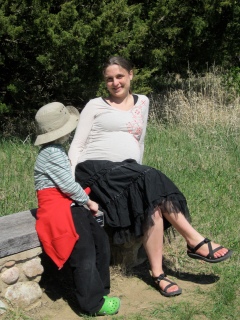
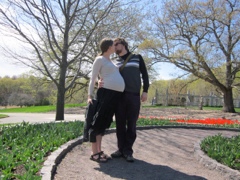
I spy...a pregnant woman ready for some honor and celebration!

In 2007, I started blogging for Citizens for Midwifery and one of my favorite blogs was a little gem then called Feminist Childbirth Studies. The blog’s author, Molly Westerman, later became more public with her blogging identity and began writing her current blog, First the Egg, a feminist resource on pregnancy, birth, and parenting. I enjoy her thought-provoking writing, her insight into birth culture and politics, and the glimpses of her family’s life in a nonsexist home. She’s smart, funny, interesting, and she’s also pregnant with her second baby and due any time now! I think every mother deserves a blessingway or mother blessing ceremony and I’m pleased to hostess a virtual blessingway for Molly. There is a tight turnaround since her anticipated birth time is so close, so if you read this and think, “I’d like to do something…” immediately stop thinking and just DO IT!

During my last pregnancy, Molly offered multiple supportive comments in response to my various musings, anxieties and fears as a pregnancy-after-loss mama (even though she didn’t have personal experience with PAL, she did know the right things to say!) Her comments, particularly one about the fact that I was doing this, meant a lot to me. I’ve now followed her current very physically challenging pregnancy with interest and long-distance support/rooting her on as she prepares for the homebirth of her new baby this month. I’m happy to have the chance to offer her a little more encouragement and love through this virtual mother blessing.

Here’s how you can participate:

Email me with your…

  • Words of support, affirmation, encouragement for Molly–either written or recorded (think about what you’d say face-to-face at a ceremony and then, if you have a smartphone, use the handy dandy microphone tool and talk into as if you were speaking directly to Molly in a mother blessing circle. After your voice memo is recorded, choose “share” and send it to me!)
  • Favorite birthy readings/poems/etc. (again could be written or recorded)
  • Birth art (i.e. a picture of something you drew, or you can mail Molly an actual drawing–see below).
  • Beads or charms for a birth bracelet/necklace–if you’d like to do this, email me for Molly’s address and then mail it now, so there is a chance she will receive it before the birth. I figure that all postpartum mamas can use ongoing doses of birth power energy anyway, so even if it gets to her post-birth, that’s cool too!

As I mentioned, there is tight turnaround on this, so on Tuesday of next week, I will gather everything that has been emailed to me and send it to Molly as a “blessingway in your inbox.” 🙂

20120410-102118.jpg

Getting closer and closer to birthing day...

If you are curious to learn more about mother blessings, click here to read other posts I’ve written about them.

If birth were a temple

20120408-133552.jpg

If birth were a temple


If birth were a temple
my body is religion, and this small form
twisting out of me,
is
prayer
my cries
reach birth’s vaulted
ceilings,
arching like my back over holy
waters,
crystal clear salt of amniotic
my womb–a blessing bowl
releases
her treasure.

–Nane Ariadne Jordan

I came across this beautiful poem in an anthology of prayers and readings called Talking to Goddess, edited by D’vorah Grenn.

Doulas at Homebirths?

What is a doula?

A doula provides non-medical labor support—all the good stuff like back rubs and encouraging words and suggestions for different positions to help with labor. She does not replace the father’s role, but “holds the space” for both mother and father as they take their own journeys/come into their new roles as parents. In my birth classes, I explain that I think one of the benefits of a doula is that it frees the dad up to JUST be the dad and to live his own experience/journey and not have the pressure of trying to remember all the birth “tricks” and book information.

But, why have a doula at a homebirth?

A lot of women planning homebirths do not feel as much of a need for a doula as do women in the hospital. The midwife is capable of providing many of the same functions as a doula, but she also has the monitoring tasks and baby tasks to take care of, while a doula is just there for YOU. Other things to consider when thinking about a doula for a homebirth are whether or not the midwife will be bringing an assistant and what her role will be if there is one–sometimes the assistant is available to fulfill some aspects of the doula role, other times she is observing or otherwise in training for other tasks. And, also consider how many people who want present at the birth–if you’re already having a midwife, an assistant, and say a mother or sister or friend there, adding a doula too may mean too much crowding.

A couple of months ago, I solicited feedback about doulas and homebirth for an article I was compiling for the Friends of Missouri Midwives newsletter. The full article is available here: Doulas and Homebirth. I had anticipated receiving a number of responses suggesting that doulas at homebirth are unnecessary, or redundant. After all, an emotional connection and secure trust is often the hallmark of what differentiates the midwifery model from the medical model. However, the responses I received were overwhelmingly in favor of hiring a doula for a homebirth. Personally, I very much valued the specific and customized postpartum care my doula provided to me after my last homebirth and I’ve concluded that a doula has the potential to offer something unique and precious to families, in whatever setting the birth takes place. I also think that the doula is the most likely member of the birth team to remain in contact with the family in the future. Perhaps it is because, even given the friendliness of the midwifery model, there is less of a “power differential” between mother and doula.

Personal experiences

The decision to hire a doula is a personal one, regardless of in which setting you give birth. My first baby was born at a birth center with the presence of a midwife, a doctor, my doula, a friend, my mother, and my husband. In hindsight, I felt like it had been too many people and that the doula hadn’t really been needed. For my second birth, at home, it was extremely important to me to have as few people present as possible. My husband, my mom, and my son greeted the arrival of my second son. My midwife arrived five minutes before his birth—just in time to catch! My midwife for his birth was so amazing, that I didn’t feel the need for any other professional care. I still miss her! My third baby was a second trimester miscarriage and he was born at home unassisted and just my husband present. Later, a friend who is a doula was very, very helpful to me with postpartum care/doula stuff. I really wished I had a doula there during his birth for emotional support and supportive physical care tasks (not medical support, but tea bringing and towel washing).

It is the little things that matter--here my doula puts warm socks on me following my baby's January birth (baby and I had special matching birth socks knitted by my mom)

And, finally, with my last baby, while I liked and respected my midwife I didn’t have the same warm bond with her and really wanted to hire a doula again, precisely because I was missing some of the emotional component I value so highly in midwifery care. It is really the little things that make doula care so special (see included photo!). When planning my last birth, I chose to hire the same doula as with my third birth, with the primary purpose being immediate postpartum help (“washing the bloody towels and bringing me tea” is how I define it).

Talk Birth in Labor…

And, speaking of my doula, I’ve been meaning to share this photo for a long time. When my doula had her own baby last April, amongst the wonderful photos that our mutual friend took at the birth, I was tickled to see this picture of my doula looking at my website while in labor:
I think this could be an advertisement for my blog 😉

You can read Summer’s intense birth story here and also be moved to tears by the stunning birth awesomeness of her video slideshow here:

Book Review: Into These Hands

Into These Hands: Wisdom from Midwives
Geradine Simkins
Paperback, 300 pages
Published by Spirituality & Health Publisher, 2011
ISBN: 9780981870854
Wisdom from Midwives

Reviewed by Molly Remer, Talk Birth

Into These Hands is an amazing anthology of midwives’ retrospectives about their careers and midwifery journey. You won’t find birth stories here–this is book about women’s lives and journeys to midwifery. A book of midwife stories–how women are birthed as midwives, rather than about births they attended–Into These Hands is great reading for aspiring midwives or for currently practicing midwives who wish to feel a sense of solidarity with their sisters. There are many paths, many lessons, many voices and each midwife clearly loves women and has a passion for birth.

From the press release:

We are eager for you to meet some modern-day wise women, healers, revolutionaries, and reformers. Into These Hands, Wisdom from Midwives© is a comprehensive anthology of the life stories of 25 remarkable women who have dedicated their lives and careers to the path of social change through midwifery. These exemplary midwives are all over 50 years of age with 25-40 years in the field. Collectively, they have over 800 years of experience and have assisted in over 35,000 births.

The midwives whose voices are included in the anthology come from diverse backgrounds, training, experiences, and range of practice settings. Quite a few of the stories are from “bridge club” members–women who began as direct entry midwives and later became CNMs. These midwives have a foot in both worlds and insight into the politics of the profession. In general, Into These Hands is a good look at the politics of midwifery both past and present. Almost all of the midwives in the book have homebirth roots or orientation.

Since there are lots of voices represented, the tone or style of some stories is more compelling than others. Some within-story chronology jumps were a little confusing and there were a couple of stories in which I had to do some re-reading for clarity.

Into These Hands is likely to be of particular interest to midwifery activists, aspiring midwives, or current/retired midwives and may hold less appeal for general birth enthusiasts, doulas, or childbirth educators. The stories are rich, insightful, thought-provoking, and diverse and they brought tears to my eyes several times. This book is a treasury of women’s wisdom and a powerful legacy for the generations of women to follow.

20120402-120957.jpg

An indicator of how much I like a book is how many page corners I turn down in order to come back to re-read those sections and write blog posts based on them/share quotes/etc. This is Into These Hands last night as I was finishing it...;-D

Disclosure: I was provided with a complimentary copy of the book for review purposes.

A Blessing…and more…

20120330-222120.jpg

Rue anemone
(next to the house)

A Blessing…

May Women all be treated

as rare and holy flowers

Petals strong and fragile

rise up sacred powers

Giving

Giving

Life its very breath.

–Sarah Blogg

I read this poem in an anthology of women’s prayers, blessings, and readings and it spoke to my heart and to the heart of birthwork, of women’s work, of why I do what I do, and care about what I care about. This is what I wish for women, not just in birth, but in life. I wish for baby girls around the world to be greeted with love and joy, “oh, good! It’s a girl! Another girl! We’re so blessed!” rather than viewed as second class citizens or as property or as burdens or as objects. I wish for the lives and bodies of women to be honored and respected and for their wisdom to be cultivated.

I’m happy to be reviewing a really great book right now called Into These Hands, Wisdom from Midwives. In the introduction is a great quote that makes me think of the above sentiments as well: “Every new member of the human family arrives on Earth through the body of a woman. Each day on our planet, the majority of babies emerge into the hands of a midwife. Since the dawn of time, midwives have been receiving the generations into their hands.” –Geraldine Simkins

Birth culture

For a dozen years now, birth and breastfeeding advocacy have been areas of intense and sustained interest to me. I feel like these are core, basic women’s issues and that women in our present day U.S. birth culture, as well as women around the world, experience significant amounts of devaluation, disempowerment, and even abuse in the medical birthplace. I agree with anthropologist Sheila Kitzinger who said that, “In any society, the way a woman gives birth and the kind of care given to her and the baby points as sharply as an arrowhead to the key values of the culture.” Our current birth culture does not value women and children. Though my focus is usually on the women, it also doesn’t much value men or fathers either. I also agree with Kitzinger’s assessment that, “Woman-to-woman help through the rites of passage that are important in every birth has significance not only for the individuals directly involved, but for the whole community. The task in which the women are engaged is political. It forms the warp and weft of society.”

A popular saying in the birth activist community is “peace on earth begins with birth.” Perhaps it really means, “respecting the birth-givers, eradicates patriarchy.”

Women’s voices & social discourse

In an article by Grassley and Eschiti in summer 2011 Journal of Perinatal Education, they state, “Women’s health research is grounded in women’s voices and experience…’What matters to people keeps getting told in their stories of their life.'” I’ve written before about the value of stories and story power. I would love for us to reach a cultural point in which the most common element found in most women’s birth stories is about their own power, rather than about times in which they experienced distress and victimization. How we talk about birth and about women matters. It matters a lot. Some time ago I read an interesting article by Debra Bingham about Taking Birth Back. It it she asks you to consider–when talking about birth–how your basic assumptions affect your discourse (the way you talk about birth):

1. Does your discourse include stories about the power of women?
2. Or do the stories shift the locus of control away from women and their bodies to other authority figures such as nurses, physicians, or machines?
3. Does your discourse assume that women are physiologically capable of giving birth and nourishing their own children?
4. Or does your discourse assume that women’s bodies are fundamentally flawed and in need of medical attention and intervention?

I frequently attempt to shift the locus of control from “authority” figures back to women–it is shocking to me how ingrained the terminology is about medical care providers (even midwives!), “letting” someone do something, etc.

As I’ve previously written, the prevailing social discourse about birth assumes a locus of control external to the woman and you rarely hear stories about the “power of women” amongst the general public or mainstream media. Ditto for the assumption of women’s bodies as fundamentally flawed, except replace “rarely” with “frequently.” These messages are so dominating that I think it is hard for women to really “hear” positive birth talk–it seems like a “joyful birth” must be a myth or impossible. Likewise, when a woman is striving to keep the birth talk around her positive, it can be very difficult to override the predominately negative messages coming at her from every side. I see this in my classes, “I believe birth is a natural event, etc., etc. BUT….” (followed by a “I trust my doctor’s judgment and if he wants me to have this GTT test or this extra ultrasound to check my fluid level, etc. I guess I will do it…” comment that contributes to the “climate of doubt” in her life). There are also the woman’s own “inner voices” to contend with—I hypothesize that the loudly-shouted cultural voices about birth contribute a good deal to the “negative voice” in her inner dialog.

Women’s stories have not been told. And without stories there is no articulation of experience. Without stories a woman is lost when she comes to make the important decisions of her life. She does not learn to value her struggles, to celebrate her strengths, to comprehend her pain. Without stories she cannot understand herself. Without stories she is alienated from those deeper experiences of self and world that have been called spiritual or religious. She is closed in silence. The expression of women’s spiritual quest is integrally related to the telling of women’s stories. If women’s stories are not told, the depth of women’s souls will not be known. (Carol Christ, p. 341, emphasis mine)

Yes. May we see and hear women. May we witness them in the act of living, of birthing, of struggling, of triumphing. In surrender and in self-doubt. In exultation and joy. May we hold that space for her story. May we listen well and wisely.

A Tale of Two Births

As Penny Simkin has frequently noted: “We can’t control labor, whether it’s hard; that’s a leap of faith. But we can always control how we care for [the mother]” [1]

In 2001 and in 2004, I attended the births of two of my dear friend’s children in the same hospital in a mid-sized Midwestern city.  I was not a childbirth educator or doula at this time, but was there in the capacity of friend and “witness.” Both births were intervention-heavy and not what I would call ideal, natural births; but the feelings were vastly different, which made all the difference.

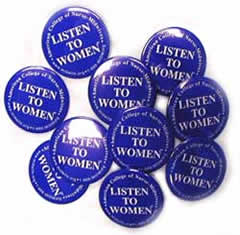
At the 2007 LLL International conference in Chicago, I picked up several of these great "Listen to Women" buttons from the ACNM booth in the exhibit area. I love them. Isn't this what it is all about? So simple and yet so profound. Imagine how the world would change if we just listened to women.

One had an atmosphere of respect, caring and trust; the other had a “climate of doubt” throughout. The difference was a certified nurse-midwife (CNM). My commitment to homebirth midwifery often leads me to forget what a profound and true difference a caring CNM can make in a hospital birth. All the other hospital procedures can be present, but the care factor a CNM provides can transform a woman’s experience from powerless to powerful. Sometimes I forget how CNMs are poised to bridge the gap between home and hospital effectively. The US needs lots of them (not as subordinate “junior obstetricians”—but as expert guardians of normal birth in a hospital setting).

The details were similar in each birth. The babies were both almost 9 lb; a doula was present (same doula in both births); and the mother labored with an IV, spent a large portion of the labor in bed and had internal fetal monitoring. In the first birth (with the CNM), the mother even had several hours of Pitocin augmentation; in the second, with the obstetrician, she had no Pitocin until third stage. With each birth, the mother also had an extensive tear and long repair (a third-degree with the CNM, a second-degree with the obstetrician).

However, some things were very different.

When the mother said, “Can I have a birth ball?” the CNM said, “Yes,” and the obstetrician said, “Not until the baby has been monitored.” And then, “The baby doesn’t like that; you need to get back into bed.”

When the mother’s confidence waned, the CNM said, “You can do it. You are.” The obstetrician said, “I don’t think this baby is moving down.

When the mother said, “This is taking such a long time,” the CNM said, “I know. It is taking for-freaking-ever!” and everyone laughed (including the laboring mother). The obstetrician said, “I think we should consider a c-section based on your history. The baby is not moving down.”

The CNM said, “You have such strong muscles in your legs and bottom, do you exercise a lot? I think because you are so strong, you’re holding a lot of tension here. Try to let it go.” The obstetrician ironed the perineum until the mother screamed with pain.

The CNM waited. The obstetrician did another internal check.

In both, a baby was eventually born (the first after four hours of pushing, the second after a little over an hour). A strong, healthy baby. Vaginally and without pain medications. After the first birth—though she would have done some things differently—my friend felt triumphant, empowered, powerful, strong, capable, happy and proud.

After the second birth she felt abused, disappointed, ashamed, guilty, angry, assaulted, diminished, wounded and scarred.

I believe the CNM’s personality, attitude and basic belief that vaginal birth would work was the critical difference between these two experiences. These births dramatically, viscerally illustrated for me that no matter what else is happening around the birthing woman, we can control how we care for her.

Endnote: My friend went on to have her third baby at home in 2008. She pushed this baby out in fifteen minutes, with no tear, and she shone with her power.

Molly Remer, MSW, ICCE, CCCE is a certified birth educator, writer, and activist who lives with her husband and children in central Missouri. She is the editor of the Friends of Missouri Midwives newsletter, a breastfeeding counselor, a professor of human services, and a doctoral student in women’s spirituality. She blogs about birth, motherhood, and women’s issues at https://talkbirth.me/posts.


[1] Looking to nature, doula Penny Simkin practices the art of delivery, in The Seattle Times, Pacific Northwest Cover Story. Originally published March 23, 2008. Accessed April 27, 2009. http://seattletimes.nwsource.com/html/pacificnw/2004299467_pacificpenny23.html.

This is a preprint of A Tale of Two Births, an article by Molly Remer, MSW, ICCE, published in Midwifery Today, Issue 91, Autumn 2009. Copyright © 2009 Midwifery Today. Midwifery Today’s website is located at: http://www.midwiferytoday.com/

Woman Rising

No time for a long post today (or, probably, this week), so I share this quote I had saved from the book A Dozen Invisible Pieces by Kimmelin Hull (p. 229):

When faced with behavior battles, health concerns, family finances, and the struggle to stretch time to the fullest, I could choose to sink into the quicksand of life with young children–becoming engulfed in the daily grind, unaware of my own loss of self–or I could rise to the occasion. And I am rising.

Hull goes on to share the following:

Whether it be the thick memory of enduring a non-medicated labor and finally pushing our third child into the world, despite feeling as though I hadn’t an ounce of energy left, or the meager sprint I managed as I neared the finish line of the marathon…, I hold tight to these images as proof that I can and will be able to rise to the occasion–again and again, if and when I need to-because the ability to do so is in my very bones. Because I am a woman.” [emphasis mine]

The birth face, immediately following birth of second son. This feeling--this crying, laughing, euphoric, I DID IT, feeling is the one I draw upon in the rest of life.

This is one of things I find so powerful about women’s birth memories—they can hold onto them as a touchstone, as an affirmation of strength and personal capacity, during other challenging (or mundane) moments of their lives. I also don’t think births have to be “empowering,” natural, or unmedicated births in order to hold this affirmation for women. There is a lot of courage to be found in most birth journeys and the ability to find moments of powerfully conscious strength to draw nourishment from in the rest of life exists in many types of birth experiences. Personally, my birth experiences created a lasting sense of personal worth, that I have drawn from ever since. This includes the birth of Noah, which was not a “happy ending” to my pregnancy. In the months after his birth, I found myself at many times thinking, “I gave birth to my little, nonliving baby alone in my bathroom, I can do this too.” I did the same with the births of my other two boys—only thankfully without the “nonliving” part. Alaina’s birth is more “integrated” somehow, and I don’t find myself thinking about it or referring to it in quite the same way, though I’ve definitely had moments of remembering, “I caught my own baby, I can do this too!

Bits of the month

I’m trying something new—a weekly (or monthly) wrap-up sort of post where I share bits and pieces that don’t warrant full posts and that allow me to share personal type things about homeschooling and so forth as well as just random thoughts and ideas and material for my personal memory archives. I’m inspired to do this by Molly Westerman’s always interesting links for thoughts posts and by a blog I stumbled across recently called The Holistic Homeschooler(she does a weekly “homeschool mother’s journal” post).

So…here goes…

What I’ve been up to

Me = grading papers and final exams. The last day of the session is today

What boys have been up to

They both enjoy playing Minecraft to an almost obsessive degree. This week they’ve been working on plans for programming mods for the game and setting up sort of mock worlds with things they’d like their mods to have. Lann worked on a Batman themed mod and Zander’s is about “hunchback zombies” (many of whom are holding cakes).

New dog Dagger!

They’ve been making movies for the last several months in a very dedicated manner that I’ve really enjoyed observing. Over 300 video clips have been filmed since this new project began. And, then, this week, the perhaps inevitable happened—they dropped and broke my camera. It was around $300, but I quickly realized that I didn’t have any grounds to be mad at them (despite the fact that they’d been carefully instructed to always keep the strap around their wrist and to be careful). When you give 8 and 5 year old’s free reign with a camera, breakage is definitely a possible side effect. I also try very hard to remember the people before things mantra. So, now their extensively movie making projects are on hold until we figure out a replacement. I’m thinking a low cost kid-friendly, video-capable camera and an adult camera might be the most logical plan.

They buzz with ideas constantly. Lann’s big project idea this week was for a virtual reality helmet. Mark and I both struggle with the balance between expressing interest in his ideas and offering reality checks. It can be extraordinarily exhausting, truly. The other thing they came up with is a cartoon strip about “Poo Log Dog.” This is based on their intense dislike of our new little dog, Dagger, who showed up skinny and starving last month and is now part of the family. I like him, which is a real shocker, because dogs are not my favorite. The boys are less enraptured.

We’re back to our no artificial colors experiment which seems to have a drastic impact on Z’s rage fits, Lann’s teasing, and their cooperation with each other. We’ve had days and days of happy playing, bright energetic faces and ideas, and very little discord or meltdowns.

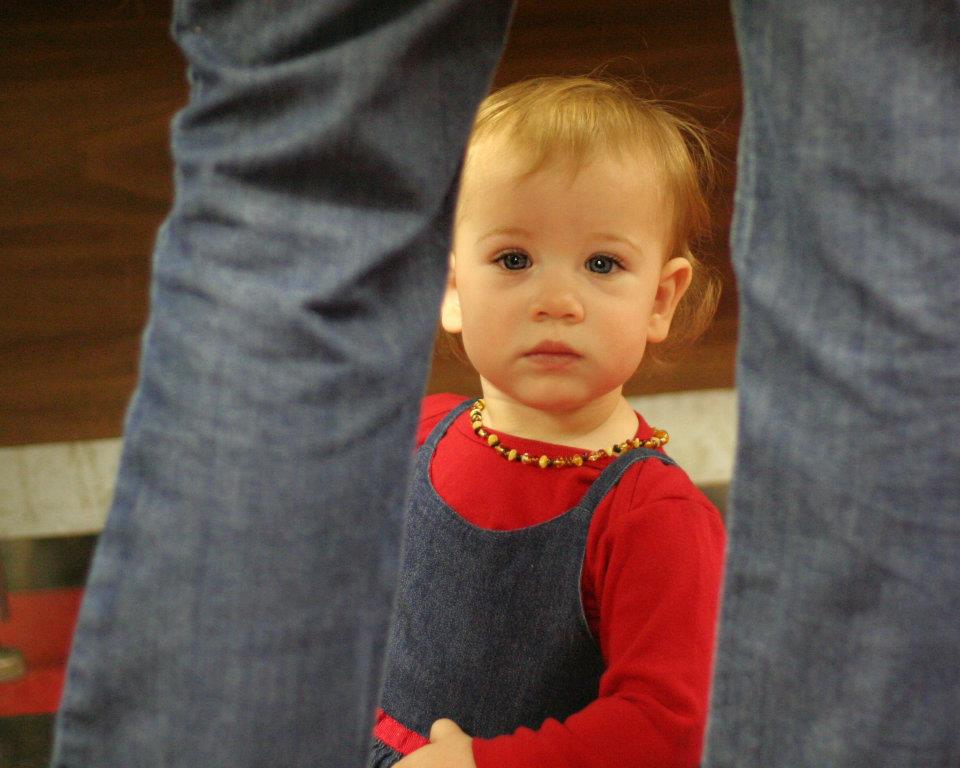
I love this baby's eye view picture taken by my friend at the playgroup Valentine party last month.

What baby has been up to

Walking more and more—I think we’ve almost seen the last of the crawling baby and the funny little one foot on ground, one leg down scoot-drag-crawl.

Climbs up on couch and onto stepstool in bathroom

Walks unsupported outside

Loves outside—loves so very much.

Likes to do mischievous stuff on purpose and stare at person til they notice and then squeal/yell while staring in their eyes.

Makes addle, addle, addle sound with tongue. Still uses adorable, “hmmm?” question-intonation sound to ask for or about things. Says Dagger, dog, Daddy, dragon, and quite a few other things. Refuses to perform any of them on command.

Loves to spin! In hammock swing outside, on Sit n Spin toy, dancing with brother. (A long time ago, pre-kids, I went to a workshop on play therapy. One of the speakers maintained that you should never bounce or rock or jiggle a baby, because it predisposes them to become addicts later in life—i.e. they start to like the feeling of having a “scrambled brain” and seek out that stimulation. It is amazing how certain, seemingly small experiences can leave a powerful legacy that cast a shadow on happy moments!)

What Mark has been up to

The man is quite focused on his plans for an aquaponics system. Is drawing plans for the greenhouse and figuring out supplies to buy. Planning to take a week off soon to focus on building it. We’ve also been doing our work party with a group of four friends. We take turns working on each other’s homesteads on alternate weekends. It has been a really good, community-building experience.

Homeschooling report

I finally did a Cartesian diver experiment (about buoyancy and air pressure) with the boys and it worked perfectly. While we did so, Alaina mashed her breakfast and a fruit leather into a cup of water.

I also signed them up for Studyladder. Jury is still out on whether this was a good plan. The graphics and style seem “primitive” in a way, like they were programmed in the late 90’s. However, I like it because they have math and science and counting in other languages, as well as reading. It seems much more comprehensive and full scale. Lann has also been wanting to work on his Click N Read Phonics lately and Zander has been doing Reading Eggs (still our favorite) and occasionally Starfall (we pay for the “more” version). Jumpstart we’ve let go, because even though it has really cool graphics and features, we can rarely get it to start up without crashing/freezing/or being generally frustrating.

I’ve been trying to find a good new book to read aloud to them. We keep reading the first chapter of various (free Kindle) books and then deciding we want something different.

This week (month) in blog news

I hit the 200,000 hit mark! That is pretty good for something that started out only intended for a local audience. I checked my annual stats too and noticed that in 2008 (my first full year of blogging), I had 8,000 hits during the entire year. Just this past week, my All that Matters is a Healthy Husband post had 8,000 hits by itself. ;-D Another new post that had a lot of shares and views was the Spontaneous Birth Reflex. I was happy to finally write it and also its related companion piece about the Rest and Be Thankful Stage of labor. My Honoring Miscarriage discussion and giveaway are still open too.

What’s on my mind

I am nearly speechless and also horrified about the current political obsession with contraception. This isn’t about birth control it is about woman control. I can’t stand it! And, I do not consider contraception to be a “women’s issue,” it is a human issue. Last time I checked, men participated in sex too. And, they too, desire a size of family that is compatible with their other needs (financial, personal, whatever). Likewise, many, many happily married, monogamous couples choose to use birth control and ; enjoy being able to have sex without procreating. It would be bizarre to characterize a man’s desire to be responsible for his own fertility as, “being paid to have sex all day.” It is equally bizarre to apply this claim to women.

In my work for my doctoral classes, I focus extensively on body politics, reproductive rights/politics, feminism, women’s rights, and personal autonomy as well as the historical and sociopolitical context of these issues. Since I live in a conservative area and have a “public” reputation to maintain, I shy away from addressing any of these subjects in depth here (I’m very googleable by students and prospective clients—heck, this blog was originally intended exclusively as a business tool for my local clients). However, in an ironic twist, that is exactly the kind of social control/inhibition/silencing/oppression of women that I am so passionate about addressing in my doctoral work. In fact, my dissertation is going to be about a thealogy of the body and how women’s bodies are the very terrain upon which patriarchal religious structures are built and maintained.

What I’m reading

I just finished reading The Hunger Games for book club—gobbled it up in a couple of hours—and I’m in the middle of the second one. I also finished reading Sisters Singing which is anthology of women’s prayers, blessings, songs, and readings. I read it over the course of several months in short segments during my daily meditation/altar time. I also finished reading Daughter of the Forest (also for book club) and Nobody Girl (don’t bother) and I am Woman by Rite: A Book of Women’s Rituals. I’m currently reading Peggy O’Mara’s Way Back Home collection of essays. The boys and I are listening to the sixth Harry Potter book on tape while in the car. I really love doing this! I less love realizing that by the time we finish we will have spent a minimum of 19 hours in the car. Whew. When I’m on my own I’m listening to Trickster’s Choice by Tamora Pierce, one of my favorite childhood authors who wrote The Song of the Lioness Quartet, which is where I got Alaina’s name (I guess when I was approximately 12). I recently finished re-listening to Two for the Dough and Three to Get Deadly by Janet Evanovich.

Articles I’ve enjoyed

Breastfeeding support: less is not more

What an awesome logo for the upcoming LLL of Illinois conference!

“I feel saddened by the alarming regularity at which women give up their desire to breastfeed because breastfeeding is not the ‘best’ way to feed babies. It’s the normal way. The idea that breastfeeding is somehow extraordinary persists because we live in a culture where very limited paternity leave is normal, where an expectation to continue cooking and cleaning and exercising and socialising in the post partum weeks and months is normal, and where a perception that unpaid work (especially if it is physical and monotonous) is pointless drudgery is normal.”

Breastfeeding – Does Science Mislead Parents & Professionals?

A clear majority of public opinion in the United States supports the view that ‘breastfeeding is healthier for babies’, yet substantially more than half of the surveyed population disagree that ‘feeding a baby formula instead of breastmilk increases the chances the baby will get sick’.

If exclusive breastfeeding was the norm against which other methods are measured, breastfeeding would not be ‘protective’ and breastfed infants would not enjoy ‘lower risks of ill health’; they would instead be referred to as ‘normal’, while formula fed infants are in fact ‘exposed’ to increased risk of poor health and development.

Also enjoyed this post from The Minimalists about turning off the internet at home. Since we live out of town and I work from home teaching online AND since it is super important to me to have a home based life, it wouldn’t make any sense for me to shut off the internet at home and drive into town to use it, but for a while after reading this article I fantasized about it.

And, this inspirational short post from Roots of She.

And, some pictures:

20120229-181538.jpg

This heart-meltingly adorable sight met my eyes as I sneaked away from Alaina's napping self this week.


20120229-181550.jpg

Tiny, independent nature girl!


20120229-181640.jpg

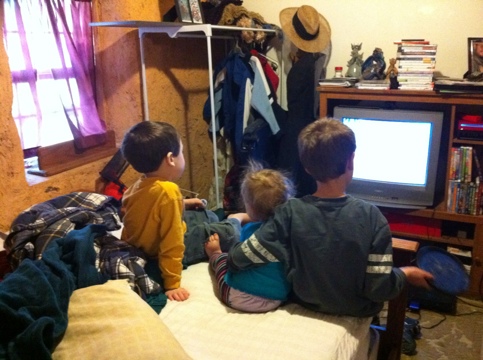
Sweet sibling moment even though I lose crunchy points because they're watching a movie (it is Kipper though)


20120229-181708.jpg

Yes, we have a michief-maker in the house!

I have about 14 others things I was going to include, but forgot about, such as the fact that we had our first local birth network meeting in February and I feel really good about it. But, now this post is terribly long and cumbersome anyway. I’m too wordy to do a bits and pieces type post, I guess! I thought it was going to be short and simple—instead it took several hours over the course of multiple days to get ready to post. Sheesh!

Birth Quotes of the Week

Quotes that recently caught my eye…

Your own wisdom is more powerful than anything you see around you. The price for living your dream is facing your deepest fear; ask yourself ‘What am I afraid of most?’ Facing your answer is the price of greatness.“–@Roots of She

“In acknowledging woman-to-woman help it is important to recognize that power, within the family and elsewhere, can be used vindictively, and that it is not only powerful men who abuse women; women with power may also abuse other women.” –Sheila Kitzinger

A woman who is enjoying her labor swings into the rhythm of contractions as if birth-giving were a powerful dance, her uterus creating the beat. She watches for it, concentrates on it, like an orchestra following its conductor.” –Shelia Kitzinger

“If you have never been called a defiant, incorrigible, impossible woman… have faith. There is yet time.” –Clarissa Pinkola Estes (via @Roots of She)

Pregnancy is a uniquely intimate relationship between two people. All of us luxuriate in this relationship once, and half of us are lucky enough to be able to do it all over again a second time, from the other side as it were. Never again outside of pregnancy can we be so truly intwined with someone else, no matter how hard we try.” -David Bainbridge

“We must not, in trying to think about how we can make a big difference, ignore the small daily differences we can make which, over time, add up to big differences that we often cannot foresee.” –Marian Wright Edelman

Reading this last quote made me remember my Small Stone Birth Activism article and so I posted it yesterday!