Archives

Birth Strength

“Women are strong, strong, terribly strong. We don’t know how strong until we are pushing out our babies. We are too often treated like babies having babies when we should be in training, like acolytes, novices to high priestesshood, like serious applicants for the space program.” –Louise Erdrich, The Blue Jay’s Dance

This is one of my favorite quotes to share at blessingways. The Blue Jay’s Dance is a memoir of the writer’s first year with her third baby (sixth child). She isn’t particularly a birth advocate, the book is a general mothering memoir, but at one point she says the above and I love it. Though, I should note that I think there are all kinds of strengths to be found in birth—not just in pushing out a baby. One can experience “terrible strength” in coping with an unexpected cesarean also. And, of course, womanpower can also be found in other non-birth experiences. When I shared the quote on Facebook, some people commented that they hated it or that it was offensive. I have been surprised by how very personally some of the  birth quotes I post on Facebook are taken. There have been several occasions where I’ve felt so upset about it that I thought maybe I should never post quotes ever again! (now who’s taking something too personally? ;)). Then, I realized a strong personal reaction is normal, because birth is such a strong and personal issue, so now I try to be extra mindful of the subtexts that might be perceived in a quote (regardless of original intent) and clarify that below the quote. I truly think the intent in this one is of the potential to discover our own hidden strength via birth, not to say that birth is the only powerful experience available to women. I know that I draw on my “birth strength” in other important moments in my life. I also realized after the miscarriage-birth of my third son that the strength found in birth is present in women, period. It is woman strength and it rises up during birth, but it is always there.

During a recent women’s retreat we reflected on sources of personal power and how we feel when we are standing in our personal power (this question comes from a fabulous book, A Mother’s Guide to Self-Renewal). When I first considered this question, I was somewhat sad to discover that the only instances of personal power I could come up with from giving birth—it would be nice to have piles of personal power experiences! More reflection revealed that I also feel like I’m standing in my personal power when I teach. Not a sense of “power over,” but in power with. More freshly, I’ve realized that I find personal power in Goddess spirituality/images and ideas of the Divine Feminine. And, I also experience personal power when I am alone. I feel most whole and authentic when I am just by myself. I like quiet space in my own head in which to think and I also enjoy my own company 🙂

“A woman meets herself in childbirth” –Cynthia Caillagh

Each time I gave birth I realized I was a pretty amazing person with inherent worth and value. The woman that I met in birth was very strong and very capable and very focused. And, she is me.

I hope my baby girl grows up standing in her own personal power and having a profound sense of her own worth.

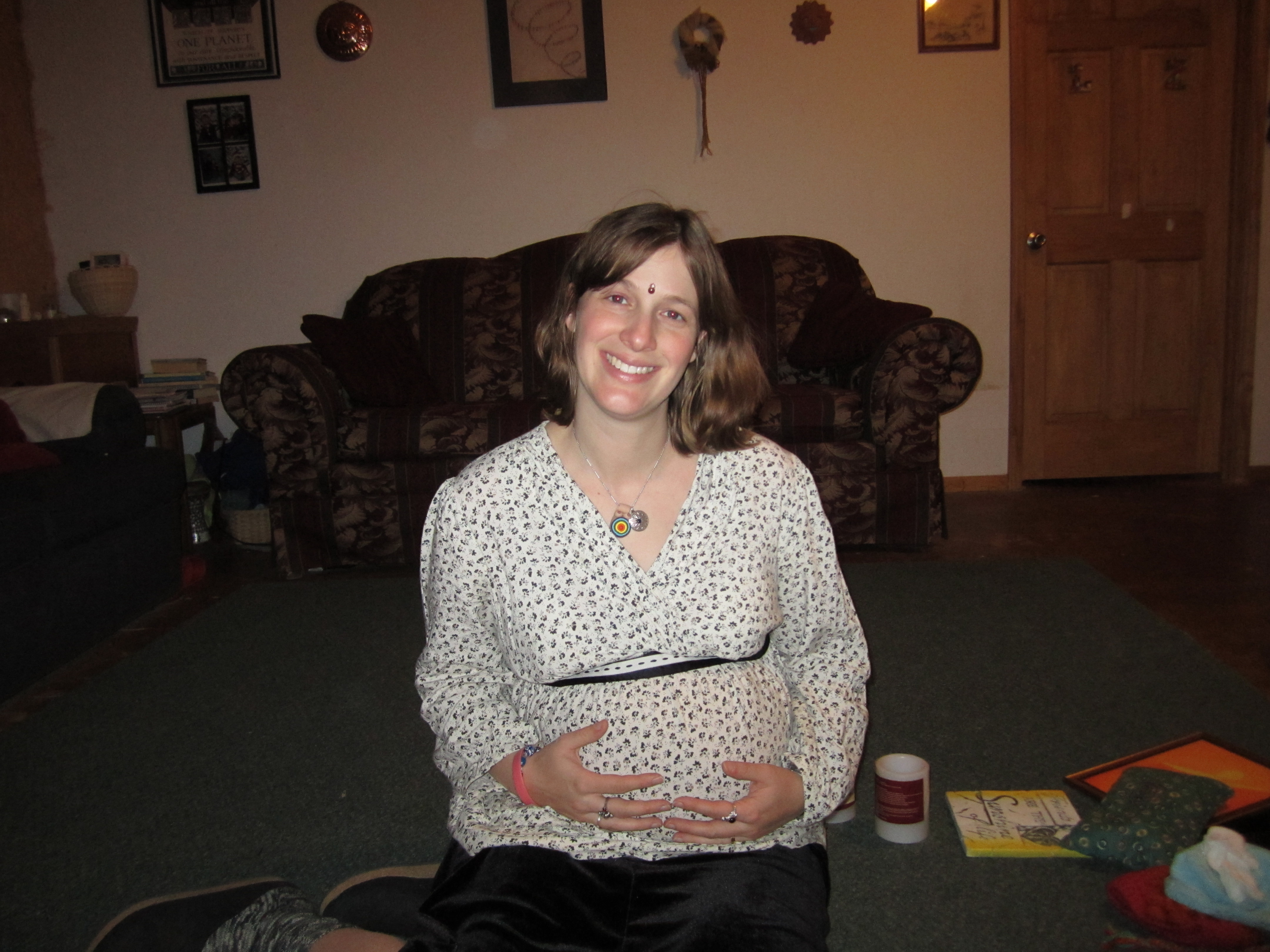
Baby's First Bindi--taken at a recent blessingway for my good friend

Responsive Readings for Women’s Rituals

As I noted in my previous post, I’m choosing some readings for an upcoming women’s retreat. Our theme for the spring is “personal power” and so these responsive readings from the book Readings for Women’s Programs by Meg Bowman and Connie Springer seemed perfect to me. The capitalized (or italicized) sections are read in unison by the group and the non-capitalized/italicized sections are read by the facilitator. I think they could work for any type of women’s ceremony (blessingways, etc.):

Self-Love

At my blessingway for my second son, May 2006

Self-love is respecting my own uniqueness,

my creativity and my talents.

LEARNING NEW SKILLS,

BEING ASSERTIVE

HAVING CONFIDENCE IN MY ABILITIES

Self-love is acknowledging my good qualities

and following my own guidelines.

SURROUNDING MYSELF WITH PEOPLE

WHO NOURISH ME AND ENHANCE MY SELF-ESTEEM.

Self-love is taking time to enjoy each day.

SURROUNDING MYSELF WITH COLORS AND BEAUTY,

GIVING PLEASURE WITHOUT GUILT

KNOWING THAT I DESERVE THE BEST

Self-love is loving and respecting my body.

REALLY TAKING CARE OF MYSELF

PHYSICALLY AND EMOTIONALLY,

GENTLY AND LOVINGLY

Self-love is seeing myself equal to others,

accepting myself and letting myself win.

NEVER PUNISHING MYSELF

OR HARMING OTHERS

TURNING MY NEGATIVE THOUGHTS

INTO POSITIVE ONES.

The more I love myself,

the more I can love others

and the more others will return my love.

SELF-LOVE

IS BEING MYSELF

AND ENJOYING MY LIFE.

Blessed be.

—-

To Be

BE healthy enough

To live each day to the fullest

BE strong enough

To know that I cannot do everything alone.

BE wise enough

To realize I don’t know everything

BE courageous enough

To speak my mind and to change my mind

BE understanding enough

To listen to those with differing views

BE secure enough

To reveal my own unique personality

BE generous enough

To assist those who need my help

BE frugal enough

To take care of my own needs

BE realistic enough

To let go of the past and live in the present

And above all, BE loving enough

To BE loved

To BE happy

To BE whole

To BE myself.

Blessed Be.

Blessingway Readings & Chants

I’m looking through my files to choose a reading for a mother blessing this weekend as well as choosing readings for a women’s retreat this weekend. Anyway, I felt like sharing some of them here for people who might be googling around looking for something to share at a blessingway:

From the book Joyful Birth: A Spiritual Path to Motherhood by Susan Piver

The path of motherhood has a beginning, but no end. It’s constantly changing and constantly challenging. Along the way, we encounter our personal limits over and over. We fall in love over and over. We ride the sharp edge of hope and fear. On this path of discovery, as on any spiritual path, our pretensions are shattered, our minds are blown, and our hearts are opened. We cry, we laugh, we bumble around and make countless mistakes. Through it all, we are gently—or abruptly—poked into greater honesty, lovingkindness, and understanding. It is a truly joyful path.

The memory of [my child’s] birth has become a talisman that I hold in my heart as I journey deeper and deeper into motherhood. For these moments come again in every mother’s life—the times when we are asked to walk straight into our pain and fear, and in doing so, open up to a love that is greater than anything we ever could have imagined: all life’s beauty and wonder, as well as all the ways that things can break and go wrong…Again and again, motherhood demands that we break through our limitations, that we split our hearts open to make room for something that may be more than we thought we could bear. In that sense, the labor with which we give birth is simply a rehearsal for something we mothers must do over and over: turn ourselves inside out, and then let go.

This is the reading we often use for symbolically summoning the four directions. It is from the book  Mother Rising: The Blessingway Journey into Motherhood:

Blessed be this gathering with the gifts of the East: communication of the heart, mind, and body; fresh beginnings with each rising of the sun; the knowledge of the growth found in sharing silences.

Blessed be this gathering with the gifts of the South: warmth of hearth and home; the heat of the heart’s passion; the light to illuminate the darkest of times.

Blessed be this gathering with the gifts of the West: the lake’s deep commitments; the river’s swift excitement; the sea’s breadth of knowing.

Blessed be this gathering with the gifts of the North: firm foundation on which to build; fertile fields to enrich our lives; a stable home to which we may always return.

From previous posts here is:

After my blessingway with baby girl, January 2011

A birth blessing

Full moon poem

Courage reading

Fear release for birth

Birth warrior affirmation

Two birth poems

Birthing poem

And, finally, here is a handout of the chants we often use. It is formatted with the chants in two columns so it can be cut in half to distribute.

International Women’s Day, Birth Activism, and Feminism

“The minute my child was born, I was reborn as a feminist. It’s so incredible what women can do…Birthing naturally, as most women do around the globe, is a superhuman act. You leave behind the comforts of being human and plunge back into being an animal. My friend’s partner said, ‘Birth is like going for a swim in the ocean. Will there be a riptide? A big storm? Or will it just be a beautiful, sunny little dip?’ Its indeterminate length, the mystery of its process, is so much a part of the nature of birth. The regimentation of a hospital birth that wants to make it happen and use their gizmos to maximum effect is counter to birth in general.” –Ani DiFranco interviewed in Mothering magazine, May/June 2008

“We were all held, touched, interrelated, in an invisible net of incarnation. I would scarcely think of it ordinarily; yet for each creature I saw, someone, a mother, had given birth….Motherhood was the gate. It was something that had always been invisible to me before, or so unvalued as to be beneath noticing: the motheredness of the world.” –Naomi Wolf, Misconceptions

Since tomorrow is International Women’s Day, I felt moved to share the above quotes. I also wanted to touch briefly on birth as a feminist issue, spurred by this thought-provoking post by my friend Summer (I have TONS more ideas about this topic, but limited time in which to share them!). Personally, I’ve identified as a feminist since I was a child—long before I became a birth activist. Identifying in this way was my first taste of the activist spirit that has fueled me for the rest of my life. For me, my birth activism is intimately and inextricably entwined with my larger interest in women’s rights. I have always been somewhat confused to hear any woman say she is not a feminist, it grieves me because when you dig a little deeper, it is usually because they are defining feminism according to a very skewed, simplified, inaccurate, media misportrayal of feminism (i.e. a man-hating caricature). I also like the term “womanist.” To me, being a feminist most simply means believing and acting as if women have value. All too often, those who mischaracterize feminism in the above ways believe EXACTLY the opposite.

In one of my many books about women’s issues, I found these awesome explanations of what feminism is—the source being of some surprise to me, the Roman Catholic Order of Sisters of Loretto:

Feminism: a world-wide social change movement which critically but lovingly rejects relationships and structures based on stereotyped roles of dominance (male) and submission (female).

Feminism: a life-affirming movement reorganizing institutions and relationships, so that women will have equal access to society’s goods, services, status, and power.

Feminism: the bonding of women discovering the joy of woman-identity.

Feminism: a process freeing women to work toward liberation for themselves and other oppressed persons.

And here is another definition: “Feminism is a conscious and continuous effort to improve the lives of all women, an effort which requires changing the system that defines success as making a lot of money.” –Jane O’Reilly

To me it also means defining all women’s work, paid or unpaid, as having real value (this includes the “invisible” work of mothering reflected in the second quote I chose to open this post).

I think all of these definitions can be well applied to our work with birth!

I  also think some women who do not self-identify as feminist do not because they feel like, “feminists want women to be like men.” So, here is a feminist quote about that too 🙂 “A woman should not be a mirror image of man’s universe. A woman should not try to emulate men, thus taking on masculine traits, she should develop herself, realize herself, gain direct vision into her own being.” —Anais Nin

I love the final point especially—gain direct vision into her own being. I think empowered birth often triggers this for women.

Net of love in action!

And, then finally, bringing us back to International Women’s Day I have a final quote:

“I believe that these circles of women around us weave invisible nets of love that carry us when we’re weak and sing with us when we’re strong.” –SARK, Succulent Wild Woman

As I noted in my post for CfM this week, in honor of International Women’s Day—and every day—let us celebrate our bodies, honor our mothers, and trust in the nets of love woven around us by a multitude of remarkable, powerful, everyday women.

Planning for Postpartum

I have been meaning to share this article on my blog for a long time. Now that I’m rapidly approaching another “babymoon,” it feels like a most excellent time to review my own reminders about planning for postpartum!

—-

Planning for Postpartum

By Molly Remer, MSW, ICCE, CCCE

Originally published in The Journal of Attachment Parenting, 2008.

When my first baby was born in 2003, I had a made a classic new mother error—I spent a lot of time preparing for the birth, but not much time truly preparing for life with a new baby.

I had regularly attended La Leche League (LLL) meetings since halfway through my pregnancy and thought I was prepared for “nursing all the time” and having my life focus around my baby’s needs. However, the actual experience of postpartum slapped me in the face and brought me to my knees.

My son’s birth was a joyous, empowering, triumphant experience, but postpartum was one of the most challenging and painful times in my life. I had not given myself permission to rest, heal, and discover. Instead, I felt intense internal pressure to “perform.” I wondered where my old life had gone and I no longer felt like a “real person.” A painful postpartum infection and a difficult healing process with a tear in an unusual location, left me feeling like an invalid—I had imagined caring for my new baby with my normal (high) energy level, not feeling wounded, weak, and depleted. And yet, at five days postpartum I was at the grocery store, at seven days at the post office resuming shipments for my small online business, at two weeks attending meetings and fulfilling responsibilities with an organization (though I still had difficulty walking normally due to pain), at six weeks hostessing at a fundraising ball, and at eight weeks teaching a volunteer training workshop. In retrospect, I have no regrets about how I cared for my baby. He was always with me and I was sensitive to and responsive to his needs. What I regret is how I cared for myself, what I expected from myself, the demands I placed upon myself, and how I treated myself.

I actually slightly delayed having a second child, not for fear of mothering two, but for fear of experiencing the overwhelm of postpartum again.

In 2006, I gave birth to my second son at home. This time I had planned realistically and specifically for a “babymoon.” My husband took four weeks off of work and I stayed at home for the majority of the first month of life with my new baby. Though I again experienced an unfortunate tear and a painful recovery from it (which was still much quicker and less traumatic than the first time) and also some rapidly shifting mood changes along with some tears and anxiety, I look back on this time with my second son with fondness instead of regret. Instead of rushing to rejoin the world, I allowed myself the time, space, and permission to rest and cocoon, knowing that I would be “real” again soon enough.

Reflecting on my two postpartum experiences leads me to offer the following suggestions for postpartum planning:

  • Try to minimize your out of home commitments in advance. Put a hold on projects and “retire” from committees and responsibilities. I joke that with my first baby I thought I needed to get my responsibilities squared away for six weeks and with my second I realized I needed to try to get them squared away for two years.
  • Have a good book on hand about postpartum. When my first baby was born, I was well stocked with baby care and breastfeeding books, but none about the transition into motherhood. My favorite postpartum book is After the Baby’s Birth by Robin Lim. It offers such gems as, “you’re postpartum for the rest of your life” and “when the tears flow, the milk will flow” (with regard to the third day postpartum). Other good postpartum readings are The Post Pregnancy Handbook by Sylvia Brown and The Year After Childbirth by Sheila Kitzinger. A classic for support people is Mothering the New Mother by Sally Placksin.
  • Prepare and freeze a lot of food in advance. Batches of nutritious muffins are a favorite of mine—freeze them and the reheat one as needed for a quick breakfast or snack. These are great for nursing mothers!
  • Plans to spend three to seven days just in bed with your baby. Skin-to-skin is even better.
  • Everyone is familiar with the “sleep when the baby sleeps” advice, but even if you don’t feel the need to sleep, stay in bed and use the quiet time for reflection or to read or write in your journal. Rest is definitely essential every day, but it doesn’t have to be actual sleep to be restorative.
  • If you have other children, arrange for plenty of help caring for them. Do not feel like you “should” be able to handle them all right away. Of course, you could do it if you had to, but you and your new baby will benefit from an extended period of cocooning together. Plan quiet projects that you can do in bed with your older child while the new baby sleeps (a favorite with my older son was making puppets and masks out of felt. I cut them out while still lying down. He actually started calling our bed the “party deck” because we did lots of fun projects there while I was resting with the new baby. I have no idea where he got the phrase!).
  • Give yourself permission to rest and be off duty.
  • When people ask what they can do to help, give them a specific task (go grocery shopping, pick up pictures, bring me dinner, etc.).
  • Ease back into “real life.” Resist the temptation to catch up with email and so forth. Respond to email or phone requests for time or help with a firm, “I just had a baby and I’m not available right now.”
  • Become comfortable asking for help (I vastly prefer being the helper to being the helped and this is particularly hard for me).
  • Similar to a birth plan, make a written postpartum plan that includes a list of the people in your support network, arrangements for help with household duties (or a plan for what can be left undone), people to call for meals, and so forth. List what each person is willing to do—laundry, grocery shopping, cleaning, childcare, meal preparation (notice that “holding the baby so you can work” isn’t on the list!). An example postpartum plan is available on DONA International’s website.
  • If you have relatives coming to help after the baby is born, make sure they know that their job is to take care of you and the house while you take care of the baby. It is not acceptable for you to be fixing meals and sweeping floors while grandma “helpfully” rocks the baby—it needs to be vice versa!
  • Prepare your partner and anyone else in your support network that you will be Queen for a Month and let them know what you will need from them (also, get it fixed in your mind that being Queen is okay!).
  • Expect to be “nursing all day long.” It is okay and good for you both (10-14 nursings in 24 hours is perfectly normal and acceptable!).
  • Encourage your partner to take as much time off as possible—either saved up vacation time or unpaid FMLA time. He can benefit from an extended period of cocooning with his newborn too!
  • Explore the idea that postpartum can be a time of postpartum expression rather than postpartum depression—letting all of your emotions flow, expressing your needs clearly and assertively, and being aware of and accepting of your continuum of feelings are ways to be expressive. (This concept comes from the excellent, but little known book Transformation Through Birth by Claudia Panuthos.)
  • Plan a few special things for yourself—have a little present for yourself to enjoy during postpartum (a new book, good magazine, postnatal massage, whatever is self-nurturing and brings you pleasure. Personally, I do not encourage TV or movie watching because it can become a passive time filler that distracts you from enjoying your babymoon. Some people may include favorite films as their enjoyable postpartum activities though).
  • As postpartum stretches on, if you experience decreased libido, it is okay to honor and accept that.

Planning for a restful, nurturing, “time out” with your new baby is way to honor this new stage in your family’s life cycle and a way to honor yourself as a woman and mother. I hope you will create space in your life for a time in which vulnerability is accepted. Postpartum is a time of openness—heart, body, and mind. I hope your experience is one of tenderness and joy.

Molly Remer, MSW, ICCE, CCCE is a certified birth educator and activist. She is editor of the Friends of Missouri Midwives newsletter, a breastfeeding counselor, and the mother of two young sons and a baby girl on the way. She loves to write and blogs about birth at http://talkbirth.me, midwifery at http://cfmidwifery.blogspot.com, and miscarriage at http://tinyfootprintsonmyheart.wordpress.com.

This is a preprint of Planning for the Postpartum Period an article published in The Journal of Attachment Parenting Volume 11, Issue 1, pp 28-29. Copyright © 2008 Attachment Parenting International. API’s website is located at: http://www.attachmentparenting.org.

Mother Blessing Ceremony

Lots of good friend energy!

I keep wanting to post about my mother blessing/blessingway ceremony last week and I can’t quite manage to find the right words. So, I decided to share some pictures mainly and wait to see if more words will come…My mom hosted it at my home and 19 women attended (so, with me, a nice even 20). I don’t think there have ever been so many people in my living room! Early in this pregnancy I said I wanted to have the “biggest blessingway ever!” and it was a big one. A lot of my friends tend towards “small and intimate” for their mother blessings and while I definitely see the value to that too, it was really important to me to see and feel and know how many people in my life care about me and my baby and who have hoped with me and waited with me while I cautiously made my way to this time and this place. My mom said something about there being a lot of people here and I said, “yep, and I like them all!” My life has been touched/enriched by every woman in the room and it was very moving to look around the room and see them all here together. It was a very crying blessingway—they each stated their name and said, “I am here for you, Molly” and I was a wreck! I really felt like it was one of the best days of my life and was just what I needed. I felt so well-cared for and loved and full of emotion. I thank each one of them for being here for me and for loving my baby with me.

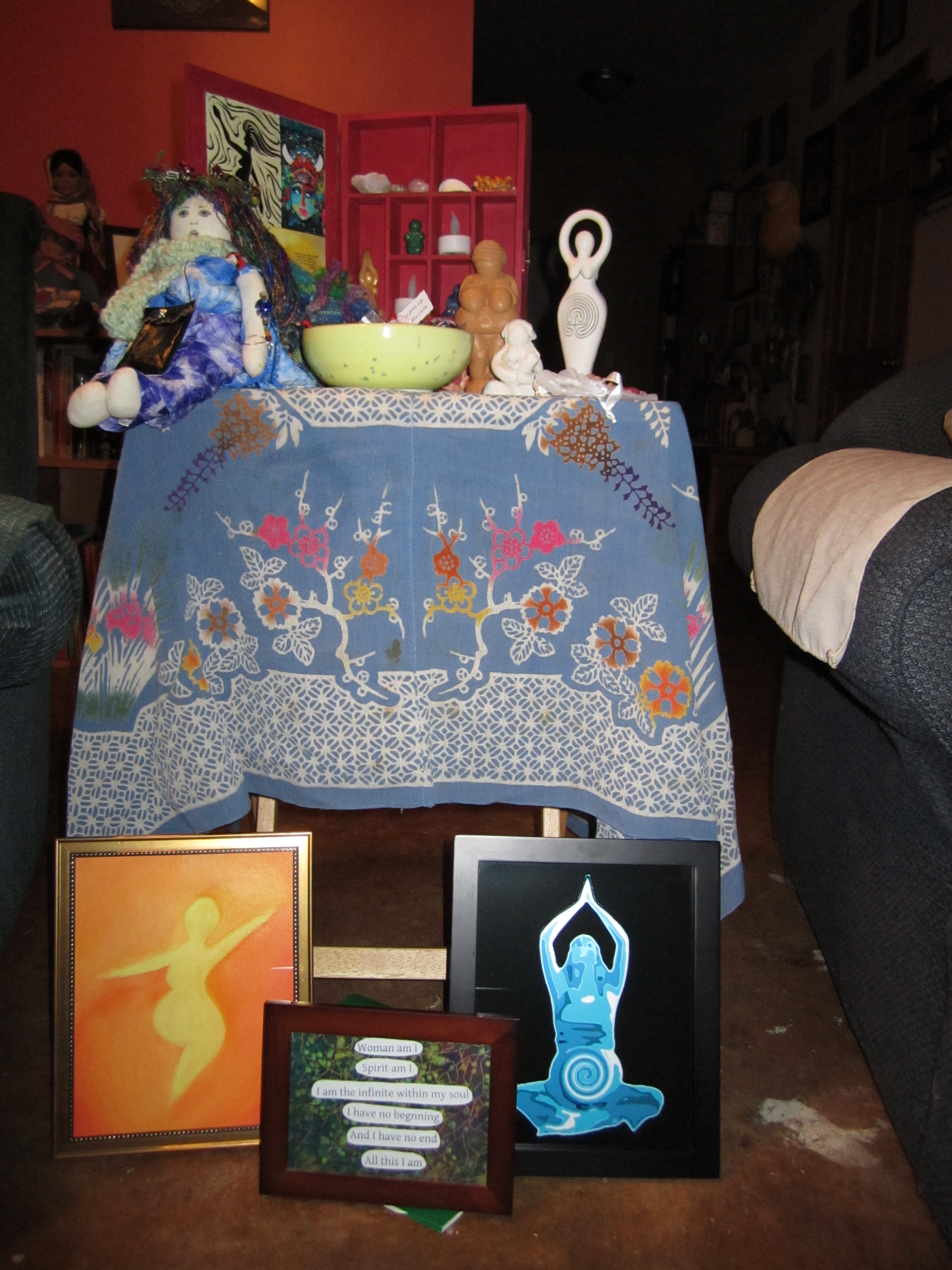
Birth altar table with many lovely new additions!

Birth doll adorned with small items from all the guests.

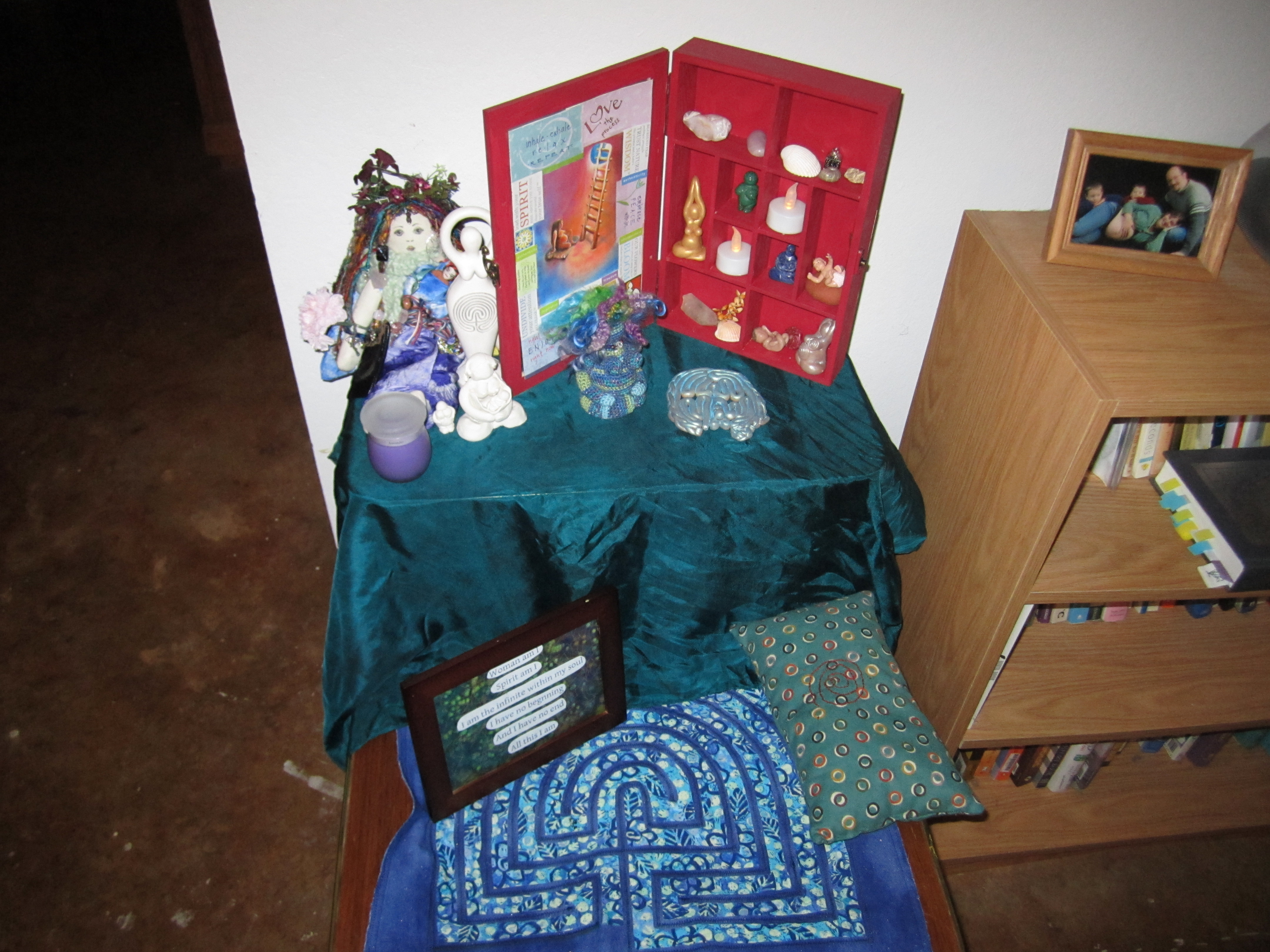
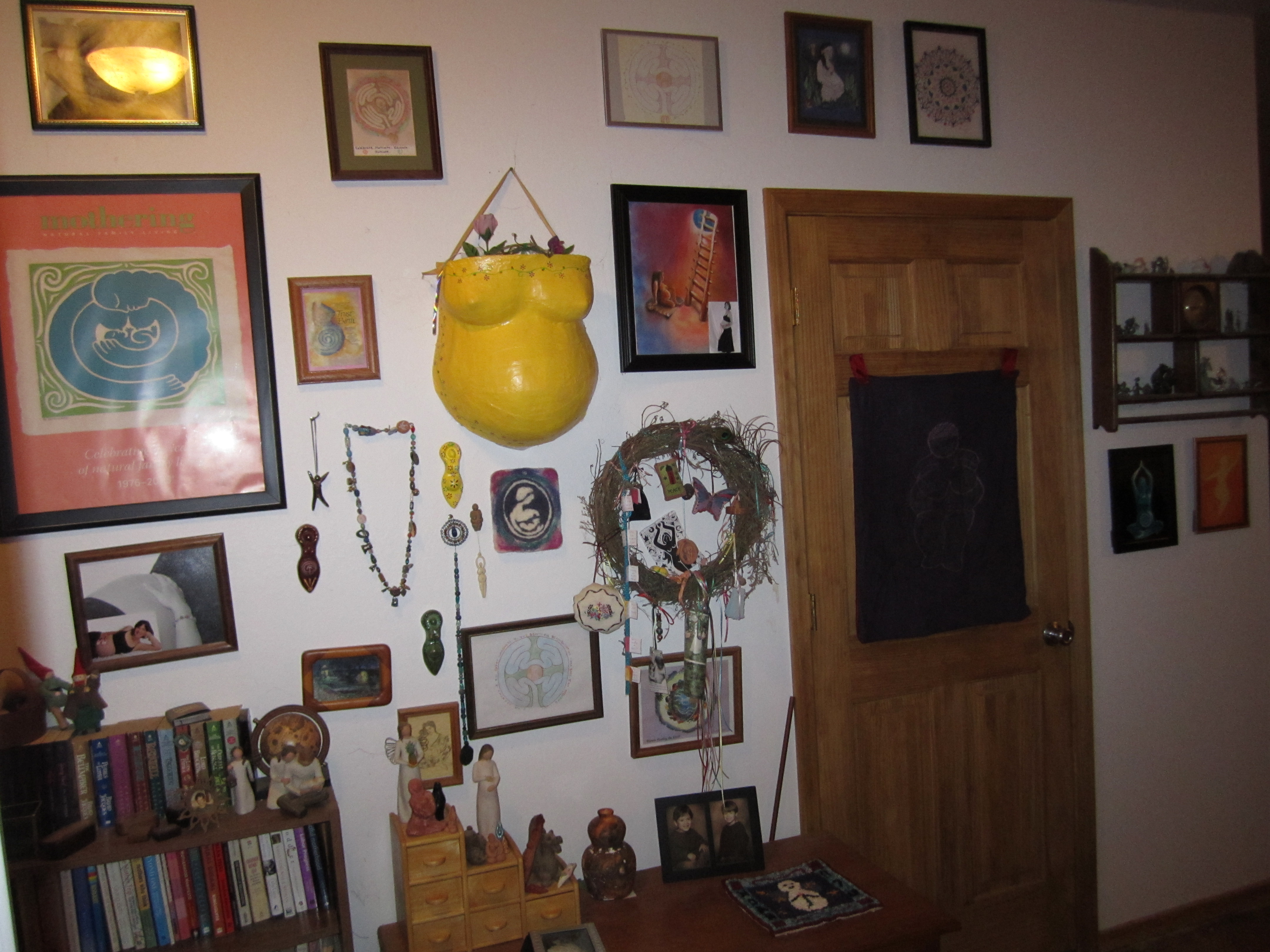
After the ceremony, I set up a different table close to my "birth nest" spot.

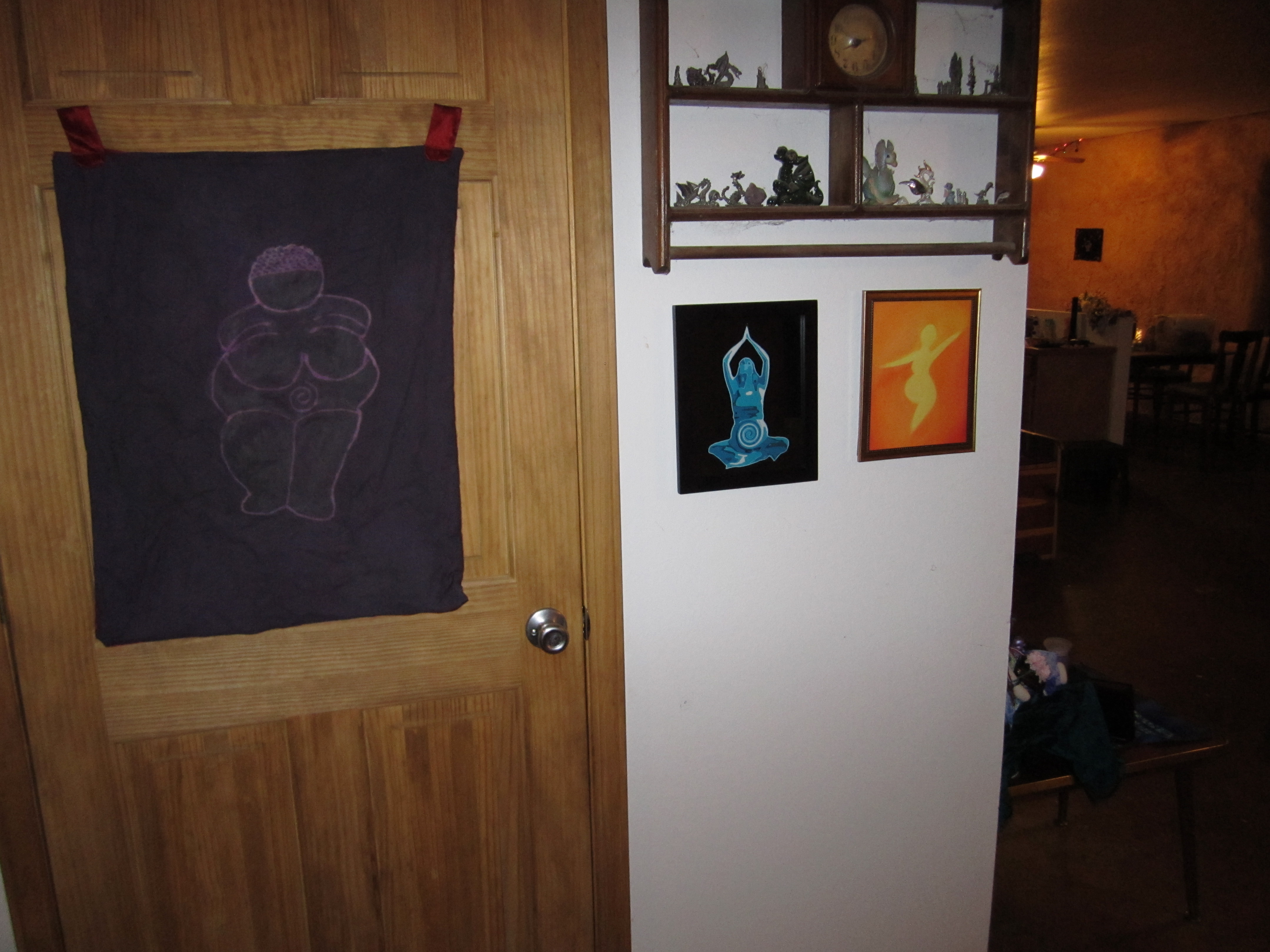
I hung these three lovely birth art pieces on the wall right around the corner from my little table. The Willendorf wallhanging is from my friend Trisha, the super cool photo from my friend Karen, and the firey pregnant woman painting from my lovely future sister-in-law, Jenny.

My whole birth art wall/gallery.

I wish I would have taken a picture of all the lovely and tasty food that was there for our feast as well! It was a beautiful, special day and felt like an amazing launching point on my upcoming birthing journey 🙂

Birth Witnesses

Birth Witnesses

Guest post by Bonnie Padgett

In this so-called Age of Information, we have iPads and smart phones, mega computers and micro chips, and a world of knowledge at our fingertips.  We are not limited by the resources in our community when we can reach out to virtual communities that span the globe with the touch of a button – forums full of ideas, innumerable news sources, websites for all schools of thought and up-to-the-minute research from leading experts in every field.

So why, then, are new and prospective mothers still so naive when it comes to the act of childbirth?  Why, despite our best efforts to educate ourselves, are we still in the dark about the whole process until those contractions hit and we begin the journey through labor ourselves?  I, myself, was included in this group, although I did everything I could think of to educate myself prior to my daughter’s birth.  I read books on what to expect, took classes hosted by my hospital, toured the birthing facility, joined an online forum of moms, and Googled everything I could think of related to pregnancy and birth.  I spent months practicing Hypnobabies for a natural birth, discussed my wishes in detail with my doctor, and, after studying ample examples and recommendations, formed a ‘birth preferences’ list for the doctor and hospital.  I knew what I wanted and what I didn’t want when it came to birth.  At the same time, I knew my “plans” would likely not go as expected, but was prepared to make informed choices along the way.  I had ideals and contingencies, preferences and plan Bs.

However, when all was said and done, I found myself totally unprepared for the experience of labor itself.  I had read about contractions, witnessed videos of women in labor, seen and practiced techniques for comfort and relaxation.  None of that prepared me for the anxiety and unknowns that flooded my mind as my body began its natural next steps.  I realized just how little I knew about the hours ahead.  How uncomfortable I would feel with nurses and midwives going about the “day to day” routines of their jobs, and by doing so how secondary I would feel to the process.  How defenseless I would feel to contradict or decline an expected treatment, especially under the medical staff’s disapproving glares, and with no one to support clueless me and my equally unknowing husband.    While a doula certainly would have helped in easing my fears and strengthening my resolve, I think my inability to grasp what I was a part of, indeed, the central part of, would have still left me bewildered and terrified in those hours.

After my daughter’s birth, I found myself struggling to comprehend what had just happened to me.  Although everyone assured me this was a fairly ‘normal’ labor, I had no point of reference on which to base that comment.  I realized the short video clips online and in class captured only key moments in a much longer, more complex and nuanced process.  Those huge gaps left in my knowledge of labor are what left me so unprepared to defend myself and my baby against treatments I didn’t want, didn’t need, and had previously decided against but found myself, in the moment, succumbing to.    I tried discussing it with my mom, who explained that she’d felt the same way when she had me (her first child).  She concluded the only way to truly understand birth was to experience it yourself.

The only way to understand birth is to experience it yourself.  The ONLY way?  That comment stayed with me, haunted me.  I became a doula after my daughter’s birth because I wanted to be able to provide women with support and knowledge that could give them a different experience, a better memory than what I had.  I just couldn’t believe that there wasn’t a way to understand birth at all except to experience it firsthand.  Certainly there wasn’t always this fear and unknown around birth that we each face today.  Not always.  I began studying that idea.  What about other cultures?  What about our culture, historically?  What about The Farm?  There wasn’t always this myth and mystery about birth!  I realized there was a time (and in places, there still is) when women banded together for births.  Mothers, sisters, cousins, daughters, aunts, friends.  They came together and comforted, guided, soothed, coached, and held the space for one another during birth.  These women didn’t go in it alone – they were surrounded by women who had birthed before them.  Women who knew what looked and felt right, and what didn’t.  Women who could empathize with them and empower them.   In addition to that, girls and women were raised in a culture of attending births.  Daughters watched mothers, sisters and aunts labor their babies into this world.  They saw, heard, and supported these women for the long hours of labor, so when they became mothers themselves, the experience was a new, but very familiar one for them.  Birth wasn’t a secretive ritual practiced behind the cold, business-like doors of a hospital.  It was a time for bonding, learning, sharing and sisterhood.  Girls learned how women become mothers, and mothers helped their sisters bring forth life.  It was a sacred and special part of the birthing process that has become lost in our institutionalized, over-medicalized, isolating and impersonalized system today.

While I certainly don’t expect us to throw our entire system out the window in favor of simpler times, I think the rush to technology and medical advances certainly left some essential elements of birth in its wake.  Elements such as women supporting women.  Listening to one’s body.   Intervening only when necessary instead of as a matter of protocol.  And perhaps, most importantly for us all, the community aspect of birth.   This has lead me to believe that in order to truly educate ourselves about birth, to improve the way we birth, and the way we prepare for birth and prepare our sisters and daughters for birth is that we need to provide the women we love (especially those of childbearing years) the opportunity to witness and participate in our births, because only when you are present for a labor and birth can you begin to fathom the process, the emotions, the physiological changes that one goes through. If we can allow women the chance to witness and share in our births – the way it was done historically – and how it is done now at sacred places such as The Farm – we can give them a chance to prepare for birth in a way we were never able to. They can see firsthand the role of a midwife or doctor (and the roles those care providers don’t play). They can observe the benefits of a doula, they can have the opportunity to doula themselves – caring for and soothing a woman in labor.  They can observe the power of changing positions, the instinctual side of birth that leads each woman to listen to her inner voice to bring forth her child.  They can witness the time, energy and atmosphere it takes to birth a baby. I truly wish that more women were invited into the birthing setting by close family or friends so they could witness normal birth and understand it as best they could before they do it themselves. This is one of the keys, to me, to normalizing birth for every woman.

As a ‘birth survivor’ myself, I understand the trepidation some women feel at including more people in this personal and – unfortunately for some – traumatizing event, and I respect that, but I would like to offer a few thoughts about opening your birth to ‘birth witnesses’.  First of all, my initial reaction to the way my daughter was birthed was “that was not how it was supposed to be!” followed shortly by “I don’t want anyone I know to have to suffer through that humiliation, degradation and pain!”  Those sentiments led me down the path of trying to discover a way to share with the women I love what childbirth could be, and what it should not be.  My best answer is to let them witness a birth experience and let them form their own opinions about what works for them and what won’t, so that they can be better equipped going into the experience themselves – empowerment!

My second thought for you is to think of those women you would want to share this experience with – do you have a younger sister? A daughter, niece, or friend who may one day become a mother?  Don’t you want to offer them the best opportunity for a great birthing experience?  Think of the presence they will bring to your birth, in turn.  These are women whom you love the most in the world.  They are going to be calming, happy, supportive presences in your birthing place (and if they’re not, I recommend they not attend).  These women want to see you succeed. They want what is best for you and your baby.  They are going to know you better than any doctor or midwife or doula, making them naturally better able to comfort you and support you.  Their love and warmth will be a welcome and helpful addition to your birth, as well as an educational experience for them.  And, if you, like me, were scarred or traumatized by your first birth, that type of love and unconditional support might be just what the doctor ordered, so to speak.

Like all things in this life, I don’t believe there is a universal approach to anything.  I don’t think that inviting birth witnesses into one’s labor is right or necessary for everyone, nor do I think that every woman must witness a birth to be adequately prepared.  For most women in our country today, though, I think there are many benefits – to the laboring mom and to her support team.    If you do want to invite birth witnesses into your experience, I recommend you consider the following as you prepare for your birth:

  • Think about where you are birthing and how many people are able to attend.  Many hospitals have limits on the number of people who can join a woman in a delivery room, but you may be able to rotate some of them in and out, giving a few women a chance to participate. Some birthing centers are more flexible, especially if you explain your intents, and your home of course is the an ideal option for including birth witnesses.
  • Think about who will best help you as well as who most will benefit from the experience.  This is YOUR birth after all.  Your needs must still come first.  If there is someone whose presence may cause friction or tension, you may not want to include them.   Birthing mothers need calm and relaxation.
  • Consider inviting witnesses no matter if you’re planning on a natural birth, an epidural, induction, or other intervention.  There is something to be learned from every birth experience, so don’t discount your ability to help because of the way you choose to birth. It is the physical presence at a birth that offers more to women than the type of birth.  They will form their own opinions about what they are comfortable with while watching and learning from you.
  • Talk to your witnesses beforehand.  Let them know you’d like them at your birth and why.  The idea of being present with birthing women has become a strange one for many people since it has fallen out of vogue, and explaining that they can help you by being present, and that you’d love for them to be there to witness your birth may warm them up to the idea.
  • Consider hiring a doula.  The doula can become a support for you, your partner and your other attendants, offering explanations and information, ideas for support, and helping to control the atmosphere and activity in the room so that it is ideal for your birth.

In the end, do what is best for you and your family.  Remember, the point of including birthing witnesses in the experience is to help you and to help someone else.  Even if you invite just one friend, a sister, or a niece to join you, you are helping to transform that woman’s view of childbirth and offer her an experience and education that she will carry with her for the rest of her life.  If we all became birth mentors for just one woman, think of the tremendous change we could affect for the next generation of birthing women.

Bonnie Padgett is a proud mother and wife, and an active member of the birthing community in Atlanta.  Bonnie is the owner of La Bonne Mama, which offers labor doula services, childbirth and newborn care education, birth art and placenta encapsulation services.  For her next birth she is planning a homebirth and her sister, sister-in-law, and niece will be invited to share in the experience. You can visit her online at www.labonnemama.com, or www.facebook.com/labonnemama.

Birth Quotes of the Week

“…a tenderness for the past, courage for the present, hope for the future….a fervent wish that every cup may overflow with blessings rich and eternal, and that every path may lead to peace.” (adapted from a quote by Agnes M. Pharo)

Happy New Year!

“Understand that the tremendous energy going through you during birth is the same sort of power as the force of ocean waves moving towards shore. Know that just as a bird knows how to build its nest, and when to lay its eggs, you too will build your birthing nest…” –Janice Marsh-Prelesnik (The Roots of Natural Mothering)

“Open hearts, strong hands. Be present, listen, feel her, trust your instincts. And remember–I have birthed my children…she will birth this child her way, with her power, be with her and let her feel your faith in her.” –Jennifer Walker (quoted in Adela Stockton’s new book, Gentle Birth Companions)

“We are living in a time where many birth peeps start out in passionate service to birth work, inspired by a Calling. But without elders to harness that passion and slowly cultivate it to grow a strong inner container so the new birth peep can learn to hold the psychic power of birth, the hard work and… unrealized dream of making a difference gradually morphs that passion into keeping a job or career…” (from Pam England’s blog post about Where are the Birth Grandmothers…)

‎”Doulas are just women who really, truly care about other women, on a major level.” –Linda Quinn (quoted in Adela Stockton’s new book, Gentle Birth Companions)

“Childbearing integrates a woman’s mind and body in the most intense way and brings on an existential crisis. However, this crisis is instructive rather than destructive. It forces a woman to rethink the meaning of her life, and to deal with the imminent, inevitable changes of lifestyle and family roles.” –Elizabeth Noble (Childbirth with Insight)

“Do not force nature, do not insult it, for it is as if you were to open the ears of corn to make the stalks grow.” –Chinese Medical Review (1852) (via Lamaze International e-newsletter)

‎”Every pregnancy and birth has something to teach us. Every one is important. Every mother and baby deserve whatever is truly best for them with respect and dignity.” —Preparing For Birth

“The more pregnancy is lived like an illness, the more it becomes in itself a cause of illness.” -Michel Odent, MD, Birth Reborn (via Mothering Magazine e-news)

“I used to have fantasies…about women in a state of revolution. I saw them getting up out of their beds and refusing the knife, refusing to be tied down, refusing to submit…Women’s health care will not improve until women reject the present system and begin instead to develop less destructive means of creating and maintaining a state of wellness.” ~A Woman in Residence, Dr. Michelle Harrison (Delightful Pregnancy & Birth)

“It is necessary for some women to risk total reclamation, to risk the direct and intentional use of power, in bold, even outrageous ways. It takes only a minority of women to alter present reality, to create new reality, because our efforts are more completely focused, more total.” –Barbara Starrett

‎”Please, choose your birth attendant and place of birth carefully. Search hard for the attendant that you connect well with. You and your baby deserve to be treated with utmost respect and dignity. There are attendants who believe in the sacredness and sanctity of birth. You may, however, need to act as a detective to find them.” –Janice Marsh-Prelesnik (The Roots of Natural Mothering)

“I know myself linked by chains of fires,
to every woman who has kept a hearth.
In the resinous smoke
I smell hut, castle, cave,
mansion and hovel,
See in the shifting flame
my mother and grandmothers
out over the world.”
–Elsa Gidlow (quoted in The Politics of Women’s Spirituality)

Posted in honor of the Winter Solstice.

Helping a Woman Give Birth?

“One cannot actively help a woman give birth. The goal is to avoid disturbing her unnecessarily.”

– Michel Odent

I shared this quote on my Facebook page and it generated enough comments that I feel it is worthy of a blog post of its own! My original thought upon sharing the quote was this:

I’m not actually sure what I think of this quote–-isn’t it possible to actively help a woman to give birth?! I’m thinking of doulas, whose active support and hands-on loving care sometimes makes the difference between having a labor that “progresses” and one that results in a cesarean (because mother has been lying in bed hooked up to monitors—though, that would invalidate the second part about not disturbing her…)

It is true that no one can physically do it for her, but the “active” word confuses me, because I believe one can take an “active” role in a birth and that it is possible for that to NOT be a bad/disturbing role, but to be a sustaining role…

A commenter on the CfM page shared her excellent  interpretation: “I believe what Michel may be saying here is that no one can do the work of a woman’s body. We can support her emotionally/physically but we need try to avoid other disturbances such as medical interventions, speaking during contractions, a disruptive atmosphere, etc.” Perhaps I personally became too hung up on the word “active” and did not pay enough attention to the words “avoid disturbing,” which is really the crux of the matter. And another commenter added this: “No one can do the miraculous job of a woman’s body in labor when left to do what it’s going to do. That being said, I birthed with my midwife and my sister as my doula. No one touched me and I needed nothing other than an occasional, ‘you’re doing great.’ had I had anymore of a difficult labor I’m sure the supporters I had in place would’ve been as hands on as I needed them to be!

And, I really agreed with this point from another person who said: “Although this may be true about one woman or even most women, it shouldn’t be stated as such a generalization, because some women really DO need active help, whether it be emotional, spiritual, or physical.” This comment echoed my own thoughts. I do not actually have the context for his quote, so I’m not sure what he may have gone on to say after it, but I think it is awfully “rigid” in its own way (it is just the reverse of the type of rigidity that we so often see from medical providers!)

Personally, I’m a hands-off birther and have no interest in people “supporting” me actively (other than my husband) as well as wanting no one to talk to me during birth, but having heard some challenging birth stories lately where it really seemed like the women were being “undisturbed” when they really could have benefited from some hands on/active help, I am pondering lately the role of “help” in birth and when not-disturbing can become neglecting. I think it is possible to be so invested in one’s own dogma and philosophy about natural birth that we can continue sitting on our hands when more active assistance is useful. I’m not talking about emergency situations here—I have yet to meet a midwife who didn’t respond quickly and appropriately in an emergency—I’m talking about the “variations of normal.” The really long labors, the slightly malpositioned babies, the mothers who experience an extra level of pain above the seeming “norm,” the women who become exhausted and just need something else—it doesn’t necessarily need to be a medical intervention or something drastic, but it does need to be something from outside herself, because her own resources are tapped. I have heard two beautiful, strong, wonderful women’s stories of cesareans recently that have prompted these thoughts—the stories were eerily similar even though the women do not know each other, gave birth in different towns, and had different midwives. In both the stories the element that seemed like it was missing to me—and, yes, I know deeply and truly that “a million factors, seen and unseen” [Pam England] go into a woman’s unfolding experience of birth and that it is almost impossible to “deconstruct” the event with full accuracy postpartum—but what was missing to my ears, was that element of hands-on, semi-directive active support and suggestion making. There are a wide variety of “tricks” that can be tried rather than waiting until a mother is completely depleted and then moving to a transfer and a cesarean.

Maybe some of these tricks might seem too “hands on” for some and, yes, they are mildly, or even significantly interventive (I’m thinking here of all the little methods of turning a malpositioned baby, up to and including, manual rotation of the baby’s head—yes, this may be more hands-on and disturbing than we would like in an ideal world, but—duh—isn’t a cesarean even more so?!). Can a midwife be so attached to a specific mode of hands-off, knitting-in-the-corner-care that she neglects to step it up a notch and try some of those model-bridging techniques? While I deeply believe in the knitting-in-the-corner approach and that is all I feel I need with my own births and that is also what many women need, I also know from the power of story that some women do need an additional level of care—a “bridging” level. Something not as dramatic as a hospital intervention, but something more than, “some labors are long, keep going.” My thoughts about a bridge reminds me of a friend of mine who was able to be helped immediately postpartum with a pitocin injection rather than having to transfer to the hospital, while another friend—lacking anyone appropriately trained to call in—had to transfer. It also reminds me of my own experience being helped by a midwife six days following my third birth (second trimester miscarriage), after I discovered the placenta was still being held in my body via some membrane through my cervix. The only option the medical model was able to offer to me was to go to the ER for a D & C. However, a midwife (with whom I had no prior relationship, but who was called in by a midwife I do know) was able to gently twist it loose and remove it—yes, this was indeed “hands on” and a small intervention (as well as uncomfortable), but it was just the “bridge” between types of care that I desperately needed and for which I remain intensely grateful!

There can be a specific element of “smugness” within the natural birth community that has been gnawing at me for quite some time. A self-satisfied assumption that if you make all the “right choices” everything will go the “right way” and women who have disappointing or traumatic births must have somehow contributed to those outcomes. For example, I’m just now reading a book about natural mothering in which the author states regarding birth: “Just remember that you will never be given more than you can handle.” Oh, really? Perhaps this is an excellent reminder for some women, and indeed, at its very core it is the truth—basically coming out alive from any situation technically means you “handled it,” I suppose. But, the implicit or felt meaning of a statement like this is: have the right attitude and be confident and everything will work out dandily. Subtext: if you don’t get what you want/don’t feel like you “handled it” the way you could or “should” have, it is your own damn fault. How does a phrase like that feel to a woman who has made all the “right choices” and tried valiantly to “handle” what was being thrown at her by a challenging birth and still ended up crushed and scarred? Yes, she’s still here. She “handled it.” But, remarks like that seem hopelessly naive and even insulting to a woman whose spirit, or heart, has been broken. By birth. Not by some evil, medical patriarchy holding her down, but by her own body and her own lived experience of trying to give birth vaginally to her child.

Of course, even as I’m having all these thoughts, I read a very disturbing story about a “power birth” experience in which the mother experienced very violating hands-on care involving an intense and violent amount of manual cervical dilation from a homebirth midwife. Maybe the midwife’s perspective was that she was providing the bridge I speak of, but that was NOT what the mother experienced.

And, then this afternoon I read a very thought-provoking post about birth rights, in which the author makes the point that, “Actually the natural birth paradigm, and its paraprofessions, are patriarchal. ‘Empowering women’ is by definition patriarchal because there is an assumption she isn’t already empowered.” There is a reason I chose “Celebrating Women” as my tagline/motto rather than “Empowering Women” and that is because I share the sentiment—I believe birth is an empowering event in women’s lives, but that outside people can’t do the “empowering” for her. I believe education and information are empowering also—when the woman seeks it out and integrates the information into her own being and her own “right way.” However, what I want to do is celebrate women—because they are already super awesome cool and worthy of celebration just as they are 🙂 The blog author also points out something interesting: “A childbearing woman’s locus of control firmly placed, by mommy-businesses, outside of the woman herself, and into the hands of western medicine model, or the natural birth model. There is a paradox in both paradigms. And our women suffer. And our girls need a future.”

When we replace medical experts with “natural” experts, the result is the same—the woman herself is not the power source and she tends to credit other people (or methods) with her own “success” (or with her own feelings, period).

However, the blog post also states: “I can say this: if I am lucky enough to be alive when my daughter, Miles, pees on the stick, I will go with her to the abortion clinic, to the elective c-section, to the pump-station, to the OB, to the midwife, to the hospital, to the shrink for meds, to the ends of the earth without judging her, without comment, without interference, but with witnessing energy of my ancestors, of all the women who faced the dilemma of life and death the moment they realize the full scope of reproductivity. That, is her birth right.” I do not actually agree that without comment is the best approach, because women are very powerfully influenced by a variety of forces around them. If natural birth proponents keep their mouths shut or act like all choices are “equal” choices, then that is actually withholding information from women and denying her the opportunity for fully realized decision making based on her own heart and her own needs. (I wrote some more about this theme—why birth activists should not stop sharing their stories—in a post a couple of months ago: Conclusions About Listening.)

I know I’ve meandered through several ideas in this post and maybe I’ve come around to a different point or subject than I initially began with, but these are the kinds of things that are on my mind during my “free time” this holiday season! I want to close tonight with a relevant, integrating quote from Elizabeth Noble in her Childbirth with Insight book:

“Birth is always the same, yet it is always different. Like a sunset, the mystery is also the appeal to those who get up in the middle of the night to attend laboring women. While the sequence of birth is simple, the nature of the experience is complex and unique to each individual. No matter how much any of us may know about birth, we know nothing about a particular labor and birth until it occurs.” (emphasis mine)

And, I would add, even after the birth maybe we don’t know as much about it as we think we do. Truly, in the end, each birth remains a unique mystery. A journey of its own. And, women have the right to define their own experiences in their own ways.

Story Power

“The universe is made of stories, not of atoms.” –Muriel Rukeyser

I have written before about the role and power of story and birth and I have an article pending publication on the same subject. In a not-about-birth anthology I finished recently (The Politics of Women’s Spirituality), I read the following from Carol Christ:

Women’s stories have not been told. And without stories there is no articulation of experience. Without stories a woman is lost when she comes to make the important decisions of her life. She does not learn to value her struggles, to celebrate her strengths, to comprehend her pain. Without stories she cannot understand herself. Without stories she is alienated from those deeper experiences of self and world that have been called spiritual or religious. She is closed in silence. The expression of women’s spiritual quest is integrally related to the telling of women’s stories. If women’s stories are not told, the depth of women’s souls will not be known.

While she is writing about women’s spirituality, I think what she says is very true of birth as well—if women’s birth stories are not heard, the depth of women’s experiences will not be known (and the birth machine will keep on rolling). I also hear women apologize for telling their birth stories “over and over” or, “for continuing to talk about this.” BUT, I believe that telling the story over and over is how we process and integrate the story into our lives. It is how we make it our story and integrate the lessons from it as well as making it make sense within in the context of the rest of our lives as women. Without telling the story in this manner, there is a gap left behind (or, sometimes a wound). Telling the story multiple times does not indicate “stuckness”—on the contrary, not telling the story leads us to a “stuck” place (I think I get this idea from Pam England, but I’m not completely sure).

So, as long as we’re talking story, my favorite books of birth stories are:

The Power of Women by Sister Morningstar

Simply Give Birth by Heather Cushman-Dowdee

Journey into Motherhood by Sheri Menelli

Adventures in Natural Childbirth Janet Schwegel

And, my own birth stories are available too:

My first son’s birth story is available here.

My second son’s birth story is available here.

My third son’s birth story is available here (warning: miscarriage/baby loss).

—–

On a somewhat related note—this time not about sharing stories, but of hearing too many other voices—I did just enjoy reading a blog post from Jennifer Louden called “static free authenticity” that describes something I complain of feeling:

Humble suggestion number one: Turn off Everyone Else’s Broadcast
When it feels too hard to hear you among all the other yous out there, you aren’t suffering from multiple personality disorder, but you may need an Internet fish bowl break.

I say “fish bowl” because everyone’s voices and big plans and ideas can create a sort of invisible fish bowl that hems you in – without you necessarily noticing it.

I describe it as being so filled with the voices of others that it is difficult (or impossible) to hear the still, small voice without. Or, alternatively (when thinking of my own written contributions to the world) as contributing to the neverending cacophony of voices clamoring to be heard.

Speaking of Jen Louden, in another post (this one about depletion), she quotes a woman as saying: “Women get into a cycle of depletion and they’re afraid to step out of it, because then they would be freed up to actually take action on what they really want. They are positive they won’t be able to create their heart’s desire. So they stay busy or scattered or overcommitted so they never have to try.

I see a lot of truth in this also.