Surrender?

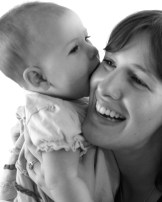
Giving kisses

Instructions for the New Mother

by Andrea Potos

Mothering magazine, January/February 1998 issue

Give up your calendar and clock,
start flowing with milk time.

Hunt for the frayed scraps
and threads of your fears.
Wrap your child’s cries around
the skein of your days.

Stop racing to meet your familiar ways–
know change
will always beat you.

Lower that small fist of resistance
still struggling to rise within you–start now–
unclench your life.
———
I feel like I have spent my whole mothering journey trying to unclench my life and to surrender fully to the rhythm of life with small children. I “should” myself a lot about this actually, telling myself about various things at various points during various days, “you need to just give up. You need to surrender. You need to figure out when to quit.” To be clear, this can be about things as simple as fixing myself breakfast or as complicated as wondering if I should give up blogging. As I’ve referenced, I’ve been going through a period of internal debate about my blog and my writing and wondering if I should just stop writing for a while. I feel like I am constantly awash with blog ideas and can spend the better part of a day waiting for the opportunity to finally have a few minutes to write one. While I really love it and find it fulfilling to do, I don’t like the tickling feeling that I’m spending so much time waiting to write about my life, that I’m not actually fully living my life. And, I do not like the frustrated, blocked, squelched, and denied feeling I get when I’m not “allowed” the space in my day I feel like I need to write (see my post about “my music“). So, I’ve spent quite a bit of time moaning and groaning about how I just need to know when to quit. I also somewhat coincidentally stumbled on a blog post by Progressive Pioneer about quitting blogging, in which she makes a lot of interesting points about the “darker side” of blogging.

And, duh, I know some people reading might think, “it’s simple. Just write when you have time and don’t write when life is too hectic. It’s just a blog, dummy.” And, I know that maybe someone will comment and say that I just need to find, “balance” (which is why I already wrote about that here). I know myself well enough to know that isn’t how I work though—I am very black and white about my responsibilities. Either I can make room in my life for something or I can’t. I cannot STAND having things lurking in the back of my brain that I want to do, or should be doing, or thought I was going to be able to do. I either have to do them, or cut off the possibility all together, otherwise they haunt me. I am almost pathologically responsible and it is impossible for me to “just relax” when I have a to-do or ought-to or thought-I-was-going-to-get-to hanging over my head—even if they are completely self-imposed.  Despite parenting for almost 8 years, I continue to have trouble realizing when to hold ’em and when to fold ’em, often struggling to keep working on something or doing something, even when it would make more sense to just quit—or, perhaps more rationally, take a break and come back later.

But, a couple of months ago as I struggled to complete something and simultaneously berated myself about not knowing when to quit, I also had a companion thought—is this what I want to teach my children? That when something feels difficult or is hard work or feels like a struggle, you just quit?! Do I want to raise children who give up when something isn’t going perfectly smoothly? Do I want them to learn to just throw up their hands, throw in the towel, and never raise a small fist of resistance? If I’d “known when to quit” trying to have another baby, I wouldn’t have Alaina right now. She is here expressly because I didn’t give up. I kept going even though it was hard and I felt like quitting and I even felt like maybe I was ignoring signs that told me I should quit. Maybe I’m actually glad I haven’t yet learned when to fold. So, I hold companion thoughts, that there is grace and ease in surrender; it makes sense, is harmonious, is zen. And, it is brave to try again. To not give up. There is beauty and strength in persistence and in refusing to quit. I do want my kids to know when to quit, but I also want them to value getting back up. I don’t want them to capitulate to the “plodding dullness of spirit” that can occur when you lower that small fist.

I was also reminded of an essay that I wrote several years ago, but no one has yet published, in which I considered the notion of “surrender” in relationship to mothering:

Is it more sensible, more true, more rational to surrender? Or is surrender another word for hiding behind? For failing to reach potential, to scale to new heights, to realize dreams. “I can’t because of the kids”—does that represent a truth and a surrendered, graceful acceptance of the season of my life, or does it actually mask fear and a hiding from potential? Isn’t it possible to hide behind my children and their need of me and in so doing deny all of us opportunities for growth and to stretch our personal boundaries?

Isn’t there value in the seeking? Is it better not to ponder and wonder, but instead to coast and flow? Which is more beautiful? Taking the fabric of life as it is and embracing it, or actively trying to sew something rich and new? Is acceptance or struggle more illuminating? Is flowing or paddling? Is it more graceful to surrender to the current or to flap my wings and soar above the trees?

What I know is that I wish to live passionately. With aliveness. Connected to the arteries and pulse of life. To know deepness, not hollowness. Sustenance and hope. Peace, but with the ability to peer into dark places and to ask difficult questions in order to more completely scale the cliffs of life. Vibrancy and truth in word, action, life, and rhythm.

I originally wrote the above in 2008 when my second son was two. After writing it, I paused in my chair and a spontaneous vision came to me—I was walking to the top of a hill. At the top, I opened my hands and beautiful butterflies spread their wings and flew away from me. Then, a matching vision—instead of opening my hands, I folded their wings up and put them into a box.

So, which is it? Open my hands and let my unique butterflies fly into the world. Or, fold their wings and shut them into a box in my heart to get out later when the time is right? Do I have to quit or just know when to stop and when to go? When to pause and when to resume?

What are the ways in which my children can climb the hill with me? To be a part of my growth and development at the same time that I am a part of theirs? How do we blend the rhythms of our lives and days into a seamless whole? How do we live harmoniously and meet the needs of all family members? To all learn and grow and reach and change together? Can we all walk up the hill together, joyfully hold up our open hands with our butterflies and greet the sun as it rises and the rain as it falls? Arm in arm?

I guess rather than balance per se, it comes back to mindfulness, attention, and discernment—knowing when to hold and when to fold. Just as I continue to return to my image of grinding corn, I continue to return to this inner vision of joyfully releasing our butterflies together…

Like many posts, I originally wrote most of this over a month ago, with, as noted, some quotes from a piece I wrote three years ago, but I continue to return to the same issues in my life. The to blog or not to blog question actually surfaced for me  in this post, but I then published several other pieces before it that were also musing on the same topic—so, if this seems like a rehash of some recent posts, consider that this one came first! This morning, as I considered that the time had come to finally publish this post, I sat at my living room sacred space/altar and these words came to my mind: surrendering to the moment is not the same as a permanent surrender.

Take Pictures

I’ve been thinking of one of my favorite poems today. Published some time ago in Mothering Magazine, it is called “Take Pictures” and is a poignant look at how fast it all goes.  The end gets me in my heart every time I read it:

“Holding tight to my neck, my son
trusts – he knows no other way – my touch lightly
dries his tears. I am his queen, his goddess, handily
his slave. Blink, it’s a photo again, a trick of the eye,

a frozen captive of time, paper, light and silver: my son
is a grown man: he drinks from his own hand.

Reader, I urge you,

spin slowly, take pictures, remember to laugh.” (emphasis mine).

Regarding Balance

My friends and I often reference the word “balance” in our conversations, with a popular refrain being, “it all comes back to balance!” I have several books about life balance—my favorite being A Mother’s Guide to Self-Renewal and I feel like I continually engage in a dance with balance in my life, coming into various sensations of balance or imbalance throughout my days. I think I make a mistake in thinking that balance is something I will one day “achieve,” rather than dipping in and out of it. I also think that the cry for “balance” can sometimes be a secret code in my brain for, “I will eventually figure everything out and life will be perfect!” So, I appreciate this quote from the book  The Mommy Wars, with regard to balance, that eternal question:

“Let me save you some money: In a life with children, balance does not exist. Once you’re a parent, you can figure you’ll be out of whack for the rest of your life…Children are not born to provide balance. children are made to stir us up, to teach us how angry we can get, how scared we can be, how utterly happy, happier than we’d ever imagined was possible, how deeply we can love. Children turn us upside down and inside out; they send us to the depths and heights of ourselves; but they do not balance us. We can’t balance them either, and that’s a good thing, too. They’re finding out how to live in the world, and the most we can do is make them as safe as possible and have a good time with them.”

I have just started teaching (college) again after having a three week break and I’m teaching more classes than I ever have before, not to mention continuing to homeschool my kids and finding scraps of time to work on my own doctoral program. And, Alaina is on the move now—a seven month old baby is quite a lot more work than a younger baby! (Chiefly that she sleeps less and gets into more!) So, I’m in that time of trying to find my footing, my balance, with this new schedule and making sure I…once again…have my priorities in the right order. I have a blog post about “surrender” that I wrote several weeks ago that I keep waiting to post for some reason, as well as some other musings about keeping my blog posts going or not. I think I will keep writing, but I’m going to just post once per week—on Wednesdays probably (though, I may prep extra posts on that day to go out on different days). I also have plans for keeping them short, less navel-gazing, using material I’ve already written, and that sort of thing. While I really enjoy writing blog posts and there is something important—but hard to identify—that I get out of it (I think it is both about telling about it and playing my music), in the scope of my life right now, it really needs to slip to the bottom and possibly off of my radar entirely for a time.

This conviction that something I’m doing needs to change in order to be “balanced” (or perfect, as the case may be!) makes me think the root issue is really about control—control of life’s energy and flow—and reminds me of something else I read recently in Thomas Moore’s book, Original Self:

As a therapist, I often followed a simple rule…I would listen to a man or woman passionately explain what was going on in their lives and what they needed to do. This strong expression of self-understanding and intention told me a great deal about their suffering. I could see where and how they were defending themselves against life…it always seemed fruitful to explore the direction closed off by insistent plans for improving life.

To free our souls, we may have to be loosened by our suffering and our problems. Rather than look for ways to be further in control, we may have to surrender to the vitality that is trying to get some representation. Rather than understand our dreams, we might be understood by them–reimagine our lives through their challenging images. Rather than get life together, we might allow life to have its way with us and get us together in a form that is a surprise. (emphasis mine)

True personal strength is not to be found in an iron will or in superior intelligence. Real strength of character shows itself in a willingness to let life sweep over us and burrow its way into us. Courage appears as we open ourselves to the natural alchemy of personal transformation, not when we close ourselves by making the changes we think are best. (emphasis mine)

In the following section he also says that, “when people say they want to change, I hear a subtle rejection of the person they are…even then, a conscious plan for change usually comes from the same imagination that got us into trouble in the first place. A new project of self-transformation may land us back in the uncomfortable wallowing hole we just left.”

Hmm. Not sure what my conclusion is after all this now…to blog or not to blog. I don’t think that is really the question.

Getting a C-Minus

Several years ago, I read a collection of essays called Sons & Mothers that I picked up at the book sale. I marked this quote from it to share:

“I also believe that C-minus is the top mark for motherhood. Each generation strives to build faster, cleaner planes, trains, and automobiles and to be better parents than their own. Without this margin for error, there can be no growth, no development” [as a species].

This is hard for me to swallow as a quintessential 4.0 overachiever student type. I like A’s dangit! 😉

On a related note, check out this wonderful post from my homeschooling friend that draws parallels between evolving technology and the not-evolving nature of education. It is just full of awesome.

Homeschooling & Feminism

Though I spent my entire childhood as a homeschooler and my own children are also homeschooled, I find I rarely have the urge to write about it. Homeschooling for my own children felt like a “given” to me—I didn’t feel like doing any reading or soul-searching about making the decision, as it had been made in my mind before ever even becoming pregnant with our first child. Indeed, the decision was made when I was a child myself. When I had been married for about two years, I remember telling a friend that maybe I wanted to wait a little longer than many people do to have children after getting married, because once I had them, I knew I was in it for the “long haul.” There was no, “well, after they’re five, then I’ll have six hours a day to myself.” I knew without a doubt that once I had kids it was going to be a 24/7, 365 gig. She said, “well, you don’t have to homeschool you know. You always have a choice.” I said, “you know. I really don’t have a choice.” And, while I do know that in truth one always has choices, homeschooling was a completely foregone conclusion for me. (Breastfeeding was the same way—I didn’t “choose” between feeding methods, I was born to be a breastfeeding mother. There wasn’t a choice about it for me in my mind—much like if someone had asked me whether I was going to go with “artificial blood” or regular blood in my own body! Hmm, thanks, I’ll take what my body makes of its own accord!) Another Molly at the blog first the egg asked a couple of weeks ago for input about homeschooling and feminism—i.e. where are the homeschooling feminist mothers. I raised my virtual hand, but said I don’t really write about it and she essentially said, “get started.” I’m surprised by how many good “nuggets” exist at my old blog, just languishing and waiting to be mined into new blog posts here and I discovered that I had, in fact, done a little writing about homeschooling there. So, with minor modification, here are some thoughts about homeschooling and feminism…as primarily separate topics though, not intertwined…

Natural Life magazine often has good articles about homeschooling. A couple of years ago, I enjoyed one called “Education is Not Something That’s Done to You” and it addresses the (false) assumption that learning “can and should be produced in people.” It addresses the assumption that children won’t learn on their own, but must be made to learn by being kept in confinement with others their own age day in and day out. She notes that even homeschoolers often fall into the trap of thinking education must be “done to” children. I marked the conclusion to share: “What we should not do is create new schools—be they charter schools, private schools, or home schools—which perpetuate old assumptions of how children learn or who controls children’s learning.” I have to remind myself of this sometimes—if I start to feel like my own children “should” be doing something specific, or think “most 5 year olds can XYZ…” or if someone asks my boys if they’re getting ready to go back to school or remarks on how “is your mommy or your daddy your teacher,” that I reject that system—why would I try to use its values to define our experiences?

The other article I enjoyed in the same issue is  The Hand that Rocks the Cradle Rocks the Boat: Life learning as the ultimate feminist act. In it, the author quotes social commentator Susan Maushart as asserting that “motherhood needs to be at the center of human society, from which all social and economic life should spin. Society needs to ‘acknowledge that bearing and raising children is not some pesky, peripheral activity we engage in, but the whole point,’…Warehousing kids in daycare or school so mothers can get on with what they see as their real lives is not part of that vision, but we need to find ways to ensure economic security for women of all classes, and extend the vision to include fathers as well.”

While thinking about feminism and homeschooling, I had an epiphany while facilitating a series of women’s spirituality classes. The theme of one week’s session was “womanpower.” A point was emphasized several times during this class that in feminism the view of power is different. A patriarchal view of power is that of “power over” or control over—you have power, someone else doesn’t. You can use your power to control others, or to take their power away, etc. A feminist view of power is of cooperation—“power with” as well as inner power. When you have inner power, you do not need power over someone else. A hierarchical version of power falls away and is unnecessary. I reflected on the times I have heard women say, “I’m not a feminist, but…” and how I’ve always *boggled* at that. How can you NOT be a feminist, I’d wonder. Now, I think it is because of a misinterpretation of values—an interpretation that views feminism as wanting to “take over” or to “dominate” men or to prove that “women are better than men.” This is flaw in understanding—using a worldview rooted in “power over” concepts, instead of a totally different worldview or a reinvention of how society operates/what it’s values are. My epiphany is that this is just like homeschooling—you can’t use the “lens” of public school to understand homeschooling and you can’t use the “lens” of patriarchy to understand feminism. These different lenses are why you feel like you are banging your head against something when you speak to someone who is coming from a fundamental misinterpretation of the values at work. Feminism and homeschooling both involve alternate value systems to that of mainstream society and a revisioning of social structures into new kinds of systems (healthier ones).

Another issue of Natural Life had an interesting article about free schools called U of Free. Some points I liked: “most come with the free school philosophy of solely pursuing an interest, rather than for a degree or other recognition of knowledge. They resist the consumer-driven mentality sweeping traditional schools, where students vie for exam hints and quick solutions to get to the next step, with their ultimate goal being an exit out – their graduation. At Anarchist U, the students are all about learning itself. Without the pressure of exams and marks, students can relax and savor their learning moments.”

And on the same topic: “In his classes at U of T, he encounters a chorus of students whose sing-song refrain ‘is this on the exam?’ puts his pedagogical ideals out of tune. The classroom conductor laments that these U of T students are looking for a quick study guide ‘because they need the credit from my class to get the piece of paper.’ Instead of enjoying the educational experience, his students are disengaged, shrewdly seeking the quickest route out of the system.”

I struggle to cope with this in teaching college classes—I want to work with people who are excited to learn, not people who are trying to just get the grade and get out. I see this as the whole point of homeschooling/unschooling—to create a way of life that involves learning for intrinsic reasons, not extrinsic ones. This was very much true for me as a homeschooler and I carried it over into college—I didn’t understand why people were there for other reasons than to learn. It didn’t make any sense to me to hear someone recommend a class because it was an “easy A” (but had a teacher who was so boring and so pointless as to make you wish to be unconscious under a rock rather than listen to him any longer). What is the point of an easy A?! Hello! It also didn’t make sense to me to have to take classes that I wasn’t interested in (and I did have to do this), but I made the best of them by studying the stuff and trying to get it/like it. Someone at our craft camp one year expressed surprise that I was “self-taught” at the classes I was teaching—“so, you just learned this by teaching yourself?” Yes, I did! Why? Because I like to learn stuff—no one has to make me do it or show me how! I study and learn things all of the time, because I like it. I’m a very self-motivated, self-disciplined, self-directed person and credit that to my homeschooled/unschooled background (thanks, Mom!). I long while ago a heard a friend say about herself that if, “no one is making me do it, I won’t do it/learn it.” I thought that was incredibly sad as well as incredibly telling about the drawbacks of our current social methods of education as something that is “done to” people, rather than a self-directed process.

Pulling my two seemingly disparate subjects back together, I return to Wendy Priesnitz’ article in which she says this: “In short, schools – and society in general – treat children the way women don’t want to be treated. They don’t trust children to control their own lives, to keep themselves safe, and to make their own decisions. In this way, feminism and life learning are one and the same because they trust people to take the paths that suit them best. ” (emphasis mine)

Isn’t that just delicious?

—-

Two pictures from our lives this morning:

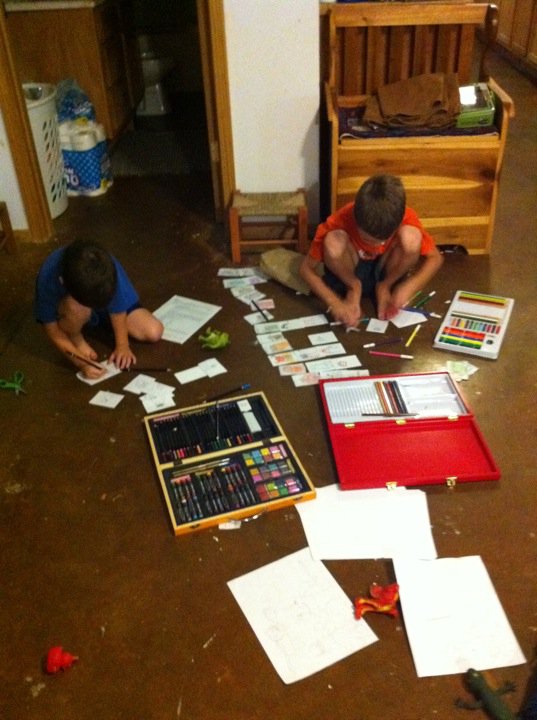
Artists at work!

Pensively patting

A Fresh Look at Discipline

“It is easier to build strong children than to repair broken men.”

– Frederick Douglass

I’m cleaning up my “office” area and keep coming across small scraps of things I’ve saved to read later. One was a notecard sized piece headed, “A Fresh Look at Discipline.” I’m not even sure what book it came from. I’m making it into a blog post rather than continue to hang onto the scrap, because then it is stored/saved this way, rather than my needing to keep track of many little papers (this makes sense and seems efficient, right?! I will do this with more scraps as I discover them!)

A Fresh Look at Discipline

(from Playful Parenting…maybe?)

  • Cool off
  • Make a connection
  • Choose a “Meeting on the Couch” over a “Time-out”
  • Play!
  • Instill good judgement
  • Look underneath the surface, at the child’s feelings and needs
  • Prevent instead of punish
  • Know your child
  • Set clear limits

I’m also trying to remember to use Naomi Aldort’s SALVE formula, which connects with the looking under the surface at the child’s feelings and needs. And, today, I started trying something I read about in the book Momfulness which involves a three breath hug—take three deep breaths together while hugging. My second son, Z, gets so upset and mad about things that I tried this with him this morning when he was really mad and having trouble calming down and it helped. I also try to remember (and I did get this from Playful Parenting) that children are seeking connection—sometimes not always in “positive” ways, but the ultimate goal is connection—and you can either promote and encourage that in your interactions, or shut it down. And that, reminds me of a quote Lu Hanessian uses in her talks about parenting: “Ernest Hemingway said it was the world that does break everyone, not life itself, but that most of us get stronger at the broken places.” She reminds us that when you do have a “breakdown” with your children, that what matters most is how you repair the cracks.

Diplomats and Breastfeeding

Today I came across an old note about a dream I had a couple of years ago:

I was in a sort of waiting room area with quite a few people in it including a friend and also a Diplomat (distinguished older gentleman with gray hair). Z wanted to nurse and so I picked him up and then turned slightly away from the diplomat in order to start nursing him. My friend said something like, “I see you’re trying to hide from everyone. I can’t believe you’re STILL breastfeeding him.” The diplomat then said, “at the Embassy we have an old saying: we work together as smoothly and comfortably as a good latch.

I wonder how world politics would look if breastfeeding mothers were the role models 🙂

Omega 3 Fatty Acid Supplementation During Pregnancy

This week, I was contacted about some new research being presented at the The Era of Hope conference in Orlando, FL about omega 3 supplementation during pregnancy reducing the risk of breast cancer for the baby girl in the future. Era of Hope is a scientific meeting funded by the Department of Defense Breast Cancer Research Program (BCRP). I was offered the opportunity to do a short interview with the researcher, Dr. Georgel:

Q. What are some easy tips for pregnant mothers to increase their consumption of omega 3 fatty acids?

A. Select the right type of oil when you go shopping:

  • Avoid corn oil and chose canola oil instead. Price is similar and canola proper ratio of omega 3 to omega 6 fatty acids (i.e., 1-2).
  • Wild caught salmon is a viable option; avoid farm-raised
  • Walnuts and broccoli are also good foods to incorporate into your diet.

Q. Are supplements (i.e. fish oil or flaxseed oil  in capsule form) as effective as other foods?

A. Yes, if you select them properly. Read the label; for fish oil, you have to make sure that the amount of omega 3 fatty acid (combined EPA plus DHA) is around 1600 mg/day. If the label says, “essential fatty acids,” it usually contains and high level of omega 6 and low omega 3 (which is not optimal) so you want to avoid those.

Q. Is the effect dose dependent? (i.e. how much do women need?

A. Yes, 1600mg of combined (EPA plus DHA) omega 3 fatty acids per day.

Q. Since it is World Breastfeeding Week this week, I’d love to tie this research in to research we already know about the role of breastfeeding in reducing a woman chance of breast cancer. Any thoughts on that?

A. Our research indicates that the maternal diet (in utero and during breast feeding) containing omega 3 fatty acids has the potential to reduce the female off-spring’s incidence of breast cancer.

I also asked about the following: finally, there is some evidence that supplementation with EFAs postpartum has an effect on reducing the incidence of postpartum mood disorders. Any thoughts on how prenatal supplementation might have a similar impact? But, since Dr. Georgel’s research does not explore mood disorders, he was unable to comment on this question. Here are two great handouts from Kathleen Kendall-Tackett about EFA supplementation postpartum:

Can fats make you happy? Omega-3s and your mental health pregnancy, postpartum and beyond

Why Breastfeeding and Omega-3s Help Prevent Depression in Pregnant and Postpartum Women

Health Care or Medical Care?

For quite some time, breastfeeding advocates have been working to change the language of infant feeding to reflect that breastfeeding is the biological norm (and formula feeding is the replacement/substitute). This includes sharing about the “risks of formula feeding” rather than the “benefits of breastfeeding” as well as encouraging research that no longer uses formula-fed babies as the control group or considers formula to be a benign variable (i.e. the babies in the breastfed group of many research projects also received some formula, but since our culture views formula as the “norm,” this was not seen as a conflict). I love Diane Wiessinger‘s example—would we ever see a research project titled “Clear air and the incidence of lung cancer.” No! Problem behavior is linked to problem outcomes in other areas of research, so it would be “Smoking and the incidence of lung cancer.” However, we routinely see research titles like “Breastfeeding and the rate of diabetes” rather than linking problem to outcome–“Infant formula and the rate of diabetes.”

Similarly, “intactivists” (people who oppose circumcision) have pointed out that there should be no need to refer to some boys as “uncircumcised”—being uncircumcised is the biological norm, it is “circumcised” boys that should received the special word/label. (On a related side note, I have written about “pleonasms”–words that contain unnecessary repetition–and birth and breastfeeding in a previous post.)

So, this brings me to another need for a change in the common language–correctly identifying whether we are really talking about “Health Care” or “Medical Care.” This was originally brought to my attention by Jody McLaughlin the publisher of Compleat Mother magazine. We have a tendency to refer to “health care” and to “health care reform” and “health insurance” and and “health care providers” and “health care centers,” when it reality what we are truly referring to is “medical care”—medical care reform, medical insurance, medical care providers, and medical care centers. As Jody says (paraphrasing), “we do not have a HEALTH care system in this country, we have a MEDICAL care system.” She also makes an interesting point about a trend to re-name medical care systems with names that use the word “health” instead:

This is what I have observed: Our local facility was called Trinity HOSPITAL, later re-named Trinity MEDICAL CENTER, and now it is Trinity HEALTH.

In the late 70’s and early 80’s the discussions centered around the MEDICAL crisis, MEDICAL reform, MEDICAL insurance and MEDICAL care cost containment.

MEDICAL insurance morphed into HEALTH CARE insurance. MEDICAL reform morphed into HEALTHCARE reform.

This is a difference with a distinction.

Health care includes clean air and safe water, enough good food to eat, exercise, rest, shelter and a safe environment as well as healing arts and the availability of and appropriate utilization of medical care services.

Medical care is surgery, pharmaceuticals, invasive tests and procedures. Malpractice tort reform is on the agenda too but no one is talking about reducing the incidence of malpractice, or alleviating the malpractice crisis by improving outcomes.

Why does this discussion belong here? First, I wanted to address it because I have a special interest in our use of language surrounding birth and how that language can impact our birth experiences. Secondly, if we emphasize that birth is a normal bodily process, a normal life function, and not an illness, we need to make sure that we are focused on health care services for birth, rather than medical care services. Personally, I think the midwives model of care can truly be described as health care, whereas standard maternity care in the U.S. can much more aptly be described as medical care.