Book Review: 25 Ways to Joy & Inner Peace for Mothers

Book Review: 25 Ways to Joy & Inner Peace for Mothers

By Danette Watson & Stephanie Corkhill Hyles
Watson & Corkhill Hyles, 2006
ISBN 0646-46588-0

84 page hardcover book & 60 minute CD set, $24.95
http://www.awakenyourbirthpower.com

Reviewed by Molly Remer, MSW, ICCE

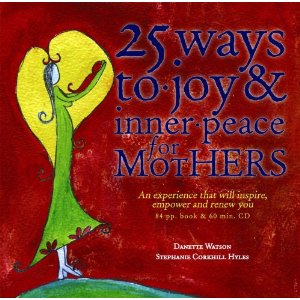
Consisting of a book and CD, 25 Ways to Joy & Inner Peace for Mothers contains 25 short breathing meditations with accompanying whimsical, colorful drawings. The meditations are on topics such as “surround yourself with mother energy,” “embrace change,” “feel reverence,” and “trust the rhythm of your baby.”

The final third of the book contains breathing tips, tips for using the meditations in life, and then “10 Healing Practices for Mothers” that are a very nice addition. This segment is followed by “Questions for Inner Exploration” that include journaling questions and prompts based on each of the meditations.

It is not clear at first glance, but 25 Ways is designed for mothers of newborns and infants, not mothers of older children (though, of course, most of the meditations could be adapted to apply to older children). The addition of “new” to the title would have been a useful clarifier.

Inspiring, empowering, and renewing, 25 Ways to Joy & Inner Peace for Mothers is a lovely and nurturing little manual that would make a nice blessingway gift for a pregnant or a congratulations gift for a special new mother.

Disclosure: I received a complimentary copy of this book for review purposes.

Review originally published in the CAPPA Quarterly, April 2010.

Birth Warrior Affirmation

July 2015 135Today I was looking at various cool things on Etsy and came across a neat “birth warrior” bracelet. She also gives the following affirmation and I LOVE it:

Birth Warrior’s Affirmation

I am a birth warrior
I embrace my strength
I embrace my power
I surrender to my body’s wisdom
and bring forth life in joy…

I’m going to a mother blessing this weekend and would like to add this to the affirmation poster we are making for the mother (I hope she doesn’t read this blog first!). I know that there are some people who not identify with the “birth warrior” mindset/coping practices, but for me personally, it is very apt and is what felt true and right for me—power and strength instead of calmness, relaxation, and control.

Birth, Motherhood, & Meaning

Birth Activist is having a Mother’s Day blog carnival focused on these questions: “As Mother’s Day approaches I always stop to reflect about how I give birth influences how I mother.  Would I have been a different mother had I birthed differently?  Just what does giving birth do to our ability to mother?”

I instantly thought of a post I made several months ago and decided to revise and update it for this carnival. In initially re-reading the post, I was interested to note that my life as a mother has already changed since I wrote it!

The post I am revising/excerpting now was a post in response to a quote from a Midwifery Today blog post: “your birth is the most important event in shaping your life as a mother.” I did a lot of thinking about this—IS birth the most important event that shaped my life as a mother? I’m not so sure. I am also interested to note how the texture of the question changes if I ask myself, “what is the most important event that shaped my life as a woman?” instead. The answer to that question—of my then-developing sense of womanhood—I believe is giving birth. But, the answer to the question about motherhood is a different and more complicated.

I definitely believe that birth is “NOT just another day in a woman’s life” and that giving birth does have lasting impact on women’s memories and quality of life, primarily because they stand out in the memory as transformative events and it becomes an issue of the mudane vs. the miraculous (so, of course your every day life with your children is more important than that “one day,” but that the one days blend into one whole, while the birth experience stands out as, “HEY! Pay attention. Something BIG is going on here!”)

I believe you can hold the two experiences simultaneously—you can enjoy (or suffer from) the birth memory while also cherishing the daily life with the little ones. One doesn’t have to trump the other or to be “what really matters.” There’s room for lots of mattering in an every day life :)

Birth is (or can be) a “peak experience” for women (and families). I want all women to have a chance to experience that. I certainly do not want her to feel diminished, unworthy, inferior or lacking if birth is not a peak experience in her life, but I also want all women to certainly be given a reasonable opportunity to let birth unfold in all its power and be treated respectfully and humanely by those around her—regardless of what is going on or the eventual outcome.

I love birth and cherish my memories of my sons’ births and consider them to be some of the most transformative, empowering, and significant single days in my life—peak experiences, powerful memories—and I also feel that birth matters as a distinct (and relatively rare) occurrence in a woman life. I believe birth has inherent value and worth on its own terms. I also believe that your feelings about the birth and the baby can most definitely be separated—you can feel pleased as punch with your delightful, precious baby and also be disappointed (or super thrilled with) your birthing. One does not take from the other—you can hold the reality of both and a breadth of feelings about them. And additionally, it is not wrong to want both things—a “good birth” and a “healthy baby.” The two go hand in hand and are not mutually exclusive concepts at all.

I also think we can draw on powerful memories for present strength—I remember my “birth warrior” feelings and it helps me with other tasks or with day to day life. I remember the laughing, crying, “my baby, MY BABY!” moments of triumph and bliss and ecstasy immediately postpartum and it buoys me with a fresh charge of  love for my boys. I remember the sense of profound inherent worth that I felt after giving birth and bring that sense into my present-day awareness. I remember the feeling of transcendence and power and know that that power is still in me, even while performing mundane daily tasks.

All that said, however, I also do not feel that my children’s births were the most important events shaping my life as a mother.

For me, the profound shaping event was the experience postpartum with my first baby. I have never had an experience that shaped me and impacted me and SHOOK me more profoundly than adjusting to life with my newborn son. That was my journey. That was my struggle. That was my challenge. That is what dissolved me and burned me into ashes and let me rise again as someone the same but also brand new—a mother. I was not “born” when my son was born, I was forged. Made, in those intense weeks that followed his birth.

When originally writing this post, I was pregnant with my third son. That pregnancy ended very unexpectedly in November, rather than May, when my baby was born after almost 15 weeks of pregnancy. Interestingly, my experience of miscarriage has supplanted the birth of my other two sons as essentially the most powerful/significant and transformative event of my life. (My sense that his birth has “replaced” the birth of my other children as most significant makes sense to me, because though it is classed as miscarriage, it is still my most recent birth experience—all of their births stand out as special, important, and meaningful days and I will remember each with clarity for the rest of my life, but his birth is the freshest and most recent and came with the additional transformative journey of grief. And thus, when I think of giving birth or when I think back to birth memories or birth feelings, his birth is the first one that comes to mind.) Though I still “vote” for postpartum as the most significant event in my life as a mother, I now “vote” for my birth-miscarriage experience as the most significant event in my life as a woman.

Noah’s Birth Story (Warning: Miscarriage/Baby Loss)

Since today is my due date (and also my own birthday), I wanted to take a minute to share Noah’s full birth story. I do have a separate blog where I keep most of my writing about miscarriage, but the birth stories of my other two boys are on this blog and I feel like his story deserves to be here also. And, since this is a blog about birth and since this is a birth story, I feel it has relevance in that sense as well. Not to mention that fact that miscarriage is part of the spectrum of childbearing experiences and that most childbirth educators should have some preparation in working with women who have had miscarriage experiences (I was very startled to discover when googling “childbirth educator” and miscarriage” that some of my own posts on the subject were on the top of the google hits—surely there are other childbirth educators out there who have had miscarriages and who write about them?!)

I wrote the story in my journal on November 10 (he was born Nov. 7) and have had it next to my computer to be typed up ever since that date. Finally, this weekend I typed it up. I have mentioned on my other blog that I feel the need to “close out” my pregnancy with him—almost like I’ve continued to be a “little bit pregnant” and it is time to close that “pregnancy” and to move on. Not to forget or to stop talking about it, but to acknowledge that NOW, finally, I “shouldn’t” be pregnant anymore. I felt almost driven this weekend to finally finish typing the story so that I could publish it on this day. Of course, I expected to have a different sort of birth story to share on this day (or somewhere around now), but this is what our story actually is (very long—I broke it into three chunks to make it a little easier to skim through if necessary):

Beginning—Finding Out

On Wednesday evening, November 4, at 14 weeks 2 days pregnant with my third baby, I had an appointment with a prospective midwife. I have not written much about this experience, because I did not want her to come across it online and feel badly. The short version is that the visit was like a “fear bath”—it was pretty intense the level of fear and “what ifs” she kept throwing out there, as well as personal insecurities. Also, she used the phrase, “you’re going to have a dead baby” at least five times during the conversation (said in reference to comments people make TO her regarding attending homebirths, however, the words made me want to curl protectively around MY baby and reassure him. And, given the way the rest of our story unfolded, in hindsight her words felt prophetic—or, like she cursed me!). When I left the fear bath, I had a headache. I woke the next morning feeling like my uterus hurt. I also became aware of contraction-like sensations coming every three minutes but only lasting about five seconds each. I lay down and rested until time for playgroup. By playgroup I was down to just uterus aching/hurting feelings, plus a low back ache. I talked to my friends Summer and Trisha about it and Summer reassured me and rubbed my belly, “your baby is strong and healthy.”

Thursday evening (November 5), I started to feel concerned. The contraction-like feeling was back. At 3:00 a.m. (my nightly wake-up time throughout the pregnancy to date) I got up to sit on the couch. I tried to be positive and think about a “bubble of peace” surrounding us and I also repeated to myself, “you are strong and healthy, your baby is strong and healthy.” I felt like I felt the baby move a little then and felt a little reassured. I had decided earlier that perhaps I had a UTI and that was what was causing the crampy feelings to come and go (urinary frequency also). I ended up throwing up later in the morning and was reassured by presence of morning sickness still. Between 3-5:00 a.m., I started to spot a little, but only when wiping. After seeing this, I began to feel extremely worried and scared. Spotting continued lightly in morning and I called a semi-local midwife to see if I could come and try to listen for a heartbeat. She was on her way to Montana however, so I made an appointment with t he nurse-practitioner at my doctor’s office for 2:45 that afternoon. I called my mom and my friend and rested in bed, waiting and worrying and repeating my healthy baby mantras.

I went ahead and packed for my class, then took the kids to Summer’s house and went to the doctor’s office, crossing my fingers that the diagnosis would be a UTI—I strongly felt it was going to be either-or, but it turned out to be both 😦 The NP said my urine looked infected and I felt my hope restored a bit. I truly thought the baby was going to be okay. She sent us downstairs for an ultrasound at 3:30. Though I tried to be hopeful, it was clear from the ultrasound tech’s non-communication that it was bad news. She didn’t show us the screen and I wish now that I would have asked to see it. I stared at the light in the ceiling and held onto my goddess of Willendorf necklace and to Mark’s hand. She clicked around with kind of a frown on her face and then finished and stood up. I said, “not good news?” and she said, “no, not good news,” put a box of tissues down said, “take as long as you need” and left. I told Mark that I couldn’t “do this” here and so we went back up to the NP and she confirmed (obliquely) that baby was dead. She said the tech said it was probably a fairly recent loss and that it was low in my uterus and my cervix was starting to dilate, so I would probably “pass it” this weekend. I felt like she expected me to be crying and I told her that I needed to “process” at home, not here. I called the college to cancel my class and that is when I started crying—I had to say the words, “I just found out I’m having a miscarriage.”

We went to Wal-Mart to pick up antibiotics for the UTI and I cried in the car while Mark went in. Then, to the post office to mail an ebay package. Again, I stayed in the car crying and wailing almost in my anguish, “MY BABY!” We got the kids from Summer’s and I cried in her arms briefly.

Mom brought over dinner in sympathy/empathy. I was still feeling some crampiness/uterus ache and that eased after dinner. I sat and read my miscarriage books—I had four on my shelf already, one from my time at RMHC and the others from my childbirth educator training. I talked with Mark for a while. I kept saying that I didn’t feel ready to let go and also that I didn’t know HOW to do this—should I walk around and try to get “labor” going or what? Decided to go to bed…

Birth

I woke at 1:00 a.m. (November 7) with contractions. I got up to use the bathroom and then walked around in the kitchen briefly, rubbing my belly, talking to the baby and telling him it was time for us to let go of each other—“I need to let go of you and you need to let go of me.” I looked at the clock and said to go ahead and come out at 3:00—“let’s get this done by 3:00.” I had woken every night at 3:00 a.m. throughout my pregnancy for no discernible reason and had said several times previously, “I’ll bet this means the baby is going to be born at 3:00!” (but in MAY, not November). I knelt on the futon by the bathroom door in child’s pose. I said again that I didn’t know HOW I was going to do this, but my body does. I realized that I needed to treat this like any other labor. I changed into soft, stretchy gray pants, leaving behind my pajama pants that felt too tight across the middle while crouching forward. These pants were Summer’s water-breaking pants—when she lent me her maternity clothes she said the only thing she was attached to getting back were these gray pants because her water had broken in them. I felt like they would be good energy birth pants. I was more comfortable right away upon changing into them. My contractions picked up to about 3 minutes apart and were just like with a full-term baby—starting in the back and spreading to a peak in the front. Mark rubbed my back and I talked to myself as I leaned forward in child’s pose with my head on my arms. I was going to “laborland”—that altered state of consciousness place of a birthing woman. I realized the only was to do it was to go through it. I asked Mark for my goddess pendant to wear (the one he gave me as a “happy new baby!” present in August when we found out I was pregnant). I held her and stared at my Trust Birth bracelet (and felt the irony). I had already put on my birth bracelet from Zander’s blessingway to help me feel strong.

When I was still having the “HOW?” questions, other women that I knew who had experienced miscarriage started to come to mind and I knew I could do it too. I told myself that I had to do what I had to do. I said out loud, “let go, let go, let go.” I said I was okay and “my body knows what to do.” The afternoon I found out the baby died, I’d received a package that included a little lavender sachet as a free gift with my order. When my labor began, for some reason I wanted the sachet and held and smelled it throughout the experience. As I chanted to myself, “let go, let go, let go,” I smelled my sachet (later, I read in one of my miscarriage books that in aromatherapy lavender is for letting go). I also told myself, “I can do it, I can do it” and “I’m okay, I’m okay.” I felt like I should get more upright and though it was very difficult to move out of the safety of child’s pose, I got up onto my knees and felt a small pop/gush. I checked and it was my water breaking. The water was clear and a small amount. I was touched that now these gray pants were my water-breaking pants too, but I was also worried about messing them up. I asked Mark to get me my leftover disposable undies from Zander’s birth and put them on (SO glad I still had them!) I went back into child’s pose and reminded myself to open and let go.

Contractions continued fairly intensely and I continue to talk myself through them while Mark rubbed my back. I coached myself to rise again and after I sat back on my heels, I felt a warm blob leave my body. I put my hand down and said, “something came out. I need to look, but I’m scared.” Then, “I can do it, I can do it,” I coached myself and went into the bathroom to check (it was extremely important to me not to have the baby on the toilet). I saw that it was a very large blood clot. I was a little confused and wondered if we were going to have to “dissect” the clot looking for the baby. Then I had another contraction and, standing with my knees slightly bent, our baby slipped out. It was 3:00. He landed face up on the clot with his arms raised over his head. I said, “Oh! It’s our baby!” and kind of shut my pants. Then, I opened them again and looked at him. He was clean and pink, about four inches in size, and well-formed with eyelids, nostrils, closed mouth, fingers, and toes.  I felt something else and saw his little cord—I showed Mark—it was spiraled like a big one, but thinner than a piece of yarn. It broke then and a whole bunch of clots came out and nearly covered the baby. His head and one arm were showing only.

No longer worried about having the baby on the toilet, I sat down on it then and took off my birth pants, feeling worried about getting blood on them (I didn’t get a drop on them though!). I tried to clean the baby off and wanted to check his gender and take some time to look at him, but he felt so soft and rubbery that I was extremely worried I was going to damage him. His mouth came open when I touched his face and I was stunned beyond words at the complexity of having a working jaw—this was a very developed little person and the magnitude of that complexity of development was unbelievable.

Then we had to set him aside to continue to deal with me. More clots came out then and I started to feel faint when I stood. I said I had to lie down and laid on the futon and smelled my lavender until I revived. I asked Mark for fizzy drink (Emergenc-C), which in hindsight I think I should have taken because I’ve read that too much Vitamin C can prolong bleeding—however, in my incredibly large collection of pregnancy and birth books, I could find NOTHING that would help me physically cope with a miscarriage in progress—no self-care suggestions, ideas of things to drink or eat. Nothing. I had Mark bring me various midwifery books and laid there bleeding and looking through them desperate to find some kind of ideas. I told him, “I’m going to write a book about this someday!” (and I am). I also had him bring me some Arnica and Rescue Remedy and later some Nux Vomica (which was in one of my books).

As I was lying there thinking about how to assess blood loss, I was also thinking about how in so many ways this had strangely been the birth I planned for, just not at the right time. And, that it was very much a birth, not “just a miscarriage.” The birth was unassisted—just my husband and me—the baby was born at a little after 3:00 in the morning, just as I had thought he would be, I had my futon “nest” on the floor as I had planned, and instead of trying to take a shower and clean up, I’d laid down when I felt I needed to. I was also thinking about how I felt good that I’d done it myself and that we’d given our baby a respectful and gentle and strong birth at home. I reflected on the similar endorphin-rush, “I did it! What an amazing person am I!” feelings I also had following my previous full-term births. In the midst of these thought processes, I was amused to notice the thought, “I obviously need to get into extreme sports!” There are probably lots easier ways to feel an endorphin rush and sense of physical prowess than in giving birth!

My contractions continued fiercely and I lost my “cool” then—after having the baby, I felt like it was “over” (the birth part anyway) and so my coping skills/altered state of consciousness diminished also—and just started saying, “ow, ow, OW!” over and over. I also said, “this is good! I’m doing good! My body is doing good work” (i.e. with my uterus clamping down and finishing up the process). This went on for some time and I kept feeling little gushes of blood with each contraction. I had Mark call my mom and dad to see if my dad could come check my blood pressure and pulse. They came and both stats were normal. Continued to have pain and to say OW and my mom suggested that perhaps getting up and using the bathroom would help. When I sat on the toilet, a giant grapefruit-sized clot came out. I immediately felt better and went to sit in a chair in the living room after that.  I had felt faint and woozy again with clot-viewing, but in the chair I felt like I was “coming back” and out of the woods after that clot was gone. Ate some cheese and crackers and drank some tea and more fizzy drink and later a pudding cup. Continued to feel contractions and little gushes of blood with each of them. Started to feel a little concerned about it and knew I had most definitely lost more than two cups of blood. Much more. More than both other kids combined.

I asked my parents if they wanted to see the baby and they went and looked at him and cried and cried. I got up to use the bathroom again and another grapefruit and some oranges came out. When I stood to pull up my pants, I held toilet paper to me to keep blood from dripping onto my clothes and when I did, blood came welling up and over the tissue and onto my fingers. My vision started to darken and I heard loud ringing in my ears and my family helped me back to sit in the chair. I felt thisclose to “going under” and sniffed my lavender desperately and put my head to my knees. Recovered a little bit, but still felt as if I was fading as well as losing more blood. I was completely white. No color. I could not differentiate any longer if I was “just fainting” or dying, so we decided I needed to go in. I said I was sad to go because I felt like I was proud of how I’d handled everything myself and that I had been strong, but that it is also strong to know when to ask for help and that I needed to go. It was around 8:00 a.m. at this point. The kids had woken up and we left them with my dad and my mom drove us to the emergency room. I laid in the back seat and hummed the song Woman Am I over and over again so that they would know I was still alive. I briefly thought about how I had so much more to do before I died and hoped it wasn’t time yet. I also thought how ironic it was that it was going to be birth that killed me. I expected at least a blood transfusion, but the hospital was fairly nonchalant about the whole thing and acted like everything was normal. I smelled my lavender and felt better almost as soon as we were there.

Aftermath—ER/Placenta

The ER staff was very casual and asked all the usual intake questions and a doctor came in to check me. She said, “this is very common. It is just natural selection,” which ranks as perhaps the very LEAST helpful thing to say to someone experiencing such an intense physical and emotional event (and, I beg to differ about “common,” since only about 1% of pregnancies end after 12 weeks). She tried to do a bimanual exam but couldn’t feel my cervix because of all the blood clots in the way and so had to do a more painful and traumatic exam using a speculum that I do not feel like writing more about because I do not want to give any space to her non-caring treatment and lack of compassion. She said the placenta was about 75% through the cervix and that was why the continued bleeding. She said I was not hemorrhaging (in sort of a, “you’re so silly and overreacting” tone) and that she expected the placenta would come out soon on its own. I was given a bag of fluids via IV, which again caused me to nearly “go under” and become completely white—vision darkening, ears ringing—the nurse seemed more understanding then of why we had come in, asking Mom and Mark, “is this how she looked when you decided to bring her in?” After the hour or so with the IV, I got up to use the bathroom. I asked first to use a commode in the room so we could see the placenta and was told to just use the regular bathroom, where the “placenta” came out, only to be whisked away by the automatic flushing action before I could see it (it was NOT the placenta however. The placenta came out six days later). Bleeding did immediately lessen then. The doctor checked me again and said my cervix was closed and there were no more clots. She gave me a prescription for an anti-inflammatory and for pain medication. We went to Wal-Mart for the scripts and then home. Getting home was HARD. Everything reminded me of what had just happened and Mark and I both cried and cried. Then slept.

My dad took the baby home to clean him up for us as well as provided a walnut Shaker box to bury him in. My mom crocheted a liner for the box and a matching blanket for the baby. I woke up at around 3:00 in the afternoon and started to collect things to add to the box. Mark and I talked about names for the baby. We thought perhaps the gender-neutral, Noa, based on a stillbirth dream I had had many years before in which we named the baby Noah. While Mark dug a hole by one of our cedar trees, I got a 2009 penny to put in the box, a purple goddess of Willendorf bead from Zander’s blessingway, one of my scrabble tile catch-your-own-baby birth power pendants, a rock and a shell from Pismo Beach, a picture of the boys, one of my womb labyrinth postcards, a hat I had crocheted, and my last “women healing the earth” postcard. Mark cut a sprig of our lavender to add. My parents came back at sunset with the boys. My dad asked if we wanted to know the baby’s gender and of course we did. He told us it was male. My mom added and elephant bead to the box and my dad had made a bead out of a log from their house. He split the bead in half so the two halves fit together—half to stay with me and half to go in the baby’s box.

I had chosen three readings from Singing the Living Tradition. I read the naming reading and since we now knew he was a boy, we announced the baby’s name was Noah after my previous dream. I read the other readings and the kids wanted to see the baby, so we all looked at him—he was much smaller than when he was first born (my dad measured him at 3.5 inches). Then, we put his box into the hole and each added a handful of dirt and said, “bye bye, baby” and cried and cried some more. (I have written more about the ceremony in these posts.)

I did not feel as if I had “lost” my baby, I felt like he died and I let him go.

“There is no footprint so small that it does not leave an imprint on the world,” or on his mother’s heart.
Film Review: Sunshine

Film Review: Sunshine

By Karen Skloss
PBS, Independent Lens, 2010
60 minutes

www.pbs.org/independentlens/sunshine

Reviewed by Molly Remer, MSW, CCCE

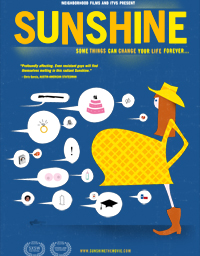
I was very excited to receive a review copy of the independent film, Sunshine, airing on the PBS series Independent Lens on Tuesday, May 4. Through personal narrative, Sunshine chronicles the changing social definition of family and cultural attitudes towards “unwed mothers” and “single moms.” Filmmaker Karen Skloss explores her answer to her question, “does history repeat itself?” as she considers her own history as a baby given up for adoption in 1975 by her nineteen year old “unwed” biological mother (Mary) and her personal experiences of giving birth to her daughter Jasmine as a “single mother” in 1999. Since I teach Human Services classes at the college level as well as teaching private childbirth education classes, I was intrigued in the film’s subject from both perspectives—that of someone in the field of social work at the academic level and that of someone deeply invested in work with pregnant women and new mothers.

The images chosen for the film are pieced together from home movies, family snapshots, interviews, and current footage of Karen and her family—both biological and adoptive. Karen and her biomom also make a pilgrimage of sorts to visit the Texas home for unwed mothers in which Mary lived before she gave birth. Karen co-parents her daughter with Jasmine’s father in a fairly unusual arrangement in that they share care 50-50—Jasmine lives with her father half-time and with Karen half-time. Jeremy, the father, also receives some screen time in the film and has some interesting comments to make about how he is perceived as a single father and how that compares to perceptions of single mothers (i.e. as a single father he is viewed as “hero” and not as someone who is just doing what anyone should do). The footage is mostly of the mundane—everyday life: bike riding, walking, people at kitchen tables—and the content is mild. No biting commentary or sweeping sociological conclusions. The story is an engaging one and an emotional connection is quickly formed. Though the content is nondramatic on the surface, the narrative is a multilayered representation of the complexity of the everyday lives of “normal” people and I was moved to tears on at least three occasions.

My medium is the written word—I read and write prolifically—so Sunshine was a change of pace for me. And yet, it unfolded like a personal essay “written” in visual form. I was fascinated in a way I have not been before by the use of film to tell a personal, human-sized story.

The Human Services professor in me would have liked to see a little more sociopolitical commentary—the viewer is left to draw their own conclusions about larger social issues that could give context to the personal story. The childbirth educator in me was delighted to see some footage of what appeared be a gentle, positive homebirth with Karen laboring in a birth pool and then giving birth in a supported squat on the floor. This footage is without commentary, but appears to be a midwife-attended homebirth with both Karen’s biomom and adoptive mother present as well as the father of her child.

As the film concludes, Karen states that, “it is hard to understand the times you’re living in, because you’re living in them.” Sunshine is a compelling portrait of one woman’s efforts to explore those times.

Disclosure: I received a complimentary copy of this film for review purposes.

Distraction, Concentration, Surrender

In my childbirth classes when I cover “labor and birth 101,” I talk about the traditional stages of labor—early labor, active labor, transition, pushing, and third stage (placenta). I also talk about the “emotional signposts” of labor—excitement, seriousness, and self-doubt, as well as about the fear-tension-pain cycle and the excitement-power-progress cycle. Recently, I finished reading the book Painless Childbirth by Giuditta Tornetta and she elegantly described the three phases of first-stage labor in a three-word format that I found extremely accurate and helpful, as well as fresh and interesting. The first phase is distraction—during early labor, it is most helpful to continue to go about your normal life as if nothing is happening. Do not give your contractions any attention until they strongly request your attention! I tell my clients to just do what they would normally be doing—-if they would be sleeping, sleep. If they would be walking the dog, walk the dog. Watering the plants, eating dinner, etc., etc. Just keep up the normal routine until you need to give the birthing energy more attention. Without distraction as a tool, labor can become very long and exhausting—if you think of yourself as in labor from the second you feel anything, you are much more likely to experience a 24 hour labor than if you do not think of yourself as in labor until you are completely absorbed by its sensations.

The second phase is concentration—contactions have now become what Ina May Gaskin would term “an interesting sensation requiring my complete attention.” This phase corresponds to the Bradley Method’s emotional signpost of “seriousness.” I tell my clients that this is when she stops laughing at your jokes and stops even seeming aware that you’re talking. (She IS still aware however, and we will address this in a later post about undisturbed birth, prompted by another new book I am reading called Optimal Birth.)

The third phase is surrender and this corresponds with the transition portion of active labor and the “self-doubt” signpost. I think the concept of surrender during labor is one of the most profound and transformative elements of giving birth. If you can embrace the notion of “surrendering” to birth rather than staying in “control” of it, I think this can revolutionize your perception of what is happening in your body and your life. While hard to express in words, the experience of surrendering to my own body’s power was a transformative experience in my life (particularly since I am a “controlling” sort of person in “real life”—maybe this is why this term and experience holds such meaning to me). With surrender comes “flow”—there is such value and beauty and strength to be found in letting go and just letting it happen; letting “the might of creation come through you.” This was the most profound truth I discovered in each of my birth experiences.

Book Review: My Name is Mary Sutter

Book Review: My Name is Mary Sutter

By Robin Oliveira
Viking, 2010
ISBN 978-0670021673
384 pages, hardcover, $26.95

Reviewed by Molly Remer, MSW, CCCE

My Name is Mary Sutter is a new novel about a young Civil War era midwife who longs to be a surgeon, but is denied entry to medical school because she is female. Historical fiction has always been a favorite genre of mine, but historical fiction about a midwife? The best! After some initial chapters involving midwifery and family life, the main character,  Mary Sutter, seeks work first as a nurse in desperately undersupplied and overworked Civil War hospitals and then directly on the battlefield following the soldiers with a cart of medical supplies. Mary is a strong female protagonist and there are some complicated male (doctor) characters as well. A couple of mild love stories serve as sub plots.

Midwifery quickly takes a back seat in the saga as Mary becomes a nurse on the bloody battlefields of the Civil War. However, her work continues to be informed by her midwifery experiences–for example she uses memories of turning malpositioned babies as inspiration for finding the right spot to amputate wounded legs.

Some famous historical figures like President Lincoln, Clara Barton, and Dorothea Dix make appearances in the tale. The slaughter on the (famous) battlefields is tightly wrought and makes you feel as if you’ve “been there.” The reader feels exhausted and battle weary right along with Mary. The novel is a third person narrative throughout, but it almost felt like a first person account—as if the author was writing from personal experience. Be prepared for a variety of personal losses for the main character.

Riveting, well constructed, and tightly paced, My Name is Mary Sutter is a gripping story of one woman’s tenacious will and her drive both to learn and to serve.

Disclosure: I received a complimentary copy of this book for review purposes.

Book Review: Pregnant on Prozac

Book Review: Pregnant on Prozac: The Essential Guide to Making the Best Decision for You & Your Baby

By Shoshanna Bennett, Ph.D.
GPP Life, 2009
ISBN 978-0-7627-4940-9

248 pages, softcover, $16.95
http://www.clearsky-inc.com

Reviewed by Molly Remer, MSW, CCCE

Written by a clinical psychologist and mother of two, Pregnant on Prozac is a comprehensive look at the benefits and risks of antidepressant use during pregnancy or postpartum. The focus on depression during pregnancy is what makes this book stand out—this is a subject that has received very little attention and it is important for doula and childbirth educators to learn more about the issues involved.

The book includes sections on “natural and emerging treatments” including homeopathy and acupuncture as well as a section on nutrition, though the overall emphasis is on pharmacological treatment methods.

The information presented is very comprehensive, though I was disturbed by the suggestion not to read the package inserts coming with medications, but to trust your doctor to know “what is safest for you and your baby.” This is not the type of informed decision-making I promote in my work with pregnant and new mothers!

Pregnant on Prozac briefly addresses midwives and doulas in a section about “helping professionals who may be of use to you.”

I have three significant critiques of the book. During one section the author waxes eloquent about the non-specific benefits of an unnamed “exercise system” and then later an unnamed “nutritional system.” She glowingly recommends these unidentified systems and refers readers to her website for more information about the nutritional system and to another website for the exercise system. I suddenly felt like I was reading a commercial and the tone called into question for me the validity and reliability of the entire rest of the book.

My third critique is that the segment addressing medication use while breastfeeding is woefully incomplete, falling back on the trite platitude “a calm, happy mother is more important to a child’s healthy development than breast milk.” Though I do not quibble with the truth of this statement in an “ultimate” sense, my concern is that it summarily dismisses the fact that many women can take medication AND breastfeed—it is not an either or situation! The very brief section on breastfeeding also included the questionable and disappointing statement, “you can even get better eye contact with your baby with a bottle in its mouth instead of being squished face-first into your breast.”

Each of these sections is small, but my concerns about them are large. Despite these critiques however, I would still recommend Pregnant on Prozac to birth professionals and parents seeking information about treatment options for depression during pregnancy with the caution not to rely on it as your only resource and certainly not to count on it for advice on exercise, nutrition, or breastfeeding.

Disclosure: I received a complimentary copy of this book for review purposes.

Thoughts About Birth Thoughts

When I check my blog stats, I’m interested to see which search terms bring people to this blog. Recently, a search term used was “birth thoughts.” I use “birth thoughts” as my default category for posts that don’t fit in a specific other category and I have a lot of posts in that category. So, I searched for the term myself and was very surprised to see that of 52 million google hits for “birth thoughts,” Talk Birth was the FIRST site to come up on a search using that term. Isn’t that cool? Since, I’ve been somewhat obsessed with searching for “birth thoughts” to see where I continue to stand and I guess it depends on page updates (?), because sometimes it drops off the top 10 (though then it is usually of 32 million or 27 million sites, not 52 million—not sure what is up with that either). Either way, I think it is interesting 🙂

I do think a lot of birth thoughts. Sometimes I wonder why birth remains such a consuming subject of interest to me. I have been considering this a lot lately, actually, and still working to put my finger on WHY. I think it is because birth, for me, is one of the fullest experiences of standing in my “personal power” that I’ve ever had. A “peak experience,” a “flow experience,” almost a “religious experience.” Last year I led a series of classes on women’s spirituality and one of the questions we addressed was, “how do you feel when you are standing in your personal power? When do you feel like you are standing in your personal power.” While it is great that I experienced such powerful births, I was saddened slightly to discover when answering this question myself, that essentially the only personal power moments I could come up with were in giving birth. What about the rest of my life?! (On my m/c blog I have written that apparently I need to get into extreme sports!) So, one of the birth thoughts on my mind lately is how do you pull that “birth power” feeling into the rest of your life? Make no mistake, my life is full and vibrant and full of good things, but that birth power feeling comes only in giving birth—maybe there is no other way to experience it?!

New Training!

This year, I completed several new trainings that I am very excited about.

Prenatal Yoga Training

This weekend I fulfilled a 7 year old dream and attended a prenatal yoga teacher training in St. Louis. I have wanted to teach prenatal yoga since I was pregnant with my first baby, but a training opportunity just never opened up for me until now. I felt like this was perfect timing. The training was through YogaFit and was pretty basic, but it was just what I needed to feel like I can move forward with this dream. YogaFit is a very “fitness” oriented type of program vs. any kind of holistic-mind/body connection stuff, but I can add those elements in myself. I think I will be able to offer something fairly unique—not just yoga and not just childbirth education but yoga-childbirth-education. There are several other programs like that, of course, but none in the local area! At the training, I also learned some really cool partner yoga stuff that I didn’t know how to do before.

Birth Art Training

In February, I completed something else that I’ve been dreaming about for some time—I took Birthing from Within‘s online course, “How to Lead the Birth Art Process.” Aside from a few minor complaints about the sometimes-frustrating “Zen” underlay and occasional contradictions within the course, I really LOVED this class. I found the online course format to be an ideal format for me—real-person interaction through message board, chat, phone call, and email; written information; writing journals/essay responses; hands-on personal practice with the assignments; and real-life application with other people/clients in birth art sessions. I felt like I got more out of actual use out of this workshop than most of the other classes and workshops I’ve attended—I think this was because the course was spread out over 5 weeks, not just a weekend, which allowed plenty of time to really assimilate and USE the information. It was very affordable too and I was able to attend right from the comfort of my own chair! The class is marketed as suitable for beginners, but personally I found my past background in childbirth education to be very important and I cannot imagine having taken the class with no prior birth class teaching experience—I think the people who had little experience were kind of disadvantaged in this course. Birthing from Within is my all-time favorite birth preparation book/resource and it was so exciting for me to have a little taste of direct training with them. Hopefully at some point in the not-too-distant future, I will take further training with BfW.

Childbirth Educator Certification

In March of this year, I was pleased to earn my childbirth educator certification with CAPPA. Since I am already certified with other organizations, I enrolled in the dual certification program option. I am very excited to be “throwing my hat in” with CAPPA. The organization is very friendly and stable and I really connect with the CAPPA Vision. The program information itself was pretty basic and I didn’t really learn anything new from it, but that makes sense because it isn’t specifically designed for people who already have CBE teaching experience—I think it is a great program for someone starting out in this field.

Comparing CBE Programs:

I get a lot of inquiries from people seeking information about different childbirth education programs and thought I would provide a super-quick mention of the things I enjoyed most about each of my certification programs/organizations. Keep in mind that I certified with ALACE first, hence, I had the most direct experience with their full training program, vs. the other organization’s “accelerated” options (which I SO deeply value and I am SO grateful that ICEA and CAPPA make that option available to people—I’m very, very grateful!). In sequential order:

ALACE (now IBWP)—phenomenally in-depth training program with a wonderful woman-oriented, holistic, midwifery-model. Very homebirth friendly. When I finished this program, I felt like I’d earned another master’s degree—this time in birth. At the present time, however, I do not get a “stable” or professional feeling from the organization and that is very disappointing 😦

ICEA—very professional. Lots of really good information on how to teach and on the principles of adult education in general. I learned the most about the “how” from ICEA (and the “how” is very, very important). They also have several great teaching manuals that are super-affordable. I enjoy the International Journal of Childbirth Education as well. Very professional. The training information assumes educators will be teaching a “mainstream” population, probably in a hospital, but their position papers are very sound and I can really get behind their mission as well. Their certification exam was the most difficult of the three programs and I feel like I really earned my certificate!

CAPPA—I am really pleased with my association with CAPPA. As I noted, they are very friendly and I feel like they will be around for a long time to come. I just get a lovely, warm feeling of “sisterhood” from CAPPA and that is very important to me. I feel connected to the organization and the people and it is a very supportive atmosphere. I recommend them for training, especially for people who are just starting out. I’m excited about the free conferences CAPPA offers as well and I’m going to my first one this July! I also enjoy the CAPPA Quarterly and and I am proud to write the book/film reviews column.