Tag Archive | giving birth

Book Review: Dance of the Womb

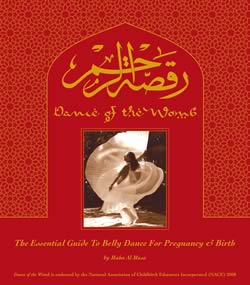
Dance of the Womb book cover

Book Review: Dance of the Womb: The Essential Guide to Belly Dance for Pregnancy and Birth
By Maha Al Musa, 2008
ISBN 978-0-646-48705-2
260 page hardcover book, $49.95 (AUS)
http://www.bellydanceforbirth.com

Reviewed by Molly Remer, MSW, ICCE

Some books simply feel good to hold in your hands. Dance of the Womb is one such book: it is beautiful, both in content and appearance. While priced a little higher than some birth books, I cannot emphasize enough what a high quality book it is—-it is not a traditional trade paperback, it is of textbook quality and size. Hardbound with a lovely cover and endpapers, Dance of the Womb is packed with full color, detailed, step-by-step instructional photographs leading the reader through a “belly dance for birth” journey.

Dance of the Womb is divided into several segments. The first section summarizes the benefits of belly dance and explores the physiology of birth. The next section walks the reader through a series of gentle warm-up exercises while the following sections progress through a variety of different specific belly dance movements. Nearing the conclusion of the text is a segment about labor movements with positions. Each section of the book is lavishly illustrated with very clear, easy to follow, step-by-step photographs.

The author’s own journey through pregnancy, birth, and mothering is skillfully interwoven throughout the text as well as her own feminine passage into understanding herself as a complete woman. Interspersed with the photographs and belly dance instructions, is the exploration of the author’s pregnancy and birth experiences, her relationship with her own mother and her parents’ culture. The book contains her personal birth stories as well as perspectives on belly dance for birth from three midwives.

The author, Maha Al Musa lives in Australia. Her interest in Middle Eastern Dance was sparked by her Palestinian/Lebanese roots and birthplace as well as her pilgrimage to explore her heritage and reconnect with her long-separated mother. Maha has also developed a Dance of the Womb step-by-step instructional belly dancing DVD (sold separately, review to follow) that includes a video of her own homebirth journey with her third child. She is also developing a one day foundation course in “bellydancebirth” for birth professionals with a plan to go international in 2011.

Dance of the Womb is a great introduction to not just the basic physical elements of prenatal belly dance, but also to the spiritual aspects of giving birth and life as a woman. It is written with an intimate tone that makes the reader feel as if the author has reached out across the miles to form a direct, personal connection. This book feels like a rich treasure to hold and is a gentle, nurturing, encouraging, and enriching voyage for pregnant women or the people who serve them.

—-

Disclosure: I received a complimentary copy of this book for review purposes.

Does Water Slow Down Labor?

il_570xN.684257213_8rjiA concern commonly expressed about using water during labor is that immersion in a tub of warm, soothing water has the potential to slow down or even stop labor, particularly in the early stage. For many women, this is not a desirable effect!

The Waterbirth International website (www.waterbirth.org) shares this information about choosing when to get into the water:

A woman should be encouraged to use the labor pool whenever she wants. However, if a mother chooses to get into the water in early labor, before her contractions are strong and close together, the water may relax her enough to slow or stop labor altogether.  That is why some practitioners limit the use of the pool until labor patterns are established and the cervix is dilated to at least 5 centimeters.

There is some physiological data that supports this rule, but each and every situation must be evaluated on its own.

Some mothers find a bath in early labor useful for its calming effect and to determine if labor has actually started. If contractions are strong and regular, no matter how dilated the cervix is, a bath might be in order to help the mother to relax enough to facilitate dilation.

Therefore, it has been suggested that the bath be used in a ‘trial of water’ for at least one hour and allow the mother to judge its effectiveness. Midwives report that some women can go from 1 cm to complete dilation within the first hour or two of immersion.  The first hour of relaxation in the pool is usually the best and can often help a woman achieve complete dilation quickly.

In the book, Birth Day: A Pediatrician Explores the Science, Mystery, and Wonder of Childbirth, Dr. Mark Sloan explores the biochemical reason why water immersion can slow down labor. I found the explanation interesting as well as logical:

When a laboring woman climbs into a bath, the refreshing buoyancy she feels sets off a chain of physical and hormonal events. As her muscles relax, her catecholamine levels—the ‘fight or flight’ hormones that rise in labor—decrease. This can actually help her labor progress, as excessive levels of catecholamines are known to slow down uterine contractions.

But countering that lowered-catecholamine labor boost is the effect that water pressure has on other maternal hormones. When a mother sinks deep into a tub, the weight of the water on her body forces fluid contained in her tissues into her bloodstream, thus increasing her blood volume. Sounds like a good idea—increased blood volume means increased cardiac output and oxygen-carrying capacity, and oxygen is a good thing to have coursing through your arteries when you’re trying to have a baby.

But the weight of the water on a woman’s body also causes a ‘pooling’ effect in the blood vessels inside her chest, because the rib cage protects the lungs from the water-pressure squeeze exerted on the softer tissues of the limbs and abdomen. Over time this leads to a complicated hormonal chain reaction that results in decreased secretion of oxytocin, the uterine-contraction hormone, from the pituitary gland within the brain. With less oxytocin circulating than before she climbed in the tub, a woman’s labor can slow down significantly.

The labor-slowing effect of taking a bath seems to be a problem only if the bath is taken early in labor, though. Once a woman is in active labor, the oxytocin surges are strong enough that no bath in the world can derail them.

The author goes on to explain that current research isn’t clear on when exactly oxytocin levels are high enough to prevent labor from slowing down, but suggests that it is “prudent to hold off on baths until the cervix has dilated to about five centimeters.” He also notes that water immersion during labor does not increase the infection risk for either mother or baby, and that as long as water is kept at body temperature, there is no risk to either of overheating.

I also decided to ask the real experts—birthing women—what their experiences were with water in labor. I posted the question to my Facebook Talk Birth “fan” page and received a few responses:

“I feel like it definitely helped me. I couldn’t find a comfortable position, but when I got out of the water it was definitely worse. It didn’t seem to slow anything down; C was born a few hours after I got in. I plan to blow the ol’ gal up again for the next baby.”–SE

“I have such fast, easy labor that I only get in the water for transition and delivery. I will not do it any other way and kick myself for not doing it with all my births!!! It definitely takes the edge off for me (and no ring of fire either). I think it actually does slow me down a bit, but my births are crazy fast, so that is a good thing.”–NA

“I feel like for first time moms it’s hard to know how to push when you don’t have all of the pressure. I labored in the water with Ashton but delivered him out of the water when things just weren’t finishing. With Brice I knew what I was doing so had no problems pushing Brice out in the water. I really liked the water but haven’t labored without it for transition. My [midwife] also has found that first time moms many times need to get out of the water to deliver and that it can slow down labor.”–RK

“I had a waterbirth with my 2nd, and due to her malpositioning it was by far my most painful birth. Most people say the water really relaxes them and eases pain, but that was not the case with me. Also, one thing I did not realize about water birth babies is that often they are not full of color when they are born. Some people say this is because they have an easier transition into the air. I’m not sure of the reason, but this was very startling for my husband. I just talked to her and rubbed her vigorously, and she pinked up soon after.”–GC

Personally, think the laboring woman should be the guide. If she feels like getting into the water, then it seems like the right time to me! With my second baby, I had a birth pool on hand thinking I may like to try it, but my labor progressed so rapidly that there was no time to blow up the pool, let alone fill it up or deliberate about when to get into it. As midwife Judy Edmunds says, “Waterbirth is one of many lovely ways to enter the world.”

Originally written for the FoMM newsletter.

Sign up for my Brigid’s Grove Newsletter for resources, monthly freebies, and art announcements.

And Even More Birth Quotes

Continuing my semi-regular addition of birth quotes I’ve used on the Talk Birth Facebook page recently.

“When women understand what’s available to us at birth, then we won’t ever give that over to an ‘expert’ the birth power, the orgasmic power that’s in our bodies” –Christiane Northrup

“Women have the inner power and the inner knowledge of giving birth. There is a parallel of sexuality and giving birth. Women who are giving birth, trust yourselves. Trust your inner power. Trust your ability to give life. This is something absolutely sacred that is inside all women in the world.” –Ricardo Jones, MD

“If women experienced the ecstasy of birth, they would have the high that would get them through the hormonal changes of the next week. Your body and your inner wisdom give you that high.” –-Christiane Northrup

“While many of us believe that encouraging a laboring woman to move when and how she wants to is healthier and safer than making her stay in bed, waiting for evidence that it produces better health outcomes is putting a burden of proof on normal birth that has never been applied to routine intervention.–Amy Romano

“Pay attention to the pregnant woman! There is no one as important as she!” –Chagga saying, Uganda

“A pregnant woman is like a beautiful flowering tree, but take care when it comes time for the harvest that you do not shake or bruise the tree, for in doing so, you may harm both the tree and its fruit.” –Peter Jackson

“Can we create a world where all needs are met with dignity and individual culture is retained; where a baby anywhere in the world is born nonviolently and according to the instincts of its mother; where people progress in directions of full potential and spirit is not sacrificed; where women no longer obey, submit and apologize for who they are?” –Sister MorningStar

“If birth were a medical disaster in waiting, routine medical intervention would not disrupt the process. It does. If technology were integral to the process of birth, routine technology would improve outcomes. It hasn’t. If birth were inherently painful, all women would suffer without medicine. They don’t. The initial assumption[s] are proven faulty.” –Kim Wildner

“Having a baby [is] an opportunity to transform a life, because in the moments of labor and birth all the forces of the universe are flowing through a woman’s body…’If you have 12 babies you only get 12 of those opportunities. This is big fun.'” –Sister MorningStar

“I think that women can be just completely surprised by the change in them from giving birth—you have something powerful in you—that fierce thing comes up—and I think babies need moms to have that fierceness—you feel like you can do anything and that’s the feeling we want moms to have.” –Ina May Gaskin

“Birth has been broken. The spirit of women with respect to their innate birthing power has been broken. We can do nothing about the millions of broken births that have already taken place, but by seriously looking at the effect of fear–the powerful emotion that clouds our thinking and causes the birthing body to break down–perhaps we can keep the finely tuned, precision bodies of women whole for future generations…” –Marie Mongan

“When you destroy midwives, you also destroy a body of knowledge that is shared by women, that can’t be put together by a bunch of surgeons or a bunch of male obstetricians, because physiologically, birth doesn’t happen the same way around surgeons, medically trained doctors, as it does around sympathetic women.” –Ina May Gaskin

“In a modern world, ‘getting through’ labour without numbing or dumbing the process can be a very powerful experience for a woman, and very challenging.” –The Pink Kit

“When it comes to pregnancy and birth, we as a culture and as individuals need to wake up and claim our right to literally birth right!” –-Christiane Northrup

“Birth may bring you face-to-face with your insecurities, doubts, inadequacies and fears, as well as your joy, determination, willingness and courage.” –The Pink Kit

“$13 to $20 billion a year could be saved in health care costs by demedicalizing childbirth, developing midwifery, and encouraging breastfeeding.” –Frank Oski, MD

“Let us initiate our daughters into the beauty and mystery of being strong and confident women who claim their right to give birth and raise their children with dignity, power, love, and joy.” –Barbara Harper

When it comes to birth classes, “restricting yourself to what ‘everyone else does’ will only get you what everyone else got. The numbers say this is a very sad limitation to place on yourself.” –-Kim Wildner

“In the absence of the medical indication for which they were developed, birth interventions are at best worthless, at worst, harmful.” –Kim Wildner

“Let parents know that they don’t need special techniques and gadgets to give birth safely and happily. Make sure to communicate to every mother you help, that she has all the essential ingredients for a safe, healthy birth within herself. A womb, a baby, a vagina, and a few warm pieces of fabric make an excellent, complete birth kit.” –Laura Morgan

“Women’s bodies have their own wisdom, and a system of birth refined over 100,000 generations is not so easily overpowered.” –Sarah Buckley


Moving During Labor

The second Healthy Birth Blog carnival is up on Lamaze’s Science & Sensibility blog. It is a great collection of links to posts about the importance of Healthy Birth Practice #2: Walk, Move Around, and Change Positions During Labor. For the blog carnival I contributed a post/handout I made last year called How to Use a Hospital Bed Without Lying Down. We spend quite some time on the subject in my classes and I encourage my clients to treat the bed like a “tool,” rather than a place to lie down. I also encourage strategizing about ways to both meet the needs of the hospital staff for “confinement” as well as the needs of the birthing woman for mobility (so, sitting on birth ball right NEXT to the bed and monitor, instead of lying back in the bed—both sets of needs can be met this way).

When reading through some of the other links in the blog carnival, I particularly enjoyed the one at The Unnecesarean about Women Describe Walking, Moving and Changing Positions in Labor. In the post, Jill points out “For first time mothers who have had no exposure to a birth, the time between, ‘I felt a contraction!’ and ‘I have to push!’ is often a total mystery.” How true is this! How many birth documentaries and shows (even very good ones), essentially only show a few minutes in early labor and then the baby being pushed out? What happened during the other 12 hours?? Obviously, we can have an episode or documentary that lasts 12 hours and shows every single detail, but I do think this gap means it is hard for first time mothers to really get a “vision” of what labor and birth is really like—the “long haul” picture.

Of course, that post made me think about my own births and how movement played an important role in both of them. I think it was equally significant/important for both, but since I was in labor longer with my first baby I used movement much more. In early labor, I sat on the floor cross legged with my back straight (working to keep the baby in “optimal” fetal alignment :), while I ate dinner and watched a movie. Then, I walked in the hallway to see if walking would stimulate any increased contractions. I also sat on the birth ball. As labor moved on, I ONCE tried lying down on my side in bed to “go to sleep” (at the suggestion of my doctor and doula) and that was IT. I had one contraction lying down and it was the worst contraction I’ve ever experienced (both babies). I never laid down again during either birthing! No possible way! When I got tired, I did kneel on the bed with a pile of pillows in front of me and rested my head/arms on the pillows. I also spent a lot of time kneeling by the side of the bed with my head resting on my arms on it. (This was my own bed at home.) I sat and rocked in the rocking chair with my eyes closed. I sat on the floor (briefly) with the rice sock under my belly and husband sitting behind me.When I went to the birth center, I sat in the rocking chair (oh wait, I did lie down one more time, for my sole cervical check of either pregnancy/birth). I also went back to kneeling on the floor with my head on the bed. Then I gave birth to my first son in a semi-sitting position on the birth center bed with my husband behind me/to the side. (Not the position I would have instinctively chosen, I think I would have actually birthed him kneeling by the side of the bed, but I was encouraged to get up into the bed. See his birth story.)

With my second baby, I walked around (again, “testing” out whether labor was “real” and going to intensify) in our kitchen. I squatted down several times (again, “testing” and trying to “make it bigger“). Then, I sat on my birth ball in the living room. I only stayed there for a few contractions and then stood up and wanted something to lean on—I leaned on the back of the (too rocky) recliner. Then, I ended up kind of hanging on my husband for a while—my arms around his neck and my legs dropping kind of outward. I then felt “driven to my knees” and got on my hands and knees on the floor with my arms and head on my birth ball. I quickly decided I didn’t want the ball and got just on my hands and knees with my husband in front of me with his arms around me. My son was born while I was on my hands and knees in this way.

I think when women think about “active birth” or “freedom of movement throughout labor,” sometimes they think this means walking the whole time or squatting up and down and up and down, or literally being *standing up* and moving around “aggressively” throughout labor. My own experiences were “active birth,” but the freedom of movement includes being able to sit in a rocking chair and “meditate” through contractions, or resting on your knees with your head on the bed. The “activity” we’re really talking about is really not lying down-–having the body upright/torso above the pelvis.

The most important event shaping my life as a mother?

Recently, this quote from a Midwifery Today blog post came to my attention: “your birth is the most important event in shaping your life as a mother.” It has generated some pretty heated discussion and negative feelings amongst some writers in the blogosphere. Despite my intense commitment to birthwork, I stumble over the quote a bit as well. I would venture to guess that if phrased in less black-and-white terms, it would not have caused such an angry reaction in some women. Perhaps, “your [child’s] birth is a very important event…” or “…is ONE of the most important events…” would have been better received, while communicating a similar idea. While I understand the sentiment and deeply agree that birth matters,  the sweeping assertion of the phrase “the most” doesn’t leave a lot of of room for personal experiences and individual variation!

I found the quote first referenced here with an insightful “rebuttal” of sorts. There is also a very detailed critique here.

I have a lot of my own thoughts based on both the original quote/blog post and on the responses from other bloggers.

It is well documented that birth is NOT “just another day in a woman’s life” and that giving birth does have lasting impact on women’s memories and quality of life. Those day-to-day moments with your children that several bloggers mentioned as more appropriate representations of “most important event shaping my life as a mother” are certainly important too and are the makings of a “real life,” but they don’t necessarily stand out in the memory as transformative events. Kind of like your wedding day stands out as very significant—it matters and is important and is not “just another day”—while simultaneously it is clear that the day-to-day life and love with your husband is actually more important than the wedding day.  So, while I would agree that “ultimately” speaking, your marriage is definitely more important than your wedding, I would also put forth that you are much more like to remember your wedding specifically and clearly and with specific emotion than you are to remember what you ate for breakfast with your honey-pie last weekend and that is one of the reasons why the wedding matters. Perhaps it is an issue of the mudane vs. the miraculous…

I believe you can hold the two experiences simultaneously—you can enjoy the wedding memory, while cherishing your regular old daily husband AND you can enjoy (or suffer from) the birth memory while also cherishing the daily life with the little ones. One doesn’t have to trump the other or to be “what really matters.” There’s room for lots of mattering in an every day life 🙂

I think another key is that birth is (or can be) a “peak experience” for women (and families). I want all women to have a chance to experience that. I certainly do not want her to feel diminished, unworthy, inferior or lacking if birth is not a peak experience in her life, but I also want all women to certainly be given a reasonable opportunity to let birth unfold in all its power and be treated respectfully and humanely by those around her—regardless of what is going on or the eventual outcome.

I love birth and cherish my memories of my sons’ births and consider them to be some of the most transformative, empowering, and significant single days in my life—peak experiences, powerful memories—and I also feel that birth matters as a distinct (and relatively rare) occurrence in a woman life. I believe birth has inherent value and worth on its own terms. I also believe that your feelings about the birth and the baby can most definitely be separated—you can feel pleased as punch with your delightful, precious baby and also be disappointed (or super thrilled with) your birthing. One does not take from the other—you can hold the reality of both and a breadth of feelings about them. And additionally, it is not wrong to want both things—a “good birth” and a “healthy baby.” The two go hand in hand and are not mutually exclusive concepts at all (see links to previous posts below).

All that said, however, I also do not feel that my children’s births were the most important events shaping my life as a mother. They were important, yes, but I think stating with finality that the event that shapes us is definitely X—or putting a finger on THE most important event is NOT something that can be pinned down by any one person or imposed from someone on the outside of yourself. I think it varies by woman and mother and there is room for many things to be true and valuable and okay. So, perhaps your important life shaper is seeing your children decorate the Christmas tree (though I still submit that “peak experiences” carry more emotional and psychological weight that everyday occurrences). For another mother, it could be the day she gave birth to her child. Those are both okay! One woman’s feelings and reality do not invalidate or dismiss another’s.

For me, the profound shaping event was the experience postpartum with my first baby. I have never had an experience that shaped me and impacted me and SHOOK me more profoundly than adjusting to life with my newborn son. That was my journey. That was my struggle. That was my challenge. That is what dissolved me and burned me into ashes and let me rise again as someone the same but also brand new—a mother. I was not “born” when my son was born, I was forged. Made, in the intense weeks that followed his birth.

If another mother states that her postpartum was full of “babymoon bliss,” do I need to dismiss her as deluded, lying, and or possibly perpetuating a myth? No! I can hold both in my awareness—my postpartum experience was my most significant life challenge. Hers was not. Both truths are FINE! Likewise, if I decide share that my sex life post-kids is better than ever before, is that dismissed as “couldn’t possible be true? MY sex life was ruined by kids!” or that I’m somehow lying or misrepresenting the truth? No, both can be true, because we are all different women with different lives and experiences and “realities.” So, if a woman feels like her birth experiences were the most important events shaping her life as a mother, that is totally okay—and, it can be true, without making a woman with the opposite experience diminished or “less than.” Of course, the logical extension of this train of thought, is whether I (and other birth activists) can hold our birth matters truth alongside the realization or acceptance that for some women birth IS “just one day” or that it is not an important event in their lives?

I also think we can draw on powerful memories for present strength—I remember my “birth warrior” feelings and it helps me with other tasks or with day to day life. I remember the laughing, crying, “my baby, MY BABY!” moments of triumph and bliss and ecstasy immediately postpartum and it buoys me with a fresh charge of  love for the little ruffians leaping off the couch in front of me or throwing crackers all over the house.

——–

Since the “birth experience vs. healthy baby” argument is of special interest to me, I’ve addressed it several other times on this blog:

Birth and Apples

Personal Mastery & Birth

Birth Experience or Healthy Baby?

Evidence Based Care

Another Healthy Mother/Healthy Baby Quote

Birth Talk

As I have referenced several times before I have a special interest in the language of birth. That is part of the reason my blog/business is so-named—because is it is a blog that “talks birth” (as in, “let’s get together and talk birth!”), but also because the way you talk about birth matters. I have also referenced before that it was originally going to be called Birth Talk, but when I went to get the gmail address, it was already taken (by a childbirth educator I coincidentally later came to know!). I’ve come to really “bond” with my Talk Birth name and now “birth talk” sounds slightly odd to me (though “talk birth” is really the odder phrasing).

A couple of months ago, I read an interesting article by Debra Bingham about Taking Birth Back. It it, she asks you to consider–when talking about birth–how your basic assumptions affect your discourse (the way you talk about birth):

1. Does your discourse include stories about the power of women?
2. Or do the stories shift the locus of control away from women and their bodies to other authority figures such as nurses, physicians, or machines?
3. Does your discourse assume that women are physiologically capable of giving birth and nourishing their own children?
4. Or does your discourse assume that women’s bodies are fundamentally flawed and in need of medical attention and intervention?

I am frequently attempting to shift the locus of control from “authority” figures back to women–it is shocking to me how ingrained the terminology is about medical care providers (even midwives!), “letting” someone do something, etc.

And, an enormous part of my life revolves around stories about the power of women, so I think I have that one down 😉

The prevailing social discourse about birth assumes a locus of control external to the woman and you rarely hear stories about the “power of women” amongst the general public or mainstream media. Ditto for the assumption of women’s bodies as fundamentally flawed, except replace “rarely” with “frequently.” These messages are so dominating that I think it is hard for women to really “hear” positive birth talk–it seems like a “joyful birth” must be a myth or impossible. Likewise, when a woman is striving to keep the birth talk around her positive, it can be very difficult to override the predominately negative messages coming at her from every side. I see this in my classes, “I believe birth is a natural event, etc., etc. BUT….” (followed by a  “I trust my doctor’s judgment and if he wants me to have this GTT test or this extra ultrasound to check my fluid level, etc. I guess I will do it…” comment that contributes to the “climate of doubt” in her life). There are also the woman’s own “inner voices” to contend with—I hypothesize that the loudly-shouted cultural voices about birth contribute a good deal to the “negative voice” in her inner dialog.

I don’t know any way to “fix” this  other than to continue “talking birth”–good, healthy, positive, normal, humanistic, natural, joyful birth–as widely and frequently as I can!

Birth as a Rite of Passage & ‘Digging Deeper’

July 2015 135Childbirth is a powerful rite of passage. One of my favorite resources, The Pink Kit, has some great reflections on this rite of passage and the words we use to describe the powerful, indescribable act of giving birth:

Whatever the culture, when a woman surrenders to the process, accepts the intense sensations, works through each contraction, and digs deep within herself to achieve the end goal–giving birth–she is touched by the Unknown and Unknowable. Many traditional cultures send their young men into initiation rites where they, too, can learn to understand humbleness and achieve the self-control that women learn in childbirth.

All cultures believe that women become better and more generous through the process of giving birth. That is why some cultures use words such as ‘sacrifice,’ ‘suffering’ and ‘labour.’ These terms can seem overwhelming and to be avoided’ however, seen from a different viewpoint, childbirth helps us to become strong, resourceful and determined.

In a modern world, ‘getting through’ labour without numbing or dumbing the process can be a very powerful experience for a woman, and very challenging.

I like the concept of “digging deeper.” This how The Pink Kit explains it:

You might avoid the pain in labour by moving into a position which is comfortable for you (i.e. reduces the sensations), but it slows labour down and then you stay there for hours. Doing that will increase the likelihood of medical intervention because you will become tired, bored, or frightened, and labour doesn’t progress. Instead, consider remaining in positions that keep you open and the labour progressing, while using your skills to manage the sensations. This is ‘digging deeper’.

I have noticed an emphasis in other natural birth preparation books and explanations about finding positions that are “comfortable.” I very much like the concept of finding positions that help you feel “open”—these positions may certainly also comfortable (and that is great!), but if you remain mindful of “staying open,” it may lead you “dig deeper” and find positions that really help move the baby. In my classes, I encourage women to welcome labor “getting bigger” (not more “painful” or “difficult,” but make it “bigger” and be excited by that change!). I think this idea goes hand in hand with digging deeper.

How do I know I’m really in labor?

Mollyblessingway 042When I was in early labor with my first son, I spent quite some time upstairs in our computer room googling, “how to know you’re really in labor” or, “signs of true labor,” or “the difference between false labor and real labor,” or, “how do I know I’m in labor,” or, “how to know I’m in labor.” I would do this between contractions and then when I had a contraction I would think, “Wow! This is definitely it!” Then, it would ease, and I’d start googling again, certain I must just really be experiencing “false labor.” One of my biggest fears was arriving at the birth center and only being two centimeters dilated (or possibly not in labor at all!). So, in honor of my former self, I offer a list of some ways to to gauge whether you are experiencing true labor.

It is true labor if/when:

  • Your contractions fall into a regular pattern. And, that pattern involves contractions that are lasting longer, feeling stronger, and occurring closer together.
  • If when you walk around or otherwise increase your activity, the contractions also increase.
  • And if changing positions and drinking plenty of fluids also do not cause the contractions to ease…
  • The sensation begins in your lower back and spreads like a band around your belly causing a peak of tightness and discomfort in the front and then fades away again.
  • You have been feeling some gastrointestinal upset and may be experiencing diarrhea also.
  • You have pinkish or blood streaked, mucousy discharge.
  • Your membranes have ruptured (keep in mind that labor only begins in this way for roughly 10% of women. So, if your waters have not released, do not be discouraged thinking that you must not be in “real labor.” Many women do not experience their waters breaking until they are pushing or are starting to feel like pushing).
  • Truly, I think that the best sign that you are in labor is if you really feel like you are in labor. This is one of those things that doesn’t feel that helpful to a first-time mom—“yes, but how will I know?! What if I’m in labor and don’t know it until the baby is coming out?!” I promise that for the wide majority of you, at a certain point, you will just know that you are in labor and there will be no more questions about whether this is “really it”—that is the best sign, when you stop wondering “is this really it?” My observation is that this point comes along when you enter active labor and enter your “birth brain” instead of your analytical, logical brain.

Is this really it?

If you are still wondering, “is this really it?” my best piece of advice is to ignore it! Pretend like nothing is happening. Go about your normal day and your normal routine. If you would normally be sleeping, sleep. If you would normally be eating, eat. Go for a walk, water the plants, feed the dog, bake something, go to the store, etc. When your contractions need your full attention, they will ask for it 🙂

Symptoms of pre-labor (“false labor”)

Some “symptoms” that what you are experiencing is instead practice labor, pre-labor, or “false labor” (I do not usually use the phrase “false labor” because I think it is dismissive of women’s experiences. All contractions are doing something and so I refer to them as “practice” rather than “false.” Another good phrase to use is “pre-labor” contractions. My midwife with my second baby referred to them as “toning contractions”):

  • The contractions are irregular (no pattern) and are not increasing in frequency or intensity.
  • If you change positions or drink two large glasses of juice, water, or tea, the contractions subside.
  • The contractions center in your lower abdomen and do not involve your back.
  • The contractions go away if you take a walk, take a shower, or lie down.

This is also a popular question in birth classes. Because labor is a new event for you, it can be hard to know what to expect until it actually happens! There is  pdf handout here with some additional signs and information. There is also a helpful handout with a sort of flowchart of signs/symptoms here.

Oh, and by the way, when I did finally go to the birth center, I was 10 centimeters dilated and started pushing about 30 minutes later!

—-

What about induction?!

On a closely related topic, why bother with all this guessing about whether or not you’re in labor? Why not be induced instead? Good questions! There are numerous reasons why you should let labor begin on it’s own—labor that begins on its own is usually safer and healthier for both mother and baby. Also, it is less painful than a labor that is induced with medications such as Pitocin. For more information about letting labor begin on its own, check out Lamaze’s Healthy Birth Practice #1, or this video clip from Mother’s Advocate:

Sign up for the Brigid’s Grove Newsletter for resources, monthly freebies, and art announcements.

Quick Births

I recently finished reading the book Permission to Mother by Denise Punger (you can read my full review in an upcoming issue of the CAPPA Quarterly). In one of the Appendices of the book, she addresses “Herbal Inductions–Are They Safe?” Her response is “no” and she adds “A homebirth does not equal a ‘natural birth’ if Blue and Black Cohosh are used to induce.” She opens the section by referencing her third labor which was over 12 hours and gave her “time to emotionally adjust to the escalating physical demands and surprise of my labor” and then goes on to say, “Over and over…I am hearing about intense labors that occur in two hours or less! Women often express delight about their miraculously quick labors (as if a quick labor were the goal). But I don’t sense any emotional, physical, or spiritual satisfaction accompanying these seemingly precipitous deliveries.” She also shares that a commonality in these stories is the use of herbals to induce or augment labor.

This section caught my eye, because I had a very quick birth with my second baby. I also was intrigued by the presumptiveness of dismissing a quick birth as not emotionally, physically, or spiritually satisfying—it seems like someone who is seeing through their own “lens” of 12+ hour labors and can’t imagine another type of timeline for birth. For the past several days I’ve been pondering this issue and considering my own experiences. I also did a variety of google searches looking for information about “emotional impact” of “fast labor” or “precipitous birth.” I turned up surprisingly little information—there was one article that popped up several times titled “The experience of precipitate labor” in the journal Birth. However, I was not able to access the full text of the article to read what it actually says. The results were described as: “The experience of precipitate labor was categorized in terms of physical experience (perception of labor length and contractions), psychological experience (relationship of how women perceived birth to their prenatal expectations, and emotional trajectory of disbelief, alarm, panic, and relief), and external factors (support persons and hospital system).”

My searches also turned up personal birth stories, excerpts from nursing textbooks or emergency medicine texts about handling precipitous birth, and message board discussion threads. The most commonly shared pieces of information about rapid labors is that they can be physically shocking and can be difficult to “catch up with” emotionally, as well as stressful because the mothers often are thinking, “if this is early labor, how I can possibly handle another 12 hours?!” They also reference increased change of hemorrhage. I did not see the questions raised by the Permission to Mother segment directly addressed anywhere. So, I want to know–if you experienced a quick birth what physical, emotional, and spiritual satisfaction did you experience, if any? What about external factors? (support persons, birth environment.) How about your psychological experience and “emotional trajectory”?

My own experiences are as follows:

Second baby, total labor two hours. Forty weeks pregnant. No herbal induction methods used. About 45 minutes were “serious labor.” It was very intense and I’ve said several times before that it felt a bit like a train rushing past and that I had run to catch up with it (emotionally and mentally).

Physical Satisfaction:

I was extremely proud of my body and its super-awesomeness 🙂 I felt that my sense of birth trust was physically manifested in my actual birth experience. My body was a powerful and unstoppable force and I had to get out of my own way and let it happen! I felt driven to my hands and knees–like a power was holding me there. After the birth my body felt weak and “run over by a truck”—I felt powerful and like a warrior during the birth, but afterward it was a physical “crash” of sorts. I did not have excessive bleeding, but I did almost faint several times after getting up (hindsight says, why didn’t I just stay down a while longer?!). I experienced labial tearing (no perineal tearing) and a lot of swelling as well as bruising, that I surmise was a direct result of my son’s rapid birth.

Emotional Satisfaction:

The birth was very emotionally satisfying. I did feel as if I never made it to “labor land” though–that hazy, dreamy, unreal state that I associate with my first son’s birth (and longer labor). I did not feel scared or overwhelmed or out of control as such (I did consciously let go of control—I think these are two different things) . I felt proud of myself. I felt amazed. I felt phenomenal. I felt ecstatic. I felt powerful. I felt empowered. I felt triumphant. I was pleased with how I’d verbally coached myself through labor—telling myself “it’s okay, you’re okay” and “be a clear, open channel for birth” and “relax your legs.” I felt excited and enjoyed the “drama” of already holding my baby after only a short while before thinking, “maybe I’m in labor.” It felt like a wonderful, fulfilling adventure.  I didn’t feel like a “victim,” but I did feel like something “happened to me”–as I said, I had to just get out of my own way and let the power roll through me. Later, I felt emotionally upset about the tears and the bruising. This felt like my piece of “failure,” because I had hoped and planned not to tear again.

Spiritual Satisfaction:

This is related to the above for me. I felt like a force of nature–like I was one with the powers of the universe. I was happy with my ability to get out of my head and “be in the now” with the energy of birth. My son’s birth was the most powerful and transformative experience of my life. I think that counts as sprititual satisfaction 🙂

External Factors:

I gave birth at home. If I hadn’t planned a homebirth, I think there would have been more stress and fear involved with trying to get to the hospital (and possibly a car birth, as we live 30 minutes from the hospital). My husband was very physically there with me–holding and supporting me–I felt like we were one person. My mother was present towards the end and held my older son. They felt overwhelmed and surprised by the intensity, but they got out of my way and let me birth! My midwife was present for 5 minutes–enough time to catch the baby. She was calm and a gentle presence.  She was very physically supportive postpartum. No one tried to influence or control what I was doing, where I was, or how I was laboring and giving birth. I had complete freedom and control over my environment.

Emotional Trajectory:

I went from excitement—“I hope this is really it!”—to, “Oh my goodness, we don’t have time to fill up the birth pool—just get me my birth shirt, my blessingway bracelet, and my ponytail holder!” and wading deeply in to the rushing waves of energy. The experience became completely encompassing–I was no longer in my left-brain, but was instead holding on to the train and catching up. I did not feel panicked or alarmed and I did not feel relieved when it was over, I felt amazed and happy and blissful and powerful.
Beautiful Homebirth Slideshow

Today I was sent a link to a lovely homebirth slideshow (scroll down through the photos and story to get to the slideshow link—-the story is worth reading too. It has some good observations about why birth matters: “If you have scene the movie The Business of Being Born there is a seen where one of the OBs being interviewed states in so many words that the process of birth is unimportant that it’s the outcome that is important – a healthy baby and a healthy mom. And while he is correct that a healthy baby and a healthy mom are always the most important end result he is dead wrong about the process. The process matters – -immensely. Physically the birth process is extremely important for the long term health of the mother and the baby, emotionally and psychologically the birth process will affect a woman for the rest of her life.” Can I just say, Amen!)

I absolutely love the joyful expressions on the mother’s face immediately after birth. So beautiful! Plus, it brings that feeling from my own births back to me. On Labor Day, CAPPA posed the question:


“Happy ‘LABOR’ day from CAPPA. What I loved about labor was________________!”

My response was: The feeling of personal power at the end—the “I climbed my mountain,” I DID IT feeling. And that moment of ecstasy of holding my new baby and saying, “my baby, my baby, oh my baby” over and over 🙂 Brings tears to my eyes thinking about it!

Watching the slideshow above, also brought the memory of that same “my baby, my baby” rapture back to me.