Repost: How I learned to mother myself

One of my very favorite books for mothers is The Mother’s Guide to Self-Renewal by Renée Trudeau (past posts referencing her are here). I also enjoy her digital newsletter. While it is a bit after the fact now, I’m reposting her Mother’s Day article about how she learned to listen to her Wise Self. As I wrap up the school session, prepare to travel, keep up with my blogs, plan rituals, attempt to halfway manage to keep up with the classes I’m taking, and mother my children, I need all the reminders I can get about self-care! (Speaking of mothers, self-care, and Mother’s Day, I also very much enjoyed this lovely blessing from Shiloh Sophia: A Mama Day Blessing for All Kinds of Mothering | Our Lady of the Red Thread.)

How I learned to mother myself

by Renée Trudeau IMG_2168

There’s been a lot of belly button gazing in our house this past week. My adolescent son told me on Friday, “I’m thinking a lot about my life right now,” my introspective husband is taking a class where he’s contemplating our relationship to the cosmos and having just returned from teaching at the ethereal Esalen Institute in Big Sur, CA and the redwood forests, I’m reflecting on my how much my self-care practice has affected my relationship with my husband (read more) …. and myself.

My beloved and I are celebrating our 13-year wedding anniversary this Tuesday and while we still two-step with our respective issues, it seems we’re becoming more accepting and gentle with another, as we slowly become more compassionate and kind to ourselves.

But it’s been a long road.

I have a visceral recollection of the day, ten years ago, when my husband returned to work after being home with me and our newborn for two weeks. Sitting in our dark, quiet kitchen, holding my baby boy, listening to the kitchen clock tick, and blanketed in a postpartum haze, I thought, “This is it. I’m all alone.”  It was a frightening and devastating realization, and I have never felt the absence of maternal nurturing more than I did then. But then, I heard a comforting voice whisper from within, “Renee, it’s time to start mothering yourself.”

That moment was a catalyst for me and the beginning of my journey to learning to both nurture and nourish myself.

For years, I didn’t even know what I needed (self-care, what’s that?!). I was so habituated to the seduction of productivity, to going non-stop, to value “doing over being,” to allowing my internal state to be dependent upon the external world and to tying my self-worth to my latest win. But as I began to tune inward and become reacquainted with my desires—my love of nature, my need to be fed by beauty/art and dance, my passion for nurturing my body through vibrant natural cooking—and watched my own commitment to my well-being grow each day, I began to see the ripple effect this had on my family, my friends and beyond. (Hear how this evolved.)

Learning to mother myself has evolved into a thirteen-year journey to not only becoming my own best friend, but to living a soulful, vibrant awakened life. At times, I am ferocious, radical and even willing to p*** people off in order to stay in integrity with “her”—what I call my Wise Self.  And I found that once I opened up and walked through the doors of self–care, I was gently brought to the path of self-compassion, then self-acceptance and eventually to self-love. It’s been long and slow. But this deeply spiritual practice of self-care has changed my life more than any other.

Now as I move steadily into the second half of my sweet, unpredictable life, holding hands and moving forward–sometimes tentatively–with my kind, tender soul, I leave behind who I thought I was  in order to fully welcome who I am becoming. Warts and all. And I watch my love and acceptance for this beautiful, sometimes controlling and perfectionististic usually compassionate and generous woman grow more each day.

Self-care has gone beyond learning to attune and respond to my physical, emotional and intellectual needs and desires—it’s how I nurture my soul—my very essence. And it’s how I not only celebrate the incredible gift of being in this amazing body and having the gift of this beautiful life— it’s how I remember who I really am.


You may reprint this newsletter in its entirety provided you include at the end: Renée Peterson Trudeau is a life balance coach/speaker and author of The Mother’s Guide to Self-Renewal and Nurturing the Soul of Your Family. You can download free book chapters, receive life balance tips or learn about upcoming events at www.ReneeTrudeau.com. On Facebook at: LiveInsideOut.

Subscribe here to receive Renée’s life balance newsletter.

Tuesday Tidbits: Breastfeeding

It is almost too late to call today Tuesday, but I’m squeaking this post in anyway! Breastfeeding articles have been catching my eye this week, MollyNov 109specifically this one about the life-saving benefits of human milk for the critically injured:

But one exciting question is still unanswered: can breast milk be used medicinally as treatment in babies –and even older children and adults– who may not have been breastfed? There is a growing body of evidence suggesting all sorts of uses for breastmilk as treatment of adult disease.   Ads may say, “Milk: Does a Body Good” but in all likelihood, human milk can do a body, any body, better.  

Baby Charlotte Rose wasn’t breastfed. Until the age of 11 months, she was a happy, healthy little girl.  All that changed radically when she suffered a traumatic brain injury…

via Miracle Milk® Helps Heal Brain Injured, Formula-Fed Baby | Best for Babes.

And, since the politics of breastfeeding are endlessly fascinating to me, I was curious to read this article by the mother who caused an unanticipated media stir last year with her breastfeeding-in-uniform pictures:

Whoever said a picture can speak a thousand words was right, even when I could speak none. A group of breastfeeding women, including myself, all took part in a photo shoot with the intentions of  letting others know breastfeeding is possible regardless of your situation. My main contribution, or so I thought, was that I happened to have twins. Boy was I wrong. Another woman and I, who both served in the Air National Guard, also took pictures in our uniform to show that even those serving could also breastfeed. We were both prior active duty so we knew the struggles of both being full-time and part-time military. Contrary to popular belief, we did get permission to take the pictures. After the pictures were taken, we were going to consult the law office on base and get permission for the photos and positive quotes to go along with them with the goal of having them put into women’s exam rooms…

via Terran McCabe: The Air Force Breastfeeding Mom Finally Speaks Out – I Am Not the Babysitter.

While some recent breastfeeding research with a very limited sample is making headlines under the misleading title that “supplementing newborns with small quantities of formula may improve long-term breastfeeding rates,” The Academy of Breastfeeding Medicine published a helpful post breaking down the research and drawing more accurate conclusions:

A small study published in Pediatrics suggests that supplementing newborns with small quantities of formula may improve long-term breastfeeding rates. The results challenge both dogma and data linking supplementation with early weaning, call into question the Joint Commission’s exclusive breastfeeding quality metric, and will no doubt inspire intimations of a formula-industry conspiracy. Before we use this study to transform clinical practice, I think it’s worth taking a careful look at what the authors actually found.

First, I think it’s very important to be clear about what the authors meant by “early limited formula.” The authors used 2 teaspoons of hypo-allergenic formula, given via a syringe, as a bridge for mothers whose infants had lost > 5% of their birthweight and mom’s milk had not yet come in. At UNC, we use donor milk in a similar way, offering supplemental breast milk via a syringe as a bridge until mom’s milk production increases.

This is very different from the way that formula supplementation is handled in many US hospitals. We know that in the US overall, 1/4 of breastfed infants are given formula by day 2 of life, and that number reaches as high as 40% in some areas. Typically, when a family member expresses interest in giving the baby some formula, a hospital staff member plunks a 6-pack of 2-oz bottles of ready-to-feed formula in the baby’s bassinet with no instruction about how much to feed. A neonate whose stomach holds one to two teaspoons gets 2 ounces (12 teaspoons) of milk poured into him. The baby then sleeps for the next four to six hours, like someone who’s just over-indulged at a Thanksgiving buffet. In this scenario. Mom doesn’t get any breast stimulation, and family members all express relief that “finally the baby is happy.” When baby finally wants to eat again, there are five more convenient, ready-to-feed, six-hour-nap-inducing bottles sitting in the bassinet. This does not tend to help mothers breastfeed successfully. I worry that the headlines from this study — such as “How Formula Could Increase Breastfeeding Rates (TIME)”  and  ”How Formula Can Complement Breastfeeding (NYT)” —  will translate into “a six pack of formula back in every bassinet!”

via Early, limited data for early, limited formula use | Breastfeeding Medicine.

Note that the benefit of this very specific type of early supplementation can also be achieved via donor milk. The research does not actually “prove” that formula is helpful for breastfeeding, but that for certain mother-baby dyads, supplementation of some kind via syringe is helpful. This is NOT the same thing at all as supplementing with a two ounce bottle of formula!

I was glad to see Dr. Newman chiming in on the comments with his no-nonsense opinion: “I also love it how they say their results may not be applicable elsewhere because they live in a community where women are eager to breastfeed and 98% initiate breastfeeding. So surely they must find ways to give these babies formula…”

Speaking of Dr. Newman, the conference registration form and website are finally available for the upcoming LLL of Missouri conference in June. I learn so much at LLL conferences and I’m very much looking forward to this one as well. Dr. Newman is the special speaker. I heard him speak at the CAPPA conference last year and he is not to be missed! I’m also speaking twice at this conference, but Dr. Newman is much more exciting than me! ;)

Happy Mother’s Day!

“Blessed be all the mothers of mothers.
Blessed be all the daughters of daughters.
Blessed be all the daughters of mothers.
Blessed be all the mothers of daughters.
Now and forever, wherever we are.” –Diann L. Neu

In Uganda there is a special word that means “mother of a newborn”–nakawere. According to the book Mothering the New Mother, “this word and the special treatment that goes with it apply to a woman following every birth, not only the first one. The massages, the foods, the care, ‘they have to take care of you in a special way for about a month.’”

There is a special word in Korea as well. Referring to the “mother of a newborn child,” san mo describes “a woman every time she has had a baby. Extended family and neighbors who act as family care for older children and for the new mother. ‘This lasts about twenty-one days…they take special care of you.’”

These concepts–and the lack of a similar one in American culture–remind me of a quote from Sheila Kitzinger that I use when talking about postpartum: “In any society, the way a woman gives birth and the kind of care given to her and the baby points as sharply as an arrowhead to the key values of the culture.” Another quote I use is an Asian proverb paraphrased in the book Fathers at Birth: “The way a woman cares for herself postpartum determines how long she will live.

Dana Raphael, the author of Breastfeeding: The Tender Gift, who is best known for coining the word “doula” as it is presently used, also coined another valuable term: matrescense. “Nothing changes life as dramatically as having a child. And there was no word to describe that. So we invented the word–matrescence–becoming a mother.”

Happy Mother’s Day to mothers around the world!

Mother's Day

Want to find out what mothers really want? Check out the newest Listening to Mothers survey results: Listening to Mothers III: Report of the Third National U.S. Survey of Women’s Childbearing Experiences

Other Mother’s Day reads:

Womenergy (Womanergy)

Prayer for Mothers

What If…She’s Stronger than She Knows…

This is a modified repost of a previous post for Citizens for Midwifery. It is being crossposted today at CfM, Talk Birth, and Pagan Families.

Birth Stories by Two Year Olds…

With each of my kids when they are somewhere between two and three years old, I feel inspired to ask them if they remember when they were born. They always say, “yes,” and I say, “tell me about it” and they do. Lann’s story was a succinct and accurate version of what happened. He said:

Toddlers can do birth art too! Love the placenta in a bowl and the baby attached to the mama with cord (yes, I know the two are mutually exclusive, but I love it anyway!)

Toddlers can do birth art too! Lann drew this after Zander was born. Love the placenta in a bowl and the baby attached to the mama with cord (yes, I know the two are mutually exclusive, but I love it anyway!)

Swimming
Swimming down out of mama.
Crying!
Nursies.
Happy now.

As I’ve written before, he did start crying loudly with only his head sticking out. Almost immediately after he was born, I put him to my breast offering him what I spontaneously called “nursies” and he was, in fact, then happy.

I asked Zander on his third birthday and his version of his birth was as follows:

First you saw a little head poking out.
Then a little arm.
Then another little arm.
And another and another.
And me was little alien.

He was, in fact, born slowly like this with head emerging and then arms and then upper body and then the rest of him. I asked him what happened to his extra arms and he said:

They actually melted.

He was nursing at the time and paused, popped off and said:

and, my extra eye melted too…

That’s my little Zander for you!

I love how the baby looks like it is "floating" in this one.

I love how the baby looks like it is “floating” in this one.

Yesterday morning, I spontaneously asked Alaina if she remembered being born and like the others she said yes. I asked her what happened and she said:

My baby! My baby!

I asked, “did you hear mama saying that?”

She said yes and then said,

Now, nonnies.  Then she just gazed off into the distance like she was remembering.

I asked her if she remembered anything else and she repeated the above. Shortest of the children’s birth stories, but also distilled to its essence ;)

I’m curious to know if other people ask their children this question and what kind of responses to you get? I love each of my children’s birth stories as told by them!

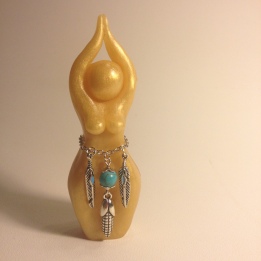
Both boys made me a birth art sculpture for my birthday this year and each is about a baby being born:

May 2013 021

Zander’s sculpture: The Goddess of Birth

May 2013 022

Lann’s sculpture.


Tuesday Tidbits: Writing, Reading, Rituals

There is an open, flexible, compassionate way of relating to everything we experience, including natural disasters and sudden death. It is not so much a process of learning how to ‘get over’ a profound loss, but rather how to allow it to be there, lightly, gently, like a fine thread woven forever into the tapestry of who we are.” –Nancy J. Rigg (previously used in this post)

I know it is boring to hear about how busy someone else is, but I’m barely keeping my head above water recently. I’m sad that my blogs are sinking to the bottom of my list, because I do so love to write and I have ideas for new blog posts every single day. And, every single day, no matter how long the to-do list is, I have a secret plan that I’ll work like the wind and finish everything else on my list and then I’ll still have time covershot-37“left over” in which I’ll actually get to write the imagined posts. Just isn’t happening this week though. I haven’t even read any birth articles to share thoughts from! However, past self, who apparently had some more time to spare than current self, did produce some work that has given me fodder for this week’s Tuesday Tidbits post. I was pleased as can be to have my article, Breastfeeding as an Ecofeminist Issue, published in Pathways Magazine this quarter. There are precious few opportunities remaining to be published in a print magazine for natural parents and there is just something extra special about having an article published in a full-color, real magazine :) They sent me a pdf version of the article to distribute on my own website and so I’m doing just that. For the nicely printable pdf version, click here.

We are mammals because as a species we nurse our young. This is a fundamental tie between the women of our time and place and the women of all other times and places as well as between the female members of every mammal species that have ever lived. It is our root tie to the planet, to the cycles of life, and to mammal life on earth. It is precisely this connection to the physical, the earthy, the material, the mundane, the body, that breastfeeding challenges men, feminists, and society.

Breastfeeding is a feminist issue and a fundamental women’s issue. And, it is an issue deeply embedded in a sociocultural context. Attitudes towards breastfeeding are intimately entwined with attitudes toward women, women’s bodies, and who has “ownership” of them. Patriarchy chafes at a woman having the audacity to feed her child with her own body, under her own authority, and without the need for any other. Feminism sometimes chafes at the “control” over the woman’s body exerted by the breastfeeding infant.

via Breastfeeding as an Ecofeminist Issue | Talk Birth.

Then, on my birthday last week, my contribution to a series of guest posts by feminist readers about children’s books appeared on First the Egg:

“Books have always been a huge part of my life, and I have many favorite and noteworthy books from my childhood. When considering the question though, one quartet immediately came to mind since two of my children are in fact named after one of the characters–the same character, no less! The Song of the Lioness quartet by Tamora Pierce is the tale of Alanna, who disguises herself as a boy in order to train as a knight. Alanna is a very kick-ass girl, and though she is small and petite, she learns to be an awesome knight, in fact the very best. She develops close friendships with the other squires while managing to guard her secret from most, even through the changes of puberty, until her final test of knighthood. These books have magic and battles and bullies and evil sorcerers and a talking cat and a Great Mother Goddess who takes a special interest in Alanna.”

via children’s books from feminist readers: the other Molly.

And, as far as reading that I’m supposed to be writing about, I’m really looking forward to finishing my book review of The Midwife’s Tale by Sam Thomas and publishing the author interview I did with him.

I also read a fun treasure of a book called Thea Gallas Always Gets Her Man. It was a mystery about a pregnant-mother-of-three and aspiring lactation consultant who solves a murder mystery in between helping mothers with breastfeeding questions. Review forthcoming, I promise!

I’m also swooning with anticipation about reviewing the new documentary about Ina May Gaskin. My screening copy of Birth Story came in the mail this week and I’m hoping to have a few Birth Network friends over for a movie review night.

I’m wrapping up the session—teaching three classes at once is a LOT for a homeschooling, toddler-breastfeeding, LLL Leader, priestess, student, writer mama—and planning an extensive and complex trip to California for my grandma’s memorial. I’m honored to have been asked to plan and officiate at the ceremony for her committal service and also to give a speech at her celebration of life luncheon. Doing these things is really important to me and I’m pleased to be able to offer them as my gift, but at the same time they’re also tipping me over the edge into reallyreallytoomuchtodoandI’mgoingtofreakoutalittle territory. I spent a long time today crying and looking at pictures of my grandma on her Facebook page when I “should” have been grading. It still doesn’t feel real and I’m still staggered at the magnitude of loss I feel. I miss her. I’ve never landed on California soil without Mamoo living there and waiting to greet us.

200825_1884333220402_1748056_o

With Mamoo at one month old. Look how our lips are pursed in a matching fashion as we talk to each other!

I’m also finalizing the preparations for our spring women’s retreat at my house this Friday. Again, this is something that I feel very blessed to be able to offer to others, while at the same time I’m also freaking out a little and just not. able. to. rest. and be still, in the way in which I feel I need to do. However, I also feel like I really, really need this retreat. I truly need to do this, for my friends and for myself.

One of the custom VBAC sculptures I made while at Craft Camp made it to its destination and now I’m receiving further requests for them. I keep saying I’m not going to do custom orders because I just don’t really have the time, but these beautiful mamas write to me with their strong stories and their tender hopes and I feel compelled to make the figures they ask for…

April 2013 026 April 2013 028 April 2013 029

Thank goodness for Tuesday Tidbits! It means I’m guaranteed to write at least one post during the week. It gives me the focus, structure, and permission to be brief that I need in order to actually get something published, even if it is hastily organized and sloppily edited!

Talk Books: The Art of Family

(Amazon affiliate link included)

Last month I finished reading The Art of Family by Gina Bria. I’ve already quoted it here a couple of times and I’d like to offer another series of quotes and insights I enjoyed from this book.

We will have doubts about our depth of relationships with our children. Questions will haunt us. (If a baby-sitter picks them up at school today, will they be irrevocably damaged?) But to a parent, doubt is a way of asking all the right questions. What we so often experience as doubt is really the process of creating ongoing relationships. It is when we stop doubting, thinking, questioning, in relationships that they die.

Gina Bria (2011-11-28). The Art of Family : Rituals, Imagination, and Everyday Spirituality (p. 7). iUniverse. Kindle Edition.

I really loved this. It reminded me of another reassuring mothering moment that happened for me at the La Leche League International conference in 2007. Martha Sears was speaking and she said something to the effect of, “does anyone ever wonder if they are ‘attached enough’ to their kids?” She then said that the very fact that you think about those subjects and ask yourself those questions means you are. And, that you are a good motherShe said that only good mothers worry about being good mothers. I found that tremendously reinforcing and have drawn on it repeatedly over the years! I’ve heard other parents say that they feel confident they are making the “right choices” for their families, because if they weren’t right, they wouldn’t do them, but I often lack that sense of complete certainty. I see a lot of possible “right choices” as well as piles of “good enough choices” in the world and it is helpful to remember that turning these things over, asking hard questions about them, and having doubts about your own parenting is actually part of the process of a healthy, alive relationship with your children.

And, speaking of making mistakes and having doubts, I also enjoyed this reminder that children are watching how you handle mistakes and how your repair damage:

Perhaps it will come as no surprise to nonreligious parents that teaching children to resist the status quo is a spiritual gift; but observing what’s wrong about what surrounds us is the first necessary step leading away from the brokenness of a particular culture, setting, or time. Spiritual leadership at home earns a special place in children’s formation, especially in their imagination. Refining our children’s spiritual imagination is essential; it will become their storehouse, a granary, for making choices about the way they will face loss or triumph. Their imaginations will be shaped by the world we present them. Children need to hear not only what we believe in, but also what we long for, what we hope for—not just what we think the world should look like, but what it doesn’t look like, and why. And, yes, we want them to be like ourselves, but more. We want our children to admire us on the deepest level of our own spirituality. Not just our ethics, our morality with others, but also what is our being, our nature, what choices we make, who we are in front of the vastness of everyday life, and what we do when confronted with evil. These questions are alive for children from the very beginning of their lives. We cannot wait until we, as adults, as individuals, have finally answered, to our satisfaction, our own questions and doubts about God, the world, and human nature. We are meant to do it together. We are joined spiritually to our children, it cannot be otherwise. Our children want computer software, Matchbox cars, and iPhones. But what they want most from us is who we are. To them we are Adam and Eve, the first human specimens of their universe. They keep their eyes on us; they know that no other adult will matter quite so much to them while they grow. They want us to be good. And when we are not good, they watch carefully to see how we will handle it. Here is where most of us will have a chance to be heroic—exactly when we stumble.

And, with regard to parents as everyday heroes, Bria touches on something that I’ve tried to communicate in a past poem for mothers:

You may feel uncomfortable and puzzled about this or you may be the most agnostic person you know, and yet, in loving your children, you are practicing the profoundest spirituality. In this you are heroic, and there are days when you know it. You know you’ve been stretched to the limit, faced insanity, wept in the closet, physically found an entirely new level of exhaustion. It’s called sacrifice. No one else, except maybe, maybe, your partner, will ever know what you’ve done. No one else will ever guess how hard it has been. No one will thank you for it. Even when your children have their children, they will only vaguely realize what you’ve done—they will be too frantic caring for their own kids. Yet you do it. Now, that’s heroism.

Gina Bria (2011-11-28). The Art of Family : Rituals, Imagination, and Everyday Spirituality (p. 80). iUniverse. Kindle Edition.

YES! Though, I do actually feel like my children are really good about expressing thanks to me. Little Alaina has a somewhat new habit of saying “thank you” to me for almost everything. She asks me to pick her up and when I do, she throws her arms around my neck, pats my back, and says, “SANK you, mommy!” And, she almost always says, “thanks” for nursing too. She’ll talk to my “na nas,” saying, “thank you, nonnies. Love you, nonnies. Thank you, mommy. Love you, mommy.” No thanklessness there :D My boys too will often tell me I’m the “best mom in the world!” or that they would never want a different mom because I’m, “the greatest mom ever!” So, I do, in fact feel appreciated by my kids on a regular basis. However, I identify with the remarks about no one really know how hard its been and that you are heroic in continuing to meet the challenge! March 2013 057

And, as I prepare for a major trip to California later this month, I call to mind two particularly àpropos reminders about having so much to do all the time:

“Face it, now, you will never have enough time to do all the right things, the necessary, even important things you can eternally think up, but you will have enough love.”

“I want my sons, both of them to learn from me that they are free to be rooted in home and still be abroad in the world as men.’’ She also feels being a mother to her sons involves giving them pictures of her as a woman engaging her gifts. She is sharing her interests with him, preparing him to see women as partners, with many interests, giving him a model.

And, finally, a thought about making a home:

HOME IS THE FIRST PLACE we spend our love. It is the site, the space, the enclosure, where we love each other and spin ourselves into a family—mother, daughter, father, son, and over all, lovers. It is the place we disburse our energy, expend our life, and exercise our imagination. It holds all our little memory objects and, with them, the people we love—the ones we are willing to spend our lives on. The ones we most want to show and tell to. It’s never just four walls. Home can be thought of almost as a body to care for; a body that contains the spirit of the family. One can read the character of a family by the home they make. It is not the things they have, but the spirit of life that is manifest in their home, because home is the ultimate joint project families do together. It is imperative that home be made by all family members. It is not a woman’s private project, whereby she creates a space and everyone else just inhabits it. Home is a joint project—that means children must be fully engaged in “keeping’’ house in the same way the adults are. Most chores for children are assigned to build character—not really to attend the body of the home together. By giving children an explanation about why their contribution to the home is important and giving them an opportunity to contribute—a true sense of ownership—a discernible difference in the attitude takes place; it’s a community effort. Young children “play house’’ for real because they understand that you depend on them; and if they feel how vital they are to you, to this project, they respond. After all that is what children inherently want, to belong to someone, in some place, and to give their little selves too.

Gina Bria (2011-11-28). The Art of Family : Rituals, Imagination, and Everyday Spirituality (pp. 126-127). iUniverse. Kindle Edition.

And, one about goblets. Yes, goblets. I feel her!

What is it about goblets that gives me a lump right in the throat? To see a little fist brandishing one about, drink half-sloshing, ought to fill me with terror. Instead I get the deeply satisfying affirmation that, for the moment, we are princes of our palaces, little or big as we are. Goblets ring royalty bells for me, aristocracy, or even only mere martiniesque sophistication, but they symbolize elevation, reminiscent of a chalice. A goblet lifts you up, even as it lifts up the body of liquid you are drinking. The imagery of a child sipping from a goblet is a glimpse of a lost land, some original garden, where animals talk, flowers sing, feasting abounds, and every servant is a noble in disguise. Maybe our little diner parties for children are a silly attempt to taste this vision, but I can’t give it up, even if we do, in the end, lose some goblets, in peril of a gash. When the other mothers come to collect their children, I know they contain their askance glances: I’ve let their children play with glass. I, too, wonder sometimes if I am a demented, too-casual mother. But I am not, I am crazy for the real. I so want to put the real into children’s hands, to promise them while they are still children, still believers, that it is beautiful, exciting, and dangerous to be at a table.

Gina Bria (2011-11-28). The Art of Family : Rituals, Imagination, and Everyday Spirituality (p. 138). iUniverse. Kindle Edition.

Alaina with sparkling cider on New Year's Eve.

Alaina with sparkling cider on New Year’s Eve. She’s got the real in her hands! :)


Tuesday Tidbits: Real Life Friend Blogs

Late Monday night I was folding laundry and my Tuesday Tidbits theme suddenly struck me—I want to give a shout out to my real-life blogger friends who write on a variety of interesting subjects. I always enjoy their posts and I love getting a glimpse into their minds and their unique thought processes by reading their words. Most of us have a lot going on in addition to our park-mom encounters with each other and it nourishes and inspires me to learn more about these women through their writing, as well as actually knowing them in person.

Cara and her husband Mike and their two homeschooled teenagers have been building a straw bale house over the past year and write the blog: Our Hand-Built Home. They are one of the families that we have our work party with and it feels good to be a part of their homesteading journey! Mike and Cara walk their talk and their commitment to their simple, sustainable living ideals is inspirational.

Hope shares her thoughts about her multiplicity of interests on Hopeful InsightsI enjoy her various 30 day experiments and also her thoughts about health at any size. She’s also on Facebook.

Karen is a runner getting ready for the Princess Half Marathon early next year and documenting her progress on Losing the Glass Slippers. She’s also a fabulous photographer and is the source of almost all pregnancy and family pictures on my site (Hope above is also a talented photographer whose talents grace my pages!). I’m not particularly interested in running, but I enjoy peeking into Karen’s runner’s mind anyway and learning from her experiences. She’s also on Facebook.

http://losingtheglassslippers.blogspot.com/

(Yes, she took the picture)

Veronica is a now-long-distance friend who used to be local. She’s contributed a guest post here before: Guest Post: Don’t Touch Me… Don’t Even Look At Me. Now, she and her cousin have an amazing cooking blog called Pen Pals and Cookin’ Gals. I totally love it and want to make something from it every day! So far, I’ve only made the french toast, but I want to make All The Things. She’s also on Facebook.

Rebecca is another formerly local friend turned long distance friend. She and her sisters have a relatively new blog called Wabi-Sabi Sisters in which they share all manner of good thing, including recipes.

Summer is a friend who makes various appearances on my blog already from photos, to putting socks on my feet after I gave birth, to saying awesome things that I have to quote. She’s a real-life birthy friend, colleague, Rolla Birth Network co-founder, future Vagina Monologues collaborator, and supportive doula. Summer and I go way back with our lives linked since childhood in various synchronistic ways. She is sometimes outrageous and I love that she will sometimes say the things that I think about, but don’t say! She writes at Midwives, Doulas, and Homebirth…Oh My! and she is on Facebook too.

Shauna is the mother of a big, happy, homeschooling family and is such a fun, fun friend to have. She is an unassisted birthing inspiration and is currently preparing to welcome her family’s eighth baby. I love her attitude, her spirit, and how we talk over each other in rapid chatter because there is always So. Much. To. Say!!!!! She has been around the internet in various ways for a long time, but her current blog is Life with Seven Kids (and a bun in the oven) and she has a new Facebook page also. Oh, and she’s cute as can be! :)

Check them out, like them, subscribe to their amazing blogs, become a part of their diverse and interesting worlds, you’ll be glad you did! 

After listing all of these out I feel a little teary-eyed at having such great friends with such diverse talents, hobbies, and interests. Aren’t they amazing? Feel free to be jealous of me ;) I’m delightfully blessed to know and learn from each of these women. We should have some kind of Blog Circle of Awesomeness project together…