
10:30 on Saturday in honor of the worldwide Big Latch On in conjunction with World Breastfeeding Week

10:30 on Saturday in honor of the worldwide Big Latch On in conjunction with World Breastfeeding Week
Today I came across an old note about a dream I had a couple of years ago:
I was in a sort of waiting room area with quite a few people in it including a friend and also a Diplomat (distinguished older gentleman with gray hair). Z wanted to nurse and so I picked him up and then turned slightly away from the diplomat in order to start nursing him. My friend said something like, “I see you’re trying to hide from everyone. I can’t believe you’re STILL breastfeeding him.” The diplomat then said, “at the Embassy we have an old saying: we work together as smoothly and comfortably as a good latch.”
I wonder how world politics would look if breastfeeding mothers were the role models 🙂
This week, I was contacted about some new research being presented at the The Era of Hope conference in Orlando, FL about omega 3  supplementation during pregnancy reducing the risk of breast cancer for the baby girl in the future. Era of Hope is a scientific meeting funded by the Department of Defense Breast Cancer Research Program (BCRP). I was offered the opportunity to do a short interview with the researcher, Dr. Georgel:
Q. What are some easy tips for pregnant mothers to increase their consumption of omega 3 fatty acids?
A. Select the right type of oil when you go shopping:
Q. Are supplements (i.e. fish oil or flaxseed oil in capsule form) as effective as other foods?
A. Yes, if you select them properly. Read the label; for fish oil, you have to make sure that the amount of omega 3 fatty acid (combined EPA plus DHA) is around 1600 mg/day. If the label says, “essential fatty acids,” it usually contains and high level of omega 6 and low omega 3 (which is not optimal) so you want to avoid those.
Q. Is the effect dose dependent? (i.e. how much do women need?
A. Yes, 1600mg of combined (EPA plus DHA) omega 3 fatty acids per day.
Q. Since it is World Breastfeeding Week this week, I’d love to tie this research in to research we already know about the role of breastfeeding in reducing a woman chance of breast cancer. Any thoughts on that?
A. Our research indicates that the maternal diet (in utero and during breast feeding) containing omega 3 fatty acids has the potential to reduce the female off-spring’s incidence of breast cancer.
I also asked about the following: finally, there is some evidence that supplementation with EFAs postpartum has an effect on reducing the incidence of postpartum mood disorders. Any thoughts on how prenatal supplementation might have a similar impact? But, since Dr. Georgel’s research does not explore mood disorders, he was unable to comment on this question. Here are two great handouts from Kathleen Kendall-Tackett about EFA supplementation postpartum:
Can fats make you happy? Omega-3s and your mental health pregnancy, postpartum and beyond
Why Breastfeeding and Omega-3s Help Prevent Depression in Pregnant and Postpartum Women
For quite some time, breastfeeding advocates have been working to change the language of infant feeding to reflect that breastfeeding is the biological norm (and formula feeding is the replacement/substitute). This includes sharing about the “risks of formula feeding” rather than the “benefits of breastfeeding” as well as encouraging research that no longer uses formula-fed babies as the control group or considers formula to be a benign variable (i.e. the babies in the breastfed group of many research projects also received some formula, but since our culture views formula as the “norm,” this was not seen as a conflict). I love Diane Wiessinger‘s example—would we ever see a research project titled “Clear air and the incidence of lung cancer.” No! Problem behavior is linked to problem outcomes in other areas of research, so it would be “Smoking and the incidence of lung cancer.” However, we routinely see research titles like “Breastfeeding and the rate of diabetes” rather than linking problem to outcome–“Infant formula and the rate of diabetes.”
Similarly, “intactivists” (people who oppose circumcision) have pointed out that there should be no need to refer to some boys as “uncircumcised”—being uncircumcised is the biological norm, it is “circumcised” boys that should received the special word/label. (On a related side note, I have written about “pleonasms”–words that contain unnecessary repetition–and birth and breastfeeding in a previous post.)
So, this brings me to another need for a change in the common language–correctly identifying whether we are really talking about “Health Care” or “Medical Care.” This was originally brought to my attention by Jody McLaughlin the publisher of Compleat Mother magazine. We have a tendency to refer to “health care” and to “health care reform” and “health insurance” and and “health care providers” and “health care centers,” when it reality what we are truly referring to is “medical care”—medical care reform, medical insurance, medical care providers, and medical care centers. As Jody says (paraphrasing), “we do not have a HEALTH care system in this country, we have a MEDICAL care system.” She also makes an interesting point about a trend to re-name medical care systems with names that use the word “health” instead:
This is what I have observed: Our local facility was called Trinity HOSPITAL, later re-named Trinity MEDICAL CENTER, and now it is Trinity HEALTH.
In the late 70’s and early 80’s the discussions centered around the MEDICAL crisis, MEDICAL reform, MEDICAL insurance and MEDICAL care cost containment.
MEDICAL insurance morphed into HEALTH CARE insurance. MEDICAL reform morphed into HEALTHCARE reform.
This is a difference with a distinction.
Health care includes clean air and safe water, enough good food to eat, exercise, rest, shelter and a safe environment as well as healing arts and the availability of and appropriate utilization of medical care services.
Medical care is surgery, pharmaceuticals, invasive tests and procedures. Malpractice tort reform is on the agenda too but no one is talking about reducing the incidence of malpractice, or alleviating the malpractice crisis by improving outcomes.
Why does this discussion belong here? First, I wanted to address it because I have a special interest in our use of language surrounding birth and how that language can impact our birth experiences. Secondly, if we emphasize that birth is a normal bodily process, a normal life function, and not an illness, we need to make sure that we are focused on health care services for birth, rather than medical care services. Personally, I think the midwives model of care can truly be described as health care, whereas standard maternity care in the U.S. can much more aptly be described as medical care.
I have a book called The Tao of Motherhood. It is literally the Tao Te Ching for mothers—a translation of the ancient Tao Te Ching by Lao-Tzu, but reworked slightly so that every “chapter” is about mothering and mothering well. It has 81 one to two page “chapters” just like the classic book. A quote from the end of the chapter on selflessness:
“You can sit and meditate while
your baby cries himself to sleep.
Or you can go to him and share
his tears, and find your Self.”
I’ve been thinking lately about writing an article about breastfeeding as a spiritual practice and have been using the same technique lately when nursing Alaina as described in this Mothering article by the same name: “breathing in, I am nursing my baby. Breathing out, I am at peace,” etc. (It also reminds me of my own How to Meditate with a Baby poem.)
On Monday, I was lying in bed nursing her and thinking about the intensity and totality of the breastfeeding relationship—it requires a more complete physical/body investment with someone than you will ever have with anyone else in your life, including sexual relationships. While I don’t like to lump the breastfeeding relationship in the same category with sex, because it feels like I’m saying breastfeeding is sexual, when it isn’t…though, I since lactation is definitely part of a woman’s reproductive functions, I guess maybe it is…but basically my line of thought was that if you nurse a couple of kids through toddlerhood, odds are high that you will have nursed them many more times than you will end up having sex with your husband in your entire lifetime. (This question of function reminds me of a quote I saw today: “Breasts are a scandal because they shatter the border between motherhood and sexuality.” ~Iris Marion Young)
I calculated that so far in my life I’ve put a baby to my breast more than 12,000 times. Even if I only experienced a single moment of mindful awareness or contemplation or transcendence or sacredness during each of those occasions, that is one heck of a potent, dedicated, and holy practice 🙂
In the book Tying Rocks to Clouds, the author interviews Stephen Levine who has three children and he says:
“Talk about a fierce teaching. It is easier to sit for three years in a cave than to raise a child from the time he is born to three years old.” This was in response to a question about whether serious spiritual development is possible when having relationships with others (spouse, children, etc.) I do believe that without having children, I would be less “developed” than I am now—I’ve said before that having kids can be hard on the self (ego), but great for the soul.
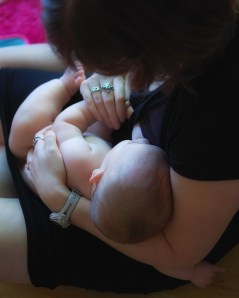
“Perhaps we owe some of our most moving literature to men who didn’t understand that they wanted to be women nursing babies.”
–Louise Erdrich, The Blue Jay’s Dance
While planning posts for World Breastfeeding Week, I realized that I’ve never posted the essay for which I am most “famous” on my own blog! “Nursing Johnny Depp” originally appeared in Literary Mama in 2009 and an excerpt was used in the 2010 edition of The Womanly Art of Breastfeeding in the section about nursing toddlers.
Nursing Johnny Depp
by Molly Remer
As I put his head to my breast, I feel a distinct thrill of the forbidden.”Na-na, Jack Sparrow, Mama,” my two-year-old son said, and I put the action figure to my chest without much thought.
As I look down at that tangled mop of dark hair and braided beard, and touch the slightly sneering lips to my nipple, I suddenly feel a bit dirty. Illicit. Inappropriate. As if perhaps I shouldn’t tell my husband what I’ve been doing in my spare time. In nursing that plastic Johnny Depp, I’ve crossed a line that maybe a good girl wouldn’t cross. Or, at least, I’ve surely violated some social norm or standard of propriety.
Previously an equal opportunity nurser, from that point on I begin to place more limits on what I am willing to nurse. Yes, to the tree frog. No, to the pink rubber rat. Yes, to the hungry-looking little piglet. No, to the Shrek Pez dispenser. I’m teaching my son about limits, I think: Body boundaries, personal space, self-respect, common decency. These are good concepts to master. Or, as I reject nursing a large red monster with a mouthful of sharp-looking teeth, am I teaching him to discriminate on the basis of personal appearance? To withhold love and to be stingy with affection? Or, perhaps more simply, that grimy, but appealing men are more worthy of attention than large blue stag beetles?
Sitting on the living room floor, my little son rocks back and forth with two small toys singing, “Rock, baby. Rock, baby…” I look closer and see that Obi-Wan Kenobi is tenderly cradling Yoda in his arms.
At dinner, eating grapes, my boy picks out a large grape and a very small grape. He is delighted with the small grape, “baby grape! Baby grape!” He holds up the large one and announces, “Mama grape.” He sets them on the table and carefully pushes the small grape towards the large one until they are touching. “Dat baby grape have na-nas!” he reports with obvious satisfaction. Later, he eats them both.
Skin contact is a requirement of nursing the inanimate. I used to try to get away with putting the toys to my breast on the outside of my shirt, but that was unacceptably less-than-genuine.
“Dat frog crying, Mama!” he implores. Later, he asks, “Where my frog go?” and I realize it is still snuggly tucked inside my bra, its purple rubber face nestled comfortably against my nipple.
I’ve seen a number of snapshots of other people’s little girls and boys “nursing” their own dolls, stuffed animals, or dump trucks, but neither of my own sons have been interested in nursing their own toys.
I have suggested it and was met with utter contempt–“Mom, we’re BOYS! We don’t have na-nas.” I am well aware that I look somewhat less than adorable at the park with a plastic alligator latched on.
Playing on the floor with my dad, my son picks up one of my husband’s childhood He-Man action figures. Evilyn has bright yellow skin and a revealing metallic bikini.
“Hey!” Zander exclaims, “Dat lady got na-nas!”
He fingers them approvingly and my dad comments blandly, “Well, yes, she does.”
Several months prior, at my older son’s insistent request, I lovingly fashioned a cloth baby carrier for Evilyn to wear on her back. Her baby of choice is a tiny crocheted “button buddy” monster with googly eyes.
“Look, Mom! She can hold her baby!” The five year old announces. Evilyn’s yellow hand is tucked completely through the button hole in the middle of her baby’s chest.
I begin to consider that perhaps I am the chief toy nurser because my sons lack enough appropriately endowed female toys. Indeed, my little one is greatly distressed by trying to get one of our Playmobil women to hold her baby. Her stiff plastic arms hold the baby by the wrist at arm’s length and this simply will not do.
He holds the baby to her plastic bump of a chest (she has a “uni-breast”) crying and fretting, “Hold baby! Na-na baby!”
Eventually I solve the problem by taping the baby sideways across her chest like a bandolier, its head now appropriately positioned at breast level. (Lest it appear my son is only concerned about proper nursing access, earlier this same month I also carefully taped a tiny plastic knife into “Baby Froggie’s” beanie baby paw. “Look, Daddy! Baby. Froggie. Got. Sword!”)
So, yes, I am still nursing and not only do I nurse my toddler, I sometimes nurse a big orange robot, assorted earth-moving vehicles, Ewoks, squirrel puppets, the occasional pretzel or grape, and more. I turn down an offer of nursing Luke Skywalker (would I have turned down Han Solo, I wonder?) and also of some guy with a half-metal face. “Sorry, honey,” I say, “I don’t nurse that kind of guy.”
Molly Remer, MSW, ICCE is a certified birth educator, writer, and activist. She is a professor of human services, an LLL Leader, and editor of the Friends of Missouri Midwives newsletter. She has two living sons and an infant daughter and blogs about birth at https://talkbirth.wordpress.com
—
Postscript: In the Literary Mama version, the editor decided to take out my last line, which was originally this: “Next time we watch Pirates of the Caribbean and that roguish face fills the screen, I can’t help but feel as if Johnny and I share a little secret. And, hey, if my son brings me Orlando Bloom to nurse next time, I definitely won’t say no… ”
I couldn’t decide whether to leave it in this version or not and ended up deciding to take it out here too (but then not, since I’m including it in this little postscript!). As a special bonus, this version includes pictures of the actual toys! (I took these last night and amazingly, three years post-events-described-in essay, Evilyn is still wearing her baby carrier and the Playmobil baby is still taped in place!)


In honor of World Breastfeeding Week this week, I am planning a series of breastfeeding posts. The following is a modified version of an article that previously appeared in a journal for support group leaders:
Listening Well Enough
by Molly Remer
When I was training to become a breastfeeding counselor, I practiced four helping situations as telephone role-plays. I was very anxious about receiving  the first practice call. In fact, I confess to being so anxious that when one of the women I was working with called for the first time to practice and I missed her call, I actually cried.
After that missed call, I had a dream. In the dream, the woman called to practice. I said “hello,” and received no response. I said hello again. No response. “I’m not able to hear you,” I explained, “you have reached a breastfeeding counselor. Do you have a breastfeeding question?” Silence. I tried again, “Let me tell you a little bit about our services…our services are free, do you want to ask me a question?” Still there was silence, though I was positive that the woman was still on the other end of the line. Finally, I said, “I am not able to hear you, so I’m going to hang up now. Please feel free to call me back if you need to talk.” Finally, the woman spoke. She told me that I had not handled the call well. I asked her how I was supposed to know what to say if the mother wasn’t saying anything. The woman responded, “that mother told you everything you needed to know, you just weren’t listening well enough.”
Obviously, this dream reflected the anxiety I was feeling about being able to “perform” during helping calls. It also showed the fears I had about being judged by the other women as not being warm enough or informative enough (though I was assured by my trainers that the practice calls were to help me feel comfortable, not to judge and test me!). Aside from this analysis of the practical reasons behind my dream, I feel it reminded me of several relevant points:
Before becoming a mother, I worked in domestic violence shelters answering the crisis line and providing short-term crisis intervention services to women who had experienced domestic violence. Interestingly enough, I find that those types of helping calls were in some ways “easier” to work through than breastfeeding help calls, since there were fewer variations in women’s stories and experiences. With breastfeeding questions, there are an infinite number of variables and an infinite array of mothers, babies, families, and mother-baby dyads. Just as there is no one way to be a good mother, there is no perfect way to help mothers. Breastfeeding is not a by the book procedure—it is an intimate relationship with different dynamics from one nursing couple to the next. Individual mothers and babies respond differently to the same things.
Our main message to each mother is how important she is to her baby and how breastfeeding can be a wonderful part of this. We want to help mothers feel good about being a mother, about meeting their babies’ needs in the way that feels best for them, and to trust their own instincts. We wish to leave mothers with a feeling of self-confidence, acceptance, and encouragement.
“You will have ideas, options and paths to ponder, but you will also have a sense of possible directions to take as you consider midwifery, childbirth education, or being a doula or an activist. Your path may be circular or straight, but meanwhile you can serve motherbaby while on the path, with a destination clearly in mind.” She also says, “I use the word midwife to refer to all birth practitioners. Whether you are a mother, doula, educator, or understanding doctor or nurse you are doing midwifery when you care for motherbaby.” —Midwifery Today editorial by Jan Tritten
Mamatoto is a Swahili word meaning “motherbaby”–reflecting the concept that mother and infant are not two separate people, but an interrelated dyad. What impacts one impacts the other and what is good for one is good for the other. The midwifery and birth communities have used this concept for quite some time and more recently some maternal health researchers have also referenced the idea of the “maternal nest”–that even following birth, the mother is the baby’s “habitat.”
Critiques of homebirth sometimes rest on a (flawed) assumption of maternal-fetal conflict (which is also invoked to describe situations with substance abuse or other risky behavior). In the Fall 2007 issue of CfM News, Willa Powell wrote about maternal-fetal conflict in response to an ABC segment on unassisted birth. She wrote:
[quoting the expert physician interviewed for the segment] “The few hours of labor are the most dangerous time during the entire lifetime of that soon to be born child. Because of this, I would argue, all soon to be born children have a right to access to immediate cesarean delivery, and women who insist on denying this right are irresponsible.”
This was the only professional opinion in the program on unassisted birth, and he set up a typical expression of an obstetric community belief: the “maternal-fetal conflict.” The notion is that there are two “patients”, where the mother’s desires are sometimes in conflict with the well-being of the baby, and that the obstetrician has a moral/professional obligation to abandon the mother in favor of the baby.
I have to remind myself that Dr. Chervenak is setting up a false choice. In fact, this scenario is a “doctor-patient conflict”. The mother wants what’s best for herself and her child, but she disagrees with her doctor about what is, in fact, best. Women are making choices they believe are best for themselves and best for their babies, but those choices are often at odds with what doctors consider best for both, and certainly at odds with what is best for the obstetrician!
In the book Birth Tides, the author discusses maternal-fetal conflict:
According to obstetricians, the infant’s need to be born in what they have defined as a safe environment, i.e. an obstetric unit, takes precedence over the mother’s desire to give birth in what doctors have described as the comfort of her own home. It is a perspective that pits the baby’s needs against those of the mother, setting ‘overriding’ physical needs against ‘mere’ psychological ones. It is rooted in the perception that the baby is a passenger in the carriage of its mother’s body–the ‘hard and soft passages,’ as they are called. It is also rooted in the notion of the mind-body split, in the idea that the two are separate and function, somehow, independently of each other, just like the passenger and the passages. While women may speak about ‘carrying’ babies, they do not see themselves as ‘carriers,’ any more than they regard their babies as ‘parasites’ in the ‘maternal environment.’ If you see your baby as a part of you, there can be no conflicts on interests between you.
I previously linked to a book review that explores this concept of the more aptly described “obstetric conflict” in even more depth.
I think it is fitting to remember that mother and baby dyads are NOT independent of each other. With a mamatoto—or, motherbaby—mother and baby are a single psychobiological organism whose needs are in harmony (what’s good for one is good for the other).
As Willa concluded in her CfM News article, “...we must reject the language that portrays a mother as hostile to her baby, just because she disagrees with her doctor.”

An example of a mamatoto 🙂
 Talk Birth