Archives

Is there really even such a thing as second stage?

Is there a second stage in labor? Who says so? Who thought it up and why? How did they decide what it would be and when it would start? How it would be measured? When it would end? Is there really even such a thing as second stage? If there isn’t, might it not be important for midwives to know that? Is the Earth really flat? Well, it is in some places. Mothers that lie, sit, walk, stand, crawl, glide, stride, squat, climb stairs or hills, dance, sway, cry, throw up, chant or create positions and sounds never heard or seen before are moving their baby from the inside of them to the outside of them. That’s labor. It doesn’t have stages. One thing melts and overlaps another. It starts slowly and gets bigger. It changes a mother’s breathing from light to deep. Her sounds change as her body and baby mould and mimic each other on the journey from inside to outside. By the time the baby is low so is the mother, her breathing and her sounds and her body. –Sister MorningStar in “Midwifing Second Stage” in Midwifery Today, 98, Summer 2011

After having written recently about the rest and be thankful stage and the spontaneous birth reflex and then finally about the
birth pause, the above quote caught my eye in an issue of Midwifery Today from last year (I’m trying to catch up with my stack of magazines/journals). I explain to my birth class clients that birth looks different from the outside than it feels on the inside. Perhaps from the outside we can identify stages and phases of labor. From the inside, we are just doing it and the stages and phases meld into one continuous experiencing.

I love the final comment in this quote especially–we don’t really need tips, tricks, and vaginal checks to tell us where baby is positioned. When mother gets “low” baby likely is too! This reminds me of another article I read in MT recently. (I didn’t save the actual quote, just going from memory.) It was about a traditional midwife who was asked, “aren’t you going to check her?” when a mother felt like pushing. The midwife put the tip of a finger in and the other people laughed at her—“that isn’t checking her!” She said that all you needed to do was feel for the baby’s head—it the finger only goes in a tip, that means baby is close, if it goes in up to the knuckle, baby is pretty close, if you can’t reach the head, baby will be a while. Why would you need to try to reach the cervix or know what it is doing?

I love Sister MorningStar’s writing. It is so beautiful and expressive. Some time ago, I reviewed her book The Power of Women and I highly recommend it.

Birth Pause…

What was the moment like immediately following the birth of your baby?

Was the baby placed directly onto your chest by a caregiver? Was she pushed into your own waiting hands and gathered to your body? Was he put first into a warmer and then onto your chest? Did a midwife pass him to you after gently receiving him? Did you glimpse her body as she was held over a blue cloth in the operating room? Did you see her whole body, or just the top of her head as she rested upon you? Did she emerge onto a soft landing where you could gaze at her for a moment, integrating the transition from giving birth to mothering, and then scoop her up into your waiting arms? No matter how it unfolded, I’m sure it was unforgettable.

Waiting to inhale…

I greatly enjoyed reading a beautiful guest editorial in The Journal of Perinatal Education by Mary Esther Malloy, called “Waiting to Inhale: How to Unhurry the Moment of Birth,” in which she explores this precious post-birth moment. This moment when mother meets baby, earthside. Malloy notes that for many women, the moment of meeting is “hurried” by the immediate placement of the baby on mother’s chest. Many women are in a brief, transitional state almost like “birthshock” at this moment—it is the moment before the classic euphoria and “I did it!” hits. Mother often has her eyes closed and needs a second to breathe and re-focus on the world outside her deeply inner focus. Malloy began to observe at births that if baby was allowed to emerge gently onto the softness beneath the mother, the mother is able to take a brief pause to integrate the shift from birthing to mothering and then begins to gently explore baby’s body on her own time, her own terms, before gathering it into her arms and to her breast. This occurs in the space of only moments, but they are unhurried, timeless, liminal moments. She notes: “…just as we are now appreciating what occurs when we respect a baby’s ability to find its mother at birth, what I am seeing [with mothers] is heightening my respect for an understanding of our own abilities as women to find our babies at birth.” She suggests that this natural pause marks a center point of a sequence that transforms woman to mother; that finding our babies ourselves brings us forward into a new state of being physically, emotionally, psychologically, and mentally. Malloy refers to this transition point as a moment to inhale—to “exhale” the experience of giving birth and to “inhale” the sight of the new baby and the beginning of a new phase of life.

Malloy does make sure to mention that the moment of birth is “just fine” and “unforgettable” without this “birth pause” and that mother’s chest is most definitely baby’s intended destination, but that she is starting to acknowledge that having her own babies delivered straight to her chest, “feels a lot like an intervention to me. If intervention feels like too strong a word, at least, it now seems like an interruption to what I might have done if no one told me what to do.” She concludes with some thoughts regarding her own upcoming birth:

Exhale and then inhale. Exhale the magnitude of the experience of birth and then inhale the unfolding moments in which I am receiving this child. Life is not one big inhale, one big gulping in of experience. It is the symmetry of exhale and inhale. Just as we breathe this rhythm through our labors, present to one contraction at a time, we can also breathe through our transition to motherhood, finding that moment between states and passing through as slowly as we need…

Personal experiences with the birth pause

Since I recently wrote about two other  “stages” of the birth process that are not widely acknowledged, the rest and be thankful stage and the spontaneous birth reflex, I knew immediately upon reading this editorial that I wanted to explore the birth pause as well. I am curious to know of others’ experiences with it or reflections upon it. I think back to my own immediate post-birth moments with my babies. My first baby was born and immediately placed onto my chest. I remember feeling disoriented, unreal, and dazed almost. It was sort of surreal. He was crying, I touched his back, and then asked him if he wanted “nursies.” It was very spontaneous and gentle and natural feeling, though taking a step back I see that there was not much time for that inhale moment.

When my second son was born, I was on my hands and knees and the midwife passed him through my legs to me as I turned over. When my daughter was born, I pushed her out into my own hands in a kneeling position. What struck me upon reading the editorial was how after my second son’s birth and after the birth of my daughter, though I was holding them, I did not immediately put them up to my chest. I held them low, against my body, near the tops of my thighs. I think my eyes were closed both times, head tilted back and then tipped forward. Then, I looked down at them, explored them briefly, and then gathered them up in my arms and to my breast. Neither was born onto the surface in front of or behind me, but neither was placed immediately on my chest either. My daughter’s birth was the most undisturbed and instinctual, and I distinctly remember looking down at her as I held her low against my body, and then making the decision to lift her higher and into my arms against my breast. With my son, I felt like his umbilical cord was short and that I actually couldn’t lift him higher without tugging it uncomfortably (it wasn’t actually short though and I’m still unclear what this sensation was exactly).

I immediately thought of post-birth pictures of each baby, in this birth pause time:

Immediately after first baby's birth--straight to chest. Main view is of top of his head. Hands tentatively touch/explore.

Immediately after second son's birth. Notice how he's held low down and kind of only with one hand. My eyes are closed and I'm not looking at him yet. In pictures shortly after, I'm looking at him and smiling and I've moved him up to my breast.
(Didn't feel totally comfortable with full breasts shot on my blog, though feel bad to conform to social expectations of appropriateness!)

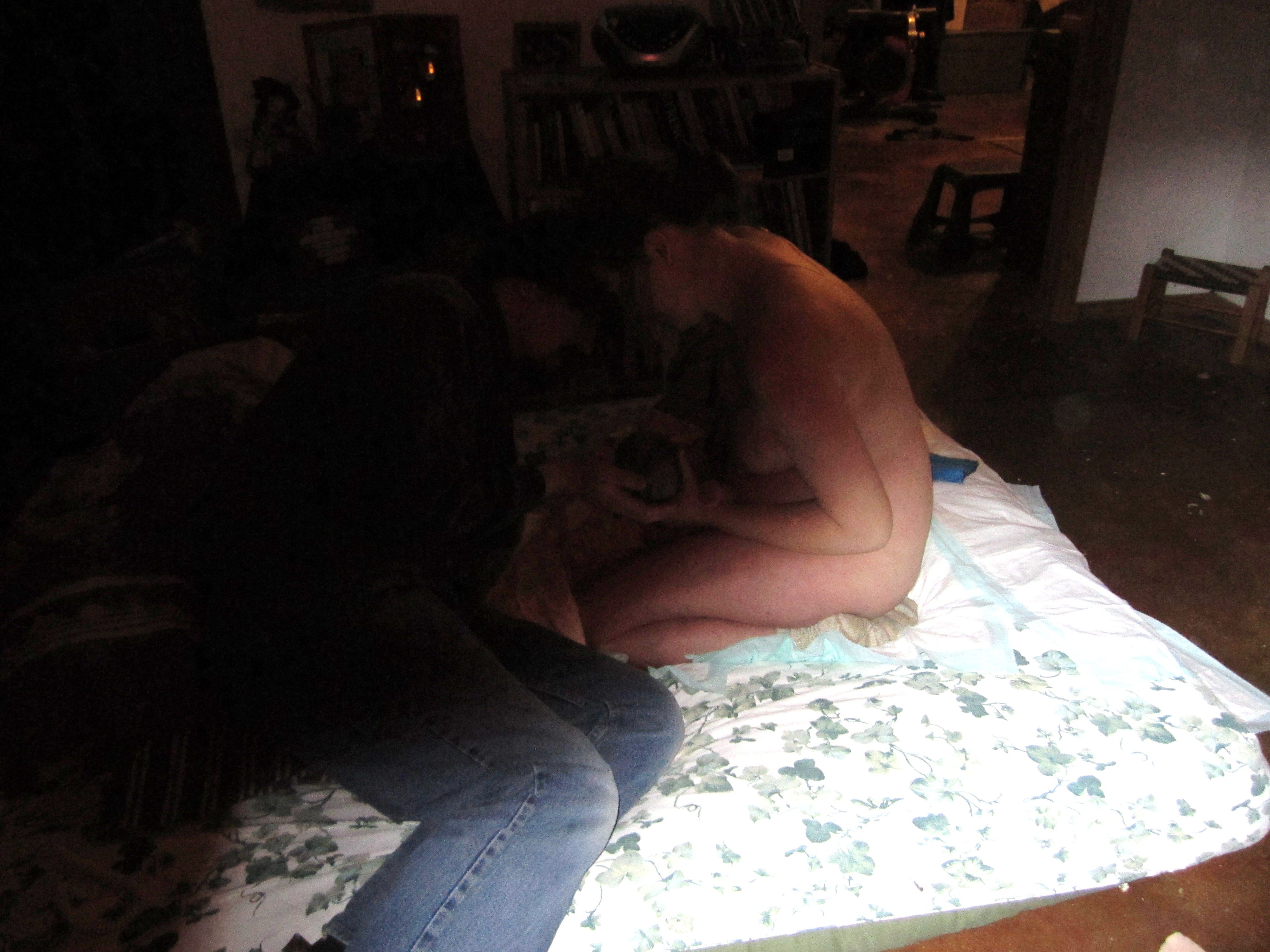
Immediately after last baby's birth. I know it is dark/hard to see, but note how I'm holding her kind of low down and actually kind of out/away from me (to look at) rather than against my chest.

I actually feel like I see in all of these pictures that birth pause to exhale the birth and then inhale the baby and the mothering of it.

What about you? What was the moment like following the birth of your baby? Did you take a brief pause, a moment to exhale and then inhale? I’d love to hear about it!

A Tale of Two Births

As Penny Simkin has frequently noted: “We can’t control labor, whether it’s hard; that’s a leap of faith. But we can always control how we care for [the mother]” [1]

In 2001 and in 2004, I attended the births of two of my dear friend’s children in the same hospital in a mid-sized Midwestern city.  I was not a childbirth educator or doula at this time, but was there in the capacity of friend and “witness.” Both births were intervention-heavy and not what I would call ideal, natural births; but the feelings were vastly different, which made all the difference.

At the 2007 LLL International conference in Chicago, I picked up several of these great "Listen to Women" buttons from the ACNM booth in the exhibit area. I love them. Isn't this what it is all about? So simple and yet so profound. Imagine how the world would change if we just listened to women.

One had an atmosphere of respect, caring and trust; the other had a “climate of doubt” throughout. The difference was a certified nurse-midwife (CNM). My commitment to homebirth midwifery often leads me to forget what a profound and true difference a caring CNM can make in a hospital birth. All the other hospital procedures can be present, but the care factor a CNM provides can transform a woman’s experience from powerless to powerful. Sometimes I forget how CNMs are poised to bridge the gap between home and hospital effectively. The US needs lots of them (not as subordinate “junior obstetricians”—but as expert guardians of normal birth in a hospital setting).

The details were similar in each birth. The babies were both almost 9 lb; a doula was present (same doula in both births); and the mother labored with an IV, spent a large portion of the labor in bed and had internal fetal monitoring. In the first birth (with the CNM), the mother even had several hours of Pitocin augmentation; in the second, with the obstetrician, she had no Pitocin until third stage. With each birth, the mother also had an extensive tear and long repair (a third-degree with the CNM, a second-degree with the obstetrician).

However, some things were very different.

When the mother said, “Can I have a birth ball?” the CNM said, “Yes,” and the obstetrician said, “Not until the baby has been monitored.” And then, “The baby doesn’t like that; you need to get back into bed.”

When the mother’s confidence waned, the CNM said, “You can do it. You are.” The obstetrician said, “I don’t think this baby is moving down.

When the mother said, “This is taking such a long time,” the CNM said, “I know. It is taking for-freaking-ever!” and everyone laughed (including the laboring mother). The obstetrician said, “I think we should consider a c-section based on your history. The baby is not moving down.”

The CNM said, “You have such strong muscles in your legs and bottom, do you exercise a lot? I think because you are so strong, you’re holding a lot of tension here. Try to let it go.” The obstetrician ironed the perineum until the mother screamed with pain.

The CNM waited. The obstetrician did another internal check.

In both, a baby was eventually born (the first after four hours of pushing, the second after a little over an hour). A strong, healthy baby. Vaginally and without pain medications. After the first birth—though she would have done some things differently—my friend felt triumphant, empowered, powerful, strong, capable, happy and proud.

After the second birth she felt abused, disappointed, ashamed, guilty, angry, assaulted, diminished, wounded and scarred.

I believe the CNM’s personality, attitude and basic belief that vaginal birth would work was the critical difference between these two experiences. These births dramatically, viscerally illustrated for me that no matter what else is happening around the birthing woman, we can control how we care for her.

Endnote: My friend went on to have her third baby at home in 2008. She pushed this baby out in fifteen minutes, with no tear, and she shone with her power.

Molly Remer, MSW, ICCE, CCCE is a certified birth educator, writer, and activist who lives with her husband and children in central Missouri. She is the editor of the Friends of Missouri Midwives newsletter, a breastfeeding counselor, a professor of human services, and a doctoral student in women’s spirituality. She blogs about birth, motherhood, and women’s issues at https://talkbirth.me/posts.


[1] Looking to nature, doula Penny Simkin practices the art of delivery, in The Seattle Times, Pacific Northwest Cover Story. Originally published March 23, 2008. Accessed April 27, 2009. http://seattletimes.nwsource.com/html/pacificnw/2004299467_pacificpenny23.html.

This is a preprint of A Tale of Two Births, an article by Molly Remer, MSW, ICCE, published in Midwifery Today, Issue 91, Autumn 2009. Copyright © 2009 Midwifery Today. Midwifery Today’s website is located at: http://www.midwiferytoday.com/

The Rest and Be Thankful Stage

During my first labor, I experienced what Sheila Kitzinger calls the “rest and be thankful stage” after reaching full dilation and before I pushed out my baby. The “rest and be thankful stage” is the lull in labor that some women experience after full dilation and before feeling the physiological urge to push. While commonly described in Kitzinger’s writings and in some other sources, mention of this stage is absent from many birth resources and many women have not heard of it. After writing recently about the spontaneous birth reflex, I received a comment stating the following: “I was particularly interested in the idea of resting after full dilation before pushing. This makes sense if you are only following your body’s urges to push, but never something I had seen (or remember seeing?) spelled out before.

I always make sure to tell my birth class clients about the possibility of experiencing a lull like this, because it is during this resting phase that labor is sometimes described as having “stalled” or as requiring Pitocin to “kick it off again” or as requiring directed or coached pushing. Also, think of the frequency of remarks from mothers such as, “I just never felt the urge to push.” When exploring further, it is often revealed that what the mother actually experienced was no immediate pushing urge instantly following assessment of full dilation. Depending on the baby’s position, this can be extremely normal. The way I explain it to my clients is that the lull represents the conclusion of the physiological shift happening in the uterus—the transition between contractions that open the cervix and the contractions that push the baby down and out.

As I wrote in a previous post from several years ago:

Your uterus is a powerful muscle and will actually push your baby out without conscious or forced effort from you–-at some point following complete dilation your body will begin involuntarily pushing the baby out. Many women experience the unmistakable urge to push as an “uncontrollable urge”–-but, in order to feel that uncontrollable urge, you often have to wait a little while! Though some care providers and nurses encourage you to begin pushing as soon as you are fully dilated there is often a natural lull in labor before your body’s own pushing urge begins. Some people refer to this lull as the “rest and be thankful” stage. It gives your body a chance to relax and prepare to do a different type of work (in labor the muscles of your uterus are working to draw your cervix up and open. During pushing, the muscles of your uterus change functions and begin to push down instead of pull up). If you wait to push until you really need to, you will often find that your pushing stage is shorter and progresses more smoothly that pushing before you feel the urge.

In the book, Our Bodies, Ourselves: Pregnancy and Birth they share the following important point:

“Research suggests that the length of time before the baby is born is the same if you allow one hour of ‘passive descent’ of the baby (when you relax and don’t consciously try to push) or you start pushing immediately after you are fully dilated.”

via Waiting before pushing… « Talk Birth.

That’s right, the length of time between full dilation and baby’s birth is the same, whether the mother waited one hour before pushing, or started pushing without the urge immediately following full dilation. I know which one sounds easier and more peaceful to me!

In my own experience with my first baby, I found that I felt like I should be pushing after full dilation and thus began to do so before feeling the full urge. I ended up pushing for about an hour and fifteen minutes. I suspect if I’d just continued hanging out for 45 minutes to an hour, he may have flown out in 15 minutes. Prior to pushing though, I did experience a rest and be thankful stage of about 30 minutes in which I sat in a rocking chair, joked about feeling “trippy,” and talked about being an A++ birthing woman. I describe it in my son’s birth story:

After finding out that I was fully dilated, I started to feel very odd and I really think I had to go through a sort of emotional/psychological transition to adjust myself to the fact that I had “missed” the physical transition point…I sat in the rocking chair for a while and kept saying things like, “am I dreaming? Is this real?” I also made a joke about feeling “trippy” like in Spiritual Midwifery. We also joked about what an A+ + + laboring woman I was (a family joke–I was a 4.0 student throughout college and grad school and so we always say that I like to get an A+ + + on everything I do). Those pressure feelings I had been having for a while, got a little more intense and I started pushing kind of experimentally. I was on my knees with my head on the bed on my pillow again and during one of the little pushes my water broke with a giant, startling POP and sprayed across the room including all over my friend. At this point, the midwife left saying, “I think I should call the doctor.” via My First Birth « Talk Birth.

The blog Birth and Baby Wise has some great thoughts to share on resting and being thankful (note the blog is from an educator in London, thus the use of the term Syntocinon, rather than the U.S. based brand Pitocin):

… it seems that there is little appreciation for this well documented pause amongst health professionals working in the consultant-led units of hospitals. Any stop in action once the magic ’10 cm dilatation’ is reached is met with almost instant medical intervention to get the contractions back up and running, ie a syntocinon drip. Women experiencing this are already on a consultant-led unit, where a higher level of medical intervention can be anticipated, but it is strange that there seems to be such a rush to use a syntocinon drip to get the contractions going again, providing mother and baby are both coping well.

One reason the contractions may ease temporarily is in order to allow the baby’s head to get into a better position. If this is the case, then artificially speeding contractions up is hardly likely to have the benefit of a faster birth for the woman – if anything, a slower and more complicated birth as she tries to push out a baby that is not quite in the right position. In addition, she has to cope with stronger contractions that she might find difficult to deal with, necessitating further medical help in the shape of an epidural – which in turn makes pushing the baby out even harder…

…At this stage, the woman and her partner are incredibly vulnerable to this well meant ‘help’ from midwives and obstetricians and are unlikely to question the requirement for additional medical help. It is also unlikely that the calm and relaxed environment so important for a peaceful birth can survive the worries of the health professionals, which will affect most women and their partners. via Rest and be thankful – or panic and have a drip shoved in? | Birth and Baby Wise.

I agree. In my own personal experience with my first birth, I was very vulnerable to just the perceived expectation of it being “time to push.” With later babies, it was intensely important to me that I have very few people present at the birth, knowing how sensitive I am to the expectations of those around me. It is truly only my husband and my mother than I trust to not disrupt my “birth brain” and the freedom of my birth space.

I’d love to hear more from readers about their experiences with the rest and be thankful stage.

Did you experience this lull between full dilation and pushing out your baby?

Was the lull recognized and respected by your birth attendants?

If you pushed without feeling the urge, was the pushing stage fairly long?

With subsequent babies, I had no internal checks during labor, so I never really knew if I experienced the rest and be thankful stage with them. I just pushed when my body started pushing—I have no idea how long after full dilation that was. So, I also am curious to know if women find they experience this stage with all babies, with only the first one, or with only some of their babies?

I suspect I did experience it with Alaina, because I remembering feeling concerned that contractions were suddenly “far apart.” I started talking more and analyzing myself and the labor and this was probably part of a lull in the intensity of the contraction action while my body prepared for a powerful spontaneous birth reflex.

Spontaneous Birth Reflex

Why do we, then, continue to treat women as if their emotions and comfort, and the postures they might want to assume while in labor, are against the rules?

– Ina May Gaskin (via Birth Smart)

I’ve  been intrigued for some time by Michel Odent’s description of what he calls the “fetal ejection reflex.” Personally, I would like to rename it the “spontaneous birth reflex.” Essentially, this reflex involves the spontaneous birth of the baby without coaching or conscious effort on the part of the mother. It is most likely to occur when the mother feels very safe and very private, which may be why we do not read descriptions of it occurring during many births. In an article about the fetal ejection reflex Odent writes: “During the powerful last contractions the mother-to-be seems to be suddenly full of energy, with the need to grasp something. The maternal body has a sudden tendency to be upright. For example, if the woman was previously on hands and knees, her chest tends to be vertical. Other women stand up to give birth, more often than not leaning on the edge of a piece of furniture. A fetus ejection reflex is usually associated with a bending forward posture.

Flicked forward hips?

In the book Optimal Birth: What, Why & How, which was heavily influenced by the work of Odent, the author frequently describes spontaneous birth reflex occurring with a swift “flicked forward” motion of the mother’s hips. I found the description curious at the time that I read the book, not really conceptualizing how one would flick one’s hips forward when pushing out a baby. However, following the birth of my daughter last year, I was completely amazed to hear my husband describe the pushing stage in these words, “…you were down on your hands and knees, but then you pushed up and moved your hips forward and suddenly you were holding her.” I would describe her birth as involving an authentic spontaneous birth reflex much like Odent and Sylvie Donna (the author of Optimal Birth) describe. This is what I wrote three days after her birth:

Shortly following a spontaneous birth reflex!

I was down on hands and knees and then moved partially up on one hand in order to put my other hand down to feel what was happening…her head pushed and pushed itself down as I continued to support myself with my hand and I moved up onto my knees, with them spread apart so I was almost sitting on my heels and her whole body and a whole bunch of fluid blooshed out into my hands… I didn’t realize until some moments later than both Mark and Mom missed the actual moment of her birth. Mark because he was coming around from behind me to the front of me when I moved up to kneeling…I had felt like the pushing went on for a “long” time, but Mark said that from hands and knees to kneeling with baby in my hands was about 12 seconds.

via Alaina’s Complete Birth Story « Talk Birth.

Birth without pushing?

I’ve been meaning to write about the experience for some time and then I received a comment on an older post I wrote titled Pushing the issue of pushing in labor… which addresses physiological pushing vs. coached/directed pushing. The mother wrote: “I would so love to give birth without pushing..I hope I can do this without pushing but is it really possible?? If it’s possible, why isn’t it practiced more widely?”

While I did not experience such a dramatic spontaneous birth reflex with any of my other births, Yes! It IS possible. There are a variety of reasons why it is not practiced more widely, two common ones being that many mothers do not give birth in the atmosphere of privacy that facilitates the reflex and secondly because many birth attendants ascribe to the notion that 10 centimeters of dilation = time to push, regardless of what mother’s body is telling her to do. With my own first baby, I was checked at 10 centimeters and told I could push whenever I felt the urge. While no one coached or directed me to begin pushing, I felt like I “should” be doing so and so start to experiment with actively pushing a little with contractions. It took a little over an hour before my son was finally born. I never felt an intense or irresistible or spontaneous urge to push. With my second baby, I felt literally driven to my knees by the force of the birthing energy. I did not consciously push him out, but it definitely took several pushes and maybe about 15 minutes to push him out. There was a process of pushing involved with his birth. With my daughter, as I describe above, it was like an irresistible force gripped my body and she just came flying out with no directed physical or mental involvement from me.

Trusting the urge

I shared the mother’s question with the CfM Facebook page in order to get some other perspectives on births with “no pushing.” I received several comments to share with the questioning mother-to-be. Most mothers referenced the idea of pushing when their bodies told them to. It is difficult to communicate this with someone who has not yet experienced it—how to recognize the “urge” and what it really means to “push when your body tells you to.” I also suspect it is frustrating for women who are honestly and courageously seeking “answers” in order to best prepare their bodies, minds, and hearts for birth, to receive responses like, “just trust your body,” which can feel trite or dismissive to the pregnant woman who hungers to know. However, then once on the other side of the birthing bridge, we discover there are really few better answers to give. I believe the capacity to trust that her body will communicate the unmistakable urge to push comes with an environment where the mother is treated with dignity and respect. She has her need for privacy honored and that she is mentally able to surrender to the birthing process and let her body take over—no attempting to wrestle with or control the birth, but to dig deep and then to let go.

Personal experiences in birthing without pushing:

ARA shared: “I will say that with my last birth I started out with having coached pushing. Then I felt my body take over. The nurse told me to stop pushing and I told her I can’t my body is doing it on it’s own. It was the most awesome feeling in the world.”

And AK shared: “I pushed when my body said to do so. It was relieving!! lol

EW wrote that she, “highly recommend physiological pushing over directed pushing. listen to your body. Consider hypnobirthing if you are wanting to birth without pushing, it encourages laboring down.

DF had this experience to share: “I don’t know if this is the same thing but with my first child, the nurse didn’t listen to me when I said I thought it was time and when my midwife came to check I was crowning, I had ‘labored down’ as she called it by my body doing the work. So I only actually pushed once on her cue and my baby was here. The second child the same happened automatically I wasn’t even aware it was happening…..maybe subconsciously?

NB shared that, “Because of my uterine prolapse issues, I do not push until the baby is essentially crowning on his own. I also don’t have anyone check to see how far dilated I am (since baby #1, that is) so when that burning feeling starts to get really strong I try a gentle little push to see what happens, and that usually initiates complete crowning… at which time, despite my best efforts, I CANNOT control the pushing urge any longer because I need to get that baby out!! 😉 I think it does make ‘transition’ longer in the sense that perhaps birth would have happened earlier if I’d begun pushing before the baby slid down that far on his/her own, but it makes the pushing stage much shorter and is certainly better for the baby – and me, too, since I’m not putting that strain on my uterine ligaments until the very last seconds.”

JD shared her different experiences: “With my first baby, I felt the need to push waaaay too early. (Baby turned posterior; I had back labor contractions less than a minute apart for several hours.) I spent over an hour pushing, but I can’t blame the wonderful midwives who attended my homebirth. They told me several times that it wasn’t time to push yet. But I was in so much pain, and had exhausted all my coping strategies, and just had to get that baby OUT! Then we had a dystocia, and everybody ended up yelling at me to push even though I wasn’t having a contraction, and my very calm, collected midwife sounded worried, so I pushed some more. Lots of pushing, lots of pain, lots of tearing. My second baby was smaller and lined herself up better. I didn’t push until the very end, and she came in a big hurry and surprised everybody. Nobody told me to push, and I barely needed to. So, yes, it can be done, but there are more factors at play than your doctor/midwife. I had two very different pushing experiences, both at home with the same midwife.

G wrote: “Unmedicated, midwife-assisted home birth, pushed for 3 hours, never really got the hang of it. Baby was not quite lined up right and was stuck, crowned, for an hour. I was exhausted and basically checked out. Eventually it was gravity that got him out – they hauled me upright and he basically fell out of me. I look back and wonder if maybe I should have taken more of a break after dilation – I FELT like I was ready to push, but who knows if I actually was. Maybe he would have labored down on his own if I’d just zonked out.

Why isn’t it encouraged?

I’ve already addressed several reasons why and then LDM shared these important points: “It’s not widely practiced because the obstetric timetable doesn’t allow for it. The physiological urge to push will be there, for some women sooner than others. Most care providers are taught to coach pushing (after all we all know women just can’t do the job they were designed to do) and to have that coached pushing happen under certain conditions (wait for the dr! Ok, doc is here!) Some women say they never felt any urge- they may have had normal physiological signals quelled from drugs or other common labor practices and/or they were not given time to rest and sleep after fully dilating. There is such urgency to force a baby out once she reaches 10, but if she is tired and cannot feel her body pushing, then mom probably needs a nap & maybe a snack. Letting a woman take that break is unheard of in hospitals.

And additionally, Mommy Baby Spot offered this tip: “Stay away from “helping” drugs so that your body knows what to do and learn different positions so that your body puts itself in the prime position to get the baby out with the minimum of hassle (which is different for everyone).

I thank the women who shared their experiences for their thoughts and I wish the mother who posed the question the very, very best with her upcoming birth. May you birth smoothly, peacefully, and spontaneously in harmony with your body’s wisdom, cues, and urging!

(Note: personal experiences are reprinted directly as shared on the CfM FB page, but have had some spelling corrected for readability.)

Sign up for my Brigid’s Grove Newsletter for resources, monthly freebies, and art announcements.

All That Matters is a Healthy Husband (or: why giving birth matters)

It is your wedding day. You have been planning this day since you got engaged nine months ago. You are happy, excited, and a little nervous. When you get to the church, you are told that it is necessary to switch your wedding to the courthouse instead—it is disappointing, but the minister’s assistant reminds you that the courthouse is probably a safer location for your wedding because there are more people on staff there to handle any problems that might arise. When you arrive, you are told that your minister isn’t going to be there for the ceremony after all, but there is a perfectly good justice of the peace available instead.

You ask when the ceremony can begin and the clerk tells you not until your fiancé’s heart rate has been monitored for twenty minutes—“We need a baseline strip on him, hon. After all, you do want a healthy husband out of all this, don’t you?!” she says.

You are asked to change out of your wedding gown and into a blue robe. When you express your dismay, you are reminded that your dress could get messy during the wedding and also, “Why does it really matter what you’re wearing? In the end you’ll have your husband and you’ll be married and that’s really what counts.”

Next, the clerk starts an IV in your hand because, as she explains, you might get dehydrated while you wait for your fiancé.

I have my favorite juice here, I’ll drink that instead,” you reply.

No, no dear. No juice. You could aspirate it and die if you end up needing surgery.”

SURGERY!” you exclaim, “Why would I need surgery? I’m just getting married!

The clerk gives you a knowing glance, “Honey, about forty percent of women who get married here need surgery before their marriages are finalized. This is an excellent courthouse! We do everything possible to make sure you have a healthy husband when you leave here. Isn’t that what you want?

Yes,” you reply weakly.

Finally, the other clerk signals that your fiancé is ready. You turn to look at him and see that he has a monitor strapped to his chest to monitor his heart rate and that he has an electrode on his scalp. You smile at him and prepare to say your vows—you’ve waited for this moment for so long! But, as you begin to speak, the clerk tells you to stop making so much noise. You start to cry in confusion and embarrassment and she tells you that you really need to get control over yourself.

She calls over several other clerks who stand near you and they all begin chanting loudly, “Say I DO! Say I DO!

Wait,” you protest, “What about our vows?”

No time for that—you’ve got to get married as quickly as possible. Husbands can only bear to stand at the altar for a short time before they start showing signs of distress—you wouldn’t want anything to happen to your husband would you? Now, say ‘I DO,’ say ‘I DO’!!

So, you say the words, feeling a sense of dismay at it not being like you had planned, but excited to finally be married to your beloved. You turn to your new husband and reach out for him eager for your first married kiss, but the clerk grabs his arm and tugs him away after her.

Wait!” you call, “I want to see my husband!”

Sorry,” is the reply, “He needs to be taken to the new husbands’ lounge for observation.”

Observation of what?”

Weddings are stressful for husbands; we need to make sure he is all right. Now wait here, while the other clerk brings you a wheelchair to take you to your waiting room.”

Instead of leaving for your honeymoon, you end up staying at the courthouse for three days. You keep asking to see your husband, but the clerk tells you he needs to gain some weight before he can leave and that he also needs some more blood drawn. She also lets you know that he has finally stopped complaining about his spinal tap.

Spinal tap?! Your dismay shows on your face and she tells you, “Come on! You’ll be married for the rest of your life! A few hours of separation isn’t going to hurt either one of you. You’ll have plenty of time with him after you get home and will probably just get fed up with him then! What really matters now is that your husband is healthy.”

Yes, of course…

Finally, you get to go home, but you feel distant and sad. Your wedding was nothing like you’d dreamed of and you feel disappointed and betrayed. You enjoy being married and snuggling with your new husband, but you keep thinking about your wedding day and all of your ruined plans to make it special. When you try to tell your mother how you feel, she tells you that you should be grateful, at least your husband is nice and healthy.

When you tell your best friend about your disappointment, she tells you it is time to get over it—“Your wedding is just one day of your entire life. It is the marriage that really matters in the end. You only get married once, but in the end, you’re married and you’ve got a healthy husband and that’s really what counts, not how you get there!

You tell another friend about your ruined plans and she reminds you that you are lucky your husband is healthy and that it is selfish of you to keep thinking about your wedding. It is over and you’ve got your nice healthy husband to keep you busy now.

Yes, but I feel like I missed out,” you venture.

On what? Weddings are SO overrated. It isn’t like you get a medal for having a beautiful wedding or anything. People have weddings every day.”

You stop sharing your feelings, but you can’t shake the memories. What you expected to be a beautiful day filled with love and celebration was not and you feel a real sense of grief at the loss of your dreams. You know you shouldn’t feel this way. You know that what really matters is your healthy, happy husband, but you keep wondering if your wedding really had to be that way. Yes, you love your husband and you are so happy that he is healthy, but you also wonder if that really is all that matters. Don’t you matter too? Doesn’t your relationship matter? What about respect, dignity, love, and self worth? Don’t those matter too? Wasn’t this a special life transition for your family? Wasn’t it the beginning of a special relationship together and couldn’t that relationship have been celebrated, honored, and treated as worthy of care and respect?

————————————————————————————————————

Notes: I originally wrote this essay in 2007. It was retained for publication by Mothering magazine, but did not end up making it in before the print publication ceased. It was then retained for publication by Midwifery Today, but has not yet appeared. I decided it is FINALLY time for it to see the light of day!

I was inspired to write this essay after reflecting upon the similarities between weddings and births—both mark the beginning of a new form of relationship and a change to the family structure and to individual roles in society. Yet, in our culture, one of these transitions is celebrated as a milestone of adult life and the value of honoring the first steps in life as new partners in a relationship is a given. The other is institutionalized and mechanized and the partners’ individuality is minimized or ignored. Much preparation, energy, time, and finances are invested in planning a lavish wedding and you are expected to expect things to go beautifully, perfectly, and as planned. If they didn’t and your wedding was ruined, most people would say, “It is awful that your wedding was ruined! Wow!” and not call into question your love of your husband or your commitment to your new role as his wife. The wedding ceremony is respected as having value in its own right. This is not true of birth, which is widely viewed as unimportant in terms of how it happens, as long as the result is a “healthy baby.”

Molly Remer, MSW, ICCE is a certified birth educator, writer, and activist. She is a breastfeeding counselor, editor of the Friends of Missouri Midwives newsletter, and a professor of Human Services. Molly has two wonderful sons and one delightful daughter and lives in central Missouri. She blogs about birth, motherhood, and women’s issues at http://talkbirth.me and is the author of the miscarriage memoir Footprints on My Heart.

Magic of Mothering

Nursing baby A at two weeks old


(The first part of this post is an excerpt from an assignment in one of the classes I’m taking)

“Remember, when Keplet postulated that the moon effected the tides on earth, Galileo dismissed the hypothesis as ‘occult fancy.’ It involved action at a distance, and, therefore, violated the ‘solid laws of nature’ of that time. Now these laws of nature (as they were understood by classical physics only a century ago) have already been transcended; this progression should gently hint to us that many of the solid laws of our day are beliefs that obscure the otherwise obvious” (Passmore, 168).

I have long been wary of the phrase, “we used to think, but now we know…” usually stated with great conviction and little room for debate.

Body Wisdom

As Passmore goes on to note, “It is important to make a distinction between ‘progress in science’ and its explanatory power. This power for explanation depends upon the kind of question being asked. History shows that the questions change with changing beliefs/values in both time and space, periods and cultures.” It is exciting to me to consider how much we just don’t know and yet, the world keeps on spinning along, with or without our “knowing” all the facts. I think about this with regard to birth and breastfeeding. How many generations of women have pushed out their babies and fed them at the breast without knowing the exact mechanics of reproduction even, let alone milk production. There are all kinds of historical myths and “rules” about breastmilk and breastfeeding and even ten years ago we used to think the inner structure of the breast was completely different than what we think it is like now. Guess what? Our breasts still made milk and we still fed our babies, whether or not we knew exactly how the milk was being produced and delivered. Body knowledge, in this case, definitely still trumped scientific knowledge. I love that feeling when I snuggle down to nurse my own baby—my body is producing milk for her regardless of my conscious knowledge of the patterns or processes. And, guess what, humans cannot improve upon it. The body continues to do what the human mind and hand cannot replicate in a lab. And, has done so for millennia. I couldn’t make this milk myself using my brain and hands and yet day in and day out I do make it for her, using the literal blood and breath of my body, approximately 32 ounces of milk every single day for the last eleven months. That is beautiful.

The protective impact of a mama

And, on a somewhat related note, several years ago when I read Birth Book, I marked a section about “imprinting” in it (I think it has been fairly well established that there isn’t really human “imprinting” after birth, but when this book was written it was still one of the ideas). Anyway, there was a section about research done with baby goats done to look at the ability of a mother to protect her offspring from environmental stress. They separated twin goats and put some in rooms alone and the others in rooms with their mothers. The only difference in the room was the presence of the mother. An artificial stress environment was created involving turning off the lights every two minutes and shocking the baby goats on the legs. After the babies were conditioned like this, they were tested again two years later. This time all the babies (now adult goats) were in rooms alone and were again “treated” to the lights off and shock routine. The goats who had been with their mothers during the early experience showed no evidence of abnormal behavior in the stressful environment. The ones who had not been with their mothers did show “definite neurotic behavior.” Somehow, the presence of the mother alone served to protect the baby goats from the traumatic influences and keep them from being “psychologically” disturbed in adulthood.

Except for feeling sorry for the baby goats, I thought this information was SO COOL. How magic are mothers that just by being there we can help our babies–even if there is still something stressful going on, our simple presence helps our babies not be stressed by it and continue to feel safe. Magic!

Birth stress?

The goat research was included in the book because of the idea that birth may be a stressful environment for a baby and if the continuity of motherbaby is maintained after birth (immediate skin-to-skin contact and opportunity for breastfeeding), the baby does not become stressed or “neurotic.” But…if the continuity for mother and baby is broken by separation (baby whisked away for weighing or whatever), both mother and baby are stressed by this and it may have an impact on their future relationship and behavior. The book also talks about how the sound of the baby’s first cry has a sort of “imprinting” effect on the mother in that her uterus immediately begins to contract and involute after hearing her baby’s first cry, whereas mothers who are immediately separated from their babies and do not make contact with them have a higher likelihood of postpartum hemorrhage (I have no idea if this has been debunked or not since the book was written in 1972, but it was an interesting idea to read about).

Mothering is magic. Seriously.

Birth Quotes of the Month

As always, while these quotes are obviously not my own words, I do appreciate a link back to my site if you re-post them because I have a significant amount of legwork invested in finding and typing the quotes. Most are not recycled from other pages (I give credit if they are), but are typed up when they catch my eye in the books/magazines/journals I’m reading.

“The first few months after a baby comes can be a lot like floating in a jar of honey—very sweet and golden, but very sticky too.” –American College of Nurse-Midwives

“Your children love you. Be the trampoline for their rocketing and the cupped palms for their returning.” –Shae Savoy (in We’Moon 2011 datebook)

“There is nobody, out the other side of that sort of strong birth, who is not better prepared to meet the absolutely remarkable challenges of parenthood. When the power and trust is transferred to the mother, when she delivers her child, rather than ‘is delivered’ when she chooses, rather than ‘is allowed’, no matter what sort of technical birth she has, she is stronger, fiercer, and better. After a trip like that, you would kill for that child, and you know you can.” —The Yarn Harlot

Why do birth work? “I do it, because nothing else… nothing else, compares to watching a woman move mountains with her own self, to watching her rise to a challenge and meet the moment with all she has, and that experience is only enhanced when she is supported by those who care for her, respect her, and want her to be empowered by the journey.” –The Yarn Harlot

“We must act to keep the knowledge and the powers of women alive.” – Lynn Andrews

“Birth Freedom is inevitable. The natural progression is for people to move from tyranny to liberty. The agents of the status quo, however, rarely yield power without a fight.” –Senator John Loudon (ret.) in Midwifery Today e-news

“If I didn’t define myself for myself, I would be crunched into other people’s fantasies for me and eaten alive.” – Audre Lorde

“We have barely tapped the power that is ours. We are more than we know.” –Charlene Spretnak

“Woman is a glorious possibility; the future of the world is hers.” – Matilda Gage

“In everyone’s life, at some time, our inner fire goes out. It is then burst into flame by an encounter with another human being. We should all be thankful for those people who rekindle the inner spirit.” ~Albert Schweitzer

“There is a sacredness in tears. They are messengers of overwhelming grief…and unspeakable love.” –Washington Irving

“Don’t you dare, for one more second, surround yourself with people who are not aware of the greatness that you are.” (Roots of She by Amanda Oaks, via @ROAR! Empowering Women to Give Voice to Their Truth)

“We all start out knowing magic. We are born with whirlwinds, forest fires, and comets inside us. We are born able to sing to birds and read the clouds and see our destiny in grains of sand. But then we get the magic educated right out of our souls.” -Robert R. McGammon

“It’s hard to describe if you’ve never been there, but to watch a woman access her full power as a woman to give birth is awe-inspiring, and I never get tired of being witness to it. It’s an honor to watch that transformation take place.” ~ Julie Bates, CNM

“The emerging woman..will be strong-minded, strong-hearted, strong-souled, and strong-bodied…strength and beauty must go together.” ~Louisa May Alcott

“We must relearn to trust the feminine, to trust women and their bodies as authoritative regarding the children they carry and the way they must birth them.” –Elizabeth Davis, CPM

“The women in labor must have NO STRESS placed upon her. She must be free to move about, walk, rock, go to the bathroom by herself, lie on her side or back, squat or kneel, or anything she finds comfortable, without fear of being scolded or embarrassed. Nor is there any need for her to be either ‘quiet’ or ‘good.’ What is a ‘good’ patient? One who does whatever she is told—who masks all the stresses she is feeling? Why can she not cry, or laugh, or complain?” –Grantly Dick Read, Childbirth without Fear

“The purpose of life is not to maintain personal comfort; it’s to grow the soul.” –Christina Baldwin

“Everyone who interacts with a pregnant woman is, in some way, her ‘teacher.’ Telling birth stories, sharing resources, imparting obstetrical information, giving advice or warnings—these are all direct or indirect ways of teaching about birth and parenting. Whether you currently identify yourself as a ‘childbirth teacher,’ or you are a midwife, doctor, doula, yoga teacher, nurse, therapist, breastfeeding counselor, or you are simply a woman or man who cares about the power of the childbearing year, you already hold the power of mentoring within you.” –Pam England

“The purpose of our lives is to give birth to the best which is within us.” –Marianne Williamson

“There is no single formula for motherhood and writing that suits us all. Instead, there are many paths on this literary journey, all leading to the same destination, each equally valuable.” – Elif Shafak

“Remember our heritage is our power; we can know ourselves and our capacities by seeing that other women have been strong.” – Judy Chicago

“Scientific medicine has never been shy to dismiss if not denigrate any perceived threat to its values or power.” –from the book Breakthrough: How the 10 Greatest Discoveries in Medicine Saved Millions and Saved the World

“Midwives often forget that our beliefs in [mom’s] abilities can alter her accomplishments. It is important to check our hearts and push through any lack of belief that may inhibit her strengths. This may sound silly or ethereal, but I guarantee it can make a difference for a laboring mom and family.” ~ Carol Gautschi (Midwifery Today)

“Hormones have a kind of crazy rhythm that you can trust. Behind them is internal intelligence; try listening instead of controlling. When hormones are ‘raging,’ they exaggerate what’s already going on internally as a signal for us to pay attention and learn from it.” –Camille Maurine (Meditation Secrets for Women)

“Since the release of adrenaline is highly contagious, the main preoccupation of an authentic midwife, after the paradigm shift, will be to maintain her own level of adrenaline as low as possible when she is close to a labouring woman. Midwives of the future will also need to train themselves to remain silent, since language is the most powerful stimulant of the neocortex. The silent knitting session will be a necessary step towards an understanding of what authentic midwifery is. We present it as the symbol of a vital new phase in the history of childbirth and midwifery.” –Michel Odent (in Midwifery Today)

“Sons branch out, but one woman leads to another.” –Margaret Atwood (quoted in Sacred Circles)

“We can no longer sit back and debate whether maternity care is evidence-based. We have seen that over and over again, in most cases, it is not…” –Connie Livingston

“If the first woman God ever made was strong enough to turn the world upside down all alone, together women ought to be able to turn it rightside up again.” –Sojourner Truth

“The intrinsic intelligence of women’s bodies can be sabotaged when they’re put into clinical settings, surrounded by strangers, and attached to machines that limit their freedom to move. They then risk falling victim to the powerful forces of fear, loneliness, doubt , and distrust, all of which increase pain. Their hopes for a normal birth disappear as quickly as the fluid in an IV bottle.” ~Peggy Vincent

“The problem is not that obstetricians are surgeons. They are. The problem is that society has invested surgeons with control over normal childbirth.” –Michael Klein, MD (in The Journal of Perinatal Education)

“Perhaps the greatest gift that women can give their daughters is to take precious care of their own lives—to develop their natural talents and to honor the opportunities that come their way. By so doing, they become vital models for their children as well as full women in their own right.” ~ Evelyn Bassoff

“When one woman puts her experiences into words, another woman who has kept silent, afraid of what others will think, can find validation. And when the second woman says aloud, ‘yes, that was my experience too,’ the first woman loses some of her fear.” –Carol Christ

“Befriend fear, embrace struggle, trust nature, the process, and a baby’s wisdom.” –WYSH (Wear Your Spirit for Humanity see also https://talkbirth.wordpress.com/2011/05/25/birth-altar-wisdom/)

“Thousands of women today have had their babies born under modern humanitarian conditions–they are the first to disclaim any knowledge of the beauties of childbirth…” –Grantly Dick Read, Childbirth without Fear

“I am not free while any woman is unfree, even when her shackles are very different from my own.” –Audre Lorde

“Not only do I trust my body, I am in awe of all it can do. I don’t know if I will ever be able to accomplish anything as marvelous as birthing and nursing two babies. That is more amazing to me than running a marathon or climbing a mountain. I have created and nurtured life; nothing tops that. ” ~ Corbin Lewars (via Midwifery Today)

“Humanizing birth means understanding that the woman giving birth is a human being, not a machine and not just a container for making babies. Showing women—half of all people—that they are inferior and inadequate by taking away their power to give birth is a tragedy for all society.” –Marsden Wagner

“I am sure that if the mothers of various nations could meet, there would be no more wars.” – E. M. Forster

“The strength that is displayed in labor and birth is something that no one can EVER take from you in your life. Elixir of courage.” –Desirre Andrews

Birth Fear

“…if you want to know where a woman’s true power lies, look to those primal experiences we’ve been taught to fear…the very same experiences the culture has taught us to distance ourselves from as much as possible, often by medicalizing them so that we are barely conscious of them anymore. Labor and birth rank right up there as experiences that put women in touch with their feminine power…” -Christiane Northrup

Since it was just Halloween, I wanted to re-post some things about fear and birth that I shared on another blog a couple of years ago. I encounter a lot of women who are very scared of birth, particularly of the pain of birth. Grantly Dick-Read’s Fear-Tension-Pain cycle has influenced the teachings of most natural birth educators and most people readily connect to the idea that fear leads to elevated tension in body which leads to increased pain (more about fear-tension-pain in a linked post below).

One of my favorite birth books, Birthing from Within, has several sections about coping with fear. The author’s idea is that by naming fears and looking them in the eye rather than denying they exist, you shift your thinking from frozen, fear-based, thoughts to more fluid, adaptable coping-mechanisms. There is a useful handout based on her ideas available at the Transition to Parenthood site.

I also think of this quote from Jennifer Block:

Why is it that the very things that cause birth related morbidity rates to rise are seen as the ‘safe’ way to go? Why aren’t women and their doctors terrified of the chemicals that are dripped into their spines and veins—the same substances that have been shown to lead to more c-sections? Why aren’t they worried about the harm these drugs might be doing to the future health of their children, as some studies are indicating might be the case? Why aren’t they afraid of picking up drug-resistant staphylococcus infections in the hospital? And why, of all things, aren’t women terrified of being cut open?

I actually was afraid of these things, which is part of why I didn’t go to a hospital to have my babies!

I hope some day all women will be able to greet birth with confidence and joy, instead of fear and anxiety. This does NOT mean denying the possibility of interventions or that cesareans can save lives. And, it also doesn’t mean just encouraging women to “trust birth.” Indeed, I  read a relevant quote in the textbook Childbirth Education: Research, Practice, & Theory: “…if women trust their ability to give birth, cesarean birth is not viewed as a failure but as a sophisticated intervention in response to their bodies’ protection of the baby.”

Here are some more good quotes from Childbirth without Fear:

A well–prepared woman, not ignorant of the processes of birth, is still subject to all the common interventions of the hospital environment, much of which places her under unnecessary stress and disrupts the neuromuscular harmony of her labor.

It is for this reason that thousands of women across the country are staying home to give birth…Women are choosing midwives as attendants, and choosing birth centers and birthing rooms, in order to regain the peaceful freedom to ‘flow with’ their own labors without the stress of disruption and intervention. Pictures on the wall and drapes on the window do not mask the fact that a woman is less free to be completely herself in the hospital environment, even in a birthing room. The possibility of her being disturbed is still there.

The women in labor must have NO STRESS placed upon her. She must be free to move about, walk, rock, go to the bathroom by herself, lie on her side or back, squat or kneel, or anything she finds comfortable, without fear of being scolded or embarrassed. Nor is there any need for her to be either ‘quiet’ or ‘good.’ What is a ‘good’ patient? One who does whatever she is told—who masks all the stresses she is feeling? Why can she not cry, or laugh, or complain?

When a woman in labor knows that she will not be disturbed, that her questions will be answered honestly and every consideration given her, then she will be better able to relax and give birth with her body’s neuromuscular perfection intact. The presence of her loving husband and/or a supportive attendant will add to her feelings of security and peace, so she can center upon the task at hand.

Childbirth without Fear was originally written in the 1940′s. The quotes above are just as relevant and true today.

Related posts:
Fear & Birth
Fears about birth and losing control

Fathers, Fear, and Birth
Fear-Tension-Pain or Excitement-Power-Progress?
Cesarean Birth in a Culture of Fear Handout
Worry is the Work of Pregnancy

Have you met Pachamama?

I have a friend who was taking a mythology class in college this session. She sent me an email titled, “have you met Pachamama?” and included this great little picture:

I just love her! Love her serene little face and the yin-yang type of background.

“Pachamama is a goddess revered by the indigenous people of the Andes. Pachamama is usually translated as Mother Earth, but a more literal translation would be “Mother world” (in Aymara and Quechua mama = mother / pacha = world or land; and later widened in a modern meaning as the cosmos or the universe).[1] Pachamama and Inti are the most benevolent deities; they are worshiped in parts of the Andean mountain ranges, also known as Tawantinsuyu (the former Inca Empire) (stretching from present day Ecuador to Chile and northern Argentina being present day Peru the center of the empire with its capital city in Cuzco).”

http://en.wikipedia.org/wiki/Pachamama