Archives

Tuesday Tidbits: Postpartum Mamas

As Americans, we are under the impression that new moms are ‘Superwomen’ & can return to life as it was before baby. We must remember to celebrate this new mother and emulate the other cultures that honor new mothers by caring for them, supporting them, & placing value on the magnificent transformation she is going through. This is the greatest gift we can give to new mothers & newborns…–Darla Burns (via Tuesday Tidbits: Postpartum Mothering)

“The first few months after a baby comes can be a lot like floating in a jar of honey—very sweet and golden, but very sticky too.” –American College of Nurse-Midwives

The United States are not known for their postpartum care practices. Many women are left caught completely off guard by the postpartum recovery experience and dogged by the nagging self-expectation to do and be it all and that to be a “good mother” means bouncing back, not needing help, and loving every minute of it.

This country is one of the only utterly lacking in a culture of postpartum care. Some version of the lie-in is still prevalent all over Asia, Africa, the Middle East, and particular parts of Europe; in these places, where women have found the postpartum regimens of their own mothers and grandmothers slightly outdated, they’ve revised them. The U.S. seems only to understand pregnancy as a distinct and fragile state. For the expectant, we issue reams of proscriptions—more than can reasonably be followed. We tell them what to eat and what not to eat. We ask that they visit the doctor regularly and that they not do any strenuous activity. We give them our seats on the bus. Finally, once they’ve actually undergone the physical trauma of it, their bodies thoroughly depleted, we beckon them most immediately to rejoin the rest of us. One New York mother summed up her recent postpartum experience this way: “You’re not hemorrhaging? OK, peace, see you later…”

…“A culturally accepted postpartum period sends a powerful message that’s not being sent in this country,” said Dr. Margaret Howard, the director of the Day Hospital for Postpartum Depression in Providence, Rhode Island. “American mothers internalize the prevailing attitude—‘I should be able to handle this myself; women have babies every day’—and if they’re not up and functioning, they feel like there’s something wrong with them.”

via Why Are America’s Postpartum Practices So Rough On New Mothers? – The Daily Beast.

Via First the Egg, I then read this powerful reflection prompted by the article above:

In the piece, one woman mentions that women are literally still bleeding, long after they’re expected to “bounce back” and reclaim their old lives and be totally self-sufficient. Our bodies haven’t finished healing, and we’re supposed to look and act as though nothing even happened here, it’s all good. It’s all just the same as it was.

Secretly, I’ve been the slightest bit ashamed of all the help I’ve needed.

via Eat the Damn Cake » bleeding time.

I also read this raw, honest, and touching look at the “betrayal” experienced by women who enter into the mystery of birth expecting a blissed out, earth mother, orgasmic birth experience:

…But inside my head, I could not believe what was happening. How painful it was. How terrifying. I felt helpless. And degraded and humiliated by there being witnesses. And at the same time, I felt so, so alone. I remember at one point saying, completely out of my mind, “I don’t understand why no one is doing anything to help me! Please help me!” Della reminded me that what I was feeling was the baby coming. That I was doing just what I was supposed to, having the baby, right then….

via Mutha Magazine » S. LYNN ALDERMAN’S Ugliest, Beautiful Moment (Or, Fuck Ina May).

And, that made me think of my own thoughts about birth regret and how we may hide it from the pregnant woman we perceive as vulnerable in her beautiful, fleeting state as Pregnant Woman:

I’ve come to realize that just as each woman has moments of triumph in birth, almost every woman, even those with the most blissful birth stories to share, have birth regrets of some kind of another. And, we may often look at subsequent births as an opportunity to “fix” whatever it was that went “wrong” with the birth that came before it. While it may seem to some that most mother swap “horror stories” more often than tales of exhilaration, I’ve noticed that those who are particularly passionate about birth, may withhold or hurry past their own birth regret moments, perhaps out of a desire not to tarnish the blissful birth image, a desire not to lose crunchy points, or a desire not to contribute to the climate of doubt already potently swirling around pregnant women…

via Birth Regrets? | Talk Birth.

Which then made me think about the women who know...

Where are the witches, midwives

and friends

August 2013 011

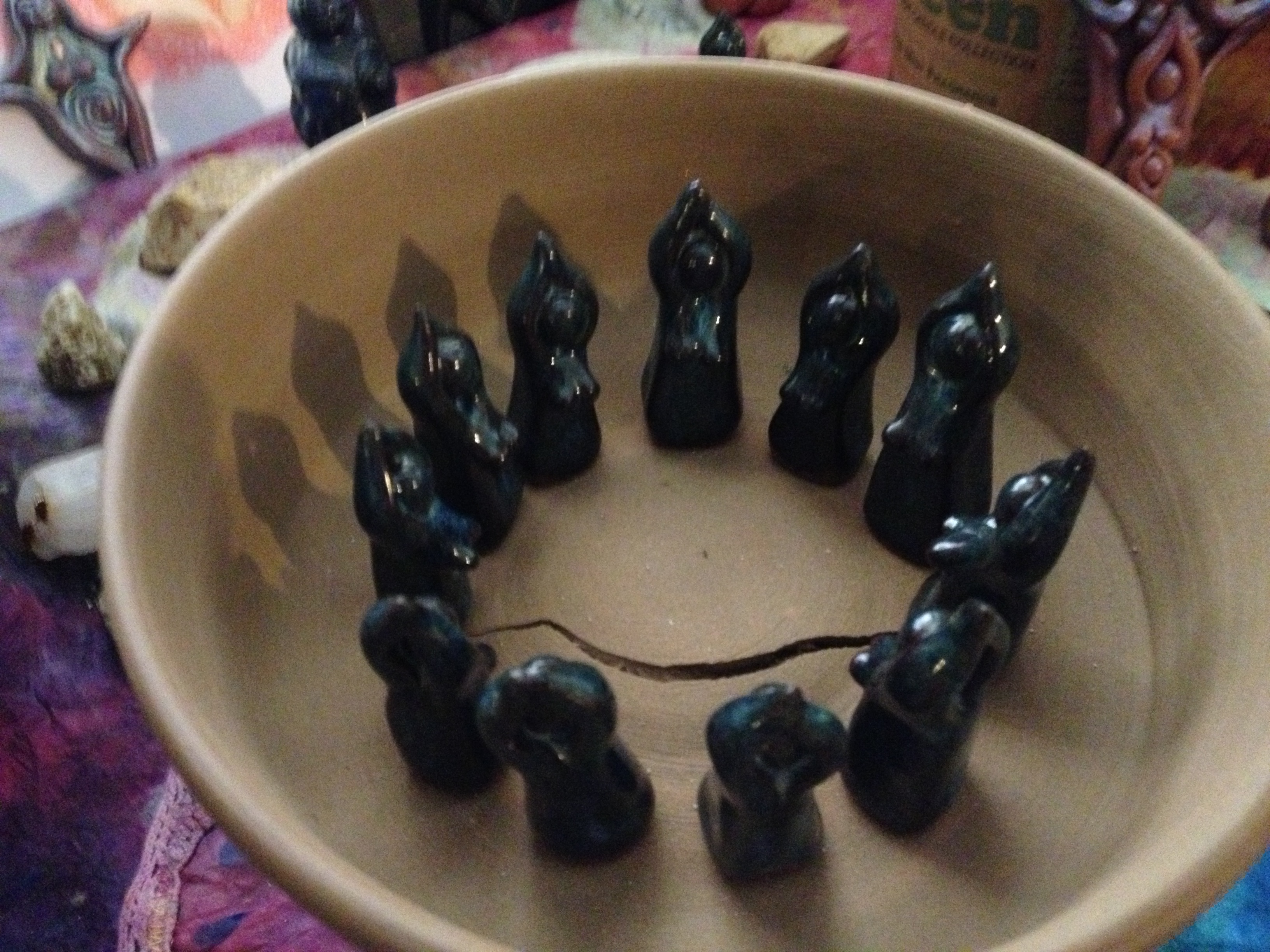
Circle of women sculptures as gifts for my women’s group. Yes, there’s a crack—“the world cracks everyone”—but that is how the light gets in…

to belly dance and chant

while I deliver

to hold me and breathe with me

as I push

to touch me and comfort me

as I cry?

Where are the womyn who know

what it’s like

to give birth?

via Where are the women who know? | Talk Birth.

Thinking about that reminded me of the chant we sang around the fire at the festival I just returned from on Sunday night:

Dance in a circle of women,

Make a web of my life,

Hold me as I spiral and spin,

Make a web of my life…

via Goddess Chants – Dance in a Circle of Women by Marie Summerwood.

May all pregnant women and tender postpartum mamas dance in a circle of women!

I’d hoped to have time to post a festival recap and some lessons learned, but other responsibilities take precedence at least for today, so I’ll leave you with one of the pictures my sister-in-law took on a misty morning, sunrise stroll around the lake and another that I took in the Temple at the festival:

Sept 2013 090

Sept 2013 036

See also:

Postpartum Survival Tips

Timeless Days: More Postpartum Planning

Mothers Matter–Creating a Postpartum Plan

Planning for Postpartum

Some reminders for postpartum mamas & those who love them

Birthing the Mother-Writer (or: Playing My Music, or: Postpartum Feelings, Part 1)

Postpartum Thoughts/Feelings, Part 2

Postpartum Feelings, Part 3

What to tell a mother-to-be about the realities of mothering…

Guest Post: Paid Menstrual Leave?

Paid Menstrual Leave – it’s time!  

by DeAnna L’am. Reprinted with permission.

A Russian lawmaker has asked parliament to give women two days paid leave a month when they menstruate… Mikhail Degtyaryov, a member of the nationalist LDPR party, wrote on his website “During that period (of menstruation), most women experience psychological and physiological discomfort. The pain for the fair sex is often so intense that it is necessary to call an ambulance”… Scientists and gynecologists look on difficult menstruation not only as a medical, but also a social problem…” ~ Standard Digital, August 2013

Fascinating! Lets look at how good things are turned on their heads, yet again, to result (unsurprisingly) in women’s dis-empowerment.

Indeed, a paid monthly Menstrual Leave would be an honoring, empowering option for women worldwide. Yet proposing it for all the wrong reasons diminishes us, and our cyclicity, to “a social problem.”

Campaigns have been initiated over the years under the guise of empowering women, which ended up diminishing, dis-empowering, and ultimately killing us! Marketing guru Edward Bernays was hired in 1928 by an American Tobacco Company president to increase sales of Lucky Strike cigarettes. Sigmond Freud’s work was utilized to expand understanding of ‘What Women Want’ and capitalize on it for marketing purposes.

Realizing that women were motivated and empowered by the suffrage movement, Bernays manipulated a real need – into a persuasive sales tactic. He hired women to march in the Easted Sunday parade smoking what he cleverly named their “Torches of Freedom.” Bernays succeeded overnight: he persuaded women to pick up an unhealthy habit, and commit to spending their hard earned money for years, by equating cigarettes with personal freedom and equality to men. Smoking among women exploded into unparalleled heights. Their personal freedom and equality to men continued to suffer…

Similarly, women were encouraged by manipulative campaigns to start giving birth in hospitals after countless generations of home births. Many new hospitals were built as a result of Second World War, to accommodate the staggering number of injured soldiers returning from battle. It took a few years for most hospitals to empty, as wounded soldiers either recovered or died. Faced with many large vacant hospital buildings and idle staff, administrators procured and released ad campaigns, which sinisterly manipulated women to believe that giving birth at home was ‘primitive’ and unsafe, while birthing at the hospital was promoted as safer, ‘modern’, and a highly intelligent choice.

Women bought into these campaigns, and many others like them, all over the world. They started smoking and felt ‘glamorous’. They started giving birth in hospitals and felt ‘modern’. They started using disposable menstrual products and felt ‘progressive’ and ‘in control.’ All along they have also been developing an array of respiratory diseases and dying of lung cancer; They have been cut open in cesarean sections (1 in 4, to accommodate doctor’s convenience); They have reached an all-time-high maternal and infant mortality rates following hospital birth; And they have been contributing to our planetary ecological crisis by damping 12 billion “feminine hygiene” products into landfills every year, in the U.S.A. Alone!

And here we are: In the midst of a pioneering worldwide movement of women reclaiming menstruation as the heightened state of awareness for which it was recognized in all indigenous cultures; In the process of inspiring women to honor their menstrual blood and their body’s needs, by taking time off to rest and renew themselves on the first day of their period — we are faced with a legal initiative which is both revolutionary and reactionary at the same time!

Wouldn’t it be revolutionary for the workplace to grant Paid Menstrual Leave to women? Wouldn’t we feel validated in our need for rejuvenation, honored for our body’s monthly regeneration, and empowered by the cultural acknowledgment of our rhythm?

We certainly would, if it weren’t billed as a response to “a social problem” of the “fair sex” who suffers “psychological and physiological discomfort.” Our menstrual cycle is neither a social problem nor a mere discomfort. Our menstrual flow is profound and life affirming work performed monthly by our bodies. We need to rest and renew in response to it, or we develop symptoms labled “psychological and physiological discomfort” by our culture (and frequently by us, too…)

Cigarettes, hospital births, and disposable menstrual products were sold to us through clever manipulative tactics, yet we never needed them… We DO NEED Paid Menstrual Leave!

We have stopped smoking in drovers. We have been reclaiming home births, and have started using sustainable menstrual products (such as cloth pads, sea sponges, and menstrual cups). It is time to claim for ourselves, and demand from our culture, a monthly PML to replace PMS!

PML (Paid Menstrual Leave) is the deeply deserved rest our body, mind, and spirit need monthly. In its absence, our body screams in PMS pain, and will continue to do so until we listen to its needs and honor them.

This is a call for action! Lets unite in demanding legaly-bound Paid Menstrual Leave — not as a patronizing gesture designed to send us home for being a “social problem.” But rather as the honoring of a deep need, which springs from our depth, to renew our body, our emotions, and our spirit – monthly – while preparing for another cycle in the ever turning wheel of our lives.  


© 2013, DeAnna L’am, Red Moon – Cycles of Women’s Wisdom™

DeAnna L’am, (B.A.) speaker, coach, and trainer, is author of ‘Becoming Peers – Mentoring Girls Into Womanhood’ and ‘A Diva’s guide to Getting Your Period’. She is founder of Red Moon School of Empowerment for Women & Girls™ and of Red Tents In Every Neighborhood – Global Network. Her pioneering work has been transforming women’s & girls’ lives around the world, for over 20 years.

DeAnna helps women & girls love themselves unconditionally! She specializes in helping women make peace with their cycle; Instructs Moms in the art of welcoming girls to empowered womanhood, and trains women to hold RED TENTS in their communities. Visit her at: www.deannalam.com

Disclaimer: I am a Red Moon program affiliate. However, the only affiliate link in this post is the one included here!

MamaFest!

Last summer, my Rolla Birth Network friends and I conceived of a local event to be held celebrating mothers. We made a couple of August 2013 020decisions in planning our event that were really smart: we decided to focus on celebration rather than education (or even activism), we decided not to involve any money (either for the attendees or the hosts [aside from tabling materials/supplies]), and…this is key…we also decided to only do that which was within our own personal resources to provide. It worked! We pulled off a lovely MamaFest event at Tara Day Spa in Rolla. It was well-attended and fun and involved very little expense for anyone. It was work, of course, but it was within our resources/capacities. Community organizations were welcome to have a table at the event for free with the only stipulations being no formula/bottle materials (this event is co-sponsored by La Leche League of Rolla in conjunction with World Breastfeeding Week) and that they had to provide something to do at their table. Our vision was that this event would not involve simply walking around picking up flyers and leaving, but instead would provide an opportunity to hang out with friends, see cool things, learn some stuff, and make some projects. I had a birth art booth that was a delight for me to offer to the women.

This year in August, we hosted our second annual MamaFest event, again with a similar vision. Our resources/time were a little slimmer August 2013 017this year due to peoples’ schedules (particularly my own, leaving my co-founder shouldering most of the organizing effort), new babies, etc. We had fewer exhibits and fewer attendees and slipped more into the boothy-vibe that we hoped to avoid, and learned some things to try next year. I still consider the event a success, especially considering the fairly minimal womanpower with which we had to work. It was an especially good outreach opportunity for LLL and I said at the end that even if I hadn’t been involved at all with the planning of it, I would definitely have considered it a worthwhile event to continue attending with my LLL booth. I was super excited about my simple, but pretty (and free!) offering for the birth art booth this year: mother affirmation/blessing cards. Unfortunately, very few people took me up on my offer and I was a little sad about that, but my LLL booth with its breastfeeding trivia game and got breastmilk ™ pins was pretty popular. We have lots of ideas for next year and the possibility of experimenting with new directions, such as doing away with the booths altogether and having more retreat-like experience stations (i.e. yoga). What we know we want to keep is our commitment to celebrating women and their capacities, because they’re just super awesome and worth celebrating!

Here are some pictures of my booth and some projects from the event:

August 2013 016

Birth art booth!

August 2013 031

Loved this thumbprint necklace project offered at the booth of a local doula/photographer. Alaina appropriated it immediately because, “me like hearts!”

August 2013 028

Babyloss memorial charms offered by the Rainbow Group (local pregnancy/infant loss support)

August 2013 015

Emergency back up project that I scrambled for when I realized people weren’t making my cards–affirmation “stones” (glass pebbles written or drawn on with glass paint markers).

August 2013 013

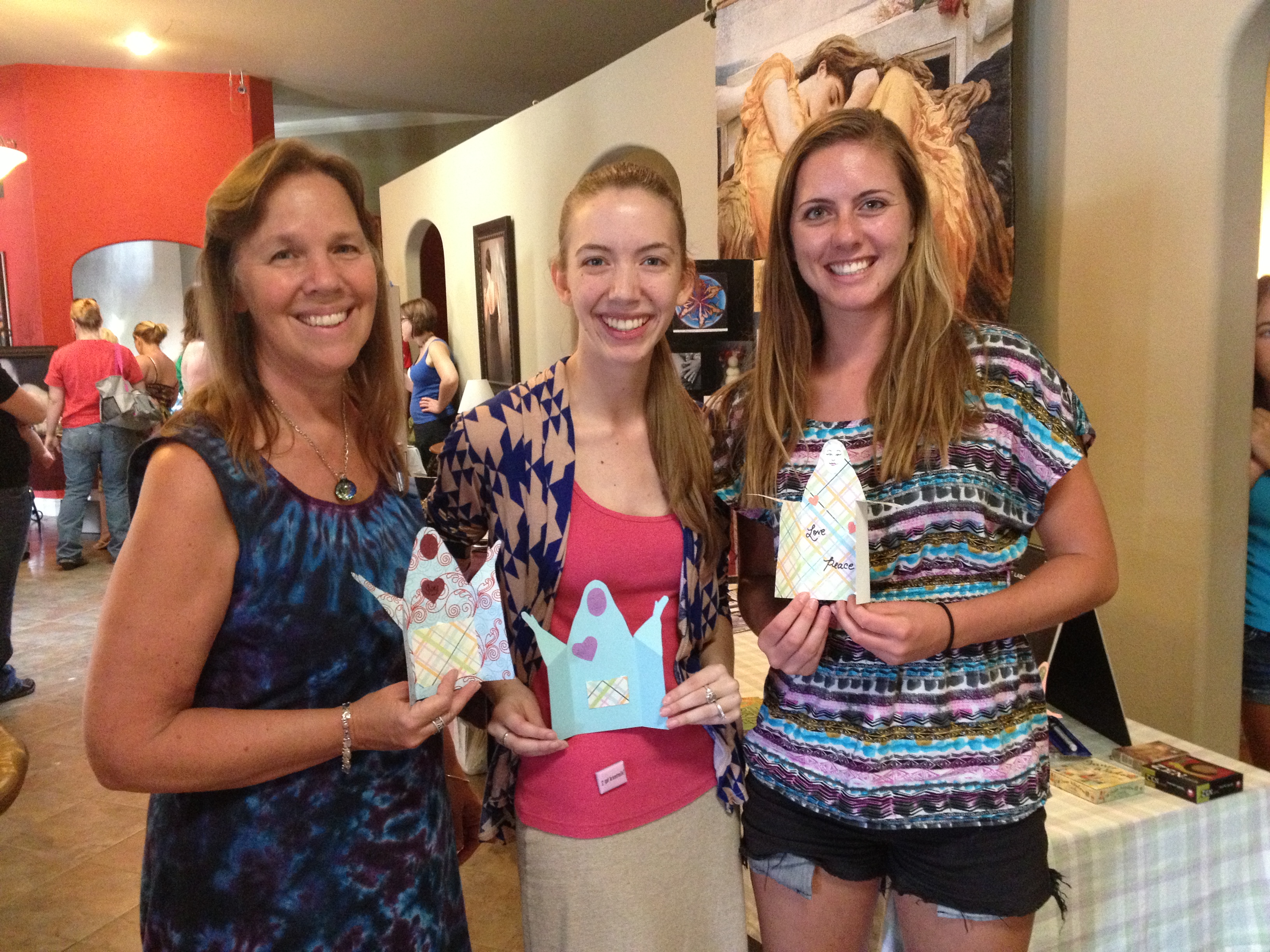
At least my own loyal family members showed up and made my project! (mom, sister, and visiting cousin)

What I learned from this event again this year was that you do not have to live in a city to be able to offer something like this in your community, all you need is a small handful of women who care and who can use their skills and resources to make it happen! 🙂

Tuesday Tidbits: Breastfeeding Research

August 2013 050

Some new (but non-breastfeeding) sculptures this week! 🙂

Before I begin today’s post, I feel like acknowledging that I find it puzzling that we even need to do research on breastfeeding or that it is considered “news” OR that it is something for which the advantages need to be “debunked” OR “proven.” It feels similar to me to seeing journal articles “revealing” that your own blood has special nutrients in it that help your body to function or announcing that having your own blood in your body helps you be healthier and live longer. Or, likewise, if we were to see articles “proving” that it is good for your cells if you drink water or that a special component has been added to a new soda to make it as “close to water as possible.” Some things just don’t really need to be news. And, I’ve observed for over eight years that new, often negative research about breastfeeding often “coincidentally” surfaces right around World Breastfeeding Week, and usually some new campaign also surfaces with a feel-good, but toothless message about “supporting all mothers,” and perhaps some “shocking” reveal article about celebrity breastfeeding will also pop up.

That said, unsurprisingly, some breastfeeding research and general breastfeeding articles have caught my eye recently. The first with regard to weaning and depression:

But the frequency with which women experience depressive episodes when weaning their babies is far less understood. Researchers “The intersection between lactation and mood is important, and it is extremely understudied,” said Dr. Samantha Meltzer-Brody, director of the perinatal psychiatry program at the UNC Center for Women’s Mood Disorders. “There are definitely people who report mood symptoms associated with lactation.”

via Weaning And Depression Linked In Many Women.

The second is one that will actually affect the way I practice when helping breastfeeding women and it is about the relationship that may exist between mothers having trouble breastfeeding and early signs of diabetes.

New research has revealed the hormone insulin plays an important part in the production of breast milk – and mothers who are struggling with feeding may have low levels of insulin.

For a long time, insulin was not thought to play a direct role in regulating the milk-making cells of the human breast.

But scientists now know that the mammary gland in breast becomes sensitive to insulin during lactation.

via Why mothers struggling to breastfeed could be showing early signs of diabetes | Mail Online.

And, not new or surprising or current, but unfortunately of continued relevance is the fact that IV fluids during labor artificially inflate baby’s birthweight:

But when babies lose more than 7% of birth weight during these early days, does this automatically mean they are not getting enough milk? No, according to a recent study.

A greater weight loss may be completely unrelated to breastfeeding and due instead to excess IV fluids mothers receive within the final 2 hours before delivery. According to this study, these excess IV fluids inflate babies’ birth weight in utero and act as a diuretic after birth. Babies whose mothers received more IV fluids before birth urinated more during their first 24 hours and as a result lost more weight. Number of wet diapers during the first 24 hours predicted infant weight loss. This was true whether the babies were born vaginally or by c-section. Another study published earlier this year had similar findings.

This weight loss has nothing whatsoever to do with breastfeeding and milk intake. In fact, the authors suggest that if clinicians want to use weight loss as a gauge of milk intake, they calculate baby’s weight loss not from birth weight, but from their weight at 24 hours. According to their findings, this could neutralize the effect of the mother’s IV fluids on newborn weight loss.

via Breastfeeding Answers Made Simple – Breastfeeding Reporter – Newborn Weight Loss and IV Fluids in Labor.

They way we treat women during birth matters for her breastfeeding relationship and the health of her baby! Birth interventions are not benign.

Also, not benign is the way this article from MSNBC chose to describe some research about breastfeeding women having a lower risk of Alzheimer’s disease (if researchers were more careful to watch their language, ala Diane Wiessinger, and remember that breastfeeding is the biologic norm, the article would actually be titled, “formula feeding increases risk of Alzheimer’s”):

Amazing news for moms who breast-fed: All that hassle was worth it — not just for your baby (who will likely have a higher IQ), but for you as well. A new Cambridge University study suggests that women who breast-feed can cut their risk of Alzheimer’s disease by up to two-thirds and calls the link “highly significant.” Those overly precious attachment parents might have the last laugh yet, as the benefits seemed to increase with longer periods of breast-feeding: Women who breast-fed for a year were found to have about a 20 percent lower risk of developing the disease as someone who had breast-fed for only four months. [Source]

via Breastfeeding cuts Alzheimer’s risk by two-thirds, study says.

Note that this “article” was published during World Breastfeeding Week and inserts little digs about being “overly precious” and a “hassle.” Words matter. They seep into our consciousness and affect our realities and our understandings of ourselves and our babies.

Not coincidentally, we also have to keep “proving” over and over again what many parents often feel in their hearts: that babies need to be with their parents, that they need to be held, and that breastfeeding is good for them.

“Ill-advised practices and beliefs have become commonplace in our culture, such as the use of infant formula, the isolation of infants in their own rooms or the belief that responding too quickly to a fussing baby will ‘spoil’ it,” Narvaez says.

This new research links certain early, nurturing parenting practices — the kind common in foraging hunter-gatherer societies — to specific, healthy emotional outcomes in adulthood, and has many experts rethinking some of our modern, cultural child-rearing “norms.”

“Breast-feeding infants, responsiveness to crying, almost constant touch and having multiple adult caregivers are some of the nurturing ancestral parenting practices that are shown to positively impact the developing brain, which not only shapes personality, but also helps physical health and moral development,” says Narvaez.

Studies show that responding to a baby’s needs (not letting a baby “cry it out”) has been shown to influence the development of conscience; positive touch affects stress reactivity, impulse control and empathy; free play in nature influences social capacities and aggression; and a set of supportive caregivers (beyond the mother alone) predicts IQ and ego resilience as well as empathy.

via Modern parenting may hinder brain development, research shows // News // Research at Notre Dame // University of Notre Dame.

Is anyone else getting tired of these kind of impressive “reveals”? I find it discouraging and frustrating, but maybe I’m just in a bad mood today!

I was less crabby to read this pleasant little story about Selma Blair and her breastfeeding toddler:

Arthur, who just celebrated his second birthday on July 25, seemed to enjoy the tasty snack, smiling and chatting gleefully with his mother and passers-by before the two headed off the train.

Even in more progressive parts of America breastfeeding is still seen as taboo, despite countless studies affirming the list of health benefits for both mothers and their children…

via Selma Blair breastfeeds her son Arthur, 2, during afternoon shopping trip | Mail Online.

And, from the same publication (not always widely renowned as a respectable source!), we see this interesting article about portraits of breastfeeding mothers from the 1800’s along with a little social commentary:

The seemingly normal image of the nursing mother in mid-1800s America poses a stark contrast against the media storm surrounding California mother-of-two Jamie Lynne Grumet last year, who posed on the cover of TIME breastfeeding her three-and-half-year-old son.

via Bizarre pictures reveal the unlikely trend for photographs of breastfeeding mothers in Victorian-era America | Mail Online.

And, interestingly, something else women also feel, but don’t necessarily have “back up” for, is the understanding that it isn’t breastmilk alone that has these effects for women, it is the act of breastfeeding itself, something that is not always differentiated in breastmilk research:

1) Find out what they mean when they say “breastfeeding.” This question by itself can often clear up misperceptions. In many cases, when critics say “breastfeeding,” what they really mean is “breast milk” independent of its delivery method; they do not mean the entire package that is breastfeeding. Breast milk obviously shines when compared to any of its substitutes. But when the independent effects of the milk are teased away from the act of breastfeeding, the differences seem smaller. And that is precisely the point—it’s the milk and the method of delivery that make the difference for both mother and baby.

via Answering the Critics: Breastmilk Separate of Breastfeeding Does Not Produce the Same Results | Kindred Community.

Along these same lines, but from a personal perspective instead, I was pleased, but not particularly surprised to read this mother’s story about breastfeeding her adopted son:

I am surprised by how not different breastfeeding our son feels compared to breastfeeding our older, biological children.

But because he’s adopted, breastfeeding felt even more important. I wanted him to feel that bond — that closeness and skin-to-skin, to help him feel comforted. Not being pregnant, and not knowing what he felt like in the womb beforehand … I wanted that physical connection with him afterward. And it’s just been really easy so far, although I don’t love the supplemental nursing system [laughs]. There have been moments of trying to get him to latch where, I’m just like, ‘Ok! I’m done!’

But I feel so bonded and attached to him, and I think a huge part of that has been the breastfeeding.

via The Breastfeeding Chronicles: Nursing My Adopted Child.

We also see questionable research results that seem to completely overlook the systemic context in which women make their feeding “choices”:

Brown found extraverted, conscientious and emotionally stable mothers were more likely to try breast-feeding. But being agreeable or open to new experiences made no difference, according to the findings published Tuesday (Aug. 6) in the Journal of Advanced Nursing.

Many try, but many quit

More than 80 percent of the women in the study tried to breast-feed, but less than half who tried were still breast-feeding six months later. And women who switched from breast to bottle tended to switch quickly. About 73 percent of the women who stopped breast-feeding did so within two weeks after giving birth.

Women who were conscientious — for example, detailed-oriented and punctual — were likely to start, but also likely to stop breast-feeding.

Mothers who kept breast-feeding during the first six months were more extroverted and less anxious than mothers who always bottle-fed or switched to the bottle. The effect was particularly strong within the first six weeks after birth. [Blossoming Body: 8 Odd Changes That Happen During Pregnancy]

via Mom’s Personality Key to Whether Baby Get the Breast or Bottle | LiveScience.

It is a huge mistake to reduce breastfeeding decisions to a “personal choice,” when it is a public health issue made in the context of a society that treats formula like the norm (as with the breastfeeding reduces risk, rather than formula increases risk research, as referenced above), pays excessive attention to celebrity breastfeeding experiences or public breastfeeding encounters, makes snide remarks under the guise of presenting new, duh-based research, that tolerates disparities in survival rates of black babies, and interferes with the birth process to the extent that we do not even have an accurate starting birth weight to gauge the “success” of breastfeeding by.

August 2013 017

Nursing toddlers at the creek last week. We’re talking about something else, but our faces look like we could be saying: “OMG! Can you *believe* that these things are even issues?!”
Totally.
Birth as a Spiritual Experience (Thesis Project)

Here is your sacrament MR_089
Take. Eat. this is my body
this is real milk, thin, sweet, bluish,
which I give for the life of the world…
Here is your bread of life.
Here is the blood by which you live in me.”
–Robin Morgan (in Life Prayers, p. 148)

“…When I say painless, please understand, I don’t mean you will not feel anything. What you will feel is a lot of pressure; you will feel the might of creation move through you…” – Giuditta Tornetta in Painless Childbirth

“I am the holy mother; . . . She is not so far from me. And perhaps She is not so very distinct from me, either. I am her child, born in Her, living and moving in Her, perhaps at death to be birthed into yet some other new life, still living and having my being in Her. But while on this earth She and I share the act of creation, of being, and Motherhood.”Niki Whiting, “On Being a Holy Mother” in Whedon

“Woman-to-woman help through the rites of passage that are important in every birth has significance not only for the individuals directly involved, but for the whole community. The task in which the women are engaged is political. It forms the warp and weft of society.” –Sheila Kitzinger

In 2011, I started working on my doctoral degree in women’s spirituality/thealogy (Goddess studies). Before I even began my first class, I chose my dissertation subject: birth as a spiritual experience. I’ve been steadily plugging away on my coursework and somehow in the midst of everything else that I am responsible for, I’ve successfully completed 13 of my classes. I already have a (not related) master’s degree and this is why I was admitted straight into the doctoral program, even though I have to complete a lot of M.Div (master’s of divinity) level coursework as prerequisites to the actual doctoral classes. After I finished my most recent class and got my updated transcript, I finally actually noticed how many M.Div classes I’ve completed thus far on my journey and it occurred to me to email to inquire what it would take to finish an M.Div degree first. I had this sudden feeling of what a nice stepping stone or milestone experience it would be to finish something, since I know that I have a minimum of three more years remaining before I complete the D.Min! They wrote back quickly and let me know that with the completion of three courses in matriarchal myth (I’m halfway through the first right now), my almost-completed year-long class in Compassion (I’m in month 11), and The Role of the Priestess course (involving three ten-page papers), all of which are also part of my doctoral program, the only other thing required for successful completion of my M.Div would be a thesis (minimum of 70 pages).

As I’ve been working through my classes, I’ve felt a gradual shift in what I want to focus on for my dissertation, and I already decided to switch to writing about theapoetics and ecopsychology now, rather than strictly about birth. I was planning to mash my previous ideas about birth and a “thealogy of the body” into this new topic somehow, perhaps: theapoetics, ecopsychology, and embodied thealogy. Then, when I got the news about the option of writing a thesis and finishing my M.Div, it became clear to me: my thesis subject is birth as a spiritual experience! This allows me to use the ideas and information I’d already been collecting as dissertation “seeds” as a thesis instead and frees me up to explore and develop my more original ideas about theapoetics for my dissertation! (This is the primary subject of my other blog.) So…why post about this now? Well, one because I’m super excited about all this and just wanted to share and two, because I’d love to hear from readers about their experiences with birth as a spiritual experience! While I don’t have to do the kind of independent research for a thesis that I will be doing for my dissertation and while my focus is unabashedly situated within a feminist context and a thealogical orientation, I would love to be informed by a diverse chorus of voices regarding this topic so that the project becomes an interfaith dialog. Luckily for me I’ve already reviewed a series of relevant titles.

Now, I’d like to hear from you. What are your experiences with the spirituality of birth? Do you consider birth to be a spiritual experience? Did you have any spiritual revelations or encounters during your births or any other events along your reproductive timeline? (miscarriage, menstruation, lactation…) Did you draw upon spiritual coping measures or resources as you labored and gave birth? Did giving birth deepen, expand, or otherwise impact your sense of spirituality or your sense of yourself as a spiritual or religious person? Did any of your reproductive experiences open your understanding of spirituality in a way that you had not previously experienced or reveal beliefs or understandings not previously uncovered?

When I use the word “spiritual,” I mean a range of experiences from a humanistic sensation of being linked to women around the world from all times and spaces while giving birth, to a “generic” sense of feeling the “might of creation” move through you, to a sense of non-specifically-labeled powers of Life and Universe being spun into being through your body, to feeling like a “birth goddess” as you pushed out your baby, to more traditional religious expressions of praying during labor, or drawing upon scripture as a coping measure, or feeling that giving birth brought you closer to the God of your understanding/religion, or, indeed, meeting God/dess or Divinity during labor and birth).  I’m particularly interested in women’s embodied experiences of creation and whether or not your previous religious beliefs or spiritual understandings in life affirmed, acknowledged, or encouraged your body and bodily experience of giving birth as sacred and valuable as well as your own sense of yourself as spiritually connected or supported while giving birth. I would appreciate links to birth stories or articles that you found helpful, books you enjoyed or connected with, and comments relating to your own personal experiences with any of the comments or questions I have raised above. I would love to hear about your thoughts as they relate to:

  • Pregnancy IMG_0225
  • Labor
  • Birthing
  • Lactation
  • Miscarriage
  • Infertility
  • Menstruation
  • Reproductive Rights
  • Birth as a feminist or social justice issue…

 Thank you!

With these things said, I also want to mention that I’m planning to redirect a lot of my writing energy/time into this thesis project rather than to blog posts. I’m trying to come up with a blog posting schedule for myself, but in order to actually do this thing, I must acknowledge that I have to re-prioritize some things and that means writing for my blogs probably needs to slip down a couple of notches in terms of priority of focus.

Oh, and I also hope this thesis project will turn into a book of some kind as well! 🙂

“It is hard to find a female-based concept such as Shakti alive within Western spiritual traditions. Shakti could be viewed as an expression of goddess in the female body at the time of birth. I would say its flow / expression and outcome of love is hindered by unnecessary interventions at birth which divert such energy towards fear- based, masculine forms. The use of masculine, rescue-based healing forms such as cutting (Grahn, 1993) can be necessary and useful, yet such procedures are currently used at the cost of women’s autonomy in the birthing process (see Jordan on C-section, 2007), and define the parameters of what feminist thinker Mary Daly called patriarchal medicine (1978). Modern women are largely lost when it comes to giving birth, turning to medical authority figures to be told what to do. Daly pointed to the dangers of this appropriation for women’s personal and collective autonomy.

Birthing bodies resist, disrupt and threaten standard North American modernist investments in linear time, rationality, order, and objectivity. Birth disrupts the Judeo-Christian male image of God, even as He hides the reality of female creation and creativity. I hold that women giving birth act from a focal point of power within their respective cultures and locations, the power to generate and renew human life itself from within the female body. This power is more absolute in its human reality then any other culturally sanctioned act of replication and material production, or social construction. I speculate that how this female power is expressed, denied, or acknowledged by women and within the society around a birthing woman reflects the degree to which women can and may express themselves at large. As each soul makes the journey through her/his mother, re-centring human consciousness within the female-based reality of human birth causes transformation of patriarchal consciousness as a whole…” –Nane Jordan, Towards an Ontology of Women Giving Birth

Tuesday Tidbits: Birth Imprinting

What are imprinting upon newborns at birth in our culture?

As Sister MorningStar writes in her article The Newborn Imprint in Midwifery Today issue 104, Winter 2012…

If you have had the misfortune, as nearly all of us who can read and write have had, to see a baby born, perhaps pulled out, under bright lights with glaring eyes and loud noises of all sorts, in a setting that smells like nothing human, with a mother shocked and teary and scared; if you have witnessed or performed touch that can only be described as brutal and cruel in any other setting…

Every baby born deserves uninterrupted, undisturbed contact with her mother in the environment the mother has nested by her own instinctual nature to create. Any movement we make to enter that inner and external womb must be acknowledged as disturbing and violating to what nature is protecting. We do not know the long-term effects of such disturbance. We cannot consider too seriously a decision to disturb a newborn by touch, sound, light, smell and taste that is different and beyond what the mother is naturally and instinctually providing. Even facilitating is often unnecessary if the motherbaby are given space and time to explore and relate to one another and the life-altering experience they just survived. They both have been turned inside out, one from the other, and the moment to face that seemingly impossible feat cannot be rushed without compromise. We have no right to compromise either a mother or a baby.

I am deliberately leaving out the issue of life-saving because it has become the license for full-scale abuse to every baby born… [emphasis mine]

In the same issue in an article called Problems in American Maternal Health Care, Dan Currin points out:

Americans put a lot of trust in their physicians. We are socialized to believe that physicians are the only ones capable of taking care of us. For everything from how to eat to how to die, the mantra is the same in the US: ‘Ask your doctor.’ Meanwhile, physicians are more and more subject to a system that, as Gaskin describes, favors the priorities of hospitals, insurances companies and doctors above the best interests of mothers and their babies

And, Judy Slome Cohain writing in Collusion and Negligence in Hospitals describes it thusly:

To err is considered human, even when it involves maternal death, at a hospital birth. When a woman dies from malpractice after birth the protocol is to hold meetings to consider how to improve relevant protocols to prevent future disasters. Survival of the hospital is first and foremost. However, if a woman dies at an attended homebirth, the Ministry of Health policy is to start a case against the guilty part in a disciplinary court…”

I wrote about birth imprinting in another short post, The Magic of Mothering and about the notion of consulting your health care provider in some thoughts about Women’s Power and Self-Authority.

We also need to consider the role of birth “imprinting” on the breastfeeding relationship:

New mothers, and those who help them, are often left wondering, “Where did breastfeeding go wrong?” All too often the answer is, “during labor and birth.” Interventions during the birthing process are an often overlooked answer to the mystery of how breastfeeding becomes derailed. An example is a mother who has an epidural, which leads to excess fluid retention in her breasts (a common side effect of the IV “bolus” of fluid administered in preparation for an epidural). After birth, the baby can’t latch well to the flattened nipple of the overfull breast, leading to frustration for both mother and baby. This frustration can quickly cascade into formula supplementation and before she knows it, the mother is left saying, “something was wrong with my nipples and the baby just couldn’t breastfeed. I tried really hard, but it just didn’t work out.” Nothing is truly wrong with her nipples or with her baby, breastfeeding got off track before her baby was even born!

via The Birth-Breastfeeding Continuum | Talk Birth.

417

If she came with it label, it would say: Imprint with Care…

*Short post today because I’m out-of-town again! What the heck?! I need a vacation from vacations!

Tuesday Tidbits: Birth Thoughts

Lots of birth stuff to share this week! I may be slowly transitioning away from face-to-face birth work, but reading and writing about birth definitely remain on my agenda. First, this post about pivotal moments in one birth professional’s journey:

Thanks to a powerful recent blog by a doula in England about her experience in a Birthing from Within workshop, I have found myself reflecting on my own path as a doula and childbirth educator. Over the years I’ve done ICEA training, DONA Birth Doula Certification, and Birthing from Within Mentor Certification, along with apprenticing as a midwife and a Masters of Science in Parent-Child Nursing – more than my fair share of learning. Through the past twenty + years of practice I can identify the 7 core experiences that have shaped who I am as a birth professional.

via Birthing Ourselves | My Path as a Doula & Childbirth Educator.

Reading her list brought back some of my own pivotal moments and also helped me see how those moments relate to my current priestess/women’s mysteries path. I think I’ve already mentioned that I renewed my ICEA CBE certification this year, but I let my CAPPA certification lapse. I will let my prenatal fitness educator certification lapse as well and I did not renew my membership in several birth-related organizations. And, in a complicated decision related to a variety of factors, I withdrew my registration for a Birthing from Within mentor training this fall. I’ve wanted to train with BfW for ages, but I realized after we got home from California that I just can’t picture myself doing birth classes any more. Single day workshops or presentations, yes, but teaching (or mentoring) series of birth classes is just not on my radar any longer. I feel removed from or distant from it and I also feel okay with that. It is taking me quite some time to realize that birth writing is still a legitimate form of birthwork/birth advocacy/activism and I don’t need to feel like I “should” be doing something else in order to be valuable.

Speaking of birth professionals, I was interested to see this promising new blog by Amy Gilliand: Doulaing The Doula | Professional Development for Birth Doulas.

And, I’m so thankful that Missouri midwives have now known the freedom to practice for five years! I meant to post this link in an earlier Tuesday Tidbits post:

There is something so genuine, so deep, so…right about women serving women. Midwifery and midwives are intricately woven into the fabric of my life.

via 5 Years of Legal Midwifery in Missouri | Midwives, Doulas, Home Birth, OH MY!

Don’t forget to watch the lovely Ballad of the Midwife video that goes with it! Both the video and the post were created by a talented friend of mine 🙂

Speaking of friends, check out these large family blogs and vote for my friend Shauna’s blog Life with 7 Kids! (she just welcomed a new baby, so it is 8 kids now! :))

And, speaking of videos, after seeing a pretty hands-on, baby-twisting sort of breech birth in Birth Story, I found this pictorial article to be a good reminder with lots of useful pictures:

Most important rule is HANDS OFF THE BREECH no matter how tempting it is just to pull on that leg DON’T. It’s the easiest way to create nuchal arms and a completely deflexed head. When you pull on the leg you create a morro reflex in the baby.

via Mechanism of breech | Homebirth: Midwife Mutiny in South Australia.

And, speaking of Ina May:

“Remember this, for it is as true as true gets: Your body is not a lemon. You are not a machine. The Creator is not a careless mechanic. Human female bodies have the same potential to give birth well as aardvarks, lions, rhinoceri, elephants, moose, and water buffalo. Even if it has not been your habit throughout your life so far, I recommend that you learn to think positively about your body.”
― Ina May Gaskin, Ina May’s Guide to Childbirth

And, speaking of watching Birth Story: Ina May Gaskin and The Farm Midwives documentary, it made me think of this old post:

I know the traditional root of the word midwife is “with woman” (some sources say “wise woman”), but I’d like to offer another. When I was pregnant with my second son, I had a wonderful midwife and we spent many hours together talking about birth and midwifery. During one conversation she said to me, “you can’t be a midwife unless you love women.” This struck me profoundly—a midwife must love women.

via Midwife means “loves women”… | Talk Birth

Oh, and speaking of this loving women and this not being a lemon stuff…

Respect for our bodies, our babies, and our rights is never too much to expect.

That’s why I’m joining forces with the folks I thought were nuts. Remember the ones waving the signs? The ones I thought were nosy, yoga-ball bouncing doctor-haters? Turns out, they are none of those things. They are a smart, growing global coalition of people who recognize that we have a problem with the way many women are treated while giving birth. Nine out of 10 women give birth in a hospital in the United States. Through rallies and advocacy, ImprovingBirth.org is making sure everyone knows that all those women do not check their human rights at the door.

via Nosy, Yoga-Ball Bouncing Doctor-Haters – Why I Changed My Tune – Improving Birth | Improving Birth

But, what happens after the birth? I’ve often thought that my role in breastfeeding support, while less “glamorous” or exciting than birth work, has had more lasting value to the women I serve. Breastfeeding is the day in, day out, nitty-gritty reality of daily mothering, rather than a single event and it matters (so does birth, of course, it matters a lot, but birth is a rite of passage, liminal event and breastfeeding is a process and a relationship that goes on and on for every. single. day. for sometimes years). Anyway, sorry for the brief side note, but I enjoyed reading this article about the celebrity culture surrounding pregnancy and birth with its obsession with who has a “bump” and then how after the birth the main deal is losing that weight and having a fabulous bod again! Woot!

And that’s it. There’s no talk of the hard decisions and challenges that arise when bringing another human in the world: coping emotionally, miscarriages and health risks throughout the pregnancy, emotions that range from excitement to loss, how the partner is coping, decisions surrounding the birth, doulas, home birth, hospital birth, breastfeeding, milk supply, c-section recovery, vaginal recovery, colic, sleep, schedules, being tired all the time, depression, regret, fear, hiding in the bathroom crying. Agonizing decisions about work, caregivers and new priorities. Maternity leave. Paid time off. Unpaid time off. Pumping at work. Making time for your partner. Making time for yourself. A body that has changed but can also do incredible things.

Instead it’s mostly about getting skinny again after the baby is born, which we’re told over and over again is the MOST IMPORTANT THING. And it’s not. I know it’s not, and yet I have a constant dialogue in my head about how I have thirty pounds to lose and my thighs rub together and my stomach is bloated and has the texture of a grape that’s not quite a raisin and my face is fat and I’ll never fit into my old clothes again. I say this to friends (who haven’t had kids) and the response is: “Focus on the amazing thing your body just did, girl! A baby came out of you! You’re being too hard on yourself!” And they are right. I know this. But I can’t shake the feeling that I’m a failure because I’m not the size and shape I once was. And then I feel dumb and embarrassed for focusing on my looks when I should be celebrating how awesome it is that I’m a mom to two healthy, wonderful kids. It’s an exhausting, stupid cycle.

There is an important conversation to have about motherhood that we’re not having on a larger level. I know this because I talk to moms all the time. None of us are talking about maxi dresses or nursery colors or how we worked out for 90 minutes a day with our trainers while wearing a corset. We’re talking about how our maternity leaves don’t feel long enough. How often there’s nowhere to pump at work so we do it in our cars. How frustrating it is to be making too much milk/too little milk. How some days we can’t stand our partners, and on other days they totally save us.

via Exclusive: There Is More To Motherhood Than A Post-Baby Bod | Kate Spencer.

Reading all that and thinking about my own “grape” stomach that just isn’t quite making it back to “normal” after having my last baby, I was reminded of a quote from a very recent post:

“…we all need the renewing powers of ‘rhythm, ritual, and rest.’ This phrase reminds doulas of three helpful labor techniques outlined by legendary doula trainer, Penny Simkin. Rhythm, ritual, and rest not only aid birthing women, but they support all of us to move skillfully through our life’s labors. The power of rhythm restores vibrancy through dance, music, and motion. The power of ritual opens the way to direct encounter with the mysterious wonder of life. Rest renews and restores the very cells of our often tired and over-stimulated bodies and minds…” –Amy Wright Glenn

via Talk Books: Birth, Breath, & Death | Talk Birth.

And, speaking of Amy Glenn, I loved her lovely blessing for mothers to be!

“…May your pregnancy unfold with ease

May gentleness surround you

Joy for precious days

Days of two hearts beating in one body

You radiate wonder

Inspiring poetry, art, worship of ancients…” –Amy Glenn

via The Birthing Site

And, speaking of loving lovely words, I just have to re-share this quote as well:

labyrinth

Tuesday Tidbits: Domestic Violence

Tonight in my Introduction to Human Services class we cover Violence, Victim Advocacy, and Corrections. In a stroke of coincidence, I saw some great materials on Facebook this morning that I quickly added to tonight’s lecture:

The first is this infographic series from the World Health Organization. I first saw it here, but it really comes from here.

WHO_NMH_VIP_PVL_13.1_eng-page-001The second was this powerful public service message from Women’s Aid in the UK (trigger warning for violence):

During this same lesson, I also show my favorite mock poster about fool-proof ways to prevent sexual assault:

preventiontipsIs this at all related to birth? Yes, totally. In fact, I used this same poster in a past post that I really liked, if I do say so myself:

I truly think this is a chronic social issue—motherblame. We MUST look at the larger system when we ask our questions. The fact that we even have to teach birth classes and to help women learn how to navigate the hospital system and to assert their rights to evidence-based care, indicates serious issues that go way beyond the individual. When we say things about women making informed choices or make statements like, “well, it’s her birth” or “it’s not my birth, it’s not my birth,” or wonder why she went to “that doctor” or “that hospital,” we are becoming blind to the sociocultural context in which those birth “choices” are embedded. When we teach women to ask their doctors about maintaining freedom of movement in labor or when we tell them to stay home as long as possible, we are, in a very real sense, endorsing, or at least acquiescing to these conditions in the first place. This isn’t changing the world for women, it is only softening the impact of a broken and oftentimes abusive system.

via Asking the right questions….

And, unfortunately, domestic violence often begins during pregnancy:

Violence during pregnancy is an unfortunately common experience. Between four and eight percent of women experience domestic (intimate partner) violence during their pregnancies. The incidence of violence increases for women with unplanned or unwanted pregnancies with 26% of pregnant teens experiencing intimate partner violence and 15% of all women whose pregnancies are unwanted being in an abusive relationship. Indeed, murder is the second only to car accidents as the most common cause of injury related death for pregnant women.[1] Sadly, these statistics are likely higher in reality due to underreporting or misclassification.

via Domestic Violence During Pregnancy.

Our maternity care system unfortunately may also BE the perpetrator of violence against women:

While the situation is different from domestic violence in some ways, it is also similar. Abuse in the medical setting is also about power and control, the pregnant or laboring woman is often blamed for her situation, and verbal and emotional abuse can be similar. Because we are taught to “trust your doctor”, and in fact there is an explicit assumption of trust in the “fiduciary relationship” between the woman and her doctor who is an “expert”, most of us do not think about the possibility of abuse, and many of us stay with the OB or feel we have no choice about our health care providers or settings, especially when we are in labor. Also, the doctors and staff generally are not even aware that their behavior or actions are abusive.

via Guest Post: Abuse of pregnant women in the medical setting.

And finally, “normative” institutional abuse may be a part of many women’s birth experiences:

“‘Old wives’ tales,’ says the Oxford dictionary, are ‘trivial stories, such as are told by garrulous old women.’ It is significant that no one ever talks about ‘old husbands’ tales’ or ‘old doctors’ tales.’ Women are blamed instead. It is implied that there is poison in their speech and that the only safe thing to do is remain silent. The experiences that women share with other women are thus rejected and trivialized…In reality, it is not other women who instill and fuel anxiety in most pregnant women, but the medical system itself.” This quote from the 1980’s book, Giving Birth, by Sheila Kitzinger, remains strikingly relevant today. When women in the United States today enter the hospital to give birth, many experience some form of institutional violence. They may not explicitly define it as violence, but listening to their stories provides a disheartening picture of maternity care today.

via Birth Violence | Talk Birth.

Tuesday Tidbits: The Role of Doulas…

“So many of us are already working towards this aim – mamas (and groups) like LLL for sure, and doulas, women-centred midwives and July 2013 038doctors, and so many others…but really we need more. And there is no time or space for petty jealousies or in-fighting (and no judgments here, because it happens! I know the pain of this kind of sh*t, I’ve written a little about it before – and I may again – but it’s urgent we move beyond this if at all possible…) because we are already losing it – losing this capacity to give birth without intervention, to feed our babies from our own bodies, to experience love and connection in the fulness of which we are intended to be capable…” -Rebecca Wright (see more on why all of us are needed)

In “The Doula Phenomenon and Authentic Midwifery: Protection as a Keyword,” Michel Odent, writing in Midwifery Today issue 104, Winter 2012 describes the cultural conditioning of birth to think that women can’t do it on their own:

In this age of videos, photos and television, one cannot ignore that our current cultural conditioning is mostly determined by visual messages. Let us mention the powerful effects of the recent epidemics of videos and photos of so-called ‘natural childbirth.’ Almost always, several people surround the labouring woman. Young generations familiar with these pictures understand that the basic need of a labouring woman is to be accompanied by several persons. The effects of these visual messages are reinforced by the modern vocabulary, for example, to give birth women need a ‘coach’ (bringing her expertise) and support persons (bringing their energy). More than ever the message is that a woman has not the power to give birth by herself.

We must add that this cultural conditioning is now shared by the world of women and the world of men as well. While traditionally childbirth was ‘women’s business,’ men are now almost always present at births, a phase of history when most women cannot give birth to the baby and to the placenta without medical assistance. A whole generation of men is learning that a woman is not able to give birth. We have reached an extreme in terms of conditioning. The current dominant paradigm has its keywords: helping, guiding, controlling, managing…coaching, supporting…the focus is always on the role of persons other than two obligatory actors (i.e. mothers and baby). Inside this paradigm, we can include medical circles and natural childbirth movements as well.

Odent then goes on to explain that while the word doula comes from ancient Greek, actual modern-day Greek people advise him to use the word “paramana” instead, meaning literally, “with the mother.” He concludes his article with these important thoughts:

The doula phenomenon must be interpreted in the context of a period of transition. When the doula is understood as the mother figure a young woman can rely on before, during and after the birth, the doula phenomenon can be presented in a positive way as an aspect of the rediscovery of authentic midwifery. When, on the other hand, the doula is still another person introduced into the birthing place in addition to the midwife, the doctor and the father, her presence is counterproductive. If the focus is on the training of the doula rather than on her way of being and her personality, the doula phenomenon will be a missed opportunity. [emphasis mine]

I am concerned when I see rivalry between doula training organizations, because I think they are doing just this: focusing on the training of the doula rather than her way of being and her personality.

A long time ago I saved these two relevant, if somewhat opposing, quotes about doulas, culture, and advocacy:

First about doulas and collusion with patriarchy…

“I hate to say that the rise in popularity of doulas has done absolutely nothing to alter the status quo of hospital birth, but this seems to me to be true. In the past 10 or so years, the popularity of doulas has risen dramatically. And so has the rate of C-section and interventions in general. Am I suggesting correlation or causation? Absolutely not. Do I think that doulas are well-meaning, amazingly hard-working women who are truly passionate about women and birth and are trying to make a positive difference? Yes yes yes. But sadly, I don’t think they’re going to get anywhere. Because hospital birth is the collision of female power and patriarchy, and we aren’t going to change anything by behaving ourselves or adopting the approach of our oppressors. (No, this isn’t hyperbole. I really believe it).”

Doubts About Doulas (and patriarchy and stuff)

And, second about not bringing “politics” into the birth room…

“Now I understand there is a type of doula for everyone. Some women benefit from doulas with a more no nonsense attitude, the ones that don’t sugar coat things or come off more “militant”. Other women prefer a lighter touch or a more “middle of the road” doula. I respect the differences and the need for them. However, I believe there should be a separation of doula and advocate. Politics, in particular your own personal politics, have no business at the birth of your client. Once a client is in labor, any personal agendas should be checked at the door. There is a more appropriate time and venue to try and change faulty birth practices.

I think the same thing goes for the myth that we empower women through these actions at her birth. A woman’s power to advocate for herself and birth in the way she wants isn’t ours to give. It’s her birth and it has to be her job to find the power and be empowered. We can help, we can guide, we can even lead, but we can give that to anyone. Sadly though, through our actions, just like the hospital staff, we can take it away…”

Doulas and Advocacy: Are they mutually exclusive?

July 2013 036And, then, some more thoughts about the difference between activism and advocacy:

Activism, advocacy and support. As a birthworker I am always using one of these three tools. Sometimes I am using two at once, but never all three. And here is why: Support and advocacy can overlap. Advocacy and activism can overlap. But if you try to overlap activism and support you are going to be either ineffective, alienating, or both…

Activism, Advocacy and Support – To Brave Birth

We definitely need advocacy though and this is why:

Horrific abuse in childbirth happens every day in developing nations where women and their babies are often denied access to life-saving obstetric care.

Freedom for Birth – Can Anyone Argue Against Respecting Women’s Rights in Childbirth?

And, regardless of where or with whom or in which country women give birth, they deserve access to evidence-based care: What is Evidence Based Birth and Why Should I Care? — Giving Birth with Confidence

Birth is also a creative process:

“I believe that this is one of the important things about preparation for childbirth–that it should not simply superimpose a series of techniques, conditioned responses to stimuli, on the labouring woman, but that it can be a truly creative act in which she spontaneously expresses herself and the sort of person she is. Education for birth consists not, as some would have it, of ‘conditioning,’ but aims at giving a woman the means by which she can express her own personality creatively in childbirth.” –Sheila Kitzinger via More Thoughts on Birth as a Creative Process | Talk Birth.

And, birth matters a lot. It isn’t “just one day.”

“Homebirth cesarean mothers do not complete their births the way they planned, worked for, meditated on, and dreamed of. As a result, their births as mothers are left unfinished. As I told my therapist when my son was six months old, “His birth was finished but my birth, into being a mother, that’s been left hanging.” –via Homebirth Cesarean: “I was still an authentic mother.” – Momma Trauma.

In non-specifically-doula, but birth-related news, I finished some new sculptures and updated my etsy shop! And, one of my breastfeeding mama sculptures was featured in a neat Etsy treasury called Supporting Breastfeeding.

Yesterday, I finished downloading the The Business of Being Born classroom edition kit, which I’ll be reviewing here and hopefully using in my community development class in August. And, I’m also looking forward to finally watching/reviewing Birth Story: Ina May Gaskin and The Farm Midwives on Thursday with my Rolla Birth Network friends! Speaking of Rolla Birth Network, plans are underway for the second annual footprintscharmMamafest event in Rolla, MO on August 10th. This is a pretty epic event given our smallish town and associated resources. It really was great last year and I expect nothing less this year! I went a little crazy online and bought all kinds of supplies so we can make our own bindis at my booth at Mamafest. I also bought a lot of new charms for several purposes and I’m going to donate my favorite footprints-on-my-heart charms   to the Rainbow babyloss support group to make miscarriage memorial charms at their Mamafest booth.

And, finally, as I shared on Facebook earlier this week: I love it when my two-year-old points at my belly casts on the wall and says, GODDESS! And, I’m like, yes, yes that’s me… 😉

Womenergy (Womanergy)

The day before my grandma died, my dad came over and said he’d coined a new word and that I could have it: Womenergy. He said he’d googled it and didn’t come up with anything. I googled it later though and there are a couple of people who have used it before, so I think my dad actually said Womanergy instead, which is still available. So, womanergy has been coined now too! 🙂 I dozed off during Alaina’s nap today and when I woke up the word was in my head and so were a bunch of other words. I channeled a bit of my inner Alice Walker and wrote:

Womenergy (Womanergy):

Feeling fierce at 37 weeks last year.

Feeling fierce at 37 weeks in 2011.

Often felt when giving birth. Also felt at blessingways and circling with women in ceremony and rituals. Involved in the fabric of creation and breath of life. Drawn upon when nursing babies and toting toddlers. Known also as womanpower, closely related to womanspirit and the hearing of one’s “sacred roar.” That which is wild, fierce. Embedded and embodied, it may also be that which has been denied and suppressed and yet waits below her surface, its hot, holy breath igniting her. Experienced as the “invisible nets of love” that surround us, womanergy makes meals for postpartum women, hugs you when you cry, smiles in solidarity at melting down toddlers. It is the force that rises in the night to take care of sick children, that which holds hands with the dying, and stretches out arms to the grieving. It sits with laboring women, nurses the sick, heals the wounded, and nurtures the young. It dances in the moonlight. Womenergy is that which holds the space, that which bears witness, that which hears and sees one another into speech, into being, into personal power. Called upon when digging deep, trying again, and rising up. That which cannot be silenced. The heart and soul of connection. The small voice within that says, “maybe I can, I think I can, I know I can. I AM doing it. Look what I did!” Creates art, weaves words, births babies, gathers people. Thinks in circles, webs, and patterns rather than in lines and angles. Felt as action, resistance, creation, struggle, power, and inherent wisdom.

Womenergy moved humanity across continents, birthed civilization, invented agriculture, conceived of art and writing, pottery, sculpture, and drumming, painted cave walls, raised sacred stones and built Goddess temples. It rises anew during ritual, sacred song, and drumming together. It says She Is Here. I Am Here. You Are Here and We Can Do This. It speaks through women’s hands, bodies, and heartsongs. Felt in hope, in tears, in blood, and in triumph.

Womenergy is the chain of the generations, the “red thread” that binds us womb to womb across time and space to the women who have come before and those who will come after. Spinning stories, memories, and bodies, it is that force which unfolds the body of humanity from single cells, to spiraled souls, and pushes them forth into the waiting world.

Used in a sentence:

“I’m headed to the women’s circle tonight. I could really use the womenergy.” February 2013 196

“I felt like I couldn’t keep going, but then my womanergy rose up and I did it anyway.”

“Feel the womenergy in this room!”

“She said she didn’t think she could give birth after all, but then she tapped into her womanergy and kept going.”

“I hope my friends have a blessingway for me, I need to be reminded of the womenergy that surrounds me as I get ready to have this baby.”

Feel it…

Listen to it…

Know it…

In the air, in her touch, in your soul.

Rising
Potent
Embodied
Yours…

“For months I just looked at you
I wondered about all the mothers before me
if they looked at their babies the way I looked at you.
In an instant I knew what moved humankind
from continent to continent
Against all odds.”

–Michelle Singer (in We’Moon 2011 datebook)

“I believe that these circles of women around us weave invisible nets of love that carry us when we’re weak and sing with us when we’re strong.” –SARK, Succulent Wild Woman

There is a wild tiger in every woman’s heart. Its hot and holy breath quietly, relentlessly feeding her.” – Chameli Ardagh

Circles of women (and art)...