Archives

Regarding Balance

My friends and I often reference the word “balance” in our conversations, with a popular refrain being, “it all comes back to balance!” I have several books about life balance—my favorite being A Mother’s Guide to Self-Renewal and I feel like I continually engage in a dance with balance in my life, coming into various sensations of balance or imbalance throughout my days. I think I make a mistake in thinking that balance is something I will one day “achieve,” rather than dipping in and out of it. I also think that the cry for “balance” can sometimes be a secret code in my brain for, “I will eventually figure everything out and life will be perfect!” So, I appreciate this quote from the book  The Mommy Wars, with regard to balance, that eternal question:

“Let me save you some money: In a life with children, balance does not exist. Once you’re a parent, you can figure you’ll be out of whack for the rest of your life…Children are not born to provide balance. children are made to stir us up, to teach us how angry we can get, how scared we can be, how utterly happy, happier than we’d ever imagined was possible, how deeply we can love. Children turn us upside down and inside out; they send us to the depths and heights of ourselves; but they do not balance us. We can’t balance them either, and that’s a good thing, too. They’re finding out how to live in the world, and the most we can do is make them as safe as possible and have a good time with them.”

I have just started teaching (college) again after having a three week break and I’m teaching more classes than I ever have before, not to mention continuing to homeschool my kids and finding scraps of time to work on my own doctoral program. And, Alaina is on the move now—a seven month old baby is quite a lot more work than a younger baby! (Chiefly that she sleeps less and gets into more!) So, I’m in that time of trying to find my footing, my balance, with this new schedule and making sure I…once again…have my priorities in the right order. I have a blog post about “surrender” that I wrote several weeks ago that I keep waiting to post for some reason, as well as some other musings about keeping my blog posts going or not. I think I will keep writing, but I’m going to just post once per week—on Wednesdays probably (though, I may prep extra posts on that day to go out on different days). I also have plans for keeping them short, less navel-gazing, using material I’ve already written, and that sort of thing. While I really enjoy writing blog posts and there is something important—but hard to identify—that I get out of it (I think it is both about telling about it and playing my music), in the scope of my life right now, it really needs to slip to the bottom and possibly off of my radar entirely for a time.

This conviction that something I’m doing needs to change in order to be “balanced” (or perfect, as the case may be!) makes me think the root issue is really about control—control of life’s energy and flow—and reminds me of something else I read recently in Thomas Moore’s book, Original Self:

As a therapist, I often followed a simple rule…I would listen to a man or woman passionately explain what was going on in their lives and what they needed to do. This strong expression of self-understanding and intention told me a great deal about their suffering. I could see where and how they were defending themselves against life…it always seemed fruitful to explore the direction closed off by insistent plans for improving life.

To free our souls, we may have to be loosened by our suffering and our problems. Rather than look for ways to be further in control, we may have to surrender to the vitality that is trying to get some representation. Rather than understand our dreams, we might be understood by them–reimagine our lives through their challenging images. Rather than get life together, we might allow life to have its way with us and get us together in a form that is a surprise. (emphasis mine)

True personal strength is not to be found in an iron will or in superior intelligence. Real strength of character shows itself in a willingness to let life sweep over us and burrow its way into us. Courage appears as we open ourselves to the natural alchemy of personal transformation, not when we close ourselves by making the changes we think are best. (emphasis mine)

In the following section he also says that, “when people say they want to change, I hear a subtle rejection of the person they are…even then, a conscious plan for change usually comes from the same imagination that got us into trouble in the first place. A new project of self-transformation may land us back in the uncomfortable wallowing hole we just left.”

Hmm. Not sure what my conclusion is after all this now…to blog or not to blog. I don’t think that is really the question.

Diplomats and Breastfeeding

Today I came across an old note about a dream I had a couple of years ago:

I was in a sort of waiting room area with quite a few people in it including a friend and also a Diplomat (distinguished older gentleman with gray hair). Z wanted to nurse and so I picked him up and then turned slightly away from the diplomat in order to start nursing him. My friend said something like, “I see you’re trying to hide from everyone. I can’t believe you’re STILL breastfeeding him.” The diplomat then said, “at the Embassy we have an old saying: we work together as smoothly and comfortably as a good latch.

I wonder how world politics would look if breastfeeding mothers were the role models 🙂

Omega 3 Fatty Acid Supplementation During Pregnancy

This week, I was contacted about some new research being presented at the The Era of Hope conference in Orlando, FL about omega 3 supplementation during pregnancy reducing the risk of breast cancer for the baby girl in the future. Era of Hope is a scientific meeting funded by the Department of Defense Breast Cancer Research Program (BCRP). I was offered the opportunity to do a short interview with the researcher, Dr. Georgel:

Q. What are some easy tips for pregnant mothers to increase their consumption of omega 3 fatty acids?

A. Select the right type of oil when you go shopping:

  • Avoid corn oil and chose canola oil instead. Price is similar and canola proper ratio of omega 3 to omega 6 fatty acids (i.e., 1-2).
  • Wild caught salmon is a viable option; avoid farm-raised
  • Walnuts and broccoli are also good foods to incorporate into your diet.

Q. Are supplements (i.e. fish oil or flaxseed oil  in capsule form) as effective as other foods?

A. Yes, if you select them properly. Read the label; for fish oil, you have to make sure that the amount of omega 3 fatty acid (combined EPA plus DHA) is around 1600 mg/day. If the label says, “essential fatty acids,” it usually contains and high level of omega 6 and low omega 3 (which is not optimal) so you want to avoid those.

Q. Is the effect dose dependent? (i.e. how much do women need?

A. Yes, 1600mg of combined (EPA plus DHA) omega 3 fatty acids per day.

Q. Since it is World Breastfeeding Week this week, I’d love to tie this research in to research we already know about the role of breastfeeding in reducing a woman chance of breast cancer. Any thoughts on that?

A. Our research indicates that the maternal diet (in utero and during breast feeding) containing omega 3 fatty acids has the potential to reduce the female off-spring’s incidence of breast cancer.

I also asked about the following: finally, there is some evidence that supplementation with EFAs postpartum has an effect on reducing the incidence of postpartum mood disorders. Any thoughts on how prenatal supplementation might have a similar impact? But, since Dr. Georgel’s research does not explore mood disorders, he was unable to comment on this question. Here are two great handouts from Kathleen Kendall-Tackett about EFA supplementation postpartum:

Can fats make you happy? Omega-3s and your mental health pregnancy, postpartum and beyond

Why Breastfeeding and Omega-3s Help Prevent Depression in Pregnant and Postpartum Women

Breastfeeding Toward Enlightenment

I have a book called The Tao of Motherhood. It is literally the Tao Te Ching for mothers—a translation of the ancient Tao Te Ching by Lao-Tzu, but reworked slightly so that every “chapter” is about mothering and mothering well. It has 81 one to two page “chapters” just like the classic book. A quote from the end of the chapter on selflessness:

“You can sit and meditate while

your baby cries himself to sleep.

Or you can go to him and share

his tears, and find your Self.”

I’ve been thinking lately about writing an article about breastfeeding as a spiritual practice and have been using the same technique lately when nursing Alaina as described in this Mothering article by the same name: “breathing in, I am nursing my baby. Breathing out, I am at peace,” etc. (It also reminds me of my own How to Meditate with a Baby poem.)

On Monday, I was lying in bed nursing her and thinking about the intensity and totality of the breastfeeding relationship—it requires a more complete physical/body investment with someone than you will ever have with anyone else in your life, including sexual relationships. While I don’t like to lump the breastfeeding relationship in the same category with sex, because it feels like I’m saying breastfeeding is sexual, when it isn’t…though, I since lactation is definitely part of a woman’s reproductive functions, I guess maybe it is…but basically my line of thought was that if you nurse a couple of kids through toddlerhood, odds are high that you will have nursed them many more times than you will end up having sex with your husband in your entire lifetime.  (This question of function reminds me of a quote I saw today: “Breasts are a scandal because they shatter the border between motherhood and sexuality.” ~Iris Marion Young)

I calculated that so far in my life I’ve put a baby to my breast more than 12,000 times. Even if I only experienced a single moment of mindful awareness or contemplation or transcendence or sacredness during each of those occasions, that is one heck of a potent, dedicated, and holy practice 🙂

In the book Tying Rocks to Clouds, the author interviews Stephen Levine who has three children and he says:

“Talk about a fierce teaching. It is easier to sit for three years in a cave than to raise a child from the time he is born to three years old.” This was in response to a question about whether serious spiritual development is possible when having relationships with others (spouse, children, etc.) I do believe that without having children, I would be less “developed” than I am now—I’ve said before that having kids can be hard on the self (ego), but great for the soul.

“Perhaps we owe some of our most moving literature to men who didn’t understand that they wanted to be women nursing babies.”

–Louise Erdrich, The Blue Jay’s Dance

Maternal-Fetal Conflict?

You will have ideas, options and paths to ponder, but you will also have a sense of possible directions to take as you consider midwifery, childbirth education, or being a doula or an activist. Your path may be circular or straight, but meanwhile you can serve motherbaby while on the path, with a destination clearly in mind.” She also says, “I use the word midwife to refer to all birth practitioners. Whether you are a mother, doula, educator, or understanding doctor or nurse you are doing midwifery when you care for motherbaby.” —Midwifery Today editorial by Jan Tritten

Mamatoto is a Swahili word meaning “motherbaby”–reflecting the concept that mother and infant are not two separate people, but an interrelated dyad. What impacts one impacts the other and what is good for one is good for the other. The midwifery and birth communities have used this concept for quite some time and more recently some maternal health researchers have also referenced the idea of the “maternal nest”–that even following birth, the mother is the baby’s “habitat.”

Critiques of homebirth sometimes rest on a (flawed) assumption of maternal-fetal conflict (which is also invoked to describe situations with substance abuse or other risky behavior). In the Fall 2007 issue of CfM News, Willa Powell wrote about maternal-fetal conflict in response to an ABC segment on unassisted birth. She wrote:

[quoting the expert physician interviewed for the segment] “The few hours of labor are the most dangerous time during the entire lifetime of that soon to be born child. Because of this, I would argue, all soon to be born children have a right to access to immediate cesarean delivery, and women who insist on denying this right are irresponsible.”

This was the only professional opinion in the program on unassisted birth, and he set up a typical expression of an obstetric community belief: the “maternal-fetal conflict.” The notion is that there are two “patients”, where the mother’s desires are sometimes in conflict with the well-being of the baby, and that the obstetrician has a moral/professional obligation to abandon the mother in favor of the baby.

I have to remind myself that Dr. Chervenak is setting up a false choice. In fact, this scenario is a “doctor-patient conflict”. The mother wants what’s best for herself and her child, but she disagrees with her doctor about what is, in fact, best. Women are making choices they believe are best for themselves and best for their babies, but those choices are often at odds with what doctors consider best for both, and certainly at odds with what is best for the obstetrician!

In the book Birth Tides, the author discusses maternal-fetal conflict:

According to obstetricians, the infant’s need to be born in what they have defined as a safe environment, i.e. an obstetric unit, takes precedence over the mother’s desire to give birth in what doctors have described as the comfort of her own home. It is a perspective that pits the baby’s needs against those of the mother, setting ‘overriding’ physical needs against ‘mere’ psychological ones. It is rooted in the perception that the baby is a passenger in the carriage of its mother’s body–the ‘hard and soft passages,’ as they are called. It is also rooted in the notion of the mind-body split, in the idea that the two are separate and function, somehow, independently of each other, just like the passenger and the passages. While women may speak about ‘carrying’ babies, they do not see themselves as ‘carriers,’ any more than they regard their babies as ‘parasites’ in the ‘maternal environment.’ If you see your baby as a part of you, there can be no conflicts on interests between you.

I previously linked to a book review that explores this concept of the more aptly described “obstetric conflict” in even more depth.

I think it is fitting to remember that mother and baby dyads are NOT independent of each other. With a mamatoto—or, motherbaby—mother and baby are a single psychobiological organism whose needs are in harmony (what’s good for one is good for the other).

As Willa concluded in her CfM News article, “...we must reject the language that portrays a mother as hostile to her baby, just because she disagrees with her doctor.

An example of a mamatoto 🙂

I just want to grind my corn!

If you know me in real life (or if you are my husband), you’ve probably heard me use the phrase, “I just want to grind my corn.” I’ve been meaning to write a blog post about this idea for quite some time and when I posted my essay about “playing my music,” I received a comment from a friend saying, “I worry I’m not accomplishing what I’m capable of doing, but I know that ditching my kids and simply pursuing my ‘own thing’ would not be fulfilling.” When I read that, I knew that the time for my corn grinding post had come. When I use the phrase, I’m envisioning some kind of ancient tribe in which the mothers are working together grinding corn, while their babies are tied to their backs, and the older children play nearby. While I do not literally want to live in primitive times (those corn grinding mothers also probably had a lifespan of 35 years!), I feel as if mothering is “meant” to be a communal activity rather than a solitary one and I feel like babies and children are meant to coexist alongside their mothers as they go about their daily work. Rather than intensive, child-focused, total-reality mothering, I think babies are happy watching their mothers work and participating in the daily rhythms of the home and world with no need for the mother to be “rolling around on the floor in the glitter in her sweatpants” (see the book Perfect Madness) while serving as a one woman entertainment committee. This age of individual mothers caring for individual children in isolation from the larger “tribe,” is a social and cultural anomaly when we look at the wide scope of human history. Likewise, meeting for playdates isn’t what I mean either—I mean more task-oriented, corn grinding work, than that.

In the book Perfect Madness, the author articulates what I mean when I say I want to grind my corn—the need for something in between staying at home and working full time (basically, that working and mothering simultaneously is the most natural and fulfilling approach, but our society does not make that combination often feasible or comfortable):

Which means that ‘natural’ motherhood today should know no conflict between providing for our children (i.e. ‘working’) and nurturing them (i.e. ‘being a mom’). Both are part of our evolutionary heritage; both are equally ‘child-centered’ imperatives. What’s ‘unnatural’ about motherhood today, if you follow Hrdy’s line of thinking, is not that mothers work but rather that their ‘striving for status’ and their ‘maternal emotions’ have been compartmentalized. By putting the two in conflict–by insisting on the incompatibility of work and motherhood–our culture does violence to mothers, splitting them, unnaturally, within themselves…For they show that the so-called ‘choices’ most of us face in America–between more-than-full-time work or 24/7 on-duty motherhood–are, quite simply, unnatural. They amount to a kind of psychological castration: excessive work severs a mother from her need to be physically present in caring for her child, and excessive ‘full-time’ motherhood of the total-reality variety severs a mother not only from her ability to financially provide for her family but also from her adult sense of agency…

This is what I’m talking about. There needs to be a third, realistic option (and not just for women. For men too. For families!). I have often expressed the desire to find a balance between mothering and “personing.” I’m seeking a seamless integration of work and family life for both Mark and myself. An integration that makes true co-parenting possible, while still meeting the potent biological need of a baby for her mother and a mother’s biological compulsion to be present with her baby. Why is the work world designed to ignore the existence of families?

So, returning to my friend’s remark, I truly feel as if there is another option between “not accomplishing” and “ditching my kids.” And, I feel like after a LOT of work and trying, I’ve found somewhat of a balance in my own life between “personing” and “mothering.” It is possible to mother well AND also do some other things that feed your soul. It doesn’t have to be an either/or arrangement. And, we don’t do our kids any favors by not pursuing some of our own passions when they can watch and observe us being vibrant, active, complex, complete human beings (not saying that it isn’t “complete” to be a SAHM, but that if you DO want to pursue some other non-kid projects, kids learn good things from watching that happen!) I used to feel like I was going to die–-metaphorically speaking…like my soul was getting squashed—if I wasn’t able to pursue some of my personal goals. I don’t feel that way anymore (and I still spend roughly 90% of every week with my kids and 99% of my waking and sleeping hours with my baby!).

At one point when my first son was a baby, I was trying to explain my “trapped” or bound feelings to my mother and she said something like, “well what would you rather be doing instead?” And, that was exactly it. I DIDN’T want to be doing something instead, I wanted to be doing something AND. I wanted to grind my corn with my baby. Before he was born I had work that I loved very much and that, to me, felt deeply important to the world. Motherhood required a radically re-defining of my sense of my self, my purpose on earth, and my reason for being. While I had been told I could bring my baby with me while continuing to teach volunteer trainings, I quickly found that it was incompatible for me—I felt like I was doing neither job well while bringing my baby with me and I had to “vote” for my baby and quit my work. While I felt like this was the right choice for my family, it felt like a tremendous personal sacrifice and I felt very restricted and “denied” in having to make it. With my first baby, I had to give up just about everything of my “old life” and it was a difficult and painful transition. When my second baby was born, it was much easier because I was already in “kid mode.” I’d already re-defined my identity to include motherhood and while I still chafed sometimes at the bonds of being bonded, they were now familiar to me.

I become fully certified as a childbirth educator in that year after my second son’s birth (provisionally certified in 2005 and he was born in 2006) and another feeling I struggled with was the sensation that I had all of this change-the-world birth energy that was being stagnated or blocked somehow. I felt like I had become a birth educator in order to change the birth world, to transform the birth culture in the US, and in my own small corner of the world I could not make the kind of impact I envisioned making. That is when I started writing and found satisfaction in reaching out to the wider world in that manner (I explored how that benefited me in the music post already).

Now, with Alaina, while I do feel overloaded or overbooked at times, in general I feel like I have found a better balance than with any of my other children. I continue to teach college classes in person (a total of 10 hours a week) and online and while it is tricky at times, so far it is working pretty well and we’re all happy (thanks in no small part to my mom who has been willing to come to class with me to take care of her in between my breaks, so that we experience only small amounts of separation once a week). As she gets bigger and more energetic (read: sleeps less), I’m definitely finding that I will probably have to let something else in my life go in order to continue to be available to her, to my boys, and to my own need for “down time” in the manner in which I wish to be without hurting myself (by staying up too late, not eating well, having stressed out “freak out” moments, etc.). Sadly, I think it is going to be my birth classes that I put on hold and possibly this blog as well (more about this later) .

Speaking of the difference between parenting and personing—I also do not view being a mother as my job. Mothering is a relationship to me and not a job that I perform. Just as it is unhealthy for me to be defined by work responsibilities, it is also unhealthy for me to be defined by relationships. I would never describe my job as being “Mark’s wife” or “Barbara’s daughter,” that gives them too much responsibility for my identity. We are in relationship to each other, but that is not a duty I perform. And, just being in relation to them is not enough for the full expression of my personhood, I need other aspects and elements to my identity. Why am I surprised that I feel the same way about parenting? I want to be with my children, but I wish to be engaged in my own pursuits at the same time. When our lives feel happiest and most harmonious is when exactly this is occurring—when we are all together, but each working on our own projects and “doing our own thing.” I envision a life of seamless integration, where there need not even be a notion of “life/work” balance, because it is all just life and living. A life in which children are welcome in workplaces and in which work can be accomplished while in childspaces. A life in which I can grind my corn with my children nearby and not feel I need apologize for doing so or explain myself to anyone.

—————————

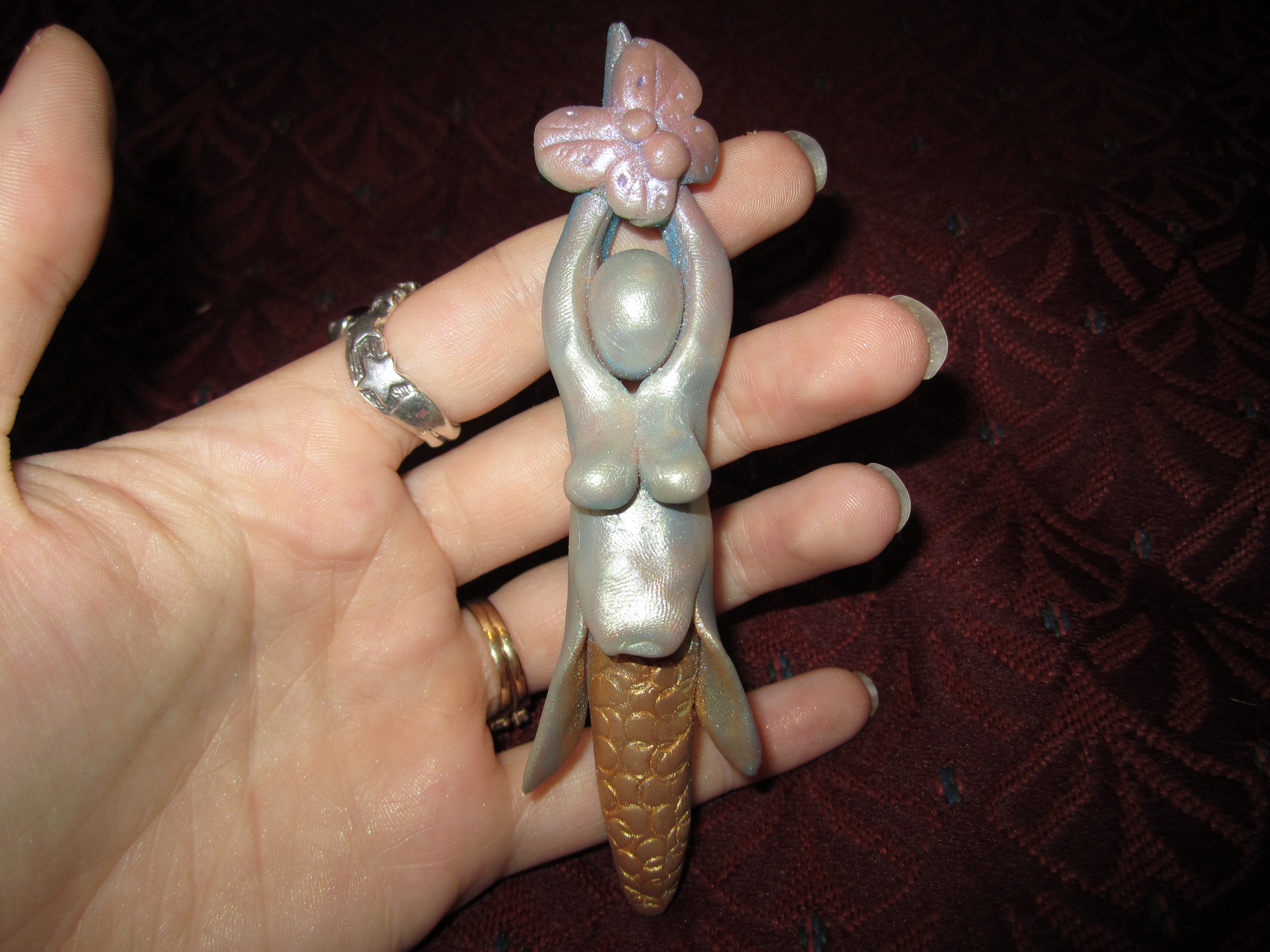
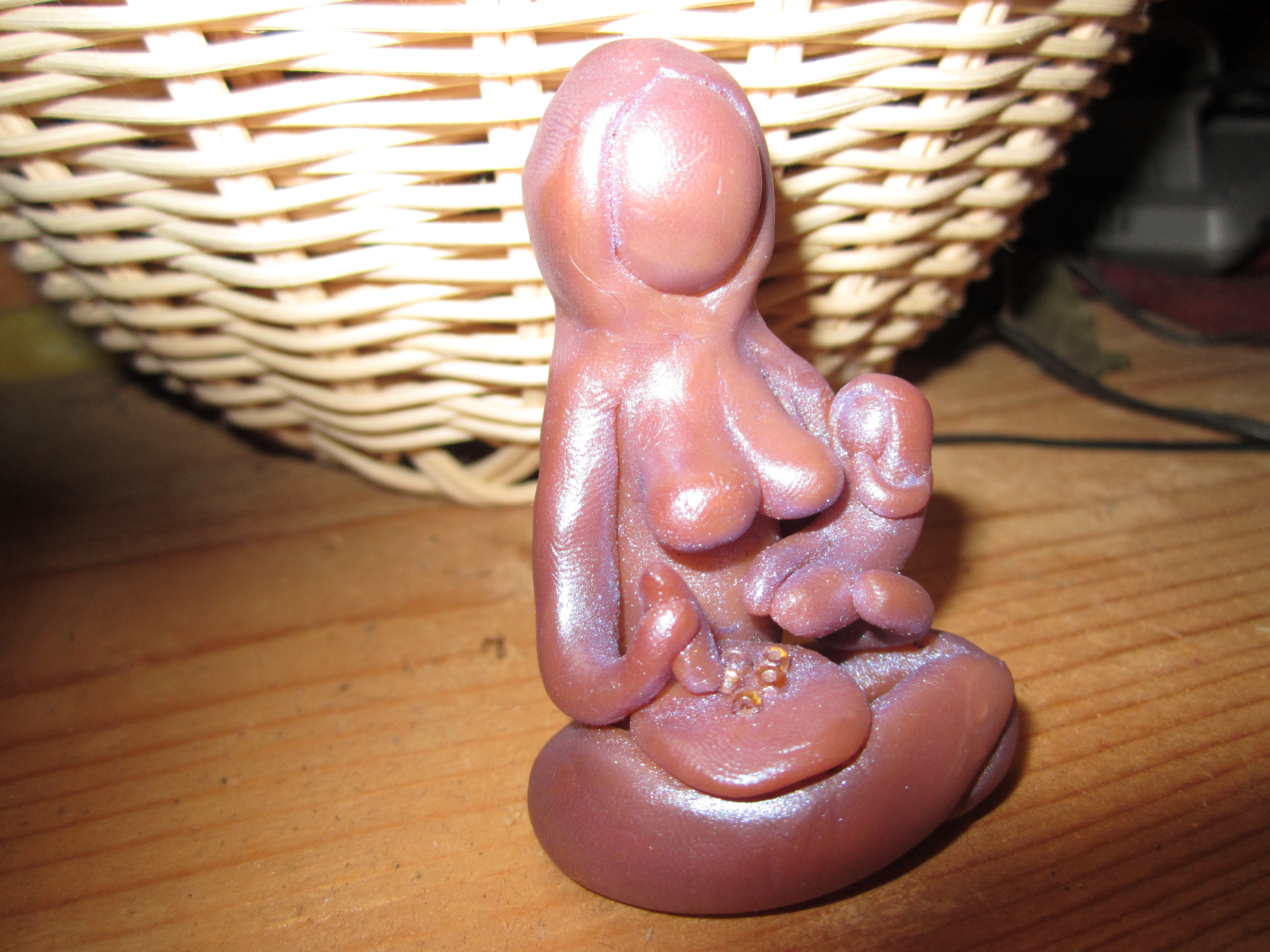
Continuing my birth art and life theme, I made two new sculptures a couple of weeks ago to express my corn grinding spirit. The first one is a corn goddess sculpture:

The second is a mama literally grinding her corn and holding her baby 🙂
They both make me happy when I look at them and I added them to my living room side table altar/sacred space.

Footnote: I started this post on June 17 and am now finishing it over a month later. Simultaneous corn-grinding and mothering can be very sloooooow…..;)

Footnote 2015: I’ve added a whole new baby since I first wrote this in 2011! I also created a whole new sculpture about the experience:
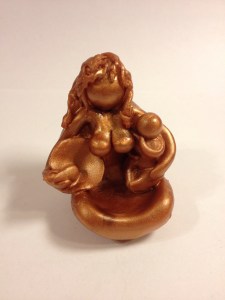
IMG_3732

Separation Anxiety?

Who is that looking at me?

I’m starting to notice some signs of what is traditionally called “separation anxiety” with Alaina—she starts to call/complain if she can’t see me, turns away from other people if she doesn’t want someone else to hold her, flops around at night until her hand is touching me, that kind of thing. Anyway, it made me think of the following quote that I had saved to post about it. From an article by the same name by Naomi Aldort in the May/June 2011 issue of Natural Life:

“By nature, there is no such thing as ‘separation anxiety.’ Instead, there is a healthy need of a child to be with her mother. Only a deprivation of a need creates anxiety. If we honor the need for as long as their child needs it, no anxiety develops. The concept ‘separation anxiety’ is the invention of a society that denies a baby and child’s need for uninterrupted connection. In this vein, we can deprive a child of food and describe her reaction as ‘hunger anxiety,’ or we can let her be cold and call her cries ‘temperature anxiety.'”

I loved this. What a strange society we have that defines a baby’s normal and wholly biologically appropriate need to be with its mother, as “anxiety.” I always call a baby that wants to be with its mother a smart baby, not a baby that has “separation anxiety.” 🙂

Telling About It…

Instructions for living a life:
Pay attention.
Be astonished.
Tell about it.

-Mary Oliver

I saw this quote on another mother’s blog yesterday and loved it. To me, it sums up the reason why I continue to write this blog. I have so many things going on in my life and I often wonder why I bother to continue writing blog posts. Does it matter at all? Aren’t I just adding to the general cacophony of voices and wild, information overloaded chaos of the internet (and even of the birth activist sphere in general). I feel almost compelled to do so though. And, really, the reason why is to tell about it. There is a lot to be astonished by in one’s everyday life. While I can get distracted and frantic and lose my present moment orientation, I do pay attention a lot. To a lot of things. A friend told me at my blessingway that I live my life with more intention than most people she knows. I considered that to be a great compliment—and, I also think I live my life with a lot of attention. Sometimes that attention may seem like excessive navel-gazing and very often it is excessively self-critical (and, isn’t that being self-centered, she says critically and self-evaluatively?), but I feel like I am a generally observant person, paying attention to my place in the world and the manner in which I walk through my day. And, the paying attention is intimately involved with then wanting to tell about it—here, on my blog 🙂

Here’s what feels astonishing about my life today. Six months ago today I gave birth to a little treasure. I feel like every day for the past six months I’ve experienced astonishment that she’s here—where did you come from, I ask her. She’s magic. I can hardly believe it has been six months already and yet, it also feels like she’s been here forever. And, guess what? My friend who has been waiting for her rainbow baby to be born, gave birth to her own precious daughter this morning. So, now our journeys share one more point of connection.

I really, really wanted to write an effusive blog post about my baby today in honor of her sixmonthabirthday. However, the end of the summer session is wrapping up and I had many papers to grade instead. I spent naptime working on them with the plan to reward myself with a blog post after finishing my grades (though, since I planned to grade 22 papers and 11 exams, you can see that something was awry in my calculations!). She woke up of course, after my only having graded 11 papers, and needed me to hold her rather than to write about her and so now I am here at almost midnight, needing to go to bed rather than to gush. Anyway, my happy, BIG, smiley, adorable, friendly, charming, unflappable, cooperative, sitting-up-and-working-on-craw​ling-and-pulling-up girl is six months old today. Her head smells like apricots and flowers. She loves watching her big brothers. She loves watching chickens and cats. She loves watching me. While I’ve written a lot about what an easy baby she is, she also likes to be held and toted along pretty much everywhere I go—maybe some people would define that as “high need” (i.e. “I can never put her down!”). I, however, think that is biologically appropriate baby genius. She is very grabby and reachy lately. My mom described holding her like “holding a bag of snakes,” because she is constantly on the lookout for something to snag. She has begun pushing up on surfaces so that her legs are standing (but her hands are still on the surface—so, not pulling up exactly, but pre-pulling up). She LOVES to find and eat paper and tear up catalogs. She laughs like crazy if I make monster noises on her belly. We tried to give her some solid food, but she gags and spits it out, even though she appears captivated by other people eating food. We still do EC (elimination communication) and she sleeps all night with a dry diaper. She always wakes up with a smile. She thinks Zander is hilarious, but isn’t very comfortable with him holding her. When Lann holds her, she snuggles down on him with total trust (even though he staggers under her weight—she weighs almost 18 pounds now and he weighs under 50). I love having a baby while also have a 7.5 year old. He carries her to the car for me. He watches her while I take a shower. He can hold her while I cut up vegetables or do something food-prep related that needs two hands. It is awesome.

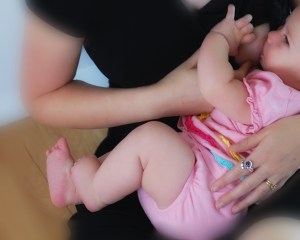
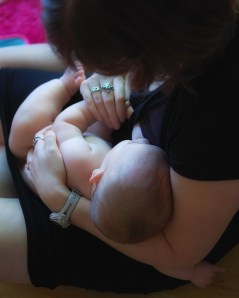
Despite grabbiness, she strokes and pats faces very gently. It is very sweet. She likes to ride in a pouch on my hip checking out the action. She likes to nurse best while lying down in bed—she tucks her feet up on my legs and puts her hands on either side of my chest. She has beautiful skin and beautiful eyelashes and her eyes sparkle with the delight of life. She is chubby and not petite. She is my most relaxed, settled baby—she rarely gets scared, hurt, or upset by things. She’s tough! When something makes a loud noise, she jumps, but then looks at me (to gauge possible severity) and then gives a big grin (the boys would both cry). If she tips and bumps her head or gets bonked or scratched by something, she usually doesn’t cry about it—my older son would have screamed and my younger son would have had a fit of rage. Her temperament is very steady and even. She has started to get more displeased if you take something away from her that she wants though—sometimes that provokes a protest. She also growls to herself while she plays with toys lately—she loves to empty a basket of toys and will sit on the floor working on this task for about 30 minutes. We think the growling sound is from listening to the boys play. I cannot believe how fast she is growing and changing. I try to take mental snapshots every day—her soft hair, her round cheeks, her little neck when her head is bent looking at something, her dark watchful pools of eyes, her careful and still clumsy hand movements and swiping grabs, her big gumbly smiles, her eyes fluttering closed at the breast. I pay attention. I am astonished. And, I tell about it.

Telling you all about it...

Mother Blessing Quotes

For the mother blessing ceremony I wrote about recently, I also went through my birth quotes collection (which is becoming quite extensive!) and picked out some special quotes that reminded me of things I wanted to share with the birthing mama-to-be.

“For each of us as women, there is a deep place within, where hidden and growing our true spirit rises…Within these deep places, each one holds an incredible reserve of creativity and power, of unexamined and unrecorded emotion and feeling. The woman’s place of power within each of us…it is dark, it is ancient, and it is deep.” –Audre Lorde

While some people have said they don’t like the use of the word “dark” in this quote, I think it is perfect. In the darkness is where wonderful seeds take root and grow.

“It is so easy to close down to risk, to protect ourselves against change and growth. But no baby bird emerges without first destroying the perfect egg sheltering it. We must risk being raw and fresh and awkward. For without such openness, life will not penetrate us anew. Unless we are open, we will not be filled.” –Patricia Monaghan

Since, as I mentioned, this recent ceremony was for a PAL-mama, I included the above quote. While I don’t really like the image of the egg being destroyed (if I relate the quote to birth), I feel like this is a good quote to describe the bravery involved with consciously undertaking the pregnancy after loss journey.

I also included my top two favorite quotes about birth and pain. The first:

“When I say painless, please understand, I don’t mean you will not feel anything. What you will feel is a lot of pressure; you will feel the might of creation move through you. Pain, however, is associated with something gone wrong. Childbirth is a lot of hard work, and the sensations that accompany it are very strong, but there is nothing wrong with labor.” –Giuditta Tornetta

I love the part about the might of creation. How is that for a bold summation of the potency and power of birth. While some people object to the inclusion of the word “painless” in it, to me the takeaway message of the quote is that birth is too big for the word “pain” to adequately contain or describe it. We need more and better language for it! And, that brings me to the second quote:

“So the question remains. Is childbirth painful? Yes. It can be, along with a thousand amazing sensations for which we have yet to find adequate language. Every Birth is different, and every woman’s experience and telling of her story will be unique.” –Marcie Macari

From the same author, two more quotes, this time describing the transformative power of birth:

“Birth is an opportunity to transcend. To rise above what we are accustomed to, reach deeper inside ourselves than we are familiar with, and to see not only what we are truly made of, but the strength we can access in and through Birth.” –Marcie Macari

“A woman in Birth is at once her most powerful, and most vulnerable. But any woman who has birthed unhindered understands that we are stronger than we know.” –Marcie Macari

And, then, a helpful reminder, that birth is our gateway to conscious, active, full-on parenting for the rest of our lives!

“The natural process of birth sets the stage for parenting. Birth and parenting mirror each other. While it takes courage and strength to cope with labor and birth, it also takes courage and strength to parent a child.” –Marcy White

And, finally, I shared the quote that to me was a touchstone describing my feelings about Alaina’s entrance into my world. She did this for me.

“A baby, a baby, she will come to remind us of the sweetness in this world, what ripe, fragile, sturdy beauty exists when you allow yourself the air, the sunshine, the reverence for what nature provides…” – Sarah Werthan Buttenwieser (in Literary Mama)

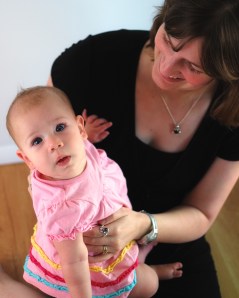
Speaking of that sweet baby of mine, here she is at my friend’s mother blessing ceremony. I’m so glad she’s here! And, my heart is full for my friend as she is soclose to her own fresh baby girl. I’m glad my daughter is going to grow up within a circle of strong, empowered, healthy women and girls and I love taking her to blessingways with me, knowing that I am socializing her into a model of womanhood and life that values the feminine 🙂 (and, yes, that is a bindi on her forehead).

(c) Sincerely Yours Photography