Archives

Tuesday Tidbits: Breastfeeding and Menstruation

I actually meant to make this post last week following my LLL meeting, but the day (and the week) spiraled away from me and before I knew it, it was already Tuesday again! As I mentioned in my last post, at our meeting we started out talking about breastfeeding and intimacy, which led into a discussion of breastfeeding and fertility as well as many other interlocking topics. It reminded me of some saved items-to-blog-about, especially this post from Lucy Pearce:

I don’t know about you, but I rarely see anything written about breastfeeding and your moontime, I mean how mamas cope with the ups and downs of their cycle while giving to their little ones 24 hours a day? Is it just presumed that if you are breastfeeding then you don’t have a cycle? I know this is true for many women (I’ve known women not bleed for 2 years!) but for me, my bleeding time has always returned after a few months, despite exclusively breastfeeding.

Most days breastfeeding is such a joy, I love the oxytocin high I get when I snuggle with my little one and feed all night long- BUT the days and nights just before my moontime, I feel touched out, wound up by the constant demands and I JUST WANT MY OWN SPACE!

…I have some ‘rules’ that I adhere to on my Sacred 1st Bleeding Day- I DON’T cook, clean, wash or do any ‘housework’, I DON’T work (although occasionally you might find me peeping in on Facebook!), I DO eat simple nourishing foods, I DO some gentle exercise- sometimes a bit of yoga, more often a walk in nature, I have a period of SILENCE to listen in to my inner wisdom- sometimes that has to be a few mins with my eyes closed while feeding.

I know- I’m lucky to have a supportive husband who accepts this- I think because I would take ‘Sacred Days’ when he first met me, he knew the score! So he is happy to take on household duties and extra childcare on these days to support me- and in the bigger picture, by supporting me on these few days I am able to be there for him and my family the rest of the month! (This is possible as we both work part time, so we can support each other, share childcare and housework)

via Blood and Milk – Self-Care for Breastfeeding Mamas who are Menstruating | The Happy Womb.

My presentation about “moontime” was very well-received at the LLL of Missouri conference in 2013 and I’ll be doing an encore presentation in 2014. However, I did not include anything in it specifically about how to handle being a menstruating, breastfeeding woman—time to make some additions! And, speaking of Lucy Pearce, I’m right in the middle of her amazing new book The Rainbow Way, which is about mothering and creativity. I’m getting my blog post finalized for her Carnival of Creative Mothers and I’m just loving this book, this topic, and this creative life I am weaving with my family.

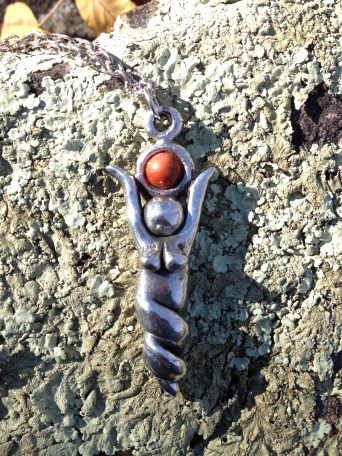
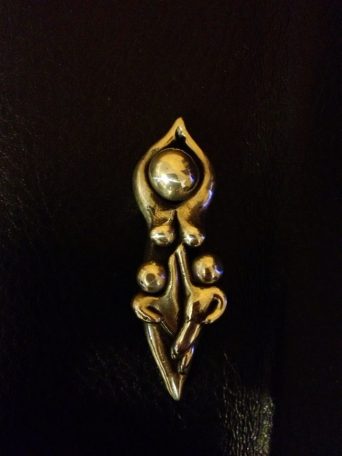
Speaking of creativity and mothering, a lot of my energy has been going into creating some new sculptures to be cast in pewter for my collaborative project with my free-range husband. I feel like I’m frequently patting myself on the back about them, but I just can’t help myself—I feel so pleased and really kind of impressed that we’re doing this. I didn’t know we could and yet…look!

1459073_10202506420051769_817650504_nNovember 2013 100 November 2013 101 The first and last photos are of new designs that I created after our fall women’s retreat this past Saturday. The last one (which I’m currently wearing!) reminds me of this quote that I read today for one of my classes:

“I can be a strong woman and laugh loudly and sing joyfully and dance wildly occasionally. I can imagine incredible things and weep if I need to.”

(woman speaking in the book To Make and Make Again: Feminist Ritual Thealogy, on why rituals matter)

And that reminded me of a lovely recent post by a friend about her sacred work:

She speaks the words and I hear the rumble
Rumbling, within me
It IS a calling
For it calls to me
Deep in my soul, my heart, my sleep
It is in every fiber of my being

via Sacred Work | Midwives, Doulas, Home Birth, OH MY!

Okay, so now I’ve moved totally away from my post theme and I don’t really have time to pull it back. Nor can I re-title it and start over, because it does segue..so, for now, I’ll bring it around the circle by mentioning that last week on my way to class, I listened to my favorite podcast, Voices of the Sacred Feminine. The first topic of the night was Women’s Spiritual Power by Hilary Hart (whose awesome sounding book Body of Wisdom went immediately on the top of my Amazon wishlist). She speaks about both menstruation and breastfeeding as powerful spiritual openings for women. Menstruation as a time of “cleaning out,” both emotionally and physically, not just for the mother, but for the whole family. She said mothers “process” the whole family’s emotions each month and clean the house, semi-metaphorically, for the family to renew and begin again. She spoke of breastfeeding as this relational, spiritual act that holds deep power. She also talked about birth and the power of birth as a creative, spiritual act. I enjoyed her thoughts because she doesn’t have children herself and nor does the host of the show and it was interesting to hear them touching on topics that I care about so much, but that they are viewing from somewhat of the “outside.”

The second topic of the night was the Sexual Politics of Meat. It may not sound that connected, but it did, in fact, tie right into my Birth Lessons from a Chicken article (in the podcast connections are made between the exploitation and domination of women and the sexual exploitation of female animals. In my article, I make the connection between the mothering and “birthing” behavior of the chicken and the birthing needs of women):

Then, one morning when my husband went to feed the chickens, he heard a funny noise. He looked at the broody hen and from beneath her, a fuzzy head appeared. Then two. Eventually, four. In this cold, cold weather at the wrong time of year with the wrong kind of feet and the wrong kind of eggs, she did it! We didn’t trust her, or believe in her. Our book and the experts didn’t either. However, her inherent mothering wisdom won out—it trumped us. At the risk of excessive personification, it truly seemed that she had believed in herself and trusted her instincts (or perhaps, that Nature believed in itself).

via Birth Lessons from a Chicken | Talk Birth.

Guest Post: Squatter’s Rights

October 2013 024

Squatter’s Rights

A couple of posts ago, I mentioned I’d made a new sculpture that I titled after a friend of mine and an article she wrote several years ago. She originally sent me the article to review, because she was thinking of sending it to a magazine. Several years passed, several more babies were born, her computer got fried, and the article was lost. However, it stayed with me anyway. It stayed with me when I prepared for the birth of my rainbow baby girl, it stayed with me as I created birth art to prepare for her birth, and it stayed with me as I reached down to catch my baby’s whole pink wonderful self in my hands as she was born in one smooth reflex almost three years ago. So, I created my figure and I emailed Shauna about it and then I went digging. Deep in the ancient, archived messages in my Outlook Express folder on my old laptop that now belongs to Zander (age 7), I found it. I found Shauna’s squatter’s rights article that had so touched my birth consciousness in such a way that I never forgot—even though babies, computers, friendships, and time have all marched on. I was already a childbirth educator when I read it, had already given birth myself, and was deeply immersed in birth work and childbearing. However, that doesn’t mean that certain descriptions cannot reach us and grab our attention in new ways. I’m delighted that Shauna gave me permission to publish her article here and to share her insights and experiences in this way!

Squatter’s Rights

by Shauna Marie

Would the new child coming from me be slippery like soap? I rubbed my fat belly. I loved each pound I gained, each craving I had, and every trip to the bathroom. Okay, maybe not every trip to the bathroom. But, I loved this growing baby. Tucked away like a pearl in the sea just waiting to be discovered. I was in a constant state of marvel.

Would I be able to physically do this? No, I don’t mean the labor, nor do I mean the birth. I knew I could do that. I got lost in thought as I planned in my head every moment that would come after my body did the work of labor. The moment would come once my body was ready and the crown of a child’s head pushed itself from me, the moment the child would emerge. That’s what I was planning for; I planned to catch my own baby.

I imagined opening my legs and squatting, I even practiced. I wondered where I’d put my hands, how I would have my legs, and if this little wet creature would be so slippery that I’d drop him or her. In December of 1999 this would be my second birth, but my first time catching a baby.

Like many people from a young age I was led to believe that women didn’t and couldn’t birth outside hospitals. The ones who did were radical or even dangerous. I was led to believe that the birth doesn’t matter, the baby matters. For my own personal sanity, due to cultural birth fear, I had to just come to the conclusion that as long as my baby was okay I could endure anything and that it would all be over soon.

Now rewind a little bit here, because there is something to be said about being at the right place at the right time; or knowing the right person. As a person who now tries to make a difference by being a strong home birth and natural family living advocate, I know who you know can sometimes make all the difference. For some people they just need that connection with real birth; they need to know someone who will talk about what birth really is about from a natural and physiological point of view. Above all people need to be exposed to home birth because it normalizes birth.

I was almost connected at one small point during my first pregnancy, just weeks before my first birth a friend of a friend was having a baby. I asked where she was having the baby at and when. My friend said she was in labor now, and having the baby at home. A jolt of sudden uncomfortableness and worry struck me, “At home! Why?” (Thinking oh my gosh there is no epidural at home!) My friend responded with a rather obvious sounding answer, “Well her mom is a midwife.” “Oh,” I said in an understanding tone. Somehow this made total sense now. If her mom is a midwife then it’s okay for her.

Quickly all home birth thoughts were intercepted with other conversations of non-birth related content. To this day I feel that should have been my contact with home birth. Instead I missed my first calling and just two months later I was induced two weeks before my due date against my own wishes (along with two other women from my OB’s office) to fit into the OB’s schedule.

I learned an awful lot that night. I learned I would never give birth to a healthy baby in a hospital again. I learned that in a hospital it is okay for others to look at your body, touch you, reach into you, and deliver your baby; but it’s not okay for you to do so.

I also learned that birth does matter, not just a healthy baby. Healthy empowered moms matter and instincts are stripped away by technology and birth colliding. This often even includes the instinct to breastfeed.

I was shocked at how disconnected I felt from the waist down. These strangers were in charge of me. There is something about being tied to IV’s and monitors, naked from the waist down in a hospital bed, legs in stirrups, that takes your power away. Even though some one at some point said, “Here comes your baby, look at your baby come” I felt like I wanted to reach over my belly and feel, or catch. I’d seen that in a birth video once –a nurse said something like ‘you can touch your baby’s head and feel’ to a mom giving birth flat on her back. I waited for someone to say that to me, but no one did.  Be it because of hospital policy, or be it because of shame, it was a no-no to touch or even catch what was mine. I felt so disconnected as I tried eagerly to see over my belly, knees being held up to my ears by three sets of hands to the chants of, “Push, push, pushhh…. good girl.”

I wondered so much about just staying home. I had what I thought was an unexplainable and unfounded desire to hibernate in a dark corner like an animal.

Around the same time that I got pregnant with baby number two I heard a doctor on television actually say that women are physiologically unable to catch their own babies. Already committed to having a home birth that comment further sealed the deal. I was catching my own baby this time. Not only do I dislike someone telling me that I can’t do something, I didn’t believe a woman would let her baby just fall to the floor (many mammals are born that
way though). Surely even if a woman didn’t squat with intent to catch her baby the child would be born slipping onto bed or floor without assistance or harm. My research lead me to discover that women have given birth effortlessly while in comas, unassisted and unmedicated. We’ve all heard the stories of scared teens giving birth suddenly, alone in a bathroom. The body just gives birth when it’s time. Not to mention National Geographic taught me from a young age more than just that women in tribes go topless; they also sometimes give birth to babies unassisted and catch them.

Shauna’s eighth baby, born into her hands this summer.

I was also somehow sure a woman could give birth in total control; in control of her thoughts, feelings, and use of good judgment. I was no longer buying into the stereotypical out of control agony portrayed in movies. I didn’t know, but I deeply believed a woman giving birth, if allowed, could totally be in control and instinctively know how to give birth.

I figured that squatting would give me the best angle to catch my baby. Being in a squat, on bent knees, or even on all fours is clearly the most natural and easiest way to birth a baby. Squatting has roots in ancient history as far as birth goes back. It is only within the last 100 to 150 years, since physicians took control of birth, that women have been required to have babies laying their backs in the lithotomy position. Lying on the back (or semi lying) has obvious benefits from the doctor’s perspective as it provides a good view and way to manually remove a baby, as well as use a scalpel to cut a wider opening to the vagina. The use of gigantic tongs (forceps), vacuum suction extraction on the baby’s head, and even manually pulling on the baby’s head have all been routinely practiced by physicians.

Elizabeth Noble, author of Childbirth with Insight, states, “Women who squat for birth can generally deliver their babies without any manual assistance at all. Gravity and the free space around the perineum allow the baby’s rotation maneuvers to be accomplished spontaneously.”

There are vast differences in giving birth in a squatting position rather than lying down. Well over half of all the births in this country currently involve some type of surgical or operative procedure such as; cesarean section, episiotomy, vacuum extraction, or the use of forceps. These interventions and their accompanying risks could be avoided if women would just adopt a squatting position for birth. Aside from working with rather than against the body and gravity the birth canal depth is shortened during a squat, and the pelvic diameter is increased. In fact just the simple act of squatting can open a women’s pelvic outlet by up to 28 percent. All of these benefits can shorten the second stage of labor and the need for interventions. Squatting also reduces the risk of tearing. Dr. Michel Odent writes in Birth Reborn that, “This position assures maximum pelvic pressure, optimal muscle relaxation, extensive perineal stretching, and minimal muscular effort. It also provides the best safeguard against serious perineal tears.”

Routinely birthing moms are put on their backs or reclined in beds which center the mother’s weight on her tail bone, narrowing the pelvic outlet and compressing major blood vessels which reduce proper circulatory function. This in turn reduces oxygen to the baby and to the uterus making contractions less productive and more painful. Less oxygen to the baby signals distress in the infant, which if in a hospital could cause a whole round of interventions. Combine an oxygen deprived baby with a mother trying to push uphill with a baby that cannot move into a good birthing position because of restricted pelvic room, and ultimately you have mothers who are very good candidates for a birth that must be forcefully assisted by forceps, vacuum extraction or the ever so common routine C-section. The Centers for Disease control states on their website that cesarean sections are now at 32.8% in North America (2011).

Delivery of the after birth in an upright position also has clear advantages. When the placenta isn’t compressed there is less chance of blood pooling up and creating large clots, and gravity aids in placental expulsion.

When the day finally came for me to catch my baby I talked myself through the contractions. I told myself I could do this. I said over and over I can do this, because as a pregnant mammal it’s what I was put here to do. When I felt it was time I squatted over a mirror and saw the crown. I told myself to enjoy this moment, not everyone gets to catch their own baby, and I didn’t want to miss one second of this experience. I swirled the thick wet black hair that was presenting around in a circle with my fingertips. Any and all pain was gone, it was amazing. I focused on this new life that was unfolding from my body. I waited for contractions and I let my body do the work without forceful pushing or feeling agony. When the baby slid into freedom and the room was engulfed with newborn smells and newborn cries I cried out, “It’s a boy, it’s a baby boy!”

The impact of that birth was powerful and amazing; so much so that I have caught five more children from my body since then. There is a saying about the “thrill of the catch,” and midwives and doctors know this. It’s intoxicating and it’s very powerful to catch a baby.

So much harm has been done to cloud the process of childbirth. Birth isn’t just about babies, it’s about mothers too. It’s about how they work together. Catching your own baby puts you focused on your birth, and without trying you take the control and suddenly you feel and know what you need to do. Focusing on the important task of birth made an impact on me a very positive way as a mother. True freedom over my body gave me independence, confidence, and self-control.

Not every woman may want to catch her own baby, but every woman should be encouraged to do so, or at the very, very least know they can if they do wish to. Most women I have spoken with actually say they have never even thought of it.

The state of birth in this country lies squarely in the hands of birthing women. Until we start demanding more respect and more variation in our birthing options we have no one to blame but ourselves. We must first credit ourselves with being able to birth safely the way nature intended before anyone else will give us that credit. The seeking out of safe and natural birth options will slowly continue to influence and change how birth is perceived.

There are specialized hospital beds that can be converted in a way that women are more upright. If you will be giving birth in a hospital request them, demand them. Hill-Rom makes such a bed; the Affinity Three Birthing Bed aids a woman to side lie, squat, kneel, sit, and lean in various positions. It has a labor bar and position controls that are quite impressive. The bed can be lowered or raised up, down, back, and forth

There are birth balls, birth bars, and birthing stools that can aid in more natural upright positions in whatever birth setting you choose. There are showers and tubs to soothe a mother.

I share my experiences with catching my own babies, and have even shared very private birth photos and even one video with others in the past; because I have been told by so many women it has empowered them. I also hear from lots of women who say how strong both me and my legs must be to squat down like that. I assure that it’s not my legs that are strong; it’s my heart and my passion, and the willingness to open up and catch what is mine.

Shauna Marie is happily married to the man of her dreams. They live in the Midwest where they juggle eight energetic children while homeschooling and developing upon a one acre hobby farm of veggies, fruits, chickens, geese, and the dream of a dairy goat. She blogs about her life at Life with Eight Kids. Shauna is very passionate about family with an emphasis on childbirth and healthy, happy moms and babies.

Postscript: Shauna’s most recent birth story, excerpted below, is an excellent description of a squatting birth!

I was standing there in the still of the labor lull a rush of hormones hit me and the baby’s head slipped fully into the birth canal. I squatted down instinctively. I was then super indecisive: I flip-flopped between on my hands and knees to squatting, then squatting with one leg up and one leg down, then a leg up on the side of the tub, then standing upright, then a squat-stand and finally then back to the other positions all over again. This baby was going to start to seriously crown in a big way and I had no idea where I wanted to be! Having done this so many times I had way too many choices in my head and I knew what they all felt like. Later Ricky told me he got nervous that I was moving around so much in the tub; he was worried I’d slip and fall. I however felt firmly planted like a rock. I told him later I felt like I had sticky gecko pads on my limbs and slipping never crossed my mind.

Our baby was starting to crown as I finally squatted down low with one leg higher than the other (I was out of time to change things up. I’ll just squat and do it the same ‘boring’ highly effective way I always do it I thought lol.) I used some counter pressure on her velvety head to help ease her head out but it wasn’t really needed and a painless contraction inched her head fully out.

via Life With Eight Kids: Beatrice’s Unassisted Birth Story (half hour labor and birth -with extra info on my favorite topics of vernix, cord cutting, and not pushing).

Related Talk Birth resources:

Active Birth in the Hospital

Spontaneous Birth Reflex

How to Use a Hospital Bed without Lying Down

What to Expect When You Go to the Hospital for a Natural Childbirth

References:

(Elizabeth Noble, Childbirth with Insight, 78). See also Golay, J., et al., “The squatting position for the second stage of labor: effects on labor and maternal ad fetal well-being,” Birth 20(2) (June 1993):73-78.

Postpartum outcomes in supine delivery by physicians vs nonsupine delivery by midwives.Terry RR, Westcott J, O’Shea L, Kelly F. J Am Osteopath Assoc. 2006 Apr;106(4):199-202. Conclusion: Nonsupline positions during labor and delivery were found to have clinical advantages without risk to mother or infant. Enhanced maternal outcomes included improved perineal integrity, less vulvar edema, and less blood loss.

Dr. Martha Collins D.C., Pregnancy and Chiropractic Planetciropractic.com

Russell JGB. Moulding of the pelvic outlet. J Obstet Gynaec Brit Cwlth 1969;76:817-20

Squatting can enlarge the pelvic outlet up to 28 percent (Russell, J.G., “The rationale of primitive delivery positions,” Br J Obstet Gynaecol 89 (September 1982):712-715

Paciornik M; Commentary: arguments against episiotomy and in favor of squatting for birth. Birth 1990; 17(2): 104-5.

The total U.S. cesarean delivery rate reached a high of 32.9% of all births in 2009, rising 60% from the most recent low of 20.7 in 1996 Martin JA, Hamilton BE, Ventura SJ, et al. Births: Final data for 2009. National vital statistics reports; vol 60 no 1. Hyattsville, MD: National Center for Health Statistics. 2011.

Marion Sousa writes: “[Squatting shortens and widens the pelvic outlet.” (Childbirth at Home. New York: Bantam, 1976 in Judith Goldsmith, Childbirth Wisdom from the World’s Oldest Societies, 153)

Several studies have reported that in the majority of women delivering in the lithotomy position, there was a 91% decrease in fetal transcutaneous oxygen saturation (Humphrey et al. 1973, 1974)

Robertson, Empowering Women: Teaching Active Birth in the 90s, (105)

Dr. M. Odent Birth Reborn, (101)

Hill-Rom Affinity Three Birthing Bed educational video and website. Online user manual http://www.hill-rom.com/PDFs/manuals/UserManuals/u025_iet.pdf
Tuesday Tidbits: Postpartum Mamas

As Americans, we are under the impression that new moms are ‘Superwomen’ & can return to life as it was before baby. We must remember to celebrate this new mother and emulate the other cultures that honor new mothers by caring for them, supporting them, & placing value on the magnificent transformation she is going through. This is the greatest gift we can give to new mothers & newborns…–Darla Burns (via Tuesday Tidbits: Postpartum Mothering)

“The first few months after a baby comes can be a lot like floating in a jar of honey—very sweet and golden, but very sticky too.” –American College of Nurse-Midwives

The United States are not known for their postpartum care practices. Many women are left caught completely off guard by the postpartum recovery experience and dogged by the nagging self-expectation to do and be it all and that to be a “good mother” means bouncing back, not needing help, and loving every minute of it.

This country is one of the only utterly lacking in a culture of postpartum care. Some version of the lie-in is still prevalent all over Asia, Africa, the Middle East, and particular parts of Europe; in these places, where women have found the postpartum regimens of their own mothers and grandmothers slightly outdated, they’ve revised them. The U.S. seems only to understand pregnancy as a distinct and fragile state. For the expectant, we issue reams of proscriptions—more than can reasonably be followed. We tell them what to eat and what not to eat. We ask that they visit the doctor regularly and that they not do any strenuous activity. We give them our seats on the bus. Finally, once they’ve actually undergone the physical trauma of it, their bodies thoroughly depleted, we beckon them most immediately to rejoin the rest of us. One New York mother summed up her recent postpartum experience this way: “You’re not hemorrhaging? OK, peace, see you later…”

…“A culturally accepted postpartum period sends a powerful message that’s not being sent in this country,” said Dr. Margaret Howard, the director of the Day Hospital for Postpartum Depression in Providence, Rhode Island. “American mothers internalize the prevailing attitude—‘I should be able to handle this myself; women have babies every day’—and if they’re not up and functioning, they feel like there’s something wrong with them.”

via Why Are America’s Postpartum Practices So Rough On New Mothers? – The Daily Beast.

Via First the Egg, I then read this powerful reflection prompted by the article above:

In the piece, one woman mentions that women are literally still bleeding, long after they’re expected to “bounce back” and reclaim their old lives and be totally self-sufficient. Our bodies haven’t finished healing, and we’re supposed to look and act as though nothing even happened here, it’s all good. It’s all just the same as it was.

Secretly, I’ve been the slightest bit ashamed of all the help I’ve needed.

via Eat the Damn Cake » bleeding time.

I also read this raw, honest, and touching look at the “betrayal” experienced by women who enter into the mystery of birth expecting a blissed out, earth mother, orgasmic birth experience:

…But inside my head, I could not believe what was happening. How painful it was. How terrifying. I felt helpless. And degraded and humiliated by there being witnesses. And at the same time, I felt so, so alone. I remember at one point saying, completely out of my mind, “I don’t understand why no one is doing anything to help me! Please help me!” Della reminded me that what I was feeling was the baby coming. That I was doing just what I was supposed to, having the baby, right then….

via Mutha Magazine » S. LYNN ALDERMAN’S Ugliest, Beautiful Moment (Or, Fuck Ina May).

And, that made me think of my own thoughts about birth regret and how we may hide it from the pregnant woman we perceive as vulnerable in her beautiful, fleeting state as Pregnant Woman:

I’ve come to realize that just as each woman has moments of triumph in birth, almost every woman, even those with the most blissful birth stories to share, have birth regrets of some kind of another. And, we may often look at subsequent births as an opportunity to “fix” whatever it was that went “wrong” with the birth that came before it. While it may seem to some that most mother swap “horror stories” more often than tales of exhilaration, I’ve noticed that those who are particularly passionate about birth, may withhold or hurry past their own birth regret moments, perhaps out of a desire not to tarnish the blissful birth image, a desire not to lose crunchy points, or a desire not to contribute to the climate of doubt already potently swirling around pregnant women…

via Birth Regrets? | Talk Birth.

Which then made me think about the women who know...

Where are the witches, midwives

and friends

August 2013 011

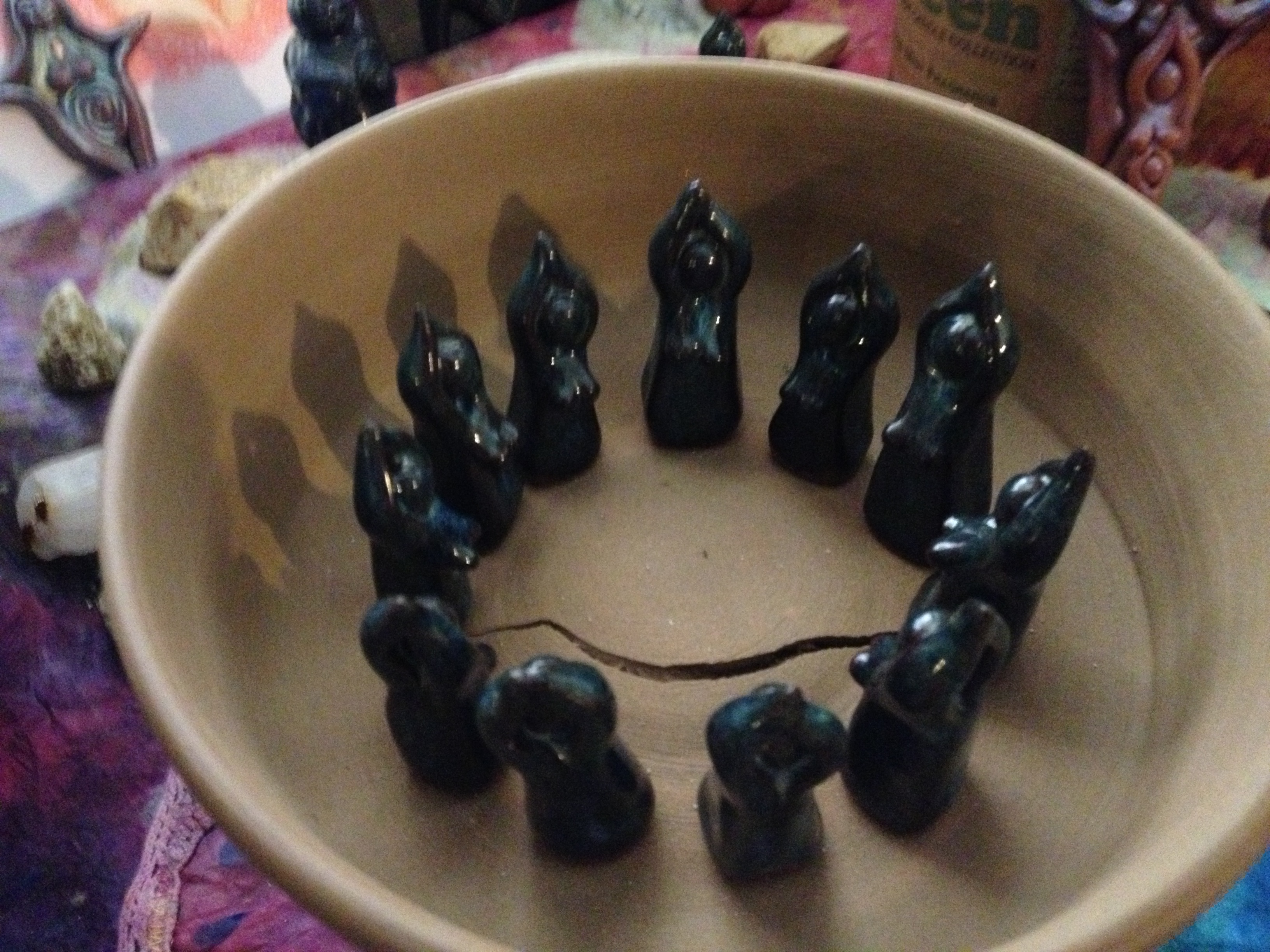
Circle of women sculptures as gifts for my women’s group. Yes, there’s a crack—“the world cracks everyone”—but that is how the light gets in…

to belly dance and chant

while I deliver

to hold me and breathe with me

as I push

to touch me and comfort me

as I cry?

Where are the womyn who know

what it’s like

to give birth?

via Where are the women who know? | Talk Birth.

Thinking about that reminded me of the chant we sang around the fire at the festival I just returned from on Sunday night:

Dance in a circle of women,

Make a web of my life,

Hold me as I spiral and spin,

Make a web of my life…

via Goddess Chants – Dance in a Circle of Women by Marie Summerwood.

May all pregnant women and tender postpartum mamas dance in a circle of women!

I’d hoped to have time to post a festival recap and some lessons learned, but other responsibilities take precedence at least for today, so I’ll leave you with one of the pictures my sister-in-law took on a misty morning, sunrise stroll around the lake and another that I took in the Temple at the festival:

Sept 2013 090

Sept 2013 036

See also:

Postpartum Survival Tips

Timeless Days: More Postpartum Planning

Mothers Matter–Creating a Postpartum Plan

Planning for Postpartum

Some reminders for postpartum mamas & those who love them

Birthing the Mother-Writer (or: Playing My Music, or: Postpartum Feelings, Part 1)

Postpartum Thoughts/Feelings, Part 2

Postpartum Feelings, Part 3

What to tell a mother-to-be about the realities of mothering…

Wednesday Tidbits: World Breastfeeding Week!

wbw2

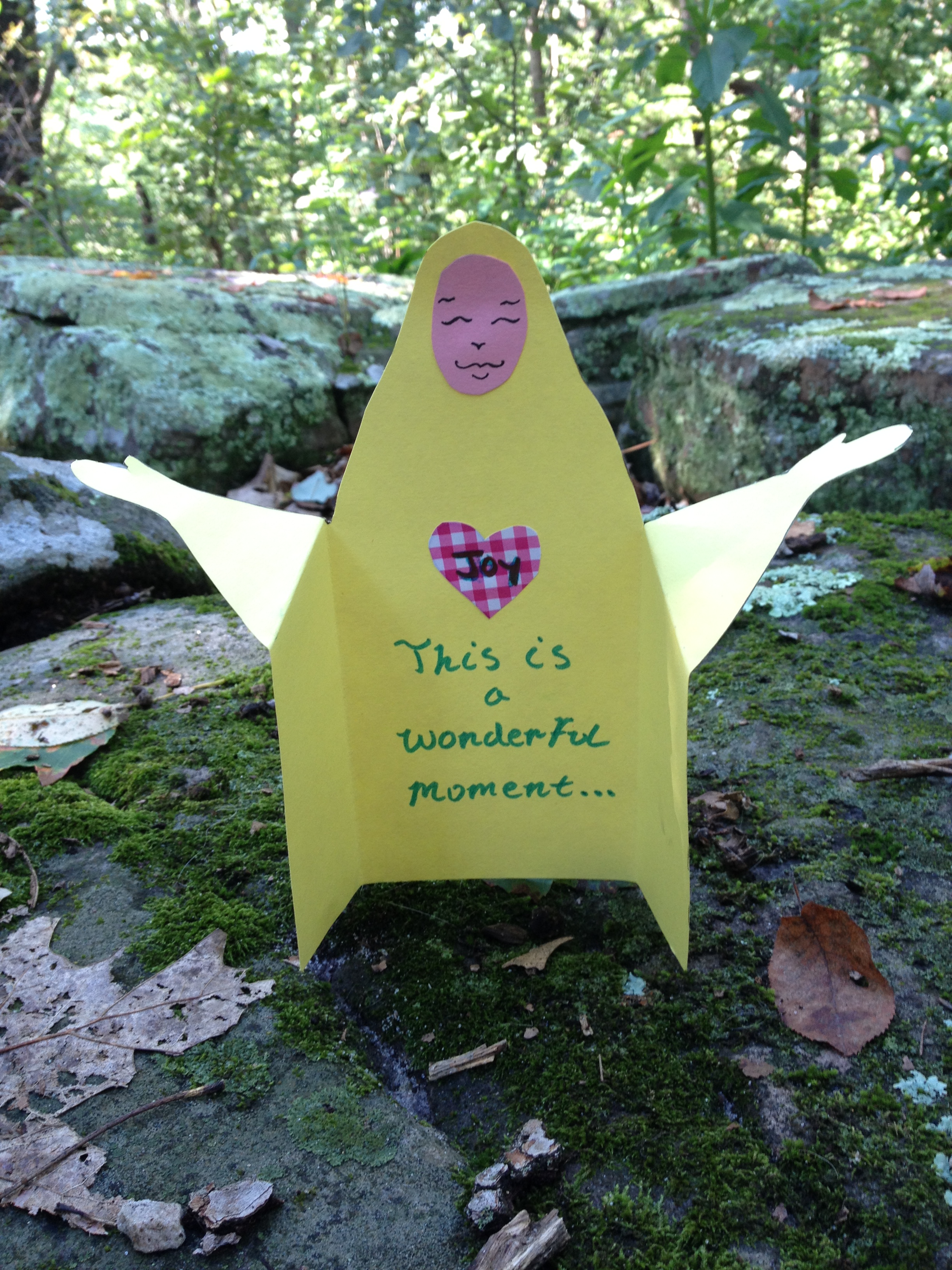
Today is the last day of World Breastfeeding Week and I fully intended to create a link-full Tuesday Tidbits post about this yesterday. However, I was busy helping actual breastfeeding mothers at my monthly LLL meeting and then came home and worked on my handout and project preparations for our second annual MamaFest event this Saturday. I then had a faculty meeting while Mark took Lann to tae kwon do and went grocery shopping with the other kids and by the time I had a few minutes to spare again, it was 11:00 at night and I figured I might as well forgo Tuesday Tidbitting and just watch Teen Wolf instead! 😉 For MamaFest, I’ve been getting together handouts, a trivia game, and pins for prizes for my La Leche League booth, birth art supplies and display items and birth education handouts for the Rolla Birth Network/Talk Birth/birth art booth, and miscarriage/stillbirth handouts for the Rainbow Group loss support table. I’ve toyed with various projects for my birth art booth and finally came up with something that feels perfect—birth or motherhood affirmation/blessing cards!

August 2013 042August 2013 046

August 2013 052

I got better at them the more I made. This one has a pocket with other little affirmation cards in it. I also started to experiment with painting on little glass “stones” to go in the pocket too. I need glass paint markers really though and I quickly ordered some, but they won’t make it in time for MamaFest.

For ideas for affirmations for them, I’m bringing along several books, including:

25 Ways to Joy & Inner Peace for Mothers

25 Ways to Awaken Your Birth Power

World Breastfeeding Week often seems like an occasion during which the media perceives non-breastfeeding mothers as being “discriminated” against somehow, and some women seem to take the occasion personally—like its very existence is a personal criticism. This article about the “I Support You” initiative is good in theory, but I sense in it the suggestion that WBW is specifically trying to make non-breastfeeding mothers “feel bad” and I did not appreciate the loads and loads of comments on the article that reference “La Leche Nazis”—particularly because said “Nazis” apparently visit mothers in the hospital to critique their mothering and I seriously doubt that any of the experiences shared in the comments were actually with LLL Leaders (who I have never been known to go to a hospital room uninvited and try to make mothers breastfeed. That isn’t part of our job at all. The commenters were probably dealing with whichever nurse is assigned to lactation, trained or otherwise).

I plan for my message to say: “To all those mothers who’ve learned the difference between the mother you think you will be and the one you actually are — I Support You.”

via I Support You: The Conversation We Should Be Having About Breastfeeding And Formula.

A related article that also has some great insights and thoughtful content (but for which, again, I feel breastfeeding advocacy is misconstrued):

Three billion things can go wrong when you breastfeed. But even with a bad latch, tongue tie, thrush, a clogged duct, and a crazy oversupply, I still think that nursing this little boy is the most amazing magic that I’ve ever felt in my life. I am the only thing that is keeping my child alive right now. You’re damn right that’s a superpower. When my breasts are engorged and I’m in pain, or when I swoop in to a room and soothe my screaming baby with my body, I want to shout it from the rafters, just like all of you did. This time, my breasts make milk. That is my superpower. And yet I have seen that breastfeeding moms get tested too: the nasty stares, the mean comments, the endless questioning that makes you doubt yourself: “Are you sure he’s getting enough? He’d sleep longer if he took a bottle. He’ll never be independent if he’s attached to you all the time.” The Mommy Wars have fueled the embers of fear and failure on both ends of the feeding spectrum. The simple act of feeding your child now comes with having to defend your choices.

via Milk Drunk | Kim Simon.

The underlying message of these articles, however, as well as that of World Breastfeeding Week itself, is really about the value of community support for mothers. The whole “village” and “tribe” concept. When I hear mothers describing attempts to breastfeed, I hear mothers with broken hearts as well as many stories involving broken circles of support:

I am a systems thinker and always hold in mind that breastfeeding, like all aspects of women’s lives, occurs in a context, a context that involves a variety of “circles of support” or lack thereof. Women don’t “fail” at breastfeeding because of personal flaws, society fails breastfeeding women and their babies every day through things like minimal maternity leave, no pumping rooms in workplaces, formula advertising and “gifts” in hospitals, formula company sponsorship of research and materials for doctors, the sexualization of breasts and objectification of women’s bodies, and so on and so forth. According to Milk, Money, and Madness (1995), “…infant formula sales comprise up to 50% of the total profits of Abbott Labs, an enormous pharmaceutical concern.” (p. 164) And the US government is the largest buyer of formula, paying for approximately 50% of all formula sold in the nation…

via Breastfeeding as an Ecofeminist Issue | Talk Birth.

Giving Birth with Confidence also wrote about the role of the breastfeeding village:

You’ve probably heard “it takes a village” when it comes to parenting and raising children. And it’s true — surrounding yourself with supportive family, friends, and professional and online resources goes a long way in making your parenting experience a better one. But what about a “village” for breastfeeding? Breastfeeding can be (and often is) a wonderful experience. It also can be trying, challenging, and hard work. Creating access to a network of people and resources who support breastfeeding will help you in times of need, provide a sounding board for your thoughts, and celebrate with your triumphs.

via World Breastfeeding Week: Creating Your Village — Giving Birth with Confidence.

And, so did Brain, Child magazine:

For breastfeeding advocates, then, your best shot at influencing other mothers to breastfeed is when you’re nursing yourself—and talking it up to your pals, especially if you’re central in your network, which gives you what social scientists call high “transitivity.” And, it stands to reason, that even if you’re not a breastfeeding advocate—even if you don’t even know what colostrum is—you can still be affected by the changing norms. Once your friends breastfeed in front of you, chances are excellent that witnessing a two-year-old lift up her mother’s shirt to nurse at a park just isn’t worthy of a second thought, much less a flinch. Like in the obesity study where friends of friends were shown to convey habits, you’ve become “tolerant.”

via The Village | Brain, Child Magazine.

Reading these articles made me think of the classic article by Teresa Pitman, originally in Mothering magazine (I think). I think this article is responsible for the introduction of the word “tribe” into the natural mothering lexicon as it is currently used (but, maybe it was The Continuum Concept, which is what Pitman references in her article. I know for me, it was Pitman’s article that first introduced me to the notion of a “tribe” and the fact that I needed one!). I was excited to hear her speak on the subject in person at the La Leche League International conference in Chicago in 2007.

I realized that we had formed our own, very small tribe. Spending our days together satisfied our need for adult companionship without separation from our babies, and working together made all the chores — even cleaning disgusting stuff out of the bottom of the fridge — more fun.

Eventually our husbands both found work in other communities, and our daily time together came to an end. But I had seen how important this kind of relationship is for me, and I deliberately tried to recreate it with other friends.

Not long after Vicki and her family moved, I was at a church picnic when I saw Lorna for the first time. She and her family had just arrived in our community. Something about the way she held her baby was familiar to me, and I went up and introduced myself.

She, too, was looking for a tribe, as she had recently moved away from her family. Soon my new friend Lorna and I got together every Thursday to bake bread (and sometimes other foods) for our families for the week. She had a bigger house and roomier kitchen, so we generally went there. We split the cost of the ingredients, and as our children played together (by then, I had three children and Lorna had six), we kneaded and shaped the dough. While the bread was rising, we talked and tended to other tasks. I often brought a basket of things that needed mending, so we could work together while we were waiting.

We were there when she miscarried her seventh baby, and she tended to my older children while I was giving birth to my fourth. I still think of Thursday as baking day, even though Lorna now lives hundreds of miles away.

My children are almost grown, but I still work with parents. The theme of loneliness is as strong and prevalent as it was when I sat crying on my bed with my new baby, wondering how I’d cope with no one to talk to. Certainly the desire to overcome isolation is one of the reasons why women return to work; it’s a need easily understood by those of us who opt to stay home with our children.

We truly are social animals; we need to be with other people to feel good, whole, and happy. It’s worth the effort to create tribes, however small and imperfect they may be.

via Finding Your Tribe – by Teresa Pitman.

I was also reminded of my own past thoughts about surviving postpartum:

“In western society, the baby gets attention while the mother is given lectures. Pregnancy is considered an illness; once the ‘illness’ is over, interest in her wanes. Mothers in ‘civilized’ countries often have no or very little help with a new baby. Women tend to be home alone to fend for themselves and the children. They are typically isolated socially & expected to complete their usual chores…while being the sole person to care for the infant…” –Milk, Money, & Madness

via Postpartum Survival Tips | Talk Birth.

And, I thought about the role that a tribe—or lack of one—plays in “lactation failure,” that may be falsely attributed to biology OR to evil “La Leche Nazis” assaulting unsuspecting women in hospital rooms with steaming piles of dogma doo.

I’ve remained firmly convinced for, like, ever, that it is culture that fails mothers and babies and not women’s bodies that fail. And, I truly wonder if it is ever possible (except for in cases of insufficient glandular tissue, metabolic disorders, breast surgery/removal, and clear physical malformations) to really tease apart whether a mother is actually experiencing lactation failure or sociocultural failure. I remain fairly convinced that in many cases it is impossible to know—but, that a mother (or physician) may certainly experience it as “lactation failure” and thus add that data point to the 1%. I have long maintained that a lot of people forget that breastfeeding occurs in a context and that context doesn’t necessarily support breastfeeding. However, I do also know from years of experience that motherbaby physiology can lead to problems too and we often overlook that in assertions about breastfeeding.

via Preventing Culturally Induced Lactation Failure | Talk Birth.

The idea of the “I Support You” campaign, with its “unbiased” subtext, also caused me to take another look at some past thoughts about “bias” and breastfeeding:

While I very much appreciate this observation and reminder, we also absolutely need to remember that biased means to exhibit “unfair prejudice”–it simply IS NOT “biased” to support breastfeeding as the biological norm and most appropriate food for babies. I was very concerned to read the comments on the post from other educators talking about their own “biases” toward physiologic birth or breastfeeding and how carefully they guard against exhibiting any such bias in their classes. Hold on! Remember that the burden of proof rests on those who promote an intervention—birth educators and breastfeeding educators should not be in a position of having to “prove” or “justify” the biological norm of unmedicated births or breastfed babies. I hate to see birth instructors being cautioned to avoid being “biased” in teaching about breastfeeding or birth, because in avoiding the appearance of bias they’d be lying to mothers. You can’t “balance” two things that are NOT equal and it is irresponsible to try out of a misplaced intention not to appeared biased. So, while I appreciate some of this educator’s points, I do think she’s off the mark in her fear/guilt and her acceptance of the word “bias.” The very fact that making a statement that someone has a bias toward breastfeeding can be accepted as a reasonable critique is indicative of how very deeply the problem goes and how systemic of an issue it is. If I say that drinking plenty of water is a good idea and is healthier for your body than drinking other liquids, no one ever accuses me of having a “bias towards water.” Breastfeeding should be no different. But, as we all know, breastfeeding occurs in a social, cultural, political, and economic context, one that all too often does not value, support, or understand the process…

via A Bias Toward Breastfeeding? | Talk Birth.

And, along these same lines, I saw a great quote from one of my midwife Facebook friends:

“Being an advocate for breastfeeding as the biological norm, healthiest and safest mode of feeding for most mothers and children is just that. It is meant to inform, enthuse, support, save lives, normalize the act. It is not meant as a slight or condemnation of non-breastfeeding mothers. Individually women breastfeed or not for a whole host of reasons. That is reality. That fact is respected and in no way is judgmental. Acknowledging the individual diversity does not change what breastfeeding is and why we need to continue to advocate for it around the world.” Desirre Andrews, CPM, RM

Exactly!

Speaking of my smart Facebook friends, I enjoyed reading a personal post from an IBCLC friend about why she didn’t celebrate WBW this month:

I think I’ve closed the “breastfeeding mother” chapter of my life, content instead to serve other breastfeeding mothers the best I know how. This is a big shift for me, since I’ve never approached breastfeeding support other than from the perspective of a mother who is also “walking the walk.” Am I “over” breastfeeding? The truth is, today, I’m ambivalent about it. My celebration of World Breastfeeding Week will always be welcome—I will never not be a supporter or an advocate, but a decade is a long time to do something, to do anything. A decade is a long time to be a breastfeeding mother; to not be one anymore, without ceremony or the closure that a more formal ending might offer, leaves me a bit unsettled.

via Why I didn’t celebrate World Breastfeeding Week this year | normal, like breathing.

IMG_7716

This small but mighty little girl still really, really, really likes to “nonny.”

Reading this made me reflect on my own breastfeeding journey and the toddler point at which I am with my own (likely) final nursling. I’ve wondered a lot if and when this chapter of my life will close in terms of working with other breastfeeding mothers. It is still very much my current reality, so it is hard to assess. What I do know is that when I go to LLL conferences and I see women who have been Leaders for 30 years, I think…that is my future. And, I leave with the distinct impression that I’m a lifer. However, a couple of years ago I might have said the same about birth work and now when I see pictures from my pregnancies, read some of my own writing, or look at some of the childbirth education supplies I’ve amassed over the years it all feels very far away now.

But, returning to the idea of support and tribes and breastfeeding women and I Support You to mothers of all kinds in their mothering journeys (which I DO absolutely believe in!), I also thought again of this:

This month as I sat in the circle at our mother-to-mother breastfeeding support group meeting, I looked around at all the beautiful mothers in that room. I reflected on each of their journeys and how much each one has been through in her life, to come to this time and this place, and tears filled my eyes. They are all so amazing. And, my simple, fervent prayer for them in that moment was that they could know that. Know that on a deep, incontrovertible level. I tried to tell them then, in that moment. How much they mean to me, how incredible they are, how I see them. How I hope they will celebrate their own capacities and marvel at their own skills. How I see their countless, beautiful, unrecognized, invisible motherful actions. How when I see them struggling in the door with toddlers and diaper bags and organic produce that they’re sharing with each other, I see heroines. They may look and feel “mundane” from the outside, but from where I’m sitting, they shine with a power and potency that takes my breath away. Moderating toddler disputes over swordplay, wiping noses, changing diapers, soothing tears, murmuring words, moving baby from breast to shoulder to floor and back to breast without even seeming consciously aware of how gorgeously they are both parenting and personing in that very moment, speaking their truths, offering what they have to give, reaching out to one another, and nursing, nursing, nursing. Giving their bodies over to their babies again and again in a tender, invisible majesty. In this room is a symphony of sustenance. An embodied maternal dance of being.

via International Women’s Day: Prayer for Mothers | Talk Birth.

August 2013 045

Stopped for some sandy nonnies.

Last year’s World Breastfeeding Week Post Round Up | Talk Birth.

Tuesday Tidbits: Birth Imprinting

What are imprinting upon newborns at birth in our culture?

As Sister MorningStar writes in her article The Newborn Imprint in Midwifery Today issue 104, Winter 2012…

If you have had the misfortune, as nearly all of us who can read and write have had, to see a baby born, perhaps pulled out, under bright lights with glaring eyes and loud noises of all sorts, in a setting that smells like nothing human, with a mother shocked and teary and scared; if you have witnessed or performed touch that can only be described as brutal and cruel in any other setting…

Every baby born deserves uninterrupted, undisturbed contact with her mother in the environment the mother has nested by her own instinctual nature to create. Any movement we make to enter that inner and external womb must be acknowledged as disturbing and violating to what nature is protecting. We do not know the long-term effects of such disturbance. We cannot consider too seriously a decision to disturb a newborn by touch, sound, light, smell and taste that is different and beyond what the mother is naturally and instinctually providing. Even facilitating is often unnecessary if the motherbaby are given space and time to explore and relate to one another and the life-altering experience they just survived. They both have been turned inside out, one from the other, and the moment to face that seemingly impossible feat cannot be rushed without compromise. We have no right to compromise either a mother or a baby.

I am deliberately leaving out the issue of life-saving because it has become the license for full-scale abuse to every baby born… [emphasis mine]

In the same issue in an article called Problems in American Maternal Health Care, Dan Currin points out:

Americans put a lot of trust in their physicians. We are socialized to believe that physicians are the only ones capable of taking care of us. For everything from how to eat to how to die, the mantra is the same in the US: ‘Ask your doctor.’ Meanwhile, physicians are more and more subject to a system that, as Gaskin describes, favors the priorities of hospitals, insurances companies and doctors above the best interests of mothers and their babies

And, Judy Slome Cohain writing in Collusion and Negligence in Hospitals describes it thusly:

To err is considered human, even when it involves maternal death, at a hospital birth. When a woman dies from malpractice after birth the protocol is to hold meetings to consider how to improve relevant protocols to prevent future disasters. Survival of the hospital is first and foremost. However, if a woman dies at an attended homebirth, the Ministry of Health policy is to start a case against the guilty part in a disciplinary court…”

I wrote about birth imprinting in another short post, The Magic of Mothering and about the notion of consulting your health care provider in some thoughts about Women’s Power and Self-Authority.

We also need to consider the role of birth “imprinting” on the breastfeeding relationship:

New mothers, and those who help them, are often left wondering, “Where did breastfeeding go wrong?” All too often the answer is, “during labor and birth.” Interventions during the birthing process are an often overlooked answer to the mystery of how breastfeeding becomes derailed. An example is a mother who has an epidural, which leads to excess fluid retention in her breasts (a common side effect of the IV “bolus” of fluid administered in preparation for an epidural). After birth, the baby can’t latch well to the flattened nipple of the overfull breast, leading to frustration for both mother and baby. This frustration can quickly cascade into formula supplementation and before she knows it, the mother is left saying, “something was wrong with my nipples and the baby just couldn’t breastfeed. I tried really hard, but it just didn’t work out.” Nothing is truly wrong with her nipples or with her baby, breastfeeding got off track before her baby was even born!

via The Birth-Breastfeeding Continuum | Talk Birth.

417

If she came with it label, it would say: Imprint with Care…

*Short post today because I’m out-of-town again! What the heck?! I need a vacation from vacations!

New Baby Ritual (Plus Maruti Beads Review!)

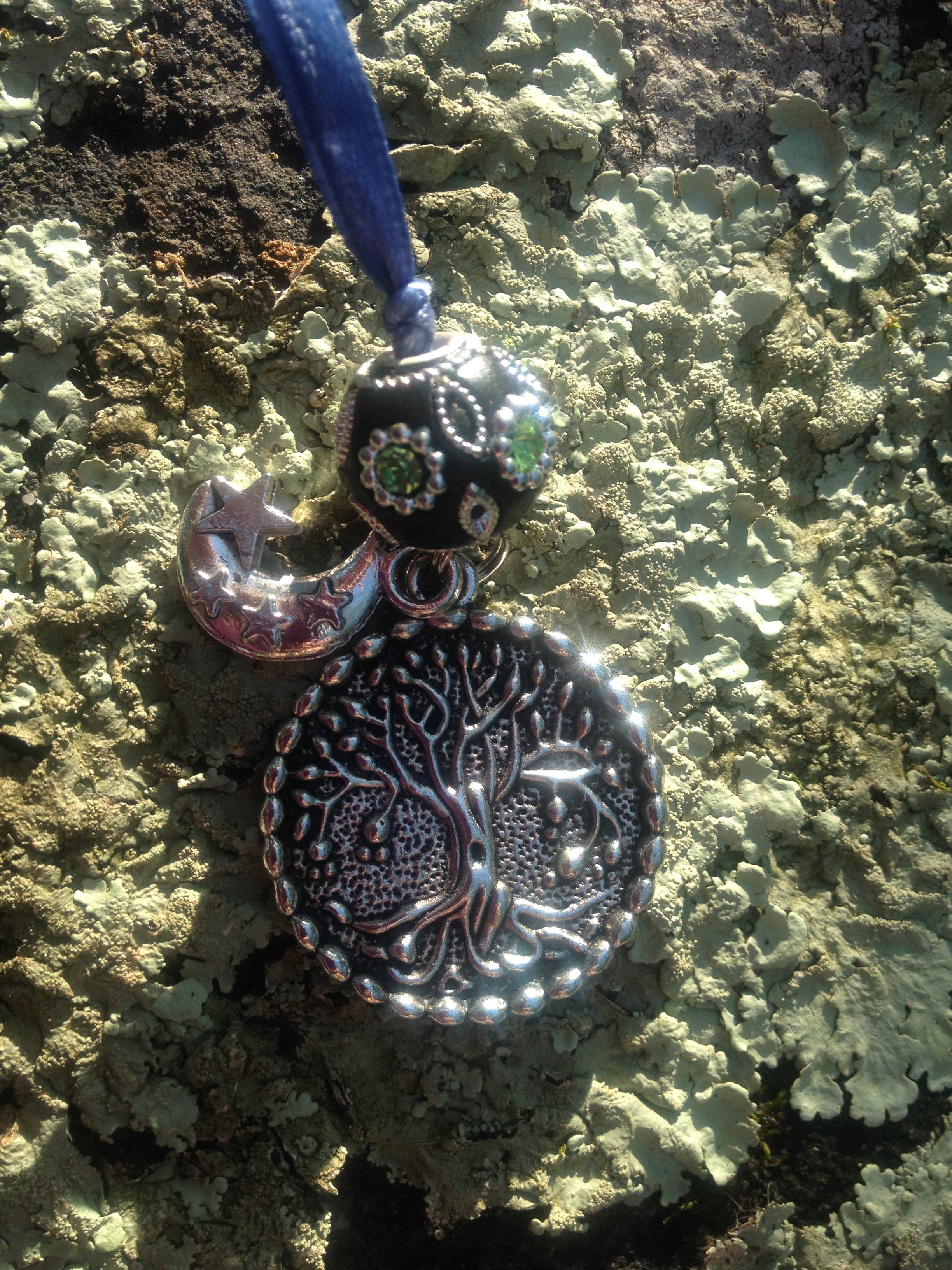
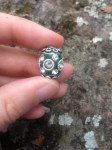
July 2013 014One of my good friends recently had her family’s eighth baby. I’ve had mother blessing ceremonies for her with past babies and I meant to do so for this baby as well, but our unexpected trip to California occurred right at the time we should have been having the blessingway. Last week, I had the chance to visit her and to meet her new baby. I decided to put together a mini-welcome-new-baby-ritual and have it with just us by the river. I called it a “blessingway in a bag” and I included some tea, candles, and bindis in the bag, so that her family could have the complete ceremony themselves on their own if they wanted to do so. Several months ago, I also received a beautiful box of Maruti Beads to review. They’ve been sitting by the computer waiting for a special occasion and this was finally it! I made a pretty necklace for my friend to honor her family’s “tree of life” and I included one of the gorgeous Maruti beads (more pictures to follow).

July 2013 043 At the river, we didn’t actually do the full ceremony that I’ve included below—I’d written it up as a complete ritual that could be done with a group, as needed/wanted—instead, I just read my friend the poems and gave her my gifts 🙂

Ceremony of Welcome for a New Baby

*Opening reading:

Wonder of Wonders

Wonder of wonders,
life is beginning
fragile as blossom,
strong as the earth.
Shaped in a person,
love has new meaning,
parents and people
sing at their birth.
Now with rejoicing,
make celebration;
joy full of promise,
laughter through tears,
naming and blessing
bring dedication,
humble in purpose
over the years.
–Singing the Living Tradition (UU Hymnal)

*Baby name is announced!

 A Prayer for One Who Comes to Choose This Life

May she know the welcome
of open arms and hearts

May she know she is loved
by many and by one

May she know the circle of friendship that gives July 2013 013
and receives love in all its forms

May she know and be known
in the heart of another

May she know the heart
that is this earth
reach for the stars and
call it home

And in the end
may she find everything
in her heart
and her heart
in everything.

(by Danelia Wild in Sisters Singing)

*Gifts, Beads, Blessings…
A good idea is for each guest to bring a special bead and add it to a necklace/mobile for the baby–as each person places their bead, they offer a wish or blessing for the baby.

*Sing Call Down a Blessing
(each person fills in a word of choice for the blank space and whole group sings each in turn. i.e. “Joy….joy before you, joy behind you…”)

Call down a blessing

Call down a blessing

Call down a blessing

Call down.

__________before you

__________behind you

__________within you

__________and around you

*Hold up/out baby or mother and baby stand in center of circle.

*Group Reading (optional: simultaneous “anointing” with elements):

Deep peace of the running wave to you.
Deep peace of the flowing air to you.
Deep peace of the quiet earth to you.
Deep peace of the shining stars to you.
Deep peace of the infinite peace to you.

*And/OR

Stars give her strength
Sun turn her eyes
Moon guide her feet
Earth turning hold her
We pray for her
We sing for her
We drum for her
We pray.

–Chrystos (in Open Mind)

Back to the beads!

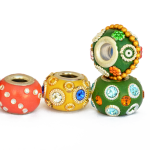
I received the 50 piece Maruti, Kashmiri & Lac Bead Mix. These beads are really something special! They are handmade in India and are of very high quality. Each one is like a small work of art. They are sparkly and beautiful and solid and wonderful. It is hard to decide how to use them, because they feel really special! Since my friend and her new baby are special too, they deserved one of these beautiful beads 🙂 Maruti Beads would make a wonderful, special addition to any blessingway or mother blessing ceremony.

Tuesday Tidbits: Breastfeeding

It is almost too late to call today Tuesday, but I’m squeaking this post in anyway! Breastfeeding articles have been catching my eye this week, MollyNov 109specifically this one about the life-saving benefits of human milk for the critically injured:

But one exciting question is still unanswered: can breast milk be used medicinally as treatment in babies –and even older children and adults– who may not have been breastfed? There is a growing body of evidence suggesting all sorts of uses for breastmilk as treatment of adult disease.   Ads may say, “Milk: Does a Body Good” but in all likelihood, human milk can do a body, any body, better.  

Baby Charlotte Rose wasn’t breastfed. Until the age of 11 months, she was a happy, healthy little girl.  All that changed radically when she suffered a traumatic brain injury…

via Miracle Milk® Helps Heal Brain Injured, Formula-Fed Baby | Best for Babes.

And, since the politics of breastfeeding are endlessly fascinating to me, I was curious to read this article by the mother who caused an unanticipated media stir last year with her breastfeeding-in-uniform pictures:

Whoever said a picture can speak a thousand words was right, even when I could speak none. A group of breastfeeding women, including myself, all took part in a photo shoot with the intentions of  letting others know breastfeeding is possible regardless of your situation. My main contribution, or so I thought, was that I happened to have twins. Boy was I wrong. Another woman and I, who both served in the Air National Guard, also took pictures in our uniform to show that even those serving could also breastfeed. We were both prior active duty so we knew the struggles of both being full-time and part-time military. Contrary to popular belief, we did get permission to take the pictures. After the pictures were taken, we were going to consult the law office on base and get permission for the photos and positive quotes to go along with them with the goal of having them put into women’s exam rooms…

via Terran McCabe: The Air Force Breastfeeding Mom Finally Speaks Out – I Am Not the Babysitter.

While some recent breastfeeding research with a very limited sample is making headlines under the misleading title that “supplementing newborns with small quantities of formula may improve long-term breastfeeding rates,” The Academy of Breastfeeding Medicine published a helpful post breaking down the research and drawing more accurate conclusions:

A small study published in Pediatrics suggests that supplementing newborns with small quantities of formula may improve long-term breastfeeding rates. The results challenge both dogma and data linking supplementation with early weaning, call into question the Joint Commission’s exclusive breastfeeding quality metric, and will no doubt inspire intimations of a formula-industry conspiracy. Before we use this study to transform clinical practice, I think it’s worth taking a careful look at what the authors actually found.

First, I think it’s very important to be clear about what the authors meant by “early limited formula.” The authors used 2 teaspoons of hypo-allergenic formula, given via a syringe, as a bridge for mothers whose infants had lost > 5% of their birthweight and mom’s milk had not yet come in. At UNC, we use donor milk in a similar way, offering supplemental breast milk via a syringe as a bridge until mom’s milk production increases.

This is very different from the way that formula supplementation is handled in many US hospitals. We know that in the US overall, 1/4 of breastfed infants are given formula by day 2 of life, and that number reaches as high as 40% in some areas. Typically, when a family member expresses interest in giving the baby some formula, a hospital staff member plunks a 6-pack of 2-oz bottles of ready-to-feed formula in the baby’s bassinet with no instruction about how much to feed. A neonate whose stomach holds one to two teaspoons gets 2 ounces (12 teaspoons) of milk poured into him. The baby then sleeps for the next four to six hours, like someone who’s just over-indulged at a Thanksgiving buffet. In this scenario. Mom doesn’t get any breast stimulation, and family members all express relief that “finally the baby is happy.” When baby finally wants to eat again, there are five more convenient, ready-to-feed, six-hour-nap-inducing bottles sitting in the bassinet. This does not tend to help mothers breastfeed successfully. I worry that the headlines from this study — such as “How Formula Could Increase Breastfeeding Rates (TIME)”  and  ”How Formula Can Complement Breastfeeding (NYT)” —  will translate into “a six pack of formula back in every bassinet!”

via Early, limited data for early, limited formula use | Breastfeeding Medicine.

Note that the benefit of this very specific type of early supplementation can also be achieved via donor milk. The research does not actually “prove” that formula is helpful for breastfeeding, but that for certain mother-baby dyads, supplementation of some kind via syringe is helpful. This is NOT the same thing at all as supplementing with a two ounce bottle of formula!

I was glad to see Dr. Newman chiming in on the comments with his no-nonsense opinion: “I also love it how they say their results may not be applicable elsewhere because they live in a community where women are eager to breastfeed and 98% initiate breastfeeding. So surely they must find ways to give these babies formula…”

Speaking of Dr. Newman, the conference registration form and website are finally available for the upcoming LLL of Missouri conference in June. I learn so much at LLL conferences and I’m very much looking forward to this one as well. Dr. Newman is the special speaker. I heard him speak at the CAPPA conference last year and he is not to be missed! I’m also speaking twice at this conference, but Dr. Newman is much more exciting than me! 😉

Happy Mother’s Day!

“Blessed be all the mothers of mothers.
Blessed be all the daughters of daughters.
Blessed be all the daughters of mothers.
Blessed be all the mothers of daughters.
Now and forever, wherever we are.” –Diann L. Neu

In Uganda there is a special word that means “mother of a newborn”–nakawere. According to the book Mothering the New Mother, “this word and the special treatment that goes with it apply to a woman following every birth, not only the first one. The massages, the foods, the care, ‘they have to take care of you in a special way for about a month.'”

There is a special word in Korea as well. Referring to the “mother of a newborn child,” san mo describes “a woman every time she has had a baby. Extended family and neighbors who act as family care for older children and for the new mother. ‘This lasts about twenty-one days…they take special care of you.'”

These concepts–and the lack of a similar one in American culture–remind me of a quote from Sheila Kitzinger that I use when talking about postpartum: “In any society, the way a woman gives birth and the kind of care given to her and the baby points as sharply as an arrowhead to the key values of the culture.” Another quote I use is an Asian proverb paraphrased in the book Fathers at Birth: “The way a woman cares for herself postpartum determines how long she will live.

Dana Raphael, the author of Breastfeeding: The Tender Gift, who is best known for coining the word “doula” as it is presently used, also coined another valuable term: matrescense. “Nothing changes life as dramatically as having a child. And there was no word to describe that. So we invented the word–matrescence–becoming a mother.”

Happy Mother’s Day to mothers around the world!

Mother's Day

Want to find out what mothers really want? Check out the newest Listening to Mothers survey results: Listening to Mothers III: Report of the Third National U.S. Survey of Women’s Childbearing Experiences

Other Mother’s Day reads:

Womenergy (Womanergy)

Prayer for Mothers

What If…She’s Stronger than She Knows…

This is a modified repost of a previous post for Citizens for Midwifery. It is being crossposted today at CfM, Talk Birth, and Pagan Families.

Birth Stories by Two Year Olds…

With each of my kids when they are somewhere between two and three years old, I feel inspired to ask them if they remember when they were born. They always say, “yes,” and I say, “tell me about it” and they do. Lann’s story was a succinct and accurate version of what happened. He said:

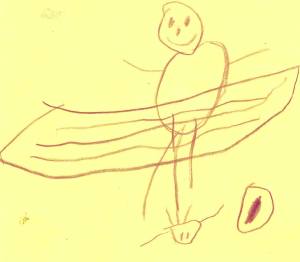
Toddlers can do birth art too! Love the placenta in a bowl and the baby attached to the mama with cord (yes, I know the two are mutually exclusive, but I love it anyway!)

Toddlers can do birth art too! Lann drew this after Zander was born. Love the placenta in a bowl and the baby attached to the mama with cord (yes, I know the two are mutually exclusive, but I love it anyway!)

Swimming
Swimming down out of mama.
Crying!
Nursies.
Happy now.

As I’ve written before, he did start crying loudly with only his head sticking out. Almost immediately after he was born, I put him to my breast offering him what I spontaneously called “nursies” and he was, in fact, then happy.

I asked Zander on his third birthday and his version of his birth was as follows:

First you saw a little head poking out.
Then a little arm.
Then another little arm.
And another and another.
And me was little alien.

He was, in fact, born slowly like this with head emerging and then arms and then upper body and then the rest of him. I asked him what happened to his extra arms and he said:

They actually melted.

He was nursing at the time and paused, popped off and said:

and, my extra eye melted too…

That’s my little Zander for you!

I love how the baby looks like it is "floating" in this one.

I love how the baby looks like it is “floating” in this one.

Yesterday morning, I spontaneously asked Alaina if she remembered being born and like the others she said yes. I asked her what happened and she said:

My baby! My baby!

I asked, “did you hear mama saying that?”

She said yes and then said,

Now, nonnies.  Then she just gazed off into the distance like she was remembering.

I asked her if she remembered anything else and she repeated the above. Shortest of the children’s birth stories, but also distilled to its essence 😉

I’m curious to know if other people ask their children this question and what kind of responses to you get? I love each of my children’s birth stories as told by them!

Both boys made me a birth art sculpture for my birthday this year and each is about a baby being born:

May 2013 021

Zander’s sculpture: The Goddess of Birth

May 2013 022

Lann’s sculpture.


Motherhood and Embodiment

“Loving, knowing, and respecting our bodies is a powerful and invincible act of rebellion in this society.” –Inga Muscio

As I’ve written before, pregnancy, birth, and breastfeeding are incredibly embodied experiences—motherhood in general feels very much a molly37weeks 016physical commitment. Our relationship with our children begins in the body, it is through the maternal body that a baby learns to interpret and engage with the world, and to the maternal body a breastfeeding toddler returns for connection, sustenance, and renewal.

Why might birth be considered an ecofeminist issue though? Because mother’s body is our first habitat. We all entered the world through the body of a woman and that initial habitat has profound and long-lasting effects on us, whether we recognize them or not. Midwife Arisika Razak explains, “the maternal womb is their first environment. The cultural paradigm of birthing is the first institution that receives our children…Each of these elements—womb, birth culture, and family—has a profound effect upon the new human bring. Each deserves our best thinking and analysis. What would it be like if we envisioned a society in which positive, lifelong nurturing support—from old to young, and young to old—were the dominant theme of human interaction?” (p. 167).

What would it be like if we treated birthing women and their babies like they mattered?

Our first and deepest impulse is connection. Before Descartes could articulate his thoughts on philosophy, he reached out his hand for his mother. I have learned a lot about the fundamental truth of relatedness through my own experiences as a mother. Relationship is our first and deepest urge and is vital to survival. The infant’s first instinct is to connect with others. Before an infant can verbalize or mobilize, she reaches out to her mother. Mothering is a profoundly physical experience. The mother’s body is the baby’s “habitat” in pregnancy and for many months following birth. Through the mother’s body, the baby learns to interpret and to relate to the rest of the world and it is to the mother’s body that she returns for safety, nurturance, and peace. Birth and breastfeeding exist on a continuum, with mother’s chest becoming baby’s new “home” after having lived in her body for nine months. These thoroughly embodied experiences of the act of giving life and in creating someone else’s life and relationship to the world are profoundly meaningful experiences and the transition from internal connection to external connection, must be vigorously protected and deeply respected.

via Talk to Your Baby | Talk Birth and Breastfeeding as a Spiritual Practice

I have a particular interest in embodiment and my dissertation topic is related to a thealogy of embodiment (basically the Goddess and the body) and so my attention was caught by some great sections about birth, bodies, and family in the book The Art of Family:

AS WE MOVE THROUGH BODILY stages together, there are some special stages that are worth thinking of in advance. Pregnancy is one, of course, and babies. Nothing is more inescapably BODY than birth. For the mother, both through her pregnancy and the labor and delivery of the baby. In birth, the body gets to drive the soul for a change and one’s soul is on for the wild ride, whatever happens. What does she deliver, after all, but a body, this little lamblike creature packaged in a now wholly-other body? What does she deliver but a body—and what do she and Daddy count but a body’s toes, a body’s fingers? In these small ways we acknowledge our wholeness, our physical sacredness.

Gina Bria (2011-11-28). The Art of Family : Rituals, Imagination, and Everyday Spirituality (Kindle Locations 1693-1700). iUniverse. Kindle Edition.

(Amazon affiliate link included)

And, I appreciate that Bria then moves into a consideration of how men experience pregnancy and birth…

YES, BIRTH IS THE BODY, and for women it is manifestly given. But one should note that the world over, there is a complementary effort by men to try to counterbalance the impressive power of women who have even the potential of birth, whether it is actualized or not. Men, too, have moments of making special use of their bodies. Men make quests, and perform feats of extraordinary effort, to put their bodies on the line in some attempt to match birth.

…For modern men, pregnancy means two things, not one integral, unfolding experience, as for women. First, they must cope with a partner undergoing tremendous physical change. In essence, they are no longer dealing with the same body. It’s a stressful experience, and many men fear they will never see their old partner again, quite literally. They listen to their wives agonize about weight gain and swollen ankles, and secretly grieve the loss, all the while maintaining a show of faith, for their wives, for themselves, that it will come to a happy ending. And on top of that, they must then forge a new relationship with the party responsible for this, someone they can neither see, nor touch, indeed, can hardly believe exists! Women at least get touched by their in-utero babies, even if it’s a swift kick from the inside. “Hey, it’s Daddy,’’ my husband said rather sheepishly into my belly one night. This seemed to me quite amusing, as if the baby needed an introduction to one half of his own genetic material. Then suddenly it struck me that I had never considered introducing myself to the baby, announcer like over an intercom—“This is your mother speaking’’—because I felt the bodily connection so inexorably. I knew I was well known to the baby, but my husband had no such advantage. He had to make connections in other physical ways, in this case using his voice. Making a family where men touch, speak, and care for children is a vital way to connect them to their own progeny; one way that many cultures, including our own, can often deny men. Perhaps you have been stopped in your tracks, as I have, over the recent spate of advertisements of bare-chested men holding tiny babies. Do advertisers, more than Freud, know what women want? Yes! We want to see our handsome men holding babies, snoozing with them, schmoozing with them in chest-to-chest communion. As Jane Austen asks, “What attaches us to life?’’ Anyone who lays on hands gets attached to life.

These thoughts really struck me in a profound way. During each of my own pregnancies, I remember marveling and feeling impressed, as well as a little sad, that my husband had to somehow forge this bond with a newcomer without the same benefit of the embodied, constant experience of pregnancy—pregnancy from the inside is different than pregnancy from the outside. I shared the author’s amusement in picturing how it would have been to “announce” my own presence to my babies. I’ve tried, but cannot fully imagine the process and psychological task involved with the paternal experience, of in a sense, “suddenly” having a baby to hold and care for and “instantly” love, though I’m sure I have the capacity within me somewhere (and, yes, I know that not all mothers feel an instant love either and may have the same sense of suddenness in their own lives—it was certainly true for me that the inner experience of a womb-dwelling baby was pretty different from the external experience of having a physically visible baby to tote around). As a pregnant woman though, the baby is basically inescapably present and part of me in an interconnected, interwoven, symbiosis of being. There is the transition at birth to an “outer” relationship, but that intense embodied interconnection continues immediately with the breastfeeding relationship. It is somewhat impressive or staggering to me almost, that men have to form their own connection born out of different “stuff” that the biology of gestation and lactation that weaves the motherbaby together.

Bria also addresses the loving of a baby’s body that isn’t going to survive:

WE ARE NEVER MORE CRUSHED than when there is trouble at birth. No sadness holds for us the power of an incomplete body, a broken body. We grieve and turn heart stricken at this time like no other. In moments like these we can only comfort ourselves, with love, that love would allow us to care for this child when many would not be able to do so. We hope to find ourselves the kind of people who could, in such circumstances, make a life for a whole person, with an incomplete body. When our son was born with a leaking heart, an old-fashioned “blue baby,’’ and destined to die without surgical repair, we learned quickly that all we could give him, all he could receive as a newborn, was the small, inconsequential daily care of the body, gentle changing, warm nursings, our breath upon his face. Perhaps, we thought, it would be all he would ever get. In that season of attention, we really learned the significance of loving a body. A body, however small, records every trace of touch; it is never unconscious; unlike the mind, a body is never without sensing, even in sleep. A body will always remember.

I liked the description of a body always remembering. We do carry deep, physical memories of our pregnancies, births, and babies. I find the physicality actually comes back most clearly in dreams for me, when I can again feel with a sharp potency the sensation of a baby’s body slipping swiftly from my own body. I also like reading research that indicates that mother’s body carries fetal cells within her forever. I like thinking that physical evidence of the embodied, relational experience of pregnancy remains written into my very cellular structure (well, and on my bones and skin too, I suppose!). I found this a comfort after my little Noah’s birth, thinking that in a very real way, I would truly always remain a “little bit pregnant” with him and that perhaps some of his unique genetic material lives on in my body.

After birth, we continue to relate to our babies on a very physical, body-oriented level. There is nothing like a baby to bring things back to the body, to use your body and their own in a complete, intensive, totalness.

BABIES’ BODIES AND CHILDREN’S BODIES   LIKE PLAY, LOOKING AT THE body of an infant returns us to childhood. Babies’ bodies are a special form of being human, and they elicit in us essential, elemental emotions. They infect us with longing for the integration, the wholeness, they have. As new parents, we experience again all the helpless and exuberant feelings of children, the unfeigned marveling over everything manifested by a baby, a physical miracle. We cannot contain our awe, expressing it to everyone within earshot. New parents on the street can always be identified by their aura of vulnerability; they’ve shed the social cloth that keeps us all appropriately attired to go about our work. Instead, just like the baby, they are naked to everything good. They blink and look around, bemused, tired, and delighted. You will notice they always smile at you at the crosswalk—it is a secret, initiated smile. They assume you either know what they are smiling about or wish that you did. What is it they know? Their babies made them once again aware of the pleasures of physical delight. To care for an infant is a test of our humanness, a trial by fire and love.

What is good about caring for infants is that they never let us forget how essential the body is. They snuffle, bawl, and demand attendance. “Feed me, change me, hold me,’’ for an eternity of right-nows. And when they sleep, it’s as if they have cast themselves on a thin but safe shelf of floating wholeness, complete integration. They show us what we once were, without guile, delightedly in love with our own body. When infants turn into toddlers, the body is still in front, still demanding, but in a bigger world. Now protection from bodily harm becomes a concern of everyday physical life together. We aren’t as impressed by the bodily transmogrification that takes place in front of us, because we’ve learned to live with it happening every day, day to day. It’s impossible for the same miracle to impress us the same way over and over again. Thus begins the very fading away of the lesson we most need from our children—that there is intense pleasure in the active human body. Right under our noses they play. They play and play and we watch and nod as if this itself isn’t a further miracle. What do infants do when they get control of themselves, but move, explore, experience exhilarated delight in their bodies and what they can do. Their essence is to enjoy themselves as bodies, all over…Through physical life with our children, through care of them and play with them, the hands-on of it, we again acquire our innocent selves, a delight in each other and the world around us. We discover all over the potentialities of the senses. This is the heart of being with young children.

Gina Bria (2011-11-28). The Art of Family : Rituals, Imagination, and Everyday Spirituality (Kindle Locations 1729-1760). iUniverse. Kindle Edition.

As they age, this physical, body-based relationality and experiences may wane, and yet still holds important value:

As our children age we must struggle to keep this alive for ourselves, for them, in one form or another, as the world begins its intrusion into our family lives. This may be as simple as pointing out that a flower is beautiful, that rain smells divine, that a hand held feels warm and comfortingly sweet, that nothing satisfies like cool water. Once children hit the walking stage and beyond, we spend more time explaining compared with the time we spent holding. Yet there are still many miniature ways of communicating with one’s body. Its active use—a nod, a wink, a hug—are all fleeting acts of committing one’s body, however momentarily, to another. Looks, touches, squeezes, physical smiles, a physical vocabulary—aren’t they what children long for? Indeed, isn’t that exactly what we thrill to in a romance—those little signals that you belong to each other—and isn’t that what we end up complaining of missing when our marriages seem stale? It isn’t just for romance that these things work, though it is there that we most seem to notice them. All of family life can capitalize on a richer life with each other’s bodies.

And, bringing it back to birth and the care of birthing bodies, I really liked this image via Facebook:

treatment