Archives

Distraction, Concentration, Surrender

In my childbirth classes when I cover “labor and birth 101,” I talk about the traditional stages of labor—early labor, active labor, transition, pushing, and third stage (placenta). I also talk about the “emotional signposts” of labor—excitement, seriousness, and self-doubt, as well as about the fear-tension-pain cycle and the excitement-power-progress cycle. Recently, I finished reading the book Painless Childbirth by Giuditta Tornetta and she elegantly described the three phases of first-stage labor in a three-word format that I found extremely accurate and helpful, as well as fresh and interesting. The first phase is distraction—during early labor, it is most helpful to continue to go about your normal life as if nothing is happening. Do not give your contractions any attention until they strongly request your attention! I tell my clients to just do what they would normally be doing—-if they would be sleeping, sleep. If they would be walking the dog, walk the dog. Watering the plants, eating dinner, etc., etc. Just keep up the normal routine until you need to give the birthing energy more attention. Without distraction as a tool, labor can become very long and exhausting—if you think of yourself as in labor from the second you feel anything, you are much more likely to experience a 24 hour labor than if you do not think of yourself as in labor until you are completely absorbed by its sensations.

The second phase is concentration—contactions have now become what Ina May Gaskin would term “an interesting sensation requiring my complete attention.” This phase corresponds to the Bradley Method’s emotional signpost of “seriousness.” I tell my clients that this is when she stops laughing at your jokes and stops even seeming aware that you’re talking. (She IS still aware however, and we will address this in a later post about undisturbed birth, prompted by another new book I am reading called Optimal Birth.)

The third phase is surrender and this corresponds with the transition portion of active labor and the “self-doubt” signpost. I think the concept of surrender during labor is one of the most profound and transformative elements of giving birth. If you can embrace the notion of “surrendering” to birth rather than staying in “control” of it, I think this can revolutionize your perception of what is happening in your body and your life. While hard to express in words, the experience of surrendering to my own body’s power was a transformative experience in my life (particularly since I am a “controlling” sort of person in “real life”—maybe this is why this term and experience holds such meaning to me). With surrender comes “flow”—there is such value and beauty and strength to be found in letting go and just letting it happen; letting “the might of creation come through you.” This was the most profound truth I discovered in each of my birth experiences.

New Training!

This year, I completed several new trainings that I am very excited about.

Prenatal Yoga Training

This weekend I fulfilled a 7 year old dream and attended a prenatal yoga teacher training in St. Louis. I have wanted to teach prenatal yoga since I was pregnant with my first baby, but a training opportunity just never opened up for me until now. I felt like this was perfect timing. The training was through YogaFit and was pretty basic, but it was just what I needed to feel like I can move forward with this dream. YogaFit is a very “fitness” oriented type of program vs. any kind of holistic-mind/body connection stuff, but I can add those elements in myself. I think I will be able to offer something fairly unique—not just yoga and not just childbirth education but yoga-childbirth-education. There are several other programs like that, of course, but none in the local area! At the training, I also learned some really cool partner yoga stuff that I didn’t know how to do before.

Birth Art Training

In February, I completed something else that I’ve been dreaming about for some time—I took Birthing from Within‘s online course, “How to Lead the Birth Art Process.” Aside from a few minor complaints about the sometimes-frustrating “Zen” underlay and occasional contradictions within the course, I really LOVED this class. I found the online course format to be an ideal format for me—real-person interaction through message board, chat, phone call, and email; written information; writing journals/essay responses; hands-on personal practice with the assignments; and real-life application with other people/clients in birth art sessions. I felt like I got more out of actual use out of this workshop than most of the other classes and workshops I’ve attended—I think this was because the course was spread out over 5 weeks, not just a weekend, which allowed plenty of time to really assimilate and USE the information. It was very affordable too and I was able to attend right from the comfort of my own chair! The class is marketed as suitable for beginners, but personally I found my past background in childbirth education to be very important and I cannot imagine having taken the class with no prior birth class teaching experience—I think the people who had little experience were kind of disadvantaged in this course. Birthing from Within is my all-time favorite birth preparation book/resource and it was so exciting for me to have a little taste of direct training with them. Hopefully at some point in the not-too-distant future, I will take further training with BfW.

Childbirth Educator Certification

In March of this year, I was pleased to earn my childbirth educator certification with CAPPA. Since I am already certified with other organizations, I enrolled in the dual certification program option. I am very excited to be “throwing my hat in” with CAPPA. The organization is very friendly and stable and I really connect with the CAPPA Vision. The program information itself was pretty basic and I didn’t really learn anything new from it, but that makes sense because it isn’t specifically designed for people who already have CBE teaching experience—I think it is a great program for someone starting out in this field.

Comparing CBE Programs:

I get a lot of inquiries from people seeking information about different childbirth education programs and thought I would provide a super-quick mention of the things I enjoyed most about each of my certification programs/organizations. Keep in mind that I certified with ALACE first, hence, I had the most direct experience with their full training program, vs. the other organization’s “accelerated” options (which I SO deeply value and I am SO grateful that ICEA and CAPPA make that option available to people—I’m very, very grateful!). In sequential order:

ALACE (now IBWP)—phenomenally in-depth training program with a wonderful woman-oriented, holistic, midwifery-model. Very homebirth friendly. When I finished this program, I felt like I’d earned another master’s degree—this time in birth. At the present time, however, I do not get a “stable” or professional feeling from the organization and that is very disappointing 😦

ICEA—very professional. Lots of really good information on how to teach and on the principles of adult education in general. I learned the most about the “how” from ICEA (and the “how” is very, very important). They also have several great teaching manuals that are super-affordable. I enjoy the International Journal of Childbirth Education as well. Very professional. The training information assumes educators will be teaching a “mainstream” population, probably in a hospital, but their position papers are very sound and I can really get behind their mission as well. Their certification exam was the most difficult of the three programs and I feel like I really earned my certificate!

CAPPA—I am really pleased with my association with CAPPA. As I noted, they are very friendly and I feel like they will be around for a long time to come. I just get a lovely, warm feeling of “sisterhood” from CAPPA and that is very important to me. I feel connected to the organization and the people and it is a very supportive atmosphere. I recommend them for training, especially for people who are just starting out. I’m excited about the free conferences CAPPA offers as well and I’m going to my first one this July! I also enjoy the CAPPA Quarterly and and I am proud to write the book/film reviews column.

Review: Moby Wrap

Several months ago, I was sent a sample Moby Wrap. I was absolutely delighted to receive the Moby, because amongst my friends and LLL Group members, a Moby Wrap is hands-down the number one pick for babywearing with an infant. I have a variety of slings and other baby carriers available in my demonstration bag to show parents during the final week of classes, but I did not have a wrap-style carrier (though I was always sure to mention that parents rave about wrap carriers!). I’m so pleased to actually have one available for parents to practice with.

The Moby Wrap is very versatile and can be used in a variety of positions from birth until over two years old. The fabric is soft and nice and hugs the baby closely and securely into your body. The knit of the fabric is also lightweight enough that you do not get roasting hot while wearing the carrier. A Moby Wrap is a long piece of breathable cotton fabric that is “wrapped around the wearer to create a safe, custom-fitted and versatile baby carrier.” Another benefit is that it can be used for “kangaroo care” with premature babies or any baby needing special care.

Babies that are “worn” cry much less frequently and parents can be hands-free to go about daily tasks while still being in close contact with their babies. When my first son was a baby, I was only half-joking when I would say that I would not be able to live without my baby carrier. With my second baby, I greatly appreciated being able to grocery shop while comfortably nursing him and still having both hands available to push the cart!

Recent negative press about slings has made me all the more determined to share the benefits and joys of babywearing with parents in my birth classes. (Reports about sling dangers are referring to a specific type of “bag” type sling [see more here], not to carriers like the Moby Wrap.)  I am currently working with very young parents for a series of prenatal classes and I am eager to introduce them to babywearing and to show them how a Moby Wrap can help them bond with their baby!

New Post…

I spent quite some time writing a new post yesterday and then it disappeared without a trace! I like to make a post here at least once a week, so I’m going to have to just link to the other post I wrote yesterday as part of the Women’s History Month blog carnival from Birth Activist. Birth Activist was the very first birth blog I ever started reading and the blog that sparked my own interest in blogging (a couple of years later).

In addition to teaching the Young Parents classes, which is a new venture for me, I also start teaching my second college class next week. This one is at a college branch about an hour from me, so I’m going to be doing a lot of driving in addition to all the preparation work. I think blogging is going to have to slip down my list of priorities for a while and so I may not be making new posts for a little while—I hope my readers don’t abandon me! Have no fear, I’ve managed to work birth activism into my class in a very appropriate way—I’m going to show them the Reducing Infant Mortality film and possibily The Doula Story as well, during my section of the class on teen pregnancy.

Resource Rack

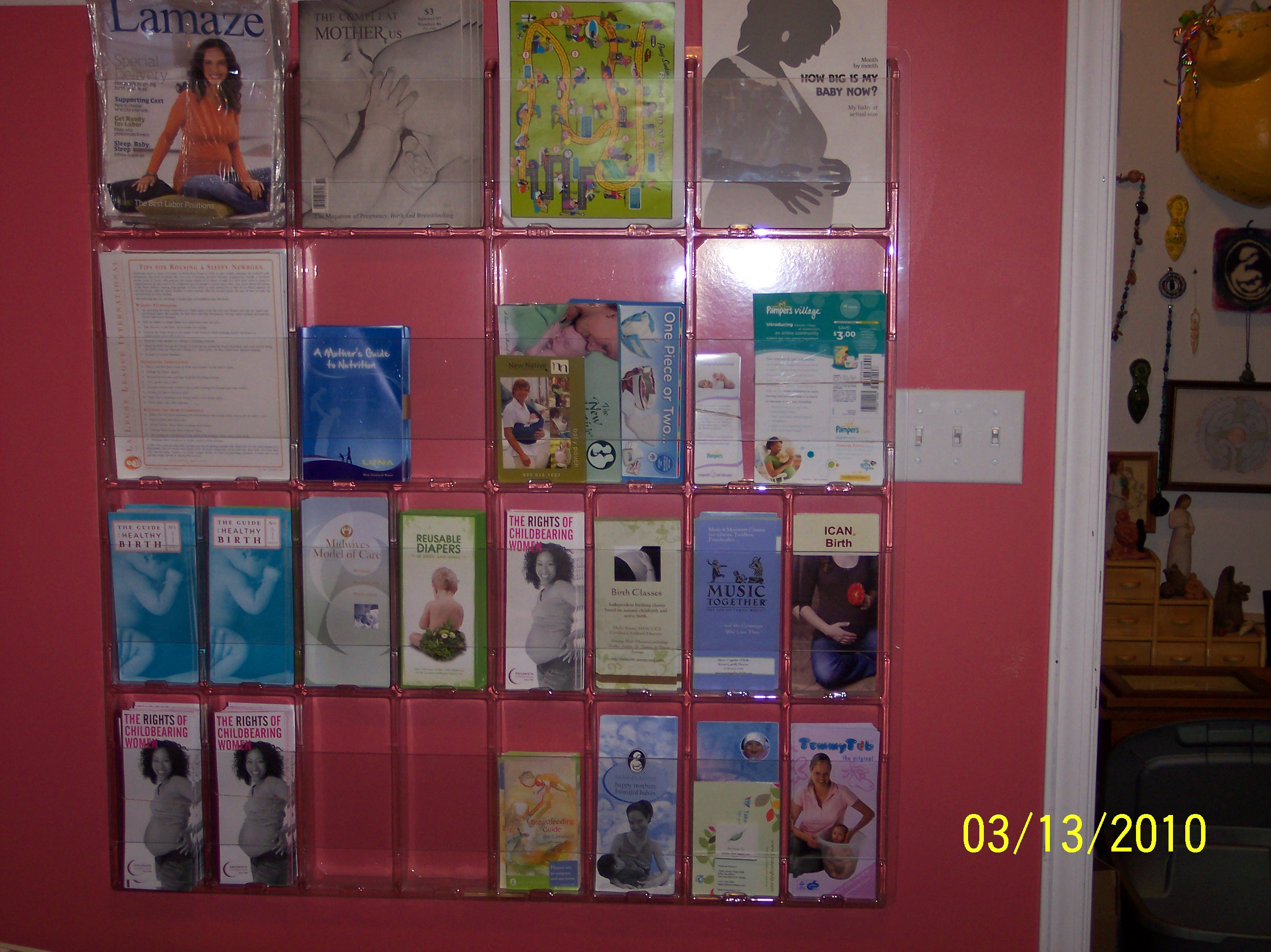
I was pleased as can be when my husband brought home a plastic brochure rack that was getting thrown away at work. As a semi-compulsive gatherer and sharer of information, I have boxes of pamphlets, magazines, brochures, etc. that I put together in packets for my birth class clients. How much more efficient and attractive to organize them this way! I took a picture of it because I’m so happy.

Young Parents Program Prenatal Classes

I am getting ready to teach a series of classes for a local Young Parents program. I have had to rework my class outlines a bit to meet some of the program’s requirements/needs. I decided to upload some of the activities here in case they may help someone else avoid reinventing the wheel by typing up their own similar activities.

Birth BINGO–this is a Bingo card with birth terminology. You can enter the terms into one of a variety of bingo card makers online in order to randomize the cards so that they are not all in the same order (which would then make everyone always win together).

Bingo Definitions–this is the list of definitions that goes with the card above. You can cut them apart and draw terms at random to read aloud. Participants yell out the answer and get to put a candy (Smarties, M & M’s, that sort of thing) onto the appropriate square on their card.

Labor Rehearsal–this is a labor walk-through. It is a little more conventional/conservative than I really like. In most of my classes I like to use the Labor Stations from the Transition to Parenthood site. I print them out as cards, not full pages, and hand them over to the parents to practice. The cards walk them through a whole labor early labor through pushing and it is a god opportunity to review and integrate everything they’ve learned and experimented with in class. I do not include the patterned breathing suggestions because I do not teach patterned breathing techniques. There are LOTS of good games and handouts for classes on this site. I really appreciate it!

Communicating with Baby Prenatally–I was specifically asked to include a component of this in this series of classes. This exercise is modified from one in the Nurturing Parents prenatal curriculum. It isn’t my favorite exercise, but I’m going to try it out. I also have another one from ICEA that I am going to use called Sensory Imaging: The Baby Inside You.

Birthing Room Yoga Handout

In my classes, I teach a short little series of prenatal yoga poses called “Birthing Room Yoga.” I learned the series from the excellent video, Yoga for Your Pregnancy by Yoga Journal and Lamaze. My rationale for including the poses in all my classes is that while academic/intellectual information is useful (and is my personal learning style), birth happens in your body and not your head—-lots of us are uncomfortable with our bodies, so I try to get people to use their bodies a lot during classes. This helps women become comfortable with using their bodies, plus gets them out of their heads-space and into body-space, plus each exercise chosen has pregnancy or birth related benefits. Physical work is important for partners too—-birth is a physical event (both for the person helping and for the partner watching the pregnant woman work during labor).

I didn’t learn this series of poses until after my first two children were born. I was interested to see that I used all of the poses (or variations thereof—I also show a variety of variations during class) during my labor with my first son—even though I didn’t call it “yoga” or consciously “practice” during labor. I think that is a powerful reminder of the wisdom we carry in our bodies—as long as there is space and freedom in which to do so, this “birth yoga” arises spontaneously out of our own inherent wisdom, no training required!

Here is the Birthing Room Yoga handout I give with the pose reminders! The pelvic circles are particularly good and can be done seated on the edge of a hospital bed while having fetal monitoring.

Book Review: L’Mazeltov

L’Mazeltov: Your Personal Guide to Jewish Childbirth Education
By Pamela Nadav
L’Mazeltov, Inc. 2008
Softcover, 248 pages, $18.00
ISBN: 978-097786610-6
www.lmazeltov.org

Reviewed by Molly Remer, MSW, ICCE

The title of the new Jewish childbirth education book L’Mazeltov combines “two important Jewish symbolic expressions—L’Chaim (To Life) and Mazel Tov (Good Fortune).” The first half of the book consists of basic childbirth education and preparation. The second half is about “Jewish Life Cycle Education.” The strength of this book is the fusion of the two.

The childbirth education section was very conventional and conservative. I was surprised by some of the advice offered such as, “Always follow your doctor’s advice in all matters related to your pregnancy, labor and delivery” and in the section about anesthesia, “All of these modern technologies are designed to assist you in having the best possible birthing experience, and are considered to be relatively safe.” Personally, I feel like an important piece of childbirth education is encouraging pregnant couples to be informed birth consumers. There was no element of this perspective within L’Mazeltov.

The book includes some population-specific pregnancy information such as a short section on Jewish genetic diseases and testing.

There is a nice recipe section at the end of L’Mazeltov. I was inspired to make some delicious Challah bread for my family! There is no index, resource list, or glossary of terms (as a non-Jewish reader, many words were unfamiliar to me—-the author does a good job defining many within the body of the text, however).

Despite my wish for a more creative and evidence-based approach to the birth education portion, this book is a one-of-a-kind contribution to birth literature, covering both the “oys and joys” of preparing for parenthood. What a resource for Jewish couples expecting their first baby! “There is such a special sweetness in being able to participate in creation.”

Disclosure: I was provided with a complimentary copy of this book for review purposes.

Review first published in The CAPPA Quarterly, January 2010.

You Can’t Be Everything to Everyone…

I got the following article in an e-newsletter and though it isn’t birth business specific, I think it has a lot of valuable food for thought in it for childbirth educators/birth professionals. I am going to answer the questions in it and post again with my thoughts!

You Can’t Serve Everyone: Clarifying Your Niche for Better Marketing Results

Before you even start implementing any marketing strategies, it’s important to be crystal clear about whom it is you are trying to reach. Some of the questions you should be able to answer around this include: What is your niche?  Who is your target market and what is it that they want?  What is your message to them?

Often, small business owners are afraid to narrow down their target market for fear that this will limit them. Countless times I have heard people say “my target market is small business owners” or “my niche is really anyone who needs what I offer.”

The truth is, you can’t be everything to everyone, and it is actually easier to market and attract prospects when you focus on a particular group of people.  It is also easier for others to refer people to you when they see you as someone who works with a specific group.  To further illustrate, here is a simple example: Instead of “I’m a financial planner,” you could clarify it to say “I’m a financial planner who specializes in families with special needs children.”

Or, instead of “I’m a marketing consultant,” a more descriptive way to say it would be “I’m an online marketing consultant who specializes in social media strategies for coaches.”

Online, a good way to create the type of presence that draws people to you is to clearly communicate who you are, what you are about, and why people should take notice. In order to figure this out, some of the questions you could ask yourself might be:

*How would you describe the essence of who you are in a single word?
*What are your top three passions related to your work or three unrelated to your work?
*What would be three adjectives used to describe your business?
*Who your best clients or the people who are most likely to benefit from your work?

Those are just some of the questions you can ask to really get clear on who you are professionally, as well as who you are personally.

Clarifying your niche is a point of “stuckness” for many business owners and it does take a bit work to discover if you aren’t clear on it yet.  But once you have that specific niche narrowed down, reaching them with your marketing becomes a whole lot easier.

© 2010 Communicate Value. All Rights Reserved.

Want to use this article on your website or your own e-zine? You can, as long as you include the following:

Christine Gallagher, The Online Marketing and Social Media Success Coach, is founder of Communicate Value, where she is dedicated to teaching small business owners and professionals how to conquer the overwhelming aspects of online and social media marketing to increase business and maximize profits. To get your F.R.E.E. 5-Part E-Course and receive her weekly marketing & success articles on leveraging technology, building relationships and boosting your profits, visit http://communicatevalue.com.

Three Hours into 1.5 Minutes??

I most often write blog posts directed at pregnant women, not birth professionals (though I hope the pros find my posts useful as well!). Via the excellent Passion for Birth blog this morning, I read this article that is very relevant to childbirth educators.

The article addresses how educators/presenters can attempt to cram three hours worth of information into 1 and half minutes and how that is NOT effective or helpful. They do so out of fear that this is their “only chance” to reach those learners (but the cramming style actually does not reach learners either).

Ugh. I found myself cringing a bit when reading because I think I have this tendency for sure. It was also relevant to me in my non-birthwork life. I am faculty at Columbia College and am teaching my first college class this session (final exam tonight!). All of the principles in the article are things I strive to keep in mind when teaching college students as well (and sometimes I succeed and sometimes I fail. The actual class is 5 hours a night—though now six, because I missed one week and made it up sequentially over the following 5 weeks of class—which makes it tricky to keep people engaged, though also gives me plenty of time not to be cramming information into people’s heads).

Anyway, so the summary of points from the article (OMG. I’m taking a metaphorical three hours to get to my point…;-) were as follows:

Learners want relevance
Learners don’t care about history
Learners want minimal detail
Learners want connections
Learners want focus
Learners want applications
Learners want practice

I remember reading somewhere else at some point (I think during my ICEA certification process), that most learners do NOT want the amount of information and level of detail that you can provide. The first three on my list above are things I find myself falling into in birth education—I tend to give lots of details and some end up being irrelvant (I don’t want anyone to miss anything!) and I do have a tendency to give lots of history, background, and overexplanation.

So, good things to keep in mind! I want to be effective, not inefficient or irrelevant. I have been thinking a lot lately about my classes and how I’d like to improve them and change them and “deepen” them. Reading this article made me think even further about my approach and what I hope to accomplish. I have this sense lately that something just isn’t “working” and I want to go beyond—stretch my boundaries and dig in further.