Archives

Why Do I Care About Birth?

Some time ago I wrote a post on the Citizens for Midwifery blog about medical control as acceptable, in which I pondered the question of why do we care about birth, if many birthing women themselves don’t really seem to care? Why do we make it any of our business what other women choose to do with their births? And, is it any of our business anyway?

Well, I’ve been doing some thinking and I made and shared a list of why I care on the CfM blog. However, I wanted to go ahead and share my reasons on this blog as well. This is why I care about about other women’s births:

  • Because women are suffering (birth trauma is real–see organizations like Solace for Mothers–and postpartum mood disorders are very common).
  • Because babies are suffering–late pre-term births are increasingly common due to induction, many babies experience at least some post-birth separation from their mothers (which is not their biological expectation), and many babies spend time in the NICU. Infant mortality rates, especially for minority babies, are higher than in other industrialized countries.
  • Because breastfeeding is suffering and thus public health is suffering (see my previous article on the birth-breastfeeding continuum)
  • Because the physical costs of our current birth model are high (morality and morbidity rates are higher than necessary due to high volume of cesareans and many physicians and hospitals do not practice evidence-based care–continuing to deny laboring women food and drink and continuing to use Cytotec for inductions for example).
  • Because the financial costs of our current birth model to society are high–birth is a multi-billion dollar a year industry. Some facts from CfM:
    • Over four million births in the US each year (26.4 births per 1000 women aged 15-44 years in 2004).
    • Second most common reason for hospitalization of women.
    • Care for mothers and babies combined rank 4th for hospital expenses.
    • Hospital costs for deliveries mounted to more than $30 billion in 2004. More than 30% of births by cesarean section. ranking seventh highest total on the “national bill” for procedures (over $17 billion per year).
    • Of all births, 99% take place in hospitals, 90% are attended by obstetricians.
    • Over 6 million obstetric procedures are performed – the most common category of surgical procedures.

The percentage of births paid for by Medicaid varies from state to state but can be as high as 50% or more in some states. Coverage by all insurers (Federal government, Medicaid, private, HMOs, etc.) varies; many will not reimburse for OOH births, and when midwives are covered, the reimbursement rate is only a percentage of the rate for physicians. We all pay for births, including unnecessary interventions and preventable complications and injuries, through our taxes, health insurance withholding, and individual policies.

  • Because women’s birth memories last a lifetime (see Simkin, Not just another day in a woman’s life).
  • Because women deserve better.
  • Because I know in my heart that birth matters for women, for babies, for families, for culture, for society, and for the world.

The Future

I enjoyed reading an article called “The Future of Midwifery” by Judith Rooks and Kitty Ernst in the December 1999 edition of the IJCE (another find from the previously referenced big binder of back issues). The conclusion of the article was as follows:

It is said that the best way to predict the future is to create it. Creative forces come from our souls, our beliefs, our values, our moral and spiritual strength, and from the scientific evidence available to us at any given time. If we are to meet the challenges ahead, each of us must weigh authoritative pronouncements and popular opinions against the available scientific evidence, temper it with our own beliefs and values, and chart a course drawing on our collective moral and spiritual strengths. Change is often shaped not only by what we do but by what we do not do. The future of midwifery and our children’s care in childbirth is in our hands today. To be silent is to speak. To do nothing is to take action. (emphasis mine)

Sometimes it seems as if I am saying the same things over and over and trying to reach people who may or may not want to be reached. I found the above quote a good reminder that continuing to pursue change in birth practices is a worthwhile endeavor.

Opening for Birth

Some time ago, I bought several large binders of back issues of The International Journal of Childbirth Education (ICEA‘s publication). The December 2001 edition of the IJCE contains an article titled “The Pelvis Revisited” by Elizabeth Noble. An interesting article overall, I particularly enjoyed the language of the section titled Opening for Birth:

“Birth is what women do. Women are privileged to stand in such power! Birth stretches a woman’s limits in every sense. To allow such stretching of one’s limits is the challenge of pregnancy, birth, and parenting. The challenge is to be fully present and to allow the process because of inner trust. How can women find their power, claim it, and stand firm in it throughout? The vertical position comes again into prominence. Women must ‘stand up’ for what they want and ‘on their own two feet’ by refusing to take their birth ‘lying down’! Being upright is essential for pelvic power–psychological strength, pelvic mobility, gravity’s assistance, pelvic pump efficiency, and the hygienic downflow of bodily fluids.”

In the September 1999 issue, the article “Belly-Dancing Through Pregnancy: A Way to Give Birth and Not Be Delivered” by Gaby Mardshana Oeftering caught my eye. In it, she also addresses the needs to build inner trust and to open to birth through physical movement and an active approach to birthing:

“Women expecting their second or third child don’t necessarily need this [traditional prenatal classes]. They are looking for a way to relax, find their inner selves, and get better acquainted with their bodies, their babies, and the process of birthing. When allowed to move during childbirth, many women instinctively start moving their pelvis in hip circles which are typical of belly-dance…All soft and gentle belly-dance movements are beneficial to pregnant women; for example, hip circles, the various hip-eights, and hip rocking. The rule is: all horizontal movements relax the uterus; vertical movements excite it. Physically speaking, all these movements strengthen and mobilize the pelvis and the legs and train the pelvic floor. They also activate deep abdominal breathing…the hip movements demand a lot of attentiveness and body awareness. On a mental level, this leads to better consciousness of tension and relaxation—a body feeling that is needed during birthing.”

Recently, I feel myself intrigued by the possibilities of working with these women—those who are on their second or third pregnancies and who are seeking to “go beyond” traditional birth class information (that often assumes first baby status). I know that I, personally, have wanted new, fresh, inspirational birth information during each of my pregnancies—labor and birth 101, stages of fetal development, or even labor support and comfort measures isn’t “enough” for me anymore (and wasn’t after my first baby). The desire to honor the pregnancy experience, prepare for the birth experience, and to work with psychological and emotional elements of childbearing are still very much present though! I envision doing a series of “pregnancy retreat” type of things or other types of workshops that “go beyond” and help second, third, or fourth time mothers to spend some dedicated,special attention to each pregnancy and birth experience in a personally enriching and rewarding way 🙂

Balanced Living and Saying ‘No’

I fairly regularly experience what I term a “crisis of abundance.” There are SO many great things to do in the world: SO many great causes, so many wonderful organizations, so many beautiful books, and just so many good things to do with my time. I prefer this state to having a crisis of scarcity or lack, but abundance brings its own challenges and saying “no” or “enough” to the requests for my time is one of those. I feel fortunate that I am humming with life purpose (most of the time), but I also have to be mindful that this hum of energy does not lead me to overcommit and to stretch myself too thin.

This past week, I said “no” to two birthwork-related opportunities that were very appealing, but that I know in my heart that I don’t have the time, space, or energy for right now. It was very empowering and actually semi-thrilling to say,”no” and to mean it. I felt smart and that in these situations saying no was taking care of myself (saying no to someone else = saying “yes” to myself” sometimes!). Perhaps not coincidentally, after my “No” experiences, I received an article to share from life-balance expert Renée Trudeau. I really like her “Nine Creative Ways to Say No.” Enjoy!

Four Key Strategies for Balanced Living by Renée Peterson Trudeau, life balance expert/speaker

~Know your top priorities & effectively manage your energy: What in life is most important to you? How good are you at managing your energy? What is draining you? What is fueling you? Are you comfortable saying “no” and not over committing? “Things which matter most should never be at the mercy of things which matter least.” Goethe

~Make your self-renewal a priority: By filling your cup first, you’ll have more to give to clients/family/friends, you’re able to function at your optimum and you’ll be setting an example for healthy, balanced living for those around you. Self-care (on all levels physical/mental/emotional/spiritual) should be part of your every day life. “Self-care is not about self-indulgence, it is about self-preservation.” A. Lorde


~Build a personal support system: What type of and how much professional & personal support do you need to feel emotionally healthy and stress-free? Learn to ask for and receive help. Re-evaluate your support needs every three months; these change based on your current life stage.


~Be more present in all that you do: Stress and overwhelm are often brought on by dwelling on the past or living in the future. By spending more time living in the present and focusing on what is most important in the here and now, the calmer, more effective we become.

Nine Creative Ways to Say “No”

Below you’ll find specific language to support you in saying “no.” Most people find that the more they say “no,” the easier it becomes say “yes” to those things that really matter.

(1) Just No: “Thanks, I’ll have to pass on that.” (Say it, then shut up.)

(2) The Gracious No: “I really appreciate you asking me, but my time is already committed.”

(3) The “I’m Sorry” No: “I wish I could, but it’s just not going to work right now.”

(4) The “It’s Someone Else’s Decision” No: “I promised my coach (therapist, husband, etc.) I wouldn’t take on any more projects right now. I’m working on creating more balance in my life.”

(5) The “My Family is the Reason” No: “Thanks so much for the invite, that’s the day of my son’s soccer game, and I never miss those.”

(6) The “I Know Someone Else” No: “I just don’t have time right now. Let me recommend someone who may be able to help you.”

(7) The “I’m Already Booked” No: “I appreciate you thinking of me, but I’m afraid I’m already booked that day.”

(8) The “Setting Boundaries” No: “Let me tell you what I can do …” Then limit the commitment to what will be comfortable for you.

(9) The “Not No, But Not Yes” No: “Let me think about it, and I’ll get back to you.”

(This list is adapted in part from Work Less, Make More—Stop Working So Hard and Create the Life You Really Want, by Jennifer White.)

Trudeau is a nationally-recognized career/life balance coach, president of Austin-based Career Strategists and the author of The Mother’s Guide to Self-Renewal: How to Reclaim, Rejuvenate and Re-Balance Your Life. Sign up to receive monthly life balance tips, order the book, find out about upcoming retreats/events and  learn more about Trudeau’s coaching groups at www.ReneeTrudeau.com or www.CareerStrategists.net.

Wordless Wednesday: Wallowing in Books

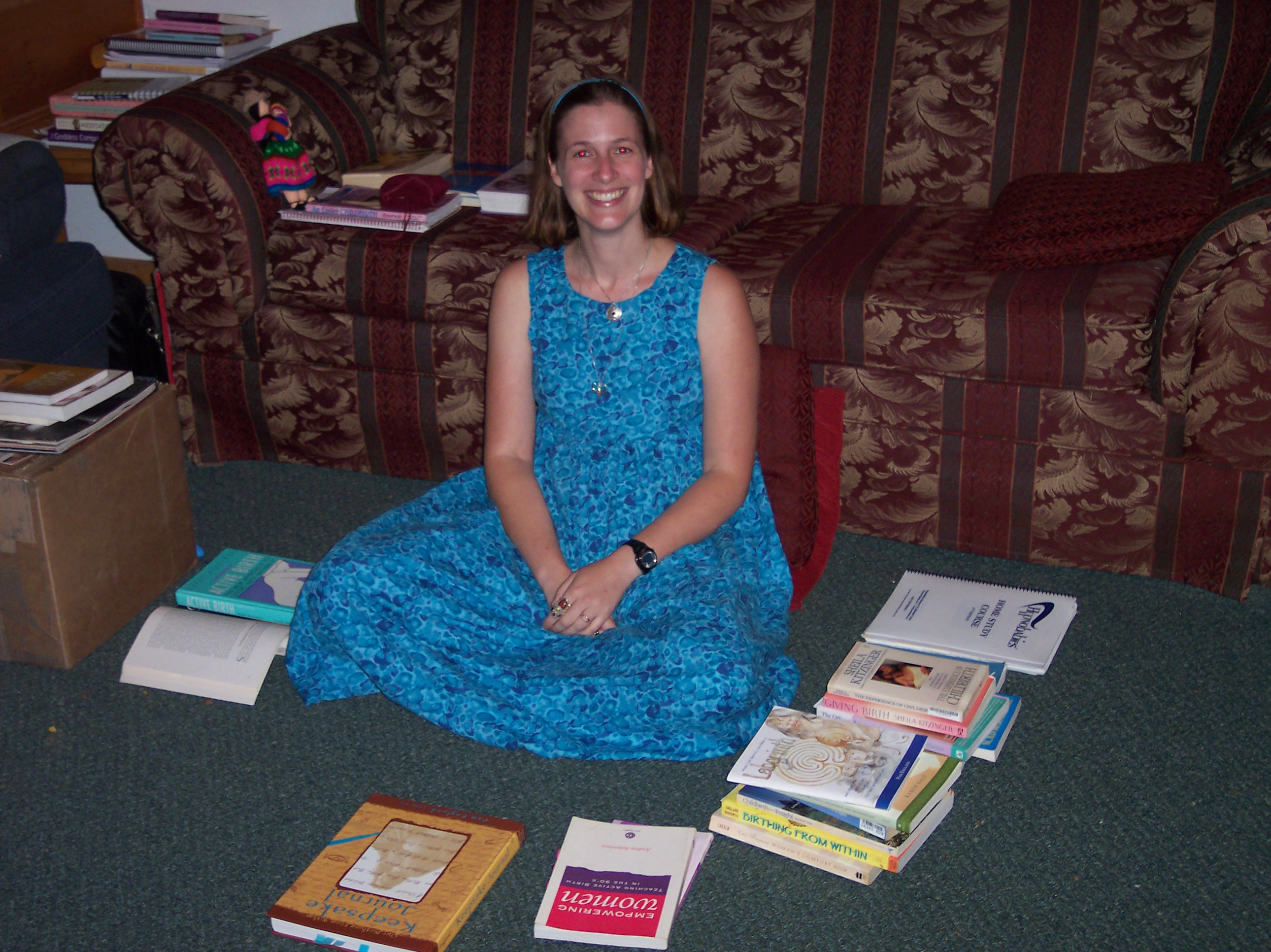
Anyone who knows me in person knows how much I love books! I joke with my husband about feeling like I need some time just to “wallow” in all my books. This past weekend, I finally did exactly that—got out all the birth and childbirth education books that are my favorites or that I’ve been wanting to look through again, spread them all around me and just enjoyed 🙂 (while I love being a book reviewer, one drawback is that I spend so much time reading NEW good books that I don’t have a chance to re-read old favorites!) Notice there are also books on the couch behind me AND in a big stack on the end table next to the couch—these are not books I got out for wallowing purposes, but are currently in-process/being used books! And, yes, that large box next to me is full of books and also has books on top (these are kids’ books mailed to us recently though, not birth books). I also feel like pointing out that this is not a very figure-flattering dress I’m wearing and though, yes, I am pregnant, I am not really as big as I look in the picture.

So much for Wordless!

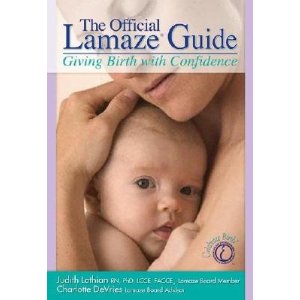
Book Review: Giving Birth with Confidence

Since I recently wrote a post inspired by a quote from The Official Lamaze Guide: Giving Birth with Confidence, I figured it was high time that I share the review I wrote of the book! The review was originally written in 2007 for CfM News.

The Official Lamaze Guide: Giving Birth with Confidence. By Judith Lothian & Charlotte DeVries. Published in 2005 by Meadowbrook Press (307p), $12.00. ISBN: 088166474X

Reviewed by Molly Remer, MSW, CCCE

Very few pregnancy books deliver the message that we think pregnant women need to hear most: Birth is a normal and natural part of life….We believe deeply that birth is a process you can trust just as millions of women before you have. This belief isn’t sentimental; it’s based on our thorough understanding of the physiologic birth process and research that confirms interfering in that process is harmful unless there is clear evidence that interference provides benefits.

So begins an opening section of the book The Official Lamaze Guide: Giving Birth with Confidence. The degree to which the book accomplishes its simple message can be summarized with a simple review: Excellent! The Lamaze Guide is digestible and reasonable for busy people to manage at less than 300 pages of text and it contains a simple, profound, and elegant message that women in the U.S. desperately need to hear.

The book begins with defining normal birth as “…a normal birth is one that unfolds naturally, free of unnecessary interventions.” It then briefly explains the history of birth and how and why normal birth is not actually the norm in our culture. The authors then clearly address the following areas in one chapter each: early pregnancy; choosing a caregiver and birth site; middle & late pregnancy; preparing for labor and birth; the simple story of birth; keeping birth normal; finding comfort in labor; creating a birth plan and a baby plan; communication and negotiation; greeting your newborn; and early parenting. The authors are clearly very supportive of midwifery and the Midwives Model of Care (though it is not referenced by name) as well as of the benefits of a doula in the birthing room.

The book is framed in the context of Lamaze International’s powerful foundation, the Six Healthy Birth Practices:

The book is also guided by Lamaze’s comprehensive and lovely philosophy of birth:

  • Birth is normal, natural and healthy.
  • The experience of birth profoundly affects women and their families.
  • Women’s inner wisdom guides them through birth.
  • Women’s confidence and ability to give birth is either enhanced or diminished by the care provider and place of birth.
  • Women have the right to give birth free from routine medical interventions.
  • Birth can safely take place in homes, birth centers and hospitals.
  • Childbirth education empowers women to make informed choices in health care, to assume responsibility for their health and to trust their inner wisdom.

After effectively bolstering the confidence of women in birth, The Lamaze Guide concludes with several useful appendices. The first is the excellent tool “Effective Care in Pregnancy & Childbirth: A Synopsis.” Though this information is easily available on the internet (see www.childbirthconnection.org), I find that many parents do not come across it on their own. How powerful to have it included for easy reference of indisputable evidence based practices. The Mother-Friendly Childbirth Initiative is included in another appendix as well as the always excellent text of The Rights of Childbearing Women. I was delighted to see all of these powerful documents in one place—and, in the hands of consumers who need to be aware of them.

This book is a refreshing presence on the shelves of my local bookstore (yes, there is only one retail book shop in my community and The Lamaze Guide is the only “alternative” birth book stocked in the store!). As I read the book, I kept nodding along and wishing it was in the hands of each pregnant woman in my community. Lamaze has a “name recognition” that gives this book the potential to have a wider and broader impact than other alternative birthing books which, though brilliant contributions, may only end up in the hands of “the choir.” The Lamaze Guide is written in such a matter-of-fact and comforting tone that I cannot see it being off putting to the average consumer as having “hippie” language or “extreme” ideas. The blueprint for normal birth that the book lays out is extreme compared to the standard practices at most hospitals, but the way in which the information is presented opens doors of communication, understanding, and exploration as well as providing the evidence basis to back normal birth. I would not hesitate to lend this book out as it will not scare anyone away with “weird” ideas. With the other books in my personal library, I have to carefully consider my audience before choosing which book has the right style and blend of information—not this one! It is good for everyone with its open, simple message. It is a good addition to lending libraries, personal libraries, to give as a gift, or to recommend to others. The Lamaze Guide is straightforward and clearly written with an unabashedly honest and truthful message of what normal birth is and how it can either be supported or undermined.

My only critique of the book is that in contains no real acknowledgment of the several other well known and effective organizations that train and certify birth educators (other than Lamaze International itself). Conspicuously absent from the resources pages are any of these other organizations.

In conclusion, The Lamaze Guide is a source of information that women need to have and a message that women need to hear. I think Giving Birth with Confidence accomplishes its purpose skillfully and has the potential to be a transformative influence. I hope women read it, absorb it, and begin to Celebrate Birth!

Sheila Kitzinger on a Woman’s Right to Her Own Experience

I have written before that every woman has the right to define her own experience—a phrase I first remember hearing when used by an ICAN volunteer. I was cleaning out a pile of stuff by my computer this weekend and found I’d marked a related quote in Education and Counseling for Childbirth by Sheila Kitzinger, so it obviously caught my eye before hearing it from ICAN, but hearing it is what fixed it into my own personal philosophy of birthwork. With regard to what good childbirth educators need to know/how they should approach teaching:

…nothing can replace the experience of having joyfully born one’s own babies in full awareness and of having had to face and cope with some of the psychological and social problems which confront most women in childbearing and child rearing. But simply having given birth happily oneself is inadequate as a basis for good teaching. Too often then a woman has a very one-sided picture of labour, and merely superimposes on other women ideals of how labour ought to be.

Labour is a highly personal experience, and every woman has a right to her own experience and to be honest about the emotions she feels. Joy tends to be catching, and when a teacher has enjoyed her own births this is valuable because she infuses her own sense of wonder and keen pleasure into her relations with those she teachers. But she must go on from there, learn how difficult labour can be for some women, and develop an understanding of all the stresses that may be involved.

I’ve noticed that women come into birthwork for a variety of different reasons (okay, that is a very obvious statement!) and two of the big ones seem to be either that she had a wonderful birth herself and wants to “share the light” or, she had a disappointing birth herself and wants to help prevent other women from having the same experience. I came from the first camp—my first birth experience was tremendously empowering and I couldn’t wait to share the joy with others. My second was even more triumphant and powerful and really lit my fire to finish my certification process and to start teaching in earnest. I feel like I have always been compassionate to that fact that not all women DO feel a sense of triumph and joy in birth, even if they do everything “right,” and I read plenty of books and articles on “unexpected outcomes” and about birth trauma. Additionally, as I’ve noted before, I also feel like my birth-miscarriage experience with my third baby more fully opened the complete range of experiences of the childbearing year to me and gave me a deeper sense of compassion and heart for all women.

Practical Ways to Enhance Knowledge for Birth

Related to my previous posts about information vs. knowledge, I want to share a couple of ideas from an article I wrote some time ago for the International Journal of Childbirth Education. Obviously, I don’t have all the answers, but these are some of my ideas/tips about transferring information into knowledge that will be meaningful to parents when their birthing time comes:

  • Use “The Ice Cube Minute” exercise from Family-Centered Education: The Process of Teaching Birth. In this exercise, couples hold an ice cube in one hand for one minute and see what coping measures spontaneously arise for them. I do this exercise fairly early in my class series, before we’ve done a lot of formal talking about coping measures. It is very empowering for couples to discover what tools and resources come from within as they try the ice cube minute.
  • To illustrate the potency of the mind-body contraction, practice two pretend contractions while holding ice. One contraction has an accompanying “stressful” paragraph read with it (“your body fills with tension…it hurts! Oh no!”) and the second contraction has a soothing paragraph read with it (“you greet the wave….it is YOUR power….”). This illustrates the fear-tension-pain cycle viscerally.
  • Use a five minutes series of birthing room yoga poses to begin the class—birth happens in our bodies, not our heads. Practicing the poses opens space to simultaneously discuss and practice: squatting, pelvic rocks, optimal fetal positioning ideas, healthy sitting, pelvic floor exercises, leg cramp prevention, back pain alleviation, and more.
  • Role playing cards-—talk through various scenarios. I’ve found that couples are more receptive to talking through the cards than actually getting into a role and playing it through. The activity that seems to work best for actual role play is the labor simulation series available on the Transition to Parenthood site.
  • Values clarification exercise—participants cut out values from a list and arrange them in a grid to help them figure out if they are in alignment with each other and with their caregivers.
  • Leg stretch exercise to explore the use of vocalizations and other coping mechanisms during labor.
  • Ask plenty of open ended questions that stimulate discussion and ideas, “what have you heard about XYZ?” or “what is your experience with…?”
  • Use birth art processes to “switch” parents from linear, logical, left-brain thinking into the right-brain mode they will also enter in “laborland.”
  • Media portrayals of birth—show two contrasting clips, such as a birth from a popular TV show (I often show Rachel’s birth from the show Friends) paired with an empowering birth from a film like Birth as We Know It and then have students discuss the two. Sometimes this more clearly brings into focus the influence of our culture on birth practices than a simple discussion does. Since I originally wrote this, the film Laboring Under an Illusion was released which does exactly this—contrast media portrayals of birth with how birth can be. It is a great resource for birth classes.

In classes, I also incorporate the idea of mother-baby symbiosis through:

  • The use of affirmations—“my baby and my body work in harmony to make birthing easier.”
  • A discussion of cardinal movements with an emphasis on how the baby moves to help itself navigate the pelvis (thus, helping you have a smoother birth).
  • Visualization exercises that encourage “seeing” and connecting with the baby while in the womb.
  • Belly Mapping” to get a sense of the baby as a person positioned in the uterus. Talking about what baby is like in the womb—when does it kick more, when is it quiet, does it like music, poke you back with you touch it, etc.
  • Impressing upon participants that it is not selfish to want both a good birth and a healthy baby (I actively challenge statements about, “well, in the end, all that matters is that the baby is healthy”). Laboring women have a basic right to humane care, which supports both a happy, satisfied mother and a healthy baby. I use examples during class to show how these are intertwined—for example, a stressed, unhappy, unsupported, tense mother may have a baby with heart decels and accompanying distress.

I try to build a sense of confidence through:

  • Opening each class with a brief series of “birthing room yoga” poses to help couples become comfortable using their bodies and moving from “head space” into “body space.” Birth is a physical process and I am convinced that it is vital to include physical movement during every class to bring that message home. Additionally, the poses I teach can all be used while in labor (thus, building confidence in coping “tools” for labor).
  • Emphasizing active birth—freedom of movement through labor helps baby rotate and descend and helps mother feel more comfortable.
  • Encouraging active birth on all levels: First, the physical level–being active during the actual physical process of birth. Second, the mental level–mentally engaged with labor. Third, a cultural level—a perspective that sees women as active birthgivers, not victims of birth. Birth is something women do, as opposed to something that “gets” them.
  • Giving couples plenty of time for hands on practice of labor support and coping measures. I have a personal motto for classes of, “talk less, learn more.” Practicing support tools in class helps them develop a sense of confidence in having a well-stocked toolbox for labor, instead of being a victim of pain.

How Do Women Really Learn About Birth?

April 2015 123“I usually claim that pregnant women should not read books about pregnancy and birth. Their time is too precious. They should, rather, watch the moon and sing to their baby in the womb.” –Michel Odent

Related to a previous post about the difference between information and knowledge, I have been pondering how women really learn about birth. Where does birth knowledge they can really use when they need it come from? Is it from birth classes, reading, or from other sources? Though I teach birth classes and believe that childbirth education has important value, I continue to return to thought that what women truly need to give birth does not come from (traditional) classes and it doesn’t come from books either.

Ever since I posted the above quote from Michel Odent on my Facebook page, I have been reflecting back to my pregnancy with my own first baby. Personally, I love books–-of all sorts-–and reading is the top way for me to learn about anything. I think some of the best preparation I did before having my first baby was to read and I always give a recommended reading list to my clients. And, while I “hear” the sentiment in the quote and honor it, my personal opinion is that in our current birth culture it is nearly impossible to go into birth just planning to “go with the flow” and let labor unfold without expectation (if you are birthing in the hospital that is—because the hospital is FULL of expectations and those will often run right over your flow).

When I was pregnant the first time and approaching my first birth, I was hungry for birth information and keenly felt the mystery and unknowableness of the challenge I was about to face. I described it as feeling like I was preparing for the biggest test of my life, but without knowing what the test was. So, how did I learn what I needed to know about giving birth? AND, perhaps most importantly, what had I learned before birth that actually spoke to me while in labor? What did I use and how did I learn about that? Obviously, women are different and have different learning styles and each birth is different, but reflecting on these questions, several things arise as most helpful for me in real preparation:

  • Other women’s experiences—these were frequently what floated through my head during labor and were what I drew on for information and guidance, not “technical” childbirth books, but the stories and opinions and reflections I had read in birth stories and from the participants of the newsgroup misc.kids.pregnancy.
  • Birth art—I created a series of needle felted birth goddess sculptures during my pregnancy that had a “message” for me (that what I needed to give birth—that wild, intuitive knowledge—was already inside me).
  • And yes, reading (and to some extent, classes). I didn’t necessarily use or remember things that I’d read (other than other women’s “voices” through birth stories), but reading definitely helped me prepare—so, while I was not necessarily conscious of book or class-knowledge when I was actually in labor, I was informed by it, yes. During all my reading what I really wanted to to figure out and know was, how am I going to do this? This is the same question that most women who come to my classes have (and my answer is really, “you just will”). The books that were of most value to me were Birthing from Within and An Easier Childbirth. These were the books that had “right brain” lessons to share, even though it was the “left brain” books that I “studied” harder.
  • Yoga—I spontaneously adopted poses used in prenatal yoga during my first labor without even knowing it was “prenatal yoga.” It was an example of how the knowledge already existed inside my body and spontaneously arose when given the space to do so. I also used yoga poses during my other births—not consciously (“I think I’ll try child’s pose now”), but spontaneously and instinct-driven.
  • My blessingway experience/memories—particularly the chant Woman Am I, which I hummed over and over again during my first labor.
  • Voice—talking to myself (inside my head or our loud), verbally coaching myself.
  • My husband—his presence just there with me. I felt like we were one person. This isn’t something I feel like you can “train” for. It too was naturally arising and just pure.
  • Holding a fused glass touchstone and having my favorite pillow (in my third labor, it was holding my goddess of Willendorf pendant).

For me, it all came down to FREEDOM and space for me—I was not in an institutional setting, I was in my own “nest” and that was very key for letting my own body’s wisdom unfold and find expression.

——

A powerful pre-birth lesson in my body’s wisdom actually came from an assassin bug (of all things!). Assassin bugs have very potent, poisonous bites (and in some countries carry hideous diseases). During my first pregnancy I was bitten multiple times in the night by one of them. I had bites on my face (lip) as well as in a row on my arm. The bites caused swelling, ongoing stabbing pain, and joint aching (as well as intense palm-of-hand and sole-of-feet itching when they first occurred). I turned this into a practice experience for myself in coping with labor—figuring that, like labor, this was something uncomfortable and out of my control, but that would eventually pass and that my body would take care of without my needed to actively do anything about it. The stabbing pain was also intermittent (like a pulse), so I thought that was good practice too. I practicing “softening” around the sensations and “being” with the discomfort. I reminded myself that my body knew what to do and that it would heal itself. And, guess what? It did. Each day as the bites healed, I would marvel, “look how much my body knows! Look what it can do without me even knowing what or how it is doing.” Of course, it took several days of stabbing and aching pain for this process to occur, whereas my first labor involved only 5 hours of intense sensation as well as several preceding hours of totally manageable sensation and my subsequent labors only involved 2 hours each of fairly intense sensation. This experience in watching my body take care of itself using its own inherent wisdom was a potent (and unexpected) lesson for me in approaching my first birth.

My Message?

The Orgasmic Birth fan page on Facebook was having a giveaway and to enter the contest the following question was posed:

You are given the chance to speak to the world about childbirth. What is your message?

What a great question! This was my response (as I re-read it, I see I answered as if I was only speaking to one person and not the world. Darn it. I want to speak to the world!):

Birth can be a beautiful, powerful, joyful celebration and a transformative experience. Women’s bodies have a deep knowing of how to give birth and I encourage you to choose a birth setting the supports the unfolding of this knowledge. Women can safely and joyfully give birth in any setting, but freedom, privacy, individualized care, and respect make a HUGE amount of difference in how readily you will be able to have the birth you imagine–so, choose carefully. You do have options. This baby will only be born once, so don’t wait for “next time” to have the birth that you and your baby both deserve.

The needs of mothers and babies during birth are intimately entwined–what is good for mother is also good for babies. Do not ever be misled into thinking that you have to choose between a “good birth” or a “healthy baby”–good, satisfying births are exactly the kind that are most likely to produce that healthy baby!