Archives

New Post…

I spent quite some time writing a new post yesterday and then it disappeared without a trace! I like to make a post here at least once a week, so I’m going to have to just link to the other post I wrote yesterday as part of the Women’s History Month blog carnival from Birth Activist. Birth Activist was the very first birth blog I ever started reading and the blog that sparked my own interest in blogging (a couple of years later).

In addition to teaching the Young Parents classes, which is a new venture for me, I also start teaching my second college class next week. This one is at a college branch about an hour from me, so I’m going to be doing a lot of driving in addition to all the preparation work. I think blogging is going to have to slip down my list of priorities for a while and so I may not be making new posts for a little while—I hope my readers don’t abandon me! Have no fear, I’ve managed to work birth activism into my class in a very appropriate way—I’m going to show them the Reducing Infant Mortality film and possibily The Doula Story as well, during my section of the class on teen pregnancy.

Resource Rack

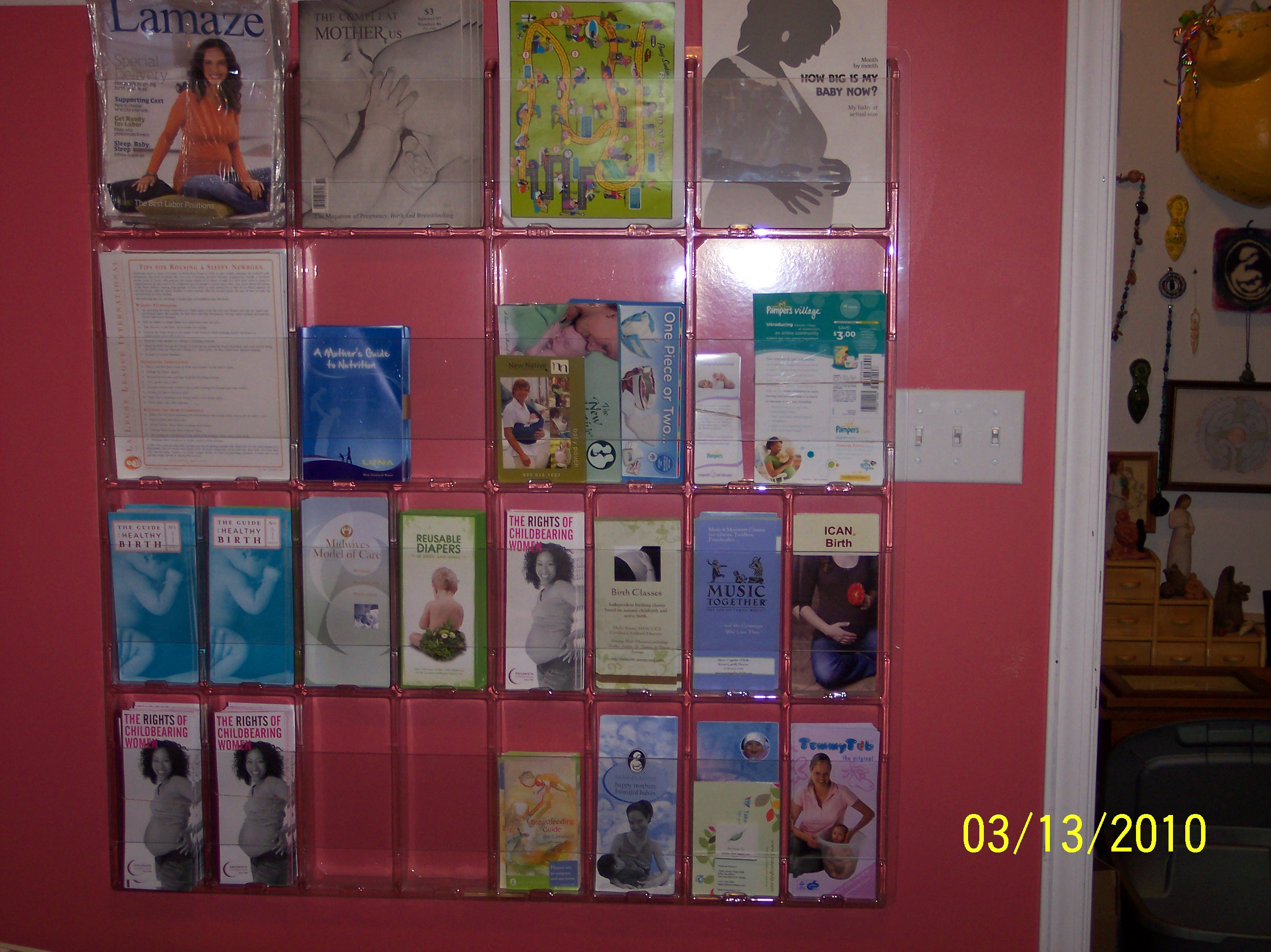
I was pleased as can be when my husband brought home a plastic brochure rack that was getting thrown away at work. As a semi-compulsive gatherer and sharer of information, I have boxes of pamphlets, magazines, brochures, etc. that I put together in packets for my birth class clients. How much more efficient and attractive to organize them this way! I took a picture of it because I’m so happy.

Young Parents Program Prenatal Classes

I am getting ready to teach a series of classes for a local Young Parents program. I have had to rework my class outlines a bit to meet some of the program’s requirements/needs. I decided to upload some of the activities here in case they may help someone else avoid reinventing the wheel by typing up their own similar activities.

Birth BINGO–this is a Bingo card with birth terminology. You can enter the terms into one of a variety of bingo card makers online in order to randomize the cards so that they are not all in the same order (which would then make everyone always win together).

Bingo Definitions–this is the list of definitions that goes with the card above. You can cut them apart and draw terms at random to read aloud. Participants yell out the answer and get to put a candy (Smarties, M & M’s, that sort of thing) onto the appropriate square on their card.

Labor Rehearsal–this is a labor walk-through. It is a little more conventional/conservative than I really like. In most of my classes I like to use the Labor Stations from the Transition to Parenthood site. I print them out as cards, not full pages, and hand them over to the parents to practice. The cards walk them through a whole labor early labor through pushing and it is a god opportunity to review and integrate everything they’ve learned and experimented with in class. I do not include the patterned breathing suggestions because I do not teach patterned breathing techniques. There are LOTS of good games and handouts for classes on this site. I really appreciate it!

Communicating with Baby Prenatally–I was specifically asked to include a component of this in this series of classes. This exercise is modified from one in the Nurturing Parents prenatal curriculum. It isn’t my favorite exercise, but I’m going to try it out. I also have another one from ICEA that I am going to use called Sensory Imaging: The Baby Inside You.

Birthing Room Yoga Handout

In my classes, I teach a short little series of prenatal yoga poses called “Birthing Room Yoga.” I learned the series from the excellent video, Yoga for Your Pregnancy by Yoga Journal and Lamaze. My rationale for including the poses in all my classes is that while academic/intellectual information is useful (and is my personal learning style), birth happens in your body and not your head—-lots of us are uncomfortable with our bodies, so I try to get people to use their bodies a lot during classes. This helps women become comfortable with using their bodies, plus gets them out of their heads-space and into body-space, plus each exercise chosen has pregnancy or birth related benefits. Physical work is important for partners too—-birth is a physical event (both for the person helping and for the partner watching the pregnant woman work during labor).

I didn’t learn this series of poses until after my first two children were born. I was interested to see that I used all of the poses (or variations thereof—I also show a variety of variations during class) during my labor with my first son—even though I didn’t call it “yoga” or consciously “practice” during labor. I think that is a powerful reminder of the wisdom we carry in our bodies—as long as there is space and freedom in which to do so, this “birth yoga” arises spontaneously out of our own inherent wisdom, no training required!

Here is the Birthing Room Yoga handout I give with the pose reminders! The pelvic circles are particularly good and can be done seated on the edge of a hospital bed while having fetal monitoring.

Birth Violence

“‘Old wives’ tales,’ says the Oxford dictionary, are ‘trivial stories, such as are told by garrulous old women.’ It is significant that no one ever talks about ‘old husbands’ tales’ or ‘old doctors’ tales.’ Women are blamed instead. It is implied that there is poison in their speech and that the only safe thing to do is remain silent. The experiences that women share with other women are thus rejected and trivialized…In reality, it is not other women who instill and fuel anxiety in most pregnant women, but the medical system itself.” This quote from the 1980’s book, Giving Birth, by Sheila Kitzinger, remains strikingly relevant today. When women in the United States today enter the hospital to give birth, many experience some form of institutional violence. They may not explicitly define it as violence, but listening to their stories provides a disheartening picture of maternity care today.

What kinds of violence occur in the birth place? Here are a few possible examples of “normative abuse” women may experience when giving birth in U.S. hospital setting

• Restriction of movement
• Restriction of nourishment
• Domination by those in positions of authority—must obey even when it is against her own best interests.
• Routine, forced interventions such as IVs
• Repeated, possibly painful, vaginal examinations by many different people
• Denial of option for VBAC (vaginal birth after cesarean)
• At the most extreme example of overriding patient rights, a forced cesarean section
• Vaginal cutting (episiotomy)
• Abusive language
• Separation from family/restriction of companionship
• Lack of respectful treatment
• Voice and wishes disregarded/unheard
• Emotional manipulation using baby as a “card” to force compliance (“you want a healthy baby don’t you?” No mother doesn’t. It is degrading and dehumanizing to suggest that she doesn’t.)
• Forced separation of mother and baby
• Administration of medications without consent
• Cord traction and interference with third stage (placenta) that may lead to hemorrhage.

The emotional treatment of women in labor is the most significant factor contributing to their satisfaction with their birth experiences (emotional factors of highest importance include having good support from caregivers and being treated with respect). According to Kitzinger, “We are only now discovering the long-term destructive effect on human beings and families of treating women as if they were merely containers, to be opened and relieved of their contents; and of concentrating attention on a bag of muscle and a birth canal, rather than relating to, and caring for, the person to whom they belong. The violence which is a common element in childbirth today leaves many women feeling that birth has been a kind of rape. This sort of experience is not easily forgotten. It can shatter a woman’s self-confidence, make her doubt her ability to mother her baby, destroy joy in the expression of her sexuality, and attack her very sense of self–the roots of her identity. It is psychologically mutilating.”

And, as Mary Rucklos Hampton says, “The effort to separate the physical experience of childbirth from the mental, emotional, and spiritual aspects of this event has served to disempower and violate women.”


Molly Remer, MSW, ICCE is a certified childbirth educator and activist who blogs about birth at https://talkbirth.wordpress.com and midwifery at http://cfmidwifery.blogspot.com.

Note: In 2009, I wrote an article about birth violence for International Women’s Day, but it appears to have never been published. So, I decided to post it here (and on the CFM blog in honor of this year’s International Women’s Day on March 8th). I also read two relevant articles recently: How childbirth caused my PTSD and Birth Trauma: An Introduction.

Book Review: L’Mazeltov

L’Mazeltov: Your Personal Guide to Jewish Childbirth Education
By Pamela Nadav
L’Mazeltov, Inc. 2008
Softcover, 248 pages, $18.00
ISBN: 978-097786610-6
www.lmazeltov.org

Reviewed by Molly Remer, MSW, ICCE

The title of the new Jewish childbirth education book L’Mazeltov combines “two important Jewish symbolic expressions—L’Chaim (To Life) and Mazel Tov (Good Fortune).” The first half of the book consists of basic childbirth education and preparation. The second half is about “Jewish Life Cycle Education.” The strength of this book is the fusion of the two.

The childbirth education section was very conventional and conservative. I was surprised by some of the advice offered such as, “Always follow your doctor’s advice in all matters related to your pregnancy, labor and delivery” and in the section about anesthesia, “All of these modern technologies are designed to assist you in having the best possible birthing experience, and are considered to be relatively safe.” Personally, I feel like an important piece of childbirth education is encouraging pregnant couples to be informed birth consumers. There was no element of this perspective within L’Mazeltov.

The book includes some population-specific pregnancy information such as a short section on Jewish genetic diseases and testing.

There is a nice recipe section at the end of L’Mazeltov. I was inspired to make some delicious Challah bread for my family! There is no index, resource list, or glossary of terms (as a non-Jewish reader, many words were unfamiliar to me—-the author does a good job defining many within the body of the text, however).

Despite my wish for a more creative and evidence-based approach to the birth education portion, this book is a one-of-a-kind contribution to birth literature, covering both the “oys and joys” of preparing for parenthood. What a resource for Jewish couples expecting their first baby! “There is such a special sweetness in being able to participate in creation.”

Disclosure: I was provided with a complimentary copy of this book for review purposes.

Review first published in The CAPPA Quarterly, January 2010.

You Can’t Be Everything to Everyone…

I got the following article in an e-newsletter and though it isn’t birth business specific, I think it has a lot of valuable food for thought in it for childbirth educators/birth professionals. I am going to answer the questions in it and post again with my thoughts!

You Can’t Serve Everyone: Clarifying Your Niche for Better Marketing Results

Before you even start implementing any marketing strategies, it’s important to be crystal clear about whom it is you are trying to reach. Some of the questions you should be able to answer around this include: What is your niche?  Who is your target market and what is it that they want?  What is your message to them?

Often, small business owners are afraid to narrow down their target market for fear that this will limit them. Countless times I have heard people say “my target market is small business owners” or “my niche is really anyone who needs what I offer.”

The truth is, you can’t be everything to everyone, and it is actually easier to market and attract prospects when you focus on a particular group of people.  It is also easier for others to refer people to you when they see you as someone who works with a specific group.  To further illustrate, here is a simple example: Instead of “I’m a financial planner,” you could clarify it to say “I’m a financial planner who specializes in families with special needs children.”

Or, instead of “I’m a marketing consultant,” a more descriptive way to say it would be “I’m an online marketing consultant who specializes in social media strategies for coaches.”

Online, a good way to create the type of presence that draws people to you is to clearly communicate who you are, what you are about, and why people should take notice. In order to figure this out, some of the questions you could ask yourself might be:

*How would you describe the essence of who you are in a single word?
*What are your top three passions related to your work or three unrelated to your work?
*What would be three adjectives used to describe your business?
*Who your best clients or the people who are most likely to benefit from your work?

Those are just some of the questions you can ask to really get clear on who you are professionally, as well as who you are personally.

Clarifying your niche is a point of “stuckness” for many business owners and it does take a bit work to discover if you aren’t clear on it yet.  But once you have that specific niche narrowed down, reaching them with your marketing becomes a whole lot easier.

© 2010 Communicate Value. All Rights Reserved.

Want to use this article on your website or your own e-zine? You can, as long as you include the following:

Christine Gallagher, The Online Marketing and Social Media Success Coach, is founder of Communicate Value, where she is dedicated to teaching small business owners and professionals how to conquer the overwhelming aspects of online and social media marketing to increase business and maximize profits. To get your F.R.E.E. 5-Part E-Course and receive her weekly marketing & success articles on leveraging technology, building relationships and boosting your profits, visit http://communicatevalue.com.

Birth & Culture & Pregnant Feelings

“Giving birth is not an isolated event in a person’s life. A woman births with both her mind and her body and participates in the attitudes toward childbearing of her culture and her family.”

This quote from the book Pregnant Feelings by Rahima Baldwin reminds me of two other relevant quotes about culture, birth, and women’s choices:

“Although pregnancy and birth is a richly intuitive and instinctive process, a woman will prepare her ‘nest’ and birth according to the style of her culture, in the same way that a particular species of bird will build its nest with whatever is available.” –Pam England

“One does not give birth in a void, but rather in a cultural and political context. Laws, professional codes, religious sanctions, and ethnic traditions all affect women’s choices concerning childbirth.” –Adrienne Rich

I think we get onto slippery ground when we start talking about how women just need to “educate themselves” and then they will make different (i.e. “enlightened like ours”) choices. If education was all that was needed, we would see much different things in our present birth culture (more on this later!). As Pam England would also say (paraphrased), thousands of factors seen and unseen go into the resulting birth experience, it is hard to point to one, two, or three factors and say “that was it! I have it all figured out.” (Reminds me of another quote that women birth as they live.) With regard to the second quote, I have to ask myself whether couples truly have a free choice of where to give birth? Ultimately speaking, yes they do, but according to my clients’ perspectives insurance companies and the political climate surrounding midwifery in our state dictate their birth location, as well as opinions of family, friends, books, and so forth. I do a “pain pie” exercise during my classes and after I do it, I always talk about how sometimes choices are actively stripped away from women and we need to keep that in mind when we hear “bad” birth stories—not, “she ‘failed’ or made the ‘wrong’ choices” but that her pieces of the pie were taken away from her (sometimes forcibly!).

The reason I initially marked Rahima Baldwin’s quote is because I am fascinated by how my birth experiences continue to inform the rest of my life–while not the defining moment of motherhood for me, I continue to draw upon the lessons of birth throughout the rest of  my life, as well as retaining a total fascination with the subject. I wonder why I’m so “stuck” on birth? Why fixate on this one element of a lifespan? Does it mean I’m not “moving on” somehow—like a high school football player still reliving the glory of that touchdown from 10 years ago? I think it is because birth touches something else. Something deep and raw and true and we glimpse something that we rarely glimpse in everyday life. A touch of the sacred perhaps. Magic. Mystery. Or is it a sense of personal power and satisfaction in being a woman? I know that the “birth power” experience is a rare one for me—I have never felt so powerful and capable and amazing as I did giving birth. I like to think about how this “birth power” sense could be drawn into the rest of my life—how can I live a powerful and affirming and amazing life, not just as a birth giver, but as a woman? Lately, I am finding some answers in feminine spirituality, but it is a question I love to consider and hope to write more about in the future.

Okay, moving back to Rahima and the quotes from Pregnant Feelings:

Anthropologists’ reports of women working the fields, going to a sheltered spot to drop their babies without any ‘preparation’ and then returning to work describe a kind of mythical natural childbirth that is nearly impossible for Western women. We are far too cerebral, and our twentieth-century consciousness intrudes between us and our instinctual selves. The fact that we question both how to birth and how to parent shows how awake our consciousness is. We must of necessity involve our minds in understanding what we do and create, for it is impossible to turn them off. Nor can we simply erase, or afford to ignore, our culture’s view that giving birth is a dangerous and painful event requiring intervention and technology. Rather, we must consciously replace that view with new knowledge and new images if we are going to be able to reclaim our ability to birth with harmony of mind and body.

Loved this. The mythical woman giving birth by the side of the road and popping back into the field to work is strongly ingrained amongst “natural birth” advocates. Some women draw strength from the image—“if she could just squat in the field, so can I!” Others make a joke of it—“are you one of those nuts who encourages women to just squat in the field?!” And others are doubtful that it has any basis in reality. I also suspect that if said women did ever exist they did not return quickly to the fields because they wanted to do so, but because of the framework of their culture and those seen and unseen factors that shape our lives—perhaps their other children would starve if they didn’t run back to the field, perhaps the overseer would beat them, etc., etc. It doesn’t mean those women were stronger or more capable, but perhaps less valued and less cared for than they should have been.

Okay, back to Rahima again:

Our task is to integrate our minds and bodies, so we can give birth in a way that feels whole and nurturing—to ourselves as parents and to our babies…We cannot go back to ‘natural childbirth’ in which we just let it happen. There must be knowledge of birth and an assumption of responsibility for our own health care and for decisions affecting ourselves and our children. There exists for us the exciting possibility of giving birth with full awareness, participating in the joy and exhilaration of working in harmony with the tremendous energy of creation. But it does not occur automatically or unconsciously…

The potential for conscious birthing can exist independently of the place of birth, although some places require more watchfulness than others….Let us just say that it is actively giving birth in an environment which is woman-centered and child-centered, in which the cues are taken from the birthing woman while she experiences fully the sensations and emotions of new life coming into the world through her. She is not medically managed or manipulated, but is supported with the knowledge, love and experience of her attendants (doctors, midwives, husband, other support people) to birth in a way which is safe, yet does not deny the intense physical, emotional, and spiritual aspects of giving birth.

Birthing in this way is rare in today’s culture…less than 5 percent of women in this country today experience ‘purebirth’ [positive birthing/conscious birthing]…

Given the wealth of images of birth that surround us, our task is to recognize that none of them adequately denies or exhausts the potential of birth. Perhaps their infinite variety can help to free us from any one fixed idea of giving birth and help us to realize our freedom to birth in the way that is right for us. We cannot control the energy of birth, but we can control our response to it by deciding to be open, relaxed positive, noisy, grouchy, whatever. We don’t need to behave in a certain way and we can accept ourselves and our births without self-judgment.

What caught me about this section was the mention of not being able to go back to a time when we could just “let it happen.” Though I feel like getting out of my own way and “letting it happen,” was a personal key to my own births—that the surrender is what gets the job done—I agree with her point that there is no letting it happen in today’s culture. A long time ago someone mentioned in an online forum that they were not planning to take birth classes or read any birth books because they felt like they should just let it happen and not have any preconceived notions; that cluttering up their heads with this other information would cloud their ability to do so. While I hear the motive and feeling behind this sentiment and believe there is some (perhaps idealized) truth to it, I simultaneously feel like it is impossible to do this, because women do not give birth in a void or outside of their culture. Women give birth in a context, usually involving other people (even with unassisted births, there is usually someone else there). If you enter the birth room (the aforementioned woman was planning to give birth in a hospital, not unassisted) without any ideas or pre-knowledge about what to expect or what you want, the stories and dramas and ideas and myths and preconceived notions and reading and media-exposure of all the other people present DO enter the room and impact your birth. You cannot just “let it happen,” because they will not just let it happen. Right or wrong, this is the environment in which many of us our building our birth nests.

I’d like to close my thoughts with another quote. This one is from one of my favorite birth books, Transformation Through Birth by Claudia Panuthos. In giving birth, regardless of our nest and our choices and all the seen and unseen elements shaping our lives, perhaps we can simply, “…celebrate ourselves for our courage to birth. The real question becomes not, ‘Have you done your breathing exercises?’ but rather, ‘Can you love yourself no matter how your birth, where you birth, or what the outcome?'”
Pathways Article

I was happy to have an article and an accompanying sidebar in the winter issue of Pathways to Family Wellness (the magazine of ICPA). This was one of my most exciting publications to date as Pathways is a lovely, full color magazine and they laid my article out so nicely and professionally. I’m posting about it here, because the articles were based on two posts originally written here:

What to Expect When You Go to the Hospital for a Natural Birth (re-named in Pathways as “The Hospital ‘Birth Plan'” and available in an online version here)

and

Can I Really Expect to Have a Great Birth? (included as the sidebar in Pathways)

As long as I’m writing about writing, I wanted to share links to some of my recent books/film reviews also:

Multimedia Review: Baby’s First Gift

Book Review: Labor of Love

DVD Review: It’s My Body, My Baby, My Birth: A film About Natural Childbirth

Book Review: The Power of Women

Book Review: Fathers-To-Be Handbook

Book Review: Permission to Mother

Book Review: Dance of the Womb

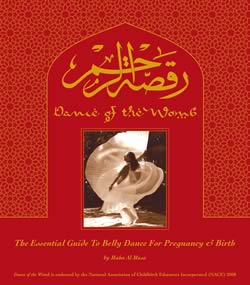
Dance of the Womb book cover

Book Review: Dance of the Womb: The Essential Guide to Belly Dance for Pregnancy and Birth
By Maha Al Musa, 2008
ISBN 978-0-646-48705-2
260 page hardcover book, $49.95 (AUS)
http://www.bellydanceforbirth.com

Reviewed by Molly Remer, MSW, ICCE

Some books simply feel good to hold in your hands. Dance of the Womb is one such book: it is beautiful, both in content and appearance. While priced a little higher than some birth books, I cannot emphasize enough what a high quality book it is—-it is not a traditional trade paperback, it is of textbook quality and size. Hardbound with a lovely cover and endpapers, Dance of the Womb is packed with full color, detailed, step-by-step instructional photographs leading the reader through a “belly dance for birth” journey.

Dance of the Womb is divided into several segments. The first section summarizes the benefits of belly dance and explores the physiology of birth. The next section walks the reader through a series of gentle warm-up exercises while the following sections progress through a variety of different specific belly dance movements. Nearing the conclusion of the text is a segment about labor movements with positions. Each section of the book is lavishly illustrated with very clear, easy to follow, step-by-step photographs.

The author’s own journey through pregnancy, birth, and mothering is skillfully interwoven throughout the text as well as her own feminine passage into understanding herself as a complete woman. Interspersed with the photographs and belly dance instructions, is the exploration of the author’s pregnancy and birth experiences, her relationship with her own mother and her parents’ culture. The book contains her personal birth stories as well as perspectives on belly dance for birth from three midwives.

The author, Maha Al Musa lives in Australia. Her interest in Middle Eastern Dance was sparked by her Palestinian/Lebanese roots and birthplace as well as her pilgrimage to explore her heritage and reconnect with her long-separated mother. Maha has also developed a Dance of the Womb step-by-step instructional belly dancing DVD (sold separately, review to follow) that includes a video of her own homebirth journey with her third child. She is also developing a one day foundation course in “bellydancebirth” for birth professionals with a plan to go international in 2011.

Dance of the Womb is a great introduction to not just the basic physical elements of prenatal belly dance, but also to the spiritual aspects of giving birth and life as a woman. It is written with an intimate tone that makes the reader feel as if the author has reached out across the miles to form a direct, personal connection. This book feels like a rich treasure to hold and is a gentle, nurturing, encouraging, and enriching voyage for pregnant women or the people who serve them.

—-

Disclosure: I received a complimentary copy of this book for review purposes.