Archives

The Value of Sharing Story

“..no matter what her experience in birth was, every mother knows something other people don’t know.”—Pam England


“Stories are medicine…They have such power; they do not require that we do, be, act anything—we need only listen. The remedies for repair or reclamation of any lost psychic drive are contained in stories.” –Clarissa Pinkola Estes


Every woman who has given birth knows something about birth that other people don’t know. She has something unique and powerful to offer.

As birth professionals, we are often cautioned against sharing our personal stories. We must remember that it is her birth and her story, not ours. In doula and childbirth educator trainings, trainees are taught to keep their own stories to themselves and to present evidence-based information so that women can make their own informed choices. As a breastfeeding counselor too, I must remind myself to keep my own personal experiences out of the helping relationship. My formal education is in clinical social work and in that field as well we are indoctrinated to guard against inappropriate self-disclosure in a client-helper setting. In each environment, we are taught how to be good listeners without clouding the exchange with our own “baggage.” The messages are powerful—keep your own stories out of it. Recently, I have been wondering how this caution might impact our real-life connections with women?

Nine months after I experienced a powerful miscarriage at home at 15 weeks, a good friend found out at 13 weeks that her baby died. As I had, she decided to let nature take its course and to let her body let go of the pregnancy on its own timetable, rather than a medical timetable. When she emailed me for support, it was extremely difficult to separate our experiences. I kept sharing bits and pieces of my own loss experiences and then apologizing and feeling guilty for having violated the “no stories” rule. I kept telling her, “I know this isn’t about me, but I felt this way…” I told her about choosing to take pictures of the baby and to have a ceremony for him at home. That I wished I had gotten his footprints and handprints. The kinds of personal sharing that may have been frowned upon in my varied collection of professional trainings. After several apologies of this sort, I began to reflect and remembered that what I hungered for most in the aftermath of my own miscarriage was other women’s voices and stories. Real stories. The nitty gritty, how-much-blood-is-normal and did-you-feel-like-you-were-going-to-die, type of stories. Just as many women enjoy and benefit from reading other women’s birth stories, I craved real, deep, miscarriage-birth stories. These stories told me the most about what I needed to know and more than organization websites or “coping with loss” books ever could.

I had a similar realization the following month when considering the effectiveness of childbirth classes and trying to pin down what truly had reached me as a first time mother. The question I was trying to answer as I considered my own childbirth education practice was how do women really learn about birth? What did I, personally, retain and carry with me into my own birth journey? The answer, for me, was again, story.

On this blog, I have a narrative about my experiences during my first pregnancy with being able to feel my baby practicing breathing while in-utero. More than any other post on the site, this post receives more comments on an ongoing basis from women saying, “thank you for sharing”–that the story has validated their own current experience. In this example, rather than getting what they need from books, experts, or classes, women have found what they needed from story and, indeed, most of them reference that it was the only place they were able to find the information they were seeking.

And finally, as breastfeeding counselor, during monthly support meetings, I cannot count the number of times I’ve seen mothers’ faces fill with relief when another mother validates her story with a similar one.

So, what is special about story as a medium and what can it offer to women that traditional forms of education cannot? Stories are validating. They can communicate that you are not alone, not crazy, and not weird. Stories are instructive without being directive or prescriptive. It is very easy to take what works from stories and leave the rest because stories communicate personal experiences and lessons learned, rather than expert direction, recommendations, or advice. Stories can also provide a point of identification and clarification as a way of sharing information that is open to possibility, rather than advice-giving.

Cautions in sharing stories while also listening to another’s experience include:

  • Are you so busy in your own story that you can’t see the person in front of you?
  • Does the story contain bad, inaccurate, or misleading information?
  • Is the story so long and involved that it is distracting from the other person’s point?
  • Does the story communicate that you are the only right person and that everyone else should do things exactly like you?
  • Is the story really advice or a “to do” disguised as a story?
  • Does the story redirect attention to you and away from the person in need of help/listening?
  • Does the story keep the focus in the past and not in the here and now present moment?
  • Is there a subtext of, “you should…”?

Several of these self-awareness questions are much bigger concerns during a person-to-person direct dialogue rather than in written form such as blog. In reading stories, the reader has the power to engage or disengage with the story, while in person there is a possibility of becoming stuck in an unwelcome story. Some things to keep in mind while sharing stories in person are:

  • Sensitivity to whether your story is welcome, helpful, or contributing to the other person’s process.
  • Being mindful of personal motives—are you telling a story to bolster your own self-image, as a means of pointing out others’ flaws and failings, or to secretly give advice?
  • Asking yourself whether the story is one that will move us forward (returning to the here and now question above).

While my training and professional background might suggest otherwise, my personal lived experience is that stories have had more power in my own childbearing life than most other single influences. The sharing of story in an appropriate way is, indeed, intimately intertwined with good listening and warm connection. As the authors of the book, Sacred Circles, remind us “…in listening you become an opening for that other person…Indeed, nothing comes close to an evening spent spellbound by the stories of women’s inner lives.”

Molly Remer, MSW, ICCE, CCCE is a certified birth educator, writer, and activist who lives in central Missouri with her husband and children. She is an LLL Leader, a professor of Human Services, and the editor of the Friends of Missouri Midwives newsletter. She blogs about birth, women, and motherhood at https://talkbirth.wordpress.com.

This is a preprint of The Value of Sharing Story, an article by Molly Remer, MSW, ICCE, published in Midwifery Today, Issue 99, Autumn 2011. Copyright © 2011 Midwifery Today. Midwifery Today’s website is located at: http://www.midwiferytoday.com/

Affordable Fetal Model

Two things to know about me:

1. I love dolls.

2. I love bargains.

For quite a while, I’ve wanted a realistic baby model to use in my birth classes. My ideal model could be used both for demonstrations of fetal positioning in the pelvis and also for demo’ing newborn care and possibly breastfeeding. Most fetal models sold by CBE supply companies range from $60-150. I usually use a Bitty Baby doll to demo newborn care and breastfeeding (a third thing to know about me is that my love of bargains makes an exception when it comes to American Girl dolls. I have an embarrassing number of AG dolls and vast quantities of accessories. I’ve had this Bitty Baby for over 10 years, I didn’t buy her to use in class). In my knitted uterus, resides a cute little baby doll I bought at Target for $5. Neither of these dolls works at all for fetal positioning or with my demonstration pelvis.

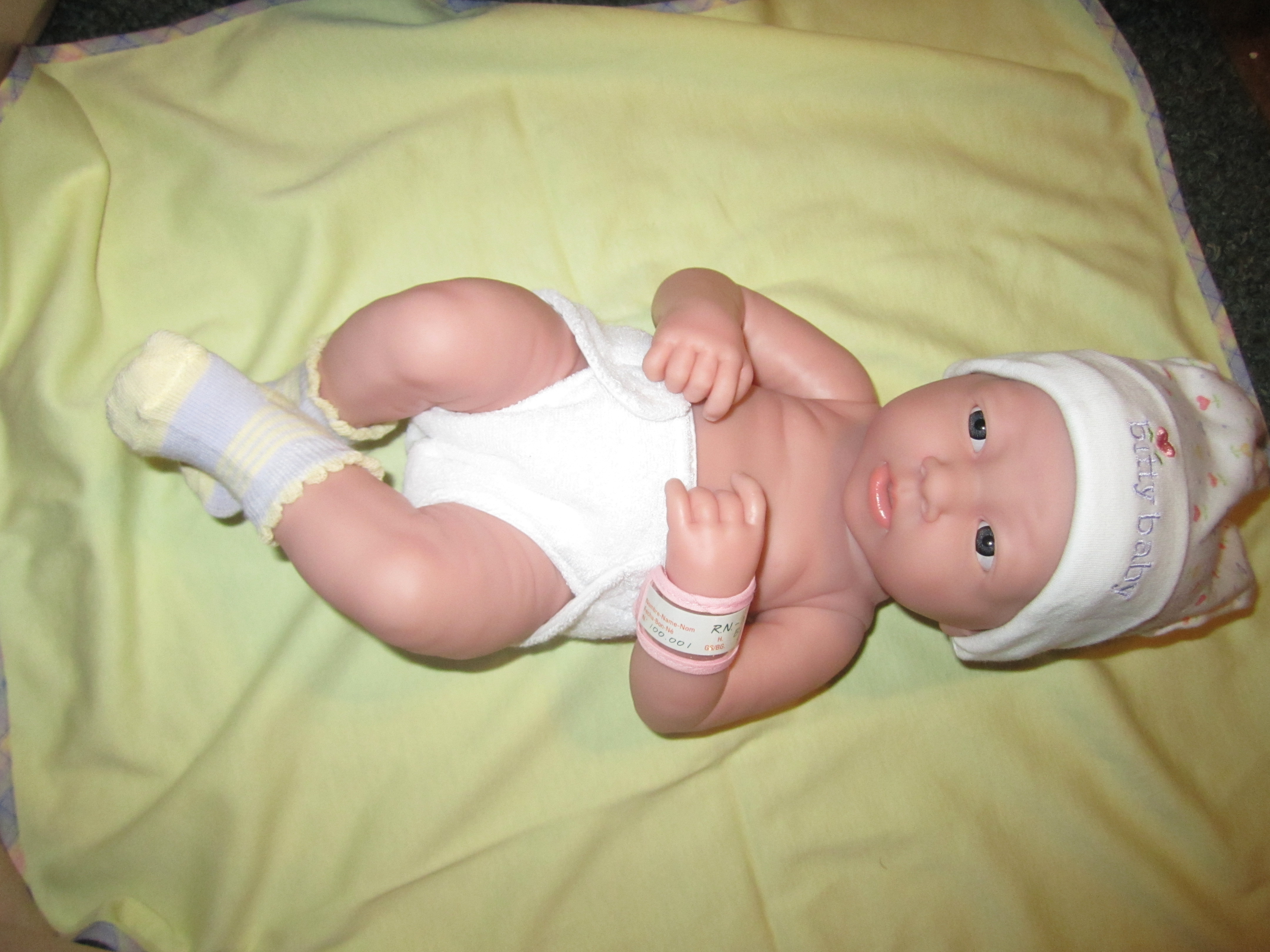
Look at this cute baby!

So, imagine my delight when I found a nearly perfect model newborn at Kmart yesterday while my son was picking out his birthday presents. I named her Sasha AND, get this, she was $20. In a bonus twist, unlike 99.9% of the dolls in the store, she did not come with a bottle! (There is a bottle pictured with a different doll on the back of the box.) She did come with a little cloth diaper, a onesie, a band to cover her cord stump (yes, she seems to have one, but it could just be a dramatic “outie”!), a little outfit, a hat, and socks. Called La Newborn (nursery doll), she is made by Berenguer.

Legs and arms straightened out a little

The only drawback is she is not very flexible and so would be hard to use comfortably for things like practicing putting on diapers. Her fairly flexed permanent body position does make her absolutely ideal for use for fetal positioning and even for swaddling or babywearing practice. I originally planned to take her arms and legs off to fill with plastic pellets to add weight, but I’d don’t think I’m going to bother. While nothing near the weight of a real baby, she is made from good quality vinyl.

After looking these dolls up various places online, I’m now thinking I should have bought the remaining one or two that they had at K-Mart. They don’t seem to be widely available for the $20 price.

This morning, my older son helped me take all kinds of pictures of my new toy—I mean, teaching aid!—today (yet another of the many benefits of having an 8 year old in the house!). So, this is a photo-heavy post!

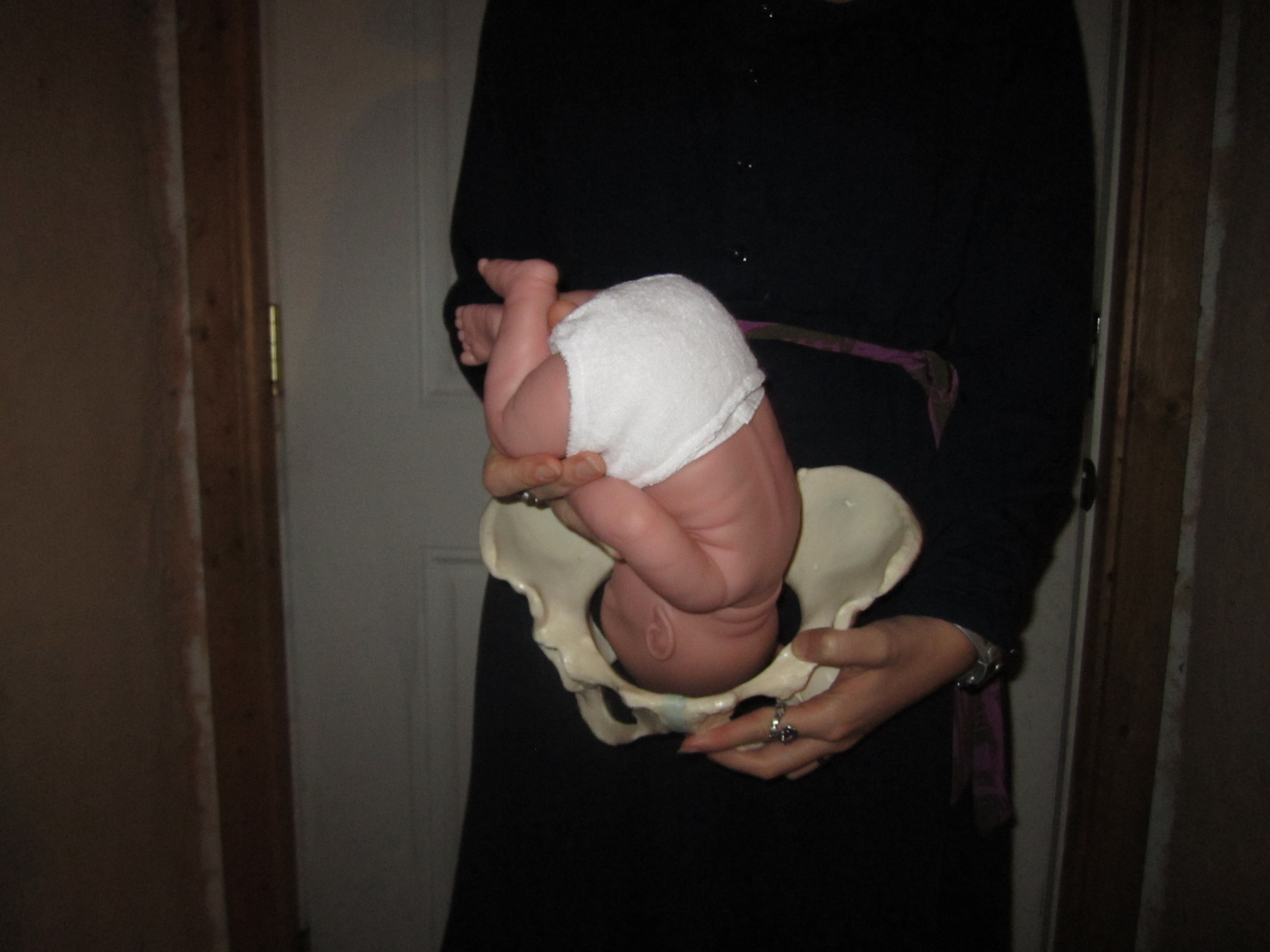
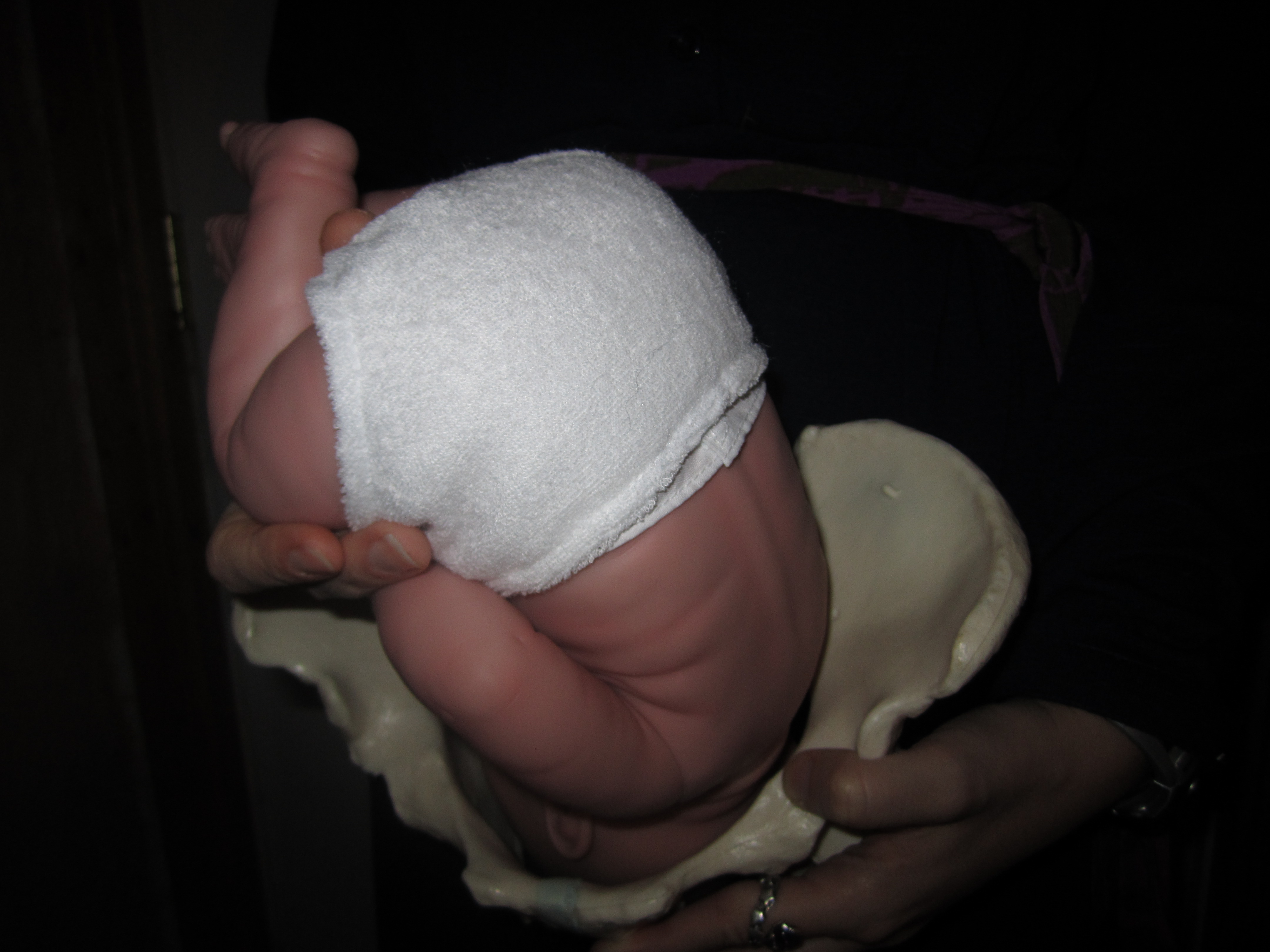
See what I mean about well flexed for fetal positioning information?!

And now my Christmas pelvis gets in on the demo…

If the demo pelvis had a coccyx joint, the baby would fit perfect through. As it is, her head does get stuck on it (good teaching moment about the importance of active positions for birthing!)

Bitty Baby Noelle and Target Baby are less than impressed with this interloper…

Alaina helps take care of baby Sasha…

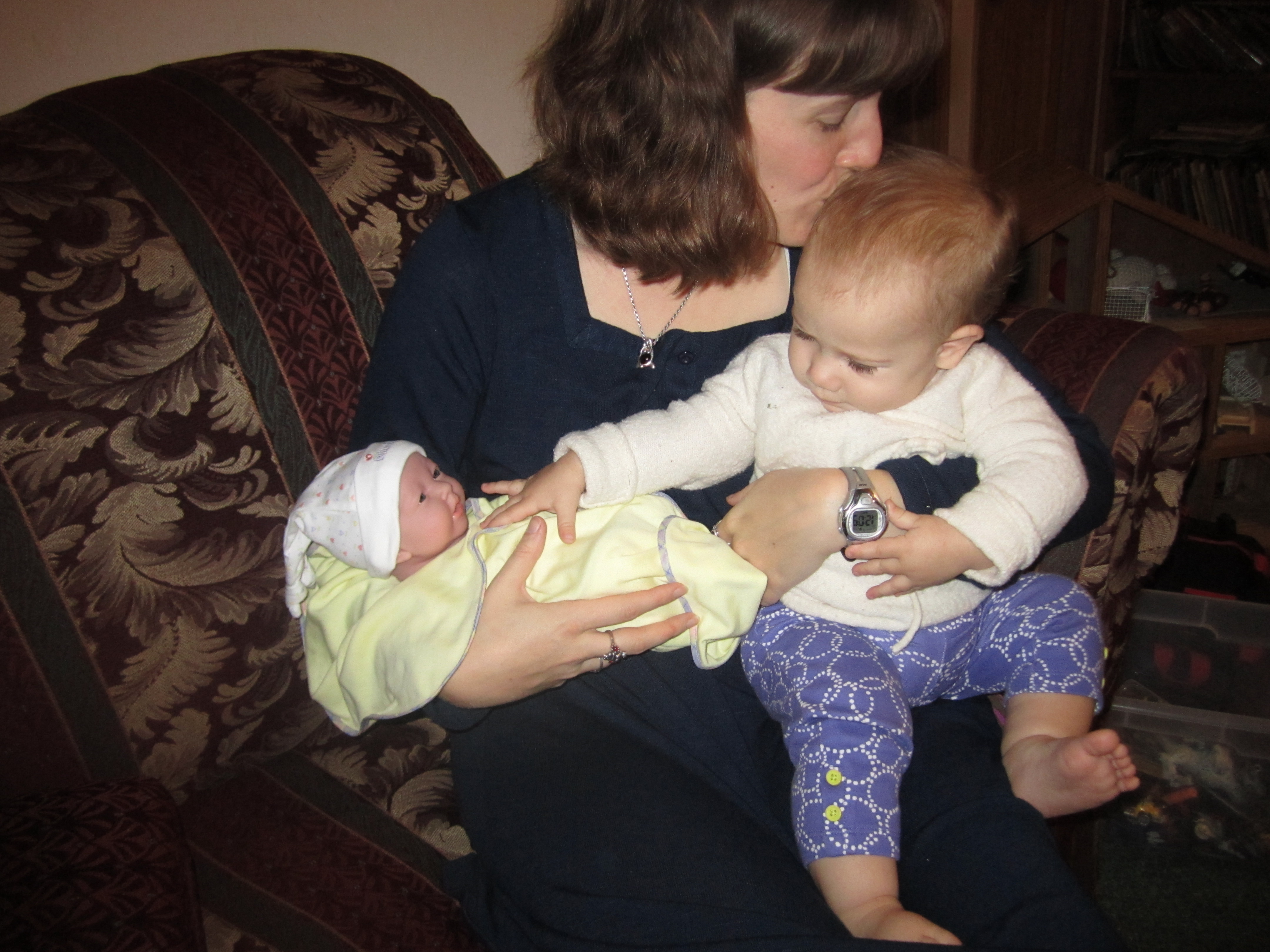
For sizing purposes—while I think she appears to be the perfect, realistic size when held up to my belly as a fetal model for positioning, when held in arms, she is more the size of a preemie baby (maybe a 31 weeker or so). She is about 15 inches.

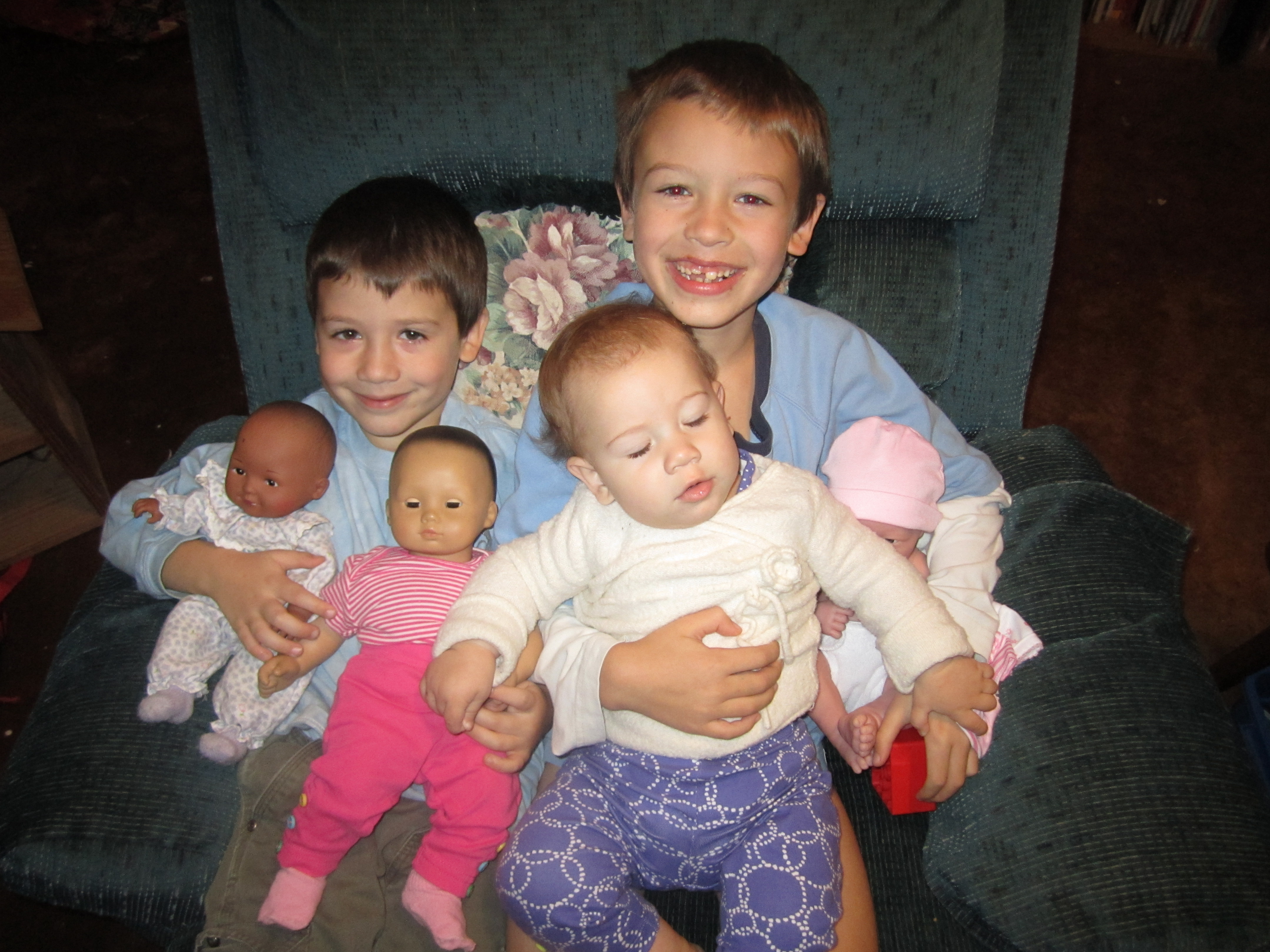
Lann wanted me to take this one—“make them guess who’s the real baby!!!”—conveniently, Alaina closed her eyes for this picture, making identification of the real baby even trickier…


Edited to add, Baby Sasha later experienced an unfortunate accident and had to be replaced. See Fetal Model Update post for pictures.

Active Birth in the Hospital

One of the inspiring images in ICAN of Atlanta's "Laboring on the Monitors" slideshow.

The vast majority of my birth class clients are women desiring a natural birth in a hospital setting. My classes are based on active birth and include a lot of resources for using your body during labor and working with gravity to help birth your baby. Sometimes I feel like active birth and hospital birth are incompatible—i.e. the woman’s need for activity runs smack dab into the hospital’s need for passivity (i.e. “lie still and be monitored”). So, I was delighted to discover this awesome series of photos from ICAN of Atlanta of VBAC mothers laboring on the monitors. It IS possible to remain active and upright, even while experiencing continuous fetal monitoring.

In my own classes, we talk about how to use a hospital bed without lying down—the idea that a hospital bed can become a tool you can use while actively birthing your baby. Here is a pdf handout on the subject:How to Use a Hospital Bed without Lying Down. In this handout, I offer these tips for using the bed as an active assistant, rather than a place to be “tied down”:

While being monitored and/or receiving IV fluids that limit mobility, try:

  • Sitting on a birth ball and leaning on bed
  • Sitting on bed
  • Sitting on bed and lean over ball (also on bed)
  • Kneeling on bed
  • Hands and knees on bed
  • Standing up and leaning on bed
  • Leaning back of bed up and resting against it on your knees
  • Bringing a beanbag chair, putting it on the bed and draping over it (can also make “nest” with pillows)
  • Partner sitting on bed and woman leaning on him/supported squats with him
  • Partner sitting behind woman on bed (with back leaned up as far as it will go)

While giving birth, try:

  • Hands and knees on bed
  • Kneeling with one leg up (on bed like a platform or “stage”)
  • Holding onto raised back of bed and squatting or kneeling
  • Squatting using squat bar

While most of the above tips can be used during monitoring, additional ideas for coping with a simultaneous need for monitoring AND activity include:

  • Kneel on bed and rotate hips
  • Sit on edge of bed and rock or rotate hips
  • Sit on ball or chair right next to bed (partner can hold monitor in place if need be)

If something truly requires being motionless, it can be helpful to have some breath awareness techniques available in your “bag of tricks.” One of my favorites is: Centering for Birth

Some time ago, a blog reader posed the question, can I really expect to have a great birth in a hospital setting? I definitely think it is possible! I also think there is a lot you can do in preparation for that great hospital birth! When planning a natural birth in the hospital, it is important to consider becoming an informed birth consumer. I always tell my clients that an excellent foundation for a simple, effective, evidence-based birth plan is to base it on Lamaze’s Six Healthy Birth Practices. My own pdf handout summarizing the practices is also available: Six Healthy Birth Practices. Don’t forget there is also a great video series of the birth practices in action! You might also want to get a copy of the book Homebirth in the Hospital. And, check out this post from Giving Birth with Confidence: Six Tips for Gentle but Effective Hospital Negotiations.

Before you go in to the hospital to birth your baby, make sure you have some ideas about this very popular question, how do I know if I’m really in labor?

And, finally, be prepared for the hospital routines you may encounter by reading my post: What to Expect When You Go to the Hospital for a Natural Childbirth.

For some other general ideas about active birth, read my post about Moving During Labor (written for a blog carnival in 2009).

Best wishes for a beautiful, healthy, active hospital birth! You can do it!

Book Review: Doulas’ Guide to Birthing Your Way

Book Review: Doulas’ Guide to Birthing Your Way
Authors: Jan Mallak & Teresa Bailey, 2010.
ISBN: 978-0-9823379-7-4
$15.37 – $21.95, 188 pages, softcover
Hale Publishing: http://www.ibreastfeeding.com/

Reviewed by Molly Remer

Geared towards pregnant women, Doulas’ Guide to Birthing Your Way is written in a simplistic manner using short, direct sentences. While in some ways this approach makes the information readily accessible, it can also feel unsophisticated in places. However, while the writing style is basic, the content is not. The Doulas’ Guide is a book that really “goes beyond” the information traditionally offered in birth preparation books, covering topics many parents typically may not have considered prenatally such as natural birth vs. birthing naturally, physical comfort preference styles, visualization, being a savvy consumer, blessingways, and taking pictures of the placenta. The information is refreshingly practical and hands-on. Chapters cover the critical importance of the human environment, “five arms of doula support,” birth preparation, one chapter for each stage of labor including separate chapter for immediate postpartum, a section about cesarean birth and VBAC, and a breastfeeding chapter.  There is an excellent section on postpartum care including a PPD symptoms chart. I was a little taken aback by a blithe comment, “Just think of it as an alternate birth route!” regarding cesareans.

Doulas’ Guide contains good, helpful snapshots throughout the text. Dads will like the plethora of labor support skills and ideas and the accompanying photographs. The book advocates preparation of a “birth vision” and includes examples at the end of the book (including cesarean birth options).

The variety of checklists, key questions, tables with reference information, bullet points, and pictures keep the pace of Doulas’ Guide to Birthing Your Way snappy and digestible. This book covers lots of ground and packs a lot of information into under 200 pages!

—–

Disclosure: I received a complimentary copy of this book for review purposes.

Asking the right questions…

A couple of weeks ago a list of sexual assault prevention tips made the rounds on Facebook. Containing reminders such as, “When you see someone walking by themselves, leave them alone” and “Carry a whistle! If you are worried you might assault someone ‘on accident’ you can hand it to the person you are with, so they can blow it if you do,” these tips are absolutely perfect and so very appropriate. I spent several years working in domestic violence shelters answering the hotline. The number one question/comment I used to get from people about this work was, “why doesn’t she just leave?” And, we always used to reply that that is the wrong question, “the question isn’t, ‘why does she stay?’ but ‘Why does HE do it?!'” And, why, as a society, do we accept it? The same website that created the SA Prevention Tips poster, also noted this:

When we talk about rape as something that happens to 1 in 6 women, it is something that happens to women. Oh no, women! You have a problem! A women’s problem! That has to do with women! What are women going to do to solve this problem? Perhaps if we rephrased that as ‘one in…however many…men will commit rape in his lifetime,’ the problem might start to look a little different to certain people.

The wrong questions

Quite a while before this, an article made the rounds about women in another country ironing their pubescent daughters’ breasts flat to try to make them less appealing as rape targets. Many comments on the article were to the effect of, “ugh! What horrible mothers.” Again, entirely the wrong lens with which to be looking. Why is it okay to rape little girls?! Ditto for the news reports of a reporter being sexually harassed by the football team when she went to  interview them—people responded with things like, “she should try dressing professionally.” Um, excuse me? How about the football players—adult, capable men—try acting like professionals? Wrong questions, wrong lens, wrong direction to point the fingers. And, it is because I respect men as people that I give them more credit than this—I believe men are rational and fully capable people who are responsible for their own behavior, not out of control pigs who women are responsible for “taming” and/or not “provoking” (sexually or otherwise). Men are smart, let’s treat them like it by remembering to ask the right questions and to give the right sets of tips.

Of cannibalism & implied social acceptance

These topics remind me of an example I use in the college classes I teach and the questions I encourage my students to ask about all kinds of social services: If we respond to the presence of disturbing social conditions by working primarily to soften the pain they cause, does this imply tolerance for their existence? Our actions do help, but we need to be sensitive to the fact that our limited actions indicate endorsement of, or at least acquiescence to, these conditions that call for all our hurry and scramble. Under the guise of caring we may have reached a point of acceptance of conditions that produce the pain we try to ease…Why are we accepting that children go hungry, that people are homeless, and that women are beaten and raped? Are these conditions that you find acceptable? Are these things just part of the “normal” course of life? I then ask my students to consider cannibalism—what would it be like if rape was as unheard of in our culture as cannibalism? We don’t have “cannibalism survivors support groups” and cannibal hotlines and shelters, because as a whole, our culture does NOT accept cannibalism as a remotely acceptable activity. All of our “services” for sexual assault and domestic violence tell a different story—while these things are “too bad” and “shouldn’t happen,” we’ve accepted that they do and in a way tolerate their existence. I believe we can and should create a world where DV and SA are as unheard of as cannibalism! Usually this example gives students pause. We need to ask bigger social questions that go beyond the individual cases right in front of us.

But what about pregnancy and birth, anyway?

Okay, what does any of this have to do with pregnancy or birth?! Well, in the most recent issue of Brain, Child magazine, I was reading an essay called “Play Parallels” by Dorothy Fortenberry, exploring parallels between her play, Good Egg, and reading What to Expect during her own pregnancy. In it, she makes this fabulous observation:

“I also left my obstetrician. The more I saw him, the less I wanted to talk to him—and if you don’t like chatting with someone, I’ve usually found you also don’t want to have his face in your crotch.”

And how! She then comments on reading an article about how the environment in the womb sets the stage for the baby’s entire life and that mothers are responsible for making this environment as pure as possible–it is in your hands! She also is thinking about the dangers of eating coldcuts during pregnancy, frequently warned about in popular pregnancy books and media: “Hold on, I thought, deep breath. Stop hating yourself and start asking questions. Like: Where was an article about why cities have air pollution in the first place? What about an article about what to do if you want to leave your ob/gyn? Or the headline I would have written: ‘Pregnant Women Routinely Denied Health Insurance, Perhaps a Bigger Deal for Babies Than Tuna‘?…I’d be damned if I paid someone else to make me feel bad about myself. The next time I started to panic, I vowed to put my time and money to helping women with real challenges in pregnancy, and more worrisome things on their plate than sliced turkey.” [emphases mine]

Finally, she describes the book as, “a long, depressing catalogue of all the ways I had already failed my baby” and then concludes, “I saw it as one more way our society puts all of the blame and credit on individual mothers, casually omitting any larger forces like politics, or fate.”

Motherblame

I truly think this is a chronic social issue—motherblame. We MUST look at the larger system when we ask our questions. The fact that we even have to teach birth classes and to help women learn how to navigate the hospital system and to assert their rights to evidence-based care, indicates serious issues that go way beyond the individual. When we say things about women making informed choices or make statements like, “well, it’s her birth” or “it’s not my birth, it’s not my birth,” or wonder why she went to “that doctor” or “that hospital,” we are becoming blind to the sociocultural context in which those birth “choices” are embedded. When we teach women to ask their doctors about maintaining freedom of movement in labor or when we tell them to stay home as long as possible, we are, in a very real sense, endorsing, or at least acquiescing to these conditions in the first place. This isn’t changing the world for women, it is only softening the impact of a broken and oftentimes abusive system.

Help Choices in Childbirth Win a Grant!

I’ve posted several times before about one of my top favorite handouts for birth classes and birth education booths—Choices in Childbirth’s booklet, Guide to a Healthy BirthNow, Choices in Childbirth is trying to win a $5000 grant through FAM (the Foundation for the Advancement of Midwifery) and would really appreciate your vote. Here is the information:

Help Choices in Childbirth win $5k! Vote Today! Tell your friends!

 Vote for CIC to win the $5,000 Floradix Fan Favorite Award from FAM, and you can help to expand our educational programs that have a direct, and positive impact on women’s pregnancy and birth experiences.

In her words…

Thank you from the bottom of my heart for your work and the ongoing work of Choices in Childbirth. Your Guide has singularly been the best and most comprehensive resource I have been given to date. Two months ago I decided to switch my care over to “Mother-Friendly” facilities and practitioners. Finding alternatives to traditional practices proved to be one of the most difficult and stressful projects in my pregnancy. I was give your Guide last week and within 2 days I had set up meetings with a pre-natal chiropractor, birth center, pediatrician, and midwife!

– Joey Anna Young

. . . . . . . . . . . . . . . . . . . . . . . . . . . . . . . . . . . . . . . . . . . . . . . . . . . . . . . . . 

The Details:

As one of the finalists for a grant proposal we submitted to FAM (the Foundation for the Advancement of Midwifery), CIC is eligible to compete for an additional $5,000 Fan Favorite Award furnished by Floradix. Your vote will help us to win crucial dollars that support our educational resources for women: the online Mother-Friendly Provider Network and the printed Guide to a Healthy Birth!

Here’s how you can help:

1. VOTE for us! Use this link (www.choicesinchildbirth.org/vote) to complete the survey and choose CHOICES IN CHILDBIRTH when you get to the selection page! (you have to click through a few pages first with a few words from the generous sponsors of this award, but hang in there – we appreciate your vote!)

2. SHARE your status! Copy this text, and set it as your status on Facebook, G-chat and Instant Messenger:

Please vote for an organization I support, Choices in Childbirth, to help them win a $5k award to fund their work to educate and support women in their maternity care options:  www.choicesinchildbirth.org/vote 

3. FORWARD this email!

4. TELL US YOUR STORY! We would love to hear your story of what CIC means to you.

Please tell us more! We’d love to be able to show what our work means to our supporters.

Email info@choicesinchildbirth.org with your story!

. . . . . . . . . . . . . . . . . . . . . . . . . . . . . . . . . . . . . . . . . . . . . . . . . . . . . . . . .

Our Proposal

CIC is eligible for this fan favorite award because the project we submitted to the Foundation for the Advancement of Midwifery has made it to the final round of the 2011 grant cycle! Below is a synopsis of our proposal:

Choices in Childbirth’s education and outreach programs are creating a national movement to change the way women and families think about birth. We are not satisfied with speaking to the choir – we want everyone to know their rights and options in birth! CIC has created two educational programs, the Guide to a Healthy Birth and the online Mother-Friendly Provider Network, that will significantly impact maternity care in this country by bringing the conversation about birth into mainstream dialogue in an accessible, evidence based way. The Sponsor a Midwife campaign is a creative marketing and outreach plan that will showcase midwifery within these programs by providing 100 free memberships to Mother-Friendly midwives in the Provider Network and distributing at least 5,000 copies of the Guide in each of 5 pilot cities. Together, these educational programs and the outreach campaign will provide more families with information about their options in maternity care, promote access to midwifery care, provide valuable advertising opportunities for midwives, and help us to create a sustainable model for providing these resources in additional communities across the country.

Review: A Book for Midwives

Review: A Book for Midwives
Hesperian Foundation
CD-Rom, 2011
544 page pdf book in English and Spanish
by Susan Klein, Suellen Miller, and Fiona Thomson
ISBN13: 978-0942364-24-8, $16.00
www.hesperian.org

Reviewed by Molly Remer, MSW, ICCE
https://talkbirth.wordpress.com

As a child, I was fascinated by my father’s copy of the book, Where There is No Doctor. Fast forward twenty or so years and imagine my glee when as a birth activist adult, I then discovered A Book for Midwives, also published by the Hesperian Foundation. Hesperian’s goal “is to promote health and self-determination in poor communities throughout the world by making health information accessible. [They] work toward that goal by producing books and other educational resources for community-based health.” In keeping with this goal, A Book for Midwives is available for FREE download on the Hesperian site. (Personally, I appreciate the professionally printed version of the book I purchased, because I think it would cost more same in ink to print it myself, but without the nice cover!).

A Book for Midwives is excellent; a true community resource. It is also a very sobering look at the reality of women’s health and health care in other countries. It contains reminders such as “do not hit or slap a woman in labor,” and other things that can make you cringe. A Book for Midwives is basically a textbook for midwives, health care workers, or educators working in developing countries and/or with very limited resources. I appreciate how it makes information available that is sometimes “hidden” in other books–i.e. explicitly technical content and “how to’s” that are normally reserved only for “professional” people. It is simply written and extremely blunt. There is no fluff and nothing romanticized about pregnancy, labor, and birth. In a way, it was hard to read a book that makes it so very clear how very, very difficult things are for midwives and women in impoverished areas (living in the US, I am used to the “normal, healthy pregnant women” approach to midwifery care). The book covers a wide range of information from preventing infection, treating obstetrical emergencies, doing pelvic exams, and breastfeeding to HIV/AIDS, testing for STDs and cervical cancer, and IUD insertion. There is also a section in the back of the book about medications, medication administration, giving injections, and other topics. It is an extremely comprehensive resource. (Just a side note, in the section on contraceptives, the book is heavily in favor of hormonal methods such as pills as well as very positive about IUDs and sterilization.)

Recently, Hesperian made A Book for Midwives available for purchase on CD. The CD includes the 544 page book as a pdf file in both English and Spanish. Both high resolution and low resolution versions of the book (in both languages) are included on the disk. This format makes it easy for the book to travel with you via laptop for trainings or presentations. I was particularly excited to convert it for my Kindle, making it readily available for travel and reference.


Disclosure: I received a complimentary copy of the CD for review purposes.

Six Healthy Birth Practices Handout

Lamaze’s Six Healthy Birth Practices are one of my favorites resources when discussing birth plans in my classes. I find that some materials about birth planning on the internet are unnecessarily cumbersome (while simultaneously being very “cookie cutter”). As I tell my clients, the Six Healthy Birth Practices provide an absolutely phenomenal “basic” birth plan and concisely cover each element of a healthy birth. I suggest using them as a foundation for any birth plan the client plans to write. For use in my own classes, I created a one page handout briefly summarizing the practices: Six Healthy Birth Practices. At the bottom of the handout, I also include my own even simpler summary of the information. I just love them and think they should be the core of any class that serves women planning hospital births. Seriously, what women deserve in a birth environment can be summed up in six, clear sentences! How practical.

I also absolutely LOVE the video based on the practices that is available from Injoy. It is extremely affordable (I actually own three copies of it!). It is very concise and clear (just like the practices themselves) and I love how it shows women in a hospital environment, getting their needs met and having satisfying births. While I personally choose homebirth for myself and am a big advocate of homebirth, at least 90% of my clients are planning hospital births and deserve information and resources that support healthy, satisfying births in the environment they have chosen. I have a variety of great videos in my library, but many of them focus on homebirth and I think the message this sends to clients is—“good birth = homebirth.” While that feels personally true for me, it isn’t actually the message I want to share with my clients—I want to share my enthusiasm for birth, period, and to help them discover resources and plans for having a beautiful birth in any setting. I want to communicate to them that they deserve access to these healthy birth practices in the hospital and I hope we can create a birthing world in which all women can expect to have access to these practices in any setting. So, I like how this video shows women getting their needs met within in a hospital setting.

Additionally, the videos are available for free, practice by practice, on the Mother’s Advocate site, which also includes a variety of accompanying handouts to print.

And, again, here is my own handout for use during birth classes: Six Healthy Birth Practices.

I know I sound like a “commercial” for Lamaze’s Birth Practices and though I am a Lamaze member, I am actually certified with other organizations (ICEA and CAPPA). I think it is important that childbirth educators not limit themselves only to the materials and information provided by their own certifying organization and instead seek out excellent materials from a variety of the wonderful organizations that exist to support birthing women!

Handouts for Birth Booths

A frequent topic on email lists for birth professionals is good handouts/resources for booths at maternity or baby fairs. Rather  than making copies of materials or creating my own handouts (reinventing the wheel in a less-professional looking way!),  I am a fan of using glossy, professionally printed, but still very low cost stuff for tables and also a fan of materials that address good maternity care in general. My top faves for having on a booth or as handouts are:

I AM doing this!

When my doula came for a visit a couple of weeks ago and we were talking about birth plans and also about fears, we addressed that some women who have experienced pregnancy losses have difficulty “letting go” of the baby and actually pushing the baby out—feeling like they want to keep the baby safe with them. I told her that I envision this baby being born very quickly—partially because I have a history of fast births, but partially because I have feared throughout my pregnancy that she is not safe inside and I want to get her out into the world where I can hold her and see her. I felt very emotional saying this out loud, because before my losses I felt absolutely certain that my body was doing a good job keeping my babies safe and I trusted its wisdom in doing so.  However, during this conversation then I also realized, “but, we’re doing it, the fact that we’re here right now shows that I am keeping her safe.”

Early in November I posted a 28 week pregnancy update and in that post I talked a little bit about this same body-trust fear (the lingering what ifs about the cause of my losses) and Molly from the the blog First the Egg commented on my post saying something that touched me deeply and that has lingered with me ever since then as a very, very, very important reminder. She drew a parallel between the classic doula response to the birthing woman’s “can’t do it” comment—“You ARE doing it”—and my own current experience. I am doing it. Regardless of how I might feel, fears, etc., the proof is right there every day—I AM doing this. She is growing and kicking and breathing and hiccuping and I’m living and loving along with her. I have brought this phrase to mind many times since Molly commented on my post and I really thank her for the simple reminder 🙂

Speaking of birthing plans, I’ve officially started working through the Hypnobabies home study program. I have to confess that it feels very strange to be “taking” a childbirth class after all this time of teaching childbirth classes, especially because I feel philosophically certain that there IS no “right way” to give birth and that women do not need “methods” to give birth, they need to trust their inner resources and give birth in an environment  of freedom that lets those inner resources bloom. However, I’ve been curious about Hypnobabies for a long time and now is my final chance to try it out! The scripts are very potent and I’m surprised by how very, completely, totally relaxing it is to listen to them—I look forward to listening as a “break” in the day and in my thoughts, etc. It is remarkable how relaxed I become in listening to them. And, when I “come back” I feel amazingly refreshed and rested. It is pretty cool. I also really like the Joyful Pregnancy Affirmations CD and have listened to that periodically for several months now (it was the weekly class work and script practice that I just started last week at 34 weeks).

I do have two “issues” with the program and we’ll see how they play out as I continue. The emphasis on “calm, peaceful” birth is challenging to reconcile with what I actually believe, experience, and truly enjoy about birth—I feel like birth is a very active process. It isn’t something to be taken “lying down.” It is a rite of passage and transformative event and not something I want to appear to “sleep” through because I’m so relaxed—-birth is something I do, not something that happens to me as I quietly relax in my “special place.” I feel like some of the information from Hypnobabies contributes to a “dissociated” or blocked out participation in birth, rather than a fully engaged, active participation. I do not mind the “out of control,” laborland, altered-state-of-consciousness, wild reality of birth—in fact, I value and cherish that and I would hate to miss the glorious intensity by being overly “calm” and peaceful! There is also an ongoing emphasis in the program on creating your own mental “anesthesia” during your birthing time—I find this incongruous with the rest of the Hypnobabies model/message which really is very contrary to the medical perspective of birth. I feel the “anesthesia” language directly conjures up medical imagery and the medical model. In all other ways and words, Hypnobabies reframes birth and the birth experience in such a positive, peaceful, loving way, I find it disappointing that there is a persistent use of a very medically-associated, “numb,” feelingless term. I also know and value birth as a very embodied process. A physical process. A felt, lived experience. “Anesthesia” communicates a detachment from and a numbing of physical sensation, which is not actually what I want from my birthing time. So, that is where I am right now. I haven’t fully worked through the whole program and we’ll see how my perspective might evolve—there is also an emphasis that you will experience the sensations exactly as you need to/your inner mind will work in exactly the right way for you—but right now, I’m very much enjoying the deep relaxation benefits 🙂