Archives

Conclusions About Listening

“What would happen if one woman told the truth about her life? The world would split open.” —Muriel Rukeyser

I continue to think about the ideas in the post I made a couple of days ago about birth choices and listening to women’s stories. Though my thoughts are by no means fully “concluded,” I wanted to add a postscript of sorts based on comments some people have left as well as to share some new apropos quotes that keep popping out at me from all kinds of places. I guess my basic conclusion is that as “birth advocates” we definitely should NOT stop sharing our stories–-perhaps what most needs to change is how we listen to stories—how they are received and accepted and heard, rather than analyzed or dissected. And, perhaps also our approach at story-telling itself needs to change-–to being about our experiences and not trying to “convert” anyone. Bottom line for me is that if I was forced to choose, I value WOMEN the most–-not birth or giving birth the “right way.”

I just finished reading a book called Soul Sisters and came across this quote: “I have learned that…in listening you become an opening for that other person.” Perhaps this is how changes are born. And later this treasure, “Indeed, nothing comes close to an evening spent spellbound by the stories of women’s inner lives.”

And, I think the KuKd author made a good point–-most women are “capable” of seeking out the information they wish, without having it handed to them (that supports the blog theory-–the value of sharing our stories via blogs and letting people find them as they wish!). Though, then my recent experience with my brother’s girlfriend shows me that maybe some people really don’t even know that they’d like to seek out the information and I’m back to the beginning again…

Another blogger commented that my post raised many conflicting feelings for her and expressed that she does not believe in a “live and let live approach,” that some choices in life truly are  “wrong.” I have many conflicting feelings about my post too…and I wrote it! However, the basic conclusion I reached with my wanderings was that I think we (okay, I) need to do some serious thinking about HOW it is (and WHY it is) that I share information about alternative choices or tell stories. Because, as the KuKd post I quoted shared, sharing in a specific type of “zealous” way, closes doors rather than opens eyes.

Birth & Culture & Pregnant Feelings

“Giving birth is not an isolated event in a person’s life. A woman births with both her mind and her body and participates in the attitudes toward childbearing of her culture and her family.”

This quote from the book Pregnant Feelings by Rahima Baldwin reminds me of two other relevant quotes about culture, birth, and women’s choices:

“Although pregnancy and birth is a richly intuitive and instinctive process, a woman will prepare her ‘nest’ and birth according to the style of her culture, in the same way that a particular species of bird will build its nest with whatever is available.” –Pam England

“One does not give birth in a void, but rather in a cultural and political context. Laws, professional codes, religious sanctions, and ethnic traditions all affect women’s choices concerning childbirth.” –Adrienne Rich

I think we get onto slippery ground when we start talking about how women just need to “educate themselves” and then they will make different (i.e. “enlightened like ours”) choices. If education was all that was needed, we would see much different things in our present birth culture (more on this later!). As Pam England would also say (paraphrased), thousands of factors seen and unseen go into the resulting birth experience, it is hard to point to one, two, or three factors and say “that was it! I have it all figured out.” (Reminds me of another quote that women birth as they live.) With regard to the second quote, I have to ask myself whether couples truly have a free choice of where to give birth? Ultimately speaking, yes they do, but according to my clients’ perspectives insurance companies and the political climate surrounding midwifery in our state dictate their birth location, as well as opinions of family, friends, books, and so forth. I do a “pain pie” exercise during my classes and after I do it, I always talk about how sometimes choices are actively stripped away from women and we need to keep that in mind when we hear “bad” birth stories—not, “she ‘failed’ or made the ‘wrong’ choices” but that her pieces of the pie were taken away from her (sometimes forcibly!).

The reason I initially marked Rahima Baldwin’s quote is because I am fascinated by how my birth experiences continue to inform the rest of my life–while not the defining moment of motherhood for me, I continue to draw upon the lessons of birth throughout the rest of  my life, as well as retaining a total fascination with the subject. I wonder why I’m so “stuck” on birth? Why fixate on this one element of a lifespan? Does it mean I’m not “moving on” somehow—like a high school football player still reliving the glory of that touchdown from 10 years ago? I think it is because birth touches something else. Something deep and raw and true and we glimpse something that we rarely glimpse in everyday life. A touch of the sacred perhaps. Magic. Mystery. Or is it a sense of personal power and satisfaction in being a woman? I know that the “birth power” experience is a rare one for me—I have never felt so powerful and capable and amazing as I did giving birth. I like to think about how this “birth power” sense could be drawn into the rest of my life—how can I live a powerful and affirming and amazing life, not just as a birth giver, but as a woman? Lately, I am finding some answers in feminine spirituality, but it is a question I love to consider and hope to write more about in the future.

Okay, moving back to Rahima and the quotes from Pregnant Feelings:

Anthropologists’ reports of women working the fields, going to a sheltered spot to drop their babies without any ‘preparation’ and then returning to work describe a kind of mythical natural childbirth that is nearly impossible for Western women. We are far too cerebral, and our twentieth-century consciousness intrudes between us and our instinctual selves. The fact that we question both how to birth and how to parent shows how awake our consciousness is. We must of necessity involve our minds in understanding what we do and create, for it is impossible to turn them off. Nor can we simply erase, or afford to ignore, our culture’s view that giving birth is a dangerous and painful event requiring intervention and technology. Rather, we must consciously replace that view with new knowledge and new images if we are going to be able to reclaim our ability to birth with harmony of mind and body.

Loved this. The mythical woman giving birth by the side of the road and popping back into the field to work is strongly ingrained amongst “natural birth” advocates. Some women draw strength from the image—“if she could just squat in the field, so can I!” Others make a joke of it—“are you one of those nuts who encourages women to just squat in the field?!” And others are doubtful that it has any basis in reality. I also suspect that if said women did ever exist they did not return quickly to the fields because they wanted to do so, but because of the framework of their culture and those seen and unseen factors that shape our lives—perhaps their other children would starve if they didn’t run back to the field, perhaps the overseer would beat them, etc., etc. It doesn’t mean those women were stronger or more capable, but perhaps less valued and less cared for than they should have been.

Okay, back to Rahima again:

Our task is to integrate our minds and bodies, so we can give birth in a way that feels whole and nurturing—to ourselves as parents and to our babies…We cannot go back to ‘natural childbirth’ in which we just let it happen. There must be knowledge of birth and an assumption of responsibility for our own health care and for decisions affecting ourselves and our children. There exists for us the exciting possibility of giving birth with full awareness, participating in the joy and exhilaration of working in harmony with the tremendous energy of creation. But it does not occur automatically or unconsciously…

The potential for conscious birthing can exist independently of the place of birth, although some places require more watchfulness than others….Let us just say that it is actively giving birth in an environment which is woman-centered and child-centered, in which the cues are taken from the birthing woman while she experiences fully the sensations and emotions of new life coming into the world through her. She is not medically managed or manipulated, but is supported with the knowledge, love and experience of her attendants (doctors, midwives, husband, other support people) to birth in a way which is safe, yet does not deny the intense physical, emotional, and spiritual aspects of giving birth.

Birthing in this way is rare in today’s culture…less than 5 percent of women in this country today experience ‘purebirth’ [positive birthing/conscious birthing]…

Given the wealth of images of birth that surround us, our task is to recognize that none of them adequately denies or exhausts the potential of birth. Perhaps their infinite variety can help to free us from any one fixed idea of giving birth and help us to realize our freedom to birth in the way that is right for us. We cannot control the energy of birth, but we can control our response to it by deciding to be open, relaxed positive, noisy, grouchy, whatever. We don’t need to behave in a certain way and we can accept ourselves and our births without self-judgment.

What caught me about this section was the mention of not being able to go back to a time when we could just “let it happen.” Though I feel like getting out of my own way and “letting it happen,” was a personal key to my own births—that the surrender is what gets the job done—I agree with her point that there is no letting it happen in today’s culture. A long time ago someone mentioned in an online forum that they were not planning to take birth classes or read any birth books because they felt like they should just let it happen and not have any preconceived notions; that cluttering up their heads with this other information would cloud their ability to do so. While I hear the motive and feeling behind this sentiment and believe there is some (perhaps idealized) truth to it, I simultaneously feel like it is impossible to do this, because women do not give birth in a void or outside of their culture. Women give birth in a context, usually involving other people (even with unassisted births, there is usually someone else there). If you enter the birth room (the aforementioned woman was planning to give birth in a hospital, not unassisted) without any ideas or pre-knowledge about what to expect or what you want, the stories and dramas and ideas and myths and preconceived notions and reading and media-exposure of all the other people present DO enter the room and impact your birth. You cannot just “let it happen,” because they will not just let it happen. Right or wrong, this is the environment in which many of us our building our birth nests.

I’d like to close my thoughts with another quote. This one is from one of my favorite birth books, Transformation Through Birth by Claudia Panuthos. In giving birth, regardless of our nest and our choices and all the seen and unseen elements shaping our lives, perhaps we can simply, “…celebrate ourselves for our courage to birth. The real question becomes not, ‘Have you done your breathing exercises?’ but rather, ‘Can you love yourself no matter how your birth, where you birth, or what the outcome?'”
Pathways Article

I was happy to have an article and an accompanying sidebar in the winter issue of Pathways to Family Wellness (the magazine of ICPA). This was one of my most exciting publications to date as Pathways is a lovely, full color magazine and they laid my article out so nicely and professionally. I’m posting about it here, because the articles were based on two posts originally written here:

What to Expect When You Go to the Hospital for a Natural Birth (re-named in Pathways as “The Hospital ‘Birth Plan'” and available in an online version here)

and

Can I Really Expect to Have a Great Birth? (included as the sidebar in Pathways)

As long as I’m writing about writing, I wanted to share links to some of my recent books/film reviews also:

Multimedia Review: Baby’s First Gift

Book Review: Labor of Love

DVD Review: It’s My Body, My Baby, My Birth: A film About Natural Childbirth

Book Review: The Power of Women

Book Review: Fathers-To-Be Handbook

Book Review: Permission to Mother

Tips for Emotional Well-Being During Pregnancy

I got a lot of wonderful responses to my question about emotional well-being during pregnancy (associated with my giveaway of the book Birth Space, Safe Place). So, courtesy of a lot of wise women, here are some top tips for supporting your emotional well-being during pregnancy and birth:

  • Peaceful Beginnings doula services shared “I think my best tip for emotional well-being during pregnancy (and life in general) is to let go of guilt. We can only do the best we can with the information we have at the time, no more, no less.”
  • Yasmel shared that her most helpful tip, “would be to find whatever gives you positive thoughts and use it, a lot. I loved the book Ina May’s Guide to Childbirth and whenever I started second guessing my homebirth decision, I would open it up and just read the birth stories in it.”
  • Heather appreciated a helpful tip from her sister: “I was having alot of people question my birthing choices and telling me that my baby and I were going to die. None of which happened. She told me that ‘you can’t expect people to agree with your choices or behave respectfully about them. All you can do is know that you are doing what’s right for you and your child and that is all the matters. Don’t let them change your mind with fear. It has no place in childbirth.’”
  • And I especially enjoyed Ahmie’s advice: “remember that cats purr while giving birth. Figure out what makes you ‘purr’ while you’re pregnant and find ways to do more of that as well as to bring those tools to the birth-space with you.”
  • One of the most simple and yet important tips was shared by bubbledumpster, “Trust yourself,” and echoed in several other comments, such as earthmothergypsy who said, “I think one of the best helps emotionally is to encourage mamas to trust in themselves, their bodies and their babies. By giving them support in a way that they don’t feel undermined they can build the above trust in themselves.” And inoakpark who said, ” learning to trust your body (and trusting the people who will be with you at your birth to hold that space), is vital for an emotionally secure pregnancy and birth.”
  • bee in the balm offered another elegantly simple tip “to breathe, just take the time to come back to center and be and breathe.”
  • Nicole d shared that her best tip is “meditation on good/safe birth… the normalcy and miraculous nature of it. So much of pregnancy stress is uncertainty and fear of the birth process. The more you can trust in the process of pregnancy and birth, the more joyful and peaceful pregnancy can be.”
  • For Lee-Ann, “emotional wellbeing came with knowledge, the more I read and the more I normalized the birth process in my mind, the more research I did, the more confident and at peace I became.”
  • Rebekah made an excellent point about honest during pregnancy: “I think being open and honest with yourself and talking to your baby openly helps. It benefits no one to ‘pretend’ like everything is perfect and is okay to have trials, doubts, and fears.”
  • Jessica benefited from midwifery care: “One of the things that helped me a lot was having a midwife that I knew and trusted implicitly. I knew that my body and my baby would know what to do, and that I had a wonderful woman who would let it all unfold!”
  • And whoz_your_doula pointed out the benefit of taking time for yourself: “For me that took the form of meditation and prayer. The early morning is my time for deep reflection before the house begins to stir.”
  • A similar tip was shared by Gentle Beginnings: “I feel it is very important for a woman’s emotional well being to take a few minutes each day to spend time alone. To sit quietly and think about the precious child growing inside them, to disconnect from the world, to envision how peaceful they want their birth to be, to take a stroll in nature and to connect with their inner self. I think we can all benefit from these simple suggestions, but feel it is especially important during pregnancy and childbirth.”
  • Helpful for birth educators as well as couples, Janet shared that her favorite tip is “teaching the mom and her partner to work together towards open and honest communication before hand. I find a lot of the mothers I teach think, ‘Oh, well we talked about it once and I think we are on the same page,’ only to be completely blind-sided afterwards. Keeping these lines of communication open before, during and after pregnancy makes for a much better emotional state for all.”
  • Jamie moved us back to the trust theme: “Trust yourself. Trust that your body knows how to be pregnant and how to give birth. Be positive in the changes your body is going through and how you are being prepared for motherhood in all facets of your being. Know that you can do this—you are doing it!”
  • And another excellent and simple tip was shared by Heather Richins: “My tip is to make sure you stay well fed and hydrated. It is hard to feel good emotionally if you don’t feel good physically.”
  • Deborah had more than one to share: “1) Eat well: increase protein and raw fruits & veggies, and drink lots of water. Decrease refined foods, white flour products and sugars. 2) Exercise: walk, swim, yoga, etc. 3) Talk: find someone you trust and be honest about how you are feeling.”
  • And finally, Kathy offered a comprehensive collection of tips: “to be conscious of their needs each day. This includes physical,emotional, and spiritual. For the physical; Eat well. Whole foods, including whole grains, fruits, vegetables. Protein intakes needs to be adequate for a pregnant woman on a daily basis. Eating often to keep your blood sugars level is especially important for warding off mood swings. For the emotional; Trust yourself and others who care about you. Surround yourself with positive people who support you in what your doing. Communicate your needs and wants. Be willing to be honest and vulnerable. Pregnancy can often ‘stir the pot.’ Being willing to work out your feeling and talk to someone you trust and bring about personal growth and sometimes, bring about healing the past. For the spiritual; It is just as important for the spirit to be fed, as it for the body. Fellowshipping with others of the same faith is uplifting to the spirit. Take time for reflections and meditations each day. Keep a journal.”

I appreciated all the responses and think that emotional well-being is such an important subject. I feel like, especially with a first baby, it is an often overlooked element of birth preparation—a lot of time and energy is spent on the physical health of the pregnant woman, but the emotions are assumed to kind of take care of themselves, to perhaps be no one’s business, or to be dismissed summarily as “crazy pregnancy hormones” and “mood swings of pregnancy!”

Birth Space, Safe Place Book Giveaway!

This giveaway is now closed! The winner was drawn and was Jessica (of Jess Loves Being a Mommy)—please email me with your mailing address! 🙂

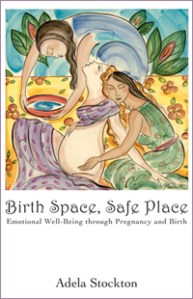
I am fortunate to have an extra copy of the new book Birth Space, Safe Place: Emotional Well-Being through Pregnancy and Birth. to give away to one lucky reader! 🙂 You can read my review of the book in the post below. There are three ways to enter to win the book and you will receive an entry for each method you employ (please make a separate comment for each of your entries):

1. Leave a comment on this post sharing your most helpful tip for emotional well-being during pregnancy and birth. I would like to compile these tips into a new blog post in the future (so if you don’t want me to include yours in that, please let me know!)

2. Become a fan of Talk Birth on Facebook (and post a comment here letting me know you are a fan).

3. Post about the giveaway on your blog and post a link back to it as well as a comment letting me know you did so.

Have fun! This is an interesting and useful little book and I know many people would enjoy having a copy. I will draw for the winner on Friday, January 22 at noon, so make sure to enter before that date!

Book Review: Birth Space, Safe Place

Birth Space, Safe Place: Emotional Well-Being through Pregnancy & Birth
By Adela Stockton
Findhorn Press, 2009
ISBN 978-1-84409-165-2

102 pages, paperback, $14.95
http://www.findhornpress.com

Reviewed by Molly Remer, MSW, ICCE

Appropriate for first time mothers as well as women having subsequent children, Birth Space, Safe Place is a slim and succinct little volume with a sole center: emotional well-being throughout pregnancy and birth. This very specific purpose is what makes the book special. It focuses on creating the emotional space for a gentle birth as well as a physical environment conducive to gentle, physiological birth. However, there is a broad range of topics covered within this specific focus including pain, fear, support, the “cocktail” of labor hormones, avoiding physiological disturbances of the birth process, optimal fetal positioning, and blessingways.

The chronology of the book flows from “conscious conception” through making decisions about birth location, preparing for labor, support during birth, “the spirit of birth,” and “early parenting joys and griefs” which addresses birth processing and postpartum recovery. The chapter on “cleansing the past” briefly addresses prior loss and bereavement, difficult previous birth experiences, and issues of abuse. Each section contains brief personal anecdotes, some from the author and some from mothers she has worked with. The exploration of each topic is brief, but is an adequate overview.

The author is a “childbirth homeopath” and so there are several sections about homeopathic remedies for specific symptoms or concerns. Aside from the homeopathic content, I did not feel as if I learned anything particularly new from the book, however it was very nice to have information about a specific element of pregnancy and birth preparation all pulled together into one nurturing place.

Birth Space, Safe Place is very supportive of doulas—for both labor and postpartum—and also of midwifery care and homebirth.

The book contains three appendices, endnotes, references, a glossary, and resource listing. The book is written in the UK (author is in Scotland), so National Health Service care is assumed and that system of maternity care, midwifery, and homebirth. The first appendix briefly addresses differences in US and Australian midwives compared to the UK.

And, make sure to check out my giveaway of Birth Space, Safe Place here!

Disclosure: I received a copy of this book for review purposes.

Does Water Slow Down Labor?

il_570xN.684257213_8rjiA concern commonly expressed about using water during labor is that immersion in a tub of warm, soothing water has the potential to slow down or even stop labor, particularly in the early stage. For many women, this is not a desirable effect!

The Waterbirth International website (www.waterbirth.org) shares this information about choosing when to get into the water:

A woman should be encouraged to use the labor pool whenever she wants. However, if a mother chooses to get into the water in early labor, before her contractions are strong and close together, the water may relax her enough to slow or stop labor altogether.  That is why some practitioners limit the use of the pool until labor patterns are established and the cervix is dilated to at least 5 centimeters.

There is some physiological data that supports this rule, but each and every situation must be evaluated on its own.

Some mothers find a bath in early labor useful for its calming effect and to determine if labor has actually started. If contractions are strong and regular, no matter how dilated the cervix is, a bath might be in order to help the mother to relax enough to facilitate dilation.

Therefore, it has been suggested that the bath be used in a ‘trial of water’ for at least one hour and allow the mother to judge its effectiveness. Midwives report that some women can go from 1 cm to complete dilation within the first hour or two of immersion.  The first hour of relaxation in the pool is usually the best and can often help a woman achieve complete dilation quickly.

In the book, Birth Day: A Pediatrician Explores the Science, Mystery, and Wonder of Childbirth, Dr. Mark Sloan explores the biochemical reason why water immersion can slow down labor. I found the explanation interesting as well as logical:

When a laboring woman climbs into a bath, the refreshing buoyancy she feels sets off a chain of physical and hormonal events. As her muscles relax, her catecholamine levels—the ‘fight or flight’ hormones that rise in labor—decrease. This can actually help her labor progress, as excessive levels of catecholamines are known to slow down uterine contractions.

But countering that lowered-catecholamine labor boost is the effect that water pressure has on other maternal hormones. When a mother sinks deep into a tub, the weight of the water on her body forces fluid contained in her tissues into her bloodstream, thus increasing her blood volume. Sounds like a good idea—increased blood volume means increased cardiac output and oxygen-carrying capacity, and oxygen is a good thing to have coursing through your arteries when you’re trying to have a baby.

But the weight of the water on a woman’s body also causes a ‘pooling’ effect in the blood vessels inside her chest, because the rib cage protects the lungs from the water-pressure squeeze exerted on the softer tissues of the limbs and abdomen. Over time this leads to a complicated hormonal chain reaction that results in decreased secretion of oxytocin, the uterine-contraction hormone, from the pituitary gland within the brain. With less oxytocin circulating than before she climbed in the tub, a woman’s labor can slow down significantly.

The labor-slowing effect of taking a bath seems to be a problem only if the bath is taken early in labor, though. Once a woman is in active labor, the oxytocin surges are strong enough that no bath in the world can derail them.

The author goes on to explain that current research isn’t clear on when exactly oxytocin levels are high enough to prevent labor from slowing down, but suggests that it is “prudent to hold off on baths until the cervix has dilated to about five centimeters.” He also notes that water immersion during labor does not increase the infection risk for either mother or baby, and that as long as water is kept at body temperature, there is no risk to either of overheating.

I also decided to ask the real experts—birthing women—what their experiences were with water in labor. I posted the question to my Facebook Talk Birth “fan” page and received a few responses:

“I feel like it definitely helped me. I couldn’t find a comfortable position, but when I got out of the water it was definitely worse. It didn’t seem to slow anything down; C was born a few hours after I got in. I plan to blow the ol’ gal up again for the next baby.”–SE

“I have such fast, easy labor that I only get in the water for transition and delivery. I will not do it any other way and kick myself for not doing it with all my births!!! It definitely takes the edge off for me (and no ring of fire either). I think it actually does slow me down a bit, but my births are crazy fast, so that is a good thing.”–NA

“I feel like for first time moms it’s hard to know how to push when you don’t have all of the pressure. I labored in the water with Ashton but delivered him out of the water when things just weren’t finishing. With Brice I knew what I was doing so had no problems pushing Brice out in the water. I really liked the water but haven’t labored without it for transition. My [midwife] also has found that first time moms many times need to get out of the water to deliver and that it can slow down labor.”–RK

“I had a waterbirth with my 2nd, and due to her malpositioning it was by far my most painful birth. Most people say the water really relaxes them and eases pain, but that was not the case with me. Also, one thing I did not realize about water birth babies is that often they are not full of color when they are born. Some people say this is because they have an easier transition into the air. I’m not sure of the reason, but this was very startling for my husband. I just talked to her and rubbed her vigorously, and she pinked up soon after.”–GC

Personally, think the laboring woman should be the guide. If she feels like getting into the water, then it seems like the right time to me! With my second baby, I had a birth pool on hand thinking I may like to try it, but my labor progressed so rapidly that there was no time to blow up the pool, let alone fill it up or deliberate about when to get into it. As midwife Judy Edmunds says, “Waterbirth is one of many lovely ways to enter the world.”

Originally written for the FoMM newsletter.

Sign up for my Brigid’s Grove Newsletter for resources, monthly freebies, and art announcements.

Books About Miscarriage

I recently made a post to my other blog about books about miscarriage. I wanted to link to the post here as well, because my blogs have different readers and I think it is useful to other childbirth educators to have read some books about miscarriage/childbearing loss and also to have some books available in their own lending libraries.

For the list of miscarriage books I’ve read since November, click here: Books About Miscarriage

Birth Symbol

At the very end of August, I went to see Birth, the play in St. Louis. I was about 5 weeks pregnant at the time. Following the play and “talkback” event, there was a BOLD Red Tent (birth stories sharing circle). Right before the birth stories portion of the Red Tent, we did a birth art project. The Birthing from Within Mentor who was facilitating the Red Tent asked each of us to draw a symbol on a card that communicated what we would want to share with other women about birth—not in words, but a visual representation of the message we’d like to share. We then painted our symbols onto prayer flags to be strung together as a whole “language of birth” in symbols. We left the flags with her to be taken to births to share the symbols with other birthing mamas. I drew a spiral and explained that the message I was sharing was, “You can do it. You’re okay. Let it happen.” I also added a little birth goddess with wild hair that to me represents the intuitive birth wisdom women carry with them (when I was pregnant with my first baby I was worried about being too “in my head” to give birth powerfully–I created a series of needled felted sculptures of birth goddesses with wild hair and worried that the hair showed that I was too in my head. After he was born, I realized that my sculptures were telling me about the wild, natural, birth wisdom I had in my head, not the “book learning” that was also there and was what I had worried about interfering with the flow of birth).

A few days following my miscarriage in November, I received a Facebook message from the BfW mentor (and friend) who had facilitated the Red Tent session. She attached a photo of the flag I had painted during the Birth Art session and asked me to “allow the gift to come and sit with you” (as well as gifting me with “no response necessary”).

It was amazing to have my own birth symbol come back to “speak” to me in this way during such a painful (and also transformative) time.

“You can do it. You’re okay. Let it happen.”

Adding More Birth Quotes…

To my ongoing collection (previously posted to my Facebook fan page, but sharing here as well. There are some grief/miscarriage quotes mixed in as well):

“Birth is valuable. It gives rise to our entire future. There is power in our ability to give birth to the future of our planet. We need to reclaim that power.” –Ginger Garner

“Birth is the epicenter of women’s power.” – Ani DiFranco

“To parent well, you have to have the gentleness and courage of a warrior.” –Carol (in the book Joyful Birth)

“There is no foot so small that it cannot leave an imprint on this world”

“You’re braver than you believe. Stronger than you seem. And smarter than you think.”– Christopher Robin

“Rivers know this: there is no hurry. We shall get there some day.” Pooh’s Little Instruction Book (added by a Facebook fan in response to the above)

“Nature, time, and patience are the three great physicians.” –Greek Proverb

“Life isn’t about waiting for the storm to pass. It’s about learning to dance in the rain.” –author unknown

Addition to the above from Teri Shilling’s blog. Her adaptation is: “Birth is not about waiting for it to be over. It’s about learning to dance through it.” — Teri Shilling

“We receive fragments of holiness, glimpses of eternity, brief moments of insight…Let us gather them up for the precious gifts that they are and, renewed by their grace, move boldy into the unknown.” –Sara York

“A Survival Meditation” by Nathan Walker. It begins: “breathing in…i am aware of my pain….breathing out…i am aware that i am not my pain…breathing in…i am aware of my past….breathing out…i am aware that i am not my past.”

“Birth goes best if not intruded upon by strange people and strange events. It goes best when a woman feels safe enough and free enough to abandon herself to the process.” –Penny Armstrong & Sheryl Feldman

“Your body is the life force power of some fifty trillion molecular geniuses…Own your power and show up for your life [birth]. Beam bright!” –Jill Bolte Taylor

“What makes a good birth experience [depends on] how we discover that energy and enthusiasm that carry us through any challenging situation in life.” –Suzanne Arms

“I will welcome happiness for it enlarges my heart; yet I will endure sadness for it opens my soul.” –Og Mandino

“Whereas loss changes us, grieving loss transforms us. Through the process of mourning, we are rehsaped into more highly evolved souls than we previously were.” –Marie Allen & Shelly Marks

“Growth is measured by…the openness with which we continue and take the next unknown step, beyond our edge…into the remarkable mystery of being.” –Stephen Levine

“Motherhood isn’t just a series of contractions, it’s a state of mind. From the moment we know life is inside us, we feel a responsibility to protect and defend that human being.” –Erma Bombeck

“Over the passage of time, we do more than survive the journey. We go through a labor of self-discovery and give birth to the being deep within…we emerge more enriched, empowered, and evolved women, connect with the instinctual wisdom that lies deep within us, and experience the more whole life we deserve…grieving …opens a door into our souls that might otherwise not have been opened.” –Marie Allen & Shelly Marks

“You are strong! Your body was made to give birth!! You aren’t broken, you aren’t incapable, and you aren’t special!! Your grandmother did it, your great, great, great grandmother did it, and you can toooo!!!” –Hathor the Cowgoddess

“As a mother to be, your critical task is to prepare for a birth that has no script. This requires great courage, flexibility, and a capacity for inner awareness.” –Pam England

“All natural birth has a purpose and a plan; who would think of tearing open the chrysalis as the butterfly is emerging? Who would break the shell to pull the chick out?” –Marie Mongan

(Butterfly & the Cesarean story link shared by a Facebook fan)

“You are pregnant and you are powerful. You are bold and you are beautiful. Go forward in your boldness, in your beauty and in your connectedness. Trust your body to birth and know that the collective power of women worldwide will be with you.” –Your Birth Right

“Nursing does not diminish the beauty of a woman’s breasts; it enhances their charm by making them look lived in and happy.” ~ Robert Heinlein

“[When a woman] has had an ecstatic birth, you can’t talk her into taking drugs that aren’t good for her body. You can’t talk her into a hysterectomy…You can’t talk her into a crummy diet…She knows what this body is capable of. She loves this body. This body loves her…there’s nothing like the transformation avail…able at birth…she becomes illuminated…she’s a channel for life…she’s a channel for life in all its forms.” –Christiane Northrup, MD

“Miscarriages are labor, miscarriages are birth. To consider them less dishonors the woman whose womb has held life, however briefly.” –Kathryn Miller Ridiman

“Character cannot be developed in ease and quiet. Only through experiences of trial and suffering can the soul be strengthened, vision cleared, ambition inspired and success achieved.” ~ Helen Keller

“Motherhood instantly ups your ante in the human sweepstakes. It gives you a very personal stake in the future, and makes you vulnerable…It can also empower. Women who hesitated to speak for themselves may find their voice and advocate energetically for themselves as mothers and for the welfare of their children. Motherhood…the single most common transformational experience in the world.” –Valerie Young

“I think one of the best things we could do would be to help women/parents/families discover their own birth power, from within themselves. And to let them know it’s always been there, they just needed to tap into it.” –John H. Kennell, MD

“[sex], birth, and breastfeeding are survival behaviors of our species, and they’re not supposed to hurt…The way we structure those behaviors often contributes to the pain that is experienced…”–Kathleen Auerbach

“Women birth everywhere–in woods, in shacks, in quaint homes and suburbs and palaces, under trees, in taxis, and lately, in clinics and hospitals. It’s hard to birth in power without privacy, love and a place called home…” –Sister MorningStar

“The especial genius of women I believe to be electrical in movement, intuitive in function, spiritual in tendency.” ~Margaret Fuller

“Birth today is a doctor dictatorship in many practices and in many hospitals. Mothers and babies are missing the healthiest possible beginning, both physically and emotionally. Their human rights are being violated.” –Jan Tritten

“If society hinders the optimal breastfeeding by mothers who work outside the home, society needs to change, not women.” –Elisabet Helsing, World Health Organization

and from UNICEF: “The promotion of breastfeeding must not be seen as an excuse to exclude women from the labor force. The burden should no longer fall on women to choose between breastfeeding and work. The burden is on society to facilitate breastfeeding and indeed child care.”

“One does not give birth in a void, but rather in a cultural and political context. Laws, professional codes, religious sanctions, and ethnic traditions all affect women’s choices concerning childbirth.” –Adrienne Rich

Discussion following on the Facebook page: Me: Do couples truly have a free choice of where to give birth? Ultimately speaking, I guess yes, but according to my clients insurance companies dictate their birth location…
Another poster:
The choice is taken from people far too often! Money talks, doctors can scare, insurance companies manipulate, etc., etc.
Sometimes the choice is pretty much taken away. 😦
AND the cultural, political, etc. The quote is so true… our choices don’t occur in a void, all those things affect choices in childbirth. Its just that sometimes, many of those choices are dictated by the above, and so, can severely limit what we do get to choose.
Me again: When we do the “pain pie” exercise in my classes, I always talk about how sometimes choices are actively stripped away from women and we need to keep that in mind when we hear “bad” birth stories–not, “she ‘failed’ or made the ‘wrong’ choices” but that her pieces of the pie were taken away from her (sometimes forcibly!).

Prompted by the above:

“The most common way people give up their power is by thinking they don’t have any.” –Alice Walker

“Life becomes precious and more special to us when we look for the little everyday miracles and get excited about the privileges of simply being human.” -Tim Hansel

“The beauty of my body is not measured by the size of the clothes it can fit into, but by the stories that it tells. I have a belly and hips that say, ‘We grew a child in here,’ and breasts that say, ‘We nourished life.’ My hands, with bitten nails and a writer’s callus, say, ‘We create amazing things.'” -Sarah (I Am Beautiful)