If you have had the misfortune, as nearly all of us who can read and write have had, to see a baby born, perhaps pulled out, under bright lights with glaring eyes and loud noises of all sorts, in a setting that smells like nothing human, with a mother shocked and teary and scared; if you have witnessed or performed touch that can only be described as brutal and cruel in any other setting…
Every baby born deserves uninterrupted, undisturbed contact with her mother in the environment the mother has nested by her own instinctual nature to create. Any movement we make to enter that inner and external womb must be acknowledged as disturbing and violating to what nature is protecting. We do not know the long-term effects of such disturbance. We cannot consider too seriously a decision to disturb a newborn by touch, sound, light, smell and taste that is different and beyond what the mother is naturally and instinctually providing. Even facilitating is often unnecessary if the motherbaby are given space and time to explore and relate to one another and the life-altering experience they just survived. They both have been turned inside out, one from the other, and the moment to face that seemingly impossible feat cannot be rushed without compromise. We have no right to compromise either a mother or a baby.
I am deliberately leaving out the issue of life-saving because it has become the license for full-scale abuse to every baby born… [emphasis mine]
In the same issue in an article called Problems in American Maternal Health Care, Dan Currin points out:
Americans put a lot of trust in their physicians. We are socialized to believe that physicians are the only ones capable of taking care of us. For everything from how to eat to how to die, the mantra is the same in the US: ‘Ask your doctor.’ Meanwhile, physicians are more and more subject to a system that, as Gaskin describes, favors the priorities of hospitals, insurances companies and doctors above the best interests of mothers and their babies
And, Judy Slome Cohain writing in Collusion and Negligence in Hospitals describes it thusly:
To err is considered human, even when it involves maternal death, at a hospital birth. When a woman dies from malpractice after birth the protocol is to hold meetings to consider how to improve relevant protocols to prevent future disasters. Survival of the hospital is first and foremost. However, if a woman dies at an attended homebirth, the Ministry of Health policy is to start a case against the guilty part in a disciplinary court…”
We also need to consider the role of birth “imprinting” on the breastfeeding relationship:
New mothers, and those who help them, are often left wondering, “Where did breastfeeding go wrong?” All too often the answer is, “during labor and birth.” Interventions during the birthing process are an often overlooked answer to the mystery of how breastfeeding becomes derailed. An example is a mother who has an epidural, which leads to excess fluid retention in her breasts (a common side effect of the IV “bolus” of fluid administered in preparation for an epidural). After birth, the baby can’t latch well to the flattened nipple of the overfull breast, leading to frustration for both mother and baby. This frustration can quickly cascade into formula supplementation and before she knows it, the mother is left saying, “something was wrong with my nipples and the baby just couldn’t breastfeed. I tried really hard, but it just didn’t work out.” Nothing is truly wrong with her nipples or with her baby, breastfeeding got off track before her baby was even born!
Lots of birth stuff to share this week! I may be slowly transitioning away from face-to-face birth work, but reading and writing about birth definitely remain on my agenda. First, this post about pivotal moments in one birth professional’s journey:
Thanks to a powerful recent blog by a doula in England about her experience in a Birthing from Within workshop, I have found myself reflecting on my own path as a doula and childbirth educator. Over the years I’ve done ICEA training, DONA Birth Doula Certification, and Birthing from Within Mentor Certification, along with apprenticing as a midwife and a Masters of Science in Parent-Child Nursing – more than my fair share of learning. Through the past twenty + years of practice I can identify the 7 core experiences that have shaped who I am as a birth professional.
Reading her list brought back some of my own pivotal moments and also helped me see how those moments relate to my current priestess/women’s mysteries path. I think I’ve already mentioned that I renewed my ICEA CBE certification this year, but I let my CAPPA certification lapse. I will let my prenatal fitness educator certification lapse as well and I did not renew my membership in several birth-related organizations. And, in a complicated decision related to a variety of factors, I withdrew my registration for a Birthing from Within mentor training this fall. I’ve wanted to train with BfW for ages, but I realized after we got home from California that I just can’t picture myself doing birth classes any more. Single day workshops or presentations, yes, but teaching (or mentoring) series of birth classes is just not on my radar any longer. I feel removed from or distant from it and I also feel okay with that. It is taking me quite some time to realize that birth writing is still a legitimate form of birthwork/birth advocacy/activism and I don’t need to feel like I “should” be doing something else in order to be valuable.
And, I’m so thankful that Missouri midwives have now known the freedom to practice for five years! I meant to post this link in an earlier Tuesday Tidbits post:
There is something so genuine, so deep, so…right about women serving women. Midwifery and midwives are intricately woven into the fabric of my life.
Don’t forget to watch the lovely Ballad of the Midwife video that goes with it! Both the video and the post were created by a talented friend of mine 🙂
Speaking of friends, check out these large family blogs and vote for my friend Shauna’s blog Life with 7 Kids! (she just welcomed a new baby, so it is 8 kids now! :))
And, speaking of videos, after seeing a pretty hands-on, baby-twisting sort of breech birth in Birth Story, I found this pictorial article to be a good reminder with lots of useful pictures:
Most important rule is HANDS OFF THE BREECH no matter how tempting it is just to pull on that leg DON’T. It’s the easiest way to create nuchal arms and a completely deflexed head. When you pull on the leg you create a morro reflex in the baby.
“Remember this, for it is as true as true gets: Your body is not a lemon. You are not a machine. The Creator is not a careless mechanic. Human female bodies have the same potential to give birth well as aardvarks, lions, rhinoceri, elephants, moose, and water buffalo. Even if it has not been your habit throughout your life so far, I recommend that you learn to think positively about your body.”
― Ina May Gaskin, Ina May’s Guide to Childbirth
I know the traditional root of the word midwife is “with woman” (some sources say “wise woman”), but I’d like to offer another. When I was pregnant with my second son, I had a wonderful midwife and we spent many hours together talking about birth and midwifery. During one conversation she said to me, “you can’t be a midwife unless you love women.” This struck me profoundly—a midwife must love women.
Oh, and speaking of this loving women and this not being a lemon stuff…
Respect for our bodies, our babies, and our rights is never too much to expect.
That’s why I’m joining forces with the folks I thought were nuts. Remember the ones waving the signs? The ones I thought were nosy, yoga-ball bouncing doctor-haters? Turns out, they are none of those things. They are a smart, growing global coalition of people who recognize that we have a problem with the way many women are treated while giving birth. Nine out of 10 women give birth in a hospital in the United States. Through rallies and advocacy, ImprovingBirth.org is making sure everyone knows that all those women do not check their human rights at the door.
But, what happens after the birth? I’ve often thought that my role in breastfeeding support, while less “glamorous” or exciting than birth work, has had more lasting value to the women I serve. Breastfeeding is the day in, day out, nitty-gritty reality of daily mothering, rather than a single event and it matters (so does birth, of course, it matters a lot, but birth is a rite of passage, liminal event and breastfeeding is a process and a relationship that goes on and on for every. single. day. for sometimes years). Anyway, sorry for the brief side note, but I enjoyed reading this article about the celebrity culture surrounding pregnancy and birth with its obsession with who has a “bump” and then how after the birth the main deal is losing that weight and having a fabulous bod again! Woot!
And that’s it. There’s no talk of the hard decisions and challenges that arise when bringing another human in the world: coping emotionally, miscarriages and health risks throughout the pregnancy, emotions that range from excitement to loss, how the partner is coping, decisions surrounding the birth, doulas, home birth, hospital birth, breastfeeding, milk supply, c-section recovery, vaginal recovery, colic, sleep, schedules, being tired all the time, depression, regret, fear, hiding in the bathroom crying. Agonizing decisions about work, caregivers and new priorities. Maternity leave. Paid time off. Unpaid time off. Pumping at work. Making time for your partner. Making time for yourself. A body that has changed but can also do incredible things.
Instead it’s mostly about getting skinny again after the baby is born, which we’re told over and over again is the MOST IMPORTANT THING. And it’s not. I know it’s not, and yet I have a constant dialogue in my head about how I have thirty pounds to lose and my thighs rub together and my stomach is bloated and has the texture of a grape that’s not quite a raisin and my face is fat and I’ll never fit into my old clothes again. I say this to friends (who haven’t had kids) and the response is: “Focus on the amazing thing your body just did, girl! A baby came out of you! You’re being too hard on yourself!” And they are right. I know this. But I can’t shake the feeling that I’m a failure because I’m not the size and shape I once was. And then I feel dumb and embarrassed for focusing on my looks when I should be celebrating how awesome it is that I’m a mom to two healthy, wonderful kids. It’s an exhausting, stupid cycle.
There is an important conversation to have about motherhood that we’re not having on a larger level. I know this because I talk to moms all the time. None of us are talking about maxi dresses or nursery colors or how we worked out for 90 minutes a day with our trainers while wearing a corset. We’re talking about how our maternity leaves don’t feel long enough. How often there’s nowhere to pump at work so we do it in our cars. How frustrating it is to be making too much milk/too little milk. How some days we can’t stand our partners, and on other days they totally save us.
Reading all that and thinking about my own “grape” stomach that just isn’t quite making it back to “normal” after having my last baby, I was reminded of a quote from a very recent post:
“…we all need the renewing powers of ‘rhythm, ritual, and rest.’ This phrase reminds doulas of three helpful labor techniques outlined by legendary doula trainer, Penny Simkin. Rhythm, ritual, and rest not only aid birthing women, but they support all of us to move skillfully through our life’s labors. The power of rhythm restores vibrancy through dance, music, and motion. The power of ritual opens the way to direct encounter with the mysterious wonder of life. Rest renews and restores the very cells of our often tired and over-stimulated bodies and minds…” –Amy Wright Glenn
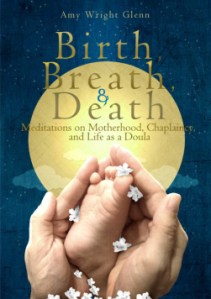
I just finished reading a lovely little book by Amy Wright Glenn. Lyrical, gentle, contemplative, and touching, Birth, Breath, and Death explores Amy’s meditations on life as a doula, mother, and hospital chaplain.
Amy Wright Glenn was raised as a Mormon and eventually found her way onto a different faith path, Unitarian Universalism. Her reasons for connecting with the UU church actually closely mirror my own. Amy mentions that she first finds the UU church through her interest in poetry, which I found interesting. She then explains, “I was drawn to the way that Unitarian Universalist (UU) ministers attempt to evoke wonder and exploration in the minds and hearts of their congregants” (p. 10). This attempt to engage with the “transcendent sense of mystery and wonder” is exactly what attracted me to the UU’s, as well as the respect for the interdependent web of life of which we are all a part, the affirmation of the dignity and worth of each human being, and the commitment to social justice.
Amy writes, “I had been raised to acknowledge only one entrance to God’s energy. In fact, one need not use the term ‘God’ at all. Such a term is another doorway into the mysterious heart unifying all existence. However, humans need language to direct the attention to the ineffable. There are many names for this mystery. The doorways were holy too” (p. 13).
She continues with a very UU perspective (I’ve heard of it describes as “the light shines through many windows. We respect all windows and welcome everyone, except for those who think they should throw rocks through everyone else’s window!”):
“Spiritual surface structures open human beings to encounters with the ineffable…I have no doubt when my father bows his head in a small Utah town, and when I meditate in quiet sublime stillness, we touch the same source. At their best, religious traditions affirm the wonder at the heart of existence and provide meaningful contexts for its experience. This mystery allows us to breathe, dream, love, and dimly perceive so,etching beyond time even while we live in time…The moon is simply the moon, a miracle enough” (p 16).
I connect to this sense of wonder, with no need for explanation or interpretation—isn’t it is enough, to just marvel at what is? On my other blog, I once wrote:
I also have a favorite passage from Susan Griffin about the earth in which she exclaims, “We are stunned by this beauty.” That is exactly how I feel. This relationship to the planet is what used to make me feel that a conception of deity was unnecessary—isn’t it enough to just marvel at what is, right here in front of us? The majesty and the miracle of the natural world. I am stunned by this beauty. I am stunned by the realization that we are all suspended in space, spinning timelessly through the universe on this beautiful planet, so small in the vastness of all that surrounds us, and yet so big that it is literally our whole world. Sometimes when I have a bad day or feel overwhelmed by the swirl of daily tasks I remember that old saying about, “sometimes I go about pitying myself when all the while I am being carried by a great wind across the sky.” If we really stopped to think about this—to sense how we are carried by the great wind, I think the whole world would change, how people relate to each other and to the environment would be transformed. Stop, look, listen, breathe, and feel how we spin. Together.
Moving into birth, Glenn addresses the potent, transformative aspects of birth in describing attending her sister’s birth, the birth that led her into doula work (before the birth of her own son): “Birth brings powerful and painful sensations to the most intimate spaces of the female body…I stood transfixed by the life-giving strength found in her feminine power.”
She also explains:
“All forms of birth–physical, intellectual, spiritual, or emotional–bring one to the depths. The power to give birth originates in the creative life spirit birthing all, the seen and the unseen. According to Joseph Campbell, the source of life is beyond gender and the duality of male and female. However, when symbolizing the power that creates, Campbell argues the representation is ‘properly female.’ I agree. From this universal goddess energy emanates the seasons, the mountains, the rivers, and the galaxies. Writ large, human birth embodied the process of manifesting dreams, working diligently through our labors, and bringing vital energies to life. On this level, all human give birth. All humans participate in life’s creative energy…
On this level, we all need the renewing powers of ‘rhythm, ritual, and rest.’ This phrase reminds doulas of three helpful labor techniques outlined by legendary doula trainer, Penny Simkin. Rhythm, ritual, and rest not only aid birthing women, but they support all of us to move skillfully through our life’s labors. The power of rhythm restores vibrancy through dance, music, and motion. The power of ritual opens the way to direct encounter with the mysterious wonder of life. Rest renews and restores the very cells of our often tired and over-stimulated bodies and minds.” (p. 28-29).
And, she makes some poignant observations about breastfeeding, one that almost made me cry: “…only a child knows what his mother’s heartbeat sounds like from the inside” (p. 67) and one that made me cheer: “Family and friends need to draw a fierce circle of protection and non-interference around the nursing mother-child dyad.”
In giving birth to her own son, Amy’s awareness and understanding are further deepened and expanded and she explains that:
“For me, birthing was a crucible moment, a dying, a deepening, and a healing. The light of birth transformed me into a mother. The light of birth is love. Looking back I see this clearly. Love was the pain and joy. Love restored me as I rested and held me up when I transformed into a wild eyed Kali. Love chanted with me in the birthing tub and love was certainly the epidural. Love pushed my baby out and gazed at me through Taber’s eyes. Love sustains me now as I watch his sweet small mouth suckle…” (p. 68)
Towards the end of this sweet, thoughtful book, she also used a great analogy that I’m going to borrow for my human services classes. She posits the scenario in which you are passing by a pond on the way to work and notice a small child drowning. You are wearing an expensive pair of new shoes and rushing into the water will ruin them. Do you rush in? The answer is YES. No one should choose their shoes over the life of the child and almost no one would respond to this scenario by saying that they would not save the child, yet, if the pond is world poverty, we do in fact, choose the shoes every day…we just aren’t looking those children in the eyes at the time…
—
Disclosure: I received a complimentary copy of this book for review purposes.
I have never met anyone with more than a passing interest in birth activism who has not heard of Ina May Gaskin. She isn’t referred to as a the world’s most legendary midwife for nothing! But, how did she get this way? The new documentary film, Birth Story, helps explore that question.
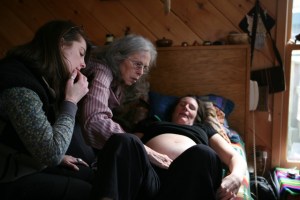
Prenatal visit
“The feature-length documentary BIRTH STORY: INA MAY GASKIN & THE FARM MIDWIVES tells the story of counterculture heroine Ina May Gaskin and her spirited friends, who began delivering each other’s babies in 1970, on a caravan of hippie school buses, headed to a patch of rural Tennessee land. With Ina May as their leader, the women taught themselves midwifery from the ground up, and, with their families, founded an entirely communal, agricultural society called The Farm. They grew their own food, built their own houses, published their own books, and, as word of their social experiment spread, created a model of care for women and babies that changed a generation’s approach to childbirth.
Forty years ago Ina May led the charge away from isolated hospital birthing rooms, where husbands were not allowed and mandatory forceps deliveries were the norm. Today, as nearly one third of all US babies are born via C-section, she fights to preserve her community’s hard-won knowledge. With incredible access to the midwives’ archival video collection, the film not only captures the unique sisterhood at The Farm Clinic–from its heyday into the present–but shows childbirth the way most people have never seen it–unadorned, unabashed, and awe-inspiring.”
I really enjoyed Birth Story. It skillfully weaves together vintage footage, commentary, and births with a present day shadowing of Ina May in her natural environment: at the Farm. The documentary shows her working in her kitchen, eating, talking to her husband, watering plants, riding her bicycle, teaching workshops, training midwives, going to prenatal visits, and finally, attending a very hands-off gentle waterbirth. It also lets us peek at images from the early days of The Farm community, the caravan of buses, the dreams of Stephen Gaskin and the “hippies” who followed him to Tennessee. Birth Story is not just a film about Ina May though, it chronicles the experiences of several other Farm midwives as well, and I loved hearing the commentary and opinions of the less-famous midwives who helped transform the birth world.
I found footage of Ina May with Stephen to be particularly poignant and very much enjoyed the vintage photos and footage. I also find it interesting how The Farm began because of Stephen’s leadership and ideas and yet Ina May took off as the ongoing famous person in the family. Of Stephen, Ina May explains: “He thought women we supposed to be uppity—this was great relief, I didn’t like being held down.”
Ina May describes her own first birth explaining that in typical birth climates, “there’s nothing about the special energy of birth and that’s kind of the most important thing…I felt like I was doing something sacred.” She also makes the basic and crucial point that the number one rule of maternity care should be Be Niceand laughs as she asks us to consider how just those two words could change maternity wards. There are only a handful of actual births in the film, three of which are from sometime in the 1980’s. We see a breech birth (a lot more hands-on than I think of present-day midwifery practice) and a shoulder dystocia, both rare occurrences in birth films. We also see brief footage of Ina May’s Safe Motherhood quilt project and a brief discussion of disparities in maternal mortality rates.
Another highlight of the film for me was midwife Pamela, whose birth we also see on-screen. She is shown telling us about an early birth she attended saying, “I fell in love with women. How can you see someone be so strong and not fall in love?” Exactly. My doula and friend, Summer, who watched the film with me, developed her reaction to this quote in a lovely blog post and it reminds me of my own past post about my own former midwife who helped me see that midwife means loves women. Ina May explains that she learned how to be a midwife by allowing herself to be instructed by the women themselves and then she trained other midwives. As I watched Birth Story I found myself feeling a little sad, nostalgic, and bittersweet, because I feel like the world that these beautiful midwives envisioned has yet to really be birthed and that in some ways we’ve gotten so far away from the relationship-oriented and community living/engagement model upon which The Farm was based.
My initial feeling as I watched the film was that it would be primarily of interest to people already very familiar with Ina May, thinking that it may not appeal to or interest “regular” people. However, the friends I viewed the film with had totally different perspectives. One friend told me she thought her husband would really have liked the documentary, particularly for the emphasis on community. The one husband who was present reported that he thought everyone should see the film and not just people who are already “birth junkies.” So, I stand corrected, and will now say that Birth Story has the capacity to engage with many people!
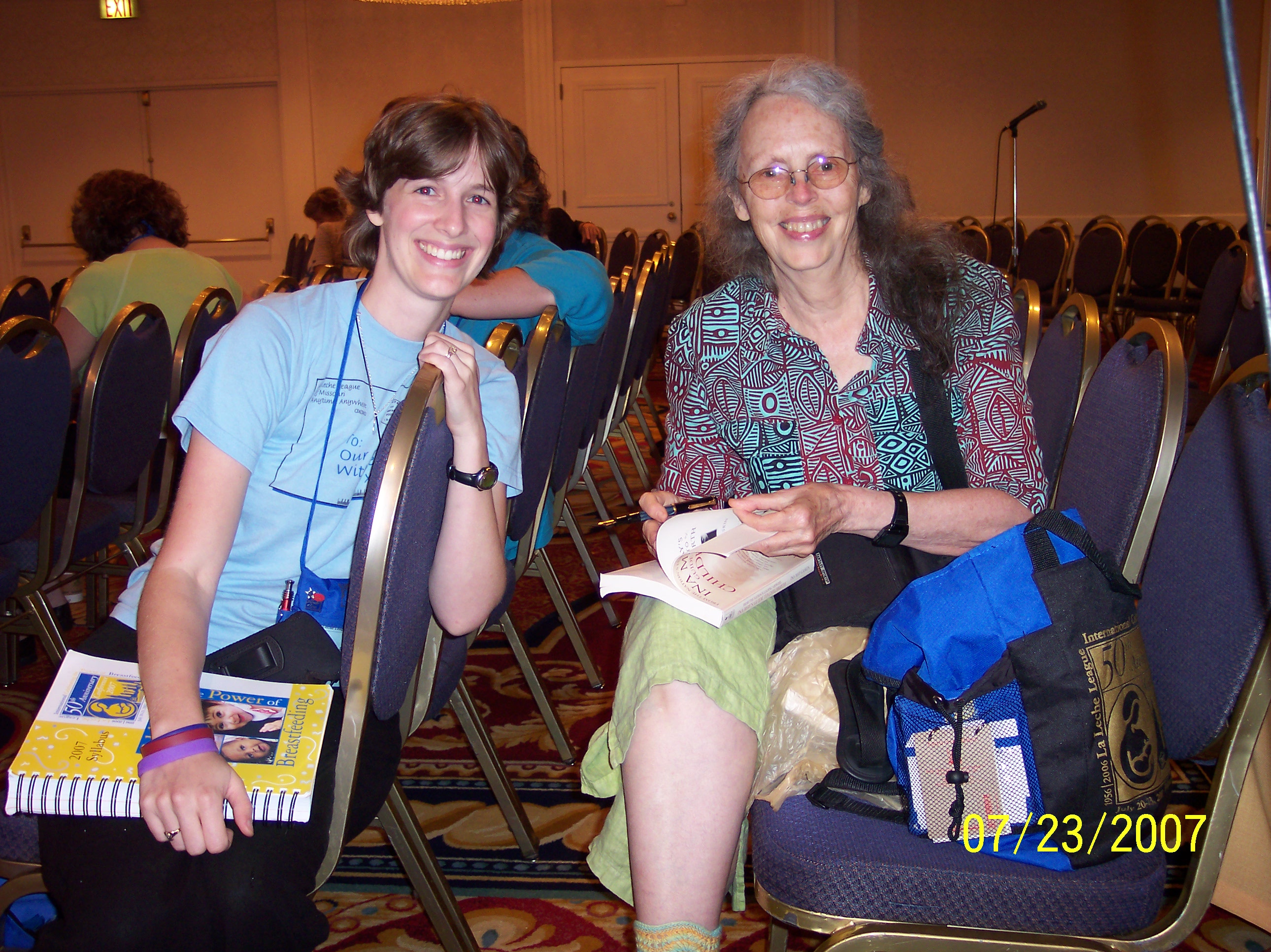
In 2007, I had the opportunity to listen to Ina May speak in person at the La Leche League International conference in Chicago. She talked about sphincter law and made the association with our bodies’ capacity for bowel movements and women’s physical capacity to rebound from childbirth. I will never forget her saying: “I don’t know about you, but my butt closes back up after I poop.” That summed her up for me: plainspoken, real, matter-of-fact, and practical. She’s a legend!
Starstruck? Oh, yes I am. My husband said, “these people are like your *celebrities.*”
—
Disclosure: I received a complimentary screening copy of the film for review purposes.
“Birth brings powerful and painful sensations to the most intimate spaces of the female body…I stood transfixed by the life-giving strength found in her feminine power.” –Amy Wright Glenn writing about attending her sister’s birth (Birth, Breath, & Death)
What About Unexpected Outcomes?
If one factor contributing significantly to a woman’s satisfaction with her birth experience is having better than expected outcomes, how then can birth educators prepare women for unexpected outcomes? As Pam England notes, “Many women are conditioned to believe that if they have lots of information, then they will ‘pass the test’ or be able to control their birth outcome” (England, 2007).
Is it possible to truly prepare couples for unexpected outcomes? Though others may disagree with me, I have to wonder if the answer is “no.” (I confess to also wondering the same thing about truly preparing for giving birth!) I used to spend a whole class session on complications/unexpected outcomes, but suddenly awoke to the realization that most people’s whole lives have been a “class” in “birth complications.” Do they really need to hear it from me too or am I undermining the very confidence I seek to build? Undoing the new messages and competencies I’ve tried to instill?
Instead of a whole class on complications, I switched to spending a short section of class asking couples what they were worried about or if they had fears about specific complications. (Since I usually taught classes one-to-one, there was a certain sense of security with sharing vulnerable emotions that may not be present with larger class settings.) Bringing fears out into the open to “look at” helps shift the perspective from “frozen” fears to coping strategies. After they share their concerns, I usually mention maternal or fetal death because I believe it is important to acknowledge this most scary of fears. I also encourage them to include options for unexpected events during labor or with mother or baby on their birth plans (based on the birth planning worksheet in the book Pregnancy, Childbirth, and the Newborn by Penny Simkin). I share that most births—if not all—involve some element of surprise, the unexpected, loss, or grief. It could be as “small” as disappointment with the baby’s appearance or a sense of loss/grief of the specialness of being pregnant or as a big of a surprise as a baby in the NICU or even death of the newborn. It is normal and okay to experience feelings of grief and loss whether the unexpected event is “big” or “small.” It is helpful to have an understanding of the possibility of the unexpected and the emotions that follow.
I believe this acknowledgment and recognition as well as asking for their personal fears is more helpful as reviewing each and every complication of birth (which is how many CBE programs train their educators!), especially given the widely stated observation that couples dismiss and forget information shared during class that feels—consciously or unconsciously—irrelevant to them (this often includes complications or even postpartum and newborn care). I believe that a generally stated recognition of loss in all its forms is more likely to “stick” because it brings it into the couple’s personal sphere instead of being a more academic exploration.
This post is modified from a sidebar originally published in the International Journal of Childbirth Education accompanying my article about Satisfaction with Birth. I re-post it now in anticipation of a planned post about rituals for coping with unexpected outcomes…
“So many of us are already working towards this aim – mamas (and groups) like LLL for sure, and doulas, women-centred midwives and doctors, and so many others…but really we need more. And there is no time or space for petty jealousies or in-fighting (and no judgments here, because it happens! I know the pain of this kind of sh*t, I’ve written a little about it before – and I may again – but it’s urgent we move beyond this if at all possible…) because we are already losing it – losing this capacity to give birth without intervention, to feed our babies from our own bodies, to experience love and connection in the fulness of which we are intended to be capable…” -Rebecca Wright (see more onwhy all of us are needed)
In “The Doula Phenomenon and Authentic Midwifery: Protection as a Keyword,” Michel Odent, writing in Midwifery Today issue 104, Winter 2012 describes the cultural conditioning of birth to think that women can’t do it on their own:
In this age of videos, photos and television, one cannot ignore that our current cultural conditioning is mostly determined by visual messages. Let us mention the powerful effects of the recent epidemics of videos and photos of so-called ‘natural childbirth.’ Almost always, several people surround the labouring woman. Young generations familiar with these pictures understand that the basic need of a labouring woman is to be accompanied by several persons. The effects of these visual messages are reinforced by the modern vocabulary, for example, to give birth women need a ‘coach’ (bringing her expertise) and support persons (bringing their energy). More than ever the message is that a woman has not the power to give birth by herself.
We must add that this cultural conditioning is now shared by the world of women and the world of men as well. While traditionally childbirth was ‘women’s business,’ men are now almost always present at births, a phase of history when most women cannot give birth to the baby and to the placenta without medical assistance. A whole generation of men is learning that a woman is not able to give birth. We have reached an extreme in terms of conditioning. The current dominant paradigm has its keywords: helping, guiding, controlling, managing…coaching, supporting…the focus is always on the role of persons other than two obligatory actors (i.e. mothers and baby). Inside this paradigm, we can include medical circles and natural childbirth movements as well.
Odent then goes on to explain that while the word doula comes from ancient Greek, actual modern-day Greek people advise him to use the word “paramana” instead, meaning literally, “with the mother.” He concludes his article with these important thoughts:
The doula phenomenon must be interpreted in the context of a period of transition. When the doula is understood as the mother figure a young woman can rely on before, during and after the birth, the doula phenomenon can be presented in a positive way as an aspect of the rediscovery of authentic midwifery. When, on the other hand, the doula is still another person introduced into the birthing place in addition to the midwife, the doctor and the father, her presence is counterproductive. If the focus is on the training of the doula rather than on her way of being and her personality, the doula phenomenon will be a missed opportunity. [emphasis mine]
I am concerned when I see rivalry between doula training organizations, because I think they are doing just this: focusing on the training of the doula rather than her way of being and her personality.
A long time ago I saved these two relevant, if somewhat opposing, quotes about doulas, culture, and advocacy:
First about doulas and collusion with patriarchy…
“I hate to say that the rise in popularity of doulas has done absolutely nothing to alter the status quo of hospital birth, but this seems to me to be true. In the past 10 or so years, the popularity of doulas has risen dramatically. And so has the rate of C-section and interventions in general. Am I suggesting correlation or causation? Absolutely not. Do I think that doulas are well-meaning, amazingly hard-working women who are truly passionate about women and birth and are trying to make a positive difference? Yes yes yes. But sadly, I don’t think they’re going to get anywhere. Because hospital birth is the collision of female power and patriarchy, and we aren’t going to change anything by behaving ourselves or adopting the approach of our oppressors. (No, this isn’t hyperbole. I really believe it).”
And, second about not bringing “politics” into the birth room…
“Now I understand there is a type of doula for everyone. Some women benefit from doulas with a more no nonsense attitude, the ones that don’t sugar coat things or come off more “militant”. Other women prefer a lighter touch or a more “middle of the road” doula. I respect the differences and the need for them. However, I believe there should be a separation of doula and advocate. Politics, in particular your own personal politics, have no business at the birth of your client. Once a client is in labor, any personal agendas should be checked at the door. There is a more appropriate time and venue to try and change faulty birth practices.
I think the same thing goes for the myth that we empower women through these actions at her birth. A woman’s power to advocate for herself and birth in the way she wants isn’t ours to give. It’s her birth and it has to be her job to find the power and be empowered. We can help, we can guide, we can even lead, but we can give that to anyone. Sadly though, through our actions, just like the hospital staff, we can take it away…”
And, then, some more thoughts about the difference between activism and advocacy:
Activism, advocacy and support. As a birthworker I am always using one of these three tools. Sometimes I am using two at once, but never all three. And here is why: Support and advocacy can overlap. Advocacy and activism can overlap. But if you try to overlap activism and support you are going to be either ineffective, alienating, or both…
We definitely need advocacy though and this is why:
Horrific abuse in childbirth happens every day in developing nations where women and their babies are often denied access to life-saving obstetric care.
“I believe that this is one of the important things about preparation for childbirth–that it should not simply superimpose a series of techniques, conditioned responses to stimuli, on the labouring woman, but that it can be a truly creative act in which she spontaneously expresses herself and the sort of person she is. Education for birth consists not, as some would have it, of ‘conditioning,’ but aims at giving a woman the means by which she can express her own personality creatively in childbirth.” –Sheila Kitzinger via More Thoughts on Birth as a Creative Process | Talk Birth.
And, birth matters a lot. It isn’t “just one day.”
“Homebirth cesarean mothers do not complete their births the way they planned, worked for, meditated on, and dreamed of. As a result, their births as mothers are left unfinished. As I told my therapist when my son was six months old, “His birth was finished but my birth, into being a mother, that’s been left hanging.” –via Homebirth Cesarean: “I was still an authentic mother.” – Momma Trauma.
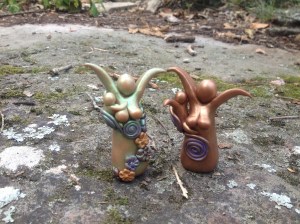
In non-specifically-doula, but birth-related news, I finished some new sculptures and updated my etsy shop! And, one of my breastfeeding mama sculptures was featured in a neat Etsy treasury called Supporting Breastfeeding.
Yesterday, I finished downloading the The Business of Being Born classroom edition kit, which I’ll be reviewing here and hopefully using in my community development class in August. And, I’m also looking forward to finally watching/reviewing Birth Story: Ina May Gaskin and The Farm Midwives on Thursday with my Rolla Birth Network friends! Speaking of Rolla Birth Network, plans are underway for the second annual Mamafest event in Rolla, MO on August 10th. This is a pretty epic event given our smallish town and associated resources. It really was great last year and I expect nothing less this year! I went a little crazy online and bought all kinds of supplies so we can make our own bindis at my booth at Mamafest. I also bought a lot of new charms for several purposes and I’m going to donate my favorite footprints-on-my-heart charms to the Rainbow babyloss support group to make miscarriage memorial charms at their Mamafest booth.
And, finally, as I shared on Facebook earlier this week: I love it when my two-year-old points at my belly casts on the wall and says, GODDESS! And, I’m like, yes, yes that’s me… 😉
I also re-read one of my own articles as I worked on a lesson for one of my classes:
“…I also think, though I could be wrong, that it is possible to plan and facilitate women’s rituals that speak to the “womanspirit” in all of us and do not require a specifically shared spiritual framework or belief system in order to gain something special from the connection with other women…”
After sharing the link on Facebook, I got a lovely comment from a midwife sharing that she shares my handouts with her clients in Trinidad and Tobega and I was humbled at how my “talking birth” in this form reaches out across the ocean and around the world. This is why I keep writing, even when I get discouraged and feel like it is an “indulgence” of some kind to write and blog.
While not about birth, but still related to the overall theme—perhaps how we speak sisterhood—one of my Facebook friends validated my stressed and overwhelmed experiences/feelings of the past month with an “of course” response and I really appreciated it!
“Through the act of controlling birth, we disassociate ourselves with its raw power. Disassociation makes it easier to identify with our ‘civilized’ nature, deny our ‘savage’ roots and connection with indigenous cultures. Birth simultaneously encompasses the three events that civilized societies fear–birth, death, and sexuality.” –Holly Richards
It is almost too late to call today Tuesday, but I’m squeaking this post in anyway! Breastfeeding articles have been catching my eye this week, specifically this one about the life-saving benefits of human milk for the critically injured:
But one exciting question is still unanswered: can breast milk be used medicinally as treatment in babies –and even older children and adults– who may not have been breastfed? There is a growing body of evidence suggesting all sorts of uses for breastmilk as treatment of adult disease. Ads may say, “Milk: Does a Body Good” but in all likelihood, human milk can do a body, any body, better.
Baby Charlotte Rose wasn’t breastfed. Until the age of 11 months, she was a happy, healthy little girl. All that changed radically when she suffered a traumatic brain injury…
And, since the politics of breastfeeding are endlessly fascinating to me, I was curious to read this article by the mother who caused an unanticipated media stir last year with her breastfeeding-in-uniform pictures:
Whoever said a picture can speak a thousand words was right, even when I could speak none. A group of breastfeeding women, including myself, all took part in a photo shoot with the intentions of letting others know breastfeeding is possible regardless of your situation. My main contribution, or so I thought, was that I happened to have twins. Boy was I wrong. Another woman and I, who both served in the Air National Guard, also took pictures in our uniform to show that even those serving could also breastfeed. We were both prior active duty so we knew the struggles of both being full-time and part-time military. Contrary to popular belief, we did get permission to take the pictures. After the pictures were taken, we were going to consult the law office on base and get permission for the photos and positive quotes to go along with them with the goal of having them put into women’s exam rooms…
While some recent breastfeeding research with a very limited sample is making headlines under the misleading title that “supplementing newborns with small quantities of formula may improve long-term breastfeeding rates,” The Academy of Breastfeeding Medicine published a helpful post breaking down the research and drawing more accurate conclusions:
A small study published in Pediatrics suggests that supplementing newborns with small quantities of formula may improve long-term breastfeeding rates. The results challenge both dogma and data linking supplementation with early weaning, call into question the Joint Commission’s exclusive breastfeeding quality metric, and will no doubt inspire intimations of a formula-industry conspiracy. Before we use this study to transform clinical practice, I think it’s worth taking a careful look at what the authors actually found.
First, I think it’s very important to be clear about what the authors meant by “early limited formula.” The authors used 2 teaspoons of hypo-allergenic formula, given via a syringe, as a bridge for mothers whose infants had lost > 5% of their birthweight and mom’s milk had not yet come in. At UNC, we use donor milk in a similar way, offering supplemental breast milk via a syringe as a bridge until mom’s milk production increases.
This is very different from the way that formula supplementation is handled in many US hospitals. We know that in the US overall, 1/4 of breastfed infants are given formula by day 2 of life, and that number reaches as high as 40% in some areas. Typically, when a family member expresses interest in giving the baby some formula, a hospital staff member plunks a 6-pack of 2-oz bottles of ready-to-feed formula in the baby’s bassinet with no instruction about how much to feed. A neonate whose stomach holds one to two teaspoons gets 2 ounces (12 teaspoons) of milk poured into him. The baby then sleeps for the next four to six hours, like someone who’s just over-indulged at a Thanksgiving buffet. In this scenario. Mom doesn’t get any breast stimulation, and family members all express relief that “finally the baby is happy.” When baby finally wants to eat again, there are five more convenient, ready-to-feed, six-hour-nap-inducing bottles sitting in the bassinet. This does not tend to help mothers breastfeed successfully. I worry that the headlines from this study — such as “How Formula Could Increase Breastfeeding Rates (TIME)” and ”How Formula Can Complement Breastfeeding (NYT)” — will translate into “a six pack of formula back in every bassinet!”
Note that the benefit of this very specific type of early supplementation can also be achieved via donor milk. The research does not actually “prove” that formula is helpful for breastfeeding, but that for certain mother-baby dyads, supplementation of some kind via syringe ishelpful. This is NOT the same thing at all as supplementing with a two ouncebottle of formula!
I was glad to see Dr. Newman chiming in on the comments with his no-nonsense opinion: “I also love it how they say their results may not be applicable elsewhere because they live in a community where women are eager to breastfeed and 98% initiate breastfeeding. So surely they must find ways to give these babies formula…”
Speaking of Dr. Newman, the conference registration form and website are finally available for the upcoming LLL of Missouri conference in June. I learn so much at LLL conferences and I’m very much looking forward to this one as well. Dr. Newman is the special speaker. I heard him speak at the CAPPA conference last year and he is not to be missed! I’m also speaking twice at this conference, but Dr. Newman is much more exciting than me! 😉
“Giving birth to a new life is about so much more than just the moment itself. The power of finding your strength as a woman through birth resonates for the rest of your life. It shapes you as a person, and as a parent.” ~ Gina Sewell
“Childbirth is a time when a woman’s power and strength emerge full force, but it is also a vulnerable time, and a time of many changes presenting opportunities for personal growth.” ~ Annemarie Van Oploo
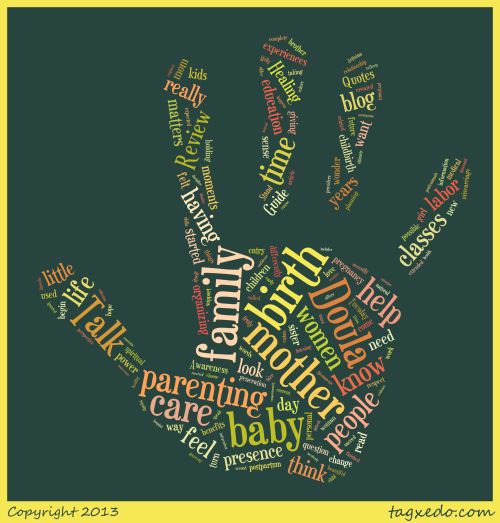
So, this is kind of weird little post, but I had some fun things to share. I’ve been playing around with Tagxedo and made a Talk Birth image! And, I learned that this year is the 70th anniversary of the classic Myers-Briggs Type Inventory. I have my online students take this test every session and we compare our results and the overall class dynamic. In celebration of the MBTI birthday, they have cool little wordcloud heads available with your type. Here’s mine!
I like that “intense” is up there at the top of the head. Feels fitting 😉 And, here’s my husband’s! I also used Tagxedo to make a “strong elephant” for my elephant-collecting mom to take with her on her visit to my grandma!
Bringing it around back to birth though, I also read an article about the potent impact of the language of birth.
So maternity care workers. Words do matter. To you and to all in earshot of you.
I’ve had an interest for a long time in what I call the “lexicon” of birth. As I’ve referenced before, that is what puts the “Talk” in my Talk Birth name! Language is powerful. Language shapes our lives and experiences. Much of the language surrounding birth and women’s bodies is negative or degrading. Think, “trial of labor,” “inadequate pelvis,” “failure to progress,” “incompetent cervix,” “irritable uterus,” “habitual aborter” (yes, that is the name for women who experience multiple miscarriages).
On the flip side, I’ve also read other writer’s critiques of an overly positive language of birth, labeling and mocking words like “primal” as “euphemisms” for hours of “excruciating” pain. But, that makes me think about the locus of control in the average birth room. It seems like it might more difficult to start an IV in a “triumphant” woman, so lets call her stubborn or even “insisting on being a martyr”? Could you tell someone making “primal” noises to be quiet? Probably not, but you can tell someone who is “screaming” to “stop scaring” others. Asserting that a painful and degrading language of labor and birth is “real” English and that the language of homebirth advocates are “euphemisms” is a way to deny women power and to keep the locus of control with medicine. This language is often that which dehumanizes and denies the personhood of the birthing women. And, not only is the language disempowering and also incomplete—I honestly never felt “agonized” or “screamed” during any of my births, so why would I use inadequate words like that in place of my more accurate “euphemisms”?
My extended family is in the middle of a stressful medical situation with my grandmother that is absorbing a lot of collective family energy lately. Such experiences always lend “perspective” to a variety of areas and I’ve felt a little blocked in the writing of blog posts because they feel frivolous or unnecessary or like they’re distracting me from where I could be spending my attention. I bought a short book for my Kindle yesterday called The Art of Being a Healing Presence, and finished reading it last night. I bought it specifically to help my mom who is going to visit my grandma and also hopefully to help me be there better for her (both my mom and grandma). It dovetails nicely with my current lesson at OSC, which is about speech and how we talk to others. So, for today’s post, I picked out some quotes from a book that I feel like fit well into any type of relationship requiring compassionate listening and attention, not solely end-of-life care, because these ideas could relate to listening to women talk about birth and motherhood as well.
Healing presence is everything life itself is: messy and mysterious, exasperating and exhilarating, wearying and wonderful. That’s what makes it so sacred.
(Kindle Locations 793-794)…
Yep. Sounds like giving birth and like birth listening too.
Healing presence is a spiritual practice or discipline as well…
(Amazon affiliate link included)
…Healing presence is essentially a spiritual discipline in itself. As you begin, you may think of healing presence primarily as something you do for someone else. Eventually, however, you’ll realize that healing presence has become an integral and significant part of your own spiritual development. As you choose to keep opening yourself to this discipline, even when it’s difficult, even when you feel yourself rebelling, you necessarily mature spiritually. As you repeatedly ask yourself, “How can I be a healing presence in this particular situation?”, you expand your horizons and you make new and fruitful connections with all dimensions of life, especially life’s sacred foundation. The more you are a healing presence in the midst of everyday events, the more you come to appreciate that the common ground on which you stand with another is pulsing with all that is divine. You realize that holiness is at work as you consciously and compassionately accompany others. Then sometimes when you least expect it, a sense of awe overwhelms you—awe, perhaps strong assurance, or waves of gratitude, or an immense sense of peace. You cannot make any of this happen. You can only welcome it as it unfolds, revealing itself and making its presence known. It is The Sacred. (Kindle Locations 821-830)
Also, from the very beginning of the book, I saved this little quote:
“In every person there is royalty. Address the royalty and royalty will respond.” –Scandinavian Proverb
The relates to the idea of seeing one another that I explored in a prior post:
I often remind students in my human services classes that all people have a basic need to be both seen and heard. This doesn’t mean agreeing with everything someone else says and does, it means being present and witnessing them as they follow their own paths.
In a newsletter recently, I read an article called “I See You” by Sue Scott, a communication skills instructor. She explains that in South Africa, native peoples greet each other with an expression that literally means, “I see you.” The response is then, “I am here.” She observes, “what a powerful and beautiful gift it is to recognize another individuals in this way: ‘I see you.’ Acknowledgement, recognition, and respect all require focus on the other person…the word respect comes from the Latin word ‘respecere’ meaning ‘to look at again and again…’I see you’…seems to me to be the ultimate in respect.” Sue goes on to explain that when we truly SEE another mother—”when we truly hear her concerns—then we affirm her ability to mother her baby in her own best way.”
A little more than two years ago, I received the precious gift of being seen when a mother that I had previously helped with many breastfeeding questions called to ask me another question. We had become friends over the course of time since she’d had her first baby and I was in the process of my second miscarriage when she called with a question about her own pregnancy. I told her about the miscarriage, but said I felt like I could still talk with her about her question. We ended up then talking for a time about miscarriage and about cesarean birth, because we discover numerous surprising connections between the feelings and experiences of an unexpected outcome to our dreams for our pregnancies. She then said, “You know in that movie Avatar how they say, ‘I see you’?” I said yes, and she said, “I just wanted to let you know that I see you, Molly.” These words were such a gift to me. It was beautiful to hear them and I cried. I felt so seen. It was just what I needed and I hadn’t even known it. I will never forget that simple and yet extremely potent gift of acknowledgement from another woman.
In my classes, I always try to explain that not only do you see someone, but they see you seeing them, and if what you see is valuable and worthy, that is what they rise to. So, that is why I liked this “royalty” proverb from the book.
And, later in the book, this concept is addressed as well:
As people experience healing presence, they change. This shift may be subtle or dramatic. They’re likely to open more—to themselves, to others, to the world, to the amazing mystery of life itself. Sensing another’s belief in them, and seeing that belief reflect-ed in life around them, they can begin to develop in completely unexpected ways, and to move in directions they have not gone before. Or perhaps they will return to their original path, but with new spirit, new vision, new hope. As they encounter the inevitable pains and diminishments that life will present, they can begin to understand that such adversities can be experienced as more than adversities—they can be known as opportunities for growth, as avenues for moving toward wholeness. Your authenticity and the compassion in your presence will fan out generously around you, always returning to envelop you again and again. As you become less driven by your own concerns and less given to your own needs, and as you forsake your need to help, you’ll become a more mature and helpful companion. (Kindle Locations 841-849).










 Talk Birth