Archives

ICAN Conference Thoughts

This past weekend, I attended the ICAN conference in St. Louis. I was really excited that the conference was in my own back yard (well, two hours from my back yard). I enjoyed seeing lots of people that I know from Friends of Missouri Midwives as well as other friends and contacts from other organizations. And, I got to meet some people in real life (like Jill from the Unnecesarean), who I previously only “knew” online. I also bought myself a pretty awesome new ring from the MANA booth (and a t-shirt and a bumper sticker!).

In addition to these things, highlights of the conference for me were:

  • Hearing Pam England speak and getting to meet her after so many years of being a fan of Birthing from Within. I will write another post soon about her “9 Birth Story Gates” presentation. It was very good.
  • Taking Amy Swagman’s birth art workshop (Amy is the Mandala Journey artist and was someone else that I enjoyed meeting in person after only “knowing” online). I will write about this soon as well.
  • Seeing the amazing breech birth videos shared by Gail Tully of Spinning Babies in her presentation about breech birth.
  • Connecting with another mother during the sand tray art therapy workshop presented by Maria Carella. Though our birth experiences were different, our “processing” of them during the workshop was amazingly similar. More about this later too.

The main reason I wanted to post tonight though was to share my experience in visiting the “Our Voices” room at the conference. This room is a safe, quiet place—a place of silence—in which women can go to to contribute their feelings about their cesareans to the wall displays. They can take their contributions home with them when they leave, or leave them up to be re-installed in the next Our Voices room at the next conference. Every wall in the room, plus the doors and several tables, was covered with women’s words and feelings about their cesarean experiences, subsequent births, VBAC, etc. It is difficult to put into words how potent of an experience visiting this room was. I was not expecting to be moved to tears by it, but I was. It was extraordinary. And, painful. There were other women in the room crying and crying as they composed their additions to the wall, as well as other women walking quietly through and looking and reading. I originally intended to add to the wall—I was told that it was not necessary to have had a cesarean myself in order to add something—but after seeing the room and the women in it, I did not feel “worthy” (so to speak!) of adding to it. It wasn’t my space. It was something I was privileged to witness, but I did not feel it was appropriate to add my own words to these women’s pain and expressive space. I felt like anything I could say would be trite somehow, almost insulting, to the depth of feeling expressed on the walls. Sometimes you really do have to have “been there” in order to fully recognize the experience of another. And, while I can certainly empathize and feel deep compassion, cesarean birth has not been my own personal journey and it just felt like it would be rude almost, to claim enough understanding of it to write on this wall.

This experience also taught me that I am not meant to start an ICAN chapter. I really think our area could use one and I love the work that ICAN does and I had signed up to start a chapter (before coming to my senses and realizing that I am overcommitted to too many projects/organizations right now as it is), but after visiting the Our Voices room, I realized that I am not the appropriate person to lead one. I just can’t really get it even though I can “see” other women and honor their experiences.

I’ve noted before that I feel like my experiences with pregnancy loss opened my heart more fully to the full range of birth loss (which  includes many women’s feelings about their cesareans) and birth/pregnancy trauma. Before loss, I only saw the “pretty” side of birth. Well, not pretty, exactly, but the empowering and triumphant and exciting side. After my birth-miscarriage, my world was opened to the wider world of birth experiences and feelings. I feel like there are—somewhat surprising—parallels between pregnancy loss and  the loss of a vaginal birth women experience with cesarean, but it is also different and the Our Voices room at the conference was a sacred space for those with cesarean experiences. It was both humbling and moving to hear their voices in this way.

There are pictures of the room and the contributions at the ICAN Conference Facebook page.

Labor Pictures

I’ve mentioned before that I was disappointed not to have any birth pictures from my last baby. What I do have is quite a few labor pictures and I want to share them in a post since labor pictures don’t often get as much “glory” as birth pictures 🙂 I didn’t have any birth pictures with my first son either, though we have several immediately after as was my preference at the time. I have two labor pictures with him, this one, taken in fairly early labor:

Trying to decide whether or not this is it!

Then, my mom took this one of me after I got out of the shower. I was going to try to go to bed, because the birth center staff seemed pretty sure I wasn’t really in labor and should just get some rest. This picture was taken about 5-6 hours before he was born:

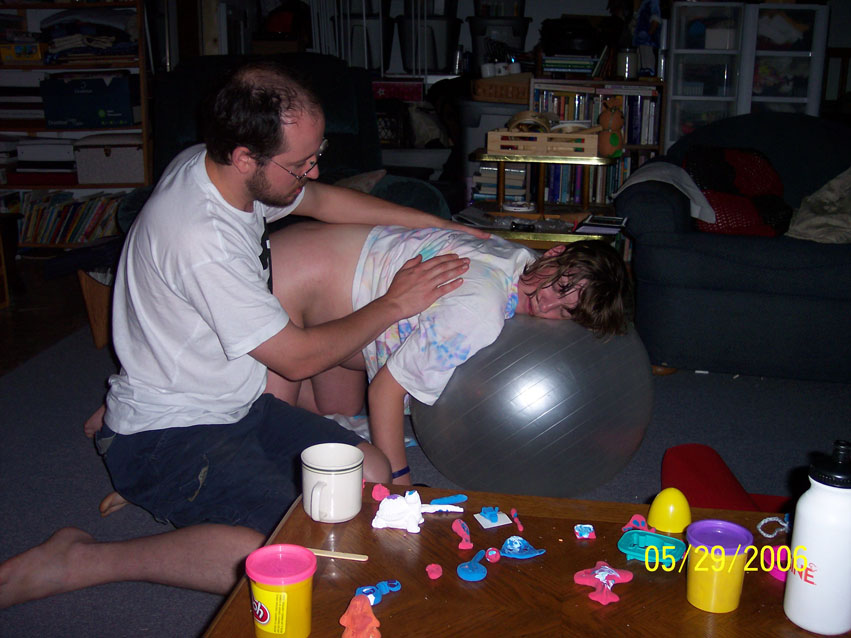
With my second son, my mom took a great series of birth pictures as he was emerging. They’re really good and step by step as he comes out—however, the angle is a very direct “rear view” that I don’t feel comfortable putting on the internet! With that birth, there is only one picture from the actual labor (and, it is a nice active labor picture that isn’t too graphic and it has actually been printed in several publications):

About 30 minutes before giving birth to second baby

I like how you can see all of my older son’s playdoh creations in the foreground. That’s homebirth for you!

With my daughter, my mom took a series of labor pictures and while I’m sad not to have birth pictures too, I like the story that these pictures tell:

Taken during the morning of birthing day–wanted one last “belly picture” of pregnancy.

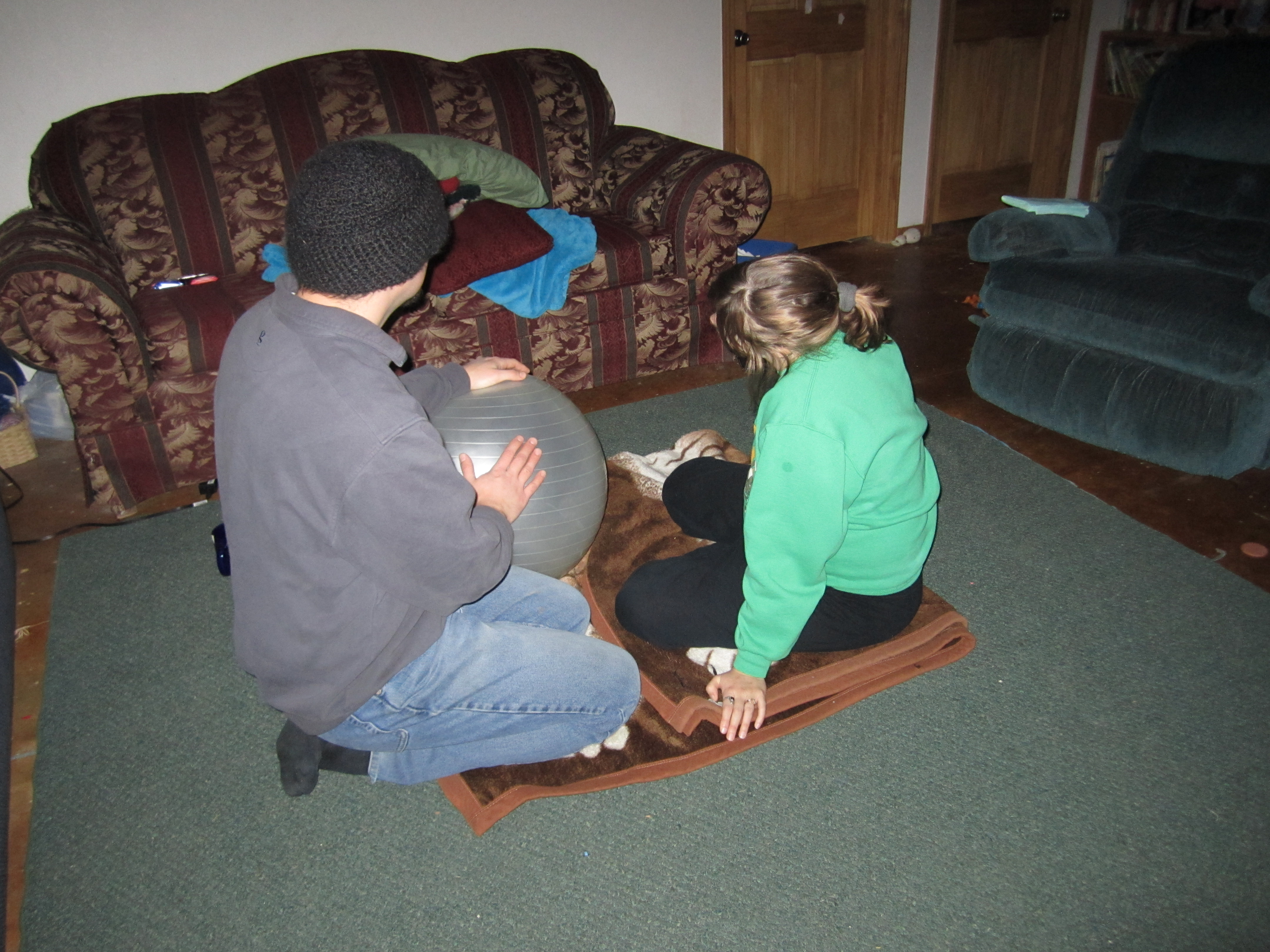
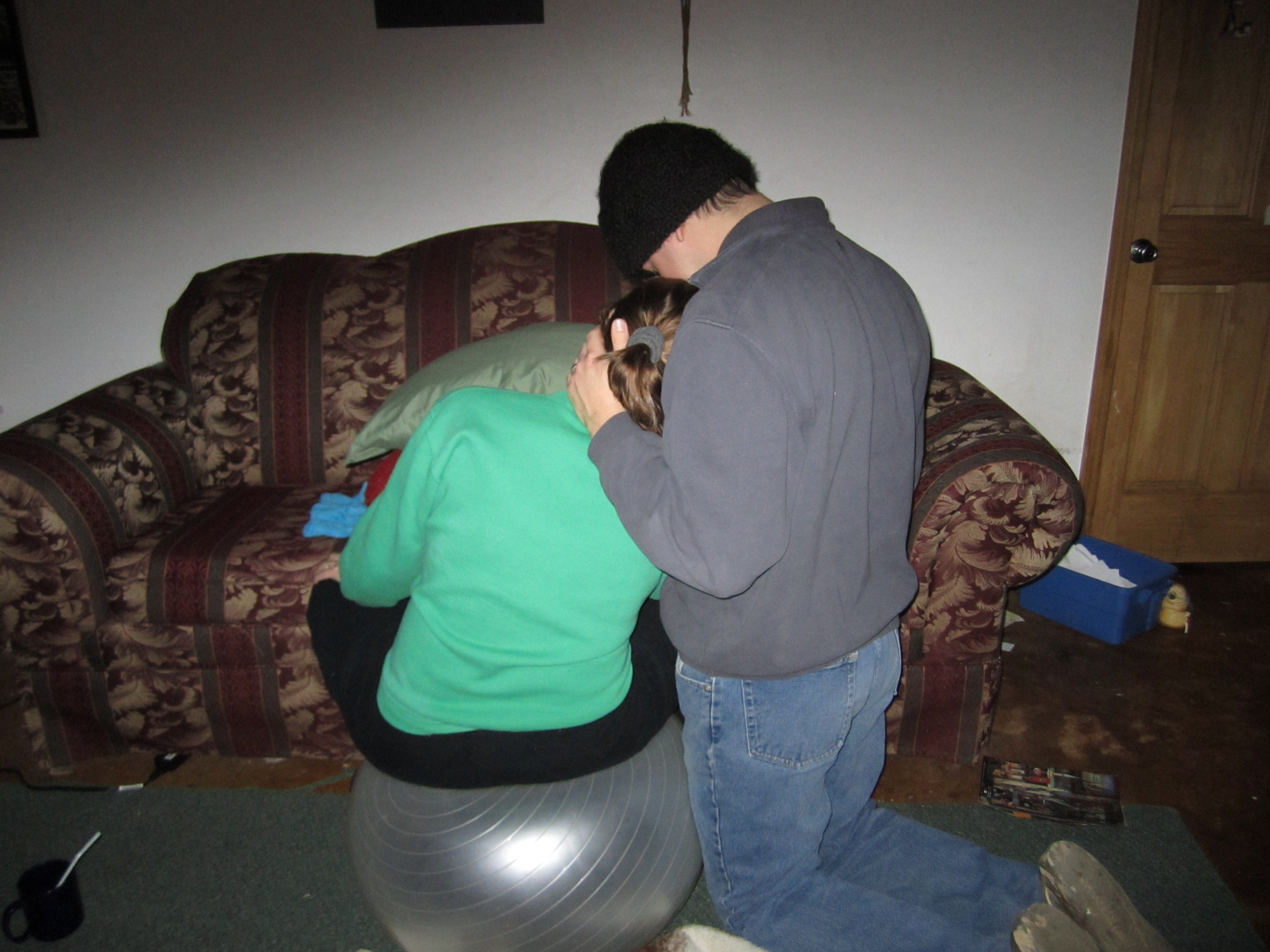
Spent a lot of time on the ball with Mark at my side

My birth nest is all ready! (on floor outside bathroom) Notice that my birth altar is set up nearby.

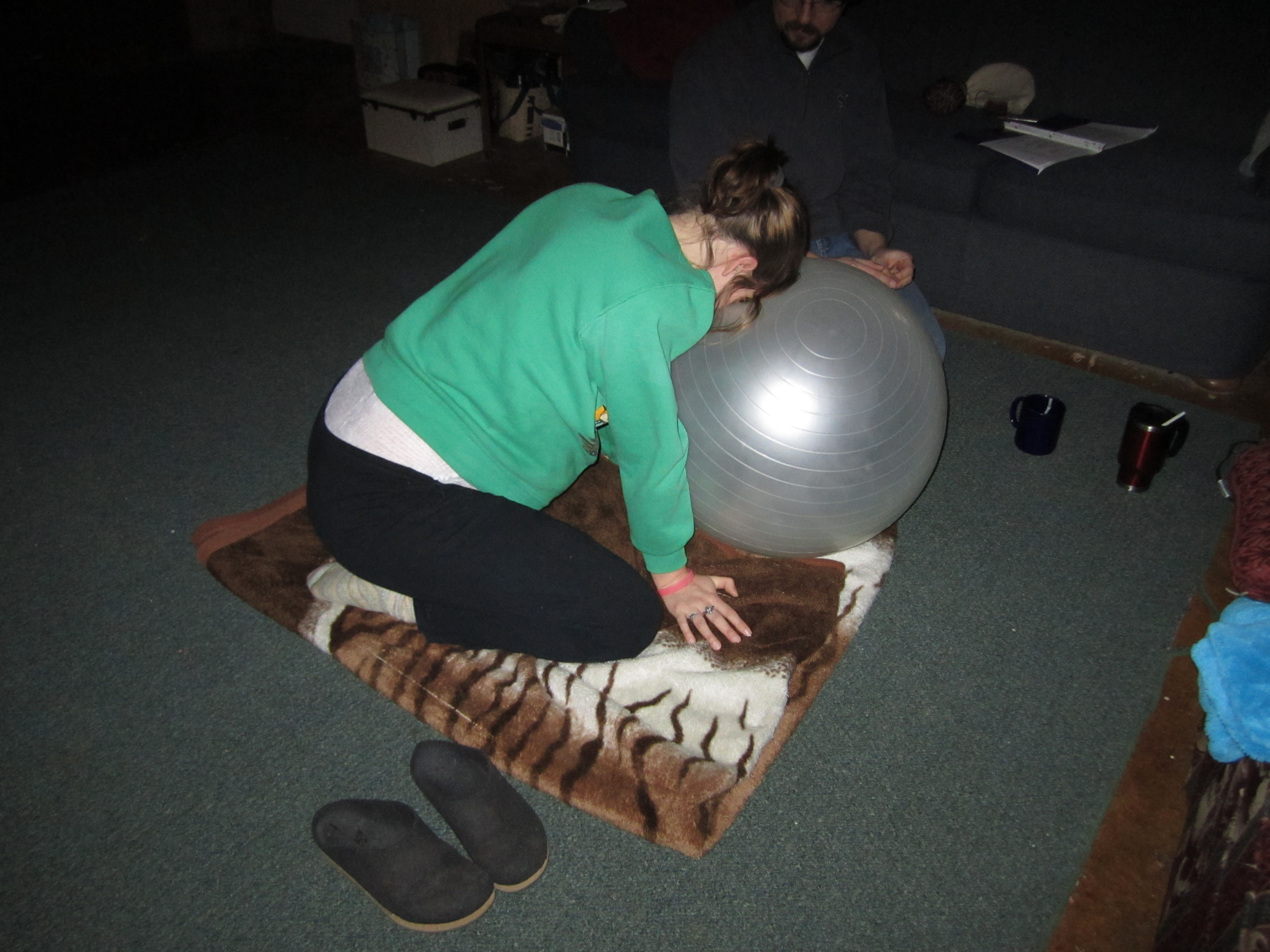
More time on the ball…

Proving I can still smile one hour before she is born! (+ advertising my alma mater)

Accidentally got trapped on floor in horrible and painful position.

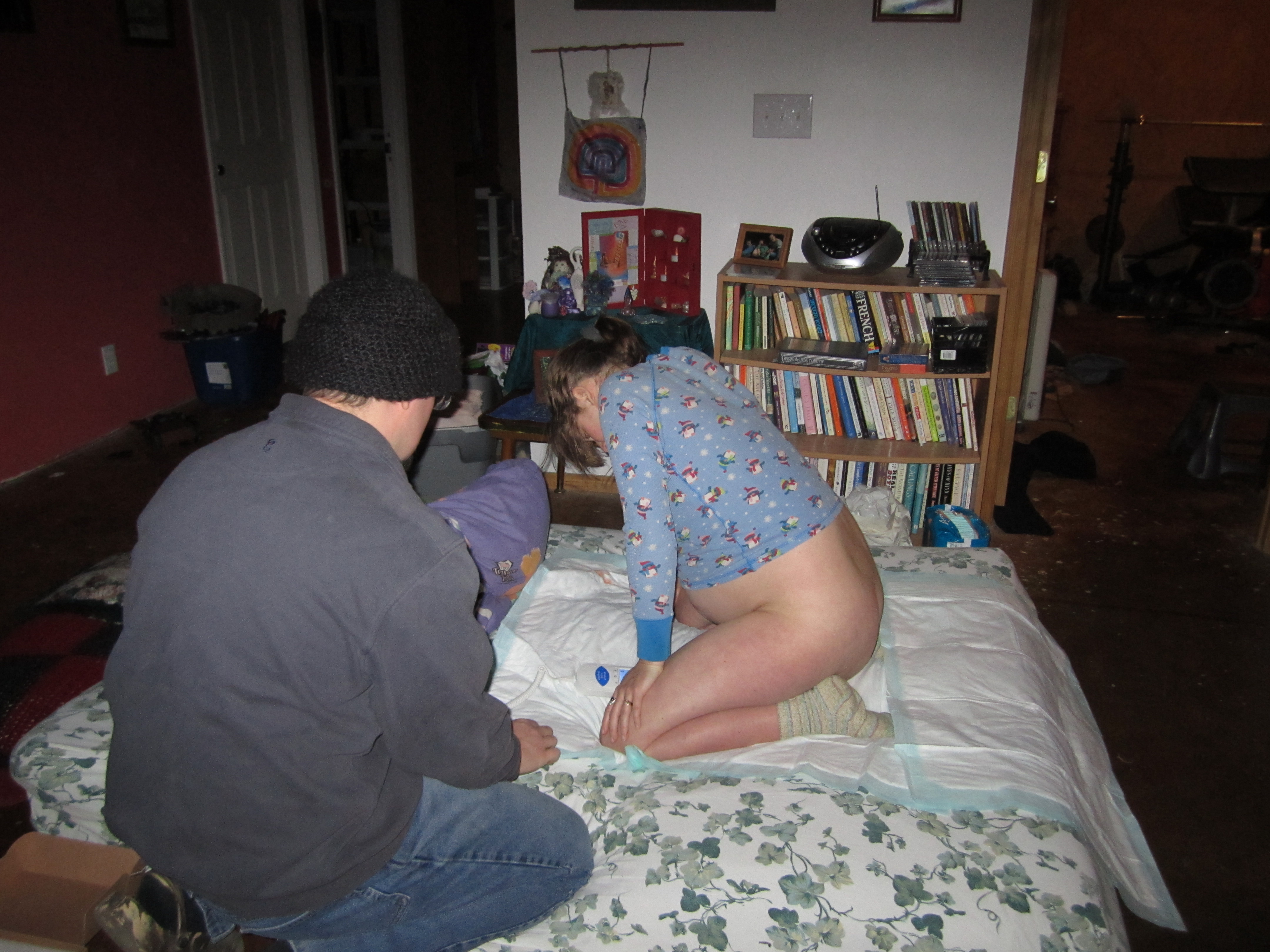
The closer I get to having a baby, the nearer to the floor I get (hands and knees is right for me)

Switched into ridiculous too-small PJ shirt right before pushing.

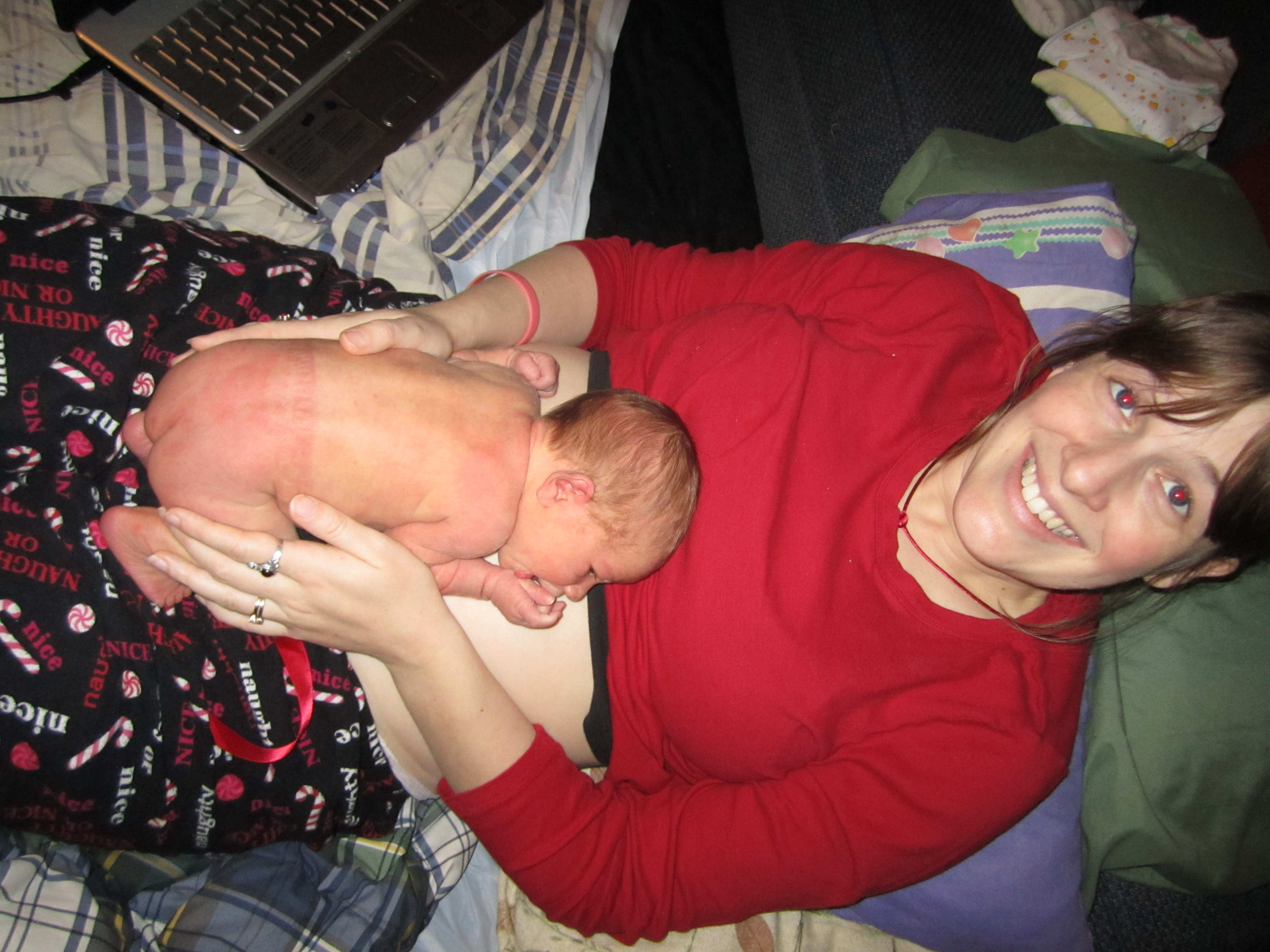
She’s here! Closest thing to a birth picture that we got.

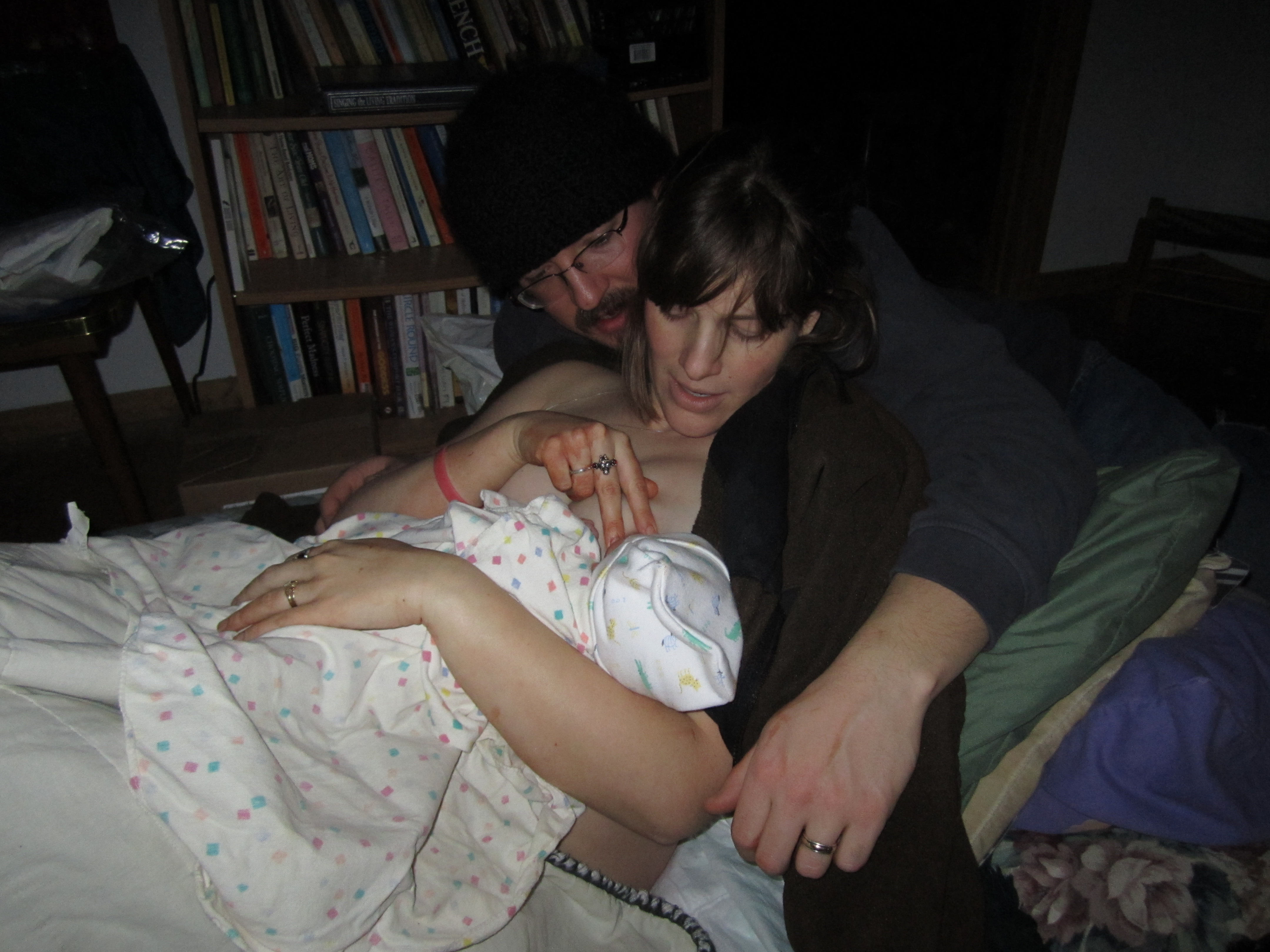
First nursing

Birth Story Wordle

I’ve done Wordle images before using the text of this blog, but I didn’t realize that you could make one using only one particular post. A couple of nights ago when I was up late with the baby, I made one using Alaina’s short birth story! I made it the day before her two month birthday—I also took her out to show her the supermoon 🙂 I like it—I find it meaningful that my husband’s name is the second largest word after the word “birth.” I also find it significant that the word baby is above the word birth, since for me this time, the baby ranked above the birth in my emotional experience of birthing. In an ultimate reckoning, The baby is always more important than the birth, of course, but my feelings about the two are usually interlocked and go hand and hand and I believe that birth has inherent value as an experience—this time I felt exhilirated about the baby and then secondarily had separate feelings about the experience of birth.

My Baby Girl is Here!

“A baby, a baby, she will come to remind us of the sweetness in this world, what ripe, fragile, sturdy beauty exists when you allow yourself the air, the sunshine, the reverence for what nature provides…”

– Sarah Werthan Buttenwieser (in Literary Mama)

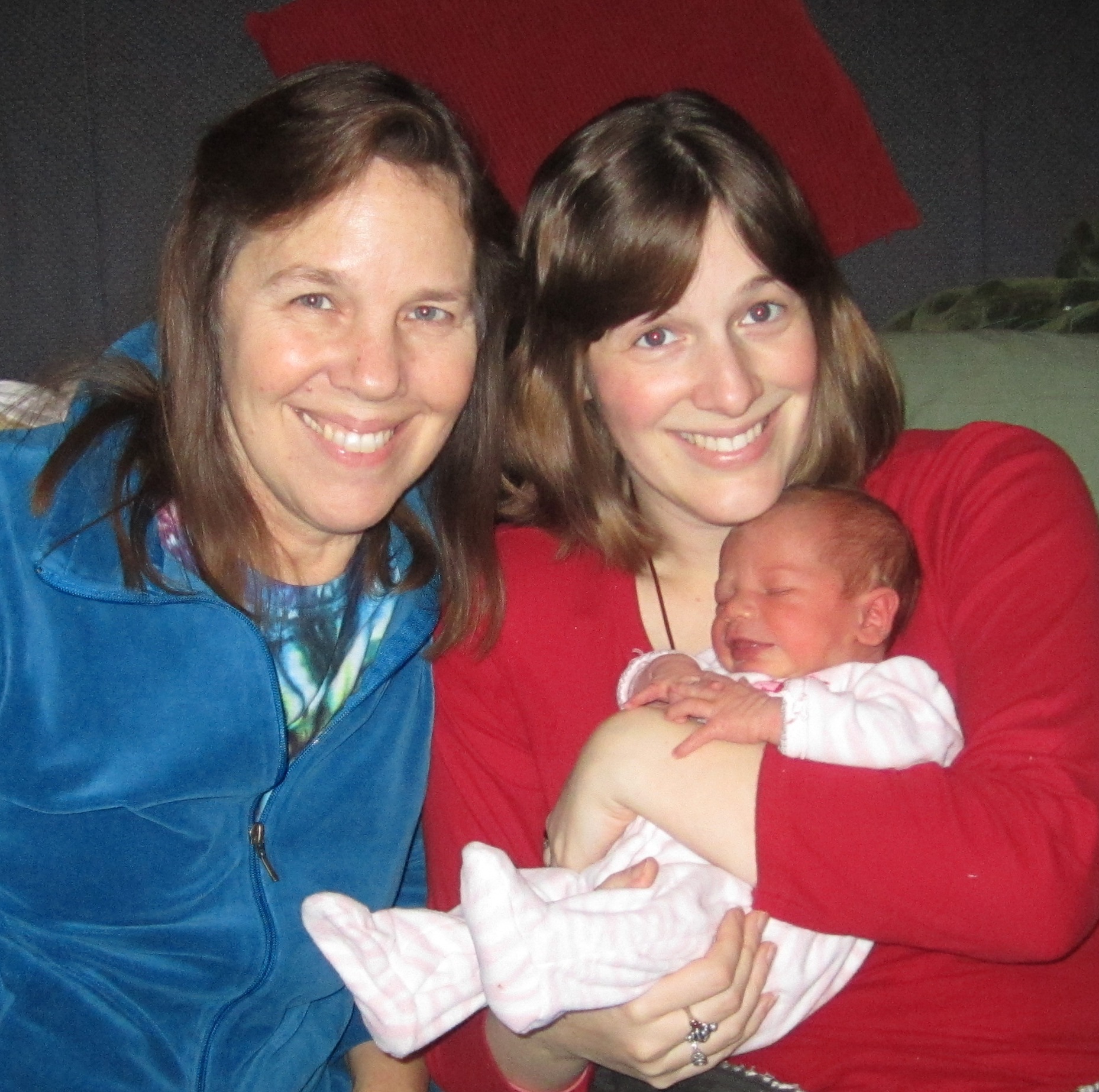
Three generations!

Alaina Diana was born at 11:15 a.m. on January 19th, 2011! She only weighed 7lbs, 8oz and was 20 inches. (My other babies were 8lbs4oz and 9lbs, 2oz.) I’ve sent a short-version birth story to a couple of friends over the last couple of days and decided I could work it up into a short blog post as well (of course, a full-length birth story will eventually follow). I actually had a little trouble getting started in writing about her birth—it was pretty uneventful until the end and I felt like the best description would be: walked around the kitchen, sat on the birth ball, walked around a little more, more time on the ball, hummed and ooohhhhhed, seemed as if  suddenly things changed and I felt big, big things happening and then baby was born all at once! And, I caught her! Emotionally more than temporally, it felt like a long labor and I felt like I experienced less mind-body integration than with previous labors (the actual moment of birth was much more instinctive and powerful than with the other babies though). In general, lots was unexpected about this labor—-it lasted longer than I expected (about 5 hours that were serious, but some warm-up time before that too) and was somewhat erratic and I had quite a bit of back pain. Right before pushing, contractions were still 4-8 minutes apart and it was hard for me to assess where I was/how “active” of labor it was—I was thinking I could either be at the 3cm point OR the transition point! My water didn’t break until seconds before she was born and I felt like it REALLY needed to break, but wasn’t. My kids weren’t here, because her birth was during the day (also unexpected, and a Wednesday, not a weekend!). It was just Mark, my Mom and me.

I spent a lot of time on the birth ball and Mark would stroke my back in just the right way

After criticizing myself at length for being “too analytical,” “thinking too much,” and not letting “my monkey do it,” I experienced a spontaneous birth reflex and pushed her out in a kneeling position and it only took one contraction—her whole head and body came out all at once, no moment of crowning or head birthed and then body following, just a bloosh of entire baby. I caught her myself. Mom and Mark both missed seeing her come out, because the phone rang at the same time. My mom went to stop it and Mark was moving around to the front of me, and when they looked again, I was holding her (Mark says it was about 12 seconds). So, no birth pix 😦

I did tear again, exact same extra-delicate and non-“traditional” place from what I can tell. Feels better than previous births already though–I know how to heal from this (even though I wish I didn’t have to).

My plan for immediate postpartum worked out perfectly and just like we planned. The midwife came about 40 minutes after the birth and checked blood loss. My doula was here about 20 minutes after and fed me a bite of placenta—and, I ate it! No gagging or anything!

I have very different post-birth feelings this time around—though I still had the “I did it!” moment, I felt less euphoric and triumphant and more relief and the feeling that, “we survived!” Blog posts about this will eventually follow…

And, did I mention that I caught her myself?! 🙂

Shortly post-birth

  • My "40 weeks" picture--due date was Jan. 22nd, so took a picture on that day to show how she could (theoretically) still fit! (though she wasn't breech!)

  • Birth Lessons from a Chicken

    Birth Lessons from a Chicken

    by Molly Remer, MSW, ICCE, CCCE

    Originally published in Midwifery Today, 2009 Spring;(89):49

    “Should we just let her sit on them?” my husband asked. He had been struggling to keep a broody hen off her nest for almost two weeks.

    “I always vote in favor of the mother,” I told him. So, we stopped trying to oust her. My husband gathered up six random eggs from the coop and put them under her and we let her sit.

    We consulted our book on raising chickens. The chicken book had very little encouraging advice about “natural incubation.” After reading it, we learned that she was likely to let the eggs get too cold causing them to die, or perhaps just chill a part of them causing the chicks to have deformed feet. If she did manage to hatch them, they will probably get bacteria in them from the “unsanitary” nest site and get “mushy chick disease.” This is, of course, if the eggs happen to be viable at all, which is improbable. It is recommended not to let her sit and if she persists to either cull her (kill her), or to just let her sit there until she dies of starvation trying to hatch infertile eggs (and therefore culls herself). The book also informed us that if she has feathery feet (she does), she will probably knock the eggs out of the nest by accident and break them. Also, she should definitely be sitting in the spring and not the dead of winter. After studying the book, we are left with a clear sense that incubating eggs artificially is the preferred way to go and that “natural incubation” is fraught with difficulty and dangers.

    However, there our chicken sat in the unheated, but well built and insulated chicken coop as the January temperatures outdoors reached -2F. We concluded that she probably had a 5% chance of actually hatching anything and I felt sad for her.

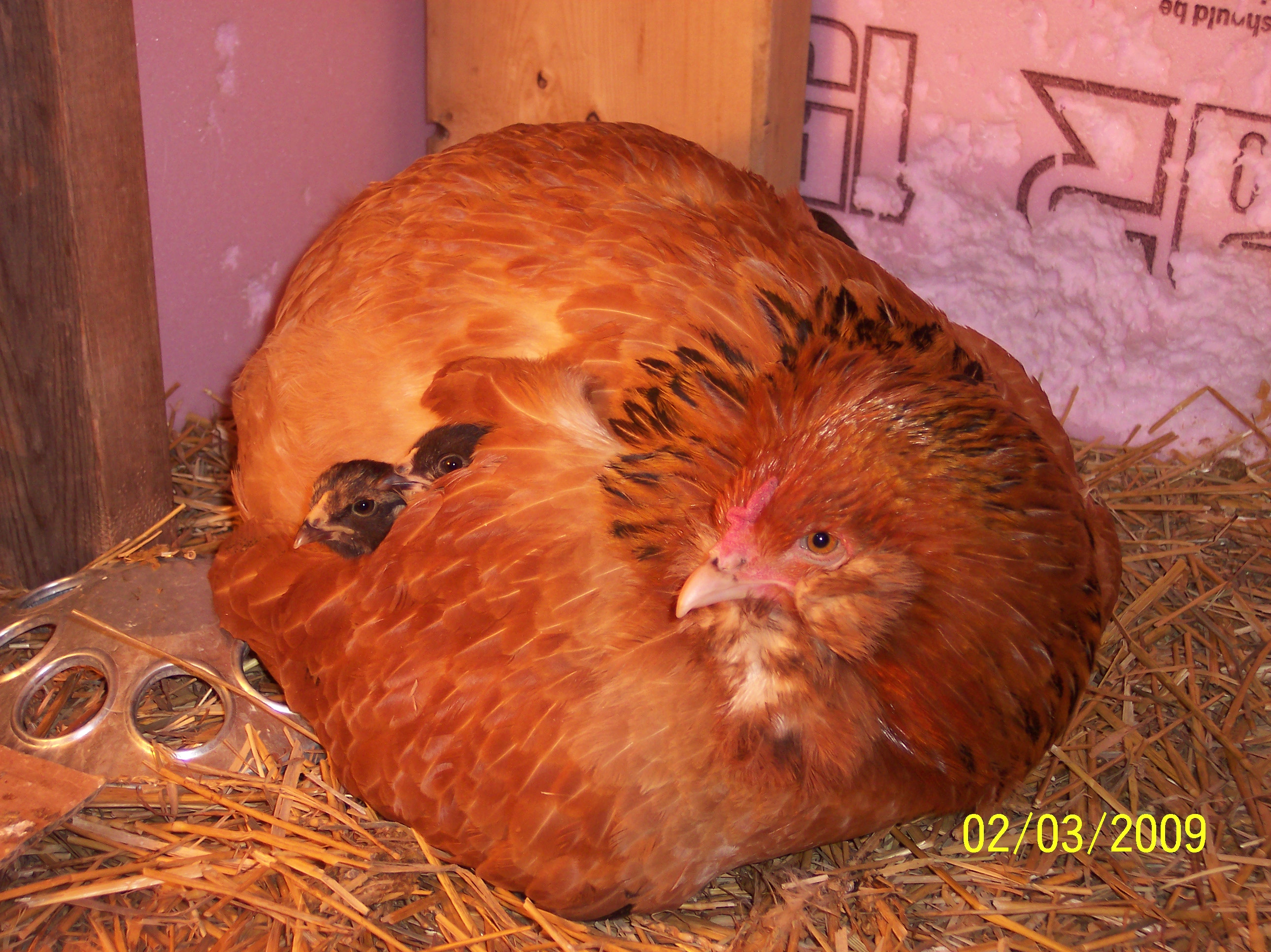
    Then, one morning when my husband went to feed the chickens, he heard a funny noise. He looked at the broody hen and from beneath her, a fuzzy head appeared. Then two. Eventually, four. In this cold, cold weather at the wrong time of year with the wrong

    The mama hen and two of her chicks

    kind of feet and the wrong kind of eggs, she did it! We didn’t trust her, or believe in her. Our book and the experts didn’t either. However, her inherent mothering wisdom won out—it trumped us. At the risk of excessive personification, it truly seemed that she had believed in herself and trusted her instincts (or perhaps, that Nature believed in itself).

    Perhaps we could have had the same result with an artificial incubator—a tray that rotates the eggs, instead of “clumsy” feathered feet; a properly temperature controlled unit instead of the heat of her own breast; a sterilized box instead of a wooden coop with an unscientific amount of possibly “germy” feathers plucked from her own body.

    My husband ran to get the rest of the family and as we watched that first small fuzzy baby with its eyes bright with life, I was awash with the parallels—the book tells her that her pelvis will be too small, labor will be too painful, her skin won’t stretch, she might have GD, there might be any manner of complications, maybe she should elect to have the baby surgically. Why all the fuss about doing it “naturally” anyway?

    Then, as we continued to stare in amazement, the mama hen clucked to her baby softly and fluffed her wings around it until it disappeared beneath her with the others. Isn’t this the birthright of every new baby of any species? To be snuggled immediately after birth into the warm embrace and near the breast of the female body that has given it life? The body that has cared for and nurtured it so lovingly so that its head may finally peek out into the world?

    If our chicken were to write a book about hatching babies—or about giving birth—perhaps her section about natural incubation would read:

    Maybe she knows what she’s doing.

    Maybe you should trust her.

    Maybe she can do a better job with her own body and her own babies than you can.

    Maybe she can do this all by herself.

    Molly Remer, MSW, ICCE, CCCE is a certified birth educator and activist. She is editor of the Friends of Missouri Midwives newsletter, a breastfeeding counselor, and the mother of two young sons and a baby girl on the way. She loves to write and blogs about birth at https://talkbirth.wordpress.com, midwifery at http://cfmidwifery.blogspot.com, and miscarriage at http://tinyfootprintsonmyheart.wordpress.com.

    This is a preprint of Birth Lessons from a Chicken, an article published in Midwifery Today, 2009 Spring;(89):49. Copyright © 2009 Midwifery Today. Midwifery Today’s website is located at: http://www.midwiferytoday.com

    Story Power

    “The universe is made of stories, not of atoms.” –Muriel Rukeyser

    I have written before about the role and power of story and birth and I have an article pending publication on the same subject. In a not-about-birth anthology I finished recently (The Politics of Women’s Spirituality), I read the following from Carol Christ:

    Women’s stories have not been told. And without stories there is no articulation of experience. Without stories a woman is lost when she comes to make the important decisions of her life. She does not learn to value her struggles, to celebrate her strengths, to comprehend her pain. Without stories she cannot understand herself. Without stories she is alienated from those deeper experiences of self and world that have been called spiritual or religious. She is closed in silence. The expression of women’s spiritual quest is integrally related to the telling of women’s stories. If women’s stories are not told, the depth of women’s souls will not be known.

    While she is writing about women’s spirituality, I think what she says is very true of birth as well—if women’s birth stories are not heard, the depth of women’s experiences will not be known (and the birth machine will keep on rolling). I also hear women apologize for telling their birth stories “over and over” or, “for continuing to talk about this.” BUT, I believe that telling the story over and over is how we process and integrate the story into our lives. It is how we make it our story and integrate the lessons from it as well as making it make sense within in the context of the rest of our lives as women. Without telling the story in this manner, there is a gap left behind (or, sometimes a wound). Telling the story multiple times does not indicate “stuckness”—on the contrary, not telling the story leads us to a “stuck” place (I think I get this idea from Pam England, but I’m not completely sure).

    So, as long as we’re talking story, my favorite books of birth stories are:

    The Power of Women by Sister Morningstar

    Simply Give Birth by Heather Cushman-Dowdee

    Journey into Motherhood by Sheri Menelli

    Adventures in Natural Childbirth Janet Schwegel

    And, my own birth stories are available too:

    My first son’s birth story is available here.

    My second son’s birth story is available here.

    My third son’s birth story is available here (warning: miscarriage/baby loss).

    —–

    On a somewhat related note—this time not about sharing stories, but of hearing too many other voices—I did just enjoy reading a blog post from Jennifer Louden called “static free authenticity” that describes something I complain of feeling:

    Humble suggestion number one: Turn off Everyone Else’s Broadcast
    When it feels too hard to hear you among all the other yous out there, you aren’t suffering from multiple personality disorder, but you may need an Internet fish bowl break.

    I say “fish bowl” because everyone’s voices and big plans and ideas can create a sort of invisible fish bowl that hems you in – without you necessarily noticing it.

    I describe it as being so filled with the voices of others that it is difficult (or impossible) to hear the still, small voice without. Or, alternatively (when thinking of my own written contributions to the world) as contributing to the neverending cacophony of voices clamoring to be heard.

    Speaking of Jen Louden, in another post (this one about depletion), she quotes a woman as saying: “Women get into a cycle of depletion and they’re afraid to step out of it, because then they would be freed up to actually take action on what they really want. They are positive they won’t be able to create their heart’s desire. So they stay busy or scattered or overcommitted so they never have to try.

    I see a lot of truth in this also.