Archives

MamaFest!

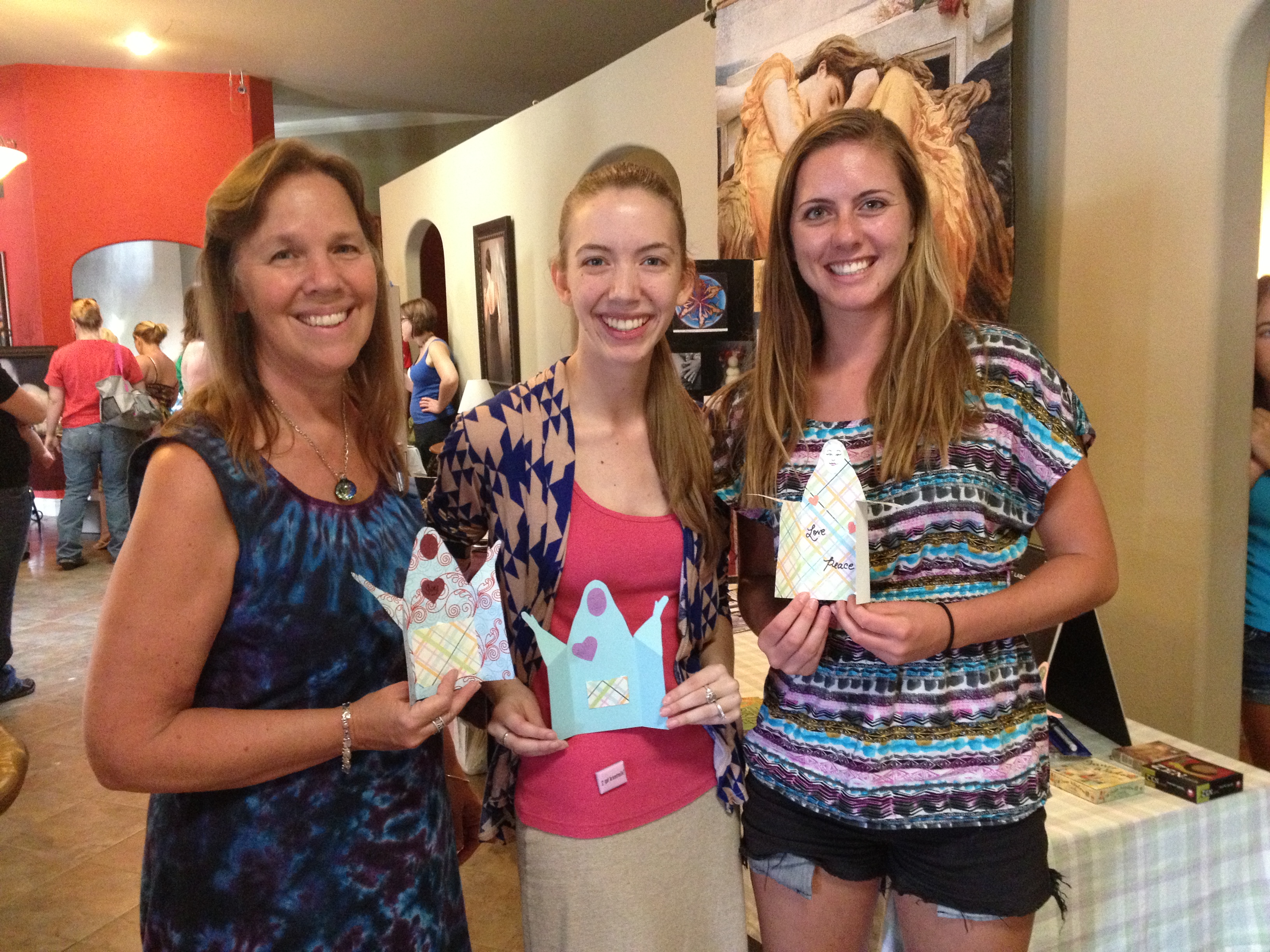
Last summer, my Rolla Birth Network friends and I conceived of a local event to be held celebrating mothers. We made a couple of August 2013 020decisions in planning our event that were really smart: we decided to focus on celebration rather than education (or even activism), we decided not to involve any money (either for the attendees or the hosts [aside from tabling materials/supplies]), and…this is key…we also decided to only do that which was within our own personal resources to provide. It worked! We pulled off a lovely MamaFest event at Tara Day Spa in Rolla. It was well-attended and fun and involved very little expense for anyone. It was work, of course, but it was within our resources/capacities. Community organizations were welcome to have a table at the event for free with the only stipulations being no formula/bottle materials (this event is co-sponsored by La Leche League of Rolla in conjunction with World Breastfeeding Week) and that they had to provide something to do at their table. Our vision was that this event would not involve simply walking around picking up flyers and leaving, but instead would provide an opportunity to hang out with friends, see cool things, learn some stuff, and make some projects. I had a birth art booth that was a delight for me to offer to the women.

This year in August, we hosted our second annual MamaFest event, again with a similar vision. Our resources/time were a little slimmer August 2013 017this year due to peoples’ schedules (particularly my own, leaving my co-founder shouldering most of the organizing effort), new babies, etc. We had fewer exhibits and fewer attendees and slipped more into the boothy-vibe that we hoped to avoid, and learned some things to try next year. I still consider the event a success, especially considering the fairly minimal womanpower with which we had to work. It was an especially good outreach opportunity for LLL and I said at the end that even if I hadn’t been involved at all with the planning of it, I would definitely have considered it a worthwhile event to continue attending with my LLL booth. I was super excited about my simple, but pretty (and free!) offering for the birth art booth this year: mother affirmation/blessing cards. Unfortunately, very few people took me up on my offer and I was a little sad about that, but my LLL booth with its breastfeeding trivia game and got breastmilk ™ pins was pretty popular. We have lots of ideas for next year and the possibility of experimenting with new directions, such as doing away with the booths altogether and having more retreat-like experience stations (i.e. yoga). What we know we want to keep is our commitment to celebrating women and their capacities, because they’re just super awesome and worth celebrating!

Here are some pictures of my booth and some projects from the event:

August 2013 016

Birth art booth!

August 2013 031

Loved this thumbprint necklace project offered at the booth of a local doula/photographer. Alaina appropriated it immediately because, “me like hearts!”

August 2013 028

Babyloss memorial charms offered by the Rainbow Group (local pregnancy/infant loss support)

August 2013 015

Emergency back up project that I scrambled for when I realized people weren’t making my cards–affirmation “stones” (glass pebbles written or drawn on with glass paint markers).

August 2013 013

At least my own loyal family members showed up and made my project! (mom, sister, and visiting cousin)

What I learned from this event again this year was that you do not have to live in a city to be able to offer something like this in your community, all you need is a small handful of women who care and who can use their skills and resources to make it happen! 🙂

Brought to our knees

“Rigid plans work best if you’re building a skyscraper; with something as mysteriously human as giving birth, it’s best, both literally and figuratively, to keep your knees bent.” –Mark Sloan, MD (Birth Day)

Today I spent a few minutes listening to a lovely webinar by Amy Glenn, the author of Birth, Breath, & Death. The topic was Supporting a Birthing Woman’s Spiritual Practice and I was immediately caught by Amy’s comparison of giving birth to kneeling in prayer. She mentioned that giving birth may drop us to our knees, just as those who pray may pray on their knees. Since I’m currently writing about birth as a spiritual experience, I connected to this implied notion: birth as embodied prayer. And, looking at the webinar photo of a woman kneeling in August 2013 019child’s pose, my own birth-prayers came vividly to mind. In my first labor, I spent a lot of time on my knees, later wishing that I had also given birth on hands and knees rather than being encouraged to birth in a semi-sitting position that I felt contributed to tearing. Later, when I discovered birthing room yoga, I loved realizing that these kneeling postures that I adopted spontaneously and intuitively in my first labor were yoga poses—an inherent body wisdom I carried within me, waiting to arise when called upon. This is part of my first birth story, briefly touching on my time on my knees…

Mark & Mom were wonderfully supportive of me as I labored. I tried various positions and they stacked up pillows for me on the bed so that I could be on my hands and knees on a soft surface (they put the Boppy onto some other pillows to make a “well” for my belly) and then Mom read some of my birth affirmations to me. That worked for a while. I also tried the birth ball for a while and ended up spending a lot of time on my knees on the floor with my head and arms resting on a pillow on the bed…

via My First Birth | Talk Birth.

Kneeling to birth played a prominent role in my second birth experience as well and I have frequently described the rapid birth of my second son as an experience that literally drove me to my knees. When writing about this birth experience, I said:

I was extremely proud of my body and its super-awesomeness 🙂 I felt that my sense of birth trust was physically manifested in my actual birth experience. My body was a powerful and unstoppable force and I had to get out of my own way and let it happen! I felt driven to my hands and knees–like a power was holding me there. After the birth my body felt weak and “run over by a truck”—I felt powerful and like a warrior during the birth…

via Quick Births | Talk Birth.

And, in perhaps my most spiritually meaningful birth experience, the home miscarriage-birth of my third baby also brought me to my knees:

August 2013 041

Brand new sculpture inspired by the thoughts in this post.

When I was still having the “HOW?” questions, other women that I knew who had experienced miscarriage started to come to mind and I knew I could do it too. I told myself that I had to do what I had to do. I said out loud, “let go, let go, let go.” I said I was okay and “my body knows what to do.” The afternoon I found out the baby died, I’d received a package that included a little lavender sachet as a free gift with my order. When my labor began, for some reason I wanted the sachet and held and smelled it throughout the experience. As I chanted to myself, “let go, let go, let go,” I smelled my sachet (later, I read in one of my miscarriage books that in aromatherapy lavender is for letting go). I also told myself, “I can do it, I can do it” and “I’m okay, I’m okay.” I felt like I should get more upright and though it was very difficult to move out of the safety of child’s pose, I got up onto my knees and felt a small pop/gush. I checked and it was my water breaking. The water was clear and a small amount. I was touched that now these gray pants were my water-breaking pants too…

Contractions continued fairly intensely and I continue to talk myself through them while Mark rubbed my back. I coached myself to rise again and after I sat back on my heels, I felt a warm blob leave my body. I put my hand down and said, “something came out. I need to look, but I’m scared.” Then, “I can do it, I can do it,” I coached myself and went into the bathroom to check (it was extremely important to me not to have the baby on the toilet). I saw that it was a very large blood clot. I was a little confused and wondered if we were going to have to “dissect” the clot looking for the baby. Then I had another contraction and, standing with my knees slightly bent, our baby slipped out…

via Noah’s Birth Story (Warning: Miscarriage/Baby Loss) | Talk Birth.

When the time came to gave birth to my rainbow daughter, she brought me to my knees as well and she was the only baby I caught in my own hands while in a kneeling position. Here is a segment from her birth-prayer:

At some point in the bathroom, I said, “I think this is pushing.” I was feeling desperate for my water to break. It felt like it was in the way and holding things up. I reached my hand down and thought I felt squooshy sac-ish feeling, but Mom and Mark looked and could not see anything. And, it still didn’t break. Mom mentioned that I should probably go to my birth nest in order to avoid having the baby on the toilet. My birth nest was a futon stack near the bathroom door. I got down on hands and knees after feeling like I might not make it all the way to the futons. Felt like I wanted to kneel on hard floor before reaching the nest.

…I couldn’t find her heartbeat and started to feel a little panicky about that as well as really uncomfortable and then threw IMG_0422the Doppler to the side saying, “forget it!” because big pushing was coming. I was down on hands and knees and then moved partially up on one hand in order to put my other hand down to feel what was happening. Could feel squishiness and water finally broke (not much, just a small trickle before her head). I could feel her head with my fingers and began to feel familiar sensation of front-burning. I said, “stretchy, stretchy, stretchy, stretchy,” the phone rang, her head pushed and pushed itself down as I continued to support myself with my hand and I moved up onto my knees, with them spread apart so I was almost sitting on my heels and her whole body and a whole bunch of fluid blooshed out into my hands. She was pink and warm and slippery and crying instantly—quite a lot of crying, actually. I said, “you’re alive, you’re alive! I did it! There’s nothing wrong with me!” and I kissed her and cried and laughed and was amazed.

via Alaina’s Complete Birth Story | Talk Birth.

Motherhood, especially my postpartum experience with my first baby also dropped the legs out from under me and I used the same expression echoed above in writing about this postpartum crucible:

I had regularly attended La Leche League (LLL) meetings since halfway through my pregnancy and thought I was prepared for “nursing all the time” and having my life focus around my baby’s needs. However, the actual experience of postpartum slapped me in the face and brought me to my knees…

via Planning for Postpartum | Talk Birth.

I’m not the only mother who finds this an apt description of the process of giving birth, today I found this touching story about memorializing the still birth of a mother’s baby girl:

This blanket isn’t much to look at. It isn’t a work of art. But it holds an entire story within its stitches. It holds the legacy of our precious baby girl who was stillborn, yes, but she was still born. Her name is etched on our hearts, and her short little life was not in vain. In those 37 weeks, she brought us joy and excitement. She brought us laughter. She brought me to my knees (to dry heave, because of being in pain, and to pray…). She brought us together, tighter, as a family. She brought us love. She brought us hope.

via Mind Mumbles: Our Stillbirth Storm.

And, I also read this gorgeous birth story that brings the concepts of prayer and birth kneeling into direct, evocative connection:
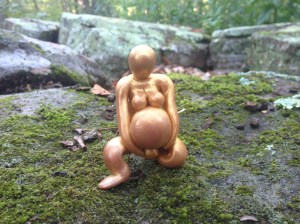
August 2013 047

Brand new sculpture inspired by the thoughts in this post.

From this point on, labor was like a long, hard prayer taking place through a dark and cold night. It literally brought me to my knees. At times I knelt, hands clasped in front of me. I had to work hard to surrender, to open myself up to the reality of labor and pain and let it be. It was a challenge. Knowing I needed to surrender to the labor, and to your advent, I made a silent decision to open my hands. I held them open and palm up in between each contraction. I tried to keep them open as long as I could once a contraction started. This was one of the most poignant parts of your birth – this surrender. I had to keep pushing my soul in the direction of you. I needed an openness of spirit as much as of body, for my spirit was caught up in a complicated grief from the months prior. At one point, when a contraction was coming, Kristen said to me, “Camille, you need to let this be big.” How did she know that I was holding back, hesitating? I needed to surrender to the hugeness of the mystery of life and birth and yes, even death. The challenge in your birth, dear Silas, was in the soul places…

…Kristen said simply, “Ok. Just listen to your body.” She trusted my body, which was so freeing. As I pushed, it felt natural. I was part of the pushing, as were you. I knew that the pushing was working, that you were coming down into the world. No one moved closer or moved away. No one tried to move me. I remained in the cleared meadow of a space with the freedom to move as my body wanted to move. There was complete freedom to do just as my midwife asked – to listen, and listen closely. To be. I was on my hands and knees, as close to earth as I could muster in the middle of Queens. And the transition to pushing felt seamless. I was permitted to remain in the deep cavities of my body, which were doing such brave work…

via The Birth Pause: Unhurrying the Moment of Meeting: The Story of Your Birth.

It isn’t only mothers who are brought to their knees by the act of birth, so are birth witnesses:

This is the story of falling in love with a baby before we even met her, the story of witnessing two friends fall deeper in love and the joy of meeting someone you just know you’ll know a lifetime in their very first second of life. This experience brought me to my knees in the end, a wreck of being awake 39.5 hours after witnessing such beauty I thought my heart would explode. I wailed in happiness, and entered a place where the only logical thing to do was roll around in the grass in the sun in full, tearful joy. I forever remain grateful to be a part of this.

It’s beautiful to document beauty, to witness beauty and just downright jump inside beauty…

via a birth story » Sara Parsons Photography.

In fact, we even see birth and knees referenced in the Bible as well:

Now when Rachel saw that she bore Jacob no children, Rachel envied her sister, and said to Jacob, “Give me children, or else I die!” And Jacob’s anger was aroused against Rachel, and he said, “Am I in the place of God, who has withheld from you the fruit of the womb?” So she said, “Here is my maid Bilhah; go in to her, and she will bear a child on my knees, that I also may have children by her.” Then she gave him Bilhah her maid as wife, and Jacob went in to her.

[No need to note how strongly I object to the notion of women being “given” to men. The author of the post referencing this quote then goes on to explain what ‘on my knees’ actually means, which is a little different than what I was thinking…]

…On my knees refers to the custom where the husband impregnated the surrogate while the surrogate reclined on the lap of the wife, and how she might even recline on the wife as she gave birth. The symbolism clearly showed the child was legally the child of the mother, not the surrogate, who was merely in the place of the wife in both conception and birth.

via Genesis 30 – The Children Born to Jacob.

Other birthing women experience the energy of birth as an embodied experience of Shakti. While Shakti can be personified as a Goddess, she is also understood as the great cosmic “fuel” of the universe, the feminine force that drives creation. Women may experience the energy of birth as Shakti moving through, with, and within them. While not specifically about birth, I recently wrote about Shakti in a related sense:

Shakti woman speaks August 2013 043
She says Dance
Write
Create
Share
Speak.

Don’t let me down
I wait within
coiled at the base of your spine
draped around your hips
like a bellydancer’s sash
snaking my way up
through your belly
and your throat
until I burst forth
in radiant power
that shall not be denied.

Do not silence me
do not coil my energy back inside
stuffing it down
where it might wither in darkness
biding its time
becoming something that waits
to strike. August 2013 050

Let me sing
let me flood through your body
in ripples of ecstasy
stretch your hands wide
wear jewels on your fingers
and your heart on your sleeve.

Spin
spin with me now
until we dance shadows into art
hope into being
and pain into power.

7/1/2013
via Woodspriestess: Shakti Woman Speaks

After thinking about this post all day and working on it in snippets at a time, a friend shared this quote with me saying that it reminded her of me. It felt like the perfect closing:

“As women connected to the earth, we are nurturing and we are fierce, we are wicked and we are sublime. The full range is ours. We hold the moon in our bellies and fire in our hearts. We bleed. We give milk. We are the mothers of first words. These words grow. They are our children. They are our stories and our poems.”

–An excerpt from “Undressing the Bear” by Terry Tempest Williams

Thesis Tidbits: Naming and Claiming

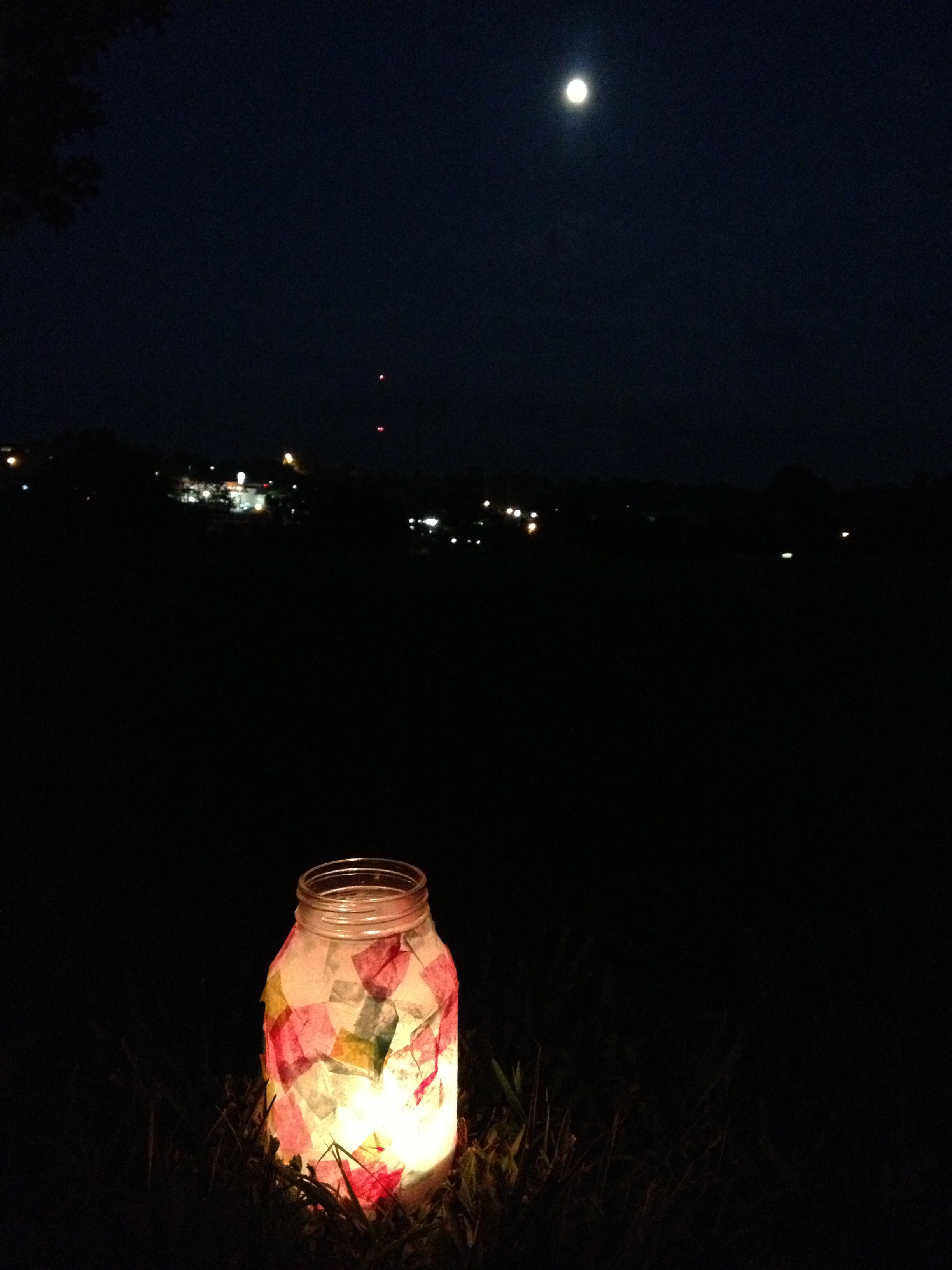
As I mentioned recently, I’m working on my thesis project on the subject of birth as a spiritual experience. Today, instead of my usual August 2013 032Tuesday collection of links, I’m sharing some thought-provoking quotes that I collected while writing the prospectus for my thesis. Pictures in this post are from last night’s Day of Hope and Healing ceremony in Rolla.

The first quote really relates to the whole reason I chose this topic in the first place:

“In this culture…a woman can be made to feel foolish for emphasizing the centrality of giving birth to her identity or her personal religiousness, her ‘womanspirit’” (Listening to Our Bodies, Stephanie Demetrakopoulos, p. 18)

While it is the opposite in my own circle of friends, in the dominant culture, whether given “religious” significance or not, I find this is true: women are made to feel foolish for emphasizing the centrality of birth to her womanspirit, to her life, to her feelings about her capacities as a woman and mother. Women are made to feel foolish for struggling with birth trauma OR for feeling “empowered” by birth. After all, it is just one day. But maybe, just maybe, part of this sensation actually originates in sensitivity to the feelings of other women:

Elizabeth Gray in Sacred Dimensions of Women’s Experience explains:

…this is not the entire story of the ambivalence a woman experiences along the way to claiming the sacredness of her own birthing process. There is the reticence she feels about possibly offending other women by seeming to elevate her own birthing experience. How is one woman to claim her own experience of an ‘easy’ birth when she knows other women labor for days in pain and some women die giving birth? How is she to name as sacred her experience of having babies, when, for whatever reason, other women are childless? How is she to claim her own experience of ‘conscious’ home-birth…,when other women may now regret having been unconscious with medications? Or if you had a ‘bad’ experience giving birth, how are you to name that when women around you are happily anticipating a successful culmination to their Lamaze classes? Women’s naming of much in their own birthing experiences is silenced by the sensitivity to other women’s feelings.

But despite these many reasons for reticence, there is a bonding of women who have given birth. It is deep and silent…a silvery shadowed oath between life and death down which all ‘the birthing mothers on the planet’ have moved, those ‘mothers of all times without whom no one walks this planet.’ Women who have given birth reach out to one another…saying to all those mothers whose birthing experiences were different than hers, ‘Don’t feel badly. ‘Rejoice in the incredible, joyous, astounding fact of creation…Every moment a child is born is a holy moment…’

(Elizabeth Dodson Gray, ed. Sacred Dimensions of Women’s Experience, p. 49-50)

Before this quote, Gray shares that the patriarchal association of birth (and women) with “uncleanliness” continues to impact women August 2013 040today:

“Because of this ancient overlay, it is not easy for women to lay claim to our life-giving power. How are we do reclaim that which has been declared fearful, polluting and yet unimportant? How are women to name as sacred the actual physical birth, which comes with no sacred ritual, while lurking around the corner of time are the long-established meta-physical rituals of circumcision and baptism?” (Elizabeth Dodson Gray p. 49)

Women today are also laboring to birth a healthier, more whole planet and means of being. For many women this begins with how they approach pregnancy and childbirth, how they consciously prepare to the welcome their babies into the world.

It is well past time in human history to push aside male dread and boldly claim the sacred woman-centeredness of every human birth…The wonder at new human life cannot be separated from the sacredness of women’s bodies or women’s lives. We will be involved in a profound betrayal of the gift of life itself as long as individual men and male culture ‘freak out’ before women’s power to give birth…If we cannot affirm women and women’s bodies and women’s birthing and women’s choice, we will go on bringing death to the planet and to ourselves. We cannot affirm life without affirming women. [emphasis mine]

(Elizabeth Dodson Gray, ed. Sacred Dimensions of Women’s Experience, p. 50-51)

And, as I’ve touched on before, birth and breastfeeding are the original sacramental experiences:

“Woman’s body is a transmutation system; it has the power to change blood to milk, to change itself into food which in turn becomes the physical and psychic energy of a child. She is creating an incarnate soul, assisting it in growth.” —Stephanie Demetrakopoulos (Listening to Our Bodies, p. 36)

August 2013 052

(this is my prayer flag this morning when I hung it up at home after the event last night)

August 2013 017

Flowers released on the lake at sunset.


A Mother’s Nest

“Although pregnancy and birth is a richly intuitive and instinctive process, a woman will prepare her ‘nest’ and birth according to the style of her culture, in the same way that a particular species of bird will build its nest with whatever is available.” –Pam England

I am planning a mother blessing ceremony for a good friend in September. In addition to fun plans like a belly cast and henna, she asked for something a little different than our usual “roster” of blessingway activities, in that she wants her friends to prepare a Mother’s Nest for her. We are going to communally decorate a birthing sheet for her bed and bring supplies for a “birth box” to have available during birth and postpartum (i.e. containing raspberry leaf tea, chlorophyll, postpartum pads, paper for placenta prints, outfit for new baby, towels etc. All the supplies you like to have on hand for a homebirth!). And, each guest will bring items to add to her bedroom, so that the whole room becomes a Mother’s Nest of birth power, strength, and support, basically like one huge birth altar!

While it wasn’t a communal process, I did intentionally create a nest for myself for the birth of my last baby. I put a futon on the floor about two feet from the bathroom and double sheeted it with a waterproof sheet in the middle and some chux pads on top. I wanted a nest that allowed me to “crawl to the bathroom” if needed. This is a request I repeated frequently during my pregnancy and it was really important to me. My mom asked, “why would you be crawling to the bathroom? Someone could help you?” and all I could say is, “I want to be able to crawl to the bathroom if I need to!” After my other births resulted in unfortunate and extensive labial tearing, I really, really disliked trying get up and into a regular bed. This time, I wanted a birth nest on the floor that I could roll off of and drop down onto, rather than trying to swing my legs out or lift them up to get in. As it was, I remained in this nest for the first three days after my daughter’s birth. I never crawled to the bathroom, but I could have if I’d needed to, dang it!

In the photo, the gray plastic tub near the futon is my birth box, all packed with labor and postpartum supplies. The cardboard boxes on the floor nearby contain my neonatal resuscitation equipment (before my daughter’s birth I became certified in Neonatal Resuscitation, because I had a fear of the baby not breathing at birth—rather than be frozen by that fear, I decided to do something about it. We then realized that it wasn’t that smart to have the only person who knows how to resuscitate a baby also being the person giving birth to that baby, so I trained my husband and mom how to use the equipment as well). I kept these supplies with my emergency birth plan underneath separate from my birth box, in order to mentally/visually have space between what was “normal” (the birth box) and what was “just in case.” My doppler is also there and some extra chux pads. You can also see my lovely birth altar with my Woman Am I picture on it, watching over my birth nest.

My baby was born into my waiting hands in this very nest, just as I planned. She breathed and cried immediately.

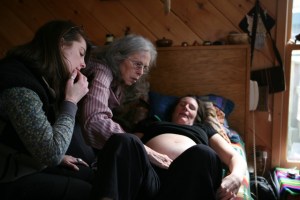
Moments before her birth. You can see the doppler in front of me, because I suddenly got freaked out about needing to listen to her heartbeat. My husband is wearing a hat because it is January and we heat with wood, but were busy having a baby instead of tending a fire!

Moments before her birth. You can see the doppler in front of me, because I suddenly got freaked out about needing to listen to her heartbeat. My husband is wearing a hat because it is January and we heat with wood, but were busy having a baby instead of tending a fire!

I look forward to helping my friend create her mother’s nest. How about you? Do you have any ideas for a Mother’s Nest? Did you build one for yourself? What would you like friends to contribute to a nest for you?
Modified from this post.

Tuesday Tidbits: Miscarriage Care

66112_618725968151055_156983473_nFor ages, I’ve had the following quote about miscarriage and doctors saved in my drafts folder:

“The only person who can really tell you what is happening to you is your own doctor, who peers into you with a light and a speculum, who samples your blood or urine, or who presses a sonogram paddle into your belly. If you are in trouble, bleeding, scared, or more depressed than you think you can handle on your own, you must find help. Read and research all you can, but remember that the one-on-one assistance of a real doctor is the only thing that will give you answers that count. If you don’t like or trust your doctor, then find one you can…”

I Will Carry You

I saved it because it bothered me so much to read. One-on-one assistance of a real doctor is the ONLY thing that will give you answers that count?! I disagree so much with this and it saddens me to know that women turn to doctors for support that they are unlikely to be able to provide, particularly if women are looking for compassion. My own ER doctor experience was horrendous and involved quotes like: “this is very common, it is just natural selection” and, “this wouldn’t hurt so much if you would just stay still,” as well as leaving bloody handprints streaked across the bed and blood on the floor (specifically after being told how very disturbed I was by all the blood). In contrast, I was treated with beautiful compassion (and actual, genuine, useful help) by every midwife I talked to. In defense of doctors though, I also went to my own family practice doctor for a follow-up visit and she said one of the best things I heard from anyone, doctor or not: “some women find comfort in knowing that love was all their babies ever knew.” And, before I left, she asked if she could give me a hug. That mattered more and lasted longer than any “advice” that she gave me about possible causes, trying, again, etc.

So, this week, related miscarriage articles and stories started catching my eye, such as this one that touches on the various dehumanizing ways many women are treated in medical care environments:

Rush of blood to my brain. Pounding in my ears. Breathing comes in short bursts. And I’m ushered out into the waiting area where I’m told to go home to wait for it to ‘come away’. And there I find myself, blinking in the sun, shaking like a leaf. So I waited. And waited. One week later the tiny form within still clung on. I saw it in my minds eye, not wanting to let go of me, its mother. Perish the thought. Instead I spent the week overly busy whilst somehow trying to recalibrate a defeated dream and birth date that would never occur. Finally, I just booked in for the D&C, and signed for an “excavation of contents.”

I am a psychotherapist and counsellor. I focus mainly on fertility in all its guises. From pre pregnancy to birth and beyond I am struck as women and their partners endure dehumanising experience after dehumanising experience, just like this one…

via The heartbreak of miscarriage

And, that reminds me of what Ina May said in her Birth Story documentary that the number one rule of maternity care should be Be Nice and she asks us to consider how just those two words could change maternity wards. While not miscarriage-specific, of course The Neighborhood Doula’s status on Facebook tonight jumped out at me:

“We need to treat women tenderly in labor. This may be the first time she has ever been treated that way. She will pass that on to her baby. If mom has a traumatic birth, filled with interventions she may be afraid of her baby. Fear of baby = disempowerment. A new mother should never feel that way. We need to treat dad with tenderness during labor too. If we treat him well, he will treat mom and baby well.”

Wise words from Ina May Gaskin at the 2012 Joyful Birth and Breastfeeding expo, Asheville, NC

Over the weekend, I was touched to see a photo from Stillbirthday on Facebook with a caption that almost made me cry because I think this perspective is SO important:

Supporting Birth Diversity means…

…Honoring that birth can occur, at any point in pregnancy.

The word “birth” is not reserved for full term, neither is it exclusively for live babies.

(Share your photo and what Supporting Birth Diversity means to you.)

And, of course I’ve already shared my thoughts on miscarriage as a birth event: 421806_605009189522733_1988490402_n

“Miscarriages are labor, miscarriages are birth. To consider them less dishonors the woman whose womb has held life, however briefly.” –Kathryn Miller Ridiman

via Miscarriage and Birth | Talk Birth.

I also read several articles about other women’s experiences with miscarriage as a birth event such as this moving exploration of “missing” when your expectation was of carrying:

Instead I was overwhelmed by pain that felt like the worst wrenching of labor, contractions that came so fast I could barely breathe, shaking and numbness in my limbs that finally made me crawl to the phone and call the nurse who told me to get to the ER as fast as we could. I’d never heard stories of the real, raw truth of what it means to miscarry, so I had no idea what to expect.

But just because a death comes early does not mean it is lighter to bear or let go…

on carrying and missing | mothering spirit.

And this article that touches on the birth event concept, as well as issues of guilt and blame, as well as the idea of miscarriage as a rite of passage:

That is why there is no doubt in my mind that any woman – and indeed any family – who goes through a miscarriage should see it as a rite of passage. The more that miscarriage is seen as horrific, as something which somehow could have been preventable, and is therefore blamed on the woman’s health, fitness or diet, the more we are denying ourselves as fallible animals. We are making women responsible somehow for these acts of nature. We are instilling guilt and fear, layer upon layer. The result is a woman, and by extension her family, who no longer trusts her body to do what is right. It must be faulty – it miscarried. Her body was not healthy enough, not experienced enough or somehow not adequately formed to be able to carry the pregnancy to full term.

This is not a healthy attitude to have, and can only result in more negative birth outcomes. One of the reasons I do not have a black tinge around my memories of my son’s birth is that, through it all, I trusted in my body. I did what I could, and although I couldn’t understand WHY it had happened, I came to accept that this time was just not meant to be. I am an animal, and I am fallible. This time I fell into the statistics of 1 in 7 pregnancies failing. There’s really no more to it – no guilt, no shame, no fear for future pregnancies; it’s just not appropriate.

Having gone through this whole process I now feel more of a woman. Yes, really. Not only have I experienced the horror myself, but I have had countless other women suddenly willing to share their own story with me. In a sad way I feel as if I have entered a secret club, something taboo and a bit shameful. I’m not really sure why nobody wants to discuss miscarriage, when it affects so many of us. If it were accepted as a rite of passage for any woman, as much as childbirth itself, I feel we’d all have a more positive outlook on all births, whatever the outcome.

via Guest Post: Miscarriage as a Rite of Passage | The Happy Womb.

I also finished reading a quick book that was offered free on Kindle last week (now back to a regular, reasonable price) and saved these two quotes:

In the days that followed, the bleeding continued. Every time I would see the blood, I couldn’t help but think I was losing my child slowly bit by bit. It wasn’t just ordinary bleeding; it was the end of my baby’s life. It was the end of my dream to become a mom. I was devastated. I felt so lost and alone. Unfortunately, my husband didn’t seem to understand or be able to comfort me. To him, the baby was not even real yet. And since he was actually afraid of becoming a dad, I think in some ways he was relieved that it didn’t work out. In my mind, I had lost a child. Someone important to me had died, and I was grieving. The hard part is that I was grieving alone with no one to share my sorrow. This is often a problem for women who miscarry. You feel so sad and devastated, but many times your friends and family don’t get it. They don’t realize how much love you can feel for a baby you never saw, met or held. You try to turn to those you love for comfort and support, but they have little to offer you during the time when you need someone to lean on the most. It’s not that they don’t want to help or that they don’t care. No one wants to see you sad or hurting. They just don’t understand what you are feeling and the intensity of your emotions. Even the words they say to you can come across as insensitive or hurtful. They often dismiss your grief and trivialize your pain, all the while thinking they are being encouraging and supportive.

(Amazon.com: From Pain to Parenthood: A Journey Through Miscarriage to Adoption eBook: Deanna Kahler: Kindle Store)

The author also touches on the depth of the grief following miscarriage and how very, very real it is (I’ve written before that one of the things I kept saying to my parents when they came to my house following Noah’s miscarriage-birth was, “this was real. I want you to know it was real.” (I honestly think I didn’t think miscarriages were “real” before, in the sense that I categorized them as something other than birth or death.)

According to The Women’s Encyclopedia of Health and Emotional Healing, “the length of the pregnancy is not as significant as how emotionally linked a woman feels to her baby.” The book goes on to say that if you felt your child was real very early in the pregnancy, then you may experience as much grief as someone who has lost a newborn. If the love for your unborn child was already there, you will be heart-broken and devastated. Your loss can affect you in many different ways, some emotional and some physical. You may notice muscle tension, have trouble sleeping, have difficulty concentrating, suffer from frequent headaches, cry a lot or even notice unusual sensations in your body.

(Amazon.com: From Pain to Parenthood: A Journey Through Miscarriage to Adoption eBook: Deanna Kahler: Kindle Store)

And, these quotes made me remember a brief post from The Amethyst Network regarding early losses and the validity of feelings:

I felt very conflicted over this. I HAD grieved before, but if I was grieving over not-an-actual-miscarriage then did it count? If my loss wasn’t actually a loss, then was my grief valid?

I was talking with a friend (who happens to also be involved with TAN) and explained to her how I was feeling confused and upset over this. She taught me something important.
“You grieved” she said. “It doesn’t matter whether the physical experience was a miscarriage or not, because the grief was real, you experienced the emotional process, and that is valid.”

And so I would say to all mothers who have had an early loss, or a loss that they felt in their gut even though there was no proof. Your feelings–no matter what they are–are valid feelings. We each have different experiences, and we each have different feelings. But what you feel is legitimate, regardless of the circumstances.

Did It Count?

995401_615271668496485_1504558296_n

(and, really, there is no “shame” in not acknowledging how it changes us either, the shame rests in the lack of acknowledgment from so many around us)

This last photo (for some reason it refuses to let me caption it?!) is of some “hope” baubles created by members of the Rainbow Group (local loss support group) at our recent MamaFest event (more about this soon, I hope!).

August 2013 028

Birth as a Spiritual Experience (Thesis Project)

Here is your sacrament MR_089
Take. Eat. this is my body
this is real milk, thin, sweet, bluish,
which I give for the life of the world…
Here is your bread of life.
Here is the blood by which you live in me.”
–Robin Morgan (in Life Prayers, p. 148)

“…When I say painless, please understand, I don’t mean you will not feel anything. What you will feel is a lot of pressure; you will feel the might of creation move through you…” – Giuditta Tornetta in Painless Childbirth

“I am the holy mother; . . . She is not so far from me. And perhaps She is not so very distinct from me, either. I am her child, born in Her, living and moving in Her, perhaps at death to be birthed into yet some other new life, still living and having my being in Her. But while on this earth She and I share the act of creation, of being, and Motherhood.”Niki Whiting, “On Being a Holy Mother” in Whedon

“Woman-to-woman help through the rites of passage that are important in every birth has significance not only for the individuals directly involved, but for the whole community. The task in which the women are engaged is political. It forms the warp and weft of society.” –Sheila Kitzinger

In 2011, I started working on my doctoral degree in women’s spirituality/thealogy (Goddess studies). Before I even began my first class, I chose my dissertation subject: birth as a spiritual experience. I’ve been steadily plugging away on my coursework and somehow in the midst of everything else that I am responsible for, I’ve successfully completed 13 of my classes. I already have a (not related) master’s degree and this is why I was admitted straight into the doctoral program, even though I have to complete a lot of M.Div (master’s of divinity) level coursework as prerequisites to the actual doctoral classes. After I finished my most recent class and got my updated transcript, I finally actually noticed how many M.Div classes I’ve completed thus far on my journey and it occurred to me to email to inquire what it would take to finish an M.Div degree first. I had this sudden feeling of what a nice stepping stone or milestone experience it would be to finish something, since I know that I have a minimum of three more years remaining before I complete the D.Min! They wrote back quickly and let me know that with the completion of three courses in matriarchal myth (I’m halfway through the first right now), my almost-completed year-long class in Compassion (I’m in month 11), and The Role of the Priestess course (involving three ten-page papers), all of which are also part of my doctoral program, the only other thing required for successful completion of my M.Div would be a thesis (minimum of 70 pages).

As I’ve been working through my classes, I’ve felt a gradual shift in what I want to focus on for my dissertation, and I already decided to switch to writing about theapoetics and ecopsychology now, rather than strictly about birth. I was planning to mash my previous ideas about birth and a “thealogy of the body” into this new topic somehow, perhaps: theapoetics, ecopsychology, and embodied thealogy. Then, when I got the news about the option of writing a thesis and finishing my M.Div, it became clear to me: my thesis subject is birth as a spiritual experience! This allows me to use the ideas and information I’d already been collecting as dissertation “seeds” as a thesis instead and frees me up to explore and develop my more original ideas about theapoetics for my dissertation! (This is the primary subject of my other blog.) So…why post about this now? Well, one because I’m super excited about all this and just wanted to share and two, because I’d love to hear from readers about their experiences with birth as a spiritual experience! While I don’t have to do the kind of independent research for a thesis that I will be doing for my dissertation and while my focus is unabashedly situated within a feminist context and a thealogical orientation, I would love to be informed by a diverse chorus of voices regarding this topic so that the project becomes an interfaith dialog. Luckily for me I’ve already reviewed a series of relevant titles.

Now, I’d like to hear from you. What are your experiences with the spirituality of birth? Do you consider birth to be a spiritual experience? Did you have any spiritual revelations or encounters during your births or any other events along your reproductive timeline? (miscarriage, menstruation, lactation…) Did you draw upon spiritual coping measures or resources as you labored and gave birth? Did giving birth deepen, expand, or otherwise impact your sense of spirituality or your sense of yourself as a spiritual or religious person? Did any of your reproductive experiences open your understanding of spirituality in a way that you had not previously experienced or reveal beliefs or understandings not previously uncovered?

When I use the word “spiritual,” I mean a range of experiences from a humanistic sensation of being linked to women around the world from all times and spaces while giving birth, to a “generic” sense of feeling the “might of creation” move through you, to a sense of non-specifically-labeled powers of Life and Universe being spun into being through your body, to feeling like a “birth goddess” as you pushed out your baby, to more traditional religious expressions of praying during labor, or drawing upon scripture as a coping measure, or feeling that giving birth brought you closer to the God of your understanding/religion, or, indeed, meeting God/dess or Divinity during labor and birth).  I’m particularly interested in women’s embodied experiences of creation and whether or not your previous religious beliefs or spiritual understandings in life affirmed, acknowledged, or encouraged your body and bodily experience of giving birth as sacred and valuable as well as your own sense of yourself as spiritually connected or supported while giving birth. I would appreciate links to birth stories or articles that you found helpful, books you enjoyed or connected with, and comments relating to your own personal experiences with any of the comments or questions I have raised above. I would love to hear about your thoughts as they relate to:

  • Pregnancy IMG_0225
  • Labor
  • Birthing
  • Lactation
  • Miscarriage
  • Infertility
  • Menstruation
  • Reproductive Rights
  • Birth as a feminist or social justice issue…

 Thank you!

With these things said, I also want to mention that I’m planning to redirect a lot of my writing energy/time into this thesis project rather than to blog posts. I’m trying to come up with a blog posting schedule for myself, but in order to actually do this thing, I must acknowledge that I have to re-prioritize some things and that means writing for my blogs probably needs to slip down a couple of notches in terms of priority of focus.

Oh, and I also hope this thesis project will turn into a book of some kind as well! 🙂

“It is hard to find a female-based concept such as Shakti alive within Western spiritual traditions. Shakti could be viewed as an expression of goddess in the female body at the time of birth. I would say its flow / expression and outcome of love is hindered by unnecessary interventions at birth which divert such energy towards fear- based, masculine forms. The use of masculine, rescue-based healing forms such as cutting (Grahn, 1993) can be necessary and useful, yet such procedures are currently used at the cost of women’s autonomy in the birthing process (see Jordan on C-section, 2007), and define the parameters of what feminist thinker Mary Daly called patriarchal medicine (1978). Modern women are largely lost when it comes to giving birth, turning to medical authority figures to be told what to do. Daly pointed to the dangers of this appropriation for women’s personal and collective autonomy.

Birthing bodies resist, disrupt and threaten standard North American modernist investments in linear time, rationality, order, and objectivity. Birth disrupts the Judeo-Christian male image of God, even as He hides the reality of female creation and creativity. I hold that women giving birth act from a focal point of power within their respective cultures and locations, the power to generate and renew human life itself from within the female body. This power is more absolute in its human reality then any other culturally sanctioned act of replication and material production, or social construction. I speculate that how this female power is expressed, denied, or acknowledged by women and within the society around a birthing woman reflects the degree to which women can and may express themselves at large. As each soul makes the journey through her/his mother, re-centring human consciousness within the female-based reality of human birth causes transformation of patriarchal consciousness as a whole…” –Nane Jordan, Towards an Ontology of Women Giving Birth

Tuesday Tidbits: Birth Imprinting

What are imprinting upon newborns at birth in our culture?

As Sister MorningStar writes in her article The Newborn Imprint in Midwifery Today issue 104, Winter 2012…

If you have had the misfortune, as nearly all of us who can read and write have had, to see a baby born, perhaps pulled out, under bright lights with glaring eyes and loud noises of all sorts, in a setting that smells like nothing human, with a mother shocked and teary and scared; if you have witnessed or performed touch that can only be described as brutal and cruel in any other setting…

Every baby born deserves uninterrupted, undisturbed contact with her mother in the environment the mother has nested by her own instinctual nature to create. Any movement we make to enter that inner and external womb must be acknowledged as disturbing and violating to what nature is protecting. We do not know the long-term effects of such disturbance. We cannot consider too seriously a decision to disturb a newborn by touch, sound, light, smell and taste that is different and beyond what the mother is naturally and instinctually providing. Even facilitating is often unnecessary if the motherbaby are given space and time to explore and relate to one another and the life-altering experience they just survived. They both have been turned inside out, one from the other, and the moment to face that seemingly impossible feat cannot be rushed without compromise. We have no right to compromise either a mother or a baby.

I am deliberately leaving out the issue of life-saving because it has become the license for full-scale abuse to every baby born… [emphasis mine]

In the same issue in an article called Problems in American Maternal Health Care, Dan Currin points out:

Americans put a lot of trust in their physicians. We are socialized to believe that physicians are the only ones capable of taking care of us. For everything from how to eat to how to die, the mantra is the same in the US: ‘Ask your doctor.’ Meanwhile, physicians are more and more subject to a system that, as Gaskin describes, favors the priorities of hospitals, insurances companies and doctors above the best interests of mothers and their babies

And, Judy Slome Cohain writing in Collusion and Negligence in Hospitals describes it thusly:

To err is considered human, even when it involves maternal death, at a hospital birth. When a woman dies from malpractice after birth the protocol is to hold meetings to consider how to improve relevant protocols to prevent future disasters. Survival of the hospital is first and foremost. However, if a woman dies at an attended homebirth, the Ministry of Health policy is to start a case against the guilty part in a disciplinary court…”

I wrote about birth imprinting in another short post, The Magic of Mothering and about the notion of consulting your health care provider in some thoughts about Women’s Power and Self-Authority.

We also need to consider the role of birth “imprinting” on the breastfeeding relationship:

New mothers, and those who help them, are often left wondering, “Where did breastfeeding go wrong?” All too often the answer is, “during labor and birth.” Interventions during the birthing process are an often overlooked answer to the mystery of how breastfeeding becomes derailed. An example is a mother who has an epidural, which leads to excess fluid retention in her breasts (a common side effect of the IV “bolus” of fluid administered in preparation for an epidural). After birth, the baby can’t latch well to the flattened nipple of the overfull breast, leading to frustration for both mother and baby. This frustration can quickly cascade into formula supplementation and before she knows it, the mother is left saying, “something was wrong with my nipples and the baby just couldn’t breastfeed. I tried really hard, but it just didn’t work out.” Nothing is truly wrong with her nipples or with her baby, breastfeeding got off track before her baby was even born!

via The Birth-Breastfeeding Continuum | Talk Birth.

417

If she came with it label, it would say: Imprint with Care…

*Short post today because I’m out-of-town again! What the heck?! I need a vacation from vacations!

Tuesday Tidbits: Birth Thoughts

Lots of birth stuff to share this week! I may be slowly transitioning away from face-to-face birth work, but reading and writing about birth definitely remain on my agenda. First, this post about pivotal moments in one birth professional’s journey:

Thanks to a powerful recent blog by a doula in England about her experience in a Birthing from Within workshop, I have found myself reflecting on my own path as a doula and childbirth educator. Over the years I’ve done ICEA training, DONA Birth Doula Certification, and Birthing from Within Mentor Certification, along with apprenticing as a midwife and a Masters of Science in Parent-Child Nursing – more than my fair share of learning. Through the past twenty + years of practice I can identify the 7 core experiences that have shaped who I am as a birth professional.

via Birthing Ourselves | My Path as a Doula & Childbirth Educator.

Reading her list brought back some of my own pivotal moments and also helped me see how those moments relate to my current priestess/women’s mysteries path. I think I’ve already mentioned that I renewed my ICEA CBE certification this year, but I let my CAPPA certification lapse. I will let my prenatal fitness educator certification lapse as well and I did not renew my membership in several birth-related organizations. And, in a complicated decision related to a variety of factors, I withdrew my registration for a Birthing from Within mentor training this fall. I’ve wanted to train with BfW for ages, but I realized after we got home from California that I just can’t picture myself doing birth classes any more. Single day workshops or presentations, yes, but teaching (or mentoring) series of birth classes is just not on my radar any longer. I feel removed from or distant from it and I also feel okay with that. It is taking me quite some time to realize that birth writing is still a legitimate form of birthwork/birth advocacy/activism and I don’t need to feel like I “should” be doing something else in order to be valuable.

Speaking of birth professionals, I was interested to see this promising new blog by Amy Gilliand: Doulaing The Doula | Professional Development for Birth Doulas.

And, I’m so thankful that Missouri midwives have now known the freedom to practice for five years! I meant to post this link in an earlier Tuesday Tidbits post:

There is something so genuine, so deep, so…right about women serving women. Midwifery and midwives are intricately woven into the fabric of my life.

via 5 Years of Legal Midwifery in Missouri | Midwives, Doulas, Home Birth, OH MY!

Don’t forget to watch the lovely Ballad of the Midwife video that goes with it! Both the video and the post were created by a talented friend of mine 🙂

Speaking of friends, check out these large family blogs and vote for my friend Shauna’s blog Life with 7 Kids! (she just welcomed a new baby, so it is 8 kids now! :))

And, speaking of videos, after seeing a pretty hands-on, baby-twisting sort of breech birth in Birth Story, I found this pictorial article to be a good reminder with lots of useful pictures:

Most important rule is HANDS OFF THE BREECH no matter how tempting it is just to pull on that leg DON’T. It’s the easiest way to create nuchal arms and a completely deflexed head. When you pull on the leg you create a morro reflex in the baby.

via Mechanism of breech | Homebirth: Midwife Mutiny in South Australia.

And, speaking of Ina May:

“Remember this, for it is as true as true gets: Your body is not a lemon. You are not a machine. The Creator is not a careless mechanic. Human female bodies have the same potential to give birth well as aardvarks, lions, rhinoceri, elephants, moose, and water buffalo. Even if it has not been your habit throughout your life so far, I recommend that you learn to think positively about your body.”
― Ina May Gaskin, Ina May’s Guide to Childbirth

And, speaking of watching Birth Story: Ina May Gaskin and The Farm Midwives documentary, it made me think of this old post:

I know the traditional root of the word midwife is “with woman” (some sources say “wise woman”), but I’d like to offer another. When I was pregnant with my second son, I had a wonderful midwife and we spent many hours together talking about birth and midwifery. During one conversation she said to me, “you can’t be a midwife unless you love women.” This struck me profoundly—a midwife must love women.

via Midwife means “loves women”… | Talk Birth

Oh, and speaking of this loving women and this not being a lemon stuff…

Respect for our bodies, our babies, and our rights is never too much to expect.

That’s why I’m joining forces with the folks I thought were nuts. Remember the ones waving the signs? The ones I thought were nosy, yoga-ball bouncing doctor-haters? Turns out, they are none of those things. They are a smart, growing global coalition of people who recognize that we have a problem with the way many women are treated while giving birth. Nine out of 10 women give birth in a hospital in the United States. Through rallies and advocacy, ImprovingBirth.org is making sure everyone knows that all those women do not check their human rights at the door.

via Nosy, Yoga-Ball Bouncing Doctor-Haters – Why I Changed My Tune – Improving Birth | Improving Birth

But, what happens after the birth? I’ve often thought that my role in breastfeeding support, while less “glamorous” or exciting than birth work, has had more lasting value to the women I serve. Breastfeeding is the day in, day out, nitty-gritty reality of daily mothering, rather than a single event and it matters (so does birth, of course, it matters a lot, but birth is a rite of passage, liminal event and breastfeeding is a process and a relationship that goes on and on for every. single. day. for sometimes years). Anyway, sorry for the brief side note, but I enjoyed reading this article about the celebrity culture surrounding pregnancy and birth with its obsession with who has a “bump” and then how after the birth the main deal is losing that weight and having a fabulous bod again! Woot!

And that’s it. There’s no talk of the hard decisions and challenges that arise when bringing another human in the world: coping emotionally, miscarriages and health risks throughout the pregnancy, emotions that range from excitement to loss, how the partner is coping, decisions surrounding the birth, doulas, home birth, hospital birth, breastfeeding, milk supply, c-section recovery, vaginal recovery, colic, sleep, schedules, being tired all the time, depression, regret, fear, hiding in the bathroom crying. Agonizing decisions about work, caregivers and new priorities. Maternity leave. Paid time off. Unpaid time off. Pumping at work. Making time for your partner. Making time for yourself. A body that has changed but can also do incredible things.

Instead it’s mostly about getting skinny again after the baby is born, which we’re told over and over again is the MOST IMPORTANT THING. And it’s not. I know it’s not, and yet I have a constant dialogue in my head about how I have thirty pounds to lose and my thighs rub together and my stomach is bloated and has the texture of a grape that’s not quite a raisin and my face is fat and I’ll never fit into my old clothes again. I say this to friends (who haven’t had kids) and the response is: “Focus on the amazing thing your body just did, girl! A baby came out of you! You’re being too hard on yourself!” And they are right. I know this. But I can’t shake the feeling that I’m a failure because I’m not the size and shape I once was. And then I feel dumb and embarrassed for focusing on my looks when I should be celebrating how awesome it is that I’m a mom to two healthy, wonderful kids. It’s an exhausting, stupid cycle.

There is an important conversation to have about motherhood that we’re not having on a larger level. I know this because I talk to moms all the time. None of us are talking about maxi dresses or nursery colors or how we worked out for 90 minutes a day with our trainers while wearing a corset. We’re talking about how our maternity leaves don’t feel long enough. How often there’s nowhere to pump at work so we do it in our cars. How frustrating it is to be making too much milk/too little milk. How some days we can’t stand our partners, and on other days they totally save us.

via Exclusive: There Is More To Motherhood Than A Post-Baby Bod | Kate Spencer.

Reading all that and thinking about my own “grape” stomach that just isn’t quite making it back to “normal” after having my last baby, I was reminded of a quote from a very recent post:

“…we all need the renewing powers of ‘rhythm, ritual, and rest.’ This phrase reminds doulas of three helpful labor techniques outlined by legendary doula trainer, Penny Simkin. Rhythm, ritual, and rest not only aid birthing women, but they support all of us to move skillfully through our life’s labors. The power of rhythm restores vibrancy through dance, music, and motion. The power of ritual opens the way to direct encounter with the mysterious wonder of life. Rest renews and restores the very cells of our often tired and over-stimulated bodies and minds…” –Amy Wright Glenn

via Talk Books: Birth, Breath, & Death | Talk Birth.

And, speaking of Amy Glenn, I loved her lovely blessing for mothers to be!

“…May your pregnancy unfold with ease

May gentleness surround you

Joy for precious days

Days of two hearts beating in one body

You radiate wonder

Inspiring poetry, art, worship of ancients…” –Amy Glenn

via The Birthing Site

And, speaking of loving lovely words, I just have to re-share this quote as well:

labyrinth

Talk Books: Birth, Breath, & Death

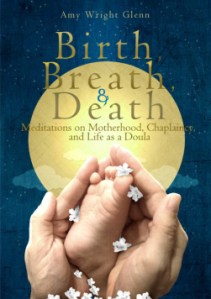
I just finished reading a lovely little book by Amy Wright Glenn. Lyrical, gentle, contemplative, and touching, Birth, Breath, and Death explores Amy’s meditations on life as a doula, mother, and hospital chaplain. birthbreathanddeath-amywrightglenn

Amy Wright Glenn was raised as a Mormon and eventually found her way onto a different faith path, Unitarian Universalism. Her reasons for connecting with the UU church actually closely mirror my own. Amy mentions that she first finds the UU church through her interest in poetry, which I found interesting. She then explains, “I was drawn to the way that Unitarian Universalist (UU) ministers attempt to evoke wonder and exploration in the minds and hearts of their congregants” (p. 10). This attempt to engage with the “transcendent sense of mystery and wonder” is exactly what attracted me to the UU’s, as well as the respect for the interdependent web of life of which we are all a part, the affirmation of the dignity and worth of each human being, and the commitment to social justice.

Amy writes, “I had been raised to acknowledge only one entrance to God’s energy. In fact, one need not use the term ‘God’ at all. Such a term is another doorway into the mysterious heart unifying all existence. However, humans need language to direct the attention to the ineffable. There are many names for this mystery. The doorways were holy too” (p. 13).

She continues with a very UU perspective (I’ve heard of it describes as “the light shines through many windows. We respect all windows and welcome everyone, except for those who think they should throw rocks through everyone else’s window!”):

“Spiritual surface structures open human beings to encounters with the ineffable…I have no doubt when my father bows his head in a small Utah town, and when I meditate in quiet sublime stillness, we touch the same source. At their best, religious traditions affirm the wonder at the heart of existence and provide meaningful contexts for its experience. This mystery allows us to breathe, dream, love, and dimly perceive so,etching beyond time even while we live in time…The moon is simply the moon, a miracle enough” (p 16).

I connect to this sense of wonder, with no need for explanation or interpretation—isn’t it is enough, to just marvel at what is? On my other blog, I once wrote:

I also have a favorite passage from Susan Griffin about the earth in which she exclaims, “We are stunned by this beauty.” That is exactly how I feel. This relationship to the planet is what used to make me feel that a conception of deity was unnecessary—isn’t it enough to just marvel at what is, right here in front of us? The majesty and the miracle of the natural world. I am stunned by this beauty. I am stunned by the realization that we are all suspended in space, spinning timelessly through the universe on this beautiful planet, so small in the vastness of all that surrounds us, and yet so big that it is literally our whole world. Sometimes when I have a bad day or feel overwhelmed by the swirl of daily tasks I remember that old saying about, “sometimes I go about pitying myself when all the while I am being carried by a great wind across the sky.” If we really stopped to think about this—to sense how we are carried by the great wind, I think the whole world would change, how people relate to each other and to the environment would be transformed. Stop, look, listen, breathe, and feel how we spin. Together.

Moving into birth, Glenn addresses the potent, transformative aspects of birth in describing attending her sister’s birth, the birth that led her into doula work (before the birth of her own son): “Birth brings powerful and painful sensations to the most intimate spaces of the female body…I stood transfixed by the life-giving strength found in her feminine power.”

She also explains:

“All forms of birth–physical, intellectual, spiritual, or emotional–bring one to the depths. The power to give birth originates in the creative life spirit birthing all, the seen and the unseen. According to Joseph Campbell, the source of life is beyond gender and the duality of male and female. However, when symbolizing the power that creates, Campbell argues the representation is ‘properly female.’ I agree. From this universal goddess energy emanates the seasons, the mountains, the rivers, and the galaxies. Writ large, human birth embodied the process of manifesting dreams, working diligently through our labors, and bringing vital energies to life. On this level, all human give birth. All humans participate in life’s creative energy…

On this level, we all need the renewing powers of ‘rhythm, ritual, and rest.’ This phrase reminds doulas of three helpful labor techniques outlined by legendary doula trainer, Penny Simkin. Rhythm, ritual, and rest not only aid birthing women, but they support all of us to move skillfully through our life’s labors. The power of rhythm restores vibrancy through dance, music, and motion. The power of ritual opens the way to direct encounter with the mysterious wonder of life. Rest renews and restores the very cells of our often tired and over-stimulated bodies and minds.” (p. 28-29).

And, she makes some poignant observations about breastfeeding, one that almost made me cry: “…only a child knows what his mother’s heartbeat sounds like from the inside” (p. 67) and one that made me cheer: “Family and friends need to draw a fierce circle of protection and non-interference around the nursing mother-child dyad.

In giving birth to her own son, Amy’s awareness and understanding are further deepened and expanded and she explains that:

“For me, birthing was a crucible moment, a dying, a deepening, and a healing. The light of birth transformed me into a mother. The light of birth is love. Looking back I see this clearly. Love was the pain and joy. Love restored me as I rested and held me up when I transformed into a wild eyed Kali. Love chanted with me in the birthing tub and love was certainly the epidural. Love pushed my baby out and gazed at me through Taber’s eyes. Love sustains me now as I watch his sweet small mouth suckle…” (p. 68)

Towards the end of this sweet, thoughtful book, she also used a great analogy that I’m going to borrow for my human services classes. She posits the scenario in which you are passing by a pond on the way to work and notice a small child drowning. You are wearing an expensive pair of new shoes and rushing into the water will ruin them. Do you rush in? The answer is YES. No one should choose their shoes over the life of the child and almost no one would respond to this scenario by saying that they would not save the child, yet, if the pond is world poverty, we do in fact, choose the shoes every day…we just aren’t looking those children in the eyes at the time…

Disclosure: I received a complimentary copy of this book for review purposes.

Film Reaction: Birth Story

bs_header_f1I have never met anyone with more than a passing interest in birth activism who has not heard of Ina May Gaskin. She isn’t referred to as a the world’s most legendary midwife for nothing! But, how did she get this way? The new documentary film, Birth Story, helps explore that question.

inamayteaches

Prenatal visit

“The feature-length documentary BIRTH STORY: INA MAY GASKIN & THE FARM MIDWIVES tells the story of counterculture heroine Ina May Gaskin and her spirited friends, who began delivering each other’s babies in 1970, on a caravan of hippie school buses, headed to a patch of rural Tennessee land. With Ina May as their leader, the women taught themselves midwifery from the ground up, and, with their families, founded an entirely communal, agricultural society called The Farm. They grew their own food, built their own houses, published their own books, and, as word of their social experiment spread, created a model of care for women and babies that changed a generation’s approach to childbirth.

Forty years ago Ina May led the charge away from isolated hospital birthing rooms, where husbands were not allowed and mandatory forceps deliveries were the norm. Today, as nearly one third of all US babies are born via C-section, she fights to preserve her community’s hard-won knowledge. With incredible access to the midwives’ archival video collection, the film not only captures the unique sisterhood at The Farm Clinic–from its heyday into the present–but shows childbirth the way most people have never seen it–unadorned, unabashed, and awe-inspiring.”

I really enjoyed Birth Story. It skillfully weaves together vintage footage, commentary, and births with a present day shadowing of Ina May in her natural environment: at the Farm. The documentary shows her working in her kitchen, eating, talking to her husband, watering plants, riding her bicycle, teaching workshops, training midwives, going to prenatal visits, and finally, attending a very hands-off gentle waterbirth. It also lets us peek at images from the early days of The Farm community, the caravan of buses, the dreams of Stephen Gaskin and the “hippies” who followed him to Tennessee. Birth Story is not just a film about Ina May though, it chronicles the experiences of several other Farm midwives as well, and I loved hearing the commentary and opinions of the less-famous midwives who helped transform the birth world. inamaystephen

I found footage of Ina May with Stephen to be particularly poignant and very much enjoyed the vintage photos and footage. I also find it interesting how The Farm began because of Stephen’s leadership and ideas and yet Ina May took off as the ongoing famous person in the family. Of Stephen, Ina May explains: “He thought women we supposed to be uppity—this was great relief, I didn’t like being held down.”

Ina May describes her own first birth explaining that in typical birth climates, “there’s nothing about the special energy of birth and that’s kind of the most important thing…I felt like I was doing something sacred.” She also makes the basic and crucial point that the number one rule of maternity care should be Be Nice and laughs as she asks us to consider how just those two words could change maternity wards. There are only a handful of actual births in the film, three of which are from sometime in the 1980’s. We see a breech birth (a lot more hands-on than I think of present-day midwifery practice) and a shoulder dystocia, both rare occurrences in birth films. We also see brief footage of Ina May’s Safe Motherhood quilt project and a brief discussion of disparities in maternal mortality rates.

Another highlight of the film for me was midwife Pamela, whose birth we also see on-screen. She is shown telling us about an early birth she attended saying, “I fell in love with women. How can you see someone be so strong and not fall in love?” Exactly. My doula and friend, Summer, who watched the film with me, developed her reaction to this quote in a lovely blog post and it reminds me of my own past post about my own former midwife who helped me see that midwife means loves women. Ina May explains that she learned how to be a midwife by allowing herself to be instructed by the women themselves and then she trained other midwives. As I watched Birth Story I found myself feeling a little sad, nostalgic, and inamayandbabybittersweet, because I feel like the world that these beautiful midwives envisioned has yet to really be birthed and that in some ways we’ve gotten so far away from the relationship-oriented and community living/engagement model upon which The Farm was based.

My initial feeling as I watched the film was that it would be primarily of interest to people already very familiar with Ina May, thinking that it  may not appeal to or interest “regular” people. However, the friends I viewed the film with had totally different perspectives. One friend told me she thought her husband would really have liked the documentary, particularly for the emphasis on community. The one husband who was present reported that he thought everyone should see the film and not just people who are already “birth junkies.” So, I stand corrected, and will now say that Birth Story has the capacity to engage with many people!

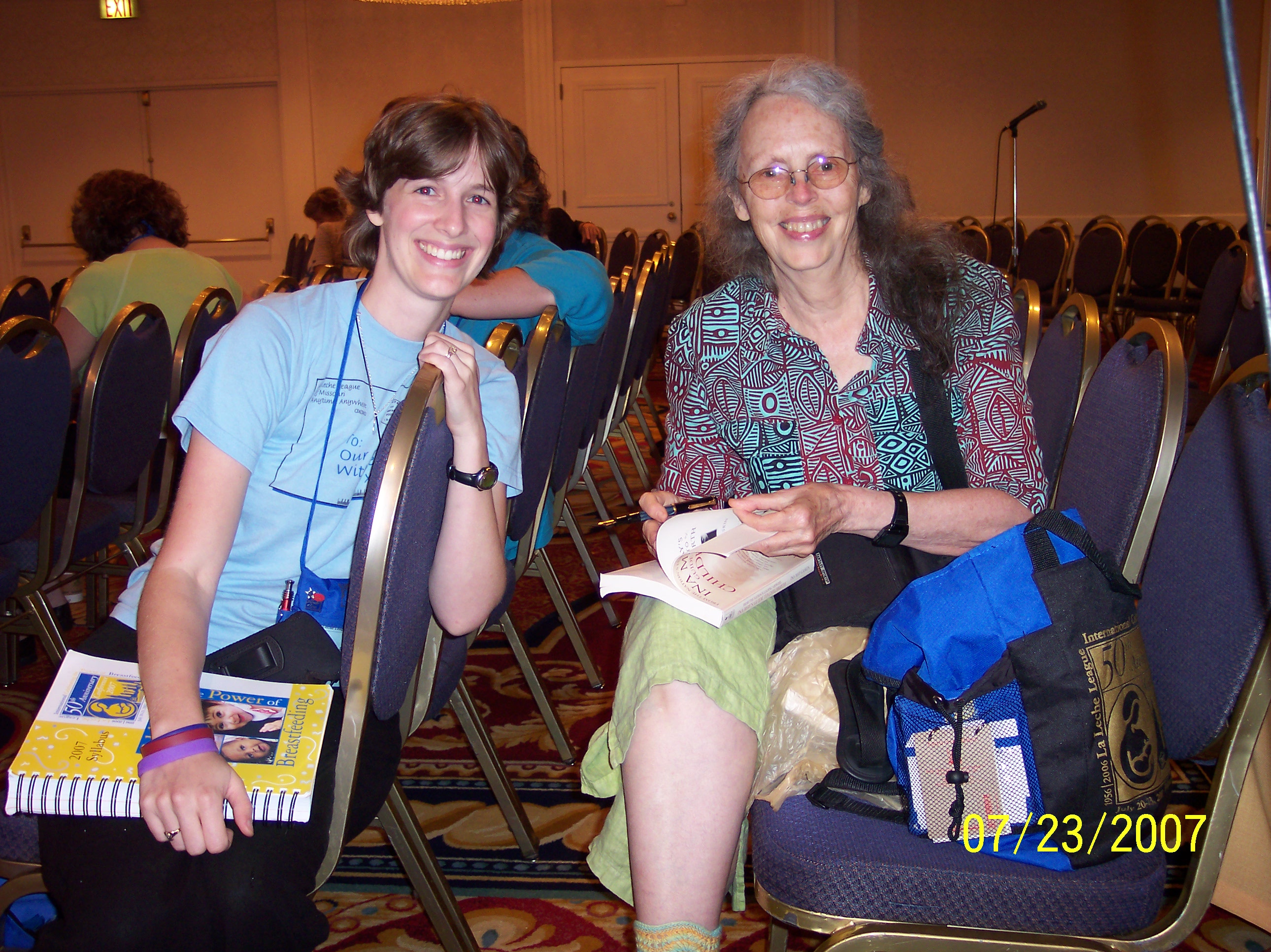
In 2007, I had the opportunity to listen to Ina May speak in person at the La Leche League International conference in Chicago. She talked about sphincter law and made the association with our bodies’ capacity for bowel movements and women’s physical capacity to rebound from childbirth. I will never forget her saying: “I don’t know about you, but my butt closes back up after I poop.” That summed her up for me: plainspoken, real, matter-of-fact, and practical. She’s a legend!

100_0564

Starstruck? Oh, yes I am. My husband said, “these people are like your *celebrities.*”

Disclosure: I received a complimentary screening copy of the film for review purposes.