Archives

Taking it to the body… (part 1)

The following is excerpted from one of my lessons in my recently finished Ecofeminism course.

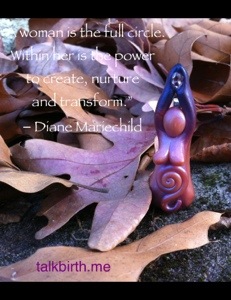
20121203-150406.jpgIn Mara Keller’s essay in the ecofeminist anthology Reweaving the World, she explains that in our cells remember an ancient era of mother-centered life. As I observe in my own children’s relationship to me as their mother, this seems extremely logical to me. Keller writes: “The renewal I long for is a return of a reverence for Mother Earth and her abundant forces of creations; an affirmation of the sacredness of sexuality and enduring human love; and the belief in the inevitability of death and the immortality of the soul” (p. 51). Mother Earth is abundant and fertile and awe-inspiring, she can also be wild and unpredictable and dangerous and is deserving of reverence and respect.

Chellis Glendinning in The Politics of Women’s Spirituality sums up the consequences of patriarchy perfectly:

“When women are faced each day with enforced cesarean deliveries, birth control that maims and kills them, and doctors who think them dirty, when we encounter rape, violence in the streets, job discrimination, sexual slavery around the world, pollution and nuclear madness, we realize that reclaiming the integrative ways of our ancestors must involve our healing powers on all fronts—from the medical to the social to the environmental to the political to the psychological to the spiritual. Healing the divisions that were imposed during the patriarchal era is the survival issue of our time and our planet. A world that systematically sickens its women cannot survive.” [emphasis mine]

Returning to Reweaving the World, in a similar line of thought, Paula Allen states that “a society based on body hate destroys itself and causes harm to all of Grandmother’s grandchildren” (p. 53). I honestly think that many, many children enter the world in an atmosphere of body hate (this can be true regardless of birthing environment). I read an article recently by the famous French obstetrician Michel Odent who explains that the human species may actually be losing the capacity to give birth on its own. Odent sums up the sobering conclusion of current research with this chilling observation: “after just 3 or 4 generations of highly technological childbirth, it seems very possible that our human oxytocin system is weakening. In other words, our capacity to give birth is weakening…” What will it mean for society if our human women can no longer successfully carry and bear new members of the species without significant technological assistance?!

So, planetary healing may actually rest in body respect and love. Allen explains that rejoicing in our bodies is how we show our respect to the planet. We can heal our bodies…”our own dear body, our own dear flesh. For the body is not the dwelling place of the spirit, it is the spirit. It is not a tomb, it is life itself” (p. 56). Allen asks the reader to consider how often we deny the urgings of our bodies. I ask this of women also—how often do you respond to the first cue from your body to use the bathroom? Usually, we resist several times—sometimes even hours—before finally going. If this basic, daily function we each experience multiple times a day is a time in which to deny and ignore our bodies’ messages, how do we expect women to then speak up for themselves in birth? To ask for what they need and to follow the instinctive dance of their birthing bodies? These same questions can be expanded to other areas of our lives as well of course…

Allen also has a refreshing perspective that now is not the time for tranquility. So often in New Age writings and Western-adapted Buddhist and Zen types of thought we see admonishments towards calmness, serenity, peace, and so forth and in the non-attachment and “I create my own reality” and “there is no reality but the present moment.” I appreciate this call for action and for passion, rather than a stilling of the emotions.

And, finally, returning to the body theme, during a recent women’s retreat one of the guests brought us each a card that reads: “Trust yourself. Take it to the body. She always knows.” I loved this and will explain more in part 2

As dear as breathing…

20121126-151448.jpg

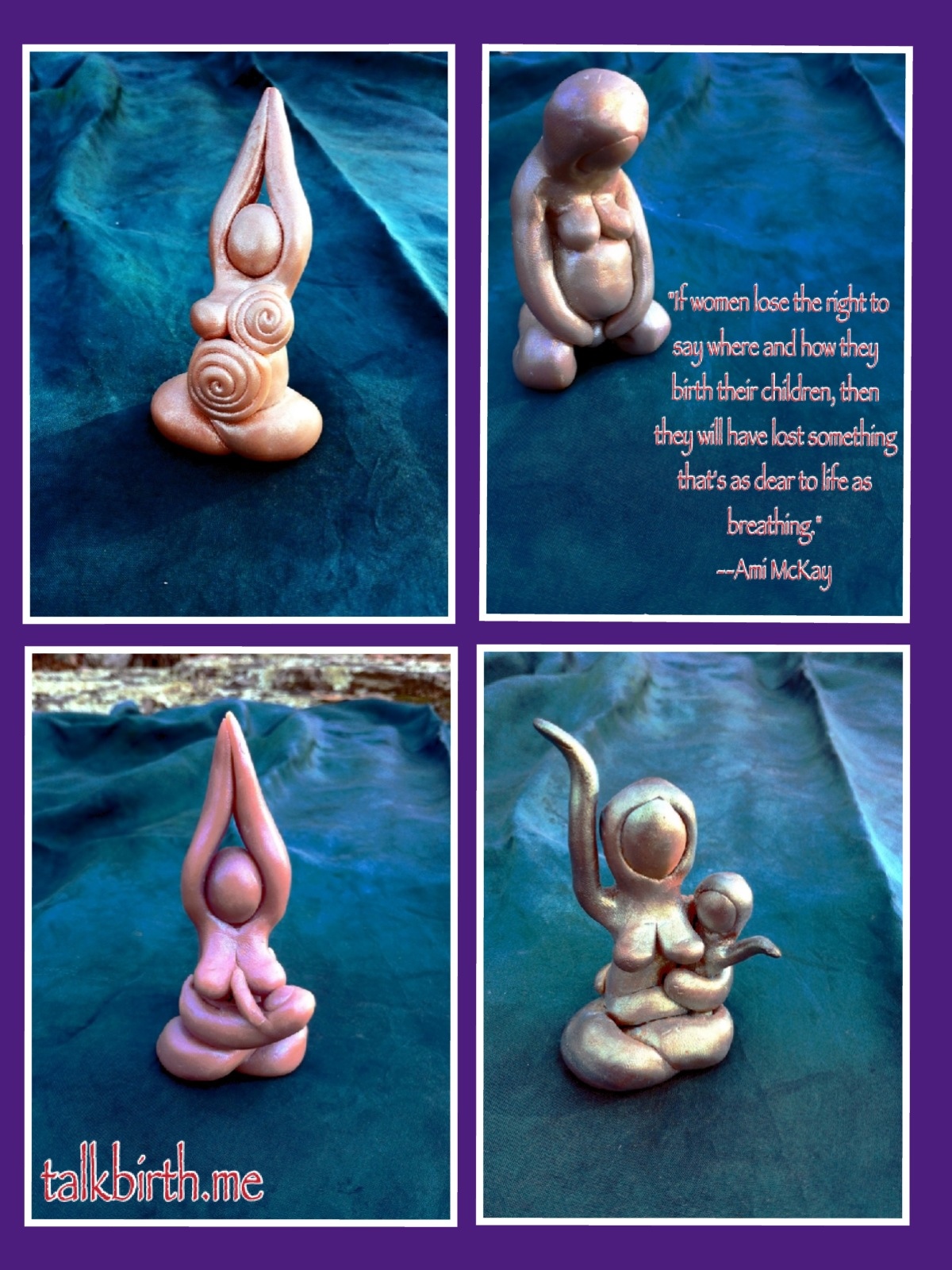
“If women lose the right to say where and how they birth their children, then they will have lost something that is as dear to life as breathing.” –Ami McKay

“Mothers need to know that their care and their choices won’t be compromised by birth politics.” – Jennifer Rosenberg

Birth politics have been on my mind this week as I’ve come across various debates from within the birth profession about the regulation of midwives and the question of licensure, and then also the seemingly ever-present critiques of homebirth from outside the homebirth community. I don’t feel as if I have time lately to fully follow all the issues, but Citizens for Midwifery’s recent response to ACOG’s newest homebirth and maternal rights smackdown contains some important thoughts:

AJOG editorial rejects the ethic that autonomy is a fundamental human right

This article represents a serious attack on home birth and on patient centered care in the United States. The attack is based on poor research and runs roughshod over established rights to bodily integrity…

…not only does the article attack home birth, it also represents an attempt to “export” to the rest of the world a position that the obstetric profession, not mothers, should have the final decision on birth, at a time when that isn’t even legally defensible here in the United States…

…One contradiction stands out as the authors call for “safe, respectful, and compassionate” hospital delivery. No hospital birth can be truly respectful if the birth is happening in the hospital because the physician disrespects the woman’s right to an alternative and has rigged the system to eliminate access to all legal alternatives…

via Citizens for Midwifery

Related thoughts:

Maternal-Fetal Conflict?

The Illusion of Choice

“Woman-to-woman help through the rites of passage that are important in every birth has significance not only for the individuals directly involved, but for the whole community. The task in which the women are engaged is political. It forms the warp and weft of society.” –Sheila Kitzinger

Continuing Birth Education (Free Webinar Round Up)

I have a good friend who has become very interested in training as a doula. I love sharing information and resources with excited women new to the birth work field! It is rejuvenating and reminds me my own enthusiasm for women and birth. When I shared this same sentiment on Facebook a fan commented with this lovely observation: “Birth is an ever-evolving subject, and there are as many different ways to do it as there are fingerprints!! How could anyone get bored in the birth work field?? I love it!! It keeps me in the Presence of Now and reminds me of the Sacredness of Life…” 🙂

Anyway, I’ve been collecting books like crazy to lend to my friend (just a word: never ask me for a book about anything unless you are ready to be overwhelmed with options!) and doing so reminded me of some free webinars that have crossed my desk(top) recently as well as some other, older continuing education resources for birth professionals or aspiring birth professionals. I always go to books first and to written information. Love it. Can’t get enough words! But…many people learn better through other mediums. Here are some non-book, free possibilities for self-education in birth work:

Edited to add another free webinar from ICEA (with paid contact hour option) that I just learned about:

Prenatal Fitness Webinar
 Join us online 
 Thursday, December 13, from 9-10 pm EST for this new educational offering
worth 1.0 ICEA Continuing Education Credit!!
 
This offering is free for all participants to audit.
The continuing education credit may be purchased after viewing the webinar for $35.00 by clicking here!
Once the credit hour is purchased, print out your receipt for confirmation of your hour earned!

A reader also commented to share that she is enrolled in a free Coursera course on contraception (she also took one that looks great about community change in public health!). There are a variety of interesting looking courses available from well-known institutions in the Coursera offerings under Health & Society and Medical Ethics.

And, for those who do well with auditory learning, I have some podcast recommendations that are available on an ongoing basis:

La Leche League International offers a series of free podcasts, my favorites being:

And, the Motherlove blog has some awesome resources too, including:

And, finally there are some great free classes and certificate programs available from Global Health eLearning Center. Many are designed for global audiences and are not specifically geared toward doulas (or even midwives, but more of health workers in general). I particularly enjoyed this class: Healthy Timing and Spacing of Pregnancy

Enjoy! And, if you have favorite recommendations to add, please let me know! (free, please)

Due to reader request, a book recommendation post will soon follow! Past book recommendations can be seen in this post, as well as a postpartum list, and also in my book reviews section.

Strong, Strong…

20121121-212301.jpg

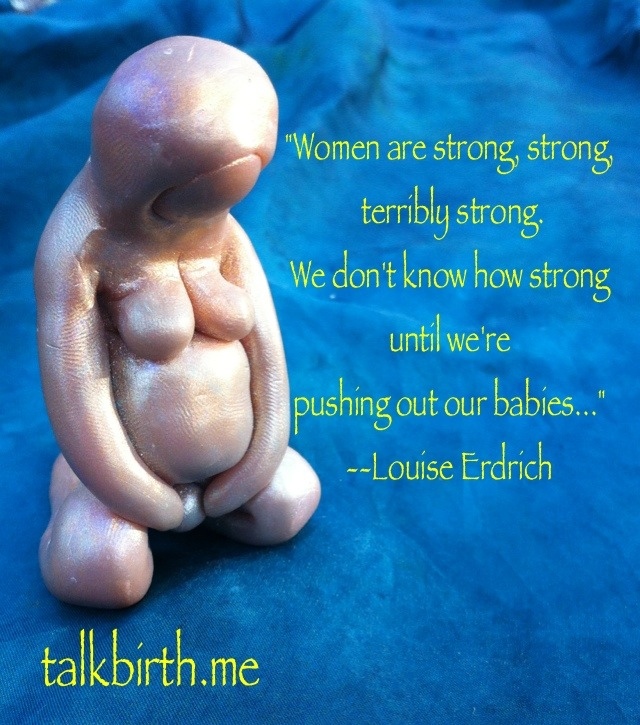
I woke up this morning with this quote running through my head and thinking of a pregnant friend of mine. Since her story is not mine to tell, suffice to say, she had a long and winding road to reach this point and this evening she gave birth at home after having had a cesarean with her first baby! Yay! I’m so excited for her and for their whole family. One part of me just knew she could do it and the other part of me still worried that I was being falsely optimistic. It has happened to me before—that I supported and encouraged and hoped with the mother and despite all those hopes and dreams and wonderful, careful, thoughtful plans, the birth still didn’t go as planned. I also believe that all births are acts of courage and that mothers, whether they push out their babies or not, have the capacity to dig deep and discover strength beyond anything they previously knew. However, just, yay. I’m so happy and excited and relieved for this friend of mine 🙂 The sculpture in the picture is the birth art piece I made after I actually gave birth to my last baby. She captures the pose in which I caught my daughter. My previous photo with this quote was of the pre-birth sculpture I’d made to address my pushing-the-baby-out fears:

Still figuring out the pictures with words app that I got. I love my nature spots in the woods as backgrounds, but they’re too busy and make choosing a text color that actually works almost impossible!

Childbirth is power in its purest and most natural form–it is wild and uncontrollable and takes us on a journey of surrender. Birth is about so much more than babies being born. It is about a mother finding her inner strength at her most vulnerable and powerful moment, which begins her unique and lifelong journey of mothering that child.”

–Brianna Kauer (in Midwifery Today, issue 103)

And, speaking of thankful birthy goodness, Thanksgiving is tomorrow and that reminded me of an earlier post about the rest and be thankful stage!

I also would like to mention that I have a Talk Birth topic on ScoopIt now. I primarily started it so that it could handily feed into my Talk Birth Facebook, while still leaving a more useable record for me to go back to/repost (things just kind of disappear off the page on Facebook and it can be hard to remember what the heck I’ve shared there if I then want to do a blog post about it). I was introduced to ScoopIt via LinkedIn when I started following a really well-curated topic about E-Learning and Online Teaching. There are very, very few birth-related topics on ScoopIt, so start curating one! It is fun and easy and, as I said, really handy for feeding content into your Facebook page or other media (I experimented yesterday with sending a post directly to WordPress and that worked too!)

I’m also thankful for several days at home to spend with my family and without a long to-do list. I have one final paper to grade tonight and then my calendar is pretty deliciously blank for the next four days! We can really use this. I need a stillpoint, a rest, and some time to spend on the fun things I want to do like wallow in piles of books and make fabulous new sculptures and go sit out in the woods and…and…and…

Thankful for all these people too! And, also thankful for fab new pictures from recent photo session with my friend 🙂

The Of COURSE response…

“As long as women are isolated one from the other, not allowed to offer other women the most personal accounts of their lives, they will not be part of any narratives of their own…women will be staving off destiny and not inviting or inventing or controlling it.” –Carolyn Heilbrun quoted in Sacred Circles

I recently finished taking a class in Ecofeminism, which makes connections between the exploitation and domination of women and the exploitation and domination of the planet. Naturally, as I also did with breastfeeding as an ecofeminist issue, I made many connections between the theme of the class and birth rights for women. The author of the book Ecofeminist Philosophy, Elizabeth Warren explains that when you are part of an unhealthy social system, you are likely to experience predictable, even “normal” consequences of living in that system: “This element of predictability explains the appropriateness of what I call the ‘Of course’ response: ‘Of course, you feel crazy when men say it’s your fault that you were raped, or that you could have prevented it.’ ‘Of course, your life has become unmanageable…'” we live in a culture that expects women to do it all and to always love parenting. If we look at our mainstream culture of birth as an unhealthy social system, I find the same response is appropriate. You really wanted to have a natural birth and then your doctor scared you into having an induction and you ended up with an epidural, of course you feel like you ‘failed.’ You feel healthy and beautiful, but now your doctor tells you that you’ve “failed” the GTT and are now “high risk,” of course, you feel stressed out and…like a high risk “patient.” You tried really hard to labor without medications, but you were “strapped down” with IV’s and continuous monitoring, of course, you felt like a trapped animal and like you had no other choices but medications. Of course, you feel upset and discouraged that your baby is ‘rejecting’ you and your breast after having been supplemented with bottles in the nursery. Of course, you are crying all the time and wondering if you are really cut out to be a mother, when your husband had to return to work after two days off and you are expected to be back at your job in five more weeks. And, so on and so forth.

“The ‘Of Course’ response affirms that those who feel crazy, powerless, alone, confused, or frustrated within unhealthy systems such as patriarchy are experiencing just what one would expect of them.” What the model of medical birth as an unhealthy social system reveals is that “no matter where one starts on the circle…one eventually comes round to one’s starting point. The circle operates as an insulated, closed system that, unchecked and unchallenged, continues uninterrupted…” How does one break free of an unhealthy system? “Getting the right beliefs by rearranging one’s thinking is an important part of the process, but it is not enough.” [emphasis mine. Here, Warren goes on to explore the issue of rape, but I have adjusted her words to be about birth instead] One can have the “right beliefs” about the prevalence of unnecessary cesareans, one’s rights as a childbearing woman, and the institutional nature of birth in our country and still experience an unwanted and unnecessary cesarean section. One can understand connections among faulty belief systems, language that devalues women, women’s bodies, and the birth process, and patriarchal behaviors of control and domination and still witness the catastrophic impact of this domination. “So, even if one must start with oneself and one’s belief system, one cannot end there. Since the problem is systemic, the system itself must be intervened upon and changed—by political, economic, social, and other means.” –Karen Warren in Ecofeminist Philosophy, p. 211. (emphasis mine)

Sometimes I honestly feel like I am one of the few people who really notices or labels the powerful systemic context in which women give birth in America. A lot of pregnancy and birth books and pregnancy and birth bloggers focus on individual responsibility and “education.” If women are always expected to “stand up for themselves” in the birth room and “get educated” so that they, personally, can prevent themselves from having unwanted interventions, of course our rates of unwanted interventions continue to rise.

“Through the act of controlling birth, we disassociate ourselves with its raw power. Disassociation makes it easier to identify with our ‘civilized’ nature, deny our ‘savage’ roots and connection with indigenous cultures. Birth simultaneously encompasses the three events that civilized societies fear–birth, death, and sexuality.” –Holly Richards (In Cultural Messages of Childbirth: The Perpetration of Fear,” ICEA Journal, 1993)

20121112-141422.jpg

Call for your experiences – the impact of birth trauma and beyond | Rebecca A. Wright

An online friend and sister birth professional, Rebecca Wright, emailed me recently to share some information about an important new project that she is launching:

I’m planning to write a book on birth trauma that will centre on women’s voices and experiences. It’s not going to be so much dwelling on birth trauma (though there will be an element of that as I want people to understand that whether an experience was ‘objectively’ traumatic or not, it can have an enormous impact – and I think a lot of women say to themselves, ‘my experience wasn’t as bad as some others I hear about’ and so don’t feel able to validate their own feelings and experience). What I really want to focus on is a) the impact of birth trauma (or of ‘difficult’ birth experiences) on mothers, babies, partners, families; b) the many individual paths to healing from birth trauma that people have walked; c) rediscovering your power in birth and motherhood following a difficult or traumatic experience.

She’d like to reach out to mothers, but also their partners, and doulas (midwives, nurses, doctors, etc.) and she’s also interested in hearing from practitioners of whatever sort who work with women and families around these issues.

Full details are available on her blog:

I want this book to be made of women’s voices (and men’s as well). I want it to be a place where the unspoken is spoken clearly and openly. I want it to be a book that honours the sacredness of each birth journey, and each path to healing. I want it to be a book that opens doorways for those who are feeling lost or alone so that they can find hope and a way forward that is suitable for them personally. Most of all, I want it to be a book that shows that it is possible to reclaim your personal power in birth and mothering following a difficult or traumatic experience in birth.

via Call for your experiences – the impact of birth trauma and beyond | Rebecca A. Wright.

Make sure to check out her project and see if you can lend your voice to what sounds like a beautifully healing book!

And, speaking of birth trauma, a while ago, I also received a question via Facebook asking for recommended resources for healing from traumatic birth. Check out the series on Giving Birth with Confidence about traumatic birth prevention and recovery. Or, look into Solace for Mothers.

Jewelry Memory

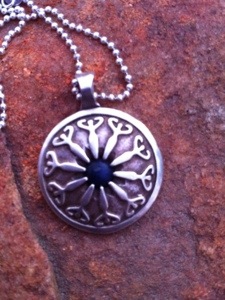
Those of you who know me in real life may know that I really like jewelry. You may or may not also know that I often use jewelry to mark significant moments in my life, to communicate certain messages, and to remind myself of things or serve as touchstones. For the last couple of days, I made sure to put on three significant necklaces and the order of the necklaces told a story. The first was my baby-in-my-heart pendant. Unfortunately no longer available for sale anywhere, I very much connected to this pendant and bought it as a connection to the baby in my own heart. I used to even sleep and shower wearing it and wore it continuously until midway through my pregnancy-after-loss in which I then felt like putting it away. Now, I wear it on certain meaningful occasions like on Noah’s birthday or on holidays.

20121107-222337.jpg

The second is a pendant I bought right after my second miscarriage. It is a small medallion style piece with the words, “believe in yourself” on the back. I wore it throughout my pregnancy with Alaina, including in labor. Now, I wear it when I need encouragement, courage, or strength. I have a tradition of wearing it to the first night of every class I teach. It serves as a reminder for me and helps me feel strong.

20121107-222343.jpg20121107-222350.jpg

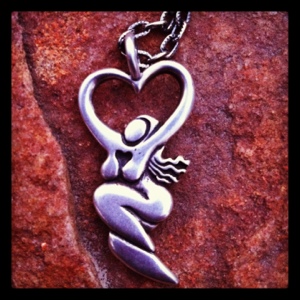
The third pendant is the dancing goddess logo from SageWoman magazine. My husband gave it to me after Alaina was born in 2011. It reminds me of my Happy Birth Dance feelings of relief and joy at her birth. I still wear this one almost every day.

20121107-222736.jpg

Together, obviously, the three in a row tell a story of loss, hope, and joy.

20121106-223159.jpg

Lann took this picture of me a couple of days ago on Nov. 6, the third anniversary of the day we found out the baby had died and I was going to have a miscarriage.

[Side note: Jewelry is significant enough to me that there are still birthy necklaces I haven’t worn since my miscarriages because they represent a happy point of pre-loss naïvety to me and I now feel uncomfortable wearing them. I put many of my very favorite necklaces away after Noah was born, because I couldn’t even stand to look at them and be confronted with the joy they had previously represented, and even though I am no longer in that dark and distressed place, I still don’t enjoy wearing them. Their association for me has permanently changed.]

20121107-222428.jpg

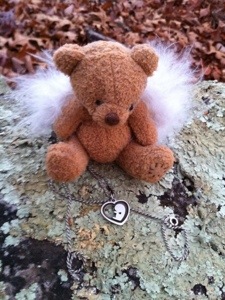
Noah’s angel bear and my necklace on the priestess rocks yesterday afternoon.

Do you have jewelry that is especially significant to you? Do you wear it when you need to tell the world something or remind yourself of an important moment or experience? I’d love to see a picture of it!

I also felt inspired to quickly make a new birth art figure—this one incorporating the “baby in my heart” image that I found so valuable. And, it also connects to the persistent feeling I had for months after he was born (until I reached his due date really) that I was going to be, “a little bit pregnant” with him forever.

20121107-224515.jpg

Miscarriage and Birth

Last month a fellow birth professional asked a question about whether it was possible to have postpartum depression after miscarriage. My response was as follows:

I think it is crucial to remember that miscarriage is a birth event—sometimes a very, very, very early birth event, but reproductively speaking that is what it is! Since we don’t have a better vocabulary for pregnancy loss in our culture, socioculturally speaking we tend to class it as “something else,” but in most ways it isn’t. A soul (or fertilized egg) touches down in a woman’s womb. Her hormones and all other physiological systems are impacted and feel its presence. The embryo/fetus/baby stays for a time and when it leaves her body, the uterus must contract and the cervix must open and the woman’s body must open to allow its passage. Her body, mind, emotions, and spirit are all affected (to varying degrees). In this way, miscarriage and full-term birth simply exist on a continuum of possible birth outcomes and are all birth events whether the pregnancy lasts five weeks or forty-two weeks.

Miscarriage as a birth event is one of my “pet” subtopics within the wide range of reading about miscarriage and quotes that respect the birth-miscarriage relationship always catch my attention. After the birth-miscarriage of my own third baby three years ago today, I found the following quote in a back issue of Midwifery Today:

“Miscarriages are labor, miscarriages are birth. To consider them less dishonors the woman whose womb has held life, however briefly.” –Kathryn Miller Ridiman

It meant so much to me and I returned to it again and again. I believe I was also responsible for introducing the quote to the internet, because since I first typed it up, I’ve now seen it floating around on many other websites and blog posts. And, in a full circle moment, my own miscarriage-birth story was published in Midwifery Today in 2011. I also latched on to a quote from the book Wild Feminine saying, “though it is not always recognized as such, miscarriage is a birth event.”
20121107-013453.jpgChristine Moulder in the book Miscarriage: Women’s Experiences and Needs quoted another mother: “Although I had a miscarriage technically, I don’t feel this. I went through labour. It was incredibly painful but my husband was with me and it was almost a happy occasion.” I agree, with my own birth experience feeling just as “legitimate” as either of my prior labors or my subsequent birth. I And, actually even more so in that Noah’s birth became possibly the most defining moment of my womanhood. I would also describe it as a spiritual experience or “awakening” of sorts in a way that has profoundly influenced me, shaping my future work with women and my life goals. I return to this experience again and again and continue to draw both strength and insight from it.

Returning to Moulder’s book, later in that section, the author says:

With the exception of women who have a late missed [miscarriage] there will be a baby that has to be born. The baby may or may not have died prior to the miscarriage. As with full-term birth, the waters must break, there will be pains and contractions and the cervix must dilate for the baby to leave the womb. Of course the baby will be smaller, in some cases much smaller, but it is essentially the same process and this comes as a great shock to many women.”

And this is absolutely true, but also not something that is mentioned in very many miscarriage books. This shock of experiencing miscarriage so clearly as a labor and birth rather than as “something else” is what led me to describe my wish for miscarriage doulas on my now-complete miscarriage blog:

On a pregnancy loss message board that I read, a mother posted asking if she was the only one who experience her miscarriage as painful (because no one mentioned it being painful in the stories she had read and she was very shocked by the pain involved). I had a couple of thoughts in response to this question. I also shared my “favorite” miscarriage-birth quote: “Miscarriages are labor, miscarriages are birth. To consider them less dishonors the woman whose womb has held life, however briefly.” (Kathryn Miller Ridiman).

I do think the amount of physical pain probably depends in part on where you are in the pregnancy. Since a lot of women experience very early miscarriages (less than 6 weeks), I think that is perhaps why you don’t hear them talk as much about pain because the baby is still so small. OR, because a lot of women end up having D & C’s and thus do not go through the “natural miscarriage” experience, perhaps that is why pain doesn’t figure heavily into narrative. Or, maybe because there is so much emotional pain involved as well, the physical pain gets overshadowed? That said, my 6-week miscarriage was not physically painful at all (not that it couldn’t be for some women, of course). However, my miscarriage at nearly 15 weeks was indistinguishable from a full-term labor. It was just the same, except with the addition of MASSIVE blood clots following the baby. I value his birth as another birth experience in my life, but at the same time I am SHOCKED that miscarriage is so often overlooked as a birth event that requires tenderness and support (where are the miscarriage doulas and midwives?! While in a way, I feel proud of myself for have an “unassisted” birth-miscarriage, I could have used the care of a knowledgeable, caring woman rather than to just be left on my own trying to gauge how much blood loss is normal, etc.)

So, what about “miscarriage doulas” as an idea? I have seriously thought about becoming one. I am trained as a birth doula, but have no interest in actually working as one, but being a m/c doula does interest me a lot. I feel like adding a section to my business website (I’m a childbirth educator) that says, “having a miscarriage? Call me and I’ll come over and rub your back and bring you things to drink…”

I decided two things shortly after my first miscarriage: one, that I was going to write a book specifically about how to deal (i.e. “what to expect when you’re having a miscarriage”), because I felt very betrayed by having this huge wealth of pregnancy, birth, and midwifery books all around me and NONE of them had the information I was looking; And, two, that if anyone was ever to tell me she was in the process of miscarrying I would go to her right away (unfortunately, it seems like people feel like they have to tough it out alone or don’t want to “bother” anyone and so only tell after the fact). Well, if she wanted me to go, obviously, not against her will. And, that would include going to the hospital with her if she needed a m/c doula there, not just for “home miscarriage.” –Originally posted as Miscarriage Doulas…on June 29, 2010

This interest and post led to the co-founding of the organization The Amethyst Network, originally intended to train the miscarriage doulas I’d longed for during my own experiences. TAN took some time getting off the ground and in the meantime the thoroughly amazing organization Stillbirthday independently arose in vibrant support of women and is now skillfully fulfilling the mission of training loss doulas.

Thankfully, I had already read a long message board thread about, “what exactly do you see with a miscarriage” long before I ever had a miscarriage experience of my own, so I did know to expect mine to be somewhat “like labor” and not to be a “heavy period” (OMG, I wanted to scream when I saw miscarriages described like that in books over, and over, and over again! Though, then when I had my second miscarriage and it WAS, in fact, like the mythical “heavy period,” and so then I understood a little better why that was a prevalent descriptor.)

On Pregnancy and Infant Loss Remembrance Day this October I was out-of-town, but I shared past blog musings on jagged peace, acknowledging that the legacy of miscarriage is profound. I also linked to a friend’s story: Mormon Monkey Mama: A Few Thoughts on Miscarriage and to my own birth-miscarriage story: Noah’s Birth Story (Warning: Miscarriage/Baby Loss).

And, I updated my Facebook status with the following:

Today is Pregnancy and Infant Loss Remembrance Day. Babyloss is part of the spectrum of the childbearing year, and miscarriage is one type of birth experience that a large number of women experience. I appreciate the opportunity to recognize this, rather than to keep a lid on our “negative” stories of grief, loss, and a multitude of complicated emotions. Today I think of my own lost baby N and also my lost babystart. I also think of all the women who do not conceive and birth the rainbow babies they so long for. I also think of a friend whose baby died last month. And, I think about and appreciate my friend/doula from Peaceful Beginnings Doula Services who helped me so much to heal from loss and who has her own babystart to remember today as well.

There are many helpful babyloss organizations and one that was particularly helpful to me was Angel Whispers in Canada. They mailed me a birth certificate for my baby (with an official looking gold seal). It meant a lot to me because it acknowledged that he had lived and was born. It hangs in our hallway and it is amazing to me how meaningful a simple, small act of kindness from strangers can be.

Today we recognize the third anniversary of the birth-miscarriage of our little son Noah. I post not for “sympathy” or condolences, but because memories are important, and because even though he only stayed with us for a couple of months, he shaped our lives and in a very real sense is responsible for the life of Alaina. 20121107-013748.jpgI share because his birth and the long, slow journey of grief was a pivotal, transformative point in my life as a mother/woman and because he helped change my destiny. And, I share because there are SO many loss mamas out there with stories of their own to tell and I hold them all in my heart and wish them all the love, caring, and wisdom that I was lucky enough to receive, both three years ago and ongoing today! ♥

There is a sacredness in tears. They are messengers of overwhelming grief…and unspeakable love.” –Washington Irving

“Remember our heritage is our power; we can know ourselves and our capacities by seeing that other women have been strong.” – Judy Chicago

“Change, when it comes, cracks everything open.” ~Dorothy Allison

“She’s turning her life into something sacred: Each breath a new birth. Each moment, a new chance. She bows her head, gathers her dreams from a pure, deep stream and stretches her arms toward the sky.” –from a journal cover

—-
Related posts:

My memories of this time in 2011: Sand Tray Therapy
From 2010: Pregnancy Update
And memories of the anniversary of the second worst day of my life
And, some past thoughts about Honoring Miscarriage

Eleven Years Ago…

In 2000, while working on my block field placement (internship) in graduate school, I met a woman who would become my best friend and a profoundly influential part of my life. We shared a lot of formative life experiences of early adulthood together and I accompanied her to the hospital for the births of two of her children and she came to the birth center with me when my oldest son was born. While my own mother had all four of her children at home and so homebirth and natural birth were parts of my life history, I didn’t really begin to focus on birth as an issue until I was married and in my early 20’s. At this point, I was most influenced by the newsgroup misc.kids.pregnancy. So, I became both deeply interested in natural birth and also very invested in my friend’s birth plans and her ideas about birth. As her pregnancy progressed, she hired a doula that I came across at a street fair and took birth classes from her at the birth center in which I would later have my first baby.

After Maggie was born, I was more involved in her life than I have ever been involved with a baby that was not related to me and in a way that I’ve never been able to be involved again. Without any children of my own at the time, I was able to be present for my friend in a way in which I now see, few friends are able to be for each other, since most women who connect during their childbearing years are intensely embroiled in the needs of their own children and families. Looking back, I see I was like the best postpartum doula ever, without knowing that is what I was being at the time (and, I was free, and did it for a year! :)) After bringing over dinner every night for the first week, for the following year I then I went over to my friend’s house every morning and took care of the baby while my friend ate her breakfast, took care of herself, and went for a run. Then, we would walk in the neighborhood together for about an hour, talking about our lives, dreams, and plans.

Last year, that magical baby that had such a profound influence on my life and on my birthwork in the world turned TEN! I could hardly believe it. At that time, I asked my friend for permission to post the birth story I had written in my journal the morning after her baby’s birth. My friend granted me permission, but then several days passed and since it wasn’t the baby’s birthday any more, the story sat in my drafts folder for…another year. And, now, that magical, wonderful baby is ELEVEN! Here is her birth story, through my naïve, pre-maternal eyes…

Maggie’s Birth

With my little friend, 2002

Journal Entry, 11/3/01. 12:22 p.m.

Returned home this morning at 7:15 after being at the birth of Kate & Dave’s baby girl, Maggie. I’m very tired, but I wanted to write a little bit anyway. We went to the hospital at 1:30 p.m. on Friday (11/2) after Kate’s water broke. She was still 2 centimeters at 9:00 p.m., so they started pitocin. At 12:00 a.m. the doulas arrived and Kate was 3-4 centimeters dilated. The doulas were absolutely wonderful at soothing and guiding her. At 1:15 a.m. she was 7 centimeters (!) and at a tiny bit after 2:00 a.m. she began pushing. Then, she pushed for almost four hours before Maggie was born at 5:51 a.m. (8lbs 10z).

It was really hard to watch and not be able to do anything for her. I can’t imagine what it would have felt like as her husband—someone that close in. She did a wonderful, wonderful job. No pain medication at all, even with the pitocin. She only asked about pain meds once (before the doulas got there). I felt completely in awe of her strength and power. She was so brave and so strong and so tough. Powerful woman stuff. I couldn’t believe that she pushed for four hours. I do not think I could have done it. The baby was worth it though—boy is she cute and pink and making me want to have one too!

I can’t really describe what this experience meant to me or how powerful it was. It was beautiful and strong. Kate is an amazing woman and I am awed by her bravery. She and Dave are so happy with their precious little bundle. I got to hold her too, when she was less than 30 minutes old and Kate was being stitched up (bad tear). I didn’t feel like much help to Kate, but being present mean a lot to me and I hope the fact that I was there meant something to her too. I’m so encouraged to see that a hospital birth can be pulled off so well.

Life is wonderful. Welcome, baby girl!

Happy Birth-Day to you both today, Maggie and Kate! You hold a deep and special place in my heart. You both changed my life forever.

The Birthing Dance

I saw this post go by on Facebook during the week and saved it to share, because it would make a nice mother blessing poem to share with a pregnant mama:

The Birthing Dance

Come to me, My Child
Secret longing of my inner heart
Breath of spirit
Wandering the cosmos

Choosing your next lifepath
Seeking sanctuary in my womb
Visions of you stir my dreams
Your gentle essence drifting inward
Merging into matter
Coming into consciousness
Birthing into being
Your tender wisdom speaks
The ancient knowledge
of a mother’s power
Our bodies grow together
Two as one
Turning round, in birthing dance
You lead me
Opening the circle corridor
Descending into unhindered ecstasy
Into my arms